Q221.First and second ionization enthalpies of lithium are 520 kJ mol−1 and 7297 kJ mol−1 respectively. Energy required to convert 3.5 mg lithium (g) into Li2+(g) [Li(g) → Li2+(g)] is _______ kJ mol−1. (nearest integer)
[Molar mass of Li = 7 g mol−1]
लीथियम की प्रथम तथा द्वितीय आयनन एन्थैल्पी क्रमशः 520 kJ mol−1 तथा 7297 kJ mol−1 हैं। 3.5 mg लीथियम (g) को Li2+(g) [Li(g) → Li2+(g)] में परिवर्तित करने के लिए आवश्यक ऊर्जा _______ kJ mol−1 है। (निकटतम पूर्णांक)
[Li का मोलर द्रव्यमान = 7 g mol−1]
Show answer
Concept: Energy for Li(g) → Li2+(g) = (IE1 + IE2) × moles of Li.
- Moles of Li = mol.
- IE1 + IE2 = 520 + 7297 = 7817 kJ mol−1.
- Energy = kJ ≈ 4 kJ (the blank asks for the energy for 3.5 mg; the unit printed with the blank is kJ mol−1, but the quantity is the total energy in kJ).
Short trick: 3.5 mg Li = 1/2000 mol → 7817/2000 ≈ 3.9.
Answer: 4
अवधारणा: Li(g) → Li2+(g) के लिए ऊर्जा = (IE1 + IE2) × Li के मोल।
- Li के मोल = मोल।
- IE1 + IE2 = 520 + 7297 = 7817 kJ mol−1।
- ऊर्जा = kJ ≈ 4 kJ (रिक्त स्थान 3.5 mg के लिए ऊर्जा पूछता है; रिक्त स्थान के साथ मुद्रित इकाई kJ mol−1 है, परन्तु राशि kJ में कुल ऊर्जा है)।
शॉर्ट ट्रिक: 3.5 mg Li = 1/2000 मोल → 7817/2000 ≈ 3.9।
उत्तर: 4
JEE Main 2026 (April) – Paper 1 (B.E./B.Tech)ChemistryClassification of Elements – ionization enthalpyJEE Main 2026 (April) – Paper 1 (B.E./B.Tech) 2026 · 6 Apr Shift 1
Q222.Consider the following sequence of reactions.
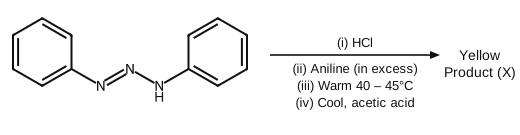
The percentage of nitrogen in the yellow product (X) formed is _______%. (Nearest Integer)
(Given Molar mass in g mol−1 H:1, C:12, N:14)
अभिक्रियाओं के निम्नलिखित अनुक्रम पर विचार कीजिए।
बने पीले उत्पाद (X) में नाइट्रोजन का प्रतिशत _______% है। (निकटतम पूर्णांक)
(दिया है मोलर द्रव्यमान g mol−1 में H:1, C:12, N:14)
Show answer
Concept: Diazoaminobenzene rearranges in acid (with excess aniline as solvent, 40–45 °C) to p-aminoazobenzene, a yellow dye.
- C6H5–N=N–NH–C6H5 + HCl → C6H5N2+ + C6H5NH2; the diazonium ion couples at the para-position of aniline → X = p-H2N–C6H4–N=N–C6H5 (yellow).
- Formula C12H11N3: M = 12×12 + 11×1 + 3×14 = 197 g mol−1.
- %N = ≈ 21.
Short trick: Rearrangement keeps the formula of the starting compound (C12H11N3), so %N is the same as in diazoaminobenzene.
Answer: 21
अवधारणा: डाइऐज़ोऐमीनोबेन्ज़ीन अम्ल में (विलायक के रूप में आधिक्य ऐनिलीन, 40–45 °C) पुनर्विन्यस्त होकर p-ऐमीनोऐज़ोबेन्ज़ीन बनाता है, जो एक पीला रंजक है।
- C6H5–N=N–NH–C6H5 + HCl → C6H5N2+ + C6H5NH2; डाइऐज़ोनियम आयन ऐनिलीन की पैरा-स्थिति पर युग्मित होता है → X = p-H2N–C6H4–N=N–C6H5 (पीला)।
- सूत्र C12H11N3: M = 12×12 + 11×1 + 3×14 = 197 g mol−1।
- %N = ≈ 21।
शॉर्ट ट्रिक: पुनर्विन्यास में प्रारंभिक यौगिक का सूत्र (C12H11N3) अपरिवर्तित रहता है, अतः %N डाइऐज़ोऐमीनोबेन्ज़ीन के समान है।
उत्तर: 21
JEE Main 2026 (April) – Paper 1 (B.E./B.Tech)ChemistryAmines – diazoamino rearrangementJEE Main 2026 (April) – Paper 1 (B.E./B.Tech) 2026 · 6 Apr Shift 1
Q223.4.7 g of phenol is heated with Zn to give product X. If this reaction goes to 60% completion then the number of moles of compound X formed will be ____ ×10−2. (Nearest Integer)
(Given molar mass in g mol−1 : H:1, C:12, O:16)
4.7 g फीनॉल को Zn के साथ गर्म करने पर उत्पाद X प्राप्त होता है। यदि यह अभिक्रिया 60% पूर्ण होती है, तो बने यौगिक X के मोलों की संख्या ____ ×10−2 होगी। (निकटतम पूर्णांक)
(दिया है मोलर द्रव्यमान g mol−1 में : H:1, C:12, O:16)
Show answer
Concept: Phenol is reduced to benzene on heating with zinc dust: C6H5OH + Zn → C6H6 + ZnO (1 : 1).
- Molar mass of phenol C6H6O = 72 + 6 + 16 = 94 g mol−1; moles = mol.
- At 60% completion, moles of benzene (X) = 0.05 × 0.6 = 0.03 mol = 3 × 10⁻² mol.
Short trick: 4.7/94 = 1/20; × 0.6 = 0.03.
Answer: 3
अवधारणा: ज़िंक चूर्ण के साथ गर्म करने पर फीनॉल बेन्ज़ीन में अपचयित होता है: C6H5OH + Zn → C6H6 + ZnO (1 : 1)।
- फीनॉल C6H6O का मोलर द्रव्यमान = 72 + 6 + 16 = 94 g mol−1; मोल = मोल।
- 60% पूर्णता पर, बेन्ज़ीन (X) के मोल = 0.05 × 0.6 = 0.03 मोल = 3 × 10⁻² मोल।
शॉर्ट ट्रिक: 4.7/94 = 1/20; × 0.6 = 0.03।
उत्तर: 3
JEE Main 2026 (April) – Paper 1 (B.E./B.Tech)ChemistryPhenols – reduction with zinc dustJEE Main 2026 (April) – Paper 1 (B.E./B.Tech) 2026 · 6 Apr Shift 1
Q224.Sucrose hydrolyses in acidic medium into glucose and fructose by first order rate law with t1/2 = 3 hour. The percentage of sucrose remaining after 6 hours is _____. (Nearest integer)
(Given : log 2 = 0.3010 and log 3 = 0.4771)
सुक्रोस अम्लीय माध्यम में प्रथम कोटि दर नियम द्वारा ग्लूकोस तथा फ्रक्टोस में जल-अपघटित होता है, जिसकी t1/2 = 3 घंटे है। 6 घंटे के बाद शेष सुक्रोस का प्रतिशत _____ है। (निकटतम पूर्णांक)
(दिया है : log 2 = 0.3010 तथा log 3 = 0.4771)
Show answer
Concept: For first-order kinetics, fraction remaining after n half-lives = (1/2)n.
- n = half-lives.
- Fraction remaining = → 25%.
- Check: h−1; → [A]/[A]0 = 0.25.
Short trick: Two half-lives: 100 → 50 → 25.
Answer: 25
अवधारणा: प्रथम कोटि बलगतिकी में, n अर्धायुओं के बाद शेष भाग = (1/2)n।
- n = अर्धायु।
- शेष भाग = → 25%।
- जाँच: h−1; → [A]/[A]0 = 0.25।
शॉर्ट ट्रिक: दो अर्धायु: 100 → 50 → 25।
उत्तर: 25
JEE Main 2026 (April) – Paper 1 (B.E./B.Tech)ChemistryChemical Kinetics – first-order half-lifeJEE Main 2026 (April) – Paper 1 (B.E./B.Tech) 2026 · 6 Apr Shift 1
Q225.Consider the reaction X ⇌ Y at 300 K. If ΔHθ and K are 28.40 kJ mol−1 and 1.8 × 10⁻⁷ at the same temperature, then the magnitude of ΔSθ for the reaction in J K−1 mol−1 is________. (Nearest integer)
(Given : R = 8.3 J K−1 mol−1, ln 10 = 2.3, log 3 = 0.48, log 2 = 0.30)
300 K पर अभिक्रिया X ⇌ Y पर विचार कीजिए। यदि उसी ताप पर ΔHθ तथा K क्रमशः 28.40 kJ mol−1 तथा 1.8 × 10⁻⁷ हैं, तो अभिक्रिया के लिए ΔSθ का परिमाण J K−1 mol−1 में ________ है। (निकटतम पूर्णांक)
(दिया है : R = 8.3 J K−1 mol−1, ln 10 = 2.3, log 3 = 0.48, log 2 = 0.30)
Show answer
Concept: ΔG° = −RT ln K = −2.3RT log K and ΔG° = ΔH° − TΔS°.
- log(1.8 × 10⁻⁷) = log 2 + 2 log 3 − 8 = 0.30 + 0.96 − 8 = −6.74.
- ΔG° = −8.3 × 300 × 2.3 × (−6.74) = +38 600 J mol−1 = 38.60 kJ mol−1.
- ΔS° = J K−1 mol−1.
- Magnitude = 34.
Short trick: 2.3RT = 5727 J; × 6.74 ≈ 38.6 kJ; (28.4 − 38.6) kJ / 300 K = −34 J K−1.
Answer: 34
अवधारणा: ΔG° = −RT ln K = −2.3RT log K तथा ΔG° = ΔH° − TΔS°।
- log(1.8 × 10⁻⁷) = log 2 + 2 log 3 − 8 = 0.30 + 0.96 − 8 = −6.74।
- ΔG° = −8.3 × 300 × 2.3 × (−6.74) = +38 600 J mol−1 = 38.60 kJ mol−1।
- ΔS° = J K−1 mol−1।
- परिमाण = 34।
शॉर्ट ट्रिक: 2.3RT = 5727 J; × 6.74 ≈ 38.6 kJ; (28.4 − 38.6) kJ / 300 K = −34 J K−1।
उत्तर: 34
JEE Main 2026 (April) – Paper 1 (B.E./B.Tech)ChemistryThermodynamics – ΔG°, K and ΔS°JEE Main 2026 (April) – Paper 1 (B.E./B.Tech) 2026 · 6 Apr Shift 1
Q226.Let be the roots of the equation and be the roots the equation ; . If are in G.P., then equals :
माना समीकरण के मूल हैं तथा समीकरण के मूल हैं; । यदि गुणोत्तर श्रेढ़ी (G.P.) में हैं, तो बराबर है :
- A
- B
- C
- D
Show answer
Concept: Write the four roots as and use sum and product of roots of each quadratic.
- and . Dividing, , so .
- : , – rejected.
- : . Roots: .
- , , so .
Short trick: Ratio of the sums ; only gives integer : roots .
Answer: (C)
अवधारणा: चारों मूलों को लिखिए तथा प्रत्येक द्विघात के मूलों के योग व गुणनफल का प्रयोग कीजिए।
- तथा । भाग देने पर , अतः ।
- : , – अस्वीकार्य।
- : । मूल: ।
- , , अतः ।
शॉर्ट ट्रिक: योगों का अनुपात ; केवल से पूर्णांक मिलता है: मूल ।
उत्तर: (C)
JEE Main 2026 (April) – Paper 1 (B.E./B.Tech)MathematicsQuadratic equations – roots in G.P.JEE Main 2026 (April) – Paper 1 (B.E./B.Tech) 2026 · 5 Apr Shift 2
Q227.Let be the distinct solutions of the equation . Then is equal to :
माना समीकरण के भिन्न हल हैं। तब बराबर है :
- A
- B
- C
- D
Show answer
Concept: Complete the square and take the square root of a complex number.
- .
- since .
- : , .
- .
Short trick: .
Answer: (D)
अवधारणा: पूर्ण वर्ग बनाइए तथा सम्मिश्र संख्या का वर्गमूल ज्ञात कीजिए।
- ।
- , क्योंकि ।
- : , ।
- ।
शॉर्ट ट्रिक: ।
उत्तर: (D)
JEE Main 2026 (April) – Paper 1 (B.E./B.Tech)MathematicsComplex numbers – quadratic with complex coefficientsJEE Main 2026 (April) – Paper 1 (B.E./B.Tech) 2026 · 5 Apr Shift 2
Q228.If is defined by $\sum\limits_{n=1}^{k} f(n)=98k$ is equal to :
यदि इस प्रकार परिभाषित है कि $\sum\limits_{n=1}^{k} f(n)=98k$ बराबर है :
- A
- B
- C
- D
Show answer
Concept: Only the first column depends on , so is the same determinant with replaced by the column of sums.
- , , .
- .
- Taking out of and expanding, the determinant simplifies to .
- , so .
Short trick: ; gives directly.
Answer: (A)
अवधारणा: केवल प्रथम स्तंभ पर निर्भर है, अतः वही सारणिक है जिसमें को योगों के स्तंभ से बदल दिया गया हो।
- , , ।
- ।
- से बाहर निकालकर प्रसार करने पर सारणिक हो जाता है।
- , अतः ।
शॉर्ट ट्रिक: ; से सीधे ।
उत्तर: (A)
JEE Main 2026 (April) – Paper 1 (B.E./B.Tech)MathematicsDeterminants – summation of determinantJEE Main 2026 (April) – Paper 1 (B.E./B.Tech) 2026 · 5 Apr Shift 2
Q229.Let be a matrix such that $M\begin{pmatrix}x\\y\\z\end{pmatrix}=\begin{pmatrix}1\\7\\11\end{pmatrix}x+y+z$ equals :
माना एक आव्यूह है जिसके लिए $M\begin{pmatrix}x\\y\\z\end{pmatrix}=\begin{pmatrix}1\\7\\11\end{pmatrix}x+y+z$ बराबर है :
- A
- B
- C
- D
Show answer
Concept: are the columns of .
- .
- Equations: , , .
- Subtract the 2nd from the 3rd: . With : .
- , , so .
Short trick: Check: ✓.
Answer: (B)
अवधारणा: ही आव्यूह के स्तंभ हैं।
- ।
- समीकरण: , , ।
- तीसरे में से दूसरा घटाने पर । रखने पर: ।
- , , अतः ।
शॉर्ट ट्रिक: जाँच: ✓।
उत्तर: (B)
JEE Main 2026 (April) – Paper 1 (B.E./B.Tech)MathematicsMatrices – matrix from column images, linear systemJEE Main 2026 (April) – Paper 1 (B.E./B.Tech) 2026 · 5 Apr Shift 2
Q230.If the sum of the first 10 terms of the series is , , then is equal to :
यदि श्रेणी के प्रथम 10 पदों का योग है, , तो बराबर है :
- A
- B
- C
- D
Show answer
Concept: (Sophie Germain), and the difference of the factors is .
- .
- Since , the sum telescopes.
- .
- (), so .
Short trick: ; : .
Answer: (C)
अवधारणा: (सोफी जर्मेन सर्वसमिका), तथा गुणनखंडों का अंतर है।
- ।
- चूँकि , योग दूरदर्शी (टेलीस्कोपिक) है।
- ।
- (), अतः ।
शॉर्ट ट्रिक: ; : ।
उत्तर: (C)
JEE Main 2026 (April) – Paper 1 (B.E./B.Tech)MathematicsSequences and series – telescoping sumJEE Main 2026 (April) – Paper 1 (B.E./B.Tech) 2026 · 5 Apr Shift 2
Q231.Let be 39 arithmetic means between the numbers 59 and 159. Then the mean of and is equal to :
माना संख्याओं 59 तथा 159 के बीच 39 समांतर माध्य हैं। तब तथा का माध्य बराबर है :
- A
- B
- C
- D
Show answer
Concept: Inserting A.M.s between and gives common difference and .
- , so .
- Mean of .
- .
Short trick: Mean of A.P. terms = term at the mean index: .
Answer: (D)
अवधारणा: तथा के बीच समांतर माध्य रखने पर सार्व अंतर तथा होता है।
- , अतः ।
- का माध्य ।
- ।
शॉर्ट ट्रिक: समांतर श्रेढ़ी के पदों का माध्य = माध्य सूचकांक वाला पद: ।
उत्तर: (D)
JEE Main 2026 (April) – Paper 1 (B.E./B.Tech)MathematicsSequences and series – arithmetic meansJEE Main 2026 (April) – Paper 1 (B.E./B.Tech) 2026 · 5 Apr Shift 2
Q232.The coefficient of in the expansion of , , is :
, , के प्रसार में का गुणांक है :
- A
- B
- C
- D
Show answer
Concept: General term .
- .
- .
- Coefficient .
Short trick: Power of drops by 3 each step from 20: at .
Answer: (B)
अवधारणा: व्यापक पद ।
- ।
- ।
- गुणांक ।
शॉर्ट ट्रिक: की घात 20 से प्रत्येक चरण में 3 घटती है: , अर्थात् पर।
उत्तर: (B)
JEE Main 2026 (April) – Paper 1 (B.E./B.Tech)MathematicsBinomial theorem – coefficient of a termJEE Main 2026 (April) – Paper 1 (B.E./B.Tech) 2026 · 5 Apr Shift 2
Q233.The probabilities that players A and B of a team are selected for the captaincy for a tournament are 0.6 and 0.4, respectively. If A is selected the captain, the probability that the team wins the tournament is 0.8 and if B is selected the captain, the probability that the team wins the tournament is 0.7. Then the probability, that the team wins the tournament, is :
किसी टीम के खिलाड़ियों A तथा B के एक टूर्नामेंट के लिए कप्तान चुने जाने की प्रायिकताएँ क्रमशः 0.6 तथा 0.4 हैं। यदि A कप्तान चुना जाता है, तो टीम के टूर्नामेंट जीतने की प्रायिकता 0.8 है तथा यदि B कप्तान चुना जाता है, तो टीम के टूर्नामेंट जीतने की प्रायिकता 0.7 है। तब टीम के टूर्नामेंट जीतने की प्रायिकता है :
- A
- B
- C
- D
Show answer
Concept: Total probability: .
- .
- .
Short trick: Weighted average of 0.8 and 0.7 with weights 6:4 → .
Answer: (B)
अवधारणा: संपूर्ण प्रायिकता: ।
- ।
- ।
शॉर्ट ट्रिक: 0.8 तथा 0.7 का 6:4 भार वाला भारित माध्य → ।
उत्तर: (B)
JEE Main 2026 (April) – Paper 1 (B.E./B.Tech)MathematicsProbability – total probability theoremJEE Main 2026 (April) – Paper 1 (B.E./B.Tech) 2026 · 5 Apr Shift 2
Q234.A box contains 5 blue, 6 yellow and 4 red balls. The number of ways, of drawing 8 balls containing at least two balls of each colour, is :
एक बक्से में 5 नीली, 6 पीली तथा 4 लाल गेंदें हैं। प्रत्येक रंग की कम से कम दो गेंदें रखते हुए 8 गेंदें निकालने के तरीकों की संख्या है :
- A
- B
- C
- D
Show answer
Concept: Balls are distinct; list all (blue, yellow, red) splits with each and total 8, then multiply combinations.
- : .
- : ; : .
- : ; : .
- : .
- Total .
Short trick: After fixing 2 of each colour, 2 extra balls are distributed: only 6 splits – list them quickly.
Answer: (A)
अवधारणा: गेंदें भिन्न हैं; (नीली, पीली, लाल) के वे सभी विभाजन लिखिए जिनमें प्रत्येक तथा कुल 8 हो, फिर संचयों का गुणा कीजिए।
- : ।
- : ; : ।
- : ; : ।
- : ।
- कुल ।
शॉर्ट ट्रिक: प्रत्येक रंग की 2 गेंदें निश्चित करने के बाद 2 अतिरिक्त गेंदें बाँटनी हैं: केवल 6 विभाजन – शीघ्रता से सूची बनाइए।
उत्तर: (A)
JEE Main 2026 (April) – Paper 1 (B.E./B.Tech)MathematicsPermutations and combinations – selection with constraintsJEE Main 2026 (April) – Paper 1 (B.E./B.Tech) 2026 · 5 Apr Shift 2
Q235.A variable X takes values with frequencies , respectively. If the mean of this data is 60, then its median is :
एक चर X मान क्रमशः बारंबारताओं के साथ लेता है। यदि इन आँकड़ों का माध्य 60 है, तो इसकी माध्यिका है :
- A
- B
- C
- D
Show answer
Concept: The value with frequency is ; use .
- Mean .
- Total frequency ; median = average of the and observations (values increase with ).
- Cumulative frequency up to : .
- Up to : . So both middle observations have .
- Median .
Short trick: Binomial frequencies are symmetric about , so the median value is .
Answer: (A)
अवधारणा: बारंबारता वाला मान है; का प्रयोग कीजिए।
- माध्य ।
- कुल बारंबारता ; माध्यिका = वें तथा वें प्रेक्षणों का औसत (मान के साथ बढ़ते हैं)।
- तक संचयी बारंबारता: ।
- तक: । अतः दोनों मध्य प्रेक्षणों के लिए ।
- माध्यिका ।
शॉर्ट ट्रिक: द्विपद बारंबारताएँ के सापेक्ष सममित हैं, अतः माध्यिका मान ।
उत्तर: (A)
JEE Main 2026 (April) – Paper 1 (B.E./B.Tech)MathematicsStatistics – mean and median with binomial frequenciesJEE Main 2026 (April) – Paper 1 (B.E./B.Tech) 2026 · 5 Apr Shift 2
Q236.Let the point P be the vertex of the parabola . If a line passing through the point P intersects the circle at the points R and S, then the maximum value of is :
माना बिंदु P परवलय का शीर्ष है। यदि बिंदु P से होकर जाने वाली एक रेखा वृत्त को बिंदुओं R तथा S पर काटती है, तो का अधिकतम मान है :
- A
- B
- C
- D
Show answer
Concept: For a secant from an external point P, where is the distance of centre C from the line; it is maximum when the line passes through C.
- , so P .
- Circle: centre C , . , so P is outside.
- Line through C: , .
- , so .
Short trick: Max of is (diameter direction): .
Answer: (B)
अवधारणा: बाह्य बिंदु P से छेदक रेखा के लिए , जहाँ केंद्र C की रेखा से दूरी है; यह अधिकतम तब है जब रेखा C से होकर जाए।
- , अतः P ।
- वृत्त: केंद्र C , । , अतः P बाहर है।
- C से होकर रेखा: , ।
- , अतः ।
शॉर्ट ट्रिक: का अधिकतम मान है (व्यास की दिशा में): ।
उत्तर: (B)
JEE Main 2026 (April) – Paper 1 (B.E./B.Tech)MathematicsCircles – power of a point, chord through external pointJEE Main 2026 (April) – Paper 1 (B.E./B.Tech) 2026 · 5 Apr Shift 2
Q237.Let the directrix of the parabola , cut -axis at the point A. Let B , , be a point on P such that the slope of AB is . If BC is a focal chord of P, then six times the area of ABC is :
माना परवलय की नियता (directrix) -अक्ष को बिंदु A पर काटती है। माना B , , P पर एक ऐसा बिंदु है कि AB की प्रवणता है। यदि BC, P की एक नाभीय जीवा है, तो ABC के क्षेत्रफल का छः गुना है :
- A
- B
- C
- D
Show answer
Concept: Parametric point on (); the other end of a focal chord has parameter .
- Directrix , so A .
- Slope of AB: or . , B .
- C has parameter : C .
- Area .
- Six times the area .
Short trick: A lies on the axis, and BC passes through focus S: area .
Answer: (B)
अवधारणा: () पर प्राचलिक बिंदु ; नाभीय जीवा के दूसरे सिरे का प्राचल होता है।
- नियता , अतः A ।
- AB की प्रवणता: या । , B ।
- C का प्राचल : C ।
- क्षेत्रफल ।
- क्षेत्रफल का छः गुना ।
शॉर्ट ट्रिक: A अक्ष पर है तथा BC नाभि S से होकर जाती है: क्षेत्रफल ।
उत्तर: (B)
JEE Main 2026 (April) – Paper 1 (B.E./B.Tech)MathematicsParabola – focal chord and area of triangleJEE Main 2026 (April) – Paper 1 (B.E./B.Tech) 2026 · 5 Apr Shift 2
Q238.Let the eccentricity e of a hyperbola satisfy the equation . If the foci of the hyperbola are and , then the length of its latus rectum is :
माना एक अतिपरवलय की उत्केंद्रता e समीकरण को संतुष्ट करती है। यदि अतिपरवलय की नाभियाँ तथा हैं, तो इसके नाभिलंब (latus rectum) की लंबाई है :
- A
- B
- C
- D
Show answer
Concept: For a hyperbola , distance between foci , , latus rectum .
- (since ).
- .
- .
- Latus rectum .
Short trick: .
Answer: (C)
अवधारणा: अतिपरवलय के लिए , नाभियों के बीच दूरी , , नाभिलंब ।
- (क्योंकि )।
- ।
- ।
- नाभिलंब ।
शॉर्ट ट्रिक: ।
उत्तर: (C)
JEE Main 2026 (April) – Paper 1 (B.E./B.Tech)MathematicsHyperbola – eccentricity, foci and latus rectumJEE Main 2026 (April) – Paper 1 (B.E./B.Tech) 2026 · 5 Apr Shift 2
Q239.Let a triangle PQR be such that P and Q lie on the line and are at a distance of 6 units from R . If is the centroid of PQR, then is equal to :
माना एक त्रिभुज PQR ऐसा है कि P तथा Q रेखा पर स्थित हैं तथा R से 6 इकाई की दूरी पर हैं। यदि , PQR का केन्द्रक है, तो बराबर है :
- A
- B
- C
- D
Show answer
Concept: Points on a line equidistant from R are symmetric about the foot F of the perpendicular from R, so .
- General point: (direction ).
- ; , F .
- , so two such points exist.
- Centroid .
- .
Short trick: .
Answer: (C)
अवधारणा: रेखा पर R से समदूरस्थ बिंदु, R से डाले गए लंब के पाद F के सापेक्ष सममित होते हैं, अतः ।
- व्यापक बिंदु: (दिशा )।
- ; , F ।
- , अतः ऐसे दो बिंदु विद्यमान हैं।
- केन्द्रक ।
- ।
शॉर्ट ट्रिक: ।
उत्तर: (C)
JEE Main 2026 (April) – Paper 1 (B.E./B.Tech)Mathematics3D geometry – foot of perpendicular, centroidJEE Main 2026 (April) – Paper 1 (B.E./B.Tech) 2026 · 5 Apr Shift 2
Q240.If the distance of the point from the image of the point in the line is 4, then the sum of all possible values of is equal to :
यदि बिंदु की, रेखा में बिंदु के प्रतिबिंब से दूरी 4 है, तो के सभी संभव मानों का योग बराबर है :
- A
- B
- C
- D
Show answer
Concept: Image = , where F is the foot of perpendicular from P on the line.
- General point ; .
- , F .
- Image .
- .
- Sum of values of .
Short trick: The two roots of are symmetric about 3, so their sum is .
Answer: (C)
अवधारणा: प्रतिबिंब , जहाँ F, P से रेखा पर डाले गए लंब का पाद है।
- व्यापक बिंदु ; ।
- , F ।
- प्रतिबिंब ।
- ।
- के मानों का योग ।
शॉर्ट ट्रिक: के दोनों मूल 3 के सापेक्ष सममित हैं, अतः उनका योग है।
उत्तर: (C)
JEE Main 2026 (April) – Paper 1 (B.E./B.Tech)Mathematics3D geometry – image of a point in a lineJEE Main 2026 (April) – Paper 1 (B.E./B.Tech) 2026 · 5 Apr Shift 2

