Q241.Let O be the origin, and . If R is the point on such that , and M is the point such that , then is equal to :
माना O मूल बिंदु है, तथा । यदि R, पर एक ऐसा बिंदु है कि , तथा M एक ऐसा बिंदु है कि , तो बराबर है :
- A
- B
- C
- D
Show answer
Concept: Express each point's position vector from O, then .
- .
- .
- .
(A), (C), (D) have wrong signs or swapped coefficients of and .
Short trick: Coefficient of in must be – only (B) has it.
Answer: (B)
अवधारणा: प्रत्येक बिंदु का O से स्थिति सदिश लिखिए, फिर ।
- ।
- ।
- ।
(A), (C), (D) में चिह्न गलत हैं अथवा तथा के गुणांक आपस में बदले हुए हैं।
शॉर्ट ट्रिक: में का गुणांक होना चाहिए – केवल (B) में है।
उत्तर: (B)
JEE Main 2026 (April) – Paper 1 (B.E./B.Tech)MathematicsVectors – position vectors and sectionJEE Main 2026 (April) – Paper 1 (B.E./B.Tech) 2026 · 5 Apr Shift 2
Q242.Let . Then the number of solutions of the equation , is :
माना । तब समीकरण , के हलों की संख्या है :
- A
- B
- C
- D
Show answer
Concept: and as .
- (also true for ).
- Solve . is a root.
- For : near 0, ; at , . For , . Exactly one positive root (), since is convex on .
- Both sides are odd, so one negative root too. Total .
Short trick: Cubic is flatter than at 0, then overtakes it once on each side: intersections.
Answer: (C)
अवधारणा: पर तथा ।
- ( के लिए भी सत्य)।
- हल कीजिए। एक मूल है।
- के लिए: 0 के निकट ; पर । के लिए । ठीक एक धनात्मक मूल (), क्योंकि पर उत्तल है।
- दोनों पक्ष विषम फलन हैं, अतः एक ऋणात्मक मूल भी। कुल ।
शॉर्ट ट्रिक: घन वक्र , 0 पर से चपटा है, फिर प्रत्येक ओर एक बार उससे आगे निकलता है: प्रतिच्छेद।
उत्तर: (C)
JEE Main 2026 (April) – Paper 1 (B.E./B.Tech)MathematicsLimits – standard limits and number of solutionsJEE Main 2026 (April) – Paper 1 (B.E./B.Tech) 2026 · 5 Apr Shift 2
Q243.Let , , be in A.P. and be the minimum value of . Then the value of the integral is :
माना , , समांतर श्रेढ़ी (A.P.) में हैं तथा , का न्यूनतम मान है। तब समाकल का मान है :
- A
- B
- C
- D
Show answer
Concept: Middle term of an A.P. is the average; minimise using AM–GM; then substitute .
- , equality at . So .
- . Put , : .
- .
Short trick: ; , → .
Answer: (B)
अवधारणा: समांतर श्रेढ़ी का मध्य पद औसत होता है; AM–GM से न्यूनतम मान ज्ञात कीजिए; फिर प्रतिस्थापित कीजिए।
- , समता पर। अतः ।
- । , रखने पर: ।
- ।
शॉर्ट ट्रिक: ; , → ।
उत्तर: (B)
JEE Main 2026 (April) – Paper 1 (B.E./B.Tech)MathematicsDefinite integration – A.P., AM–GM and substitutionJEE Main 2026 (April) – Paper 1 (B.E./B.Tech) 2026 · 5 Apr Shift 2
Q244.Let be a differentiable function defined as . Then the value of is :
माना एक अवकलनीय फलन है जो द्वारा परिभाषित है। तब का मान है :
- A
- B
- C
- D
Show answer
Concept: Differentiate the integral equation (Leibniz rule) to get a linear differential equation; the initial value comes from .
- At : .
- Differentiating: .
- Put : .
- , so .
- .
Short trick: Try : it satisfies and .
Answer: (A)
अवधारणा: समाकल समीकरण का अवकलन (लाइबनिज नियम) करके रैखिक अवकल समीकरण प्राप्त कीजिए; प्रारंभिक मान से मिलता है।
- पर: ।
- अवकलन करने पर: ।
- रखने पर: ।
- , अतः ।
- ।
शॉर्ट ट्रिक: आज़माइए: यह तथा को संतुष्ट करता है।
उत्तर: (A)
JEE Main 2026 (April) – Paper 1 (B.E./B.Tech)MathematicsIntegral equations – Leibniz rule and linear differential equationJEE Main 2026 (April) – Paper 1 (B.E./B.Tech) 2026 · 5 Apr Shift 2
Q245.Let and be twice differentiable functions satisfying for all , and . Then is equal to :
माना तथा दो बार अवकलनीय फलन हैं जो सभी के लिए , तथा को संतुष्ट करते हैं। तब बराबर है :
- A
- B
- C
- D
Show answer
Concept: If then is linear; take .
- , , , .
- , so .
- .
- .
Short trick: .
Answer: (B)
अवधारणा: यदि तो रैखिक है; लीजिए।
- , , , ।
- , अतः ।
- ।
- ।
शॉर्ट ट्रिक: ।
उत्तर: (B)
JEE Main 2026 (April) – Paper 1 (B.E./B.Tech)MathematicsDifferential equations – integrating twiceJEE Main 2026 (April) – Paper 1 (B.E./B.Tech) 2026 · 5 Apr Shift 2
Q246.Let and . Then the number of elements, in the relation is ________.
माना तथा । तब संबंध में अवयवों की संख्या ________ है।
Show answer
Concept: The condition involves the pairs and , each of which ranges freely over . So count ordered pairs of sums (with multiplicity) such that .
- All 9 sums : (9 appears twice).
- : → 6.
- : → 2; : → 2.
- (two copies): → .
- : only themselves → .
- Total .
Short trick: Map is a bijection, so it is just counting divisor pairs among the 9 sums.
Answer: 18
अवधारणा: शर्त में युग्म तथा आते हैं, जिनमें से प्रत्येक स्वतंत्र रूप से पर चलता है। अतः योगों (पुनरावृत्ति सहित) के ऐसे क्रमित युग्म गिनिए जिनमें ।
- सभी 9 योग : (9 दो बार)।
- : → 6।
- : → 2; : → 2।
- (दो प्रतियाँ): → ।
- : केवल स्वयं → ।
- कुल ।
शॉर्ट ट्रिक: प्रतिचित्रण एकैकी आच्छादी है, अतः यह केवल 9 योगों में भाजक युग्मों की गणना है।
उत्तर: 18
JEE Main 2026 (April) – Paper 1 (B.E./B.Tech)MathematicsSets and relations – counting elements of a relationJEE Main 2026 (April) – Paper 1 (B.E./B.Tech) 2026 · 5 Apr Shift 2
Q247.From the point , two rays are sent making angles of with the line . These rays get reflected from the mirror . If the equations of the reflected rays are and , , then the value of is ________.
बिंदु से, रेखा के साथ का कोण बनाती हुई दो किरणें भेजी जाती हैं। ये किरणें दर्पण से परावर्तित होती हैं। यदि परावर्तित किरणों के समीकरण तथा हैं, , तो का मान ________ है।
Show answer
Concept: A reflected ray passes through the point of incidence and the image of the source in the mirror.
- has slope (inclination ); lines at to it are horizontal and vertical: and .
- Image of in : → .
- Ray meets the mirror at . Line through and : slope → .
- Ray meets the mirror at . Line through and : slope → .
- : .
Short trick: Both reflected rays pass through the image : check and ✓.
Answer: 7
अवधारणा: परावर्तित किरण आपतन बिंदु तथा दर्पण में स्रोत के प्रतिबिंब से होकर जाती है।
- की प्रवणता है (झुकाव ); इससे पर रेखाएँ क्षैतिज व ऊर्ध्वाधर हैं: तथा ।
- में का प्रतिबिंब: → ।
- किरण दर्पण से पर मिलती है। तथा से रेखा: प्रवणता → ।
- किरण दर्पण से पर मिलती है। तथा से रेखा: प्रवणता → ।
- : ।
शॉर्ट ट्रिक: दोनों परावर्तित किरणें प्रतिबिंब से होकर जाती हैं: जाँच तथा ✓।
उत्तर: 7
JEE Main 2026 (April) – Paper 1 (B.E./B.Tech)MathematicsStraight lines – reflection of rays in a line mirrorJEE Main 2026 (April) – Paper 1 (B.E./B.Tech) 2026 · 5 Apr Shift 2
Q248.If , then is equal to ________.
यदि , तो बराबर ________ है।
Show answer
Concept: Use on both sides, then the general solution of .
- LHS , RHS .
- So .
- '' sign: , → 9 values.
- '' sign: , → 13 values.
- Common: → 3 values.
- .
Short trick: The terms cancel; count and in and remove the overlap ( a multiple of ).
Answer: 19
अवधारणा: दोनों पक्षों पर लगाइए, फिर का व्यापक हल लीजिए।
- बायाँ पक्ष , दायाँ पक्ष ।
- अतः ।
- '' चिह्न: , → 9 मान।
- '' चिह्न: , → 13 मान।
- उभयनिष्ठ: → 3 मान।
- ।
शॉर्ट ट्रिक: वाले पद कट जाते हैं; में तथा गिनिए और उभयनिष्ठ ( के गुणज) हटाइए।
उत्तर: 19
JEE Main 2026 (April) – Paper 1 (B.E./B.Tech)MathematicsTrigonometric equations – product to sumJEE Main 2026 (April) – Paper 1 (B.E./B.Tech) 2026 · 5 Apr Shift 2
Q249.Let be a function such that , . Let the maximum value of on be . If the area of the region bounded by the curves and , , is , then is equal to ________.
माना एक ऐसा फलन है कि , । माना पर का अधिकतम मान है। यदि वक्रों तथा , , द्वारा परिबद्ध क्षेत्र का क्षेत्रफल है, तो बराबर ________ है।
Show answer
Concept: Replace by to get a second equation and solve for ; then area between and .
- and .
- Multiply the 2nd by 3 and subtract the 1st: .
- , so .
- Curves meet at and ; area .
- , so .
Short trick: Area between and is ; then .
Answer: 16
अवधारणा: के स्थान पर रखकर दूसरा समीकरण प्राप्त कीजिए और ज्ञात कीजिए; फिर तथा के बीच का क्षेत्रफल।
- तथा ।
- दूसरे को 3 से गुणा कर पहले को घटाइए: ।
- , अतः ।
- वक्र तथा पर मिलते हैं; क्षेत्रफल ।
- , अतः ।
शॉर्ट ट्रिक: तथा के बीच क्षेत्रफल है; अतः ।
उत्तर: 16
JEE Main 2026 (April) – Paper 1 (B.E./B.Tech)MathematicsArea under curves – functional equation and area between curvesJEE Main 2026 (April) – Paper 1 (B.E./B.Tech) 2026 · 5 Apr Shift 2
Q250.Let be the solution of the differential equation , , . If , then equals ________.
माना अवकल समीकरण , , का हल है। यदि , तो बराबर ________ है।
Show answer
Concept: Divide by to get a linear equation ; integrating factor .
- . I.F. .
- . Put , : .
- At : .
- At (, ): .
- , so .
Short trick: With , ; at : .
Answer: 48
अवधारणा: से भाग देकर रैखिक समीकरण बनाइए; समाकलन गुणक ।
- । समाकलन गुणक ।
- । , रखने पर: ।
- पर: ।
- पर (, ): ।
- , अतः ।
शॉर्ट ट्रिक: होने पर ; पर: ।
उत्तर: 48
JEE Main 2026 (April) – Paper 1 (B.E./B.Tech)MathematicsDifferential equations – linear first-order equationJEE Main 2026 (April) – Paper 1 (B.E./B.Tech) 2026 · 5 Apr Shift 2
Q251.Match List - I with List - II.
| List - I | | List - II |
|---|
| A. | Meter (L) | I. | |
| B. | Second (S) | II. | |
| C. | Kilogram (M) | III. | |
| D. | Kelvin (K) | IV. | |
where h (Planck's constant), G (gravitational constant) and c (speed of light in vacuum) as fundamental units.
Choose the
correct answer from the options given below :
सूची-I का सूची-II से मिलान कीजिए।
| सूची - I | | सूची - II |
|---|
| A. | मीटर (L) | I. | |
| B. | सेकण्ड (S) | II. | |
| C. | किलोग्राम (M) | III. | |
| D. | केल्विन (K) | IV. | |
जहाँ h (प्लांक नियतांक), G (गुरुत्वाकर्षण नियतांक) तथा c (निर्वात में प्रकाश की चाल) को मूल मात्रक माना गया है।
नीचे दिए गए विकल्पों में से
सही उत्तर चुनिए :
- AA-II, B-IV, C-I, D-III
- BA-IV, B-II, C-I, D-III
- CA-IV, B-I, C-II, D-III
- DA-III, B-I, C-II, D-IV
Show answer
Concept: Use , , and check the dimension of each expression in List-II.
- ⇒ is a mass: C → I.
- ⇒ is a length: A → IV.
- ⇒ is a time: B → II.
- The only expression left (III, containing the constant ) goes with Kelvin: D → III.
- So A-IV, B-II, C-I, D-III. (A) has A-II, (C) and (D) put C with II — both wrong because is a time, not a length or a mass.
Short trick: Planck length , Planck time , Planck mass — remember "length , time , mass upstairs".
Answer: (B) A-IV, B-II, C-I, D-III
अवधारणा: , , लेकर सूची-II के प्रत्येक व्यंजक की विमा जाँचिए।
- ⇒ एक द्रव्यमान है: C → I।
- ⇒ एक लम्बाई है: A → IV।
- ⇒ एक समय है: B → II।
- शेष व्यंजक (III, जिसमें नियतांक है) केल्विन से मेल खाता है: D → III।
- अतः A-IV, B-II, C-I, D-III। (A) में A-II है, (C) तथा (D) में C-II है — दोनों गलत, क्योंकि समय है, न कि लम्बाई या द्रव्यमान।
शॉर्ट ट्रिक: प्लांक लम्बाई , प्लांक समय , प्लांक द्रव्यमान — "लम्बाई में , समय में , द्रव्यमान में ऊपर" याद रखिए।
उत्तर: (B) A-IV, B-II, C-I, D-III
JEE Main 2026 (April) – Paper 1 (B.E./B.Tech)PhysicsUnits & Dimensions – Planck unitsJEE Main 2026 (April) – Paper 1 (B.E./B.Tech) 2026 · 5 Apr Shift 2
Q252.In an experiment to determine the resistance of a given wire using Ohm's law, the voltmeter and ammeter readings are noted as 10 V and 5 A, respectively. The least counts of voltmeter and ammeter are 500 mV and 200 mA, respectively. The estimated error in the resistance measurement is ________ Ω
ओम के नियम का उपयोग करके किसी दिए गए तार का प्रतिरोध ज्ञात करने के एक प्रयोग में वोल्टमीटर तथा अमीटर के पाठ्यांक क्रमशः 10 V तथा 5 A नोट किए गए। वोल्टमीटर तथा अमीटर के अल्पतमांक (least count) क्रमशः 500 mV तथा 200 mA हैं। प्रतिरोध के मापन में आकलित त्रुटि ________ Ω है।
- A0.25
- B2
- C2.5
- D0.18
Show answer
Concept: For , relative errors add: , with = least counts.
- .
- .
- .
Short trick: 5% + 4% = 9% of 2 Ω = 0.18 Ω.
Answer: (D) 0.18
अवधारणा: के लिए आपेक्षिक त्रुटियाँ जुड़ती हैं: , जहाँ = अल्पतमांक।
- ।
- ।
- ।
शॉर्ट ट्रिक: 5% + 4% = 9%, और 2 Ω का 9% = 0.18 Ω।
उत्तर: (D) 0.18
JEE Main 2026 (April) – Paper 1 (B.E./B.Tech)PhysicsUnits & Measurements – errorsJEE Main 2026 (April) – Paper 1 (B.E./B.Tech) 2026 · 5 Apr Shift 2
Q253.A mass of 1 kg is kept on a inclined plane with 30° inclination with respect to horizontal plane and it is at rest initially. Then the whole assembly is moved up with constant velocity of 4 m/s. The work done by the frictional force in time 2 s is ________ J. (Take )
1 kg का एक द्रव्यमान क्षैतिज तल से 30° झुकाव वाले एक नत तल पर रखा है तथा प्रारम्भ में विरामावस्था में है। फिर सम्पूर्ण व्यवस्था को 4 m/s के नियत वेग से ऊपर की ओर गति कराई जाती है। 2 s के समय में घर्षण बल द्वारा किया गया कार्य ________ J है। ( लीजिए)
- A20
- B25
- C30
- D10
Show answer
Concept: The block stays at rest relative to the incline, so static friction balances along the incline. The assembly moves vertically up, so work = (vertical component of friction) × (vertical displacement).
- Friction (up the incline) N.
- Vertical component of friction N (upward).
- Displacement in 2 s m (upward).
- J.
Short trick: J (normal force does the other J; total J).
Answer: (A) 20
अवधारणा: गुटका नत तल के सापेक्ष विराम में रहता है, अतः स्थैतिक घर्षण नत तल के अनुदिश को सन्तुलित करता है। व्यवस्था ऊर्ध्वाधर ऊपर चलती है, अतः कार्य = (घर्षण का ऊर्ध्वाधर घटक) × (ऊर्ध्वाधर विस्थापन)।
- घर्षण (नत तल के अनुदिश ऊपर) N।
- घर्षण का ऊर्ध्वाधर घटक N (ऊपर की ओर)।
- 2 s में विस्थापन m (ऊपर)।
- J।
शॉर्ट ट्रिक: J (अभिलम्ब बल शेष J कार्य करता है; कुल J)।
उत्तर: (A) 20
JEE Main 2026 (April) – Paper 1 (B.E./B.Tech)PhysicsWork, Energy & Power – work by frictionJEE Main 2026 (April) – Paper 1 (B.E./B.Tech) 2026 · 5 Apr Shift 2
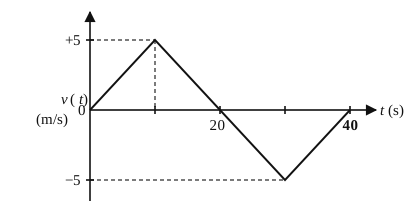
Q254.The velocity (
) versus time (
) plot of a particle is shown in the figure, for a time interval of 40 s. The total distance travelled by the particle and the average velocity during this period are, respectively ________.
किसी कण के वेग (
) तथा समय (
) का ग्राफ चित्र में 40 s के समय अन्तराल के लिए दर्शाया गया है। इस अवधि में कण द्वारा तय की गई कुल दूरी तथा औसत वेग क्रमशः ________ हैं।
- A25 m and zero25 m तथा शून्य
- B50 m and zero50 m तथा शून्य
- C100 m and zero100 m तथा शून्य
- D100 m and 2.5 m/s100 m तथा 2.5 m/s
Show answer
Concept: Distance = total area between the – graph and the time axis (all taken positive); displacement = signed area; average velocity = displacement / time.
- Area of the upper triangle (0 to 20 s) m.
- Area of the lower triangle (20 to 40 s) m (below the axis, i.e. m).
- Distance m; displacement .
- Average velocity . (D) uses distance/time, which is average speed, not average velocity.
Short trick: Equal areas above and below the axis ⇒ displacement zero, distance = twice one area.
Answer: (C) 100 m and zero
अवधारणा: दूरी = – ग्राफ तथा समय-अक्ष के बीच का कुल क्षेत्रफल (सभी धनात्मक); विस्थापन = चिह्न सहित क्षेत्रफल; औसत वेग = विस्थापन / समय।
- ऊपरी त्रिभुज (0 से 20 s) का क्षेत्रफल m।
- निचले त्रिभुज (20 से 40 s) का क्षेत्रफल m (अक्ष के नीचे, अर्थात् m)।
- दूरी m; विस्थापन ।
- औसत वेग । (D) में दूरी/समय लिया है, जो औसत चाल है, औसत वेग नहीं।
शॉर्ट ट्रिक: अक्ष के ऊपर व नीचे बराबर क्षेत्रफल ⇒ विस्थापन शून्य, दूरी = एक क्षेत्रफल का दोगुना।
उत्तर: (C) 100 m तथा शून्य
JEE Main 2026 (April) – Paper 1 (B.E./B.Tech)PhysicsKinematics – v-t graphJEE Main 2026 (April) – Paper 1 (B.E./B.Tech) 2026 · 5 Apr Shift 2
Q255.A wheel initially at rest is subjected to a uniform angular acceleration about its axis. In the first 2 s it rotates through an angle and in the next 2 s it rotates through an angle . The ratio is ________.
प्रारम्भ में विराम में स्थित एक पहिये पर उसकी अक्ष के परितः एकसमान कोणीय त्वरण लगाया जाता है। प्रथम 2 s में यह कोण से घूमता है तथा अगले 2 s में कोण से घूमता है। अनुपात ________ है।
- A6
- B3
- C4
- D
Show answer
Concept: From rest, .
- .
- Angle in 4 s , so .
- .
Short trick: Equal successive intervals from rest cover angles in the ratio 1 : 3 : 5 … ⇒ 3.
Answer: (B) 3
अवधारणा: विराम से, ।
- ।
- 4 s में कोण , अतः ।
- ।
शॉर्ट ट्रिक: विराम से बराबर क्रमागत समय अन्तरालों में कोण 1 : 3 : 5 … के अनुपात में होते हैं ⇒ 3।
उत्तर: (B) 3
JEE Main 2026 (April) – Paper 1 (B.E./B.Tech)PhysicsRotational Motion – rotational kinematicsJEE Main 2026 (April) – Paper 1 (B.E./B.Tech) 2026 · 5 Apr Shift 2
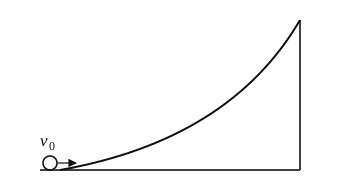
Q256.An object of uniform density rolls up the curved path with the initial velocity
as shown in the figure. If the maximum height attained by an object is
(
= acceleration due to gravity), the object is a ________.
एकसमान घनत्व की एक वस्तु चित्र में दर्शाए अनुसार प्रारम्भिक वेग
से वक्र पथ पर ऊपर की ओर लुढ़कती है। यदि वस्तु द्वारा प्राप्त अधिकतम ऊँचाई
(
= गुरुत्वीय त्वरण) है, तो वस्तु एक ________ है।
- Asolid cylinderठोस बेलन
- Bringवलय
- Cdiscचकती
- Dsolid sphereठोस गोला
Show answer
Concept: Rolling without slipping all the way up: total KE becomes .
- .
- ⇒ .
- is a solid sphere. (Ring: 1 → ; disc / solid cylinder: → .)
Short trick: , and is the solid-sphere factor.
Answer: (D) solid sphere
अवधारणा: पूरे रास्ते बिना फिसले लुढ़कने पर कुल गतिज ऊर्जा , में बदल जाती है।
- ।
- ⇒ ।
- ठोस गोले का होता है। (वलय: 1 → ; चकती / ठोस बेलन: → ।)
शॉर्ट ट्रिक: , और ठोस गोले का गुणक है।
उत्तर: (D) ठोस गोला
JEE Main 2026 (April) – Paper 1 (B.E./B.Tech)PhysicsRotational Motion – rolling up a curveJEE Main 2026 (April) – Paper 1 (B.E./B.Tech) 2026 · 5 Apr Shift 2
Q257.A body of mass is taken from the surface of earth to a height equal to twice the radius of earth (). The increase in potential energy will be ________.
( is acceleration due to gravity at the surface of earth)
द्रव्यमान की एक वस्तु को पृथ्वी की सतह से पृथ्वी की त्रिज्या () के दोगुने के बराबर ऊँचाई तक ले जाया जाता है। स्थितिज ऊर्जा में वृद्धि ________ होगी।
( पृथ्वी की सतह पर गुरुत्वीय त्वरण है)
- A
- B
- C
- D
Show answer
Concept: , using .
- .
- .
Short trick: for ; ⇒ .
Answer: (D)
अवधारणा: , जहाँ ।
- ।
- ।
शॉर्ट ट्रिक: के लिए ; ⇒ ।
उत्तर: (D)
JEE Main 2026 (April) – Paper 1 (B.E./B.Tech)PhysicsGravitation – potential energyJEE Main 2026 (April) – Paper 1 (B.E./B.Tech) 2026 · 5 Apr Shift 2
Q258.Eight mercury drops, each of radius , coalesce to form a bigger drop. The surface energy released in this process is ________. ( is the surface tension of mercury).
पारे की आठ बूँदें, जिनमें से प्रत्येक की त्रिज्या है, मिलकर एक बड़ी बूँद बनाती हैं। इस प्रक्रम में मुक्त पृष्ठ ऊर्जा ________ है। ( पारे का पृष्ठ तनाव है)।
- A
- B
- C
- D
Show answer
Concept: Volume is conserved; energy released (decrease in surface area).
- ⇒ .
- Initial area ; final area .
- Energy released .
Short trick: .
Answer: (B)
अवधारणा: आयतन संरक्षित रहता है; मुक्त ऊर्जा (पृष्ठ क्षेत्रफल में कमी)।
- ⇒ ।
- प्रारम्भिक क्षेत्रफल ; अन्तिम क्षेत्रफल ।
- मुक्त ऊर्जा ।
शॉर्ट ट्रिक: ।
उत्तर: (B)
JEE Main 2026 (April) – Paper 1 (B.E./B.Tech)PhysicsMechanical Properties of Fluids – surface energyJEE Main 2026 (April) – Paper 1 (B.E./B.Tech) 2026 · 5 Apr Shift 2
Q259.An ideal gas at pressure and temperature is expanding such that = constant. The coefficient of volume expansion of the gas is ________.
दाब तथा ताप पर एक आदर्श गैस इस प्रकार प्रसारित हो रही है कि = नियतांक। गैस का आयतन प्रसार गुणांक ________ है।
- A
- B
- C
- D
Show answer
Concept: ; combine with the given process.
- , so .
- ⇒ .
- .
Short trick: If then ; here .
Answer: (C)
अवधारणा: ; को दिए गए प्रक्रम से जोड़िए।
- , अतः ।
- ⇒ ।
- ।
शॉर्ट ट्रिक: यदि तो ; यहाँ ।
उत्तर: (C)
JEE Main 2026 (April) – Paper 1 (B.E./B.Tech)PhysicsThermal Properties – volume expansion of gasJEE Main 2026 (April) – Paper 1 (B.E./B.Tech) 2026 · 5 Apr Shift 2
Q260.Match List - I with List - II.
| List - I | | List - II |
|---|
| A. | | I. | Periodic with time period but not simple harmonic motion (SHM) |
| B. | | II. | Periodic with time period but Not SHM |
| C. | | III. | Periodic with time period and SHM |
| D. | | IV. | Non-periodic |
Choose the
correct answer from the options given below :
सूची-I का सूची-II से मिलान कीजिए।
| सूची - I | | सूची - II |
|---|
| A. | | I. | आवर्तकाल के साथ आवर्ती, परन्तु सरल आवर्त गति (SHM) नहीं |
| B. | | II. | आवर्तकाल के साथ आवर्ती, परन्तु SHM नहीं |
| C. | | III. | आवर्तकाल के साथ आवर्ती तथा SHM |
| D. | | IV. | अनावर्ती |
नीचे दिए गए विकल्पों में से
सही उत्तर चुनिए :
- AA-III, B-I, C-IV, D-II
- BA-II, B-I, C-III, D-IV
- CA-III, B-II, C-IV, D-I
- DA-II, B-I, C-IV, D-III
Show answer
Concept: A motion is SHM only if it is a single sinusoid (plus a constant) about a mean position; a sum of sinusoids is periodic only if the ratio of their angular frequencies is rational.
- A: — a single sinusoid of angular frequency about mean ⇒ SHM with → III.
- B: — two frequencies ⇒ not SHM; period → I.
- C: frequencies and have irrational ratio ⇒ non-periodic → IV.
- D: frequencies and ⇒ periodic with , not SHM → II.
- So A-III, B-I, C-IV, D-II. (B) and (D) call non-SHM; (C) gives D a period — all wrong.
Short trick: Spot C first (π inside ⇒ non-periodic → IV) and A ( is SHM about → III): only (A) has both.
Answer: (A) A-III, B-I, C-IV, D-II
अवधारणा: कोई गति SHM तभी है जब वह माध्य स्थिति के परितः एक ही ज्यावक्रीय फलन (+ नियतांक) हो; ज्यावक्रों का योग तभी आवर्ती होता है जब उनकी कोणीय आवृत्तियों का अनुपात परिमेय हो।
- A: — माध्य के परितः कोणीय आवृत्ति का एक ज्यावक्र ⇒ SHM, → III।
- B: — दो आवृत्तियाँ ⇒ SHM नहीं; आवर्तकाल → I।
- C: आवृत्तियाँ तथा का अनुपात अपरिमेय ⇒ अनावर्ती → IV।
- D: आवृत्तियाँ तथा ⇒ आवर्ती, , SHM नहीं → II।
- अतः A-III, B-I, C-IV, D-II। (B) तथा (D) में को SHM नहीं माना गया; (C) में D का आवर्तकाल दिया गया — सभी गलत।
शॉर्ट ट्रिक: पहले C पहचानिए (π अन्दर ⇒ अनावर्ती → IV) तथा A (, के परितः SHM → III): दोनों केवल (A) में हैं।
उत्तर: (A) A-III, B-I, C-IV, D-II
JEE Main 2026 (April) – Paper 1 (B.E./B.Tech)PhysicsOscillations – periodic motion & SHMJEE Main 2026 (April) – Paper 1 (B.E./B.Tech) 2026 · 5 Apr Shift 2

