Q341.The temperature of a body in air falls from C to C in 4 minutes. The temperature of the air is C. The temperature of the body in the next 4 minutes will be:
वायु में रखे किसी पिंड का ताप 4 मिनट में C से गिरकर C हो जाता है। वायु का ताप C है। अगले 4 मिनट में पिंड का ताप होगा:
- AC
- BC
- CC
- DC
Show answer
Concept: Newton's law of cooling (average form): .
- First interval: per min.
- Next interval (final temperature ): .
- C.
Short trick: Excess over surroundings falls by the same factor in equal times: (factor 3), so , giving C.
Answer: (D)
अवधारणा: न्यूटन का शीतलन नियम (औसत रूप): ।
- पहला अंतराल: प्रति मिनट।
- अगला अंतराल (अंतिम ताप ): ।
- C।
शॉर्ट ट्रिक: परिवेश से ताप-आधिक्य समान समय में समान गुणक से घटता है: (गुणक 3), अतः , जिससे C।
उत्तर: (D)
JEE Main 2025 (January) – Paper 1 (B.E./B.Tech)PhysicsThermal properties – Newton's law of coolingJEE Main 2025 (January) – Paper 1 (B.E./B.Tech) 2025 · 24 Jan Shift 2
Q342.A solid sphere is rolling without slipping on a horizontal plane. The ratio of the linear kinetic energy of the centre of mass of the sphere and rotational kinetic energy is :
एक ठोस गोला क्षैतिज तल पर बिना फिसले लुढ़क रहा है। गोले के द्रव्यमान केंद्र की रैखिक गतिज ऊर्जा तथा घूर्णी गतिज ऊर्जा का अनुपात है :
- A
- B
- C
- D
Show answer
Concept: For rolling without slipping, and .
- Translational KE .
- Rotational KE .
- Ratio .
Short trick: for a solid sphere.
Answer: (C)
अवधारणा: बिना फिसले लोटन के लिए तथा ठोस गोले का ।
- स्थानांतरीय गतिज ऊर्जा ।
- घूर्णी गतिज ऊर्जा ।
- अनुपात ।
शॉर्ट ट्रिक: (ठोस गोले के लिए)।
उत्तर: (C)
JEE Main 2025 (January) – Paper 1 (B.E./B.Tech)PhysicsRotational motion – rolling kinetic energyJEE Main 2025 (January) – Paper 1 (B.E./B.Tech) 2025 · 24 Jan Shift 2
Q343.In a Young's double slit experiment, three polarizers are kept as shown in the figure. The transmission axes of
and
are orthogonal to each other. The polarizer
covers both the slits with its transmission axis at
to those of
and
. An unpolarized light of wavelength
and intensity
is incident on
and
. The intensity at a point after
where the path difference between the light waves from
and
is
, is
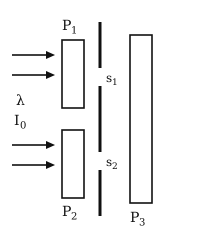
यंग के द्वि-झिरी प्रयोग में चित्रानुसार तीन ध्रुवक (polarizer) रखे हैं।
तथा
के पारगमन अक्ष परस्पर लंबवत हैं। ध्रुवक
दोनों झिरियों को ढकता है और इसका पारगमन अक्ष
व
के अक्षों से
पर है।
तरंगदैर्घ्य तथा
तीव्रता का अध्रुवित प्रकाश
तथा
पर आपतित होता है।
के बाद उस बिंदु पर तीव्रता, जहाँ
तथा
से आने वाली प्रकाश तरंगों के बीच पथांतर
है, होगी
- A
- B
- C
- D
Show answer
Concept: An unpolarized beam loses half its intensity at a polarizer (Malus: for polarized light); interference of two waves: .
- After (and ): intensity from each slit , polarized along orthogonal axes.
- After (at to each): each beam gives , now both polarized along the same axis, so they interfere.
- Path difference , .
- .
Answer: (B)
अवधारणा: ध्रुवक पर अध्रुवित पुंज की तीव्रता आधी रह जाती है (ध्रुवित प्रकाश के लिए मैलस का नियम: ); दो तरंगों का व्यतिकरण: ।
- (तथा ) के बाद: प्रत्येक झिरी से तीव्रता , परस्पर लंबवत अक्षों के अनुदिश ध्रुवित।
- (प्रत्येक से पर) के बाद: प्रत्येक पुंज से , अब दोनों एक ही अक्ष के अनुदिश ध्रुवित हैं, अतः व्यतिकरण करते हैं।
- पथांतर , ।
- ।
उत्तर: (B)
JEE Main 2025 (January) – Paper 1 (B.E./B.Tech)PhysicsWave optics – interference with polarizersJEE Main 2025 (January) – Paper 1 (B.E./B.Tech) 2025 · 24 Jan Shift 2
Q344.Given below are two statements. One is labelled as Assertion (A) and the other is labelled as Reason (R).
Assertion (A) : In an insulated container, a gas is adiabatically shrunk to half of its initial volume. The temperature of the gas decreases.
Reason (R) : Free expansion of an ideal gas is an irreversible and an adiabatic process.
In the light of the above statements, choose the correct answer from the options given below :
नीचे दो कथन दिए गए हैं। एक को अभिकथन (A) तथा दूसरे को कारण (R) कहा गया है।
अभिकथन (A) : एक ऊष्मारोधी पात्र में किसी गैस को रुद्धोष्म रूप से उसके प्रारंभिक आयतन के आधे तक संपीडित किया जाता है। गैस का ताप घट जाता है।
कारण (R) : आदर्श गैस का मुक्त प्रसार एक अनुत्क्रमणीय तथा रुद्धोष्म प्रक्रम है।
उपर्युक्त कथनों के आलोक में, निम्नलिखित विकल्पों में से सही उत्तर चुनिए :
- ABoth (A) and (R) are true but (R) is NOT the correct explanation of (A)(A) तथा (R) दोनों सत्य हैं परंतु (R), (A) की सही व्याख्या नहीं है
- B(A) is false but (R) is true(A) असत्य है परंतु (R) सत्य है
- C(A) is true but (R) is false(A) सत्य है परंतु (R) असत्य है
- DBoth (A) and (R) are true and (R) is the correct explanation of (A)(A) तथा (R) दोनों सत्य हैं तथा (R), (A) की सही व्याख्या है
Show answer
Concept: In an adiabatic compression, work is done on the gas with , so its internal energy and temperature rise ( constant).
- Assertion: shrinking the gas to half its volume adiabatically gives — the temperature increases, not decreases. (A) is false.
- Reason: free expansion is sudden (irreversible) and occurs in an insulated enclosure with no heat exchange (adiabatic). (R) is true.
- Hence (A) is false but (R) is true.
Answer: (B)
अवधारणा: रुद्धोष्म संपीडन में रहते हुए गैस पर कार्य किया जाता है, अतः उसकी आंतरिक ऊर्जा और ताप बढ़ते हैं ( नियत)।
- अभिकथन: गैस का आयतन रुद्धोष्म रूप से आधा करने पर — ताप बढ़ता है, घटता नहीं। (A) असत्य है।
- कारण: मुक्त प्रसार आकस्मिक (अनुत्क्रमणीय) होता है तथा ऊष्मारोधी पात्र में बिना ऊष्मा विनिमय (रुद्धोष्म) होता है। (R) सत्य है।
- अतः (A) असत्य है परंतु (R) सत्य है।
उत्तर: (B)
JEE Main 2025 (January) – Paper 1 (B.E./B.Tech)PhysicsThermodynamics – adiabatic processJEE Main 2025 (January) – Paper 1 (B.E./B.Tech) 2025 · 24 Jan Shift 2
Q345.Given below are two statements. One is labelled as Assertion (A) and the other is labelled as Reason (R).
Assertion (A) : A electron in a certain region of uniform magnetic field is moving with constant velocity in a straight line path.
Reason (R) : The magnetic field in that region is along the direction of velocity of the electron.
In the light of the above statements, choose the correct answer from the options given below :
नीचे दो कथन दिए गए हैं। एक को अभिकथन (A) तथा दूसरे को कारण (R) कहा गया है।
अभिकथन (A) : एकसमान चुंबकीय क्षेत्र के किसी क्षेत्र में एक इलेक्ट्रॉन नियत वेग से सरल रेखीय पथ पर गति कर रहा है।
कारण (R) : उस क्षेत्र में चुंबकीय क्षेत्र इलेक्ट्रॉन के वेग की दिशा के अनुदिश है।
उपर्युक्त कथनों के आलोक में, निम्नलिखित विकल्पों में से सही उत्तर चुनिए :
- A(A) is true but (R) is false(A) सत्य है परंतु (R) असत्य है
- BBoth (A) and (R) are true but (R) is NOT the correct explanation of (A)(A) तथा (R) दोनों सत्य हैं परंतु (R), (A) की सही व्याख्या नहीं है
- CBoth (A) and (R) are true and (R) is the correct explanation of (A)(A) तथा (R) दोनों सत्य हैं तथा (R), (A) की सही व्याख्या है
- D(A) is false but (R) is true(A) असत्य है परंतु (R) सत्य है
Show answer
Concept: Magnetic force on a moving charge: ; it vanishes when is parallel (or antiparallel) to .
- If the electron moves undeflected with constant velocity in a region where only a uniform magnetic field acts, the magnetic force on it must be zero.
- requires — exactly what (R) states.
- So both statements are true and (R) correctly explains (A).
Answer: (C)
अवधारणा: गतिमान आवेश पर चुंबकीय बल: ; जब , के समांतर (या प्रतिसमांतर) हो तो यह शून्य होता है।
- यदि केवल एकसमान चुंबकीय क्षेत्र वाले क्षेत्र में इलेक्ट्रॉन बिना विक्षेप नियत वेग से चलता है, तो उस पर चुंबकीय बल शून्य होना चाहिए।
- के लिए आवश्यक है — यही (R) कहता है।
- अतः दोनों कथन सत्य हैं और (R), (A) की सही व्याख्या है।
उत्तर: (C)
JEE Main 2025 (January) – Paper 1 (B.E./B.Tech)PhysicsMoving charges – force on a charge in magnetic fieldJEE Main 2025 (January) – Paper 1 (B.E./B.Tech) 2025 · 24 Jan Shift 2
Q346.The ratio of the power of a light source to that the light source is 2. is emitting photons per second at 600 nm. If the wavelength of the source is 300 nm, then the number of photons per second emitted by is ________ .
प्रकाश स्रोत की शक्ति का प्रकाश स्रोत की शक्ति से अनुपात 2 है। , 600 nm पर प्रति सेकंड फोटॉन उत्सर्जित करता है। यदि स्रोत की तरंगदैर्घ्य 300 nm है, तो द्वारा प्रति सेकंड उत्सर्जित फोटॉनों की संख्या ________ है।
Show answer
Concept: Power of a monochromatic source , where is the number of photons emitted per second.
- .
- photons per second.
- So the required number is , i.e. the blank is 5.
Answer: 5
अवधारणा: एकवर्णी स्रोत की शक्ति , जहाँ प्रति सेकंड उत्सर्जित फोटॉनों की संख्या है।
- ।
- फोटॉन प्रति सेकंड।
- अतः अभीष्ट संख्या है, अर्थात रिक्त स्थान 5।
उत्तर: 5
JEE Main 2025 (January) – Paper 1 (B.E./B.Tech)PhysicsModern physics – photonsJEE Main 2025 (January) – Paper 1 (B.E./B.Tech) 2025 · 24 Jan Shift 2
Q347.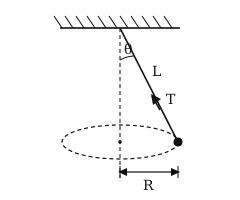
A string of length L is fixed at one end and carries a mass of M at the other end. The mass makes
rotations per second about the vertical axis passing through end of the string as shown. The tension in the string is ________ ML.
L लंबाई की एक डोरी एक सिरे पर बँधी है और दूसरे सिरे पर M द्रव्यमान जुड़ा है। चित्रानुसार द्रव्यमान, डोरी के सिरे से गुजरने वाले ऊर्ध्वाधर अक्ष के परितः प्रति सेकंड
चक्कर लगाता है। डोरी में तनाव ________ ML है।
Show answer
Concept: For a conical pendulum of string length at angle : with , so independent of .
- Frequency rev/s rad/s.
- (SI units).
- Hence the blank is 36.
Short trick: Whenever has in the denominator, becomes a clean number — here 6.
Answer: 36
अवधारणा: लंबाई की डोरी व कोण वाले शंक्वाकार लोलक के लिए: , जहाँ , अतः ( से स्वतंत्र)।
- आवृत्ति चक्कर/सेकंड rad/s।
- (SI मात्रक)।
- अतः रिक्त स्थान 36 है।
शॉर्ट ट्रिक: जब के हर में हो, तो एक सरल संख्या बनता है — यहाँ 6।
उत्तर: 36
JEE Main 2025 (January) – Paper 1 (B.E./B.Tech)PhysicsCircular motion – conical pendulumJEE Main 2025 (January) – Paper 1 (B.E./B.Tech) 2025 · 24 Jan Shift 2
Q348.The increase in pressure required to decrease the volume of a water sample by 0.2% is Nm. Bulk modulus of water is Nm. The value of P is ________.
जल के किसी नमूने का आयतन 0.2% घटाने के लिए आवश्यक दाब वृद्धि Nm है। जल का आयतन प्रत्यास्थता गुणांक (bulk modulus) Nm है। P का मान ________ है।
Show answer
Concept: Bulk modulus: .
- .
- Nm.
- Nm.
Answer: 43
अवधारणा: आयतन प्रत्यास्थता गुणांक: ।
- ।
- Nm।
- Nm।
उत्तर: 43
JEE Main 2025 (January) – Paper 1 (B.E./B.Tech)PhysicsMechanical properties – bulk modulusJEE Main 2025 (January) – Paper 1 (B.E./B.Tech) 2025 · 24 Jan Shift 2
Q349.A tightly wound long solenoid carries a current of 1.5 A. An electron is executing uniform circular motion inside the solenoid with a time period of 75 ns. The number of turns per metre in the solenoid is ________.
[Take mass of electron kg, charge of electron C, N A, ns s]
कसकर लपेटी गई एक लंबी परिनालिका में 1.5 A धारा प्रवाहित है। परिनालिका के भीतर एक इलेक्ट्रॉन 75 ns आवर्तकाल से एकसमान वृत्तीय गति कर रहा है। परिनालिका में प्रति मीटर फेरों की संख्या ________ है।
[इलेक्ट्रॉन का द्रव्यमान kg, इलेक्ट्रॉन का आवेश C, N A, ns s लीजिए]
Show answer
Concept: Period of circular motion of a charge in field B: ; field inside a long solenoid: .
- T.
- turns per metre.
Short trick: Combine directly: — the cancels with .
Answer: 250
अवधारणा: क्षेत्र B में आवेश की वृत्तीय गति का आवर्तकाल: ; लंबी परिनालिका के भीतर क्षेत्र: ।
- T।
- फेरे प्रति मीटर।
शॉर्ट ट्रिक: सीधे जोड़ें: — , के साथ कट जाता है।
उत्तर: 250
JEE Main 2025 (January) – Paper 1 (B.E./B.Tech)PhysicsMagnetic effects of current – solenoidJEE Main 2025 (January) – Paper 1 (B.E./B.Tech) 2025 · 24 Jan Shift 2
Q350.Acceleration due to gravity on the surface of earth is 'g'. If the diameter of earth is reduced to one third of its original value and mass remains unchanged, then the acceleration due to gravity on the surface of the earth is ________ g.
पृथ्वी की सतह पर गुरुत्वीय त्वरण 'g' है। यदि पृथ्वी का व्यास घटाकर अपने मूल मान का एक-तिहाई कर दिया जाए और द्रव्यमान अपरिवर्तित रहे, तो पृथ्वी की सतह पर गुरुत्वीय त्वरण ________ g होगा।
Show answer
Concept: On the surface, .
- Diameter (and hence radius) becomes one third: , mass M unchanged.
- .
- So the new acceleration due to gravity is 9g — the blank is 9.
Short trick: at fixed mass: radius .
Answer: 9
अवधारणा: सतह पर ।
- व्यास (अतः त्रिज्या) एक-तिहाई हो जाती है: , द्रव्यमान M अपरिवर्तित।
- ।
- अतः नया गुरुत्वीय त्वरण 9g है — रिक्त स्थान 9।
शॉर्ट ट्रिक: नियत द्रव्यमान पर : त्रिज्या ।
उत्तर: 9
JEE Main 2025 (January) – Paper 1 (B.E./B.Tech)PhysicsGravitation – acceleration due to gravityJEE Main 2025 (January) – Paper 1 (B.E./B.Tech) 2025 · 24 Jan Shift 2
Q351.For hydrogen atom, the orbital/s with lowest energy is/are :
(A) (B) (C) (D) (E)
Choose the correct answer from the options given below :
हाइड्रोजन परमाणु के लिए, न्यूनतम ऊर्जा वाला/वाले कक्षक है/हैं :
(A) (B) (C) (D) (E)
नीचे दिए गए विकल्पों में से सही उत्तर चुनिए :
- A(B), (C) and (D) onlyकेवल (B), (C) और (D)
- B(A) and (E) onlyकेवल (A) और (E)
- C(A) onlyकेवल (A)
- D(B) onlyकेवल (B)
Show answer
Concept: In a one-electron species such as the H atom, orbital energy depends only on the principal quantum number : eV. There is no -dependence.
- , and all have , so they are degenerate.
- and have , hence higher (less negative) energy.
- Lowest energy therefore belongs to the three orbitals: (B), (C) and (D).
Short trick: For hydrogen, just compare – smaller means lower energy; never matters.
Answer: (A)
अवधारणा: H परमाणु जैसी एक-इलेक्ट्रॉन स्पीशीज़ में कक्षक की ऊर्जा केवल मुख्य क्वांटम संख्या पर निर्भर करती है: eV। इसमें की कोई भूमिका नहीं होती।
- , और सभी के लिए है, अतः ये समभ्रंश (degenerate) हैं।
- और के लिए है, अतः इनकी ऊर्जा अधिक है।
- अतः न्यूनतम ऊर्जा वाले तीनों कक्षकों की है: (B), (C) और (D)।
शॉर्ट ट्रिक: हाइड्रोजन के लिए केवल की तुलना कीजिए – छोटा अर्थात् कम ऊर्जा; का कोई महत्व नहीं।
उत्तर: (A)
JEE Main 2025 (January) – Paper 1 (B.E./B.Tech)ChemistryAtomic Structure – orbital energies in H atomJEE Main 2025 (January) – Paper 1 (B.E./B.Tech) 2025 · 24 Jan Shift 2
Q352.Match List - I with List - II.
List - I
(Transition metal ion) | List - II
(Spin only magnetic moment (B.M.)) |
|---|
| (A) | Ti3+ | (I) | 3.87 |
| (B) | V2+ | (II) | 0.00 |
| (C) | Ni2+ | (III) | 1.73 |
| (D) | Sc3+ | (IV) | 2.84 |
Choose the correct answer from the options given below :
सूची - I का सूची - II से मिलान कीजिए।
सूची - I
(संक्रमण धातु आयन) | सूची - II
(चक्रण-मात्र चुंबकीय आघूर्ण (B.M.)) |
|---|
| (A) | Ti3+ | (I) | 3.87 |
| (B) | V2+ | (II) | 0.00 |
| (C) | Ni2+ | (III) | 1.73 |
| (D) | Sc3+ | (IV) | 2.84 |
नीचे दिए गए विकल्पों में से सही उत्तर चुनिए :
- A(A)-(III), (B)-(I), (C)-(IV), (D)-(II)
- B(A)-(III), (B)-(I), (C)-(II), (D)-(IV)
- C(A)-(IV), (B)-(II), (C)-(III), (D)-(I)
- D(A)-(II), (B)-(IV), (C)-(I), (D)-(III)
Show answer
Concept: Spin-only moment B.M., where = number of unpaired d-electrons.
- Ti3+: 3d1, , → (III)
- V2+: 3d3, , → (I)
- Ni2+: 3d8, , → (IV)
- Sc3+: 3d0, , → (II)
Short trick: Memorise B.M. for 1–4 unpaired electrons.
Answer: (A)
अवधारणा: चक्रण-मात्र आघूर्ण B.M., जहाँ = अयुग्मित d-इलेक्ट्रॉनों की संख्या।
- Ti3+: 3d1, , → (III)
- V2+: 3d3, , → (I)
- Ni2+: 3d8, , → (IV)
- Sc3+: 3d0, , → (II)
शॉर्ट ट्रिक: 1–4 अयुग्मित इलेक्ट्रॉनों के लिए B.M. याद रखिए।
उत्तर: (A)
JEE Main 2025 (January) – Paper 1 (B.E./B.Tech)Chemistryd-block – spin-only magnetic momentJEE Main 2025 (January) – Paper 1 (B.E./B.Tech) 2025 · 24 Jan Shift 2
Q353.Given below are two statements :
Statement (I) : Experimentally determined oxygen-oxygen bond lengths in the O3 are found to be same and the bond length is greater than that of a O=O (double bond) but less than that of a single (O−O) bond.
Statement (II) : The strong lone pair-lone pair repulsion between oxygen atoms is solely responsible for the fact that the bond length in ozone is smaller than that of a double bond (O=O) but more than that of a single bond (O−O).
In the light of the above statements, choose the correct answer from the options given below :
नीचे दो कथन दिए गए हैं :
कथन (I) : O3 में प्रयोगात्मक रूप से निर्धारित ऑक्सीजन-ऑक्सीजन आबंध लंबाइयाँ समान पाई जाती हैं तथा यह आबंध लंबाई O=O (द्विआबंध) से अधिक परन्तु एकल (O−O) आबंध से कम होती है।
कथन (II) : ओज़ोन में आबंध लंबाई द्विआबंध (O=O) से कम परन्तु एकल आबंध (O−O) से अधिक होने के लिए ऑक्सीजन परमाणुओं के बीच प्रबल एकाकी युग्म-एकाकी युग्म (lone pair-lone pair) प्रतिकर्षण ही एकमात्र उत्तरदायी है।
उपर्युक्त कथनों के आलोक में, नीचे दिए गए विकल्पों में से सही उत्तर चुनिए :
- ABoth Statement I and Statement II are falseकथन I और कथन II दोनों असत्य हैं
- BStatement I is false but Statement II is trueकथन I असत्य है परन्तु कथन II सत्य है
- CStatement I is true but Statement II is falseकथन I सत्य है परन्तु कथन II असत्य है
- DBoth Statement I and Statement II are trueकथन I और कथन II दोनों सत्य हैं
Show answer
Concept: O3 is a resonance hybrid of two equivalent structures; each O–O bond has bond order 1.5.
- Because of resonance, both O–O bonds are identical (128 pm), intermediate between O=O (121 pm) and O−O (148 pm) – Statement I is true.
- The intermediate bond length arises from delocalisation of the π-electrons (resonance), not from lone pair-lone pair repulsion. Saying lp–lp repulsion is 'solely responsible' is wrong – Statement II is false.
Short trick: Equal, intermediate bond lengths almost always point to resonance.
Answer: (C)
अवधारणा: O3 दो तुल्य संरचनाओं का अनुनाद संकर है; प्रत्येक O–O आबंध की आबंध कोटि 1.5 है।
- अनुनाद के कारण दोनों O–O आबंध समान (128 pm) होते हैं, जो O=O (121 pm) और O−O (148 pm) के बीच का मान है – कथन I सत्य है।
- यह मध्यवर्ती आबंध लंबाई π-इलेक्ट्रॉनों के विस्थानीकरण (अनुनाद) के कारण है, एकाकी युग्म-एकाकी युग्म प्रतिकर्षण के कारण नहीं। इसे 'एकमात्र उत्तरदायी' कहना गलत है – कथन II असत्य है।
शॉर्ट ट्रिक: समान तथा मध्यवर्ती आबंध लंबाइयाँ लगभग हमेशा अनुनाद की ओर संकेत करती हैं।
उत्तर: (C)
JEE Main 2025 (January) – Paper 1 (B.E./B.Tech)ChemistryChemical Bonding – resonance in ozoneJEE Main 2025 (January) – Paper 1 (B.E./B.Tech) 2025 · 24 Jan Shift 2
Q354.When Ethane-1,2-diamine is added progressively to an aqueous solution of Nickel (II) chloride, the sequence of colour change observed will be :
जब एथेन-1,2-डाइऐमीन को निकैल (II) क्लोराइड के जलीय विलयन में क्रमशः मिलाया जाता है, तो प्रेक्षित रंग परिवर्तन का क्रम होगा :
- AViolet → Blue → Pale Blue → Greenबैंगनी → नीला → हल्का नीला → हरा
- BPale Blue → Blue → Green → Violetहल्का नीला → नीला → हरा → बैंगनी
- CGreen → Pale Blue → Blue → Violetहरा → हल्का नीला → नीला → बैंगनी
- DPale Blue → Blue → Violet → Greenहल्का नीला → नीला → बैंगनी → हरा
Show answer
Concept: Ethane-1,2-diamine (en) is a stronger field ligand than H2O; as en replaces water step by step in [Ni(H2O)6]2+, Δo increases and the colour changes.
- [Ni(H2O)6]2+ – green (initial aqueous NiCl2).
- [Ni(H2O)4(en)]2+ – pale blue.
- [Ni(H2O)2(en)2]2+ – blue/purple.
- [Ni(en)3]2+ – violet.
Short trick: This NCERT sequence 'green → pale blue → blue → violet' is a direct fact question.
Answer: (C)
अवधारणा: एथेन-1,2-डाइऐमीन (en), H2O से प्रबल क्षेत्र लिगैन्ड है; जैसे-जैसे en, [Ni(H2O)6]2+ में जल को चरणबद्ध प्रतिस्थापित करता है, Δo बढ़ता है और रंग बदलता है।
- [Ni(H2O)6]2+ – हरा (प्रारंभिक जलीय NiCl2)।
- [Ni(H2O)4(en)]2+ – हल्का नीला।
- [Ni(H2O)2(en)2]2+ – नीला/बैंगनी।
- [Ni(en)3]2+ – बैंगनी।
शॉर्ट ट्रिक: NCERT का क्रम 'हरा → हल्का नीला → नीला → बैंगनी' सीधा तथ्यात्मक प्रश्न है।
उत्तर: (C)
JEE Main 2025 (January) – Paper 1 (B.E./B.Tech)ChemistryCoordination Compounds – colour of Ni(II) complexesJEE Main 2025 (January) – Paper 1 (B.E./B.Tech) 2025 · 24 Jan Shift 2
Q355.Given below are two statements :
Statement (I) : The first ionization energy of Pb is greater than that of Sn.
Statement (II) : The first ionization energy of Ge is greater than that of Si.
In the light of the above statements, choose the correct answer from the options given below :
नीचे दो कथन दिए गए हैं :
कथन (I) : Pb की प्रथम आयनन ऊर्जा Sn से अधिक है।
कथन (II) : Ge की प्रथम आयनन ऊर्जा Si से अधिक है।
उपर्युक्त कथनों के आलोक में, नीचे दिए गए विकल्पों में से सही उत्तर चुनिए :
- AStatement I is false but Statement II is trueकथन I असत्य है परन्तु कथन II सत्य है
- BStatement I is true but Statement II is falseकथन I सत्य है परन्तु कथन II असत्य है
- CBoth Statement I and Statement II are trueकथन I और कथन II दोनों सत्य हैं
- DBoth Statement I and Statement II are falseकथन I और कथन II दोनों असत्य हैं
Show answer
Concept: Down group 14, IE1 generally decreases, but poor shielding by intervening d- and f-electrons raises the effective nuclear charge for Pb.
- Pb (716 kJ mol−1) vs Sn (709 kJ mol−1): the poorly shielding 4f14 (and 5d10) electrons make Zeff on the 6s/6p electrons of Pb higher, so IE1(Pb) > IE1(Sn) – Statement I is true.
- Ge (762 kJ mol−1) vs Si (786 kJ mol−1): IE1 of Ge is lower than Si, so Statement II is false.
Short trick: Group 14 IE1 order: C > Si > Ge > Sn < Pb – the only inversion is at Pb.
Answer: (B)
अवधारणा: वर्ग 14 में नीचे जाने पर IE1 सामान्यतः घटती है, परन्तु मध्यवर्ती d- तथा f-इलेक्ट्रॉनों के दुर्बल परिरक्षण से Pb पर प्रभावी नाभिकीय आवेश बढ़ जाता है।
- Pb (716 kJ mol−1) बनाम Sn (709 kJ mol−1): दुर्बल परिरक्षण वाले 4f14 (तथा 5d10) इलेक्ट्रॉनों से Pb के 6s/6p इलेक्ट्रॉनों पर Zeff अधिक हो जाता है, अतः IE1(Pb) > IE1(Sn) – कथन I सत्य है।
- Ge (762 kJ mol−1) बनाम Si (786 kJ mol−1): Ge की IE1, Si से कम है, अतः कथन II असत्य है।
शॉर्ट ट्रिक: वर्ग 14 का IE1 क्रम: C > Si > Ge > Sn < Pb – उत्क्रम केवल Pb पर है।
उत्तर: (B)
JEE Main 2025 (January) – Paper 1 (B.E./B.Tech)ChemistryPeriodicity – first ionisation energyJEE Main 2025 (January) – Paper 1 (B.E./B.Tech) 2025 · 24 Jan Shift 2
Q356.Identify correct statement/s :
(A) −OCH3 and −NHCOCH3 are activating group.
(B) -CN and -OH are meta directing group.
(C) -CN and −SO3H are meta directing group.
(D) Activating groups act as ortho - and para directing groups.
(E) Halides are activating groups.
Choose the correct answer from the options given below :
सही कथन/कथनों की पहचान कीजिए :
(A) −OCH3 तथा −NHCOCH3 सक्रियक समूह हैं।
(B) -CN तथा -OH मेटा निर्देशक समूह हैं।
(C) -CN तथा −SO3H मेटा निर्देशक समूह हैं।
(D) सक्रियक समूह ऑर्थो- तथा पैरा निर्देशक समूहों के रूप में कार्य करते हैं।
(E) हैलाइड सक्रियक समूह हैं।
नीचे दिए गए विकल्पों में से सही उत्तर चुनिए :
- A(A) onlyकेवल (A)
- B(A), (B) and (E) onlyकेवल (A), (B) और (E)
- C(A) and (C) onlyकेवल (A) और (C)
- D(A), (C) and (D) onlyकेवल (A), (C) और (D)
Show answer
Concept: +M/+R groups (−OCH3, −NHCOCH3, −OH) activate the ring and direct ortho/para; −M groups (−CN, −SO3H) deactivate and direct meta; halogens are deactivating yet ortho/para directing.
- (A) True: −OCH3 and −NHCOCH3 donate electrons by resonance, activating the ring.
- (B) False: −CN is meta directing, but −OH is a strong ortho/para director.
- (C) True: both −CN and −SO3H are electron-withdrawing, meta directors.
- (D) True: every activating group directs ortho and para.
- (E) False: halogens are deactivating (−I dominates) though o/p-directing.
Short trick: 'Deactivating + meta' go together except halogens, which are deactivating but o/p-directing.
Answer: (D)
अवधारणा: +M/+R समूह (−OCH3, −NHCOCH3, −OH) वलय को सक्रिय करते हैं तथा ऑर्थो/पैरा निर्देशित करते हैं; −M समूह (−CN, −SO3H) निष्क्रियक तथा मेटा निर्देशक हैं; हैलोजन निष्क्रियक होते हुए भी ऑर्थो/पैरा निर्देशक हैं।
- (A) सत्य: −OCH3 तथा −NHCOCH3 अनुनाद द्वारा इलेक्ट्रॉन देकर वलय को सक्रिय करते हैं।
- (B) असत्य: −CN मेटा निर्देशक है, परन्तु −OH प्रबल ऑर्थो/पैरा निर्देशक है।
- (C) सत्य: −CN तथा −SO3H दोनों इलेक्ट्रॉन-आकर्षी, मेटा निर्देशक हैं।
- (D) सत्य: प्रत्येक सक्रियक समूह ऑर्थो तथा पैरा निर्देशित करता है।
- (E) असत्य: हैलोजन निष्क्रियक हैं (−I प्रभावी), यद्यपि o/p-निर्देशक हैं।
शॉर्ट ट्रिक: 'निष्क्रियक + मेटा' साथ चलते हैं, अपवाद हैलोजन – निष्क्रियक परन्तु o/p-निर्देशक।
उत्तर: (D)
JEE Main 2025 (January) – Paper 1 (B.E./B.Tech)ChemistryOrganic Chemistry – activating and directing groupsJEE Main 2025 (January) – Paper 1 (B.E./B.Tech) 2025 · 24 Jan Shift 2
Q357.Based on the data given below :
V V
V V
the strongest reducing agent is :
नीचे दिए गए आँकड़ों के आधार पर :
V V
V V
प्रबलतम अपचायक है :
- ACr
- BCl−
- CMnO4−
- DMn2+
Show answer
Concept: The lower (more negative) the standard reduction potential of a couple, the stronger the reduced form acts as a reducing agent.
- V is the lowest among the given couples.
- So Cr is oxidised most easily (oxidation potential V) and donates electrons best.
- MnO4− and Cr2O72− (high ) are strong oxidising agents instead, and Cl−/Mn2+ are poor electron donors.
Short trick: Strongest reducing agent = reduced species of the couple with the most negative .
Answer: (A)
अवधारणा: किसी युग्म का मानक अपचयन विभव जितना कम (अधिक ऋणात्मक) होता है, उसका अपचित रूप उतना ही प्रबल अपचायक होता है।
- V दिए गए युग्मों में न्यूनतम है।
- अतः Cr सबसे आसानी से ऑक्सीकृत होता है (ऑक्सीकरण विभव V) और सर्वोत्तम इलेक्ट्रॉन दाता है।
- MnO4− तथा Cr2O72− (उच्च ) प्रबल ऑक्सीकारक हैं, और Cl−/Mn2+ दुर्बल इलेक्ट्रॉन दाता हैं।
शॉर्ट ट्रिक: प्रबलतम अपचायक = सबसे ऋणात्मक वाले युग्म की अपचित स्पीशीज़।
उत्तर: (A)
JEE Main 2025 (January) – Paper 1 (B.E./B.Tech)ChemistryElectrochemistry – electrode potential and reducing powerJEE Main 2025 (January) – Paper 1 (B.E./B.Tech) 2025 · 24 Jan Shift 2
Q358.For the reaction, H2(g) + I2(g) ⇌ 2HI(g)
Attainment of equilibrium is predicted correctly by :
अभिक्रिया H2(g) + I2(g) ⇌ 2HI(g) के लिए
साम्य की प्राप्ति का सही पूर्वानुमान किया गया है :
- A
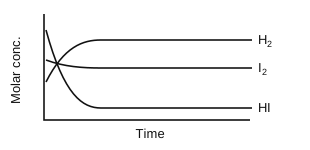
- B
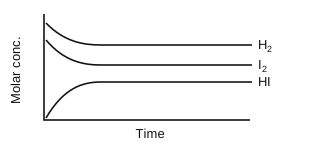
- C
- D
Show answer
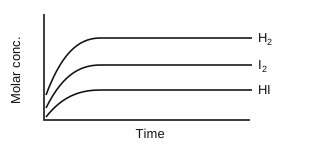
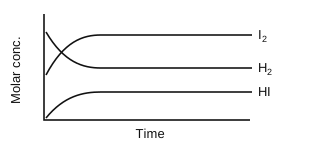
Concept: Starting from the reactants, [H2] and [I2] must fall from their initial values, [HI] must rise from zero, and all three must become constant (parallel to the time axis) at equilibrium.
- Option (B) shows exactly this: both reactant curves decrease, HI grows from zero, and every curve flattens at the same time.
- Options (A) and (D) are wrong because a reactant (H2 or I2) is shown increasing.
- Option (C) is wrong because all three species, including the reactants, are shown increasing.
Short trick: Reactants can only go down, products only up; after equilibrium every curve is horizontal.
Answer: (B)
अवधारणा: अभिकारकों से प्रारंभ करने पर [H2] तथा [I2] अपने प्रारंभिक मानों से घटने चाहिए, [HI] शून्य से बढ़ना चाहिए, और साम्य पर तीनों स्थिर (समय-अक्ष के समांतर) हो जाने चाहिए।
- विकल्प (B) ठीक यही दर्शाता है: दोनों अभिकारक वक्र घटते हैं, HI शून्य से बढ़ता है, और सभी वक्र एक साथ समतल हो जाते हैं।
- विकल्प (A) और (D) गलत हैं क्योंकि एक अभिकारक (H2 या I2) बढ़ता दिखाया गया है।
- विकल्प (C) गलत है क्योंकि अभिकारकों सहित तीनों स्पीशीज़ बढ़ती दिखाई गई हैं।
शॉर्ट ट्रिक: अभिकारक केवल घट सकते हैं, उत्पाद केवल बढ़ सकते हैं; साम्य के बाद प्रत्येक वक्र क्षैतिज होता है।
उत्तर: (B)
JEE Main 2025 (January) – Paper 1 (B.E./B.Tech)ChemistryChemical Equilibrium – approach to equilibriumJEE Main 2025 (January) – Paper 1 (B.E./B.Tech) 2025 · 24 Jan Shift 2
Q359.Find the compound 'A' from the following reaction sequences.
A B yellow ppt
निम्नलिखित अभिक्रिया अनुक्रमों से यौगिक 'A' ज्ञात कीजिए।
A B पीला अवक्षेप
- ACoS
- BZnS
- CNiS
- DMnS
Show answer
Concept: The yellow precipitate obtained with KNO2 in acetic acid medium is potassium hexanitritocobaltate(III), K3[Co(NO2)6] – the classic confirmatory test for Co2+.
- Aqua-regia dissolves the sulfide A, giving the metal chloride B in solution (CoS → CoCl2).
- Co2+ + excess KNO2 in AcOH: 3K+ + Co2+ + 7NO2− + 2H+ → K3[Co(NO2)6]↓ (yellow) + NO + H2O.
- Zn2+, Ni2+ and Mn2+ give no such yellow nitrito complex, so A = CoS.
Short trick: 'Yellow ppt with KNO2/AcOH' = cobalt, every time.
Answer: (A)
अवधारणा: ऐसीटिक अम्ल माध्यम में KNO2 के साथ प्राप्त पीला अवक्षेप पोटैशियम हेक्सानाइट्रिटोकोबाल्टेट(III), K3[Co(NO2)6] है – यह Co2+ का प्रसिद्ध पुष्टिकारक परीक्षण है।
- अम्लराज (aqua-regia) सल्फाइड A को घोलकर विलयन में धातु क्लोराइड B देता है (CoS → CoCl2)।
- Co2+ + आधिक्य KNO2 (AcOH में): 3K+ + Co2+ + 7NO2− + 2H+ → K3[Co(NO2)6]↓ (पीला) + NO + H2O।
- Zn2+, Ni2+ तथा Mn2+ ऐसा पीला नाइट्रिटो संकुल नहीं देते, अतः A = CoS।
शॉर्ट ट्रिक: 'KNO2/AcOH से पीला अवक्षेप' = हर बार कोबाल्ट।
उत्तर: (A)
JEE Main 2025 (January) – Paper 1 (B.E./B.Tech)ChemistryQualitative Analysis – cation identificationJEE Main 2025 (January) – Paper 1 (B.E./B.Tech) 2025 · 24 Jan Shift 2
Q360.The elemental composition of a compound is 54.2%C, 9.2%H and 36.6%O. If the molar mass of the compound is 132 g mol−1, the molecular formula of the compound is :
[Given : The relative atomic mass of C : H : O = 12 : 1 : 16]
किसी यौगिक का तात्विक संघटन 54.2%C, 9.2%H तथा 36.6%O है। यदि यौगिक का मोलर द्रव्यमान 132 g mol−1 है, तो यौगिक का अणु सूत्र है :
[दिया है : C : H : O का आपेक्षिक परमाणु द्रव्यमान = 12 : 1 : 16]
- AC4H9O3
- BC6H12O6
- CC4H8O2
- DC6H12O3
Show answer
Concept: Mole ratio of atoms gives the empirical formula; molecular formula = (empirical formula) × where = molar mass / empirical formula mass.
- Moles per 100 g: C , H , O .
- Divide by 2.29: C : H : O → empirical formula C2H4O (mass 44).
- → molecular formula C6H12O3.
Short trick: Only C6H12O3 among the choices has molar mass 132 (); C6H12O6 is 180.
Answer: (D)
अवधारणा: परमाणुओं का मोल अनुपात मूलानुपाती सूत्र देता है; अणु सूत्र = (मूलानुपाती सूत्र) × , जहाँ = मोलर द्रव्यमान / मूलानुपाती सूत्र द्रव्यमान।
- 100 g में मोल: C , H , O ।
- 2.29 से भाग देने पर: C : H : O → मूलानुपाती सूत्र C2H4O (द्रव्यमान 44)।
- → अणु सूत्र C6H12O3।
शॉर्ट ट्रिक: विकल्पों में केवल C6H12O3 का मोलर द्रव्यमान 132 () है; C6H12O6 का 180 है।
उत्तर: (D)
JEE Main 2025 (January) – Paper 1 (B.E./B.Tech)ChemistryMole Concept – molecular formulaJEE Main 2025 (January) – Paper 1 (B.E./B.Tech) 2025 · 24 Jan Shift 2

