Q361.The conditions and consequence that favours the configuration in a metal complex are
किसी धातु संकुल में विन्यास के अनुकूल परिस्थितियाँ एवं परिणाम हैं
- Aweak field ligand, low spin complexदुर्बल क्षेत्र लिगैन्ड, निम्न चक्रण संकुल
- Bweak field ligand, high spin complexदुर्बल क्षेत्र लिगैन्ड, उच्च चक्रण संकुल
- Cstrong field ligand, high spin complexप्रबल क्षेत्र लिगैन्ड, उच्च चक्रण संकुल
- Dstrong field ligand, low spin complexप्रबल क्षेत्र लिगैन्ड, निम्न चक्रण संकुल
Show answer
Concept: For a d4 ion in an octahedral field, the 4th electron enters only when the crystal field splitting Δo is smaller than the pairing energy P.
- means the 4th electron occupies the higher set instead of pairing in .
- This happens when Δo < P, i.e. with a weak field ligand.
- Maximum unpaired electrons (4) result – a high spin complex. A strong field ligand would give the low-spin instead.
Short trick: Electron sitting in before is full ⇒ weak field ⇒ high spin.
Answer: (B)
अवधारणा: अष्टफलकीय क्षेत्र में d4 आयन के लिए चौथा इलेक्ट्रॉन में तभी जाता है जब क्रिस्टल क्षेत्र विपाटन Δo युग्मन ऊर्जा P से छोटा हो।
- का अर्थ है कि चौथा इलेक्ट्रॉन में युग्मित होने के बजाय ऊपरी समुच्चय में जाता है।
- यह तब होता है जब Δo < P, अर्थात् दुर्बल क्षेत्र लिगैन्ड हो।
- अधिकतम अयुग्मित इलेक्ट्रॉन (4) प्राप्त होते हैं – उच्च चक्रण संकुल। प्रबल क्षेत्र लिगैन्ड होने पर निम्न चक्रण बनता।
शॉर्ट ट्रिक: भरने से पहले इलेक्ट्रॉन का में बैठना ⇒ दुर्बल क्षेत्र ⇒ उच्च चक्रण।
उत्तर: (B)
JEE Main 2025 (January) – Paper 1 (B.E./B.Tech)ChemistryCoordination Compounds – crystal field theoryJEE Main 2025 (January) – Paper 1 (B.E./B.Tech) 2025 · 24 Jan Shift 2
Q362.In the given structure, number of sp and sp
2 hybridized carbon atoms present respectively are :
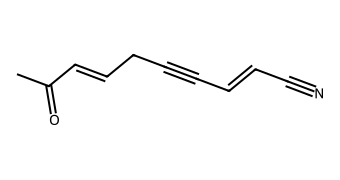
दी गई संरचना में उपस्थित sp तथा sp
2 संकरित कार्बन परमाणुओं की संख्या क्रमशः है :
- A4 and 54 और 5
- B3 and 53 और 5
- C3 and 63 और 6
- D4 and 64 और 6
Show answer
Concept: sp carbon: part of C≡C or C≡N (or cumulated diene); sp2 carbon: part of C=C or C=O; sp3: only single bonds.
- The chain is CH3–CO–CH=CH–CH2–C≡C–CH=CH–C≡N (10 carbons).
- sp carbons: the two alkyne carbons (C≡C) + the nitrile carbon (C≡N) = 3.
- sp2 carbons: the carbonyl carbon (C=O) + four alkene carbons of the two C=C units = 5.
- The remaining CH3 and CH2 are sp3. So sp : sp2 = 3 : 5.
Short trick: Count triple-bonded carbons first (sp), then every doubly bonded carbon (sp2) including C=O.
Answer: (B)
अवधारणा: sp कार्बन: C≡C या C≡N का भाग; sp2 कार्बन: C=C या C=O का भाग; sp3: केवल एकल आबंध।
- शृंखला है CH3–CO–CH=CH–CH2–C≡C–CH=CH–C≡N (10 कार्बन)।
- sp कार्बन: ऐल्काइन के दो कार्बन (C≡C) + नाइट्राइल कार्बन (C≡N) = 3।
- sp2 कार्बन: कार्बोनिल कार्बन (C=O) + दोनों C=C इकाइयों के चार ऐल्कीन कार्बन = 5।
- शेष CH3 तथा CH2 sp3 हैं। अतः sp : sp2 = 3 : 5।
शॉर्ट ट्रिक: पहले त्रिआबंधित कार्बन (sp) गिनिए, फिर C=O सहित प्रत्येक द्विआबंधित कार्बन (sp2)।
उत्तर: (B)
JEE Main 2025 (January) – Paper 1 (B.E./B.Tech)ChemistryGOC – hybridisationJEE Main 2025 (January) – Paper 1 (B.E./B.Tech) 2025 · 24 Jan Shift 2
Q363.Given below are two statements :
Statement (I) :
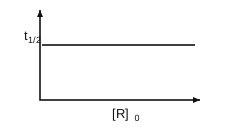
is valid for first order reaction.
Statement (II) :
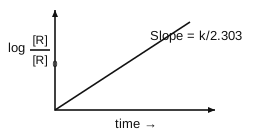
is valid for first order reaction.
In the light of the above statements, choose the correct answer from the options given below :
नीचे दो कथन दिए गए हैं :
कथन (I) :
प्रथम कोटि अभिक्रिया के लिए मान्य है।
कथन (II) :
प्रथम कोटि अभिक्रिया के लिए मान्य है।
उपर्युक्त कथनों के आलोक में, नीचे दिए गए विकल्पों में से सही उत्तर चुनिए :
- ABoth Statement I and Statement II are trueकथन I और कथन II दोनों सत्य हैं
- BStatement I is false but Statement II is trueकथन I असत्य है परन्तु कथन II सत्य है
- CStatement I is true but Statement II is falseकथन I सत्य है परन्तु कथन II असत्य है
- DBoth Statement I and Statement II are falseकथन I और कथन II दोनों असत्य हैं
Show answer
Concept: For a first order reaction (independent of ) and .
- Statement I: vs is a horizontal line because half-life does not depend on initial concentration – true.
- Statement II: vs time is a straight line through the origin but with negative slope , since decreases. The graph shown rises with slope – false.
- A positive slope would be obtained for vs time, not .
Short trick: falls; rises – watch which ratio is on the y-axis.
Answer: (C)
अवधारणा: प्रथम कोटि अभिक्रिया के लिए ( से स्वतंत्र) तथा ।
- कथन I: बनाम क्षैतिज रेखा है क्योंकि अर्ध-आयु प्रारंभिक सांद्रता पर निर्भर नहीं करती – सत्य।
- कथन II: बनाम समय मूल बिंदु से गुजरती सरल रेखा है परन्तु ऋणात्मक ढाल के साथ, क्योंकि घटता है। दर्शाया गया ग्राफ ढाल से बढ़ता है – असत्य।
- धनात्मक ढाल तो बनाम समय के लिए मिलती, के लिए नहीं।
शॉर्ट ट्रिक: घटता है; बढ़ता है – y-अक्ष पर कौन-सा अनुपात है, ध्यान दीजिए।
उत्तर: (C)
JEE Main 2025 (January) – Paper 1 (B.E./B.Tech)ChemistryChemical Kinetics – first order reaction graphsJEE Main 2025 (January) – Paper 1 (B.E./B.Tech) 2025 · 24 Jan Shift 2
Q364.Match List - I with List - II.
| List - I | List - II |
|---|
| (A) | RCN R CHO | (I) | Etard reaction |
| (B) | 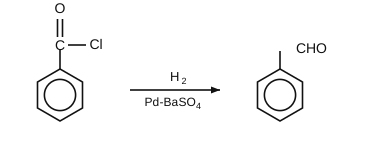 | (II) | Gatterman-Koch reaction |
| (C) | 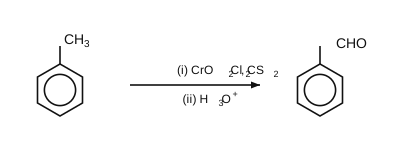 | (III) | Rosenmund reduction |
| (D) | 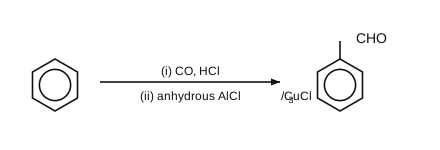 | (IV) | Stephen reaction |
Choose the correct answer from the options given below :
सूची - I का सूची - II से मिलान कीजिए।
| सूची - I | सूची - II |
|---|
| (A) | RCN R CHO | (I) | एटार्ड अभिक्रिया (Etard reaction) |
| (B) | | (II) | गाटरमान-कोच अभिक्रिया (Gatterman-Koch reaction) |
| (C) | | (III) | रोज़ेनमुंड अपचयन (Rosenmund reduction) |
| (D) | | (IV) | स्टीफन अभिक्रिया (Stephen reaction) |
नीचे दिए गए विकल्पों में से सही उत्तर चुनिए :
- A(A)-(III), (B)-(IV), (C)-(II), (D)-(I)
- B(A)-(I), (B)-(III), (C)-(II), (D)-(IV)
- C(A)-(III), (B)-(IV), (C)-(I), (D)-(II)
- D(A)-(IV), (B)-(III), (C)-(I), (D)-(II)
Show answer
Concept: Four classical routes to aldehydes carry the names of their discoverers.
- (A) RCN reduced by SnCl2/HCl to an aldimine, hydrolysed to RCHO – Stephen reaction → (IV).
- (B) Acid chloride + H2 over Pd-BaSO4 (poisoned catalyst) → aldehyde – Rosenmund reduction → (III).
- (C) Toluene + CrO2Cl2 in CS2, then hydrolysis → benzaldehyde – Etard reaction → (I).
- (D) Benzene + CO/HCl with anhydrous AlCl3/CuCl → benzaldehyde – Gatterman-Koch reaction → (II).
Short trick: Stephen–SnCl2 (both start with S); Rosenmund–'reduced' acid chloride; Etard–chromyl chloride; Gatterman-Koch–CO gas.
Answer: (D)
अवधारणा: ऐल्डिहाइड बनाने के चार क्लासिक मार्ग अपने खोजकर्ताओं के नाम से जाने जाते हैं।
- (A) RCN का SnCl2/HCl से ऐल्डिमीन में अपचयन, फिर जल-अपघटन से RCHO – स्टीफन अभिक्रिया → (IV)।
- (B) अम्ल क्लोराइड + H2, Pd-BaSO4 (विषाक्त उत्प्रेरक) पर → ऐल्डिहाइड – रोज़ेनमुंड अपचयन → (III)।
- (C) टॉलूईन + CrO2Cl2 (CS2 में), फिर जल-अपघटन → बेन्ज़ैल्डिहाइड – एटार्ड अभिक्रिया → (I)।
- (D) बेन्ज़ीन + CO/HCl, निर्जल AlCl3/CuCl के साथ → बेन्ज़ैल्डिहाइड – गाटरमान-कोच अभिक्रिया → (II)।
शॉर्ट ट्रिक: स्टीफन–SnCl2 (दोनों 'S' से); रोज़ेनमुंड–अम्ल क्लोराइड का अपचयन; एटार्ड–क्रोमिल क्लोराइड; गाटरमान-कोच–CO गैस।
उत्तर: (D)
JEE Main 2025 (January) – Paper 1 (B.E./B.Tech)ChemistryAldehydes – name reactionsJEE Main 2025 (January) – Paper 1 (B.E./B.Tech) 2025 · 24 Jan Shift 2
Q365.The structure of the major product formed in the following reaction is :
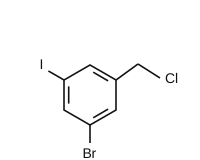
major product
निम्नलिखित अभिक्रिया में बनने वाले मुख्य उत्पाद की संरचना है :
मुख्य उत्पाद
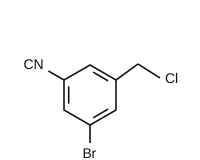
- A
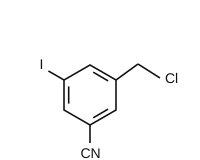
- B
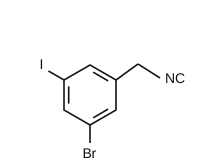
- C
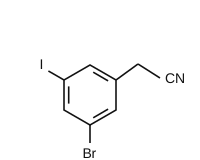
- D
Show answer
Concept: CN− is ambident. In covalent AgCN the carbon lone pair is tied up with Ag, so attack occurs through nitrogen, giving an isocyanide (R–NC). Only the benzylic C–Cl is reactive; aryl C–I and C–Br do not undergo nucleophilic substitution under these conditions.
- Ag+ assists ionisation of the benzylic C–Cl bond.
- N of AgCN attacks the benzylic carbon → ArCH2–NC (isocyanide), with ring I and Br untouched – option (C).
- Options (A) and (B) are wrong because they show substitution at the aromatic C–Br/C–I, which does not occur.
- Option (D) (nitrile, –CH2CN) would be the main product with ionic KCN, not AgCN.
Short trick: KCN → cyanide (R–CN); AgCN → isocyanide (R–NC).
Answer: (C)
अवधारणा: CN− उभयदंती है। सहसंयोजक AgCN में कार्बन का एकाकी युग्म Ag से बँधा होता है, अतः आक्रमण नाइट्रोजन से होता है और आइसोसायनाइड (R–NC) बनता है। केवल बेन्ज़िलिक C–Cl क्रियाशील है; ऐरिल C–I तथा C–Br इन परिस्थितियों में नाभिकरागी प्रतिस्थापन नहीं देते।
- Ag+ बेन्ज़िलिक C–Cl आबंध के आयनन में सहायता करता है।
- AgCN का N बेन्ज़िलिक कार्बन पर आक्रमण करता है → ArCH2–NC (आइसोसायनाइड), वलय के I व Br अपरिवर्तित – विकल्प (C)।
- विकल्प (A) और (B) गलत हैं क्योंकि उनमें ऐरोमैटिक C–Br/C–I पर प्रतिस्थापन दिखाया गया है, जो नहीं होता।
- विकल्प (D) (नाइट्राइल, –CH2CN) आयनिक KCN के साथ मुख्य उत्पाद होता, AgCN के साथ नहीं।
शॉर्ट ट्रिक: KCN → सायनाइड (R–CN); AgCN → आइसोसायनाइड (R–NC)।
उत्तर: (C)
JEE Main 2025 (January) – Paper 1 (B.E./B.Tech)ChemistryHaloalkanes – reaction with AgCNJEE Main 2025 (January) – Paper 1 (B.E./B.Tech) 2025 · 24 Jan Shift 2
Q366.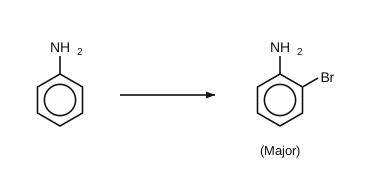
For reaction
The correct order of set of reagents for the above conversion is :
उपर्युक्त अभिक्रिया/रूपांतरण के लिए अभिकर्मकों के समुच्चय का सही क्रम है :
- ABr2 | FeBr3, H2O(Δ), NaOH
- BH2SO4, Ac2O, Br2, H2O(Δ), NaOH
- CAc2O, Br2, H2O(Δ), NaOH
- DAc2O, H2SO4, Br2, NaOH
Show answer
Concept: To brominate aniline selectively at the ortho position, the para position must be blocked and the strongly activating –NH2 moderated.
- H2SO4: sulfonation blocks the para position (–SO3H at C-4).
- Ac2O: acetylation of –NH2 to –NHCOCH3 moderates activation and prevents polybromination/oxidation.
- Br2: bromine now enters ortho to the –NHCOCH3 group (para is blocked).
- H2O(Δ): hot aqueous hydrolysis removes both the acetyl group and the –SO3H group; NaOH liberates the free amine → 2-bromoaniline (major).
- Option (A) fails: free aniline with Br2 gives 2,4,6-tribromoaniline. Option (C) gives mainly p-bromoacetanilide since para is open. Option (D) has no hydrolysis step to free the amine before NaOH.
Short trick: 'Block para (sulfonate), tame NH2 (acetylate), brominate, then unblock' is the standard ortho-selective route.
Answer: (B)
अवधारणा: ऐनिलीन का चयनात्मक ऑर्थो ब्रोमीनन करने के लिए पैरा स्थिति को अवरुद्ध करना और प्रबल सक्रियक –NH2 को संयमित करना आवश्यक है।
- H2SO4: सल्फोनीकरण से पैरा स्थिति अवरुद्ध हो जाती है (C-4 पर –SO3H)।
- Ac2O: –NH2 का ऐसीटिलीकरण (–NHCOCH3) सक्रियण को संयमित करता है तथा बहुब्रोमीनन/ऑक्सीकरण रोकता है।
- Br2: ब्रोमीन अब –NHCOCH3 के ऑर्थो में प्रवेश करता है (पैरा अवरुद्ध है)।
- H2O(Δ): गर्म जलीय जल-अपघटन ऐसीटिल तथा –SO3H दोनों समूह हटा देता है; NaOH मुक्त ऐमीन देता है → 2-ब्रोमोऐनिलीन (मुख्य)।
- विकल्प (A) असफल: मुक्त ऐनिलीन Br2 से 2,4,6-ट्राइब्रोमोऐनिलीन देती है। विकल्प (C) में पैरा खुला होने से मुख्यतः p-ब्रोमोऐसीटैनिलाइड बनता है। विकल्प (D) में NaOH से पहले जल-अपघटन का चरण ही नहीं है।
शॉर्ट ट्रिक: 'पैरा रोकिए (सल्फोनीकरण), NH2 संयमित कीजिए (ऐसीटिलीकरण), ब्रोमीनन कीजिए, फिर समूह हटाइए' – यही मानक ऑर्थो-चयनात्मक मार्ग है।
उत्तर: (B)
JEE Main 2025 (January) – Paper 1 (B.E./B.Tech)ChemistryAmines – synthesis of 2-bromoanilineJEE Main 2025 (January) – Paper 1 (B.E./B.Tech) 2025 · 24 Jan Shift 2
Q367.The successive 5 ionisation energies of an element are 800, 2427, 3658, 25024 and 32824 kJ/mol, respectively. By using the above values predict the group in which the above element is present :
किसी तत्व की क्रमिक 5 आयनन ऊर्जाएँ क्रमशः 800, 2427, 3658, 25024 तथा 32824 kJ/mol हैं। उपर्युक्त मानों के आधार पर उस वर्ग का पूर्वानुमान कीजिए जिसमें यह तत्व उपस्थित है :
- AGroup 13वर्ग 13
- BGroup 14वर्ग 14
- CGroup 2वर्ग 2
- DGroup 4वर्ग 4
Show answer
Concept: A sudden large jump between successive ionisation energies appears when a stable noble-gas core starts being broken; the number of easily removed electrons equals the number of valence electrons.
- IE1 to IE3: 800 → 2427 → 3658 kJ/mol – gradual increase.
- IE3 to IE4: 3658 → 25024 kJ/mol – a nearly 7-fold jump, so the 4th electron comes from the inner core.
- Hence the element has 3 valence electrons (ns2np1) → Group 13 (like B or Al).
Short trick: Count the IEs before the big jump – that count is the number of valence electrons; 3 valence electrons ⇒ group 13.
Answer: (A)
अवधारणा: क्रमिक आयनन ऊर्जाओं में अचानक बड़ी छलांग तब आती है जब स्थायी उत्कृष्ट-गैस कोर टूटना प्रारंभ होता है; आसानी से निकलने वाले इलेक्ट्रॉनों की संख्या = संयोजकता इलेक्ट्रॉनों की संख्या।
- IE1 से IE3: 800 → 2427 → 3658 kJ/mol – क्रमिक वृद्धि।
- IE3 से IE4: 3658 → 25024 kJ/mol – लगभग 7 गुना छलांग, अतः चौथा इलेक्ट्रॉन आंतरिक कोर से निकलता है।
- अतः तत्व में 3 संयोजकता इलेक्ट्रॉन हैं (ns2np1) → वर्ग 13 (जैसे B या Al)।
शॉर्ट ट्रिक: बड़ी छलांग से पहले की आयनन ऊर्जाएँ गिनिए – वही संयोजकता इलेक्ट्रॉनों की संख्या है; 3 संयोजकता इलेक्ट्रॉन ⇒ वर्ग 13।
उत्तर: (A)
JEE Main 2025 (January) – Paper 1 (B.E./B.Tech)ChemistryPeriodicity – successive ionisation energiesJEE Main 2025 (January) – Paper 1 (B.E./B.Tech) 2025 · 24 Jan Shift 2
- A(A)-(IV), (B)-(III), (C)-(II), (D)-(I)
- B(A)-(III), (B)-(IV), (C)-(II), (D)-(I)
- C(A)-(III), (B)-(IV), (C)-(I), (D)-(II)
- D(A)-(III), (B)-(I), (C)-(IV), (D)-(II)
Show answer
Concept: Adenine and guanine are purines (fused bicyclic); cytosine, thymine and uracil are pyrimidines (single six-membered ring).
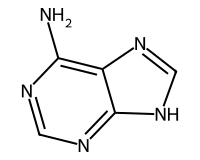
- (A) Adenine – the only purine shown, bicyclic with an –NH2 group → (III).
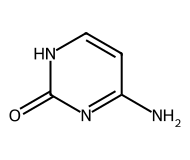
- (B) Cytosine – pyrimidine with one C=O and one –NH2 → (IV).
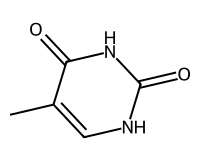
- (C) Thymine – pyrimidine with two C=O and a 5-CH3 group → (II).
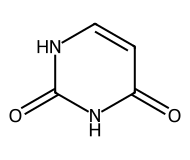
- (D) Uracil – pyrimidine with two C=O and no CH3 → (I).
Short trick: Thymine = 'methyl uracil'; spot the CH3 to separate (II) from (I).
Answer: (B)
अवधारणा: ऐडेनीन तथा ग्वानीन प्यूरीन हैं (संगलित द्विचक्रीय); साइटोसीन, थाइमीन तथा यूरैसिल पिरिमिडीन हैं (एकल षट्सदस्यीय वलय)।
- (A) ऐडेनीन – दर्शाई गई एकमात्र प्यूरीन, –NH2 समूह वाली द्विचक्रीय संरचना → (III)।
- (B) साइटोसीन – एक C=O तथा एक –NH2 वाली पिरिमिडीन → (IV)।
- (C) थाइमीन – दो C=O तथा 5-CH3 समूह वाली पिरिमिडीन → (II)।
- (D) यूरैसिल – दो C=O, बिना CH3 वाली पिरिमिडीन → (I)।
शॉर्ट ट्रिक: थाइमीन = 'मेथिल यूरैसिल'; CH3 देखकर (II) को (I) से अलग कीजिए।
उत्तर: (B)
JEE Main 2025 (January) – Paper 1 (B.E./B.Tech)ChemistryBiomolecules – nucleic acid basesJEE Main 2025 (January) – Paper 1 (B.E./B.Tech) 2025 · 24 Jan Shift 2
Q369.Which of the following mixing of 1 M base and 1 M acid leads to the largest increase in temperature?
1 M क्षारक तथा 1 M अम्ल के निम्नलिखित में से किस मिश्रण से ताप में सर्वाधिक वृद्धि होती है?
- A30 mL CH3COOH and 30 mL NaOH30 mL CH3COOH और 30 mL NaOH
- B45 mL CH3COOH and 25 mL NaOH45 mL CH3COOH और 25 mL NaOH
- C30 mL HCl and 30 mL NaOH30 mL HCl और 30 mL NaOH
- D50 mL HCl and 20 mL NaOH50 mL HCl और 20 mL NaOH
Show answer
Concept: ΔT ∝ heat released / total volume. Strong acid–strong base releases the full 57.1 kJ per mol of water; a weak acid releases less because part of the energy is used for its ionisation.
- Option (C): 30 mmol neutralised in 60 mL → 0.50 mmol per mL, all at 57.1 kJ/mol – highest ΔT.
- Option (D): only 20 mmol (limited by NaOH) in 70 mL → 0.286 mmol per mL – smaller rise.
- Options (A) and (B) use CH3COOH, whose enthalpy of neutralisation (≈ 55 kJ/mol) is lower, and (B) also neutralises only 25 mmol in 70 mL.
Short trick: Pick strong acid + strong base in exact equivalent amounts with the least total volume.
Answer: (C)
अवधारणा: ΔT ∝ उत्सर्जित ऊष्मा / कुल आयतन। प्रबल अम्ल–प्रबल क्षारक प्रति मोल जल पूरे 57.1 kJ देता है; दुर्बल अम्ल कम ऊष्मा देता है क्योंकि ऊर्जा का कुछ भाग उसके आयनन में लगता है।
- विकल्प (C): 60 mL में 30 mmol उदासीन → 0.50 mmol प्रति mL, सब 57.1 kJ/mol पर – सर्वाधिक ΔT।
- विकल्प (D): 70 mL में केवल 20 mmol (NaOH सीमित) → 0.286 mmol प्रति mL – कम वृद्धि।
- विकल्प (A) और (B) में CH3COOH है, जिसकी उदासीनीकरण एन्थैल्पी (≈ 55 kJ/mol) कम है, तथा (B) में 70 mL में केवल 25 mmol ही उदासीन होते हैं।
शॉर्ट ट्रिक: प्रबल अम्ल + प्रबल क्षारक, तुल्य मात्रा में, न्यूनतम कुल आयतन के साथ चुनिए।
उत्तर: (C)
JEE Main 2025 (January) – Paper 1 (B.E./B.Tech)ChemistryThermochemistry – enthalpy of neutralisationJEE Main 2025 (January) – Paper 1 (B.E./B.Tech) 2025 · 24 Jan Shift 2
Q370. kcal
kcal
The heat of formation of SO2(g) is given by :
kcal
kcal
SO2(g) की संभवन ऊष्मा (heat of formation) दी जाती है :
- A kcal
- B kcal
- C kcal
- D kcal
Show answer
Concept: Hess's law – subtract the two thermochemical equations to get the formation reaction of SO2. Heat written on the product side means ΔH = −(that heat).
- Equation 1: kcal; Equation 2: kcal.
- Equation 1 − Equation 2: , with kcal.
- So the heat of formation of SO2(g) is kcal.
Short trick: Target = (full oxidation) − (second-stage oxidation); do the same algebra on the ΔH values.
Answer: (B)
अवधारणा: हेस नियम – दोनों ऊष्मारासायनिक समीकरणों को घटाकर SO2 की संभवन अभिक्रिया प्राप्त कीजिए। उत्पाद पक्ष में लिखी ऊष्मा का अर्थ है ΔH = −(वह ऊष्मा)।
- समीकरण 1: kcal; समीकरण 2: kcal।
- समीकरण 1 − समीकरण 2: , जिसके लिए kcal।
- अतः SO2(g) की संभवन ऊष्मा kcal है।
शॉर्ट ट्रिक: लक्ष्य = (पूर्ण ऑक्सीकरण) − (द्वितीय चरण का ऑक्सीकरण); यही बीजगणित ΔH मानों पर कीजिए।
उत्तर: (B)
JEE Main 2025 (January) – Paper 1 (B.E./B.Tech)ChemistryThermochemistry – Hess law and enthalpy of formationJEE Main 2025 (January) – Paper 1 (B.E./B.Tech) 2025 · 24 Jan Shift 2
Q371.In Carius method of estimation of halogen, 0.25 g of an organic compound gave 0.15 g of silver bromide (AgBr). The percentage of Bromine in the organic compound is ______ ×10−1% (Nearest integer).
(Given : Molar mass of Ag is 108 and Br is 80 g mol−1)
हैलोजन के आकलन की कैरियस विधि में, 0.25 g कार्बनिक यौगिक ने 0.15 g सिल्वर ब्रोमाइड (AgBr) दिया। कार्बनिक यौगिक में ब्रोमीन का प्रतिशत ______ ×10−1% है (निकटतम पूर्णांक)।
(दिया है : Ag का मोलर द्रव्यमान 108 तथा Br का 80 g mol−1)
Show answer
Concept: In the Carius method, % halogen .
- Molar mass of AgBr g mol−1.
- Mass of Br in 0.15 g AgBr g.
- % Br .
- Expressed as : .
Short trick: – plug in and shift the decimal once for the ×10−1 format.
Answer: 255
अवधारणा: कैरियस विधि में, % हैलोजन ।
- AgBr का मोलर द्रव्यमान g mol−1।
- 0.15 g AgBr में Br का द्रव्यमान g।
- % Br ।
- के रूप में: ।
शॉर्ट ट्रिक: – मान रखिए और ×10−1 प्रारूप के लिए दशमलव एक स्थान खिसकाइए।
उत्तर: 255
JEE Main 2025 (January) – Paper 1 (B.E./B.Tech)ChemistryOrganic Analysis – Carius methodJEE Main 2025 (January) – Paper 1 (B.E./B.Tech) 2025 · 24 Jan Shift 2
Q372.The observed and normal molar masses of compound MX2 are 65.6 and 164 respectively. The percent degree of ionisation of MX2 is ______ %. (Nearest integer)
यौगिक MX2 के प्रेक्षित तथा सामान्य मोलर द्रव्यमान क्रमशः 65.6 तथा 164 हैं। MX2 के आयनन की प्रतिशत मात्रा ______ % है। (निकटतम पूर्णांक)
Show answer
Concept: van't Hoff factor ; for dissociation into ions, .
- .
- MX2 → M2+ + 2X−, so .
- , i.e. .
Short trick: Observed mass 2.5 times smaller ⇒ ; with 3 ions, .
Answer: 75
अवधारणा: वान्ट हॉफ गुणांक ; आयनों में वियोजन के लिए ।
- ।
- MX2 → M2+ + 2X−, अतः ।
- , अर्थात् ।
शॉर्ट ट्रिक: प्रेक्षित द्रव्यमान 2.5 गुना छोटा ⇒ ; 3 आयनों के साथ ।
उत्तर: 75
JEE Main 2025 (January) – Paper 1 (B.E./B.Tech)ChemistrySolutions – van’t Hoff factor and ionisationJEE Main 2025 (January) – Paper 1 (B.E./B.Tech) 2025 · 24 Jan Shift 2
Q373.Consider a complex reaction taking place in three steps with rate constants and respectively. The overall rate constant is given by the expression . If the activation energies of the three steps are 60, 30 and 10 kJ mol−1 respectively, then the overall energy of activation in kJ mol−1 is ______ . (Nearest integer)
तीन चरणों में होने वाली एक जटिल अभिक्रिया पर विचार कीजिए जिनके दर स्थिरांक क्रमशः तथा हैं। समग्र दर स्थिरांक व्यंजक द्वारा दिया जाता है। यदि तीनों चरणों की सक्रियण ऊर्जाएँ क्रमशः 60, 30 तथा 10 kJ mol−1 हैं, तो समग्र सक्रियण ऊर्जा kJ mol−1 में ______ है। (निकटतम पूर्णांक)
Show answer
Concept: Substituting the Arrhenius form into the rate-constant expression: multiplying rate constants adds activation energies, dividing subtracts them, and a square root halves them.
- .
- kJ mol−1.
Short trick: Treat like exponents: product → add, quotient → subtract, root → divide by the index.
Answer: 20
अवधारणा: दर स्थिरांक व्यंजक में आरेनियस रूप रखने पर: दर स्थिरांकों के गुणन से सक्रियण ऊर्जाएँ जुड़ती हैं, भाग से घटती हैं, तथा वर्गमूल से आधी हो जाती हैं।
- ।
- kJ mol−1।
शॉर्ट ट्रिक: को घातांकों की तरह लीजिए: गुणनफल → जोड़, भागफल → घटाव, मूल → घात से भाग।
उत्तर: 20
JEE Main 2025 (January) – Paper 1 (B.E./B.Tech)ChemistryChemical Kinetics – overall activation energyJEE Main 2025 (January) – Paper 1 (B.E./B.Tech) 2025 · 24 Jan Shift 2
Q374.The possible number of stereoisomers for 5-phenylpent-4-en-2-ol is ______
5-फेनिलपेन्ट-4-ईन-2-ऑल के संभावित त्रिविम समावयवियों (stereoisomers) की संख्या ______ है।
Show answer
Concept: Number of stereoisomers when no symmetry makes any of them identical.
- 5-Phenylpent-4-en-2-ol: C6H5–CH=CH–CH2–CH(OH)–CH3.
- The C4=C5 double bond carries Ph/H and chain/H → E and Z forms (1 stereogenic double bond).
- C-2 bears four different groups (OH, CH3, H, CH2CH=CHPh) → one chiral centre (R/S).
- Total stereoisomers (2R,E; 2S,E; 2R,Z; 2S,Z).
Short trick: One C=C with different ends + one chiral carbon ⇒ .
Answer: 4
अवधारणा: त्रिविम समावयवियों की संख्या , जब कोई सममिति उन्हें समान न बनाए।
- 5-फेनिलपेन्ट-4-ईन-2-ऑल: C6H5–CH=CH–CH2–CH(OH)–CH3।
- C4=C5 द्विआबंध पर Ph/H तथा शृंखला/H हैं → E और Z रूप (1 त्रिविमजनक द्विआबंध)।
- C-2 पर चार भिन्न समूह हैं (OH, CH3, H, CH2CH=CHPh) → एक किरैल केंद्र (R/S)।
- कुल त्रिविम समावयवी (2R,E; 2S,E; 2R,Z; 2S,Z)।
शॉर्ट ट्रिक: भिन्न सिरों वाला एक C=C + एक किरैल कार्बन ⇒ ।
उत्तर: 4
JEE Main 2025 (January) – Paper 1 (B.E./B.Tech)ChemistryStereochemistry – number of stereoisomersJEE Main 2025 (January) – Paper 1 (B.E./B.Tech) 2025 · 24 Jan Shift 2
Q375.The hydrocarbon (X) with molar mass 80 g mol−1 and 90% carbon has ______ degree of unsaturation.
80 g mol−1 मोलर द्रव्यमान तथा 90% कार्बन वाले हाइड्रोकार्बन (X) की असंतृप्तता की कोटि ______ है।
Show answer
Concept: Find the molecular formula from % composition, then degree of unsaturation for CCHH.
- Mass of C g → carbon atoms.
- Mass of H g → hydrogen atoms. So X = C6H8.
- Degree of unsaturation .
Short trick: Compare with saturated C6H14: deficiency of 6 H ⇒ degrees.
Answer: 3
अवधारणा: % संघटन से अणु सूत्र निकालिए, फिर CCHH के लिए असंतृप्तता की कोटि ।
- C का द्रव्यमान g → कार्बन परमाणु।
- H का द्रव्यमान g → हाइड्रोजन परमाणु। अतः X = C6H8।
- असंतृप्तता की कोटि ।
शॉर्ट ट्रिक: संतृप्त C6H14 से तुलना कीजिए: 6 H की कमी ⇒ कोटि।
उत्तर: 3
JEE Main 2025 (January) – Paper 1 (B.E./B.Tech)ChemistryGOC – degree of unsaturationJEE Main 2025 (January) – Paper 1 (B.E./B.Tech) 2025 · 24 Jan Shift 2
Q376.Let circle be the image of in the line and be the point on such that is parallel to -axis and lies on the right hand side of the centre of . If , with , lies on such that the length of the arc is of the perimeter of , then is equal to
माना वृत्त , वृत्त का रेखा में प्रतिबिम्ब है तथा , वृत्त पर स्थित ऐसा बिन्दु है कि , -अक्ष के समान्तर है और , के केन्द्र के दायीं ओर स्थित है। यदि , जहाँ , वृत्त पर इस प्रकार स्थित है कि चाप (arc) की लम्बाई के परिमाप का वाँ भाग है, तो बराबर है
- A
- B
- C
- D
Show answer
Concept: Reflection of a circle in a line keeps the radius; an arc equal to of the perimeter subtends at the centre.
- has centre and radius .
- Image of in : , giving centre . So .
- parallel to the -axis with to the right of gives .
- Arc . Since , take below : .
- .
Answer: (B)
अवधारणा: रेखा में वृत्त का प्रतिबिम्ब लेने पर त्रिज्या अपरिवर्तित रहती है; परिमाप के भाग के बराबर चाप केन्द्र पर का कोण बनाता है।
- का केन्द्र तथा त्रिज्या है।
- का में प्रतिबिम्ब: , अतः केन्द्र । इसलिए ।
- , -अक्ष के समान्तर है तथा , के दायीं ओर है, अतः ।
- चाप । चूँकि , को के नीचे लीजिए: ।
- ।
उत्तर: (B)
JEE Main 2025 (January) – Paper 1 (B.E./B.Tech)MathematicsCircle – image and arc lengthJEE Main 2025 (January) – Paper 1 (B.E./B.Tech) 2025 · 24 Jan Shift 1
Q377.Let in a , the length of the side be 6, the vertex be and the vertices lie on the line . Then the area (in sq. units) of is:
माना एक में भुजा की लम्बाई 6 है, शीर्ष , है तथा शीर्ष रेखा पर स्थित हैं। तब का क्षेत्रफल (वर्ग इकाई में) है:
- A
- B
- C
- D
Show answer
Concept: Area base height, where the height is the perpendicular distance of from the line .
- The line passes through with direction , .
- , so and .
- Height .
- Area sq. units.
Answer: (B)
अवधारणा: क्षेत्रफल आधार ऊँचाई, जहाँ ऊँचाई बिन्दु की रेखा से लाम्बिक दूरी है।
- रेखा बिन्दु से होकर जाती है तथा दिक्-अनुपात है, ।
- , अतः तथा ।
- ऊँचाई ।
- क्षेत्रफल वर्ग इकाई।
उत्तर: (B)
JEE Main 2025 (January) – Paper 1 (B.E./B.Tech)Mathematics3D Geometry – area of a triangleJEE Main 2025 (January) – Paper 1 (B.E./B.Tech) 2025 · 24 Jan Shift 1
Q378.Let the product of the focal distances of the point on the ellipse , be . Then the absolute difference of the eccentricities of two such ellipses is
माना दीर्घवृत्त पर स्थित बिन्दु की नाभीय दूरियों (focal distances) का गुणनफल है। तब ऐसे दो दीर्घवृत्तों की उत्केन्द्रताओं के अन्तर का निरपेक्ष मान है
- A
- B
- C
- D
Show answer
Concept: Focal distances of on the ellipse are , so their product is .
- Product , so .
- The point lies on the ellipse: with .
- Multiplying by : .
- So or .
- , , hence .
Answer: (B)
अवधारणा: दीर्घवृत्त पर बिन्दु की नाभीय दूरियाँ होती हैं, अतः इनका गुणनफल है।
- गुणनफल , अतः ।
- बिन्दु दीर्घवृत्त पर स्थित है: , जहाँ ।
- से गुणा करने पर: ।
- अतः अथवा ।
- , , अतः ।
उत्तर: (B)
JEE Main 2025 (January) – Paper 1 (B.E./B.Tech)MathematicsEllipse – focal distances and eccentricityJEE Main 2025 (January) – Paper 1 (B.E./B.Tech) 2025 · 24 Jan Shift 1
Q379.If the system of equations
has infinitely many solutions, then is equal to
यदि समीकरण निकाय
के अनन्त हल हैं, तो बराबर है
- A
- B
- C
- D
Show answer
Concept: For infinitely many solutions the third equation must be a linear combination of the first two (the system is dependent).
- Let . Comparing coefficients of and the constants: and .
- Solving: , .
- Coefficient of : .
- Coefficient of : .
- .
Answer: (A)
अवधारणा: अनन्त हलों के लिए तीसरा समीकरण, पहले दो समीकरणों का रैखिक संयोजन होना चाहिए (निकाय परतन्त्र होता है)।
- माना । के गुणांकों तथा अचर पदों की तुलना से: तथा ।
- हल करने पर: , ।
- का गुणांक: ।
- का गुणांक: ।
- ।
उत्तर: (A)
JEE Main 2025 (January) – Paper 1 (B.E./B.Tech)MathematicsDeterminants – system of linear equationsJEE Main 2025 (January) – Paper 1 (B.E./B.Tech) 2025 · 24 Jan Shift 1
Q380.For some , let the coefficients of the 5th, 6th and 7th terms in the binomial expansion of be in A.P. Then the largest coefficient in the expansion of is:
किसी के लिए, माना के द्विपद प्रसार में 5वें, 6वें तथा 7वें पदों के गुणांक समान्तर श्रेढ़ी (A.P.) में हैं। तब के प्रसार में सबसे बड़ा गुणांक है:
- A
- B
- C
- D
Show answer
Concept: If are in A.P., then ; the largest coefficient of is the middle one.
- Let . The condition gives the standard equation or .
- means , which is excluded, so .
- Largest coefficient of is .
Short trick: Coefficients of of in A.P. with here, giving , i.e. or , directly.
Answer: (C)
अवधारणा: यदि समान्तर श्रेढ़ी में हों, तो ; का सबसे बड़ा गुणांक मध्य पद का गुणांक होता है।
- माना । उक्त प्रतिबन्ध से मानक समीकरण अथवा प्राप्त होता है।
- का अर्थ है , जो वर्जित है, अतः ।
- का सबसे बड़ा गुणांक है।
शॉर्ट ट्रिक: के के गुणांक समान्तर श्रेढ़ी में ; यहाँ रखने पर सीधे , अर्थात् या मिलता है।
उत्तर: (C)
JEE Main 2025 (January) – Paper 1 (B.E./B.Tech)MathematicsBinomial theorem – coefficients in A.P.JEE Main 2025 (January) – Paper 1 (B.E./B.Tech) 2025 · 24 Jan Shift 1