Q621.If , then is equal to ______
यदि है, तो बराबर है ______
Show answer
Concept: ; and , .
- , so the general term .
- Sum .
- and .
- Sum .
- Hence .
Answer: 465
अवधारणा: ; तथा , ।
- , अतः व्यापक पद ।
- योग ।
- तथा ।
- योग ।
- अतः ।
उत्तर: 465
JEE Main 2025 (January) – Paper 1 (B.E./B.Tech)MathematicsBinomial Theorem – sum of binomial coefficientsJEE Main 2025 (January) – Paper 1 (B.E./B.Tech) 2025 · 22 Jan Shift 2
Q622.Let . The number of relations on , containing and , which are reflexive and transitive but not symmetric, is ______
माना है। पर ऐसे संबंधों की संख्या, जिनमें तथा हों, जो स्वतुल्य (reflexive) तथा संक्रामक (transitive) हों परन्तु सममित (symmetric) न हों, है ______
Show answer
Concept: Build the smallest forced relation, then test each optional pair for transitivity.
- Reflexivity forces ; given ; transitivity then forces . Base has these 6 pairs and is transitive, not symmetric — valid.
- Optional extra pairs: .
- : needs , , — all present; in but out, so not symmetric — valid.
- : needs , , — all present; in but out — valid.
- Adding forces ; adding and together forces — every such closure becomes the full relation , which is symmetric — invalid.
- Count .
Answer: 3
अवधारणा: सबसे छोटा अनिवार्य संबंध बनाइए, फिर प्रत्येक वैकल्पिक युग्म के लिए संक्रामकता जाँचिए।
- स्वतुल्यता से अनिवार्य; दिए हैं; संक्रामकता से अनिवार्य। आधार में ये 6 युग्म हैं, यह संक्रामक है और सममित नहीं — मान्य।
- वैकल्पिक अतिरिक्त युग्म: ।
- : , , — सभी उपस्थित; है पर नहीं, अतः सममित नहीं — मान्य।
- : , , — सभी उपस्थित; है पर नहीं — मान्य।
- जोड़ने पर अनिवार्य हो जाता है; तथा साथ जोड़ने पर अनिवार्य — ऐसा हर संवरक पूर्ण संबंध बन जाता है, जो सममित है — अमान्य।
- संख्या ।
उत्तर: 3
JEE Main 2025 (January) – Paper 1 (B.E./B.Tech)MathematicsRelations – reflexive, transitive, not symmetricJEE Main 2025 (January) – Paper 1 (B.E./B.Tech) 2025 · 22 Jan Shift 2
Q623.Let and , be the vertices of a triangle. If and be its orthocenter and centroid respectively, then is equal to ______
माना तथा एक त्रिभुज के शीर्ष हैं। यदि इसका लम्बकेन्द्र (orthocenter) तथा केन्द्रक (centroid) हो, तो बराबर है ______
Show answer
Concept: All three vertices are at distance from the origin, so the circumcentre is ; then the orthocentre is and the centroid is of it.
- , so circumcentre .
- .
- -coordinate : .
- Then ; .
- Squaring: .
- .
Answer: 145
अवधारणा: तीनों शीर्ष मूलबिंदु से दूरी पर हैं, अतः परिकेन्द्र है; तब लम्बकेन्द्र तथा केन्द्रक इसका है।
- , अतः परिकेन्द्र ।
- ।
- -निर्देशांक : ।
- तब ; ।
- वर्ग करने पर: ।
- ।
उत्तर: 145
JEE Main 2025 (January) – Paper 1 (B.E./B.Tech)MathematicsStraight Lines – orthocentre, centroid, circumcentreJEE Main 2025 (January) – Paper 1 (B.E./B.Tech) 2025 · 22 Jan Shift 2
Q624.Let be the solution of the differential equation such that . If then is equal to ______
माना अवकल समीकरण का हल है, जहाँ है। यदि है, तो बराबर है ______
Show answer
Concept: Linear first-order equation: I.F. on ; then use odd/even symmetry of the integrand.
- .
- Integrating with : , so .
- Over the part is odd (integral ): .
- With : .
- Comparing with : .
Answer: 27
अवधारणा: रैखिक प्रथम कोटि समीकरण: पर समाकलन गुणक ; फिर समाकल्य की विषम/सम सममिति का उपयोग कीजिए।
- ।
- के साथ समाकलन करने पर: , अतः ।
- पर वाला भाग विषम फलन है (समाकलन ): ।
- रखने पर: ।
- से तुलना करने पर: ।
उत्तर: 27
JEE Main 2025 (January) – Paper 1 (B.E./B.Tech)MathematicsDifferential Equations – linear with definite integralJEE Main 2025 (January) – Paper 1 (B.E./B.Tech) 2025 · 22 Jan Shift 2
Q625.Let the distance between two parallel lines be units and a point lie between the lines at a unit distance from one of them. An equilateral triangle is formed such that lies on one of the parallel lines, while lies on the other. Then is equal to ______
माना दो समान्तर रेखाओं के बीच की दूरी इकाई है तथा एक बिंदु इन रेखाओं के बीच, उनमें से एक से इकाई दूरी पर स्थित है। एक समबाहु त्रिभुज इस प्रकार बनाया गया है कि एक समान्तर रेखा पर तथा दूसरी रेखा पर स्थित है। तो बराबर है ______
Show answer
Concept: Place the lines as and with ; use equal side lengths to form an equation in .
- Let , and side .
- , , .
- Expanding : .
- Squaring: .
- Let : .
- Hence .
Answer: 28
अवधारणा: रेखाओं को तथा लीजिए और रखिए; समान भुजाओं की शर्त से में समीकरण बनाइए।
- माना , तथा भुजा ।
- , , ।
- का विस्तार: ।
- वर्ग करने पर: ।
- रखने पर: ।
- अतः ।
उत्तर: 28
JEE Main 2025 (January) – Paper 1 (B.E./B.Tech)MathematicsStraight Lines – equilateral triangle between parallel linesJEE Main 2025 (January) – Paper 1 (B.E./B.Tech) 2025 · 22 Jan Shift 2
Q626.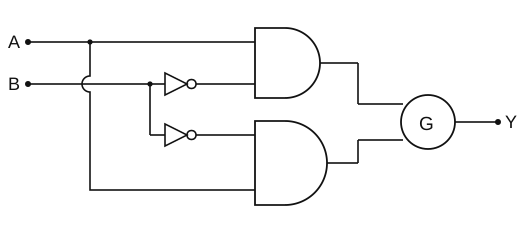
To obtain the given truth table, following logic gate should be placed at G:
दी गई सत्य सारणी (truth table) प्राप्त करने के लिए G के स्थान पर निम्नलिखित तर्क द्वार (logic gate) लगाना चाहिए :
- AOR GateOR गेट
- BAND GateAND गेट
- CNOR GateNOR गेट
- DNAND GateNAND गेट
Show answer
Concept: Trace the wiring: the top AND gate receives and ; the lower wire from A jumps over the B-line and feeds the bottom AND gate together with the second inverter's output . So both AND gates give the same output , and both inputs of gate G are always equal.
- equals 1 only for and 0 for the other three input rows.
- The required output is only for , i.e. — gate G must simply invert .
- With equal inputs: NOR gives and NAND gives — both reproduce the table. OR and AND give itself, which fails the first row ( needs ), so (A) and (B) are wrong.
- Hence two of the given gates, (C) NOR and (D) NAND, both produce the given truth table.
Answer: Bonus – both (C) and (D) give the required truth table, so the question has two correct options.
अवधारणा: परिपथ के तारों का अनुसरण कीजिए: ऊपरी AND गेट को तथा मिलते हैं; A से आने वाला निचला तार B-रेखा के ऊपर से (बिना जुड़े) गुजरकर निचले AND गेट को दूसरे इन्वर्टर के निर्गत के साथ मिलता है। अतः दोनों AND गेटों का निर्गत समान है: , और G के दोनों निवेश सदैव बराबर हैं।
- केवल के लिए 1 है तथा शेष तीनों पंक्तियों के लिए 0 है।
- अभीष्ट निर्गत केवल पर 0 है, अर्थात् — गेट G को केवल को उल्टा (invert) करना है।
- बराबर निवेशों के लिए: NOR देता है तथा NAND देता है — दोनों सारणी को संतुष्ट करते हैं। OR तथा AND स्वयं देते हैं, जो पहली पंक्ति ( पर ) पर गलत है, अतः (A) व (B) गलत हैं।
- अर्थात् दिए गए विकल्पों में से (C) NOR तथा (D) NAND दोनों से दी गई सत्य सारणी प्राप्त होती है।
उत्तर: Bonus – (C) तथा (D) दोनों से अभीष्ट सत्य सारणी मिलती है, अतः प्रश्न के दो सही विकल्प हैं।
JEE Main 2025 (January) – Paper 1 (B.E./B.Tech)PhysicsSemiconductors – logic gatesJEE Main 2025 (January) – Paper 1 (B.E./B.Tech) 2025 · 22 Jan Shift 2
Q627.A small rigid spherical ball of mass M is dropped in a long vertical tube containing glycerine. The velocity of the ball becomes constant after some time. If the density of glycerine is half of the density of the ball, then the viscous force acting on the ball will be (consider g as acceleration due to gravity)
M द्रव्यमान की एक छोटी दृढ़ गोलाकार गेंद को ग्लिसरीन से भरी एक लम्बी ऊर्ध्वाधर नली में गिराया जाता है। कुछ समय बाद गेंद का वेग नियत हो जाता है। यदि ग्लिसरीन का घनत्व गेंद के घनत्व का आधा हो, तो गेंद पर लगने वाला श्यान बल (viscous force) होगा (g को गुरुत्वीय त्वरण मानिए)
- A2 Mg
- BMg
- CMg
- D
Show answer
Concept: At terminal (constant) velocity the net force on the ball is zero: weight = buoyant force + viscous force.
- Buoyant force = weight of displaced glycerine (density of glycerine is half that of the ball).
- Force balance: .
- .
Short trick: at terminal speed.
Answer: (D)
अवधारणा: सीमान्त (नियत) वेग पर गेंद पर नेट बल शून्य होता है: भार = उत्प्लावन बल + श्यान बल।
- उत्प्लावन बल = विस्थापित ग्लिसरीन का भार (ग्लिसरीन का घनत्व गेंद के घनत्व का आधा है)।
- बल सन्तुलन: ।
- ।
शॉर्ट ट्रिक: सीमान्त चाल पर ।
उत्तर: (D)
JEE Main 2025 (January) – Paper 1 (B.E./B.Tech)PhysicsFluid mechanics – terminal velocityJEE Main 2025 (January) – Paper 1 (B.E./B.Tech) 2025 · 22 Jan Shift 2
Q628.The torque due to the force about the origin, acting on a particle whose position vector is , would be
मूल बिन्दु के परितः बल के कारण उस कण पर बल-आघूर्ण (torque), जिसका स्थिति सदिश है, होगा
- A
- B
- C
- D
Show answer
Concept: Torque about the origin .
- .
Answer: (A)
अवधारणा: मूल बिन्दु के परितः बल-आघूर्ण ।
- ।
उत्तर: (A)
JEE Main 2025 (January) – Paper 1 (B.E./B.Tech)PhysicsRotational motion – torqueJEE Main 2025 (January) – Paper 1 (B.E./B.Tech) 2025 · 22 Jan Shift 2
Q629.A symmetric thin biconvex lens is cut into four equal parts by two planes AB and CD as shown in figure. If the power of original lens is 4 D then the power of a part of the divided lens is
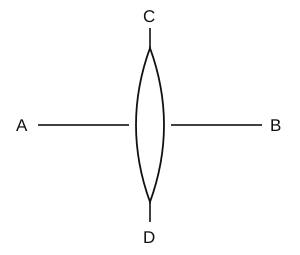
एक सममित पतले उभयोत्तल (biconvex) लेंस को चित्रानुसार दो तलों AB तथा CD द्वारा चार बराबर भागों में काटा जाता है। यदि मूल लेंस की क्षमता 4 D हो, तो विभाजित लेंस के एक भाग की क्षमता होगी
- AD
- B8D
- C2D
- D4D
Show answer
Concept: Cutting a lens along its principal axis (plane AB) does not change the radii of curvature, so the focal length and power stay the same. Cutting perpendicular to the axis (plane CD) converts the biconvex lens into two plano-convex pieces, each with one curved surface.
- Original lens: .
- Each quarter has only one curved surface of the same radius: .
- .
Short trick: Cut along the axis → power unchanged; cut across the axis → power halves.
Answer: (C) 2D
अवधारणा: मुख्य अक्ष के अनुदिश (तल AB से) काटने पर वक्रता त्रिज्याएँ नहीं बदलतीं, अतः फोकस दूरी व क्षमता वही रहती है। अक्ष के लम्बवत (तल CD से) काटने पर उभयोत्तल लेंस दो समतलोत्तल (plano-convex) भागों में बँट जाता है, जिनमें केवल एक वक्र पृष्ठ होता है।
- मूल लेंस: ।
- प्रत्येक चौथाई भाग में समान त्रिज्या का केवल एक वक्र पृष्ठ है: ।
- ।
शॉर्ट ट्रिक: अक्ष के अनुदिश काटने पर क्षमता अपरिवर्तित; अक्ष के आर-पार काटने पर क्षमता आधी।
उत्तर: (C) 2D
JEE Main 2025 (January) – Paper 1 (B.E./B.Tech)PhysicsRay optics – power of lensJEE Main 2025 (January) – Paper 1 (B.E./B.Tech) 2025 · 22 Jan Shift 2
Q630.For a short dipole placed at origin O, the dipole moment
is along x-axis, as shown in the figure. If the electric potential and electric field at A are
and
, respectively, then the correct combination of the electric potential and electric field, respectively, at point
on the y-axis is given by
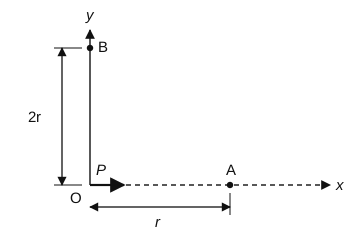
मूल बिन्दु O पर रखे एक लघु द्विध्रुव का द्विध्रुव आघूर्ण
चित्रानुसार x-अक्ष के अनुदिश है। यदि बिन्दु A पर विद्युत विभव तथा विद्युत क्षेत्र क्रमशः
तथा
हों, तो y-अक्ष पर स्थित बिन्दु
पर विद्युत विभव तथा विद्युत क्षेत्र का सही संयोजन क्रमशः होगा
- A and तथा
- Bzero and शून्य तथा
- Czero and शून्य तथा
- D and तथा
Show answer
Concept: For a short dipole: axial point — , ; equatorial point — , .
- A is on the axis at distance : , .
- B is on the equatorial line (y-axis) at distance : potential (every equatorial point of a dipole is at zero potential).
- .
Short trick: at the same distance; doubling the distance divides by 8 → factor .
Answer: (B) zero and
अवधारणा: लघु द्विध्रुव के लिए: अक्षीय बिन्दु — , ; निरक्षीय बिन्दु — , ।
- A अक्ष पर दूरी पर है: , ।
- B निरक्षीय रेखा (y-अक्ष) पर दूरी पर है: विभव (द्विध्रुव के प्रत्येक निरक्षीय बिन्दु पर विभव शून्य होता है)।
- ।
शॉर्ट ट्रिक: समान दूरी पर ; दूरी दोगुनी होने पर आठवाँ भाग → कुल गुणक ।
उत्तर: (B) शून्य तथा
JEE Main 2025 (January) – Paper 1 (B.E./B.Tech)PhysicsElectrostatics – electric dipoleJEE Main 2025 (January) – Paper 1 (B.E./B.Tech) 2025 · 22 Jan Shift 2
Q631.A transparent film of refractive index, 2.0 is coated on a glass slab of refractive index, 1.45. What is the minimum thickness of transparent film to be coated for the maximum transmission of Green light of wavelength 550 nm . [Assume that the light is incident nearly perpendicular to the glass surface.]
अपवर्तनांक 2.0 की एक पारदर्शी फिल्म, अपवर्तनांक 1.45 के काँच के स्लैब पर लेपित की जाती है। 550 nm तरंगदैर्ध्य के हरे प्रकाश के अधिकतम पारगमन (transmission) के लिए लेपित की जाने वाली पारदर्शी फिल्म की न्यूनतम मोटाई क्या होगी? [मानिए कि प्रकाश काँच की सतह पर लगभग लम्बवत आपतित होता है।]
- A137.5 nm
- B275 nm
- C94.8 nm
- D68.7 nm
Show answer
Concept: Maximum transmission means minimum reflection — the two reflected rays must interfere destructively. At the air–film surface (1.0 → 2.0, rarer to denser) there is a phase change of ; at the film–glass surface (2.0 → 1.45, denser to rarer) there is none.
- Net phase difference between reflected rays .
- For destructive interference: (m = 0 gives zero thickness).
- Minimum thickness: nm.
Short trick: Exactly one of the two reflections suffers a shift → anti-reflection condition is , so .
Answer: (A) 137.5 nm
अवधारणा: अधिकतम पारगमन का अर्थ है न्यूनतम परावर्तन — दोनों परावर्तित किरणों का विनाशी व्यतिकरण होना चाहिए। वायु–फिल्म पृष्ठ (1.0 → 2.0, विरल से सघन) पर का कलान्तर होता है; फिल्म–काँच पृष्ठ (2.0 → 1.45, सघन से विरल) पर नहीं।
- परावर्तित किरणों के बीच कुल कलान्तर ।
- विनाशी व्यतिकरण के लिए: (m = 0 पर मोटाई शून्य)।
- न्यूनतम मोटाई: nm।
शॉर्ट ट्रिक: दोनों में से ठीक एक परावर्तन पर का कलान्तर → अपरावर्तन शर्त , अतः ।
उत्तर: (A) 137.5 nm
JEE Main 2025 (January) – Paper 1 (B.E./B.Tech)PhysicsWave optics – thin film interferenceJEE Main 2025 (January) – Paper 1 (B.E./B.Tech) 2025 · 22 Jan Shift 2
Q632.Given are statements for certain thermodynamic variables, (A) Internal energy, volume (V) and mass (M) are extensive variables. (B) Pressure (P), temperature (T) and density () are intensive variables. (C) Volume (V), temperature (T) and density () are intensive variables. (D) Mass (M), temperature (T) and internal energy are extensive variables. Choose the correct answer from the options given below :
कुछ ऊष्मागतिक चरों के विषय में कथन दिए गए हैं, (A) आन्तरिक ऊर्जा, आयतन (V) तथा द्रव्यमान (M) विस्तृत (extensive) चर हैं। (B) दाब (P), ताप (T) तथा घनत्व () गहन (intensive) चर हैं। (C) आयतन (V), ताप (T) तथा घनत्व () गहन चर हैं। (D) द्रव्यमान (M), ताप (T) तथा आन्तरिक ऊर्जा विस्तृत चर हैं। नीचे दिए गए विकल्पों में से सही उत्तर चुनिए :
- A(B) and (C) Onlyकेवल (B) तथा (C)
- B(C) and (D) Onlyकेवल (C) तथा (D)
- C(D) and (A) Onlyकेवल (D) तथा (A)
- D(A) and (B) Onlyकेवल (A) तथा (B)
Show answer
Concept: Extensive variables scale with the size (amount of matter) of the system — mass, volume, internal energy. Intensive variables are independent of size — pressure, temperature, density.
- Statement (A): internal energy, V and M are all extensive — correct.
- Statement (B): P, T and are all intensive — correct.
- Statement (C) is wrong because volume (V) is extensive, not intensive.
- Statement (D) is wrong because temperature (T) is intensive, not extensive.
Answer: (D) (A) and (B) Only
अवधारणा: विस्तृत चर निकाय के आकार (पदार्थ की मात्रा) के साथ बदलते हैं — द्रव्यमान, आयतन, आन्तरिक ऊर्जा। गहन चर आकार पर निर्भर नहीं करते — दाब, ताप, घनत्व।
- कथन (A): आन्तरिक ऊर्जा, V तथा M सभी विस्तृत हैं — सही।
- कथन (B): P, T तथा सभी गहन हैं — सही।
- कथन (C) गलत है क्योंकि आयतन (V) विस्तृत चर है, गहन नहीं।
- कथन (D) गलत है क्योंकि ताप (T) गहन चर है, विस्तृत नहीं।
उत्तर: (D) केवल (A) तथा (B)
JEE Main 2025 (January) – Paper 1 (B.E./B.Tech)PhysicsThermodynamics – intensive and extensive variablesJEE Main 2025 (January) – Paper 1 (B.E./B.Tech) 2025 · 22 Jan Shift 2
Q633.An electron projected perpendicular to a uniform magnetic field B moves in a circle. If Bohr's quantization is applicable, then the radius of the electronic orbit in the first excited state is :
एकसमान चुम्बकीय क्षेत्र B के लम्बवत प्रक्षेपित एक इलेक्ट्रॉन वृत्त में गति करता है। यदि बोर का क्वाण्टीकरण (quantization) लागू हो, तो प्रथम उत्तेजित अवस्था में इलेक्ट्रॉनिक कक्षा की त्रिज्या है :
- A
- B
- C
- D
Show answer
Concept: Magnetic force provides the centripetal force, , and Bohr's rule quantizes angular momentum: .
- From : .
- Substitute in : , so .
- First excited state means : .
Short trick: here (unlike in hydrogen) — be careful to put , not .
Answer: (A)
अवधारणा: चुम्बकीय बल अभिकेन्द्र बल देता है, , तथा बोर का नियम कोणीय संवेग को क्वाण्टित करता है: ।
- से: ।
- में रखने पर: , अतः ।
- प्रथम उत्तेजित अवस्था का अर्थ है : ।
शॉर्ट ट्रिक: यहाँ (हाइड्रोजन के से भिन्न) — नहीं, रखना न भूलें।
उत्तर: (A)
JEE Main 2025 (January) – Paper 1 (B.E./B.Tech)PhysicsAtoms – Bohr quantizationJEE Main 2025 (January) – Paper 1 (B.E./B.Tech) 2025 · 22 Jan Shift 2
Q634.Given below are two statements. One is labelled as Assertion (A) and the other is labelled as Reason (R). Assertion (A) : In Young's double slit experiment, the fringes produced by red light are closer as compared to those produced by blue light. Reason (R): The fringe width is directly proportional to the wavelength of light. In the light of the above statements, choose the correct answer from the options given below :
नीचे दो कथन दिए गए हैं। एक को अभिकथन (A) तथा दूसरे को कारण (R) कहा गया है। अभिकथन (A) : यंग के द्विझिरी प्रयोग में, लाल प्रकाश द्वारा बनी फ्रिंजें नीले प्रकाश द्वारा बनी फ्रिंजों की तुलना में अधिक पास-पास होती हैं। कारण (R) : फ्रिंज चौड़ाई प्रकाश की तरंगदैर्ध्य के अनुक्रमानुपाती होती है। उपर्युक्त कथनों के आलोक में, नीचे दिए गए विकल्पों में से सही उत्तर चुनिए :
- ABoth (A) and (R) are true but (R) is NOT the correct explanation of (A)(A) तथा (R) दोनों सत्य हैं परन्तु (R), (A) की सही व्याख्या नहीं है
- B(A) is true but (R) is false(A) सत्य है परन्तु (R) असत्य है
- CBoth (A) and (R) are true and (R) is the correct explanation of (A)(A) तथा (R) दोनों सत्य हैं तथा (R), (A) की सही व्याख्या है
- D(A) is false but (R) is true(A) असत्य है परन्तु (R) सत्य है
Show answer
Concept: Fringe width in YDSE: , i.e. .
- Reason (R): fringe width is directly proportional to wavelength — true, from .
- , so red fringes are wider (farther apart), not closer.
- Hence Assertion (A) is false while Reason (R) is true.
Answer: (D) (A) is false but (R) is true
अवधारणा: यंग के प्रयोग में फ्रिंज चौड़ाई: , अर्थात् ।
- कारण (R): फ्रिंज चौड़ाई तरंगदैर्ध्य के अनुक्रमानुपाती है — से सत्य।
- , अतः लाल फ्रिंजें अधिक चौड़ी (अधिक दूर-दूर) होती हैं, पास-पास नहीं।
- अतः अभिकथन (A) असत्य है जबकि कारण (R) सत्य है।
उत्तर: (D) (A) असत्य है परन्तु (R) सत्य है
JEE Main 2025 (January) – Paper 1 (B.E./B.Tech)PhysicsWave optics – Young's double slit experimentJEE Main 2025 (January) – Paper 1 (B.E./B.Tech) 2025 · 22 Jan Shift 2
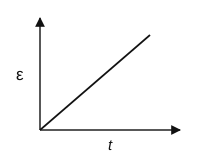
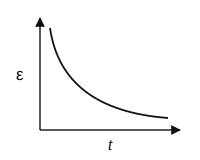
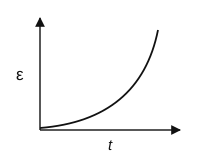
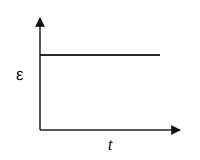
Q635.A rectangular metallic loop is moving out of a uniform magnetic field region to a field free region with a constant speed. When the loop is partially inside the magnate field, the plot of magnitude of induced emf () with time () is given by
एक आयताकार धात्विक लूप एकसमान चुम्बकीय क्षेत्र वाले क्षेत्र से क्षेत्र-मुक्त क्षेत्र की ओर नियत चाल से बाहर निकल रहा है। जब लूप आंशिक रूप से चुम्बकीय क्षेत्र के भीतर है, तब प्रेरित विद्युत वाहक बल () के परिमाण का समय () के साथ आलेख होगा
- A
- B
- C
- D
Show answer
Concept: Motional emf of a loop leaving a uniform field: , where is the width of the side still cutting field lines.
- While the loop is partially inside, only one side of length lies in the field and sweeps area at the rate .
- — with , and all constant, the emf is constant in time.
- So the – graph is a horizontal straight line, as in option (D). Options (A) and (C) show emf growing and (B) shows it decaying — all wrong, since nothing in changes with time.
Answer: (D) constant (horizontal line)
अवधारणा: एकसमान क्षेत्र से बाहर निकलते लूप का गतिक वि.वा. बल: , जहाँ क्षेत्र-रेखाओं को काटती भुजा की लम्बाई है।
- जब लूप आंशिक रूप से भीतर है, केवल लम्बाई की एक भुजा क्षेत्र में है और की दर से क्षेत्रफल बुहारती है।
- — , तथा सभी नियत हैं, अतः वि.वा. बल समय के साथ नियत है।
- अतः – आलेख क्षैतिज सरल रेखा है, जैसा विकल्प (D) में है। विकल्प (A) व (C) में वि.वा. बल बढ़ता तथा (B) में घटता दिखाया गया है — सभी गलत, क्योंकि में कुछ भी समय के साथ नहीं बदलता।
उत्तर: (D) नियत (क्षैतिज रेखा)
JEE Main 2025 (January) – Paper 1 (B.E./B.Tech)PhysicsElectromagnetic induction – motional emfJEE Main 2025 (January) – Paper 1 (B.E./B.Tech) 2025 · 22 Jan Shift 2
Q636.A ball of mass 100 g is projected with velocity 20 m/s at with horizontal. The decrease in kinetic energy of the ball during the motion from point of projection to highest point is
100 g द्रव्यमान की एक गेंद क्षैतिज से पर 20 m/s वेग से प्रक्षेपित की जाती है। प्रक्षेपण बिन्दु से उच्चतम बिन्दु तक गति के दौरान गेंद की गतिज ऊर्जा में कमी है
- A5 J
- B15 J
- C20 J
- Dzeroशून्य
Show answer
Concept: At the highest point only the horizontal component survives.
- Initial KE J.
- KE at top J.
- Decrease J.
Short trick: Decrease J.
Answer: (B) 15 J
अवधारणा: उच्चतम बिन्दु पर केवल क्षैतिज घटक शेष रहता है।
- प्रारम्भिक गतिज ऊर्जा J।
- शीर्ष पर गतिज ऊर्जा J।
- कमी J।
शॉर्ट ट्रिक: कमी J।
उत्तर: (B) 15 J
JEE Main 2025 (January) – Paper 1 (B.E./B.Tech)PhysicsProjectile motion – kinetic energyJEE Main 2025 (January) – Paper 1 (B.E./B.Tech) 2025 · 22 Jan Shift 2
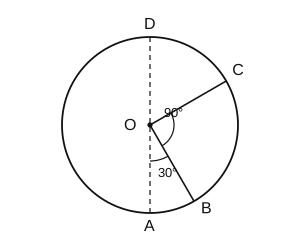
Q637.A body of mass 100 g is moving in circular path of radius 2 m on vertical plane as shown in figure. The velocity of the body at point
is 10 m/s. The ratio of its kinetic energies at point
and
is :
(Take acceleration due to gravity as 10 m/s )
100 g द्रव्यमान का एक पिण्ड चित्रानुसार ऊर्ध्वाधर तल में 2 m त्रिज्या के वृत्तीय पथ पर गति कर रहा है। बिन्दु
पर पिण्ड का वेग 10 m/s है। बिन्दु
तथा
पर इसकी गतिज ऊर्जाओं का अनुपात है :
(गुरुत्वीय त्वरण 10 m/s लीजिए)
- A
- B
- C
- D
Show answer
Concept: Energy conservation from the lowest point A: , where is the height above A and is the angle from OA.
- From the figure, B is at from OA and C is at from OA.
- m; .
- m; .
- .
Answer: (C)
अवधारणा: निम्नतम बिन्दु A से ऊर्जा संरक्षण: , जहाँ A से ऊँचाई है और , OA से मापा कोण है।
- चित्र से, B, OA से पर तथा C, OA से पर है।
- m; ।
- m; ।
- ।
उत्तर: (C)
JEE Main 2025 (January) – Paper 1 (B.E./B.Tech)PhysicsWork, energy and power – vertical circular motionJEE Main 2025 (January) – Paper 1 (B.E./B.Tech) 2025 · 22 Jan Shift 2
Q638.Given below are two statements. One is labelled as Assertion (A) and the other is labelled as Reason (R). Assertion (A) : A simple pendulum is taken to a planet of mass and radius, 4 times and 2 times, respectively, than the Earth. The time period of the pendulum remains same on earth and the planet. Reason (R): The mass of the pendulum remains unchanged at Earth and the other planet. In the light of the above statements, choose the correct answer from the options given below :
नीचे दो कथन दिए गए हैं। एक को अभिकथन (A) तथा दूसरे को कारण (R) कहा गया है। अभिकथन (A) : एक सरल लोलक को ऐसे ग्रह पर ले जाया जाता है जिसके द्रव्यमान तथा त्रिज्या पृथ्वी की तुलना में क्रमशः 4 गुना तथा 2 गुना हैं। लोलक का आवर्तकाल पृथ्वी तथा उस ग्रह पर समान रहता है। कारण (R) : लोलक का द्रव्यमान पृथ्वी तथा दूसरे ग्रह पर अपरिवर्तित रहता है। उपर्युक्त कथनों के आलोक में, नीचे दिए गए विकल्पों में से सही उत्तर चुनिए :
- A(A) is false but (R) is true(A) असत्य है परन्तु (R) सत्य है
- B(A) is true but (R) is false(A) सत्य है परन्तु (R) असत्य है
- CBoth (A) and (R) are true and (R) is the correct explanation of (A)(A) तथा (R) दोनों सत्य हैं तथा (R), (A) की सही व्याख्या है
- DBoth (A) and (R) are true but (R) is NOT the correct explanation of (A)(A) तथा (R) दोनों सत्य हैं परन्तु (R), (A) की सही व्याख्या नहीं है
Show answer
Concept: with — the period depends on , not on the bob's mass.
- On the planet: .
- Since , the time period is the same — Assertion (A) is true.
- Reason (R) is also a true statement: mass does not change from place to place.
- But the equality of periods is because is unchanged, not because the bob's mass is unchanged ( is independent of the bob's mass anyway). So (R) is not the correct explanation of (A).
Answer: (D) Both (A) and (R) are true but (R) is NOT the correct explanation of (A)
अवधारणा: तथा — आवर्तकाल पर निर्भर है, गोलक के द्रव्यमान पर नहीं।
- ग्रह पर: ।
- चूँकि , आवर्तकाल समान रहता है — अभिकथन (A) सत्य है।
- कारण (R) भी एक सत्य कथन है: द्रव्यमान स्थान बदलने से नहीं बदलता।
- परन्तु आवर्तकालों की समानता का कारण का अपरिवर्तित रहना है, गोलक के द्रव्यमान का नहीं ( वैसे भी गोलक के द्रव्यमान पर निर्भर नहीं करता)। अतः (R), (A) की सही व्याख्या नहीं है।
उत्तर: (D) (A) तथा (R) दोनों सत्य हैं परन्तु (R), (A) की सही व्याख्या नहीं है
JEE Main 2025 (January) – Paper 1 (B.E./B.Tech)PhysicsOscillations – simple pendulumJEE Main 2025 (January) – Paper 1 (B.E./B.Tech) 2025 · 22 Jan Shift 2
Q639.A series LCR circuit is connected to an alternating source of emf E. The current amplitude at resonant frequency is . If the value of resistance R becomes twice of its initial value then amplitude of current at resonance will be
एक श्रेणी LCR परिपथ प्रत्यावर्ती विद्युत वाहक बल E के स्रोत से जुड़ा है। अनुनादी आवृत्ति पर धारा का आयाम है। यदि प्रतिरोध R का मान अपने प्रारम्भिक मान का दोगुना हो जाए, तो अनुनाद पर धारा का आयाम होगा
- A
- B
- C
- D
Show answer
Concept: At resonance , so the impedance of a series LCR circuit is purely resistive: .
- at resonance.
- With : .
Answer: (C)
अवधारणा: अनुनाद पर , अतः श्रेणी LCR परिपथ की प्रतिबाधा शुद्ध प्रतिरोधी होती है: ।
- अनुनाद पर ।
- करने पर: ।
उत्तर: (C)
JEE Main 2025 (January) – Paper 1 (B.E./B.Tech)PhysicsAlternating current – LCR resonanceJEE Main 2025 (January) – Paper 1 (B.E./B.Tech) 2025 · 22 Jan Shift 2
Q640.Which one of the following is the correct dimensional formula for the capacitance in F ? M, L, T and C stand for unit of mass, length, time and charge,
फैरड (F) में धारिता के लिए निम्नलिखित में से कौन-सा विमीय सूत्र सही है? M, L, T तथा C क्रमशः द्रव्यमान, लम्बाई, समय तथा आवेश के मात्रक हैं,
- A
- B
- C
- D
Show answer
Concept: and , so capacitance (charge squared per energy).
- and .
- .
Short trick: From , capacitance = charge²/energy — fastest route when charge is a base unit.
Answer: (A)
अवधारणा: तथा , अतः धारिता (आवेश का वर्ग प्रति ऊर्जा)।
- तथा ।
- ।
शॉर्ट ट्रिक: से, धारिता = आवेश²/ऊर्जा — जब आवेश मूल मात्रक हो तो यही सबसे तेज़ रास्ता है।
उत्तर: (A)
JEE Main 2025 (January) – Paper 1 (B.E./B.Tech)PhysicsUnits and dimensionsJEE Main 2025 (January) – Paper 1 (B.E./B.Tech) 2025 · 22 Jan Shift 2

