Q641.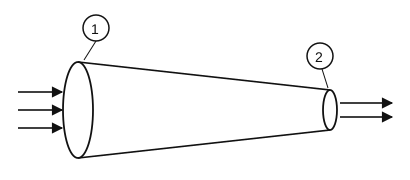
A tube of length is shown in the figure. The radius of cross section at the point (1) is 2 cm and at the point (2) is 1 cm , respectively. If the velocity of water entering at point (1) is 2 m/s, then velocity of water leaving the point (2) will be
चित्र में लम्बाई की एक नली दर्शाई गई है। बिन्दु (1) पर अनुप्रस्थ काट की त्रिज्या 2 cm तथा बिन्दु (2) पर 1 cm है। यदि बिन्दु (1) पर प्रवेश करते जल का वेग 2 m/s हो, तो बिन्दु (2) से निकलते जल का वेग होगा
- A4 m/s
- B2 m/s
- C6 m/s
- D8 m/s
Show answer
Concept: Equation of continuity for an incompressible fluid: .
- .
- m/s.
Short trick: Radius halves → area becomes one-fourth → speed becomes four times.
Answer: (D) 8 m/s
अवधारणा: असंपीड्य तरल के लिए सांतत्य समीकरण: ।
- ।
- m/s।
शॉर्ट ट्रिक: त्रिज्या आधी → क्षेत्रफल चौथाई → चाल चार गुनी।
उत्तर: (D) 8 m/s
JEE Main 2025 (January) – Paper 1 (B.E./B.Tech)PhysicsFluid mechanics – equation of continuityJEE Main 2025 (January) – Paper 1 (B.E./B.Tech) 2025 · 22 Jan Shift 2
Q642.A light source of wavelength illuminates a metal surface and electrons are ejected with maximum kinetic energy of 2 eV . If the same surface is illuminated by a light source of wavelength , then the maximum kinetic energy of ejected electrons will be (The work function of metal is 1 eV )
तरंगदैर्ध्य का एक प्रकाश स्रोत धातु की सतह को प्रदीप्त करता है और इलेक्ट्रॉन 2 eV की अधिकतम गतिज ऊर्जा से उत्सर्जित होते हैं। यदि उसी सतह को तरंगदैर्ध्य के प्रकाश स्रोत से प्रदीप्त किया जाए, तो उत्सर्जित इलेक्ट्रॉनों की अधिकतम गतिज ऊर्जा होगी (धातु का कार्य फलन 1 eV है)
- A3 eV
- B2 eV
- C6 eV
- D5 eV
Show answer
Concept: Einstein's photoelectric equation: .
- First case: eV.
- Second case: photon energy eV.
- eV.
Short trick: Halving doubles photon energy, but does not double because is subtracted only once.
Answer: (D) 5 eV
अवधारणा: आइंस्टीन का प्रकाश-विद्युत समीकरण: ।
- पहली स्थिति: eV।
- दूसरी स्थिति: फोटॉन ऊर्जा eV।
- eV।
शॉर्ट ट्रिक: आधी करने पर फोटॉन ऊर्जा दोगुनी होती है, परन्तु दोगुनी नहीं होती क्योंकि केवल एक बार घटता है।
उत्तर: (D) 5 eV
JEE Main 2025 (January) – Paper 1 (B.E./B.Tech)PhysicsPhotoelectric effectJEE Main 2025 (January) – Paper 1 (B.E./B.Tech) 2025 · 22 Jan Shift 2
Q643.The maximum percentage error in the measurment of density of a wire is [Given, mass of wire g radius of wire cm length of wire cm]
किसी तार के घनत्व के मापन में अधिकतम प्रतिशत त्रुटि है [दिया है, तार का द्रव्यमान g, तार की त्रिज्या cm, तार की लम्बाई cm]
- A8
- B5
- C4
- D7
Show answer
Concept: For , the maximum fractional error adds: .
- .
- .
- .
- Total .
Answer: (B) 5
अवधारणा: के लिए अधिकतम आंशिक त्रुटियाँ जुड़ती हैं: ।
- ।
- ।
- ।
- कुल ।
उत्तर: (B) 5
JEE Main 2025 (January) – Paper 1 (B.E./B.Tech)PhysicsUnits and measurements – error analysisJEE Main 2025 (January) – Paper 1 (B.E./B.Tech) 2025 · 22 Jan Shift 2
Q644.For a diatomic gas, if for rigid molecules and for another diatomic molecules, but also having vibrational modes. Then, which one of the following options is correct ? (Cp and Cv are specific heats of the gas at constant pressure and volume)
एक द्विपरमाणुक गैस के लिए, यदि दृढ़ (rigid) अणुओं हेतु है तथा ऐसे अन्य द्विपरमाणुक अणुओं हेतु, जिनमें कम्पन विधाएँ (vibrational modes) भी हैं, है, तो निम्नलिखित में से कौन-सा विकल्प सही है? (Cp तथा Cv नियत दाब तथा नियत आयतन पर गैस की विशिष्ट ऊष्माएँ हैं)
- A
- B
- C
- D
Show answer
Concept: , where is the number of degrees of freedom — more degrees of freedom means smaller .
- Rigid diatomic: (3 translational + 2 rotational), .
- With vibration: (one vibrational mode adds 2), .
- Hence .
Short trick: always decreases as increases.
Answer: (C)
अवधारणा: , जहाँ स्वातंत्र्य कोटियों की संख्या है — जितनी अधिक, उतना छोटा।
- दृढ़ द्विपरमाणुक: (3 स्थानान्तरीय + 2 घूर्णी), ।
- कम्पन सहित: (एक कम्पन विधा 2 कोटियाँ जोड़ती है), ।
- अतः ।
शॉर्ट ट्रिक: बढ़ने पर सदैव घटता है।
उत्तर: (C)
JEE Main 2025 (January) – Paper 1 (B.E./B.Tech)PhysicsKinetic theory of gases – degrees of freedomJEE Main 2025 (January) – Paper 1 (B.E./B.Tech) 2025 · 22 Jan Shift 2
Q645.A force is applied on a particle and it undergoes a displacement . What will be the value of , if work done on the particle is zero.
एक कण पर बल लगाया जाता है और उसका विस्थापन होता है। यदि कण पर किया गया कार्य शून्य हो, तो का मान क्या होगा?
- A0
- B
- C2
- D
Show answer
Concept: Work ; zero work means the force is perpendicular to the displacement.
- .
- Set : .
Answer: (B)
अवधारणा: कार्य ; शून्य कार्य का अर्थ है बल विस्थापन के लम्बवत है।
- ।
- रखने पर: ।
उत्तर: (B)
JEE Main 2025 (January) – Paper 1 (B.E./B.Tech)PhysicsWork, energy and power – work by a forceJEE Main 2025 (January) – Paper 1 (B.E./B.Tech) 2025 · 22 Jan Shift 2
Q646.A proton is moving undeflected in a region of crossed electric and magnetic fields at a constant speed of . When the electric field is switched off, the proton moves along a circular path of radius 2 cm . The magnitude of electric field is N/C. The value of is _______ Take the mass of the proton kg.
एक प्रोटॉन परस्पर लम्बवत (crossed) विद्युत तथा चुम्बकीय क्षेत्रों के क्षेत्र में की नियत चाल से अविक्षेपित (undeflected) गति कर रहा है। विद्युत क्षेत्र हटा देने पर प्रोटॉन 2 cm त्रिज्या के वृत्तीय पथ पर चलता है। विद्युत क्षेत्र का परिमाण N/C है। का मान _______ है। प्रोटॉन का द्रव्यमान kg लीजिए।
Show answer
Concept: Undeflected motion in crossed fields: . In the magnetic field alone: .
- T.
- N/C.
- Comparing with N/C: .
Answer: 2
अवधारणा: परस्पर लम्बवत क्षेत्रों में अविक्षेपित गति: । केवल चुम्बकीय क्षेत्र में: ।
- T।
- N/C।
- N/C से तुलना करने पर: ।
उत्तर: 2
JEE Main 2025 (January) – Paper 1 (B.E./B.Tech)PhysicsMoving charges – velocity selectorJEE Main 2025 (January) – Paper 1 (B.E./B.Tech) 2025 · 22 Jan Shift 2
Q647.The net current flowing in the given circuit is_______ A.
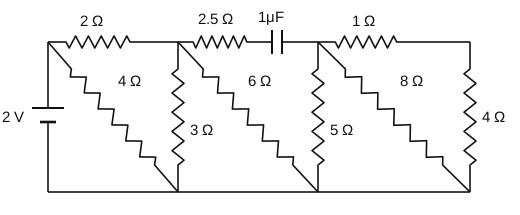
दिए गए परिपथ में प्रवाहित नेट धारा _______ A है।
Show answer
Concept: In steady state no current flows through the capacitor, so the branch containing 2.5 Ω and 1 μF is open. The part of the network to the right of the capacitor has no source, so it carries no current at all. The bottom wire makes all lower junctions a single node.
- Surviving paths from the battery's positive terminal (call it node T) to the bottom node: (i) the 4 Ω diagonal directly, (ii) 2 Ω to the middle-top node, then 3 Ω and 6 Ω in parallel to the bottom.
- , so path (ii) has resistance .
- A through the 4 Ω diagonal; A through the 2 Ω branch.
- Net current from the battery A.
Short trick: A fully-charged capacitor is an open switch — chop off everything beyond it that has no source.
Answer: 1
अवधारणा: स्थायी अवस्था में संधारित्र से कोई धारा नहीं बहती, अतः 2.5 Ω तथा 1 μF वाली शाखा खुली है। संधारित्र के दाईं ओर के भाग में कोई स्रोत नहीं है, अतः वहाँ कोई धारा नहीं बहती। नीचे का तार सभी निचले संधियों को एक ही नोड बना देता है।
- बैटरी के धन सिरे (नोड T) से निचले नोड तक बचे पथ: (i) सीधे 4 Ω विकर्ण से, (ii) 2 Ω से मध्य-ऊपरी नोड तक, फिर 3 Ω तथा 6 Ω समान्तर में नीचे तक।
- , अतः पथ (ii) का प्रतिरोध ।
- 4 Ω विकर्ण से A; 2 Ω शाखा से A।
- बैटरी से नेट धारा A।
शॉर्ट ट्रिक: पूर्ण आवेशित संधारित्र खुले स्विच जैसा है — उसके आगे का स्रोतहीन भाग हटा दीजिए।
उत्तर: 1
JEE Main 2025 (January) – Paper 1 (B.E./B.Tech)PhysicsCurrent electricity – capacitor in steady stateJEE Main 2025 (January) – Paper 1 (B.E./B.Tech) 2025 · 22 Jan Shift 2
Q648.A parallel plate capacitor of area and separation between the plates 10 cm , is charged by a DC current. Consider a hypothetical plane surface of area inside the capacitor and parallel to the plates. At an instant, the current through the circuit is 6A. At the same instant the displacement current through is ________ mA .
क्षेत्रफल तथा प्लेटों के बीच 10 cm दूरी वाले एक समान्तर प्लेट संधारित्र को DC धारा से आवेशित किया जाता है। संधारित्र के भीतर प्लेटों के समान्तर, क्षेत्रफल के एक काल्पनिक समतल पृष्ठ पर विचार कीजिए। किसी क्षण परिपथ में धारा 6 A है। उसी क्षण से होकर विस्थापन धारा ________ mA है।
Show answer
Concept: Between the plates the total displacement current equals the conduction current charging the capacitor, and it is uniformly distributed over the plate area.
- Total displacement current A (spread uniformly over ).
- Through the surface : A.
- mA. (The plate separation does not enter the calculation.)
Answer: 1200
अवधारणा: प्लेटों के बीच कुल विस्थापन धारा, संधारित्र को आवेशित करने वाली चालन धारा के बराबर होती है और प्लेट के क्षेत्रफल पर एकसमान वितरित रहती है।
- कुल विस्थापन धारा A ( पर एकसमान वितरित)।
- पृष्ठ से होकर: A।
- mA। (प्लेटों की दूरी गणना में नहीं आती।)
उत्तर: 1200
JEE Main 2025 (January) – Paper 1 (B.E./B.Tech)PhysicsElectromagnetic waves – displacement currentJEE Main 2025 (January) – Paper 1 (B.E./B.Tech) 2025 · 22 Jan Shift 2
Q649.A tube of length 1 m is filled completely with an ideal liquid of mass 2 M , and closed at both ends. The tube is rotated uniformly in horizontal plane about one of its ends. If the force exerted by the liquid at the other end is F then angular velocity of the tube is in SI unit. The value of is __________.
1 m लम्बाई की एक नली एक आदर्श द्रव से, जिसका द्रव्यमान 2 M है, पूर्णतः भरी है तथा दोनों सिरों पर बन्द है। नली को उसके एक सिरे के परितः क्षैतिज तल में एकसमान रूप से घुमाया जाता है। यदि द्रव द्वारा दूसरे सिरे पर लगाया गया बल F हो, तो नली का कोणीय वेग SI मात्रक में है। का मान __________ है।
Show answer
Concept: Each element of the rotating liquid needs a centripetal force; the far end-cap must supply the resultant inward force on the whole column, so the liquid pushes the far end outward with the equal and opposite force F.
- Mass per unit length . An element at distance needs force .
- .
- With m: .
- Comparing with : .
Answer: 1
अवधारणा: घूमते द्रव के प्रत्येक अवयव को अभिकेन्द्र बल चाहिए; दूर वाला सिरा पूरे स्तम्भ पर आवश्यक परिणामी अन्दर की ओर बल देता है, अतः द्रव उस सिरे पर बराबर व विपरीत बल F बाहर की ओर लगाता है।
- प्रति एकांक लम्बाई द्रव्यमान । दूरी पर अवयव को बल चाहिए।
- ।
- m रखने पर: ।
- से तुलना करने पर: ।
उत्तर: 1
JEE Main 2025 (January) – Paper 1 (B.E./B.Tech)PhysicsFluid mechanics – rotating liquid columnJEE Main 2025 (January) – Paper 1 (B.E./B.Tech) 2025 · 22 Jan Shift 2
Q650.Two long parallel wires
and
, separated by a distance of 6 cm , carry currents of 5A and 4A, respectively, in opposite directions as shown in the figure. Magnitude of the resultant magnetic field at point P at a distance of 4 cm from wire Y is
T. The value of
is __________. Take permeability of free space as
SI units.
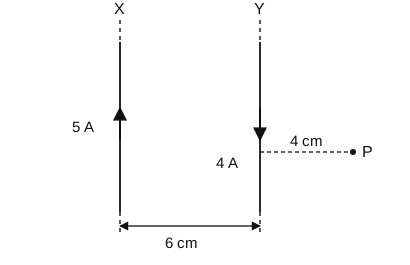
दो लम्बे समान्तर तार
तथा
, जो परस्पर 6 cm दूरी पर हैं, चित्रानुसार क्रमशः 5 A तथा 4 A की धाराएँ विपरीत दिशाओं में वहन करते हैं। तार Y से 4 cm दूरी पर स्थित बिन्दु P पर परिणामी चुम्बकीय क्षेत्र का परिमाण
T है।
का मान __________ है। निर्वात की चुम्बकशीलता
SI मात्रक लीजिए।
Show answer
Concept: Field of a long straight wire: . P lies 4 cm from Y on the side away from X, so it is cm from X. With opposite currents, the two fields at P point in opposite directions.
- T (due to X, current upward).
- T (due to Y, current downward).
- At P, by the right-hand rule, is into the page while is out of the page, so they subtract: T.
- Comparing with T: .
Answer: 1
अवधारणा: लम्बे सीधे तार का क्षेत्र: । P, तार Y से 4 cm दूर, X से दूर वाली ओर है, अतः X से इसकी दूरी cm है। विपरीत धाराओं के कारण P पर दोनों क्षेत्र विपरीत दिशाओं में हैं।
- T (ऊपर की ओर धारा वाले X के कारण)।
- T (नीचे की ओर धारा वाले Y के कारण)।
- दाएँ हाथ के नियम से P पर पृष्ठ के भीतर की ओर तथा पृष्ठ से बाहर की ओर है, अतः वे घटते हैं: T।
- T से तुलना करने पर: ।
उत्तर: 1
JEE Main 2025 (January) – Paper 1 (B.E./B.Tech)PhysicsMagnetic effects of current – field of parallel wiresJEE Main 2025 (January) – Paper 1 (B.E./B.Tech) 2025 · 22 Jan Shift 2
Q651.Given below are two statements :
Statement (I) : Nitrogen, sulphur, halogen and phosphorus present in an organic compound are detected by Lassaigne's Test.
Statement (II) : The elements present in the compound are converted from covalent form into ionic form by fusing the compound with Magnesium in Lassaigne's test.
In the light of the above statements, choose the correct answer from the options given below :
नीचे दो कथन दिए गए हैं :
कथन (I) : किसी कार्बनिक यौगिक में उपस्थित नाइट्रोजन, सल्फर, हैलोजन तथा फॉस्फोरस की पहचान लैसें परीक्षण (Lassaigne's Test) द्वारा की जाती है।
कथन (II) : लैसें परीक्षण में यौगिक को मैग्नीशियम के साथ संगलित करके यौगिक में उपस्थित तत्वों को सहसंयोजक रूप से आयनिक रूप में परिवर्तित किया जाता है।
उपर्युक्त कथनों के आलोक में, नीचे दिए गए विकल्पों में से सही उत्तर चुनिए :
- AStatement I is false but Statement II is trueकथन I असत्य है परन्तु कथन II सत्य है
- BBoth Statement I and Statement II are trueकथन I और कथन II दोनों सत्य हैं
- CBoth Statement I and Statement II are falseकथन I और कथन II दोनों असत्य हैं
- DStatement I is true but Statement II is falseकथन I सत्य है परन्तु कथन II असत्य है
Show answer
Concept: In Lassaigne's test the organic compound is fused with sodium metal; N, S, halogens and P are thereby converted from covalent form into ionic form (NaCN, Na2S, NaX, Na3PO4) and then detected in the sodium fusion extract.
- Statement I is true: nitrogen, sulphur, halogens and phosphorus are all detected by Lassaigne's test.
- Statement II is false: the fusion is done with sodium, not magnesium. Sodium is used because it is highly reactive and converts the elements into water-soluble ionic salts.
Short trick: Lassaigne = Na-fusion. Any statement replacing Na by Mg/K is wrong.
Answer: (D)
अवधारणा: लैसें परीक्षण में कार्बनिक यौगिक को सोडियम धातु के साथ संगलित किया जाता है; इससे N, S, हैलोजन तथा P सहसंयोजक रूप से आयनिक रूप (NaCN, Na2S, NaX, Na3PO4) में बदल जाते हैं और सोडियम संगलन निष्कर्ष में उनकी पहचान की जाती है।
- कथन I सत्य है : नाइट्रोजन, सल्फर, हैलोजन तथा फॉस्फोरस सभी की पहचान लैसें परीक्षण से होती है।
- कथन II असत्य है : संगलन सोडियम से किया जाता है, मैग्नीशियम से नहीं। सोडियम अत्यधिक क्रियाशील है और तत्वों को जल में विलेय आयनिक लवणों में बदल देता है।
शॉर्ट ट्रिक: लैसें = Na-संगलन। Na के स्थान पर Mg/K लिखा कथन गलत होता है।
उत्तर: (D)
JEE Main 2025 (January) – Paper 1 (B.E./B.Tech)ChemistryOrganic chemistry – Detection of elements (Lassaigne's test)JEE Main 2025 (January) – Paper 1 (B.E./B.Tech) 2025 · 22 Jan Shift 2
Q652.Density of 3 M NaCl solution is 1.25 g/mL. The molality of the solution is :
3 M NaCl विलयन का घनत्व 1.25 g/mL है। विलयन की मोललता (molality) है :
- A1.79 m
- B2.79 m
- C2 m
- D3 m
Show answer
Concept: Molality . Take 1 L of solution and subtract the mass of solute from the mass of solution.
- In 1 L of solution: moles of NaCl = 3 mol; mass of NaCl = 3 × 58.5 = 175.5 g.
- Mass of 1 L solution = 1000 mL × 1.25 g/mL = 1250 g.
- Mass of water = 1250 − 175.5 = 1074.5 g = 1.0745 kg.
- Molality = = 2.79 m.
Short trick: = ≈ 2.79 m.
Answer: (B) 2.79 m
अवधारणा: मोललता । 1 L विलयन लेकर विलयन के द्रव्यमान में से विलेय का द्रव्यमान घटाइए।
- 1 L विलयन में : NaCl के मोल = 3 mol; NaCl का द्रव्यमान = 3 × 58.5 = 175.5 g।
- 1 L विलयन का द्रव्यमान = 1000 mL × 1.25 g/mL = 1250 g।
- जल का द्रव्यमान = 1250 − 175.5 = 1074.5 g = 1.0745 kg।
- मोललता = = 2.79 m।
शॉर्ट ट्रिक: = ≈ 2.79 m।
उत्तर: (B) 2.79 m
JEE Main 2025 (January) – Paper 1 (B.E./B.Tech)ChemistrySolutions – Molarity and molalityJEE Main 2025 (January) – Paper 1 (B.E./B.Tech) 2025 · 22 Jan Shift 2
Q653.The correct order of the following complexes in terms of their crystal field stabilization energies is :
निम्नलिखित संकुलों का उनकी क्रिस्टल क्षेत्र स्थायीकरण ऊर्जा (crystal field stabilization energy) के पदों में सही क्रम है :
- A[Co(NH3)4]2+ < [Co(NH3)6]2+ < [Co(en)3]3+ < [Co(NH3)6]3+
- B[Co(NH3)6]2+ < [Co(NH3)6]3+ < [Co(NH3)4]2+ < [Co(en)3]3+
- C[Co(en)3]3+ < [Co(NH3)6]3+ < [Co(NH3)6]2+ < [Co(NH3)4]2+
- D[Co(NH3)4]2+ < [Co(NH3)6]2+ < [Co(NH3)6]3+ < [Co(en)3]3+
Show answer
Concept: CFSE increases with (i) octahedral > tetrahedral geometry (), (ii) higher oxidation state of the metal, and (iii) stronger field ligand (en > NH3 in the spectrochemical series).
- [Co(NH3)4]2+ is tetrahedral → smallest splitting, least CFSE.
- [Co(NH3)6]2+ is octahedral but Co is only +2 → moderate CFSE.
- [Co(NH3)6]3+ has Co3+ → larger Δo than the Co2+ complex.
- [Co(en)3]3+ has Co3+ with the stronger chelating ligand en → largest CFSE.
- Hence [Co(NH3)4]2+ < [Co(NH3)6]2+ < [Co(NH3)6]3+ < [Co(en)3]3+.
Short trick: Geometry first (Td < Oh), then oxidation state, then ligand strength.
Answer: (D)
अवधारणा: CFSE बढ़ती है : (i) अष्टफलकीय > चतुष्फलकीय ज्यामिति (), (ii) धातु की उच्च ऑक्सीकरण अवस्था, तथा (iii) प्रबल क्षेत्र लिगन्ड (स्पेक्ट्रोरासायनिक श्रेणी में en > NH3)।
- [Co(NH3)4]2+ चतुष्फलकीय है → सबसे कम विपाटन, न्यूनतम CFSE।
- [Co(NH3)6]2+ अष्टफलकीय है परन्तु Co केवल +2 में है → मध्यम CFSE।
- [Co(NH3)6]3+ में Co3+ है → Co2+ संकुल से बड़ा Δo।
- [Co(en)3]3+ में Co3+ के साथ प्रबल कीलेटी लिगन्ड en है → अधिकतम CFSE।
- अतः [Co(NH3)4]2+ < [Co(NH3)6]2+ < [Co(NH3)6]3+ < [Co(en)3]3+।
शॉर्ट ट्रिक: पहले ज्यामिति (Td < Oh), फिर ऑक्सीकरण अवस्था, फिर लिगन्ड की प्रबलता।
उत्तर: (D)
JEE Main 2025 (January) – Paper 1 (B.E./B.Tech)ChemistryCoordination compounds – Crystal field stabilization energyJEE Main 2025 (January) – Paper 1 (B.E./B.Tech) 2025 · 22 Jan Shift 2
Q654.Given below are two statements :
Statement (I) : Corrosion is an electrochemical phenomenon in which pure metal acts as an anode and impure metal as a cathode.
Statement (II) : The rate of corrosion is more in alkaline medium than in acidic medium.
In the light of the above statements, choose the correct answer from the options given below :
नीचे दो कथन दिए गए हैं :
कथन (I) : संक्षारण (corrosion) एक वैद्युतरासायनिक परिघटना है जिसमें शुद्ध धातु ऐनोड के रूप में तथा अशुद्ध धातु कैथोड के रूप में कार्य करती है।
कथन (II) : क्षारीय माध्यम में संक्षारण की दर अम्लीय माध्यम की अपेक्षा अधिक होती है।
उपर्युक्त कथनों के आलोक में, नीचे दिए गए विकल्पों में से सही उत्तर चुनिए :
- ABoth Statement I and Statement II are trueकथन I और कथन II दोनों सत्य हैं
- BStatement I is false but Statement II is trueकथन I असत्य है परन्तु कथन II सत्य है
- CStatement I is true but Statement II is falseकथन I सत्य है परन्तु कथन II असत्य है
- DBoth Statement I and Statement II are falseकथन I और कथन II दोनों असत्य हैं
Show answer
Concept: Corrosion works like a tiny electrochemical cell on the metal surface: the pure metal portion is oxidised (anode) while the impurity/less active spot serves as the cathode where O2 is reduced. H+ ions accelerate corrosion.
- Statement I is true: at the anodic spot the pure metal loses electrons (M → Mn+ + ne−); the impurity acts as the cathode.
- Statement II is false: corrosion is faster in acidic medium, because the cathodic reaction O2 + 4H+ + 4e− → 2H2O is favoured at high [H+]; in alkaline medium corrosion is suppressed.
Short trick: Rust loves acid rain — more H+, faster corrosion.
Answer: (C)
अवधारणा: संक्षारण धातु की सतह पर बने एक लघु वैद्युतरासायनिक सेल की तरह होता है : शुद्ध धातु वाला भाग ऑक्सीकृत होता है (ऐनोड) जबकि अशुद्धि वाला स्थान कैथोड बनता है जहाँ O2 अपचयित होती है। H+ आयन संक्षारण को तीव्र करते हैं।
- कथन I सत्य है : ऐनोडी स्थल पर शुद्ध धातु इलेक्ट्रॉन त्यागती है (M → Mn+ + ne−); अशुद्धि कैथोड का कार्य करती है।
- कथन II असत्य है : संक्षारण अम्लीय माध्यम में तीव्र होता है, क्योंकि उच्च [H+] पर कैथोडी अभिक्रिया O2 + 4H+ + 4e− → 2H2O अनुकूल होती है; क्षारीय माध्यम में संक्षारण मंद हो जाता है।
शॉर्ट ट्रिक: जंग को अम्ल प्रिय है — जितने अधिक H+, उतना तीव्र संक्षारण।
उत्तर: (C)
JEE Main 2025 (January) – Paper 1 (B.E./B.Tech)ChemistryElectrochemistry – CorrosionJEE Main 2025 (January) – Paper 1 (B.E./B.Tech) 2025 · 22 Jan Shift 2
Q655.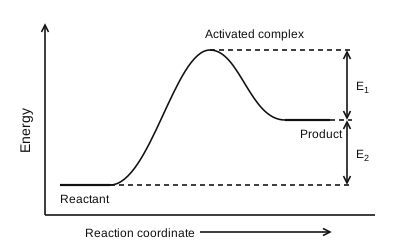
Consider the given figure and choose the correct option :
दिए गए चित्र पर विचार कीजिए तथा सही विकल्प चुनिए :
- AActivation energy of both forward and backward reaction is E1 + E2 and reactant is more stable than product.अग्र तथा प्रतीप दोनों अभिक्रियाओं की सक्रियण ऊर्जा E1 + E2 है तथा अभिकारक, उत्पाद से अधिक स्थायी है।
- BActivation energy of forward reaction is E1 + E2 and product is less stable than reactant.अग्र अभिक्रिया की सक्रियण ऊर्जा E1 + E2 है तथा उत्पाद, अभिकारक से कम स्थायी है।
- CActivation energy of backward reaction is E1 and product is more stable than reactant.प्रतीप अभिक्रिया की सक्रियण ऊर्जा E1 है तथा उत्पाद, अभिकारक से अधिक स्थायी है।
- DActivation energy of forward reaction is E1 + E2 and product is more stable than reactant.अग्र अभिक्रिया की सक्रियण ऊर्जा E1 + E2 है तथा उत्पाद, अभिकारक से अधिक स्थायी है।
Show answer
Concept: Activation energy = energy gap between the starting level and the peak (activated complex); the lower the energy level, the more stable the species.
- From the figure, the product level lies E1 below the peak and the reactant level lies E2 below the product level.
- Forward activation energy (reactant → peak) = E1 + E2; backward activation energy (product → peak) = E1.
- The product lies at higher energy than the reactant → product is less stable than reactant (endothermic reaction).
- (A) is wrong because backward Ea is only E1; (C) and (D) are wrong because the product is less stable, not more stable.
Short trick: Lower level = more stable; Ea is always measured up to the hump.
Answer: (B)
अवधारणा: सक्रियण ऊर्जा = प्रारम्भिक स्तर और शिखर (सक्रियित संकुल) के बीच का ऊर्जा अन्तर; जितना नीचा ऊर्जा स्तर, उतनी अधिक स्थायी स्पीशीज़।
- चित्र से, उत्पाद का स्तर शिखर से E1 नीचे है तथा अभिकारक का स्तर उत्पाद से E2 नीचे है।
- अग्र अभिक्रिया की सक्रियण ऊर्जा (अभिकारक → शिखर) = E1 + E2; प्रतीप अभिक्रिया की सक्रियण ऊर्जा (उत्पाद → शिखर) = E1।
- उत्पाद, अभिकारक से ऊँची ऊर्जा पर है → उत्पाद अभिकारक से कम स्थायी है (ऊष्माशोषी अभिक्रिया)।
- (A) गलत है क्योंकि प्रतीप Ea केवल E1 है; (C) तथा (D) गलत हैं क्योंकि उत्पाद कम स्थायी है, अधिक नहीं।
शॉर्ट ट्रिक: नीचा स्तर = अधिक स्थायी; Ea सदैव शिखर तक मापी जाती है।
उत्तर: (B)
JEE Main 2025 (January) – Paper 1 (B.E./B.Tech)ChemistryChemical kinetics – Energy profile diagramJEE Main 2025 (January) – Paper 1 (B.E./B.Tech) 2025 · 22 Jan Shift 2
Q656.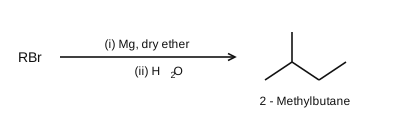
The maximum number of RBr producing 2-methylbutane by above sequence of reactions is ________ (Consider the structural isomers only)
उपरोक्त अभिक्रिया अनुक्रम द्वारा 2-मेथिलब्यूटेन देने वाले RBr की अधिकतम संख्या ________ है। (केवल संरचनात्मक समावयवियों (structural isomers) पर विचार कीजिए)
- A5
- B4
- C3
- D1
Show answer
Concept: RBr + Mg (dry ether) gives RMgBr, which on hydrolysis gives the alkane R–H. So every structurally different monobromide of 2-methylbutane gives 2-methylbutane.
- The carbon skeleton of R must be that of 2-methylbutane (C5H11–Br).
- Distinct positions for Br on the 2-methylbutane skeleton: C-1 (1-bromo-2-methylbutane), C-2 (2-bromo-2-methylbutane), C-3 (2-bromo-3-methylbutane) and C-4 (1-bromo-3-methylbutane).
- Hence 4 structural isomers of RBr give 2-methylbutane.
Short trick: Number of monobromo structural isomers = number of different types of H in 2-methylbutane = 4.
Answer: (B)
अवधारणा: RBr + Mg (शुष्क ईथर) से RMgBr बनता है, जो जल-अपघटन पर ऐल्केन R–H देता है। अतः 2-मेथिलब्यूटेन का प्रत्येक संरचनात्मक रूप से भिन्न मोनोब्रोमाइड 2-मेथिलब्यूटेन देगा।
- R का कार्बन कंकाल 2-मेथिलब्यूटेन का होना चाहिए (C5H11–Br)।
- 2-मेथिलब्यूटेन के कंकाल पर Br की भिन्न स्थितियाँ : C-1 (1-ब्रोमो-2-मेथिलब्यूटेन), C-2 (2-ब्रोमो-2-मेथिलब्यूटेन), C-3 (2-ब्रोमो-3-मेथिलब्यूटेन) तथा C-4 (1-ब्रोमो-3-मेथिलब्यूटेन)।
- अतः RBr के 4 संरचनात्मक समावयवी 2-मेथिलब्यूटेन देते हैं।
शॉर्ट ट्रिक: मोनोब्रोमो संरचनात्मक समावयवियों की संख्या = 2-मेथिलब्यूटेन में भिन्न प्रकार के H की संख्या = 4।
उत्तर: (B)
JEE Main 2025 (January) – Paper 1 (B.E./B.Tech)ChemistryHaloalkanes – Grignard reagentJEE Main 2025 (January) – Paper 1 (B.E./B.Tech) 2025 · 22 Jan Shift 2
Q657.The species which does not undergo disproportionation reaction is :
वह स्पीशीज़ जो विषमानुपातन (disproportionation) अभिक्रिया प्रदर्शित नहीं करती है, है :
- AClO3−
- BClO−
- CClO2−
- DClO4−
Show answer
Concept: Disproportionation needs an element in an intermediate oxidation state, so that it can be simultaneously oxidised and reduced.
- Oxidation state of Cl: ClO− (+1), ClO2− (+3), ClO3− (+5), ClO4− (+7).
- In ClO4−, chlorine is in its highest possible oxidation state (+7); it cannot be oxidised further, so it cannot disproportionate.
- ClO−, ClO2− and ClO3− have Cl in intermediate states and do disproportionate (e.g. 4ClO3− → Cl− + 3ClO4−).
Short trick: Highest oxidation state ⇒ no disproportionation.
Answer: (D)
अवधारणा: विषमानुपातन के लिए तत्व का मध्यवर्ती ऑक्सीकरण अवस्था में होना आवश्यक है, ताकि वह एक साथ ऑक्सीकृत एवं अपचयित हो सके।
- Cl की ऑक्सीकरण अवस्था : ClO− (+1), ClO2− (+3), ClO3− (+5), ClO4− (+7)।
- ClO4− में क्लोरीन अपनी उच्चतम सम्भव ऑक्सीकरण अवस्था (+7) में है; इसका और ऑक्सीकरण सम्भव नहीं, अतः यह विषमानुपातित नहीं हो सकता।
- ClO−, ClO2− तथा ClO3− में Cl मध्यवर्ती अवस्था में है और ये विषमानुपातन दर्शाते हैं (जैसे 4ClO3− → Cl− + 3ClO4−)।
शॉर्ट ट्रिक: उच्चतम ऑक्सीकरण अवस्था ⇒ विषमानुपातन नहीं।
उत्तर: (D)
JEE Main 2025 (January) – Paper 1 (B.E./B.Tech)ChemistryRedox reactions – DisproportionationJEE Main 2025 (January) – Paper 1 (B.E./B.Tech) 2025 · 22 Jan Shift 2
Q658.The molar solubility(s) of zirconium phosphate with molecular formula (Zr4+)3(PO43−)4 is given by relation :
अणुसूत्र (Zr4+)3(PO43−)4 वाले ज़र्कोनियम फॉस्फेट की मोलर विलेयता (s) निम्न सम्बन्ध द्वारा दी जाती है :
- A
- B
- C
- D
Show answer
Concept: For a salt AxBy with molar solubility s, .
- Zr3(PO4)4 ⇌ 3Zr4+ + 4PO43−.
- .
- Therefore .
Short trick: ; here , .
Answer: (B)
अवधारणा: मोलर विलेयता s वाले लवण AxBy के लिए ।
- Zr3(PO4)4 ⇌ 3Zr4+ + 4PO43−।
- ।
- अतः ।
शॉर्ट ट्रिक: ; यहाँ , ।
उत्तर: (B)
JEE Main 2025 (January) – Paper 1 (B.E./B.Tech)ChemistryIonic equilibrium – Solubility productJEE Main 2025 (January) – Paper 1 (B.E./B.Tech) 2025 · 22 Jan Shift 2
Q659.Identify the homoleptic complex(es) that is/are low spin.
(A) [Fe(CN)5NO]2− (B) [CoF6]3− (C) [Fe(CN)6]4− (D) [Co(NH3)6]3+ (E) [Cr(H2O)6]2+
Choose the correct answer from the options given below :
उन समलिगेंडी (homoleptic) संकुल/संकुलों की पहचान कीजिए जो निम्न चक्रण (low spin) है/हैं।
(A) [Fe(CN)5NO]2− (B) [CoF6]3− (C) [Fe(CN)6]4− (D) [Co(NH3)6]3+ (E) [Cr(H2O)6]2+
नीचे दिए गए विकल्पों में से सही उत्तर चुनिए :
- A(C) onlyकेवल (C)
- B(C) and (D) onlyकेवल (C) और (D)
- C(A) and (C) onlyकेवल (A) और (C)
- D(B) and (E) onlyकेवल (B) और (E)
Show answer
Concept: A homoleptic complex has only one kind of ligand. Low spin results with strong field ligands (CN−) or with M3+ ions of later 3d metals even with NH3.
- (A) [Fe(CN)5NO]2− has two different ligands → heteroleptic, ruled out even though it is low spin.
- (B) [CoF6]3−: F− is weak field → high spin.
- (C) [Fe(CN)6]4−: homoleptic, CN− strong field → low spin (t2g6).
- (D) [Co(NH3)6]3+: homoleptic; for Co3+, NH3 produces a large enough Δo → low spin, diamagnetic (t2g6).
- (E) [Cr(H2O)6]2+: H2O weak field → high spin. Hence only (C) and (D).
Short trick: With Co3+, every ligand from NH3 onwards in the spectrochemical series gives a low-spin complex.
Answer: (B)
अवधारणा: समलिगेंडी संकुल में केवल एक ही प्रकार का लिगन्ड होता है। निम्न चक्रण प्रबल क्षेत्र लिगन्डों (CN−) से, अथवा परवर्ती 3d धातुओं के M3+ आयनों में NH3 से भी प्राप्त होता है।
- (A) [Fe(CN)5NO]2− में दो भिन्न लिगन्ड हैं → विषमलिगेंडी, अतः निम्न चक्रण होते हुए भी मान्य नहीं।
- (B) [CoF6]3− : F− दुर्बल क्षेत्र है → उच्च चक्रण।
- (C) [Fe(CN)6]4− : समलिगेंडी, CN− प्रबल क्षेत्र → निम्न चक्रण (t2g6)।
- (D) [Co(NH3)6]3+ : समलिगेंडी; Co3+ के लिए NH3 पर्याप्त बड़ा Δo देता है → निम्न चक्रण, प्रतिचुम्बकीय (t2g6)।
- (E) [Cr(H2O)6]2+ : H2O दुर्बल क्षेत्र → उच्च चक्रण। अतः केवल (C) और (D)।
शॉर्ट ट्रिक: Co3+ के साथ स्पेक्ट्रोरासायनिक श्रेणी में NH3 से आगे का प्रत्येक लिगन्ड निम्न चक्रण संकुल देता है।
उत्तर: (B)
JEE Main 2025 (January) – Paper 1 (B.E./B.Tech)ChemistryCoordination compounds – High spin and low spin complexesJEE Main 2025 (January) – Paper 1 (B.E./B.Tech) 2025 · 22 Jan Shift 2
Q660. | List - I
(Partial Derivatives) | | List - II
(Thermodynamic Quantity) |
|---|
| (A) | | (I) | Cp |
| (B) | | (II) | −S |
| (C) | | (III) | CV |
| (D) | | (IV) | V |
Match List - I with List - II.
Choose the correct answer from the options given below :
| List - I
(Partial Derivatives) | | List - II
(Thermodynamic Quantity) |
|---|
| (A) | | (I) | Cp |
| (B) | | (II) | −S |
| (C) | | (III) | CV |
| (D) | | (IV) | V |
सूची-I का सूची-II से मिलान कीजिए।
नीचे दिए गए विकल्पों में से सही उत्तर चुनिए :
- A(A)-(II), (B)-(I), (C)-(III), (D)-(IV)
- B(A)-(I), (B)-(II), (C)-(IV), (D)-(III)
- C(A)-(II), (B)-(I), (C)-(IV), (D)-(III)
- D(A)-(II), (B)-(III), (C)-(I), (D)-(IV)
Show answer
Concept: From dG = VdP − SdT, dH = TdS + VdP and dU = TdS − PdV, together with the definitions of heat capacities.
- (A) → (II).
- (B) → (I).
- (C) → (IV).
- (D) → (III).
- Only option (C) carries this full matching; the others mismatch (C)/(D) with CV, V or S.
Short trick: dG = VdP − SdT: G differentiated by T gives −S, by P gives V.
Answer: (C)
अवधारणा: dG = VdP − SdT, dH = TdS + VdP तथा dU = TdS − PdV और ऊष्माधारिताओं की परिभाषाओं से।
- (A) → (II)।
- (B) → (I)।
- (C) → (IV)।
- (D) → (III)।
- यह पूर्ण मिलान केवल विकल्प (C) में है; शेष विकल्पों में (C)/(D) का मिलान CV, V या S से गलत किया गया है।
शॉर्ट ट्रिक: dG = VdP − SdT : G का T से अवकलन −S देता है, P से अवकलन V देता है।
उत्तर: (C)
JEE Main 2025 (January) – Paper 1 (B.E./B.Tech)ChemistryThermodynamics – Partial derivatives of state functionsJEE Main 2025 (January) – Paper 1 (B.E./B.Tech) 2025 · 22 Jan Shift 2

