NEET UG · 2,240 questions

NEET UG 2015, 2016, 2017, 2018, 2019, 2020, 2021, 2022, 2023, 2024, 2025, 2026 PYQs

Real previous year questions, subject-wise. Try the question, then open the answer and the explanation in Hindi & English – free, no login.

Courses – airGurukul

2,240 questions.

Q321.
Given below are two statements:
Statement I: Fig fruit is a non-vegetarian fruit as it has enclosed fig wasps in it.
Statement II: Fig wasp and fig tree exhibit mutual relationship as fig wasp completes its life cycle in fig fruit and fig fruit gets pollinated by fig wasp.
In the light of the above statements, choose the most appropriate answer from the options given below :
नीचे दो कथन दिए गए हैं :
कथन I: अंजीर का फल एक मांसाहारी फल है क्योंकि इसमें अंजीर ततैया बंद रहती हैं।
कथन II: अंजीर ततैया और अंजीर वृक्ष सहोपकारी संबंध दर्शाते हैं क्योंकि अंजीर ततैया अपना जीवन चक्र अंजीर फल में पूरा करती है और अंजीर फल ततैया द्वारा परागित होता है।
उपर्युक्त कथनों के आलोक में, नीचे दिए गए विकल्पों में से सबसे उपयुक्त उत्तर चुनिए :
  1. AStatement I is correct but statement II is incorrectकथन I सही है परन्तु कथन II गलत है
  2. BStatement I is incorrect but statement II is correctकथन I गलत है परन्तु कथन II सही है
  3. CBoth statement I and statement II are correctकथन I और कथन II दोनों सही हैं
  4. DBoth statement I and statement II are incorrectकथन I और कथन II दोनों गलत हैं
Show answer

Concept: NCERT (Organisms & Populations): the fig and its pollinator wasp show obligate mutualism – the female wasp pollinates the fig inflorescence (its flowers) while searching for egg-laying sites, and uses the fruit as an oviposition site and the developing seeds to nourish its larvae.

  1. Statement I – incorrect. The fig (syconium) is a plant product; wasps that die inside are broken down by the plant’s enzyme (ficin). "Non-vegetarian fruit" is a dietary label, not a biological fact.
  2. Statement II – incorrect as worded. Pollination is the transfer of pollen to the stigma of a flower; a fruit develops only after pollination and fertilisation, so a "fig fruit" cannot "get pollinated". NCERT says the wasp pollinates the fig inflorescence. The statement also ties the mutualism to wrong reasoning, so it cannot be accepted as correct.
  3. Both statements are incorrect → (D). (A) and (C) wrongly accept Statement I; (B) wrongly accepts Statement II.

Short trick: Read every word of a statement – "fruit gets pollinated" is impossible (flower → pollination → fruit). One wrong word makes the statement wrong.

Answer: (D) Both statement I and statement II are incorrect

अवधारणा: NCERT (जीव और समष्टियाँ): अंजीर और उसकी परागणकारी ततैया अविकल्पी सहोपकारिता दर्शाते हैं – मादा ततैया अंडे देने का स्थान खोजते समय अंजीर के पुष्पक्रम (उसके पुष्पों) को परागित करती है, और फल को अंडनिक्षेपण स्थल तथा विकसित होते बीजों को अपने लार्वा के पोषण हेतु उपयोग करती है।

  1. कथन I – गलत। अंजीर (साइकोनस) एक पादप उत्पाद है; अंदर मरने वाली ततैया पादप के एंजाइम (फ़िसिन) द्वारा विघटित हो जाती हैं। "मांसाहारी फल" एक आहार-संबंधी लेबल है, जैविक तथ्य नहीं।
  2. कथन II – जैसा लिखा है वैसा गलत। परागण किसी पुष्प के वर्तिकाग्र तक परागकणों का स्थानांतरण है; फल परागण और निषेचन के बाद ही बनता है, अतः "अंजीर फल" का "परागित होना" संभव नहीं। NCERT के अनुसार ततैया अंजीर के पुष्पक्रम को परागित करती है। कथन सहोपकारिता को गलत तर्क से जोड़ता है, इसलिए इसे सही नहीं माना जा सकता।
  3. दोनों कथन गलत हैं → (D)। (A) और (C) कथन I को गलत रूप से सही मानते हैं; (B) कथन II को गलत रूप से सही मानता है।

शॉर्ट ट्रिक: कथन का हर शब्द पढ़ें – "फल परागित होता है" असंभव है (पुष्प → परागण → फल)। एक गलत शब्द पूरे कथन को गलत बना देता है।

उत्तर: (D) कथन I और कथन II दोनों गलत हैं
NEET UGBiologyOrganisms and populations – mutualismNEET UG 2025 · 4 May Shift 1
Q322.
Given below are two statements: One is labelled as Assertion (A) and the other is labelled as Reason (R).
Assertion (A) : Cells of the tapetum possess dense cytoplasm and generally have more than one nucleus.
Reason (R) : Presence of more than one nucleus in the tapetum increases the efficiency of nourishing the developing microspore mother cells.
In light of the above statements, choose the most appropriate answer from the options given below :
नीचे दो कथन दिए गए हैं : एक को अभिकथन (A) तथा दूसरे को कारण (R) के रूप में चिह्नित किया गया है।
अभिकथन (A) : टेपीटम की कोशिकाओं में सघन कोशिकाद्रव्य होता है और सामान्यतः एक से अधिक केन्द्रक होते हैं।
कारण (R) : टेपीटम में एक से अधिक केन्द्रक की उपस्थिति विकासशील लघुबीजाणु मातृ कोशिकाओं के पोषण की दक्षता बढ़ाती है।
उपर्युक्त कथनों के आलोक में, नीचे दिए गए विकल्पों में से सबसे उपयुक्त उत्तर चुनिए :
  1. AA is true but R is falseA सही है परन्तु R गलत है
  2. BA is false but R is trueA गलत है परन्तु R सही है
  3. CBoth A and R are true and R is the correct explanation of AA और R दोनों सही हैं तथा R, A की सही व्याख्या है
  4. DBoth A and R are true but R is NOT the correct explanation of AA और R दोनों सही हैं परन्तु R, A की सही व्याख्या नहीं है
Show answer

Concept: NCERT: the tapetum (innermost anther wall layer) nourishes the developing pollen; its cells have dense cytoplasm and generally more than one nucleus.

  1. A is a verbatim NCERT line → true.
  2. Multinucleate, cytoplasm-rich cells have high metabolic/synthetic activity, so they supply nutrients, enzymes and sporopollenin precursors efficiently → R true.
  3. R gives the functional reason why the cells are multinucleate → R explains A.

Short trick: Tapetum = "nurse layer"; more nuclei = more synthesis = better nursing.

Answer: (C) Both A and R are true and R is the correct explanation of A

अवधारणा: NCERT: टेपीटम (परागकोश भित्ति की सबसे भीतरी परत) विकसित होते परागकणों को पोषण देता है; इसकी कोशिकाओं में सघन कोशिकाद्रव्य और सामान्यतः एक से अधिक केन्द्रक होते हैं।

  1. A NCERT की शब्दशः पंक्ति है → सत्य।
  2. बहुकेन्द्रकी, कोशिकाद्रव्य-समृद्ध कोशिकाओं में उपापचयी/संश्लेषी क्रियाशीलता अधिक होती है, अतः वे पोषक, एंजाइम और स्पोरोपोलेनिन पूर्ववर्ती कुशलता से देती हैं → R सत्य।
  3. R बताता है कि कोशिकाएँ बहुकेन्द्रकी क्यों हैं (कार्यात्मक कारण) → R, A की व्याख्या करता है।

शॉर्ट ट्रिक: टेपीटम = "पोषक परत"; अधिक केन्द्रक = अधिक संश्लेषण = बेहतर पोषण।

उत्तर: (C) A और R दोनों सही हैं तथा R, A की सही व्याख्या है

NEET UGBiologySexual reproduction in flowering plants – anther wall (tapetum)NEET UG 2025 · 4 May Shift 1
Q323.
From the statements given below choose the correct option :
A. The eukaryotic ribosomes are 80S and prokaryotic ribosomes are 70S.
B. Each ribosome has two sub-units.
C. The two sub-units of 80S ribosome are 60S and 40S while that of 70S are 50S and 30S.
D. The two sub-units of 80S ribosome are 60S and 20S and that of 70S are 50S and 20S.
E. The two sub-units of 80S are 60S and 30S and that of 70S are 50S and 30S.
नीचे दिए गए कथनों में से सही विकल्प चुनिए :
A. यूकैरियोटी राइबोसोम 80S तथा प्रोकैरियोटी राइबोसोम 70S होते हैं।
B. प्रत्येक राइबोसोम में दो उप-इकाइयाँ होती हैं।
C. 80S राइबोसोम की दो उप-इकाइयाँ 60S और 40S होती हैं जबकि 70S की 50S और 30S।
D. 80S राइबोसोम की दो उप-इकाइयाँ 60S और 20S तथा 70S की 50S और 20S होती हैं।
E. 80S की दो उप-इकाइयाँ 60S और 30S तथा 70S की 50S और 30S होती हैं।
  1. AA, B, E are trueA, B, E सत्य हैं
  2. BB, D, E are trueB, D, E सत्य हैं
  3. CA, B, C are trueA, B, C सत्य हैं
  4. DA, B, D are trueA, B, D सत्य हैं
Show answer

Concept: Ribosomes: 80S (eukaryotic cytoplasm) = 60S + 40S; 70S (prokaryotes, mitochondria, chloroplasts) = 50S + 30S; S = Svedberg unit (sedimentation coefficient).

  1. A true, B true (large + small sub-unit).
  2. C true (60S + 40S; 50S + 30S).
  3. D false (no 20S sub-unit); E false (80S small sub-unit is 40S, not 30S).
  4. S values are not additive (60 + 40 = 100 ≠ 80) because sedimentation depends on shape and mass.

Short trick: "Eukaryote = 6-4, Prokaryote = 5-3".

Answer: (C) A, B, C are true

अवधारणा: राइबोसोम: 80S (यूकैरियोटी कोशिकाद्रव्य) = 60S + 40S; 70S (प्रोकैरियोट, माइटोकॉन्ड्रिया, क्लोरोप्लास्ट) = 50S + 30S; S = स्वेडबर्ग इकाई (अवसादन गुणांक)।

  1. A सत्य, B सत्य (बड़ी + छोटी उप-इकाई)।
  2. C सत्य (60S + 40S; 50S + 30S)।
  3. D असत्य (20S उप-इकाई नहीं होती); E असत्य (80S की छोटी उप-इकाई 40S है, 30S नहीं)।
  4. S मान योगात्मक नहीं होते (60 + 40 = 100 ≠ 80) क्योंकि अवसादन आकार और द्रव्यमान पर निर्भर करता है।

शॉर्ट ट्रिक: "यूकैरियोट = 6-4, प्रोकैरियोट = 5-3"।

उत्तर: (C) A, B, C सत्य हैं

NEET UGBiologyCell – ribosomesNEET UG 2025 · 4 May Shift 1
Q324.
Which one of the following enzymes contains ‘Haem’ as the prosthetic group?
निम्नलिखित में से किस एंजाइम में ‘हीम’ प्रोस्थेटिक समूह के रूप में होता है?
  1. ASuccinate dehydrogenaseसक्सिनेट डीहाइड्रोजिनेज
  2. BCatalaseकैटालेज़
  3. CRuBisCoरूबिस्को (RuBisCo)
  4. DCarbonic anhydraseकार्बोनिक एनहाइड्रेज़
Show answer

Concept: NCERT (Biomolecules): prosthetic groups are organic compounds tightly bound to the apoenzyme – e.g. in peroxidase and catalase, which break down H2O2, haem is the prosthetic group.

  1. Catalase: 2H2O2 → 2H2O + O2, haem (iron-porphyrin) at the active site ✔.
  2. Succinate dehydrogenase – FAD (flavoprotein) with Fe–S centres.
  3. RuBisCo – needs Mg2+ as activator, no haem.
  4. Carbonic anhydrase – Zn2+ metal cofactor.

Short trick: NCERT example pair: "Peroxidase & Catalase → Haem"; "Carbonic anhydrase → Zn".

Answer: (B) Catalase

अवधारणा: NCERT (जैव अणु): प्रोस्थेटिक समूह कार्बनिक यौगिक हैं जो एपोएंजाइम से दृढ़ता से बंधे होते हैं – जैसे H2O2 को तोड़ने वाले पेरॉक्सीडेज़ और कैटालेज़ में हीम प्रोस्थेटिक समूह है।

  1. कैटालेज़: 2H2O2 → 2H2O + O2, सक्रिय स्थल पर हीम (लौह-पोर्फिरिन) ✔।
  2. सक्सिनेट डीहाइड्रोजिनेज – FAD (फ्लेवोप्रोटीन) तथा Fe–S केन्द्र।
  3. रूबिस्को – सक्रियक के रूप में Mg2+ चाहिए, हीम नहीं।
  4. कार्बोनिक एनहाइड्रेज़ – Zn2+ धातु सहकारक।

शॉर्ट ट्रिक: NCERT उदाहरण: "पेरॉक्सीडेज़ व कैटालेज़ → हीम"; "कार्बोनिक एनहाइड्रेज़ → Zn"।

उत्तर: (B) कैटालेज़

NEET UGBiologyBiomolecules – prosthetic groupsNEET UG 2025 · 4 May Shift 1
Q325.
What is the name of the blood vessel that carries deoxygenated blood from the body to the heart in a frog ?
मेंढक में शरीर से हृदय तक विऑक्सीजनित रुधिर ले जाने वाली रुधिर वाहिका का नाम क्या है?
  1. APulmonary veinफुफ्फुस शिरा
  2. BVena cavaमहाशिरा (Vena cava)
  3. CAortaमहाधमनी
  4. DPulmonary arteryफुफ्फुस धमनी
Show answer

Concept: In the frog, deoxygenated blood from the body returns through the venae cavae (anterior/precaval and posterior/postcaval) into the sinus venosus and then the right atrium.

  1. Vena cava → sinus venosus → right atrium: deoxygenated blood ✔.
  2. Pulmonary vein brings oxygenated blood from lungs to the left atrium.
  3. Aorta (from truncus arteriosus) carries blood away from the heart.
  4. Pulmonary (pulmocutaneous) artery carries blood from heart to lungs/skin.

Short trick: Veins to heart, arteries away; "cava = cave where body blood comes home".

Answer: (B) Vena cava

अवधारणा: मेंढक में शरीर का विऑक्सीजनित रुधिर महाशिराओं (अग्र/प्रीकैवल तथा पश्च/पोस्टकैवल) द्वारा शिरा कोटर (sinus venosus) और फिर दाएँ अलिंद में लौटता है।

  1. महाशिरा → शिरा कोटर → दायाँ अलिंद: विऑक्सीजनित रुधिर ✔।
  2. फुफ्फुस शिरा फेफड़ों से ऑक्सीजनित रुधिर बाएँ अलिंद में लाती है।
  3. महाधमनी (ट्रंकस आर्टीरियोसस से) रुधिर को हृदय से दूर ले जाती है।
  4. फुफ्फुस (फुफ्फुस-त्वचीय) धमनी हृदय से फेफड़ों/त्वचा तक रुधिर ले जाती है।

शॉर्ट ट्रिक: शिराएँ हृदय की ओर, धमनियाँ दूर; "cava = गुफा जहाँ शरीर का रुधिर घर लौटता है"।

उत्तर: (B) महाशिरा (Vena cava)

NEET UGBiologyStructural organisation in animals – frog circulationNEET UG 2025 · 4 May Shift 1
Q326.
Given below are the stages in the life cycle of pteridophytes. Arrange the following stages in the correct sequence.
A. Prothallus stage
B. Meiosis in spore mother cells
C. Fertilisation
D. Formation of archegonia and antheridia in gametophyte.
E. Transfer of antherozoids to the archegonia in presence of water.
Choose the correct answer from the options given below :
नीचे टेरिडोफाइटों के जीवन चक्र की अवस्थाएँ दी गई हैं। इन अवस्थाओं को सही क्रम में व्यवस्थित कीजिए।
A. प्रोथैलस अवस्था
B. बीजाणु मातृ कोशिकाओं में अर्धसूत्री विभाजन
C. निषेचन
D. युग्मकोद्भिद् में स्त्रीधानी और पुंधानी का निर्माण।
E. जल की उपस्थिति में पुमणुओं (antherozoids) का स्त्रीधानी तक स्थानांतरण।
नीचे दिए गए विकल्पों में से सही उत्तर चुनिए :
  1. AD, E, C, A, B
  2. BE, D, C, B, A
  3. CB, A, D, E, C
  4. DB, A, E, C, D
Show answer

Concept: Pteridophytes: dominant sporophyte (2n) → spores (n) by meiosis → free-living gametophyte (prothallus) → sex organs → water-mediated fertilisation → zygote → new sporophyte.

  1. B – meiosis in spore mother cells inside sporangia gives haploid spores.
  2. A – spores germinate into the small, green, thalloid prothallus.
  3. D – prothallus bears antheridia and archegonia.
  4. E – antherozoids swim in water to the archegonia.
  5. C – fertilisation → zygote → embryo/sporophyte. Sequence B, A, D, E, C.

Short trick: Must start with B (meiosis) and must end with C (fertilisation) – only (C) fits.

Answer: (C) B, A, D, E, C

अवधारणा: टेरिडोफाइट: प्रभावी बीजाणुद्भिद् (2n) → अर्धसूत्री विभाजन से बीजाणु (n) → स्वतंत्र युग्मकोद्भिद् (प्रोथैलस) → जननांग → जल द्वारा निषेचन → युग्मनज → नया बीजाणुद्भिद्।

  1. B – बीजाणुधानी में बीजाणु मातृ कोशिकाओं के अर्धसूत्री विभाजन से अगुणित बीजाणु बनते हैं।
  2. A – बीजाणु अंकुरित होकर छोटा, हरा, थैलसाभ प्रोथैलस बनाते हैं।
  3. D – प्रोथैलस पर पुंधानी और स्त्रीधानी बनती हैं।
  4. E – पुमणु जल में तैरकर स्त्रीधानी तक पहुँचते हैं।
  5. C – निषेचन → युग्मनज → भ्रूण/बीजाणुद्भिद्। क्रम B, A, D, E, C।

शॉर्ट ट्रिक: क्रम B (अर्धसूत्री) से शुरू और C (निषेचन) पर समाप्त होना चाहिए – केवल (C) उपयुक्त।

उत्तर: (C) B, A, D, E, C

NEET UGBiologyPlant kingdom – pteridophyte life cycleNEET UG 2025 · 4 May Shift 1
Q327.
The blue and white selectable markers have been developed which differentiate recombinant colonies from non-recombinant colonies on the basis of their ability to produce colour in the presence of a chromogenic substrate.
Given below are two statements about this method:
Statement I : The blue coloured colonies have DNA insert in the plasmid and they are identified as recombinant colonies.
Statement II : The colonies without blue colour have DNA insert in the plasmid and are identified as recombinant colonies.
In the light of the above statements, choose the most appropriate answer from the options given below :
नीले और सफ़ेद वरणयोग्य चिह्नक विकसित किए गए हैं जो क्रोमोजेनिक क्रियाधार की उपस्थिति में रंग उत्पन्न करने की क्षमता के आधार पर पुनर्योगज निवहों (colonies) को अपुनर्योगज निवहों से अलग करते हैं।
इस विधि के बारे में नीचे दो कथन दिए गए हैं :
कथन I : नीले रंग के निवहों के प्लाज्मिड में DNA निवेश (insert) होता है और उन्हें पुनर्योगज निवहों के रूप में पहचाना जाता है।
कथन II : बिना नीले रंग वाले निवहों के प्लाज्मिड में DNA निवेश होता है और उन्हें पुनर्योगज निवहों के रूप में पहचाना जाता है।
उपर्युक्त कथनों के आलोक में, नीचे दिए गए विकल्पों में से सबसे उपयुक्त उत्तर चुनिए :
  1. AStatement I is correct but Statement II is incorrectकथन I सही है परन्तु कथन II गलत है
  2. BStatement I is incorrect but Statement II is correctकथन I गलत है परन्तु कथन II सही है
  3. CBoth Statement I and Statement II are correctकथन I और कथन II दोनों सही हैं
  4. DBoth Statement I and Statement II are incorrectकथन I और कथन II दोनों गलत हैं
Show answer

Concept: Insertional inactivation: the foreign DNA is inserted inside the lacZ (β-galactosidase) gene of the vector.

  1. No insert → β-galactosidase is made → it cleaves the chromogenic substrate (X-gal) → blue colonies = non-recombinant. So Statement I is wrong.
  2. Insert present → lacZ inactivated → no enzyme → colonies stay white/colourless = recombinant. Statement II is correct.

Short trick: "Blue = Blank (no insert), White = Winner (recombinant)".

Answer: (B) Statement I is incorrect but Statement II is correct

अवधारणा: निवेशी निष्क्रियता: विदेशी DNA को वाहक के lacZ (β-गैलेक्टोसाइडेज़) जीन के भीतर निवेशित किया जाता है।

  1. निवेश नहीं → β-गैलेक्टोसाइडेज़ बनता है → क्रोमोजेनिक क्रियाधार (X-gal) को तोड़ता है → नीले निवह = अपुनर्योगज। अतः कथन I गलत।
  2. निवेश उपस्थित → lacZ निष्क्रिय → एंजाइम नहीं → निवह सफ़ेद/रंगहीन = पुनर्योगज। कथन II सही।

शॉर्ट ट्रिक: "Blue = Blank (निवेश नहीं), White = Winner (पुनर्योगज)"।

उत्तर: (B) कथन I गलत है परन्तु कथन II सही है

NEET UGBiologyBiotechnology – blue-white selectionNEET UG 2025 · 4 May Shift 1
Q328.
Which of the following microbes is NOT involved in the preparation of household products?
A. Aspergillus niger
B. Lactobacillus
C. Trichoderma polysporum
D. Saccharomyces cerevisiae
E. Propionibacterium sharmanii
Choose the correct answer from the options given below:
निम्नलिखित में से कौन-सा सूक्ष्मजीव घरेलू उत्पादों के निर्माण में सम्मिलित नहीं है?
A. Aspergillus niger
B. Lactobacillus
C. Trichoderma polysporum
D. Saccharomyces cerevisiae
E. Propionibacterium sharmanii
नीचे दिए गए विकल्पों में से सही उत्तर चुनिए :
  1. AC and D onlyकेवल C और D
  2. BC and E onlyकेवल C और E
  3. CA and B onlyकेवल A और B
  4. DA and C onlyकेवल A और C
Show answer

Concept: NCERT separates microbes in household products (curd, bread, idli/dosa, cheese) from microbes in industrial products (acids, enzymes, drugs).

  1. Lactobacillus – milk → curd (household) ✔.
  2. Saccharomyces cerevisiae (baker’s yeast) – bread dough (household) ✔.
  3. Propionibacterium sharmanii – large holes of Swiss cheese (household) ✔.
  4. Aspergillus niger – citric acid (industrial) ✘; Trichoderma polysporum – cyclosporin A, an immunosuppressant (industrial/medical) ✘.

Short trick: Curd–bread–cheese = LAB, yeast, Propioni; "Aspergillus → acid, Trichoderma → transplant drug".

Answer: (D) A and C only

अवधारणा: NCERT घरेलू उत्पादों (दही, ब्रेड, इडली/डोसा, पनीर) के सूक्ष्मजीवों को औद्योगिक उत्पादों (अम्ल, एंजाइम, औषधियाँ) के सूक्ष्मजीवों से अलग रखती है।

  1. Lactobacillus – दूध → दही (घरेलू) ✔।
  2. Saccharomyces cerevisiae (बेकर्स यीस्ट) – ब्रेड का आटा (घरेलू) ✔।
  3. Propionibacterium sharmanii – स्विस चीज़ के बड़े छिद्र (घरेलू) ✔।
  4. Aspergillus niger – सिट्रिक अम्ल (औद्योगिक) ✘; Trichoderma polysporum – साइक्लोस्पोरिन A, प्रतिरक्षा निरोधक (औद्योगिक/औषधीय) ✘।

शॉर्ट ट्रिक: दही–ब्रेड–चीज़ = LAB, यीस्ट, Propioni; "Aspergillus → अम्ल, Trichoderma → प्रत्यारोपण औषधि"।

उत्तर: (D) केवल A और C

NEET UGBiologyMicrobes in human welfare – household productsNEET UG 2025 · 4 May Shift 1
Q329.
Silencing of specific mRNA is possible via RNAi because of -
RNAi द्वारा विशिष्ट mRNA का शांतन (silencing) किसके कारण संभव है -
  1. AComplementary tRNAपूरक tRNA
  2. BNon-complementary ssRNAअपूरक ssRNA
  3. CComplementary dsRNAपूरक dsRNA
  4. DInhibitory ssRNAनिरोधी ssRNA
Show answer

Concept: NCERT (Biotechnology – nematode-resistant tobacco): RNAi silences a specific mRNA because a complementary dsRNA molecule binds to and prevents translation of the mRNA.

  1. dsRNA (from viral RNA/transposons or introduced via vector) is cut by Dicer into siRNA.
  2. siRNA + RISC pairs with the complementary target mRNA → cleaved/blocked → no protein.
  3. tRNA only carries amino acids; non-complementary RNA cannot find the target; single-stranded "inhibitory" RNA is not the trigger.

Short trick: RNAi needs "double + complementary" – dsRNA that matches the target.

Answer: (C) Complementary dsRNA

अवधारणा: NCERT (जैव प्रौद्योगिकी – सूत्रकृमि-प्रतिरोधी तंबाकू): RNAi विशिष्ट mRNA का शांतन करता है क्योंकि पूरक dsRNA अणु mRNA से बंधकर उसके स्थानांतरण (translation) को रोक देता है।

  1. dsRNA (वायरल RNA/ट्रांसपोज़ॉन से या वाहक द्वारा प्रविष्ट) को Dicer एंजाइम siRNA में काटता है।
  2. siRNA + RISC पूरक लक्ष्य mRNA से युग्मित होते हैं → mRNA कटता/अवरुद्ध होता है → प्रोटीन नहीं बनता।
  3. tRNA केवल अमीनो अम्ल लाता है; अपूरक RNA लक्ष्य नहीं पहचान सकता; एकल-रज्जुक "निरोधी" RNA प्रेरक नहीं है।

शॉर्ट ट्रिक: RNAi के लिए "द्विरज्जुक + पूरक" – लक्ष्य से मेल खाता dsRNA।

उत्तर: (C) पूरक dsRNA

NEET UGBiologyBiotechnology applications – RNA interferenceNEET UG 2025 · 4 May Shift 1
Q330.
The complex II of mitochondrial electron transport chain is also known as
माइटोकॉन्ड्रियल इलेक्ट्रॉन परिवहन तंत्र के संकुल II को और किस नाम से जाना जाता है?
  1. ACytochrome c oxidaseसाइटोक्रोम c ऑक्सीडेज़
  2. BNADH dehydrogenaseNADH डीहाइड्रोजिनेज
  3. CCytochrome bc1साइटोक्रोम bc1
  4. DSuccinate dehydrogenaseसक्सिनेट डीहाइड्रोजिनेज
Show answer

Concept: ETS complexes (NCERT): I – NADH dehydrogenase; II – succinate dehydrogenase (FADH2 entry); III – cytochrome bc1; IV – cytochrome c oxidase (cyt a, a3, Cu); V – ATP synthase.

  1. Succinate → fumarate in the Krebs cycle releases FADH2, whose electrons pass to ubiquinone via complex II.
  2. Complex II is the only Krebs-cycle enzyme bound to the inner mitochondrial membrane.

Short trick: "1-NADH, 2-Succinate, 3-bc1, 4-Oxidase, 5-ATP synthase".

Answer: (D) Succinate dehydrogenase

अवधारणा: ETS संकुल (NCERT): I – NADH डीहाइड्रोजिनेज; II – सक्सिनेट डीहाइड्रोजिनेज (FADH2 प्रवेश); III – साइटोक्रोम bc1; IV – साइटोक्रोम c ऑक्सीडेज़ (cyt a, a3, Cu); V – ATP सिंथेज़।

  1. क्रेब्स चक्र में सक्सिनेट → फ्यूमेरेट से FADH2 बनता है, जिसके इलेक्ट्रॉन संकुल II द्वारा यूबिक्विनोन तक जाते हैं।
  2. संकुल II क्रेब्स चक्र का एकमात्र एंजाइम है जो आंतरिक माइटोकॉन्ड्रियल झिल्ली से बंधा होता है।

शॉर्ट ट्रिक: "1-NADH, 2-सक्सिनेट, 3-bc1, 4-ऑक्सीडेज़, 5-ATP सिंथेज़"।

उत्तर: (D) सक्सिनेट डीहाइड्रोजिनेज

NEET UGBiologyRespiration in plants – electron transport chainNEET UG 2025 · 4 May Shift 1
Q331.
While trying to find out the characteristic of a newly found animal, a researcher did the histology of adult animal and observed a cavity with presence of mesodermal tissue towards the body wall but no mesodermal tissue was observed towards the alimentary canal. What could be the possible coelom of that animal?
एक नए खोजे गए प्राणी के लक्षण ज्ञात करते समय एक शोधकर्ता ने वयस्क प्राणी का ऊतकविज्ञानीय अध्ययन किया और एक ऐसी गुहा देखी जिसमें देहभित्ति की ओर मीसोडर्मी ऊतक उपस्थित था परन्तु आहारनाल की ओर कोई मीसोडर्मी ऊतक नहीं देखा गया। उस प्राणी की संभावित देहगुहा क्या हो सकती है?
  1. ASchizocoelomateदीर्णगुहिक (Schizocoelomate)
  2. BSpongocoelomateस्पंजगुहिक (Spongocoelomate)
  3. CAcoelomateअगुहिक (Acoelomate)
  4. DPseudocoelomateकूटगुहिक (Pseudocoelomate)
Show answer

Concept: NCERT: in pseudocoelomates the mesoderm is present as scattered pouches between ectoderm and endoderm, so the body cavity is not fully lined by mesoderm (e.g. Aschelminthes).

  1. Mesoderm only on the body-wall side, none around the gut → cavity not completely lined → pseudocoelom.
  2. Schizocoelom is a true coelom – lined by mesoderm on both sides (parietal and visceral layers).
  3. Acoelomates (Platyhelminthes) have no cavity at all.
  4. "Spongocoel" is the water canal cavity of sponges, not a coelom type.

Short trick: True coelom = mesoderm on both walls; pseudo = mesoderm on one side only.

Answer: (D) Pseudocoelomate

अवधारणा: NCERT: कूटगुहिकों में मीसोडर्म एक्टोडर्म और एंडोडर्म के बीच बिखरी थैलियों के रूप में होता है, अतः देहगुहा पूर्णतः मीसोडर्म से आस्तरित नहीं होती (जैसे ऐस्केल्मिन्थीज़)।

  1. मीसोडर्म केवल देहभित्ति की ओर, आहारनाल के चारों ओर नहीं → गुहा पूरी तरह आस्तरित नहीं → कूटगुहा।
  2. दीर्णगुहा वास्तविक देहगुहा है – दोनों ओर (भित्तीय और आंतरांगी स्तर) मीसोडर्म से आस्तरित।
  3. अगुहिक (प्लेटीहेल्मिन्थीज़) में कोई गुहा नहीं होती।
  4. "स्पंजगुहा" स्पंजों की जल नाल गुहा है, देहगुहा का प्रकार नहीं।

शॉर्ट ट्रिक: वास्तविक देहगुहा = दोनों भित्तियों पर मीसोडर्म; कूट = केवल एक ओर।

उत्तर: (D) कूटगुहिक (Pseudocoelomate)

NEET UGBiologyAnimal kingdom – coelomNEET UG 2025 · 4 May Shift 1
Q332.
Given below are two statements :
Statement I : In a floral formula ⊕ stands for zygomorphic nature of the flower, and G stands for inferior ovary.
Statement II : In a floral formula ⊕ stands for actinomorphic nature of the flower and G stands for superior ovary.
In the light of the above statements, choose the correct answer from the options given below:
नीचे दो कथन दिए गए हैं :
कथन I : पुष्प सूत्र में ⊕ पुष्प की एकव्याससममित (zygomorphic) प्रकृति को तथा G अधोवर्ती अंडाशय को दर्शाता है।
कथन II : पुष्प सूत्र में ⊕ पुष्प की त्रिज्यासममित (actinomorphic) प्रकृति को तथा G ऊर्ध्ववर्ती अंडाशय को दर्शाता है।
उपर्युक्त कथनों के आलोक में, नीचे दिए गए विकल्पों में से सही उत्तर चुनिए :
  1. AStatement I is correct but Statement II is incorrectकथन I सही है परन्तु कथन II गलत है
  2. BStatement I is incorrect but Statement II is correctकथन I गलत है परन्तु कथन II सही है
  3. CBoth Statement I and Statement II are correctकथन I और कथन II दोनों सही हैं
  4. DBoth Statement I and Statement II are incorrectकथन I और कथन II दोनों गलत हैं
Show answer

Concept: Floral formula symbols (NCERT): ⊕ = actinomorphic, % = zygomorphic; G with a line below (G) = superior ovary, G with a line above = inferior ovary.

  1. Statement I calls ⊕ zygomorphic and G inferior – both wrong.
  2. Statement II: ⊕ actinomorphic and G superior – both right.

Short trick: The bar shows where the thalamus is: bar below G → ovary sits above it → superior.

Answer: (B) Statement I is incorrect but Statement II is correct

अवधारणा: पुष्प सूत्र के प्रतीक (NCERT): ⊕ = त्रिज्यासममित, % = एकव्याससममित; G के नीचे रेखा (G) = ऊर्ध्ववर्ती अंडाशय, G के ऊपर रेखा = अधोवर्ती अंडाशय।

  1. कथन I ⊕ को एकव्याससममित और G को अधोवर्ती कहता है – दोनों गलत।
  2. कथन II: ⊕ त्रिज्यासममित और G ऊर्ध्ववर्ती – दोनों सही।

शॉर्ट ट्रिक: रेखा पुष्पासन का स्थान बताती है: रेखा G के नीचे → अंडाशय उसके ऊपर → ऊर्ध्ववर्ती।

उत्तर: (B) कथन I गलत है परन्तु कथन II सही है

NEET UGBiologyMorphology of flowering plants – floral formulaNEET UG 2025 · 4 May Shift 1
Q333.
Given below are two statements :
Statement I : In ecosystem, there is unidirectional flow of energy of sun from producers to consumers.
Statement II : Ecosystems are exempted from 2nd law of thermodynamics.
In the light of the above statements, choose the most appropriate answer from the options given below :
नीचे दो कथन दिए गए हैं :
कथन I : पारितंत्र में सूर्य की ऊर्जा का उत्पादकों से उपभोक्ताओं की ओर एकदिशीय प्रवाह होता है।
कथन II : पारितंत्र ऊष्मागतिकी के द्वितीय नियम से मुक्त हैं।
उपर्युक्त कथनों के आलोक में, नीचे दिए गए विकल्पों में से सबसे उपयुक्त उत्तर चुनिए :
  1. AStatement I is correct but statement II is incorrectकथन I सही है परन्तु कथन II गलत है
  2. BStatement I is incorrect but statement II is correctकथन I गलत है परन्तु कथन II सही है
  3. CBoth statement I and statement II are correctकथन I और कथन II दोनों सही हैं
  4. DBoth statement I and statement II are incorrectकथन I और कथन II दोनों गलत हैं
Show answer

Concept: NCERT (Ecosystem): "there is a unidirectional flow of energy from the sun to producers and then to consumers"; ecosystems are not exempt from the second law of thermodynamics.

  1. Statement I is the NCERT line → correct.
  2. Every transfer loses energy as heat (≈10% passes on) – that is the 2nd law at work; ecosystems need a constant input of solar energy to counter increasing disorder → Statement II incorrect.

Short trick: NCERT literally says "Ecosystems are not exempt from the Second Law of thermodynamics".

Answer: (A) Statement I is correct but statement II is incorrect

अवधारणा: NCERT (पारितंत्र): "सूर्य से उत्पादकों और फिर उपभोक्ताओं की ओर ऊर्जा का एकदिशीय प्रवाह होता है"; पारितंत्र ऊष्मागतिकी के द्वितीय नियम से मुक्त नहीं हैं।

  1. कथन I NCERT पंक्ति है → सही।
  2. हर स्थानांतरण में ऊर्जा ऊष्मा के रूप में नष्ट होती है (≈10% ही आगे जाती है) – यही द्वितीय नियम है; बढ़ती अव्यवस्था रोकने हेतु पारितंत्र को सौर ऊर्जा की निरंतर आपूर्ति चाहिए → कथन II गलत।

शॉर्ट ट्रिक: NCERT में शब्दशः: "पारितंत्र ऊष्मागतिकी के द्वितीय नियम से मुक्त नहीं हैं"।

उत्तर: (A) कथन I सही है परन्तु कथन II गलत है

NEET UGBiologyEcosystem – energy flowNEET UG 2025 · 4 May Shift 1
Q334.
Which of the following is the unit of productivity of an Ecosystem?
निम्नलिखित में से कौन-सी पारितंत्र की उत्पादकता की इकाई है?
  1. AKCal m–3
  2. B(KCal m–2)yr–1
  3. Cgm–2
  4. DKCal m–2
Show answer

Concept: Productivity = rate of biomass production per unit area; NCERT: expressed as g m–2 yr–1 or (kcal m–2) yr–1.

  1. A rate needs a time term (yr–1) – only option (B) has it.
  2. g m–2 or kcal m–2 are units of standing crop/biomass (amount), not productivity; m–3 is per volume.

Short trick: Productivity is a rate → look for "per year".

Answer: (B) (KCal m–2)yr–1

अवधारणा: उत्पादकता = प्रति इकाई क्षेत्र जैवभार उत्पादन की दर; NCERT: इसे g m–2 yr–1 या (kcal m–2) yr–1 में व्यक्त करते हैं।

  1. दर के लिए समय पद (yr–1) चाहिए – केवल विकल्प (B) में है।
  2. g m–2 या kcal m–2 खड़ी फसल/जैवभार (मात्रा) की इकाइयाँ हैं, उत्पादकता की नहीं; m–3 प्रति आयतन है।

शॉर्ट ट्रिक: उत्पादकता एक दर है → "प्रति वर्ष" ढूँढें।

उत्तर: (B) (KCal m–2)yr–1

NEET UGBiologyEcosystem – productivityNEET UG 2025 · 4 May Shift 1
Q335.
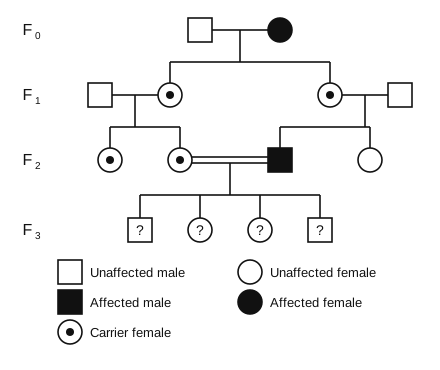
With the help of given pedigree, find out the probability for the birth of a child having no disease and being a carrier (has the disease mutation in one allele of the gene) in F3 generation.
दी गई वंशावली की सहायता से F3 पीढ़ी में ऐसी संतान के जन्म की प्रायिकता ज्ञात कीजिए जो रोगग्रस्त न हो परन्तु वाहक हो (जीन के एक युग्मविकल्पी में रोग उत्परिवर्तन हो)।
  1. A1/8
  2. BZeroशून्य
  3. C1/4
  4. D1/2
Show answer

Concept: The pedigree shows only carrier females and an affected male born to a carrier mother and a normal father – the pattern of an X-linked recessive trait (like haemophilia/colour blindness).

  1. F0: affected mother XaXa × normal father XAY → every daughter XAXa (both F1 daughters are carriers ✔).
  2. F1 carrier × normal male → F2 sons can be XaY (affected ✔) and daughters carriers or normal ✔ – autosomal inheritance cannot give an affected son to a normal (non-carrier) father this way, so X-linkage fits.
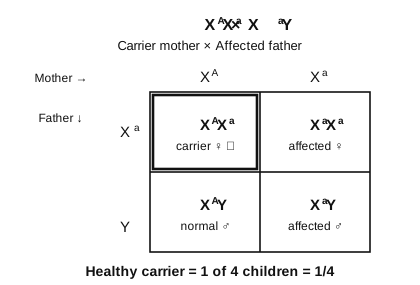
  3. F2 cross: carrier female XAXa × affected male XaY.
  4. Children: XAXa (carrier, normal) : XaXa (affected) : XAY (normal) : XaY (affected) = 1 : 1 : 1 : 1.
  5. Healthy carrier = XAXa only = 1/4 of all births (males cannot be carriers of an X-linked gene).

Short trick: X-linked: carrier ♀ × affected ♂ → ¼ each of carrier ♀, affected ♀, normal ♂, affected ♂.

Answer: (C) 1/4

अवधारणा: वंशावली में केवल वाहक मादाएँ हैं और एक रोगी नर वाहक माता व सामान्य पिता से जन्मा है – यह X-सहलग्न अप्रभावी लक्षण (जैसे हीमोफीलिया/वर्णांधता) का प्रतिरूप है।

  1. F0: रोगी माता XaXa × सामान्य पिता XAY → हर पुत्री XAXa (दोनों F1 पुत्रियाँ वाहक ✔)।
  2. F1 वाहक × सामान्य नर → F2 में पुत्र XaY (रोगी ✔) और पुत्रियाँ वाहक या सामान्य ✔ – अलिंगसूत्री वंशागति में सामान्य (अवाहक) पिता से इस प्रकार रोगी पुत्र नहीं होगा, अतः X-सहलग्नता उपयुक्त है।
  3. F2 संकरण: वाहक मादा XAXa × रोगी नर XaY।
  4. संतानें: XAXa (वाहक, सामान्य) : XaXa (रोगी) : XAY (सामान्य) : XaY (रोगी) = 1 : 1 : 1 : 1।
  5. स्वस्थ वाहक = केवल XAXa = सभी जन्मों का 1/4 (X-सहलग्न जीन के लिए नर वाहक नहीं हो सकते)।

शॉर्ट ट्रिक: X-सहलग्न: वाहक ♀ × रोगी ♂ → वाहक ♀, रोगी ♀, सामान्य ♂, रोगी ♂ प्रत्येक ¼।

उत्तर: (C) 1/4

NEET UGBiologyPrinciples of inheritance – pedigree analysis (X-linked)NEET UG 2025 · 4 May Shift 1
Q336.
In the seeds of cereals, the outer covering of endosperm separates the embryo by a protein-rich layer called :
अनाजों के बीजों में भ्रूणपोष का बाहरी आवरण भ्रूण को एक प्रोटीन-समृद्ध परत द्वारा अलग करता है, जिसे कहते हैं :
  1. AIntegumentअध्यावरण
  2. BAleurone layerएल्यूरोन परत
  3. CColeoptileप्रांकुरचोल (Coleoptile)
  4. DColeorhizaमूलांकुरचोल (Coleorhiza)
Show answer

Concept: NCERT (Morphology – monocot seed): in cereals the outer covering of the endosperm separates the embryo by a proteinous layer called the aleurone layer.

  1. Aleurone cells secrete α-amylase (GA-induced) during germination to digest starch.
  2. Integument becomes the seed coat; coleoptile sheaths the plumule; coleorhiza sheaths the radicle.

Short trick: "Aleurone = Albumin (protein) layer".

Answer: (B) Aleurone layer

अवधारणा: NCERT (आकारिकी – एकबीजपत्री बीज): अनाजों में भ्रूणपोष का बाहरी आवरण भ्रूण को एक प्रोटीनयुक्त परत द्वारा अलग करता है जिसे एल्यूरोन परत कहते हैं।

  1. अंकुरण के समय एल्यूरोन कोशिकाएँ (GA-प्रेरित) α-एमाइलेज़ स्रावित करके स्टार्च पचाती हैं।
  2. अध्यावरण बीजावरण बनता है; प्रांकुरचोल प्रांकुर को और मूलांकुरचोल मूलांकुर को ढकता है।

शॉर्ट ट्रिक: "Aleurone = Albumin (प्रोटीन) परत"।

उत्तर: (B) एल्यूरोन परत

NEET UGBiologySexual reproduction in flowering plants – seed (aleurone layer)NEET UG 2025 · 4 May Shift 1
Q337.
Match List I with List II:
List IList II
A. Chlorophyll aI. Yellow-green
B. Chlorophyll bII. Yellow
C. XanthophyllsIII. Blue-green
D. CarotenoidsIV. Yellow to Yellow-orange
Choose the option with all correct matches.
सूची I का सूची II से मिलान कीजिए :
सूची Iसूची II
A. क्लोरोफिल aI. पीला-हरा
B. क्लोरोफिल bII. पीला
C. ज़ैन्थोफिलIII. नीला-हरा
D. कैरोटिनॉइडIV. पीले से पीला-नारंगी
सभी सही मिलान वाला विकल्प चुनिए।
  1. AA-I, B-II, C-IV, D-III
  2. BA-I, B-IV, C-III, D-II
  3. CA-III, B-IV, C-II, D-I
  4. DA-III, B-I, C-II, D-IV
Show answer

Concept: NCERT paper chromatography of leaf pigments: chlorophyll a – bright/blue-green; chlorophyll b – yellow-green; xanthophylls – yellow; carotenoids – yellow to yellow-orange.

  1. A → III, B → I, C → II, D → IV.
  2. (A), (B) give chl a yellow-green (wrong); (C) gives chl b yellow-orange (wrong).

Short trick: Bands top to bottom: carotene (orange), xanthophyll (yellow), chl a (blue-green), chl b (yellow-green) – "a = aqua (blue-green)".

Answer: (D) A-III, B-I, C-II, D-IV

अवधारणा: NCERT – पत्ती वर्णकों का पेपर क्रोमैटोग्राफ़ी: क्लोरोफिल a – चमकीला/नीला-हरा; क्लोरोफिल b – पीला-हरा; ज़ैन्थोफिल – पीला; कैरोटिनॉइड – पीले से पीला-नारंगी।

  1. A → III, B → I, C → II, D → IV।
  2. (A), (B) में क्लोरोफिल a पीला-हरा (गलत); (C) में क्लोरोफिल b पीला-नारंगी (गलत)।

शॉर्ट ट्रिक: ऊपर से नीचे बैंड: कैरोटीन (नारंगी), ज़ैन्थोफिल (पीला), क्लोरोफिल a (नीला-हरा), क्लोरोफिल b (पीला-हरा) – "a = aqua (नीला-हरा)"।

उत्तर: (D) A-III, B-I, C-II, D-IV

NEET UGBiologyPhotosynthesis – pigmentsNEET UG 2025 · 4 May Shift 1
Q338.
Who proposed that the genetic code for amino acids should be made up of three nucleotides?
किसने प्रस्तावित किया कि अमीनो अम्लों के लिए आनुवंशिक कूट तीन न्यूक्लियोटाइडों का बना होना चाहिए?
  1. AJacque Monodजैक मोनो (Jacque Monod)
  2. BFranklin Stahlफ्रैंकलिन स्टाल (Franklin Stahl)
  3. CGeorge Gamowजॉर्ज गैमो (George Gamow)
  4. DFrancis Crickफ्रांसिस क्रिक (Francis Crick)
Show answer

Concept: NCERT: physicist George Gamow argued that 4 bases must code for 20 amino acids, so the code should be a triplet (43 = 64 combinations ≥ 20).

  1. 41 = 4 and 42 = 16 are fewer than 20; 43 = 64 is enough.
  2. Monod – lac operon (with Jacob); Stahl – semi-conservative replication (with Meselson); Crick – DNA double helix, central dogma, wobble hypothesis.

Short trick: "Gamow → Game of 3".

Answer: (C) George Gamow

अवधारणा: NCERT: भौतिकविद् जॉर्ज गैमो ने तर्क दिया कि 4 क्षारकों को 20 अमीनो अम्लों का कूट बनाना है, अतः कूट त्रिक होना चाहिए (43 = 64 संयोजन ≥ 20)।

  1. 41 = 4 और 42 = 16, 20 से कम हैं; 43 = 64 पर्याप्त है।
  2. मोनो – lac ओपेरॉन (जैकब के साथ); स्टाल – अर्धसंरक्षी प्रतिकृतियन (मेसेल्सन के साथ); क्रिक – DNA द्विकुंडली, केंद्रीय सिद्धांत, वॉबल परिकल्पना।

शॉर्ट ट्रिक: "Gamow → 3 का खेल"।

उत्तर: (C) जॉर्ज गैमो

NEET UGBiologyMolecular basis of inheritance – genetic codeNEET UG 2025 · 4 May Shift 1
Q339.
Histones are enriched with -
हिस्टोन किससे समृद्ध होते हैं -
  1. APhenylalanine & Leucineफेनिलऐलानिन एवं ल्यूसीन
  2. BPhenylalanine & Arginineफेनिलऐलानिन एवं आर्जिनिन
  3. CLysine & Arginineलाइसिन एवं आर्जिनिन
  4. DLeucine & Lysineल्यूसीन एवं लाइसिन
Show answer

Concept: NCERT: histones are rich in the basic amino acid residues lysine and arginine, which carry positive charges in their side chains – so histones are positively charged.

  1. Positive histones bind the negatively charged phosphate backbone of DNA → nucleosome (≈200 bp DNA around a histone octamer).
  2. Phenylalanine and leucine are neutral, non-polar – they cannot give the basic character.

Short trick: "Basic histones love acidic DNA – K and R (Lys, Arg)".

Answer: (C) Lysine & Arginine

अवधारणा: NCERT: हिस्टोन क्षारकीय अमीनो अम्ल अवशेषों लाइसिन और आर्जिनिन से समृद्ध होते हैं, जिनकी पार्श्व शृंखलाओं पर धनावेश होता है – अतः हिस्टोन धनावेशित होते हैं।

  1. धनावेशित हिस्टोन DNA की ऋणावेशित फॉस्फेट रीढ़ से बंधते हैं → न्यूक्लियोसोम (हिस्टोन अष्टक के चारों ओर ≈200 bp DNA)।
  2. फेनिलऐलानिन और ल्यूसीन उदासीन, अध्रुवीय हैं – ये क्षारकीय गुण नहीं दे सकते।

शॉर्ट ट्रिक: "क्षारकीय हिस्टोन, अम्लीय DNA से जुड़ते हैं – K और R (Lys, Arg)"।

उत्तर: (C) लाइसिन एवं आर्जिनिन

NEET UGBiologyMolecular basis of inheritance – histonesNEET UG 2025 · 4 May Shift 1
Q340.
Which of the following enzyme(s) are NOT essential for gene cloning?
A. Restriction enzymes
B. DNA ligase
C. DNA mutase
D. DNA recombinase
E. DNA polymerase
Choose the correct answer from the options given below :
निम्नलिखित में से कौन-सा/से एंजाइम जीन क्लोनिंग के लिए आवश्यक नहीं है/हैं?
A. प्रतिबंधन एंजाइम
B. DNA लाइगेज़
C. DNA म्यूटेज़
D. DNA रिकॉम्बिनेज़
E. DNA पॉलीमरेज़
नीचे दिए गए विकल्पों में से सही उत्तर चुनिए :
  1. AD and E onlyकेवल D और E
  2. BB and C onlyकेवल B और C
  3. CC and D onlyकेवल C और D
  4. DA and B onlyकेवल A और B
Show answer

Concept: Gene cloning needs: restriction endonuclease (molecular scissors), DNA ligase (molecular glue), DNA polymerase (PCR amplification), plus vector and host.

  1. A, B, E are essential → every option with A, B or E is wrong.
  2. "DNA mutase" is not a cloning tool, and "DNA recombinase" is not required for standard rDNA cloning → C and D are not essential.

Short trick: Scissors + glue + copier (RE, ligase, polymerase) – anything else is extra.

Answer: (C) C and D only

अवधारणा: जीन क्लोनिंग में आवश्यक: प्रतिबंधन एंडोन्यूक्लिएज़ (आण्विक कैंची), DNA लाइगेज़ (आण्विक गोंद), DNA पॉलीमरेज़ (PCR प्रवर्धन), साथ में वाहक और परपोषी।

  1. A, B, E आवश्यक हैं → A, B या E वाला हर विकल्प गलत।
  2. "DNA म्यूटेज़" क्लोनिंग उपकरण नहीं है, और "DNA रिकॉम्बिनेज़" सामान्य rDNA क्लोनिंग में आवश्यक नहीं → C और D आवश्यक नहीं।

शॉर्ट ट्रिक: कैंची + गोंद + कॉपियर (RE, लाइगेज़, पॉलीमरेज़) – बाकी सब अतिरिक्त।

उत्तर: (C) केवल C और D

NEET UGBiologyBiotechnology – tools of recombinant DNA technologyNEET UG 2025 · 4 May Shift 1