Q361.At any instant of time t, the displacement of any particle is given by (SI unit) under the influence of force of 5 N. The value of instantaneous power is (in SI unit):
किसी भी क्षण t पर, 5 N के बल के प्रभाव में किसी कण का विस्थापन (SI मात्रक) द्वारा दिया जाता है। तात्क्षणिक शक्ति (instantaneous power) का मान (SI मात्रक में) है:
- A5
- B7
- C6
- D10
Show answer
Concept: Instantaneous power (force along the motion).
- (constant).
- W.
Short trick: Only the coefficient of t matters (the –1 is just the starting position): P = F × (coefficient of t).
Answer: (D) 10
अवधारणा: तात्क्षणिक शक्ति (बल गति की दिशा में)।
- (नियत)।
- W।
शॉर्ट ट्रिक: केवल t का गुणांक मायने रखता है (–1 केवल प्रारंभिक स्थिति है): P = F × (t का गुणांक)।
उत्तर: (D) 10
NEET UGPhysicsWork, energy and power – instantaneous powerNEET UG 2024 · 5 May Shift 1
Q362.If the monochromatic source in Young’s double slit experiment is replaced by white light, then
यदि यंग के द्विझिरी प्रयोग (YDSE) में एकवर्णी (monochromatic) स्रोत को श्वेत प्रकाश से प्रतिस्थापित कर दिया जाए, तो
- AThere will be a central dark fringe surrounded by a few coloured fringesकेंद्र में एक अदीप्त (dark) फ्रिंज होगी जिसके चारों ओर कुछ रंगीन फ्रिंजें होंगी
- BThere will be a central bright fringe surrounded by a few coloured fringes.केंद्र में एक दीप्त (bright) फ्रिंज होगी जिसके चारों ओर कुछ रंगीन फ्रिंजें होंगी।
- CAll bright fringes will be of equal widthसभी दीप्त फ्रिंजों की चौड़ाई समान होगी
- DInterference pattern will disappear.व्यतिकरण पैटर्न लुप्त हो जाएगा।
Show answer
Concept: At the centre the path difference is zero for every wavelength, so all colours form a maximum there; fringe width depends on λ.
- Central point: Δx = 0 for all colours → all overlap → central white bright fringe (A wrong).
- Away from the centre, maxima of different colours separate (violet closest, red farthest) → a few coloured fringes, then uniform illumination.
- Since β ∝ λ, widths differ (C wrong); a pattern is still seen near the centre (D wrong).
Short trick: White light YDSE = “white centre, coloured edges, washes out quickly”.
Answer: (B) Central bright fringe with a few coloured fringes
अवधारणा: केंद्र पर प्रत्येक तरंगदैर्ध्य के लिए पथांतर शून्य होता है, अतः वहाँ सभी रंगों का उच्चिष्ठ बनता है; फ्रिंज चौड़ाई , λ पर निर्भर है।
- केंद्रीय बिंदु: सभी रंगों के लिए Δx = 0 → सभी अध्यारोपित → केंद्रीय श्वेत दीप्त फ्रिंज (A गलत)।
- केंद्र से दूर विभिन्न रंगों के उच्चिष्ठ अलग हो जाते हैं (बैंगनी सबसे पास, लाल सबसे दूर) → कुछ रंगीन फ्रिंजें, फिर एकसमान प्रकाश।
- चूँकि β ∝ λ, चौड़ाइयाँ भिन्न होंगी (C गलत); केंद्र के पास पैटर्न अब भी दिखता है (D गलत)।
शॉर्ट ट्रिक: श्वेत प्रकाश YDSE = “केंद्र श्वेत, किनारे रंगीन, जल्दी धुंधला”।
उत्तर: (B) केंद्रीय दीप्त फ्रिंज तथा कुछ रंगीन फ्रिंजें
NEET UGPhysicsWave optics – YDSE with white lightNEET UG 2024 · 5 May Shift 1
Q363.
In the nuclear emission stated above, the mass number and atomic number of the product Q respectively, are:
ऊपर दिए गए नाभिकीय उत्सर्जन में उत्पाद Q की द्रव्यमान संख्या और परमाणु क्रमांक क्रमशः हैं:
- A286, 80
- B288, 82
- C286, 81
- D280, 81
Show answer
Concept: α-emission: A − 4, Z − 2; positron (, β⁺) emission: Z − 1; electron (, β⁻) emission: Z + 1; β-emissions do not change A.
- α:
- :
- :
- (another β⁻):
Short trick: Only α changes A (290 − 4 = 286, so B and D go). Z: 82 − 2 − 1 + 1 + 1 = 81.
Answer: (C) 286, 81
अवधारणा: α-उत्सर्जन: A − 4, Z − 2; पॉज़िट्रॉन (, β⁺) उत्सर्जन: Z − 1; इलेक्ट्रॉन (, β⁻) उत्सर्जन: Z + 1; β-उत्सर्जन में A नहीं बदलता।
- α:
- :
- :
- (एक और β⁻):
शॉर्ट ट्रिक: केवल α से A बदलता है (290 − 4 = 286, अतः B और D हटे)। Z: 82 − 2 − 1 + 1 + 1 = 81।
उत्तर: (C) 286, 81
NEET UGPhysicsNuclei – radioactive decay chainNEET UG 2024 · 5 May Shift 1
Q364.Match List – I with List – II.
| List – I (Material) | List – II (Susceptibility) (χ) |
|---|
| A. Diamagnetic | I. |
| B. Ferromagnetic | II. |
| C. Paramagnetic | III. |
| D. Non-magnetic | IV. (a small positive number) |
Choose the correct answer from the options given below
सूची – I का सूची – II से मिलान कीजिए।
| सूची – I (पदार्थ) | सूची – II (प्रवृत्ति / susceptibility) (χ) |
|---|
| A. प्रतिचुंबकीय (Diamagnetic) | I. |
| B. लौहचुंबकीय (Ferromagnetic) | II. |
| C. अनुचुंबकीय (Paramagnetic) | III. |
| D. अचुंबकीय (Non-magnetic) | IV. (एक छोटी धनात्मक संख्या) |
नीचे दिए गए विकल्पों में से सही उत्तर चुनिए
- AA – II, B – I, C – III, D – IV
- BA – III, B – II, C – I, D – IV
- CA – IV, B – III, C – II, D – I
- DA – II, B – III, C – IV, D – I
Show answer
Concept: Diamagnetic: small negative χ (−1 ≤ χ < 0, −1 for a superconductor); paramagnetic: small positive χ; ferromagnetic: very large positive χ; non-magnetic: χ = 0.
- A Diamagnetic → → II
- B Ferromagnetic → → III
- C Paramagnetic → → IV
- D Non-magnetic → → I
Short trick: Sign of χ: Dia = minus, Para = plus (small), Ferro = PLUS (huge). A–II alone leaves only (A) and (D); B–III picks (D).
Answer: (D) A – II, B – III, C – IV, D – I
अवधारणा: प्रतिचुंबकीय: छोटा ऋणात्मक χ (−1 ≤ χ < 0, अतिचालक के लिए −1); अनुचुंबकीय: छोटा धनात्मक χ; लौहचुंबकीय: बहुत बड़ा धनात्मक χ; अचुंबकीय: χ = 0।
- A प्रतिचुंबकीय → → II
- B लौहचुंबकीय → → III
- C अनुचुंबकीय → → IV
- D अचुंबकीय → → I
शॉर्ट ट्रिक: χ का चिह्न: प्रति = ऋण, अनु = धन (छोटा), लौह = धन (बहुत बड़ा)। A–II से केवल (A) व (D) बचते हैं; B–III से (D)।
उत्तर: (D) A – II, B – III, C – IV, D – I
NEET UGPhysicsMagnetism and matter – magnetic susceptibilityNEET UG 2024 · 5 May Shift 1
Q365.In the following circuit, the equivalent capacitance between terminal A and terminal B is:
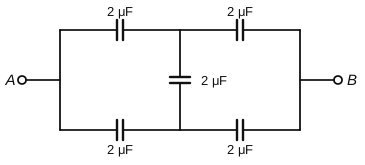
निम्नलिखित परिपथ में टर्मिनल A और टर्मिनल B के बीच तुल्य धारिता है:
- AF
- BF
- CF
- DF
Show answer
Concept: A capacitor bridge is balanced when ; then the middle capacitor has no charge and can be removed.
- All four arms are 2 μF → ratio 2/2 = 2/2 → bridge balanced, middle 2 μF drops out.
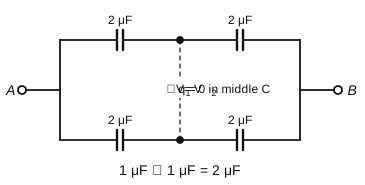
- Upper branch: 2 μF and 2 μF in series = 1 μF; lower branch = 1 μF.
- Two branches in parallel: F.
Short trick: Symmetric bridge of identical capacitors: CAB = C (same as one capacitor).
Answer: (D) 2 μF
अवधारणा: संधारित्र सेतु तब संतुलित होता है जब ; तब बीच वाले संधारित्र पर कोई आवेश नहीं होता और उसे हटा सकते हैं।
- चारों भुजाएँ 2 μF → अनुपात 2/2 = 2/2 → सेतु संतुलित, बीच वाला 2 μF हट जाता है।
- ऊपरी शाखा: 2 μF व 2 μF श्रेणी में = 1 μF; निचली शाखा = 1 μF।
- दोनों शाखाएँ समांतर में: F।
शॉर्ट ट्रिक: समान संधारित्रों का सममित सेतु: CAB = C (एक संधारित्र के बराबर)।
उत्तर: (D) 2 μF
NEET UGPhysicsCapacitance – balanced Wheatstone bridgeNEET UG 2024 · 5 May Shift 1
Q366.A thin spherical shell is charged by some source. The potential difference between the two points C and P (in V) shown in the figure is
(Take
SI units)
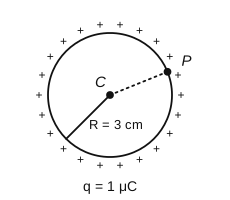
एक पतले गोलीय कोश को किसी स्रोत द्वारा आवेशित किया गया है। चित्र में दर्शाए गए दो बिंदुओं C और P के बीच विभवांतर (V में) है
(
SI मात्रक लीजिए)
- A
- B
- CZeroशून्य
- D
Show answer
Concept: For a charged conducting/thin shell, all charge sits on the surface; E = 0 inside, so the potential is the same at every point inside and on the shell.
- Inside the shell → V is constant from the centre C up to the surface.
- P lies on the shell and C is the centre → V each.
- .
Short trick: “Inside a shell, potential is flat” – any two points inside/on the shell: ΔV = 0. Option (D) is the trap value of V itself.
Answer: (C) Zero
अवधारणा: आवेशित पतले कोश पर संपूर्ण आवेश सतह पर रहता है; अंदर E = 0, अतः कोश के अंदर और सतह पर प्रत्येक बिंदु पर विभव समान होता है।
- कोश के अंदर → केंद्र C से सतह तक V नियत है।
- P कोश पर है और C केंद्र है → V (प्रत्येक)।
- ।
शॉर्ट ट्रिक: “कोश के अंदर विभव समतल (नियत)” – अंदर/सतह के किन्हीं दो बिंदुओं पर ΔV = 0। विकल्प (D) स्वयं V का मान है – जाल।
उत्तर: (C) शून्य
NEET UGPhysicsElectrostatic potential – charged spherical shellNEET UG 2024 · 5 May Shift 1
Q367.The output (Y) of the given logic gate is similar to the output of an/a:
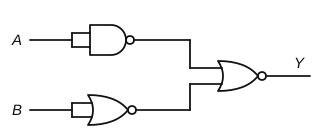
दिए गए लॉजिक गेट परिपथ का निर्गत (Y) किसके निर्गत के समान है?
- ANOR gateNOR गेट
- BOR gateOR गेट
- CAND gateAND गेट
- DNAND gateNAND गेट
Show answer
Concept: A NAND or NOR gate with its inputs joined acts as a NOT gate; De Morgan: .
- First NAND (inputs tied to A): output . NOR (inputs tied to B): output .
- Final NOR: .
- By De Morgan: → AND gate.
Short trick: NOR with inverted inputs = AND; NAND with inverted inputs = OR (“bubbles cancel, symbol flips”).
Answer: (C) AND gate
अवधारणा: जिस NAND या NOR गेट के निवेश जोड़ दिए जाएँ वह NOT गेट की तरह कार्य करता है; डी मॉर्गन: ।
- पहला NAND (दोनों निवेश A से जुड़े): निर्गत । NOR (दोनों निवेश B से जुड़े): निर्गत ।
- अंतिम NOR: ।
- डी मॉर्गन से: → AND गेट।
शॉर्ट ट्रिक: उलटे (inverted) निवेशों वाला NOR = AND; उलटे निवेशों वाला NAND = OR (“बबल कटे, चिह्न बदले”)।
उत्तर: (C) AND गेट
NEET UGPhysicsSemiconductor electronics – logic gatesNEET UG 2024 · 5 May Shift 1
Q368.An unpolarized light beam strikes a glass surface at Brewster’s angle. Then
एक अध्रुवित प्रकाश किरणपुंज काँच की सतह पर ब्रूस्टर कोण पर आपतित होता है। तब
- AThe refracted light will be completely polarisedअपवर्तित प्रकाश पूर्णतः ध्रुवित होगा
- BBoth the reflected and refracted light will be completely polarisedपरावर्तित और अपवर्तित दोनों प्रकाश पूर्णतः ध्रुवित होंगे
- CThe reflected light will be completely polarized but the refracted light will be partially polarizedपरावर्तित प्रकाश पूर्णतः ध्रुवित होगा परंतु अपवर्तित प्रकाश आंशिक रूप से ध्रुवित होगा
- DThe reflected light will be partially polarized.परावर्तित प्रकाश आंशिक रूप से ध्रुवित होगा।
Show answer
Concept: At Brewster’s angle () the reflected and refracted rays are perpendicular; the component of E in the plane of incidence is not reflected at all.
- Reflected light contains only the vibration perpendicular to the plane of incidence → completely (plane) polarised.
- Refracted light carries all of the parallel component plus the rest of the perpendicular one → only partially polarised.
- So (A), (B) and (D) are wrong.
Short trick: Brewster: “Reflected = Fully, Refracted = Partly”. Also .
Answer: (C) Reflected completely polarised, refracted partially polarised
अवधारणा: ब्रूस्टर कोण () पर परावर्तित और अपवर्तित किरणें परस्पर लंबवत होती हैं; आपतन तल में E का घटक बिल्कुल परावर्तित नहीं होता।
- परावर्तित प्रकाश में केवल आपतन तल के लंबवत कंपन होते हैं → पूर्णतः (समतल) ध्रुवित।
- अपवर्तित प्रकाश में संपूर्ण समांतर घटक तथा लंबवत घटक का शेष भाग होता है → केवल आंशिक ध्रुवित।
- अतः (A), (B) और (D) गलत हैं।
शॉर्ट ट्रिक: ब्रूस्टर: “परावर्तित = पूर्ण, अपवर्तित = आंशिक”। साथ ही ।
उत्तर: (C) परावर्तित पूर्णतः ध्रुवित, अपवर्तित आंशिक ध्रुवित
NEET UGPhysicsWave optics – polarisation by reflection (Brewster)NEET UG 2024 · 5 May Shift 1
Q369.A tightly wound 100 turns coil of radius 10 cm carries a current of 7 A. The magnitude of the magnetic field at the centre of the coil is (Take permeability of free space as SI units):
10 cm त्रिज्या की 100 फेरों वाली एक कसकर लपेटी गई कुंडली में 7 A धारा प्रवाहित है। कुंडली के केंद्र पर चुंबकीय क्षेत्र का परिमाण है (मुक्त आकाश की चुंबकशीलता SI मात्रक लीजिए):
- A4.4 T
- B4.4 mT
- C44 T
- D44 mT
Show answer
Concept: Field at the centre of a circular coil of N turns: .
- T
- T = 4.4 mT
Short trick: = 2π × 10⁻⁷ × 700/0.1 = 1400π × 10⁻⁶ ≈ 4.4 mT.
Answer: (B) 4.4 mT
अवधारणा: N फेरों वाली वृत्ताकार कुंडली के केंद्र पर क्षेत्र: ।
- T
- T = 4.4 mT
शॉर्ट ट्रिक: = 2π × 10⁻⁷ × 700/0.1 = 1400π × 10⁻⁶ ≈ 4.4 mT।
उत्तर: (B) 4.4 mT
NEET UGPhysicsMoving charges and magnetism – field at centre of a coilNEET UG 2024 · 5 May Shift 1
Q370.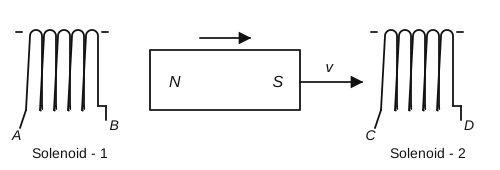
In the above diagram, a strong bar magnet is moving towards solenoid – 2 from solenoid – 1. The direction of induced current in solenoid – 1 and that in solenoid – 2, respectively, are through the directions:
उपर्युक्त चित्र में एक प्रबल छड़ चुंबक परिनालिका – 1 से परिनालिका – 2 की ओर गतिमान है। परिनालिका – 1 तथा परिनालिका – 2 में प्रेरित धारा की दिशाएँ क्रमशः हैं:
- ABA and CDBA तथा CD
- BAB and CDAB तथा CD
- CBA and DCBA तथा DC
- DAB and DCAB तथा DC
Show answer
Concept: Lenz’s law: the induced current makes a pole that opposes the motion – a receding pole is attracted (opposite pole formed), an approaching pole is repelled (like pole formed).
- Solenoid – 1: the N-end of the magnet moves away from its right face → that face must become an S-pole (to attract the magnet back) → seen from the magnet, current is clockwise.
- Solenoid – 2: the S-end approaches its left face → that face must also become an S-pole (to repel) → seen from the magnet, current is again clockwise.
- Both coils are viewed from opposite ends (one from its right end, the other from its left end) with the same winding, so the same “clockwise” sense means opposite terminal order: current flows A → B in solenoid – 1 and D → C in solenoid – 2.
Short trick: Faces nearest the magnet both become S here (N leaving → S, S coming → S); “S face = clockwise seen from outside”. Then read terminals off the winding.
Answer: (D) AB and DC
अवधारणा: लेंज़ का नियम: प्रेरित धारा ऐसा ध्रुव बनाती है जो गति का विरोध करे – दूर जाते ध्रुव को आकर्षित करती है (विपरीत ध्रुव बनता है), पास आते ध्रुव को प्रतिकर्षित करती है (समान ध्रुव बनता है)।
- परिनालिका – 1: चुंबक का N-सिरा इसके दाएँ फलक से दूर जा रहा है → यह फलक S-ध्रुव बनेगा (चुंबक को वापस खींचने हेतु) → चुंबक की ओर से देखने पर धारा दक्षिणावर्त।
- परिनालिका – 2: चुंबक का S-सिरा इसके बाएँ फलक की ओर आ रहा है → यह फलक भी S-ध्रुव बनेगा (प्रतिकर्षण हेतु) → चुंबक की ओर से देखने पर धारा फिर दक्षिणावर्त।
- दोनों कुंडलियाँ समान लपेटन की हैं पर विपरीत सिरों से देखी जा रही हैं (एक दाएँ सिरे से, दूसरी बाएँ सिरे से), अतः समान “दक्षिणावर्त” का अर्थ टर्मिनलों का विपरीत क्रम है: परिनालिका – 1 में धारा A → B तथा परिनालिका – 2 में D → C।
शॉर्ट ट्रिक: यहाँ चुंबक के निकटतम दोनों फलक S बनते हैं (N जा रहा → S, S आ रहा → S); “S फलक = बाहर से देखने पर दक्षिणावर्त”। फिर लपेटन से टर्मिनल पढ़ें।
उत्तर: (D) AB तथा DC
NEET UGPhysicsElectromagnetic induction – Lenz’s lawNEET UG 2024 · 5 May Shift 1
Q371.Two bodies A and B of same mass undergo completely inelastic one-dimensional collision. The body A moves with velocity while body B is at rest before collision. The velocity of the system after collision is . The ratio is:
समान द्रव्यमान की दो वस्तुएँ A और B पूर्णतः अप्रत्यास्थ एकविमीय संघट्ट करती हैं। संघट्ट से पहले वस्तु A वेग से गतिमान है जबकि वस्तु B विरामावस्था में है। संघट्ट के बाद निकाय का वेग है। अनुपात है:
- A2 : 1
- B4 : 1
- C1 : 4
- D1 : 2
Show answer
Concept: In a perfectly inelastic collision the bodies stick together; linear momentum is conserved.
Short trick: Equal masses, one at rest, sticking together → common velocity is half.
Answer: (A) 2 : 1
अवधारणा: पूर्णतः अप्रत्यास्थ संघट्ट में वस्तुएँ आपस में चिपक जाती हैं; रैखिक संवेग संरक्षित रहता है।
शॉर्ट ट्रिक: समान द्रव्यमान, एक विराम में, चिपक जाएँ → उभयनिष्ठ वेग आधा।
उत्तर: (A) 2 : 1
NEET UGPhysicsLaws of motion – perfectly inelastic collisionNEET UG 2024 · 5 May Shift 1
Q372.Given below are two statements: One is labelled as Assertion A and the other is labelled as Reason R.
Assertion A: The potential (V) at any axial point, at 2 m distance (r) from the centre of the dipole of dipole moment vector of magnitude, C m, is V
(Take SI units)
Reason R: , where r is the distance of any axial point, situated at 2 m from the centre of the dipole.
In the light of the above statements, choose the correct answer from the options given below:
नीचे दो कथन दिए गए हैं: एक को अभिकथन A और दूसरे को कारण R कहा गया है।
अभिकथन A: द्विध्रुव आघूर्ण सदिश , जिसका परिमाण C m है, वाले द्विध्रुव के केंद्र से 2 m दूरी (r) पर किसी अक्षीय बिंदु पर विभव (V) V है
( SI मात्रक लीजिए)
कारण R: , जहाँ r द्विध्रुव के केंद्र से 2 m पर स्थित किसी अक्षीय बिंदु की दूरी है।
उपर्युक्त कथनों के आलोक में नीचे दिए गए विकल्पों में से सही उत्तर चुनिए:
- ABoth A and R are true and R is NOT the correct explanation of A.A और R दोनों सत्य हैं तथा R, A की सही व्याख्या नहीं है।
- BA is true but R is falseA सत्य है परंतु R असत्य है
- CA is false but R is trueA असत्य है परंतु R सत्य है
- DBoth A and R are true and R is the correct explanation of A.A और R दोनों सत्य हैं तथा R, A की सही व्याख्या है।
Show answer
Concept: Potential of a short dipole: ; on the axis θ = 0° or 180°, so (no factor 2).
- V → A is true.
- R uses – the factor 2 belongs to the axial field , not to potential → R is false.
- (With R’s formula V would be ±1.8 × 10⁴ V, which contradicts A.)
Short trick: Dipole on axis: E has “2P/r³”, V has “P/r²”. Mixing them is the usual trap.
Answer: (B) A is true but R is false
अवधारणा: लघु द्विध्रुव का विभव: ; अक्ष पर θ = 0° या 180°, अतः (गुणक 2 नहीं)।
- V → A सत्य है।
- R में लिया है – गुणक 2 अक्षीय क्षेत्र में आता है, विभव में नहीं → R असत्य है।
- (R के सूत्र से V = ±1.8 × 10⁴ V आता, जो A के विपरीत है।)
शॉर्ट ट्रिक: अक्ष पर द्विध्रुव: E में “2P/r³”, V में “P/r²”। इन्हें मिलाना सामान्य जाल है।
उत्तर: (B) A सत्य है परंतु R असत्य है
NEET UGPhysicsElectric dipole – axial potential (Assertion–Reason)NEET UG 2024 · 5 May Shift 1
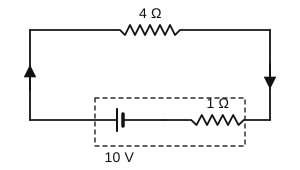
Q373.The terminal voltage of the battery, whose emf is 10 V and internal resistance 1 Ω, when connected through an external resistance of 4 Ω as shown in the figure is:
जिस बैटरी का विद्युत वाहक बल (emf) 10 V तथा आंतरिक प्रतिरोध 1 Ω है, उसे चित्रानुसार 4 Ω के बाह्य प्रतिरोध से जोड़ने पर उसकी टर्मिनल वोल्टता है:
- A6 V
- B8 V
- C10 V
- D4 V
Show answer
Concept: and terminal voltage (while discharging).
- A
- V
- Check: V.
Short trick: Voltage divides in ratio of resistances: V = ε·R/(R + r) = 10 × 4/5 = 8 V.
Answer: (B) 8 V
अवधारणा: तथा टर्मिनल वोल्टता (निरावेशन के समय)।
- A
- V
- जाँच: V।
शॉर्ट ट्रिक: वोल्टता प्रतिरोधों के अनुपात में बँटती है: V = ε·R/(R + r) = 10 × 4/5 = 8 V।
उत्तर: (B) 8 V
NEET UGPhysicsCurrent electricity – terminal voltageNEET UG 2024 · 5 May Shift 1
Q374.A particle moving with uniform speed in a circular path maintains:
वृत्तीय पथ पर एकसमान चाल से गतिमान कोई कण बनाए रखता है:
- AConstant accelerationनियत त्वरण
- BConstant velocity but varying accelerationनियत वेग परंतु परिवर्ती त्वरण
- CVarying velocity and varying accelerationपरिवर्ती वेग और परिवर्ती त्वरण
- DConstant velocity.नियत वेग।
Show answer
Concept: In uniform circular motion speed is constant but the velocity is always tangential and the acceleration always points to the centre.
- Velocity direction keeps turning → velocity varies (B, D wrong).
- Centripetal acceleration has constant magnitude but rotating direction → acceleration varies (A wrong).
- Hence both velocity and acceleration vary.
Short trick: Vectors change if only their direction changes. In UCM only the magnitudes (speed, ) are constant.
Answer: (C) Varying velocity and varying acceleration
अवधारणा: एकसमान वृत्तीय गति में चाल नियत रहती है परंतु वेग सदैव स्पर्शरेखीय होता है और त्वरण सदैव केंद्र की ओर होता है।
- वेग की दिशा लगातार बदलती है → वेग परिवर्ती (B, D गलत)।
- अभिकेंद्र त्वरण का परिमाण नियत पर दिशा घूमती है → त्वरण परिवर्ती (A गलत)।
- अतः वेग और त्वरण दोनों परिवर्ती हैं।
शॉर्ट ट्रिक: केवल दिशा बदलने पर भी सदिश बदल जाता है। UCM में केवल परिमाण (चाल, ) नियत हैं।
उत्तर: (C) परिवर्ती वेग और परिवर्ती त्वरण
NEET UGPhysicsMotion in a plane – uniform circular motionNEET UG 2024 · 5 May Shift 1
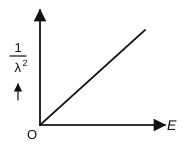
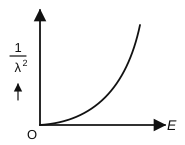
Q375.The graph which shows the variation of and its kinetic energy, E is (where λ is de Broglie wavelength of a free particle):
वह ग्राफ जो तथा गतिज ऊर्जा E के बीच परिवर्तन दर्शाता है (जहाँ λ किसी मुक्त कण की दे ब्रॉग्ली तरंगदैर्ध्य है):
- A
- B
- C
- D
Show answer
Concept: for a free (non-relativistic) particle.
- This is of the form y = kx → a straight line through the origin with positive slope.
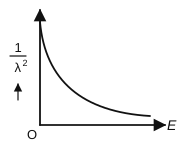
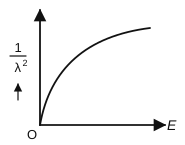
- (A) is a 1/x-type curve, (B) a √x-type curve, (D) an x²-type curve – all wrong.
Short trick: λ ∝ 1/√E → 1/λ² ∝ E: “square the relation and it becomes linear”.
Answer: (C) Straight line through the origin
अवधारणा: मुक्त (अनापेक्षिकीय) कण के लिए ।
- यह y = kx के रूप में है → मूलबिंदु से गुजरती धनात्मक ढाल वाली सरल रेखा।
- (A) 1/x प्रकार का वक्र, (B) √x प्रकार का वक्र, (D) x² प्रकार का वक्र – सभी गलत।
शॉर्ट ट्रिक: λ ∝ 1/√E → 1/λ² ∝ E: “संबंध का वर्ग करो, रैखिक बन जाएगा”।
उत्तर: (C) मूलबिंदु से गुजरती सरल रेखा
NEET UGPhysicsDual nature – de Broglie wavelength vs kinetic energyNEET UG 2024 · 5 May Shift 1
Q376.A light ray enters through a right angled prism at point P with the angle of incidence 30° as shown in figure. It travels through the prism parallel to its base BC and emerges along the face AC. The refractive index of the prism is:
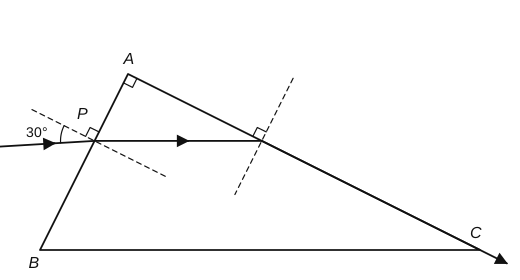
एक प्रकाश किरण चित्रानुसार एक समकोण प्रिज़्म में बिंदु P पर 30° आपतन कोण से प्रवेश करती है। यह प्रिज़्म में उसके आधार BC के समांतर चलती है और फलक AC के अनुदिश (along) निर्गत होती है। प्रिज़्म का अपवर्तनांक है:
- A
- B
- C
- D
Show answer
Concept: Emerging along face AC means grazing emergence: the angle of incidence on AC equals the critical angle, . In a prism .
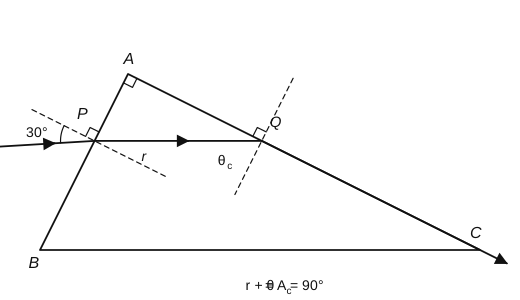
- Here A = 90°, → .
- Snell at P: .
Short trick: μ must be > 1, so (B), (C), (D) (all < 1) are impossible – only (A) survives without any working.
Answer: (A)
अवधारणा: फलक AC के अनुदिश निर्गत होने का अर्थ है स्पर्शी निर्गमन: AC पर आपतन कोण = क्रांतिक कोण, । प्रिज़्म में ।
- यहाँ A = 90°, → ।
- P पर स्नेल का नियम: ।
शॉर्ट ट्रिक: μ का मान 1 से अधिक होना चाहिए, अतः (B), (C), (D) (सभी < 1) असंभव – बिना गणना के केवल (A) बचता है।
उत्तर: (A)
NEET UGPhysicsRay optics – refraction through a prism, critical angleNEET UG 2024 · 5 May Shift 1
Q377.A wheel of a bullock cart is rolling on a level road as shown in the figure below. If its linear speed is v in the direction shown, which one of the following options is correct (P and Q are any highest and lowest points on the wheel, respectively)?
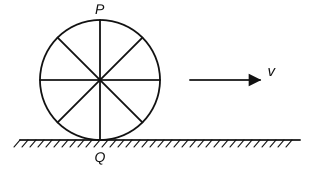
एक बैलगाड़ी का पहिया नीचे दिए चित्रानुसार समतल सड़क पर लुढ़क रहा है। यदि दर्शाई गई दिशा में इसकी रैखिक चाल v है, तो निम्नलिखित में से कौन-सा विकल्प सही है (P और Q क्रमशः पहिये के उच्चतम और निम्नतम बिंदु हैं)?
- APoint P moves faster than point Qबिंदु P, बिंदु Q से तेज़ चलता है
- BBoth the points P and Q move with equal speedबिंदु P और Q दोनों समान चाल से चलते हैं
- CPoint P has zero speedबिंदु P की चाल शून्य है
- DPoint P moves slower than point Qबिंदु P, बिंदु Q से धीमा चलता है
Show answer
Concept: In pure rolling ; velocity of a point = velocity of centre + rotational velocity .
- Top point P: .
- Contact point Q: .
- So P moves fastest and Q is momentarily at rest → (A); (B), (C), (D) wrong.
Short trick: Rolling wheel: top 2v, centre v, bottom 0 – the reason spokes look blurred at the top in photographs.
Answer: (A) Point P moves faster than point Q
अवधारणा: शुद्ध लोटनिक गति में ; किसी बिंदु का वेग = केंद्र का वेग + घूर्णी वेग ।
- शीर्ष बिंदु P: ।
- संपर्क बिंदु Q: ।
- अतः P सबसे तेज़ और Q क्षणिक विराम में → (A); (B), (C), (D) गलत।
शॉर्ट ट्रिक: लुढ़कता पहिया: शीर्ष 2v, केंद्र v, तली 0 – इसी कारण तस्वीरों में ऊपर की तीलियाँ धुंधली दिखती हैं।
उत्तर: (A) बिंदु P, बिंदु Q से तेज़ चलता है
NEET UGPhysicsRotational motion – rolling without slippingNEET UG 2024 · 5 May Shift 1
Q378.A thermodynamic system is taken through the cycle abcda. The work done by the gas along the path bc is:
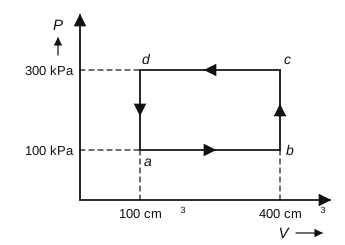
एक ऊष्मागतिक निकाय को चक्र abcda से ले जाया जाता है। पथ bc के अनुदिश गैस द्वारा किया गया कार्य है:
- A30 J
- B−90 J
- C−60 J
- DZeroशून्य
Show answer
Concept: Work by a gas = area under the P–V curve; if V does not change (isochoric), W = 0.
- Along bc, V stays 400 cm³ while P rises 100 → 300 kPa (vertical line).
- .
- (For comparison: J, J – the distractors.)
Short trick: Vertical line on P–V diagram ⇒ zero work, whatever the pressure change.
Answer: (D) Zero
अवधारणा: गैस द्वारा कार्य = P–V वक्र के नीचे का क्षेत्रफल; यदि V न बदले (समआयतनिक), तो W = 0।
- bc के अनुदिश V = 400 cm³ नियत रहता है जबकि P 100 → 300 kPa बढ़ता है (ऊर्ध्वाधर रेखा)।
- ।
- (तुलना हेतु: J, J – ये भ्रामक विकल्प हैं।)
शॉर्ट ट्रिक: P–V आरेख पर ऊर्ध्वाधर रेखा ⇒ कार्य शून्य, दाब कितना भी बदले।
उत्तर: (D) शून्य
NEET UGPhysicsThermodynamics – work in a cyclic processNEET UG 2024 · 5 May Shift 1
Q379.In an ideal transformer, the turns ratio is . The ratio is equal to (the symbols carry their usual meaning):
एक आदर्श ट्रांसफ़ॉर्मर में फेरों का अनुपात है। अनुपात बराबर है (प्रतीकों के सामान्य अर्थ हैं):
- A2 : 1
- B1 : 1
- C1 : 4
- D1 : 2
Show answer
Concept: For an ideal transformer .
- (step-up transformer).
Short trick: Voltage follows turns; current goes inversely. More secondary turns → step-up.
Answer: (A) 2 : 1
अवधारणा: आदर्श ट्रांसफ़ॉर्मर के लिए ।
- (उच्चायी / step-up ट्रांसफ़ॉर्मर)।
शॉर्ट ट्रिक: वोल्टता फेरों के अनुपात में, धारा व्युत्क्रम में। द्वितीयक में अधिक फेरे → उच्चायी।
उत्तर: (A) 2 : 1
NEET UGPhysicsAlternating current – ideal transformerNEET UG 2024 · 5 May Shift 1
Q380.A thin flat circular disc of radius 4.5 cm is placed gently over the surface of water. If surface tension of water is , then the excess force required to take it away from the surface is:
4.5 cm त्रिज्या की एक पतली सपाट वृत्ताकार चकती को जल की सतह पर धीरे से रखा जाता है। यदि जल का पृष्ठ तनाव है, तो इसे सतह से अलग करने के लिए आवश्यक अतिरिक्त बल है:
- A198 N
- B1.98 mN
- C99 N
- D19.8 mN
Show answer
Concept: A thin disc lying on water is held only along its rim (one contact line, length ): .
- N
- mN
Short trick: Disc on surface → one circumference (2πR); a ring pulled out of liquid → two circumferences (4πR).
Answer: (D) 19.8 mN
अवधारणा: जल पर रखी पतली चकती केवल अपनी परिधि (एक संपर्क रेखा, लंबाई ) पर पकड़ी रहती है: ।
- N
- mN
शॉर्ट ट्रिक: सतह पर चकती → एक परिधि (2πR); द्रव से खींची गई वलय → दो परिधियाँ (4πR)।
उत्तर: (D) 19.8 mN
NEET UGPhysicsMechanical properties of fluids – surface tension forceNEET UG 2024 · 5 May Shift 1

