Q401.Two heaters A and B have power rating of 1 kW and 2 kW, respectively. Those two are first connected in series and then in parallel to a fixed power source. The ratio of power outputs for these two cases is:
दो हीटरों A और B की शक्ति रेटिंग क्रमशः 1 kW और 2 kW है। इन्हें पहले श्रेणी में और फिर समांतर में एक नियत शक्ति स्रोत से जोड़ा जाता है। इन दोनों स्थितियों में शक्ति निर्गतों का अनुपात है:
- A2 : 9
- B1 : 2
- C2 : 3
- D1 : 1
Show answer
Concept: At fixed voltage, ; series: ; parallel: .
- Series: kW.
- Parallel: kW.
Short trick: Powers combine like capacitors: series → product/sum, parallel → sum.
Answer: (A) 2 : 9
अवधारणा: नियत वोल्टता पर ; श्रेणी: ; समांतर: ।
- श्रेणी: kW।
- समांतर: kW।
शॉर्ट ट्रिक: शक्तियाँ संधारित्रों की तरह जुड़ती हैं: श्रेणी → गुणनफल/योग, समांतर → योग।
उत्तर: (A) 2 : 9
NEET UGPhysicsCurrent electricity – power in series and parallelNEET UG 2024 · 5 May Shift 1
Q402.If the mass of the bob in a simple pendulum is increased to thrice its original mass and its length is made half its original length, then the new time period of oscillation is times its original time period. Then the value of x is:
यदि किसी सरल लोलक के गोलक का द्रव्यमान उसके मूल द्रव्यमान का तीन गुना कर दिया जाए और उसकी लंबाई मूल लंबाई की आधी कर दी जाए, तो दोलन का नया आवर्तकाल मूल आवर्तकाल का गुना हो जाता है। तब x का मान है:
- A
- B
- C4
- D
Show answer
Concept: – independent of the mass of the bob.
Short trick: Ignore the mass completely (it is a distractor); only L matters.
Answer: (A)
अवधारणा: – गोलक के द्रव्यमान से स्वतंत्र।
शॉर्ट ट्रिक: द्रव्यमान को पूरी तरह अनदेखा करें (भ्रामक है); केवल L मायने रखती है।
उत्तर: (A)
NEET UGPhysicsOscillations – simple pendulum time periodNEET UG 2024 · 5 May Shift 1
Q403.The property which is not of an electromagnetic wave travelling in free space is that:
मुक्त आकाश में गतिमान वैद्युतचुंबकीय तरंग का वह गुण जो सही नहीं है:
- AThe energy density in electric field is equal to energy density in magnetic fieldविद्युत क्षेत्र में ऊर्जा घनत्व, चुंबकीय क्षेत्र में ऊर्जा घनत्व के बराबर होता है
- BThey travel with a speed equal to ये के बराबर चाल से चलती हैं
- CThey originate from charges moving with uniform speedये एकसमान चाल से गतिमान आवेशों से उत्पन्न होती हैं
- DThey are transverse in nature.ये अनुप्रस्थ प्रकृति की होती हैं।
Show answer
Concept: EM waves are produced by accelerated (oscillating) charges; a charge moving with uniform velocity produces only steady E and B fields, no radiation.
- (A) (since E = cB) → true.
- (B) → true.
- (D) E and B are perpendicular to the direction of propagation → true.
- (C) uniform speed → no EM wave → this is NOT a property.
Short trick: Charge at rest → only E; uniform motion → E + steady B; acceleration → EM wave.
Answer: (C) They originate from charges moving with uniform speed
अवधारणा: वैद्युतचुंबकीय तरंगें त्वरित (दोलित) आवेशों से उत्पन्न होती हैं; एकसमान वेग से गतिमान आवेश केवल स्थायी E और B क्षेत्र बनाता है, कोई विकिरण नहीं।
- (A) (क्योंकि E = cB) → सत्य।
- (B) → सत्य।
- (D) E और B संचरण दिशा के लंबवत हैं → सत्य।
- (C) एकसमान चाल → कोई EM तरंग नहीं → यह गुण नहीं है।
शॉर्ट ट्रिक: विरामस्थ आवेश → केवल E; एकसमान गति → E + स्थायी B; त्वरण → EM तरंग।
उत्तर: (C) ये एकसमान चाल से गतिमान आवेशों से उत्पन्न होती हैं
NEET UGPhysicsElectromagnetic waves – propertiesNEET UG 2024 · 5 May Shift 1
Q404.A sheet is placed on a horizontal surface in front of a strong magnetic pole. A force is needed to:
A. hold the sheet there if it is magnetic
B. hold the sheet there if it is non-magnetic.
C. move the sheet away from the pole with uniform velocity if it is conducting.
D. move the sheet away from the pole with uniform velocity if it is both, non-conducting and non-polar
Choose the correct statement(s) from the options given below
एक प्रबल चुंबकीय ध्रुव के सामने एक चादर (sheet) क्षैतिज सतह पर रखी है। बल की आवश्यकता होती है:
A. चादर को वहाँ रोके रखने के लिए यदि वह चुंबकीय है
B. चादर को वहाँ रोके रखने के लिए यदि वह अचुंबकीय है।
C. चादर को ध्रुव से एकसमान वेग से दूर ले जाने के लिए यदि वह चालक है।
D. चादर को ध्रुव से एकसमान वेग से दूर ले जाने के लिए यदि वह अचालक और अध्रुवीय दोनों है
नीचे दिए गए विकल्पों में से सही कथन चुनिए
- AA and C onlyकेवल A और C
- BA, C and D onlyकेवल A, C और D
- CC onlyकेवल C
- DB and D onlyकेवल B और D
Show answer
Concept: A magnetic (ferromagnetic) material is attracted by a pole; a moving conductor in a non-uniform field carries eddy currents that oppose the motion (Lenz); a non-magnetic, non-conducting, non-polar sheet feels no such force.
- A: magnetic sheet is pulled towards the pole → a force is needed to hold it → true.
- B: non-magnetic sheet is not attracted → no holding force needed → false.
- C: as a conducting sheet moves away, the flux through it changes → eddy currents → magnetic drag opposing the motion → a force is needed for uniform velocity → true.
- D: non-conducting and non-polar → no eddy currents, no attraction → no force needed → false.
Short trick: “Magnetic → attraction; Conducting + moving → eddy drag; neither → nothing.”
Answer: (A) A and C only
अवधारणा: चुंबकीय (लौहचुंबकीय) पदार्थ ध्रुव द्वारा आकर्षित होता है; असमान क्षेत्र में गतिमान चालक में भँवर धाराएँ (eddy currents) बनती हैं जो गति का विरोध करती हैं (लेंज़); अचुंबकीय, अचालक, अध्रुवीय चादर पर ऐसा कोई बल नहीं लगता।
- A: चुंबकीय चादर ध्रुव की ओर खिंचती है → रोके रखने हेतु बल चाहिए → सत्य।
- B: अचुंबकीय चादर आकर्षित नहीं होती → रोकने हेतु बल नहीं चाहिए → असत्य।
- C: चालक चादर के दूर जाने पर उससे गुजरने वाला फ्लक्स बदलता है → भँवर धाराएँ → गति-विरोधी चुंबकीय कर्षण → एकसमान वेग हेतु बल चाहिए → सत्य।
- D: अचालक और अध्रुवीय → न भँवर धाराएँ, न आकर्षण → बल नहीं चाहिए → असत्य।
शॉर्ट ट्रिक: “चुंबकीय → आकर्षण; चालक + गतिमान → भँवर कर्षण; दोनों नहीं → कुछ नहीं।”
उत्तर: (A) केवल A और C
NEET UGPhysicsElectromagnetic induction – magnetic attraction and eddy currentsNEET UG 2024 · 5 May Shift 1
Q405.The velocity (v) – time (t) plot of the motion of a body is shown below:
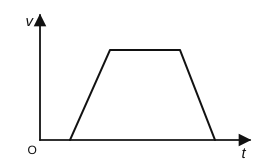
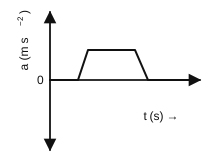
The acceleration (a) – time (t) graph that best suits this motion is:
किसी वस्तु की गति का वेग (v) – समय (t) आलेख नीचे दर्शाया गया है:
इस गति के लिए सबसे उपयुक्त त्वरण (a) – समय (t) ग्राफ़ है:
- A
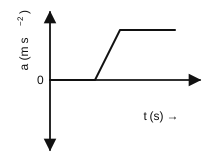
- B
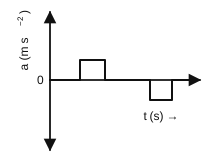
- C
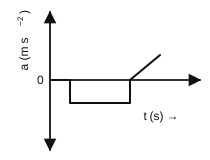
- D
Show answer
Concept: = slope of the v–t graph; a straight-line segment has constant slope.
- Rising straight line → constant positive a (a positive rectangle).
- Horizontal part → slope 0 → a = 0.
- Falling straight line → constant negative a (a negative rectangle).
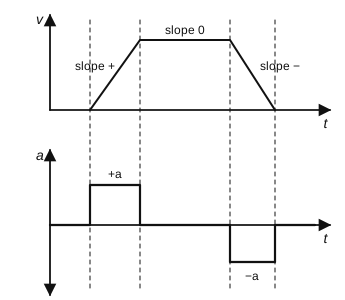
- Only (B) shows: positive block, zero, negative block. (A), (D) have no negative part; (C) starts negative.
Short trick: For v–t made of straight lines, the a–t graph is always a set of flat steps (rectangles), never sloping lines.
Answer: (B) Graph (B)
अवधारणा: = v–t ग्राफ़ की ढाल; सरल रेखा खंड की ढाल नियत होती है।
- ऊपर उठती सरल रेखा → नियत धनात्मक a (धनात्मक आयत)।
- क्षैतिज भाग → ढाल 0 → a = 0।
- नीचे गिरती सरल रेखा → नियत ऋणात्मक a (ऋणात्मक आयत)।
- केवल (B) में: धनात्मक खंड, शून्य, ऋणात्मक खंड। (A), (D) में ऋणात्मक भाग नहीं; (C) ऋणात्मक से शुरू होता है।
शॉर्ट ट्रिक: सरल रेखाओं से बने v–t के लिए a–t ग्राफ़ सदैव समतल सीढ़ियों (आयतों) का होता है, कभी ढलवाँ रेखाएँ नहीं।
उत्तर: (B) ग्राफ़ (B)
NEET UGPhysicsMotion in a straight line – v–t to a–t graphNEET UG 2024 · 5 May Shift 1
Q406.A parallel plate capacitor is charged by connecting it to a battery through a resistor. If I is the current in the circuit, then in the gap between the plates:
एक समांतर पट्टिका संधारित्र को एक प्रतिरोधक के माध्यम से बैटरी से जोड़कर आवेशित किया जाता है। यदि परिपथ में धारा I है, तो पट्टिकाओं के बीच के रिक्त स्थान में:
- ADisplacement current of magnitude equal to I flows in the same direction as I.I के बराबर परिमाण की विस्थापन धारा I की ही दिशा में बहती है।
- BDisplacement current of magnitude equal to I flows in a direction opposite to that of I.I के बराबर परिमाण की विस्थापन धारा I की विपरीत दिशा में बहती है।
- CDisplacement current of magnitude greater than I flows but can be in any direction.I से अधिक परिमाण की विस्थापन धारा बहती है परंतु वह किसी भी दिशा में हो सकती है।
- DThere is no current.कोई धारा नहीं बहती।
Show answer
Concept: Displacement current makes current continuous: in the gap equals the conduction current I in the wires.
- .
- While charging, E (and ) grows in the direction of I → is in the same direction as I.
- So magnitude equal, direction same → (A); (B), (C), (D) wrong.
Short trick: Kirchhoff-style continuity: whatever enters the capacitor gap as I continues as , same size, same way.
Answer: (A) Displacement current equal to I, in the same direction
अवधारणा: विस्थापन धारा धारा को सतत बनाती है: रिक्त स्थान में तारों की चालन धारा I के बराबर होती है।
- ।
- आवेशन के समय E (और ) I की दिशा में बढ़ता है → की दिशा I के समान है।
- अतः परिमाण बराबर, दिशा समान → (A); (B), (C), (D) गलत।
शॉर्ट ट्रिक: किरखॉफ़ जैसी सततता: संधारित्र के रिक्त स्थान में जो I के रूप में आता है वही के रूप में आगे बढ़ता है, समान परिमाण, समान दिशा।
उत्तर: (A) I के बराबर विस्थापन धारा, समान दिशा में
NEET UGPhysicsElectromagnetic waves – displacement currentNEET UG 2024 · 5 May Shift 1
Q407.A force defined by acts on a particle at a given time t. The factor which is dimensionless, if α and β are constants, is:
किसी दिए गए समय t पर एक कण पर द्वारा परिभाषित बल कार्य करता है। यदि α और β नियतांक हैं, तो विमाहीन गुणक है:
- A
- B
- C
- D
Show answer
Concept: Only like quantities can be added: each term has the dimension of force.
- and .
- Dividing: → dimensionless.
- (B) , (C) , (D) have dimensions → wrong.
Short trick: Ratio of two terms of the same sum is always dimensionless: .
Answer: (A)
अवधारणा: केवल समान विमा वाली राशियाँ जोड़ी जा सकती हैं: प्रत्येक पद की विमा बल की है।
- तथा ।
- भाग देने पर: → विमाहीन।
- (B) , (C) , (D) की विमाएँ हैं → गलत।
शॉर्ट ट्रिक: एक ही योग के दो पदों का अनुपात सदैव विमाहीन होता है: ।
उत्तर: (A)
NEET UGPhysicsUnits and dimensions – dimensional analysisNEET UG 2024 · 5 May Shift 1
Q408.If the plates of a parallel plate capacitor connected to a battery are moved close to each other, then
A. The charge stored in it, increases.
B. The energy stored in it decreases.
C. Its capacitance increases.
D. The ratio of charge to its potential remains the same.
E. The product of charge and voltage increases.
Choose the most appropriate answer from the options given below:
यदि बैटरी से जुड़े एक समांतर पट्टिका संधारित्र की पट्टिकाओं को एक-दूसरे के पास लाया जाए, तो
A. इसमें संचित आवेश बढ़ता है।
B. इसमें संचित ऊर्जा घटती है।
C. इसकी धारिता बढ़ती है।
D. आवेश और विभव का अनुपात समान रहता है।
E. आवेश और वोल्टता का गुणनफल बढ़ता है।
नीचे दिए गए विकल्पों में से सबसे उपयुक्त उत्तर चुनिए:
- AA, C and E onlyकेवल A, C और E
- BB, D and E onlyकेवल B, D और E
- CA, B and C onlyकेवल A, B और C
- DA, B and E onlyकेवल A, B और E
Show answer
Concept: With the battery connected V stays constant; increases as d decreases.
- C: d ↓ → C ↑ → true.
- A: Q = CV ↑ → true.
- B: ↑ → “decreases” is false.
- D: Q/V = C, which increases → false.
- E: QV = CV² ↑ → true.
Short trick: Battery connected → V fixed → everything with C in it (Q, U, QV) increases.
Answer: (A) A, C and E only
अवधारणा: बैटरी जुड़ी रहने पर V नियत रहता है; d घटने पर बढ़ती है।
- C: d ↓ → C ↑ → सत्य।
- A: Q = CV ↑ → सत्य।
- B: ↑ → “घटती है” असत्य।
- D: Q/V = C, जो बढ़ती है → असत्य।
- E: QV = CV² ↑ → सत्य।
शॉर्ट ट्रिक: बैटरी जुड़ी → V नियत → जिसमें C है वह सब (Q, U, QV) बढ़ता है।
उत्तर: (A) केवल A, C और E
NEET UGPhysicsCapacitance – plates moved closer with battery connectedNEET UG 2024 · 5 May Shift 1
Q409.The following graph represents the T-V curves of an ideal gas (where T is the temperature and V the volume) at three pressures
,
and
compared with those of Charles’s law represented as dotted lines.
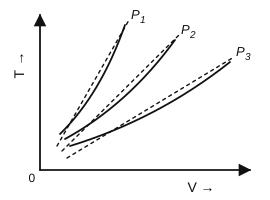
Then the correct relation is:
निम्नलिखित ग्राफ़ एक आदर्श गैस के तीन दाबों
,
और
पर T-V वक्रों (जहाँ T ताप तथा V आयतन है) को दर्शाता है, जिनकी तुलना बिंदुकित रेखाओं द्वारा दर्शाए गए चार्ल्स नियम के वक्रों से की गई है।
तब सही संबंध है:
- A
- B
- C
- D
Show answer
Concept: At constant pressure : the slope of a T–V line is proportional to P.
- Steepest curve is , then , then .
- Larger slope → larger pressure → .
Short trick: On T–V (T on y-axis) steeper = higher P; on V–T (V on y-axis) steeper = lower P. Check the axes first!
Answer: (C)
अवधारणा: नियत दाब पर : T–V रेखा की ढाल P के समानुपाती है।
- सबसे तीव्र वक्र , फिर , फिर ।
- अधिक ढाल → अधिक दाब → ।
शॉर्ट ट्रिक: T–V (y-अक्ष पर T) में तीव्र = अधिक P; V–T (y-अक्ष पर V) में तीव्र = कम P। पहले अक्ष जाँचें!
उत्तर: (C)
NEET UGPhysicsKinetic theory – ideal gas T–V graph (Charles’s law)NEET UG 2024 · 5 May Shift 1
Q410.The minimum energy required to launch a satellite of mass m from the surface of earth of mass M and radius R in a circular orbit at an altitude of 2R from the surface of the earth is:
द्रव्यमान M और त्रिज्या R वाली पृथ्वी की सतह से m द्रव्यमान के एक उपग्रह को पृथ्वी की सतह से 2R ऊँचाई पर वृत्ताकार कक्षा में प्रक्षेपित करने के लिए आवश्यक न्यूनतम ऊर्जा है:
- A
- B
- C
- D
Show answer
Concept: Energy needed = (total energy in orbit) − (energy at the surface). In a circular orbit of radius r: .
- Orbit radius → .
- At the surface (at rest, ignoring earth’s rotation): .
Short trick: Altitude h → r = R + h. Use (half of PE), not PE alone: .
Answer: (D)
अवधारणा: आवश्यक ऊर्जा = (कक्षा में कुल ऊर्जा) − (सतह पर ऊर्जा)। त्रिज्या r की वृत्ताकार कक्षा में: ।
- कक्षा की त्रिज्या → ।
- सतह पर (विराम में, पृथ्वी का घूर्णन नगण्य): ।
शॉर्ट ट्रिक: ऊँचाई h → r = R + h। केवल PE नहीं, (PE का आधा) लें: ।
उत्तर: (D)
NEET UGPhysicsGravitation – energy to put a satellite in orbitNEET UG 2024 · 5 May Shift 1
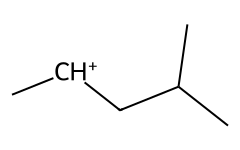
Q411.The most stable carbocation among the following
निम्नलिखित में से सबसे अधिक स्थायी कार्बधनायन (carbocation) है
- A
- B
- C
- D
Show answer
Concept: In the absence of conjugation, carbocation stability is decided by +I effect and hyperconjugation: 3° > 2° > 1°; more α-hydrogens → more hyperconjugative structures → more stable.
- (A) 4-methylpentan-2-yl cation: 2°, α-H = 3 (CH3) + 2 (CH2) = 5.
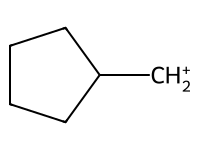
- (B) cyclopentylmethyl cation: 1°, α-H = 1 only – least stable.
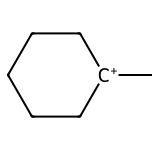
- (C) 1-methylcyclohexyl cation: 3°, α-H = 3 (CH3) + 2 + 2 (two ring CH2) = 7.
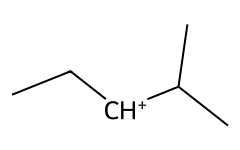
- (D) 2-methylpentan-3-yl cation: 2°, α-H = 2 (CH2) + 1 (CH) = 3.
- The only tertiary cation, with the maximum α-H (7), is (C).
Short trick: Count α-H (H on carbons directly attached to C+). Highest count + highest degree wins: 3° with 7 α-H beats every 2° and 1° here.
Answer: (C)
अवधारणा: अनुनाद न होने पर कार्बधनायन का स्थायित्व +I प्रभाव और अतिसंयुग्मन (hyperconjugation) से तय होता है: 3° > 2° > 1°; जितने अधिक α-हाइड्रोजन, उतनी अधिक अतिसंयुग्मी संरचनाएँ → उतना अधिक स्थायी।
- (A) 4-मेथिलपेन्टेन-2-इल धनायन: 2°, α-H = 3 (CH3) + 2 (CH2) = 5।
- (B) साइक्लोपेन्टिलमेथिल धनायन: 1°, केवल 1 α-H – सबसे कम स्थायी।
- (C) 1-मेथिलसाइक्लोहेक्सिल धनायन: 3°, α-H = 3 (CH3) + 2 + 2 (वलय के दो CH2) = 7।
- (D) 2-मेथिलपेन्टेन-3-इल धनायन: 2°, α-H = 2 (CH2) + 1 (CH) = 3।
- एकमात्र तृतीयक धनायन, जिसमें अधिकतम α-H (7) हैं, (C) है।
शॉर्ट ट्रिक: α-H गिनिए (C+ से सीधे जुड़े कार्बनों पर H)। सबसे अधिक संख्या + सबसे उच्च कोटि वाला जीतता है: 7 α-H वाला 3° धनायन यहाँ सभी 2° और 1° से अधिक स्थायी है।
उत्तर: (C)
NEET UGChemistryOrganic chemistry – carbocation stability (hyperconjugation)NEET UG 2024 · 5 May Shift 1
Q412.For the reaction 2A ⇌ B + C, Kc = 4 × 10⁻³. At a given time, the composition of reaction mixture is : [A] = [B] = [C] = 2 × 10⁻³ M
Then, which of the following is correct?
अभिक्रिया 2A ⇌ B + C के लिए Kc = 4 × 10⁻³ है। किसी दिए गए समय पर अभिक्रिया मिश्रण का संघटन है : [A] = [B] = [C] = 2 × 10⁻³ M
तब, निम्नलिखित में से कौन-सा सही है?
- AReaction has a tendency to go in forward direction.अभिक्रिया में अग्र दिशा में जाने की प्रवृत्ति है।
- BReaction has a tendency to go in backward direction.अभिक्रिया में पश्च दिशा में जाने की प्रवृत्ति है।
- CReaction has gone to completion in forward direction.अभिक्रिया अग्र दिशा में पूर्ण हो चुकी है।
- DReaction is at equilibrium.अभिक्रिया साम्यावस्था में है।
Show answer
Concept: Compare the reaction quotient Qc with Kc: Q < K → forward; Q = K → equilibrium; Q > K → backward.
- Kc = 4 × 10–3 = 0.004.
- Qc (1) > Kc (0.004): too much product is present, so the reaction shifts backward to form more A.
- It is not at equilibrium (Q ≠ K) and not complete (A is still present), so (A), (C), (D) are wrong.
Short trick: When all concentrations are equal, Q = (conc.)Δn = (2 × 10⁻³)0 = 1, since Δn = 2 − 2 = 0. Any K < 1 then means "backward".
Answer: (B)
अवधारणा: अभिक्रिया भागफल Qc की Kc से तुलना कीजिए: Q < K → अग्र दिशा; Q = K → साम्य; Q > K → पश्च दिशा।
- Kc = 4 × 10–3 = 0.004।
- Qc (1) > Kc (0.004): उत्पाद आवश्यकता से अधिक है, अतः अभिक्रिया पश्च दिशा में जाकर अधिक A बनाएगी।
- यह साम्य में नहीं है (Q ≠ K) और पूर्ण भी नहीं हुई (A अभी भी उपस्थित है), अतः (A), (C), (D) गलत हैं।
शॉर्ट ट्रिक: सभी सांद्रताएँ बराबर हों तो Q = (सांद्रता)Δn = (2 × 10⁻³)0 = 1, क्योंकि Δn = 2 − 2 = 0। तब K < 1 का अर्थ है "पश्च दिशा"।
उत्तर: (B)
NEET UGChemistryChemical equilibrium – reaction quotient Q vs KNEET UG 2024 · 5 May Shift 1
Q413.‘Spin only’ magnetic moment is same for which of the following ions?
A. Ti3+, B. Cr2+
C. Mn2+, D. Fe2+
E. Sc3+
Choose the most appropriate answer from the options given below:
निम्नलिखित में से किन आयनों के लिए ‘केवल चक्रण’ (spin only) चुंबकीय आघूर्ण समान है?
A. Ti3+, B. Cr2+
C. Mn2+, D. Fe2+
E. Sc3+
नीचे दिए गए विकल्पों में से सबसे उपयुक्त उत्तर चुनिए:
- AA and E onlyकेवल A और E
- BB and C onlyकेवल B और C
- CA and D onlyकेवल A और D
- DB and D onlyकेवल B और D
Show answer
Concept: BM depends only on the number of unpaired electrons n, so ions with equal n have equal μ.
- Ti3+: 3d1 → n = 1 → 1.73 BM
- Cr2+: 3d4 → n = 4 → 4.90 BM
- Mn2+: 3d5 → n = 5 → 5.92 BM
- Fe2+: 3d6 → n = 4 → 4.90 BM
- Sc3+: 3d0 → n = 0 → 0 BM
- Only Cr2+ and Fe2+ have the same n (4) → B and D.
Short trick: dn and d10−n (high spin) have the same unpaired electrons: d4 ↔ d6, d1 ↔ d9, d3 ↔ d7.
Answer: (D)
अवधारणा: BM केवल अयुग्मित इलेक्ट्रॉनों की संख्या n पर निर्भर करता है, अतः समान n वाले आयनों का μ समान होता है।
- Ti3+: 3d1 → n = 1 → 1.73 BM
- Cr2+: 3d4 → n = 4 → 4.90 BM
- Mn2+: 3d5 → n = 5 → 5.92 BM
- Fe2+: 3d6 → n = 4 → 4.90 BM
- Sc3+: 3d0 → n = 0 → 0 BM
- केवल Cr2+ और Fe2+ में n समान (4) है → B और D।
शॉर्ट ट्रिक: dn और d10−n (उच्च चक्रण) में अयुग्मित इलेक्ट्रॉन समान होते हैं: d4 ↔ d6, d1 ↔ d9, d3 ↔ d7।
उत्तर: (D)
NEET UGChemistryd-block – spin-only magnetic momentNEET UG 2024 · 5 May Shift 1
Q414.The energy of an electron in the ground state (n = 1) for He+ ion is –x J, then that for an electron in n = 2 state for Be3+ ion in J is
He+ आयन की मूल अवस्था (n = 1) में इलेक्ट्रॉन की ऊर्जा –x J है, तो Be3+ आयन की n = 2 अवस्था में इलेक्ट्रॉन की ऊर्जा (J में) है
- A
- B–4x
- C
- D–x
Show answer
Concept: For a one-electron species, eV, i.e. .
- He+ (Z = 2, n = 1): Z2/n2 = 4/1 = 4 → E = –x J.
- Be3+ (Z = 4, n = 2): Z2/n2 = 16/4 = 4.
- Same ratio Z2/n2 → same energy: E = –x J.
Short trick: Z/n is 2 in both cases (2/1 = 4/2), so the energies are identical – no calculation needed.
Answer: (D) –x
अवधारणा: एक-इलेक्ट्रॉन स्पीशीज़ के लिए eV, अर्थात् ।
- He+ (Z = 2, n = 1): Z2/n2 = 4/1 = 4 → E = –x J।
- Be3+ (Z = 4, n = 2): Z2/n2 = 16/4 = 4।
- Z2/n2 का अनुपात समान → ऊर्जा समान: E = –x J।
शॉर्ट ट्रिक: दोनों में Z/n = 2 है (2/1 = 4/2), अतः ऊर्जाएँ बराबर हैं – गणना की आवश्यकता नहीं।
उत्तर: (D) –x
NEET UGChemistryAtomic structure – Bohr energy of hydrogen-like ionsNEET UG 2024 · 5 May Shift 1
Q415.Which reaction is NOT a redox reaction ?
कौन-सी अभिक्रिया रेडॉक्स (अपचयोपचय) अभिक्रिया नहीं है?
- A2KClO3 + I2 → 2KIO3 + Cl2
- BH2 + Cl2 → 2HCl
- CBaCl2 + Na2SO4 → BaSO4 + 2NaCl
- DZn + CuSO4 → ZnSO4 + Cu
Show answer
Concept: A redox reaction needs a change in oxidation number of some element (one oxidised, one reduced).
- (A) Cl: +5 → 0 (reduced); I: 0 → +5 (oxidised) – redox.
- (B) H: 0 → +1, Cl: 0 → –1 – redox.
- (C) Ba +2, Cl –1, Na +1, S +6, O –2 on both sides – only exchange of ions (precipitation of BaSO4), no change – NOT redox.
- (D) Zn: 0 → +2, Cu: +2 → 0 – redox (displacement).
Short trick: Double-displacement (ion exchange / precipitation, neutralisation) reactions are never redox; any reaction with a free element on one side is redox.
Answer: (C)
अवधारणा: रेडॉक्स अभिक्रिया में किसी तत्व की ऑक्सीकरण संख्या में परिवर्तन होना आवश्यक है (एक ऑक्सीकृत, एक अपचयित)।
- (A) Cl: +5 → 0 (अपचयित); I: 0 → +5 (ऑक्सीकृत) – रेडॉक्स।
- (B) H: 0 → +1, Cl: 0 → –1 – रेडॉक्स।
- (C) दोनों ओर Ba +2, Cl –1, Na +1, S +6, O –2 – केवल आयनों का विनिमय (BaSO4 का अवक्षेपण), कोई परिवर्तन नहीं – रेडॉक्स नहीं।
- (D) Zn: 0 → +2, Cu: +2 → 0 – रेडॉक्स (विस्थापन)।
शॉर्ट ट्रिक: द्वि-विस्थापन (आयन विनिमय / अवक्षेपण, उदासीनीकरण) अभिक्रियाएँ कभी रेडॉक्स नहीं होतीं; जिस अभिक्रिया में किसी ओर मुक्त तत्व हो वह रेडॉक्स होती है।
उत्तर: (C)
NEET UGChemistryRedox reactions – identifying redoxNEET UG 2024 · 5 May Shift 1
Q416.Match List-I with List-II
| List-I (Molecule) | List-II (Number and types of bond/s between two carbon atoms) |
|---|
| A. ethane | I. one σ-bond and two π-bonds |
| B. ethene | II. two π-bonds |
| C. carbon molecule, C2 | III. one σ-bonds |
| D. ethyne | IV. one σ-bond and one π-bonds |
Choose the correct answer from the options given below:
सूची-I का सूची-II से मिलान कीजिए
| सूची-I (अणु) | सूची-II (दो कार्बन परमाणुओं के बीच आबंध/आबंधों की संख्या और प्रकार) |
|---|
| A. एथेन | I. एक σ-आबंध और दो π-आबंध |
| B. एथीन | II. दो π-आबंध |
| C. कार्बन अणु, C2 | III. एक σ-आबंध |
| D. एथाइन | IV. एक σ-आबंध और एक π-आबंध |
नीचे दिए गए विकल्पों में से सही उत्तर चुनिए:
- AA-IV, B-III, C-II, D-I
- BA-III, B-IV, C-II, D-I
- CA-III, B-IV, C-I, D-II
- DA-I, B-IV, C-II, D-III
Show answer
Concept: Single bond = 1σ; double bond = 1σ + 1π; triple bond = 1σ + 2π. In C2 (MOT), the bond order 2 comes from two π(2p) bonding MOs, with no σ(2p) electrons.
- A. Ethane, H3C–CH3: single bond → one σ (III).
- B. Ethene, H2C=CH2: one σ + one π (IV).
- C. C2: σ1s2 σ*1s2 σ2s2 σ*2s2 (π2px2 = π2py2); B.O. = (8 − 4)/2 = 2, both bonds are π → two π (II).
- D. Ethyne, HC≡CH: one σ + two π (I).
- Match: A-III, B-IV, C-II, D-I.
Short trick: C2 is the classic NCERT exception: a double bond made of two π bonds and no σ bond.
Answer: (B)
अवधारणा: एकल आबंध = 1σ; द्वि-आबंध = 1σ + 1π; त्रि-आबंध = 1σ + 2π। C2 में (आण्विक कक्षक सिद्धांत) आबंध कोटि 2 दो π(2p) आबंधी कक्षकों से आती है, σ(2p) में कोई इलेक्ट्रॉन नहीं होता।
- A. एथेन, H3C–CH3: एकल आबंध → एक σ (III)।
- B. एथीन, H2C=CH2: एक σ + एक π (IV)।
- C. C2: σ1s2 σ*1s2 σ2s2 σ*2s2 (π2px2 = π2py2); आबंध कोटि = (8 − 4)/2 = 2, दोनों आबंध π हैं → दो π (II)।
- D. एथाइन, HC≡CH: एक σ + दो π (I)।
- मिलान: A-III, B-IV, C-II, D-I।
शॉर्ट ट्रिक: C2 NCERT का प्रसिद्ध अपवाद है: द्वि-आबंध जो दो π आबंधों से बना है, σ आबंध नहीं।
उत्तर: (B)
NEET UGChemistryChemical bonding – σ and π bonds, MOT of C₂NEET UG 2024 · 5 May Shift 1
Q417.Match List I with List II
| List I (Complex) | List II (types of isomerism) |
|---|
| A. [Co(NH3)5(NO2)]Cl2 | I. Solvate isomerism |
| B. [Co(NH3)5(SO4)]Br | II. Linkage isomerism |
| C. [Co(NH3)6][Cr(CN)6] | III. Ionization isomerism |
| D. [Co(H2O)6]Cl3 | IV. Coordination isomerism |
Choose the correct answer from the options given below
सूची I का सूची II से मिलान कीजिए
| सूची I (संकुल) | सूची II (समावयवता के प्रकार) |
|---|
| A. [Co(NH3)5(NO2)]Cl2 | I. विलायकयोजन समावयवता (Solvate isomerism) |
| B. [Co(NH3)5(SO4)]Br | II. बंधनी समावयवता (Linkage isomerism) |
| C. [Co(NH3)6][Cr(CN)6] | III. आयनन समावयवता (Ionization isomerism) |
| D. [Co(H2O)6]Cl3 | IV. उपसहसंयोजन समावयवता (Coordination isomerism) |
नीचे दिए गए विकल्पों में से सही उत्तर चुनिए
- AA-I, B-III, C-IV, D-II
- BA-I, B-IV, C-III, D-II
- CA-II, B-IV, C-III, D-I
- DA-II, B-III, C-IV, D-I
Show answer
Concept: Linkage – ambidentate ligand (NO2–/ONO–); ionisation – ligand and counter-ion exchange; coordination – both cation and anion are complexes; solvate (hydrate) – water inside vs outside the sphere.
- A. NO2– can bind through N (nitro) or O (nitrito) → linkage (II).
- B. SO42– inside / Br– outside ↔ [Co(NH3)5Br]SO4 → ionisation (III).
- C. Both ions are complex ions; ligands can swap: [Cr(NH3)6][Co(CN)6] → coordination (IV).
- D. [Co(H2O)6]Cl3 ↔ [Co(H2O)5Cl]Cl2·H2O → solvate/hydrate (I).
- Match: A-II, B-III, C-IV, D-I.
Short trick: Spot the clue: NO2/SCN/CN → linkage; two complex ions → coordination; H2O ligands → solvate; different anions inside/outside → ionisation.
Answer: (D)
अवधारणा: बंधनी – उभयदंती लिगन्ड (NO2–/ONO–); आयनन – लिगन्ड और प्रति-आयन का आदान-प्रदान; उपसहसंयोजन – धनायन और ऋणायन दोनों संकुल; विलायकयोजन (हाइड्रेट) – जल का समन्वय मंडल के अंदर बनाम बाहर होना।
- A. NO2– N (नाइट्रो) या O (नाइट्राइटो) से जुड़ सकता है → बंधनी (II)।
- B. SO42– अंदर / Br– बाहर ↔ [Co(NH3)5Br]SO4 → आयनन (III)।
- C. दोनों आयन संकुल आयन हैं; लिगन्ड अदला-बदली कर सकते हैं: [Cr(NH3)6][Co(CN)6] → उपसहसंयोजन (IV)।
- D. [Co(H2O)6]Cl3 ↔ [Co(H2O)5Cl]Cl2·H2O → विलायकयोजन/हाइड्रेट (I)।
- मिलान: A-II, B-III, C-IV, D-I।
शॉर्ट ट्रिक: संकेत पहचानिए: NO2/SCN/CN → बंधनी; दो संकुल आयन → उपसहसंयोजन; H2O लिगन्ड → विलायकयोजन; अंदर/बाहर भिन्न ऋणायन → आयनन।
उत्तर: (D)
NEET UGChemistryCoordination compounds – structural isomerismNEET UG 2024 · 5 May Shift 1
Q418.The Eo value for the Mn3+/Mn2+ couple is more positive than that of Cr3+/Cr2+ or Fe3+/Fe2+ due to change of
Mn3+/Mn2+ युग्म का Eo मान Cr3+/Cr2+ या Fe3+/Fe2+ की तुलना में अधिक धनात्मक होता है, जिसका कारण है निम्न में परिवर्तन
- Ad5 to d2 configurationd5 से d2 विन्यास
- Bd4 to d5 configurationd4 से d5 विन्यास
- Cd3 to d5 configurationd3 से d5 विन्यास
- Dd5 to d4 configurationd5 से d4 विन्यास
Show answer
Concept: A large positive E°(M3+/M2+) means M3+ is very easily reduced to M2+, i.e. M2+ is extra stable.
- Mn3+ = 3d4; on reduction Mn2+ = 3d5 (half-filled, maximum exchange energy).
- So Mn3+ + e– → Mn2+ is highly favourable: E° = +1.57 V.
- Cr3+ (d3, stable half-filled t2g) → Cr2+ (d4) is unfavourable (E° = –0.41 V); Fe3+ (d5) → Fe2+ (d6) loses the half-filled set (E° = +0.77 V).
- Hence the cause is the change d4 → d5.
Short trick: Mn3+ is "one electron away" from the magic d5 – it grabs that electron eagerly, so its E° is the highest.
Answer: (B)
अवधारणा: E°(M3+/M2+) का अधिक धनात्मक होना बताता है कि M3+ आसानी से M2+ में अपचयित होता है, अर्थात् M2+ अत्यधिक स्थायी है।
- Mn3+ = 3d4; अपचयन पर Mn2+ = 3d5 (अर्ध-पूरित, अधिकतम विनिमय ऊर्जा)।
- अतः Mn3+ + e– → Mn2+ अत्यधिक अनुकूल है: E° = +1.57 V।
- Cr3+ (d3, स्थायी अर्ध-पूरित t2g) → Cr2+ (d4) प्रतिकूल है (E° = –0.41 V); Fe3+ (d5) → Fe2+ (d6) में अर्ध-पूरित विन्यास टूटता है (E° = +0.77 V)।
- अतः कारण d4 → d5 परिवर्तन है।
शॉर्ट ट्रिक: Mn3+ जादुई d5 से "एक इलेक्ट्रॉन दूर" है – वह इलेक्ट्रॉन तुरंत ले लेता है, इसलिए उसका E° सबसे अधिक है।
उत्तर: (B)
NEET UGChemistryd-block – E° of M³⁺/M²⁺ couplesNEET UG 2024 · 5 May Shift 1
Q419.The highest number of helium atoms is in
हीलियम परमाणुओं की सर्वाधिक संख्या किसमें है?
- A4 u of helium4 u हीलियम
- B4 g of helium4 g हीलियम
- C2.271098 L of helium at STPSTP पर 2.271098 L हीलियम
- D4 mol of helium4 mol हीलियम
Show answer
Concept: Number of atoms = moles × NA (He is monatomic). Molar mass of He = 4 g mol–1; molar volume at STP (1 bar, 273.15 K) = 22.71098 L.
- 4 u = mass of one He atom → 1 atom only.
- 4 g → 4/4 = 1 mol → NA atoms.
- 2.271098 L at STP → 2.271098/22.71098 = 0.1 mol → 0.1 NA atoms.
- 4 mol → 4 NA atoms – the highest.
Short trick: Convert everything to moles; "u" is the mass of a single atom – always the smallest.
Answer: (D)
अवधारणा: परमाणुओं की संख्या = मोल × NA (He एकपरमाणुक है)। He का मोलर द्रव्यमान = 4 g mol–1; STP (1 bar, 273.15 K) पर मोलर आयतन = 22.71098 L।
- 4 u = एक He परमाणु का द्रव्यमान → केवल 1 परमाणु।
- 4 g → 4/4 = 1 mol → NA परमाणु।
- STP पर 2.271098 L → 2.271098/22.71098 = 0.1 mol → 0.1 NA परमाणु।
- 4 mol → 4 NA परमाणु – सर्वाधिक।
शॉर्ट ट्रिक: सबको मोल में बदलिए; "u" एक परमाणु का द्रव्यमान है – हमेशा सबसे छोटा।
उत्तर: (D)
NEET UGChemistryMole concept – number of atomsNEET UG 2024 · 5 May Shift 1
Q420.Which plot of ln k vs 1/T is consistent with Arrhenius equation?
ln k तथा 1/T के बीच कौन-सा आलेख आरेनियस समीकरण के अनुरूप है?
- A
- B
- C
- D
Show answer
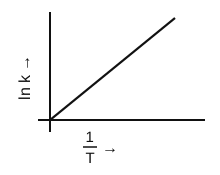
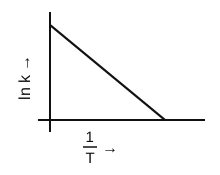
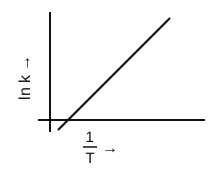
Concept: Arrhenius: ⇒ – a straight line (y = c + mx) with slope (negative) and intercept ln A on the ln k axis.
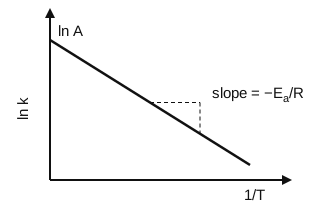
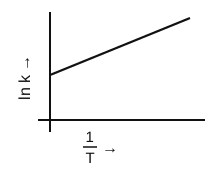
- Since Ea > 0, the slope is negative: ln k must decrease as 1/T increases.
- (A), (B), (D) all show a positive slope – wrong.
- (C) is a falling straight line with a positive intercept (ln A) – correct.
Short trick: Higher T → larger k. Higher 1/T means lower T → smaller k, so the line must go DOWN.
Answer: (C)
अवधारणा: आरेनियस: ⇒ – एक सरल रेखा (y = c + mx) जिसकी ढाल (ऋणात्मक) और ln k अक्ष पर अंतःखंड ln A है।
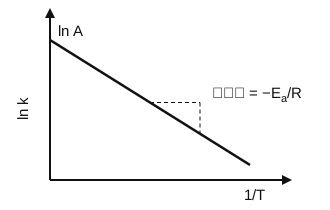
- चूँकि Ea > 0, ढाल ऋणात्मक है: 1/T बढ़ने पर ln k घटना चाहिए।
- (A), (B), (D) सभी धनात्मक ढाल दिखाते हैं – गलत।
- (C) धनात्मक अंतःखंड (ln A) वाली नीचे गिरती सरल रेखा है – सही।
शॉर्ट ट्रिक: T बढ़ने पर k बढ़ता है। 1/T अधिक अर्थात् T कम → k कम, अतः रेखा नीचे की ओर जानी चाहिए।
उत्तर: (C)
NEET UGChemistryChemical kinetics – Arrhenius plotNEET UG 2024 · 5 May Shift 1

