Q61.Given below are two statements : one is labelled as Assertion A and the other is labelled as Reason R.
Assertion A : Generally, 3d transition metals have high melting points.
Reason R : Involvement of 3d-electrons in addition to 4s-electrons in the interatomic metallic bonding.
In light of the above statements, choose the most appropriate answer from the options given below:
नीचे दो कथन दिए गए हैं : एक को अभिकथन A और दूसरे को कारण R कहा गया है।
अभिकथन A : सामान्यतः 3d संक्रमण धातुओं के गलनांक उच्च होते हैं।
कारण R : अंतरापरमाण्विक धात्विक आबंधन में 4s-इलेक्ट्रॉनों के अतिरिक्त 3d-इलेक्ट्रॉनों की भी भागीदारी।
उपर्युक्त कथनों के आलोक में, नीचे दिए गए विकल्पों में से सबसे उपयुक्त उत्तर चुनिए:
- ABoth A and R are correct and R is the correct explanation of AA और R दोनों सही हैं और R, A की सही व्याख्या है
- BBoth A and R are correct but R is NOT the correct explanation of AA और R दोनों सही हैं लेकिन R, A की सही व्याख्या नहीं है
- CA is correct but R is not correctA सही है लेकिन R सही नहीं है
- DA is not correct but R is correctA सही नहीं है लेकिन R सही है
Show answer
Concept: NCERT: transition metals have high melting points because of the involvement of a greater number of electrons from (n−1)d in addition to ns electrons in interatomic metallic bonding.
- A is true: e.g. Cr, V, Ti melt far above Ca or K.
- R is true and is exactly the reason – more bonding electrons per atom ⇒ stronger metallic bonds ⇒ higher m.p. (maximum near d5).
Short trick: More unpaired d-electrons → stronger metallic bond → m.p. rises up to mid-series.
Answer: (A) Both A and R correct; R explains A
अवधारणा: NCERT: संक्रमण धातुओं के गलनांक उच्च होते हैं क्योंकि अंतरापरमाण्विक धात्विक आबंधन में ns इलेक्ट्रॉनों के अतिरिक्त (n−1)d के अधिक इलेक्ट्रॉन भाग लेते हैं।
- A सत्य है: जैसे Cr, V, Ti के गलनांक Ca या K से बहुत अधिक हैं।
- R सत्य है और यही कारण है – प्रति परमाणु अधिक आबंधी इलेक्ट्रॉन ⇒ प्रबल धात्विक आबंध ⇒ उच्च गलनांक (d5 के आसपास अधिकतम)।
शॉर्ट ट्रिक: अधिक अयुग्मित d-इलेक्ट्रॉन → प्रबल धात्विक आबंध → श्रेणी के मध्य तक गलनांक बढ़ता है।
उत्तर: (A) A और R दोनों सही; R, A की व्याख्या है
NEET UGChemistryd-block elements – melting pointsNEET UG 2026 · 21 Jun Shift 1
Q62.For a salt XY, which is a strong electrolyte, the plot of Λm versus has a slope of −90.0 S cm2 mol−3/2 L1/2 at 298 K. At 0.01 M concentration of XY, the values of Λm is 145 S cm2 mol−1. The limiting molar conductivity of Y− ion (, in S cm2 mol−1) at 298 K will be
(Given = 74.0 S cm2 mol−1)
प्रबल विद्युत-अपघट्य लवण XY के लिए 298 K पर Λm बनाम आलेख की प्रवणता −90.0 S cm2 mol−3/2 L1/2 है। XY की 0.01 M सांद्रता पर Λm का मान 145 S cm2 mol−1 है। 298 K पर Y− आयन की सीमांत मोलर चालकता (, S cm2 mol−1 में) होगी
(दिया है = 74.0 S cm2 mol−1)
- A80.0
- B100.0
- C90.0
- D76.0
Show answer
Concept: Debye–Hückel–Onsager: (slope = −A); Kohlrausch: .
- ; 145 = Λ0 − 90 × 0.1 ⇒ Λ0 = 145 + 9 = 154 S cm2 mol−1.
- = 154 − 74 = 80.0 S cm2 mol−1.
Short trick: Slope is negative, so Λ0 is always LARGER than the measured Λm – add |slope|·√c.
Answer: (A) 80.0
अवधारणा: डेबाई–हकेल–ऑन्सागर: (प्रवणता = −A); कोलराउश: ।
- ; 145 = Λ0 − 90 × 0.1 ⇒ Λ0 = 145 + 9 = 154 S cm2 mol−1।
- = 154 − 74 = 80.0 S cm2 mol−1।
शॉर्ट ट्रिक: प्रवणता ऋणात्मक है, इसलिए Λ0 सदैव मापे गए Λm से बड़ा – |प्रवणता|·√c जोड़ें।
उत्तर: (A) 80.0
NEET UGChemistryElectrochemistry – Kohlrausch’s lawNEET UG 2026 · 21 Jun Shift 1
Q63.The amount of carbon dioxide evolved upon complete combustion of 116 g of n-butane is
(Given : atomic mass in amu H = 1, C = 12 and O = 16)
116 g n-ब्यूटेन के पूर्ण दहन पर निकलने वाली कार्बन डाइऑक्साइड की मात्रा है
(दिया है : परमाणु द्रव्यमान amu में H = 1, C = 12 और O = 16)
- A352 g
- B322 g
- C176 g
- D362 g
Show answer
Concept: 2C4H10 + 13O2 → 8CO2 + 10H2O: each mole of butane gives 4 mol CO2.
- M(C4H10) = 48 + 10 = 58 g mol−1 ⇒ 116 g = 2 mol.
- CO2 = 2 × 4 = 8 mol = 8 × 44 = 352 g.
Short trick: Carbon balance: mass CO2 = (moles C) × 44 = 2 × 4 × 44.
Answer: (A) 352 g
अवधारणा: 2C4H10 + 13O2 → 8CO2 + 10H2O: ब्यूटेन का प्रत्येक मोल 4 mol CO2 देता है।
- M(C4H10) = 48 + 10 = 58 g mol−1 ⇒ 116 g = 2 mol।
- CO2 = 2 × 4 = 8 mol = 8 × 44 = 352 g।
शॉर्ट ट्रिक: कार्बन संतुलन: CO2 का द्रव्यमान = (C के मोल) × 44 = 2 × 4 × 44।
उत्तर: (A) 352 g
NEET UGChemistryStoichiometry – combustion of butaneNEET UG 2026 · 21 Jun Shift 1
Q64.For an elementary chemical reaction, the Arrhenius plot is given below.
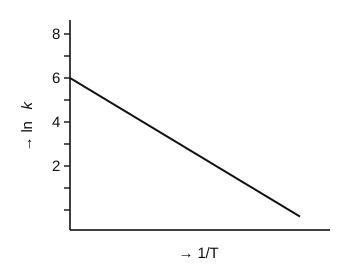
If the energy of activation is 6.64 kJ mol
−1 and R = 8.3 J K
−1 mol
−1, the temperature at which the rate constant becomes e
2 min
−1, is
एक प्राथमिक रासायनिक अभिक्रिया के लिए आरेनियस आलेख नीचे दिया गया है।
यदि सक्रियण ऊर्जा 6.64 kJ mol
−1 और R = 8.3 J K
−1 mol
−1 है, तो वह ताप जिस पर वेग नियतांक e
2 min
−1 हो जाता है, है
- A125 K
- B150 K
- C200 K
- D250 K
Show answer
Concept: : the intercept of the ln k vs 1/T line is ln A.
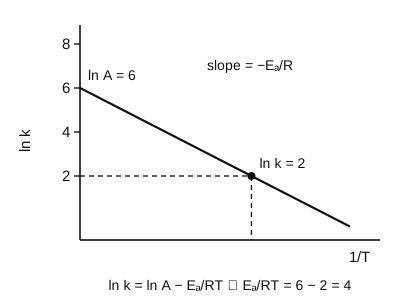
- From the graph, intercept ln A = 6.
- k = e2 ⇒ ln k = 2 ⇒ Ea/RT = 6 − 2 = 4.
- T = Ea/(4R) = 6640/(4 × 8.3) = 6640/33.2 = 200 K.
Short trick: Read ln A from the y-intercept, then T = Ea/[R(ln A − ln k)].
Answer: (C) 200 K
अवधारणा: : ln k बनाम 1/T रेखा का अंतःखंड ln A है।
- आलेख से अंतःखंड ln A = 6।
- k = e2 ⇒ ln k = 2 ⇒ Ea/RT = 6 − 2 = 4।
- T = Ea/(4R) = 6640/(4 × 8.3) = 6640/33.2 = 200 K।
शॉर्ट ट्रिक: y-अंतःखंड से ln A पढ़ें, फिर T = Ea/[R(ln A − ln k)]।
उत्तर: (C) 200 K
NEET UGChemistryChemical kinetics – Arrhenius plotNEET UG 2026 · 21 Jun Shift 1
Q65.Given below are two statements:
Statement-I : Heating NaCl with concentrated H2SO4 and MnO2 results in oxidation of Mn.
Statement-II : Heating NaI with concentrated H2SO4 and MnO2 results in reduction of Mn.
In light of the above statements, choose the most appropriate answer from the options given below:
नीचे दो कथन दिए गए हैं:
कथन-I : NaCl को सांद्र H2SO4 और MnO2 के साथ गर्म करने पर Mn का ऑक्सीकरण होता है।
कथन-II : NaI को सांद्र H2SO4 और MnO2 के साथ गर्म करने पर Mn का अपचयन होता है।
उपर्युक्त कथनों के आलोक में, नीचे दिए गए विकल्पों में से सबसे उपयुक्त उत्तर चुनिए:
- ABoth Statement-I and Statement-II are correct.कथन-I और कथन-II दोनों सही हैं।
- BBoth Statement-I and Statement-II are incorrect.कथन-I और कथन-II दोनों गलत हैं।
- CStatement-I is correct but Statement-II is incorrect.कथन-I सही है लेकिन कथन-II गलत है।
- DStatement-I is incorrect but Statement-II is correct.कथन-I गलत है लेकिन कथन-II सही है।
Show answer
Concept: MnO2 acts as an oxidising agent: it oxidises X− to X2 and is itself reduced from Mn(+4) to Mn(+2).
- 4NaCl + MnO2 + 4H2SO4 → MnCl2 + 4NaHSO4 + 2H2O + Cl2: Mn +4 → +2 = reduction, so Statement-I (oxidation of Mn) is incorrect.
- 2NaI + MnO2 + 3H2SO4 → 2NaHSO4 + MnSO4 + 2H2O + I2: Mn +4 → +2 = reduction. Statement-II correct.
Short trick: Halide → halogen means halide is oxidised, so the partner (MnO2) MUST be reduced.
Answer: (D) Statement-I incorrect, Statement-II correct
अवधारणा: MnO2 ऑक्सीकारक का कार्य करता है: यह X− को X2 में ऑक्सीकृत करता है और स्वयं Mn(+4) से Mn(+2) में अपचयित होता है।
- 4NaCl + MnO2 + 4H2SO4 → MnCl2 + 4NaHSO4 + 2H2O + Cl2: Mn +4 → +2 = अपचयन, अतः कथन-I (Mn का ऑक्सीकरण) गलत है।
- 2NaI + MnO2 + 3H2SO4 → 2NaHSO4 + MnSO4 + 2H2O + I2: Mn +4 → +2 = अपचयन। कथन-II सही।
शॉर्ट ट्रिक: हैलाइड → हैलोजन का अर्थ है हैलाइड का ऑक्सीकरण, अतः साथी (MnO2) का अपचयन अनिवार्य है।
उत्तर: (D) कथन-I गलत, कथन-II सही
NEET UGChemistryp-block – preparation of halogens (redox)NEET UG 2026 · 21 Jun Shift 1
Q66.Among the species given below, the spin only magnetic moment is highest for
(Given : Atomic number of Ti = 22, Mn = 25, Fe = 26 and Co = 27)
नीचे दी गई स्पीशीज़ में से, केवल-प्रचक्रण (spin only) चुंबकीय आघूर्ण किसके लिए सर्वाधिक है?
(दिया है : परमाणु क्रमांक Ti = 22, Mn = 25, Fe = 26 और Co = 27)
- A[Mn(CN)6]3−
- B[Fe(CN)6]3−
- C[Co(NH3)6]3+
- D[Ti(H2O)6]3+
Show answer
Concept: μs = √(n(n+2)) BM; CN− and NH3 (with M3+) are strong-field → low-spin pairing in t2g.
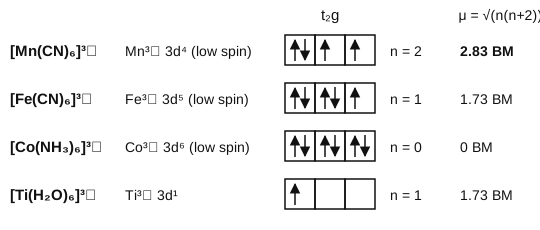
- [Mn(CN)6]3−: Mn3+ d4, t2g4 → n = 2, μ = 2.83 BM.
- [Fe(CN)6]3−: Fe3+ d5, t2g5 → n = 1, μ = 1.73 BM.
- [Co(NH3)6]3+: Co3+ d6, t2g6 → n = 0, diamagnetic.
- [Ti(H2O)6]3+: Ti3+ d1 → n = 1, μ = 1.73 BM. Highest: [Mn(CN)6]3−.
Short trick: Low-spin octahedral dn: unpaired = n for n ≤ 3, then 6 − n for d4–d6 (d4→2, d5→1, d6→0).
Answer: (A) [Mn(CN)6]3−
अवधारणा: μs = √(n(n+2)) BM; CN− तथा NH3 (M3+ के साथ) प्रबल क्षेत्र लिगन्ड हैं → t2g में निम्न-प्रचक्रण युग्मन।
- [Mn(CN)6]3−: Mn3+ d4, t2g4 → n = 2, μ = 2.83 BM।
- [Fe(CN)6]3−: Fe3+ d5, t2g5 → n = 1, μ = 1.73 BM।
- [Co(NH3)6]3+: Co3+ d6, t2g6 → n = 0, प्रतिचुंबकीय।
- [Ti(H2O)6]3+: Ti3+ d1 → n = 1, μ = 1.73 BM। सर्वाधिक: [Mn(CN)6]3−।
शॉर्ट ट्रिक: निम्न-प्रचक्रण अष्टफलकीय dn: n ≤ 3 तक अयुग्मित = n, फिर d4–d6 के लिए 6 − n (d4→2, d5→1, d6→0)।
उत्तर: (A) [Mn(CN)6]3−
NEET UGChemistryCoordination compounds – CFT and magnetic momentNEET UG 2026 · 21 Jun Shift 1
Q67.The lanthanide ion having four unpaired electrons is
(Given : Atomic number of Ce = 58, Nd = 60, Tb = 65 and Ho = 67)
चार अयुग्मित इलेक्ट्रॉन वाला लैन्थेनॉइड आयन है
(दिया है : परमाणु क्रमांक Ce = 58, Nd = 60, Tb = 65 और Ho = 67)
- ANd3+
- BCe3+
- CTb3+
- DHo3+
Show answer
Concept: Ln3+ = [Xe]4fn with n = Z − 57; unpaired = n (n ≤ 7) or 14 − n (n > 7).
- Ce3+: 4f1 → 1.
- Nd3+: 4f3 → 3.
- Tb3+: 4f8 → 6.
- Ho3+: 4f10 → 14 − 10 = 4 ✔
Short trick: f-electrons of Ln3+ = Z − 57 (Ho: 67 − 57 = 10 → 4 unpaired).
Answer: (D) Ho3+
अवधारणा: Ln3+ = [Xe]4fn, जहाँ n = Z − 57; अयुग्मित = n (n ≤ 7) या 14 − n (n > 7)।
- Ce3+: 4f1 → 1।
- Nd3+: 4f3 → 3।
- Tb3+: 4f8 → 6।
- Ho3+: 4f10 → 14 − 10 = 4 ✔
शॉर्ट ट्रिक: Ln3+ के f-इलेक्ट्रॉन = Z − 57 (Ho: 67 − 57 = 10 → 4 अयुग्मित)।
उत्तर: (D) Ho3+
NEET UGChemistryf-block – lanthanide ions, unpaired electronsNEET UG 2026 · 21 Jun Shift 1
Q68.The formula of tetraammineaquachloridocobalt(III) chloride is
टेट्राऐम्मीनऐक्वाक्लोरिडोकोबाल्ट(III) क्लोराइड का सूत्र है
- A[Co(NH3)4Cl2] × H2O
- B[Co(NH3)4]Cl3 × H2O
- C[Co(NH3)4(H2O)Cl]Cl
- D[Co(NH3)4(H2O)Cl]Cl2
Show answer
Concept: Name → ligands inside the bracket: 4 NH3, 1 H2O, 1 Cl− on Co(III); the outer “chloride” balances the charge.
- Charge of complex ion = +3 (Co) + 0 + 0 + (−1) = +2 → [Co(NH3)4(H2O)Cl]2+.
- Two Cl− counter-ions needed → [Co(NH3)4(H2O)Cl]Cl2.
- (A), (B) have no coordinated water; (C) gives Co(II) – charge mismatch.
Short trick: Oxidation state + charges of anionic ligands = charge of complex ion = number of outer Cl−.
Answer: (D) [Co(NH3)4(H2O)Cl]Cl2
अवधारणा: नाम → कोष्ठक के अंदर लिगन्ड: Co(III) पर 4 NH3, 1 H2O, 1 Cl−; बाहरी “क्लोराइड” आवेश संतुलित करता है।
- संकुल आयन का आवेश = +3 (Co) + 0 + 0 + (−1) = +2 → [Co(NH3)4(H2O)Cl]2+।
- दो Cl− प्रति-आयन चाहिए → [Co(NH3)4(H2O)Cl]Cl2।
- (A), (B) में उपसहसंयोजित जल नहीं है; (C) में Co(II) बनता है – आवेश असंगत।
शॉर्ट ट्रिक: ऑक्सीकरण अवस्था + ऋणायनी लिगन्डों का आवेश = संकुल आयन का आवेश = बाहरी Cl− की संख्या।
उत्तर: (D) [Co(NH3)4(H2O)Cl]Cl2
NEET UGChemistryCoordination compounds – IUPAC nomenclatureNEET UG 2026 · 21 Jun Shift 1
Q69.Consider the reversible processes for 1.0 mol of an ideal gas as shown in the figure.
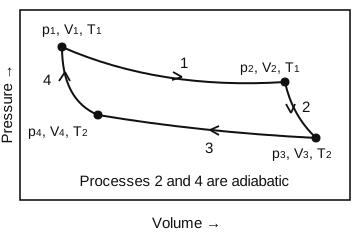
w
1, w
2, w
3 and w
4 represent work done (in calories) in the processes 1, 2, 3 and 4, respectively; ΔU
2 and ΔU
4 are changes in the internal energy for the processes 2 and 4, respectively.
(use R = 2 cal K
−1 mol
−1)
The correct option is
1.0 mol आदर्श गैस के लिए चित्र में दर्शाए गए उत्क्रमणीय प्रक्रमों पर विचार कीजिए।
w
1, w
2, w
3 और w
4 क्रमशः प्रक्रम 1, 2, 3 और 4 में किया गया कार्य (कैलोरी में) दर्शाते हैं; ΔU
2 और ΔU
4 क्रमशः प्रक्रम 2 और 4 के लिए आंतरिक ऊर्जा में परिवर्तन हैं।
(R = 2 cal K
−1 mol
−1 लें)
सही विकल्प है
- A
- B
- C
- D
Show answer
Concept: Work done on the gas (chemistry sign convention): reversible isothermal w = −nRT ln(Vf/Vi); adiabatic q = 0 ⇒ w = ΔU.
- Process 1 (isothermal, T1, V1→V2): w1 = −1 × 2 × T1 ln(V2/V1).
- Process 3 (isothermal, T2, V3→V4): w3 = −2T2 ln(V4/V3). Sum = option (A) ✔.
- (B): w2 = ΔU2, w4 = ΔU4 ⇒ w2 + w4 = ΔU2 + ΔU4 (= 0, since ΔU2 = Cv(T2−T1) = −ΔU4), not ΔU2 − ΔU4.
- (C): w1 + w2 = −2T1 ln(V2/V1) + Cv(T2 − T1) – sign and extra term wrong.
- (D): For a cycle ΔU = 0 so Σw = −Σq = −(net heat absorbed) ≠ 0 (area enclosed).
Short trick: In a Carnot cycle the two adiabatic works cancel, so net work = sum of the two isothermal works ≠ 0.
Answer: (A)
अवधारणा: गैस पर किया गया कार्य (रसायन चिह्न परिपाटी): उत्क्रमणीय समतापी w = −nRT ln(Vf/Vi); रुद्धोष्म q = 0 ⇒ w = ΔU।
- प्रक्रम 1 (समतापी, T1, V1→V2): w1 = −1 × 2 × T1 ln(V2/V1)।
- प्रक्रम 3 (समतापी, T2, V3→V4): w3 = −2T2 ln(V4/V3)। योग = विकल्प (A) ✔।
- (B): w2 = ΔU2, w4 = ΔU4 ⇒ w2 + w4 = ΔU2 + ΔU4 (= 0, क्योंकि ΔU2 = Cv(T2−T1) = −ΔU4), ΔU2 − ΔU4 नहीं।
- (C): w1 + w2 = −2T1 ln(V2/V1) + Cv(T2 − T1) – चिह्न गलत और अतिरिक्त पद।
- (D): चक्र के लिए ΔU = 0, अतः Σw = −Σq = −(अवशोषित शुद्ध ऊष्मा) ≠ 0 (घिरा क्षेत्रफल)।
शॉर्ट ट्रिक: कार्नो चक्र में दोनों रुद्धोष्म कार्य निरस्त हो जाते हैं, अतः शुद्ध कार्य = दोनों समतापी कार्यों का योग ≠ 0।
उत्तर: (A)
NEET UGChemistryThermodynamics – Carnot-type reversible cycleNEET UG 2026 · 21 Jun Shift 1
Q70.Given below are two statements : One is labelled as Assertion A and the other is labelled as Reason R.
Assertion A : The first ionization enthalpy of O is lower than that of N and F.
Reason R : The loss of an electron from O leads to stable half-filled p orbital.
In light of the above statements, choose the most appropriate answer from the options given below:
नीचे दो कथन दिए गए हैं : एक को अभिकथन A और दूसरे को कारण R कहा गया है।
अभिकथन A : O की प्रथम आयनन एन्थैल्पी N और F से कम है।
कारण R : O से एक इलेक्ट्रॉन निकलने पर स्थायी अर्ध-पूरित p कक्षक बनता है।
उपर्युक्त कथनों के आलोक में, नीचे दिए गए विकल्पों में से सबसे उपयुक्त उत्तर चुनिए:
- ABoth A and R are correct and R is the correct explanation of AA और R दोनों सही हैं और R, A की सही व्याख्या है
- BBoth A and R are correct but R is NOT the correct explanation of AA और R दोनों सही हैं लेकिन R, A की सही व्याख्या नहीं है
- CA is correct but R is not correctA सही है लेकिन R सही नहीं है
- DA is not correct but R is correctA सही नहीं है लेकिन R सही है
Show answer
Concept: O: 1s22s22p4 – one 2p orbital holds a pair; removing that paired electron gives O+ 2p3 (half-filled, extra stable).
- IE1: N 1402, O 1314, F 1681 kJ mol−1 → O is lower than both: A true.
- Electron-pair repulsion in the doubly-occupied 2p orbital plus formation of stable half-filled 2p3 in O+ makes removal easier: R true and explains A.
Short trick: N(2p3) is reluctant to lose, O(2p4) is happy to lose → order N > O dip in period 2.
Answer: (A) Both A and R correct; R explains A
अवधारणा: O: 1s22s22p4 – एक 2p कक्षक में युग्म है; उस युग्मित इलेक्ट्रॉन को हटाने पर O+ 2p3 (अर्ध-पूरित, अतिरिक्त स्थायी) बनता है।
- IE1: N 1402, O 1314, F 1681 kJ mol−1 → O दोनों से कम: A सत्य।
- द्वि-अधिभोगित 2p कक्षक में इलेक्ट्रॉन-युग्म प्रतिकर्षण तथा O+ में स्थायी अर्ध-पूरित 2p3 बनना इलेक्ट्रॉन निकालना आसान करते हैं: R सत्य है और A की व्याख्या करता है।
शॉर्ट ट्रिक: N(2p3) इलेक्ट्रॉन छोड़ने में अनिच्छुक, O(2p4) छोड़ने को तत्पर → आवर्त 2 में N > O की गिरावट।
उत्तर: (A) A और R दोनों सही; R, A की व्याख्या है
NEET UGChemistryPeriodic properties – ionisation enthalpy (assertion-reason)NEET UG 2026 · 21 Jun Shift 1
Q71.Consider the following statements about the solutions formed by mixing two liquids.
A. An ideal solution thus formed obeys Raoult's law throughout the composition range.
B. Mixture of chloroform and acetone shows, negative deviation from Raoult's law.
C. Mixture of aniline and phenol shows positive deviation from Raoult's law.
दो द्रवों को मिलाकर बने विलयनों के बारे में निम्नलिखित कथनों पर विचार कीजिए।
A. इस प्रकार बना आदर्श विलयन संपूर्ण संघटन परास में राउल्ट नियम का पालन करता है।
B. क्लोरोफॉर्म और ऐसीटोन का मिश्रण राउल्ट नियम से ऋणात्मक विचलन दर्शाता है।
C. ऐनिलीन और फ़ीनॉल का मिश्रण राउल्ट नियम से धनात्मक विचलन दर्शाता है।
- AA and B onlyकेवल A और B
- BB and C onlyकेवल B और C
- CA onlyकेवल A
- DA and C onlyकेवल A और C
Show answer
Concept: Negative deviation occurs when A–B attractions are stronger than A–A and B–B (often new H-bonds between components).
- A – correct: an ideal solution obeys Raoult’s law over the entire range of concentration.
- B – correct: CHCl3 forms an H-bond with the C=O of acetone → negative deviation.
- C – incorrect: phenol (acidic O–H) and aniline (basic N) form strong intermolecular H-bonds → negative deviation (NCERT example).
Short trick: NCERT negative-deviation pairs: chloroform + acetone, phenol + aniline (both “new H-bond” pairs).
Answer: (A) A and B only
अवधारणा: ऋणात्मक विचलन तब होता है जब A–B आकर्षण A–A और B–B से प्रबल हों (प्रायः घटकों के बीच नए H-आबंध)।
- A – सही: आदर्श विलयन सांद्रता के संपूर्ण परास में राउल्ट नियम का पालन करता है।
- B – सही: CHCl3, ऐसीटोन के C=O से H-आबंध बनाता है → ऋणात्मक विचलन।
- C – गलत: फ़ीनॉल (अम्लीय O–H) और ऐनिलीन (क्षारीय N) प्रबल अंतराअणुक H-आबंध बनाते हैं → ऋणात्मक विचलन (NCERT उदाहरण)।
शॉर्ट ट्रिक: NCERT ऋणात्मक-विचलन युग्म: क्लोरोफॉर्म + ऐसीटोन, फ़ीनॉल + ऐनिलीन (दोनों “नया H-आबंध” युग्म)।
उत्तर: (A) केवल A और B
NEET UGChemistrySolutions – Raoult’s law and deviationsNEET UG 2026 · 21 Jun Shift 1
Q72.One of the products formed in the following reaction is
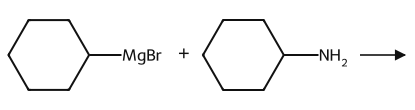
निम्नलिखित अभिक्रिया में बनने वाले उत्पादों में से एक है
- A
- B
- C
- D
Show answer
Concept: Grignard reagents are very strong bases; any compound with an acidic (active) H – water, alcohol, amine N–H, terminal alkyne – protonates R–MgX to give the alkane R–H.
- C6H11MgBr + C6H11NH2 → C6H12 (cyclohexane) + C6H11NH–MgBr.
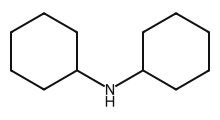
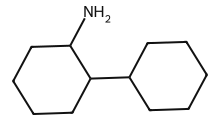
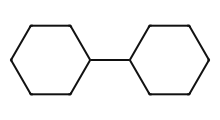
- No C–N or C–C coupling occurs, so dicyclohexylamine (A), the amino-bicyclohexyl (B) and bicyclohexyl (C) are not formed.
Short trick: RMgX + anything with O–H / N–H / ≡C–H → R–H first (acid–base beats nucleophilic attack).
Answer: (D) cyclohexane
अवधारणा: ग्रीन्यार अभिकर्मक अत्यंत प्रबल क्षारक हैं; अम्लीय (सक्रिय) H वाला कोई भी यौगिक – जल, ऐल्कोहॉल, ऐमीन N–H, अंतस्थ ऐल्काइन – R–MgX को प्रोटॉनित कर ऐल्केन R–H देता है।
- C6H11MgBr + C6H11NH2 → C6H12 (साइक्लोहेक्सेन) + C6H11NH–MgBr।
- कोई C–N या C–C युग्मन नहीं होता, अतः डाइसाइक्लोहेक्सिलऐमीन (A), ऐमीनो-बाइसाइक्लोहेक्सिल (B) और बाइसाइक्लोहेक्सिल (C) नहीं बनते।
शॉर्ट ट्रिक: RMgX + O–H / N–H / ≡C–H वाला कोई भी यौगिक → पहले R–H (अम्ल–क्षार अभिक्रिया, नाभिकरागी आक्रमण से तेज़)।
उत्तर: (D) साइक्लोहेक्सेन
NEET UGChemistryGrignard reagent – reaction with active hydrogenNEET UG 2026 · 21 Jun Shift 1
Q73.The correct statement is
सही कथन है
- ABoron has a maximum covalency of four.बोरॉन की अधिकतम सहसंयोजकता चार है।
- BBeryllium has three valence orbitals.बेरिलियम में तीन संयोजकता कक्षक हैं।
- CMagnesium has a maximum covalency of four.मैग्नीशियम की अधिकतम सहसंयोजकता चार है।
- DAluminium has five valence orbitals.ऐलुमिनियम में पाँच संयोजकता कक्षक हैं।
Show answer
Concept: Second-period elements have only 4 valence orbitals (2s + three 2p) ⇒ maximum covalency 4; third-period elements can also use 3d ⇒ covalency up to 6.
- (A) correct: B has no d orbitals → max covalency 4, e.g. [BF4]−, [BH4]−.
- (B) wrong: Be has four valence orbitals (2s, 2px, 2py, 2pz).
- (C) wrong: Mg (period 3) can use d orbitals – covalency up to 6.
- (D) wrong: Al has nine valence orbitals (3s, 3p, 3d) and shows covalency 6, e.g. [AlF6]3−.
Short trick: Period 2 → covalency ≤ 4; period 3 onwards → up to 6.
Answer: (A) Boron has a maximum covalency of four
अवधारणा: द्वितीय आवर्त के तत्वों में केवल 4 संयोजकता कक्षक (2s + तीन 2p) होते हैं ⇒ अधिकतम सहसंयोजकता 4; तृतीय आवर्त के तत्व 3d का भी उपयोग कर सकते हैं ⇒ सहसंयोजकता 6 तक।
- (A) सही: B में d कक्षक नहीं → अधिकतम सहसंयोजकता 4, जैसे [BF4]−, [BH4]−।
- (B) गलत: Be में चार संयोजकता कक्षक (2s, 2px, 2py, 2pz) हैं।
- (C) गलत: Mg (आवर्त 3) d कक्षकों का उपयोग कर सकता है – सहसंयोजकता 6 तक।
- (D) गलत: Al में नौ संयोजकता कक्षक (3s, 3p, 3d) हैं और यह सहसंयोजकता 6 दर्शाता है, जैसे [AlF6]3−।
शॉर्ट ट्रिक: आवर्त 2 → सहसंयोजकता ≤ 4; आवर्त 3 से आगे → 6 तक।
उत्तर: (A) बोरॉन की अधिकतम सहसंयोजकता चार है
NEET UGChemistrys- and p-block – covalency and valence orbitalsNEET UG 2026 · 21 Jun Shift 1
Q74.A protein undergoes reversible thermal denaturation from its initial state N to denatured state D according to N ⇌ D. At 60 °C, the concentrations of both N and D are equal at equilibrium, and the standard enthalpy change of denaturation is 666 kJ mol−1. The standard entropy change (ΔS° in kJ K−1 mol−1) of the protein upon denaturation at 60°C is closest to
एक प्रोटीन अपनी प्रारंभिक अवस्था N से विकृत अवस्था D में N ⇌ D के अनुसार उत्क्रमणीय ऊष्मीय विकृतीकरण (denaturation) करता है। 60 °C पर साम्यावस्था में N और D दोनों की सांद्रताएँ बराबर हैं, और विकृतीकरण का मानक एन्थैल्पी परिवर्तन 666 kJ mol−1 है। 60°C पर विकृतीकरण के समय प्रोटीन का मानक एन्ट्रॉपी परिवर्तन (ΔS°, kJ K−1 mol−1 में) निकटतम है
- A2.0
- B2000.0
- C333.0
- D11.1
Show answer
Concept: ΔG° = −RT ln K and ΔG° = ΔH° − TΔS°.
- [N] = [D] ⇒ K = 1 ⇒ ΔG° = −RT ln 1 = 0.
- ΔH° = TΔS° ⇒ ΔS° = 666 kJ mol−1 / 333 K = 2.0 kJ K−1 mol−1 (T = 60 + 273 = 333 K).
Short trick: K = 1 ⇒ T = ΔH°/ΔS° (the “melting point” of the protein). 666/333 = 2.
Answer: (A) 2.0
अवधारणा: ΔG° = −RT ln K तथा ΔG° = ΔH° − TΔS°।
- [N] = [D] ⇒ K = 1 ⇒ ΔG° = −RT ln 1 = 0।
- ΔH° = TΔS° ⇒ ΔS° = 666 kJ mol−1 / 333 K = 2.0 kJ K−1 mol−1 (T = 60 + 273 = 333 K)।
शॉर्ट ट्रिक: K = 1 ⇒ T = ΔH°/ΔS° (प्रोटीन का “गलनांक”)। 666/333 = 2।
उत्तर: (A) 2.0
NEET UGChemistryThermodynamics – ΔG°, K and ΔS°NEET UG 2026 · 21 Jun Shift 1
Q75.Match the species in
List-I with their geometry in
List-II | List-I | | List-II |
|---|
| A. | PCl5 | I. | Tetrahedral |
| B. | BrF5 | II. | Square Planar |
| C. | BF4− | III. | Trigonal bipyramidal |
| D. | [Ni(CN)4]2− | IV. | Square pyramidal |
Choose the
correct answer from the options given below :
सूची-I की स्पीशीज़ का
सूची-II में उनकी ज्यामिति से मिलान कीजिए
| सूची-I | | सूची-II |
|---|
| A. | PCl5 | I. | चतुष्फलकीय (Tetrahedral) |
| B. | BrF5 | II. | वर्ग समतली (Square Planar) |
| C. | BF4− | III. | त्रिकोणीय द्विपिरैमिडी (Trigonal bipyramidal) |
| D. | [Ni(CN)4]2− | IV. | वर्ग पिरैमिडी (Square pyramidal) |
नीचे दिए गए विकल्पों में से
सही उत्तर चुनिए :
- AA-IV, B-III, C-I, D-II
- BA-III, B-IV, C-I, D-II
- CA-III, B-I, C-II, D-IV
- DA-III, B-II, C-I, D-IV
Show answer
Concept: Count bond pairs + lone pairs (VSEPR) or identify hybridisation.
- PCl5: 5 bp, 0 lp, sp3d → trigonal bipyramidal (A-III).
- BrF5: 5 bp, 1 lp, sp3d2 → square pyramidal (B-IV).
- BF4−: 4 bp, sp3 → tetrahedral (C-I).
- [Ni(CN)4]2−: Ni2+ d8 with strong-field CN− → dsp2, square planar, diamagnetic (D-II).
Short trick: Ni(II) + CN− → square planar; Ni(II)/Ni(0) + Cl−/CO → tetrahedral.
Answer: (B) A-III, B-IV, C-I, D-II
अवधारणा: बंध युग्म + एकाकी युग्म गिनें (VSEPR) या संकरण पहचानें।
- PCl5: 5 bp, 0 lp, sp3d → त्रिकोणीय द्विपिरैमिडी (A-III)।
- BrF5: 5 bp, 1 lp, sp3d2 → वर्ग पिरैमिडी (B-IV)।
- BF4−: 4 bp, sp3 → चतुष्फलकीय (C-I)।
- [Ni(CN)4]2−: Ni2+ d8 प्रबल क्षेत्र CN− के साथ → dsp2, वर्ग समतली, प्रतिचुंबकीय (D-II)।
शॉर्ट ट्रिक: Ni(II) + CN− → वर्ग समतली; Ni(II)/Ni(0) + Cl−/CO → चतुष्फलकीय।
उत्तर: (B) A-III, B-IV, C-I, D-II
NEET UGChemistryChemical bonding – VSEPR / hybridisation geometryNEET UG 2026 · 21 Jun Shift 1
Q76.Given below are two statements :
Statement-I :trans-But-2-ene upon treatment with Br
2 in CCl
4 gives the following product
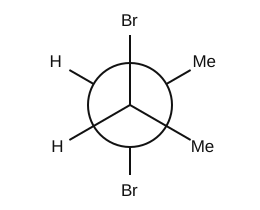 Statement-II:cis
-But-2-ene upon treatment with alkaline KMnO
4 gives the following product
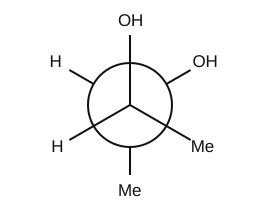
In light of the above statements, choose the
most appropriate answer from the options given below:
नीचे दो कथन दिए गए हैं :
कथन-I :trans-ब्यूट-2-ईन, CCl
4 में Br
2 के साथ उपचारित करने पर निम्नलिखित उत्पाद देता है
कथन-II:cis-ब्यूट-2-ईन, क्षारीय KMnO
4 के साथ उपचारित करने पर निम्नलिखित उत्पाद देता है
उपर्युक्त कथनों के आलोक में, नीचे दिए गए विकल्पों में से
सबसे उपयुक्त उत्तर चुनिए:
- ABoth Statement-I and Statement-II are correct.कथन-I और कथन-II दोनों सही हैं।
- BBoth Statement-I and Statement-II are incorrect.कथन-I और कथन-II दोनों गलत हैं।
- CStatement-I is correct but Statement-II is incorrect.कथन-I सही है लेकिन कथन-II गलत है।
- DStatement-I is incorrect but Statement-II is correct.कथन-I गलत है लेकिन कथन-II सही है।
Show answer
Concept: Br2 adds anti; cold alkaline KMnO4 adds two OH groups syn. trans + anti → meso; cis + syn → meso. A Newman projection is meso if, on rotating to the eclipsed form, identical groups eclipse each other (mirror plane).
- Statement-I drawing: Br (front, up) anti to Br (back, down), but both H’s lie on the left and both Me on the right. Rotating the back carbon by 180° to eclipse Br/Br puts front-H on back-Me – no mirror plane → this is the chiral (±)-2,3-dibromobutane (the product of cis-but-2-ene). trans-But-2-ene actually gives meso-2,3-dibromobutane. Statement-I incorrect.
- Statement-II drawing: rotating the back carbon by 60° gives OH/OH, H/H and Me/Me eclipsed → plane of symmetry → meso-butane-2,3-diol, which is exactly what syn-dihydroxylation of cis-but-2-ene gives. Statement-II correct.
Short trick: “Same–Same–meso”: cis+syn or trans+anti → meso; mixed (cis+anti, trans+syn) → racemic.
Answer: (D) Statement-I incorrect, Statement-II correct
अवधारणा: Br2 प्रति (anti) योग करता है; ठंडा क्षारीय KMnO4 दो OH समूह सम (syn) जोड़ता है। trans + anti → मीसो; cis + syn → मीसो। न्यूमैन प्रक्षेप मीसो है यदि ग्रसित (eclipsed) रूप में घुमाने पर समान समूह एक-दूसरे को ग्रसित करें (दर्पण तल)।
- कथन-I का चित्र: Br (आगे, ऊपर) Br (पीछे, नीचे) के प्रति है, परंतु दोनों H बाईं ओर और दोनों Me दाईं ओर हैं। Br/Br को ग्रसित करने हेतु पीछे के कार्बन को 180° घुमाने पर आगे का H पीछे के Me पर आता है – कोई दर्पण तल नहीं → यह किरेल (±)-2,3-डाइब्रोमोब्यूटेन है (जो cis-ब्यूट-2-ईन का उत्पाद है)। trans-ब्यूट-2-ईन वास्तव में मीसो-2,3-डाइब्रोमोब्यूटेन देता है। कथन-I गलत।
- कथन-II का चित्र: पीछे के कार्बन को 60° घुमाने पर OH/OH, H/H और Me/Me ग्रसित होते हैं → सममिति तल → मीसो-ब्यूटेन-2,3-डाइऑल, जो cis-ब्यूट-2-ईन के सम-डाइहाइड्रॉक्सिलन से ठीक यही बनता है। कथन-II सही।
शॉर्ट ट्रिक: “समान–समान–मीसो”: cis+syn या trans+anti → मीसो; मिश्रित (cis+anti, trans+syn) → रेसेमिक।
उत्तर: (D) कथन-I गलत, कथन-II सही
NEET UGChemistryStereochemistry – anti/syn addition and Newman projectionsNEET UG 2026 · 21 Jun Shift 1
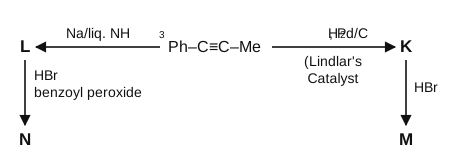
Q77.Consider the following reaction sequences and choose the correct option
निम्नलिखित अभिक्रिया अनुक्रमों पर विचार कीजिए और सही विकल्प चुनिए
- AK and L are geometrical isomers.K और L ज्यामितीय समावयवी हैं।
- BK and L are enantiomersK और L प्रतिबिंबरूपी (enantiomers) हैं
- CM and N are geometrical isomers.M और N ज्यामितीय समावयवी हैं।
- DM and N are stereoisomersM और N त्रिविम समावयवी हैं
Show answer
Concept: Na/liq. NH3 (Birch-type) reduces an alkyne to the trans-alkene; H2/Lindlar gives the cis-alkene. HBr adds Markovnikov (ionic) or anti-Markovnikov with peroxide (radical); in both cases the more stable benzylic intermediate decides.
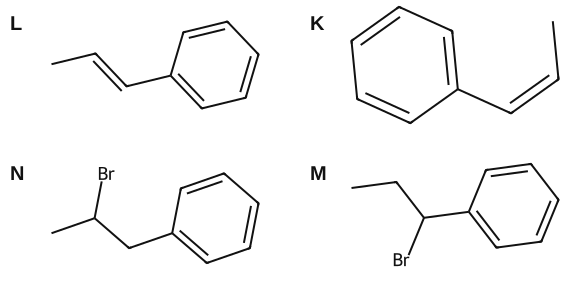
- L = (E)-Ph–CH=CH–Me; K = (Z)-Ph–CH=CH–Me → K and L are geometrical (cis–trans) isomers ✔.
- K + HBr: H+ adds to C-2 giving the benzylic cation → M = Ph–CHBr–CH2CH3.
- L + HBr/peroxide: Br• adds to C-2 giving the benzylic radical → N = Ph–CH2–CHBr–CH3.
- M and N differ in the position of Br → position (structural) isomers, not geometrical or stereoisomers; K/L are not mirror images (achiral), so not enantiomers.
Short trick: Na/NH3 → Trans (“Na-Trans”); Lindlar → Cis.
Answer: (A) K and L are geometrical isomers
अवधारणा: Na/द्रव NH3 ऐल्काइन को trans-ऐल्कीन में अपचयित करता है; H2/लिंडलार cis-ऐल्कीन देता है। HBr मार्कोनीकॉफ़ (आयनिक) रूप से या परॉक्साइड के साथ प्रति-मार्कोनीकॉफ़ (मुक्त मूलक) रूप से जुड़ता है; दोनों में अधिक स्थायी बेंज़िलिक मध्यवर्ती निर्णायक है।
- L = (E)-Ph–CH=CH–Me; K = (Z)-Ph–CH=CH–Me → K और L ज्यामितीय (cis–trans) समावयवी हैं ✔।
- K + HBr: H+ C-2 पर जुड़कर बेंज़िलिक धनायन देता है → M = Ph–CHBr–CH2CH3।
- L + HBr/परॉक्साइड: Br• C-2 पर जुड़कर बेंज़िलिक मूलक देता है → N = Ph–CH2–CHBr–CH3।
- M और N में Br की स्थिति भिन्न है → स्थिति (संरचनात्मक) समावयवी, ज्यामितीय या त्रिविम समावयवी नहीं; K/L दर्पण प्रतिबिंब नहीं हैं (अकिरेल), अतः प्रतिबिंबरूपी नहीं।
शॉर्ट ट्रिक: Na/NH3 → Trans; लिंडलार → Cis।
उत्तर: (A) K और L ज्यामितीय समावयवी हैं
NEET UGChemistryAlkynes – partial reduction and HBr additionNEET UG 2026 · 21 Jun Shift 1
Q78.The complex which has facial and meridional isomers is
(Given: py = pyridine and en = H2N–CH2–CH2–NH2)
वह संकुल जिसके फ़ैशियल (facial) और मेरिडियोनल (meridional) समावयवी होते हैं, है
(दिया है: py = पिरिडीन और en = H2N–CH2–CH2–NH2)
- A[Cr(py)3(Cl)3]
- B[Cr(H2O)6]3+
- C[Co(NH3)4(H2O)2]3+
- D[Ni(en)2(H2O)2]2+
Show answer
Concept: fac/mer isomerism is shown by octahedral complexes of the type [MA3B3].
- [Cr(py)3Cl3] is MA3B3 → fac (three Cl on one face) and mer (three Cl on a meridian) ✔.
- [Cr(H2O)6]3+ (MA6): no isomers.
- [Co(NH3)4(H2O)2]3+ (MA4B2): cis/trans only.
- [Ni(en)2(H2O)2]2+ (M(AA)2B2): cis/trans (+ optical for cis).
Short trick: fac/mer ⇔ “3 + 3”. MA4B2 ⇔ cis/trans.
Answer: (A) [Cr(py)3(Cl)3]
अवधारणा: fac/mer समावयवता [MA3B3] प्रकार के अष्टफलकीय संकुल दर्शाते हैं।
- [Cr(py)3Cl3] MA3B3 है → fac (तीनों Cl एक फलक पर) और mer (तीनों Cl एक याम्योत्तर पर) ✔।
- [Cr(H2O)6]3+ (MA6): कोई समावयवी नहीं।
- [Co(NH3)4(H2O)2]3+ (MA4B2): केवल cis/trans।
- [Ni(en)2(H2O)2]2+ (M(AA)2B2): cis/trans (+ cis के लिए प्रकाशिक)।
शॉर्ट ट्रिक: fac/mer ⇔ “3 + 3”। MA4B2 ⇔ cis/trans।
उत्तर: (A) [Cr(py)3(Cl)3]
NEET UGChemistryCoordination compounds – fac/mer isomerismNEET UG 2026 · 21 Jun Shift 1
Q79.Identify the reactions which give aniline as the major product.
A.
B.
C.
D.
Choose the correct answer from the options given below.
उन अभिक्रियाओं को पहचानिए जो मुख्य उत्पाद के रूप में ऐनिलीन देती हैं।
A.
B.
C.
D.
नीचे दिए गए विकल्पों में से सही उत्तर चुनिए।
- AA and B onlyकेवल A और B
- BB and D onlyकेवल B और D
- CA and C onlyकेवल A और C
- DC and D onlyकेवल C और D
Show answer
Concept: Aniline = C6H5–NH2 (N directly on the ring).
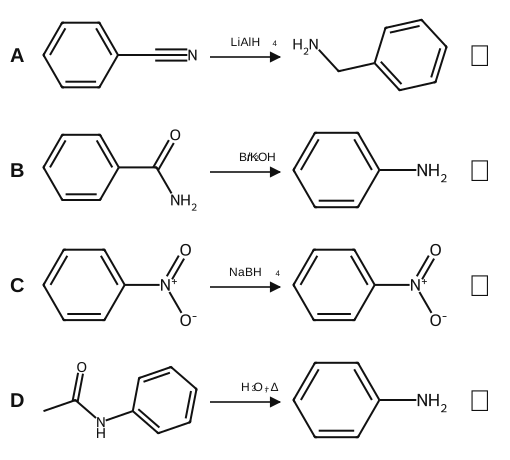
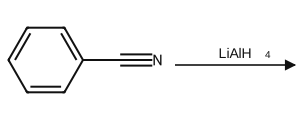
- A: C6H5CN + LiAlH4 → C6H5CH2NH2 (benzylamine) – an extra CH2, not aniline ✗.
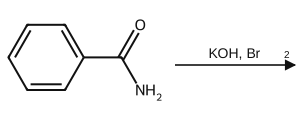
- B: Hofmann bromamide degradation, C6H5CONH2 + Br2 + 4KOH → C6H5NH2 (one carbon less) ✔.
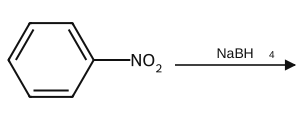
- C: NaBH4 does not reduce an aromatic nitro group (needs Sn/HCl, Fe/HCl or H2/Pd) ✗.
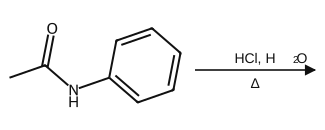
- D: acid hydrolysis of acetanilide, C6H5NHCOCH3 + H2O/H+ → C6H5NH2 + CH3COOH ✔.
Short trick: Nitrile reduction ADDS a carbon (–CH2NH2); Hofmann REMOVES one. NaBH4 leaves –NO2 untouched.
Answer: (B) B and D only
अवधारणा: ऐनिलीन = C6H5–NH2 (N सीधे वलय पर)।
- A: C6H5CN + LiAlH4 → C6H5CH2NH2 (बेंज़िलऐमीन) – एक अतिरिक्त CH2, ऐनिलीन नहीं ✗।
- B: हॉफ़मान ब्रोमैमाइड निम्नीकरण, C6H5CONH2 + Br2 + 4KOH → C6H5NH2 (एक कार्बन कम) ✔।
- C: NaBH4 ऐरोमैटिक नाइट्रो समूह को अपचयित नहीं करता (इसके लिए Sn/HCl, Fe/HCl या H2/Pd चाहिए) ✗।
- D: ऐसीटैनिलाइड का अम्लीय जल-अपघटन, C6H5NHCOCH3 + H2O/H+ → C6H5NH2 + CH3COOH ✔।
शॉर्ट ट्रिक: नाइट्राइल अपचयन एक कार्बन जोड़ता है (–CH2NH2); हॉफ़मान एक घटाता है। NaBH4 –NO2 को अछूता छोड़ता है।
उत्तर: (B) केवल B और D
NEET UGChemistryAmines – preparation of anilineNEET UG 2026 · 21 Jun Shift 1
Q80.Match the vitamins in
List-I with their sources in
List-II | List-I | | List-II |
|---|
| A. | vitamin A | I. | meat |
| B. | vitamin B12 | II. | sunflower oil |
| C. | vitamin E | III. | green leafy vegetables |
| D. | vitamin K | IV. | carrots |
Choose the correct answer from the options given below.
सूची-I के विटामिनों का
सूची-II में उनके स्रोतों से मिलान कीजिए
| सूची-I | | सूची-II |
|---|
| A. | विटामिन A | I. | मांस |
| B. | विटामिन B12 | II. | सूरजमुखी का तेल |
| C. | विटामिन E | III. | हरी पत्तेदार सब्ज़ियाँ |
| D. | विटामिन K | IV. | गाजर |
नीचे दिए गए विकल्पों में से सही उत्तर चुनिए।
- AA-II, B-III, C-IV, D-I
- BA-IV, B-I, C-II, D-III
- CA-IV, B-II, C-I, D-III
- DA-III, B-I, C-IV, D-II
Show answer
Concept: NCERT table of vitamins: A – fish-liver oil, carrots, butter, milk; B12 – meat, fish, egg, curd; E – vegetable oils (wheat-germ, sunflower oil); K – green leafy vegetables.
- A → carrots (IV) (β-carotene is pro-vitamin A).
- B12 → meat (I) (animal sources only).
- E → sunflower oil (II).
- K → green leafy vegetables (III).
Short trick: “K for Kale (leafy greens), E for oils, B12 from animals, A from cArrots.”
Answer: (B) A-IV, B-I, C-II, D-III
अवधारणा: NCERT विटामिन सारणी: A – मछली-यकृत तेल, गाजर, मक्खन, दूध; B12 – मांस, मछली, अंडा, दही; E – वनस्पति तेल (गेहूँ-अंकुर, सूरजमुखी तेल); K – हरी पत्तेदार सब्ज़ियाँ।
- A → गाजर (IV) (β-कैरोटीन, प्रो-विटामिन A है)।
- B12 → मांस (I) (केवल जंतु स्रोत)।
- E → सूरजमुखी का तेल (II)।
- K → हरी पत्तेदार सब्ज़ियाँ (III)।
शॉर्ट ट्रिक: “K – पत्तेदार सब्ज़ी, E – तेल, B12 – जंतु, A – गाजर।”
उत्तर: (B) A-IV, B-I, C-II, D-III
NEET UGChemistryBiomolecules – vitamins and their sourcesNEET UG 2026 · 21 Jun Shift 1

