Q81.The correct decreasing order of oxidation state of the underlined atom in each molecule is
प्रत्येक अणु में रेखांकित परमाणु की ऑक्सीकरण अवस्था का सही घटता क्रम है
- AP4O10 > SO3 > H2O
- BN2O5 > Al2O3 > H2S
- CPbO2 > N2O3 > SO3
- DP4O6 > Cl2O7 > AlH3
Show answer
Concept: Use O = −2, H = +1 (but H = −1 in metal hydrides) and the sum of oxidation numbers = 0.
- (A) P +5, S +6, O −2 → 5 < 6, not decreasing ✗.
- (B) N in N2O5 = +5, Al in Al2O3 = +3, S in H2S = −2 → +5 > +3 > −2 ✔.
- (C) Pb +4, N +3, S +6 ✗.
- (D) P in P4O6 = +3, Cl in Cl2O7 = +7, Al in AlH3 = +3 ✗.
Short trick: For oxides ExOy: oxidation state = 2y/x (N2O5 → 10/2 = +5).
Answer: (B) N2O5 > Al2O3 > H2S
अवधारणा: O = −2, H = +1 (परंतु धातु हाइड्राइड में H = −1) तथा ऑक्सीकरण संख्याओं का योग = 0 लें।
- (A) P +5, S +6, O −2 → 5 < 6, घटता क्रम नहीं ✗।
- (B) N2O5 में N = +5, Al2O3 में Al = +3, H2S में S = −2 → +5 > +3 > −2 ✔।
- (C) Pb +4, N +3, S +6 ✗।
- (D) P4O6 में P = +3, Cl2O7 में Cl = +7, AlH3 में Al = +3 ✗।
शॉर्ट ट्रिक: ऑक्साइड ExOy के लिए: ऑक्सीकरण अवस्था = 2y/x (N2O5 → 10/2 = +5)।
उत्तर: (B) N2O5 > Al2O3 > H2S
NEET UGChemistryRedox – oxidation numberNEET UG 2026 · 21 Jun Shift 1
Q82.The compound that
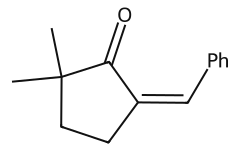
CANNOT be obtained from the aldol condensation reaction shown below, is
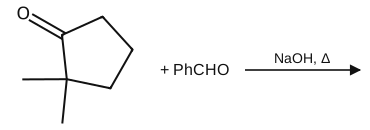
नीचे दर्शाई गई ऐल्डोल संघनन अभिक्रिया से कौन-सा यौगिक प्राप्त
नहीं किया जा सकता?
- A
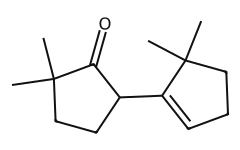
- B
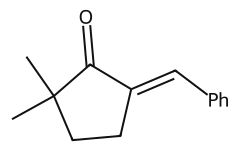
- C
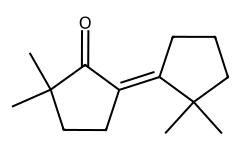
- D
Show answer
Concept: In 2,2-dimethylcyclopentanone only C-5 has α-H; C-2 is quaternary. Base-catalysed aldol condensation always ends by E1cB dehydration, giving an α,β-unsaturated (conjugated) carbonyl compound with the new C=C on the α-carbon.
- Crossed aldol: C-5 enolate + PhCHO → after dehydration 5-benzylidene-2,2-dimethylcyclopentanone, which can form as E (option B) and Z (option D) isomers.
- Self aldol: C-5 enolate attacks C=O of a second ketone; dehydration gives C-5=C (exocyclic, conjugated with C=O) → option (C).
- Option (A) has the C=C inside the second ring (β,γ-position, not conjugated with C=O) and the ketone α-carbon bearing H and a single bond – this is not the product of aldol condensation (E1cB removes the α-H of the carbonyl part to form the conjugated enone).
Short trick: Aldol condensation product = C=C exactly between the old α-carbon and the old carbonyl carbon (enone). Look for a C=C that is not conjugated with C=O → cannot form.
Answer: (A) the non-conjugated (β,γ-unsaturated) ketone
अवधारणा: 2,2-डाइमेथिलसाइक्लोपेन्टेनोन में केवल C-5 पर α-H है; C-2 चतुष्क है। क्षार-उत्प्रेरित ऐल्डोल संघनन सदैव E1cB निर्जलीकरण से समाप्त होता है, जिससे α,β-असंतृप्त (संयुग्मित) कार्बोनिल यौगिक बनता है जिसमें नया C=C α-कार्बन पर होता है।
- क्रॉस ऐल्डोल: C-5 ईनोलेट + PhCHO → निर्जलीकरण के बाद 5-बेंज़िलिडीन-2,2-डाइमेथिलसाइक्लोपेन्टेनोन, जो E (विकल्प B) और Z (विकल्प D) समावयवी के रूप में बन सकता है।
- स्व-ऐल्डोल: C-5 ईनोलेट दूसरे कीटोन के C=O पर आक्रमण करता है; निर्जलीकरण से C-5=C (वलय-बाह्य, C=O से संयुग्मित) बनता है → विकल्प (C)।
- विकल्प (A) में C=C दूसरे वलय के अंदर है (β,γ-स्थिति, C=O से संयुग्मित नहीं) और कीटोन के α-कार्बन पर H तथा एकल आबंध है – यह ऐल्डोल संघनन का उत्पाद नहीं है (E1cB, कार्बोनिल भाग का α-H हटाकर संयुग्मित ईनोन बनाता है)।
शॉर्ट ट्रिक: ऐल्डोल संघनन उत्पाद = C=C ठीक पुराने α-कार्बन और पुराने कार्बोनिल कार्बन के बीच (ईनोन)। जो C=C, C=O से संयुग्मित न हो → नहीं बन सकता।
उत्तर: (A) असंयुग्मित (β,γ-असंतृप्त) कीटोन
NEET UGChemistryAldol condensation – crossed and self condensationNEET UG 2026 · 21 Jun Shift 1
Q83.Among the following, the compound having conjugated double bonds is
निम्नलिखित में से संयुग्मित द्वि-आबंध वाला यौगिक है
- Ahepta-1,3-dieneहेप्टा-1,3-डाईन
- Bhepta-1,4-dieneहेप्टा-1,4-डाईन
- Chepta-1,5-dieneहेप्टा-1,5-डाईन
- Dhepta-1,6-dieneहेप्टा-1,6-डाईन
Show answer
Concept: Double bonds are conjugated when they alternate with one single bond (C=C–C=C), i.e. locants differ by 2.
- Hepta-1,3-diene: CH2=CH–CH=CH–CH2CH2CH3 → conjugated ✔.
- 1,4-diene: separated by one sp3 CH2 (isolated, “skipped”); 1,5- and 1,6-dienes: even farther apart (isolated).
Short trick: Locant difference 1 → cumulated, 2 → conjugated, ≥ 3 → isolated.
Answer: (A) hepta-1,3-diene
अवधारणा: द्वि-आबंध संयुग्मित होते हैं जब वे एक एकल आबंध से एकांतर हों (C=C–C=C), अर्थात स्थानांकों का अंतर 2 हो।
- हेप्टा-1,3-डाईन: CH2=CH–CH=CH–CH2CH2CH3 → संयुग्मित ✔।
- 1,4-डाईन: एक sp3 CH2 से पृथक (विलगित); 1,5- और 1,6-डाईन: और भी दूर (विलगित)।
शॉर्ट ट्रिक: स्थानांक अंतर 1 → संचयी, 2 → संयुग्मित, ≥ 3 → विलगित।
उत्तर: (A) हेप्टा-1,3-डाईन
NEET UGChemistryHydrocarbons – conjugated dienesNEET UG 2026 · 21 Jun Shift 1
Q84.Given below are two statements:
Statement-I : Oxidation of p-nitrotoluene with acidic KMnO4 gives an acid that is stronger than benzoic acid.
Statement-II : Reduction of p-nitrotoluene with Sn/HCl followed by neutralization gives an amine that is more basic than aniline.
In light of the above statements, choose the most appropriate answer from the options given below:
नीचे दो कथन दिए गए हैं:
कथन-I : p-नाइट्रोटॉलूईन का अम्लीय KMnO4 से ऑक्सीकरण एक ऐसा अम्ल देता है जो बेंज़ोइक अम्ल से प्रबल है।
कथन-II : p-नाइट्रोटॉलूईन का Sn/HCl से अपचयन तथा उसके बाद उदासीनीकरण एक ऐसी ऐमीन देता है जो ऐनिलीन से अधिक क्षारीय है।
उपर्युक्त कथनों के आलोक में, नीचे दिए गए विकल्पों में से सबसे उपयुक्त उत्तर चुनिए:
- ABoth Statement-I and Statement-II are correct.कथन-I और कथन-II दोनों सही हैं।
- BBoth Statement-I and Statement-II are incorrect.कथन-I और कथन-II दोनों गलत हैं।
- CStatement-I is correct but Statement-II is incorrect.कथन-I सही है लेकिन कथन-II गलत है।
- DStatement-I is incorrect but Statement-II is correct.कथन-I गलत है लेकिन कथन-II सही है।
Show answer
Concept: Electron-withdrawing groups stabilise the carboxylate (↑ acidity); electron-donating groups increase electron density on N (↑ basicity).
- I: CH3 → COOH gives p-nitrobenzoic acid (pKa 3.4) – –NO2 (−I, −R) makes it stronger than benzoic acid (pKa 4.2). Correct.
- II: –NO2 → –NH2 gives p-toluidine (pKb 8.9) – –CH3 (+I, hyperconjugation) makes it more basic than aniline (pKb 9.4). Correct.
Short trick: EWG: acid ↑, base ↓; EDG: acid ↓, base ↑.
Answer: (A) Both statements correct
अवधारणा: इलेक्ट्रॉन-आकर्षी समूह कार्बोक्सिलेट को स्थायी करते हैं (अम्लता ↑); इलेक्ट्रॉन-दाता समूह N पर इलेक्ट्रॉन घनत्व बढ़ाते हैं (क्षारकता ↑)।
- I: CH3 → COOH से p-नाइट्रोबेंज़ोइक अम्ल (pKa 3.4) बनता है – –NO2 (−I, −R) इसे बेंज़ोइक अम्ल (pKa 4.2) से प्रबल बनाता है। सही।
- II: –NO2 → –NH2 से p-टॉलूइडीन (pKb 8.9) बनता है – –CH3 (+I, अतिसंयुग्मन) इसे ऐनिलीन (pKb 9.4) से अधिक क्षारीय बनाता है। सही।
शॉर्ट ट्रिक: EWG: अम्लता ↑, क्षारकता ↓; EDG: अम्लता ↓, क्षारकता ↑।
उत्तर: (A) दोनों कथन सही
NEET UGChemistrySubstituent effects – acidity of benzoic acids and basicity of anilinesNEET UG 2026 · 21 Jun Shift 1
Q85.The green paramagnetic species formed by heating KMnO4 at 513 K is
513 K पर KMnO4 को गर्म करने पर बनने वाली हरी अनुचुंबकीय स्पीशीज़ है
- AK2MnO4
- BMn3O4
- CMnO
- DKO2
Show answer
Concept: NCERT: 2KMnO4 K2MnO4 + MnO2 + O2.
- K2MnO4 (manganate) is dark green; Mn(+6) is 3d1 → one unpaired electron → paramagnetic ✔.
- Mn3O4, MnO are not formed here (and are not green); KO2 is a yellow superoxide, not a decomposition product.
Short trick: Manganate (MnO42−) = green & paramagnetic (d1); permanganate (MnO4−) = purple & diamagnetic (d0).
Answer: (A) K2MnO4
अवधारणा: NCERT: 2KMnO4 K2MnO4 + MnO2 + O2।
- K2MnO4 (मैंगनेट) गहरा हरा है; Mn(+6) 3d1 है → एक अयुग्मित इलेक्ट्रॉन → अनुचुंबकीय ✔।
- Mn3O4, MnO यहाँ नहीं बनते (और हरे भी नहीं हैं); KO2 पीला सुपरऑक्साइड है, अपघटन उत्पाद नहीं।
शॉर्ट ट्रिक: मैंगनेट (MnO42−) = हरा व अनुचुंबकीय (d1); परमैंगनेट (MnO4−) = बैंगनी व प्रतिचुंबकीय (d0)।
उत्तर: (A) K2MnO4
NEET UGChemistryd-block – thermal decomposition of KMnO<sub>4</sub>NEET UG 2026 · 21 Jun Shift 1
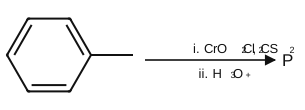
Q86.Consider the following reaction, and choose the correct option.
निम्नलिखित अभिक्रिया पर विचार कीजिए और सही विकल्प चुनिए।
- AOn treating compound P with saturated NaHCO3 solution, brisk effervescence is observed.यौगिक P को संतृप्त NaHCO3 विलयन के साथ उपचारित करने पर तीव्र बुदबुदाहट दिखाई देती है।
- BCompound P can be prepared by treating benzene with anhydrous AlCl3 and CH3COCl.यौगिक P को बेंज़ीन को निर्जल AlCl3 और CH3COCl के साथ उपचारित करके बनाया जा सकता है।
- COn treatment with bromine water, compound P gives a white precipitate.ब्रोमीन जल के साथ उपचारित करने पर यौगिक P श्वेत अवक्षेप देता है।
- DCompound P is obtained by the hydrogenation of benzoyl chloride with Pd on BaSO4.यौगिक P, BaSO4 पर Pd द्वारा बेंज़ॉयल क्लोराइड के हाइड्रोजनन से प्राप्त होता है।
Show answer
Concept: Etard reaction: chromyl chloride (CrO2Cl2) in CS2 oxidises Ar–CH3 only up to the aldehyde (via a chromium complex hydrolysed by H3O+). So P = benzaldehyde.
- (D) Rosenmund reduction: C6H5COCl + H2 C6H5CHO ✔.
- (A) NaHCO3 effervescence needs a carboxylic acid – benzaldehyde gives none.
- (B) Benzene + CH3COCl/AlCl3 gives acetophenone, not benzaldehyde.
- (C) White precipitate with bromine water is the test for phenol/aniline (2,4,6-tribromo product).
Short trick: Etard (CrO2Cl2) and Gatterman–Koch (CO/HCl) → benzaldehyde; Rosenmund also → aldehyde.
Answer: (D) P is obtained by Rosenmund reduction of benzoyl chloride
अवधारणा: इटार्ड अभिक्रिया: CS2 में क्रोमिल क्लोराइड (CrO2Cl2) Ar–CH3 को केवल ऐल्डिहाइड तक ऑक्सीकृत करता है (क्रोमियम संकुल के माध्यम से, जिसका H3O+ से जल-अपघटन होता है)। अतः P = बेंज़ैल्डिहाइड।
- (D) रोज़ेनमुंड अपचयन: C6H5COCl + H2 C6H5CHO ✔।
- (A) NaHCO3 से बुदबुदाहट के लिए कार्बोक्सिलिक अम्ल चाहिए – बेंज़ैल्डिहाइड नहीं देता।
- (B) बेंज़ीन + CH3COCl/AlCl3 से ऐसीटोफ़ीनोन बनता है, बेंज़ैल्डिहाइड नहीं।
- (C) ब्रोमीन जल के साथ श्वेत अवक्षेप फ़ीनॉल/ऐनिलीन का परीक्षण है (2,4,6-ट्राइब्रोमो उत्पाद)।
शॉर्ट ट्रिक: इटार्ड (CrO2Cl2) तथा गाटरमान–कोख (CO/HCl) → बेंज़ैल्डिहाइड; रोज़ेनमुंड भी → ऐल्डिहाइड।
उत्तर: (D) P, बेंज़ॉयल क्लोराइड के रोज़ेनमुंड अपचयन से प्राप्त होता है
NEET UGChemistryAldehydes – Etard reaction and Rosenmund reductionNEET UG 2026 · 21 Jun Shift 1
Q87.A 1 : 3 electrolyte in an aqueous solution is
जलीय विलयन में 1 : 3 विद्युत-अपघट्य है
- A[CoCl2(NH3)4]Cl
- B[CoCl(NH3)5]Cl2
- C[Co(NH3)6]Cl3
- D[Co(NH3)3(NO2)3]
Show answer
Concept: Only ions outside the coordination sphere are released: a 1 : 3 electrolyte gives one complex cation and three counter-anions.
- [Co(NH3)6]Cl3 → [Co(NH3)6]3+ + 3Cl− (4 ions, 1 : 3) ✔.
- [CoCl2(NH3)4]Cl → 1 : 1; [CoCl(NH3)5]Cl2 → 1 : 2; [Co(NH3)3(NO2)3] → non-electrolyte.
Short trick: Count the Cl outside the square bracket = number of AgCl precipitated = “1 : x”.
Answer: (C) [Co(NH3)6]Cl3
अवधारणा: केवल उपसहसंयोजन मंडल के बाहर के आयन मुक्त होते हैं: 1 : 3 विद्युत-अपघट्य एक संकुल धनायन और तीन प्रति-ऋणायन देता है।
- [Co(NH3)6]Cl3 → [Co(NH3)6]3+ + 3Cl− (4 आयन, 1 : 3) ✔।
- [CoCl2(NH3)4]Cl → 1 : 1; [CoCl(NH3)5]Cl2 → 1 : 2; [Co(NH3)3(NO2)3] → अविद्युत-अपघट्य।
शॉर्ट ट्रिक: वर्ग कोष्ठक के बाहर Cl गिनें = अवक्षेपित AgCl की संख्या = “1 : x”।
उत्तर: (C) [Co(NH3)6]Cl3
NEET UGChemistryCoordination compounds – Werner’s theory, ionisationNEET UG 2026 · 21 Jun Shift 1
Q88.Consider the following schematic plots of orbital wavefunction (ψ
r) against distance (r) from the nucleus.
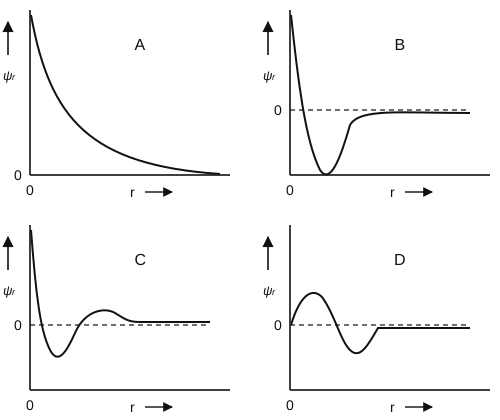
The figure representing two radial nodes in the orbital is
नाभिक से दूरी (r) के विरुद्ध कक्षक तरंग फलन (ψ
r) के निम्नलिखित व्यवस्थात्मक आलेखों पर विचार कीजिए।
कक्षक में दो त्रिज्य नोड (radial nodes) दर्शाने वाला चित्र है
- AA
- BB
- CC
- DD
Show answer
Concept: A radial node is a distance r > 0 where ψ changes sign (crosses the zero line). Number of radial nodes = n − l − 1. ψ = 0 at r = 0 for p, d orbitals is not a radial node.
- A: never crosses zero → 0 nodes (1s).
- B: crosses zero once → 1 node (2s).
- C: starts large, crosses zero going down, then crosses again going up → 2 radial nodes (3s) ✔.
- D: ψ = 0 at r = 0 (p orbital), crosses zero once → 1 radial node (3p).
Short trick: Count only sign changes away from the nucleus; 3s has 2, 3p has 1, 3d has 0.
Answer: (C) C
अवधारणा: त्रिज्य नोड वह दूरी r > 0 है जहाँ ψ का चिह्न बदलता है (शून्य रेखा को काटता है)। त्रिज्य नोडों की संख्या = n − l − 1। p, d कक्षकों के लिए r = 0 पर ψ = 0 त्रिज्य नोड नहीं है।
- A: शून्य को कभी नहीं काटता → 0 नोड (1s)।
- B: शून्य को एक बार काटता है → 1 नोड (2s)।
- C: बड़े मान से शुरू, नीचे जाते हुए शून्य को काटता है, फिर ऊपर जाते हुए पुनः काटता है → 2 त्रिज्य नोड (3s) ✔।
- D: r = 0 पर ψ = 0 (p कक्षक), शून्य को एक बार काटता है → 1 त्रिज्य नोड (3p)।
शॉर्ट ट्रिक: नाभिक से दूर केवल चिह्न-परिवर्तन गिनें; 3s में 2, 3p में 1, 3d में 0।
उत्तर: (C) C
NEET UGChemistryAtomic structure – radial nodes and wave function plotsNEET UG 2026 · 21 Jun Shift 1
Q89.Arrange the following compounds in the increasing order of polarity
A. CH3CH2OCH2CH3
B. CH3CH2OH
C. CH3COCH3
D. CH3COOH
Choose the correct answer from the options given below :
निम्नलिखित यौगिकों को ध्रुवता के बढ़ते क्रम में व्यवस्थित कीजिए
A. CH3CH2OCH2CH3
B. CH3CH2OH
C. CH3COCH3
D. CH3COOH
नीचे दिए गए विकल्पों में से सही उत्तर चुनिए :
- AA < B < C < D
- BC < A < D < B
- CC < A < B < D
- DA < C < B < D
Show answer
Concept: Polarity of these solvents (as used in chromatography / solvent polarity scales) rises with the polar group and its hydrogen-bonding ability: ether < ketone < alcohol < carboxylic acid.
- A, diethyl ether: only a weakly polar C–O–C, no O–H → least polar.
- C, acetone: strongly polar C=O but cannot donate an H-bond.
- B, ethanol: O–H group – both H-bond donor and acceptor.
- D, acetic acid: COOH has C=O + O–H, strongest H-bonding (forms dimers) → most polar. Order: A < C < B < D.
Short trick: Eluotropic series to remember: ether < acetone < ethanol < acetic acid (“E-A-E-A”).
Answer: (D) A < C < B < D
अवधारणा: इन विलायकों की ध्रुवता (क्रोमैटोग्राफ़ी / विलायक-ध्रुवता पैमानों के अनुसार) ध्रुवीय समूह तथा उसकी हाइड्रोजन-आबंधन क्षमता के साथ बढ़ती है: ईथर < कीटोन < ऐल्कोहॉल < कार्बोक्सिलिक अम्ल।
- A, डाइएथिल ईथर: केवल दुर्बल ध्रुवीय C–O–C, कोई O–H नहीं → सबसे कम ध्रुवीय।
- C, ऐसीटोन: प्रबल ध्रुवीय C=O, परंतु H-आबंध दान नहीं कर सकता।
- B, एथेनॉल: O–H समूह – H-आबंध दाता तथा ग्राही दोनों।
- D, ऐसीटिक अम्ल: COOH में C=O + O–H, सबसे प्रबल H-आबंधन (द्वितय बनाता है) → सबसे अधिक ध्रुवीय। क्रम: A < C < B < D।
शॉर्ट ट्रिक: याद रखने हेतु इलूओट्रॉपिक श्रेणी: ईथर < ऐसीटोन < एथेनॉल < ऐसीटिक अम्ल।
उत्तर: (D) A < C < B < D
NEET UGChemistryOrganic compounds – polarity and hydrogen bondingNEET UG 2026 · 21 Jun Shift 1
Q90.The highest occupied molecular orbital for Ne2 is
Ne2 के लिए उच्चतम अधिकृत अणु कक्षक (HOMO) है
- A
- B
- C
- D
Show answer
Concept: For O2, F2, Ne2 the order is σ1s < σ*1s < σ2s < σ*2s < σ2pz < π2px = π2py < π*2px = π*2py < σ*2pz.
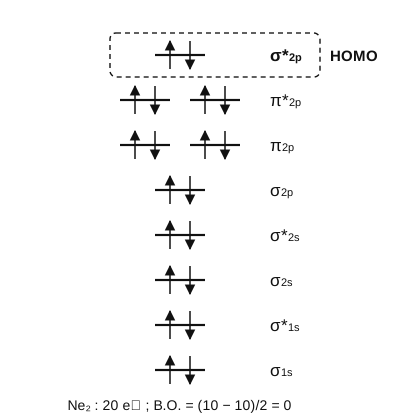
- Ne2 has 20 electrons: σ1s2 σ*1s2 σ2s2 σ*2s2 σ2p2 π2p4 π*2p4 σ*2p2.
- The last two electrons enter σ*2pz → HOMO = σ*2p (bond order (10 − 10)/2 = 0, so Ne2 does not exist).
Short trick: Every orbital up to σ*2p is full for a noble-gas dimer – the top one is σ*2p.
Answer: (D)
अवधारणा: O2, F2, Ne2 के लिए क्रम है σ1s < σ*1s < σ2s < σ*2s < σ2pz < π2px = π2py < π*2px = π*2py < σ*2pz।
- Ne2 में 20 इलेक्ट्रॉन: σ1s2 σ*1s2 σ2s2 σ*2s2 σ2p2 π2p4 π*2p4 σ*2p2।
- अंतिम दो इलेक्ट्रॉन σ*2pz में जाते हैं → HOMO = σ*2p (आबंध कोटि (10 − 10)/2 = 0, अतः Ne2 का अस्तित्व नहीं है)।
शॉर्ट ट्रिक: उत्कृष्ट गैस द्वितय में σ*2p तक सभी कक्षक भरे होते हैं – सबसे ऊपर σ*2p है।
उत्तर: (D)
NEET UGChemistryChemical bonding – MO theoryNEET UG 2026 · 21 Jun Shift 1
Q91.The number of vertebrae in a human is ______.
मनुष्य में कशेरुकाओं (vertebrae) की संख्या ______ है।
- A7
- B12
- C26
- D206
Show answer
Concept: The adult human vertebral column is formed by 26 serially arranged vertebrae.
- Cervical 7 + thoracic 12 + lumbar 5 + sacral 1 (fused) + coccygeal 1 (fused) = 26.
- 7 is only the number of cervical vertebrae and 12 only the thoracic vertebrae (also the number of pairs of ribs).
- 206 is the total number of bones in the adult human skeleton, not the vertebrae.
Short trick: Formula of vertebral column: C7 T12 L5 S1 Co1 → 7+12+5+1+1 = 26 (in a child 33, as sacrum = 5 and coccyx = 4 are still separate).
Answer: (C) 26
अवधारणा: वयस्क मनुष्य का कशेरुक दंड (vertebral column) क्रमबद्ध रूप से व्यवस्थित 26 कशेरुकाओं से बना होता है।
- ग्रीवा (cervical) 7 + वक्षीय (thoracic) 12 + कटि (lumbar) 5 + त्रिक (sacral) 1 (समेकित) + अनुत्रिक (coccygeal) 1 (समेकित) = 26।
- 7 केवल ग्रीवा कशेरुकाओं की संख्या है और 12 केवल वक्षीय कशेरुकाओं की (जो पसलियों के जोड़ों की संख्या भी है)।
- 206 वयस्क मानव कंकाल की कुल अस्थियों की संख्या है, कशेरुकाओं की नहीं।
शॉर्ट ट्रिक: कशेरुक दंड का सूत्र: C7 T12 L5 S1 Co1 → 7+12+5+1+1 = 26 (बच्चे में 33, क्योंकि त्रिक के 5 और अनुत्रिक के 4 कशेरुक अभी अलग होते हैं)।
उत्तर: (C) 26
NEET UGBiologyLocomotion and movement – axial skeletonNEET UG 2026 · 21 Jun Shift 1
Q92.Symbiotic association between fungi and algae are called _____.
कवक (fungi) और शैवाल (algae) के बीच सहजीवी संबंध को _____ कहते हैं।
- Alichensलाइकेन (lichens)
- Bspongesस्पंज (sponges)
- Cmycorrhizaकवकमूल (mycorrhiza)
- Dchrysophytesक्राइसोफाइट्स (chrysophytes)
Show answer
Concept: Lichens are symbiotic associations (mutually useful) between algae (phycobiont) and fungi (mycobiont).
- Algae prepare food for the fungus; the fungus gives shelter and absorbs mineral nutrients and water for the alga.
- Mycorrhiza is an association of a fungus with the roots of higher plants – not with algae.
- Sponges are animals (phylum Porifera); chrysophytes are diatoms/desmids (protists).
Short trick: Lichen = "Alga + Fungus = Li-chen" – they are good pollution indicators (do not grow in SO2-polluted air).
Answer: (A) lichens
अवधारणा: लाइकेन शैवाल (फाइकोबायंट) और कवक (माइकोबायंट) के बीच परस्पर लाभदायक सहजीवी संबंध हैं।
- शैवाल कवक के लिए भोजन बनाते हैं; कवक शैवाल को आश्रय देता है तथा उसके लिए खनिज पोषक और जल अवशोषित करता है।
- कवकमूल (mycorrhiza) कवक का उच्च पादपों की जड़ों के साथ संबंध है – शैवाल के साथ नहीं।
- स्पंज जंतु हैं (संघ पोरीफेरा); क्राइसोफाइट्स डायटम/डेस्मिड (प्रोटिस्टा) हैं।
शॉर्ट ट्रिक: लाइकेन = "शैवाल + कवक" – ये प्रदूषण के अच्छे सूचक हैं (SO2 प्रदूषित वायु में नहीं उगते)।
उत्तर: (A) लाइकेन
NEET UGBiologyBiological classification – lichensNEET UG 2026 · 21 Jun Shift 1
Q93.Cell theory was formulated by_____.
कोशिका सिद्धांत _____ द्वारा प्रतिपादित किया गया था।
- ASchleiden and Schwannश्लाइडेन और श्वान (Schleiden and Schwann)
- BRobert Brownरॉबर्ट ब्राउन (Robert Brown)
- CSinger and Nicolsonसिंगर और निकोलसन (Singer and Nicolson)
- DAntonie Von Leeuwenhoekएंटोनी वॉन ल्यूवेनहॉक (Antonie Von Leeuwenhoek)
Show answer
Concept: M.J. Schleiden (botanist, 1838) and T. Schwann (zoologist, 1839) together formulated the cell theory.
- Schleiden: all plants are made of different kinds of cells; Schwann: animal cells have a thin outer layer (plasma membrane) and plants have a cell wall.
- Robert Brown discovered the nucleus.
- Singer and Nicolson gave the fluid mosaic model of membrane (1972).
- Leeuwenhoek first saw and described a live cell. Rudolf Virchow later added "Omnis cellula-e cellula".
Short trick: Cell theory = "S + S" (Schleiden + Schwann); modified by Virchow (cells arise from pre-existing cells).
Answer: (A) Schleiden and Schwann
अवधारणा: एम.जे. श्लाइडेन (वनस्पतिशास्त्री, 1838) और टी. श्वान (प्राणिशास्त्री, 1839) ने मिलकर कोशिका सिद्धांत प्रतिपादित किया।
- श्लाइडेन: सभी पौधे विभिन्न प्रकार की कोशिकाओं से बने हैं; श्वान: जंतु कोशिकाओं के बाहर एक पतली परत (प्लाज्मा झिल्ली) होती है और पादप कोशिकाओं में कोशिका भित्ति होती है।
- रॉबर्ट ब्राउन ने केंद्रक की खोज की।
- सिंगर और निकोलसन ने झिल्ली का तरल किर्मीर मॉडल (fluid mosaic model, 1972) दिया।
- ल्यूवेनहॉक ने सबसे पहले जीवित कोशिका देखी और उसका वर्णन किया। बाद में रुडोल्फ विर्खो ने "Omnis cellula-e cellula" जोड़ा।
शॉर्ट ट्रिक: कोशिका सिद्धांत = "S + S" (श्लाइडेन + श्वान); विर्खो ने संशोधित किया (कोशिकाएँ पूर्ववर्ती कोशिकाओं से बनती हैं)।
उत्तर: (A) श्लाइडेन और श्वान
NEET UGBiologyCell – cell theoryNEET UG 2026 · 21 Jun Shift 1
Q94.Which of the following are characteristics of prokaryotic cells ?
(a) Ribosomes are made of 50S and 30S subunits
(b) They can have plasmids
(c) They contain mesosome
(d) They have peroxisomes
Choose the correct answer from the options given below :
निम्नलिखित में से कौन-से प्रोकैरियोटिक कोशिकाओं के लक्षण हैं ?
(a) राइबोसोम 50S और 30S उप-इकाइयों से बने होते हैं
(b) इनमें प्लाज्मिड हो सकते हैं
(c) इनमें मीसोसोम होता है
(d) इनमें परऑक्सीसोम होते हैं
नीचे दिए गए विकल्पों में से सही उत्तर चुनिए :
- A(b) and (c) onlyकेवल (b) और (c)
- B(a) and (c) onlyकेवल (a) और (c)
- C(a), (c) and (d) onlyकेवल (a), (c) और (d)
- D(a), (b) and (c) onlyकेवल (a), (b) और (c)
Show answer
Concept: Prokaryotes lack membrane-bound organelles; they have 70S ribosomes, plasmids and mesosomes.
- (a) Correct – 70S ribosome = 50S + 30S subunits.
- (b) Correct – many bacteria have small circular extra-chromosomal DNA (plasmids), e.g. giving antibiotic resistance.
- (c) Correct – mesosome is an infolding of the plasma membrane (helps in wall formation, DNA replication, respiration).
- (d) Incorrect – peroxisome is a membrane-bound organelle, found only in eukaryotes.
Short trick: In prokaryotes remember "R-P-M" (70S Ribosome, Plasmid, Mesosome) – anything membrane-bound (peroxisome, mitochondria, ER, Golgi) is absent.
Answer: (D) (a), (b) and (c) only
अवधारणा: प्रोकैरियोट में झिल्ली-आबद्ध कोशिकांग नहीं होते; इनमें 70S राइबोसोम, प्लाज्मिड और मीसोसोम होते हैं।
- (a) सही – 70S राइबोसोम = 50S + 30S उप-इकाइयाँ।
- (b) सही – अनेक जीवाणुओं में छोटा वृत्ताकार गुणसूत्रबाह्य DNA (प्लाज्मिड) होता है, जैसे प्रतिजैविक प्रतिरोध देने वाला।
- (c) सही – मीसोसोम प्लाज्मा झिल्ली का अंतर्वलन है (भित्ति निर्माण, DNA प्रतिकृति, श्वसन में सहायक)।
- (d) गलत – परऑक्सीसोम झिल्ली-आबद्ध कोशिकांग है, जो केवल यूकैरियोट में मिलता है।
शॉर्ट ट्रिक: प्रोकैरियोट में "R-P-M" याद रखें (70S राइबोसोम, प्लाज्मिड, मीसोसोम) – कोई भी झिल्ली-आबद्ध अंग (परऑक्सीसोम, माइटोकॉन्ड्रिया, ER, गॉल्जी) अनुपस्थित।
उत्तर: (D) केवल (a), (b) और (c)
NEET UGBiologyCell – prokaryotic cellNEET UG 2026 · 21 Jun Shift 1
Q95.Which of the following is not a part of human central neural system ?
निम्नलिखित में से कौन-सा मानव केंद्रीय तंत्रिका तंत्र का भाग नहीं है ?
- AArachnoidजालतानिका (Arachnoid)
- BDura materदृढ़तानिका (Dura mater)
- CPia materमृदुतानिका (Pia mater)
- DPericardiumहृदयावरण (Pericardium)
Show answer
Concept: The brain (and spinal cord) of the CNS is protected by three cranial meninges: dura mater, arachnoid and pia mater.
- Dura mater – outer tough layer; arachnoid – thin middle layer; pia mater – inner layer in contact with brain tissue. All three belong to the CNS coverings.
- Pericardium is the double-layered membrane around the heart – part of the circulatory system, not the neural system.
Short trick: Meninges order from outside: "DAP" – Dura, Arachnoid, Pia. Pericardium = "peri + cardia" = around the heart.
Answer: (D) Pericardium
अवधारणा: केंद्रीय तंत्रिका तंत्र का मस्तिष्क (और मेरुरज्जु) तीन मस्तिष्कावरणों (meninges) से सुरक्षित रहता है: दृढ़तानिका, जालतानिका और मृदुतानिका।
- दृढ़तानिका – बाहरी मजबूत परत; जालतानिका – पतली मध्य परत; मृदुतानिका – मस्तिष्क ऊतक के संपर्क वाली भीतरी परत। तीनों CNS के आवरण हैं।
- हृदयावरण (pericardium) हृदय के चारों ओर की दोहरी झिल्ली है – यह परिसंचरण तंत्र का भाग है, तंत्रिका तंत्र का नहीं।
शॉर्ट ट्रिक: बाहर से मस्तिष्कावरण का क्रम: "DAP" – Dura, Arachnoid, Pia। Pericardium = "peri + cardia" = हृदय के चारों ओर।
उत्तर: (D) हृदयावरण (Pericardium)
NEET UGBiologyNeural control – central nervous systemNEET UG 2026 · 21 Jun Shift 1
Q96.Mitochondrial inner membrane encloses _____.
माइटोकॉन्ड्रिया की आंतरिक झिल्ली _____ को घेरती है।
- Amatrixमैट्रिक्स (matrix)
- Bcytosolकोशिकाद्रव्य (cytosol)
- Cmucusश्लेष्मा (mucus)
- Daqueous humorनेत्रोद (aqueous humor)
Show answer
Concept: Mitochondria have two membranes and two compartments: the outer compartment (between membranes) and the inner compartment filled with matrix.
- The inner membrane (folded into cristae) encloses the dense homogeneous matrix containing circular DNA, 70S ribosomes and Krebs-cycle enzymes.
- Cytosol lies outside the mitochondrion; mucus is a secretion of goblet cells; aqueous humor is fluid of the eye.
Short trick: Inner membrane → matrix (Krebs cycle); cristae (on inner membrane) → ETS/ATP synthase.
Answer: (A) matrix
अवधारणा: माइटोकॉन्ड्रिया में दो झिल्लियाँ और दो कक्ष होते हैं: बाहरी कक्ष (दोनों झिल्लियों के बीच) और मैट्रिक्स से भरा आंतरिक कक्ष।
- आंतरिक झिल्ली (जो क्रिस्टी में वलित होती है) घने समांगी मैट्रिक्स को घेरती है, जिसमें वृत्ताकार DNA, 70S राइबोसोम और क्रेब्स चक्र के एंजाइम होते हैं।
- कोशिकाद्रव्य माइटोकॉन्ड्रिया के बाहर होता है; श्लेष्मा गॉब्लेट कोशिकाओं का स्राव है; नेत्रोद आँख का द्रव है।
शॉर्ट ट्रिक: आंतरिक झिल्ली → मैट्रिक्स (क्रेब्स चक्र); क्रिस्टी (आंतरिक झिल्ली पर) → ETS/ATP सिंथेज़।
उत्तर: (A) मैट्रिक्स
NEET UGBiologyCell – mitochondriaNEET UG 2026 · 21 Jun Shift 1
Q97.Match
List-I with
List-II.
| List-I | List-II |
|---|
| A. Cristae | I. Flat membrane sacs in stroma of chloroplast |
| B. Cisternae | II. Infoldings in mitochondria |
| C. Thylakoids | III. Cell membrane |
| D. Phospholipid | IV. Disc shaped sacs in the Golgi apparatus |
Choose the
correct answer from the options given below :
सूची-I का सूची-II से मिलान कीजिए।
| सूची-I | सूची-II |
|---|
| A. क्रिस्टी (Cristae) | I. हरितलवक के पीठिका (stroma) में चपटी झिल्लीमय थैलियाँ |
| B. सिस्टर्नी (Cisternae) | II. माइटोकॉन्ड्रिया में अंतर्वलन |
| C. थाइलेकॉइड (Thylakoids) | III. कोशिका झिल्ली |
| D. फॉस्फोलिपिड (Phospholipid) | IV. गॉल्जी उपकरण में चक्रिका-आकार की थैलियाँ |
नीचे दिए गए विकल्पों में से
सही उत्तर चुनिए :
- AA-III, B-IV, C-I, D-II
- BA-II, B-IV, C-I, D-III
- CA-II, B-IV, C-III, D-I
- DA-IV, B-III, C-I, D-II
Show answer
Concept: Each organelle has a characteristic membrane structure (NCERT, Cell: The Unit of Life).
- A. Cristae – infoldings of inner mitochondrial membrane → II.
- B. Cisternae – flat, disc-shaped sacs stacked in Golgi apparatus → IV.
- C. Thylakoids – flat membranous sacs in the stroma of chloroplast (stacked as grana) → I.
- D. Phospholipid – lipid bilayer forms the cell membrane → III.
Short trick: Only option (B) begins with A-II and has C-I; (A) and (D) put cristae wrong, (C) puts thylakoid in cell membrane.
Answer: (B) A-II, B-IV, C-I, D-III
अवधारणा: प्रत्येक कोशिकांग की एक विशिष्ट झिल्लीमय संरचना होती है (NCERT, कोशिका: जीवन की इकाई)।
- A. क्रिस्टी – माइटोकॉन्ड्रिया की आंतरिक झिल्ली के अंतर्वलन → II।
- B. सिस्टर्नी – गॉल्जी उपकरण में ढेर के रूप में व्यवस्थित चपटी चक्रिका-आकार थैलियाँ → IV।
- C. थाइलेकॉइड – हरितलवक की पीठिका में चपटी झिल्लीमय थैलियाँ (ग्रैना के रूप में ढेर) → I।
- D. फॉस्फोलिपिड – लिपिड द्विपरत कोशिका झिल्ली बनाती है → III।
शॉर्ट ट्रिक: केवल विकल्प (B) A-II से शुरू होता है और उसमें C-I है; (A) और (D) में क्रिस्टी गलत है, (C) में थाइलेकॉइड को कोशिका झिल्ली से मिलाया गया है।
उत्तर: (B) A-II, B-IV, C-I, D-III
NEET UGBiologyCell – cell organellesNEET UG 2026 · 21 Jun Shift 1
Q98.The plastid that stores xanthophyll is known as _____.
ज़ैंथोफिल का संचय करने वाला लवक _____ कहलाता है।
- Achloroplastहरितलवक (chloroplast)
- Bchromoplastवर्णीलवक (chromoplast)
- Caleuroplastएल्यूरोप्लास्ट (aleuroplast)
- Damyloplastएमाइलोप्लास्ट (amyloplast)
Show answer
Concept: Chromoplasts contain fat-soluble carotenoid pigments like carotene and xanthophylls, giving yellow, orange or red colour.
- Chromoplast – stores carotene and xanthophyll (colour of petals, ripe fruits).
- Chloroplast – mainly chlorophyll; its yellow pigments are only accessory pigments for photosynthesis, not stored.
- Aleuroplast stores proteins; amyloplast stores starch (both are colourless leucoplasts).
Short trick: Leucoplasts: "AAE" – Amyloplast (starch), Aleuroplast (protein), Elaioplast (oil). Coloured non-green = Chromoplast.
Answer: (B) chromoplast
अवधारणा: वर्णीलवक में वसा-विलेय कैरोटिनॉइड वर्णक जैसे कैरोटीन और ज़ैंथोफिल होते हैं, जो पीला, नारंगी या लाल रंग देते हैं।
- वर्णीलवक – कैरोटीन और ज़ैंथोफिल का संचय (पंखुड़ियों, पके फलों का रंग)।
- हरितलवक – मुख्यतः क्लोरोफिल; इसके पीले वर्णक केवल प्रकाश-संश्लेषण के सहायक वर्णक हैं, संचित नहीं होते।
- एल्यूरोप्लास्ट प्रोटीन संचित करता है; एमाइलोप्लास्ट मंड (स्टार्च) संचित करता है (दोनों रंगहीन अवर्णीलवक हैं)।
शॉर्ट ट्रिक: अवर्णीलवक: "AAE" – एमाइलोप्लास्ट (मंड), एल्यूरोप्लास्ट (प्रोटीन), इलायोप्लास्ट (तेल)। रंगीन पर हरा नहीं = वर्णीलवक।
उत्तर: (B) वर्णीलवक (chromoplast)
NEET UGBiologyCell – plastidsNEET UG 2026 · 21 Jun Shift 1
Q99.Which of the following statements related to pituitary gland are correct ?
(a) It is divided anatomically into adenohypophysis and neurohypophysis
(b) It secretes follicle stimulating hormone
(c) It secretes melanocyte stimulating hormone
(d) It does not secrete prolactin
Choose the correct answer from the options given below :
पीयूष ग्रंथि से संबंधित निम्नलिखित में से कौन-से कथन सही हैं ?
(a) यह शारीरिक रूप से एडिनोहाइपोफाइसिस और न्यूरोहाइपोफाइसिस में विभाजित है
(b) यह पुटिका उद्दीपक हॉर्मोन (FSH) स्रावित करती है
(c) यह मेलानोसाइट उद्दीपक हॉर्मोन (MSH) स्रावित करती है
(d) यह प्रोलैक्टिन स्रावित नहीं करती
नीचे दिए गए विकल्पों में से सही उत्तर चुनिए :
- A(a) and (b) onlyकेवल (a) और (b)
- B(a), (b) and (c) onlyकेवल (a), (b) और (c)
- C(c) and (d) onlyकेवल (c) और (d)
- D(b) and (c) onlyकेवल (b) और (c)
Show answer
Concept: Pituitary (hypophysis) has adenohypophysis (pars distalis + pars intermedia) and neurohypophysis (pars nervosa).
- (a) Correct – anatomical division into adenohypophysis and neurohypophysis.
- (b) Correct – pars distalis secretes GH, PRL, TSH, ACTH, LH and FSH.
- (c) Correct – pars intermedia secretes melanocyte stimulating hormone (MSH).
- (d) Incorrect – prolactin (PRL) is secreted by pars distalis.
Short trick: Pars distalis hormones: "GPA-TLF" – GH, PRL, ACTH, TSH, LH, FSH; pars intermedia → MSH; neurohypophysis stores oxytocin & vasopressin.
Answer: (B) (a), (b) and (c) only
अवधारणा: पीयूष ग्रंथि (हाइपोफाइसिस) में एडिनोहाइपोफाइसिस (पार्स डिस्टेलिस + पार्स इंटरमीडिया) और न्यूरोहाइपोफाइसिस (पार्स नर्वोसा) होते हैं।
- (a) सही – एडिनोहाइपोफाइसिस और न्यूरोहाइपोफाइसिस में शारीरिक विभाजन।
- (b) सही – पार्स डिस्टेलिस GH, PRL, TSH, ACTH, LH और FSH स्रावित करता है।
- (c) सही – पार्स इंटरमीडिया मेलानोसाइट उद्दीपक हॉर्मोन (MSH) स्रावित करता है।
- (d) गलत – प्रोलैक्टिन (PRL) पार्स डिस्टेलिस द्वारा स्रावित होता है।
शॉर्ट ट्रिक: पार्स डिस्टेलिस के हॉर्मोन: "GPA-TLF" – GH, PRL, ACTH, TSH, LH, FSH; पार्स इंटरमीडिया → MSH; न्यूरोहाइपोफाइसिस ऑक्सीटोसिन व वैसोप्रेसिन का संचय करता है।
उत्तर: (B) केवल (a), (b) और (c)
NEET UGBiologyChemical coordination – pituitary glandNEET UG 2026 · 21 Jun Shift 1
Q100.Photorespiration reaction catalyzed by RuBisCo is shown below :
RuBP + O2 → 3-Phosphoglycerate + X
Identify "X" from the given options :
RuBisCo द्वारा उत्प्रेरित प्रकाश-श्वसन अभिक्रिया नीचे दी गई है :
RuBP + O2 → 3-Phosphoglycerate + X
दिए गए विकल्पों में से "X" को पहचानिए :
- APhosphoenolpyruvateफॉस्फोईनॉलपाइरुवेट (Phosphoenolpyruvate)
- B2-Phosphoglycolate2-फॉस्फोग्लाइकोलेट (2-Phosphoglycolate)
- COxaloacetateऑक्सैलोएसीटेट (Oxaloacetate)
- DMalateमैलेट (Malate)
Show answer
Concept: When RuBisCo acts as an oxygenase, RuBP (5C) + O2 gives one PGA (3C) and one phosphoglycolate (2C).
- Carbon balance: 5C (RuBP) → 3C (PGA) + 2C → X is the 2-carbon compound 2-phosphoglycolate.
- PEP is the primary CO2 acceptor in C4 plants; oxaloacetate (4C) is the first product of C4 fixation; malate is the 4C acid sent to bundle sheath – none are photorespiration products.
Short trick: Count carbons: 5 − 3 = 2 → "glycolate" (2C). Photorespiration = C2 cycle.
Answer: (B) 2-Phosphoglycolate
अवधारणा: जब RuBisCo ऑक्सीजिनेज़ की तरह कार्य करता है, तो RuBP (5C) + O2 से एक PGA (3C) और एक फॉस्फोग्लाइकोलेट (2C) बनता है।
- कार्बन संतुलन: 5C (RuBP) → 3C (PGA) + 2C → X दो-कार्बन यौगिक 2-फॉस्फोग्लाइकोलेट है।
- PEP, C4 पादपों में प्राथमिक CO2 ग्राही है; ऑक्सैलोएसीटेट (4C) C4 स्थिरीकरण का प्रथम उत्पाद है; मैलेट पूलाच्छद (bundle sheath) में भेजा जाने वाला 4C अम्ल है – इनमें से कोई भी प्रकाश-श्वसन का उत्पाद नहीं।
शॉर्ट ट्रिक: कार्बन गिनें: 5 − 3 = 2 → "ग्लाइकोलेट" (2C)। प्रकाश-श्वसन = C2 चक्र।
उत्तर: (B) 2-फॉस्फोग्लाइकोलेट
NEET UGBiologyPhotosynthesis – photorespirationNEET UG 2026 · 21 Jun Shift 1

