NEET UG · 2,240 questions

NEET UG 2015, 2016, 2017, 2018, 2019, 2020, 2021, 2022, 2023, 2024, 2025, 2026 PYQs

Real previous year questions, subject-wise. Try the question, then open the answer and the explanation in Hindi & English – free, no login.

Courses – airGurukul

2,240 questions.

Q1801.
Which among the following are the smallest living cells, known without a definite cell wall, pathogenic to plants as well as animals and can survive without oxygen?
निम्नलिखित में से कौन-सी सबसे छोटी जीवित कोशिकाएँ हैं, जिनमें निश्चित कोशिका भित्ति नहीं होती, जो पादपों तथा जंतुओं दोनों के लिए रोगजनक हैं तथा ऑक्सीजन के बिना जीवित रह सकती हैं?
  1. ABacillus
  2. BPseudomonas
  3. CMycoplasmaमाइकोप्लाज़्मा
  4. DNostoc
Show answer

Concept: Mycoplasma are the smallest known living cells; they lack a cell wall (hence pleomorphic), can live without oxygen and cause diseases in plants and animals.

  1. All four clues (smallest, wall-less, pathogenic to both, anaerobic) fit only Mycoplasma.
  2. (A) Bacillus and (B) Pseudomonas – typical bacteria with a peptidoglycan wall. (D) Nostoc – cyanobacterium with a wall and mucilage sheath; photosynthetic, not a pathogen.

Short trick: “PPLO” (pleuro-pneumonia-like organisms) = Mycoplasma = No wall, No shape.

Answer: (C) Mycoplasma

अवधारणा: माइकोप्लाज़्मा ज्ञात सबसे छोटी जीवित कोशिकाएँ हैं; इनमें कोशिका भित्ति नहीं होती (इसलिए बहुरूपी), ये ऑक्सीजन के बिना जीवित रह सकती हैं और पादपों व जंतुओं में रोग उत्पन्न करती हैं।

  1. चारों संकेत (सबसे छोटी, भित्तिहीन, दोनों में रोगजनक, अवायवीय) केवल माइकोप्लाज़्मा पर लागू होते हैं।
  2. (A) Bacillus तथा (B) Pseudomonas – पेप्टिडोग्लाइकन भित्ति वाले सामान्य जीवाणु। (D) Nostoc – भित्ति एवं श्लेष्मी आवरण युक्त सायनोबैक्टीरिया; प्रकाश-संश्लेषी, रोगजनक नहीं।

शॉर्ट ट्रिक: “PPLO” (प्लूरो-न्यूमोनिया जैसे जीव) = माइकोप्लाज़्मा = न भित्ति, न निश्चित आकार।

उत्तर: (C) माइकोप्लाज़्मा
NEET UGBiologyBiological classification – MycoplasmaNEET UG 2017 · 7 May Shift 1
Q1802.
Which of the following options gives the correct sequence of events during mitosis?
निम्नलिखित में से कौन-सा विकल्प समसूत्रण (mitosis) के दौरान घटनाओं का सही क्रम दर्शाता है?
  1. ACondensation → nuclear membrane disassembly → crossing over → segregation → telophaseसंघनन → केंद्रक झिल्ली का विघटन → जीन विनिमय (crossing over) → पृथक्करण → अंत्यावस्था
  2. BCondensation → nuclear membrane disassembly → arrangement at equator → centromere division → segregation → telophaseसंघनन → केंद्रक झिल्ली का विघटन → मध्यरेखा पर विन्यास → गुणसूत्रबिंदु विभाजन → पृथक्करण → अंत्यावस्था
  3. CCondensation → crossing over → nuclear membrane disassembly → segregation → telophaseसंघनन → जीन विनिमय (crossing over) → केंद्रक झिल्ली का विघटन → पृथक्करण → अंत्यावस्था
  4. DCondensation → arrangement at equator → centromere division → segregation → telophaseसंघनन → मध्यरेखा पर विन्यास → गुणसूत्रबिंदु विभाजन → पृथक्करण → अंत्यावस्था
Show answer

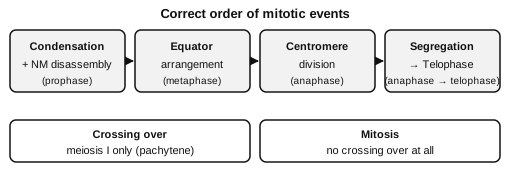
Concept: In mitosis: prophase (chromatin condenses, nuclear envelope breaks down at its end) → metaphase (chromosomes at equator) → anaphase (centromeres split, chromatids segregate) → telophase.

  1. Option (B) lists exactly these steps in order.
  2. (A) and (C) contain crossing over – it occurs only in meiosis I (pachytene), never in mitosis.
  3. (D) omits nuclear-membrane disassembly; chromosomes cannot reach the equator while the envelope is intact.

Short trick: Any option with “crossing over” is out for mitosis; then choose the one that is complete – P-M-A-T.

Answer: (B) Condensation → nuclear membrane disassembly → arrangement at equator → centromere division → segregation → telophase

अवधारणा: समसूत्रण में: पूर्वावस्था (क्रोमैटिन संघनित, अंत में केंद्रक आवरण विघटित) → मध्यावस्था (गुणसूत्र मध्यरेखा पर) → पश्चावस्था (गुणसूत्रबिंदु विभाजित, अर्धगुणसूत्र पृथक) → अंत्यावस्था।

  1. विकल्प (B) ठीक यही चरण सही क्रम में देता है।
  2. (A) तथा (C) में जीन विनिमय है – यह केवल अर्धसूत्रण-I (पैकीटीन) में होता है, समसूत्रण में कभी नहीं।
  3. (D) में केंद्रक झिल्ली का विघटन छूट गया है; आवरण अक्षुण्ण रहते गुणसूत्र मध्यरेखा तक नहीं पहुँच सकते।

शॉर्ट ट्रिक: जिस विकल्प में “जीन विनिमय” हो वह समसूत्रण के लिए बाहर; फिर पूरा क्रम वाला चुनें – P-M-A-T।

उत्तर: (B) संघनन → केंद्रक झिल्ली का विघटन → मध्यरेखा पर विन्यास → गुणसूत्रबिंदु विभाजन → पृथक्करण → अंत्यावस्था

NEET UGBiologyCell cycle and cell division – mitosisNEET UG 2017 · 7 May Shift 1
Q1803.
Which one of the following statements is correct, with reference to enzymes?
एंज़ाइमों के संदर्भ में निम्नलिखित में से कौन-सा कथन सही है?
  1. AApoenzyme = Holoenzyme + Coenzymeऐपोएंज़ाइम = होलोएंज़ाइम + सहएंज़ाइम
  2. BHoloenzyme = Apoenzyme + Coenzymeहोलोएंज़ाइम = ऐपोएंज़ाइम + सहएंज़ाइम
  3. CCoenzyme = Apoenzyme + Holoenzymeसहएंज़ाइम = ऐपोएंज़ाइम + होलोएंज़ाइम
  4. DHoloenzyme = Coenzyme + Cofactorहोलोएंज़ाइम = सहएंज़ाइम + सहकारक
Show answer

Concept: The protein part of a conjugated enzyme is the apoenzyme; the non-protein part is a cofactor (coenzyme, prosthetic group or metal ion). Apoenzyme + cofactor = holoenzyme (the complete, active enzyme).

  1. Holoenzyme = Apoenzyme + Coenzyme → (B).
  2. (A) and (C) put the whole (holoenzyme) on the wrong side. (D) A coenzyme is itself a type of cofactor – no protein part, so it cannot make a holoenzyme.

Short trick: Holo = whole: whole enzyme = protein (apo) + helper (co).

Answer: (B) Holoenzyme = Apoenzyme + Coenzyme

अवधारणा: संयुग्मी एंज़ाइम का प्रोटीन भाग ऐपोएंज़ाइम है; अप्रोटीन भाग सहकारक (सहएंज़ाइम, प्रोस्थेटिक समूह या धातु आयन) है। ऐपोएंज़ाइम + सहकारक = होलोएंज़ाइम (पूर्ण, सक्रिय एंज़ाइम)।

  1. होलोएंज़ाइम = ऐपोएंज़ाइम + सहएंज़ाइम → (B)।
  2. (A) तथा (C) में पूर्ण (होलोएंज़ाइम) गलत ओर रखा गया है। (D) सहएंज़ाइम स्वयं सहकारक का एक प्रकार है – प्रोटीन भाग नहीं, अतः होलोएंज़ाइम नहीं बन सकता।

शॉर्ट ट्रिक: Holo = पूर्ण: पूर्ण एंज़ाइम = प्रोटीन (apo) + सहायक (co)।

उत्तर: (B) होलोएंज़ाइम = ऐपोएंज़ाइम + सहएंज़ाइम

NEET UGBiologyBiomolecules – enzymes and cofactorsNEET UG 2017 · 7 May Shift 1
Q1804.
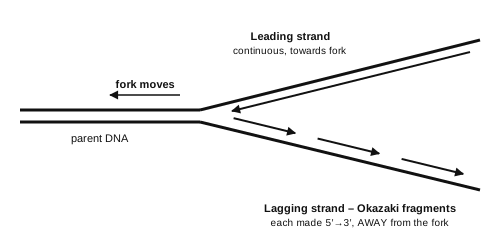
During DNA replication, Okazaki fragments are used to elongate
DNA प्रतिकृति के दौरान ओकाज़ाकी खंडों का उपयोग किसे दीर्घित करने में होता है?
  1. AThe leading strand towards replication forkअग्रग रज्जुक को प्रतिकृति फोर्क की ओर
  2. BThe lagging strand towards replication forkपश्चगामी रज्जुक को प्रतिकृति फोर्क की ओर
  3. CThe leading strand away from replication forkअग्रग रज्जुक को प्रतिकृति फोर्क से दूर
  4. DThe lagging strand away from the replication forkपश्चगामी रज्जुक को प्रतिकृति फोर्क से दूर
Show answer

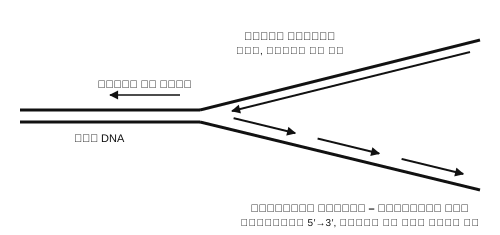
Concept: DNA polymerase works only 5′→3′. On the template running 5′→3′ (towards the fork) the new strand must be made in short pieces – Okazaki fragments – each growing away from the fork; these join (ligase) to form the lagging strand.

  1. Leading strand: continuous, grows towards the fork → (A), (C) wrong (no Okazaki fragments on it).
  2. Lagging strand: discontinuous; each fragment is synthesised 5′→3′ in the direction opposite to fork movement, i.e. away from the fork → (D), not (B).

Short trick: Lagging = Little pieces that Leave (move away from) the fork.

Answer: (D) The lagging strand away from the replication fork

अवधारणा: DNA पॉलिमरेज़ केवल 5′→3′ दिशा में कार्य करता है। जो टेम्पलेट फोर्क की ओर 5′→3′ चलता है, उस पर नया रज्जुक छोटे-छोटे टुकड़ों – ओकाज़ाकी खंडों – में बनता है, प्रत्येक खंड फोर्क से दूर की ओर बढ़ता है; लाइगेज़ इन्हें जोड़कर पश्चगामी रज्जुक बनाता है।

  1. अग्रग रज्जुक: सतत, फोर्क की ओर बढ़ता है → (A), (C) गलत (इस पर ओकाज़ाकी खंड नहीं)।
  2. पश्चगामी रज्जुक: असतत; प्रत्येक खंड 5′→3′ दिशा में फोर्क की गति के विपरीत, अर्थात फोर्क से दूर बनता है → (D), न कि (B)।

शॉर्ट ट्रिक: Lagging = Little pieces that Leave (फोर्क से दूर जाते) – छोटे टुकड़े फोर्क छोड़कर दूर बढ़ते हैं।

उत्तर: (D) पश्चगामी रज्जुक को प्रतिकृति फोर्क से दूर

NEET UGBiologyMolecular basis of inheritance – DNA replicationNEET UG 2017 · 7 May Shift 1
Q1805.
Which of the following are not polymeric?
निम्नलिखित में से कौन बहुलकी (polymeric) नहीं हैं?
  1. ANucleic acidsन्यूक्लिक अम्ल
  2. BProteinsप्रोटीन
  3. CPolysaccharidesपॉलीसैकेराइड
  4. DLipidsलिपिड
Show answer

Concept: Polymers are chains of repeating monomers. Lipids (molecular mass < 800 Da) are not polymers – they are esters of fatty acids and alcohol; they appear in the acid-insoluble fraction only because they form membrane vesicles.

  1. (A) Nucleic acids – polymers of nucleotides. (B) Proteins – polymers of amino acids. (C) Polysaccharides – polymers of monosaccharides.
  2. (D) Lipids – no repeating monomer chain → not polymeric.

Short trick: NCERT: “lipids are not strictly macromolecules” – the odd one among the four macromolecule classes.

Answer: (D) Lipids

अवधारणा: बहुलक दोहराई जाने वाली एकलक इकाइयों की शृंखलाएँ हैं। लिपिड (अणुभार < 800 Da) बहुलक नहीं हैं – ये वसीय अम्ल और ऐल्कोहॉल के एस्टर हैं; ये अम्ल-अविलेय अंश में केवल इसलिए आते हैं क्योंकि ये झिल्ली पुटिकाएँ बनाते हैं।

  1. (A) न्यूक्लिक अम्ल – न्यूक्लियोटाइडों के बहुलक। (B) प्रोटीन – अमीनो अम्लों के बहुलक। (C) पॉलीसैकेराइड – मोनोसैकेराइडों के बहुलक।
  2. (D) लिपिड – दोहराई जाने वाली एकलक शृंखला नहीं → बहुलक नहीं।

शॉर्ट ट्रिक: NCERT: “लिपिड वास्तव में वृहदणु नहीं हैं” – चार वृहदणु वर्गों में यही अलग है।

उत्तर: (D) लिपिड

NEET UGBiologyBiomolecules – polymersNEET UG 2017 · 7 May Shift 1
Q1806.
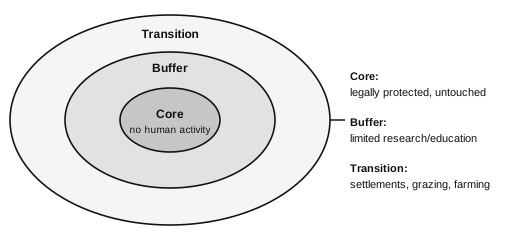
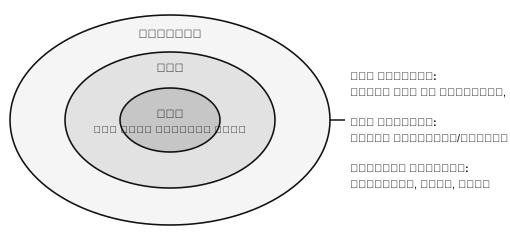
The region of Biosphere Reserve which is legally protected and where no human activity is allowed is known as
जीवमंडल आरक्षित क्षेत्र (Biosphere Reserve) का वह भाग जो विधिक रूप से संरक्षित है और जहाँ किसी भी मानव गतिविधि की अनुमति नहीं है, क्या कहलाता है?
  1. ACore zoneकोर क्षेत्र
  2. BBuffer zoneबफर क्षेत्र
  3. CTransition zoneसंक्रमण क्षेत्र
  4. DRestoration zoneपुनःस्थापन क्षेत्र
Show answer

Concept: A biosphere reserve has three concentric zones: core (strictly protected, no human activity), buffer (limited research and education) and transition (human settlements, grazing, cultivation).

  1. Legally protected + no human activity = core zone.
  2. (B) Buffer – limited activities allowed. (C) Transition – outermost, people live and farm there. (D) Restoration zone – degraded area being restored, not the untouched part.

Short trick: Think of an apple: the core is untouched, the flesh (buffer) is nibbled a little, the peel (transition) is handled by all.

Answer: (A) Core zone

अवधारणा: जीवमंडल आरक्षित क्षेत्र के तीन संकेंद्री भाग होते हैं: कोर (कठोर रूप से संरक्षित, कोई मानव गतिविधि नहीं), बफर (सीमित अनुसंधान व शिक्षा) तथा संक्रमण (मानव बस्तियाँ, चराई, खेती)।

  1. विधिक रूप से संरक्षित + कोई मानव गतिविधि नहीं = कोर क्षेत्र।
  2. (B) बफर – सीमित गतिविधियों की अनुमति। (C) संक्रमण – सबसे बाहरी, लोग वहाँ रहते व खेती करते हैं। (D) पुनःस्थापन क्षेत्र – निम्नीकृत क्षेत्र जिसे सुधारा जा रहा है, अछूता भाग नहीं।

शॉर्ट ट्रिक: सेब की तरह सोचें: कोर (बीच का भाग) अछूता, गूदा (बफर) थोड़ा-सा खाया, छिलका (संक्रमण) सब छूते हैं।

उत्तर: (A) कोर क्षेत्र

NEET UGBiologyBiodiversity and conservation – biosphere reserveNEET UG 2017 · 7 May Shift 1
Q1807.
A dioecious flowering plant prevents both:
एक एकलिंगाश्रयी (dioecious) पुष्पी पादप किन दोनों को रोकता है?
  1. AAutogamy and xenogamyस्वयुग्मन (ऑटोगैमी) तथा परनिषेचन (ज़ीनोगैमी)
  2. BAutogamy and geitonogamyस्वयुग्मन (ऑटोगैमी) तथा सजातपुष्पी परागण (गीटोनोगैमी)
  3. CGeitonogamy and xenogamyसजातपुष्पी परागण (गीटोनोगैमी) तथा परनिषेचन (ज़ीनोगैमी)
  4. DCleistogamy and xenogamyअनुन्मील्यता (क्लिस्टोगैमी) तथा परनिषेचन (ज़ीनोगैमी)
Show answer

Concept: In a dioecious plant (e.g. papaya) male and female flowers are on different plants.

  1. No bisexual flower → autogamy (same flower) impossible.
  2. No male and female flowers on the same plant → geitonogamy (another flower, same plant) impossible.
  3. Only xenogamy remains possible, so (A), (C), (D) – which include xenogamy – are wrong.

Short trick: NCERT line: “dioecy prevents both autogamy and geitonogamy”; monoecy prevents only autogamy.

Answer: (B) Autogamy and geitonogamy

अवधारणा: एकलिंगाश्रयी पादप (जैसे पपीता) में नर तथा मादा पुष्प अलग-अलग पौधों पर होते हैं।

  1. उभयलिंगी पुष्प नहीं → स्वयुग्मन (उसी पुष्प में) असंभव।
  2. एक ही पौधे पर नर व मादा पुष्प नहीं → सजातपुष्पी परागण (उसी पौधे का दूसरा पुष्प) असंभव।
  3. केवल परनिषेचन संभव रहता है, अतः (A), (C), (D) – जिनमें परनिषेचन है – गलत हैं।

शॉर्ट ट्रिक: NCERT पंक्ति: “एकलिंगाश्रयता स्वयुग्मन और सजातपुष्पी परागण दोनों को रोकती है”; उभयलिंगाश्रयता केवल स्वयुग्मन को।

उत्तर: (B) स्वयुग्मन (ऑटोगैमी) तथा सजातपुष्पी परागण (गीटोनोगैमी)

NEET UGBiologySexual reproduction in flowering plants – outbreeding devicesNEET UG 2017 · 7 May Shift 1
Q1808.
A temporary endocrine gland in the human body is
मानव शरीर में एक अस्थायी अंतःस्रावी ग्रंथि है
  1. APineal glandपीनियल ग्रंथि
  2. BCorpus cardiacumकॉर्पस कार्डियेकम
  3. CCorpus luteumकॉर्पस ल्यूटियम (पीतपिंड)
  4. DCorpus allatumकॉर्पस एलेटम
Show answer

Concept: After ovulation, the remains of the Graafian follicle form the corpus luteum, which secretes progesterone; it degenerates if fertilisation does not occur – a temporary endocrine gland.

  1. Corpus luteum – forms each cycle and regresses (corpus albicans) → temporary.
  2. (A) Pineal – permanent gland secreting melatonin. (B) Corpus cardiacum and (D) Corpus allatum – endocrine glands of insects, not humans.

Short trick: “Luteum lasts a little” – lives about 14 days unless pregnancy (hCG) rescues it.

Answer: (C) Corpus luteum

अवधारणा: अंडोत्सर्ग के बाद ग्राफ़ी पुटक के अवशेष पीतपिंड (corpus luteum) बनाते हैं जो प्रोजेस्टेरॉन स्रावित करता है; निषेचन न होने पर यह विघटित हो जाता है – अतः यह अस्थायी अंतःस्रावी ग्रंथि है।

  1. पीतपिंड – प्रत्येक चक्र में बनता है और ह्रासित होता है (corpus albicans) → अस्थायी।
  2. (A) पीनियल – मेलाटोनिन स्रावित करने वाली स्थायी ग्रंथि। (B) कॉर्पस कार्डियेकम तथा (D) कॉर्पस एलेटम – कीटों की अंतःस्रावी ग्रंथियाँ, मनुष्यों की नहीं।

शॉर्ट ट्रिक: “Luteum lasts a little” – लगभग 14 दिन जीवित रहता है, जब तक गर्भधारण (hCG) इसे न बचा ले।

उत्तर: (C) कॉर्पस ल्यूटियम (पीतपिंड)

NEET UGBiologyHuman reproduction – corpus luteumNEET UG 2017 · 7 May Shift 1
Q1809.
Match the following sexually transmitted diseases (Column - I) with their causative agent (Column - II) and select the correct option.
Column - IColumn - II
(a) Gonorrhea(i) HIV
(b) Syphilis(ii) Neisseria
(c) Genital Warts(iii) Treponema
(d) AIDS(iv) Human Papilloma virus
Options :
निम्नलिखित यौन संचारित रोगों (कॉलम - I) का उनके रोगकारक (कॉलम - II) से मिलान कीजिए तथा सही विकल्प चुनिए।
कॉलम - Iकॉलम - II
(a) सुज़ाक (गोनोरिया)(i) HIV
(b) सिफ़लिस(ii) Neisseria
(c) जननांग मस्से (Genital Warts)(iii) Treponema
(d) AIDS(iv) Human Papilloma वाइरस
विकल्प :
  1. A(a)-(ii), (b)-(iii), (c)-(iv), (d)-(i)
  2. B(a)-(iii), (b)-(iv), (c)-(i), (d)-(ii)
  3. C(a)-(iv), (b)-(ii), (c)-(iii), (d)-(i)
  4. D(a)-(iv), (b)-(iii), (c)-(ii), (d)-(i)
Show answer

Concept: Bacterial STDs: gonorrhoea (Neisseria gonorrhoeae), syphilis (Treponema pallidum); viral STDs: genital warts (human papilloma virus), AIDS (HIV).

  1. (a) Gonorrhoea – (ii) Neisseria.
  2. (b) Syphilis – (iii) Treponema.
  3. (c) Genital warts – (iv) HPV.
  4. (d) AIDS – (i) HIV. Only option (A) has a-ii, b-iii, c-iv, d-i.

Short trick: Lock d-(i) (AIDS–HIV) and a-(ii) – only (A) has both; “Go Neisseria, Syph Treponema”.

Answer: (A) (a)-(ii), (b)-(iii), (c)-(iv), (d)-(i)

अवधारणा: जीवाणुजनित STD: सुज़ाक (Neisseria gonorrhoeae), सिफ़लिस (Treponema pallidum); विषाणुजनित STD: जननांग मस्से (ह्यूमन पैपिलोमा वाइरस), AIDS (HIV)।

  1. (a) सुज़ाक – (ii) Neisseria।
  2. (b) सिफ़लिस – (iii) Treponema।
  3. (c) जननांग मस्से – (iv) HPV।
  4. (d) AIDS – (i) HIV। केवल विकल्प (A) में a-ii, b-iii, c-iv, d-i है।

शॉर्ट ट्रिक: d-(i) (AIDS–HIV) तथा a-(ii) पक्का करें – दोनों केवल (A) में; “Go Neisseria, Syph Treponema”।

उत्तर: (A) (a)-(ii), (b)-(iii), (c)-(iv), (d)-(i)

NEET UGBiologyReproductive health – STDsNEET UG 2017 · 7 May Shift 1
Q1810.
Transplantation of tissues/organs fails often due to non-acceptance by the patient's body. Which type of immune-response is responsible for such rejections?
ऊतकों/अंगों का प्रत्यारोपण प्रायः रोगी के शरीर द्वारा अस्वीकार किए जाने के कारण विफल हो जाता है। ऐसी अस्वीकृतियों के लिए किस प्रकार की प्रतिरक्षा अनुक्रिया उत्तरदायी है?
  1. AAutoimmune responseस्वप्रतिरक्षी अनुक्रिया
  2. BCell-mediated immune responseकोशिका-माध्यित प्रतिरक्षा अनुक्रिया
  3. CHormonal immune responseहॉर्मोनी प्रतिरक्षा अनुक्रिया
  4. DPhysiological immune responseकायिक (शरीरक्रियात्मक) प्रतिरक्षा अनुक्रिया
Show answer

Concept: The body distinguishes “self” from “non-self”; graft rejection is brought about by T-lymphocytes – the cell-mediated immune response (CMI).

  1. NCERT: graft rejection is due to CMI; hence tissue matching and immunosuppressants are needed.
  2. (A) Autoimmune response – attack on one’s own cells (e.g. rheumatoid arthritis), not a foreign graft. (C) “Hormonal” – no such immune type (humoral ≠ hormonal). (D) Physiological barriers (fever, acid) belong to innate immunity, not graft rejection.

Short trick: Graft → T cells → Transplant rejection.

Answer: (B) Cell-mediated immune response

अवधारणा: शरीर “स्व” और “पर” में अंतर करता है; प्रत्यारोपण अस्वीकृति T-लसीकाणुओं द्वारा होती है – अर्थात कोशिका-माध्यित प्रतिरक्षा अनुक्रिया (CMI)।

  1. NCERT: प्रत्यारोपण अस्वीकृति CMI के कारण होती है; इसीलिए ऊतक मिलान तथा प्रतिरक्षा-निरोधकों की आवश्यकता होती है।
  2. (A) स्वप्रतिरक्षी अनुक्रिया – स्वयं की कोशिकाओं पर आक्रमण (जैसे रूमेटॉइड संधिशोथ), बाहरी अंग पर नहीं। (C) “हॉर्मोनी” – ऐसा कोई प्रतिरक्षा प्रकार नहीं (तरल ≠ हॉर्मोनी)। (D) कायिक रोध (ज्वर, अम्ल) सहज प्रतिरक्षा का भाग हैं, प्रत्यारोपण अस्वीकृति का नहीं।

शॉर्ट ट्रिक: प्रत्यारोपण → T कोशिकाएँ → Transplant अस्वीकृति।

उत्तर: (B) कोशिका-माध्यित प्रतिरक्षा अनुक्रिया

NEET UGBiologyHuman health and disease – immunityNEET UG 2017 · 7 May Shift 1
Q1811.
Spliceosomes are not found in cells of
स्प्लाइसोसोम किसकी कोशिकाओं में नहीं पाए जाते?
  1. APlantsपादप
  2. BFungiकवक
  3. CAnimalsजंतु
  4. DBacteriaजीवाणु
Show answer

Concept: Spliceosomes remove introns from hnRNA and join exons. Split genes (with introns) occur only in eukaryotes.

  1. Bacterial (prokaryotic) genes are continuous – no introns → no splicing → no spliceosomes.
  2. (A) Plants, (B) Fungi, (C) Animals are eukaryotes – all have split genes and spliceosomes.

Short trick: Introns ⇒ eukaryotes only; the single prokaryote in the list is the answer.

Answer: (D) Bacteria

अवधारणा: स्प्लाइसोसोम hnRNA से इंट्रॉन हटाकर एक्सॉनों को जोड़ते हैं। खंडित जीन (इंट्रॉन युक्त) केवल यूकैरियोटों में होते हैं।

  1. जीवाणु (प्रोकैरियोटी) जीन सतत होते हैं – इंट्रॉन नहीं → समबंधन नहीं → स्प्लाइसोसोम नहीं।
  2. (A) पादप, (B) कवक, (C) जंतु यूकैरियोट हैं – सभी में खंडित जीन तथा स्प्लाइसोसोम होते हैं।

शॉर्ट ट्रिक: इंट्रॉन ⇒ केवल यूकैरियोट; सूची का एकमात्र प्रोकैरियोट ही उत्तर है।

उत्तर: (D) जीवाणु

NEET UGBiologyMolecular basis of inheritance – splicingNEET UG 2017 · 7 May Shift 1
Q1812.
An example of colonial alga is
औपनिवेशिक (colonial) शैवाल का एक उदाहरण है
  1. AChlorella
  2. BVolvox
  3. CUlothrix
  4. DSpirogyra
Show answer

Concept: NCERT: algae occur as unicellular (Chlamydomonas, Chlorella), colonial (Volvox) and filamentous (Ulothrix, Spirogyra) forms.

  1. Volvox – motile, spherical colony of a fixed number of cells.
  2. (A) Chlorella – unicellular. (C) Ulothrix and (D) Spirogyra – filamentous.

Short trick: Volvox = Volleyball-shaped colony.

Answer: (B) Volvox

अवधारणा: NCERT: शैवाल एककोशिकीय (Chlamydomonas, Chlorella), औपनिवेशिक (Volvox) तथा तंतुमय (Ulothrix, Spirogyra) रूपों में पाए जाते हैं।

  1. Volvox – निश्चित संख्या की कोशिकाओं वाली चलनशील, गोलाकार कॉलोनी।
  2. (A) Chlorella – एककोशिकीय। (C) Ulothrix तथा (D) Spirogyra – तंतुमय।

शॉर्ट ट्रिक: Volvox = Volleyball जैसी गोल कॉलोनी।

उत्तर: (B) Volvox

NEET UGBiologyPlant kingdom – algaeNEET UG 2017 · 7 May Shift 1
Q1813.
Which of the following represents order of 'Horse'?
निम्नलिखित में से कौन ‘घोड़े’ का गण (order) दर्शाता है?
  1. AEquidae
  2. BPerissodactyla
  3. CCaballus
  4. DFerus
Show answer

Concept: Horse: Kingdom Animalia → Class Mammalia → Order Perissodactyla (odd-toed ungulates) → Family Equidae → Genus Equus → species caballus (Equus ferus caballus).

  1. Order = Perissodactyla → (B).
  2. (A) Equidae – family (“-idae” ending). (C) caballus and (D) ferus – species/subspecies epithets.

Short trick: Suffix trick: “-idae” = family; orders of hoofed mammals end in “-dactyla” (odd-toed horse, even-toed cow = Artiodactyla).

Answer: (B) Perissodactyla

अवधारणा: घोड़ा: जगत Animalia → वर्ग Mammalia → गण Perissodactyla (विषम-अंगुलीय खुरदार) → कुल Equidae → वंश Equus → जाति caballus (Equus ferus caballus)।

  1. गण = Perissodactyla → (B)।
  2. (A) Equidae – कुल (“-idae” अंत)। (C) caballus तथा (D) ferus – जाति/उपजाति पद।

शॉर्ट ट्रिक: प्रत्यय ट्रिक: “-idae” = कुल; खुरदार स्तनियों के गण “-dactyla” पर समाप्त होते हैं (विषम-अंगुली घोड़ा, सम-अंगुली गाय = Artiodactyla)।

उत्तर: (B) Perissodactyla

NEET UGBiologyThe living world – taxonomic categoriesNEET UG 2017 · 7 May Shift 1
Q1814.
Which of the following cell organelles is responsible for extracting energy from carbohydrates to form ATP?
निम्नलिखित में से कौन-सा कोशिकांग कार्बोहाइड्रेटों से ऊर्जा निकालकर ATP बनाने के लिए उत्तरदायी है?
  1. ALysosomeलयनकाय (लाइसोसोम)
  2. BRibosomeराइबोसोम
  3. CChloroplastहरितलवक (क्लोरोप्लास्ट)
  4. DMitochondrionसूत्रकणिका (माइटोकॉन्ड्रियॉन)
Show answer

Concept: Mitochondria are the sites of aerobic respiration (Krebs cycle + ETS) where carbohydrates are oxidised and ATP is formed – the “power houses” of the cell.

  1. (A) Lysosome – hydrolytic enzymes for intracellular digestion. (B) Ribosome – protein synthesis. (C) Chloroplast – traps light energy and makes carbohydrates (the reverse job).
  2. (D) Mitochondrion – extracts energy from carbohydrates as ATP.

Short trick: Chloroplast makes sugar, mitochondrion burns sugar.

Answer: (D) Mitochondrion

अवधारणा: माइटोकॉन्ड्रिया वायवीय श्वसन (क्रेब्स चक्र + ETS) के स्थल हैं जहाँ कार्बोहाइड्रेटों का ऑक्सीकरण होकर ATP बनता है – कोशिका के “ऊर्जा घर”।

  1. (A) लयनकाय – अंतःकोशिकीय पाचन हेतु जल-अपघटनी एंज़ाइम। (B) राइबोसोम – प्रोटीन संश्लेषण। (C) हरितलवक – प्रकाश ऊर्जा पकड़कर कार्बोहाइड्रेट बनाता है (उल्टा कार्य)।
  2. (D) माइटोकॉन्ड्रियॉन – कार्बोहाइड्रेटों से ऊर्जा ATP के रूप में निकालता है।

शॉर्ट ट्रिक: हरितलवक शर्करा बनाता है, माइटोकॉन्ड्रियॉन शर्करा जलाता है।

उत्तर: (D) सूत्रकणिका (माइटोकॉन्ड्रियॉन)

NEET UGBiologyCell – mitochondriaNEET UG 2017 · 7 May Shift 1
Q1815.
The process of separation and purification of expressed protein before marketing is called
विपणन से पहले अभिव्यक्त प्रोटीन के पृथक्करण तथा शोधन की प्रक्रिया क्या कहलाती है?
  1. AUpstream processingउपरिप्रवाह संसाधन (अपस्ट्रीम प्रोसेसिंग)
  2. BDownstream processingअनुप्रवाह संसाधन (डाउनस्ट्रीम प्रोसेसिंग)
  3. CBioprocessingजैव संसाधन (बायोप्रोसेसिंग)
  4. DPostproduction processingउत्पादनोत्तर संसाधन
Show answer

Concept: After biosynthesis in a bioreactor, the product is separated, purified, formulated with preservatives and quality-tested – collectively called downstream processing.

  1. Separation + purification = downstream processing → (B).
  2. (A) Upstream – the stages before/including biosynthesis (gene cloning, culture). (C) Bioprocessing – general term for the whole production. (D) “Postproduction processing” – not the standard term.

Short trick: Product flows down the stream from bioreactor to market – everything after the reactor is downstream.

Answer: (B) Downstream processing

अवधारणा: जैव-अभिक्रियक में जैवसंश्लेषण के बाद उत्पाद को पृथक, शुद्ध, परिरक्षकों के साथ संरूपित तथा गुणवत्ता-परीक्षित किया जाता है – इन सभी को सामूहिक रूप से अनुप्रवाह संसाधन कहते हैं।

  1. पृथक्करण + शोधन = अनुप्रवाह संसाधन → (B)।
  2. (A) उपरिप्रवाह – जैवसंश्लेषण से पहले/उसके दौरान के चरण (जीन क्लोनिंग, संवर्धन)। (C) जैव संसाधन – पूरे उत्पादन का सामान्य शब्द। (D) “उत्पादनोत्तर संसाधन” – मानक शब्द नहीं।

शॉर्ट ट्रिक: उत्पाद जैव-अभिक्रियक से बाज़ार तक धारा में नीचे बहता है – अभिक्रियक के बाद का सब कुछ अनुप्रवाह है।

उत्तर: (B) अनुप्रवाह संसाधन (डाउनस्ट्रीम प्रोसेसिंग)

NEET UGBiologyBiotechnology – downstream processingNEET UG 2017 · 7 May Shift 1
Q1816.
Mycorrhizae are the example of
कवकमूल (माइकोराइज़ा) किसका उदाहरण है?
  1. AFungistasisकवकस्थैतिकता (फंजिस्टेसिस)
  2. BAmensalismअंतरजातीय परजीविता (ऐमेन्सलिज़्म)
  3. CAntibiosisप्रतिजीविता (एंटीबायोसिस)
  4. DMutualismसहोपकारिता (म्यूचुअलिज़्म)
Show answer

Concept: Mycorrhiza is a symbiotic fungus–root association: the fungus absorbs water and minerals (especially phosphorus) for the plant and receives carbohydrates in return – both gain (+/+).

  1. (+/+) interaction = mutualism → (D).
  2. (A) Fungistasis – inhibition of fungal growth. (B) Amensalism – one harmed, other unaffected (−/0). (C) Antibiosis – one organism’s chemicals harm another.

Short trick: Lichens and mycorrhizae – the two NCERT textbook examples of mutualism.

Answer: (D) Mutualism

अवधारणा: कवकमूल कवक और जड़ का सहजीवी संबंध है: कवक पौधे के लिए जल तथा खनिज (विशेषकर फॉस्फोरस) अवशोषित करता है और बदले में कार्बोहाइड्रेट पाता है – दोनों लाभान्वित (+/+)।

  1. (+/+) पारस्परिक क्रिया = सहोपकारिता → (D)।
  2. (A) कवकस्थैतिकता – कवक वृद्धि का संदमन। (B) ऐमेन्सलिज़्म – एक को हानि, दूसरा अप्रभावित (−/0)। (C) प्रतिजीविता – एक जीव के रसायन दूसरे को हानि पहुँचाते हैं।

शॉर्ट ट्रिक: लाइकेन तथा कवकमूल – सहोपकारिता के दो NCERT पाठ्य-उदाहरण।

उत्तर: (D) सहोपकारिता (म्यूचुअलिज़्म)

NEET UGBiologyOrganisms and populations – population interactionsNEET UG 2017 · 7 May Shift 1
Q1817.
Viroids differ from viruses in having :
वाइरॉइड, वाइरसों से किस बात में भिन्न होते हैं?
  1. ADNA molecules with protein coatप्रोटीन आवरण सहित DNA अणु
  2. BDNA molecules without protein coatप्रोटीन आवरण रहित DNA अणु
  3. CRNA molecules with protein coatप्रोटीन आवरण सहित RNA अणु
  4. DRNA molecules without protein coatप्रोटीन आवरण रहित RNA अणु
Show answer

Concept: Viroids (discovered by T.O. Diener, 1971, causing potato spindle tuber disease) are free low-molecular-weight RNA without the protein coat that viruses have.

  1. Viroid = naked RNA → (D).
  2. (A) and (C) have a protein coat – that is a virus. (B) Viroids contain RNA, not DNA.

Short trick: Viroid = “virus minus coat” = naked RNA.

Answer: (D) RNA molecules without protein coat

अवधारणा: वाइरॉइड (टी.ओ. डाइनर, 1971 द्वारा खोजे गए, आलू स्पिंडल ट्यूबर रोग के कारक) कम अणुभार वाले स्वतंत्र RNA हैं जिनमें वाइरसों जैसा प्रोटीन आवरण नहीं होता।

  1. वाइरॉइड = नग्न RNA → (D)।
  2. (A) तथा (C) में प्रोटीन आवरण है – वह वाइरस है। (B) वाइरॉइड में RNA होता है, DNA नहीं।

शॉर्ट ट्रिक: वाइरॉइड = “वाइरस घटा आवरण” = नग्न RNA।

उत्तर: (D) प्रोटीन आवरण रहित RNA अणु

NEET UGBiologyBiological classification – viroidsNEET UG 2017 · 7 May Shift 1
Q1818.
Root hairs develop from the region of
मूलरोम किस क्षेत्र से विकसित होते हैं?
  1. AMaturationपरिपक्वन (मैच्योरेशन)
  2. BElongationदीर्घीकरण (इलॉन्गेशन)
  3. CRoot capमूल गोप (रूट कैप)
  4. DMeristematic activityविभज्योतकी सक्रियता
Show answer

Concept: Root tip regions (tip upward): root cap → meristematic activity → elongation → maturation. Cells of the maturation zone differentiate, and some epidermal cells form root hairs.

  1. Root hairs arise from the zone of maturation → (A).
  2. (B) Elongation zone – cells only enlarge. (C) Root cap – protects the apex. (D) Meristematic zone – cells divide repeatedly, not yet differentiated.

Short trick: Hairs grow only on “mature” skin – zone of maturation.

Answer: (A) Maturation

अवधारणा: मूल शीर्ष के क्षेत्र (शीर्ष से ऊपर): मूल गोप → विभज्योतकी सक्रियता → दीर्घीकरण → परिपक्वन। परिपक्वन क्षेत्र की कोशिकाएँ विभेदित होती हैं और कुछ बाह्यत्वचीय कोशिकाएँ मूलरोम बनाती हैं।

  1. मूलरोम परिपक्वन क्षेत्र से निकलते हैं → (A)।
  2. (B) दीर्घीकरण क्षेत्र – कोशिकाएँ केवल बढ़ती हैं। (C) मूल गोप – शीर्ष की रक्षा करता है। (D) विभज्योतकी क्षेत्र – कोशिकाएँ बार-बार विभाजित होती हैं, अभी विभेदित नहीं।

शॉर्ट ट्रिक: रोम केवल “परिपक्व” त्वचा पर उगते हैं – परिपक्वन क्षेत्र।

उत्तर: (A) परिपक्वन (मैच्योरेशन)

NEET UGBiologyMorphology of flowering plants – regions of rootNEET UG 2017 · 7 May Shift 1
Q1819.
Coconut fruit is a
नारियल का फल है
  1. ADrupeअष्ठिल (ड्रूप)
  2. BBerryबेरी
  3. CNutदृढ़फल (नट)
  4. DCapsuleसंपुट (कैप्सूल)
Show answer

Concept: A drupe develops from a monocarpellary superior ovary and is one-seeded, with pericarp in three layers – epicarp, mesocarp, hard stony endocarp (e.g. mango, coconut).

  1. Coconut: fibrous mesocarp (coir) + hard endocarp (shell) → drupe → (A).
  2. (B) Berry – fleshy throughout, many seeds (tomato). (C) Nut – dry, indehiscent, one-seeded fruit with a hard woody pericarp throughout (no fleshy/fibrous layer). (D) Capsule – dry dehiscent, many seeds (cotton).

Short trick: Mango and coconut – NCERT’s twin drupes: “stone” fruits.

Answer: (A) Drupe

अवधारणा: अष्ठिल (ड्रूप) एकाण्डपी ऊर्ध्ववर्ती अंडाशय से विकसित होता है, एक-बीजी होता है, तथा फलभित्ति तीन परतों में – बाह्य फलभित्ति, मध्य फलभित्ति, कठोर पथरीली अंतः फलभित्ति (जैसे आम, नारियल)।

  1. नारियल: रेशेदार मध्य फलभित्ति (जटा/coir) + कठोर अंतः फलभित्ति (खोल) → अष्ठिल → (A)।
  2. (B) बेरी – पूर्णतः गूदेदार, अनेक बीज (टमाटर)। (C) दृढ़फल – शुष्क, अस्फुटनशील, एक-बीजी फल जिसकी पूरी फलभित्ति कठोर काष्ठीय होती है (कोई गूदेदार/रेशेदार परत नहीं)। (D) संपुट – शुष्क स्फुटनशील, अनेक बीज (कपास)।

शॉर्ट ट्रिक: आम और नारियल – NCERT के जुड़वाँ अष्ठिल: “गुठली” वाले फल।

उत्तर: (A) अष्ठिल (ड्रूप)

NEET UGBiologyMorphology of flowering plants – fruitsNEET UG 2017 · 7 May Shift 1
Q1820.
Plants which produce characterstic pneumatophores and show vivipary belong to
वे पादप जो विशिष्ट श्वसनमूल (न्यूमैटोफोर) बनाते हैं तथा जरायुजता (vivipary) दर्शाते हैं, किससे संबंधित हैं?
  1. AMesophytesसमोद्भिद (मीसोफाइट)
  2. BHalophytesलवणमृदोद्भिद (हैलोफाइट)
  3. CPsammophytesबालुकोद्भिद (सैमोफाइट)
  4. DHydrophytesजलोद्भिद (हाइड्रोफाइट)
Show answer

Concept: Mangroves (e.g. Rhizophora) are halophytes of saline swamps: the waterlogged, oxygen-poor soil makes them grow negatively geotropic respiratory roots (pneumatophores), and salty soil favours vivipary (seed germinates while still on the parent).

  1. Pneumatophores + vivipary → halophytes → (B).
  2. (A) Mesophytes – normal soil, no such adaptations. (C) Psammophytes – sand-dwelling plants. (D) Hydrophytes – aquatic plants with aerenchyma, not pneumatophores/vivipary.

Short trick: Mangrove = salt (halo) + mud: “breathing roots + babies on the tree”.

Answer: (B) Halophytes

अवधारणा: मैंग्रोव (जैसे Rhizophora) लवणीय दलदलों के लवणमृदोद्भिद हैं: जलाक्रांत, ऑक्सीजन-विहीन मृदा के कारण ये ऋणात्मक गुरुत्वानुवर्ती श्वसन मूल (न्यूमैटोफोर) बनाते हैं, तथा लवणीय मृदा के कारण जरायुजता (बीज का मातृ पौधे पर ही अंकुरण) दर्शाते हैं।

  1. श्वसनमूल + जरायुजता → लवणमृदोद्भिद → (B)।
  2. (A) समोद्भिद – सामान्य मृदा, ऐसे अनुकूलन नहीं। (C) बालुकोद्भिद – रेत में उगने वाले पादप। (D) जलोद्भिद – वायूतक युक्त जलीय पादप, श्वसनमूल/जरायुजता नहीं।

शॉर्ट ट्रिक: मैंग्रोव = लवण (halo) + कीचड़: “साँस लेती जड़ें + पेड़ पर ही शिशु”।

उत्तर: (B) लवणमृदोद्भिद (हैलोफाइट)

NEET UGBiologyMorphology / Ecology – halophytesNEET UG 2017 · 7 May Shift 1