Q481.What will come in place of the question mark (?) in the following equation, if '+' and '÷' are interchanged and '-' and 'x' are interchanged?
195 + 5 x 44 - 6 ÷ 320 = ?
यदि '+' और '÷' को आपस में बदल दिया जाए तथा '-' और 'x' को आपस में बदल दिया जाए, तो निम्नलिखित समीकरण में प्रश्न चिह्न (?) के स्थान पर क्या आएगा?
195 + 5 x 44 - 6 ÷ 320 = ?
- A109
- B91
- C95
- D113
Show answer
Concept: Swap the signs first, then apply BODMAS.
- After swapping:
Short trick: Write the new expression before calculating – most errors come from swapping only one pair.
Answer: (C) 95
अवधारणा: पहले चिह्न बदलें, फिर BODMAS लगाएँ।
- बदलने के बाद:
शॉर्ट ट्रिक: गणना से पहले नया व्यंजक लिख लें – दोनों जोड़ी चिह्न बदलना न भूलें।
उत्तर: (C) 95
RRB ALP CBT 1General Intelligence and ReasoningMathematical operations – interchangeRRB ALP CBT 1 2025 · 17 Feb Shift 1
Q482.In a certain code language, ‘CASH’ is coded as ‘1937’ and ‘EAHS’ is coded as ‘9163’. What is the code for ‘E’ in the given code language?
एक निश्चित कूट भाषा में, ‘CASH’ को ‘1937’ और ‘EAHS’ को ‘9163’ के रूप में कूटबद्ध किया जाता है। दी गई कूट भाषा में ‘E’ का कूट क्या है?
- A9
- B3
- C6
- D1
Show answer
Concept: Letters common to both words share the common digits; the leftover letter takes the leftover digit.
- CASH → 1, 9, 3, 7; EAHS → 9, 1, 6, 3
- Common letters A, S, H ↔ common digits 1, 9, 3
- C = 7 and E = 6
Short trick: Cross out common digits from EAHS (9163): 9, 1, 3 → 6 left = E.
Answer: (C) 6
अवधारणा: दोनों शब्दों के उभयनिष्ठ अक्षर उभयनिष्ठ अंकों से मेल खाते हैं; बचा अक्षर बचे अंक से।
- CASH → 1, 9, 3, 7; EAHS → 9, 1, 6, 3
- उभयनिष्ठ A, S, H ↔ 1, 9, 3
- C = 7 और E = 6
शॉर्ट ट्रिक: EAHS (9163) से उभयनिष्ठ 9, 1, 3 काटें → 6 बचा = E।
उत्तर: (C) 6
RRB ALP CBT 1General Intelligence and ReasoningCoding – common lettersRRB ALP CBT 1 2025 · 17 Feb Shift 1
Q483.What should come in place of ? in the given series?
36 40 46 50 56 ?
दी गई शृंखला में ? के स्थान पर क्या आना चाहिए?
36 40 46 50 56 ?
- A59
- B61
- C62
- D60
Show answer
Concept: Differences alternate +4, +6.
- 36 +4 = 40, +6 = 46, +4 = 50, +6 = 56
- Next: 56 + 4 = 60
Short trick: Alternate terms rise by 10: 40, 50, 60.
Answer: (D) 60
अवधारणा: अंतर बारी-बारी से +4, +6 हैं।
- 36 +4 = 40, +6 = 46, +4 = 50, +6 = 56
- अगला: 56 + 4 = 60
शॉर्ट ट्रिक: एकांतर पद 10 बढ़ते हैं: 40, 50, 60।
उत्तर: (D) 60
RRB ALP CBT 1General Intelligence and ReasoningNumber series – alternating differencesRRB ALP CBT 1 2025 · 17 Feb Shift 1
Q484.Arman starts from Point A and drives 61 km towards west. He then takes a right turn, drives 58 km, turns right and drives 64 km. He then takes a right turn and drives 71 km. He takes a final right turn, drives 3 km and stops at Point P. How far (shortest distance) and towards which direction should he drive in order to reach Point A again? (All turns are 90 degrees turns only unless specified)
अरमान बिंदु A से चलना शुरू करता है और पश्चिम की ओर 61 km गाड़ी चलाता है। फिर वह दाएँ मुड़ता है, 58 km गाड़ी चलाता है, दाएँ मुड़ता है और 64 km गाड़ी चलाता है। फिर वह दाएँ मुड़ता है और 71 km गाड़ी चलाता है। वह अंतिम बार दाएँ मुड़ता है, 3 km गाड़ी चलाता है और बिंदु P पर रुक जाता है। बिंदु A पर फिर से पहुँचने के लिए उसे कितनी दूर (न्यूनतम दूरी) और किस दिशा में गाड़ी चलानी चाहिए? (जब तक निर्दिष्ट न हो, सभी मोड़ केवल 90 डिग्री के हैं)
- A15 km to the southदक्षिण की ओर 15 km
- B14 km to the southदक्षिण की ओर 14 km
- C12 km to the northउत्तर की ओर 12 km
- D13 km to the northउत्तर की ओर 13 km
Show answer
Concept: Net displacement; right turn from west = north.
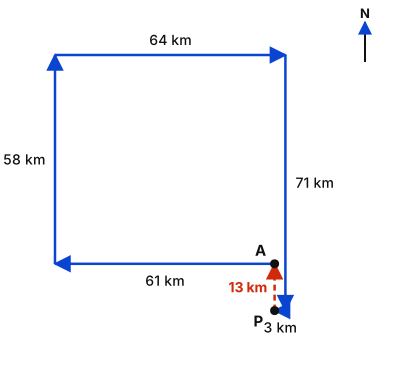
- West 61, North 58, East 64, South 71, West 3
- East–west:
- North–south: → P is 13 km south of A
- Drive 13 km to the North
Short trick: E–W cancels (61 + 3 = 64); N–S gap = 71 − 58 = 13.
Answer: (D) 13 km to the north
अवधारणा: शुद्ध विस्थापन; पश्चिम से दाएँ मुड़ने पर उत्तर।
- पश्चिम 61, उत्तर 58, पूर्व 64, दक्षिण 71, पश्चिम 3
- पूर्व–पश्चिम:
- उत्तर–दक्षिण: → P, A से 13 km दक्षिण में
- 13 km उत्तर की ओर जाना होगा
शॉर्ट ट्रिक: पूर्व–पश्चिम कट जाता है (61 + 3 = 64); अंतर = 71 − 58 = 13।
उत्तर: (D) उत्तर की ओर 13 km
RRB ALP CBT 1General Intelligence and ReasoningDirection and distanceRRB ALP CBT 1 2025 · 17 Feb Shift 1
Q485.In a certain code language, ‘SONG’ is coded as ‘9785’ and ‘GONE’ is coded as ‘5867’. What is the code for ‘E’ in the given code language?
एक निश्चित कूट भाषा में, ‘SONG’ को ‘9785’ और ‘GONE’ को ‘5867’ के रूप में कूटबद्ध किया जाता है। दी गई कूट भाषा में ‘E’ का कूट क्या है?
- A6
- B8
- C5
- D7
Show answer
Concept: Common letters ↔ common digits; the remaining letter gets the remaining digit.
- SONG → 9, 7, 8, 5; GONE → 5, 8, 6, 7
- Common O, N, G ↔ 7, 8, 5
- S = 9, E = 6
Short trick: From GONE (5867) strike 5, 8, 7 → 6 = E.
Answer: (A) 6
अवधारणा: उभयनिष्ठ अक्षर ↔ उभयनिष्ठ अंक; बचा अक्षर बचे अंक से।
- SONG → 9, 7, 8, 5; GONE → 5, 8, 6, 7
- उभयनिष्ठ O, N, G ↔ 7, 8, 5
- S = 9, E = 6
शॉर्ट ट्रिक: GONE (5867) से 5, 8, 7 काटें → 6 = E।
उत्तर: (A) 6
RRB ALP CBT 1General Intelligence and ReasoningCoding – common lettersRRB ALP CBT 1 2025 · 17 Feb Shift 1
Q486.24 is related to 74 following a certain logic. Following the same logic, 36 is related to 110. To which of the given options is 51 related, following the same logic?
(NOTE: Operations should be performed on the whole numbers, without breaking down the numbers into their constituent digits. E.g. 13 – Operations on 13 such as adding to/subtracting from/multiplying with 13 can be performed. Breaking down 13 into 1 and 3 and then performing mathematical operations on 1 and 3 is not allowed.)
किसी निश्चित तर्क के अनुसार 24 का संबंध 74 से है। उसी तर्क के अनुसार 36 का संबंध 110 से है। उसी तर्क के अनुसार 51 का संबंध दिए गए विकल्पों में से किससे है?
(ध्यान दें: संख्याओं को उनके घटक अंकों में तोड़े बिना, पूर्ण संख्याओं पर संक्रियाएँ की जानी चाहिए। उदाहरण: 13 – 13 पर संक्रियाएँ जैसे 13 में जोड़ना/घटाना/गुणा करना आदि किया जा सकता है। 13 को 1 और 3 में तोड़ना और फिर 1 और 3 पर गणितीय संक्रियाएँ करना वर्जित है।)
- A155
- B261
- C151
- D266
Show answer
Concept: Rule: number × 3 + 2.
- ✓, ✓
Short trick: 74 and 110 are just above 3 × 24 = 72 and 3 × 36 = 108 → "+2".
Answer: (A) 155
अवधारणा: नियम: संख्या × 3 + 2।
- ✓, ✓
शॉर्ट ट्रिक: 74 और 110, 72 और 108 से 2 अधिक हैं → "×3 + 2"।
उत्तर: (A) 155
RRB ALP CBT 1General Intelligence and ReasoningNumber analogyRRB ALP CBT 1 2025 · 17 Feb Shift 1
Q487.Select the set in which the numbers are related in the same way as are the numbers of the following sets.
(NOTE : Operations should be performed on the whole numbers, without breaking down the numbers into its constituent digits. E.g. 13 – Operations on 13 such as adding / subtracting /multiplying etc. to 13 can be performed. Breaking down 13 into 1 and 3 and then performing mathematical operations on 1 and 3 is not allowed)
(18, 5, 85)
(11, 7, 72)
उस समुच्चय का चयन करें जिसमें संख्याएँ उसी प्रकार संबंधित हैं जैसे निम्नलिखित समुच्चयों की संख्याएँ संबंधित हैं।
(ध्यान दें: संख्याओं को उनके घटक अंकों में तोड़े बिना, पूर्ण संख्याओं पर संक्रियाएँ की जानी चाहिए। उदाहरण: 13 – 13 पर संक्रियाएँ जैसे 13 में जोड़ना/घटाना/गुणा करना आदि किया जा सकता है। 13 को 1 और 3 में तोड़ना और फिर 1 और 3 पर गणितीय संक्रियाएँ करना वर्जित है।)
(18, 5, 85)
(11, 7, 72)
- A(9, 7, 68)
- B(15, 6, 85)
- C(10, 8, 85)
- D(8, 4, 32)
Show answer
Concept: Third number = first × second − 5.
- ✓, ✓
- (B) ✓
- (A) 58, (C) 75, (D) 27 – do not match
Short trick: Product is always 5 more than the third number: 90/85, 77/72 → check 90/85 in (B).
Answer: (B) (15, 6, 85)
अवधारणा: तीसरी संख्या = पहली × दूसरी − 5।
- ✓, ✓
- (B) ✓
- (A) 58, (C) 75, (D) 27 – मेल नहीं
शॉर्ट ट्रिक: गुणनफल हमेशा तीसरी संख्या से 5 अधिक: (B) में 90 → 85।
उत्तर: (B) (15, 6, 85)
RRB ALP CBT 1General Intelligence and ReasoningNumber triadsRRB ALP CBT 1 2025 · 17 Feb Shift 1
Q488.If ‘A’ stands for ‘÷’, ‘B’ stands for ‘×’, ‘C’ stands for ‘+’ and ‘D’ stands for ‘−’, then what will come in place of the question mark (?) in the following equation?
26 A 2 C 14 B 4 D 18 = ?
यदि ‘A’ का अर्थ ‘÷’, ‘B’ का अर्थ ‘×’, ‘C’ का अर्थ ‘+’ और ‘D’ का अर्थ ‘−’ है, तो निम्नलिखित समीकरण में प्रश्न चिह्न (?) के स्थान पर क्या आएगा?
26 A 2 C 14 B 4 D 18 = ?
- A51
- B44
- C62
- D70
Show answer
Concept: Replace letters with operators, then BODMAS.
Short trick: Unit digits: 3 + 6 − 8 → ends in 1 → only 51.
Answer: (A) 51
अवधारणा: अक्षरों को चिह्नों से बदलें, फिर BODMAS।
शॉर्ट ट्रिक: इकाई अंक: 3 + 6 − 8 → 1 → केवल 51।
उत्तर: (A) 51
RRB ALP CBT 1General Intelligence and ReasoningMathematical operations – symbol substitutionRRB ALP CBT 1 2025 · 17 Feb Shift 1
Q489.A, B, C, D, E, F and G live on seven different floors of the same building. The lowermost floor in the building is numbered 1, the floor above it is numbered 2 and so on till the topmost floor is numbered 7. Only two persons live above C. Only two persons live between C and E. B lives immediately above E. D lives immediately below F. A does not live on the lowermost floor. On which floor number does A live?
A, B, C, D, E, F और G एक ही इमारत की सात अलग-अलग मंज़िलों पर रहते हैं। इमारत की सबसे निचली मंज़िल की संख्या 1 है, उसके ऊपर वाली मंज़िल की संख्या 2 है और इसी प्रकार सबसे ऊपरी मंज़िल की संख्या 7 है। C के ऊपर केवल दो व्यक्ति रहते हैं। C और E के बीच केवल दो व्यक्ति रहते हैं। B, E के ठीक ऊपर रहता है। D, F के ठीक नीचे रहता है। A सबसे निचली मंज़िल पर नहीं रहता है। A किस मंज़िल पर रहता है?
- AFloor number 2मंज़िल संख्या 2
- BFloor number 3मंज़िल संख्या 3
- CFloor number 4मंज़िल संख्या 4
- DFloor number 6मंज़िल संख्या 6
Show answer
Concept: Start with definite clues and fill the rest.
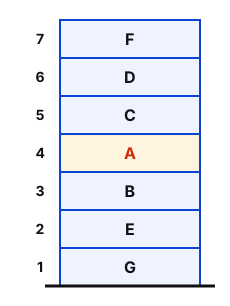
- Only two above C → C = 5
- Two between C and E → E = 2
- B immediately above E → B = 3
- Free floors 1, 4, 6, 7; D immediately below F → D = 6, F = 7
- A not on floor 1 → A = 4, G = 1
Short trick: Only 6–7 is a free consecutive pair, so D–F is fixed at once.
Answer: (C) Floor number 4
अवधारणा: निश्चित संकेतों से शुरू करें।
- C के ऊपर केवल दो → C = 5
- C और E के बीच दो → E = 2
- B, E के ठीक ऊपर → B = 3
- खाली मंज़िलें 1, 4, 6, 7; D, F के ठीक नीचे → D = 6, F = 7
- A मंज़िल 1 पर नहीं → A = 4, G = 1
शॉर्ट ट्रिक: खाली लगातार जोड़ी केवल 6–7 है, इसलिए D–F तुरंत तय।
उत्तर: (C) मंज़िल संख्या 4
RRB ALP CBT 1General Intelligence and ReasoningFloor-based puzzleRRB ALP CBT 1 2025 · 17 Feb Shift 1
Q490.This question is based on the five, three-digit numbers given below.
(Left) 629 574 315 681 459 (Right)
(Example- 697 – First digit = 6, second digit = 9 and third digit = 7)
What will be the resultant if the second digit of the highest number is added to the third digit of the lowest number?
यह प्रश्न नीचे दी गई पाँच तीन-अंकीय संख्याओं पर आधारित है।
(बाएँ) 629 574 315 681 459 (दाएँ)
(उदाहरण- 697 – पहला अंक = 6, दूसरा अंक = 9 और तीसरा अंक = 7)
यदि सबसे बड़ी संख्या के दूसरे अंक को सबसे छोटी संख्या के तीसरे अंक में जोड़ा जाए, तो परिणाम क्या होगा?
- A13
- B11
- C10
- D12
Show answer
Concept: Find the highest and lowest numbers, then pick the asked digits.
- Highest = 681 → second digit 8
- Lowest = 315 → third digit 5
Short trick: Compare only first digits: 6 (two numbers) → 681 > 629; 3 → 315 lowest.
Answer: (A) 13
अवधारणा: सबसे बड़ी और सबसे छोटी संख्या ज्ञात करें, फिर माँगे गए अंक लें।
- सबसे बड़ी = 681 → दूसरा अंक 8
- सबसे छोटी = 315 → तीसरा अंक 5
शॉर्ट ट्रिक: केवल पहले अंक देखें: 681 > 629; 315 सबसे छोटी।
उत्तर: (A) 13
RRB ALP CBT 1General Intelligence and ReasoningThree-digit number puzzleRRB ALP CBT 1 2025 · 17 Feb Shift 1
Q491.Six friends D, E, F, G, J and K are sitting in a straight line facing north. No one sits to the right of K. Only one person sits between F and K. Only three people sit between K and J. G sits at some place to the left of D but at some place to the right of E. How many people sit between E and D?
छह मित्र D, E, F, G, J और K एक सीधी पंक्ति में उत्तर की ओर मुख करके बैठे हैं। K के दाईं ओर कोई नहीं बैठा है। F और K के बीच केवल एक व्यक्ति बैठा है। K और J के बीच केवल तीन व्यक्ति बैठे हैं। G, D के बाईं ओर कहीं बैठा है लेकिन E के दाईं ओर कहीं बैठा है। E और D के बीच कितने व्यक्ति बैठे हैं?
- ATwoदो
- BFourचार
- COneएक
- DThreeतीन
Show answer
Concept: Facing north: right = east end. Place K at the right end and build around it.
- K at position 6 (extreme right)
- One between F and K → F = 4; three between K and J → J = 2
- E, G, D take 1, 3, 5 with E < G < D (left to right) → E = 1, G = 3, D = 5
- Between E and D: J, G, F = three
Short trick: Once K, F, J are fixed, the free seats 1, 3, 5 are forced in the order E, G, D.
Answer: (D) Three
अवधारणा: उत्तर की ओर मुख: दायाँ सिरा = पूर्व। K को दाएँ सिरे पर रखें।
- K स्थान 6 पर
- F और K के बीच एक → F = 4; K और J के बीच तीन → J = 2
- E, G, D स्थान 1, 3, 5 पर (बाएँ से दाएँ E, G, D) → E = 1, G = 3, D = 5
- E और D के बीच: J, G, F = तीन
शॉर्ट ट्रिक: K, F, J तय होते ही खाली सीटें 1, 3, 5 क्रम से E, G, D।
उत्तर: (D) तीन
RRB ALP CBT 1General Intelligence and ReasoningLinear seating arrangementRRB ALP CBT 1 2025 · 17 Feb Shift 1
Q492.What should come in place of the question mark (?) in the given series?
64 68 80 84 96 100 112 ?
दी गई शृंखला में प्रश्न चिह्न (?) के स्थान पर क्या आना चाहिए?
64 68 80 84 96 100 112 ?
- A124
- B120
- C116
- D118
Show answer
Concept: Differences alternate +4, +12.
- 64 +4 = 68, +12 = 80, +4 = 84, +12 = 96, +4 = 100, +12 = 112
- Next: 112 + 4 = 116
Short trick: Pattern repeats every 16: 64, 80, 96, 112 and 68, 84, 100, 116.
Answer: (C) 116
अवधारणा: अंतर बारी-बारी से +4, +12।
- 64 +4 = 68, +12 = 80, +4 = 84, +12 = 96, +4 = 100, +12 = 112
- अगला: 112 + 4 = 116
शॉर्ट ट्रिक: एकांतर पद 16 बढ़ते हैं: 68, 84, 100, 116।
उत्तर: (C) 116
RRB ALP CBT 1General Intelligence and ReasoningNumber series – alternating differencesRRB ALP CBT 1 2025 · 17 Feb Shift 1
Q493.Based on the English alphabetical order, three of the following four letter-cluster pairs are alike in a certain way and thus form a group. Which letter-cluster pair DOES NOT belong to that group? (Note: The odd one out is not based on the number of consonants/vowels or their position in the letter-cluster.)
अंग्रेज़ी वर्णमाला क्रम के आधार पर, निम्नलिखित चार अक्षर-समूह युग्मों में से तीन किसी निश्चित प्रकार से एकसमान हैं और इस प्रकार एक समूह बनाते हैं। कौन-सा अक्षर-समूह युग्म उस समूह से संबंधित नहीं है? (ध्यान दें: असंगत अक्षर-समूह, उस अक्षर-समूह में व्यंजनों/स्वरों की संख्या या उनके स्थान पर आधारित नहीं है।)
- AAW - KP
- BAC - DF
- CPR - SU
- DGI - JL
Show answer
Concept: Check the gaps between consecutive letters of the pair.
- AC - DF: A +2 C, C +1 D, D +2 F
- PR - SU: +2, +1, +2 ✓; GI - JL: +2, +1, +2 ✓
- AW - KP: A +22 W … pattern broken → odd
Short trick: In the group each cluster is "letter, skip one" (AC, DF, PR …); AW is not.
Answer: (A) AW - KP
अवधारणा: युग्म के क्रमागत अक्षरों के बीच अंतर देखें।
- AC - DF: A +2 C, C +1 D, D +2 F
- PR - SU: +2, +1, +2 ✓; GI - JL: +2, +1, +2 ✓
- AW - KP: पैटर्न नहीं → विषम
शॉर्ट ट्रिक: समूह में हर क्लस्टर "एक अक्षर छोड़कर" है (AC, DF …); AW नहीं।
उत्तर: (A) AW - KP
RRB ALP CBT 1General Intelligence and ReasoningLetter-cluster pairs – odd one outRRB ALP CBT 1 2025 · 17 Feb Shift 1
Q494.What should come in place of the question mark (?) in the given series based on the English alphabetical order?
DHS HLW LPA PTE ?
दी गई शृंखला में अंग्रेज़ी वर्णमाला क्रम के आधार पर प्रश्न चिह्न (?) के स्थान पर क्या आना चाहिए?
DHS HLW LPA PTE ?
- ATXS
- BTIX
- CTXI
- DTCD
Show answer
Concept: Each position moves forward by 4 letters.
- 1st: D → H → L → P → T
- 2nd: H → L → P → T → X
- 3rd: S → W → A → E → I
Short trick: Each group starts with the previous group's 2nd letter: PTE → T X _, and E + 4 = I.
Answer: (C) TXI
अवधारणा: प्रत्येक स्थान का अक्षर 4 आगे बढ़ता है।
- पहला: D → H → L → P → T
- दूसरा: H → L → P → T → X
- तीसरा: S → W → A → E → I
शॉर्ट ट्रिक: हर समूह पिछले समूह के दूसरे अक्षर से शुरू होता है: PTE → TX_, E + 4 = I।
उत्तर: (C) TXI
RRB ALP CBT 1General Intelligence and ReasoningLetter seriesRRB ALP CBT 1 2025 · 17 Feb Shift 1
Q495.Based on the English alphabetical order, three of the following four letter-cluster pairs are alike in a certain way and thus form a group. Which letter-cluster pair DOES NOT belong to that group? (Note: The odd one out is not based on the number of consonants/vowels or their position in the letter-cluster.)
अंग्रेज़ी वर्णमाला क्रम के आधार पर, निम्नलिखित चार अक्षर-समूह युग्मों में से तीन किसी निश्चित प्रकार से एकसमान हैं और इस प्रकार एक समूह बनाते हैं। कौन-सा अक्षर-समूह युग्म उस समूह से संबंधित नहीं है? (ध्यान दें: असंगत अक्षर-समूह, उस अक्षर-समूह में व्यंजनों/स्वरों की संख्या या उनके स्थान पर आधारित नहीं है।)
- AOP−ST
- BVW−ZA
- CMN−QR
- DEF−HL
Show answer
Concept: Pattern: +1, +3, +1 between successive letters.
- OP - ST: O +1 P, P +3 S, S +1 T ✓
- VW - ZA: +1, +3, +1 ✓ (Z → A cyclic); MN - QR ✓
- EF - HL: E +1 F, F +2 H, H +4 L → odd
Short trick: Second cluster must start 3 after the first one ends: P→S, W→Z, N→Q, but F→H is only 2.
Answer: (D) EF−HL
अवधारणा: पैटर्न: क्रमागत अक्षरों में +1, +3, +1।
- OP - ST: +1, +3, +1 ✓
- VW - ZA: +1, +3, +1 ✓ (Z → A चक्रीय); MN - QR ✓
- EF - HL: +1, +2, +4 → विषम
शॉर्ट ट्रिक: दूसरा क्लस्टर पहले के अंत से 3 आगे शुरू होता है: P→S, W→Z, N→Q, पर F→H केवल 2।
उत्तर: (D) EF−HL
RRB ALP CBT 1General Intelligence and ReasoningLetter-cluster pairs – odd one outRRB ALP CBT 1 2025 · 17 Feb Shift 1
Q496.Select the pair which follows the same pattern as that followed by the two pairs given below. Both pairs follow the same pattern.
ALI : BIE
IIK : JFG
उस युग्म का चयन करें जो नीचे दिए गए दो युग्मों के समान पैटर्न का अनुसरण करता है। दोनों युग्म एक ही पैटर्न का अनुसरण करते हैं।
ALI : BIE
IIK : JFG
- ABFK : BBG
- BCJE : DGA
- CFQO : FNJ
- DIPN : IMI
Show answer
Concept: Pattern: +1, −3, −4 on the three letters.
- ALI → BIE: A+1 = B, L−3 = I, I−4 = E
- IIK → JFG: I+1 = J, I−3 = F, K−4 = G
- CJE → C+1 = D, J−3 = G, E−4 = A → DGA ✓
Short trick: First letter +1 already kills A, C, D (B→B, F→F, I→I).
Answer: (B) CJE : DGA
अवधारणा: पैटर्न: तीनों अक्षरों पर +1, −3, −4।
- ALI → BIE: A+1 = B, L−3 = I, I−4 = E
- IIK → JFG: +1, −3, −4 ✓
- CJE → D, G, A → DGA ✓
शॉर्ट ट्रिक: पहला अक्षर +1 से ही A, C, D कट जाते हैं।
उत्तर: (B) CJE : DGA
RRB ALP CBT 1General Intelligence and ReasoningLetter analogyRRB ALP CBT 1 2025 · 17 Feb Shift 1
Q497.Refer to the following number, symbol series and answer the question that follows. Counting to be done from left to right only. All numbers are single-digit numbers. (Left) ^ 7 + > 6 $ > 2 8 4 6 \ 2 & 9 ? + ^ # < % (Right)
How many such numbers are there each of which is immediately preceded by a symbol and also immediately followed by a symbol?
निम्नलिखित संख्या, प्रतीक शृंखला को देखें और उसके बाद आने वाले प्रश्न का उत्तर दें। गिनती केवल बाएँ से दाएँ की जानी है। सभी संख्याएँ एक-अंकीय संख्याएँ हैं। (बाएँ) ^ 7 + > 6 $ > 2 8 4 6 \ 2 & 9 ? + ^ # < % (दाएँ)
ऐसी कितनी संख्याएँ हैं जिनमें से प्रत्येक के ठीक पहले एक प्रतीक है और ठीक बाद में भी एक प्रतीक है?
- AFourचार
- BThreeतीन
- COneएक
- DTwoदो
Show answer
Concept: Check each digit's left and right neighbours.
- ^ 7 + ✓
- > 6 $ ✓
- \ 2 & ✓
- & 9 ? ✓
- Others (2 8 4 6) have a digit beside them
- Count = 4
Short trick: Skip the run "2 8 4 6" entirely – digits in a run of digits can never qualify.
Answer: (A) Four
अवधारणा: प्रत्येक अंक के बाएँ और दाएँ पड़ोसी देखें।
- ^ 7 + ✓
- > 6 $ ✓
- \ 2 & ✓
- & 9 ? ✓
- शेष (2 8 4 6) के पास अंक हैं
- गिनती = 4
शॉर्ट ट्रिक: लगातार अंकों का समूह "2 8 4 6" छोड़ दें – वे कभी शर्त पूरी नहीं करते।
उत्तर: (A) चार
RRB ALP CBT 1General Intelligence and ReasoningNumber–symbol seriesRRB ALP CBT 1 2025 · 17 Feb Shift 1
Q498.Each letter in the word VISION is changed to the letter immediately following it in the English alphabetical order, and then all the letters thus formed are arranged in reverse alphabetical order. Which letter will be fourth from the left?
शब्द VISION के प्रत्येक अक्षर को अंग्रेज़ी वर्णमाला क्रम में उसके ठीक बाद वाले अक्षर से बदल दिया जाता है, और फिर इस प्रकार बने सभी अक्षरों को उल्टे वर्णानुक्रम में व्यवस्थित किया जाता है। बाएँ से चौथा अक्षर कौन-सा होगा?
- AU
- BT
- CO
- DW
Show answer
Concept: Shift each letter +1, then sort Z → A.
- VISION → W J T J P O
- Reverse alphabetical: W, T, P, O, J, J
- Fourth from left = O
Short trick: Fourth from the left in Z→A order = third from the right in A→Z order: J, J, O → O.
Answer: (C) O
अवधारणा: प्रत्येक अक्षर +1, फिर Z → A क्रम में लगाएँ।
- VISION → W J T J P O
- उल्टा वर्णक्रम: W, T, P, O, J, J
- बाएँ से चौथा = O
शॉर्ट ट्रिक: Z→A क्रम में बाएँ से चौथा = A→Z क्रम में दाएँ से तीसरा: J, J, O → O।
उत्तर: (C) O
RRB ALP CBT 1General Intelligence and ReasoningLetter arrangementRRB ALP CBT 1 2025 · 17 Feb Shift 1
Q499.Refer to the following letter series and answer the question that follows. Counting to be done from left to right only.
(Left) F J A F Y H J I D X Q O B C O P O G F I O G (Right)
How many such consonants are there, each of which is immediately preceded by a consonant and also immediately followed by a consonant?
निम्नलिखित अक्षर शृंखला को देखें और उसके बाद आने वाले प्रश्न का उत्तर दें। गिनती केवल बाएँ से दाएँ की जानी है।
(बाएँ) F J A F Y H J I D X Q O B C O P O G F I O G (दाएँ)
ऐसे कितने व्यंजन हैं जिनमें से प्रत्येक के ठीक पहले एक व्यंजन है और ठीक बाद में भी एक व्यंजन है?
- A3
- B4
- C5
- D6
Show answer
Concept: Find consonant triplets (C C C) and count the middle letter.
- F Y H ✓
- Y H J ✓
- D X Q ✓
- Others are broken by vowels (A, I, O)
- Count = 3
Short trick: Mark vowels first (A, I, O, O, O, I, O); only stretches of 3+ consonants between them can give answers: F Y H J and D X Q B C.
Answer: (A) 3
अवधारणा: व्यंजन त्रिक (व्य व्य व्य) खोजें और बीच वाला अक्षर गिनें।
- F Y H ✓
- Y H J ✓
- D X Q ✓
- शेष स्वरों (A, I, O) से टूटते हैं
- गिनती = 3
शॉर्ट ट्रिक: पहले स्वरों पर निशान लगाएँ; केवल 3+ व्यंजनों के खंड (F Y H J, D X Q …) से उत्तर मिलते हैं।
उत्तर: (A) 3
RRB ALP CBT 1General Intelligence and ReasoningLetter series – position countingRRB ALP CBT 1 2025 · 17 Feb Shift 1
Q500.Five friends Varun, Ankit, Neha, Adya and Ruby are of different ages. Only Adya is older than Ankit. Exactly two people are younger than Ruby. Varun is younger than Neha. How many people among them are older than Neha?
पाँच मित्र वरुण, अंकित, नेहा, अद्या और रूबी अलग-अलग आयु के हैं। केवल अद्या, अंकित से बड़ी है। ठीक दो लोग रूबी से छोटे हैं। वरुण, नेहा से छोटा है। उनमें से कितने लोग नेहा से बड़े हैं?
- AThreeतीन
- BFourचार
- COneएक
- DTwoदो
Show answer
Concept: Arrange oldest to youngest.
- Only Adya older than Ankit → Adya 1st, Ankit 2nd
- Exactly two younger than Ruby → Ruby 3rd
- Varun younger than Neha → Neha 4th, Varun 5th
- Older than Neha: Adya, Ankit, Ruby = three
Short trick: Neha is 4th of 5 → three people older.
Answer: (A) Three
अवधारणा: सबसे बड़े से सबसे छोटे तक क्रम लगाएँ।
- केवल अद्या, अंकित से बड़ी → अद्या 1, अंकित 2
- रूबी से ठीक दो छोटे → रूबी 3
- वरुण, नेहा से छोटा → नेहा 4, वरुण 5
- नेहा से बड़े: अद्या, अंकित, रूबी = तीन
शॉर्ट ट्रिक: नेहा 5 में चौथे स्थान पर → तीन बड़े।
उत्तर: (A) तीन
RRB ALP CBT 1General Intelligence and ReasoningRanking – agesRRB ALP CBT 1 2025 · 17 Feb Shift 1

