Q441.Megaphones, loudhailers, horns and musical instruments like trumpets and shehnais are designed to:
मेगाफोन, लाउडहेलर, हॉर्न और तुरही तथा शहनाई जैसे वाद्य यंत्र किस लिए डिज़ाइन किए जाते हैं?
- AAbsorb sound wavesध्वनि तरंगों को अवशोषित करने के लिए
- BSend sound in a specific directionध्वनि को एक विशिष्ट दिशा में भेजने के लिए
- CSpread sound equally in all directionsध्वनि को सभी दिशाओं में समान रूप से फैलाने के लिए
- DReduce the loudness of soundध्वनि की प्रबलता कम करने के लिए
Show answer
Concept: These devices work on multiple reflection of sound.
- They have a tube followed by a conical (flared) opening.
- Sound waves reflect again and again from the walls of the tube/cone and come out together in the forward direction.
- So the sound is sent mainly towards the audience without spreading in all directions.
Short trick: "Megaphone = mega-focus": the cone directs sound forward. (Stethoscope and curved hall ceilings also use multiple reflection.)
Answer: (B) Send sound in a specific direction
अवधारणा: ये उपकरण ध्वनि के बहुल परावर्तन पर कार्य करते हैं।
- इनमें एक नली और उसके आगे शंकु के आकार का खुला मुँह होता है।
- ध्वनि तरंगें नली/शंकु की दीवारों से बार-बार परावर्तित होकर आगे की दिशा में एक साथ निकलती हैं।
- अतः ध्वनि सभी दिशाओं में न फैलकर मुख्यतः श्रोताओं की ओर जाती है।
शॉर्ट ट्रिक: "मेगाफोन = शंकु से दिशा": शंकु ध्वनि को आगे की ओर दिशा देता है। (स्टेथोस्कोप व सभागार की वक्र छत भी बहुल परावर्तन पर आधारित।)
उत्तर: (B) ध्वनि को एक विशिष्ट दिशा में भेजना
RRB ALP CBT 1General ScienceSound – multiple reflection of soundRRB ALP CBT 1 2025 · 17 Feb Shift 2
Q442.The distance between the pole and the principal focus of a spherical mirror is called:
गोलीय दर्पण के ध्रुव और मुख्य फोकस के बीच की दूरी क्या कहलाती है?
- AFocal lengthफोकस दूरी
- BMagnificationआवर्धन
- CRadius of curvatureवक्रता त्रिज्या
- DApertureद्वारक
Show answer
Concept: Pole (P) is the centre of the mirror surface; principal focus (F) lies on the principal axis.
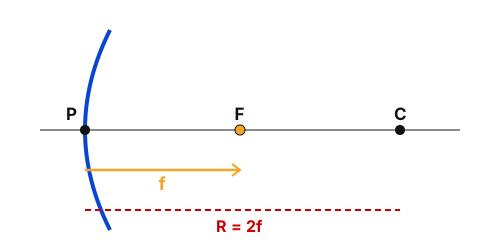
- PF = focal length (f).
- PC = radius of curvature (R) = 2f.
- Aperture = diameter of the reflecting surface; magnification = image height ÷ object height.
Short trick: "P to F = f; P to C = R = 2f" – F is exactly midway between P and C.
Answer: (A) Focal length
अवधारणा: ध्रुव (P) दर्पण की सतह का मध्य बिंदु है; मुख्य फोकस (F) मुख्य अक्ष पर होता है।
- PF = फोकस दूरी (f)।
- PC = वक्रता त्रिज्या (R) = 2f।
- द्वारक = परावर्तक सतह का व्यास; आवर्धन = प्रतिबिंब की ऊँचाई ÷ वस्तु की ऊँचाई।
शॉर्ट ट्रिक: "P से F = f; P से C = R = 2f" – F, P और C के ठीक बीच में।
उत्तर: (A) फोकस दूरी
RRB ALP CBT 1General ScienceLight – spherical mirror termsRRB ALP CBT 1 2025 · 17 Feb Shift 2
Q443.Which of the following processes is responsible for the transportation of soluble products formed by photosynthesis in different parts of plant?
पौधे के विभिन्न भागों में प्रकाश संश्लेषण द्वारा बने घुलनशील उत्पादों के परिवहन के लिए निम्नलिखित में से कौन-सा प्रक्रम उत्तरदायी है?
- ATranspirationवाष्पोत्सर्जन
- BAssimilationस्वांगीकरण
- CTerminationसमापन
- DTranslocationस्थानांतरण
Show answer
Concept: Movement of food (sugars) made in leaves to other parts is called translocation.
- It occurs through phloem (sieve tubes, companion cells).
- It uses energy (ATP) and can move food both upward and downward.
- Transpiration = loss of water vapour from leaves (xylem pull), not food transport.
Short trick: "Phloem = Food, Xylem = Water" – Food moves by TransLOCATION (food changes LOCATION).
Answer: (D) Translocation
अवधारणा: पत्तियों में बने भोजन (शर्करा) का अन्य भागों तक जाना स्थानांतरण (ट्रांसलोकेशन) कहलाता है।
- यह फ्लोएम (चालनी नलिकाएँ, सहचर कोशिकाएँ) द्वारा होता है।
- इसमें ऊर्जा (ATP) लगती है और भोजन ऊपर-नीचे दोनों दिशाओं में जा सकता है।
- वाष्पोत्सर्जन = पत्तियों से जल वाष्प का निकलना, भोजन परिवहन नहीं।
शॉर्ट ट्रिक: "फ्लोएम = भोजन, ज़ाइलम = जल" – भोजन का स्थान बदलना = स्थानांतरण।
उत्तर: (D) स्थानांतरण
RRB ALP CBT 1General SciencePlant transport – translocation in phloemRRB ALP CBT 1 2025 · 17 Feb Shift 2
Q444.For an echo to be heard clearly, the reflecting surface should be at least how far from the listener? (Take speed of sound ≈ 340 m/s)
स्पष्ट प्रतिध्वनि सुनने के लिए परावर्तक सतह श्रोता से कम से कम कितनी दूरी पर होनी चाहिए? (ध्वनि की चाल ≈ 340 m/s लें)
- A50 m
- B17 m
- C100 m
- D34 m
Show answer
Concept: The sensation of sound persists in our brain for about 0.1 s, so the echo must return after at least 0.1 s.
- Total path (to the wall and back) m
- Minimum distance m
Short trick: Distance : m. (34 m is the round trip – a common trap.)
Answer: (B) 17 m
अवधारणा: ध्वनि की संवेदना हमारे मस्तिष्क में लगभग 0.1 s तक रहती है, अतः प्रतिध्वनि कम से कम 0.1 s बाद लौटनी चाहिए।
- कुल पथ (दीवार तक और वापस) m
- न्यूनतम दूरी m
शॉर्ट ट्रिक: दूरी m। (34 m आने-जाने की दूरी है – सामान्य जाल।)
उत्तर: (B) 17 m
RRB ALP CBT 1General ScienceSound – echoRRB ALP CBT 1 2025 · 17 Feb Shift 2
Q445.If the energy of an electron in the second orbit of hydrogen is −3.4 eV, what is the energy in the fourth orbit?
यदि हाइड्रोजन की दूसरी कक्षा में इलेक्ट्रॉन की ऊर्जा −3.4 eV है, तो चौथी कक्षा में ऊर्जा क्या है?
- A−1.7 eV
- B−6.8 eV
- C−13.6 eV
- D−0.85 eV
Show answer
Concept: In hydrogen, eV, i.e. .
- eV
- Check: eV ✓
Short trick: Doubling n divides energy by 4: −3.4 → −0.85. Energy stays negative and gets closer to 0 in higher orbits.
Answer: (D) −0.85 eV
अवधारणा: हाइड्रोजन में eV, अर्थात् ।
- eV
- जाँच: eV ✓
शॉर्ट ट्रिक: n दोगुना → ऊर्जा 4 से भाग: −3.4 → −0.85। ऊँची कक्षाओं में ऊर्जा ऋणात्मक रहते हुए 0 के निकट जाती है।
उत्तर: (D) −0.85 eV
RRB ALP CBT 1General ScienceAtomic structure – Bohr model energy levelsRRB ALP CBT 1 2025 · 17 Feb Shift 2
Q446.The cilia in the upper respiratory tract primarily help in:
ऊपरी श्वसन पथ में उपस्थित पक्ष्माभ (सिलिया) मुख्य रूप से किसमें सहायता करते हैं?
- AAbsorbing oxygenऑक्सीजन को अवशोषित करने में
- BGas exchangeगैसों के विनिमय में
- CPumping blood to lungsफेफड़ों तक रक्त पंप करने में
- DRemoving harmful particles from inhaled airअंदर ली गई वायु से हानिकारक कणों को हटाने में
Show answer
Concept: The nasal passage and trachea are lined with mucus and hair-like cilia.
- Mucus traps dust, pollen and germs in the inhaled air.
- Cilia beat rhythmically and push this mucus up towards the throat, where it is swallowed or coughed out.
- Gas exchange happens only in the alveoli – not in the upper tract.
Short trick: "Cilia = cleaners / brooms" of the airway; "Alveoli = exchange".
Answer: (D) Removing harmful particles from inhaled air
अवधारणा: नासिका मार्ग और श्वासनली के भीतर श्लेष्मा और बाल जैसे पक्ष्माभ (सिलिया) होते हैं।
- श्लेष्मा अंदर ली गई वायु की धूल, परागकण और रोगाणुओं को फँसा लेती है।
- सिलिया लयबद्ध गति से इस श्लेष्मा को गले की ओर धकेलते हैं, जहाँ से यह निगल ली जाती है या खाँसी से बाहर निकलती है।
- गैस विनिमय केवल कूपिकाओं (एल्वियोलाई) में होता है।
शॉर्ट ट्रिक: "सिलिया = श्वास मार्ग की झाड़ू"; "कूपिकाएँ = विनिमय"।
उत्तर: (D) अंदर ली गई वायु से हानिकारक कणों को हटाना
RRB ALP CBT 1General ScienceHuman respiratory system – cilia and mucusRRB ALP CBT 1 2025 · 17 Feb Shift 2
Q447.Why do we feel cool after applying water on our skin in summer?
गर्मियों में त्वचा पर पानी लगाने के बाद हमें ठंडक क्यों महसूस होती है?
- AEvaporation of water absorbs heat from the skin surfaceपानी का वाष्पीकरण त्वचा की सतह से ऊष्मा अवशोषित करता है
- BWater reduces sweat formation and retains body heatपानी पसीने के निर्माण को कम करता है और शरीर की ऊष्मा को बनाए रखता है
- CWater increases body temperature by absorbing sunlightपानी सूर्य के प्रकाश को अवशोषित करके शरीर का तापमान बढ़ाता है
- DCondensation of water releases energy on the skin surfaceपानी का संघनन त्वचा की सतह पर ऊर्जा मुक्त करता है
Show answer
Concept: Evaporation causes cooling.
- To change from liquid to vapour, water needs latent heat of vaporisation.
- It takes this heat from the skin, so the skin temperature falls and we feel cool.
- Same reason: sweating, earthen pot (matka) cooling, wet cloth on forehead.
Short trick: "Evaporation steals heat" – the escaping molecules carry away energy; condensation does the opposite (releases heat).
Answer: (A) Evaporation of water absorbs heat from the skin surface
अवधारणा: वाष्पीकरण से शीतलन होता है।
- द्रव से वाष्प बनने के लिए पानी को वाष्पन की गुप्त ऊष्मा चाहिए।
- यह ऊष्मा वह त्वचा से लेता है, जिससे त्वचा का तापमान घटता है और ठंडक लगती है।
- इसी कारण: पसीना आना, मटके का पानी ठंडा होना, माथे पर गीली पट्टी।
शॉर्ट ट्रिक: "वाष्पीकरण ऊष्मा चुराता है" – संघनन इसका उल्टा (ऊष्मा मुक्त करता है)।
उत्तर: (A) पानी का वाष्पीकरण त्वचा की सतह से ऊष्मा अवशोषित करता है
RRB ALP CBT 1General ScienceMatter – evaporation causes coolingRRB ALP CBT 1 2025 · 17 Feb Shift 2
Q448.On the basis of function, the plasma membrane is ________ in nature.
कार्य के आधार पर, प्लाज़्मा झिल्ली की प्रकृति ________ होती है।
- Asemi-permeableअर्ध-पारगम्य
- Bselectively permeableचयनात्मक पारगम्य
- Cfully permeableपूर्ण पारगम्य
- Dfully non-permeableपूर्ण अपारगम्य
Show answer
Concept: The plasma membrane controls what enters and leaves the cell.
- It allows some substances (water, O, CO) to pass freely and regulates others (ions, glucose) using carrier proteins.
- Because it actively "chooses", it is called selectively permeable.
- Semi-permeable is a physical term (e.g. an artificial membrane letting only solvent pass); cell wall is fully permeable.
Short trick: "Plasma membrane = Security guard – it SELECTS who enters"; cell wall = open gate (fully permeable).
Answer: (B) selectively permeable
अवधारणा: प्लाज़्मा झिल्ली नियंत्रित करती है कि कोशिका में क्या आए और क्या बाहर जाए।
- यह कुछ पदार्थों (जल, O, CO) को स्वतंत्र रूप से जाने देती है और अन्य (आयन, ग्लूकोज़) को वाहक प्रोटीन द्वारा नियंत्रित करती है।
- चूँकि यह "चुनाव" करती है, इसे चयनात्मक पारगम्य कहते हैं।
- अर्ध-पारगम्य एक भौतिक पद है (केवल विलायक को जाने देने वाली झिल्ली); कोशिका भित्ति पूर्ण पारगम्य है।
शॉर्ट ट्रिक: "प्लाज़्मा झिल्ली = सुरक्षा गार्ड – चुनकर अंदर जाने देती है"; कोशिका भित्ति = खुला द्वार।
उत्तर: (B) चयनात्मक पारगम्य
RRB ALP CBT 1General ScienceCell biology – plasma membraneRRB ALP CBT 1 2025 · 17 Feb Shift 2
Q449.Oaths and affirmations for various constitutional posts are provided in which Schedule of the Indian Constitution?
विभिन्न संवैधानिक पदों के लिए शपथ और प्रतिज्ञान भारतीय संविधान की किस अनुसूची में दिए गए हैं?
- AEleventh Scheduleग्यारहवीं अनुसूची
- BFirst Scheduleपहली अनुसूची
- CThird Scheduleतीसरी अनुसूची
- DNinth Scheduleनौवीं अनुसूची
Show answer
Concept: The Third Schedule contains the forms of oaths or affirmations.
- It covers Union ministers, candidates for and members of Parliament, Supreme Court judges, CAG, state ministers, MLAs and High Court judges.
- (The President's and Vice-President's oaths are in Articles 60 and 69, not in this Schedule.)
- First = States & UTs; Ninth = laws protected from judicial review (1st Amendment); Eleventh = Panchayats (29 subjects).
Short trick: Schedules 1–4 in order: States, Salaries, Oaths, Rajya Sabha seats – "S-S-O-R"; the O (Oath) is 3rd.
Answer: (C) Third Schedule
अवधारणा: तीसरी अनुसूची में शपथ या प्रतिज्ञान के प्रारूप दिए गए हैं।
- इसमें केंद्रीय मंत्री, संसद के प्रत्याशी व सदस्य, सर्वोच्च न्यायालय के न्यायाधीश, CAG, राज्य मंत्री, विधायक और उच्च न्यायालय के न्यायाधीश शामिल हैं।
- (राष्ट्रपति और उपराष्ट्रपति की शपथ अनुच्छेद 60 और 69 में है।)
- पहली = राज्य व केंद्रशासित प्रदेश; नौवीं = न्यायिक समीक्षा से संरक्षित कानून; ग्यारहवीं = पंचायत (29 विषय)।
शॉर्ट ट्रिक: अनुसूची 1–4 क्रम से: राज्य, वेतन, शपथ, राज्यसभा सीटें – शपथ तीसरे स्थान पर।
उत्तर: (C) तीसरी अनुसूची
RRB ALP CBT 1General AwarenessIndian Polity – Schedules of the ConstitutionRRB ALP CBT 1 2025 · 17 Feb Shift 2
Q450.In 2025, which Indian state unveiled plans to establish the country’s first Quantum Computing Village?
वर्ष 2025 में, किस भारतीय राज्य ने देश का पहला क्वांटम कंप्यूटिंग गाँव (क्वांटम कंप्यूटिंग विलेज) स्थापित करने की योजना का अनावरण किया?
- ATamil Naduतमिलनाडु
- BKeralaकेरल
- CAndhra Pradeshआंध्र प्रदेश
- DHaryanaहरियाणा
Show answer
Concept: Andhra Pradesh announced India's first Quantum Computing Village at its capital Amaravati.
- It is part of the "Amaravati Quantum Valley" plan, with IBM's quantum computer to be installed there.
- It supports the National Quantum Mission (2023).
Short trick: "A for Amaravati, A for Andhra – Quantum Valley".
Answer: (C) Andhra Pradesh
अवधारणा: आंध्र प्रदेश ने अपनी राजधानी अमरावती में भारत के पहले क्वांटम कंप्यूटिंग गाँव की घोषणा की।
- यह "अमरावती क्वांटम वैली" योजना का भाग है, जहाँ IBM का क्वांटम कंप्यूटर स्थापित होना है।
- यह राष्ट्रीय क्वांटम मिशन (2023) को बढ़ावा देता है।
शॉर्ट ट्रिक: "A से अमरावती, A से आंध्र – क्वांटम वैली"।
उत्तर: (C) आंध्र प्रदेश
RRB ALP CBT 1General AwarenessCurrent affairs – science and technologyRRB ALP CBT 1 2025 · 17 Feb Shift 2
Q451.What is the overall percentage increase in a number if it is increased successively by 10%, 20%, and 15%?
किसी संख्या में क्रमशः 10%, 20% और 15% की वृद्धि करने पर कुल प्रतिशत वृद्धि कितनी होगी?
- A45.8%
- B51.8%
- C41.8%
- D55.8%
Show answer
Concept: Successive changes multiply: final = of the original.
- Increase
Short trick: Two-step formula : 10 and 20 → 32; then 32 and 15 → .
Answer: (B) 51.8%
अवधारणा: क्रमिक परिवर्तन गुणा होते हैं: अंतिम = मूल का गुना।
- वृद्धि
शॉर्ट ट्रिक: सूत्र : 10 और 20 → 32; फिर 32 और 15 → ।
उत्तर: (B) 51.8%
RRB ALP CBT 1MathematicsPercentage – successive increaseRRB ALP CBT 1 2025 · 17 Feb Shift 1
Q452.A toy is in the form of a solid cone having a radius of 5 cm and a height of 12 cm. It is mounted on a frustum of a solid cone, with the toy’s vertex pointed upwards, and the frustum’s smaller base having a radius of 5 cm. The larger base of the frustum has a radius of 22 cm. The slant height of the frustum is 32 cm. What is the total surface area (in cm2) of the toy?
एक खिलौना 5 cm त्रिज्या और 12 cm ऊँचाई वाले ठोस शंकु के आकार का है। इसे एक ठोस शंकु के छिन्नक पर इस प्रकार लगाया गया है कि खिलौने का शीर्ष ऊपर की ओर है और छिन्नक के छोटे आधार की त्रिज्या 5 cm है। छिन्नक के बड़े आधार की त्रिज्या 22 cm है। छिन्नक की तिर्यक ऊँचाई 32 cm है। खिलौने का कुल पृष्ठीय क्षेत्रफल (cm2 में) क्या है?
- A
- B
- C
- D
Show answer
Concept: Exposed surfaces = cone curved surface + frustum curved surface + frustum larger base (the joined bases are hidden).
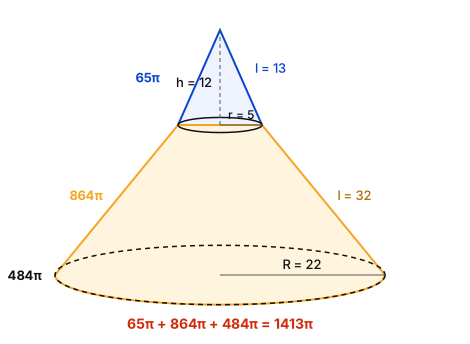
- Cone slant → CSA
- Frustum CSA
- Larger base
- Total
Short trick: 5–12–13 triplet gives the slant instantly; unit digit check: 5 + 4 + 4 → ends in 3 → only 1413π.
Answer: (D)
अवधारणा: खुली सतहें = शंकु का वक्र पृष्ठ + छिन्नक का वक्र पृष्ठ + छिन्नक का बड़ा आधार (जुड़े हुए आधार छिपे रहते हैं)।
- शंकु की तिर्यक ऊँचाई → वक्र पृष्ठ
- छिन्नक वक्र पृष्ठ
- बड़ा आधार
- कुल
शॉर्ट ट्रिक: 5–12–13 त्रिक से तिर्यक ऊँचाई तुरंत; इकाई अंक 5 + 4 + 4 → 3 → केवल 1413π।
उत्तर: (D)
RRB ALP CBT 1MathematicsMensuration – cone on frustumRRB ALP CBT 1 2025 · 17 Feb Shift 1
Q453.A and B can do a piece of work in 10 days, B and C in 15 days and C and A in 20 days. C alone can do the work in:
A और B किसी कार्य को 10 दिनों में, B और C 15 दिनों में तथा C और A 20 दिनों में कर सकते हैं। C अकेले उस कार्य को कितने दिनों में कर सकता है?
- A120 days120 दिन
- B140 days140 दिन
- C150 days150 दिन
- D130 days130 दिन
Show answer
Concept: Add the three pair-rates: is known; subtract a pair to isolate one person.
- , ,
- Sum →
- → 120 days
Short trick: Take total work = LCM 60: pair rates 6, 4, 3 → A+B+C = 6.5 → C = 6.5 − 6 = 0.5 per day → 60 ÷ 0.5 = 120 days.
Answer: (A) 120 days
अवधारणा: तीनों युग्म दरों को जोड़ें: मिलता है; फिर एक युग्म घटाएँ।
- , ,
- योग →
- → 120 दिन
शॉर्ट ट्रिक: कुल कार्य = LCM 60: दरें 6, 4, 3 → A+B+C = 6.5 → C = 0.5 प्रतिदिन → 60 ÷ 0.5 = 120 दिन।
उत्तर: (A) 120 दिन
RRB ALP CBT 1MathematicsTime and work – pairsRRB ALP CBT 1 2025 · 17 Feb Shift 1
Q454.In , points M and N lie on sides PQ and PR respectively, such that MN is parallel to QR. If PM : QM = 4 : 7 and area of = 36 m2, find the area of trapezium MQRN.
में, बिंदु M और N क्रमशः भुजाओं PQ और PR पर इस प्रकार स्थित हैं कि MN, QR के समांतर है। यदि PM : QM = 4 : 7 और का क्षेत्रफल = 36 m2 है, तो समलंब MQRN का क्षेत्रफल ज्ञात कीजिए।
- A236.25 cm2
- B222.86 cm2
- C216.36 cm2
- D248.15 cm2
Show answer
Concept: MN ∥ QR ⇒ ; areas are in the ratio of squares of sides.
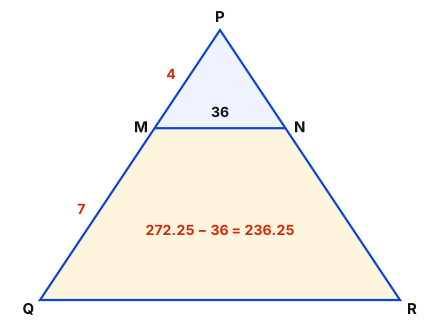
- →
- Trapezium
Short trick: Trapezium = small area × in one step.
Answer: (A) 236.25
अवधारणा: MN ∥ QR ⇒ ; क्षेत्रफल भुजाओं के वर्गों के अनुपात में।
- →
- समलंब
शॉर्ट ट्रिक: समलंब = एक ही चरण में।
उत्तर: (A) 236.25
RRB ALP CBT 1MathematicsGeometry – similar triangles (BPT)RRB ALP CBT 1 2025 · 17 Feb Shift 1
Q455.Simplify:
सरल कीजिए:
- A8
- B4
- C2
- D6
Show answer
Concept: Open brackets from the innermost: ( ) → { } → [ ].
- →
Short trick: Inside-out with sign care: 4 → 6 → −4 → 6.
Answer: (D) 6
अवधारणा: सबसे भीतरी कोष्ठक से खोलें: ( ) → { } → [ ]।
- →
शॉर्ट ट्रिक: अंदर से बाहर, चिह्नों पर ध्यान: 4 → 6 → −4 → 6।
उत्तर: (D) 6
RRB ALP CBT 1MathematicsSimplification – bracketsRRB ALP CBT 1 2025 · 17 Feb Shift 1
Q456.Anand purchased an item and spent ₹175 on its repair. He then sold it to Bharath at a profit of 25%. Later, Bharath sold the item for ₹3,402, incurring a loss of 58%. What was Anand’s cost (in ₹) of the item just before selling it to Bharath?
आनंद ने एक वस्तु खरीदी और उसकी मरम्मत पर ₹175 खर्च किए। फिर उसने इसे 25% लाभ पर भरत को बेच दिया। बाद में, भरत ने वस्तु को ₹3,402 में बेचा, जिससे उसे 58% की हानि हुई। भरत को बेचने से ठीक पहले वस्तु पर आनंद की लागत (₹ में) क्या थी?
- A6478
- B6483
- C6481
- D6480
Show answer
Concept: Work backwards from the last sale using SP = CP × (1 ± r%).
- Bharath: (this is Anand's SP)
- Anand:
- This 6480 already includes the ₹175 repair (cost just before selling)
Short trick: : 3402 ÷ 42 = 81 → 81 × 80 = 6480.
Answer: (D) 6480
अवधारणा: अंतिम बिक्री से उल्टा चलें: SP = CP × (1 ± r%)।
- भरत: (यही आनंद का SP है)
- आनंद:
- इसमें ₹175 मरम्मत शामिल है (बेचने से ठीक पहले की लागत)
शॉर्ट ट्रिक: 3402 ÷ 42 = 81 → 81 × 80 = 6480।
उत्तर: (D) 6480
RRB ALP CBT 1MathematicsProfit and loss – chain saleRRB ALP CBT 1 2025 · 17 Feb Shift 1
Q457.Which of the following ratios is the greatest: 8 : 11, 5 : 7, 13 : 17, or 11 : 13?
निम्नलिखित में से कौन-सा अनुपात सबसे बड़ा है: 8 : 11, 5 : 7, 13 : 17, या 11 : 13?
- A13 : 17
- B8 : 11
- C5 : 7
- D11 : 13
Show answer
Concept: Compare ratios as decimals (or by how close they are to 1).
- 8/11 ≈ 0.727, 5/7 ≈ 0.714
- 13/17 ≈ 0.765, 11/13 ≈ 0.846
- Greatest: 11 : 13
Short trick: Gap method: 1 − ratio = 3/11, 2/7, 4/17, 2/13; the smallest gap (2/13 ≈ 0.15) is the largest ratio.
Answer: (D) 11 : 13
अवधारणा: अनुपातों को दशमलव में बदलकर तुलना करें।
- 8/11 ≈ 0.727, 5/7 ≈ 0.714
- 13/17 ≈ 0.765, 11/13 ≈ 0.846
- सबसे बड़ा: 11 : 13
शॉर्ट ट्रिक: अंतर विधि: 1 − अनुपात = 3/11, 2/7, 4/17, 2/13; सबसे छोटा अंतर (2/13) → सबसे बड़ा अनुपात।
उत्तर: (D) 11 : 13
RRB ALP CBT 1MathematicsRatio – comparisonRRB ALP CBT 1 2025 · 17 Feb Shift 1
Q458.A speedboat, whose speed is 16 km/hr in still water, travels 40 km downstream and returns in a total of 6 hours 24 minutes. What is the speed of the stream (in km/hr)?
एक स्पीडबोट, जिसकी शांत जल में चाल 16 km/hr है, 40 km अनुप्रवाह जाती है और कुल 6 घंटे 24 मिनट में वापस आ जाती है। धारा की चाल (km/hr में) क्या है?
- A
- B
- C
- D
Show answer
Concept: Time = distance ÷ speed; downstream , upstream .
- h
- →
- → km/h
Short trick: Formula: total time → → .
Answer: (C)
अवधारणा: समय = दूरी ÷ चाल; अनुप्रवाह , ऊर्ध्वप्रवाह ।
- घंटे
- →
- → km/h
शॉर्ट ट्रिक: सूत्र: कुल समय → → ।
उत्तर: (C)
RRB ALP CBT 1MathematicsBoats and streamsRRB ALP CBT 1 2025 · 17 Feb Shift 1
Q459.A sum of ₹5,890 is divided between Alok, Gita and Suresh such that if their shares are decreased by ₹320, ₹590 and ₹750, respectively, then they are in the ratio of 9 : 3 : 6. What is the original share of Gita?
₹5,890 की राशि आलोक, गीता और सुरेश के बीच इस प्रकार बाँटी जाती है कि यदि उनके हिस्सों में क्रमशः ₹320, ₹590 और ₹750 की कमी की जाए, तो वे 9 : 3 : 6 के अनुपात में हो जाते हैं। गीता का मूल हिस्सा क्या है?
- A₹1,209
- B₹1,380
- C₹1,295
- D₹1,157
Show answer
Concept: Subtract the deductions from the total, split in the ratio, then add back.
- parts → 1 part
- Gita
Short trick: Ratio 9 : 3 : 6 = 3 : 1 : 2 → Gita gets of 4230 = 705; +590 = 1295.
Answer: (C) ₹1,295
अवधारणा: कुल में से कटौतियाँ घटाएँ, अनुपात में बाँटें, फिर वापस जोड़ें।
- 18 भाग → 1 भाग
- गीता
शॉर्ट ट्रिक: 9 : 3 : 6 = 3 : 1 : 2 → गीता = 4230 का = 705; +590 = 1295।
उत्तर: (C) ₹1,295
RRB ALP CBT 1MathematicsRatio – shares after deductionRRB ALP CBT 1 2025 · 17 Feb Shift 1
Q460.During a sale, 40% of the goods are sold at a 44% profit, 25% of the remaining goods are sold at a 29% profit and the rest are sold at a 39% loss. If there is an overall profit of x%, then what is the value of x?
एक सेल के दौरान, 40% माल 44% लाभ पर बेचा जाता है, शेष माल का 25% भाग 29% लाभ पर बेचा जाता है और बाकी माल 39% हानि पर बेचा जाता है। यदि कुल लाभ x% है, तो x का मान क्या है?
- A4.4%
- B15%
- C7.5%
- D10.5%
Show answer
Concept: Overall profit % = weighted average of the individual profit % (weights = share of goods).
- Shares: 40%, 25% of 60% = 15%, rest = 45%
- , ,
Short trick: Take 100 items of cost ₹1 each: profit 17.6 + 4.35 − 17.55 = ₹4.4 on ₹100 → 4.4%.
Answer: (A) 4.4%
अवधारणा: कुल लाभ % = अलग-अलग लाभ % का भारित औसत (भार = माल का भाग)।
- भाग: 40%, 60% का 25% = 15%, शेष = 45%
- , ,
शॉर्ट ट्रिक: ₹1 वाली 100 वस्तुएँ मानें: लाभ 17.6 + 4.35 − 17.55 = ₹4.4 → 4.4%।
उत्तर: (A) 4.4%
RRB ALP CBT 1MathematicsProfit and loss – weighted averageRRB ALP CBT 1 2025 · 17 Feb Shift 1

