Q801.IM 126 is related to LN 116 in a certain way. In the same way, KO 149 is related to NP 139. To which of the given options is RV 263, following the same logic?
IM 126 एक निश्चित प्रकार से LN 116 से संबंधित है। उसी प्रकार, KO 149, NP 139 से संबंधित है। समान तर्क का अनुसरण करते हुए, RV 263 दिए गए विकल्पों में से किससे संबंधित है?
- ATW 233
- BSX 243
- CTX 253
- DUW 253
Show answer
Concept: Letters and number change separately.
- IM 126 → LN 116: I + 3 = L, M + 1 = N, 126 − 10 = 116
- KO 149 → NP 139: K + 3, O + 1, −10 ✓
- RV 263 → R + 3 = U, V + 1 = W, 263 − 10 = 253 → UW 253
Short trick: Number −10 → 253 (C or D); first letter R + 3 = U → D.
Answer: (D) UW 253
अवधारणा: अक्षर और संख्या अलग-अलग बदलते हैं।
- IM 126 → LN 116: I + 3 = L, M + 1 = N, 126 − 10 = 116
- KO 149 → NP 139: K + 3, O + 1, −10 ✓
- RV 263 → U, W, 253 → UW 253
शॉर्ट ट्रिक: संख्या −10 → 253 (C या D); R + 3 = U → D.
उत्तर: (D) UW 253
RRB ALP CBT 1General Intelligence and ReasoningAlphanumeric analogyRRB ALP CBT 1 2025 · 13 Feb Shift 1
Q802.What should come in place of the question mark (?) in the given series based on the English alphabetical order?
GTN ZMG SFZ LYS ?
अंग्रेजी वर्णमाला क्रम के आधार पर दी गई श्रृंखला में प्रश्न चिह्न (?) के स्थान पर क्या आना चाहिए?
GTN ZMG SFZ LYS ?
- AERD
- BERF
- CRDS
- DERL
Show answer
Concept: Each position moves −7 (wrapping around Z → A).
- 1st: G(7) → Z(26) → S(19) → L(12) → E(5)
- 2nd: T(20) → M(13) → F(6) → Y(25) → R(18)
- 3rd: N(14) → G(7) → Z(26) → S(19) → L(12)
Short trick: The 3rd letter of each term = 1st letter of the previous term (N→G→Z→S→L), so the answer ends in L → ERL.
Answer: (D) ERL
अवधारणा: प्रत्येक स्थान पर −7 (Z के बाद फिर A से)।
- पहला: G(7) → Z(26) → S(19) → L(12) → E(5)
- दूसरा: T(20) → M(13) → F(6) → Y(25) → R(18)
- तीसरा: N(14) → G(7) → Z(26) → S(19) → L(12)
शॉर्ट ट्रिक: प्रत्येक पद का तीसरा अक्षर = पिछले पद का पहला अक्षर → उत्तर L पर समाप्त → ERL.
उत्तर: (D) ERL
RRB ALP CBT 1General Intelligence and ReasoningLetter seriesRRB ALP CBT 1 2025 · 13 Feb Shift 1
Q803.A question is followed by two statements numbered (I) and (II). You have to decide whether the data provided in the statements are sufficient to answer the question. Read both the statements and decide the appropriate answer.
Q. Four relatives – Leena, Mona, Pooja, and Reema – are of different ages. Who is the second oldest?
(I) Mona is older than Leena but younger than Reema.
(II) Pooja is younger than Reema but older than Mona.
एक प्रश्न के बाद दो कथन (I) और (II) दिए गए हैं। आपको यह निर्णय लेना है कि कथनों में दिए गए आँकड़े प्रश्न का उत्तर देने के लिए पर्याप्त हैं या नहीं। दोनों कथनों को पढ़िए और उचित उत्तर चुनिए।
प्र. चार संबंधी – लीना, मोना, पूजा और रीमा – अलग-अलग आयु के हैं। दूसरा सबसे बड़ा कौन है?
(I) मोना, लीना से बड़ी है लेकिन रीमा से छोटी है।
(II) पूजा, रीमा से छोटी है लेकिन मोना से बड़ी है।
- AData in both statements I and II together (and not statement I alone or statement II alone) are sufficient to answer the questionकथन I और II दोनों में दिए गए आँकड़े एक साथ (न कि अकेले कथन I या अकेले कथन II) प्रश्न का उत्तर देने के लिए पर्याप्त हैं
- BData in Statement I alone is sufficient to answer the question while data in Statement II is notअकेले कथन I के आँकड़े प्रश्न का उत्तर देने के लिए पर्याप्त हैं जबकि कथन II के आँकड़े पर्याप्त नहीं हैं
- CData in Statement II alone is sufficient to answer the question while data in Statement I is notअकेले कथन II के आँकड़े प्रश्न का उत्तर देने के लिए पर्याप्त हैं जबकि कथन I के आँकड़े पर्याप्त नहीं हैं
- DData in both statements I and II together are NOT sufficient to answer the questionकथन I और II दोनों के आँकड़े एक साथ भी प्रश्न का उत्तर देने के लिए पर्याप्त नहीं हैं
Show answer
Concept: Check each statement alone, then together.
- (I) Reema > Mona > Leena – Pooja’s position unknown ✗
- (II) Reema > Pooja > Mona – Leena’s position unknown ✗
- Together: Reema > Pooja > Mona > Leena → second oldest = Pooja ✓
Short trick: Each statement misses one person; together they cover all four in one chain.
Answer: (A) Data in both statements I and II together (and not statement I alone or statement II alone) are sufficient to answer the question
अवधारणा: प्रत्येक कथन को अलग से, फिर एक साथ जाँचें।
- (I) रीमा > मोना > लीना – पूजा का स्थान अज्ञात ✗
- (II) रीमा > पूजा > मोना – लीना का स्थान अज्ञात ✗
- दोनों मिलाकर: रीमा > पूजा > मोना > लीना → दूसरी सबसे बड़ी = पूजा ✓
शॉर्ट ट्रिक: प्रत्येक कथन में एक व्यक्ति छूटता है; दोनों मिलकर पूरी श्रृंखला बनाते हैं।
उत्तर: (A) कथन I और II दोनों मिलकर पर्याप्त हैं
RRB ALP CBT 1General Intelligence and ReasoningData sufficiency – rankingRRB ALP CBT 1 2025 · 13 Feb Shift 1
Q804.Among five people named V, W, X, Y and Z, each have a certain age. X is four times the age of Y. V's age is equal to the age of X. Y is one-third the age of Z. W is half the age of V. If the age of Z is 12, what is the age of W?
V, W, X, Y और Z नाम के पाँच व्यक्तियों में से प्रत्येक की एक निश्चित आयु है। X की आयु, Y की आयु की चार गुनी है। V की आयु, X की आयु के बराबर है। Y की आयु, Z की आयु की एक-तिहाई है। W की आयु, V की आयु की आधी है। यदि Z की आयु 12 है, तो W की आयु कितनी है?
- A8
- B6
- C15
- D4
Show answer
Concept: Start from the known age and follow the chain.
- Z = 12 → Y = 12 ÷ 3 = 4
- X = 4 × Y = 16 → V = X = 16
- W = V ÷ 2 = 8
Short trick: W = ½V = ½X = ½ × 4Y = 2Y = 2 × 4 = 8.
Answer: (A) 8
अवधारणा: ज्ञात आयु से शुरू करके श्रृंखला का अनुसरण करें।
- Z = 12 → Y = 12 ÷ 3 = 4
- X = 4 × Y = 16 → V = X = 16
- W = V ÷ 2 = 8
शॉर्ट ट्रिक: W = ½V = ½X = 2Y = 8.
उत्तर: (A) 8
RRB ALP CBT 1General Intelligence and ReasoningAge relationsRRB ALP CBT 1 2025 · 13 Feb Shift 1
Q805.Each of G, J, M, O, R, S and T has an exam on a different day of a week, starting from Monday and ending on Sunday of the same week.
S has an exam on Friday. Only two people have exams between G and S. Only four people have exams between M and G. J has an exam immediately after T. R does not have an exam on Monday.
How many people have exams between R and O?
G, J, M, O, R, S और T में से प्रत्येक की परीक्षा सप्ताह के एक अलग दिन है, जो सोमवार से शुरू होकर उसी सप्ताह के रविवार को समाप्त होता है।
S की परीक्षा शुक्रवार को है। G और S के बीच केवल दो लोगों की परीक्षाएँ हैं। M और G के बीच केवल चार लोगों की परीक्षाएँ हैं। J की परीक्षा T के ठीक बाद है। R की परीक्षा सोमवार को नहीं है।
R और O के बीच कितने लोगों की परीक्षाएँ हैं?
- ATwoदो
- BThreeतीन
- COneएक
- DFourचार
Show answer
Concept: Fix S, then G, then M.
| Mon | Tue | Wed | Thu | Fri | Sat | Sun |
|---|
| O | G | T | J | S | R | M |
- S = Friday. Two people between G and S → G = Tuesday.
- Four people between M and G → M = Sunday.
- Free: Mon, Wed, Thu, Sat. T, J consecutive → T = Wed, J = Thu.
- R not Monday → R = Saturday, O = Monday.
- Between O (Mon) and R (Sat): G, T, J, S → 4.
Short trick: G is forced to Tue (Fri − 3); M = Tue + 5 = Sun.
Answer: (D) Four
अवधारणा: पहले S, फिर G, फिर M को रखें।
| सोम | मंगल | बुध | गुरु | शुक्र | शनि | रवि |
|---|
| O | G | T | J | S | R | M |
- S = शुक्रवार। G और S के बीच दो लोग → G = मंगलवार।
- M और G के बीच चार लोग → M = रविवार।
- खाली: सोम, बुध, गुरु, शनि। T, J क्रमागत → T = बुध, J = गुरु।
- R सोमवार नहीं → R = शनि, O = सोम।
- O (सोम) और R (शनि) के बीच: G, T, J, S → 4.
शॉर्ट ट्रिक: G = शुक्र − 3 = मंगल; M = मंगल + 5 = रवि।
उत्तर: (D) चार
RRB ALP CBT 1General Intelligence and ReasoningScheduling puzzle – days of weekRRB ALP CBT 1 2025 · 13 Feb Shift 1
Q806.D, E, F, G, K, L and M are sitting around a circular table, facing the centre of the table. D sits fourth to the right of K. Only two people sit between L and G when counted from the left of L. F sits third to the left of E. M is an immediate neighbour of E and G. How many people sit between D and M when counted from the left of M?
D, E, F, G, K, L और M एक वृत्ताकार मेज के चारों ओर केंद्र की ओर मुख करके बैठे हैं। D, K के दाएँ चौथे स्थान पर बैठा है। L के बाएँ से गिनने पर L और G के बीच केवल दो व्यक्ति बैठे हैं। F, E के बाएँ तीसरे स्थान पर बैठा है। M, E और G दोनों का निकटतम पड़ोसी है। M के बाएँ से गिनने पर D और M के बीच कितने व्यक्ति बैठे हैं?
- AThreeतीन
- BOneएक
- CTwoदो
- DFourचार
Show answer
Concept: Facing the centre: right = anticlockwise, left = clockwise.
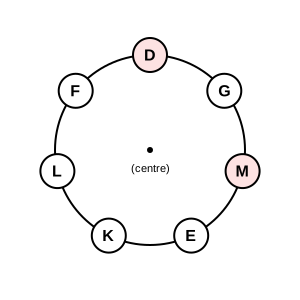
- Fix K; D is 4th to the right of K (= 3rd to the left).
- M sits between E and G; F is 3rd to the left of E; G is 3rd to the left of L (two between, counted from L’s left).
- Only arrangement (going right from D): D, F, L, K, E, M, G.
- From M going left: E, K, L, F, then D → 4 people between.
Short trick: In a 7-seat circle “4th to the right” = “3rd to the left” – use whichever is shorter.
Answer: (D) Four
अवधारणा: केंद्र की ओर मुख: दाएँ = वामावर्त, बाएँ = दक्षिणावर्त।
- K को स्थिर करें; D, K के दाएँ चौथे (= बाएँ तीसरे) स्थान पर।
- M, E और G के बीच; F, E के बाएँ तीसरा; G, L के बाएँ तीसरा (L के बाएँ से गिनने पर बीच में दो)।
- एकमात्र व्यवस्था (D से दाएँ चलते हुए): D, F, L, K, E, M, G.
- M से बाएँ: E, K, L, F, फिर D → बीच में 4 लोग।
शॉर्ट ट्रिक: 7 सीटों में “दाएँ चौथा” = “बाएँ तीसरा” – जो छोटा हो वह लें।
उत्तर: (D) चार
RRB ALP CBT 1General Intelligence and ReasoningCircular seating arrangementRRB ALP CBT 1 2025 · 13 Feb Shift 1
Q807.18 is related to 321 following a certain logic. Following the same logic,13 is related to 166. To which of the given options is 25 related, following the same logic?
(NOTE: Operations should be performed on the whole numbers, without breaking down the numbers into their constituent digits. E.g. 13 – Operations on 13 such as adding to/subtracting from/multiplying with 13 can be performed. Breaking down 13 into 1 and 3 and then performing mathematical operations on 1 and 3 is not allowed.)
18 एक निश्चित तर्क का अनुसरण करते हुए 321 से संबंधित है। उसी तर्क का अनुसरण करते हुए, 13, 166 से संबंधित है। समान तर्क का अनुसरण करते हुए, 25 दिए गए विकल्पों में से किससे संबंधित है?
(ध्यान दें: संक्रियाएँ पूर्ण संख्याओं पर की जानी चाहिए, संख्याओं को उनके घटक अंकों में तोड़े बिना। उदाहरण: 13 – 13 पर संक्रियाएँ जैसे 13 में जोड़ना/घटाना/गुणा करना आदि की जा सकती हैं। 13 को 1 और 3 में तोड़कर 1 और 3 पर गणितीय संक्रियाएँ करने की अनुमति नहीं है।)
- A622
- B426
- C422
- D626
Show answer
Concept: Look for a square near the second number.
- 18² = 324 → 324 − 3 = 321
- 13² = 169 → 169 − 3 = 166
- 25² = 625 → 625 − 3 = 622
Short trick: Answer must end in 2 (625 − 3) → 622 or 422; 25² ≈ 600 → 622.
Answer: (A) 622
अवधारणा: दूसरी संख्या के पास का वर्ग देखें।
- 18² = 324 → 324 − 3 = 321
- 13² = 169 → 169 − 3 = 166
- 25² = 625 → 625 − 3 = 622
शॉर्ट ट्रिक: उत्तर 2 पर समाप्त (625 − 3) → 622 या 422; 25² ≈ 600 → 622.
उत्तर: (A) 622
RRB ALP CBT 1General Intelligence and ReasoningNumber analogyRRB ALP CBT 1 2025 · 13 Feb Shift 1
Q808.In this question, a question is followed by two statements numbered (I) and (II). You have to decide whether the data provided in the statements are sufficient to answer the question. Read both the statements and decide the appropriate answer.
Among the five poles—R, A, M, E, and N—each having a different height, which one is the shortest?
(I) N is shorter than A. E is shorter than R.
(II) E is taller than N.
इस प्रश्न में, एक प्रश्न के बाद दो कथन (I) और (II) दिए गए हैं। आपको यह निर्णय लेना है कि कथनों में दिए गए आँकड़े प्रश्न का उत्तर देने के लिए पर्याप्त हैं या नहीं। दोनों कथनों को पढ़िए और उचित उत्तर चुनिए।
पाँच खंभों—R, A, M, E और N—में से प्रत्येक की ऊँचाई अलग-अलग है, उनमें से सबसे छोटा कौन-सा है?
(I) N, A से छोटा है। E, R से छोटा है।
(II) E, N से लंबा है।
- ABoth statements I and II together are NOT sufficient to answer the questionकथन I और II दोनों मिलकर भी प्रश्न का उत्तर देने के लिए पर्याप्त नहीं हैं
- BData in statement I alone is sufficient to answer the question while data in statement II is notअकेले कथन I के आँकड़े प्रश्न का उत्तर देने के लिए पर्याप्त हैं जबकि कथन II के आँकड़े पर्याप्त नहीं हैं
- CBoth statements I and II together (and not statement I alone or statement II alone) are sufficient to answer the questionकथन I और II दोनों एक साथ (न कि अकेले कथन I या अकेले कथन II) प्रश्न का उत्तर देने के लिए पर्याप्त हैं
- DData in statement II alone is sufficient to answer the question while data in statement I is notअकेले कथन II के आँकड़े प्रश्न का उत्तर देने के लिए पर्याप्त हैं जबकि कथन I के आँकड़े पर्याप्त नहीं हैं
Show answer
Concept: For “shortest”, every pole must be compared (directly or through a chain).
- (I) N < A and E < R – two separate pairs, M not mentioned ✗
- (II) N < E – M not mentioned ✗
- Together: N < A, N < E < R → N is shorter than A, E, R, but M is never compared ✗
Short trick: A pole (M) absent from both statements → “not sufficient” immediately.
Answer: (A) Both statements I and II together are NOT sufficient to answer the question
अवधारणा: “सबसे छोटा” जानने के लिए हर खंभे की तुलना (सीधे या श्रृंखला से) आवश्यक है।
- (I) N < A तथा E < R – दो अलग जोड़ियाँ, M का उल्लेख नहीं ✗
- (II) N < E – M का उल्लेख नहीं ✗
- दोनों मिलाकर: N < A, N < E < R → N, A, E, R से छोटा, पर M की तुलना कहीं नहीं ✗
शॉर्ट ट्रिक: कोई खंभा (M) दोनों कथनों में अनुपस्थित → तुरंत “पर्याप्त नहीं”।
उत्तर: (A) दोनों कथन मिलकर भी पर्याप्त नहीं हैं
RRB ALP CBT 1General Intelligence and ReasoningData sufficiency – height rankingRRB ALP CBT 1 2025 · 13 Feb Shift 1
Q809.Refer to the following number and symbol series and answer the question that follows. Counting to be done from left to right only.
(Note: All numbers are single digit numbers only.)
(Left) 6 £ 2 @ % 7 8 # 1 3 * 9 $ & 4 ^ ≺ 5 (Right)
How many such symbols are there, each of which is immediately preceded by a number and also immediately followed by another number?
निम्नलिखित संख्या और प्रतीक श्रृंखला को देखें और उसके बाद आने वाले प्रश्न का उत्तर दें। गिनती केवल बाएँ से दाएँ की जानी है।
(ध्यान दें: सभी संख्याएँ केवल एक अंक वाली संख्याएँ हैं।)
(बाएँ) 6 £ 2 @ % 7 8 # 1 3 * 9 $ & 4 ^ ≺ 5 (दाएँ)
ऐसे कितने प्रतीक हैं, जिनमें से प्रत्येक के ठीक पहले एक संख्या है और ठीक बाद एक अन्य संख्या है?
- AOneएक
- BTwoदो
- CThreeतीन
- DNoneकोई नहीं
Show answer
Concept: Find every “number – symbol – number” triple.
- 6 £ 2 ✓
- 8 # 1 ✓
- 3 * 9 ✓
- Others: 2 @ % ✗, 9 $ & ✗, 4 ^ ≺ ✗, ^ ≺ 5 ✗
Short trick: Look at single symbols sandwiched between numbers: £, #, * → 3.
Answer: (C) Three
अवधारणा: हर “संख्या – प्रतीक – संख्या” समूह खोजें।
- 6 £ 2 ✓
- 8 # 1 ✓
- 3 * 9 ✓
- बाकी: 2 @ % ✗, 9 $ & ✗, 4 ^ ≺ ✗, ^ ≺ 5 ✗
शॉर्ट ट्रिक: दो संख्याओं के बीच अकेले प्रतीक: £, #, * → 3.
उत्तर: (C) तीन
RRB ALP CBT 1General Intelligence and ReasoningSymbol series – position countingRRB ALP CBT 1 2025 · 13 Feb Shift 1
Q810.Refer to the following letter, symbol series and answer the question that follows. Counting to be done from left to right only.
(Left) $ T % K L € & € G R Y @ A W # Y © R B * O Y (Right)
How many such letter are there, each of which is immediately preceded by a letter and also immediately followed by a symbol?
निम्नलिखित अक्षर, प्रतीक श्रृंखला को देखें और उसके बाद आने वाले प्रश्न का उत्तर दें। गिनती केवल बाएँ से दाएँ की जानी है।
(बाएँ) $ T % K L € & € G R Y @ A W # Y © R B * O Y (दाएँ)
ऐसे कितने अक्षर हैं, जिनमें से प्रत्येक के ठीक पहले एक अक्षर है और ठीक बाद एक प्रतीक है?
- A5
- B6
- C3
- D4
Show answer
Concept: Find every “letter – letter – symbol” triple; the middle letter counts.
- K L € ✓
- R Y @ ✓
- A W # ✓
- R B * ✓
- Not counted: T (after $), Y (after #), O Y (end).
Short trick: Look just before each symbol: if two letters precede it, count one.
Answer: (D) 4
अवधारणा: हर “अक्षर – अक्षर – प्रतीक” समूह खोजें; बीच का अक्षर गिना जाएगा।
- K L € ✓
- R Y @ ✓
- A W # ✓
- R B * ✓
- नहीं गिने: T ($ के बाद), Y (# के बाद), O Y (अंत)।
शॉर्ट ट्रिक: प्रत्येक प्रतीक से ठीक पहले देखें: यदि दो अक्षर हों तो एक गिनें।
उत्तर: (D) 4
RRB ALP CBT 1General Intelligence and ReasoningLetter–symbol series – position countingRRB ALP CBT 1 2025 · 13 Feb Shift 1
Q811.Refer to the following letter, symbol series and answer the question. Counting to be done from left to right only.
(Left) X # $ L K M O > ? A S + T % @ A P & ? X Z R @ * + # I O ? & @ E R $ Y U ? (Right)
How many such symbols are there each of which is immediately preceded by a letter and also immediately followed by a letter?
निम्नलिखित अक्षर, प्रतीक श्रृंखला को देखें और प्रश्न का उत्तर दें। गिनती केवल बाएँ से दाएँ की जानी है।
(बाएँ) X # $ L K M O > ? A S + T % @ A P & ? X Z R @ * + # I O ? & @ E R $ Y U ? (दाएँ)
ऐसे कितने प्रतीक हैं, जिनमें से प्रत्येक के ठीक पहले एक अक्षर है और ठीक बाद एक अक्षर है?
- A3
- B4
- C1
- D2
Show answer
Concept: Find every “letter – symbol – letter” triple.
- S + T ✓
- R $ Y ✓
- All other symbols are next to another symbol or at the end (e.g. O > ?, P & ?, R @ *, O ? &, U ? end).
Short trick: Look for a single symbol standing alone between two letters → only “+” and “$”.
Answer: (D) 2
अवधारणा: हर “अक्षर – प्रतीक – अक्षर” समूह खोजें।
- S + T ✓
- R $ Y ✓
- बाकी सभी प्रतीक किसी अन्य प्रतीक के पास या अंत में हैं (जैसे O > ?, P & ?, R @ *, O ? &, U ? अंत)।
शॉर्ट ट्रिक: दो अक्षरों के बीच अकेला प्रतीक खोजें → केवल “+” और “$”।
उत्तर: (D) 2
RRB ALP CBT 1General Intelligence and ReasoningLetter–symbol series – position countingRRB ALP CBT 1 2025 · 13 Feb Shift 1
Q812.What should come in place of ? in the given series?
32 40 50 58 68 ?
दी गई श्रृंखला में ? के स्थान पर क्या आना चाहिए?
32 40 50 58 68 ?
- A77
- B78
- C75
- D76
Show answer
Concept: Differences alternate.
- 32 +8 = 40, +10 = 50, +8 = 58, +10 = 68
- Next: 68 + 8 = 76
Short trick: Pattern +8, +10 repeats → next is +8.
Answer: (D) 76
अवधारणा: अंतर बारी-बारी से बदलते हैं।
- 32 +8 = 40, +10 = 50, +8 = 58, +10 = 68
- अगला: 68 + 8 = 76
शॉर्ट ट्रिक: पैटर्न +8, +10 दोहराता है → अगला +8.
उत्तर: (D) 76
RRB ALP CBT 1General Intelligence and ReasoningNumber series – alternating differencesRRB ALP CBT 1 2025 · 13 Feb Shift 1
Q813.Aryan starts from point P and walks for 4 m towards the south. Then he takes a left turn and walks for 3 m. Then he takes one more left turn and walks for 8 m. Then he takes a right turn and walks for 2 m. Then he takes the last right turn and walks for 4 m before stopping at point Q. Towards which direction should he walk in order to reach point P again? (All turns are 90-degree turns only unless specified.)
आर्यन बिंदु P से शुरू करता है और दक्षिण की ओर 4 m चलता है। फिर वह बाएँ मुड़ता है और 3 m चलता है। फिर वह एक बार और बाएँ मुड़ता है और 8 m चलता है। फिर वह दाएँ मुड़ता है और 2 m चलता है। फिर वह अंतिम बार दाएँ मुड़ता है और बिंदु Q पर रुकने से पहले 4 m चलता है। बिंदु P पर फिर से पहुँचने के लिए उसे किस दिशा में चलना चाहिए? (जब तक निर्दिष्ट न किया जाए, सभी मोड़ केवल 90 डिग्री के मोड़ हैं।)
- AEastपूर्व
- BNorthउत्तर
- CSouthदक्षिण
- DWestपश्चिम
Show answer
Concept: Take P = (0, 0); track each turn.
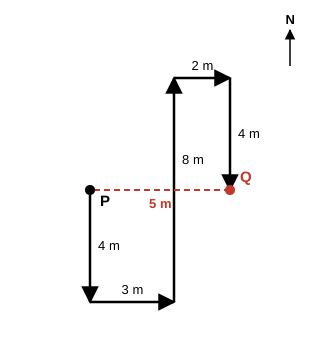
- South 4 → (0, −4); left → East 3 → (3, −4)
- left → North 8 → (3, 4); right → East 2 → (5, 4)
- right → South 4 → Q = (5, 0)
- Q is 5 m East of P → walk West.
Short trick: Net N–S = −4 + 8 − 4 = 0, net E–W = 3 + 2 = 5 East → go West.
Answer: (D) West
अवधारणा: P = (0, 0) लें; हर मोड़ पर दिशा देखें।
- दक्षिण 4 → (0, −4); बाएँ → पूर्व 3 → (3, −4)
- बाएँ → उत्तर 8 → (3, 4); दाएँ → पूर्व 2 → (5, 4)
- दाएँ → दक्षिण 4 → Q = (5, 0)
- Q, P से 5 m पूर्व में → पश्चिम की ओर चलना होगा।
शॉर्ट ट्रिक: कुल उत्तर–दक्षिण = −4 + 8 − 4 = 0, कुल पूर्व = 5 → पश्चिम जाएँ।
उत्तर: (D) पश्चिम
RRB ALP CBT 1General Intelligence and ReasoningDirection senseRRB ALP CBT 1 2025 · 13 Feb Shift 1
Q814.A, B, C, D, E, F and G are sitting around a circular table facing the centre. Only two people sit between C and B when counted from the right of C. Only two people sit between B and D. Only three people sit between C and F. G sits to the immediate left of E. How many people sit between A and B when counted from the left of A?
A, B, C, D, E, F और G एक वृत्ताकार मेज के चारों ओर केंद्र की ओर मुख करके बैठे हैं। C के दाएँ से गिनने पर C और B के बीच केवल दो व्यक्ति बैठे हैं। B और D के बीच केवल दो व्यक्ति बैठे हैं। C और F के बीच केवल तीन व्यक्ति बैठे हैं। G, E के ठीक बाएँ बैठा है। A के बाएँ से गिनने पर A और B के बीच कितने व्यक्ति बैठे हैं?
- A1
- B4
- C2
- D3
Show answer
Concept: Facing the centre: right = anticlockwise, left = clockwise.
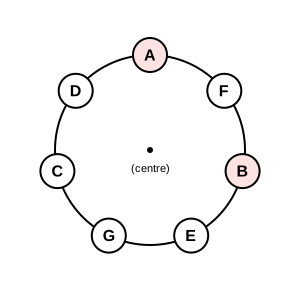
- B is 3rd to the right of C (two between from C’s right).
- D is 3 places from B on the other side, F is 3 places from C on the other side (three between C and F).
- G immediately left of E fills the remaining pair; A takes the last seat.
- Order going right from A: A, D, C, G, E, B, F.
- From A going left: F, then B → 1 person between.
Short trick: Seven seats: “three between” C and F = F is 3rd from C the other way – place C, B, D, F first.
Answer: (A) 1
अवधारणा: केंद्र की ओर मुख: दाएँ = वामावर्त, बाएँ = दक्षिणावर्त।
- C के दाएँ से गिनने पर बीच में दो → B, C के दाएँ तीसरा।
- D, B से दूसरी ओर 3 स्थान पर; F, C से दूसरी ओर 3 स्थान पर (C और F के बीच तीन)।
- G, E के ठीक बाएँ – शेष जोड़ी; A अंतिम सीट पर।
- A से दाएँ क्रम: A, D, C, G, E, B, F.
- A से बाएँ: F, फिर B → बीच में 1 व्यक्ति।
शॉर्ट ट्रिक: 7 सीटों में C और F के बीच “तीन” = दूसरी ओर से तीसरा – पहले C, B, D, F रखें।
उत्तर: (A) 1
RRB ALP CBT 1General Intelligence and ReasoningCircular seating arrangementRRB ALP CBT 1 2025 · 13 Feb Shift 1
Q815.Read the given statement(s) and conclusions carefully. Assuming that the information given in the statements is true, even if it appears to be at variance with commonly known facts, decide which of the given conclusions logically follow(s) from the statement(s).
Statements:
All cows are buttons.
All fingers are buttons.
Conclusions:
(I) No cows are fingers.
(II) Some fingers are cows.
दिए गए कथन/कथनों और निष्कर्षों को ध्यानपूर्वक पढ़िए। यह मानते हुए कि कथनों में दी गई जानकारी सत्य है, भले ही वह सामान्य रूप से ज्ञात तथ्यों से भिन्न प्रतीत होती हो, निर्णय लीजिए कि दिए गए निष्कर्षों में से कौन-सा/कौन-से निष्कर्ष कथन/कथनों का तार्किक रूप से अनुसरण करता है/करते हैं।
कथन:
सभी गायें, बटन हैं।
सभी उंगलियाँ, बटन हैं।
निष्कर्ष:
(I) कोई गाय, उंगली नहीं है।
(II) कुछ उंगलियाँ, गायें हैं।
- ABoth conclusions (I) and (II) follow.निष्कर्ष (I) और (II) दोनों अनुसरण करते हैं।
- BOnly conclusion (I) follows.केवल निष्कर्ष (I) अनुसरण करता है।
- CNeither conclusion (I) nor (II) follows.न तो निष्कर्ष (I) और न ही (II) अनुसरण करता है।
- DOnly conclusion (II) follows.केवल निष्कर्ष (II) अनुसरण करता है।
Show answer
Concept: Two “All” statements with the same predicate (buttons) give no relation between the two subjects.
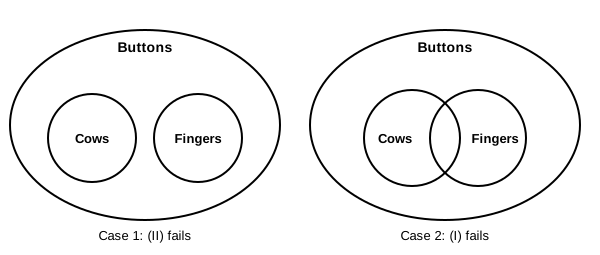
- Cows and fingers are both inside buttons, but they may or may not overlap.
- Case 1 (separate): “Some fingers are cows” is false → (II) not definite.
- Case 2 (overlap): “No cows are fingers” is false → (I) not definite.
- Neither conclusion is certain in every case → neither follows.
Short trick: All A are C + All B are C → no conclusion about A and B (middle term not distributed).
Answer: (C) Neither conclusion (I) nor (II) follows.
अवधारणा: एक ही विधेय (बटन) वाले दो “सभी” कथनों से दोनों विषयों के बीच कोई संबंध नहीं निकलता।
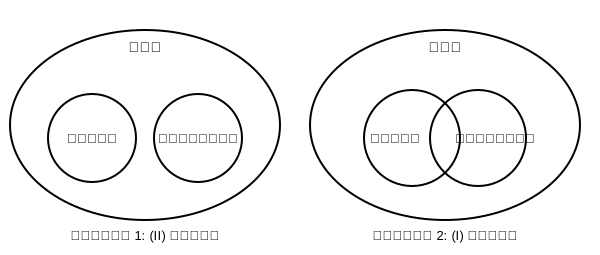
- गायें और उंगलियाँ दोनों बटन के अंदर हैं, पर वे परस्पर मिल भी सकती हैं और नहीं भी।
- स्थिति 1 (अलग): “कुछ उंगलियाँ गायें हैं” असत्य → (II) निश्चित नहीं।
- स्थिति 2 (आंशिक मिलन): “कोई गाय उंगली नहीं है” असत्य → (I) निश्चित नहीं।
- अतः कोई भी निष्कर्ष निश्चित रूप से अनुसरण नहीं करता।
शॉर्ट ट्रिक: सभी A, C हैं + सभी B, C हैं → A और B के बारे में कोई निष्कर्ष नहीं।
उत्तर: (C) न तो निष्कर्ष (I) और न ही (II) अनुसरण करता है।
RRB ALP CBT 1General Intelligence and ReasoningSyllogism – possibilityRRB ALP CBT 1 2025 · 13 Feb Shift 1
Q816.Which of the following is NOT an example of connective tissue?
निम्नलिखित में से कौन-सा संयोजी ऊतक का उदाहरण नहीं है?
- ACartilageउपास्थि
- BBloodरक्त
- CSkinत्वचा
- DBoneअस्थि
Show answer
Concept: Connective tissue connects/supports organs and has cells scattered in a matrix.
- Bone and cartilage → skeletal connective tissue (solid/semi-solid matrix).
- Blood → fluid connective tissue (matrix = plasma).
- Skin (epidermis) is made of stratified squamous epithelial tissue – a covering tissue, not connective.
Short trick: Connective = “B-B-C-L-T-A”: Blood, Bone, Cartilage, Ligament, Tendon, Areolar/Adipose. Skin is a cover → epithelium.
Answer: (C) Skin
अवधारणा: संयोजी ऊतक अंगों को जोड़ता/सहारा देता है; इसकी कोशिकाएँ आधात्री (मैट्रिक्स) में बिखरी रहती हैं।
- अस्थि और उपास्थि → कंकालीय संयोजी ऊतक।
- रक्त → तरल संयोजी ऊतक (आधात्री = प्लाज्मा)।
- त्वचा (बाह्यत्वचा) स्तरित शल्की उपकला ऊतक से बनी है – आवरण ऊतक, संयोजी नहीं।
शॉर्ट ट्रिक: संयोजी = रक्त, अस्थि, उपास्थि, स्नायु, कंडरा, एरिओलर/वसा। त्वचा = आवरण → उपकला।
उत्तर: (C) त्वचा
RRB ALP CBT 1General ScienceAnimal tissues – connective tissueRRB ALP CBT 1 2025 · 13 Feb Shift 1
Q817.Which reaction is NOT a displacement reaction?
कौन-सी अभिक्रिया विस्थापन अभिक्रिया नहीं है?
- ANa + H₂O → NaOH + H₂
- BHCl + NaOH → NaCl + H₂O
- CFe + CuSO₄ → FeSO₄ + Cu
- DZn + H₂SO₄ → ZnSO₄ + H₂
Show answer
Concept: In a displacement reaction a more reactive element pushes a less reactive one out of its compound.
- Na displaces H from water; Fe displaces Cu from CuSO₄; Zn displaces H from H₂SO₄ – all displacement.
- HCl + NaOH → NaCl + H₂O: acid + base → salt + water = neutralisation; no free element displaces another.
Short trick: Look for a lone element on the left side: A, C, D have Na, Fe, Zn; B has none → not displacement.
Answer: (B) HCl + NaOH → NaCl + H₂O
अवधारणा: विस्थापन अभिक्रिया में अधिक क्रियाशील तत्व कम क्रियाशील तत्व को उसके यौगिक से हटा देता है।
- Na जल से H विस्थापित करता है; Fe, CuSO₄ से Cu; Zn, H₂SO₄ से H – सभी विस्थापन।
- HCl + NaOH → NaCl + H₂O: अम्ल + क्षार → लवण + जल = उदासीनीकरण; कोई मुक्त तत्व विस्थापित नहीं करता।
शॉर्ट ट्रिक: बाएँ ओर अकेला तत्व खोजें: A, C, D में Na, Fe, Zn हैं; B में नहीं → विस्थापन नहीं।
उत्तर: (B) HCl + NaOH → NaCl + H₂O
RRB ALP CBT 1General ScienceChemical reactions – displacement vs neutralisationRRB ALP CBT 1 2025 · 13 Feb Shift 1
Q818.A tuning fork is struck harder. Which of the following increases as a result?
एक स्वरित्र (ट्यूनिंग फोर्क) को अधिक जोर से मारा जाता है। इसके परिणामस्वरूप निम्नलिखित में से क्या बढ़ता है?
- AFrequency and amplitudeआवृत्ति और आयाम
- BFrequency onlyकेवल आवृत्ति
- CNeither frequency nor amplitudeन तो आवृत्ति और न ही आयाम
- DAmplitude onlyकेवल आयाम
Show answer
Concept: Frequency (pitch) of a tuning fork depends only on its length, mass and material; amplitude depends on how hard it is struck.
- Striking harder gives more energy → larger vibration → larger amplitude → louder sound.
- The fork still vibrates at its natural frequency → frequency unchanged.
Short trick: “Hit harder = louder, not higher.” Loudness ↔ amplitude, pitch ↔ frequency.
Answer: (D) Amplitude only
अवधारणा: स्वरित्र की आवृत्ति (तारत्व) केवल उसकी लंबाई, द्रव्यमान और पदार्थ पर निर्भर करती है; आयाम इस पर निर्भर करता है कि उसे कितनी जोर से मारा गया।
- जोर से मारने पर अधिक ऊर्जा → बड़ा कंपन → अधिक आयाम → तेज (प्रबल) ध्वनि।
- स्वरित्र अपनी प्राकृतिक आवृत्ति पर ही कंपन करता है → आवृत्ति अपरिवर्तित।
शॉर्ट ट्रिक: “जोर से मारो = तेज आवाज, ऊँचा सुर नहीं।” प्रबलता ↔ आयाम, तारत्व ↔ आवृत्ति।
उत्तर: (D) केवल आयाम
RRB ALP CBT 1General ScienceSound – amplitude and frequencyRRB ALP CBT 1 2025 · 13 Feb Shift 1
Q819.Which of the following best describes a heterogeneous mixture?
निम्नलिखित में से कौन-सा कथन विषमांगी मिश्रण का सबसे अच्छा वर्णन करता है?
- AIt has a single composition.इसका संघटन एक ही होता है।
- BIts components are visibly distinct.इसके घटक स्पष्ट रूप से अलग दिखाई देते हैं।
- CIt is a pure substance.यह एक शुद्ध पदार्थ है।
- DIt cannot be separated physically.इसे भौतिक रूप से अलग नहीं किया जा सकता।
Show answer
Concept: A heterogeneous mixture has non-uniform composition, so its components/boundaries can be seen.
- Examples: sand + water, oil + water, soil, salt + iron filings.
- “Single composition” describes a homogeneous mixture; a mixture is never a pure substance; mixtures CAN be separated by physical methods.
Short trick: Hetero = different → you can SEE the different parts.
Answer: (B) Its components are visibly distinct.
अवधारणा: विषमांगी मिश्रण का संघटन असमान होता है, इसलिए इसके घटक/सीमाएँ दिखाई देती हैं।
- उदाहरण: रेत + पानी, तेल + पानी, मिट्टी, नमक + लौह चूर्ण।
- “एक समान संघटन” समांगी मिश्रण का लक्षण है; मिश्रण कभी शुद्ध पदार्थ नहीं होता; मिश्रण को भौतिक विधियों से अलग किया जा सकता है।
शॉर्ट ट्रिक: विषम = अलग-अलग → अलग भाग आँखों से दिखते हैं।
उत्तर: (B) इसके घटक स्पष्ट रूप से अलग दिखाई देते हैं।
RRB ALP CBT 1General ScienceMatter – heterogeneous mixtureRRB ALP CBT 1 2025 · 13 Feb Shift 1
Q820.If an object is moved from beyond the center of curvature towards the focus in front of a concave mirror, the image _______.
यदि किसी वस्तु को अवतल दर्पण के सामने वक्रता केंद्र से परे से फोकस की ओर ले जाया जाता है, तो प्रतिबिंब _______।
- Abecomes virtual and moves towards the mirrorआभासी हो जाता है और दर्पण की ओर चला जाता है
- Bremains the same size and positionउसी आकार और स्थिति में रहता है
- Cbecomes larger and moves away from the mirrorबड़ा हो जाता है और दर्पण से दूर चला जाता है
- Dbecomes smaller and moves closer to the mirrorछोटा हो जाता है और दर्पण के करीब आ जाता है
Show answer
Concept: For a concave mirror, as the object comes closer (from far towards F), the real image moves away from the mirror and grows.
- Object beyond C → image between F and C, diminished.
- Object at C → image at C, same size.
- Object between C and F → image beyond C, enlarged.
- So moving from beyond C towards F: image becomes larger and moves away from the mirror (to infinity when object reaches F).
Short trick: “Object in, image out” – the object and real image always move in opposite directions.
Answer: (C) becomes larger and moves away from the mirror
अवधारणा: अवतल दर्पण में जैसे-जैसे वस्तु पास आती है (दूर से F की ओर), वास्तविक प्रतिबिंब दर्पण से दूर जाता है और बड़ा होता है।
- वस्तु C से परे → प्रतिबिंब F और C के बीच, छोटा।
- वस्तु C पर → प्रतिबिंब C पर, समान आकार।
- वस्तु C और F के बीच → प्रतिबिंब C से परे, बड़ा।
- अतः C से परे से F की ओर: प्रतिबिंब बड़ा होता है और दर्पण से दूर जाता है (F पर अनंत पर)।
शॉर्ट ट्रिक: “वस्तु अंदर, प्रतिबिंब बाहर” – वस्तु और वास्तविक प्रतिबिंब हमेशा विपरीत दिशा में चलते हैं।
उत्तर: (C) बड़ा हो जाता है और दर्पण से दूर चला जाता है
RRB ALP CBT 1General ScienceLight – image by concave mirrorRRB ALP CBT 1 2025 · 13 Feb Shift 1

