Q761.5% of a number is what percentage of 4% of the same number?
किसी संख्या का 5%, उसी संख्या के 4% का कितना प्रतिशत है?
- A55.55%
- B27.78%
- C125%
- D80%
Show answer
Concept: Same number cancels: compare 5 with 4.
Short trick: Numerator larger than denominator → answer must exceed 100% → only 125%.
Answer: (C) 125%
अवधारणा: संख्या कट जाती है: 5 की तुलना 4 से करें।
शॉर्ट ट्रिक: अंश, हर से बड़ा → उत्तर 100% से अधिक → केवल 125%.
उत्तर: (C) 125%
RRB ALP CBT 1MathematicsPercentage – comparisonRRB ALP CBT 1 2025 · 13 Feb Shift 1
Q762.Sonal takes three times as long as Parul and four times as long as Sweety to complete a decoration work. Working together, they can complete the work in 6 days. How many days will Parul alone take to complete the decoration work?
सोनल को सजावट का काम पूरा करने में पारुल से तीन गुना और स्वीटी से चार गुना अधिक समय लगता है। एक साथ मिलकर वे इस काम को 6 दिनों में पूरा कर सकती हैं। पारुल को अकेले सजावट का काम पूरा करने में कितने दिन लगेंगे?
- A24
- B48
- C12
- D16
Show answer
Concept: Time ∝ 1/efficiency. Take Sonal’s time as LCM of 3 and 4.
- Sonal = 12k days, Parul = 4k days, Sweety = 3k days.
- One-day work:
- → Parul = 4k = 16 days
Short trick: Efficiencies Sonal : Parul : Sweety = 1 : 3 : 4 (total 8). Work = 8 × 6 = 48 units → Parul = 48 ÷ 3 = 16 days.
Answer: (D) 16
अवधारणा: समय ∝ 1/दक्षता. सोनल का समय 3 और 4 का LCM लें।
- सोनल = 12k दिन, पारुल = 4k दिन, स्वीटी = 3k दिन।
- एक दिन का कार्य:
- → पारुल = 16 दिन
शॉर्ट ट्रिक: दक्षता सोनल : पारुल : स्वीटी = 1 : 3 : 4 (कुल 8)। कार्य = 8 × 6 = 48 इकाई → पारुल = 48 ÷ 3 = 16 दिन।
उत्तर: (D) 16
RRB ALP CBT 1MathematicsTime and work – efficiency ratioRRB ALP CBT 1 2025 · 13 Feb Shift 1
Q763.Two trains A and B are running in opposite directions with speeds of 66 km/hr and 60 km/hr, respectively. If the length of the train A is 240 m and they cross each other in 10 seconds, then find the length of the train B.
दो रेलगाड़ियाँ A और B क्रमशः 66 km/hr और 60 km/hr की चाल से विपरीत दिशाओं में चल रही हैं। यदि रेलगाड़ी A की लंबाई 240 m है और वे एक-दूसरे को 10 सेकंड में पार करती हैं, तो रेलगाड़ी B की लंबाई ज्ञात कीजिए।
- A110 m
- B120 m
- C144 m
- D150 m
Show answer
Concept: Opposite directions → add speeds; distance covered = sum of lengths.
- Relative speed = 66 + 60 = 126 km/h = m/s
- Total length = 35 × 10 = 350 m
- Length of B = 350 − 240 = 110 m
Short trick: 126 km/h = 35 m/s (since 18 km/h = 5 m/s → 126 = 7 × 18).
Answer: (A) 110 m
अवधारणा: विपरीत दिशा → चालें जोड़ें; तय दूरी = लंबाइयों का योग।
- सापेक्ष चाल = 66 + 60 = 126 km/h = m/s
- कुल लंबाई = 35 × 10 = 350 m
- B की लंबाई = 350 − 240 = 110 m
शॉर्ट ट्रिक: 126 km/h = 35 m/s (18 km/h = 5 m/s, 126 = 7 × 18)।
उत्तर: (A) 110 m
RRB ALP CBT 1MathematicsTrains – opposite directionsRRB ALP CBT 1 2025 · 13 Feb Shift 1
Q764.If x : y = 9 : 11, then what is the value of ?
यदि x : y = 9 : 11 है, तो का मान क्या है?
- A
- B
- C
- D
Show answer
Concept: ; then put x = 9k, y = 11k.
Short trick: Put k = 1 (x = 9, y = 11): value = 10/8 = 1.25; only (11k − 1)/(9k − 1) = 10/8.
Answer: (C)
अवधारणा: ; फिर x = 9k, y = 11k रखें।
शॉर्ट ट्रिक: k = 1 रखें (x = 9, y = 11): मान = 10/8; केवल (11k − 1)/(9k − 1) = 10/8.
उत्तर: (C)
RRB ALP CBT 1MathematicsAlgebra – ratio and identitiesRRB ALP CBT 1 2025 · 13 Feb Shift 1
Q765.Anand purchased an item and incurred ₹82 as repair expenses. Subsequently, he sold it to Bharath with 25% profit. Eventually, Bharath sold the item for ₹2915, making 47% loss. What was the cost (in ₹) of the item for Anand just before selling it to Bharath?
आनंद ने एक वस्तु खरीदी और उस पर मरम्मत खर्च के रूप में ₹82 खर्च किए। इसके बाद, उसने इसे 25% लाभ पर भरत को बेच दिया। अंततः, भरत ने 47% हानि उठाकर वस्तु को ₹2915 में बेच दिया। भरत को बेचने से ठीक पहले आनंद के लिए वस्तु की लागत (₹ में) क्या थी?
- A4400
- B4397
- C4402
- D4398
Show answer
Concept: Work backwards from the final selling price.
- Bharath’s CP =
- Anand’s SP = 5500 = 1.25 × (Anand’s total cost)
- Anand’s cost (including repair) =
Short trick: (2915 = 53 × 55).
Answer: (A) 4400
अवधारणा: अंतिम विक्रय मूल्य से पीछे की ओर चलें।
- भरत का क्रय मूल्य =
- आनंद का विक्रय मूल्य = 5500 = 1.25 × (आनंद की कुल लागत)
- आनंद की लागत (मरम्मत सहित) =
शॉर्ट ट्रिक: (2915 = 53 × 55)।
उत्तर: (A) 4400
RRB ALP CBT 1MathematicsProfit and loss – successive transactionsRRB ALP CBT 1 2025 · 13 Feb Shift 1
Q766.The following data shows the ages of the patients admitted in a hospital during a year. What is the modal age of the patients (correct to 2 decimal places)?
| Age (in years) | 5 - 10 | 10 - 15 | 15 - 20 | 20 - 25 | 25 - 30 | 30 - 35 | 35 - 40 |
|---|
| Number of Patients | 4 | 10 | 8 | 2 | 12 | 6 | 3 |
|---|
निम्नलिखित आँकड़े एक वर्ष के दौरान एक अस्पताल में भर्ती मरीजों की आयु दर्शाते हैं। मरीजों की बहुलक आयु (2 दशमलव स्थानों तक) क्या है?
| आयु (वर्षों में) | 5 - 10 | 10 - 15 | 15 - 20 | 20 - 25 | 25 - 30 | 30 - 35 | 35 - 40 |
|---|
| मरीजों की संख्या | 4 | 10 | 8 | 2 | 12 | 6 | 3 |
|---|
- A33.51 years33.51 वर्ष
- B28.13 years28.13 वर्ष
- C29.12 years29.12 वर्ष
- D32.23 years32.23 वर्ष
Show answer
Concept: Mode
- Highest frequency 12 → modal class 25 – 30: l = 25, = 12, = 2, = 6, h = 5.
- Mode
- years
Short trick: Answer must lie inside the modal class 25 – 30 → 28.13 or 29.12; 3.125 = 50/16 gives 28.13.
Answer: (B) 28.13 years
अवधारणा: बहुलक
- सर्वाधिक बारंबारता 12 → बहुलक वर्ग 25 – 30: l = 25, = 12, = 2, = 6, h = 5.
- बहुलक
- वर्ष
शॉर्ट ट्रिक: उत्तर बहुलक वर्ग 25 – 30 के अंदर होगा → 28.13 या 29.12; 50/16 = 3.125 → 28.13.
उत्तर: (B) 28.13 वर्ष
RRB ALP CBT 1MathematicsStatistics – mode of grouped dataRRB ALP CBT 1 2025 · 13 Feb Shift 1
Q767.A and B can complete a job in 12 days and 18 days, respectively. If they work together for 6 days, how much of the job is left to be done?
A और B एक काम को क्रमशः 12 दिन और 18 दिन में पूरा कर सकते हैं। यदि वे 6 दिनों तक एक साथ काम करते हैं, तो कितना काम पूरा करना शेष रह जाता है?
- A of the jobकार्य का
- B of the jobकार्य का
- C of the jobकार्य का
- D of the jobकार्य का
Show answer
Concept: Work done = days × combined one-day work.
- One-day work
- In 6 days:
- Left
Short trick: Total work = LCM 36 units; A = 3, B = 2 per day → 6 days × 5 = 30 → left 6/36 = 1/6.
Answer: (B) of the job
अवधारणा: किया गया कार्य = दिन × संयुक्त एक दिन का कार्य।
- एक दिन का कार्य
- 6 दिनों में:
- शेष
शॉर्ट ट्रिक: कुल कार्य = LCM 36 इकाई; A = 3, B = 2 प्रतिदिन → 6 × 5 = 30 → शेष 6/36 = 1/6.
उत्तर: (B) कार्य का
RRB ALP CBT 1MathematicsTime and work – remaining workRRB ALP CBT 1 2025 · 13 Feb Shift 1
Q768.A sum of ₹3,540 is divided between Nisha, Sameer and Rupesh such that if their shares are decreased by ₹760, ₹190 and ₹280, respectively, then they are in the ratio of 10 : 2 : 9. What is the original share of Sameer?
₹3,540 की राशि निशा, समीर और रुपेश के बीच इस प्रकार विभाजित की जाती है कि यदि उनके हिस्सों में क्रमशः ₹760, ₹190 और ₹280 की कमी की जाए, तो वे 10 : 2 : 9 के अनुपात में होते हैं। समीर का मूल हिस्सा क्या है?
- A₹596
- B₹137
- C₹410
- D₹468
Show answer
Concept: Subtract the reductions from the total first; the remainder is in the given ratio.
- Remaining total = 3540 − (760 + 190 + 280) = 3540 − 1230 = 2310
- 1 part = 2310 ÷ (10 + 2 + 9) = 2310 ÷ 21 = 110
- Sameer = 2 × 110 + 190 = 410
Short trick: Sameer’s share − 190 must be even multiple of 110: 410 − 190 = 220 ✓.
Answer: (C) ₹410
अवधारणा: पहले कुल राशि से कटौतियाँ घटाएँ; शेष दिए गए अनुपात में होगा।
- शेष = 3540 − 1230 = 2310
- 1 भाग = 2310 ÷ 21 = 110
- समीर = 2 × 110 + 190 = 410
शॉर्ट ट्रिक: समीर का हिस्सा − 190, 110 का दोगुना होना चाहिए: 410 − 190 = 220 ✓.
उत्तर: (C) ₹410
RRB ALP CBT 1MathematicsRatio – shares after reductionRRB ALP CBT 1 2025 · 13 Feb Shift 1
Q769.If x% of 600 = 12% of 250 + 18% of 300, then the value of x is:
यदि 600 का x% = 250 का 12% + 300 का 18% है, तो x का मान क्या है?
- A12
- B18
- C16
- D14
Show answer
Concept: Evaluate the right side and divide.
- 12% of 250 = 30; 18% of 300 = 54 → total 84
Short trick: x% of 600 = 6x → x = 84 ÷ 6 = 14.
Answer: (D) 14
अवधारणा: दाएँ पक्ष का मान निकालें और भाग दें।
- 250 का 12% = 30; 300 का 18% = 54 → कुल 84
शॉर्ट ट्रिक: 600 का x% = 6x → x = 84 ÷ 6 = 14.
उत्तर: (D) 14
RRB ALP CBT 1MathematicsPercentage – equationRRB ALP CBT 1 2025 · 13 Feb Shift 1
Q770.A person drove at 53 kmph for 2.5 hours, then increased his speed by 28 kmph, and reached the destination in another hour. Find the average speed (in kmph) of the person during the entire journey.
एक व्यक्ति ने 2.5 घंटे तक 53 kmph की चाल से गाड़ी चलाई, फिर अपनी चाल 28 kmph बढ़ा दी, और अगले एक घंटे में गंतव्य पर पहुँच गया। पूरी यात्रा के दौरान व्यक्ति की औसत चाल (kmph में) ज्ञात कीजिए।
- A59
- B61
- C60
- D58
Show answer
Concept: Average speed = total distance ÷ total time.
- Distance 1 = 53 × 2.5 = 132.5 km
- New speed = 53 + 28 = 81 km/h → distance 2 = 81 km
- Average = km/h
Short trick: Time-weighted mean: .
Answer: (B) 61
अवधारणा: औसत चाल = कुल दूरी ÷ कुल समय।
- दूरी 1 = 53 × 2.5 = 132.5 km
- नई चाल = 53 + 28 = 81 km/h → दूरी 2 = 81 km
- औसत = km/h
शॉर्ट ट्रिक: समय-भारित औसत: .
उत्तर: (B) 61
RRB ALP CBT 1MathematicsSpeed – average speedRRB ALP CBT 1 2025 · 13 Feb Shift 1
Q771.Find the mean proportional of 49 and 16.
49 और 16 का मध्यानुपाती ज्ञात कीजिए।
- A36
- B32
- C28
- D24
Show answer
Concept: Mean proportional of a and b = .
Short trick: Both are perfect squares → multiply their roots: 7 × 4.
Answer: (C) 28
अवधारणा: a और b का मध्यानुपाती = ।
शॉर्ट ट्रिक: दोनों पूर्ण वर्ग → मूलों का गुणा: 7 × 4.
उत्तर: (C) 28
RRB ALP CBT 1MathematicsRatio – mean proportionalRRB ALP CBT 1 2025 · 13 Feb Shift 1
Q772.Find the simplified value of the following expression.
निम्नलिखित व्यंजक का सरलीकृत मान ज्ञात कीजिए।
- A23
- B22
- C21
- D24
Show answer
Concept: Brackets first, then ×, then −, then divide by 4.
- 36 ÷ 3 = 12, 48 ÷ 6 = 8, 16 ÷ 2 = 8
- 12 × 8 − 8 = 96 − 8 = 88
- 88 ÷ 4 = 22
Short trick:
Answer: (B) 22
अवधारणा: पहले कोष्ठक, फिर ×, फिर −, फिर 4 से भाग।
- 36 ÷ 3 = 12, 48 ÷ 6 = 8, 16 ÷ 2 = 8
- 12 × 8 − 8 = 88
- 88 ÷ 4 = 22
शॉर्ट ट्रिक:
उत्तर: (B) 22
RRB ALP CBT 1MathematicsSimplification – BODMASRRB ALP CBT 1 2025 · 13 Feb Shift 1
Q773.In a circle, the diameter PQ is extended through Q to an external point X. Tangent XY is drawn to point Y on the circle. If XY = 15 cm and QX = 9 cm, then find the radius of the circle.
एक वृत्त में, व्यास PQ को Q से होकर एक बाहरी बिंदु X तक बढ़ाया जाता है। वृत्त पर बिंदु Y तक स्पर्शरेखा XY खींची जाती है। यदि XY = 15 cm और QX = 9 cm है, तो वृत्त की त्रिज्या ज्ञात कीजिए।
- A9 cm
- B7 cm
- C10 cm
- D8 cm
Show answer
Concept: From an external point: (tangent)² = (whole secant) × (external part): .
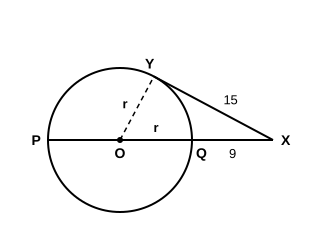
- XP = XQ + QP = 9 + 2r
- cm
Short trick: OY ⊥ XY: with OX = r + 9 → (r + 9)² − r² = 225 → 18r + 81 = 225 → r = 8.
Answer: (D) 8 cm
अवधारणा: बाह्य बिंदु से: (स्पर्शरेखा)² = (पूरा छेदक) × (बाहरी भाग): ।
- XP = XQ + QP = 9 + 2r
- cm
शॉर्ट ट्रिक: OY ⊥ XY: , OX = r + 9 → 18r + 81 = 225 → r = 8.
उत्तर: (D) 8 cm
RRB ALP CBT 1MathematicsCircles – tangent–secant theoremRRB ALP CBT 1 2025 · 13 Feb Shift 1
Q774.A student's marks were incorrectly entered as 25 instead of 37. Due to this, the average marks of the class got decreased by . What is the number of students in the class?
एक छात्र के अंक गलती से 37 के स्थान पर 25 दर्ज किए गए। इसके कारण, कक्षा के औसत अंक कम हो गए। कक्षा में छात्रों की संख्या कितनी है?
- A3
- B9
- C1
- D19
Show answer
Concept: Change in average = (error in total) ÷ (number of students).
- Error = 37 − 25 = 12
Short trick: n = difference ÷ change in average.
Answer: (B) 9
अवधारणा: औसत में परिवर्तन = (योग में त्रुटि) ÷ (छात्रों की संख्या)।
- त्रुटि = 37 − 25 = 12
शॉर्ट ट्रिक: n = अंतर ÷ औसत में परिवर्तन।
उत्तर: (B) 9
RRB ALP CBT 1MathematicsAverage – wrong entryRRB ALP CBT 1 2025 · 13 Feb Shift 1
Q775.PQ is a direct common tangent of two circles with centres and , respectively, that contact each other externally at a point A. The circles have radii of 11 cm and 4 cm, respectively. Find the length of PQ.
PQ, क्रमशः और केंद्र वाले दो वृत्तों की सीधी उभयनिष्ठ स्पर्शरेखा है, जो एक-दूसरे को बिंदु A पर बाह्य रूप से स्पर्श करते हैं। वृत्तों की त्रिज्याएँ क्रमशः 11 cm और 4 cm हैं। PQ की लंबाई ज्ञात कीजिए।
- A cm
- B cm
- C cm
- D cm
Show answer
Concept: Direct common tangent ; circles touching externally → .
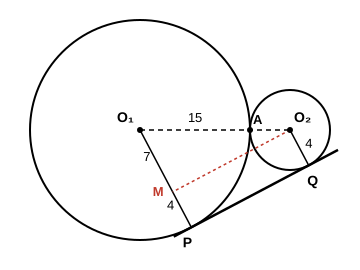
- d = 11 + 4 = 15 cm
- cm
Short trick: For externally touching circles, .
Answer: (D) cm
अवधारणा: सीधी उभयनिष्ठ स्पर्शरेखा ; बाह्य रूप से स्पर्श करने वाले वृत्त → ।
- d = 11 + 4 = 15 cm
- cm
शॉर्ट ट्रिक: बाह्य स्पर्श वाले वृत्तों में .
उत्तर: (D) cm
RRB ALP CBT 1MathematicsCircles – direct common tangentRRB ALP CBT 1 2025 · 13 Feb Shift 1
Q776.Based on the English alphabetical order, three of the following four letter-cluster pairs are alike in a certain way and thus form a group. Which letter-cluster pair DOES NOT belong to that group? (Note: The odd one out is not based on the number of consonants/vowels or their position in the letter-cluster.)
अंग्रेजी वर्णमाला क्रम के आधार पर, निम्नलिखित चार अक्षर-समूह युग्मों में से तीन किसी निश्चित प्रकार से एकसमान हैं और इस प्रकार एक समूह बनाते हैं। कौन-सा अक्षर-समूह युग्म उस समूह से संबंधित नहीं है? (ध्यान दें: असंगत का निर्धारण अक्षर-समूह में व्यंजनों/स्वरों की संख्या या उनके स्थान के आधार पर नहीं है।)
- APT - MR
- BEI - BF
- CNR - KO
- DJN - GK
Show answer
Concept: Compare the letter gaps inside each cluster and between the two clusters of a pair.
- EI – BF: E→I = +4, B→F = +4; E→B = −3, I→F = −3.
- NR – KO: +4, +4; −3, −3.
- JN – GK: +4, +4; −3, −3.
- PT – MR: P→T = +4 but M→R = +5 (T→R is only −2).
Short trick: Just check the second cluster: BF, KO, GK all have gap +4; MR has gap +5 → odd.
Answer: (A) PT - MR
अवधारणा: प्रत्येक समूह के अंदर तथा युग्म के दोनों समूहों के बीच अक्षरों का अंतर देखें।
- EI – BF: E→I = +4, B→F = +4; E→B = −3, I→F = −3.
- NR – KO: +4, +4; −3, −3.
- JN – GK: +4, +4; −3, −3.
- PT – MR: P→T = +4 पर M→R = +5 (T→R केवल −2)।
शॉर्ट ट्रिक: केवल दूसरा समूह देखें: BF, KO, GK में अंतर +4 है; MR में +5 → असंगत।
उत्तर: (A) PT - MR
RRB ALP CBT 1General Intelligence and ReasoningOdd one out – letter-cluster pairsRRB ALP CBT 1 2025 · 13 Feb Shift 1
Q777.This question is based on the five, three-digit numbers given below.
(Left) 567 154 264 614 328 (Right)
(Example- 697 – First digit = 6, second digit = 9 and third digit = 7)
What will be the resultant if third digit of the highest number is added to the second digit of lowest number?
यह प्रश्न नीचे दी गई पाँच, तीन अंकों वाली संख्याओं पर आधारित है।
(बाएँ) 567 154 264 614 328 (दाएँ)
(उदाहरण- 697 – पहला अंक = 6, दूसरा अंक = 9 और तीसरा अंक = 7)
यदि सबसे बड़ी संख्या के तीसरे अंक को सबसे छोटी संख्या के दूसरे अंक में जोड़ा जाए, तो परिणाम क्या होगा?
- A5
- B6
- C9
- D8
Show answer
Concept: Identify the highest and lowest numbers, then pick the asked digits.
- Highest = 614 → third digit = 4.
- Lowest = 154 → second digit = 5.
- 4 + 5 = 9
Short trick: Compare only the first digits: 6 is largest (614), 1 is smallest (154).
Answer: (C) 9
अवधारणा: सबसे बड़ी और सबसे छोटी संख्या पहचानें, फिर पूछे गए अंक लें।
- सबसे बड़ी = 614 → तीसरा अंक = 4.
- सबसे छोटी = 154 → दूसरा अंक = 5.
- 4 + 5 = 9
शॉर्ट ट्रिक: केवल पहले अंक की तुलना करें: 6 सबसे बड़ा (614), 1 सबसे छोटा (154)।
उत्तर: (C) 9
RRB ALP CBT 1General Intelligence and ReasoningNumber arrangement – digit operationsRRB ALP CBT 1 2025 · 13 Feb Shift 1
Q778.Ashutosh starts from Point A and drives 19 km towards West. He then takes a left turn, drives 9 km, turns left and drives 26 km. He then takes a left turn and drives 19 km. He takes a final left turn, drives 7 km and stops at Point P. How far (shortest distance) and towards which direction should he drive in order to reach Point A again? (All turns are 90-degree turns only, unless specified.)
आशुतोष बिंदु A से शुरू करता है और पश्चिम की ओर 19 km गाड़ी चलाता है। फिर वह बाएँ मुड़ता है, 9 km गाड़ी चलाता है, बाएँ मुड़ता है और 26 km गाड़ी चलाता है। फिर वह बाएँ मुड़ता है और 19 km गाड़ी चलाता है। वह अंतिम बार बाएँ मुड़ता है, 7 km गाड़ी चलाता है और बिंदु P पर रुक जाता है। बिंदु A पर फिर से पहुँचने के लिए उसे कितनी दूर (न्यूनतम दूरी) और किस दिशा में गाड़ी चलानी चाहिए? (जब तक निर्दिष्ट न किया जाए, सभी मोड़ केवल 90 डिग्री के मोड़ हैं।)
- A10 km to the Northउत्तर की ओर 10 km
- B11 km to the Northउत्तर की ओर 11 km
- C11 km to the Southदक्षिण की ओर 11 km
- D10 km to the Southदक्षिण की ओर 10 km
Show answer
Concept: Take A = (0, 0); East = +x, North = +y. A left turn from West faces South, and so on.
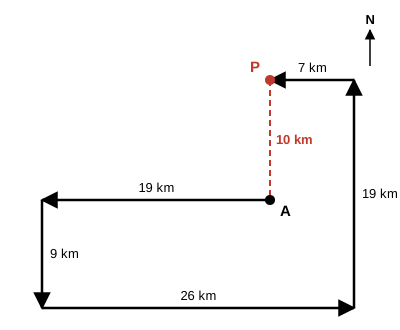
- West 19 → (−19, 0); left → South 9 → (−19, −9)
- left → East 26 → (7, −9); left → North 19 → (7, 10)
- left → West 7 → P = (0, 10)
- P is 10 km North of A → drive 10 km South.
Short trick: Net x = −19 + 26 − 7 = 0; net y = −9 + 19 = +10 → P is straight 10 km north of A.
Answer: (D) 10 km to the South
अवधारणा: A = (0, 0) लें; पूर्व = +x, उत्तर = +y. पश्चिम की ओर से बाएँ मुड़ने पर दक्षिण दिशा, इत्यादि।
- पश्चिम 19 → (−19, 0); बाएँ → दक्षिण 9 → (−19, −9)
- बाएँ → पूर्व 26 → (7, −9); बाएँ → उत्तर 19 → (7, 10)
- बाएँ → पश्चिम 7 → P = (0, 10)
- P, A से 10 km उत्तर में है → 10 km दक्षिण की ओर जाना होगा।
शॉर्ट ट्रिक: कुल x = −19 + 26 − 7 = 0; कुल y = −9 + 19 = +10 → P, A के ठीक 10 km उत्तर में।
उत्तर: (D) दक्षिण की ओर 10 km
RRB ALP CBT 1General Intelligence and ReasoningDirection sense – shortest distanceRRB ALP CBT 1 2025 · 13 Feb Shift 1
Q779.A, G, H, P, S and Y live on six different floors of the same building. The lowermost floor in the building is numbered 1, the floor above it is numbered 2 and so on till the topmost floor is numbered 6. Only three people live between Y and H, where Y lives below H. G lives on an odd-numbered floor and immediately above Y. S lives on one of the floors below A and on one of the floors above P. Who lives on floor numbered 5?
A, G, H, P, S और Y एक ही इमारत की छह अलग-अलग मंजिलों पर रहते हैं। इमारत की सबसे निचली मंजिल की संख्या 1 है, उसके ऊपर वाली मंजिल की संख्या 2 है और इसी प्रकार सबसे ऊपरी मंजिल की संख्या 6 है। Y और H के बीच केवल तीन लोग रहते हैं, जहाँ Y, H से नीचे रहता है। G एक विषम संख्या वाली मंजिल पर और Y के ठीक ऊपर रहता है। S, A से नीचे की किसी एक मंजिल पर और P से ऊपर की किसी एक मंजिल पर रहता है। मंजिल संख्या 5 पर कौन रहता है?
- AY
- BG
- CP
- DA
Show answer
Concept: Fix the pair with the most definite gap first (Y–H), then use the odd-floor clue.
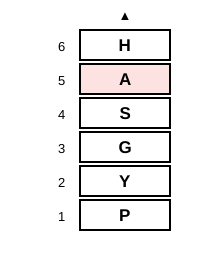
- Three people between Y and H, Y below H → (Y1, H5) or (Y2, H6).
- G is on an odd floor immediately above Y → Y = 2, G = 3, H = 6 (Y1 gives G = 2, even ✗).
- Left floors 1, 4, 5 for P, S, A with P < S < A → P = 1, S = 4, A = 5.
Short trick: “G odd and just above Y” forces Y even → Y = 2 immediately.
Answer: (D) A
अवधारणा: पहले सबसे निश्चित अंतर वाली जोड़ी (Y–H) तय करें, फिर विषम मंजिल वाला संकेत लगाएँ।
- Y और H के बीच तीन लोग, Y नीचे → (Y1, H5) या (Y2, H6).
- G विषम मंजिल पर, Y के ठीक ऊपर → Y = 2, G = 3, H = 6 (Y1 से G = 2 सम ✗).
- बची मंजिलें 1, 4, 5: P < S < A → P = 1, S = 4, A = 5.
शॉर्ट ट्रिक: “G विषम और Y के ठीक ऊपर” से Y सम होगा → तुरंत Y = 2.
उत्तर: (D) A
RRB ALP CBT 1General Intelligence and ReasoningFloor puzzleRRB ALP CBT 1 2025 · 13 Feb Shift 1
Q780.What will come in place of the question mark (?) in the following equation, if '+' and '÷' are interchanged and '-' and 'x' are interchanged?
243 + 9 x 4 - 19 ÷ 200 = ?
यदि '+' और '÷' को आपस में बदल दिया जाए तथा '-' और 'x' को आपस में बदल दिया जाए, तो निम्नलिखित समीकरण में प्रश्न चिह्न (?) के स्थान पर क्या आएगा?
243 + 9 x 4 - 19 ÷ 200 = ?
- A156
- B149
- C144
- D151
Show answer
Concept: Swap the signs first, then apply BODMAS.
- + ↔ ÷ and − ↔ ×: 243 ÷ 9 − 4 × 19 + 200
- = 27 − 76 + 200
- = 151
Short trick: Unit digit check: 7 − 6 + 0 → ends in 1 → only 151.
Answer: (D) 151
अवधारणा: पहले चिह्न बदलें, फिर BODMAS लगाएँ।
- + ↔ ÷ तथा − ↔ ×: 243 ÷ 9 − 4 × 19 + 200
- = 27 − 76 + 200
- = 151
शॉर्ट ट्रिक: इकाई अंक: 7 − 6 + 0 → अंत में 1 → केवल 151.
उत्तर: (D) 151
RRB ALP CBT 1General Intelligence and ReasoningMathematical operations – sign interchangeRRB ALP CBT 1 2025 · 13 Feb Shift 1

