Q721.Wasim starts from Point A and drives 24 km towards the south. He then takes a right turn, drives 24 km, turns right and drives 31 km. He then takes a right turn and drives 33 km. He takes a final right turn, drives 7 km and stops at Point P. How far (shortest distance) and towards which direction should he drive in order to reach Point A again? (All turns are 90-degree turns only unless specified.)
वसीम बिंदु A से शुरू करके दक्षिण की ओर 24 km गाड़ी चलाता है। फिर वह दाएँ मुड़ता है, 24 km चलाता है, दाएँ मुड़ता है और 31 km चलाता है। फिर वह दाएँ मुड़ता है और 33 km चलाता है। वह अंतिम बार दाएँ मुड़ता है, 7 km चलाता है और बिंदु P पर रुक जाता है। बिंदु A पर फिर से पहुँचने के लिए उसे कितनी दूरी (न्यूनतम दूरी) और किस दिशा में गाड़ी चलानी चाहिए? (जब तक निर्दिष्ट न हो, सभी मोड़ केवल 90 डिग्री के हैं।)
- A6 km to the east6 km पूर्व की ओर
- B8 km to the west8 km पश्चिम की ओर
- C9 km to the west9 km पश्चिम की ओर
- D7 km to the east7 km पूर्व की ओर
Show answer
Concept: Track net east-west and north-south displacement (take A as origin).
- South 24 → (0, −24). Right turn (facing south) = west 24 → (−24, −24).
- Right = north 31 → (−24, 7). Right = east 33 → (9, 7). Right = south 7 → (9, 0) = P.
- P is 9 km east of A on the same line → drive 9 km west.
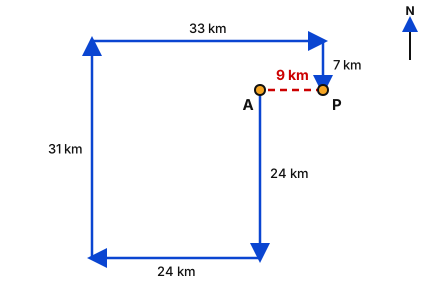
Short trick: N−S: −24 + 31 − 7 = 0; E−W: −24 + 33 = +9 east → go 9 km west.
Answer: (C) 9 km to the west
अवधारणा: कुल पूर्व-पश्चिम और उत्तर-दक्षिण विस्थापन ज्ञात करें (A को मूल बिंदु मानें)।
- दक्षिण 24 → (0, −24)। दाएँ मोड़ (दक्षिण मुख) = पश्चिम 24 → (−24, −24)।
- दाएँ = उत्तर 31 → (−24, 7)। दाएँ = पूर्व 33 → (9, 7)। दाएँ = दक्षिण 7 → (9, 0) = P।
- P, A से 9 km पूर्व में एक ही रेखा पर → 9 km पश्चिम की ओर चलना होगा।
शॉर्ट ट्रिक: उ−द: −24 + 31 − 7 = 0; पू−प: −24 + 33 = +9 पूर्व → 9 km पश्चिम जाएँ।
उत्तर: (C) 9 km पश्चिम की ओर
RRB ALP CBT 1General Intelligence and ReasoningDirection sense – right turnsRRB ALP CBT 1 2025 · 16 Feb Shift 1
Q722.If ‘A’ stands for ‘÷’, ‘B’ stands for ‘×’, ‘C’ stands for ‘+’ and ‘D’ stands for ‘−’, what will come in place of the question mark (?) in the following equation?
45 C 9 B 7 D 195 A 13 = ?
यदि ‘A’ का अर्थ ‘÷’, ‘B’ का अर्थ ‘×’, ‘C’ का अर्थ ‘+’ और ‘D’ का अर्थ ‘−’ है, तो निम्नलिखित समीकरण में प्रश्न चिह्न (?) के स्थान पर क्या आएगा?
45 C 9 B 7 D 195 A 13 = ?
- A93
- B94
- C95
- D90
Show answer
Concept: Replace letters by operators, then apply BODMAS.
- 45 C 9 B 7 D 195 A 13 → 45 + 9 × 7 − 195 ÷ 13.
- = 45 + 63 − 15.
- = 93.
Short trick: Units-digit check: 5 + 3 − 5 = 3 → only 93 ends in 3.
Answer: (A) 93
अवधारणा: अक्षरों को संक्रियाओं से बदलें, फिर BODMAS लगाएँ।
- 45 C 9 B 7 D 195 A 13 → 45 + 9 × 7 − 195 ÷ 13।
- = 45 + 63 − 15।
- = 93।
शॉर्ट ट्रिक: इकाई अंक जाँच: 5 + 3 − 5 = 3 → केवल 93 का इकाई अंक 3 है।
उत्तर: (A) 93
RRB ALP CBT 1General Intelligence and ReasoningSymbol substitution – BODMASRRB ALP CBT 1 2025 · 16 Feb Shift 1
Q723.Based on the English alphabetical order, three of the following four letter-cluster pairs are alike in a certain way and thus form a group. Which letter-cluster pair DOES NOT belong to that group? (Note: The odd one out is not based on the number of consonants/vowels or their position in the letter-cluster.)
अंग्रेज़ी वर्णमाला क्रम के आधार पर, निम्नलिखित चार अक्षर-समूह युग्मों में से तीन किसी निश्चित प्रकार से समान हैं और इस प्रकार एक समूह बनाते हैं। कौन-सा अक्षर-समूह युग्म उस समूह से संबंधित नहीं है? (ध्यान दें: असंगत अक्षर-समूह युग्म, उस अक्षर-समूह में व्यंजनों/स्वरों की संख्या या उनके स्थान पर आधारित नहीं है।)
- ARS-VW
- BTZ-AB
- CGH-KL
- DAB-EF
Show answer
Concept: In each pair, check (i) letters within a cluster and (ii) the jump between clusters.
- RS-VW: RS, VW consecutive; R +4 = V.
- GH-KL: consecutive; G +4 = K.
- AB-EF: consecutive; A +4 = E.
- TZ-AB: T and Z are not consecutive (and T +4 = X, not A) ✗.
Short trick: Three pairs are 'two consecutive letters, then skip three'; TZ breaks the consecutive rule at a glance.
Answer: (B) TZ-AB
अवधारणा: प्रत्येक युग्म में (i) समूह के अंदर के अक्षर और (ii) समूहों के बीच की छलाँग जाँचें।
- RS-VW: RS, VW क्रमागत; R +4 = V।
- GH-KL: क्रमागत; G +4 = K।
- AB-EF: क्रमागत; A +4 = E।
- TZ-AB: T और Z क्रमागत नहीं (और T +4 = X, A नहीं) ✗।
शॉर्ट ट्रिक: तीन युग्म 'दो क्रमागत अक्षर, फिर तीन छोड़कर' हैं; TZ पहली नज़र में ही नियम तोड़ता है।
उत्तर: (B) TZ-AB
RRB ALP CBT 1General Intelligence and ReasoningOdd one out – letter-cluster pairsRRB ALP CBT 1 2025 · 16 Feb Shift 1
Q724.In a certain code language, ‘HAST’ is coded as ‘3586’ and ‘DAHS’ is coded as ‘6357’. What is the code for ‘D’ in the given code language?
एक निश्चित कूट भाषा में, ‘HAST’ को ‘3586’ और ‘DAHS’ को ‘6357’ के रूप में कूटबद्ध किया जाता है। दी गई कूट भाषा में ‘D’ का कूट क्या है?
- A5
- B6
- C3
- D7
Show answer
Concept: Letter codes are jumbled; compare common letters and common digits.
- HAST → {3, 5, 8, 6}; DAHS → {6, 3, 5, 7}.
- Common letters A, H, S ↔ common digits 3, 5, 6.
- Left over in DAHS: letter D ↔ digit 7 (and T ↔ 8).
Short trick: Uncommon letter ↔ uncommon digit: D is the only new letter, 7 the only new digit.
Answer: (D) 7
अवधारणा: अक्षरों के कोड क्रम में नहीं हैं; उभयनिष्ठ अक्षरों और अंकों की तुलना करें।
- HAST → {3, 5, 8, 6}; DAHS → {6, 3, 5, 7}।
- उभयनिष्ठ अक्षर A, H, S ↔ उभयनिष्ठ अंक 3, 5, 6।
- DAHS में शेष: अक्षर D ↔ अंक 7 (और T ↔ 8)।
शॉर्ट ट्रिक: अलग अक्षर ↔ अलग अंक: D ही नया अक्षर है, 7 ही नया अंक।
उत्तर: (D) 7
RRB ALP CBT 1General Intelligence and ReasoningCoding – common lettersRRB ALP CBT 1 2025 · 16 Feb Shift 1
Q725.Select the pair which follows the same pattern as that followed by the two pairs given below. Both pairs follow the same pattern.
VQG : WNJ
DUN : ERQ
उस युग्म का चयन करें जो उसी पैटर्न का अनुसरण करता है जिसका अनुसरण नीचे दिए गए दो युग्म करते हैं। दोनों युग्म समान पैटर्न का अनुसरण करते हैं।
VQG : WNJ
DUN : ERQ
- ANPL : OLO
- BIRI : JOL
- CPNQ : QKS
- DKRG : LOI
Show answer
Concept: Find the shift for each position: +1, −3, +3.
- VQG : WNJ → V+1 = W, Q−3 = N, G+3 = J.
- DUN : ERQ → D+1 = E, U−3 = R, N+3 = Q ✓.
- IRI : JOL → I+1 = J, R−3 = O, I+3 = L ✓.
- Others fail: NPL → O M O (not OLO), PNQ → Q K T (not QKS), KRG → L O J (not LOI).
Short trick: Check only the 3rd letter (+3): NPL gives L→O, PNQ gives Q→T, KRG gives G→J – only IRI gives I→L as printed.
Answer: (B) IRI : JOL
अवधारणा: प्रत्येक स्थान का खिसकाव: +1, −3, +3।
- VQG : WNJ → V+1 = W, Q−3 = N, G+3 = J।
- DUN : ERQ → D+1 = E, U−3 = R, N+3 = Q ✓।
- IRI : JOL → I+1 = J, R−3 = O, I+3 = L ✓।
- अन्य असफल: NPL → O M O (OLO नहीं), PNQ → Q K T (QKS नहीं), KRG → L O J (LOI नहीं)।
शॉर्ट ट्रिक: केवल तीसरा अक्षर (+3) जाँचें: NPL में L→O, PNQ में Q→T, KRG में G→J – केवल IRI में I→L मुद्रित से मेल खाता है।
उत्तर: (B) IRI : JOL
RRB ALP CBT 1General Intelligence and ReasoningLetter-pair analogyRRB ALP CBT 1 2025 · 16 Feb Shift 1
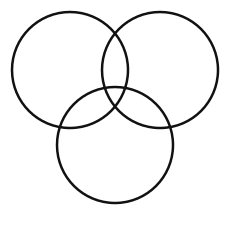
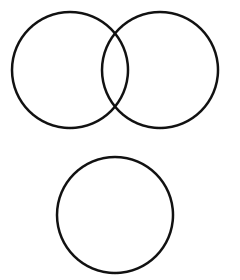
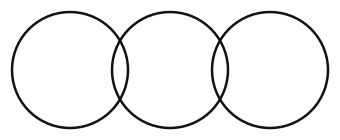
Q726.Select the Venn diagram that best illustrates the relationship between the following classes.
Lawyers, Teachers, Parents
उस वेन आरेख का चयन करें जो निम्नलिखित वर्गों के बीच संबंध को सर्वोत्तम रूप से दर्शाता है।
वकील, शिक्षक, माता-पिता
- A

- B
- C
- D
Show answer
Concept: Lawyers, teachers and parents are independent categories that can overlap with one another.
- A lawyer can be a parent, a teacher can be a parent, and a person can be both a lawyer and a teacher (e.g. a law lecturer).
- Someone can even be all three.
- So all three circles must overlap each other – option B.
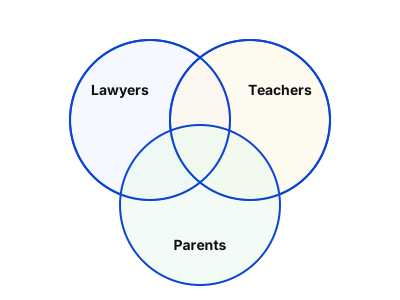
Short trick: Profession + profession + family role: every pair can share members → all three intersect.
Answer: (B) Three mutually overlapping circles
अवधारणा: वकील, शिक्षक और माता-पिता स्वतंत्र वर्ग हैं जो एक-दूसरे से प्रतिच्छेद कर सकते हैं।
- एक वकील माता-पिता हो सकता है, एक शिक्षक माता-पिता हो सकता है, और कोई व्यक्ति वकील और शिक्षक दोनों हो सकता है (जैसे विधि व्याख्याता)।
- कोई व्यक्ति तीनों भी हो सकता है।
- अतः तीनों वृत्त परस्पर प्रतिच्छेद करेंगे – विकल्प B।
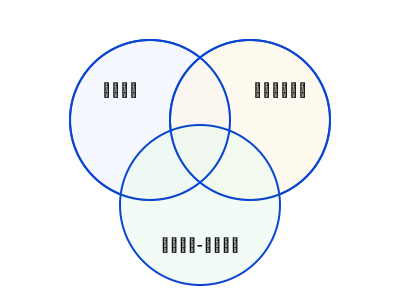
शॉर्ट ट्रिक: पेशा + पेशा + पारिवारिक भूमिका: हर युग्म में साझा सदस्य संभव → तीनों प्रतिच्छेदी।
उत्तर: (B) तीन परस्पर प्रतिच्छेदी वृत्त
RRB ALP CBT 1General Intelligence and ReasoningVenn diagram – classificationRRB ALP CBT 1 2025 · 16 Feb Shift 1
Q727.Select the set in which the numbers are related in the same way as are the numbers of the following sets.
(NOTE : Operations should be performed on the whole numbers, without breaking down the numbers into its constituent digits. E.g. 13 – Operations on 13 such as adding / subtracting /multiplying etc. to 13 can be performed. Breaking down 13 into 1 and 3 and then performing mathematical operations on 1 and 3 is not allowed)
(24,8,384)
(18,6,216)
उस समुच्चय का चयन करें जिसमें संख्याएँ उसी प्रकार संबंधित हैं जिस प्रकार निम्नलिखित समुच्चयों की संख्याएँ संबंधित हैं।
(ध्यान दें: संक्रियाएँ संख्याओं को उनके घटक अंकों में तोड़े बिना, पूर्ण संख्याओं पर की जानी चाहिए। उदाहरण के लिए, 13 – 13 पर संक्रियाएँ जैसे 13 में जोड़ना/घटाना/गुणा करना आदि की जा सकती हैं। 13 को 1 और 3 में तोड़ना और फिर 1 और 3 पर गणितीय संक्रियाएँ करना वर्जित है।)
(24,8,384)
(18,6,216)
- A(15,9,240)
- B(17,6,204)
- C(13,10,130)
- D(24,3,240)
Show answer
Concept: Third number = 2 × first × second.
- 24 × 8 × 2 = 384 ✓; 18 × 6 × 2 = 216 ✓.
- (15, 9): 15 × 9 × 2 = 270 ≠ 240; (17, 6): 17 × 6 × 2 = 204 ✓.
- (13, 10): 260 ≠ 130; (24, 3): 144 ≠ 240.
Short trick: Third ÷ (first × second) must be 2: 204 ÷ 102 = 2 ✓.
Answer: (B) (17,6,204)
अवधारणा: तीसरी संख्या = 2 × पहली × दूसरी।
- 24 × 8 × 2 = 384 ✓; 18 × 6 × 2 = 216 ✓।
- (15, 9): 15 × 9 × 2 = 270 ≠ 240; (17, 6): 17 × 6 × 2 = 204 ✓।
- (13, 10): 260 ≠ 130; (24, 3): 144 ≠ 240।
शॉर्ट ट्रिक: तीसरी ÷ (पहली × दूसरी) = 2 होना चाहिए: 204 ÷ 102 = 2 ✓।
उत्तर: (B) (17,6,204)
RRB ALP CBT 1General Intelligence and ReasoningNumber sets – product ruleRRB ALP CBT 1 2025 · 16 Feb Shift 1
Q728.Based on the English alphabetical order, three of the following four letter-cluster pairs are alike in a certain way and thus form a group. Which letter-cluster pair DOES NOT belong to that group? (Note: The odd one out is not based on the number of consonants/vowels or their position in the letter-cluster.)
अंग्रेज़ी वर्णमाला क्रम के आधार पर, निम्नलिखित चार अक्षर-समूह युग्मों में से तीन किसी निश्चित प्रकार से समान हैं और इस प्रकार एक समूह बनाते हैं। कौन-सा अक्षर-समूह युग्म उस समूह से संबंधित नहीं है? (ध्यान दें: असंगत अक्षर-समूह युग्म, उस अक्षर-समूह में व्यंजनों/स्वरों की संख्या या उनके स्थान पर आधारित नहीं है।)
- ANO−ST
- BRS−WX
- CYZ−DE
- DMN−QU
Show answer
Concept: Each pair: two consecutive letters, then the first letter +5 starts another consecutive pair.
- NO−ST: N +5 = S, ST consecutive ✓.
- RS−WX: R +5 = W ✓.
- YZ−DE: Y +5 = D (cyclic) ✓.
- MN−QU: M +4 = Q, and Q, U are not consecutive ✗.
Short trick: Second cluster must be two neighbours – QU is not, so it is out instantly.
Answer: (D) MN−QU
अवधारणा: प्रत्येक युग्म: दो क्रमागत अक्षर, फिर पहले अक्षर +5 से दूसरा क्रमागत युग्म।
- NO−ST: N +5 = S, ST क्रमागत ✓।
- RS−WX: R +5 = W ✓।
- YZ−DE: Y +5 = D (चक्रीय) ✓।
- MN−QU: M +4 = Q, और Q, U क्रमागत नहीं ✗।
शॉर्ट ट्रिक: दूसरा समूह दो पड़ोसी अक्षर होने चाहिए – QU नहीं है, अतः तुरंत बाहर।
उत्तर: (D) MN−QU
RRB ALP CBT 1General Intelligence and ReasoningOdd one out – letter-cluster pairsRRB ALP CBT 1 2025 · 16 Feb Shift 1
Q729.A, Q, N, L, R and K live on six different floors of the same building. The lowermost floor in the building is numbered 1, the floor above it is numbered 2 and so on till the topmost floor is numbered 6. L lives on an even-numbered floor but not on the topmost floor. Only three people live between K and N. R lives immediately below Q. K lives immediately above L. A lives on the topmost floor. Who lives on floor number 3?
A, Q, N, L, R और K एक ही इमारत की छह अलग-अलग मंज़िलों पर रहते हैं। इमारत की सबसे निचली मंज़िल की संख्या 1 है, उसके ऊपर वाली मंज़िल की संख्या 2 है और इसी प्रकार सबसे ऊपरी मंज़िल की संख्या 6 है। L एक सम संख्या वाली मंज़िल पर रहता है, लेकिन सबसे ऊपरी मंज़िल पर नहीं। K और N के बीच केवल तीन व्यक्ति रहते हैं। R, Q के ठीक नीचे रहता है। K, L के ठीक ऊपर रहता है। A सबसे ऊपरी मंज़िल पर रहता है। मंज़िल संख्या 3 पर कौन रहता है?
- AK
- BA
- CR
- DQ
Show answer
Concept: Place the definite people first: A on floor 6, L on an even floor other than 6.
- L = 2 or 4 and K is just above L.
- If L = 2, K = 3 and N must be 7 (three between) – impossible. So L = 4, K = 5, N = 1.
- R immediately below Q → floors 2 and 3: R = 2, Q = 3.
- Floor 3 → Q.
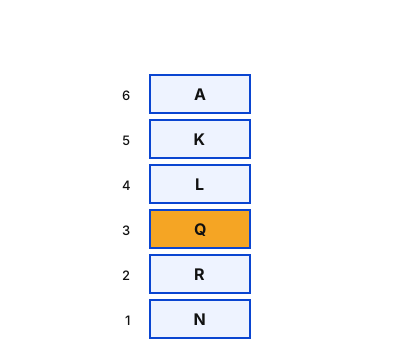
Short trick: K−N gap of 4 floors with K ≤ 5 forces K = 5, N = 1 straight away.
Answer: (D) Q
अवधारणा: पहले निश्चित व्यक्ति रखें: A मंज़िल 6 पर, L 6 के अलावा किसी सम मंज़िल पर।
- L = 2 या 4 और K, L के ठीक ऊपर।
- यदि L = 2, K = 3 तो N = 7 (बीच में तीन) – असंभव। अतः L = 4, K = 5, N = 1।
- R, Q के ठीक नीचे → मंज़िल 2 और 3: R = 2, Q = 3।
- मंज़िल 3 → Q।
शॉर्ट ट्रिक: K और N के बीच 4 मंज़िल का अंतर और K ≤ 5 से तुरंत K = 5, N = 1।
उत्तर: (D) Q
RRB ALP CBT 1General Intelligence and ReasoningFloor puzzleRRB ALP CBT 1 2025 · 16 Feb Shift 1
Q730.Below are given two sets of numbers. In each set of numbers, a certain mathematical operation on the first number results in the second number. Similarly, certain mathematical operation on the second number results in the third number and so on. Which of the given options follows the same set of operations as in the given sets?
(NOTE – A two/three digit number cannot be broken into individual digits for operations e.g. if 37 is followed by 10, the operation cannot be 3+7 as a two digit number cannot be broken into individual digits)
10 - 5 - 25 - 30 ; 4 - 2 - 4 - 9
नीचे संख्याओं के दो समुच्चय दिए गए हैं। संख्याओं के प्रत्येक समुच्चय में, पहली संख्या पर एक निश्चित गणितीय संक्रिया करने से दूसरी संख्या प्राप्त होती है। इसी प्रकार, दूसरी संख्या पर एक निश्चित गणितीय संक्रिया करने से तीसरी संख्या प्राप्त होती है और इसी प्रकार आगे भी। दिए गए विकल्पों में से कौन-सा विकल्प दिए गए समुच्चयों के समान संक्रियाओं के समुच्चय का अनुसरण करता है?
(ध्यान दें – दो/तीन अंकों वाली संख्या को संक्रियाओं के लिए अलग-अलग अंकों में नहीं तोड़ा जा सकता, उदाहरण के लिए यदि 37 के बाद 10 आता है, तो संक्रिया 3+7 नहीं हो सकती क्योंकि दो अंकों वाली संख्या को अलग-अलग अंकों में नहीं तोड़ा जा सकता)
10 - 5 - 25 - 30 ; 4 - 2 - 4 - 9
- A12 - 6 - 36 - 40
- B7 - 49 - 54 - 60
- C10 - 20 - 40 - 50
- D8 - 4 - 16 - 21
Show answer
Concept: Find one rule set that fits both given chains.
- 10 → 5 (÷2) → 25 (square) → 30 (+5).
- 4 → 2 (÷2) → 4 (square) → 9 (+5) ✓.
- 8 → 4 (÷2) → 16 (square) → 21 (+5) ✓.
Short trick: Check the first step (÷2) and the last step (+5) – only 12-6-… and 8-4-… halve; 40 − 36 = 4 rejects the first.
Answer: (D) 8 - 4 - 16 - 21
अवधारणा: दोनों दी गई श्रृंखलाओं में फिट होने वाला एक नियम ज्ञात करें।
- 10 → 5 (÷2) → 25 (वर्ग) → 30 (+5)।
- 4 → 2 (÷2) → 4 (वर्ग) → 9 (+5) ✓।
- 8 → 4 (÷2) → 16 (वर्ग) → 21 (+5) ✓।
शॉर्ट ट्रिक: पहला चरण (÷2) और अंतिम चरण (+5) जाँचें – केवल 12-6-… और 8-4-… आधे होते हैं; 40 − 36 = 4 से पहला बाहर।
उत्तर: (D) 8 - 4 - 16 - 21
RRB ALP CBT 1General Intelligence and ReasoningNumber operations – chainRRB ALP CBT 1 2025 · 16 Feb Shift 1
Q731.Among five people named V, W, X, Y and Z, each have a certain age. X is thrice the age of Y. The age of V is 3. Y is half the age of Z. W is twice the age of V. If Z is four times the age of W, what is the age of X?
V, W, X, Y और Z नाम के पाँच व्यक्तियों में से प्रत्येक की एक निश्चित आयु है। X की आयु Y की आयु की तीन गुनी है। V की आयु 3 है। Y की आयु Z की आयु की आधी है। W की आयु V की आयु की दोगुनी है। यदि Z की आयु W की आयु की चार गुनी है, तो X की आयु कितनी है?
- A38
- B34
- C40
- D36
Show answer
Concept: Start from the only known value (V) and follow the chain.
- V = 3 → W = 2 × 3 = 6.
- Z = 4 × W = 24 → Y = 24 ÷ 2 = 12.
- X = 3 × Y = 36.
Short trick: X = 3 × ½ × 4 × 2 × 3 = 36 – multiply the chain factors directly.
Answer: (D) 36
अवधारणा: एकमात्र ज्ञात मान (V) से शुरू करके श्रृंखला का अनुसरण करें।
- V = 3 → W = 2 × 3 = 6।
- Z = 4 × W = 24 → Y = 24 ÷ 2 = 12।
- X = 3 × Y = 36।
शॉर्ट ट्रिक: X = 3 × ½ × 4 × 2 × 3 = 36 – श्रृंखला के गुणकों को सीधे गुणा करें।
उत्तर: (D) 36
RRB ALP CBT 1General Intelligence and ReasoningAge puzzle – chained ratiosRRB ALP CBT 1 2025 · 16 Feb Shift 1
Q732.If 1 is added to each odd digit and 2 is subtracted from each even digit in the number 7531468, how many digits will appear more than once in the new number thus formed?
यदि संख्या 7531468 में प्रत्येक विषम अंक में 1 जोड़ा जाए और प्रत्येक सम अंक में से 2 घटाया जाए, तो इस प्रकार बनी नई संख्या में कितने अंक एक से अधिक बार आएँगे?
- AOneएक
- BThreeतीन
- CNoneकोई नहीं
- DTwoदो
Show answer
Concept: Odd digit +1, even digit −2.
- 7531468 → 7→8, 5→6, 3→4, 1→2, 4→2, 6→4, 8→6.
- New number: 8642246.
- Repeated digits: 2 (twice), 4 (twice), 6 (twice) → three digits.
Short trick: Odd digits become 8, 6, 4, 2; even digits become 2, 4, 6 – the three overlaps 2, 4, 6 are the repeats.
Answer: (B) Three
अवधारणा: विषम अंक +1, सम अंक −2।
- 7531468 → 7→8, 5→6, 3→4, 1→2, 4→2, 6→4, 8→6।
- नई संख्या: 8642246।
- दोहराए अंक: 2 (दो बार), 4 (दो बार), 6 (दो बार) → तीन अंक।
शॉर्ट ट्रिक: विषम अंक 8, 6, 4, 2 बनते हैं; सम अंक 2, 4, 6 बनते हैं – साझा 2, 4, 6 ही दोहराए अंक हैं।
उत्तर: (B) तीन
RRB ALP CBT 1General Intelligence and ReasoningDigit operationsRRB ALP CBT 1 2025 · 16 Feb Shift 1
Q733.What will come in the place of ‘?’ in the following equation, if ‘+’ and ‘-‘ are interchanged and ‘×’ and ‘÷’ are interchanged?
31 - 26 × 1 ÷ 24 + 45 = ?
यदि ‘+’ और ‘−’ को आपस में बदल दिया जाए तथा ‘×’ और ‘÷’ को आपस में बदल दिया जाए, तो निम्नलिखित समीकरण में ‘?’ के स्थान पर क्या आएगा?
31 - 26 × 1 ÷ 24 + 45 = ?
- A612
- B608
- C611
- D610
Show answer
Concept: Swap the signs first, then apply BODMAS.
- 31 − 26 × 1 ÷ 24 + 45 → 31 + 26 ÷ 1 × 24 − 45.
- = 31 + 26 × 24 − 45 = 31 + 624 − 45.
- = 610.
Short trick: Units digit: 1 + 4 − 5 = 0 → only 610 ends in 0.
Answer: (D) 610
अवधारणा: पहले चिह्न बदलें, फिर BODMAS लगाएँ।
- 31 − 26 × 1 ÷ 24 + 45 → 31 + 26 ÷ 1 × 24 − 45।
- = 31 + 26 × 24 − 45 = 31 + 624 − 45।
- = 610।
शॉर्ट ट्रिक: इकाई अंक: 1 + 4 − 5 = 0 → केवल 610 का इकाई अंक 0 है।
उत्तर: (D) 610
RRB ALP CBT 1General Intelligence and ReasoningInterchanging signsRRB ALP CBT 1 2025 · 16 Feb Shift 1
Q734.Yatin starts from Point A and drives 21 km towards East. He then takes a left turn, drives 15 km, turns left and drives 29 km. He then takes a left turn and drives 26 km. He takes a final left turn, drives 8 km and stops at Point P. How far (shortest distance) and towards which direction should he drive in order to reach Point A again? (All turns are 90-degree turns only, unless specified.)
यतिन बिंदु A से शुरू करके पूर्व की ओर 21 km गाड़ी चलाता है। फिर वह बाएँ मुड़ता है, 15 km चलाता है, बाएँ मुड़ता है और 29 km चलाता है। फिर वह बाएँ मुड़ता है और 26 km चलाता है। वह अंतिम बार बाएँ मुड़ता है, 8 km चलाता है और बिंदु P पर रुक जाता है। बिंदु A पर फिर से पहुँचने के लिए उसे कितनी दूरी (न्यूनतम दूरी) और किस दिशा में गाड़ी चलानी चाहिए? (जब तक निर्दिष्ट न हो, सभी मोड़ केवल 90 डिग्री के हैं।)
- A10 km to the North10 km उत्तर की ओर
- B9 km to the South9 km दक्षिण की ओर
- C9 km to the North9 km उत्तर की ओर
- D11 km to the North11 km उत्तर की ओर
Show answer
Concept: Track net displacement with A as origin.
- East 21 → (21, 0). Left (facing east) = north 15 → (21, 15).
- Left = west 29 → (−8, 15). Left = south 26 → (−8, −11). Left = east 8 → (0, −11) = P.
- P is 11 km directly south of A → drive 11 km north.
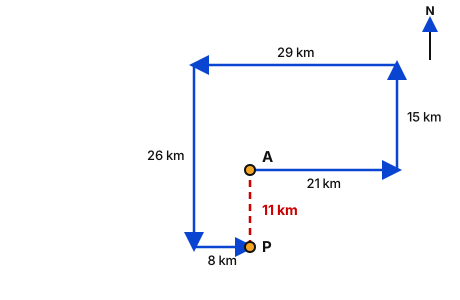
Short trick: E−W: 21 − 29 + 8 = 0; N−S: 15 − 26 = −11 → go 11 km north.
Answer: (D) 11 km to the North
अवधारणा: A को मूल बिंदु मानकर कुल विस्थापन ज्ञात करें।
- पूर्व 21 → (21, 0)। बाएँ (पूर्व मुख) = उत्तर 15 → (21, 15)।
- बाएँ = पश्चिम 29 → (−8, 15)। बाएँ = दक्षिण 26 → (−8, −11)। बाएँ = पूर्व 8 → (0, −11) = P।
- P, A से ठीक 11 km दक्षिण में → 11 km उत्तर की ओर चलना होगा।
शॉर्ट ट्रिक: पू−प: 21 − 29 + 8 = 0; उ−द: 15 − 26 = −11 → 11 km उत्तर जाएँ।
उत्तर: (D) 11 km उत्तर की ओर
RRB ALP CBT 1General Intelligence and ReasoningDirection sense – left turnsRRB ALP CBT 1 2025 · 16 Feb Shift 1
Q735.Select the triad which follows the same pattern as that followed by the two triads given below. Both triads follow the same pattern.
LHC – PLG – TPK
SOJ – WSN – AWR
उस त्रिक का चयन करें जो उसी पैटर्न का अनुसरण करता है जिसका अनुसरण नीचे दिए गए दो त्रिक करते हैं। दोनों त्रिक समान पैटर्न का अनुसरण करते हैं।
LHC – PLG – TPK
SOJ – WSN – AWR
- AUQL – YUP – CYU
- BUHK – XTP – FBX
- CVRM – ZVQ – DZU
- DRNI – XTP – AVQ
Show answer
Concept: Every letter moves +4 from one cluster to the next.
- LHC → PLG → TPK (+4 each); SOJ → WSN → AWR (+4, cyclic).
- VRM +4 → ZVQ, +4 → DZU (Z+4 = D) ✓.
- UQL → YUP ✓ but YUP → CYT (not CYU) ✗; others also break the +4 rule.
Short trick: Also inside each cluster: 1st −4 = 2nd, 2nd −5 = 3rd (L,H,C). V,R,M fits; then just add 4.
Answer: (C) VRM – ZVQ – DZU
अवधारणा: प्रत्येक अक्षर एक समूह से अगले समूह में +4 बढ़ता है।
- LHC → PLG → TPK (+4 प्रत्येक); SOJ → WSN → AWR (+4, चक्रीय)।
- VRM +4 → ZVQ, +4 → DZU (Z+4 = D) ✓।
- UQL → YUP ✓ पर YUP → CYT (CYU नहीं) ✗; अन्य भी +4 नियम तोड़ते हैं।
शॉर्ट ट्रिक: हर समूह के अंदर भी: पहला −4 = दूसरा, दूसरा −5 = तीसरा (L,H,C)। V,R,M फिट; फिर बस 4 जोड़ें।
उत्तर: (C) VRM – ZVQ – DZU
RRB ALP CBT 1General Intelligence and ReasoningLetter triads – constant shiftRRB ALP CBT 1 2025 · 16 Feb Shift 1
Q736.Refer to the following letter, symbol series and answer the question that follows. Counting to be done from left to right only.
(Left) F Y $ F O € Z # J © G * U N @ M $ N © £ © & (Right)
How many such letter are there, each of which is immediately preceded by a symbol and also immediately followed by a symbol?
निम्नलिखित अक्षर, प्रतीक श्रृंखला को देखें और उसके बाद आने वाले प्रश्न का उत्तर दें। गिनती केवल बाएँ से दाएँ की जानी है।
(बाएँ) F Y $ F O € Z # J © G * U N @ M $ N © £ © & (दाएँ)
ऐसे कितने अक्षर हैं, जिनमें से प्रत्येक के ठीक पहले एक प्रतीक है और ठीक बाद भी एक प्रतीक है?
- A5
- B4
- C6
- D7
Show answer
Concept: Pattern needed: Symbol – Letter – Symbol.
- € Z # ✓
- # J © ✓
- © G * ✓
- @ M $ ✓
- $ N © ✓
- Total = 5.
Short trick: Look for single letters 'sandwiched' between symbols – they stand alone in the series.
Answer: (A) 5
अवधारणा: आवश्यक पैटर्न: प्रतीक – अक्षर – प्रतीक।
- € Z # ✓
- # J © ✓
- © G * ✓
- @ M $ ✓
- $ N © ✓
- कुल = 5।
शॉर्ट ट्रिक: दो प्रतीकों के बीच 'सैंडविच' अकेले अक्षर खोजें।
उत्तर: (A) 5
RRB ALP CBT 1General Intelligence and ReasoningLetter-symbol seriesRRB ALP CBT 1 2025 · 16 Feb Shift 1
Q737.What should come in place of the question mark (?) in the given series?
145 132 120 109 99 90 ?
दी गई श्रृंखला में प्रश्न चिह्न (?) के स्थान पर क्या आना चाहिए?
145 132 120 109 99 90 ?
- A78
- B80
- C82
- D84
Show answer
Concept: Differences decrease by 1.
- 145 − 13 = 132, − 12 = 120, − 11 = 109, − 10 = 99, − 9 = 90.
- Next: 90 − 8 = 82.
Short trick: Subtractors run 13, 12, 11, … → the next one is 8.
Answer: (C) 82
अवधारणा: अंतर 1-1 से घट रहे हैं।
- 145 − 13 = 132, − 12 = 120, − 11 = 109, − 10 = 99, − 9 = 90।
- अगला: 90 − 8 = 82।
शॉर्ट ट्रिक: घटाए जाने वाले अंक 13, 12, 11, … → अगला 8 है।
उत्तर: (C) 82
RRB ALP CBT 1General Intelligence and ReasoningNumber series – decreasing differencesRRB ALP CBT 1 2025 · 16 Feb Shift 1
Q738.Read the given statements and conclusions carefully. Assuming that the information given in the statements is true, even if it appears to be at variance with commonly known facts, decide which of the given conclusions logically follow(s) from the statements.
Statements:
Some bugs are moths.
Some moths are parrots.
Conclusions:
(I) Some parrots are bugs.
(II) All moths are bugs.
दिए गए कथनों और निष्कर्षों को ध्यानपूर्वक पढ़ें। यह मानते हुए कि कथनों में दी गई जानकारी सत्य है, भले ही वह सामान्यतः ज्ञात तथ्यों से भिन्न प्रतीत होती हो, निर्णय लें कि दिए गए निष्कर्षों में से कौन-सा/से निष्कर्ष कथनों का तार्किक रूप से अनुसरण करता है/करते हैं।
कथन:
कुछ कीड़े, पतंगे हैं।
कुछ पतंगे, तोते हैं।
निष्कर्ष:
(I) कुछ तोते, कीड़े हैं।
(II) सभी पतंगे, कीड़े हैं।
- AOnly conclusion (II) follows.केवल निष्कर्ष (II) अनुसरण करता है।
- BOnly conclusion (I) follows.केवल निष्कर्ष (I) अनुसरण करता है।
- CBoth conclusions (I) and (II) follow.निष्कर्ष (I) और (II) दोनों अनुसरण करते हैं।
- DNeither conclusion (I) nor (II) follows.न तो निष्कर्ष (I) और न ही (II) अनुसरण करता है।
Show answer
Concept: Two 'some' statements give no definite link between the end terms.
- Draw the least-overlap diagram: Bugs ∩ Moths and Moths ∩ Parrots, with Bugs and Parrots not touching.
- I: 'Some parrots are bugs' – not necessary (they may not touch) ✗.
- II: 'All moths are bugs' – only some moths are bugs ✗.
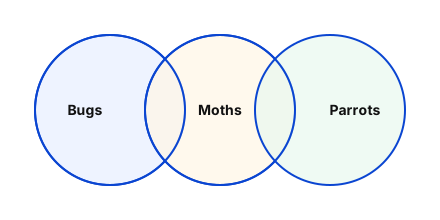
Short trick: Some + Some → no conclusion between the end terms. 'All' never follows from 'some'.
Answer: (D) Neither conclusion (I) nor (II) follows.
अवधारणा: दो 'कुछ' कथनों से अंतिम पदों के बीच कोई निश्चित संबंध नहीं बनता।
- न्यूनतम-अतिव्यापन आरेख बनाएँ: कीड़े ∩ पतंगे और पतंगे ∩ तोते, कीड़े और तोते आपस में नहीं मिलते।
- I: 'कुछ तोते, कीड़े हैं' – आवश्यक नहीं (वे न मिलें) ✗।
- II: 'सभी पतंगे, कीड़े हैं' – केवल कुछ पतंगे कीड़े हैं ✗।
शॉर्ट ट्रिक: कुछ + कुछ → अंतिम पदों में कोई निष्कर्ष नहीं। 'कुछ' से 'सभी' कभी नहीं निकलता।
उत्तर: (D) न तो निष्कर्ष (I) और न ही (II) अनुसरण करता है।
RRB ALP CBT 1General Intelligence and ReasoningSyllogismRRB ALP CBT 1 2025 · 16 Feb Shift 1
Q739.T, W, A, L, O and B live on six different floors of the same building. The lowermost floor in the building is numbered 1, the floor above it is numbered 2 and so on till the topmost floor is numbered 6. A lives on an even-numbered floor. T lives immediately below A. Exactly one person lives between T and L. Exactly one person lives between W and L. W lives immediately above O. O does not live on the lowermost floor. Who lives immediately above L?
T, W, A, L, O और B एक ही इमारत की छह अलग-अलग मंज़िलों पर रहते हैं। इमारत की सबसे निचली मंज़िल की संख्या 1 है, उसके ऊपर वाली मंज़िल की संख्या 2 है और इसी प्रकार सबसे ऊपरी मंज़िल की संख्या 6 है। A एक सम संख्या वाली मंज़िल पर रहता है। T, A के ठीक नीचे रहता है। T और L के बीच ठीक एक व्यक्ति रहता है। W और L के बीच ठीक एक व्यक्ति रहता है। W, O के ठीक ऊपर रहता है। O सबसे निचली मंज़िल पर नहीं रहता है। L के ठीक ऊपर कौन रहता है?
- AT
- BA
- CO
- DW
Show answer
Concept: Try the possible floors of A (even) with T just below it.
- A = 2, 4 or 6, T = A − 1. L is two floors from T, W is two floors from L, and W is just above O (O ≠ 1).
- A = 2, T = 1 → L = 3 → W = 5, O = 4 ✓, B = 6.
- Other cases clash (e.g. A = 4, T = 3 → L = 1 or 5 → W collides or O = 1).
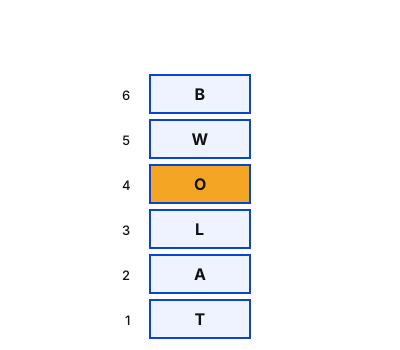
Short trick: W–O form a block with W two floors from L; with T = 1, L = 3, the block 4–5 fits immediately.
Answer: (C) O
अवधारणा: A (सम) के संभावित मंज़िलें और उसके ठीक नीचे T आज़माएँ।
- A = 2, 4 या 6, T = A − 1। L, T से दो मंज़िल दूर, W, L से दो मंज़िल दूर, और W, O के ठीक ऊपर (O ≠ 1)।
- A = 2, T = 1 → L = 3 → W = 5, O = 4 ✓, B = 6।
- अन्य स्थितियाँ टकराती हैं (जैसे A = 4, T = 3 → L = 1 या 5 → W टकराता है या O = 1)।
शॉर्ट ट्रिक: W–O एक खंड है और W, L से दो मंज़िल दूर; T = 1, L = 3 पर 4–5 का खंड तुरंत फिट होता है।
उत्तर: (C) O
RRB ALP CBT 1General Intelligence and ReasoningFloor puzzleRRB ALP CBT 1 2025 · 16 Feb Shift 1
Q740.Each vowel in the word TRASHED is changed to the letter immediately following it in the English alphabetical order and each consonant is changed to the letter immediately preceding it in the English alphabetical order. Which of the following letters will be third from the left in the new group of letters thus formed?
शब्द TRASHED में प्रत्येक स्वर को अंग्रेज़ी वर्णमाला क्रम में उसके ठीक बाद वाले अक्षर से और प्रत्येक व्यंजन को उसके ठीक पहले वाले अक्षर से बदल दिया जाता है। इस प्रकार बने नए अक्षर-समूह में बाएँ से तीसरा अक्षर कौन-सा होगा?
- AQ
- BR
- CG
- DB
Show answer
Concept: Vowel → next letter, consonant → previous letter.
- T→S, R→Q, A→B, S→R, H→G, E→F, D→C.
- New group: S Q B R G F C.
- Third from the left = B.
Short trick: Only the 3rd letter matters: A is a vowel → B.
Answer: (D) B
अवधारणा: स्वर → अगला अक्षर, व्यंजन → पिछला अक्षर।
- T→S, R→Q, A→B, S→R, H→G, E→F, D→C।
- नया समूह: S Q B R G F C।
- बाएँ से तीसरा = B।
शॉर्ट ट्रिक: केवल तीसरा अक्षर देखें: A स्वर है → B।
उत्तर: (D) B
RRB ALP CBT 1General Intelligence and ReasoningLetter change – vowels and consonantsRRB ALP CBT 1 2025 · 16 Feb Shift 1

