RRB ALP CBT 1 · 825 questions

RRB ALP CBT 1 2025 PYQs

Real previous year questions, subject-wise. Try the question, then open the answer and the explanation in Hindi & English – free, no login.

Courses – airGurukul

825 questions.

Q741.
Which of the following effects of smoking was observed in terms of respiration?
श्वसन के संदर्भ में धूम्रपान का निम्नलिखित में से कौन-सा प्रभाव देखा गया?
  1. APromotion of cilia in upper respiratory tractऊपरी श्वसन पथ में पक्ष्माभों (सिलिया) को बढ़ावा
  2. BDestruction of cilia in upper respiratory tractऊपरी श्वसन पथ में पक्ष्माभों (सिलिया) का नष्ट होना
  3. CPromotion of cilia in lower respiratory tractनिचले श्वसन पथ में पक्ष्माभों (सिलिया) को बढ़ावा
  4. DDestruction of cilia in lower respiratory tractनिचले श्वसन पथ में पक्ष्माभों (सिलिया) का नष्ट होना
Show answer

Concept: Cilia lining the upper respiratory tract (nose, trachea, bronchi) sweep dust and germs out; smoke destroys them.

  1. Hair-like cilia in the upper respiratory tract push mucus with trapped dust and germs out of the airway.
  2. Tobacco smoke damages and destroys these cilia, so dust, smoke particles and germs enter the lungs.
  3. Result: chronic cough, infections, bronchitis and higher risk of lung cancer.

Short trick: Smoke = 'sweepers' (cilia) killed at the entrance (upper tract) – the gatekeepers fall first.

Answer: (B) Destruction of cilia in upper respiratory tract

अवधारणा: ऊपरी श्वसन पथ (नाक, श्वासनली, श्वसनी) के पक्ष्माभ धूल और रोगाणुओं को बाहर धकेलते हैं; धुआँ इन्हें नष्ट कर देता है।

  1. ऊपरी श्वसन पथ के बाल जैसे पक्ष्माभ धूल व रोगाणुओं वाले श्लेष्म को वायुमार्ग से बाहर धकेलते हैं।
  2. तंबाकू का धुआँ इन पक्ष्माभों को नष्ट कर देता है, जिससे धूल, धुएँ के कण और रोगाणु फेफड़ों में पहुँच जाते हैं।
  3. परिणाम: लगातार खाँसी, संक्रमण, ब्रॉन्काइटिस और फेफड़ों के कैंसर का अधिक खतरा।

शॉर्ट ट्रिक: धुआँ = प्रवेश-द्वार (ऊपरी पथ) के 'सफ़ाईकर्मी' (सिलिया) सबसे पहले नष्ट।

उत्तर: (B) ऊपरी श्वसन पथ में पक्ष्माभों (सिलिया) का नष्ट होना
RRB ALP CBT 1General ScienceEffects of smoking on respirationRRB ALP CBT 1 2025 · 16 Feb Shift 1
Q742.
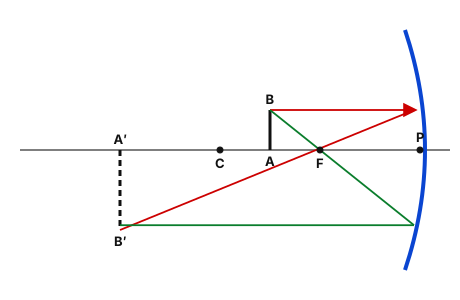
If an object is placed between the centre of curvature (C) and the focus (F) of a concave mirror, what type of image will be formed?
यदि किसी वस्तु को अवतल दर्पण के वक्रता केंद्र (C) और फोकस (F) के बीच रखा जाए, तो किस प्रकार का प्रतिबिंब बनेगा?
  1. ADiminished, real, and invertedछोटा, वास्तविक और उल्टा
  2. BHighly enlarged and virtualअत्यधिक बड़ा और आभासी
  3. CSame size, real, and uprightसमान आकार का, वास्तविक और सीधा
  4. DEnlarged, real, and invertedबड़ा, वास्तविक और उल्टा
Show answer

Concept: For an object between C and F of a concave mirror, the image forms beyond C.

  1. Ray parallel to the axis reflects through F; ray through F reflects parallel to the axis.
  2. The reflected rays actually meet beyond C, below the axis → image is real and inverted.
  3. The image distance is more than the object distance → image is enlarged.

Short trick: Object and image swap: object beyond C ↔ image between F and C. So object between C and F → image beyond C, enlarged, real, inverted.

Answer: (D) Enlarged, real, and inverted

अवधारणा: अवतल दर्पण के C और F के बीच रखी वस्तु का प्रतिबिंब C से परे बनता है।

  1. अक्ष के समांतर किरण परावर्तन के बाद F से गुज़रती है; F से जाने वाली किरण परावर्तन के बाद अक्ष के समांतर हो जाती है।
  2. परावर्तित किरणें वास्तव में C से परे अक्ष के नीचे मिलती हैं → प्रतिबिंब वास्तविक और उल्टा।
  3. प्रतिबिंब की दूरी वस्तु की दूरी से अधिक → प्रतिबिंब बड़ा।

शॉर्ट ट्रिक: वस्तु और प्रतिबिंब की अदला-बदली: वस्तु C से परे ↔ प्रतिबिंब F और C के बीच। अतः वस्तु C और F के बीच → प्रतिबिंब C से परे, बड़ा, वास्तविक, उल्टा।

उत्तर: (D) बड़ा, वास्तविक और उल्टा

RRB ALP CBT 1General ScienceImage formation by concave mirrorRRB ALP CBT 1 2025 · 16 Feb Shift 1
Q743.
A ball is dropped from a height and falls freely for 2 seconds. Its average speed during this time is: (Consider: acceleration due to gravity =10 m/s2)
एक गेंद को किसी ऊँचाई से गिराया जाता है और वह 2 सेकंड तक मुक्त रूप से गिरती है। इस दौरान उसकी औसत चाल कितनी है? (गुरुत्वीय त्वरण = 10 m/s2 मानें)
  1. A20 m/s
  2. B10 m/s
  3. C5 m/s
  4. D15 m/s
Show answer

Concept: Average speed = total distance ÷ total time; in uniform acceleration from rest it equals (u + v)/2.

  1. Distance in 2 s: s=12gt2=12×10×22=20 m.
  2. Average speed = 20 ÷ 2 = 10 m/s.
  3. Check: v = gt = 20 m/s; (0 + 20)/2 = 10 m/s ✓.

Short trick: From rest, average speed = gt2 = 10 × 2 ÷ 2 = 10 m/s.

Answer: (B) 10 m/s

अवधारणा: औसत चाल = कुल दूरी ÷ कुल समय; विरामावस्था से एकसमान त्वरण में यह (u + v)/2 के बराबर होती है।

  1. 2 s में दूरी: s=12gt2=12×10×22=20 m।
  2. औसत चाल = 20 ÷ 2 = 10 m/s।
  3. जाँच: v = gt = 20 m/s; (0 + 20)/2 = 10 m/s ✓।

शॉर्ट ट्रिक: विराम से, औसत चाल = gt2 = 10 × 2 ÷ 2 = 10 m/s।

उत्तर: (B) 10 m/s

RRB ALP CBT 1General ScienceFree fall – average speedRRB ALP CBT 1 2025 · 16 Feb Shift 1
Q744.
When a living plant cell loses water through osmosis, what happens to the cell contents?
जब एक जीवित पादप कोशिका परासरण द्वारा जल खोती है, तो कोशिका की सामग्री का क्या होता है?
  1. AThey remain unchangedवे अपरिवर्तित रहती हैं
  2. BThey dissolveवे घुल जाती हैं
  3. CThey swell and burstवे फूलकर फट जाती हैं
  4. DThey contract and move away from the cell wallवे सिकुड़कर कोशिका भित्ति से दूर हट जाती हैं
Show answer

Concept: In a hypertonic solution a plant cell loses water by osmosis – this is plasmolysis.

  1. Water moves out of the vacuole and cytoplasm to the more concentrated outside solution.
  2. The protoplast shrinks, but the rigid cell wall keeps its shape.
  3. So the cell contents contract and pull away from the cell wall.

Short trick: Plasmo-LYSIS = protoplasm 'lets go' of the wall; swelling and bursting happens only to animal cells (no wall) in water.

Answer: (D) They contract and move away from the cell wall

अवधारणा: अतिपरासारी (hypertonic) विलयन में पादप कोशिका परासरण द्वारा जल खोती है – इसे जीवद्रव्यकुंचन कहते हैं।

  1. जल रिक्तिका और कोशिकाद्रव्य से बाहर अधिक सांद्र विलयन की ओर जाता है।
  2. जीवद्रव्य सिकुड़ जाता है, पर कठोर कोशिका भित्ति अपना आकार बनाए रखती है।
  3. अतः कोशिका की सामग्री सिकुड़कर कोशिका भित्ति से दूर हट जाती है।

शॉर्ट ट्रिक: जीवद्रव्य 'कुंचन' = सिकुड़ना; फूलकर फटना केवल जल में रखी जंतु कोशिका (भित्ति रहित) में होता है।

उत्तर: (D) वे सिकुड़कर कोशिका भित्ति से दूर हट जाती हैं

RRB ALP CBT 1General SciencePlasmolysisRRB ALP CBT 1 2025 · 16 Feb Shift 1
Q745.
The gravitational potential energy of an object depends on what?
किसी वस्तु की गुरुत्वीय स्थितिज ऊर्जा किस पर निर्भर करती है?
  1. AIts acceleration onlyकेवल उसके त्वरण पर
  2. BIts velocity and massउसके वेग और द्रव्यमान पर
  3. CIts speed onlyकेवल उसकी चाल पर
  4. DIts mass and heightउसके द्रव्यमान और ऊँचाई पर
Show answer

Concept: Gravitational PE near the earth: Ep=mgh.

  1. m = mass of the object, h = height above the reference level, g = constant (≈ 9.8 m/s²).
  2. PE does not depend on velocity, speed or acceleration of the object (those affect kinetic energy, 12mv2).
  3. So it depends on mass and height.

Short trick: Potential = Position: 'P for Position' → height; Kinetic = Kinetic motion → speed.

Answer: (D) Its mass and height

अवधारणा: पृथ्वी के निकट गुरुत्वीय स्थितिज ऊर्जा: Ep=mgh।

  1. m = वस्तु का द्रव्यमान, h = संदर्भ तल से ऊँचाई, g = नियतांक (≈ 9.8 m/s²)।
  2. स्थितिज ऊर्जा वस्तु के वेग, चाल या त्वरण पर निर्भर नहीं करती (ये गतिज ऊर्जा 12mv2 को प्रभावित करते हैं)।
  3. अतः यह द्रव्यमान और ऊँचाई पर निर्भर करती है।

शॉर्ट ट्रिक: स्थितिज = स्थिति (ऊँचाई); गतिज = गति (चाल)।

उत्तर: (D) उसके द्रव्यमान और ऊँचाई पर

RRB ALP CBT 1General ScienceGravitational potential energyRRB ALP CBT 1 2025 · 16 Feb Shift 1
Q746.
Match the columns.
Epithelial TissueLocation
ICuboidal EpitheliumA.Lining of intestine
IIColumnar EpitheliumB.Skin
IIISquamous EpitheliumC.Lining of kidney tubules
स्तंभों का मिलान करें।
उपकला ऊतकस्थान
Iघनाकार उपकलाA.आंत का अस्तर
IIस्तंभाकार उपकलाB.त्वचा
IIIशल्की उपकलाC.वृक्क नलिकाओं का अस्तर
  1. AI-A; II-B; III-C
  2. BI-A; II-C; III-B
  3. CI-C; II-A; III-B
  4. DI-B; II-C; III-A
Show answer

Concept: Shape of epithelial cells matches their job.

  1. Cuboidal epithelium – cube-shaped cells that absorb/secrete: lining of kidney tubules (and salivary-gland ducts) → I-C.
  2. Columnar epithelium – tall cells for absorption: lining of the intestine → II-A.
  3. Squamous epithelium – flat, thin cells; stratified squamous forms the skin → III-B.

Short trick: C-K-C: Cuboidal = Kidney; Columnar = Canal (intestine); Squamous = Skin (both start with S).

Answer: (C) I-C; II-A; III-B

अवधारणा: उपकला कोशिकाओं की आकृति उनके कार्य के अनुसार होती है।

  1. घनाकार उपकला – घन जैसी कोशिकाएँ जो अवशोषण/स्राव करती हैं: वृक्क नलिकाओं (और लार ग्रंथि की वाहिनियों) का अस्तर → I-C।
  2. स्तंभाकार उपकला – लंबी कोशिकाएँ जो अवशोषण करती हैं: आंत का अस्तर → II-A।
  3. शल्की उपकला – चपटी, पतली कोशिकाएँ; स्तरित शल्की उपकला से त्वचा बनती है → III-B।

शॉर्ट ट्रिक: याद रखें: घनाकार = गुर्दा (वृक्क); स्तंभाकार = आंत; शल्की = त्वचा (Squamous = Skin)।

उत्तर: (C) I-C; II-A; III-B

RRB ALP CBT 1General ScienceEpithelial tissues and locationRRB ALP CBT 1 2025 · 16 Feb Shift 1
Q747.
To neutralise excess acidity in the stomach, one can take:
पेट में अतिरिक्त अम्लता को उदासीन करने के लिए, कोई क्या ले सकता है?
  1. ALemon juiceनींबू का रस
  2. BAntacids like Mg(OH)₂Mg(OH)₂ जैसे प्रतिअम्ल (एंटासिड)
  3. CHCl solutionHCl विलयन
  4. DVinegarसिरका
Show answer

Concept: Excess HCl in the stomach is neutralised by a mild base (antacid).

  1. Milk of magnesia, Mg(OH)₂, is a mild base.
  2. Mg(OH)₂ + 2HCl → MgCl₂ + 2H₂O (neutralisation).
  3. Lemon juice, HCl and vinegar are acids – they would increase acidity.

Short trick: Acid trouble → take a base: 'Milk of Magnesia' = Mg(OH)₂. Eliminate all sour options.

Answer: (B) Antacids like Mg(OH)₂

अवधारणा: पेट में अतिरिक्त HCl को एक दुर्बल क्षार (प्रतिअम्ल) से उदासीन किया जाता है।

  1. मिल्क ऑफ़ मैग्नीशिया, Mg(OH)₂, एक दुर्बल क्षार है।
  2. Mg(OH)₂ + 2HCl → MgCl₂ + 2H₂O (उदासीनीकरण)।
  3. नींबू का रस, HCl और सिरका अम्ल हैं – ये अम्लता बढ़ाएँगे।

शॉर्ट ट्रिक: अम्ल की समस्या → क्षार लें: 'मिल्क ऑफ़ मैग्नीशिया' = Mg(OH)₂। सभी खट्टे विकल्प हटाएँ।

उत्तर: (B) Mg(OH)₂ जैसे प्रतिअम्ल (एंटासिड)

RRB ALP CBT 1General ScienceAcids, bases – antacidsRRB ALP CBT 1 2025 · 16 Feb Shift 1
Q748.
Which of the following observations supports that matter is made of small particles?
निम्नलिखित में से कौन-सा प्रेक्षण इस बात का समर्थन करता है कि द्रव्य छोटे-छोटे कणों से बना है?
  1. AOil floats above the surface after gentle stirring.धीरे से हिलाने के बाद तेल सतह के ऊपर तैरता है।
  2. BChalk powder remains visible even after mixing.मिलाने के बाद भी चॉक का चूर्ण दिखाई देता रहता है।
  3. CSugar dissolves in water without change in level.चीनी जल में घुल जाती है और जल-स्तर में कोई परिवर्तन नहीं होता।
  4. DSand settles at the bottom when mixed with water.जल में मिलाने पर रेत तली में बैठ जाती है।
Show answer

Concept: Matter is made of tiny particles with spaces between them.

  1. When sugar dissolves, its particles spread into the spaces between water particles.
  2. Hence the water level does not rise noticeably – evidence of small particles and inter-particle spaces.
  3. Oil floating, chalk staying visible and sand settling show insolubility/density, not particle nature.

Short trick: 'Disappears but level stays' = particles hide in the gaps – the classic NCERT Class 9 activity.

Answer: (C) Sugar dissolves in water without change in level.

अवधारणा: द्रव्य छोटे-छोटे कणों से बना है जिनके बीच रिक्त स्थान होते हैं।

  1. चीनी घुलने पर उसके कण जल के कणों के बीच के रिक्त स्थानों में फैल जाते हैं।
  2. इसलिए जल-स्तर में उल्लेखनीय वृद्धि नहीं होती – यह छोटे कणों और कणों के बीच रिक्त स्थान का प्रमाण है।
  3. तेल का तैरना, चॉक का दिखना और रेत का बैठना अविलेयता/घनत्व दर्शाते हैं, कणीय प्रकृति नहीं।

शॉर्ट ट्रिक: 'घुल गई पर स्तर वही' = कण रिक्त स्थानों में छिप गए – NCERT कक्षा 9 की प्रसिद्ध गतिविधि।

उत्तर: (C) चीनी जल में घुल जाती है और जल-स्तर में कोई परिवर्तन नहीं होता।

RRB ALP CBT 1General ScienceParticulate nature of matterRRB ALP CBT 1 2025 · 16 Feb Shift 1
Q749.
In which location was Exercise Cyclone 2025 conducted with Egypt in February?
फरवरी में मिस्र के साथ अभ्यास साइक्लोन 2025 किस स्थान पर आयोजित किया गया था?
  1. AJodhpur Desert Grounds, Rajasthanजोधपुर डेज़र्ट ग्राउंड्स, राजस्थान
  2. BMahajan Field Firing Range, Rajasthanमहाजन फील्ड फायरिंग रेंज, राजस्थान
  3. CDeesa Range, Gujaratडीसा रेंज, गुजरात
  4. DBabina Field, Uttar Pradeshबबीना फील्ड, उत्तर प्रदेश
Show answer

Concept: Exercise Cyclone is the joint special-forces exercise of India and Egypt.

  1. The 3rd edition, Exercise Cyclone 2025, was held from 10 to 23 February 2025.
  2. Venue: Mahajan Field Firing Range, Rajasthan (desert and semi-desert terrain).
  3. Focus: special-forces skills, counter-terror operations and interoperability.

Short trick: Cyclone from Egypt's desert to India's desert – Mahajan (Bikaner region), the same range used for many joint drills.

Answer: (B) Mahajan Field Firing Range, Rajasthan

अवधारणा: अभ्यास साइक्लोन भारत और मिस्र का संयुक्त विशेष बल अभ्यास है।

  1. तीसरा संस्करण, अभ्यास साइक्लोन 2025, 10 से 23 फरवरी 2025 तक आयोजित हुआ।
  2. स्थान: महाजन फील्ड फायरिंग रेंज, राजस्थान (रेगिस्तानी और अर्ध-रेगिस्तानी क्षेत्र)।
  3. उद्देश्य: विशेष बल कौशल, आतंकवाद-रोधी अभियान और अंतर-संचालनीयता।

शॉर्ट ट्रिक: मिस्र के रेगिस्तान से भारत के रेगिस्तान तक 'साइक्लोन' – महाजन (बीकानेर क्षेत्र), जहाँ अनेक संयुक्त अभ्यास होते हैं।

उत्तर: (B) महाजन फील्ड फायरिंग रेंज, राजस्थान

RRB ALP CBT 1General AwarenessDefence exercises 2025RRB ALP CBT 1 2025 · 16 Feb Shift 1
Q750.
How many members are elected to the Public Accounts Committee from Rajya Sabha?
लोक लेखा समिति में राज्य सभा से कितने सदस्य चुने जाते हैं?
  1. A15
  2. B7
  3. C22
  4. D5
Show answer

Concept: The Public Accounts Committee (PAC) has 22 members.

  1. 15 members are elected from Lok Sabha and 7 from Rajya Sabha (by proportional representation, single transferable vote).
  2. Term: one year; the Chairman is appointed by the Lok Sabha Speaker (by convention from the opposition).
  3. PAC examines the audit reports of the CAG on government spending.

Short trick: PAC = 15 + 7 = 22 (Estimates Committee = 30, all from Lok Sabha).

Answer: (B) 7

अवधारणा: लोक लेखा समिति (PAC) में 22 सदस्य होते हैं।

  1. 15 सदस्य लोक सभा से और 7 सदस्य राज्य सभा से (आनुपातिक प्रतिनिधित्व, एकल संक्रमणीय मत द्वारा) चुने जाते हैं।
  2. कार्यकाल: एक वर्ष; अध्यक्ष की नियुक्ति लोक सभा अध्यक्ष करते हैं (परंपरा से विपक्ष से)।
  3. PAC सरकारी व्यय पर CAG की लेखापरीक्षा रिपोर्टों की जाँच करती है।

शॉर्ट ट्रिक: PAC = 15 + 7 = 22 (प्राक्कलन समिति = 30, सभी लोक सभा से)।

उत्तर: (B) 7

RRB ALP CBT 1General AwarenessParliamentary committees – PACRRB ALP CBT 1 2025 · 16 Feb Shift 1
Q751.
Shubh marks an article 40% above its cost price. He allows a single discount of d% on the marked price and still makes a profit of 10% on the cost price. Find the discount d%.
शुभ एक वस्तु पर उसके क्रय मूल्य से 40% अधिक मूल्य अंकित करता है। वह अंकित मूल्य पर d% की एकल छूट देता है और फिर भी क्रय मूल्य पर 10% का लाभ कमाता है। छूट d% ज्ञात कीजिए।
  1. A23%
  2. B2127%
  3. C2137%
  4. D22%
Show answer

Concept: SP = MP × (1 − d%) and SP = CP × (1 + profit%).

  1. Let CP = 100 → MP = 140, SP = 110.
  2. Discount = 140 − 110 = 30.
  3. d=30140×100=1507=2137%

Short trick: d%=Markup−Profit100+Markup×100=40−10140×100

Answer: (C) 2137%

अवधारणा: विक्रय मूल्य = अंकित मूल्य × (1 − d%) तथा विक्रय मूल्य = क्रय मूल्य × (1 + लाभ%)।

  1. माना क्रय मूल्य = 100 → अंकित मूल्य = 140, विक्रय मूल्य = 110.
  2. छूट = 140 − 110 = 30.
  3. d=30140×100=1507=2137%

शॉर्ट ट्रिक: d%=40−10100+40×100 (मार्कअप − लाभ) ÷ (100 + मार्कअप)।

उत्तर: (C) 2137%

RRB ALP CBT 1MathematicsProfit and loss – marked price and discountRRB ALP CBT 1 2025 · 13 Feb Shift 1
Q752.
A shopkeeper fixes the marked price of an item 20% above its cost price. What percentage of discount should he offer to gain 2%?
एक दुकानदार किसी वस्तु का अंकित मूल्य उसके क्रय मूल्य से 20% अधिक निर्धारित करता है। 2% लाभ प्राप्त करने के लिए उसे कितने प्रतिशत छूट देनी चाहिए?
  1. A12%
  2. B15%
  3. C18%
  4. D17%
Show answer

Concept: Required SP = CP × (1 + gain%); discount is taken on MP.

  1. Let CP = 100 → MP = 120.
  2. Required SP = 102.
  3. Discount = 120 − 102 = 18 → 18120×100=15%

Short trick: 20−2120×100=15%

Answer: (B) 15%

अवधारणा: आवश्यक विक्रय मूल्य = क्रय मूल्य × (1 + लाभ%); छूट अंकित मूल्य पर होती है।

  1. माना क्रय मूल्य = 100 → अंकित मूल्य = 120.
  2. आवश्यक विक्रय मूल्य = 102.
  3. छूट = 120 − 102 = 18 → 18120×100=15%

शॉर्ट ट्रिक: 20−2120×100=15%

उत्तर: (B) 15%

RRB ALP CBT 1MathematicsProfit and loss – discount for desired gainRRB ALP CBT 1 2025 · 13 Feb Shift 1
Q753.
If the interest earned during the 2nd year on a certain sum is ₹3072, and the rate of interest is 20% per annum compounded annually, then the sum is:
यदि किसी निश्चित राशि पर दूसरे वर्ष के दौरान अर्जित ब्याज ₹3072 है, और ब्याज की दर 20% वार्षिक चक्रवृद्धि है, तो राशि कितनी है?
  1. A₹12965
  2. B₹12800
  3. C₹13545
  4. D₹12055
Show answer

Concept: Interest of the 2nd year = interest of the 1st year + interest on that interest = P⋅r(1+r).

  1. 1st-year interest =30721.2=2560
  2. P=25600.20=12800

Short trick: P=30720.2×1.2=30720.24=12800

Answer: (B) ₹12800

अवधारणा: दूसरे वर्ष का ब्याज = पहले वर्ष का ब्याज + उस ब्याज पर ब्याज = P⋅r(1+r)।

  1. पहले वर्ष का ब्याज =30721.2=2560
  2. P=25600.20=12800

शॉर्ट ट्रिक: P=30720.2×1.2=30720.24=12800

उत्तर: (B) ₹12800

RRB ALP CBT 1MathematicsCompound interest – interest of 2nd yearRRB ALP CBT 1 2025 · 13 Feb Shift 1
Q754.
What sum (in ₹) will earn an interest of ₹480 in 2 years at 10% simple interest per year?
कौन-सी राशि (₹ में) 10% वार्षिक साधारण ब्याज की दर से 2 वर्षों में ₹480 का ब्याज अर्जित करेगी?
  1. A2600
  2. B2550
  3. C2200
  4. D2400
Show answer

Concept: SI=P×R×T100

  1. 480=P×10×2100=P5
  2. P=480×5=2400

Short trick: Total rate = 10% × 2 = 20% → 20% of P = 480 → P = 480 × 5 = 2400.

Answer: (D) 2400

अवधारणा: SI=P×R×T100

  1. 480=P×10×2100=P5
  2. P=480×5=2400

शॉर्ट ट्रिक: कुल दर = 10% × 2 = 20% → P का 20% = 480 → P = 2400.

उत्तर: (D) 2400

RRB ALP CBT 1MathematicsSimple interest – principalRRB ALP CBT 1 2025 · 13 Feb Shift 1
Q755.
During a sale, 50% of the goods are sold at a 49% profit, 32% of the remaining goods are sold at a 45% profit and the still remaining goods are sold at a loss of 15%. If there is an overall profit of x%, then what is the value of x?
एक सेल के दौरान, 50% माल 49% लाभ पर बेचा जाता है, शेष माल का 32% भाग 45% लाभ पर बेचा जाता है और बचा हुआ माल 15% हानि पर बेचा जाता है। यदि कुल लाभ x% है, तो x का मान क्या है?
  1. A28.1%
  2. B26.6%
  3. C25%
  4. D27%
Show answer

Concept: Overall profit % = weighted average of the individual profit % (weights = share of goods).

  1. Shares: 50%, 32% of remaining 50% = 16%, rest = 34%.
  2. Overall = 0.50 × 49 + 0.16 × 45 − 0.34 × 15
  3. = 24.5 + 7.2 − 5.1 = 26.6%

Short trick: Take 100 units of cost 1 each: profit = 24.5 + 7.2 − 5.1 = 26.6 on 100 → 26.6%.

Answer: (B) 26.6%

अवधारणा: कुल लाभ % = अलग-अलग लाभ % का भारित औसत (भार = माल का हिस्सा)।

  1. हिस्से: 50%, शेष 50% का 32% = 16%, बाकी = 34%.
  2. कुल = 0.50 × 49 + 0.16 × 45 − 0.34 × 15
  3. = 24.5 + 7.2 − 5.1 = 26.6%

शॉर्ट ट्रिक: ₹1 प्रति इकाई की 100 इकाइयाँ लें: लाभ = 24.5 + 7.2 − 5.1 = 26.6 → 26.6%.

उत्तर: (B) 26.6%

RRB ALP CBT 1MathematicsProfit and loss – weighted overall profitRRB ALP CBT 1 2025 · 13 Feb Shift 1
Q756.
The LCM of the numbers 1.3, 7.6 and 0.13 is:
संख्याओं 1.3, 7.6 और 0.13 का LCM क्या है?
  1. A107
  2. B98.8
  3. C102
  4. D100
Show answer

Concept: Make equal decimal places, find LCM of the whole numbers, then put back the decimal.

  1. 1.30, 7.60, 0.13 → 130, 760, 13 (÷100 later).
  2. 130=2×5×13, 760=23×5×19, 13=13
  3. LCM =23×5×13×19=9880 → 98.8

Short trick: LCM must be divisible by 7.6 and 1.3: 98.8 ÷ 7.6 = 13 and 98.8 ÷ 1.3 = 76 – only 98.8 works.

Answer: (B) 98.8

अवधारणा: दशमलव स्थान बराबर करें, पूर्ण संख्याओं का LCM निकालें, फिर दशमलव वापस लगाएँ।

  1. 1.30, 7.60, 0.13 → 130, 760, 13 (बाद में ÷100).
  2. 130=2×5×13, 760=23×5×19, 13=13
  3. LCM =23×5×13×19=9880 → 98.8

शॉर्ट ट्रिक: LCM, 7.6 और 1.3 दोनों से विभाज्य होना चाहिए: 98.8 ÷ 7.6 = 13, 98.8 ÷ 1.3 = 76 – केवल 98.8 सही।

उत्तर: (B) 98.8

RRB ALP CBT 1MathematicsLCM of decimalsRRB ALP CBT 1 2025 · 13 Feb Shift 1
Q757.
What is the mode of the following data?
44, 45, 51, 50, 53, 54, 46, 40, 51, 46, 40, 42, 55, 42, 44, 55, 49, 44
निम्नलिखित आँकड़ों का बहुलक क्या है?
44, 45, 51, 50, 53, 54, 46, 40, 51, 46, 40, 42, 55, 42, 44, 55, 49, 44
  1. A44
  2. B51
  3. C55
  4. D40
Show answer

Concept: Mode = the value that occurs most often.

  1. 44 appears 3 times (positions 1, 16, 18).
  2. 40, 42, 46, 51, 55 appear twice each; others once.
  3. Mode = 44

Short trick: Scan only the options: 44 → 3 times, 51, 55, 40 → 2 times each.

Answer: (A) 44

अवधारणा: बहुलक = वह मान जो सबसे अधिक बार आता है।

  1. 44 तीन बार आता है।
  2. 40, 42, 46, 51, 55 दो-दो बार; बाकी एक बार।
  3. बहुलक = 44

शॉर्ट ट्रिक: केवल विकल्प गिनें: 44 → 3 बार; 51, 55, 40 → 2-2 बार।

उत्तर: (A) 44

RRB ALP CBT 1MathematicsStatistics – modeRRB ALP CBT 1 2025 · 13 Feb Shift 1
Q758.
When the one-third of a number is increased by 25, the result is 87. Find the sum of the digits of the original number.
जब किसी संख्या के एक-तिहाई में 25 की वृद्धि की जाती है, तो परिणाम 87 होता है। मूल संख्या के अंकों का योग ज्ञात कीजिए।
  1. A18
  2. B15
  3. C14
  4. D17
Show answer

Concept: Form the equation and reverse the operations.

  1. n3+25=87⇒n3=62
  2. n=186
  3. Digit sum = 1 + 8 + 6 = 15

Short trick: Work backwards: (87 − 25) × 3 = 186.

Answer: (B) 15

अवधारणा: समीकरण बनाएँ और संक्रियाएँ उलटी करें।

  1. n3+25=87⇒n3=62
  2. n=186
  3. अंकों का योग = 1 + 8 + 6 = 15

शॉर्ट ट्रिक: उल्टा चलें: (87 − 25) × 3 = 186.

उत्तर: (B) 15

RRB ALP CBT 1MathematicsLinear equation – numberRRB ALP CBT 1 2025 · 13 Feb Shift 1
Q759.
A flask in the shape of a right circular cone of height 19 cm is filled with water. The water is poured in the right circular cylindrical flask whose radius is one-third of the radius of the base of the circular cone. Then, what is the height of the water in the cylindrical flask?
लंब वृत्तीय शंकु के आकार का एक फ्लास्क, जिसकी ऊँचाई 19 cm है, पानी से भरा है। पानी को एक लंब वृत्तीय बेलनाकार फ्लास्क में डाला जाता है जिसकी त्रिज्या, शंकु के आधार की त्रिज्या की एक-तिहाई है। तो, बेलनाकार फ्लास्क में पानी की ऊँचाई कितनी है?
  1. A83 cm
  2. B73 cm
  3. C57 cm
  4. D53 cm
Show answer

Concept: Volume of water stays the same: 13πR2H=πr2h.

  1. r=R3
  2. 13πR2(19)=πR29h
  3. h=19×93=57 cm

Short trick: h=H3×(Rr)2=193×9=57

Answer: (C) 57 cm

अवधारणा: पानी का आयतन समान रहता है: 13πR2H=πr2h।

  1. r=R3
  2. 13πR2(19)=πR29h
  3. h=19×93=57 cm

शॉर्ट ट्रिक: h=H3×(Rr)2=193×9=57

उत्तर: (C) 57 cm

RRB ALP CBT 1MathematicsMensuration – cone to cylinderRRB ALP CBT 1 2025 · 13 Feb Shift 1
Q760.
Two triangles share the same base of 14 cm. The area of one triangle is 98 cm². If the area of the other triangle is twice that of the first, find the height of the second triangle.
दो त्रिभुजों का आधार समान 14 cm है। एक त्रिभुज का क्षेत्रफल 98 cm² है। यदि दूसरे त्रिभुज का क्षेत्रफल पहले त्रिभुज के क्षेत्रफल का दोगुना है, तो दूसरे त्रिभुज की ऊँचाई ज्ञात कीजिए।
  1. A7 cm
  2. B28 cm
  3. C21 cm
  4. D14 cm
Show answer

Concept: Area = ½ × base × height; with the same base, area ∝ height.

  1. First triangle: 98=12×14×h1⇒h1=14 cm
  2. Second area = 196 → h2=2×19614=28 cm

Short trick: Same base, area doubled → height doubled: 14 × 2 = 28 cm.

Answer: (B) 28 cm

अवधारणा: क्षेत्रफल = ½ × आधार × ऊँचाई; समान आधार पर क्षेत्रफल ∝ ऊँचाई।

  1. पहला त्रिभुज: 98=12×14×h1⇒h1=14 cm
  2. दूसरा क्षेत्रफल = 196 → h2=2×19614=28 cm

शॉर्ट ट्रिक: आधार समान, क्षेत्रफल दोगुना → ऊँचाई दोगुनी: 14 × 2 = 28 cm.

उत्तर: (B) 28 cm

RRB ALP CBT 1MathematicsMensuration – area of triangleRRB ALP CBT 1 2025 · 13 Feb Shift 1