Q101.Refer to the following letter, symbol series and answer the question that follows. Counting to be done from left to right only.
(Left) I A & @ @ # X % A N * @ W U # P $ U X & K Y (Right)
How many such symbols are there, each of which is immediately preceded by a letter and also immediately followed by a symbol?
निम्नलिखित अक्षर, प्रतीक शृंखला को देखिए और नीचे दिए गए प्रश्न का उत्तर दीजिए। गिनती केवल बाएँ से दाएँ की जानी है।
(बाएँ) I A & @ @ # X % A N * @ W U # P $ U X & K Y (दाएँ)
ऐसे कितने प्रतीक हैं, जिनमें से प्रत्येक के ठीक पहले एक अक्षर है और ठीक बाद भी एक प्रतीक है?
- A4
- B1
- C3
- D2
Show answer
Concept: Find every pattern Letter – Symbol – Symbol and count the middle symbol.
- Scan left to right for a letter followed by a symbol: A&, X%, N*, U#, P$, X&.
- Check the next element: A & @ ✓, X % A ✗, N * @ ✓, U # P ✗, P $ U ✗, X & K ✗.
- Qualifying symbols: & and * → 2.
Short trick: Only look at letter–symbol pairs and test the next element; ignore everything else.
Answer: (D) 2
अवधारणा: अक्षर – प्रतीक – प्रतीक पैटर्न खोजें और बीच वाले प्रतीक गिनें।
- बाएँ से दाएँ ऐसे जोड़े खोजें जहाँ अक्षर के बाद प्रतीक हो: A&, X%, N*, U#, P$, X&।
- अगला तत्व जाँचें: A & @ ✓, X % A ✗, N * @ ✓, U # P ✗, P $ U ✗, X & K ✗।
- योग्य प्रतीक: & और * → 2।
शॉर्ट ट्रिक: केवल अक्षर–प्रतीक जोड़ों पर ध्यान दें और उसके बाद का तत्व देखें।
उत्तर: (D) 2
RRB ALP CBT 1General Intelligence and ReasoningLetter-symbol seriesRRB ALP CBT 1 2025 · 18 Feb Shift 3
Q102.Chahak starts from point A and walks for 6 m towards the south. Then she takes a left turn and walks for 5 m. Then she takes a left turn again and walks for 9 m. Once again, she takes a left turn and walks for 2 m. At last, she takes one more left turn and walks for 3 m. And she stops at point B. Towards which direction should she walk in order to reach point A again? (All turns are 90-degree turns only unless specified.)
चहक बिंदु A से चलना शुरू करती है और दक्षिण की ओर 6 m चलती है। फिर वह बाएँ मुड़ती है और 5 m चलती है। फिर वह फिर से बाएँ मुड़ती है और 9 m चलती है। एक बार फिर, वह बाएँ मुड़ती है और 2 m चलती है। अंत में, वह एक बार और बाएँ मुड़ती है और 3 m चलती है और बिंदु B पर रुक जाती है। बिंदु A पर फिर से पहुँचने के लिए उसे किस दिशा में चलना चाहिए? (जब तक निर्दिष्ट न हो, सभी मोड़ केवल 90 डिग्री के मोड़ हैं।)
- ANorthउत्तर
- BEastपूर्व
- CSouthदक्षिण
- DWestपश्चिम
Show answer
Concept: Trace each move on a grid (left turn from South faces East, etc.).
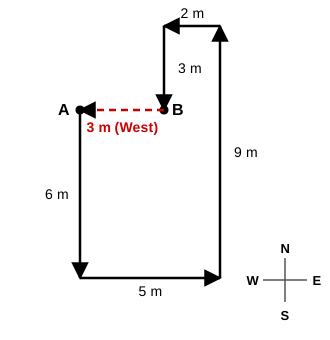
- Take A = (0, 0). South 6 → (0, −6).
- Left (East) 5 → (5, −6); left (North) 9 → (5, 3).
- Left (West) 2 → (3, 3); left (South) 3 → (3, 0) = B.
- B is 3 m directly east of A → she must walk West.
Short trick: Net N–S: −6 + 9 − 3 = 0, so A and B are on the same horizontal line; net E–W: +5 − 2 = +3 (East) → return West.
Answer: (D) West
अवधारणा: प्रत्येक चाल को ग्रिड पर बनाइए (दक्षिण की ओर से बाएँ मुड़ने पर मुख पूर्व की ओर होता है, आदि)।
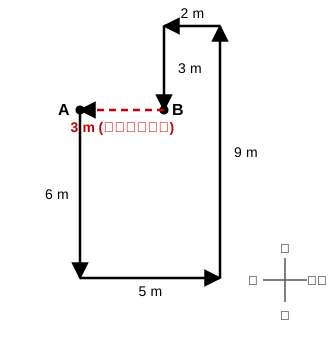
- A = (0, 0) लें। दक्षिण 6 → (0, −6)।
- बाएँ (पूर्व) 5 → (5, −6); बाएँ (उत्तर) 9 → (5, 3)।
- बाएँ (पश्चिम) 2 → (3, 3); बाएँ (दक्षिण) 3 → (3, 0) = B।
- B, A के ठीक 3 m पूर्व में है → उसे पश्चिम की ओर चलना होगा।
शॉर्ट ट्रिक: कुल उत्तर–दक्षिण: −6 + 9 − 3 = 0; कुल पूर्व–पश्चिम: +5 − 2 = +3 (पूर्व) → वापसी पश्चिम की ओर।
उत्तर: (D) पश्चिम
RRB ALP CBT 1General Intelligence and ReasoningDirection senseRRB ALP CBT 1 2025 · 18 Feb Shift 3
Q103.In a certain code language,
'A + B' means ‘A is the mother of B’,
'A – B' means ‘A is the brother of B’,
'A × B' means ‘A is the wife of B’, and
'A ÷ B' means ‘A is the father of B’.
Based on the above, how is P related to T, if ‘P × Q ÷ S – R + T’?
एक निश्चित कूट भाषा में,
'A + B' का अर्थ है ‘A, B की माँ है’,
'A – B' का अर्थ है ‘A, B का भाई है’,
'A × B' का अर्थ है ‘A, B की पत्नी है’, और
'A ÷ B' का अर्थ है ‘A, B का पिता है’।
उपर्युक्त के आधार पर, यदि ‘P × Q ÷ S – R + T’ है, तो P का T से क्या संबंध है?
- AFather's sisterपिता की बहन
- BFather's motherपिता की माँ
- CMother's motherमाँ की माँ
- DMother's sisterमाँ की बहन
Show answer
Concept: Decode each symbol and draw the family tree.
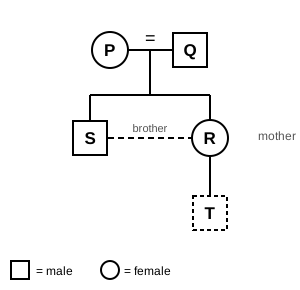
- P × Q → P is the wife of Q.
- Q ÷ S → Q is the father of S; S – R → S is the brother of R (so Q is R’s father too).
- R + T → R is the mother of T.
- P is the mother of R, and R is T’s mother → P is T’s mother’s mother.
Short trick: Read the chain from T backwards: T → mother (R) → her mother (P, wife of R’s father).
Answer: (C) Mother's mother
अवधारणा: प्रत्येक प्रतीक को डिकोड करें और वंश-वृक्ष बनाएँ।
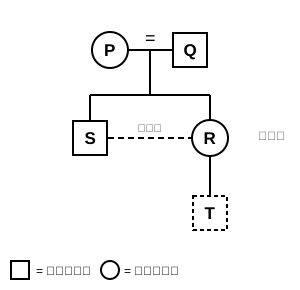
- P × Q → P, Q की पत्नी है।
- Q ÷ S → Q, S का पिता है; S – R → S, R का भाई है (अतः Q, R का भी पिता है)।
- R + T → R, T की माँ है।
- P, R की माँ है और R, T की माँ है → P, T की माँ की माँ है।
शॉर्ट ट्रिक: T से पीछे की ओर पढ़ें: T → माँ (R) → उसकी माँ (P, जो R के पिता की पत्नी है)।
उत्तर: (C) माँ की माँ
RRB ALP CBT 1General Intelligence and ReasoningCoded blood relationRRB ALP CBT 1 2025 · 18 Feb Shift 3
Q104.Refer to the following series and answer the question (All numbers are single digit numbers only. Counting to be done from left to right.)
(Left) 1 8 4 6 1 8 6 4 4 3 3 2 1 1 8 8 6 7 4 6 8 8 4 5 9 9 4 (Right)
How many such even numbers are there each of which is immediately preceded by an odd number and also immediately followed by an odd number?
निम्नलिखित शृंखला को देखिए और प्रश्न का उत्तर दीजिए (सभी संख्याएँ केवल एक अंक वाली संख्याएँ हैं। गिनती बाएँ से दाएँ की जानी है।)
(बाएँ) 1 8 4 6 1 8 6 4 4 3 3 2 1 1 8 8 6 7 4 6 8 8 4 5 9 9 4 (दाएँ)
ऐसी कितनी सम संख्याएँ हैं, जिनमें से प्रत्येक के ठीक पहले एक विषम संख्या है और ठीक बाद भी एक विषम संख्या है?
- A1
- B2
- C3
- D0
Show answer
Concept: Look for the pattern Odd – Even – Odd.
- Odd digits are only 1, 3, 5, 7, 9; check the neighbours of each even digit next to an odd one.
- … 8 6 7 4 6 … : 7 is odd but no even digit between two odds there.
- … 4 5 9 9 4: no even between odds.
- “3 2 1” → 2 is preceded by 3 and followed by 1 ✓; no other even digit is sandwiched.
- Count = 1.
Short trick: Mark the odd digits first (1,1,3,3,1,1,7,5,9,9); an even digit must be sandwiched between two marks — only 3 2 1.
Answer: (A) 1
अवधारणा: विषम – सम – विषम पैटर्न खोजें।
- विषम अंक केवल 1, 3, 5, 7, 9 हैं; विषम अंक के पास वाले प्रत्येक सम अंक के पड़ोसी जाँचें।
- … 8 6 7 4 6 … : यहाँ दो विषम के बीच कोई सम नहीं।
- … 4 5 9 9 4: दो विषम के बीच कोई सम नहीं।
- “3 2 1” → 2 के पहले 3 और बाद में 1 है ✓; कोई अन्य सम अंक दो विषम के बीच नहीं।
- गिनती = 1।
शॉर्ट ट्रिक: पहले विषम अंकों पर निशान लगाएँ; सम अंक दो निशानों के बीच होना चाहिए — केवल 3 2 1।
उत्तर: (A) 1
RRB ALP CBT 1General Intelligence and ReasoningNumber series – positionRRB ALP CBT 1 2025 · 18 Feb Shift 3
Q105.A, B, C, D, E, F and G are sitting around a circular table, facing the centre.
Only two people sit between B and G when counted from the left of G. D sits third to the left of A. E sits to the immediate right of A. E sits second to the left of B. C is an immediate neighbour of D.
How many people sit between C and E when counted from the right of C?
A, B, C, D, E, F और G एक वृत्ताकार मेज़ के चारों ओर केंद्र की ओर मुख करके बैठे हैं।
G के बाएँ से गिनने पर B और G के बीच केवल दो व्यक्ति बैठे हैं। D, A के बाएँ से तीसरे स्थान पर बैठा है। E, A के ठीक दाएँ बैठा है। E, B के बाएँ से दूसरे स्थान पर बैठा है। C, D का निकटतम पड़ोसी है।
C के दाएँ से गिनने पर C और E के बीच कितने व्यक्ति बैठे हैं?
- A2
- B1
- C3
- D4
Show answer
Concept: Facing the centre: left = clockwise, right = anticlockwise.

- Fix A. E is immediate right of A; D is 3rd to the left of A.
- E is 2nd to the left of B → B is 2nd to the right of E, i.e. 3rd to the right of A.
- B is 3rd to the left of G → G is immediate left of A. C is a neighbour of D → C sits between G and D.
- Clockwise: A, G, C, D, B, F, E.
- From C moving right: G, A, then E → 2 people between.
Short trick: Place the persons with fixed links to A first (E, D, B); G and C then have only one seat each.
Answer: (A) 2
अवधारणा: केंद्र की ओर मुख: बायाँ = दक्षिणावर्त, दायाँ = वामावर्त।

- A को स्थिर करें। E, A के ठीक दाएँ है; D, A के बाएँ तीसरा है।
- E, B के बाएँ दूसरा है → B, E के दाएँ दूसरा, अर्थात A के दाएँ तीसरा है।
- B, G के बाएँ से तीसरा है → G, A के ठीक बाएँ है। C, D का पड़ोसी है → C, G और D के बीच बैठता है।
- दक्षिणावर्त: A, G, C, D, B, F, E।
- C से दाएँ चलने पर: G, A, फिर E → बीच में 2 व्यक्ति।
शॉर्ट ट्रिक: पहले A से सीधे जुड़े व्यक्तियों (E, D, B) को बैठाएँ; फिर G और C के लिए केवल एक-एक स्थान बचता है।
उत्तर: (A) 2
RRB ALP CBT 1General Intelligence and ReasoningCircular seating arrangementRRB ALP CBT 1 2025 · 18 Feb Shift 3
Q106.What should come in place of the question mark (?) in the given series?
57 68 79 90 101 ?
दी गई शृंखला में प्रश्न चिह्न (?) के स्थान पर क्या आना चाहिए?
57 68 79 90 101 ?
- A114
- B112
- C108
- D110
Show answer
Concept: Each term increases by the same number.
- 68 − 57 = 11, 79 − 68 = 11, 90 − 79 = 11, 101 − 90 = 11.
- Next = 101 + 11 = 112.
Short trick: Arithmetic progression with : last + 11.
Answer: (B) 112
अवधारणा: प्रत्येक पद समान संख्या से बढ़ता है।
- 68 − 57 = 11, 79 − 68 = 11, 90 − 79 = 11, 101 − 90 = 11।
- अगला = 101 + 11 = 112।
शॉर्ट ट्रिक: वाली समांतर श्रेणी: अंतिम + 11।
उत्तर: (B) 112
RRB ALP CBT 1General Intelligence and ReasoningNumber series – constant differenceRRB ALP CBT 1 2025 · 18 Feb Shift 3
Q107.What should come in place of the question mark (?) in the given series based on the English alphabetical order?
ILT LOW ORZ RUC ?
अंग्रेज़ी वर्णमाला क्रम के आधार पर, दी गई शृंखला में प्रश्न चिह्न (?) के स्थान पर क्या आना चाहिए?
ILT LOW ORZ RUC ?
- AUFX
- BUFF
- CUDE
- DUXF
Show answer
Concept: Track each letter position separately.
| 1st | I | L | O | R | U | (+3) |
| 2nd | L | O | R | U | X | (+3) |
| 3rd | T | W | Z | C | F | (+3) |
- Answer: UXF.
Short trick: Every letter moves +3; the next term is RUC shifted by 3 → UXF.
Answer: (D) UXF
अवधारणा: प्रत्येक स्थान के अक्षर को अलग-अलग देखें।
| पहला | I | L | O | R | U | (+3) |
| दूसरा | L | O | R | U | X | (+3) |
| तीसरा | T | W | Z | C | F | (+3) |
- उत्तर: UXF।
शॉर्ट ट्रिक: हर अक्षर +3 चलता है; RUC को 3 आगे बढ़ाएँ → UXF।
उत्तर: (D) UXF
RRB ALP CBT 1General Intelligence and ReasoningAlphabet seriesRRB ALP CBT 1 2025 · 18 Feb Shift 3
Q108.What will come in the place of ‘?’ in the following equation, if ‘+’ and ‘-‘ are interchanged and ‘×’ and ‘÷’ are interchanged?
28 × 2 - 4 ÷ 24 + 41 = ?
यदि ‘+’ और ‘-’ को आपस में बदल दिया जाए तथा ‘×’ और ‘÷’ को आपस में बदल दिया जाए, तो निम्नलिखित समीकरण में ‘?’ के स्थान पर क्या आएगा?
28 × 2 - 4 ÷ 24 + 41 = ?
- A68
- B71
- C70
- D69
Show answer
Concept: Interchange the signs first, then apply BODMAS.
- After interchange: 28 ÷ 2 + 4 × 24 − 41.
- = 14 + 96 − 41.
- = 69.
Short trick: Rewrite once carefully, then do ÷ and × first.
Answer: (D) 69
अवधारणा: पहले चिह्न बदलें, फिर BODMAS लगाएँ।
- बदलने के बाद: 28 ÷ 2 + 4 × 24 − 41।
- = 14 + 96 − 41।
- = 69।
शॉर्ट ट्रिक: एक बार ध्यान से दोबारा लिखें, फिर पहले ÷ और × करें।
उत्तर: (D) 69
RRB ALP CBT 1General Intelligence and ReasoningMathematical operations – interchangeRRB ALP CBT 1 2025 · 18 Feb Shift 3
Q109.In the following number-pairs, the second number is obtained by applying certain mathematical operations to the first number. Select the set in which the numbers are related in the same way as are the numbers of the following sets.
(NOTE : Operations should be performed on the whole numbers, without breaking down the numbers into its constituent digits. E.g. 13 – Operations on 13 such as adding / subtracting /multiplying etc. to 13 can be performed. Breaking down 13 into 1 and 3 and then performing mathematical operations on 1 and 3 is not allowed).
2 - 5
10 - 101
निम्नलिखित संख्या-युग्मों में, पहली संख्या पर कुछ गणितीय संक्रियाएँ करके दूसरी संख्या प्राप्त की जाती है। उस समुच्चय का चयन कीजिए जिसमें संख्याएँ उसी प्रकार संबंधित हैं, जिस प्रकार निम्नलिखित समुच्चयों की संख्याएँ संबंधित हैं।
(नोट: संक्रियाएँ पूर्ण संख्याओं पर की जानी चाहिए, संख्याओं को उनके घटक अंकों में तोड़े बिना। उदाहरण के लिए 13 – 13 पर संक्रियाएँ जैसे 13 में जोड़ना/घटाना/गुणा करना आदि किया जा सकता है। 13 को 1 और 3 में तोड़कर फिर 1 और 3 पर गणितीय संक्रियाएँ करने की अनुमति नहीं है।)
2 - 5
10 - 101
- A5 - 26
- B4 - 18
- C9 - 80
- D8 - 63
Show answer
Concept: Find one rule that fits both given pairs.
- 2 → 5 = ; 10 → 101 = . Rule: .
- 5 → ✓; 4 → 17 (not 18); 9 → 82 (not 80); 8 → 65 (not 63).
Short trick: The second number is just above a perfect square — test directly on options.
Answer: (A) 5 - 26
अवधारणा: ऐसा एक नियम खोजें जो दोनों युग्मों पर लागू हो।
- 2 → 5 = ; 10 → 101 = । नियम: ।
- 5 → ✓; 4 → 17 (18 नहीं); 9 → 82 (80 नहीं); 8 → 65 (63 नहीं)।
शॉर्ट ट्रिक: दूसरी संख्या पूर्ण वर्ग से ठीक 1 अधिक है — विकल्पों पर सीधे जाँचें।
उत्तर: (A) 5 - 26
RRB ALP CBT 1General Intelligence and ReasoningNumber-pair analogyRRB ALP CBT 1 2025 · 18 Feb Shift 3
Q110.A question is followed by two statements numbered (I) and (II). You have to decide whether the data provided in the statements are sufficient to answer the question. Read both the statements and decide the appropriate answer.
Q. Four runners – Ravi, Sahil, Tarun, and Uday – run at different speeds.
Who is the fastest?
(I) Tarun runs faster than Ravi but slower than Sahil.
(II) Uday runs slower than Sahil but faster than Tarun.
एक प्रश्न के बाद दो कथन (I) और (II) दिए गए हैं। आपको यह तय करना है कि कथनों में दिया गया डेटा प्रश्न का उत्तर देने के लिए पर्याप्त है या नहीं। दोनों कथनों को पढ़ें और उपयुक्त उत्तर चुनें।
प्रश्न: चार धावक – रवि, साहिल, तरुण और उदय – अलग-अलग गति से दौड़ते हैं।
सबसे तेज़ कौन है?
(I) तरुण, रवि से तेज़ लेकिन साहिल से धीमा दौड़ता है।
(II) उदय, साहिल से धीमा लेकिन तरुण से तेज़ दौड़ता है।
- AData in Statement I alone is sufficient to answer the question while data in Statement II is notकथन I में दिया गया डेटा अकेले प्रश्न का उत्तर देने के लिए पर्याप्त है, जबकि कथन II में दिया गया डेटा पर्याप्त नहीं है
- BData in both statements I and II together (and not statement I alone or statement II alone) are sufficient to answer the questionकथन I और II दोनों में दिया गया डेटा एक साथ (न कि अकेले कथन I या अकेले कथन II) प्रश्न का उत्तर देने के लिए पर्याप्त है
- CData in Statement II alone is sufficient to answer the question while data in Statement I is notकथन II में दिया गया डेटा अकेले प्रश्न का उत्तर देने के लिए पर्याप्त है, जबकि कथन I में दिया गया डेटा पर्याप्त नहीं है
- DData in both statements I and II together are NOT sufficient to answer the questionकथन I और II दोनों में दिया गया डेटा एक साथ भी प्रश्न का उत्तर देने के लिए पर्याप्त नहीं है
Show answer
Concept: Write each statement as an inequality chain.
- I: Sahil > Tarun > Ravi — Uday unknown, so fastest not fixed.
- II: Sahil > Uday > Tarun — Ravi unknown, so not fixed.
- I + II: Sahil > Uday > Tarun > Ravi → Sahil is the fastest.
- So both together are needed.
Short trick: Each statement leaves exactly one person unplaced, and the other statement places that person below Sahil → together sufficient.
Answer: (B) Data in both statements I and II together (and not statement I alone or statement II alone) are sufficient to answer the question
अवधारणा: प्रत्येक कथन को असमिका-शृंखला के रूप में लिखें।
- I: साहिल > तरुण > रवि — उदय अज्ञात, अतः सबसे तेज़ तय नहीं।
- II: साहिल > उदय > तरुण — रवि अज्ञात, अतः तय नहीं।
- I + II: साहिल > उदय > तरुण > रवि → साहिल सबसे तेज़।
- अतः दोनों कथन साथ में आवश्यक हैं।
शॉर्ट ट्रिक: प्रत्येक कथन में एक व्यक्ति छूट जाता है, दूसरा कथन उसे साहिल से नीचे रखता है → दोनों साथ में पर्याप्त।
उत्तर: (B) कथन I और II दोनों में दिया गया डेटा एक साथ (न कि अकेले कथन I या अकेले कथन II) प्रश्न का उत्तर देने के लिए पर्याप्त है
RRB ALP CBT 1General Intelligence and ReasoningData sufficiency – rankingRRB ALP CBT 1 2025 · 18 Feb Shift 3
Q111.What should come in place of the question mark (?) in the given series based on the English alphabetical order?
CMA GQF KUK OYP ?
अंग्रेज़ी वर्णमाला क्रम के आधार पर, दी गई शृंखला में प्रश्न चिह्न (?) के स्थान पर क्या आना चाहिए?
CMA GQF KUK OYP ?
- ASCU
- BRMU
- CSCA
- DSMU
Show answer
Concept: Track each letter position separately (wrap Z → A).
| 1st | C | G | K | O | S | (+4) |
| 2nd | M | Q | U | Y | C | (+4) |
| 3rd | A | F | K | P | U | (+5) |
- Answer: SCU.
Short trick: First two letters +4, third +5: Y + 4 wraps to C, P + 5 = U → SCU.
Answer: (A) SCU
अवधारणा: प्रत्येक स्थान के अक्षर को अलग-अलग देखें (Z के बाद A)।
| पहला | C | G | K | O | S | (+4) |
| दूसरा | M | Q | U | Y | C | (+4) |
| तीसरा | A | F | K | P | U | (+5) |
- उत्तर: SCU।
शॉर्ट ट्रिक: पहले दो अक्षर +4, तीसरा +5: Y + 4 = C, P + 5 = U → SCU।
उत्तर: (A) SCU
RRB ALP CBT 1General Intelligence and ReasoningAlphabet seriesRRB ALP CBT 1 2025 · 18 Feb Shift 3
Q112.Below are given two sets of numbers. In each set of numbers, a certain mathematical operation on the first number results in the second number. Similarly, certain mathematical operation on the second number results in the third number and so on. Which of the given options follows the same set of operations as in the given sets?
(NOTE – A two/three digit number cannot be broken into individual digits for operations e.g. if 37 is followed by 10, the operation cannot be 3+7 as a two digit number cannot be broken into individual digits)
13 - 26 - 30 - 60 ; 9 - 18 - 22 - 44
नीचे संख्याओं के दो समुच्चय दिए गए हैं। प्रत्येक समुच्चय में, पहली संख्या पर एक निश्चित गणितीय संक्रिया करने से दूसरी संख्या प्राप्त होती है। इसी प्रकार, दूसरी संख्या पर एक निश्चित गणितीय संक्रिया करने से तीसरी संख्या प्राप्त होती है, और इसी तरह आगे भी। दिए गए विकल्पों में से कौन-सा विकल्प दिए गए समुच्चयों के समान संक्रियाओं का अनुसरण करता है?
(नोट – संक्रियाओं के लिए दो/तीन अंकों वाली संख्या को अलग-अलग अंकों में नहीं तोड़ा जा सकता, उदाहरण के लिए यदि 37 के बाद 10 आता है, तो संक्रिया 3+7 नहीं हो सकती क्योंकि दो अंकों वाली संख्या को अलग-अलग अंकों में नहीं तोड़ा जा सकता)
13 - 26 - 30 - 60 ; 9 - 18 - 22 - 44
- A10 - 20 - 24 - 54
- B2 - 4 - 8 - 12
- C3 - 6 - 10 - 22
- D6 - 12 - 16 - 32
Show answer
Concept: Find the operation chain from the given sets.
- 13 → 26 (×2) → 30 (+4) → 60 (×2); 9 → 18 → 22 → 44 — same: ×2, +4, ×2.
- A: 24 × 2 = 48 ≠ 54 ✗; B: 2 × 2 = 4, 4 + 4 = 8, 8 × 2 = 16 ≠ 12 ✗; C: 10 × 2 = 20 ≠ 22 ✗.
- D: 6 → 12 → 16 → 32 ✓.
Short trick: The last term must be double the third — only 16 → 32 passes at a glance.
Answer: (D) 6 - 12 - 16 - 32
अवधारणा: दिए गए समुच्चयों से संक्रिया-क्रम ज्ञात करें।
- 13 → 26 (×2) → 30 (+4) → 60 (×2); 9 → 18 → 22 → 44 — वही: ×2, +4, ×2।
- A: 24 × 2 = 48 ≠ 54 ✗; B: 8 × 2 = 16 ≠ 12 ✗; C: 10 × 2 = 20 ≠ 22 ✗।
- D: 6 → 12 → 16 → 32 ✓।
शॉर्ट ट्रिक: अंतिम पद तीसरे का दोगुना होना चाहिए — केवल 16 → 32 तुरंत सही बैठता है।
उत्तर: (D) 6 - 12 - 16 - 32
RRB ALP CBT 1General Intelligence and ReasoningNumber set – operationsRRB ALP CBT 1 2025 · 18 Feb Shift 3
Q113.D, E, F, G, K, L and M are sitting around a circular table, facing the centre of the table. Only four people sit between F and G when counted from the right of F. F sits third to the left of M. E sits third to the left of D. K is an immediate neighbour of both G and M. How many people sit between L and K when counted from the right of L?
D, E, F, G, K, L और M एक वृत्ताकार मेज़ के चारों ओर, मेज़ के केंद्र की ओर मुख करके बैठे हैं। F के दाएँ से गिनने पर F और G के बीच केवल चार व्यक्ति बैठे हैं। F, M के बाएँ से तीसरे स्थान पर बैठा है। E, D के बाएँ से तीसरे स्थान पर बैठा है। K, G और M दोनों का निकटतम पड़ोसी है। L के दाएँ से गिनने पर L और K के बीच कितने व्यक्ति बैठे हैं?
- AOneएक
- BTwoदो
- CThreeतीन
- DFourचार
Show answer
Concept: Facing the centre: left = clockwise, right = anticlockwise.

- F is 3rd to the left of M. Four people between F and G counting from F’s right → G is 5th to the right of F (= 2nd to the left of F).
- K is a neighbour of both G and M → K sits between them.
- Seats left: one beside M, one between F and G, one between M-side seat and F. E is 3rd to the left of D → D sits immediately left of M and E between F and G; L takes the last seat.
- Clockwise: D, L, F, E, G, K, M.
- From L moving right: D, M, then K → 2 people between.
Short trick: “Only 4 between” in a 7-seat circle = only 1 between on the other side — so G is 2nd to F’s left.
Answer: (B) Two
अवधारणा: केंद्र की ओर मुख: बायाँ = दक्षिणावर्त, दायाँ = वामावर्त।

- F, M के बाएँ तीसरा है। F के दाएँ से गिनने पर F और G के बीच चार व्यक्ति → G, F के दाएँ पाँचवाँ (= F के बाएँ दूसरा) है।
- K, G और M दोनों का पड़ोसी है → K उनके बीच है।
- E, D के बाएँ तीसरा है → D, M के ठीक बाएँ और E, F व G के बीच बैठता है; बचा स्थान L का।
- दक्षिणावर्त: D, L, F, E, G, K, M।
- L से दाएँ चलने पर: D, M, फिर K → बीच में 2 व्यक्ति।
शॉर्ट ट्रिक: 7 सीटों वाले वृत्त में “केवल 4 बीच में” = दूसरी ओर केवल 1 बीच में — अतः G, F के बाएँ दूसरा।
उत्तर: (B) दो
RRB ALP CBT 1General Intelligence and ReasoningCircular seating arrangementRRB ALP CBT 1 2025 · 18 Feb Shift 3
Q114.Among five people named V, W, X, Y and Z, each have a certain age. The age of X is 30. V is four times the age of W. Y is twice the age of V. Z is five times the age of W. If Z is half the age of X, what is the age of Y?
V, W, X, Y और Z नामक पाँच व्यक्तियों में से प्रत्येक की एक निश्चित आयु है। X की आयु 30 है। V की आयु, W की आयु की चार गुनी है। Y की आयु, V की आयु की दोगुनी है। Z की आयु, W की आयु की पाँच गुनी है। यदि Z की आयु, X की आयु की आधी है, तो Y की आयु क्या है?
- A45
- B75
- C25
- D24
Show answer
Concept: Start from the known value and move along the chain.
- Z = ½ × X = 15.
- Z = 5W → W = 3.
- V = 4W = 12; Y = 2V = 24.
Short trick: Y = 2 × 4 × W = 8W and W = Z/5 = 3 → Y = 24.
Answer: (D) 24
अवधारणा: ज्ञात मान से शुरू करके शृंखला में आगे बढ़ें।
- Z = ½ × X = 15।
- Z = 5W → W = 3।
- V = 4W = 12; Y = 2V = 24।
शॉर्ट ट्रिक: Y = 8W और W = Z/5 = 3 → Y = 24।
उत्तर: (D) 24
RRB ALP CBT 1General Intelligence and ReasoningAges – ratio chainRRB ALP CBT 1 2025 · 18 Feb Shift 3
Q115.What should come in place of ? in the given series?
57 82 118 167 231 ?
दी गई शृंखला में ? के स्थान पर क्या आना चाहिए?
57 82 118 167 231 ?
- A311
- B314
- C312
- D313
Show answer
Concept: Check the differences between terms.
- Differences: 25, 36, 49, 64 = .
- Next difference = .
- 231 + 81 = 312.
Short trick: Consecutive squares as gaps → add the next square.
Answer: (C) 312
अवधारणा: पदों के बीच का अंतर देखें।
- अंतर: 25, 36, 49, 64 = ।
- अगला अंतर = ।
- 231 + 81 = 312।
शॉर्ट ट्रिक: अंतर क्रमागत वर्ग हैं → अगला वर्ग जोड़ें।
उत्तर: (C) 312
RRB ALP CBT 1General Intelligence and ReasoningNumber series – square differencesRRB ALP CBT 1 2025 · 18 Feb Shift 3
Q116.Read the given statements and conclusions carefully. Assuming that the information given in the statements is true, even if it appears to be at variance with commonly known facts, decide which of the given conclusion(s) logically follow(s) from the statements.
Statements:
Some mats are carpets.
All carpets are rugs.
Conclusions:
(I) Some mats are rugs.
(II) All rugs are carpets.
दिए गए कथनों और निष्कर्षों को ध्यानपूर्वक पढ़िए। यह मानते हुए कि कथनों में दी गई जानकारी सत्य है, भले ही वह सामान्य रूप से ज्ञात तथ्यों से भिन्न प्रतीत होती हो, निर्णय लीजिए कि दिए गए निष्कर्षों में से कौन-सा/से निष्कर्ष तार्किक रूप से कथनों का अनुसरण करता है/करते हैं।
कथन:
कुछ मैट, कालीन हैं।
सभी कालीन, गलीचे हैं।
निष्कर्ष:
(I) कुछ मैट, गलीचे हैं।
(II) सभी गलीचे, कालीन हैं।
- AOnly conclusion (II) follows.केवल निष्कर्ष (II) अनुसरण करता है।
- BNeither conclusion (I) nor (II) follows.न तो निष्कर्ष (I) और न ही (II) अनुसरण करता है।
- COnly conclusion (I) follows.केवल निष्कर्ष (I) अनुसरण करता है।
- DBoth conclusions (I) and (II) follow.दोनों निष्कर्ष (I) और (II) अनुसरण करते हैं।
Show answer
Concept: Draw the least-overlap Venn diagram.
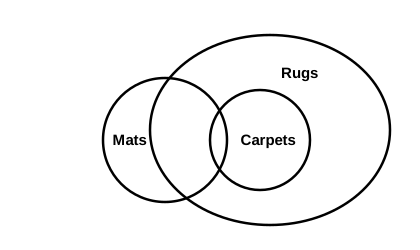
- Some mats are carpets and all carpets lie inside rugs.
- The mats that are carpets are therefore rugs → I (Some mats are rugs) follows.
- Rugs may contain things that are not carpets → II does not follow.
Short trick: Some + All → Some (I-type conclusion follows); “All B are A” can never be reversed to “All A are B”.
Answer: (C) Only conclusion (I) follows.
अवधारणा: न्यूनतम अतिव्यापन वाला वेन आरेख बनाइए।
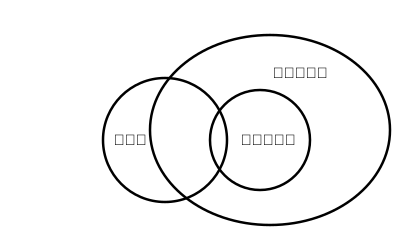
- कुछ मैट कालीन हैं और सभी कालीन गलीचों के अंदर हैं।
- अतः जो मैट कालीन हैं वे गलीचे भी हैं → I (कुछ मैट गलीचे हैं) अनुसरण करता है।
- गलीचों में ऐसी चीज़ें भी हो सकती हैं जो कालीन नहीं हैं → II अनुसरण नहीं करता।
शॉर्ट ट्रिक: कुछ + सभी → कुछ (I अनुसरण करता है); “सभी B, A हैं” को उलटकर “सभी A, B हैं” नहीं बनाया जा सकता।
उत्तर: (C) केवल निष्कर्ष (I) अनुसरण करता है।
RRB ALP CBT 1General Intelligence and ReasoningSyllogismRRB ALP CBT 1 2025 · 18 Feb Shift 3
Q117.In a code language, 'PET' is coded as 123 and 'NEAR' is coded as 152. How will 'TRAIN' be coded in the same language?
एक कूट भाषा में, 'PET' को 123 के रूप में और 'NEAR' को 152 के रूप में कूटबद्ध किया जाता है। उसी भाषा में 'TRAIN' को किस प्रकार कूटबद्ध किया जाएगा?
- A310
- B196
- C218
- D288
Show answer
Concept: Code = (sum of alphabet positions) × (number of letters).
- PET: 16 + 5 + 20 = 41; 41 × 3 = 123 ✓.
- NEAR: 14 + 5 + 1 + 18 = 38; 38 × 4 = 152 ✓.
- TRAIN: 20 + 18 + 1 + 9 + 14 = 62; 62 × 5 = 310.
Short trick: 123 = 3 × 41 and 152 = 4 × 38 — both codes are divisible by the word length, which reveals the multiplier.
Answer: (A) 310
अवधारणा: कूट = (अक्षरों के वर्णमाला क्रमांकों का योग) × (अक्षरों की संख्या)।
- PET: 16 + 5 + 20 = 41; 41 × 3 = 123 ✓।
- NEAR: 14 + 5 + 1 + 18 = 38; 38 × 4 = 152 ✓।
- TRAIN: 20 + 18 + 1 + 9 + 14 = 62; 62 × 5 = 310।
शॉर्ट ट्रिक: 123 = 3 × 41 और 152 = 4 × 38 — दोनों कूट शब्द-लंबाई से विभाज्य हैं, यही गुणक बताता है।
उत्तर: (A) 310
RRB ALP CBT 1General Intelligence and ReasoningCoding – letter valuesRRB ALP CBT 1 2025 · 18 Feb Shift 3
Q118.If ‘A’ stands for ‘÷’, ‘B’ stands for ‘x’, ‘C’ stands for ‘+’ and ‘D’ stands for ‘-’, what will come in place of the question mark (?) in the following equation?
22 B 108 A 12 C 43 D 171 = ?
यदि ‘A’ का अर्थ ‘÷’, ‘B’ का अर्थ ‘×’, ‘C’ का अर्थ ‘+’ और ‘D’ का अर्थ ‘-’ है, तो निम्नलिखित समीकरण में प्रश्न चिह्न (?) के स्थान पर क्या आएगा?
22 B 108 A 12 C 43 D 171 = ?
- A75
- B71
- C70
- D72
Show answer
Concept: Replace letters by signs, then BODMAS.
- 22 × 108 ÷ 12 + 43 − 171.
- 108 ÷ 12 = 9 → 22 × 9 = 198.
- 198 + 43 − 171 = 70.
Short trick: Divide first (108 ÷ 12 = 9) to keep numbers small.
Answer: (C) 70
अवधारणा: अक्षरों के स्थान पर चिह्न रखें, फिर BODMAS।
- 22 × 108 ÷ 12 + 43 − 171।
- 108 ÷ 12 = 9 → 22 × 9 = 198।
- 198 + 43 − 171 = 70।
शॉर्ट ट्रिक: पहले भाग करें (108 ÷ 12 = 9) ताकि संख्याएँ छोटी रहें।
उत्तर: (C) 70
RRB ALP CBT 1General Intelligence and ReasoningMathematical operations – substitutionRRB ALP CBT 1 2025 · 18 Feb Shift 3
Q119.Refer to the following letter series and answer the question that follows. Counting to be done from left to right only.
(Left) T O W A Q D F H G U K S I C X Z O F H G U K I S (Right)
How many such consonants are there, each of which is immediately preceded by a vowel and also immediately followed by a vowel?
निम्नलिखित अक्षर शृंखला को देखिए और नीचे दिए गए प्रश्न का उत्तर दीजिए। गिनती केवल बाएँ से दाएँ की जानी है।
(बाएँ) T O W A Q D F H G U K S I C X Z O F H G U K I S (दाएँ)
ऐसे कितने व्यंजन हैं, जिनमें से प्रत्येक के ठीक पहले एक स्वर है और ठीक बाद भी एक स्वर है?
- AThreeतीन
- BTwoदो
- CNoneकोई नहीं
- DOneएक
Show answer
Concept: Find the pattern Vowel – Consonant – Vowel.
- Vowels in the series: O (2nd), A (4th), U (10th), I (13th), O (17th), U (21st), I (23rd).
- O W A ✓ (positions 2-3-4).
- U K I (positions 21-22-23) ✓; others (A Q D, U K S, I C X, O F H) fail.
- Count = 2.
Short trick: Two vowels with exactly one letter between them — check only such gaps: O_A and U_I (second time) work.
Answer: (B) Two
अवधारणा: स्वर – व्यंजन – स्वर पैटर्न खोजें।
- शृंखला में स्वर: O (2), A (4), U (10), I (13), O (17), U (21), I (23)।
- O W A ✓ (स्थान 2-3-4)।
- U K I (स्थान 21-22-23) ✓; अन्य (A Q D, U K S, I C X, O F H) नहीं।
- गिनती = 2।
शॉर्ट ट्रिक: ऐसे दो स्वर खोजें जिनके बीच ठीक एक अक्षर हो — केवल O_A और (दूसरी बार) U_I।
उत्तर: (B) दो
RRB ALP CBT 1General Intelligence and ReasoningLetter series – vowel/consonantRRB ALP CBT 1 2025 · 18 Feb Shift 3
Q120.Each of G, H, I, J, K, L and M has an exam on a different day of a week starting from Monday and ending on Sunday of the same week. G has an exam on Wednesday. Only two persons have exam between G and L. I has exam immediately before L. H's exam is not on the last day. J has exam immediately after K. On which day does M have the exam?
G, H, I, J, K, L और M में से प्रत्येक की परीक्षा एक ही सप्ताह के सोमवार से शुरू होकर रविवार को समाप्त होने वाले अलग-अलग दिनों में है। G की परीक्षा बुधवार को है। G और L के बीच केवल दो व्यक्तियों की परीक्षा है। I की परीक्षा, L से ठीक पहले है। H की परीक्षा अंतिम दिन नहीं है। J की परीक्षा, K के ठीक बाद है। M की परीक्षा किस दिन है?
- AFridayशुक्रवार
- BSaturdayशनिवार
- CSundayरविवार
- DMondayसोमवार
Show answer
Concept: Fix the definite days first.
| Mon | Tue | Wed | Thu | Fri | Sat | Sun |
| K | J | G | H | I | L | M |
- G = Wed; two between G and L → L = Sat (Sun-side only possible); I = Fri.
- K–J consecutive: only Mon–Tue left.
- H not Sunday → H = Thu, M = Sunday.
Short trick: After placing G, L, I and the K–J block, two days remain (Thu, Sun); H can’t be last → M = Sunday.
Answer: (C) Sunday
अवधारणा: पहले निश्चित दिन तय करें।
| सोम | मंगल | बुध | गुरु | शुक्र | शनि | रवि |
| K | J | G | H | I | L | M |
- G = बुधवार; G और L के बीच दो → L = शनिवार; I = शुक्रवार।
- K–J क्रमागत: केवल सोम–मंगल बचे।
- H रविवार नहीं → H = गुरुवार, M = रविवार।
शॉर्ट ट्रिक: G, L, I और K–J रखने के बाद दो दिन (गुरु, रवि) बचते हैं; H अंतिम दिन नहीं → M = रविवार।
उत्तर: (C) रविवार
RRB ALP CBT 1General Intelligence and ReasoningScheduling – days of weekRRB ALP CBT 1 2025 · 18 Feb Shift 3

