RRB ALP CBT 1 · 825 questions

RRB ALP CBT 1 2025 PYQs

Real previous year questions, subject-wise. Try the question, then open the answer and the explanation in Hindi & English – free, no login.

Courses – airGurukul

825 questions.

Q161.
In two triangles, ∆ABC ∼ ∆PQR, AB=12cm and PQ=4cm, if AL and PM are altitudes of the respected triangles, then what will be AL:PM?
दो त्रिभुजों में, ∆ABC ∼ ∆PQR, AB = 12 cm और PQ = 4 cm है। यदि AL और PM संबंधित त्रिभुजों के शीर्षलंब हैं, तो AL : PM क्या होगा?
  1. A1:3
  2. B3:1
  3. C2:3
  4. D2:1
Show answer

Concept: In similar triangles, corresponding altitudes are in the ratio of corresponding sides.

  1. AL : PM = AB : PQ = 12 : 4 = 3 : 1.

Short trick: Every linear measure (side, altitude, median, perimeter) has the same ratio; only areas go as the square.

Answer: (B) 3:1

अवधारणा: समरूप त्रिभुजों में संगत शीर्षलंब संगत भुजाओं के अनुपात में होते हैं।

  1. AL : PM = AB : PQ = 12 : 4 = 3 : 1।

शॉर्ट ट्रिक: हर रैखिक माप (भुजा, शीर्षलंब, माध्यिका, परिमाप) का अनुपात समान; केवल क्षेत्रफल वर्ग के अनुपात में।

उत्तर: (B) 3:1
RRB ALP CBT 1MathematicsSimilar triangles – altitudesRRB ALP CBT 1 2025 · 18 Feb Shift 2
Q162.
On a certain sum, if at the same rate of interest, in 2 years, the simple interest is ₹64 and the compound interest is ₹80, then what is the sum (in ₹)?
किसी निश्चित राशि पर, ब्याज की समान दर से, 2 वर्षों में साधारण ब्याज ₹64 और चक्रवृद्धि ब्याज ₹80 है, तो राशि (₹ में) कितनी है?
  1. A68
  2. B57
  3. C64
  4. D59
Show answer

Concept: For 2 years, CI − SI = interest on one year’s SI: CI−SI=SI1×r100.

  1. SI per year = 64 ÷ 2 = 32.
  2. CI − SI = 16 = 32 × r/100 ⇒ r = 50 %.
  3. P = 32×10050=64.

Short trick: P=(SI1)2CI−SI=32216=64.

Answer: (C) 64

अवधारणा: 2 वर्षों के लिए CI − SI = एक वर्ष के SI पर ब्याज।

  1. प्रति वर्ष SI = 64 ÷ 2 = 32।
  2. CI − SI = 16 = 32 × r/100 ⇒ r = 50 %।
  3. P = 32×10050=64।

शॉर्ट ट्रिक: P=32216=64।

उत्तर: (C) 64

RRB ALP CBT 1MathematicsCI – SI for 2 yearsRRB ALP CBT 1 2025 · 18 Feb Shift 2
Q163.
Simplify: 0.8×0.8×0.8−0.08×0.08×0.088×8×8
सरल कीजिए: 0.8×0.8×0.8−0.08×0.08×0.088×8×8
  1. A0.000999
  2. B0.0000999
  3. C0.0999
  4. D0.00999
Show answer

Concept: Write each term with powers of 10.

  1. 0.83=0.512, 0.083=0.000512.
  2. Numerator = 0.512−0.000512=0.511488.
  3. 0.511488512=0.000999.

Short trick: 0.8383=10−3 and 0.08383=10−6 → 0.001−0.000001=0.000999.

Answer: (A) 0.000999

अवधारणा: हर पद को 10 की घातों में लिखें।

  1. 0.83=0.512, 0.083=0.000512।
  2. अंश = 0.511488।
  3. 0.511488512=0.000999।

शॉर्ट ट्रिक: 0.8383=10−3, 0.08383=10−6 → 0.001−0.000001=0.000999।

उत्तर: (A) 0.000999

RRB ALP CBT 1MathematicsSimplification – decimalsRRB ALP CBT 1 2025 · 18 Feb Shift 2
Q164.
What is the mode of the following data?
70, 79, 66, 89, 68, 80, 82, 80, 71, 84, 69, 68, 61, 85, 71, 84, 68, 86, 73, 75, 83, 88, 64, 88, 65
निम्नलिखित आँकड़ों का बहुलक क्या है?
70, 79, 66, 89, 68, 80, 82, 80, 71, 84, 69, 68, 61, 85, 71, 84, 68, 86, 73, 75, 83, 88, 64, 88, 65
  1. A80
  2. B88
  3. C71
  4. D68
Show answer

Concept: Mode = value occurring most often.

  1. Frequencies of the options: 80 → 2, 88 → 2, 71 → 2, 68 → 3.
  2. Every other value occurs at most twice.
  3. Mode = 68.

Short trick: Only count the four option values in the list – 68 is the one that appears 3 times.

Answer: (D) 68

अवधारणा: बहुलक = सबसे अधिक बार आने वाला मान।

  1. विकल्पों की बारंबारता: 80 → 2, 88 → 2, 71 → 2, 68 → 3।
  2. अन्य हर मान अधिकतम दो बार।
  3. बहुलक = 68।

शॉर्ट ट्रिक: केवल चार विकल्प-मानों को गिनें – 68 तीन बार आता है।

उत्तर: (D) 68

RRB ALP CBT 1MathematicsStatistics – modeRRB ALP CBT 1 2025 · 18 Feb Shift 2
Q165.
A shopkeeper bought six identical mobile phones for ₹ 72000, and sold two of them for ₹ 72000. Find his gain percentage.
एक दुकानदार ने छह एक जैसे मोबाइल फ़ोन ₹72000 में खरीदे और उनमें से दो को ₹72000 में बेच दिया। उसका लाभ प्रतिशत ज्ञात कीजिए।
  1. A200%
  2. B203%
  3. C1.97%
  4. D201%
Show answer

Concept: Compare CP and SP of the same number of items.

  1. CP of 1 phone = 72000 ÷ 6 = 12000; CP of 2 = 24000.
  2. SP of 2 = 72000; profit = 48000.
  3. Gain % = 4800024000×100=200 %.

Short trick: SP of 2 = CP of 6 ⇒ SP/CP = 6/2 = 3 ⇒ gain = (3 − 1) × 100 = 200 %.

Answer: (A) 200%

अवधारणा: समान संख्या की वस्तुओं के क्रय और विक्रय मूल्य की तुलना करें।

  1. 1 फ़ोन का CP = 12000; 2 का CP = 24000।
  2. 2 का SP = 72000; लाभ = 48000।
  3. लाभ % = 4800024000×100=200 %।

शॉर्ट ट्रिक: 2 का SP = 6 का CP ⇒ SP/CP = 3 ⇒ लाभ = (3 − 1) × 100 = 200 %।

उत्तर: (A) 200%

RRB ALP CBT 1MathematicsProfit percentageRRB ALP CBT 1 2025 · 18 Feb Shift 2
Q166.
The price of an article was ₹1700. It increased by 5% in the first year and by 20% in the second year. What is the price (in ₹) of the article after two years?
एक वस्तु का मूल्य ₹1700 था। पहले वर्ष में इसमें 5% और दूसरे वर्ष में 20% की वृद्धि हुई। दो वर्ष बाद वस्तु का मूल्य (₹ में) कितना है?
  1. A1885
  2. B2040
  3. C2142
  4. D2125
Show answer

Concept: Multiply by the growth factors one after another.

  1. 1700×1.05=1785.
  2. 1785×1.2=2142.

Short trick: Net increase = 5+20+5×20100=26 % → 1700 × 1.26 = 2142.

Answer: (C) 2142

अवधारणा: वृद्धि गुणकों से क्रमशः गुणा करें।

  1. 1700×1.05=1785।
  2. 1785×1.2=2142।

शॉर्ट ट्रिक: कुल वृद्धि = 5 + 20 + 1 = 26 % → 1700 × 1.26 = 2142।

उत्तर: (C) 2142

RRB ALP CBT 1MathematicsSuccessive percentage increaseRRB ALP CBT 1 2025 · 18 Feb Shift 2
Q167.
The lifetime of certain species is given in the following table. Calculate the modal lifetime (rounded up to one decimal place) in days.
Lifetime (days)0-1010-2020-3030-4040-5050-60
Frequency103552613829
कुछ प्रजातियों का जीवनकाल निम्नलिखित तालिका में दिया गया है। बहुलक जीवनकाल (एक दशमलव स्थान तक पूर्णांकित) दिनों में ज्ञात कीजिए।
जीवनकाल (दिन)0-1010-2020-3030-4040-5050-60
बारंबारता103552613829
  1. A29
  2. B40
  3. C36.5
  4. D32.8
Show answer

Concept: Mode = l+f1−f02f1−f0−f2×h.

  1. Modal class = 30–40 (highest frequency 61); l=30, f1=61, f0=52, f2=38, h=10.
  2. Mode = 30+61−52122−52−38×10=30+9032.
  3. =30+2.8125=32.8 days.

Short trick: The mode must lie inside the modal class 30–40 and nearer to the bigger neighbour (52 on the left) → just above 30 → 32.8.

Answer: (D) 32.8

अवधारणा: बहुलक = l+f1−f02f1−f0−f2×h।

  1. बहुलक वर्ग = 30–40 (अधिकतम बारंबारता 61); l=30, f1=61, f0=52, f2=38, h=10।
  2. बहुलक = 30+932×10।
  3. =30+2.8125=32.8 दिन।

शॉर्ट ट्रिक: बहुलक वर्ग 30–40 के भीतर और बड़े पड़ोसी (बाईं ओर 52) की तरफ़ → 30 के थोड़ा ऊपर → 32.8।

उत्तर: (D) 32.8

RRB ALP CBT 1MathematicsMode of grouped dataRRB ALP CBT 1 2025 · 18 Feb Shift 2
Q168.
What sum (in ₹) will earn an interest of ₹460 in 4 years at 5% simple interest per year?
कितनी राशि (₹ में) पर 5% वार्षिक साधारण ब्याज की दर से 4 वर्षों में ₹460 ब्याज मिलेगा?
  1. A2500
  2. B2300
  3. C2450
  4. D2100
Show answer

Concept: P=SI×100R×T.

  1. P=460×1005×4=4600020=2300.

Short trick: Total rate = 5 × 4 = 20 % → 460 is 20 % of P → P = 460 × 5 = 2300.

Answer: (B) 2300

अवधारणा: P=SI×100R×T।

  1. P=460×10020=2300।

शॉर्ट ट्रिक: कुल दर = 20 % → 460 = P का 20 % → P = 460 × 5 = 2300।

उत्तर: (B) 2300

RRB ALP CBT 1MathematicsSimple interest – principalRRB ALP CBT 1 2025 · 18 Feb Shift 2
Q169.
Two pipes, A and B, can fill a water tank in 1 hour and 112 hours, respectively. Pipe A is opened. After 15 minutes without closing it, pipe B is also opened. How much more time will both the pipes take to fill the tank?
दो पाइप, A और B, एक पानी की टंकी को क्रमशः 1 घंटे और 112 घंटे में भर सकते हैं। पाइप A खोला जाता है। 15 मिनट बाद, इसे बंद किए बिना, पाइप B भी खोल दिया जाता है। टंकी को भरने में दोनों पाइपों को और कितना समय लगेगा?
  1. A27 minutes27 मिनट
  2. B24 minutes24 मिनट
  3. C30 minutes30 मिनट
  4. D25 minutes25 मिनट
Show answer

Concept: Work done by A alone first, rest by A + B together.

  1. In 15 min A fills 14; remaining 34.
  2. A + B per hour = 1+23=53.
  3. Time = 34÷53=920 h = 27 min.

Short trick: LCM method: tank = 6 units, A = 6/h, B = 4/h. A fills 1.5 in 15 min; 4.5 left at 10/h = 0.45 h = 27 min.

Answer: (A) 27 minutes

अवधारणा: पहले A अकेले कार्य करता है, शेष A + B मिलकर।

  1. 15 मिनट में A भरता है 14; शेष 34।
  2. A + B प्रति घंटा = 1+23=53।
  3. समय = 34÷53=920 h = 27 मिनट।

शॉर्ट ट्रिक: LCM विधि: टंकी = 6 इकाई, A = 6/h, B = 4/h। 15 मिनट में A = 1.5; शेष 4.5, 10/h पर = 0.45 h = 27 मिनट।

उत्तर: (A) 27 मिनट

RRB ALP CBT 1MathematicsPipes – one opened laterRRB ALP CBT 1 2025 · 18 Feb Shift 2
Q170.
The sum of the present ages of Kamlesh and Prathmesh is 52 years. After 2 years from now, Kamlesh's age will be three times that of Prathmesh's age. Kamlesh's present age (in years) is:
कमलेश और प्रथमेश की वर्तमान आयु का योग 52 वर्ष है। अब से 2 वर्ष बाद, कमलेश की आयु प्रथमेश की आयु की तीन गुनी होगी। कमलेश की वर्तमान आयु (वर्षों में) है:
  1. A32
  2. B40
  3. C36
  4. D34
Show answer

Concept: Form equations from the present sum and the future ratio.

  1. K + P = 52.
  2. After 2 years: K + 2 = 3(P + 2) ⇒ K = 3P + 4.
  3. 4P + 4 = 52 ⇒ P = 12, K = 40.

Short trick: Option check: K = 40 → P = 12; after 2 years 42 and 14 → 3 times ✓

Answer: (B) 40

अवधारणा: वर्तमान योग और भविष्य के अनुपात से समीकरण बनाएँ।

  1. K + P = 52।
  2. 2 वर्ष बाद: K + 2 = 3(P + 2) ⇒ K = 3P + 4।
  3. 4P + 4 = 52 ⇒ P = 12, K = 40।

शॉर्ट ट्रिक: विकल्प जाँच: K = 40 → P = 12; 2 वर्ष बाद 42 और 14 → 3 गुना ✓

उत्तर: (B) 40

RRB ALP CBT 1MathematicsProblems on agesRRB ALP CBT 1 2025 · 18 Feb Shift 2
Q171.
4% of a number is approximately what percentage of 18% of the same number?
किसी संख्या का 4%, उसी संख्या के 18% का लगभग कितना प्रतिशत है?
  1. A18.18%
  2. B22.22%
  3. C450%
  4. D9.09%
Show answer

Concept: Required % = 418×100.

  1. 418×100=2009=22.22 %.

Short trick: 4 is smaller than 18, so the answer is below 100 %; 29 = 22.22 %.

Answer: (B) 22.22%

अवधारणा: अभीष्ट % = 418×100।

  1. 2009=22.22 %।

शॉर्ट ट्रिक: 4, 18 से छोटा है, अतः उत्तर 100 % से कम; 29 = 22.22 %।

उत्तर: (B) 22.22%

RRB ALP CBT 1MathematicsPercentage of a percentageRRB ALP CBT 1 2025 · 18 Feb Shift 2
Q172.
If 2a = 32, b4 = 81, and b > 0, then what is the value of ab?
यदि 2a = 32, b4 = 81 और b > 0 है, तो ab का मान क्या है?
  1. A216
  2. B64
  3. C125
  4. D27
Show answer

Concept: Express each number as a power.

  1. 2a=32=25 ⇒ a=5.
  2. b4=81=34, b>0 ⇒ b=3.
  3. ab=53=125.

Short trick: Remember 25=32 and 34=81 – instant.

Answer: (C) 125

अवधारणा: हर संख्या को घात के रूप में लिखें।

  1. 2a=25 ⇒ a=5।
  2. b4=34, b>0 ⇒ b=3।
  3. ab=53=125।

शॉर्ट ट्रिक: 25=32 और 34=81 याद रखें।

उत्तर: (C) 125

RRB ALP CBT 1MathematicsExponentsRRB ALP CBT 1 2025 · 18 Feb Shift 2
Q173.
A cylindrical rod has an outer curved surface area of 7500 cm2. If the length of the rod is 92 cm, then the outer radius (in cm) of the rod, rounded off to two places of decimal, is: (Take π=227)
एक बेलनाकार छड़ का बाहरी वक्र पृष्ठीय क्षेत्रफल 7500 cm2 है। यदि छड़ की लंबाई 92 cm है, तो छड़ की बाहरी त्रिज्या (cm में), दो दशमलव स्थानों तक पूर्णांकित, है: (π=227 लीजिए)
  1. A13.11
  2. B14.12
  3. C11.65
  4. D12.97
Show answer

Concept: CSA of cylinder = 2πrh.

  1. 2×227×r×92=7500.
  2. r=7500×744×92=525004048=12.97 cm.

Short trick: Estimate: 2πh≈6.29×92≈578; 7500 ÷ 578 ≈ 13 but a bit less → 12.97.

Answer: (D) 12.97

अवधारणा: बेलन का वक्र पृष्ठीय क्षेत्रफल = 2πrh।

  1. 2×227×r×92=7500।
  2. r=525004048=12.97 cm।

शॉर्ट ट्रिक: अनुमान: 2πh≈578; 7500 ÷ 578 ≈ 13 से थोड़ा कम → 12.97।

उत्तर: (D) 12.97

RRB ALP CBT 1MathematicsCylinder – curved surface areaRRB ALP CBT 1 2025 · 18 Feb Shift 2
Q174.
A shopkeeper sells an item for ₹689.7 after giving two successive discounts of 75% and 34% on its marked price. Had he not given any discount, he would have earned a profit of 76%. What is the cost price (in ₹) of the item?
एक दुकानदार किसी वस्तु के अंकित मूल्य पर 75% और 34% की दो क्रमिक छूट देने के बाद उसे ₹689.7 में बेचता है। यदि उसने कोई छूट नहीं दी होती, तो उसे 76% का लाभ होता। वस्तु का क्रय मूल्य (₹ में) कितना है?
  1. A2,375
  2. B2,397
  3. C2,359
  4. D2,333
Show answer

Concept: SP = MP × (1 − d₁)(1 − d₂); without discount, SP = MP.

  1. MP×0.25×0.66=689.7 ⇒ MP=689.70.165=4180.
  2. MP = 1.76 × CP ⇒ CP = 4180 ÷ 1.76 = 2375.

Short trick: CP = 689.70.165×1.76=689.70.2904=2375 in one step.

Answer: (A) 2,375

अवधारणा: विक्रय मूल्य = अंकित मूल्य × (1 − d₁)(1 − d₂); छूट न हो तो SP = MP।

  1. MP×0.25×0.66=689.7 ⇒ MP=4180।
  2. MP = 1.76 × CP ⇒ CP = 4180 ÷ 1.76 = 2375।

शॉर्ट ट्रिक: एक चरण में: CP = 689.70.165×1.76=2375।

उत्तर: (A) 2,375

RRB ALP CBT 1MathematicsSuccessive discounts and profitRRB ALP CBT 1 2025 · 18 Feb Shift 2
Q175.
A number of 512 identical small spheres are cast from a sphere of radius 40 cm, with the total volume of the small spheres being equal to the volume of the larger sphere. The diameter (in cm) of each of the small spheres is:
40 cm त्रिज्या वाले एक गोले से 512 सर्वसम छोटे गोले ढाले जाते हैं, जिनमें छोटे गोलों का कुल आयतन बड़े गोले के आयतन के बराबर है। प्रत्येक छोटे गोले का व्यास (cm में) है:
  1. A6
  2. B15
  3. C10
  4. D14
Show answer

Concept: Volume is conserved: n×43πr3=43πR3.

  1. 512r3=403 ⇒ r=405123=408=5 cm.
  2. Diameter = 10 cm.

Short trick: Radius scales by the cube root of the number: 5123=8 → 80 cm diameter ÷ 8 = 10 cm.

Answer: (C) 10

अवधारणा: आयतन संरक्षित रहता है: n×43πr3=43πR3।

  1. 512r3=403 ⇒ r=408=5 cm।
  2. व्यास = 10 cm।

शॉर्ट ट्रिक: त्रिज्या संख्या के घनमूल से घटती है: 5123=8 → 80 cm व्यास ÷ 8 = 10 cm।

उत्तर: (C) 10

RRB ALP CBT 1MathematicsRecasting spheresRRB ALP CBT 1 2025 · 18 Feb Shift 2
Q176.
21 is related to 83 following a certain logic. Following the same logic, 33 is related to 131. To which of the given options is 43 related, following the same logic?
(NOTE: Operations should be performed on the whole numbers, without breaking down the numbers into their constituent digits. E.g. 13 – Operations on 13 such as adding to/subtracting from/multiplying with 13 can be performed. Breaking down 13 into 1 and 3 and then performing mathematical operations on 1 and 3 is not allowed.)
एक निश्चित तर्क के अनुसार 21, 83 से संबंधित है। उसी तर्क के अनुसार 33, 131 से संबंधित है। उसी तर्क के अनुसार 43 दिए गए विकल्पों में से किससे संबंधित है?
(नोट: संक्रियाएँ पूर्ण संख्याओं पर की जानी चाहिए, संख्याओं को उनके घटक अंकों में तोड़े बिना। उदाहरण के लिए 13 – 13 पर संक्रियाएँ जैसे 13 में जोड़ना/घटाना/गुणा करना आदि किया जा सकता है। 13 को 1 और 3 में तोड़कर फिर 1 और 3 पर गणितीय संक्रियाएँ करने की अनुमति नहीं है।)
  1. A177
  2. B171
  3. C161
  4. D166
Show answer

Concept: Find one rule that fits both given pairs.

  1. 21×4−1=83 ✓
  2. 33×4−1=131 ✓
  3. 43×4−1=172−1=171

Short trick: Second number ≈ 4 × first (83 ≈ 84, 131 ≈ 132), so the answer must be just below 172 → 171.

Answer: (B) 171

अवधारणा: दोनों दिए गए युग्मों पर लागू होने वाला एक नियम खोजें।

  1. 21×4−1=83 ✓
  2. 33×4−1=131 ✓
  3. 43×4−1=172−1=171

शॉर्ट ट्रिक: दूसरी संख्या ≈ पहली का 4 गुना (83 ≈ 84, 131 ≈ 132), अतः उत्तर 172 से ठीक कम → 171।

उत्तर: (B) 171

RRB ALP CBT 1General Intelligence and ReasoningNumber analogy – multiply and addRRB ALP CBT 1 2025 · 18 Feb Shift 2
Q177.
DTWM is related to IXZO in a certain way based on the English alphabetic order. In the same way, KRHF is related to PVKH. To which of the given options is SLCO related, following the same logic?
अंग्रेज़ी वर्णमाला क्रम के आधार पर DTWM एक निश्चित प्रकार से IXZO से संबंधित है। उसी प्रकार KRHF, PVKH से संबंधित है। उसी तर्क के अनुसार SLCO दिए गए विकल्पों में से किससे संबंधित है?
  1. AXPFR
  2. BXPFQ
  3. CYOFR
  4. DYPFR
Show answer

Concept: Each letter moves forward by +5, +4, +3, +2.

  1. 1st2nd3rd4th
    DTWM→IXZOD+5=IT+4=XW+3=ZM+2=O
    KRHF→PVKHK+5=PR+4=VH+3=KF+2=H
    SLCO→?S+5=XL+4=PC+3=FO+2=Q
  2. So SLCO → XPFQ.

Short trick: Only the last letter differs between XPFR and XPFQ: O + 2 = Q, so pick XPFQ.

Answer: (B) XPFQ

अवधारणा: प्रत्येक अक्षर क्रमशः +5, +4, +3, +2 आगे बढ़ता है।

  1. 1st2nd3rd4th
    DTWM→IXZOD+5=IT+4=XW+3=ZM+2=O
    KRHF→PVKHK+5=PR+4=VH+3=KF+2=H
    SLCO→?S+5=XL+4=PC+3=FO+2=Q
  2. अतः SLCO → XPFQ।

शॉर्ट ट्रिक: XPFR और XPFQ में केवल अंतिम अक्षर का अंतर है: O + 2 = Q, अतः XPFQ।

उत्तर: (B) XPFQ

RRB ALP CBT 1General Intelligence and ReasoningLetter analogy – position shiftRRB ALP CBT 1 2025 · 18 Feb Shift 2
Q178.
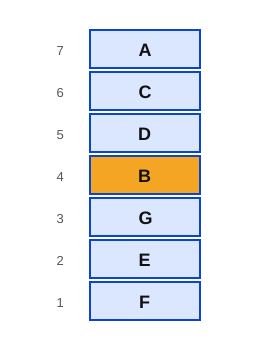
A, B, C, D, E, F and G live on seven different floors of the same building. The lowermost floor in the building is numbered 1, the floor above it is numbered 2 and so on till the topmost floor is numbered 7. Only one person lives above C. Only two persons live between G and C. Only one person lives between D and G, but D does not live on the lowermost floor. F lives immediately below E. Only two persons live between F and B. On which floor number does B live?
A, B, C, D, E, F और G एक ही इमारत की सात अलग-अलग मंज़िलों पर रहते हैं। इमारत की सबसे निचली मंज़िल की संख्या 1 है, उसके ऊपर की मंज़िल की संख्या 2 है और इसी प्रकार सबसे ऊपरी मंज़िल की संख्या 7 है। C के ऊपर केवल एक व्यक्ति रहता है। G और C के बीच केवल दो व्यक्ति रहते हैं। D और G के बीच केवल एक व्यक्ति रहता है, लेकिन D सबसे निचली मंज़िल पर नहीं रहता है। F, E के ठीक नीचे रहता है। F और B के बीच केवल दो व्यक्ति रहते हैं। B किस मंज़िल पर रहता है?
  1. AFloor number 4मंज़िल संख्या 4
  2. BFloor number 2मंज़िल संख्या 2
  3. CFloor number 3मंज़िल संख्या 3
  4. DFloor number 5मंज़िल संख्या 5
Show answer

Concept: Fix the definite clues first (C, then G, then D), then place the pairs.

  1. Only one above C → C = 6.
  2. Two between G and C → G = 3.
  3. One between D and G → D = 1 or 5; D ≠ 1 → D = 5.
  4. F just below E: free floors 1, 2, 4, 7 → only 1–2 are consecutive → F = 1, E = 2.
  5. Two between F and B → B = 4; A = 7.

Short trick: Once F = 1 is fixed, “two persons between F and B” directly gives B = 1 + 3 = 4.

Answer: (A) Floor number 4

अवधारणा: पहले निश्चित संकेत रखें (C, फिर G, फिर D), फिर युग्म रखें।

  1. C के ऊपर केवल एक → C = 6।
  2. G और C के बीच दो → G = 3।
  3. D और G के बीच एक → D = 1 या 5; D ≠ 1 → D = 5।
  4. F, E के ठीक नीचे: खाली मंज़िलें 1, 2, 4, 7 → केवल 1–2 क्रमागत → F = 1, E = 2।
  5. F और B के बीच दो → B = 4; A = 7।

शॉर्ट ट्रिक: F = 1 होते ही “F और B के बीच दो व्यक्ति” से सीधे B = 1 + 3 = 4।

उत्तर: (A) मंज़िल संख्या 4

RRB ALP CBT 1General Intelligence and ReasoningFloor puzzleRRB ALP CBT 1 2025 · 18 Feb Shift 2
Q179.
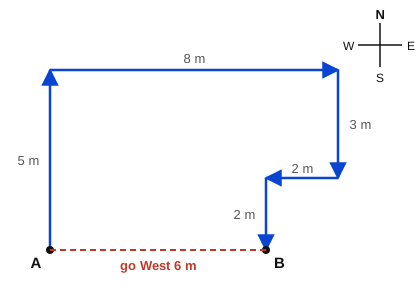
Amita walks towards north for 5 m from point A. Then she takes a right turn and walks for 8 m. Then, again, she takes a right turn and walks for 3 m. Once again, she takes a right turn and walks for 2 m. Then she takes a left turn and walk for 2 m and stops at point B. Towards which direction should she walk in order to reach point A again? (All turns are 90-degree turns only unless specified.)
अमिता बिंदु A से उत्तर की ओर 5 m चलती है। फिर वह दाएँ मुड़ती है और 8 m चलती है। फिर से वह दाएँ मुड़ती है और 3 m चलती है। एक बार फिर वह दाएँ मुड़ती है और 2 m चलती है। फिर वह बाएँ मुड़ती है और 2 m चलकर बिंदु B पर रुक जाती है। बिंदु A पर फिर से पहुँचने के लिए उसे किस दिशा में चलना चाहिए? (जब तक निर्दिष्ट न हो, सभी मोड़ केवल 90-डिग्री के मोड़ हैं।)
  1. AWestपश्चिम
  2. BEastपूर्व
  3. CSouthदक्षिण
  4. DNorthउत्तर
Show answer

Concept: Track the coordinates step by step (east = +x, north = +y).

  1. A(0, 0) → north 5 → (0, 5).
  2. Right (east) 8 → (8, 5); right (south) 3 → (8, 2).
  3. Right (west) 2 → (6, 2); left (south) 2 → B(6, 0).
  4. B is 6 m due east of A, so she must walk towards west.

Short trick: Net north–south = 5 − 3 − 2 = 0, so A and B are on the same horizontal line; net east = 8 − 2 = 6 → go west.

Answer: (A) West

अवधारणा: हर चरण पर निर्देशांक लिखें (पूर्व = +x, उत्तर = +y)।

  1. A(0, 0) → उत्तर 5 → (0, 5)।
  2. दाएँ (पूर्व) 8 → (8, 5); दाएँ (दक्षिण) 3 → (8, 2)।
  3. दाएँ (पश्चिम) 2 → (6, 2); बाएँ (दक्षिण) 2 → B(6, 0)।
  4. B, A से 6 m पूर्व में है, अतः उसे पश्चिम की ओर चलना होगा।

शॉर्ट ट्रिक: कुल उत्तर–दक्षिण = 5 − 3 − 2 = 0, अतः A और B एक ही क्षैतिज रेखा पर; कुल पूर्व = 8 − 2 = 6 → पश्चिम जाएँ।

उत्तर: (A) पश्चिम

RRB ALP CBT 1General Intelligence and ReasoningDirection senseRRB ALP CBT 1 2025 · 18 Feb Shift 2
Q180.
Refer to the following series and answer the question that follows. Counting to be done from left to right. All numbers are single-digit numbers only.
(Left) 3 5 6 3 4 6 4 3 1 5 7 6 8 6 3 1 3 6 7 8 9 7 5 (Right)
How many such odd digits are there, each of which is immediately preceded by an even digit and also immediately followed by an odd digit?
निम्नलिखित शृंखला को देखें और उसके बाद दिए गए प्रश्न का उत्तर दें। गिनती बाएँ से दाएँ की जानी है। सभी संख्याएँ केवल एक-अंकीय संख्याएँ हैं।
(बाएँ) 3 5 6 3 4 6 4 3 1 5 7 6 8 6 3 1 3 6 7 8 9 7 5 (दाएँ)
ऐसे कितने विषम अंक हैं, जिनमें से प्रत्येक के ठीक पहले एक सम अंक है और ठीक बाद एक विषम अंक भी है?
  1. ATWOदो
  2. BTHREEतीन
  3. CFOURचार
  4. DNONEकोई नहीं
Show answer

Concept: Look for the pattern Even – Odd – Odd (middle one is counted).

  1. Scan: 4 3 1, 6 3 1, 8 9 7.
  2. No other odd digit has an even digit before it and an odd digit after it.
  3. Count = 3.

Short trick: First mark every even digit, then check only the two digits right after it – much faster than checking every digit.

Answer: (B) THREE

अवधारणा: पैटर्न सम – विषम – विषम खोजें (बीच वाला गिना जाएगा)।

  1. जाँच: 4 3 1, 6 3 1, 8 9 7।
  2. किसी अन्य विषम अंक के पहले सम और बाद में विषम अंक नहीं है।
  3. संख्या = 3।

शॉर्ट ट्रिक: पहले हर सम अंक पर निशान लगाएँ, फिर केवल उसके बाद के दो अंक देखें – हर अंक जाँचने से तेज़।

उत्तर: (B) तीन

RRB ALP CBT 1General Intelligence and ReasoningNumber series – position conditionsRRB ALP CBT 1 2025 · 18 Feb Shift 2