Q2161.Find the value of
का मान ज्ञात कीजिए।
- A19
- B18
- C12
- D4
Show answer
Concept: ; both decimals have 6 places, so they cancel.
- ,
Trick: directly, and .
Answer: (D)
अवधारणा: ; दोनों में 6 दशमलव स्थान हैं, अतः कट जाते हैं।
- ,
ट्रिक: और ।
उत्तर: (D)
RRB NTPC Graduate CBT 1MathematicsSquare Roots of DecimalsRRB NTPC Graduate CBT 1 2024 · 16 Jun Shift 3
Q2162.Find the circumference (in m) of the largest circle that can be inscribed in a rectangle whose dimensions are given as 114 m and 63 m.
Take
114 m और 63 m विमाओं वाले एक आयत के अंदर बनाए जा सकने वाले सबसे बड़े वृत्त की परिधि (m में) ज्ञात कीजिए।
लीजिए
- A199
- B202
- C201
- D198
Show answer
Concept: The largest circle inside a rectangle touches the two longer sides, so its diameter equals the shorter side.
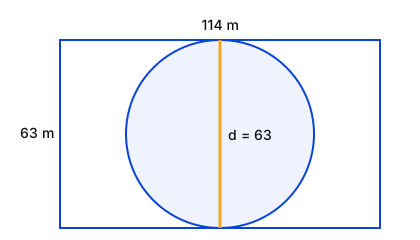
- Diameter m
- Circumference
- m
Trick: Ignore the longer side (114 m) — only the smaller dimension limits the circle.
Answer: (D)
अवधारणा: आयत के अंदर सबसे बड़ा वृत्त छोटी भुजा से सीमित होता है, अतः व्यास = छोटी भुजा।
- व्यास m
- परिधि
- m
ट्रिक: लंबी भुजा (114 m) को अनदेखा करें — केवल छोटी भुजा वृत्त को सीमित करती है।
उत्तर: (D)
RRB NTPC Graduate CBT 1MathematicsMensuration – Circle in RectangleRRB NTPC Graduate CBT 1 2024 · 16 Jun Shift 3
Q2163.A cylindrical rod has an curved surface area of 4,900 cm2. If the length of the rod is 97 cm, then the radius (in cm) of the rod, correct to two places of decimal, is:
Take
एक बेलनाकार छड़ का वक्र पृष्ठीय क्षेत्रफल 4,900 cm2 है। यदि छड़ की लंबाई 97 cm है, तो दशमलव के दो स्थानों तक सही छड़ की त्रिज्या (cm में) कितनी है?
लीजिए
- A6.97
- B8.55
- C7.95
- D8.04
Show answer
Concept: Curved surface area of a cylinder .
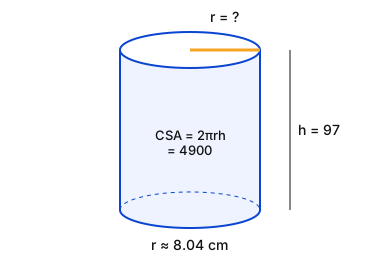
- cm
Trick: Estimate: ; .
Answer: (D)
अवधारणा: बेलन का वक्र पृष्ठीय क्षेत्रफल ।
- cm
ट्रिक: अनुमान: ; ।
उत्तर: (D)
RRB NTPC Graduate CBT 1MathematicsMensuration – CylinderRRB NTPC Graduate CBT 1 2024 · 16 Jun Shift 3
Q2164.The greatest number that divides 93 and 190 leaving remainders 5 and 3, respectively, is:
वह सबसे बड़ी संख्या कौन-सी है जिससे 93 और 190 को विभाजित करने पर क्रमशः 5 और 3 शेषफल प्राप्त होते हैं?
- A21
- B17
- C14
- D11
Show answer
Concept: Required number = HCF of (number − its remainder).
- ,
- ,
- HCF (and , so remainder 5 is valid).
Trick: Check options from the largest: 21, 17, 14 do not divide both 88 and 187; 11 does.
Answer: (D)
अवधारणा: अभीष्ट संख्या = (संख्या − शेषफल) का HCF।
- ,
- ,
- HCF (और , अतः शेषफल 5 मान्य)।
ट्रिक: विकल्प जाँचें: 21, 17, 14 दोनों (88, 187) को नहीं बाँटते; 11 बाँटता है।
उत्तर: (D)
RRB NTPC Graduate CBT 1MathematicsHCF with RemaindersRRB NTPC Graduate CBT 1 2024 · 16 Jun Shift 3
Q2165.A vendor sells oranges at ₹29 each and incurs a loss of 75%. If he wants to make a profit of 75%, at what price (in ₹) should he sell each orange?
एक विक्रेता संतरे ₹29 प्रति संतरा बेचता है और उसे 75% की हानि होती है। यदि वह 75% का लाभ कमाना चाहता है, तो उसे प्रत्येक संतरा किस मूल्य (₹ में) पर बेचना चाहिए?
- A201
- B206
- C203
- D205
Show answer
Concept: SP at loss ; SP at profit .
- Required SP
Trick: Ratio method: .
Answer: (C) ₹203
अवधारणा: हानि पर विक्रय मूल्य ; लाभ पर ।
- अभीष्ट विक्रय मूल्य
ट्रिक: अनुपात विधि: ।
उत्तर: (C) ₹203
RRB NTPC Graduate CBT 1MathematicsProfit and LossRRB NTPC Graduate CBT 1 2024 · 16 Jun Shift 3
Q2166.A shopkeeper marked his goods at X% above their cost price and sold them at a discount of 60%. If he gained 84% profit, then find the value of X.
एक दुकानदार ने अपने सामान पर क्रय मूल्य से X% अधिक मूल्य अंकित किया और उन्हें 60% की छूट पर बेच दिया। यदि उसे 84% लाभ हुआ, तो X का मान ज्ञात कीजिए।
- A362
- B360
- C359
- D361
Show answer
Concept: .
- Let ; .
- Mark-up
Trick: ⇒ .
Answer: (B)
अवधारणा: ।
- माना ; ।
- अंकन
ट्रिक: ⇒ ।
उत्तर: (B)
RRB NTPC Graduate CBT 1MathematicsMarked Price and DiscountRRB NTPC Graduate CBT 1 2024 · 16 Jun Shift 3
Q2167.If the manufacturer gains 10%, the wholesaler gains 15%, and the retailer gains 28%, then find the cost of production of a table (in ₹), whose retail price for the customer is ₹75,900. (NOTE: Manufacturer sells to wholesaler, wholesaler sells to retailer and retailer sells to customers.)
यदि निर्माता को 10%, थोक विक्रेता को 15% और खुदरा विक्रेता को 28% लाभ होता है, तो उस मेज़ की उत्पादन लागत (₹ में) ज्ञात कीजिए, जिसका ग्राहक के लिए खुदरा मूल्य ₹75,900 है। (नोट: निर्माता थोक विक्रेता को बेचता है, थोक विक्रेता खुदरा विक्रेता को बेचता है और खुदरा विक्रेता ग्राहकों को बेचता है।)
- A60,000
- B53,906.25
- C46,875
- D51,562.5
Show answer
Concept: Each seller’s SP is the next buyer’s CP, so the gains multiply: .
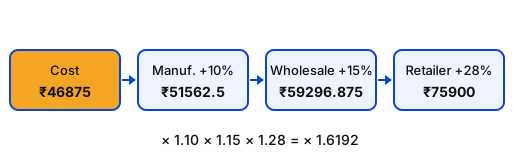
- ;
- Check: ✓
Trick: Write as fractions: — 11 and 23 cancel neatly ().
Answer: (C) ₹46,875
अवधारणा: हर विक्रेता का विक्रय मूल्य अगले क्रेता का क्रय मूल्य है, अतः लाभ गुणा होते हैं: ।
- ;
- जाँच: ✓
ट्रिक: भिन्न में: ()।
उत्तर: (C) ₹46,875
RRB NTPC Graduate CBT 1MathematicsSuccessive Profit (Chain)RRB NTPC Graduate CBT 1 2024 · 16 Jun Shift 3
Q2168.What is the median of the following data?
61, 55, 18, 49, 52, 80, 60, 33, 54, 56, 28
निम्नलिखित आँकड़ों की माध्यिका क्या है?
61, 55, 18, 49, 52, 80, 60, 33, 54, 56, 28
- A54
- B54.5
- C55
- D53.5
Show answer
Concept: Median = middle value after arranging in order; for odd it is the value.
- Ascending: 18, 28, 33, 49, 52, 54, 55, 56, 60, 61, 80
- , so median is the value.
- 6th value
Trick: Never take the middle of the unsorted list (it would give 80) — always sort first.
Answer: (A)
अवधारणा: माध्यिका = क्रम में लगाने पर बीच का मान; विषम के लिए वाँ पद।
- आरोही क्रम: 18, 28, 33, 49, 52, 54, 55, 56, 60, 61, 80
- , अतः माध्यिका वाँ पद।
- 6वाँ पद
ट्रिक: बिना क्रम लगाए बीच का पद न लें — पहले क्रम में लगाएँ।
उत्तर: (A)
RRB NTPC Graduate CBT 1MathematicsStatistics – MedianRRB NTPC Graduate CBT 1 2024 · 16 Jun Shift 3
Q2169.Which of the following numbers is divisible by 47?
निम्नलिखित में से कौन-सी संख्या 47 से विभाज्य है?
- A3674
- B4416
- C3995
- D3816
Show answer
Concept: Divide each option by 47 or build multiples of 47 near the options.
- , so
- ✓
- Others: , , — not divisible.
Trick: .
Answer: (C)
अवधारणा: हर विकल्प को 47 से भाग दें या 47 के गुणज बनाएँ।
- , अतः
- ✓
- अन्य: , , — विभाज्य नहीं।
ट्रिक: ।
उत्तर: (C)
RRB NTPC Graduate CBT 1MathematicsDivisibilityRRB NTPC Graduate CBT 1 2024 · 16 Jun Shift 3
Q2170.Two taps can fill a cistern in 2 hours and 64 hours, respectively. A third tap can empty it in 2 hours. How long (in hours) will it take to fill half of the empty cistern, if all of them are opened together?
दो नल एक टंकी को क्रमशः 2 घंटे और 64 घंटे में भर सकते हैं। एक तीसरा नल इसे 2 घंटे में खाली कर सकता है। यदि तीनों नलों को एक साथ खोल दिया जाए, तो खाली टंकी का आधा भाग भरने में कितना समय (घंटों में) लगेगा?
- A96
- B32
- C128
- D64
Show answer
Concept: Net rate = sum of filling rates − emptying rate (part of tank per hour).
- Net
- Full tank takes 64 hours.
- Half tank hours
Trick: The 2-hour filler and 2-hour emptier cancel out; only the 64-hour tap works.
Answer: (B)
अवधारणा: शुद्ध दर = भरने की दरों का योग − खाली करने की दर (प्रति घंटा टंकी का भाग)।
- शुद्ध
- पूरी टंकी 64 घंटे में।
- आधी टंकी घंटे
ट्रिक: 2 घंटे वाला भरने वाला और 2 घंटे वाला खाली करने वाला नल एक-दूसरे को रद्द करते हैं।
उत्तर: (B)
RRB NTPC Graduate CBT 1MathematicsPipes and CisternsRRB NTPC Graduate CBT 1 2024 · 16 Jun Shift 3
Q2171.In a certain code language, ‘BEST’ is coded as ‘4568’ and ‘STAB’ is coded as ‘8965’. What is the code for ‘A’ in the given code language?
एक निश्चित कूट भाषा में, ‘BEST’ को ‘4568’ लिखा जाता है और ‘STAB’ को ‘8965’ लिखा जाता है। उस कूट भाषा में ‘A’ के लिए क्या कूट है?
- A6
- B5
- C9
- D8
Show answer
Concept: Letters common to both words share the common digits; the leftover letter gets the leftover digit.
- BEST → 4, 5, 6, 8 and STAB → 8, 9, 6, 5.
- Common letters: S, T, B → common digits 5, 6, 8.
- STAB has the extra letter A, and its extra digit is 9.
- So A = 9.
Trick: Cancel common letters and common digits – what remains matches.
Answer: (C) 9
अवधारणा: दोनों शब्दों के सामान्य अक्षरों के कोड भी सामान्य अंक होते हैं; बचे अक्षर का कोड बचा अंक है।
- BEST → 4, 5, 6, 8 और STAB → 8, 9, 6, 5।
- सामान्य अक्षर S, T, B → सामान्य अंक 5, 6, 8।
- STAB में बचा अक्षर A और बचा अंक 9।
- अतः A = 9।
ट्रिक: सामान्य अक्षर और सामान्य अंक काटें – जो बचे वही जोड़ी है।
उत्तर: (C) 9
RRB NTPC Graduate CBT 1General Intelligence and ReasoningCoding-DecodingRRB NTPC Graduate CBT 1 2024 · 16 Jun Shift 3
Q2172.What will come in place of the question mark (?) in the following equation, if ‘+’ and ‘–’ are interchanged, and ‘×’ and ‘÷’ are interchanged?
34 + 43 − 17 ÷ 121 × 11 = ?
यदि ‘+’ और ‘–’ को आपस में बदल दिया जाए तथा ‘×’ और ‘÷’ को आपस में बदल दिया जाए, तो निम्नलिखित समीकरण में प्रश्न चिह्न (?) के स्थान पर क्या आएगा?
34 + 43 − 17 ÷ 121 × 11 = ?
- A181
- B164
- C156
- D178
Show answer
Concept: Swap the signs first, then apply BODMAS.
- After interchange: .
- , so .
- .
Trick: Rewrite the whole expression with new signs before calculating.
Answer: (D) 178
अवधारणा: पहले चिह्न बदलें, फिर BODMAS लगाएँ।
- बदलने के बाद: ।
- , अतः ।
- ।
ट्रिक: गणना से पहले पूरा व्यंजक नए चिह्नों के साथ लिख लें।
उत्तर: (D) 178
RRB NTPC Graduate CBT 1General Intelligence and ReasoningMathematical OperationsRRB NTPC Graduate CBT 1 2024 · 16 Jun Shift 3
Q2173.Which of the following letter-clusters should replace # and % so that the pattern and relationship followed between the letter-cluster pair on the left side of :: is the same as that on the right side of :: ?
# : MRN :: HMI : %
निम्नलिखित में से कौन-से अक्षर-समूह # और % को प्रतिस्थापित करने चाहिए ताकि :: के बाईं ओर के अक्षर-समूह युग्म के बीच का पैटर्न और संबंध वही हो जो :: के दाईं ओर है?
# : MRN :: HMI : %
- A# = JIQ, % = FDJ
- B# = KLJ, % = KHI
- C# = LPR, % = JHG
- D# = PUQ, % = EJF
Show answer
Concept: Find the rule on the right pair (HMI → %) and apply the same rule to # → MRN.
- Option D: P − 3 = M, U − 3 = R, Q − 3 = N → PUQ : MRN.
- H − 3 = E, M − 3 = J, I − 3 = F → HMI : EJF.
- Both pairs use −3 on every letter.
Trick: Test each option with one letter first; only D gives −3 on both sides.
Answer: (D) # = PUQ, % = EJF
अवधारणा: दाएँ जोड़े में जो नियम है वही बाएँ जोड़े (# → MRN) पर लगाएँ।
- विकल्प D: P − 3 = M, U − 3 = R, Q − 3 = N → PUQ : MRN।
- H − 3 = E, M − 3 = J, I − 3 = F → HMI : EJF।
- दोनों में हर अक्षर में −3।
ट्रिक: हर विकल्प को पहले एक अक्षर से जाँचें; केवल D में दोनों ओर −3 है।
उत्तर: (D) # = PUQ, % = EJF
RRB NTPC Graduate CBT 1General Intelligence and ReasoningLetter AnalogyRRB NTPC Graduate CBT 1 2024 · 16 Jun Shift 3
Q2174.Select the triad that follows the same pattern as that followed by the two triads given below. Both triads follow the same pattern.
GB-IE-LN
KF-MI-PR
उस त्रिक का चयन कीजिए जो उसी पैटर्न का अनुसरण करता है जिसका अनुसरण नीचे दिए गए दो त्रिक करते हैं। दोनों त्रिक एक ही पैटर्न का अनुसरण करते हैं।
GB-IE-LN
KF-MI-PR
- APJ-QM-TU
- BOJ-QM-TV
- COJ-QM-TU
- DPJ-QN-TU
Show answer
Concept: Track first letters and second letters separately using place values.
- GB-IE-LN: G(7)→I(9)→L(12) is +2, +3; B(2)→E(5)→N(14) is +3, +9.
- KF-MI-PR: K→M→P (+2, +3); F→I→R (+3, +9).
- OJ-QM-TV: O(15)→Q(17)→T(20) is +2, +3; J(10)→M(13)→V(22) is +3, +9. ✓
Trick: Option A/C fail on the last letter: U = M + 8, not +9.
Answer: (B) OJ-QM-TV
अवधारणा: पहले अक्षरों और दूसरे अक्षरों को स्थानीय मान से अलग-अलग जाँचें।
- GB-IE-LN: G(7)→I(9)→L(12) = +2, +3; B(2)→E(5)→N(14) = +3, +9।
- KF-MI-PR: K→M→P (+2, +3); F→I→R (+3, +9)।
- OJ-QM-TV: O(15)→Q(17)→T(20) = +2, +3; J(10)→M(13)→V(22) = +3, +9 ✓।
ट्रिक: विकल्प A/C अंतिम अक्षर पर गलत: U = M + 8 है, +9 नहीं।
उत्तर: (B) OJ-QM-TV
RRB NTPC Graduate CBT 1General Intelligence and ReasoningLetter TriadsRRB NTPC Graduate CBT 1 2024 · 16 Jun Shift 3
Q2175.Barun starts from Point A and drives 8 km towards West. He then takes a left turn, drives 9 km, turns left and drives 12 km. He then takes a left turn and drives 13 km. He takes a final left turn, drives 4 km and stops at Point P. How far (shortest distance) and towards which direction should he drive in order to reach Point A again? (All turns are 90° turns only, unless specified.)
बरुण बिंदु A से शुरू करता है और पश्चिम की ओर 8 km गाड़ी चलाता है। फिर वह बाएँ मुड़ता है, 9 km गाड़ी चलाता है, बाएँ मुड़ता है और 12 km गाड़ी चलाता है। फिर वह बाएँ मुड़ता है और 13 km गाड़ी चलाता है। वह अंतिम बार बाएँ मुड़ता है, 4 km गाड़ी चलाता है और बिंदु P पर रुक जाता है। पुनः बिंदु A पर पहुँचने के लिए उसे कितनी दूरी (न्यूनतम दूरी) तक और किस दिशा में गाड़ी चलानी चाहिए? (जब तक निर्दिष्ट न हो, सभी मोड़ केवल 90° के मोड़ हैं।)
- A3 km to the southदक्षिण की ओर 3 km
- B5 km to the southदक्षिण की ओर 5 km
- C4 km to the southदक्षिण की ओर 4 km
- D2 km to the southदक्षिण की ओर 2 km
Show answer
Concept: Place A at the origin and track each move (left turn: West→South→East→North→West).
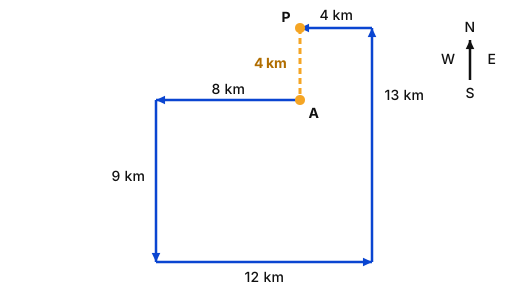
- West 8 → ; left (South) 9 → .
- Left (East) 12 → ; left (North) 13 → .
- Left (West) 4 → P .
- P is 4 km directly north of A, so he must drive 4 km south.
Trick: Net East–West: ; net North–South: North.
Answer: (C) 4 km to the south
अवधारणा: A को मूल बिंदु मानें और हर चाल लिखें (बाएँ मुड़ना: पश्चिम→दक्षिण→पूर्व→उत्तर→पश्चिम)।
- पश्चिम 8 → ; बाएँ (दक्षिण) 9 → ।
- बाएँ (पूर्व) 12 → ; बाएँ (उत्तर) 13 → ।
- बाएँ (पश्चिम) 4 → P ।
- P, A से 4 km उत्तर में है, अतः 4 km दक्षिण जाना होगा।
ट्रिक: शुद्ध पूर्व–पश्चिम: ; उत्तर–दक्षिण: उत्तर।
उत्तर: (C) 4 km to the south
RRB NTPC Graduate CBT 1General Intelligence and ReasoningDirection and DistanceRRB NTPC Graduate CBT 1 2024 · 16 Jun Shift 3
Q2176.Karuna, Jyoti, Shiv, Ram, Puran, Om and Luv are sitting around a circular table, facing the centre. Shiv sits third to the left of Luv. Karuna sits second to the left of Shiv. Jyoti sits third to the right of Puran. Ram sits second to the right of Jyoti. Ram is not an immediate neighbour of Shiv. Who sits to the immediate left of Ram?
करुणा, ज्योति, शिव, राम, पूरन, ओम और लव एक वृत्ताकार मेज़ के चारों ओर केंद्र की ओर मुख करके बैठे हैं। शिव, लव के बाईं ओर तीसरे स्थान पर बैठा है। करुणा, शिव के बाईं ओर दूसरे स्थान पर बैठी है। ज्योति, पूरन के दाईं ओर तीसरे स्थान पर बैठी है। राम, ज्योति के दाईं ओर दूसरे स्थान पर बैठा है। राम, शिव का निकटतम पड़ोसी नहीं है। राम के ठीक बाईं ओर कौन बैठा है?
- ALuvलव
- BKarunaकरुणा
- COmओम
- DPuranपूरन
Show answer
Concept: Facing the centre, "left" means clockwise and "right" means anticlockwise.
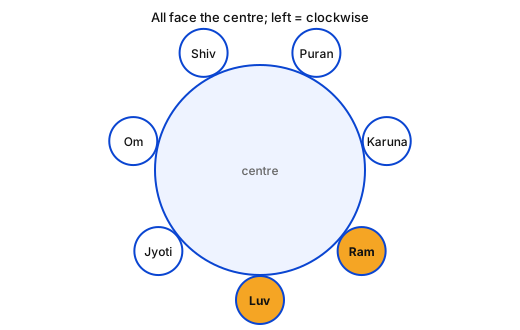
- Fix Luv; Shiv is 3rd to his left and Karuna 2nd to the left of Shiv.
- Jyoti is 3rd to the right of Puran and Ram is 2nd to the right of Jyoti, so Ram is 2nd to the left of Puran.
- Only one fit keeps Ram away from Shiv: Puran, Ram, Luv consecutive with Om and Jyoti on the other side (see figure).
- Ram sits between Karuna and Luv; going left (clockwise) from Ram we reach Luv.
Trick: Draw the fixed pair first (Luv–Shiv–Karuna) and test the free chain.
Answer: (A) Luv
अवधारणा: केंद्र की ओर मुख हो तो "बाएँ" = दक्षिणावर्त (clockwise) और "दाएँ" = वामावर्त।
- लव को स्थिर करें; शिव उसके बाएँ तीसरे और करुणा शिव के बाएँ दूसरे स्थान पर।
- ज्योति, पूरन के दाएँ तीसरे और राम, ज्योति के दाएँ दूसरे – अर्थात राम, पूरन के बाएँ दूसरे।
- राम को शिव से दूर रखने वाली केवल एक व्यवस्था बनती है (चित्र देखें)।
- राम, करुणा और लव के बीच है; राम के ठीक बाएँ लव है।
ट्रिक: पहले स्थिर समूह (लव–शिव–करुणा) बनाएँ, फिर बाकी जाँचें।
उत्तर: (A) Luv
RRB NTPC Graduate CBT 1General Intelligence and ReasoningCircular Seating ArrangementRRB NTPC Graduate CBT 1 2024 · 16 Jun Shift 3
Q2177.Two sets of numbers are given below. In each set of numbers, certain mathematical operation(s) on the first number results in the second number. Similarly, certain mathematical operation(s) on the second number results in the third number and so on. Which of the given options follows the same set of operations as in the given sets? (NOTE: Operations should be performed on the whole numbers, without breaking down the numbers into their constituent digits. E.g. 13 – Operations on 13 such as adding / subtracting / multiplying to 13 can be performed. Breaking down 13 into 1 and 3 and then performing mathematical operations on 1 and 3 is not allowed.)
13 - 26 - 30 - 60; 5 - 10 - 14 - 28
नीचे संख्याओं के दो समुच्चय दिए गए हैं। संख्याओं के प्रत्येक समुच्चय में, पहली संख्या पर कुछ निश्चित गणितीय संक्रिया/संक्रियाएँ करने पर दूसरी संख्या प्राप्त होती है। इसी प्रकार, दूसरी संख्या पर कुछ निश्चित गणितीय संक्रिया/संक्रियाएँ करने पर तीसरी संख्या प्राप्त होती है और इसी तरह आगे भी। दिए गए विकल्पों में से कौन-सा विकल्प दिए गए समुच्चयों की तरह संक्रियाओं के समान समुच्चय का अनुसरण करता है? (नोट: संख्याओं को उनके घटक अंकों में विभाजित किए बिना, पूर्ण संख्याओं पर संक्रियाएँ की जानी चाहिए। उदाहरण 13 – 13 पर संक्रियाएँ जैसे 13 में जोड़ना/घटाना/गुणा करना आदि किया जा सकता है। 13 को 1 और 3 में विभाजित करके फिर 1 और 3 पर गणितीय संक्रियाएँ करने की अनुमति नहीं है।)
13 - 26 - 30 - 60; 5 - 10 - 14 - 28
- A3 - 6 - 10 - 30
- B7 - 14 - 18 - 22
- C10 - 20 - 24 - 48
- D2 - 4 - 8 - 12
Show answer
Concept: Find the operations between consecutive numbers.
- .
- .
- Pattern: .
- Option C: . ✓
Trick: Check the last step: only fits among the options.
Answer: (C) 10 - 20 - 24 - 48
अवधारणा: क्रमागत संख्याओं के बीच संक्रियाएँ खोजें।
- ।
- ।
- नियम: ।
- विकल्प C: ✓।
ट्रिक: अंतिम चरण जाँचें: केवल नियम पर खरा उतरता है।
उत्तर: (C) 10 - 20 - 24 - 48
RRB NTPC Graduate CBT 1General Intelligence and ReasoningNumber Series – OperationsRRB NTPC Graduate CBT 1 2024 · 16 Jun Shift 3
Q2178.Read the given statements and conclusions carefully. Assuming that the information given in the statements is true, even if it appears to be at variance with commonly known facts, decide which of the given conclusion(s) logically follow(s) from the statements.
Statements:
All lions are tigers.
Some tigers are leopard.
No leopard is giraffe.
Conclusions:
(I) Some leopards are lions.
(II) Some giraffe can be tigers.
दिए गए कथनों और निष्कर्षों को ध्यानपूर्वक पढ़िए। कथनों में दी गई जानकारी को सत्य मानते हुए, भले ही वह सामान्यतः ज्ञात तथ्यों से भिन्न प्रतीत होती हो, निर्णय लीजिए कि दिए गए निष्कर्षों में से कौन-सा/से निष्कर्ष कथनों का तार्किक रूप से अनुसरण करता है/करते हैं।
कथन:
सभी शेर, बाघ हैं।
कुछ बाघ, तेंदुए हैं।
कोई तेंदुआ, जिराफ़ नहीं है।
निष्कर्ष:
(I) कुछ तेंदुए, शेर हैं।
(II) कुछ जिराफ़, बाघ हो सकते हैं।
- ABoth conclusions (I) and (II) followनिष्कर्ष (I) और (II) दोनों अनुसरण करते हैं
- BOnly conclusion (I) followsकेवल निष्कर्ष (I) अनुसरण करता है
- CEither conclusion (I) or conclusion (II) followsया तो निष्कर्ष (I) या निष्कर्ष (II) अनुसरण करता है
- DOnly conclusion (II) followsकेवल निष्कर्ष (II) अनुसरण करता है
Show answer
Concept: Draw the least possible Venn diagram and test each conclusion.
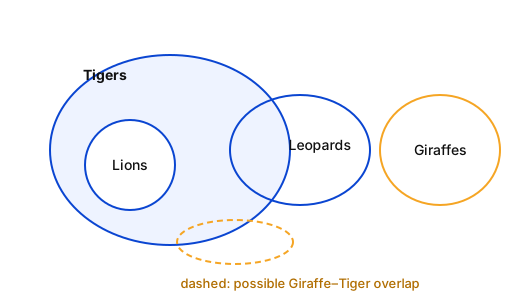
- Lions lie inside Tigers; Leopards only partly overlap Tigers.
- (I) Lions and Leopards need not meet → not definite → does not follow.
- (II) Giraffes are separated only from Leopards, not from Tigers, so a Giraffe–Tiger overlap is possible → follows.
Trick: "Can be" conclusions follow whenever no statement forbids them.
Answer: (D) Only conclusion (II) follows
अवधारणा: न्यूनतम वेन आरेख बनाकर प्रत्येक निष्कर्ष जाँचें।
- Lions पूरी तरह Tigers के अंदर; Leopards का Tigers से आंशिक मेल।
- (I) Lions और Leopards का मिलना निश्चित नहीं → अनुसरण नहीं करता।
- (II) Giraffe केवल Leopard से अलग है, Tiger से नहीं; अतः Giraffe–Tiger संभव → अनुसरण करता है।
ट्रिक: "हो सकता है" वाले निष्कर्ष तब सही होते हैं जब कोई कथन उन्हें रोकता न हो।
उत्तर: (D) Only conclusion (II) follows
RRB NTPC Graduate CBT 1General Intelligence and ReasoningSyllogismRRB NTPC Graduate CBT 1 2024 · 16 Jun Shift 3
Q2179.Each of P, Q, R, S, T, U and V has an exam on a different day of a week starting from Monday and ending on Sunday of the same week. V has an exam on Thursday. Exactly 4 people have their exams between U and Q, neither of whom has an exam on Sunday. T has an exam immediately before S. R does not have an exam on Friday. U does not have an exam after S. How many people have exams after Q?
P, Q, R, S, T, U और V में से प्रत्येक की परीक्षा एक ही सप्ताह के सोमवार से शुरू होकर रविवार को समाप्त होने वाले सप्ताह के अलग-अलग दिन है। V की परीक्षा गुरुवार को है। U और Q के बीच ठीक 4 लोगों की परीक्षाएँ हैं, इन दोनों में से किसी की भी परीक्षा रविवार को नहीं है। T की परीक्षा S से ठीक पहले है। R की परीक्षा शुक्रवार को नहीं है। U की परीक्षा S के बाद नहीं है। Q के बाद कितने लोगों की परीक्षाएँ हैं?
- A3
- B1
- C4
- D2
Show answer
Concept: Fix the definite clues first: V on Thursday and the U–Q gap.
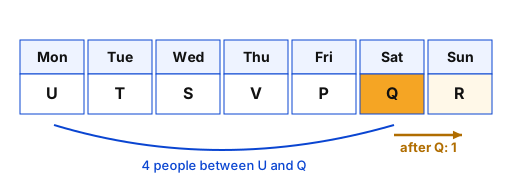
- 4 people between U and Q → (Mon, Sat) or (Tue, Sun); none on Sunday → U, Q on Mon and Sat.
- If U were Saturday, S would need Sunday and T Saturday – clash. So U = Mon, Q = Sat.
- T immediately before S → Tue, Wed. R not Friday → R = Sun, P = Fri.
- After Q (Saturday) only R (Sunday) → 1 person.
Trick: "Exactly 4 between" in a 7-day week means positions 1 & 6 or 2 & 7.
Answer: (B) 1
अवधारणा: पहले निश्चित सूचनाएँ रखें: V गुरुवार और U–Q का अंतर।
- U और Q के बीच 4 लोग → (सोम, शनि) या (मंगल, रवि); रविवार नहीं → सोम और शनि।
- U शनिवार हो तो S रविवार व T शनिवार – टकराव। अतः U = सोम, Q = शनि।
- T, S से ठीक पहले → मंगल, बुध। R शुक्रवार नहीं → R = रवि, P = शुक्र।
- Q (शनिवार) के बाद केवल R → 1 व्यक्ति।
ट्रिक: 7 दिनों में "ठीक 4 बीच में" = स्थान 1 व 6 या 2 व 7।
उत्तर: (B) 1
RRB NTPC Graduate CBT 1General Intelligence and ReasoningScheduling PuzzleRRB NTPC Graduate CBT 1 2024 · 16 Jun Shift 3
Q2180.This question is based on the five, three-digit numbers given below.
(Left) 190 735 494 761 781 (Right)
(Example- 697 – First digit = 6, second digit = 9 and third digit = 7)
(NOTE: All operations to be done from left to right.)
What will be the resultant if the second digit of the highest number is subtracted from the second digit of the lowest number?
यह प्रश्न नीचे दी गई पाँच, तीन अंकों वाली संख्याओं पर आधारित है।
(बाएँ) 190 735 494 761 781 (दाएँ)
(उदाहरण- 697 – पहला अंक = 6, दूसरा अंक = 9 और तीसरा अंक = 7)
(नोट: सभी संक्रियाएँ बाएँ से दाएँ की जानी हैं।)
यदि सबसे बड़ी संख्या के दूसरे अंक को सबसे छोटी संख्या के दूसरे अंक में से घटाया जाए, तो परिणाम क्या होगा?
- A0
- B4
- C2
- D1
Show answer
Concept: Pick the highest and lowest numbers, then take their second digits.
- Highest = 781 → second digit 8; lowest = 190 → second digit 9.
- Second digit of highest subtracted from that of lowest: .
Trick: "A subtracted from B" means .
Answer: (D) 1
अवधारणा: सबसे बड़ी और सबसे छोटी संख्या चुनकर उनके दूसरे अंक लें।
- सबसे बड़ी = 781 → दूसरा अंक 8; सबसे छोटी = 190 → दूसरा अंक 9।
- सबसे बड़ी का दूसरा अंक, सबसे छोटी के दूसरे अंक में से घटाएँ: ।
ट्रिक: "A को B में से घटाना" = ।
उत्तर: (D) 1
RRB NTPC Graduate CBT 1General Intelligence and ReasoningNumber ArrangementRRB NTPC Graduate CBT 1 2024 · 16 Jun Shift 3

