Q2181.Which of the following letter-number clusters will replace the question mark (?) in the given series to make it logically complete?
SM13 QK25 OI37 MG49 ?
निम्नलिखित में से कौन-सा अक्षर-संख्या समूह दी गई श्रृंखला को तार्किक रूप से पूर्ण करने के लिए प्रश्न चिह्न (?) का स्थान लेगा?
SM13 QK25 OI37 MG49 ?
- AKF62
- BKE62
- CKE61
- DKF61
Show answer
Concept: Treat the first letter, second letter and number as three separate series.
- First letters: S, Q, O, M → −2 each → K.
- Second letters: M, K, I, G → −2 each → E.
- Numbers: 13, 25, 37, 49 → +12 each → 61.
Trick: Each part moves by a constant: −2, −2, +12.
Answer: (C) KE61
अवधारणा: पहला अक्षर, दूसरा अक्षर और संख्या – तीन अलग श्रृंखलाएँ मानें।
- पहले अक्षर: S, Q, O, M → हर बार −2 → K।
- दूसरे अक्षर: M, K, I, G → हर बार −2 → E।
- संख्याएँ: 13, 25, 37, 49 → हर बार +12 → 61।
ट्रिक: हर भाग स्थिर अंतर से चलता है: −2, −2, +12।
उत्तर: (C) KE61
RRB NTPC Graduate CBT 1General Intelligence and ReasoningAlpha-Numeric SeriesRRB NTPC Graduate CBT 1 2024 · 16 Jun Shift 3
Q2182.What will come in the place of the question mark ‘(?)’ in the following equation, if ‘+’ and ‘−’ are interchanged and ‘×’ and ‘÷’ are interchanged?
43 ÷ 9 − 988 × 2 + 11 = ?
यदि ‘+’ और ‘−’ को आपस में बदल दिया जाए तथा ‘×’ और ‘÷’ को आपस में बदल दिया जाए, तो निम्नलिखित समीकरण में प्रश्न चिह्न ‘(?)’ के स्थान पर क्या आएगा?
43 ÷ 9 − 988 × 2 + 11 = ?
- A880
- B895
- C870
- D875
Show answer
Concept: Interchange the signs, then follow BODMAS.
- New expression: .
- and .
- .
Trick: Do × and ÷ first, then + and − from left to right.
Answer: (C) 870
अवधारणा: चिह्न बदलें, फिर BODMAS लगाएँ।
- नया व्यंजक: ।
- और ।
- ।
ट्रिक: पहले × और ÷, फिर बाएँ से दाएँ + और −।
उत्तर: (C) 870
RRB NTPC Graduate CBT 1General Intelligence and ReasoningMathematical OperationsRRB NTPC Graduate CBT 1 2024 · 16 Jun Shift 3
Q2183.F is the husband of G. G is the mother of H. H is the wife of I. I is the father of J. How is F related to J?
F, G का पति है। G, H की माता है। H, I की पत्नी है। I, J का पिता है। F का J से क्या संबंध है?
- AMother's brotherमाता का भाई
- BMother's fatherमाता का पिता
- CFather's fatherपिता का पिता
- DFather's brotherपिता का भाई
Show answer
Concept: Draw the family tree generation by generation.
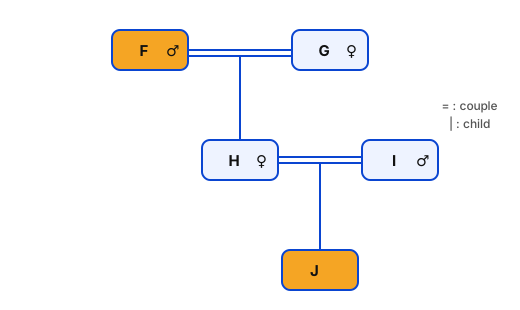
- F (male) is the husband of G; G is the mother of H, so F is H’s father.
- H is the wife of I, and I is the father of J → H is J’s mother.
- F is the father of J’s mother.
Trick: Father of mother = maternal grandfather (Nana).
Answer: (B) Mother's father
अवधारणा: पीढ़ी-दर-पीढ़ी वंश वृक्ष बनाएँ।
- F (पुरुष), G का पति है; G, H की माँ है → F, H का पिता।
- H, I की पत्नी है और I, J का पिता → H, J की माँ।
- F, J की माँ का पिता है।
ट्रिक: माँ के पिता = नाना।
उत्तर: (B) Mother's father
RRB NTPC Graduate CBT 1General Intelligence and ReasoningBlood RelationsRRB NTPC Graduate CBT 1 2024 · 16 Jun Shift 3
Q2184.Seven boxes, A, B, C, D, E, F and G, are kept one above the other but not necessarily in the same order. Only C is kept above B. Only two boxes are kept between B and F. Only E is kept below A. G is not kept immediately above F. How many boxes are kept above G?
सात बक्से, A, B, C, D, E, F और G, एक के ऊपर एक रखे गए हैं, लेकिन आवश्यक नहीं कि इसी क्रम में हों। केवल C को B के ऊपर रखा गया है। B और F के बीच केवल दो बक्से रखे गए हैं। केवल E को A के नीचे रखा गया है। G को F के ठीक ऊपर नहीं रखा गया है। G के ऊपर कितने बक्से रखे गए हैं?
- A4
- B2
- C1
- D3
Show answer
Concept: Number the positions 1 (top) to 7 (bottom) and fix the "only" clues.
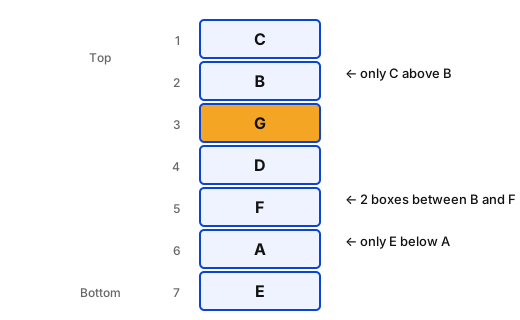
- Only C above B → C = 1, B = 2.
- Only E below A → A = 6, E = 7.
- Two boxes between B and F → F = 5.
- G not immediately above F → G ≠ 4, so G = 3, D = 4. Above G: C and B → 2.
Trick: "Only X above Y" fixes both at the top immediately.
Answer: (B) 2
अवधारणा: स्थान 1 (ऊपर) से 7 (नीचे) तक मानें और "केवल" वाले संकेत पहले लगाएँ।
- केवल C, B के ऊपर → C = 1, B = 2।
- केवल E, A के नीचे → A = 6, E = 7।
- B और F के बीच दो बक्से → F = 5।
- G, F के ठीक ऊपर नहीं → G = 3, D = 4। G के ऊपर C, B → 2।
ट्रिक: "केवल X, Y के ऊपर" से दोनों तुरंत सबसे ऊपर तय होते हैं।
उत्तर: (B) 2
RRB NTPC Graduate CBT 1General Intelligence and ReasoningVertical ArrangementRRB NTPC Graduate CBT 1 2024 · 16 Jun Shift 3
Q2185.Based on the English alphabetical order, three of the following four letter-cluster pairs are alike in a certain way and thus form a group. Which letter-cluster pair DOES NOT belong to that group?
(Note: The odd one out is not based on the number of consonants/vowels or their position in the letter-cluster.)
अंग्रेज़ी वर्णमाला क्रम के आधार पर, निम्नलिखित चार अक्षर-समूह युग्मों में से तीन किसी निश्चित प्रकार से एक समान हैं और इस प्रकार एक समूह बनाते हैं। कौन-सा अक्षर-समूह युग्म उस समूह से संबंधित नहीं है?
(नोट: असंगत का चयन व्यंजनों/स्वरों की संख्या या अक्षर-समूह में उनके स्थान पर आधारित नहीं है।)
- AOR – TN
- BJM – OH
- CSV – XQ
- DBE – GZ
Show answer
Concept: Compare positions: 1st→2nd letter, 1st→3rd letter, 2nd→4th letter.
- JM – OH: J+3 = M, J+5 = O, M−5 = H.
- SV – XQ: S+3 = V, S+5 = X, V−5 = Q.
- BE – GZ: B+3 = E, B+5 = G, E−5 = Z (cyclic).
- OR – TN: O+3 = R, O+5 = T but R−4 = N (should be M) → odd.
Trick: Pattern +3, +5, −5; break in the last letter gives the odd one.
Answer: (A) OR – TN
अवधारणा: स्थान तुलना करें: पहला→दूसरा, पहला→तीसरा, दूसरा→चौथा अक्षर।
- JM – OH: J+3 = M, J+5 = O, M−5 = H।
- SV – XQ: S+3 = V, S+5 = X, V−5 = Q।
- BE – GZ: B+3 = E, B+5 = G, E−5 = Z (चक्रीय)।
- OR – TN: O+3 = R, O+5 = T पर R−4 = N (M होना चाहिए) → विषम।
ट्रिक: नियम +3, +5, −5; अंतिम अक्षर में टूट = विषम।
उत्तर: (A) OR – TN
RRB NTPC Graduate CBT 1General Intelligence and ReasoningOdd One Out – Letter PairsRRB NTPC Graduate CBT 1 2024 · 16 Jun Shift 3
Q2186.Select the letter-cluster from among the given options that can replace the question mark (?) in the following series.
YOD WNF UMH SLJ ?
दिए गए विकल्पों में से उस अक्षर-समूह का चयन कीजिए जो निम्नलिखित श्रृंखला में प्रश्न चिह्न (?) का स्थान ले सकता है।
YOD WNF UMH SLJ ?
- AQKL
- BQLL
- CQKK
- DQLK
Show answer
Concept: Track each letter position separately.
- 1st letters: Y, W, U, S → −2 → Q.
- 2nd letters: O, N, M, L → −1 → K.
- 3rd letters: D, F, H, J → +2 → L.
Trick: Three positions move by −2, −1, +2.
Answer: (A) QKL
अवधारणा: प्रत्येक स्थान के अक्षर अलग-अलग देखें।
- पहले अक्षर: Y, W, U, S → −2 → Q।
- दूसरे अक्षर: O, N, M, L → −1 → K।
- तीसरे अक्षर: D, F, H, J → +2 → L।
ट्रिक: तीन स्थान −2, −1, +2 से चलते हैं।
उत्तर: (A) QKL
RRB NTPC Graduate CBT 1General Intelligence and ReasoningLetter SeriesRRB NTPC Graduate CBT 1 2024 · 16 Jun Shift 3
Q2187.In a certain code language, ‘MANY’ is coded as ‘5391’ and ‘ARCS’ is coded as ‘2458’. What is the code for ‘A’ in the given code language?
एक निश्चित कूट भाषा में, ‘MANY’ को ‘5391’ लिखा जाता है और ‘ARCS’ को ‘2458’ लिखा जाता है। उस कूट भाषा में ‘A’ के लिए क्या कूट है?
- A5
- B3
- C2
- D8
Show answer
Concept: The only letter common to both words gets the only digit common to both codes.
- MANY → 5, 3, 9, 1 and ARCS → 2, 4, 5, 8.
- Common letter: A; common digit: 5.
- So A = 5.
Trick: One common letter ↔ one common digit.
Answer: (A) 5
अवधारणा: दोनों शब्दों का एकमात्र सामान्य अक्षर = दोनों कोड का एकमात्र सामान्य अंक।
- MANY → 5, 3, 9, 1 और ARCS → 2, 4, 5, 8।
- सामान्य अक्षर A; सामान्य अंक 5।
- अतः A = 5।
ट्रिक: एक सामान्य अक्षर ↔ एक सामान्य अंक।
उत्तर: (A) 5
RRB NTPC Graduate CBT 1General Intelligence and ReasoningCoding-DecodingRRB NTPC Graduate CBT 1 2024 · 16 Jun Shift 3
Q2188.Seven friends, F, G, H, I, O, P and Q, are sitting in a row facing north. Only two people sit between I and G. Only H sits to the right of F. Only one person sits between G and F. O sits at some place to the right of P but at some place to the left of Q. Who sits third from the right end of the line?
सात मित्र, F, G, H, I, O, P और Q, उत्तर की ओर मुख करके एक पंक्ति में बैठे हैं। I और G के बीच केवल दो व्यक्ति बैठे हैं। F के दाईं ओर केवल H बैठा है। G और F के बीच केवल एक व्यक्ति बैठा है। O, P के दाईं ओर कहीं बैठा है, लेकिन Q के बाईं ओर कहीं बैठा है। पंक्ति के दाएँ छोर से तीसरे स्थान पर कौन बैठा है?
- AF
- BG
- CH
- DQ
Show answer
Concept: Facing north, the right end is position 7. Fix the definite clues first.
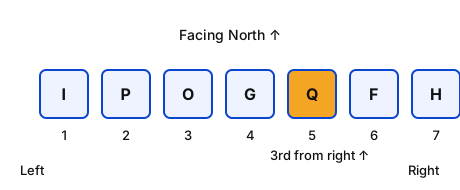
- Only H is to the right of F ⇒ F = 6, H = 7.
- One person between G and F ⇒ G = 4.
- Two between I and G ⇒ I = 1 (7 is taken).
- P < O < Q in the free seats 2, 3, 5 ⇒ P = 2, O = 3, Q = 5.
- Row: I P O G Q F H; third from right = Q.
Trick: Start with "only X to the right of Y" — it pins two seats at the end immediately.
Answer: (D) Q
अवधारणा: उत्तर की ओर मुख होने पर दायाँ छोर स्थान 7 है। पहले निश्चित सूचनाएँ लगाएँ।
- केवल H, F के दाएँ ⇒ F = 6, H = 7।
- G और F के बीच एक व्यक्ति ⇒ G = 4।
- I और G के बीच दो ⇒ I = 1 (7 भरा है)।
- खाली स्थान 2, 3, 5 में P, O, Q क्रम से ⇒ P = 2, O = 3, Q = 5।
- पंक्ति: I P O G Q F H; दाएँ से तीसरा = Q।
ट्रिक: "केवल X, Y के दाएँ" वाली सूचना से छोर के दो स्थान तुरंत तय हो जाते हैं।
उत्तर: (D) Q
RRB NTPC Graduate CBT 1General Intelligence and ReasoningLinear Seating ArrangementRRB NTPC Graduate CBT 1 2024 · 16 Jun Shift 3
Q2189.Which of the following letter-clusters should replace # and % so that the pattern and relationship followed between the letter-cluster pair on the left side of :: is the same as that on the right side of :: ?
# : CRX :: ELU : %
निम्नलिखित में से कौन-से अक्षर-समूह # और % को प्रतिस्थापित करने चाहिए ताकि :: के बाईं ओर के अक्षर-समूह युग्म के बीच का पैटर्न और संबंध वही हो जो :: के दाईं ओर है?
# : CRX :: ELU : %
- A# = BIY, % = HNW
- B# = AHW, % = GMY
- C# = APW, % = GNV
- D# = BPU, % = DNY
Show answer
Concept: Find the letter-wise shift from # to CRX and apply the same shift to ELU.
- Option (C): A → C (+2), P → R (+2), W → X (+1).
- ELU: E → G (+2), L → N (+2), U → V (+1) = GNV.
- Both pairs follow +2, +2, +1, so # = APW, % = GNV.
Trick: Test the right-hand pair first (ELU → %), it filters options fastest.
Answer: (C) # = APW, % = GNV
अवधारणा: # से CRX तक हर अक्षर का खिसकाव ज्ञात करें और वही ELU पर लगाएँ।
- विकल्प (C): A → C (+2), P → R (+2), W → X (+1)।
- ELU: E → G (+2), L → N (+2), U → V (+1) = GNV।
- दोनों युग्म +2, +2, +1 का पालन करते हैं, अतः # = APW, % = GNV।
ट्रिक: पहले दाएँ युग्म (ELU → %) को जाँचें, विकल्प जल्दी कटते हैं।
उत्तर: (C) # = APW, % = GNV
RRB NTPC Graduate CBT 1General Intelligence and ReasoningLetter AnalogyRRB NTPC Graduate CBT 1 2024 · 16 Jun Shift 3
Q2190.What should come in place of the question mark (?) in the given series?
176 168 159 149 138 ? 113
दी गई श्रृंखला में प्रश्न चिह्न (?) के स्थान पर क्या आना चाहिए?
176 168 159 149 138 ? 113
- A125
- B129
- C126
- D123
Show answer
Concept: Check the differences between consecutive terms.
- , , ,
- Next:
- Check: ✓
Trick: Differences increasing by 1 (8, 9, 10, …) → subtract the next number.
Answer: (C)
अवधारणा: क्रमागत पदों का अंतर देखें।
- , , ,
- अगला:
- जाँच: ✓
ट्रिक: अंतर 1-1 बढ़ रहा है (8, 9, 10, …)।
उत्तर: (C)
RRB NTPC Graduate CBT 1General Intelligence and ReasoningNumber SeriesRRB NTPC Graduate CBT 1 2024 · 16 Jun Shift 3
Q2191.Each of P, Q, R, S, T, U and V has an exam on a different day of a week starting from Monday and ending on Sunday of the same week. R has the exam on Tuesday. Only two people have exams between U and R. Q has the exam immediately before V but not on Wednesday. S has the exam immediately before T.
How many people have exams between Q and P ?
P, Q, R, S, T, U और V में से प्रत्येक की परीक्षा एक ही सप्ताह के सोमवार से शुरू होकर रविवार को समाप्त होने वाले सप्ताह के अलग-अलग दिन है। R की परीक्षा मंगलवार को है। U और R के बीच केवल दो लोगों की परीक्षाएँ हैं। Q की परीक्षा V से ठीक पहले है, लेकिन बुधवार को नहीं है। S की परीक्षा T से ठीक पहले है।
Q और P के बीच कितने लोगों की परीक्षाएँ हैं?
- AThreeतीन
- BFourचार
- CTwoदो
- DOneएक
Show answer
Concept: Number days Mon = 1 … Sun = 7 and place definite clues first.
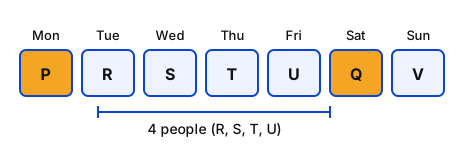
- R = Tue (2). Two between U and R ⇒ U = 5 (Fri).
- Free days: Mon, Wed, Thu, Sat, Sun. Consecutive pairs available: Wed–Thu and Sat–Sun.
- Q–V not starting on Wed ⇒ Q = Sat, V = Sun; S = Wed, T = Thu; P = Mon.
- Between Q (Sat) and P (Mon): R, S, T, U = 4.
Trick: Blocks of two (QV, ST) can only fit where two free days are adjacent.
Answer: (B) Four
अवधारणा: सोम = 1 … रवि = 7 मानें और पहले निश्चित सूचनाएँ लगाएँ।
- R = मंगल (2)। U और R के बीच दो ⇒ U = 5 (शुक्र)।
- खाली दिन: सोम, बुध, गुरु, शनि, रवि। लगातार युग्म: बुध–गुरु और शनि–रवि।
- Q–V बुध से नहीं ⇒ Q = शनि, V = रवि; S = बुध, T = गुरु; P = सोम।
- Q (शनि) और P (सोम) के बीच: R, S, T, U = 4।
ट्रिक: दो-दो के ब्लॉक (QV, ST) केवल वहीं आएँगे जहाँ दो खाली दिन साथ हों।
उत्तर: (B) चार
RRB NTPC Graduate CBT 1General Intelligence and ReasoningScheduling Puzzle – Days of WeekRRB NTPC Graduate CBT 1 2024 · 16 Jun Shift 3
Q2192.Kanav starts from point A and drives 11 km towards the east. He then takes a left turn, drives 7 km, turns left and drives 13 km. He then takes a left turn and drives 12 km. He takes a final left turn, drives 2 km and stops at point P. How far (shortest distance) and towards which direction should he drive in order to reach point A again? (All turns are 90-degree turns only unless specified.)
कनव बिंदु A से शुरू करता है और पूर्व की ओर 11 km गाड़ी चलाता है। फिर वह बाएँ मुड़ता है, 7 km गाड़ी चलाता है, बाएँ मुड़ता है और 13 km गाड़ी चलाता है। फिर वह बाएँ मुड़ता है और 12 km गाड़ी चलाता है। वह अंतिम बार बाएँ मुड़ता है, 2 km गाड़ी चलाता है और बिंदु P पर रुक जाता है। पुनः बिंदु A पर पहुँचने के लिए उसे कितनी दूरी (न्यूनतम दूरी) तक और किस दिशा में गाड़ी चलानी चाहिए? (जब तक निर्दिष्ट न हो, सभी मोड़ केवल 90 डिग्री के मोड़ हैं।)
- A5 km to the southदक्षिण की ओर 5 km
- B4 km to the southदक्षिण की ओर 4 km
- C4 km to the northउत्तर की ओर 4 km
- D5 km to the northउत्तर की ओर 5 km
Show answer
Concept: Track coordinates: east/north positive. Each left turn rotates the direction 90° anticlockwise.
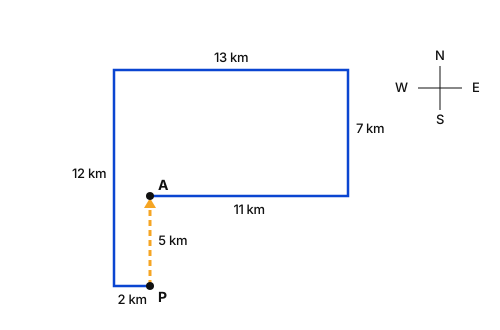
- East 11 → (11, 0); left = north 7 → (11, 7).
- Left = west 13 → (−2, 7); left = south 12 → (−2, −5).
- Left = east 2 → P (0, −5).
- A (0, 0) is 5 km directly north of P.
Trick: Net E–W: ; net N–S: ⇒ P is 5 km south of A, so go 5 km north.
Answer: (D) 5 km to the north
अवधारणा: निर्देशांक लें: पूर्व/उत्तर धनात्मक। हर बाएँ मोड़ पर दिशा 90° वामावर्त घूमती है।
- पूर्व 11 → (11, 0); बाएँ = उत्तर 7 → (11, 7)।
- बाएँ = पश्चिम 13 → (−2, 7); बाएँ = दक्षिण 12 → (−2, −5)।
- बाएँ = पूर्व 2 → P (0, −5)।
- A (0, 0), P से ठीक 5 km उत्तर में है।
ट्रिक: शुद्ध पूर्व–पश्चिम: ; उत्तर–दक्षिण: ⇒ 5 km उत्तर जाना होगा।
उत्तर: (D) उत्तर की ओर 5 km
RRB NTPC Graduate CBT 1General Intelligence and ReasoningDirection and DistanceRRB NTPC Graduate CBT 1 2024 · 16 Jun Shift 3
Q2193.What should come in place of the question mark (?) in the given series?
862 860 856 850 842 ?
दी गई श्रृंखला में प्रश्न चिह्न (?) के स्थान पर क्या आना चाहिए?
862 860 856 850 842 ?
- A832
- B833
- C831
- D830
Show answer
Concept: Look at the differences between terms.
- , , ,
- Next difference is 10:
Trick: Differences are consecutive even numbers 2, 4, 6, 8, 10.
Answer: (A)
अवधारणा: पदों के बीच अंतर देखें।
- , , ,
- अगला अंतर 10:
ट्रिक: अंतर क्रमागत सम संख्याएँ 2, 4, 6, 8, 10 हैं।
उत्तर: (A)
RRB NTPC Graduate CBT 1General Intelligence and ReasoningNumber SeriesRRB NTPC Graduate CBT 1 2024 · 16 Jun Shift 3
Q2194.Refer to the following number and symbol series and answer the question that follows. Counting to be done from left to right only.
(NOTE: All numbers are single digit numbers only.)
(Left) 8 & 1 9 5 £ $ 6 8 $ # 8 & @ * 5 $ # * 5 $ 9 (Right)
How many such symbols are there each of which is immediately preceded by a number and also immediately followed by a symbol?
निम्नलिखित संख्या और प्रतीक श्रृंखला का संदर्भ लीजिए और उसके बाद दिए गए प्रश्न का उत्तर दीजिए। गिनती केवल बाएँ से दाएँ की जानी है।
(नोट: सभी संख्याएँ केवल एक अंक वाली संख्याएँ हैं।)
(बाएँ) 8 & 1 9 5 £ $ 6 8 $ # 8 & @ * 5 $ # * 5 $ 9 (दाएँ)
ऐसे कितने प्रतीक हैं जिनमें से प्रत्येक के ठीक पहले एक संख्या है और ठीक बाद एक प्रतीक भी है?
- A5
- B6
- C4
- D3
Show answer
Concept: Pattern needed: Number – Symbol – Symbol. Scan each symbol and check both neighbours.
- Series: 8 & 1 9 5 £ $ 6 8 $ # 8 & @ * 5 $ # * 5 $ 9
- 5 £ $ ✓, 8 $ # ✓, 8 & @ ✓, 5 $ # ✓
- Rejected: 8 & 1 (followed by number), 5 $ 9 (followed by number); other symbols are preceded by symbols.
- Total = 4
Trick: First mark every "number followed by symbol", then keep only those where the next item is also a symbol.
Answer: (C)
अवधारणा: आवश्यक पैटर्न: संख्या – प्रतीक – प्रतीक। हर प्रतीक के दोनों पड़ोसी जाँचें।
- श्रृंखला: 8 & 1 9 5 £ $ 6 8 $ # 8 & @ * 5 $ # * 5 $ 9
- 5 £ $ ✓, 8 $ # ✓, 8 & @ ✓, 5 $ # ✓
- अस्वीकृत: 8 & 1 (बाद में संख्या), 5 $ 9 (बाद में संख्या); बाकी प्रतीकों से पहले प्रतीक है।
- कुल = 4
ट्रिक: पहले हर "संख्या के बाद प्रतीक" चिह्नित करें, फिर केवल वे रखें जिनके बाद भी प्रतीक हो।
उत्तर: (C)
RRB NTPC Graduate CBT 1General Intelligence and ReasoningSymbol-Number SeriesRRB NTPC Graduate CBT 1 2024 · 16 Jun Shift 3
Q2195.In a certain code language, ‘FAIR’ is coded as ‘9357’ and ‘ROSE’ is coded as ‘8632’. What is the code for R’ in the given code language?
एक निश्चित कूट भाषा में, ‘FAIR’ को ‘9357’ लिखा जाता है और ‘ROSE’ को ‘8632’ लिखा जाता है। उस कूट भाषा में ‘R’ के लिए क्या कूट है?
- A2
- B8
- C7
- D3
Show answer
Concept: In jumbled-letter coding, the letter common to two words takes the digit common to their codes.
- FAIR → 9357 and ROSE → 8632.
- Common letter: R. Common digit: 3.
- So R = 3.
Trick: Common letter ↔ common digit; order of digits does not matter.
Answer: (D)
अवधारणा: उलझे क्रम वाली कोडिंग में दो शब्दों का उभयनिष्ठ अक्षर, दोनों कोडों के उभयनिष्ठ अंक से कोड होता है।
- FAIR → 9357 और ROSE → 8632।
- उभयनिष्ठ अक्षर: R; उभयनिष्ठ अंक: 3।
- अतः R = 3।
ट्रिक: उभयनिष्ठ अक्षर ↔ उभयनिष्ठ अंक; अंकों का क्रम मायने नहीं रखता।
उत्तर: (D)
RRB NTPC Graduate CBT 1General Intelligence and ReasoningCoding-DecodingRRB NTPC Graduate CBT 1 2024 · 16 Jun Shift 3
Q2196.If 2 is added to each odd digit and 3 is subtracted from each even digit in the number 7516438, what will be the difference between the greatest and smallest digits in the new number thus formed?
यदि संख्या 7516438 में प्रत्येक विषम अंक में 2 जोड़ दिया जाए और प्रत्येक सम अंक में से 3 घटा दिया जाए, तो इस प्रकार बनी नई संख्या में सबसे बड़े और सबसे छोटे अंक के बीच का अंतर कितना होगा?
- A6
- B8
- C4
- D2
Show answer
Concept: Apply the rule digit by digit: odd → +2, even → −3.
- 7516438: 7→9, 5→7, 1→3, 6→3, 4→1, 3→5, 8→5
- New number: 9731355
- Greatest , smallest ; difference
Trick: Only the extremes matter: largest new digit from 7 → 9, smallest from 4 → 1.
Answer: (B)
अवधारणा: हर अंक पर नियम लगाएँ: विषम → +2, सम → −3।
- 7516438: 7→9, 5→7, 1→3, 6→3, 4→1, 3→5, 8→5
- नई संख्या: 9731355
- सबसे बड़ा , सबसे छोटा ; अंतर
ट्रिक: केवल अधिकतम/न्यूनतम देखें: 7 → 9 और 4 → 1।
उत्तर: (B)
RRB NTPC Graduate CBT 1General Intelligence and ReasoningDigit OperationsRRB NTPC Graduate CBT 1 2024 · 16 Jun Shift 3
Q2197.Based on the English alphabetical order, three of the following four letter-clusters are alike in a certain way and thus form a group. Which letter-cluster DOES NOT belong to that group?
(Note: The odd one out is not based on the number of consonants/vowels or their position in the letter-cluster.)
अंग्रेज़ी वर्णमाला क्रम के आधार पर, निम्नलिखित चार अक्षर-समूहों में से तीन किसी निश्चित प्रकार से एक समान हैं और इस प्रकार एक समूह बनाते हैं। कौन-सा अक्षर-समूह उस समूह से संबंधित नहीं है?
(नोट: असंगत का चयन व्यंजनों/स्वरों की संख्या या अक्षर-समूह में उनके स्थान पर आधारित नहीं है।)
- ATQLJ
- BJGBZ
- CROIH
- DBYTR
Show answer
Concept: Write the alphabet positions and find the gaps (cyclic: after A comes Z backwards).
- TQLJ: 20, 17, 12, 10 → −3, −5, −2
- JGBZ: 10, 7, 2, 26 → −3, −5, −2 (B − 2 = Z)
- BYTR: 2, 25, 20, 18 → −3, −5, −2 (B − 3 = Y)
- ROIH: 18, 15, 9, 8 → −3, −6, −1 ✗
Trick: When B or A appears, count backwards around the alphabet (A → Z).
Answer: (C) ROIH
अवधारणा: अक्षरों के स्थानीय मान लिखें और अंतर देखें (चक्रीय: A के बाद पीछे Z)।
- TQLJ: 20, 17, 12, 10 → −3, −5, −2
- JGBZ: 10, 7, 2, 26 → −3, −5, −2 (B − 2 = Z)
- BYTR: 2, 25, 20, 18 → −3, −5, −2 (B − 3 = Y)
- ROIH: 18, 15, 9, 8 → −3, −6, −1 ✗
ट्रिक: B या A आने पर वर्णमाला में चक्रीय रूप से पीछे गिनें (A → Z)।
उत्तर: (C) ROIH
RRB NTPC Graduate CBT 1General Intelligence and ReasoningOdd One Out – Letter ClustersRRB NTPC Graduate CBT 1 2024 · 16 Jun Shift 3
Q2198.This question is based on the five, three-digit numbers given below.
(Left) 657 435 578 659 619 (Right)
(Example- 697 – First digit = 6, second digit = 9 and third digit = 7)
(NOTE: All operations to be done from left to right.)
What will be the resultant if the second digit of the highest number is added to the third digit of the lowest number?
यह प्रश्न नीचे दी गई पाँच, तीन अंकों वाली संख्याओं पर आधारित है।
(बाएँ) 657 435 578 659 619 (दाएँ)
(उदाहरण- 697 – पहला अंक = 6, दूसरा अंक = 9 और तीसरा अंक = 7)
(नोट: सभी संक्रियाएँ बाएँ से दाएँ की जानी हैं।)
यदि सबसे बड़ी संख्या के दूसरे अंक को सबसे छोटी संख्या के तीसरे अंक में जोड़ा जाए, तो परिणाम क्या होगा?
- A13
- B9
- C10
- D11
Show answer
Concept: Identify the highest and lowest numbers, then pick the required digits.
- Numbers: 657, 435, 578, 659, 619
- Highest = 659 → second digit = 5
- Lowest = 435 → third digit = 5
Trick: Compare 657 vs 659 carefully — 659 is the highest.
Answer: (C)
अवधारणा: सबसे बड़ी और सबसे छोटी संख्या पहचानें, फिर अंक चुनें।
- संख्याएँ: 657, 435, 578, 659, 619
- सबसे बड़ी = 659 → दूसरा अंक = 5
- सबसे छोटी = 435 → तीसरा अंक = 5
ट्रिक: 657 और 659 की तुलना ध्यान से करें — 659 सबसे बड़ी है।
उत्तर: (C)
RRB NTPC Graduate CBT 1General Intelligence and ReasoningNumber ArrangementRRB NTPC Graduate CBT 1 2024 · 16 Jun Shift 3
Q2199.Which of the following letter-clusters should replace # and % so that the pattern and relationship followed between the letter-cluster pair on the left side of :: is the same as that on the right side of :: ?
# : EIC :: QLZ : %
निम्नलिखित में से कौन-से अक्षर-समूह # और % को प्रतिस्थापित करने चाहिए ताकि :: के बाईं ओर के अक्षर-समूह युग्म के बीच का पैटर्न और संबंध वही हो जो :: के दाईं ओर है?
# : EIC :: QLZ : %
- A# = ERB, % = RNW
- B# = DJF, % = UPV
- C# = EDG, % = PNY
- D# = FHD, % = PMY
Show answer
Concept: Find the shift from # to EIC and apply it to QLZ.
- Option (D): F → E (−1), H → I (+1), D → C (−1).
- QLZ: Q → P (−1), L → M (+1), Z → Y (−1) = PMY.
- Both pairs follow −1, +1, −1.
Trick: Check % first: only PMY fits −1, +1, −1 on QLZ.
Answer: (D) # = FHD, % = PMY
अवधारणा: # से EIC तक का खिसकाव ज्ञात करें और QLZ पर लगाएँ।
- विकल्प (D): F → E (−1), H → I (+1), D → C (−1)।
- QLZ: Q → P (−1), L → M (+1), Z → Y (−1) = PMY।
- दोनों युग्म −1, +1, −1 का पालन करते हैं।
ट्रिक: पहले % जाँचें: केवल PMY, QLZ पर −1, +1, −1 से मेल खाता है।
उत्तर: (D) # = FHD, % = PMY
RRB NTPC Graduate CBT 1General Intelligence and ReasoningLetter AnalogyRRB NTPC Graduate CBT 1 2024 · 16 Jun Shift 3
Q2200.What will come in the place of the question mark ‘(?)’ in the following equation, if ‘+’ and ‘−’ are interchanged and ‘×’ and ‘÷’ are interchanged?
175 ÷ 5 + 213 × 3 − 75 = ?
यदि ‘+’ और ‘−’ को आपस में बदल दिया जाए तथा ‘×’ और ‘÷’ को आपस में बदल दिया जाए, तो निम्नलिखित समीकरण में प्रश्न चिह्न ‘(?)’ के स्थान पर क्या आएगा?
175 ÷ 5 + 213 × 3 − 75 = ?
- A889
- B879
- C898
- D869
Show answer
Concept: Interchange the signs first, then solve using BODMAS.
- After swapping:
Trick: Swap the signs on paper before calculating — most errors come from doing it mentally.
Answer: (B)
अवधारणा: पहले चिह्न बदलें, फिर BODMAS से हल करें।
- चिह्न बदलने पर:
ट्रिक: गणना से पहले चिह्न कागज़ पर बदल लें — गलती कम होगी।
उत्तर: (B)
RRB NTPC Graduate CBT 1General Intelligence and ReasoningMathematical OperationsRRB NTPC Graduate CBT 1 2024 · 16 Jun Shift 3

