Q1781.This question is based on the five, three-digit numbers given below.
(Left) 512 648 729 378 462 (Right)
(Example- 697 – First digit = 6, second digit = 9 and third digit = 7)
(NOTE: All operations to be done from left to right.)
What will be the resultant if the first digit of the lowest number is added to the third digit of the highest number?
यह प्रश्न नीचे दी गई पाँच, तीन-अंकीय संख्याओं पर आधारित है।
(बाएँ) 512 648 729 378 462 (दाएँ)
(उदाहरण- 697 – पहला अंक = 6, दूसरा अंक = 9 और तीसरा अंक = 7)
(नोट: सभी संक्रियाएँ बाएँ से दाएँ की जानी हैं।)
यदि सबसे छोटी संख्या के पहले अंक को सबसे बड़ी संख्या के तीसरे अंक में जोड़ा जाए, तो परिणाम क्या होगा?
- A12
- B10
- C13
- D11
Show answer
Concept: Identify lowest and highest numbers first.
- Lowest = 378 → first digit 3
- Highest = 729 → third digit 9
Trick: Compare hundreds digits first: 3 is lowest, 7 is highest.
Answer: (A) 12
अवधारणा: पहले सबसे छोटी और सबसे बड़ी संख्या पहचानें।
- सबसे छोटी = 378 → पहला अंक 3
- सबसे बड़ी = 729 → तीसरा अंक 9
ट्रिक: सैकड़े के अंक से तुलना करें: 3 सबसे छोटा, 7 सबसे बड़ा।
उत्तर: (A) 12
RRB NTPC Undergraduate CBT 1General Intelligence and ReasoningNumber AnalysisRRB NTPC Undergraduate CBT 1 2024 · 1 Sep Shift 1
Q1782.I, J, K, L, O, P and Q are sitting around a circular table, facing the centre of the table. P sits third to the left of K. O sits second to the left of J. Only K sits between Q and O. L is not an immediate neighbour of P.
How many people sit between I and O when counted from the right of I?
I, J, K, L, O, P और Q एक वृत्ताकार मेज़ के चारों ओर मेज़ के केंद्र की ओर मुख करके बैठे हैं। P, K के बाएँ से तीसरे स्थान पर बैठा है। O, J के बाएँ से दूसरे स्थान पर बैठा है। Q और O के बीच केवल K बैठा है। L, P का निकटतम पड़ोसी नहीं है।
I के दाएँ से गिनने पर I और O के बीच कितने व्यक्ति बैठे हैं?
- AOneएक
- BFourचार
- CThreeतीन
- DTwoदो
Show answer
Concept: Facing the centre: left = clockwise, right = anticlockwise.
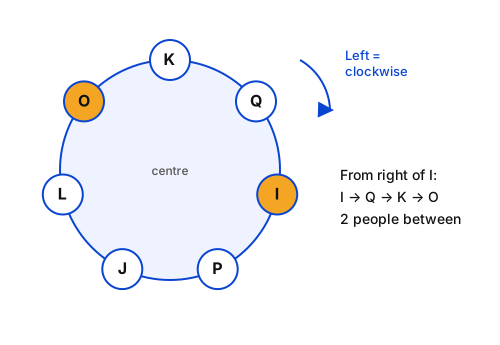
- Fix K; P is 3rd to the left of K.
- Q and O are K's two neighbours; O is 2nd left of J ⇒ O on K's right, Q on K's left, J next to P.
- Remaining seats: L not next to P ⇒ L sits between J and O; I sits between Q and P.
- From I going right: Q, K, then O ⇒ 2 people between.
Trick: Place the person with most clues (K) first, then use the 'only between' clue.
Answer: (D) Two
अवधारणा: केंद्र की ओर मुख: बाएँ = दक्षिणावर्त, दाएँ = वामावर्त।
- K को रखें; P, K के बाएँ तीसरे स्थान पर।
- Q और O, K के दोनों पड़ोसी; O, J के बाएँ दूसरे ⇒ O, K के दाएँ, Q बाएँ, J, P के बगल में।
- L, P का पड़ोसी नहीं ⇒ L, J और O के बीच; I, Q और P के बीच।
- I से दाईं ओर: Q, K, फिर O ⇒ 2 व्यक्ति।
ट्रिक: सबसे अधिक सूचना वाले व्यक्ति (K) को पहले रखें।
उत्तर: (D) दो
RRB NTPC Undergraduate CBT 1General Intelligence and ReasoningCircular SeatingRRB NTPC Undergraduate CBT 1 2024 · 1 Sep Shift 1
Q1783.What should come in place of the question mark (?) in the given series?
890 891 893 896 900 ?
दी गई श्रृंखला में प्रश्न चिह्न (?) के स्थान पर क्या आना चाहिए?
890 891 893 896 900 ?
- A903
- B906
- C905
- D904
Show answer
Concept: Look at successive differences.
- Differences: +1, +2, +3, +4
- Next: +5
Trick: Increasing natural-number differences are the most common pattern.
Answer: (C) 905
अवधारणा: क्रमागत अंतर देखें।
- अंतर: +1, +2, +3, +4
- अगला: +5
ट्रिक: बढ़ते प्राकृत संख्या अंतर सबसे आम पैटर्न है।
उत्तर: (C) 905
RRB NTPC Undergraduate CBT 1General Intelligence and ReasoningNumber SeriesRRB NTPC Undergraduate CBT 1 2024 · 1 Sep Shift 1
Q1784.Seven boxes P, Q, R, S, X, Y and Z are kept one over the other, but not necessarily in the same order. Z is kept second from the bottom. Only three boxes are kept between Z and R. X is kept at one of the positions below Z. Only S is kept between R and Y. P is kept at one of the positions above R. How many boxes are kept between Q and R?
सात बक्से P, Q, R, S, X, Y और Z एक के ऊपर एक रखे गए हैं, लेकिन ज़रूरी नहीं कि इसी क्रम में हों। Z को नीचे से दूसरे स्थान पर रखा गया है। Z और R के बीच केवल तीन बक्से रखे गए हैं। X को Z के नीचे के किसी एक स्थान पर रखा गया है। R और Y के बीच केवल S रखा गया है। P को R के ऊपर के किसी एक स्थान पर रखा गया है। Q और R के बीच कितने बक्से रखे गए हैं?
- AOneएक
- BFourचार
- CTwoदो
- DThreeतीन
Show answer
Concept: Number positions from the bottom (1) to the top (7).
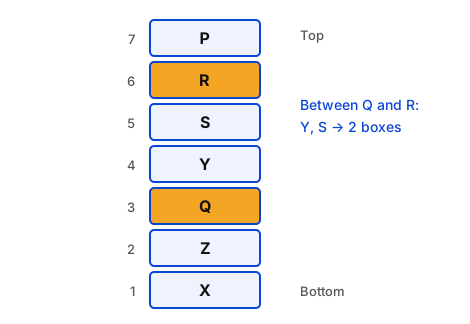
- Z = 2; three boxes between Z and R ⇒ R = 6.
- X below Z ⇒ X = 1. P above R ⇒ P = 7.
- Only S between R and Y ⇒ S = 5, Y = 4 (S cannot be 7 as P is there). Q = 3.
- Between Q (3) and R (6): Y, S ⇒ 2 boxes.
Trick: Use 'X below Z' with Z = 2 to lock X at the bottom immediately.
Answer: (C) Two
अवधारणा: स्थान नीचे (1) से ऊपर (7) गिनें।
- Z = 2; Z और R के बीच तीन ⇒ R = 6।
- X, Z के नीचे ⇒ X = 1। P, R के ऊपर ⇒ P = 7।
- R और Y के बीच केवल S ⇒ S = 5, Y = 4। Q = 3।
- Q (3) और R (6) के बीच: Y, S ⇒ 2 बॉक्स।
ट्रिक: Z = 2 होने पर 'X, Z के नीचे' से X = 1 तुरंत तय।
उत्तर: (C) दो
RRB NTPC Undergraduate CBT 1General Intelligence and ReasoningBox ArrangementRRB NTPC Undergraduate CBT 1 2024 · 1 Sep Shift 1
Q1785.What should come in place of the question mark (?) in the given series?
56 58 63 73 90 ?
दी गई श्रृंखला में प्रश्न चिह्न (?) के स्थान पर क्या आना चाहिए?
56 58 63 73 90 ?
- A115
- B112
- C114
- D116
Show answer
Concept: Differences follow .
- Differences: 2, 5, 10, 17
- Next difference
Trick: Differences 2, 5, 10, 17 themselves differ by 3, 5, 7 → next 9.
Answer: (D) 116
अवधारणा: अंतर के रूप में हैं।
- अंतर: 2, 5, 10, 17
- अगला अंतर
ट्रिक: अंतरों का अंतर 3, 5, 7 → अगला 9।
उत्तर: (D) 116
RRB NTPC Undergraduate CBT 1General Intelligence and ReasoningNumber SeriesRRB NTPC Undergraduate CBT 1 2024 · 1 Sep Shift 1
Q1786.Based on the English alphabetical order, three of the following four letter-clusters are alike in a certain way and thus form a group. Which letter-cluster DOES NOT belong to that group?
(Note: The odd one out is not based on the number of consonants/vowels or their position in the letter-cluster.)
अंग्रेज़ी वर्णमाला क्रम के आधार पर, निम्नलिखित चार अक्षर-समूहों में से तीन किसी निश्चित प्रकार से एकसमान हैं और इस प्रकार एक समूह बनाते हैं। कौन-सा अक्षर-समूह उस समूह से संबंधित नहीं है?
(नोट: असंगत अक्षर-समूह, उस अक्षर-समूह में व्यंजनों/स्वरों की संख्या या उनके स्थान पर आधारित नहीं है।)
- ACXZ
- BOJL
- CZTW
- DIDF
Show answer
Concept: Check the gap pattern in each cluster.
- CXZ: C −5 X +2 Z
- OJL: O −5 J +2 L
- IDF: I −5 D +2 F
- ZTW: Z −6 T +3 W ✗
Trick: Write position numbers: Z = 26, T = 20, W = 23 shows −6, +3.
Answer: (C) ZTW
अवधारणा: प्रत्येक समूह में अंतर का पैटर्न देखें।
- CXZ: C −5 X +2 Z
- OJL: O −5 J +2 L
- IDF: I −5 D +2 F
- ZTW: Z −6 T +3 W ✗
ट्रिक: स्थान संख्या लिखें: Z = 26, T = 20, W = 23 → −6, +3।
उत्तर: (C) ZTW
RRB NTPC Undergraduate CBT 1General Intelligence and ReasoningOdd One Out – LettersRRB NTPC Undergraduate CBT 1 2024 · 1 Sep Shift 1
Q1787.In a certain code language, ‘learning is lifelong’ is written as ‘fk mb tb’ and ‘is school over’ is coded as ‘jt mt fk’. How is ‘is’ coded in the given language?
एक निश्चित कूट भाषा में, ‘learning is lifelong’ को ‘fk mb tb’ लिखा जाता है और ‘is school over’ को ‘jt mt fk’ के रूप में कूटबद्ध किया जाता है। दी गई भाषा में ‘is’ को किस प्रकार कूटबद्ध किया जाता है?
- Ajt
- Btb
- Cfk
- Dmb
Show answer
Concept: A word common to two sentences takes the code common to both.
- 'is' appears in both sentences.
- Common code in 'fk mb tb' and 'jt mt fk' is 'fk'.
- So 'is' = fk.
Trick: Common word ↔ common code.
Answer: (C) fk
अवधारणा: दो वाक्यों में उभयनिष्ठ शब्द का कोड, दोनों कोड में उभयनिष्ठ होता है।
- 'is' दोनों वाक्यों में है।
- 'fk mb tb' और 'jt mt fk' में उभयनिष्ठ कोड 'fk' है।
- अतः 'is' = fk।
ट्रिक: उभयनिष्ठ शब्द ↔ उभयनिष्ठ कोड।
उत्तर: (C) fk
RRB NTPC Undergraduate CBT 1General Intelligence and ReasoningCoding–DecodingRRB NTPC Undergraduate CBT 1 2024 · 1 Sep Shift 1
Q1788.A, B, C, D, E, F and G are sitting around a circular table facing the centre. B sits third to the left of G. C sits second to the left of B. F sits to the immediate right of D. E sits to the immediate right of G. How many people sit between A and D when counted from the left of A?
A, B, C, D, E, F और G एक वृत्ताकार मेज़ के चारों ओर केंद्र की ओर मुख करके बैठे हैं। B, G के बाएँ से तीसरे स्थान पर बैठा है। C, B के बाएँ से दूसरे स्थान पर बैठा है। F, D के ठीक दाएँ बैठा है। E, G के ठीक दाएँ बैठा है। A के बाएँ से गिनने पर A और D के बीच कितने व्यक्ति बैठे हैं?
- AThreeतीन
- BOneएक
- CFourचार
- DTwoदो
Show answer
Concept: Facing the centre: left = clockwise, right = anticlockwise.
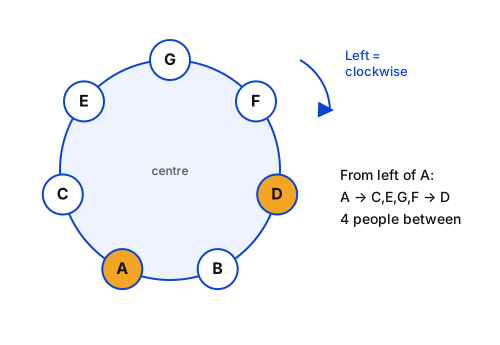
- Fix G. B is 3rd to the left of G; C is 2nd to the left of B.
- E is immediately right of G.
- Remaining seats for D, F, A: F immediately right of D ⇒ F next to G, then D, and A between D and B.
- From A going left: C, E, G, F, then D ⇒ 4 people between.
Trick: With 7 seats, going 4 one way = 3 the other way — useful to cross-check.
Answer: (C) Four
अवधारणा: केंद्र की ओर मुख: बाएँ = दक्षिणावर्त, दाएँ = वामावर्त।
- G को रखें। B, G के बाएँ तीसरा; C, B के बाएँ दूसरा।
- E, G के ठीक दाएँ।
- D, F, A के लिए शेष स्थान: F, D के ठीक दाएँ ⇒ G के बाद F, फिर D, और A, D व B के बीच।
- A से बाईं ओर: C, E, G, F, फिर D ⇒ 4 व्यक्ति।
ट्रिक: 7 सीटों में एक ओर 4 = दूसरी ओर 3 — जाँच के लिए उपयोगी।
उत्तर: (C) चार
RRB NTPC Undergraduate CBT 1General Intelligence and ReasoningCircular SeatingRRB NTPC Undergraduate CBT 1 2024 · 1 Sep Shift 1
Q1789.Bimal starts from Point Y and drives 44 km towards south. He then takes a left turn, drives 56 km, turns right and drives 37 km. He then takes a right turn and drives 23 km. He takes a right turn, drives 28 km. He then turns right, drives 38 km, turns left and drives 53 km, turns right and drives 19 km to stop at Point Z. How far (shortest distance) and towards which direction should he drive in order to reach Point Y again? (All turns are 90° turns only unless specified.)
बिमल बिंदु Y से चलना शुरू करता है और दक्षिण की ओर 44 km गाड़ी चलाता है। फिर वह बाएँ मुड़ता है, 56 km गाड़ी चलाता है, दाएँ मुड़ता है और 37 km गाड़ी चलाता है। फिर वह दाएँ मुड़ता है और 23 km गाड़ी चलाता है। वह दाएँ मुड़ता है, 28 km गाड़ी चलाता है। फिर वह दाएँ मुड़ता है, 38 km गाड़ी चलाता है, बाएँ मुड़ता है और 53 km गाड़ी चलाता है, दाएँ मुड़ता है और 19 km गाड़ी चलाकर बिंदु Z पर रुक जाता है। पुनः बिंदु Y तक पहुँचने के लिए उसे कितनी दूरी (न्यूनतम दूरी) तक और किस दिशा में गाड़ी चलानी चाहिए? (जब तक निर्दिष्ट न हो, सभी मोड़ केवल 90° के मोड़ हैं।)
- A90 km towards westपश्चिम की ओर 90 km
- B87 km towards eastपूर्व की ओर 87 km
- C92 km towards eastपूर्व की ओर 92 km
- D84 km towards southदक्षिण की ओर 84 km
Show answer
Concept: Track net East–West and North–South displacement.
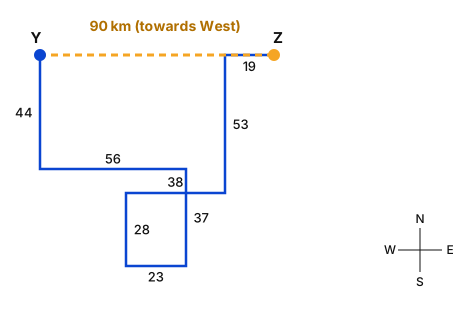
- Moves: S 44, E 56, S 37, W 23, N 28, E 38, N 53, E 19.
- North–South:
- East–West: km East
- Z is 90 km east of Y ⇒ drive 90 km towards West.
Trick: Net vertical is zero, so the answer is just the net horizontal distance.
Answer: (A) 90 km towards west
अवधारणा: कुल पूर्व–पश्चिम और उत्तर–दक्षिण विस्थापन निकालें।
- चालें: दक्षिण 44, पूर्व 56, दक्षिण 37, पश्चिम 23, उत्तर 28, पूर्व 38, उत्तर 53, पूर्व 19।
- उत्तर–दक्षिण:
- पूर्व–पश्चिम: km पूर्व
- Z, Y से 90 km पूर्व ⇒ पश्चिम की ओर 90 km चलना होगा।
ट्रिक: ऊर्ध्वाधर विस्थापन शून्य है, अतः उत्तर केवल क्षैतिज दूरी है।
उत्तर: (A) पश्चिम की ओर 90 km
RRB NTPC Undergraduate CBT 1General Intelligence and ReasoningDirection and DistanceRRB NTPC Undergraduate CBT 1 2024 · 1 Sep Shift 1
Q1790.What should come in place of the question mark (?) in the given series based on the English alphabetical order?
UNA OHU IBO CVI ?
अंग्रेज़ी वर्णमाला क्रम के आधार पर दी गई श्रृंखला में प्रश्न चिह्न (?) के स्थान पर क्या आना चाहिए?
UNA OHU IBO CVI ?
- AWSP
- BWPC
- CWPS
- DWCP
Show answer
Concept: Each position moves −6 (with wrap-around).
- 1st letters: U, O, I, C → W (C − 6 → W)
- 2nd letters: N, H, B, V → P
- 3rd letters: A, U, O, I → C
- Answer: WPC
Trick: Note the 3rd letter of each term = 1st letter of the previous term.
Answer: (B) WPC
अवधारणा: हर स्थान −6 खिसकता है (चक्रीय)।
- पहले अक्षर: U, O, I, C → W
- दूसरे अक्षर: N, H, B, V → P
- तीसरे अक्षर: A, U, O, I → C
- उत्तर: WPC
ट्रिक: हर पद का तीसरा अक्षर = पिछले पद का पहला अक्षर।
उत्तर: (B) WPC
RRB NTPC Undergraduate CBT 1General Intelligence and ReasoningLetter SeriesRRB NTPC Undergraduate CBT 1 2024 · 1 Sep Shift 1
Q1791.Which of the following letter-number clusters will replace the question mark (?) in the given series to make it logically complete?
DLY 15, BJW 22, ZHU 29, XFS 36, ?
निम्नलिखित में से कौन-सा अक्षर-संख्या समूह दी गई श्रृंखला को तार्किक रूप से पूर्ण करने के लिए प्रश्न चिह्न (?) का स्थान लेगा?
DLY 15, BJW 22, ZHU 29, XFS 36, ?
- AVDP 41
- BWER 43
- CVDQ 43
- DVER 42
Show answer
Concept: Letters move −2; number moves +7.
- D, B, Z, X → V; L, J, H, F → D; Y, W, U, S → Q
- Numbers: 15, 22, 29, 36 → 43
- Answer: VDQ 43
Trick: The number part alone (+7 → 43) leaves only two options; the last letter Q decides.
Answer: (C) VDQ 43
अवधारणा: अक्षर −2; संख्या +7।
- D, B, Z, X → V; L, J, H, F → D; Y, W, U, S → Q
- संख्याएँ: 15, 22, 29, 36 → 43
- उत्तर: VDQ 43
ट्रिक: केवल संख्या (+7 → 43) से दो विकल्प बचते हैं; अंतिम अक्षर Q निर्णय करता है।
उत्तर: (C) VDQ 43
RRB NTPC Undergraduate CBT 1General Intelligence and ReasoningLetter–Number SeriesRRB NTPC Undergraduate CBT 1 2024 · 1 Sep Shift 1
Q1792.Read the given statement(s) and conclusions carefully. Assuming that the information given in the statements is true, even if it appears to be at variance with commonly known facts, decide which of the given conclusions logically follow(s) from the statement(s).
Statements:
Some crafts are handlooms.
All shawls are handlooms.
Conclusions:
(I) Some crafts are shawls.
(II) All handlooms are shawls.
दिए गए कथन(नों) और निष्कर्षों को ध्यानपूर्वक पढ़िए। यह मानते हुए कि कथनों में दी गई जानकारी सत्य है, भले ही वह सामान्य रूप से ज्ञात तथ्यों से भिन्न प्रतीत होती हो, निर्णय लीजिए कि दिए गए निष्कर्षों में से कौन-सा/से निष्कर्ष तार्किक रूप से कथन(नों) का अनुसरण करता है/करते हैं।
कथन:
कुछ शिल्प, हथकरघा हैं।
सभी शॉल, हथकरघा हैं।
निष्कर्ष:
(I) कुछ शिल्प, शॉल हैं।
(II) सभी हथकरघा, शॉल हैं।
- AOnly conclusion (II) follows.केवल निष्कर्ष (II) अनुसरण करता है।
- BOnly conclusion (I) follows.केवल निष्कर्ष (I) अनुसरण करता है।
- CNeither conclusion (I) nor (II) follows.न तो निष्कर्ष (I) और न ही (II) अनुसरण करता है।
- DBoth conclusions (I) and (II) follow.निष्कर्ष (I) और (II) दोनों अनुसरण करते हैं।
Show answer
Concept: Draw the least-overlap Venn diagram consistent with the statements.
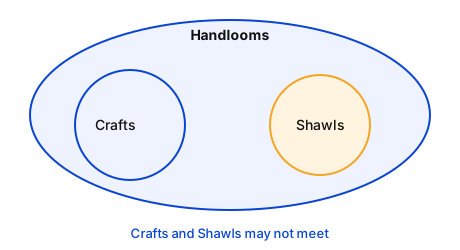
- Crafts and shawls both lie partly/fully inside handlooms but need not touch each other ⇒ (I) not certain.
- Shawls are inside handlooms, not vice versa ⇒ 'All handlooms are shawls' (II) does not follow.
Trick: Two circles linked only through a common third circle give no definite relation.
Answer: (C) Neither conclusion (I) nor (II) follows.
अवधारणा: कथनों के अनुरूप न्यूनतम ओवरलैप वाला वेन आरेख बनाएँ।
- Crafts और shawls दोनों handlooms से जुड़े हैं पर आपस में मिलना आवश्यक नहीं ⇒ (I) निश्चित नहीं।
- Shawls, handlooms के अंदर हैं, उल्टा नहीं ⇒ (II) अनुसरण नहीं करता।
ट्रिक: तीसरे वृत्त के माध्यम से जुड़े दो वृत्तों में कोई निश्चित संबंध नहीं होता।
उत्तर: (C) न तो (I) और न ही (II) अनुसरण करता है।
RRB NTPC Undergraduate CBT 1General Intelligence and ReasoningSyllogismRRB NTPC Undergraduate CBT 1 2024 · 1 Sep Shift 1
Q1793.Refer to the following number and symbol series and answer the question that follows. Counting to be done from left to right only.
(Left) 5 8 £ 1 7 & $ $ 7 # 4 1 8 9 @ 7 5 7 £ @ 2 & (Right)
How many such numbers are there each of which is immediately preceded by a number and also immediately followed by a number?
निम्नलिखित संख्या और प्रतीक श्रृंखला को देखिए और उसके बाद दिए गए प्रश्न का उत्तर दीजिए। गिनती केवल बाएँ से दाएँ की जानी है।
(बाएँ) 5 8 £ 1 7 & $ $ 7 # 4 1 8 9 @ 7 5 7 £ @ 2 & (दाएँ)
ऐसी कितनी संख्याएँ हैं, जिनमें से प्रत्येक के ठीक पहले एक संख्या है और ठीक बाद में भी एक संख्या है?
- A3
- B5
- C4
- D2
Show answer
Concept: Check each number's immediate left and right neighbours.
- Series: 5 8 £ 1 7 & $ $ 7 # 4 1 8 9 @ 7 5 7 £ @ 2 &
- Qualifying: 1 (between 4 and 8), 8 (between 1 and 9), 5 (between 7 and 7)
- Count
Trick: Look only at runs of 3 or more consecutive numbers: '4 1 8 9' gives 2 and '7 5 7' gives 1.
Answer: (A) 3
अवधारणा: प्रत्येक संख्या के ठीक बाएँ और दाएँ पड़ोसी देखें।
- श्रृंखला: 5 8 £ 1 7 & $ $ 7 # 4 1 8 9 @ 7 5 7 £ @ 2 &
- योग्य: 1 (4 और 8 के बीच), 8 (1 और 9 के बीच), 5 (7 और 7 के बीच)
- कुल
ट्रिक: केवल 3 या अधिक लगातार संख्याओं के समूह देखें: '4 1 8 9' से 2, '7 5 7' से 1।
उत्तर: (A) 3
RRB NTPC Undergraduate CBT 1General Intelligence and ReasoningNumber–Symbol SeriesRRB NTPC Undergraduate CBT 1 2024 · 1 Sep Shift 1
Q1794.DJMS is related to FORU in a certain way based on the English alphabetical order. In the same way, LDGA is related to NILC. To which of the given options is RSVG related, following the same logic?
अंग्रेज़ी वर्णमाला क्रम के आधार पर DJMS एक निश्चित प्रकार से FORU से संबंधित है। उसी प्रकार LDGA, NILC से संबंधित है। समान तर्क का अनुसरण करते हुए RSVG दिए गए विकल्पों में से किससे संबंधित है?
- ATAXI
- BTIXA
- CTXAI
- DTXSW
Show answer
Concept: Find shifts position by position.
- DJMS → FORU: +2, +5, +5, +2
- LDGA → NILC: +2, +5, +5, +2 ✓
- RSVG: R+2 = T, S+5 = X, V+5 = A (wrap), G+2 = I ⇒ TXAI
Trick: Pattern +2, +5, +5, +2 is symmetric; remember V + 5 crosses Z to A.
Answer: (C) TXAI
अवधारणा: हर स्थान पर खिसकाव ज्ञात करें।
- DJMS → FORU: +2, +5, +5, +2
- LDGA → NILC: +2, +5, +5, +2 ✓
- RSVG: R+2 = T, S+5 = X, V+5 = A (चक्रीय), G+2 = I ⇒ TXAI
ट्रिक: पैटर्न +2, +5, +5, +2 सममित है; V + 5, Z पार करके A बनता है।
उत्तर: (C) TXAI
RRB NTPC Undergraduate CBT 1General Intelligence and ReasoningLetter AnalogyRRB NTPC Undergraduate CBT 1 2024 · 1 Sep Shift 1
Q1795.Each of the digits in the number 2516984 is arranged in the ascending order from left to right. What will be the sum of the digits that are third from the left and third from the right in the new number thus formed?
संख्या 2516984 के प्रत्येक अंक को बाएँ से दाएँ आरोही क्रम में व्यवस्थित किया जाता है। इस प्रकार बनी नई संख्या में बाएँ से तीसरे और दाएँ से तीसरे अंकों का योग क्या होगा?
- A12
- B10
- C9
- D7
Show answer
Concept: Arrange digits in ascending order.
- 2516984 → 1245689
- 3rd from left , 3rd from right
- Sum
Trick: In a 7-digit number, 3rd from right = 5th from left.
Answer: (B) 10
अवधारणा: अंकों को आरोही क्रम में लगाएँ।
- 2516984 → 1245689
- बाएँ से तीसरा , दाएँ से तीसरा
- योग
ट्रिक: 7 अंकों की संख्या में दाएँ से तीसरा = बाएँ से पाँचवाँ।
उत्तर: (B) 10
RRB NTPC Undergraduate CBT 1General Intelligence and ReasoningDigit ArrangementRRB NTPC Undergraduate CBT 1 2024 · 1 Sep Shift 1
Q1796.In the following triads, each group of letters is related to the subsequent one following a certain logic. Select from the given options, the one which follows the same logic. ABLE - BLAE - ELBA
ITEM - TEIM - METI
निम्नलिखित त्रिकों में, अक्षरों का प्रत्येक समूह एक निश्चित तर्क का अनुसरण करते हुए अगले समूह से संबंधित है। दिए गए विकल्पों में से उस विकल्प का चयन कीजिए जो समान तर्क का अनुसरण करता है। ABLE - BLAE - ELBA
ITEM - TEIM - METI
- ASACK - ASCK - KACS
- BOPEN - OEPN - NEPO
- CSLOT - LOST - TOLS
- DCAME - AMCE - AMEC
Show answer
Concept: Find how 2nd and 3rd words are formed from the 1st.
- ABLE → BLAE: letters 2, 3, 1, 4 (first letter moves to 3rd place).
- ELBA = ABLE reversed. Same for ITEM → TEIM → METI.
- SLOT → LOST (2, 3, 1, 4) and TOLS = SLOT reversed ✓
Trick: Check the easy rule first: 3rd word = 1st word reversed quickly rules out (A), (B) and (D).
Answer: (C) SLOT - LOST - TOLS
अवधारणा: दूसरा और तीसरा शब्द पहले से कैसे बनता है, देखें।
- ABLE → BLAE: अक्षर क्रम 2, 3, 1, 4।
- ELBA = ABLE उल्टा। ITEM → TEIM → METI भी ऐसा ही।
- SLOT → LOST (2, 3, 1, 4) और TOLS = SLOT उल्टा ✓
ट्रिक: पहले आसान नियम जाँचें: तीसरा शब्द = पहला शब्द उल्टा।
उत्तर: (C) SLOT - LOST - TOLS
RRB NTPC Undergraduate CBT 1General Intelligence and ReasoningLetter TriadsRRB NTPC Undergraduate CBT 1 2024 · 1 Sep Shift 1
Q1797.Read the given statements and conclusions carefully. Assuming that the information given in the statements is true, even if it appears to be at variance with commonly known facts, decide which of the given conclusion(s) logically follow(s) from the statements.
Statements: Some laptops are computers. No computer is a mobile.
Conclusions (I): No laptop is a mobile.
Conclusions (II): Some laptops are mobile.
दिए गए कथनों और निष्कर्षों को ध्यानपूर्वक पढ़िए। यह मानते हुए कि कथनों में दी गई जानकारी सत्य है, भले ही वह सामान्य रूप से ज्ञात तथ्यों से भिन्न प्रतीत होती हो, निर्णय लीजिए कि दिए गए निष्कर्षों में से कौन-सा/से निष्कर्ष तार्किक रूप से कथनों का अनुसरण करता है/करते हैं।
कथन: कुछ लैपटॉप, कंप्यूटर हैं। कोई भी कंप्यूटर, मोबाइल नहीं है।
निष्कर्ष (I): कोई भी लैपटॉप, मोबाइल नहीं है।
निष्कर्ष (II): कुछ लैपटॉप, मोबाइल हैं।
- AOnly conclusion (I) follows.केवल निष्कर्ष (I) अनुसरण करता है।
- BBoth conclusions (I) and (II) follow.निष्कर्ष (I) और (II) दोनों अनुसरण करते हैं।
- COnly conclusion (II) follows.केवल निष्कर्ष (II) अनुसरण करता है।
- DNeither conclusion (I) nor (II) follows.न तो निष्कर्ष (I) और न ही (II) अनुसरण करता है।
Show answer
Concept: Draw the Venn diagram; a conclusion follows only if true in every possible diagram.
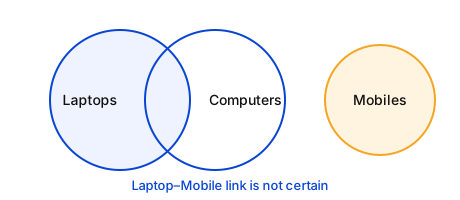
- Laptops overlap computers; mobiles lie outside computers.
- Laptops outside computers may or may not touch mobiles.
- So neither 'No laptop is a mobile' nor 'Some laptops are mobile' is definitely true.
Yaad rakhein: 'Some–No' with the middle term in between gives no definite link between the end terms.
Answer: (D) Neither conclusion (I) nor (II) follows.
अवधारणा: वेन आरेख बनाएँ; निष्कर्ष तभी अनुसरण करता है जब हर संभावित आरेख में सही हो।
- Laptops, computers से ओवरलैप; mobiles, computers के बाहर।
- Computers से बाहर वाले laptops, mobiles से मिल भी सकते हैं और नहीं भी।
- अतः न (I) निश्चित है, न (II)।
याद रखें: 'कुछ–कोई नहीं' कथनों में अंतिम पदों के बीच निश्चित संबंध नहीं बनता।
उत्तर: (D) न तो (I) और न ही (II) अनुसरण करता है।
RRB NTPC Undergraduate CBT 1General Intelligence and ReasoningSyllogismRRB NTPC Undergraduate CBT 1 2024 · 1 Sep Shift 1
Q1798.What should come in place of the question mark (?) in the given series?
191 192 196 205 221 ?
दी गई श्रृंखला में प्रश्न चिह्न (?) के स्थान पर क्या आना चाहिए?
191 192 196 205 221 ?
- A231
- B241
- C236
- D246
Show answer
Concept: Differences are perfect squares.
- Differences:
- Next:
Trick: Spot squares 1, 4, 9, 16 instantly in differences.
Answer: (D) 246
अवधारणा: अंतर पूर्ण वर्ग हैं।
- अंतर:
- अगला:
ट्रिक: अंतर में 1, 4, 9, 16 तुरंत पहचानें।
उत्तर: (D) 246
RRB NTPC Undergraduate CBT 1General Intelligence and ReasoningNumber SeriesRRB NTPC Undergraduate CBT 1 2024 · 1 Sep Shift 1
Q1799.Each of the digits in the number 5648321 is arranged in ascending order from left to right. What will be the sum of the digits that are second from the left and second from the right in the new number thus formed?
संख्या 5648321 के प्रत्येक अंक को बाएँ से दाएँ आरोही क्रम में व्यवस्थित किया जाता है। इस प्रकार बनी नई संख्या में बाएँ से दूसरे और दाएँ से दूसरे अंकों का योग क्या होगा?
- A4
- B6
- C5
- D8
Show answer
Concept: Arrange digits in ascending order.
- 5648321 → 1234568
- 2nd from left , 2nd from right
- Sum
Trick: 2nd smallest + 2nd largest digit — no need to write the full number.
Answer: (D) 8
अवधारणा: अंकों को आरोही क्रम में लगाएँ।
- 5648321 → 1234568
- बाएँ से दूसरा , दाएँ से दूसरा
- योग
ट्रिक: दूसरा सबसे छोटा + दूसरा सबसे बड़ा अंक — पूरी संख्या लिखने की ज़रूरत नहीं।
उत्तर: (D) 8
RRB NTPC Undergraduate CBT 1General Intelligence and ReasoningDigit ArrangementRRB NTPC Undergraduate CBT 1 2024 · 1 Sep Shift 1
Q1800.In a row of certain number of people facing north, Rahul is sitting 245th from the left end and 19th from the right end. What is the total number of people in that row?
उत्तर की ओर मुख करके बैठे कुछ लोगों की एक पंक्ति में, राहुल बाएँ छोर से 245वें और दाएँ छोर से 19वें स्थान पर बैठा है। उस पंक्ति में कुल कितने लोग हैं?
- A226
- B236
- C263
- D264
Show answer
Concept: Total = position from left + position from right − 1.
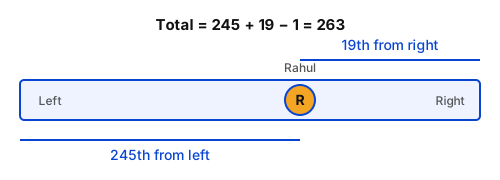
Trick: Subtract 1 because Rahul is counted twice.
Answer: (C) 263
अवधारणा: कुल = बाएँ से स्थान + दाएँ से स्थान − 1।
ट्रिक: 1 घटाएँ क्योंकि राहुल दो बार गिना गया है।
उत्तर: (C) 263
RRB NTPC Undergraduate CBT 1General Intelligence and ReasoningRanking and OrderRRB NTPC Undergraduate CBT 1 2024 · 1 Sep Shift 1

