Q1861.The average runs scored by a batsman in 23 matches is 44. In the next 10 matches, the batsman scored an average of 13 runs. Find his average (rounded off to two decimals) in all the 33 matches?
एक बल्लेबाज़ द्वारा 23 मैचों में बनाए गए रनों का औसत 44 है। अगले 10 मैचों में बल्लेबाज़ ने औसतन 13 रन बनाए। सभी 33 मैचों में उसका औसत (दो दशमलव स्थानों तक पूर्णांकित) ज्ञात कीजिए।
- A35.61
- B34.61
- C33.61
- D36.61
Show answer
Concept: Combined average .
- First 23 matches: .
- Next 10 matches: .
- Average .
Trick: Deviation method: .
Answer: (B) 34.61
अवधारणा: संयुक्त औसत ।
- ।
- ।
- औसत ।
ट्रिक: ।
उत्तर: (B) 34.61
RRB NTPC Undergraduate CBT 1MathematicsAverageRRB NTPC Undergraduate CBT 1 2024 · 29 Aug Shift 3
Q1862.Find the H.C.F. and L.C.M. of 0.48, 1.20 and 1.68.
0.48, 1.20 और 1.68 का म.स. (H.C.F.) और ल.स. (L.C.M.) ज्ञात कीजिए।
- AH.C.F. = 0.24; L.C.M. = 4.80म.स. = 0.24; ल.स. = 4.80
- BH.C.F. = 0.12; L.C.M. = 2.40म.स. = 0.12; ल.स. = 2.40
- CH.C.F. = 0.12; L.C.M. = 1.68म.स. = 0.12; ल.स. = 1.68
- DH.C.F. = 0.24; L.C.M. = 16.8म.स. = 0.24; ल.स. = 16.8
Show answer
Concept: Make decimal places equal, find HCF/LCM of the whole numbers, then put the decimal back.
- Numbers become 48, 120, 168 (two decimal places).
- , , .
- HCF ; LCM .
Trick: LCM must be a multiple of the largest number : fits.
Answer: (D) H.C.F. ; L.C.M.
अवधारणा: दशमलव स्थान बराबर करें, पूर्ण संख्याओं का HCF/LCM निकालें, फिर दशमलव लगाएँ।
- संख्याएँ: 48, 120, 168।
- , , ।
- HCF ; LCM ।
ट्रिक: LCM सबसे बड़ी संख्या का गुणज होना चाहिए: ।
उत्तर: (D) H.C.F. ; L.C.M.
RRB NTPC Undergraduate CBT 1MathematicsHCF and LCM of decimalsRRB NTPC Undergraduate CBT 1 2024 · 29 Aug Shift 3
Q1863.M and N start a business. M invests ₹33,000 more than N for 2 months and N invests for 7 months. M's share is ₹605 more than that of N, out of a total profit of ₹1,815. Find the capital contributed by M.
M और N एक व्यवसाय शुरू करते हैं। M, 2 महीने के लिए N से ₹33,000 अधिक निवेश करता है और N, 7 महीने के लिए निवेश करता है। ₹1,815 के कुल लाभ में से M का हिस्सा N के हिस्से से ₹605 अधिक है। M द्वारा लगाई गई पूँजी ज्ञात कीजिए।
- A₹38,500
- B₹38,339
- C₹38,697
- D₹38,300
Show answer
Concept: Profit ratio capital time.
- M N , M N → M , N ; ratio .
- .
- , so M .
Trick: Check: .
Answer: (A) ₹38,500
अवधारणा: लाभ अनुपात पूँजी समय।
- M , N ; अनुपात ।
- ।
- M ।
ट्रिक: जाँच: ।
उत्तर: (A) ₹38,500
RRB NTPC Undergraduate CBT 1MathematicsPartnership – capital × timeRRB NTPC Undergraduate CBT 1 2024 · 29 Aug Shift 3
Q1864.A can lay railway track between two given stations in 20 days and B can do the same job in 15 days. With the help of C, they did the job in 3 days only. Then, C alone can do the job in
A दो दिए गए स्टेशनों के बीच रेलवे ट्रैक 20 दिनों में बिछा सकता है और B वही कार्य 15 दिनों में कर सकता है। C की सहायता से उन्होंने वह कार्य केवल 3 दिनों में पूरा कर दिया। तो, C अकेले वह कार्य कितने समय में कर सकता है?
- A days दिन
- B days दिन
- C days दिन
- D days दिन
Show answer
Concept: One-day works add up: .
- .
- LCM 60: .
- C alone days.
Trick: Total work units: A 3, B 4, all 20 per day → C → days.
Answer: (C) days
अवधारणा: एक दिन के कार्य जुड़ते हैं: ।
- ।
- C अकेले दिन।
ट्रिक: कुल कार्य 60 इकाई: A 3, B 4, सभी 20 → C ।
उत्तर: (C) दिन
RRB NTPC Undergraduate CBT 1MathematicsTime and workRRB NTPC Undergraduate CBT 1 2024 · 29 Aug Shift 3
Q1865.A mobile phone is marked at ₹30,000. Successive discounts of 20% and 10% are applied. What is the final selling price?
एक मोबाइल फ़ोन का अंकित मूल्य ₹30,000 है। उस पर 20% और 10% की क्रमागत छूटें दी जाती हैं। अंतिम विक्रय मूल्य क्या है?
- A₹24,000
- B₹22,600
- C₹21,600
- D₹24,600
Show answer
Concept: Apply successive discounts one after another on the reduced price.
- After : .
- After : .
Trick: Net discount ; of .
Answer: (C) ₹21,600
अवधारणा: क्रमिक छूट घटे हुए मूल्य पर एक के बाद एक लगती है।
- के बाद: ।
- के बाद: ।
ट्रिक: कुल छूट ; का ।
उत्तर: (C) ₹21,600
RRB NTPC Undergraduate CBT 1MathematicsSuccessive discountsRRB NTPC Undergraduate CBT 1 2024 · 29 Aug Shift 3
Q1866.Train A leaves station M at 6:40 AM and reaches station N at 3:40 PM on the same day. Train B leaves station N at 8:40 AM and reaches station M at 2:40 PM on the same day. Find the time when trains A and B meet.
ट्रेन A, स्टेशन M से सुबह 6:40 बजे (6:40 AM) चलती है और उसी दिन दोपहर 3:40 बजे (3:40 PM) स्टेशन N पहुँचती है। ट्रेन B, स्टेशन N से सुबह 8:40 बजे (8:40 AM) चलती है और उसी दिन दोपहर 2:40 बजे (2:40 PM) स्टेशन M पहुँचती है। वह समय ज्ञात कीजिए जब ट्रेन A और B मिलती हैं।
- A11:28 AM
- B1:28 PM
- C11:58 AM
- D12:28 PM
Show answer
Concept: Take the distance as 1 unit; speeds are . After both are running, they close the gap at the sum of speeds.
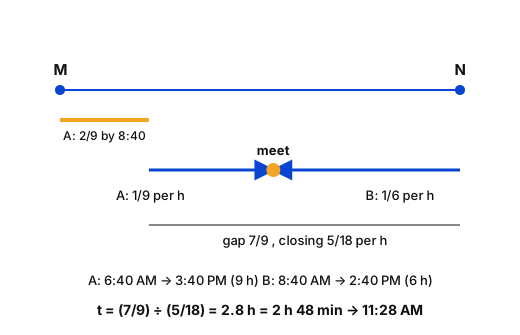
- A takes 9 h (6:40 AM–3:40 PM) → per h; B takes 6 h → per h.
- By 8:40 AM, A has covered ; gap .
- Time h h 48 min.
- Meeting time 8:40 AM 2 h 48 min 11:28 AM.
Trick: Take distance units (LCM of 9, 6): A 2/h, B 3/h; at 8:40 gap ; h.
Answer: (A) 11:28 AM
अवधारणा: दूरी 1 इकाई मानें; चाल । दोनों चलने पर अंतर, चालों के योग से घटता है।
- A को 9 h → प्रति h; B को 6 h → प्रति h।
- 8:40 AM तक A ने तय किया; शेष ।
- समय h h 48 min।
- मिलने का समय 11:28 AM।
ट्रिक: दूरी 18 इकाई: A 2, B 3 प्रति घंटा; अंतर 14; h।
उत्तर: (A) 11:28 AM
RRB NTPC Undergraduate CBT 1MathematicsTrains – meeting timeRRB NTPC Undergraduate CBT 1 2024 · 29 Aug Shift 3
Q1867.The ratio between the perimeter and the length of a rectangle is 3 : 1. If the area of the rectangle is 180.5 cm2, then what is the breadth of the rectangle?
एक आयत के परिमाप और लंबाई का अनुपात 3 : 1 है। यदि आयत का क्षेत्रफल 180.5 cm2 है, तो आयत की चौड़ाई कितनी है?
- A38 cm
- B21 cm
- C19 cm
- D9.5 cm
Show answer
Concept: Perimeter , Area .
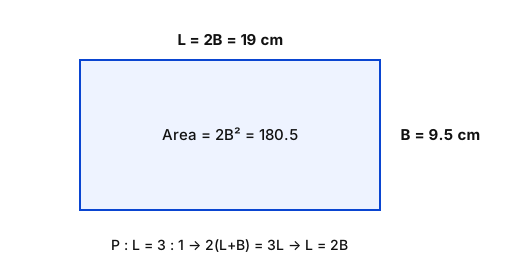
- .
- Area .
- (and ).
Trick: Option check: , → ✓.
Answer: (D)
अवधारणा: परिमाप , क्षेत्रफल ।
- ।
- ।
- ()।
ट्रिक: जाँच: ✓।
उत्तर: (D)
RRB NTPC Undergraduate CBT 1MathematicsMensuration – rectangleRRB NTPC Undergraduate CBT 1 2024 · 29 Aug Shift 3
Q1868.The product of two consecutive positive natural numbers is 462. The greater of the two numbers is:
दो क्रमागत धनात्मक प्राकृत संख्याओं का गुणनफल 462 है। दोनों संख्याओं में से बड़ी संख्या है:
- A22
- B24
- C23
- D21
Show answer
Concept: Product of consecutive numbers is close to .
- , so try 21 and 22.
- ✓.
- Greater number .
Trick: Unit digit 2 of 462 comes from → numbers end in 1 and 2.
Answer: (A) 22
अवधारणा: क्रमागत संख्याओं का गुणनफल ।
- → 21 और 22।
- ✓।
- बड़ी संख्या ।
ट्रिक: इकाई अंक 2 = → संख्याएँ 1 और 2 पर समाप्त।
उत्तर: (A) 22
RRB NTPC Undergraduate CBT 1MathematicsNumber system – consecutive numbersRRB NTPC Undergraduate CBT 1 2024 · 29 Aug Shift 3
Q1869.8 men can complete a piece of work in 5 days, while 8 women can do it in 15 days. In how many days can 3 women and 4 men complete this work?
8 पुरुष एक कार्य को 5 दिनों में पूरा कर सकते हैं, जबकि 8 महिलाएँ उसे 15 दिनों में कर सकती हैं। 3 महिलाएँ और 4 पुरुष मिलकर इस कार्य को कितने दिनों में पूरा कर सकते हैं?
- A5 days5 दिन
- B8 days8 दिन
- C7 days7 दिन
- D9 days9 दिन
Show answer
Concept: Convert to one person’s daily work.
- Work man-days → 1 man does per day.
- Work woman-days → 1 woman does per day.
- men women per day.
- Time days.
Trick: 1 man women; men women women; days.
Answer: (B) 8 days
अवधारणा: एक व्यक्ति का एक दिन का कार्य निकालें।
- कार्य पुरुष-दिवस → 1 पुरुष प्रतिदिन।
- कार्य महिला-दिवस → 1 महिला प्रतिदिन।
- प्रतिदिन।
- समय दिन।
ट्रिक: 1 पुरुष महिलाएँ; कुल महिलाएँ; ।
उत्तर: (B) 8 दिन
RRB NTPC Undergraduate CBT 1MathematicsTime and work – men and womenRRB NTPC Undergraduate CBT 1 2024 · 29 Aug Shift 3
Q1870.The H.C.F. and the L.C.M. of two numbers are 4 and 3360 respectively. If one of the numbers is 96, find the other one.
दो संख्याओं का म.स. (H.C.F.) और ल.स. (L.C.M.) क्रमशः 4 और 3360 हैं। यदि उनमें से एक संख्या 96 है, तो दूसरी संख्या ज्ञात कीजिए।
- A92
- B116
- C164
- D140
Show answer
Concept: Product of two numbers HCF LCM.
- Other number .
- .
- Check: HCF ✓.
Trick: , .
Answer: (D) 140
अवधारणा: दो संख्याओं का गुणनफल HCF LCM।
- दूसरी संख्या ।
- जाँच: HCF ✓।
ट्रिक: , ।
उत्तर: (D) 140
RRB NTPC Undergraduate CBT 1MathematicsHCF and LCMRRB NTPC Undergraduate CBT 1 2024 · 29 Aug Shift 3
Q1871.What should come in place of the question mark (?) in the given series?
9 11 19 61 239 ?
दी गई श्रृंखला में प्रश्न चिह्न (?) के स्थान पर क्या आना चाहिए?
9 11 19 61 239 ?
- A1201
- B1120
- C1102
- D1021
Show answer
Concept: Each term previous with alternate / of a growing number.
- , , .
- .
- Next: .
Trick: Multipliers 1, 2, 3, 4, 5 and adders .
Answer: (A) 1201
अवधारणा: हर पद पिछला , साथ में बारी-बारी / बढ़ती संख्या।
- , , ।
- ।
- अगला: ।
ट्रिक: गुणक 1,2,3,4,5; जोड़ ।
उत्तर: (A) 1201
RRB NTPC Undergraduate CBT 1General Intelligence and ReasoningNumber series – mixed operationsRRB NTPC Undergraduate CBT 1 2024 · 29 Aug Shift 3
Q1872.What should come in place of the question mark (?) in the given series based on the English alphabetical order?
LEB QJG VOL ATQ ?
अंग्रेज़ी वर्णमाला क्रम के आधार पर दी गई श्रृंखला में प्रश्न चिह्न (?) के स्थान पर क्या आना चाहिए?
LEB QJG VOL ATQ ?
- AFYV
- BFVY
- CFYU
- DFRT
Show answer
Concept: Each letter position moves from one cluster to the next.
- 1st letters: L → Q → V → A → F.
- 2nd letters: E → J → O → T → Y.
- 3rd letters: B → G → L → Q → V.
Trick: After Z wrap round: V = A, so T = Y and Q = V.
Answer: (A) FYV
अवधारणा: हर अक्षर अगले समूह में आगे बढ़ता है।
- पहले अक्षर: L → Q → V → A → F।
- दूसरे: E → J → O → T → Y।
- तीसरे: B → G → L → Q → V।
ट्रिक: Z के बाद फिर A से गिनें।
उत्तर: (A) FYV
RRB NTPC Undergraduate CBT 1General Intelligence and ReasoningAlphabet seriesRRB NTPC Undergraduate CBT 1 2024 · 29 Aug Shift 3
Q1873.Read the given statements and conclusions carefully. Assuming that the information given in the statements is true, even if it appears to be at variance with commonly known facts, decide which of the given conclusion(s) logically follow(s) from the statements.
Statements: All geysers are fans. No fan is a bulb.
Conclusions (I): No geyser is a bulb.
Conclusions (II): Some fans are geysers.
दिए गए कथनों और निष्कर्षों को ध्यानपूर्वक पढ़िए। कथनों में दी गई जानकारी को सत्य मानते हुए, भले ही वह सामान्यतः ज्ञात तथ्यों से भिन्न प्रतीत होती हो, निर्णय कीजिए कि दिए गए निष्कर्षों में से कौन-सा/कौन-से निष्कर्ष तार्किक रूप से कथनों का अनुसरण करता/करते है/हैं।
कथन: सभी गीज़र, पंखे हैं। कोई पंखा, बल्ब नहीं है।
निष्कर्ष (I): कोई गीज़र, बल्ब नहीं है।
निष्कर्ष (II): कुछ पंखे, गीज़र हैं।
- ANeither conclusion (I) nor (II) follows.न तो निष्कर्ष (I) और न ही (II) अनुसरण करता है।
- BOnly conclusion (I) follows.केवल निष्कर्ष (I) अनुसरण करता है।
- COnly conclusion (II) follows.केवल निष्कर्ष (II) अनुसरण करता है।
- DBoth conclusions (I) and (II) follow.निष्कर्ष (I) और (II) दोनों अनुसरण करते हैं।
Show answer
Concept: Draw the least-overlap Venn diagram allowed by the statements.
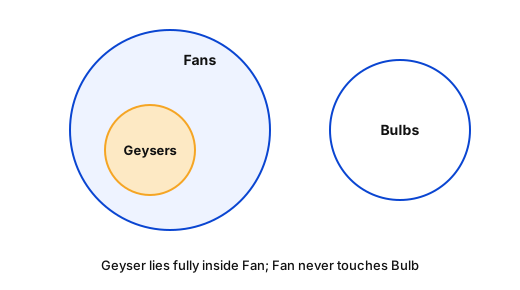
- All geysers are inside fans; no fan touches bulbs → no geyser can be a bulb. (I) follows.
- "All geysers are fans" converts to "Some fans are geysers". (II) follows.
Yaad rakhein: All A are B + No B is C ⇒ No A is C (always definite).
Answer: (D) Both conclusions (I) and (II) follow.
अवधारणा: कथनों के अनुसार न्यूनतम ओवरलैप वाला वेन आरेख बनाएँ।
- सभी गीज़र, पंखों के अंदर हैं; कोई पंखा बल्ब नहीं → कोई गीज़र बल्ब नहीं। (I) सही।
- "सभी गीज़र पंखे हैं" का रूपांतरण "कुछ पंखे गीज़र हैं"। (II) सही।
याद रखें: सभी A, B हैं + कोई B, C नहीं ⇒ कोई A, C नहीं।
उत्तर: (D) दोनों निष्कर्ष (I) और (II) अनुसरण करते हैं।
RRB NTPC Undergraduate CBT 1General Intelligence and ReasoningSyllogismRRB NTPC Undergraduate CBT 1 2024 · 29 Aug Shift 3
Q1874.If ‘A’ stands for ‘÷’, ‘B’ stands for ‘×’, ‘C’ stands for ‘+’ and ‘D’ stands for ‘−’, then what will come in place of the question mark (?) in the following equation?
48 A 3 C 21 D 8 B 3 = ?
यदि ‘A’ का अर्थ ‘÷’, ‘B’ का अर्थ ‘×’, ‘C’ का अर्थ ‘+’ और ‘D’ का अर्थ ‘−’ है, तो निम्नलिखित समीकरण में प्रश्न चिह्न (?) के स्थान पर क्या आएगा?
48 A 3 C 21 D 8 B 3 = ?
- A2
- B13
- C6
- D10
Show answer
Concept: Replace letters by signs, then apply BODMAS.
- 48 A 3 C 21 D 8 B 3 → .
- .
- .
Trick: Do ÷ and × first: 16 and 24.
Answer: (B) 13
अवधारणा: अक्षरों के स्थान पर चिह्न रखें, फिर BODMAS लगाएँ।
- ।
- ।
ट्रिक: पहले ÷ और ×: 16 और 24।
उत्तर: (B) 13
RRB NTPC Undergraduate CBT 1General Intelligence and ReasoningMathematical operations – symbol substitutionRRB NTPC Undergraduate CBT 1 2024 · 29 Aug Shift 3
Q1875.What should come in place of the question mark (?) in the given series?
38 41 47 59 83 ?
दी गई श्रृंखला में प्रश्न चिह्न (?) के स्थान पर क्या आना चाहिए?
38 41 47 59 83 ?
- A131
- B121
- C132
- D145
Show answer
Concept: Look at differences between consecutive terms.
- Differences: (each doubles).
- Next difference .
- .
Trick: Difference series each time.
Answer: (A) 131
अवधारणा: क्रमागत पदों का अंतर देखें।
- अंतर: (हर बार दोगुना)।
- अगला अंतर ।
- ।
ट्रिक: अंतर हर बार ।
उत्तर: (A) 131
RRB NTPC Undergraduate CBT 1General Intelligence and ReasoningNumber series – doubling differencesRRB NTPC Undergraduate CBT 1 2024 · 29 Aug Shift 3
Q1876.In a certain code language,
A $ B means ‘A is the mother of B’,
A + B means ‘A is the brother of B’,
A @ B means ‘A is the wife of B’,
and A ÷ B means ‘A is the father of B’.
How is E related to N if ‘E $ F @ G ÷ M + N’?
एक निश्चित कूट भाषा में,
A $ B का अर्थ है ‘A, B की माता है’,
A + B का अर्थ है ‘A, B का भाई है’,
A @ B का अर्थ है ‘A, B की पत्नी है’,
और A ÷ B का अर्थ है ‘A, B का पिता है’।
यदि ‘E $ F @ G ÷ M + N’ है, तो E का N से क्या संबंध है?
- AMotherमाता
- BMother's sisterमाता की बहन
- CMother's motherमाता की माता
- DSisterबहन
Show answer
Concept: Decode each symbol ($ mother, @ wife, ÷ father, + brother) and build the family tree.
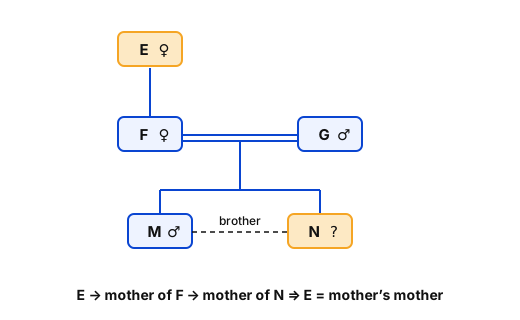
- E $ F → E is mother of F; F @ G → F is wife of G.
- G ÷ M → G is father of M, so F is mother of M; M + N → M is brother of N.
- So F is mother of N, and E is mother of F → E is N’s mother’s mother.
Trick: Chain: E → mother → F → mother → N.
Answer: (C) Mother's mother
अवधारणा: हर चिह्न को समझें ($ माता, @ पत्नी, ÷ पिता, + भाई) और वंश-वृक्ष बनाएँ।
- E $ F → E, F की माता; F @ G → F, G की पत्नी।
- G ÷ M → G, M का पिता, अतः F, M की माता; M + N → M, N का भाई।
- F, N की माता है और E, F की माता → E, N की नानी (माता की माता)।
ट्रिक: श्रृंखला: E → माता → F → माता → N।
उत्तर: (C) माता की माता (Mother's mother)
RRB NTPC Undergraduate CBT 1General Intelligence and ReasoningCoded blood relationRRB NTPC Undergraduate CBT 1 2024 · 29 Aug Shift 3
Q1877.Based on the English alphabetical order, three of the following four letter-cluster pairs are alike in a certain way and thus form a group. Which letter-cluster pair DOES NOT belong to that group?
(Note: The odd one out is not based on the number of consonants/vowels or their position in the letter-cluster.)
अंग्रेज़ी वर्णमाला क्रम के आधार पर, निम्नलिखित चार अक्षर-समूह युग्मों में से तीन किसी निश्चित प्रकार से एकसमान हैं और इस प्रकार एक समूह बनाते हैं। कौन-सा अक्षर-समूह युग्म उस समूह से संबंधित नहीं है?
(ध्यान दें: असंगत अक्षर-समूह, उस अक्षर-समूह में व्यंजनों/स्वरों की संख्या या उनकी स्थिति पर आधारित नहीं है।)
- AES - AN
- BNB - KW
- CWI - TD
- DKX - HS
Show answer
Concept: Compare position changes from the first cluster to the second.
- NB → KW: N=K, B=W; WI → TD: , ; KX → HS: , .
- ES → AN: E=A, S=N → pattern , .
- So ES - AN is odd.
Trick: Use EJOTY (5, 10, 15, 20, 25) for quick positions.
Answer: (A) ES - AN
अवधारणा: पहले समूह से दूसरे में अक्षरों का स्थान-परिवर्तन देखें।
- NB → KW, WI → TD, KX → HS: सभी में , ।
- ES → AN: , ।
- अतः ES - AN भिन्न है।
ट्रिक: स्थानों के लिए EJOTY (5,10,15,20,25) याद रखें।
उत्तर: (A) ES - AN
RRB NTPC Undergraduate CBT 1General Intelligence and ReasoningLetter-cluster pair odd one outRRB NTPC Undergraduate CBT 1 2024 · 29 Aug Shift 3
Q1878.EGLU is related to CDJR in a certain way based on the English alphabetical order. In the same way, WUDI is related to URBF. To which of the given options is QLXZ related, following the same logic?
अंग्रेज़ी वर्णमाला क्रम के आधार पर EGLU एक निश्चित प्रकार से CDJR से संबंधित है। उसी प्रकार WUDI, URBF से संबंधित है। समान तर्क का अनुसरण करते हुए, QLXZ दिए गए विकल्पों में से किससे संबंधित है?
- AOVIT
- BOIVW
- CYOBH
- DOWVI
Show answer
Concept: Find the shift for each letter position.
- EGLU → CDJR: ; WUDI → URBF: same.
- QLXZ: Q=O, L=I, X=V, Z=W.
- Result: OIVW.
Trick: Pattern alternating.
Answer: (B) OIVW
अवधारणा: हर स्थान के अक्षर का खिसकाव देखें।
- EGLU → CDJR: ; WUDI → URBF भी यही।
- QLXZ: O, I, V, W।
ट्रिक: क्रम ।
उत्तर: (B) OIVW
RRB NTPC Undergraduate CBT 1General Intelligence and ReasoningLetter analogyRRB NTPC Undergraduate CBT 1 2024 · 29 Aug Shift 3
Q1879.Salman ranked 24th from the top and 11th from the bottom in his class. How many students are there in his class?
सलमान अपनी कक्षा में ऊपर से 24वें और नीचे से 11वें स्थान पर है। उसकी कक्षा में कितने विद्यार्थी हैं?
- A33
- B34
- C31
- D32
Show answer
Concept: Total rank from top rank from bottom .
- Total .
- .
Yaad rakhein: Subtract 1 because Salman is counted twice.
Answer: (B) 34
अवधारणा: कुल ऊपर से रैंक नीचे से रैंक ।
- कुल ।
याद रखें: सलमान दो बार गिना गया, इसलिए 1 घटाएँ।
उत्तर: (B) 34
RRB NTPC Undergraduate CBT 1General Intelligence and ReasoningRankingRRB NTPC Undergraduate CBT 1 2024 · 29 Aug Shift 3
Q1880.Which of the following letter-number clusters will replace the question mark (?) in the given series to make it logically complete?
O50P R51S U54V X59Y ?
दी गई श्रृंखला को तार्किक रूप से पूर्ण करने के लिए निम्नलिखित में से कौन-सा अक्षर-संख्या समूह प्रश्न चिह्न (?) का स्थान लेगा?
O50P R51S U54V X59Y ?
- AA65B
- BZ65B
- CZ66A
- DA66B
Show answer
Concept: Track letters and numbers separately.
- First letters: O, R, U, X → → A.
- Last letters: P, S, V, Y → → B.
- Numbers: 50, 51, 54, 59 (differences ) → next difference : .
Trick: Odd-number differences: .
Answer: (D) A66B
अवधारणा: अक्षर और संख्या अलग-अलग देखें।
- पहले अक्षर: O, R, U, X → → A।
- अंतिम अक्षर: P, S, V, Y → → B।
- संख्याएँ: 50, 51, 54, 59 (अंतर ) → ।
ट्रिक: अंतर विषम संख्याएँ: ।
उत्तर: (D) A66B
RRB NTPC Undergraduate CBT 1General Intelligence and ReasoningLetter-number seriesRRB NTPC Undergraduate CBT 1 2024 · 29 Aug Shift 3

