Question bank

Q&A: practice questions with answers

Search questions on any topic. Filter by exam category, exam, subject and topic, try the question, then open the answer and explanation.

Courses – airGurukul

53,050 questions in the question bank.

Q4121.
Which of the following is used as a clot buster?
निम्नलिखित में से किसका उपयोग थक्का स्फोटक (clot buster) के रूप में किया जाता है?
  1. AStreptokinaseस्ट्रेप्टोकाइनेज
  2. BPenicillinपेनिसिलिन
  3. CCyclosporin Aसाइक्लोस्पोरिन A
  4. DStatinsस्टैटिन
Show answer

Concept: Streptokinase, produced by the bacterium Streptococcus and modified by genetic engineering, is used as a "clot buster" to remove clots from blood vessels of patients who have had myocardial infarction.

  1. Streptokinase dissolves (lyses) blood clots – clot buster.
  2. Penicillin – an antibiotic (from Penicillium notatum), kills bacteria.
  3. Cyclosporin A – from the fungus Trichoderma polysporum, an immunosuppressant used in organ-transplant patients.
  4. Statins – from the yeast Monascus purpureus, lower blood cholesterol (competitive inhibitors of cholesterol synthesis).

Short trick: StreptoKINASE → "kills clots"; Cyclosporin → "transplant"; Statin → "cholesterol"; Penicillin → "bacteria".

Answer: (A) Streptokinase

अवधारणा: Streptococcus जीवाणु द्वारा उत्पन्न तथा आनुवंशिक इंजीनियरिंग द्वारा रूपांतरित स्ट्रेप्टोकाइनेज का उपयोग हृदयाघात (myocardial infarction) के रोगियों की रक्त वाहिकाओं से थक्का हटाने के लिए "थक्का स्फोटक" के रूप में किया जाता है।

  1. स्ट्रेप्टोकाइनेज रक्त के थक्के को घोल देता है – थक्का स्फोटक।
  2. पेनिसिलिन – एक प्रतिजैविक (Penicillium notatum से), जीवाणुओं को मारता है।
  3. साइक्लोस्पोरिन A – कवक Trichoderma polysporum से, अंग प्रत्यारोपण के रोगियों में प्रतिरक्षा-निरोधक (immunosuppressant)।
  4. स्टैटिन – यीस्ट Monascus purpureus से, रक्त कोलेस्टेरॉल कम करते हैं (कोलेस्टेरॉल संश्लेषण के प्रतिस्पर्धी संदमक)।

शॉर्ट ट्रिक: स्ट्रेप्टोकाइनेज → "थक्का घोले"; साइक्लोस्पोरिन → "प्रत्यारोपण"; स्टैटिन → "कोलेस्टेरॉल"; पेनिसिलिन → "जीवाणु"।

उत्तर: (A) स्ट्रेप्टोकाइनेज
NEET UGBiologyMicrobes in human welfare – bioactive moleculesNEET UG 2026 · 21 Jun Shift 1 →
Q4122.
The inactive form of Bt toxin is converted to the active form in the insect gut ________.
Bt आविष (toxin) का निष्क्रिय रूप कीट की आहारनाल में ________ सक्रिय रूप में परिवर्तित हो जाता है।
  1. Adue to alkaline pHक्षारीय pH के कारण
  2. Bdue to acidic pHअम्लीय pH के कारण
  3. Cby proteasesप्रोटिएज़ द्वारा
  4. Dby nucleasesन्यूक्लिएज़ द्वारा
Show answer

Concept: Bacillus thuringiensis makes Bt toxin as an inactive protoxin (crystal). In the insect gut the alkaline pH solubilises the crystals and the toxin becomes active (NCERT).

  1. Insect eats the inactive protoxin crystals.
  2. Alkaline pH of the gut solubilises the crystals → active toxin.
  3. Active toxin binds to the surface of midgut epithelial cells, creates pores → cells swell and lyse → insect dies.
  4. Acidic pH is wrong (insect midgut is alkaline); proteases/nucleases are not the trigger named in NCERT.

Short trick: Bt = "Basic trigger" – alkaline (basic) gut activates it; no harm to humans whose stomach is acidic.

Answer: (A) due to alkaline pH

अवधारणा: Bacillus thuringiensis Bt आविष को निष्क्रिय प्राक्आविष (protoxin, क्रिस्टल) के रूप में बनाता है। कीट की आहारनाल का क्षारीय pH क्रिस्टलों को घुलनशील बनाकर आविष को सक्रिय कर देता है (NCERT)।

  1. कीट निष्क्रिय प्राक्आविष क्रिस्टल खाता है।
  2. आहारनाल का क्षारीय pH क्रिस्टलों को घोल देता है → सक्रिय आविष।
  3. सक्रिय आविष मध्यांत्र की उपकला कोशिकाओं की सतह से बंधकर छिद्र बनाता है → कोशिकाएँ फूलकर फट जाती हैं → कीट की मृत्यु।
  4. अम्लीय pH गलत है (कीट का मध्यांत्र क्षारीय होता है); प्रोटिएज़/न्यूक्लिएज़ NCERT में बताया गया कारण नहीं हैं।

शॉर्ट ट्रिक: Bt = "Basic (क्षारीय) trigger" – क्षारीय आहारनाल इसे सक्रिय करती है; मनुष्य का आमाशय अम्लीय है, इसलिए हानि नहीं।

उत्तर: (A) क्षारीय pH के कारण

NEET UGBiologyBiotechnology applications – Bt toxinNEET UG 2026 · 21 Jun Shift 1 →
Q4123.
Given below are two statements :
Statement I : Down's syndrome is caused by the absence of one of the X-chromosomes.
Statement II : Turner's syndrome is caused by the presence of an additional copy of the chromosomes.
In the light of the above statements, choose the correct answer from the options given below :
नीचे दो कथन दिए गए हैं :
कथन I : डाउन सिंड्रोम एक X-गुणसूत्र की अनुपस्थिति के कारण होता है।
कथन II : टर्नर सिंड्रोम गुणसूत्रों की एक अतिरिक्त प्रति की उपस्थिति के कारण होता है।
उपरोक्त कथनों के आलोक में, नीचे दिए गए विकल्पों में से सही उत्तर चुनिए :
  1. ABoth Statement I and Statement II are correctकथन I और कथन II दोनों सही हैं
  2. BBoth Statement I and Statement II are incorrectकथन I और कथन II दोनों गलत हैं
  3. CStatement I is correct but Statement II is incorrectकथन I सही है लेकिन कथन II गलत है
  4. DStatement I is incorrect but Statement II is correctकथन I गलत है लेकिन कथन II सही है
Show answer

Concept: Down's syndrome = trisomy of chromosome 21 (47, +21). Turner's syndrome = absence of one X chromosome (45, X0).

  1. Statement I is wrong – absence of one X is Turner's syndrome; Down's is an extra copy of chromosome 21.
  2. Statement II is wrong – an additional chromosome (trisomy 21) describes Down's; Turner's has one chromosome less (44 + X0).
  3. So the two statements have simply been swapped – both are incorrect.

Short trick: Down = Double-plus-one 21 (extra); Turner = Taken away one X (X0, female, sterile).

Answer: (B) Both statements are incorrect

अवधारणा: डाउन सिंड्रोम = गुणसूत्र 21 की त्रिसूत्रता (trisomy, 47, +21)। टर्नर सिंड्रोम = एक X गुणसूत्र की अनुपस्थिति (45, X0)।

  1. कथन I गलत है – एक X की अनुपस्थिति टर्नर सिंड्रोम है; डाउन सिंड्रोम में गुणसूत्र 21 की एक अतिरिक्त प्रति होती है।
  2. कथन II गलत है – अतिरिक्त गुणसूत्र (ट्राइसोमी 21) डाउन सिंड्रोम का लक्षण है; टर्नर में एक गुणसूत्र कम होता है (44 + X0)।
  3. अर्थात दोनों कथनों को आपस में बदल दिया गया है – दोनों गलत हैं।

शॉर्ट ट्रिक: डाउन = 21 पर एक अतिरिक्त; टर्नर = एक X कम (X0, स्त्री, बंध्य)।

उत्तर: (B) दोनों कथन गलत हैं

NEET UGBiologyChromosomal disordersNEET UG 2026 · 21 Jun Shift 1 →
Q4124.
Which of the following disease is not sexually transmitted ?
निम्नलिखित में से कौन-सा रोग यौन संचारित नहीं है?
  1. ASyphilisसिफिलिस
  2. BTuberculosisक्षय रोग (ट्यूबरकुलोसिस)
  3. CGonorrhoeaसुजाक (गोनोरिया)
  4. DGenital wartsजननांग मस्से (genital warts)
Show answer

Concept: NCERT list of STIs: gonorrhoea, syphilis, genital herpes, chlamydiasis, genital warts, trichomoniasis, hepatitis-B and HIV/AIDS.

  1. Syphilis (Treponema pallidum) – STI.
  2. Gonorrhoea (Neisseria gonorrhoeae) – STI.
  3. Genital warts (human papilloma virus) – STI.
  4. Tuberculosis (Mycobacterium tuberculosis) spreads through droplets/air – not an STI.

Short trick: STI hook: "Go See Great Clinic With True Help" – Gonorrhoea, Syphilis, Genital herpes, Chlamydiasis, Warts, Trichomoniasis, Hepatitis-B/HIV. TB is not in it.

Answer: (B) Tuberculosis

अवधारणा: NCERT के अनुसार यौन संचारित रोग: सुजाक, सिफिलिस, जननांग हर्पीज़, क्लैमिडियता, जननांग मस्से, ट्राइकोमोनसता, यकृतशोथ-B और HIV/AIDS।

  1. सिफिलिस (Treponema pallidum) – यौन संचारित।
  2. सुजाक (Neisseria gonorrhoeae) – यौन संचारित।
  3. जननांग मस्से (ह्यूमन पैपिलोमा वायरस) – यौन संचारित।
  4. क्षय रोग (Mycobacterium tuberculosis) बूँदिकाओं/वायु से फैलता है – यौन संचारित नहीं।

शॉर्ट ट्रिक: STI सूची याद रखें: सुजाक, सिफिलिस, हर्पीज़, क्लैमिडिया, मस्से, ट्राइकोमोनास, हेपेटाइटिस-B/HIV – TB इसमें नहीं है।

उत्तर: (B) क्षय रोग (ट्यूबरकुलोसिस)

NEET UGBiologyReproductive health – STIsNEET UG 2026 · 21 Jun Shift 1 →
Q4125.
Sperm motility is due to ________.
शुक्राणु की गतिशीलता ________ के कारण होती है।
  1. Aflagellar movementकशाभिकीय गति (flagellar movement)
  2. Bciliary movementपक्ष्माभी गति (ciliary movement)
  3. Camoeboid movementअमीबीय गति
  4. Dmuscular movementपेशीय गति
Show answer

Concept: A human sperm has head, neck, middle piece and tail; the tail is a flagellum whose movement (powered by ATP from mitochondria of the middle piece) makes the sperm swim.

  1. Tail = flagellum → flagellar movement gives motility.
  2. Ciliary movement is seen in fallopian tube/trachea cells (moves ovum, mucus), not sperm.
  3. Amoeboid movement – leucocytes/macrophages.
  4. Muscular movement – limbs, jaws; a single sperm cell has no muscle.

Short trick: NCERT line: "The sperm tail facilitates sperm motility essential for fertilisation" – tail = flagellum.

Answer: (A) flagellar movement

अवधारणा: मानव शुक्राणु में सिर, ग्रीवा, मध्य भाग तथा पूँछ होती है; पूँछ एक कशाभ (flagellum) है जिसकी गति (मध्य भाग के माइटोकॉन्ड्रिया से मिली ATP द्वारा) शुक्राणु को तैराती है।

  1. पूँछ = कशाभ → कशाभिकीय गति से गतिशीलता।
  2. पक्ष्माभी गति फैलोपियन नलिका/श्वासनली की कोशिकाओं में होती है (अंडाणु, श्लेष्मा को आगे बढ़ाती है), शुक्राणु में नहीं।
  3. अमीबीय गति – श्वेताणु/महाभक्षकाणु।
  4. पेशीय गति – पाद, जबड़े; एक शुक्राणु कोशिका में पेशी नहीं होती।

शॉर्ट ट्रिक: NCERT पंक्ति: "शुक्राणु की पूँछ निषेचन के लिए आवश्यक गतिशीलता प्रदान करती है" – पूँछ = कशाभ।

उत्तर: (A) कशाभिकीय गति

NEET UGBiologyHuman reproduction – sperm structureNEET UG 2026 · 21 Jun Shift 1 →
Q4126.
Natural selection can lead to ________.
(a) stabilisation
(b) genetic drift
(c) directional change
(d) disruption
Choose the correct answer from the options given below :
प्राकृतिक वरण ________ की ओर ले जा सकता है।
(a) स्थायीकरण (stabilisation)
(b) आनुवंशिक विचलन (genetic drift)
(c) दिशात्मक परिवर्तन
(d) विदारण (disruption)
नीचे दिए गए विकल्पों में से सही उत्तर चुनिए :
  1. A(a) onlyकेवल (a)
  2. B(a), (c) and (d) onlyकेवल (a), (c) और (d)
  3. C(a), (b), (c) and (d)(a), (b), (c) और (d)
  4. D(a) and (c) onlyकेवल (a) और (c)
Show answer

Concept: NCERT: natural selection can lead to stabilisation (more individuals acquire mean character value), directional change (more individuals acquire value other than the mean) or disruption (more individuals acquire peripheral values at both ends).

  1. (a), (c), (d) – the three types of natural selection – correct.
  2. (b) Genetic drift is a separate factor of evolution: a chance change in allele frequency (founder effect) – it is not an outcome of natural selection.
  3. Hence (a), (c) and (d) only.

Short trick: Selection = "S-D-D": Stabilising, Directional, Disruptive. Drift is random, selection is not.

Answer: (B) (a), (c) and (d) only

अवधारणा: NCERT: प्राकृतिक वरण से स्थायीकरण (अधिक जीव माध्य लक्षण-मान प्राप्त करते हैं), दिशात्मक परिवर्तन (अधिक जीव माध्य से भिन्न मान प्राप्त करते हैं) या विदारण (अधिक जीव वितरण के दोनों छोरों के मान प्राप्त करते हैं) हो सकता है।

  1. (a), (c), (d) – प्राकृतिक वरण के तीन प्रकार – सही।
  2. (b) आनुवंशिक विचलन विकास का एक अलग कारक है: अलील आवृत्ति में संयोगवश परिवर्तन (संस्थापक प्रभाव) – यह प्राकृतिक वरण का परिणाम नहीं है।
  3. अतः केवल (a), (c) और (d)।

शॉर्ट ट्रिक: वरण = "स्थायीकारी, दिशात्मक, विदारक" (S-D-D)। विचलन यादृच्छिक है, वरण नहीं।

उत्तर: (B) केवल (a), (c) और (d)

NEET UGBiologyEvolution – natural selectionNEET UG 2026 · 21 Jun Shift 1 →
Q4127.
The method of directly injecting a sperm into ovum in assisted reproductive technology is called :
सहायक जनन प्रौद्योगिकी में शुक्राणु को सीधे अंडाणु में अंतःक्षेपित करने की विधि कहलाती है :
  1. AGamete intra fallopian transfer (GIFT)युग्मक अंतः फैलोपियन स्थानांतरण (GIFT)
  2. BZygote intra fallopian transfer (ZIFT)युग्मनज अंतः फैलोपियन स्थानांतरण (ZIFT)
  3. CIntra cytoplasmic sperm injection (ICSI)अंतः कोशिकाद्रव्यी शुक्राणु निक्षेपण (ICSI)
  4. DEmbryo transfer (ET)भ्रूण स्थानांतरण (ET)
Show answer

Concept: ICSI is a specialised procedure to form an embryo in the laboratory in which a sperm is directly injected into the ovum.

  1. GIFT – transfer of an ovum collected from a donor into the fallopian tube of a female who cannot produce ova.
  2. ZIFT – zygote or early embryo (up to 8 blastomeres) transferred into the fallopian tube.
  3. ICSI – sperm injected directly into the cytoplasm of the ovum → correct.
  4. ET – general term for transfer of embryo (IUT for embryo with more than 8 blastomeres into uterus).

Short trick: Read the full form: Intra-Cytoplasmic Sperm Injection = injection of sperm into the ovum's cytoplasm.

Answer: (C) Intra cytoplasmic sperm injection (ICSI)

अवधारणा: ICSI एक विशेष प्रक्रिया है जिसमें प्रयोगशाला में भ्रूण बनाने के लिए शुक्राणु को सीधे अंडाणु में अंतःक्षेपित किया जाता है।

  1. GIFT – दाता से लिया गया अंडाणु उस स्त्री की फैलोपियन नलिका में स्थानांतरित किया जाता है जो अंडाणु नहीं बना सकती।
  2. ZIFT – युग्मनज या प्रारंभिक भ्रूण (8 कोरकखंडों तक) फैलोपियन नलिका में स्थानांतरित।
  3. ICSI – शुक्राणु सीधे अंडाणु के कोशिकाद्रव्य में अंतःक्षेपित → सही।
  4. ET – भ्रूण स्थानांतरण का सामान्य नाम (8 से अधिक कोरकखंडों वाला भ्रूण गर्भाशय में – IUT)।

शॉर्ट ट्रिक: पूरा नाम पढ़ें: अंतः-कोशिकाद्रव्यी शुक्राणु निक्षेपण = अंडाणु के कोशिकाद्रव्य में शुक्राणु का इंजेक्शन।

उत्तर: (C) अंतः कोशिकाद्रव्यी शुक्राणु निक्षेपण (ICSI)

NEET UGBiologyReproductive health – ARTNEET UG 2026 · 21 Jun Shift 1 →
Q4128.
Which of the following structure is not a part of the male reproductive system ?
निम्नलिखित में से कौन-सी संरचना नर जनन तंत्र का भाग नहीं है?
  1. ARete testisवृषण जालिका (rete testis)
  2. BEpididymisअधिवृषण (epididymis)
  3. CVasa efferentiaशुक्रवाहिकाएँ (vasa efferentia)
  4. DInfundibulumकीपक (infundibulum)
Show answer

Concept: Male accessory ducts: rete testis → vasa efferentia → epididymis → vas deferens → ejaculatory duct → urethra.

  1. Rete testis, vasa efferentia and epididymis are all male accessory ducts.
  2. Infundibulum is the funnel-shaped part of the fallopian tube (oviduct) closest to the ovary, with finger-like fimbriae – female structure.

Short trick: Male duct order "Red Van Enters Village" – Rete, Vasa efferentia, Epididymis, Vas deferens. Infundibulum–ampulla–isthmus = oviduct.

Answer: (D) Infundibulum

अवधारणा: नर सहायक नलिकाएँ: वृषण जालिका → शुक्रवाहिकाएँ → अधिवृषण → शुक्रवाहक → स्खलनीय वाहिनी → मूत्रमार्ग।

  1. वृषण जालिका, शुक्रवाहिकाएँ और अधिवृषण सभी नर सहायक नलिकाएँ हैं।
  2. कीपक (infundibulum) फैलोपियन नलिका (अंडवाहिनी) का अंडाशय के निकट कीप-आकार का भाग है, जिसमें अंगुली-सदृश झालर (fimbriae) होती है – मादा संरचना।

शॉर्ट ट्रिक: नर नलिका क्रम: वृषण जालिका → शुक्रवाहिकाएँ → अधिवृषण → शुक्रवाहक। कीपक–तुंबिका–संकीर्ण पथ = अंडवाहिनी।

उत्तर: (D) कीपक (infundibulum)

NEET UGBiologyHuman reproduction – male reproductive systemNEET UG 2026 · 21 Jun Shift 1 →
Q4129.
Arrange the following in descending order of number of species in the Amazonian rain forest.
(a) Plants
(b) Birds
(c) Fishes
(d) Invertebrates
(e) Mammals
Choose the correct answer from the options given below :
अमेज़न वर्षा वन में जातियों की संख्या के घटते क्रम में निम्नलिखित को व्यवस्थित कीजिए।
(a) पादप
(b) पक्षी
(c) मछलियाँ
(d) अकशेरुकी
(e) स्तनधारी
नीचे दिए गए विकल्पों में से सही उत्तर चुनिए :
  1. A(c) > (b) > (d) > (e) > (a)
  2. B(d) > (a) > (c) > (b) > (e)
  3. C(e) > (b) > (a) > (c) > (d)
  4. D(b) > (a) > (d) > (c) > (e)
Show answer

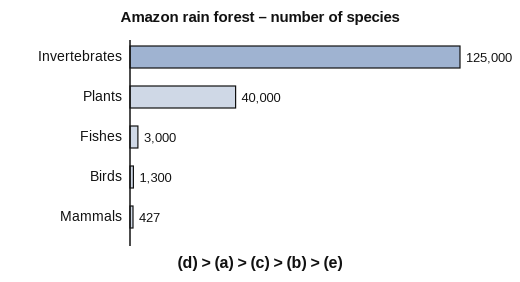
Concept: NCERT: the Amazonian rain forest has ~40,000 species of plants, 3,000 of fishes, 1,300 of birds, 427 of mammals, 427 of amphibians, 378 of reptiles and more than 1,25,000 invertebrates.

  1. Invertebrates (1,25,000+) > Plants (40,000) > Fishes (3,000) > Birds (1,300) > Mammals (427).
  2. i.e. (d) > (a) > (c) > (b) > (e).

Short trick: Invertebrates always top any species count; among vertebrates fishes > birds > mammals. Only option (B) starts with (d).

Answer: (B) (d) > (a) > (c) > (b) > (e)

अवधारणा: NCERT: अमेज़न वर्षा वन में लगभग 40,000 पादप जातियाँ, 3,000 मछलियाँ, 1,300 पक्षी, 427 स्तनधारी, 427 उभयचर, 378 सरीसृप तथा 1,25,000 से अधिक अकशेरुकी जातियाँ हैं।

  1. अकशेरुकी (1,25,000+) > पादप (40,000) > मछलियाँ (3,000) > पक्षी (1,300) > स्तनधारी (427)।
  2. अर्थात (d) > (a) > (c) > (b) > (e)।

शॉर्ट ट्रिक: जातियों की गिनती में अकशेरुकी सदैव सबसे ऊपर; कशेरुकियों में मछलियाँ > पक्षी > स्तनधारी। केवल विकल्प (B) (d) से शुरू होता है।

उत्तर: (B) (d) > (a) > (c) > (b) > (e)

NEET UGBiologyBiodiversity – Amazon rain forestNEET UG 2026 · 21 Jun Shift 1 →
Q4130.
Given below are two statements :
Statement I : Ovulation is caused by LH surge leading to rupture of Graafian follicles.
Statement II : Graafian follicle remaining after ovulation transform into corpus luteum and secretes large amount of estrogen.
In the light of the above statements, choose the most appropriate answer from the options given below :
नीचे दो कथन दिए गए हैं :
कथन I : अंडोत्सर्ग LH प्रवाह (surge) के कारण होता है जिससे ग्राफी पुटक फट जाते हैं।
कथन II : अंडोत्सर्ग के बाद शेष ग्राफी पुटक पीत पिंड (corpus luteum) में बदल जाता है और बड़ी मात्रा में एस्ट्रोजन स्रावित करता है।
उपरोक्त कथनों के आलोक में, नीचे दिए गए विकल्पों में से सबसे उपयुक्त उत्तर चुनिए :
  1. ABoth Statement I and Statement II are correctकथन I और कथन II दोनों सही हैं
  2. BBoth Statement I and Statement II are incorrectकथन I और कथन II दोनों गलत हैं
  3. CStatement I is correct but Statement II is incorrectकथन I सही है लेकिन कथन II गलत है
  4. DStatement I is incorrect but Statement II is correctकथन I गलत है लेकिन कथन II सही है
Show answer

Concept: Mid-cycle LH surge induces rupture of the Graafian follicle → ovulation (~14th day). The remaining follicle becomes the corpus luteum, which secretes large amounts of progesterone.

  1. Statement I – correct (LH surge → ovulation).
  2. Statement II – incorrect: corpus luteum mainly secretes progesterone (essential to maintain the endometrium), not "large amount of estrogen".

Short trick: Corpus luteum = "Pregnancy Protector" → Progesterone. Follicle (follicular phase) = estrogen.

Answer: (C) Statement I is correct but Statement II is incorrect

अवधारणा: चक्र के मध्य में LH प्रवाह ग्राफी पुटक को फाड़ देता है → अंडोत्सर्ग (~14वाँ दिन)। शेष पुटक पीत पिंड बनता है जो बड़ी मात्रा में प्रोजेस्टेरॉन स्रावित करता है।

  1. कथन I – सही (LH प्रवाह → अंडोत्सर्ग)।
  2. कथन II – गलत: पीत पिंड मुख्यतः प्रोजेस्टेरॉन स्रावित करता है (गर्भाशय अंतःस्तर को बनाए रखने हेतु आवश्यक), "बड़ी मात्रा में एस्ट्रोजन" नहीं।

शॉर्ट ट्रिक: पीत पिंड = "गर्भ रक्षक" → प्रोजेस्टेरॉन। पुटक (पुटकीय प्रावस्था) = एस्ट्रोजन।

उत्तर: (C) कथन I सही है लेकिन कथन II गलत है

NEET UGBiologyMenstrual cycle – ovulation and corpus luteumNEET UG 2026 · 21 Jun Shift 1 →
Q4131.
Which of the following are primary consumers in a food chain ?
खाद्य श्रृंखला में निम्नलिखित में से कौन प्राथमिक उपभोक्ता हैं?
  1. AParasitesपरजीवी
  2. BPredatorsपरभक्षी
  3. CHerbivoresशाकाहारी
  4. DCarnivoresमांसाहारी
Show answer

Concept: Producers (plants) → primary consumers (herbivores) → secondary consumers (primary carnivores) → tertiary consumers.

  1. Herbivores feed directly on producers → primary consumers (2nd trophic level).
  2. Carnivores feed on herbivores → secondary/tertiary consumers.
  3. Predators are mostly carnivores (higher consumers).
  4. Parasites may live on any host – not a defined trophic level for primary consumers.

Short trick: Primary = first eater of plants = herbivore (grasshopper, cow, deer).

Answer: (C) Herbivores

अवधारणा: उत्पादक (पादप) → प्राथमिक उपभोक्ता (शाकाहारी) → द्वितीयक उपभोक्ता (प्राथमिक मांसाहारी) → तृतीयक उपभोक्ता।

  1. शाकाहारी सीधे उत्पादकों को खाते हैं → प्राथमिक उपभोक्ता (दूसरा पोषी स्तर)।
  2. मांसाहारी शाकाहारियों को खाते हैं → द्वितीयक/तृतीयक उपभोक्ता।
  3. परभक्षी अधिकतर मांसाहारी होते हैं (उच्च उपभोक्ता)।
  4. परजीवी किसी भी परपोषी पर रह सकते हैं – प्राथमिक उपभोक्ता का निश्चित पोषी स्तर नहीं।

शॉर्ट ट्रिक: प्राथमिक = पौधों का पहला भक्षक = शाकाहारी (टिड्डा, गाय, हिरण)।

उत्तर: (C) शाकाहारी

NEET UGBiologyEcosystem – food chainNEET UG 2026 · 21 Jun Shift 1 →
Q4132.
A population of diploid organisms is at Hardy-Weinberg equilibrium. If the frequency of allele A is 0.1, the frequency of AA is ________.
द्विगुणित जीवों की एक समष्टि हार्डी-वेनबर्ग साम्य में है। यदि अलील A की आवृत्ति 0.1 है, तो AA की आवृत्ति ________ है।
  1. A0.01
  2. B0.02
  3. C0.10
  4. D0.99
Show answer

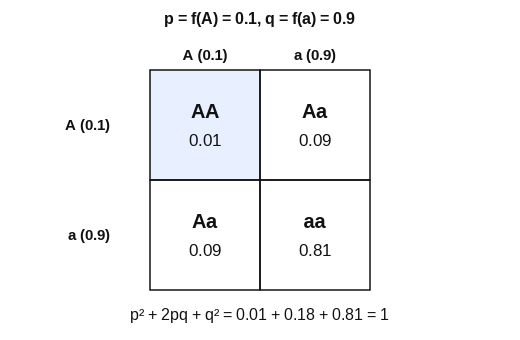
Concept: At Hardy-Weinberg equilibrium p2+2pq+q2=1, where p2 = frequency of homozygous dominant genotype AA.

  1. p=0.1, so q=1−0.1=0.9.
  2. Frequency of AA =p2=(0.1)2=0.01.
  3. Check: Aa =2pq=0.18, aa =q2=0.81; total =1.

Short trick: Genotype AA needs two A gametes: 0.1×0.1=0.01. 0.10 is the allele, not the genotype – a common trap.

Answer: (A) 0.01

अवधारणा: हार्डी-वेनबर्ग साम्य में p2+2pq+q2=1, जहाँ p2 = समयुग्मजी प्रभावी जीनोटाइप AA की आवृत्ति।

  1. p=0.1, अतः q=1−0.1=0.9।
  2. AA की आवृत्ति =p2=(0.1)2=0.01।
  3. जाँच: Aa =2pq=0.18, aa =q2=0.81; योग =1।

शॉर्ट ट्रिक: AA के लिए दो A युग्मक चाहिए: 0.1×0.1=0.01। 0.10 अलील आवृत्ति है, जीनोटाइप की नहीं – आम जाल।

उत्तर: (A) 0.01

NEET UGBiologyEvolution – Hardy-Weinberg principleNEET UG 2026 · 21 Jun Shift 1 →
Q4133.
Match List-I with List-II.
List-IList-II
A. Excess growth hormoneI. Reabsorption of water and electrolytes in kidney
B. Luteinizing hormoneII. Contraction of uterus during child birth
C. VasopressinIII. Acromegaly
D. OxytocinIV. Ovulation

Choose the correct answer from the options given below :
सूची-I का सूची-II से मिलान कीजिए।
सूची-Iसूची-II
A. अतिरिक्त वृद्धि हॉर्मोनI. वृक्क में जल और विद्युत-अपघट्यों का पुनरावशोषण
B. ल्यूटिनाइज़िंग हॉर्मोनII. प्रसव के समय गर्भाशय का संकुचन
C. वैसोप्रेसिनIII. एक्रोमेगाली (अतिकायता)
D. ऑक्सीटोसिनIV. अंडोत्सर्ग

नीचे दिए गए विकल्पों में से सही उत्तर चुनिए :
  1. AA-III, B-IV, C-II, D-I
  2. BA-III, B-IV, C-I, D-II
  3. CA-II, B-IV, C-I, D-III
  4. DA-IV, B-III, C-I, D-II
Show answer

Concept: Pituitary hormones and their actions (NCERT, Chemical Coordination).

  1. A – Excess GH in adults (especially middle age) → acromegaly (III).
  2. B – LH surge induces ovulation (IV).
  3. C – Vasopressin (ADH) → reabsorption of water and electrolytes by distal tubules (I).
  4. D – Oxytocin → contraction of uterus during child birth (II).

Short trick: Only options (A), (B) have A-III with B-IV; ADH = "Anti-Diuretic" = water back to blood → C-I fixes option (B).

Answer: (B) A-III, B-IV, C-I, D-II

अवधारणा: पीयूष ग्रंथि के हॉर्मोन और उनके कार्य (NCERT, रासायनिक समन्वय)।

  1. A – वयस्कों (विशेषकर मध्य आयु) में अतिरिक्त GH → एक्रोमेगाली (III)।
  2. B – LH प्रवाह अंडोत्सर्ग प्रेरित करता है (IV)।
  3. C – वैसोप्रेसिन (ADH) → दूरस्थ नलिकाओं द्वारा जल व विद्युत-अपघट्यों का पुनरावशोषण (I)।
  4. D – ऑक्सीटोसिन → प्रसव के समय गर्भाशय का संकुचन (II)।

शॉर्ट ट्रिक: केवल विकल्प (A), (B) में A-III तथा B-IV है; ADH = "प्रतिमूत्रल" = जल वापस रक्त में → C-I से विकल्प (B) तय।

उत्तर: (B) A-III, B-IV, C-I, D-II

NEET UGBiologyChemical coordination – hormonesNEET UG 2026 · 21 Jun Shift 1 →
Q4134.
The opening between the right atrium and the right ventricle is guarded by ________.
दाएँ अलिंद और दाएँ निलय के बीच का छिद्र ________ द्वारा रक्षित होता है।
  1. Abicuspid valveद्विवलनी कपाट (bicuspid valve)
  2. Btricuspid valveत्रिवलनी कपाट (tricuspid valve)
  3. Csemilunar valveअर्धचंद्र कपाट
  4. Dsino-atrial nodeशिरा-अलिंद पर्व (SA node)
Show answer

Concept: NCERT: the opening between right atrium and right ventricle is guarded by a valve formed of three muscular flaps or cusps – the tricuspid valve.

  1. Right AV opening → tricuspid valve (3 cusps).
  2. Bicuspid (mitral) valve – between left atrium and left ventricle.
  3. Semilunar valves – at the openings of pulmonary artery and aorta from the ventricles.
  4. SA node – pacemaker tissue in the right atrial wall, not a valve.

Short trick: "RighT = Tricuspid" ; "Left = bicuspid / mitraL".

Answer: (B) tricuspid valve

अवधारणा: NCERT: दाएँ अलिंद और दाएँ निलय के बीच का छिद्र तीन पेशीय पल्लों (cusps) से बने कपाट – त्रिवलनी कपाट – द्वारा रक्षित होता है।

  1. दायाँ अलिंद-निलय छिद्र → त्रिवलनी कपाट (3 पल्ले)।
  2. द्विवलनी (मिट्रल) कपाट – बाएँ अलिंद और बाएँ निलय के बीच।
  3. अर्धचंद्र कपाट – निलयों से फुफ्फुस धमनी और महाधमनी के निकास पर।
  4. SA नोड – दाएँ अलिंद की भित्ति में गति-प्रेरक ऊतक, कपाट नहीं।

शॉर्ट ट्रिक: "दायाँ = त्रि (तीन)" ; "बायाँ = द्वि (मिट्रल)"।

उत्तर: (B) त्रिवलनी कपाट

NEET UGBiologyCirculation – human heartNEET UG 2026 · 21 Jun Shift 1 →
Q4135.
Sponges exchange O2 with CO2 by ________.
स्पंज O2 का CO2 के साथ विनिमय ________ द्वारा करते हैं।
  1. Asimple diffusion over their entire body surfacesअपनी संपूर्ण शरीर सतह पर सरल विसरण
  2. Bmoist cuticleनम उपचर्म (moist cuticle)
  3. Ctracheal tubesश्वासनलिकाएँ (tracheal tubes)
  4. Dgillsक्लोम (gills)
Show answer

Concept: NCERT: lower invertebrates like sponges, coelenterates and flatworms exchange O2 with CO2 by simple diffusion over their entire body surface.

  1. Sponges → simple diffusion over the whole body surface.
  2. Moist cuticle – earthworms.
  3. Tracheal tubes – insects.
  4. Gills – most aquatic arthropods and molluscs, fishes.

Short trick: Body-surface diffusion = "Sponge, Cnidaria, Flatworm" (simple, small, thin bodies).

Answer: (A) simple diffusion over their entire body surfaces

अवधारणा: NCERT: स्पंज, सीलेंटरेट और चपटे कृमि जैसे निम्न अकशेरुकी अपनी संपूर्ण शरीर सतह पर सरल विसरण द्वारा O2 का CO2 से विनिमय करते हैं।

  1. स्पंज → संपूर्ण शरीर सतह पर सरल विसरण।
  2. नम उपचर्म – केंचुआ।
  3. श्वासनलिकाएँ – कीट।
  4. क्लोम – अधिकांश जलीय आर्थ्रोपोड, मोलस्क तथा मछलियाँ।

शॉर्ट ट्रिक: शरीर-सतह विसरण = "स्पंज, नाइडेरिया, चपटे कृमि" (सरल, छोटे, पतले शरीर)।

उत्तर: (A) अपनी संपूर्ण शरीर सतह पर सरल विसरण

NEET UGBiologyBreathing – respiratory organsNEET UG 2026 · 21 Jun Shift 1 →
Q4136.
How many theca are present in each lobe of a typical bilobed angiosperm anther ?
एक प्रारूपिक द्विपालित आवृतबीजी परागकोश की प्रत्येक पालि में कितने कोष्ठ (theca) होते हैं?
  1. A2
  2. B6
  3. C8
  4. D12
Show answer

Concept: A typical angiosperm anther is bilobed and each lobe has two theca, i.e., it is dithecous (NCERT).

  1. Anther = 2 lobes.
  2. Each lobe = 2 theca → anther is dithecous (4 theca in all).
  3. Each theca has a microsporangium → anther is tetrasporangiate (4 microsporangia).

Short trick: "2-2-4": 2 lobes × 2 theca = 4 microsporangia (tetrasporangiate).

Answer: (A) 2

अवधारणा: एक प्रारूपिक आवृतबीजी परागकोश द्विपालित होता है और प्रत्येक पालि में दो कोष्ठ होते हैं, अर्थात यह द्विकोष्ठी (dithecous) होता है (NCERT)।

  1. परागकोश = 2 पालियाँ।
  2. प्रत्येक पालि = 2 कोष्ठ → परागकोश द्विकोष्ठी (कुल 4 कोष्ठ)।
  3. प्रत्येक कोष्ठ में एक लघुबीजाणुधानी → परागकोश चतुर्बीजाणुधानीय (4 लघुबीजाणुधानियाँ)।

शॉर्ट ट्रिक: "2-2-4": 2 पालियाँ × 2 कोष्ठ = 4 लघुबीजाणुधानियाँ।

उत्तर: (A) 2

NEET UGBiologySexual reproduction in flowering plants – antherNEET UG 2026 · 21 Jun Shift 1 →
Q4137.
Muscle contraction is initiated by a signal sent by the central nervous system by the release of ________.
पेशी संकुचन केंद्रीय तंत्रिका तंत्र द्वारा भेजे गए संकेत से ________ के मोचन द्वारा प्रारंभ होता है।
  1. Aacetyl cholineऐसीटिल कोलीन
  2. Bacetyl coenzyme Aऐसीटिल कोएंज़ाइम A
  3. Ccyclic guanine monophosphateचक्रीय ग्वानीन मोनोफॉस्फेट
  4. Dcyclic adenine monophosphateचक्रीय एडेनीन मोनोफॉस्फेट
Show answer

Concept: NCERT: a neural signal reaching the neuromuscular junction releases the neurotransmitter acetylcholine, which generates an action potential in the sarcolemma.

  1. Motor neuron signal → neuromuscular junction → acetylcholine released.
  2. Action potential spreads → Ca2+ released from sarcoplasmic reticulum → binds troponin → actin sites exposed → cross bridges → contraction.
  3. Acetyl CoA – metabolic intermediate (Krebs cycle).
  4. cGMP and cAMP – second messengers of hormones, not the neuromuscular signal.

Short trick: Neuromuscular junction = "ACh-junction". Signal chain: ACh → AP → Ca2+ → troponin → sliding.

Answer: (A) acetyl choline

अवधारणा: NCERT: तंत्रिका-पेशी संधि पर पहुँचा तंत्रिका संकेत तंत्रिकाप्रेषी ऐसीटिल कोलीन मुक्त करता है, जो सार्कोलेमा में क्रिया विभव उत्पन्न करता है।

  1. प्रेरक तंत्रिका का संकेत → तंत्रिका-पेशी संधि → ऐसीटिल कोलीन मुक्त।
  2. क्रिया विभव फैलता है → सार्कोप्लाज़्मिक जालिका से Ca2+ मुक्त → ट्रोपोनिन से बंधन → ऐक्टिन स्थल अनावृत → क्रॉस ब्रिज → संकुचन।
  3. ऐसीटिल CoA – उपापचयी मध्यवर्ती (क्रेब्स चक्र)।
  4. cGMP और cAMP – हॉर्मोनों के द्वितीयक संदेशवाहक, तंत्रिका-पेशी संकेत नहीं।

शॉर्ट ट्रिक: तंत्रिका-पेशी संधि = "ACh संधि"। क्रम: ACh → क्रिया विभव → Ca2+ → ट्रोपोनिन → सर्पण।

उत्तर: (A) ऐसीटिल कोलीन

NEET UGBiologyLocomotion – mechanism of muscle contractionNEET UG 2026 · 21 Jun Shift 1 →
Q4138.
Which of the following statements about lac-operon is correct?
लैक-ओपेरॉन के बारे में निम्नलिखित में से कौन-सा कथन सही है?
  1. AGene i is constitutively expressedजीन i निर्बाध रूप से (constitutively) अभिव्यक्त होता है
  2. BLactose activates repressor to bind to the operatorलैक्टोज़ दमनकर्ता को ऑपरेटर से बंधने हेतु सक्रिय करता है
  3. CGenes i, z, y and a share single common promoterजीन i, z, y और a एक ही उभयनिष्ठ उन्नायक (promoter) साझा करते हैं
  4. DGalactose can act as an inducer of lac operonगैलेक्टोज़ लैक ओपेरॉन के प्रेरक के रूप में कार्य कर सकता है
Show answer

Concept: In the lac operon the regulatory gene i codes for the repressor and is expressed constitutively (always); lactose (allolactose) is the inducer that inactivates the repressor.

  1. (A) Correct – i gene has its own promoter and is transcribed all the time.
  2. (B) Wrong – lactose binds the repressor and inactivates it, so it cannot bind the operator.
  3. (C) Wrong – z, y, a share one promoter (polycistronic); i is a separate unit with its own promoter.
  4. (D) Wrong – the inducer is lactose (allolactose), not galactose.

Short trick: "i = inhibitor gene, always ON"; inducer lactose switches the operon ON by switching the repressor OFF.

Answer: (A) Gene i is constitutively expressed

अवधारणा: लैक ओपेरॉन में नियामक जीन i दमनकर्ता (repressor) का कूटन करता है और निर्बाध रूप से (constitutively, हर समय) अभिव्यक्त होता है; लैक्टोज़ (एलोलैक्टोज़) प्रेरक है जो दमनकर्ता को निष्क्रिय करता है।

  1. (A) सही – i जीन का अपना उन्नायक होता है और यह हर समय अनुलेखित होता है।
  2. (B) गलत – लैक्टोज़ दमनकर्ता से बंधकर उसे निष्क्रिय करता है, जिससे वह ऑपरेटर से नहीं बंध पाता।
  3. (C) गलत – z, y, a एक उन्नायक साझा करते हैं (बहुसिस्ट्रॉनी); i अपने उन्नायक वाली अलग इकाई है।
  4. (D) गलत – प्रेरक लैक्टोज़ (एलोलैक्टोज़) है, गैलेक्टोज़ नहीं।

शॉर्ट ट्रिक: "i = निरोधक जीन, सदा चालू"; प्रेरक लैक्टोज़ दमनकर्ता को बंद करके ओपेरॉन को चालू करता है।

उत्तर: (A) जीन i निर्बाध रूप से (constitutively) अभिव्यक्त होता है

NEET UGBiologyMolecular basis of inheritance – lac operonNEET UG 2026 · 21 Jun Shift 1 →
Q4139.
Which of the following in female gametophyte of an angiosperm helps in guiding the pollen tube for fertilizing the eggs ?
आवृतबीजी के मादा युग्मकोद्भिद में निम्नलिखित में से कौन अंडों के निषेचन हेतु पराग नलिका के मार्गदर्शन में सहायता करता है?
  1. AAntipodalsप्रतिमुखी कोशिकाएँ
  2. BSynergidsसहायक कोशिकाएँ (synergids)
  3. CCentral cellsकेंद्रीय कोशिकाएँ
  4. DPolar nucleusध्रुवीय केंद्रक
Show answer

Concept: Synergids have a special cellular thickening at the micropylar tip called the filiform apparatus, which guides the pollen tube into the synergid.

  1. Synergids (2, at micropylar end with the egg) → filiform apparatus → guide pollen tube.
  2. Antipodals – 3 cells at chalazal end, no role in guidance.
  3. Central cell with polar nuclei – fuses with second male gamete to form PEN (endosperm).

Short trick: Synergid = Satellite navigator – filiform apparatus = "GPS" for the pollen tube.

Answer: (B) Synergids

अवधारणा: सहायक कोशिकाओं के बीजांडद्वारी सिरे पर एक विशेष कोशिकीय स्थूलन होता है जिसे तंतुरूप समुच्चय (filiform apparatus) कहते हैं; यह पराग नलिका को सहायक कोशिका में मार्गदर्शित करता है।

  1. सहायक कोशिकाएँ (2, अंड के साथ बीजांडद्वारी सिरे पर) → तंतुरूप समुच्चय → पराग नलिका का मार्गदर्शन।
  2. प्रतिमुखी कोशिकाएँ – निभागीय सिरे पर 3 कोशिकाएँ, मार्गदर्शन में भूमिका नहीं।
  3. ध्रुवीय केंद्रकों वाली केंद्रीय कोशिका – दूसरे नर युग्मक से संलयन कर PEN (भ्रूणपोष) बनाती है।

शॉर्ट ट्रिक: सहायक कोशिका = पराग नलिका का "GPS" – तंतुरूप समुच्चय।

उत्तर: (B) सहायक कोशिकाएँ

NEET UGBiologySexual reproduction in flowering plants – embryo sacNEET UG 2026 · 21 Jun Shift 1 →
Q4140.
Which of the following plant produces non-albuminous seeds ?
निम्नलिखित में से कौन-सा पादप अभ्रूणपोषी (non-albuminous) बीज उत्पन्न करता है?
  1. AWheatगेहूँ
  2. BMaizeमक्का
  3. CBarleyजौ
  4. DPeaमटर
Show answer

Concept: Non-albuminous (exalbuminous) seeds have no residual endosperm – it is consumed during embryo development (e.g. pea, groundnut). Albuminous seeds retain endosperm (wheat, maize, barley, castor).

  1. Wheat, maize, barley – cereals with persistent endosperm → albuminous.
  2. Pea – food stored in cotyledons, endosperm fully used → non-albuminous.

Short trick: Cereals + castor = albuminous; "Pea and Groundnut" (pulses) = non-albuminous.

Answer: (D) Pea

अवधारणा: अभ्रूणपोषी बीजों में अवशिष्ट भ्रूणपोष नहीं होता – यह भ्रूण विकास के दौरान पूरी तरह उपयोग हो जाता है (जैसे मटर, मूँगफली)। भ्रूणपोषी बीजों में भ्रूणपोष शेष रहता है (गेहूँ, मक्का, जौ, अरंड)।

  1. गेहूँ, मक्का, जौ – स्थायी भ्रूणपोष वाले अनाज → भ्रूणपोषी।
  2. मटर – भोजन बीजपत्रों में संचित, भ्रूणपोष पूरी तरह प्रयुक्त → अभ्रूणपोषी।

शॉर्ट ट्रिक: अनाज + अरंड = भ्रूणपोषी; "मटर और मूँगफली" (दालें) = अभ्रूणपोषी।

उत्तर: (D) मटर

NEET UGBiologySeed – albuminous and non-albuminousNEET UG 2026 · 21 Jun Shift 1 →