Question bank

Q&A: practice questions with answers

Search questions on any topic. Filter by exam category, exam, subject and topic, try the question, then open the answer and explanation.

Courses – airGurukul

53,050 questions in the question bank.

Q1741.
If I=∫0π2sin32⁡xsin32⁡x+cos32⁡xdx, then ∫02Ixsin⁡xcos⁡xsin4⁡x+cos4⁡xdx equals :
यदि I=∫0π2sin32⁡xsin32⁡x+cos32⁡xdx है, तो ∫02Ixsin⁡xcos⁡xsin4⁡x+cos4⁡xdx बराबर है :
  1. Aπ212
  2. Bπ24
  3. Cπ216
  4. Dπ28
Show answer

Concept: ∫0π/2sink⁡xsink⁡x+cosk⁡xdx=π4 for any k; then King's property x→π2−x removes the factor x.

  1. I=π4, so the upper limit is 2I=π2.
  2. Let J=∫0π/2xsin⁡xcos⁡xsin4⁡x+cos4⁡xdx. Replacing x by π2−x leaves sin⁡xcos⁡xsin4⁡x+cos4⁡x unchanged, so 2J=π2∫0π/2sin⁡xcos⁡xsin4⁡x+cos4⁡xdx.
  3. Put t=sin2⁡x, dt=2sin⁡xcos⁡xdx: the integral becomes 12∫01dtt2+(1−t)2=12∫01dt2t2−2t+1=12[tan−1⁡(2t−1)]01=12⋅π2=π4.
  4. 2J=π2⋅π4⇒J=π216.

Short trick: Whenever x multiplies a function symmetric about π4 on [0,π2], the x averages to π4.

Answer: (C) π216

अवधारणा: किसी भी k के लिए ∫0π/2sink⁡xsink⁡x+cosk⁡xdx=π4; फिर King गुणधर्म x→π2−x से गुणनखंड x हट जाता है।

  1. I=π4, अतः ऊपरी सीमा 2I=π2।
  2. माना J=∫0π/2xsin⁡xcos⁡xsin4⁡x+cos4⁡xdx। x के स्थान पर π2−x रखने पर sin⁡xcos⁡xsin4⁡x+cos4⁡x अपरिवर्तित रहता है, अतः 2J=π2∫0π/2sin⁡xcos⁡xsin4⁡x+cos4⁡xdx।
  3. t=sin2⁡x, dt=2sin⁡xcos⁡xdx रखने पर: समाकल 12∫01dtt2+(1−t)2=12∫01dt2t2−2t+1=12[tan−1⁡(2t−1)]01=12⋅π2=π4।
  4. 2J=π2⋅π4⇒J=π216।

शॉर्ट ट्रिक: जब [0,π2] पर x किसी π4 के सापेक्ष सममित फलन से गुणित हो, तो x का औसत π4 होता है।

उत्तर: (C) π216

JEE Main 2025 (January) – Paper 1 (B.E./B.Tech)MathematicsDefinite Integration – King's propertyJEE Main 2025 (January) – Paper 1 (B.E./B.Tech) 2025 · 23 Jan Shift 2 →
Q1742.
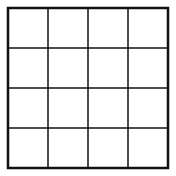
A board has 16 squares as shown in the figure:

Out of these 16 squares, two squares are chosen at random. The probability that they have no side in common is :
एक बोर्ड में, चित्र में दर्शाए अनुसार, 16 वर्ग हैं :

इन 16 वर्गों में से दो वर्ग यादृच्छया चुने जाते हैं। उनकी कोई भुजा उभयनिष्ठ न होने की प्रायिकता है :
  1. A7/10
  2. B4/5
  3. C23/30
  4. D3/5
Show answer

Concept: Complementary counting — count the pairs of squares that share a side in the 4×4 board.

  1. Total ways =(162)=120.
  2. Side-sharing pairs: each row has 3 horizontal adjacencies ⇒4×3=12; similarly 12 vertical. Total =24.
  3. Favourable =120−24=96; probability =96120=45.

Short trick: In an m×n grid the number of side-sharing pairs is m(n−1)+n(m−1); here 4⋅3+4⋅3=24.

Answer: (B) 4/5

अवधारणा: पूरक गणना — 4×4 बोर्ड में उन वर्ग-युग्मों को गिनिए जिनकी भुजा उभयनिष्ठ है।

  1. कुल तरीके =(162)=120।
  2. उभयनिष्ठ भुजा वाले युग्म: प्रत्येक पंक्ति में 3 क्षैतिज संलग्नताएँ ⇒4×3=12; इसी प्रकार 12 ऊर्ध्वाधर। कुल =24।
  3. अनुकूल =120−24=96; प्रायिकता =96120=45।

शॉर्ट ट्रिक: m×n ग्रिड में उभयनिष्ठ भुजा वाले युग्मों की संख्या m(n−1)+n(m−1) होती है; यहाँ 4⋅3+4⋅3=24।

उत्तर: (B) 4/5

JEE Main 2025 (January) – Paper 1 (B.E./B.Tech)MathematicsProbability – choosing squares on a boardJEE Main 2025 (January) – Paper 1 (B.E./B.Tech) 2025 · 23 Jan Shift 2 →
Q1743.
Let the shortest distance from (a,0), a>0, to the parabola y2=4x be 4. Then the equation of the circle passing through the point (a,0) and the focus of the parabola, and having its centre on the axis of the parabola is :
माना (a,0), a>0, से परवलय y2=4x की न्यूनतम दूरी 4 है। तो बिंदु (a,0) तथा परवलय की नाभि से होकर जाने वाले उस वृत्त का समीकरण, जिसका केंद्र परवलय के अक्ष पर है, है :
  1. Ax2+y2−10x+9=0
  2. Bx2+y2−6x+5=0
  3. Cx2+y2−4x+3=0
  4. Dx2+y2−8x+7=0
Show answer

Concept: Minimise the distance from (a,0) to (t2,2t); the circle's centre lies midway since both given points are on its axis-diameter.

  1. D2=(t2−a)2+4t2; d(D2)dt=4t(t2−a+2)=0. For a>2, t2=a−2 gives D2=4a−4 (and t=0 would give D=a≤2<4 only when a≤2, rejected).
  2. 4a−4=16⇒a=5.
  3. Focus of y2=4x is (1,0). Circle through (5,0) and (1,0) with centre on the x-axis: these are ends of a diameter, so centre (3,0), radius 2.
  4. Equation: (x−3)2+y2=4, i.e. x2+y2−6x+5=0.

Short trick: Normal-chord fact: for y2=4ax′, the foot of shortest distance satisfies t2=a1−2; then two axis points on a circle with centre on that axis are automatically diametrically opposite.

Answer: (B) x2+y2−6x+5=0

अवधारणा: (a,0) से (t2,2t) की दूरी का न्यूनतमीकरण कीजिए; दोनों दिए गए बिंदु अक्ष पर हैं, अतः वे वृत्त के व्यास के सिरे हैं।

  1. D2=(t2−a)2+4t2; d(D2)dt=4t(t2−a+2)=0। a>2 के लिए t2=a−2 से D2=4a−4 (तथा t=0 से D=a≤2<4 केवल a≤2 पर, अस्वीकृत)।
  2. 4a−4=16⇒a=5।
  3. y2=4x की नाभि (1,0) है। (5,0) तथा (1,0) से होकर, x-अक्ष पर केंद्र वाला वृत्त: ये व्यास के सिरे हैं, अतः केंद्र (3,0), त्रिज्या 2।
  4. समीकरण: (x−3)2+y2=4, अर्थात् x2+y2−6x+5=0।

शॉर्ट ट्रिक: अक्ष पर स्थित दो बिंदु, अक्ष पर केंद्र वाले वृत्त पर हों, तो वे स्वतः व्यासतः सम्मुख होते हैं — केंद्र उनका मध्य-बिंदु।

उत्तर: (B) x2+y2−6x+5=0

JEE Main 2025 (January) – Paper 1 (B.E./B.Tech)MathematicsParabola and Circle – shortest distance, circle on axisJEE Main 2025 (January) – Paper 1 (B.E./B.Tech) 2025 · 23 Jan Shift 2 →
Q1744.
If in the expansion of (1+x)p(1−x)q, the coefficients of x and x2 are 1 and -2, respectively, then p2+q2 is equal to :
यदि (1+x)p(1−x)q के प्रसार में x तथा x2 के गुणांक क्रमशः 1 तथा −2 हैं, तो p2+q2 बराबर है :
  1. A18
  2. B13
  3. C8
  4. D20
Show answer

Concept: Multiply the first few terms of each binomial expansion and equate coefficients.

  1. Coefficient of x: p−q=1.
  2. Coefficient of x2: (p2)+(q2)−pq=−2, i.e. (p−q)2−(p+q)2=−2.
  3. With p−q=1: 1−(p+q)=−4⇒p+q=5.
  4. So p=3, q=2 and p2+q2=9+4=13.

Short trick: (p2)+(q2)−pq=(p−q)2−(p+q)2 — this identity turns the messy condition into one line.

Answer: (B) 13

अवधारणा: दोनों द्विपद प्रसारों के प्रारंभिक पद गुणा कर गुणांकों की तुलना कीजिए।

  1. x का गुणांक: p−q=1।
  2. x2 का गुणांक: (p2)+(q2)−pq=−2, अर्थात् (p−q)2−(p+q)2=−2।
  3. p−q=1 से: 1−(p+q)=−4⇒p+q=5।
  4. अतः p=3, q=2 तथा p2+q2=9+4=13।

शॉर्ट ट्रिक: (p2)+(q2)−pq=(p−q)2−(p+q)2 — यह सर्वसमिका जटिल शर्त को एक पंक्ति बना देती है।

उत्तर: (B) 13

JEE Main 2025 (January) – Paper 1 (B.E./B.Tech)MathematicsBinomial Theorem – equating coefficientsJEE Main 2025 (January) – Paper 1 (B.E./B.Tech) 2025 · 23 Jan Shift 2 →
Q1745.
If the area of the region {(x,y):−1≤x≤1, 0≤y≤a+e|x|−e−x, a>0} is e2+8e+1e, then the value of a is :
यदि क्षेत्र {(x,y):−1≤x≤1, 0≤y≤a+e|x|−e−x, a>0} का क्षेत्रफल e2+8e+1e है, तो a का मान है :
  1. A8
  2. B7
  3. C5
  4. D6
Show answer

Concept: Split at x=0 because of |x|; on the left the exponentials cancel.

  1. For −1≤x≤0: e|x|−e−x=e−x−e−x=0, so the height is just a — area =a.
  2. For 0≤x≤1: height =a+ex−e−x; area =a+[ex+e−x]01=a+(e+1e)−2.
  3. Total area =2a+e+1e−2. Given value e2+8e+1e=e+8+1e.
  4. 2a−2=8⇒a=5.

Short trick: Match the e and 1e terms first — they already agree, so only the constants 2a−2 and 8 need equating.

Answer: (C) 5

अवधारणा: |x| के कारण x=0 पर विभाजित कीजिए; बाईं ओर चरघातांकी पद निरस्त हो जाते हैं।

  1. −1≤x≤0 के लिए: e|x|−e−x=e−x−e−x=0, अतः ऊँचाई केवल a — क्षेत्रफल =a।
  2. 0≤x≤1 के लिए: ऊँचाई =a+ex−e−x; क्षेत्रफल =a+[ex+e−x]01=a+(e+1e)−2।
  3. कुल क्षेत्रफल =2a+e+1e−2। दिया गया मान e2+8e+1e=e+8+1e।
  4. 2a−2=8⇒a=5।

शॉर्ट ट्रिक: पहले e तथा 1e पदों का मिलान कीजिए — वे पहले से बराबर हैं, अतः केवल अचर 2a−2 तथा 8 की तुलना शेष रहती है।

उत्तर: (C) 5

JEE Main 2025 (January) – Paper 1 (B.E./B.Tech)MathematicsArea under CurvesJEE Main 2025 (January) – Paper 1 (B.E./B.Tech) 2025 · 23 Jan Shift 2 →
Q1746.
The variance of the numbers 8,21,34,47,…,320 is ______.
संख्याओं 8,21,34,47,…,320 का प्रसरण ______ है।
Show answer

Concept: For an AP with common difference d and n terms, variance =d2(n2−1)12.

  1. d=13; number of terms n=320−813+1=25.
  2. Variance =132(252−1)12=169×62412=169×52.
  3. 169×52=8788.

Short trick: An AP is a shifted-scaled version of 1,2,…,n, whose variance is n2−112; shifting changes nothing, scaling multiplies by d2.

Answer: 8788

अवधारणा: सार्व अंतर d तथा n पदों वाली समांतर श्रेढ़ी के लिए प्रसरण =d2(n2−1)12।

  1. d=13; पदों की संख्या n=320−813+1=25।
  2. प्रसरण =132(252−1)12=169×62412=169×52।
  3. 169×52=8788।

शॉर्ट ट्रिक: समांतर श्रेढ़ी 1,2,…,n का ही स्थानांतरित-मापित रूप है, जिसका प्रसरण n2−112 है; स्थानांतरण से कुछ नहीं बदलता, मापन से d2 गुणा होता है।

उत्तर: 8788

JEE Main 2025 (January) – Paper 1 (B.E./B.Tech)MathematicsStatistics – variance of an APJEE Main 2025 (January) – Paper 1 (B.E./B.Tech) 2025 · 23 Jan Shift 2 →
Q1747.
The roots of the quadratic equation 3x2−px+q=0 are 10th  and 11th  terms of an arithmetic progression with common difference 32. If the sum of the first 11 terms of this arithmetic progression is 88, then q−2p is equal to ______.
द्विघात समीकरण 3x2−px+q=0 के मूल, सार्व अंतर 32 वाली एक समांतर श्रेढ़ी के 10वें तथा 11वें पद हैं। यदि इस समांतर श्रेढ़ी के प्रथम 11 पदों का योग 88 है, तो q−2p बराबर ______ है।
Show answer

Concept: Find the first term from S11, then use Vieta's formulas on 3x2−px+q=0.

  1. S11=112(2a+10⋅32)=88⇒2a+15=16⇒a=12.
  2. t10=a+9d=12+272=14 and t11=a+10d=12+15=312.
  3. Sum of roots: p3=14+312=592⇒p=1772. Product: q3=14⋅312=217⇒q=651.
  4. q−2p=651−177=474.

Short trick: S11=11t6, so t6=8 at once; then t10=t6+4d=14 and t11=15.5 without touching a.

Answer: 474

अवधारणा: S11 से प्रथम पद निकालिए, फिर 3x2−px+q=0 पर विएटा (Vieta) सूत्र लगाइए।

  1. S11=112(2a+10⋅32)=88⇒2a+15=16⇒a=12।
  2. t10=a+9d=12+272=14 तथा t11=a+10d=12+15=312।
  3. मूलों का योग: p3=14+312=592⇒p=1772। गुणनफल: q3=14⋅312=217⇒q=651।
  4. q−2p=651−177=474।

शॉर्ट ट्रिक: S11=11t6, अतः तुरंत t6=8; फिर a निकाले बिना t10=t6+4d=14 तथा t11=15.5।

उत्तर: 474

JEE Main 2025 (January) – Paper 1 (B.E./B.Tech)MathematicsSequences and Series – AP terms as roots of a quadraticJEE Main 2025 (January) – Paper 1 (B.E./B.Tech) 2025 · 23 Jan Shift 2 →
Q1748.
The number of ways, 5 boys and 4 girls can sit in a row so that either all the boys sit together or no two boys sit together, is ______.
5 लड़कों तथा 4 लड़कियों के एक पंक्ति में बैठने के तरीकों की संख्या, जबकि या तो सभी लड़के एक साथ बैठें या कोई भी दो लड़के एक साथ न बैठें, ______ है।
Show answer

Concept: The two events are mutually exclusive — add the counts.

  1. All boys together: tie the 5 boys into one block — 5! arrangements of (block + 4 girls) × 5! internal orders =120×120=14400.
  2. No two boys together: seat the 4 girls (4!=24 ways), creating 5 gaps; place the 5 boys in these 5 gaps in 5!=120 ways ⇒24×120=2880.
  3. Total =14400+2880=17280.

Short trick: With 5 boys and only 5 gaps from 4 girls, 'no two together' forces every gap to be used — exactly 4!×5!.

Answer: 17280

अवधारणा: दोनों घटनाएँ परस्पर अपवर्जी हैं — गणनाएँ जोड़िए।

  1. सभी लड़के एक साथ: 5 लड़कों का एक ब्लॉक बनाइए — (ब्लॉक + 4 लड़कियाँ) के 5! विन्यास × ब्लॉक के भीतर 5! क्रम =120×120=14400।
  2. कोई दो लड़के एक साथ नहीं: 4 लड़कियों को बैठाइए (4!=24 तरीके), जिससे 5 रिक्त स्थान बनते हैं; इन 5 स्थानों में 5 लड़कों को 5!=120 तरीकों से रखिए ⇒24×120=2880।
  3. कुल =14400+2880=17280।

शॉर्ट ट्रिक: 5 लड़के तथा 4 लड़कियों से बने केवल 5 रिक्त स्थान — 'कोई दो साथ नहीं' में हर स्थान भरना अनिवार्य है, अतः ठीक 4!×5!।

उत्तर: 17280

JEE Main 2025 (January) – Paper 1 (B.E./B.Tech)MathematicsPermutations and Combinations – arrangements in a rowJEE Main 2025 (January) – Paper 1 (B.E./B.Tech) 2025 · 23 Jan Shift 2 →
Q1749.
The focus of the parabola y2=4x+16 is the centre of the circle C of radius 5. If the values of λ, for which C passes through the point of intersection of the lines 3x−y=0 and x+λy=4, are λ1 and λ2, λ1<λ2, then 12λ1+29λ2 is equal to ______.
परवलय y2=4x+16 की नाभि, त्रिज्या 5 वाले वृत्त C का केंद्र है। यदि λ के वे मान, जिनके लिए C रेखाओं 3x−y=0 तथा x+λy=4 के प्रतिच्छेद बिंदु से होकर जाता है, λ1 तथा λ2, λ1<λ2, हैं, तो 12λ1+29λ2 बराबर ______ है।
Show answer

Concept: Shift the parabola to find its focus; then impose that the intersection point lies on the circle.

  1. y2=4(x+4): vertex (−4,0), so focus =(−4+1, 0)=(−3,0). Circle C: (x+3)2+y2=25.
  2. Intersection of y=3x and x+λy=4: x=41+3λ, y=121+3λ. Put s=1+3λ.
  3. On C: (4s+3)2+144s2=25⇒(4+3s)2+144=25s2⇒2s2−3s−20=0.
  4. s=4 or s=−52, i.e. λ=1 or λ=−76. So λ1=−76, λ2=1.
  5. 12λ1+29λ2=−14+29=15.

Short trick: Substituting s=1+3λ makes the intersection point (4s,12s) — one clean quadratic in s instead of fractions in λ.

Answer: 15

अवधारणा: परवलय को स्थानांतरित कर नाभि ज्ञात कीजिए; फिर शर्त लगाइए कि प्रतिच्छेद बिंदु वृत्त पर हो।

  1. y2=4(x+4): शीर्ष (−4,0), अतः नाभि =(−4+1, 0)=(−3,0)। वृत्त C: (x+3)2+y2=25।
  2. y=3x तथा x+λy=4 का प्रतिच्छेद: x=41+3λ, y=121+3λ। s=1+3λ रखिए।
  3. C पर: (4s+3)2+144s2=25⇒(4+3s)2+144=25s2⇒2s2−3s−20=0।
  4. s=4 अथवा s=−52, अर्थात् λ=1 अथवा λ=−76। अतः λ1=−76, λ2=1।
  5. 12λ1+29λ2=−14+29=15।

शॉर्ट ट्रिक: s=1+3λ रखते ही प्रतिच्छेद बिंदु (4s,12s) बन जाता है — λ की भिन्नों के स्थान पर s में एक साफ द्विघात।

उत्तर: 15

JEE Main 2025 (January) – Paper 1 (B.E./B.Tech)MathematicsParabola and Circle – focus as centreJEE Main 2025 (January) – Paper 1 (B.E./B.Tech) 2025 · 23 Jan Shift 2 →
Q1750.
Let α,β be the roots of the equation x2−ax−b=0 with Im(α)<Im(β). Let Pn=αn−βn. If P3=−57i, P4=−37i, P5=117i and P6=457i, then |α4+β4| is equal to ______.
माना x2−ax−b=0 के मूल α,β हैं, जहाँ Im(α)<Im(β) है। माना Pn=αn−βn है। यदि P3=−57i, P4=−37i, P5=117i तथा P6=457i हैं, तो |α4+β4| बराबर ______ है।
Show answer

Concept: Since α,β satisfy x2=ax+b, the sequence obeys Pn=aPn−1+bPn−2.

  1. P5=aP4+bP3: 117i=−3a7i−5b7i⇒−3a−5b=11.
  2. P6=aP5+bP4: 45=11a−3b.
  3. Solving: a=3, b=−4, so the equation is x2−3x+4=0 with α+β=3, αβ=4.
  4. α2+β2=32−2⋅4=1; α4+β4=(α2+β2)2−2(αβ)2=1−32=−31.
  5. |α4+β4|=31.

Short trick: Never find α,β themselves — two steps of the linear recurrence give a,b, and Newton's identities give the power sums.

Answer: 31

अवधारणा: चूँकि α,β समीकरण x2=ax+b को संतुष्ट करते हैं, अनुक्रम Pn=aPn−1+bPn−2 का पालन करता है।

  1. P5=aP4+bP3: 117i=−3a7i−5b7i⇒−3a−5b=11।
  2. P6=aP5+bP4: 45=11a−3b।
  3. हल करने पर: a=3, b=−4, अतः समीकरण x2−3x+4=0 है जिसमें α+β=3, αβ=4।
  4. α2+β2=32−2⋅4=1; α4+β4=(α2+β2)2−2(αβ)2=1−32=−31।
  5. |α4+β4|=31।

शॉर्ट ट्रिक: α,β कभी न निकालें — रैखिक पुनरावृत्ति के दो चरणों से a,b मिल जाते हैं, तथा न्यूटन सर्वसमिकाओं से घात-योग।

उत्तर: 31

JEE Main 2025 (January) – Paper 1 (B.E./B.Tech)MathematicsComplex Numbers – recurrence for powers of rootsJEE Main 2025 (January) – Paper 1 (B.E./B.Tech) 2025 · 23 Jan Shift 2 →
Q1751.
A galvanometer having a coil of resistance 30 Ω need 20 mA of current for full-scale deflection. If a maximum current of 3 A is to be measured using this galvanometer, the resistance of the shunt to be added to the galvanometer should be 30X Ω, where X is
एक गैल्वेनोमीटर की कुंडली का प्रतिरोध 30 Ω है तथा पूर्ण स्केल विक्षेप के लिए इसमें 20 mA धारा चाहिए। यदि इस गैल्वेनोमीटर द्वारा अधिकतम 3 A धारा मापनी हो, तो गैल्वेनोमीटर के साथ जोड़े जाने वाले शंट (shunt) का प्रतिरोध 30X Ω होना चाहिए, जहाँ X है
  1. A596
  2. B149
  3. C298
  4. D447
Show answer

Concept: To convert a galvanometer into an ammeter, a shunt S=IgGI−Ig is connected in parallel with it.

  1. Ig=20 mA=0.02 A, G=30 Ω, I=3 A.
  2. S=IgGI−Ig=0.02×303−0.02=0.62.98 Ω.
  3. S=0.62.98=60298=30149 Ω, so comparing with 30X, X=149.

Short trick: S=G(I/Ig)−1=30150−1=30149 — the shunt divides G by (n−1) where n=I/Ig=150.

Answer: (B)

अवधारणा: गैल्वेनोमीटर को अमीटर में बदलने के लिए उसके समान्तर में शंट S=IgGI−Ig जोड़ा जाता है।

  1. Ig=20 mA=0.02 A, G=30 Ω, I=3 A।
  2. S=IgGI−Ig=0.02×303−0.02=0.62.98 Ω।
  3. S=0.62.98=60298=30149 Ω, अतः 30X से तुलना करने पर X=149।

शॉर्ट ट्रिक: S=G(I/Ig)−1=30150−1=30149 — जहाँ n=I/Ig=150, शंट G को (n−1) से भाग देता है।

उत्तर: (B)

JEE Main 2025 (January) – Paper 1 (B.E./B.Tech)PhysicsCurrent Electricity – galvanometer and shuntJEE Main 2025 (January) – Paper 1 (B.E./B.Tech) 2025 · 23 Jan Shift 2 →
Q1752.
A ball having kinetic energy KE, is projected at an angle of 60∘ from the horizontal. What will be the kinetic energy of ball at the highest point of its flight ?
गतिज ऊर्जा KE वाली एक गेंद क्षैतिज से 60∘ कोण पर प्रक्षेपित की जाती है। उड़ान के उच्चतम बिंदु पर गेंद की गतिज ऊर्जा क्या होगी?
  1. A(KE)8
  2. B(KE)2
  3. C(KE)16
  4. D(KE)4
Show answer

Concept: At the highest point only the horizontal component ucos⁡θ of the velocity survives, so KEtop=KEcos2⁡θ.

  1. At the top, v=ucos⁡60∘=u2.
  2. KEtop=12m(u2)2=14⋅12mu2=KE4.

Short trick: KEtop=KEcos2⁡60∘=KE×14.

Answer: (D)

अवधारणा: उच्चतम बिंदु पर वेग का केवल क्षैतिज घटक ucos⁡θ शेष रहता है, अतः KEtop=KEcos2⁡θ।

  1. उच्चतम बिंदु पर v=ucos⁡60∘=u2।
  2. KEtop=12m(u2)2=14⋅12mu2=KE4।

शॉर्ट ट्रिक: KEtop=KEcos2⁡60∘=KE×14।

उत्तर: (D)

JEE Main 2025 (January) – Paper 1 (B.E./B.Tech)PhysicsKinematics – projectile motionJEE Main 2025 (January) – Paper 1 (B.E./B.Tech) 2025 · 23 Jan Shift 2 →
Q1753.
Two charges 7μc and −4μc are placed at (−7 cm,0,0) and (7 cm,0,0) respectively. Given, ϵ0=8.85×10⁻¹² C2N−1m−2, the electrostatic potential energy of the charge configuration is :
दो आवेश 7μc तथा −4μc क्रमशः (−7 cm,0,0) तथा (7 cm,0,0) पर रखे हैं। दिया है, ϵ0=8.85×10⁻¹² C2N−1m−2। इस आवेश विन्यास की स्थिरवैद्युत स्थितिज ऊर्जा है :
  1. A-1.8 J
  2. B-2.0 J
  3. C-1.5 J
  4. D-1.2 J
Show answer

Concept: Potential energy of a two-charge system: U=14πϵ0q1q2r.

  1. Separation r=7−(−7)=14 cm=0.14 m.
  2. U=9×109×(7×10−6)×(−4×10⁻⁶)0.14.
  3. U=−252×10−30.14 J=−1.8 J.

Short trick: U=9×7×414×10−1=1.8 with a negative sign (unlike charges attract).

Answer: (A)

अवधारणा: दो आवेशों के निकाय की स्थितिज ऊर्जा: U=14πϵ0q1q2r।

  1. दूरी r=7−(−7)=14 cm=0.14 m।
  2. U=9×109×(7×10−6)×(−4×10⁻⁶)0.14।
  3. U=−252×10−30.14 J=−1.8 J।

शॉर्ट ट्रिक: U=9×7×414×10−1=1.8, ऋणात्मक चिह्न के साथ (विपरीत आवेश आकर्षित होते हैं)।

उत्तर: (A)

JEE Main 2025 (January) – Paper 1 (B.E./B.Tech)PhysicsElectrostatics – potential energy of a system of chargesJEE Main 2025 (January) – Paper 1 (B.E./B.Tech) 2025 · 23 Jan Shift 2 →
Q1754.
Two point charges −4μc and 4μc, constituting an electric dipole, are placed at (−9,0,0)cm and (9,0,0)cm in a uniform electric field of strength 104 NC−1. The work done on the dipole in rotating it from the equilibrium through 180∘ is :
एक विद्युत द्विध्रुव बनाने वाले दो बिंदु आवेश −4μc तथा 4μc, 104 NC−1 तीव्रता के एकसमान विद्युत क्षेत्र में (−9,0,0)cm तथा (9,0,0)cm पर रखे हैं। द्विध्रुव को साम्यावस्था से 180∘ घुमाने में द्विध्रुव पर किया गया कार्य है :
  1. A18.4 mJ
  2. B14.4 mJ
  3. C12.4 mJ
  4. D16.4 mJ
Show answer

Concept: Work done in rotating a dipole in a uniform field: W=pE(cos⁡θ1−cos⁡θ2); from stable equilibrium (θ1=0∘) to θ2=180∘, W=2pE.

  1. Dipole moment p=q×2a=4×10−6×0.18=7.2×10⁻⁷ Cm.
  2. W=2pE=2×7.2×10−7×104=1.44×10⁻² J.
  3. W=14.4 mJ.

Short trick: Equilibrium → 180∘ always costs 2pE; here 2×(4μC)(0.18m)(104)=14.4 mJ.

Answer: (B)

अवधारणा: एकसमान क्षेत्र में द्विध्रुव को घुमाने में किया गया कार्य: W=pE(cos⁡θ1−cos⁡θ2); स्थायी साम्यावस्था (θ1=0∘) से θ2=180∘ तक W=2pE।

  1. द्विध्रुव आघूर्ण p=q×2a=4×10−6×0.18=7.2×10⁻⁷ Cm।
  2. W=2pE=2×7.2×10−7×104=1.44×10⁻² J।
  3. W=14.4 mJ।

शॉर्ट ट्रिक: साम्यावस्था → 180∘ में सदैव 2pE कार्य लगता है; यहाँ 2×(4μC)(0.18m)(104)=14.4 mJ।

उत्तर: (B)

JEE Main 2025 (January) – Paper 1 (B.E./B.Tech)PhysicsElectrostatics – electric dipole in a uniform fieldJEE Main 2025 (January) – Paper 1 (B.E./B.Tech) 2025 · 23 Jan Shift 2 →
Q1755.
A massless spring gets elongated by amount x1 under a tension of 5 N . Its elongation is x2 under the tension of 7 N . For the elongation of (5x1−2x2), the tension in the spring will be,
एक द्रव्यमानहीन स्प्रिंग 5 N तनाव के अंतर्गत x1 मात्रा से लंबी हो जाती है। 7 N तनाव के अंतर्गत इसका दीर्घीकरण (elongation) x2 है। (5x1−2x2) दीर्घीकरण के लिए स्प्रिंग में तनाव होगा,
  1. A39 N
  2. B15 N
  3. C11 N
  4. D20 N
Show answer

Concept: For an ideal spring, tension T=kx (Hooke's law), so tensions superpose linearly with elongations.

  1. kx1=5 N and kx2=7 N.
  2. Required tension T=k(5x1−2x2)=5(kx1)−2(kx2).
  3. T=5×5−2×7=25−14=11 N.

Short trick: Replace each kxi directly by its force: 5x1−2x2→5(5)−2(7)=11 N.

Answer: (C)

अवधारणा: आदर्श स्प्रिंग के लिए तनाव T=kx (हुक का नियम), अतः तनाव दीर्घीकरण के साथ रैखिक रूप से जुड़ते हैं।

  1. kx1=5 N तथा kx2=7 N।
  2. अभीष्ट तनाव T=k(5x1−2x2)=5(kx1)−2(kx2)।
  3. T=5×5−2×7=25−14=11 N।

शॉर्ट ट्रिक: प्रत्येक kxi के स्थान पर सीधे उसका बल रखिए: 5x1−2x2→5(5)−2(7)=11 N।

उत्तर: (C)

JEE Main 2025 (January) – Paper 1 (B.E./B.Tech)PhysicsElasticity – Hooke's law for a springJEE Main 2025 (January) – Paper 1 (B.E./B.Tech) 2025 · 23 Jan Shift 2 →
Q1756.
Water of mass m gram is slowly heated to increase the temperature from T1 to T2. The change in entropy of the water, given specific heat of water is 1 Jkg−1K−1, is :
m ग्राम द्रव्यमान के जल को धीरे-धीरे गर्म करके उसका ताप T1 से T2 किया जाता है। जल की एन्ट्रॉपी (entropy) में परिवर्तन, जबकि जल की विशिष्ट ऊष्मा 1 Jkg−1K−1 है, होगा :
  1. Amln⁡(T2T1)
  2. Bzeroशून्य
  3. Cmln⁡(T1T2)
  4. Dm(T2−T1)
Show answer

Concept: For reversible (slow) heating, dS=dQT=mcdTT.

  1. ΔS=∫T1T2mcdTT=mcln⁡(T2T1).
  2. With the given specific heat c=1 (in the stated units), ΔS=mln⁡(T2T1).
  3. Entropy increases on heating (T2>T1), so (B) and (C) are ruled out; (D) would follow only if dS=mcdT, which ignores division by T.

Short trick: Slow heating at variable T always gives the logarithmic form mcln⁡(Tf/Ti).

Answer: (A)

अवधारणा: उत्क्रमणीय (धीमे) तापन के लिए dS=dQT=mcdTT।

  1. ΔS=∫T1T2mcdTT=mcln⁡(T2T1)।
  2. दी गई विशिष्ट ऊष्मा c=1 (दिए गए मात्रकों में) रखने पर ΔS=mln⁡(T2T1)।
  3. गर्म करने पर एन्ट्रॉपी बढ़ती है (T2>T1), अतः (B) तथा (C) असंभव हैं; (D) तभी आता जब dS=mcdT होता, जिसमें T से भाग छूट गया है।

शॉर्ट ट्रिक: परिवर्ती ताप पर धीमे तापन में सदैव लघुगणकीय रूप mcln⁡(Tf/Ti) आता है।

उत्तर: (A)

JEE Main 2025 (January) – Paper 1 (B.E./B.Tech)PhysicsThermodynamics – entropy changeJEE Main 2025 (January) – Paper 1 (B.E./B.Tech) 2025 · 23 Jan Shift 2 →
Q1757.
Water flows in a horizontal pipe whose one end is closed with a valve. The reading of the pressure gauge attached to the pipe is P1. The reading of the pressure gauge falls to P2 when the valve is opened. The speed of water flowing in the pipe is proportional to
एक क्षैतिज पाइप, जिसका एक सिरा वाल्व से बंद है, में जल बहता है। पाइप से जुड़े दाबमापी (pressure gauge) का पाठ्यांक P1 है। वाल्व खोलने पर दाबमापी का पाठ्यांक गिरकर P2 हो जाता है। पाइप में बहते जल की चाल अनुक्रमानुपाती है
  1. AP1−P2
  2. B(P1−P2)4
  3. C(P1−P2)2
  4. DP1−P2
Show answer

Concept: Bernoulli's equation for a horizontal pipe: P+12ρv2=constant.

  1. Valve closed: water at rest, gauge reads static pressure P1.
  2. Valve open: P1=P2+12ρv2.
  3. v=2(P1−P2)ρ ⇒ v∝P1−P2.

Short trick: Pressure drop converts to kinetic energy: ΔP=12ρv2⇒v∝ΔP.

Answer: (D)

अवधारणा: क्षैतिज पाइप के लिए बरनूली समीकरण: P+12ρv2=नियत।

  1. वाल्व बंद: जल स्थिर है, दाबमापी स्थैतिक दाब P1 दर्शाता है।
  2. वाल्व खुला: P1=P2+12ρv2।
  3. v=2(P1−P2)ρ ⇒ v∝P1−P2।

शॉर्ट ट्रिक: दाब में कमी गतिज ऊर्जा में बदलती है: ΔP=12ρv2⇒v∝ΔP।

उत्तर: (D)

JEE Main 2025 (January) – Paper 1 (B.E./B.Tech)PhysicsFluid Mechanics – Bernoulli's principleJEE Main 2025 (January) – Paper 1 (B.E./B.Tech) 2025 · 23 Jan Shift 2 →
Q1758.
A concave mirror of focal length f in air is dipped in a liquid of refractive index μ. Its focal length in the liquid will be:
वायु में f फोकस दूरी वाले एक अवतल दर्पण को μ अपवर्तनांक के द्रव में डुबोया जाता है। द्रव में इसकी फोकस दूरी होगी:
  1. Aμf
  2. Bf
  3. Cf(μ−1)
  4. Dfμ
Show answer

Concept: A mirror works by reflection, and the law of reflection does not depend on the surrounding medium.

  1. For a mirror, f=R2, which involves only the geometry (radius of curvature R).
  2. Dipping in a liquid changes neither R nor the law of reflection, so f is unchanged.
  3. Options (A), (C), (D) would apply to lenses (refraction), not to mirrors.

Short trick: Mirror formulae never contain μ — focal length of a mirror is medium-independent.

Answer: (B)

अवधारणा: दर्पण परावर्तन से कार्य करता है, और परावर्तन का नियम माध्यम पर निर्भर नहीं करता।

  1. दर्पण के लिए f=R2, जो केवल ज्यामिति (वक्रता त्रिज्या R) पर निर्भर है।
  2. द्रव में डुबोने से न R बदलता है न परावर्तन का नियम, अतः f अपरिवर्तित रहती है।
  3. विकल्प (A), (C), (D) लेंस (अपवर्तन) पर लागू होते, दर्पण पर नहीं।

शॉर्ट ट्रिक: दर्पण के सूत्रों में कभी μ नहीं आता — दर्पण की फोकस दूरी माध्यम से स्वतंत्र होती है।

उत्तर: (B)

JEE Main 2025 (January) – Paper 1 (B.E./B.Tech)PhysicsRay Optics – mirrorsJEE Main 2025 (January) – Paper 1 (B.E./B.Tech) 2025 · 23 Jan Shift 2 →
Q1759.

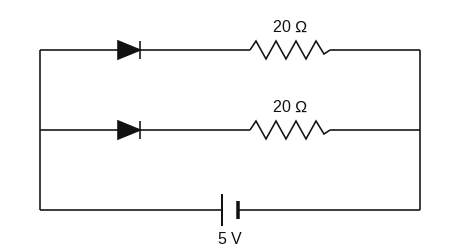
What is the current through the battery in the circuit shown below

नीचे दर्शाए गए परिपथ में बैटरी से प्रवाहित धारा क्या है
  1. A1.5 A
  2. B0.5 A
  3. C0.25 A
  4. D1.0 A
Show answer

Concept: An ideal diode conducts (zero resistance) when forward biased and blocks when reverse biased.

  1. Both diodes point in the direction of conventional current driven by the 5 V battery, so both are forward biased and act as plain wires.
  2. The two 20 Ω resistors are then in parallel: Req=20×2020+20=10 Ω.
  3. I=VReq=510=0.5 A.

Short trick: Both branches conduct → two equal resistors in parallel halve the resistance.

Answer: (B)

अवधारणा: आदर्श डायोड अग्र अभिनत (forward biased) होने पर चालन करता है (शून्य प्रतिरोध) तथा पश्च अभिनत होने पर धारा रोकता है।

  1. दोनों डायोड 5 V बैटरी द्वारा चलाई गई पारंपरिक धारा की दिशा में हैं, अतः दोनों अग्र अभिनत हैं और सीधे तार की तरह व्यवहार करते हैं।
  2. तब दोनों 20 Ω प्रतिरोध समान्तर क्रम में हैं: Req=20×2020+20=10 Ω।
  3. I=VReq=510=0.5 A।

शॉर्ट ट्रिक: दोनों शाखाएँ चालन करती हैं → दो समान प्रतिरोध समान्तर में प्रतिरोध आधा कर देते हैं।

उत्तर: (B)

JEE Main 2025 (January) – Paper 1 (B.E./B.Tech)PhysicsSemiconductors – diode circuitsJEE Main 2025 (January) – Paper 1 (B.E./B.Tech) 2025 · 23 Jan Shift 2 →
Q1760.
The refractive index of the material of a glass prism is 3. The angle of minimum deviation is equal to the angle of the prism. What is the angle of the prism?
एक काँच के प्रिज़्म के पदार्थ का अपवर्तनांक 3 है। न्यूनतम विचलन कोण, प्रिज़्म कोण के बराबर है। प्रिज़्म का कोण क्या है?
  1. A60∘
  2. B58∘
  3. C48∘
  4. D50∘
Show answer

Concept: Prism formula: μ=sin⁡A+δm2sin⁡A2.

  1. Given δm=A: μ=sin⁡Asin⁡A2=2sin⁡A2cos⁡A2sin⁡A2=2cos⁡A2.
  2. 2cos⁡A2=3⇒cos⁡A2=32⇒A2=30∘.
  3. A=60∘.

Short trick: When δm=A, μ=2cos⁡(A/2); μ=3⇒A=60∘ (a standard result).

Answer: (A)

अवधारणा: प्रिज़्म सूत्र: μ=sin⁡A+δm2sin⁡A2।

  1. दिया है δm=A: μ=sin⁡Asin⁡A2=2sin⁡A2cos⁡A2sin⁡A2=2cos⁡A2।
  2. 2cos⁡A2=3⇒cos⁡A2=32⇒A2=30∘।
  3. A=60∘।

शॉर्ट ट्रिक: जब δm=A हो तो μ=2cos⁡(A/2); μ=3⇒A=60∘ (मानक परिणाम)।

उत्तर: (A)

JEE Main 2025 (January) – Paper 1 (B.E./B.Tech)PhysicsRay Optics – prismJEE Main 2025 (January) – Paper 1 (B.E./B.Tech) 2025 · 23 Jan Shift 2 →