Question bank

Q&A: practice questions with answers

Search questions on any topic. Filter by exam category, exam, subject and topic, try the question, then open the answer and explanation.

Courses – airGurukul

53,050 questions in the question bank.

Q1761.
The width of one of the two slits in Young's double slit experiment is d while that of the other slit is x d. If the ratio of the maximum to the minimum intensity in the interference pattern on the screen is 9 : 4 then what is the value of x ? (Assume that the field strength varies according to the slit width.)
यंग के द्विझिरी प्रयोग में एक झिरी की चौड़ाई d है जबकि दूसरी झिरी की चौड़ाई x d है। यदि पर्दे पर व्यतिकरण प्रतिरूप में अधिकतम व न्यूनतम तीव्रताओं का अनुपात 9 : 4 है, तो x का मान क्या है? (मान लीजिए कि क्षेत्र की तीव्रता झिरी की चौड़ाई के अनुसार बदलती है।)
  1. A4
  2. B5
  3. C3
  4. D2
Show answer

Concept: If the amplitudes from the slits are a1 and a2, then ImaxImin=(a1+a2a1−a2)2.

  1. Field strength ∝ slit width, so a1∝d, a2∝xd i.e. a2a1=x.
  2. ImaxImin=(x+1x−1)2=94⇒x+1x−1=32.
  3. 2x+2=3x−3⇒x=5.

Short trick: Imax/Imin=3/2=x+1x−1 → componendo–dividendo gives x=3+23−2=5.

Answer: (B)

अवधारणा: यदि झिरियों से आयाम a1 तथा a2 हों, तो ImaxImin=(a1+a2a1−a2)2।

  1. क्षेत्र की तीव्रता ∝ झिरी की चौड़ाई, अतः a1∝d, a2∝xd अर्थात् a2a1=x।
  2. ImaxImin=(x+1x−1)2=94⇒x+1x−1=32।
  3. 2x+2=3x−3⇒x=5।

शॉर्ट ट्रिक: Imax/Imin=3/2=x+1x−1 → योगान्तरानुपात से x=3+23−2=5।

उत्तर: (B)

JEE Main 2025 (January) – Paper 1 (B.E./B.Tech)PhysicsWave Optics – Young's double slit experimentJEE Main 2025 (January) – Paper 1 (B.E./B.Tech) 2025 · 23 Jan Shift 2 →
Q1762.

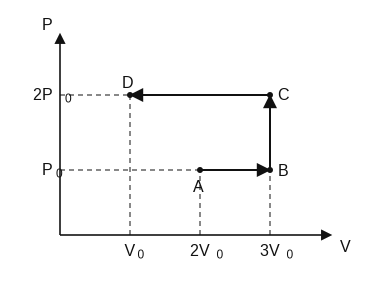
Using the given P−V diagram, the work done by an ideal gas along the path ABCD is :

दिए गए P−V आरेख के अनुसार, पथ ABCD के अनुदिश आदर्श गैस द्वारा किया गया कार्य है :
  1. A3P0V0
  2. B−4P0V0
  3. C−3P0V0
  4. D4P0V0
Show answer

Concept: Work done by the gas W=∫PdV — positive during expansion, negative during compression, zero at constant volume.

  1. A(2V0,P0)→B(3V0,P0): WAB=P0(3V0−2V0)=+P0V0.
  2. B(3V0,P0)→C(3V0,2P0): constant volume, WBC=0.
  3. C(3V0,2P0)→D(V0,2P0): WCD=2P0(V0−3V0)=−4P0V0.
  4. W=P0V0+0−4P0V0=−3P0V0.

Short trick: Only horizontal segments do work: +1P0V0 (right) and −4P0V0 (left) → −3P0V0.

Answer: (C)

अवधारणा: गैस द्वारा किया गया कार्य W=∫PdV — प्रसार में धनात्मक, संपीडन में ऋणात्मक, नियत आयतन पर शून्य।

  1. A(2V0,P0)→B(3V0,P0): WAB=P0(3V0−2V0)=+P0V0।
  2. B(3V0,P0)→C(3V0,2P0): नियत आयतन, WBC=0।
  3. C(3V0,2P0)→D(V0,2P0): WCD=2P0(V0−3V0)=−4P0V0।
  4. W=P0V0+0−4P0V0=−3P0V0।

शॉर्ट ट्रिक: केवल क्षैतिज खंड ही कार्य करते हैं: +1P0V0 (दाएँ) तथा −4P0V0 (बाएँ) → −3P0V0।

उत्तर: (C)

JEE Main 2025 (January) – Paper 1 (B.E./B.Tech)PhysicsThermodynamics – work done in P–V diagramJEE Main 2025 (January) – Paper 1 (B.E./B.Tech) 2025 · 23 Jan Shift 2 →
Q1763.
A plane electromagnetic wave of frequency 20 MHz travels in free space along the +x direction. At a particular point in space and time, the electric field vector of the wave is Ey=9.3 Vm−1. Then, the magnetic field vector of the wave at that point is
20 MHz आवृत्ति की एक समतल विद्युत चुम्बकीय तरंग मुक्त आकाश में +x दिशा में चलती है। आकाश व समय के किसी विशेष बिंदु पर तरंग का विद्युत क्षेत्र सदिश Ey=9.3 Vm−1 है। तब उस बिंदु पर तरंग का चुम्बकीय क्षेत्र सदिश है
  1. ABz=6.2×10⁻⁸ T
  2. BBz=3.1×10⁻⁸ T
  3. CBz=1.55×10⁻⁸ T
  4. DBz=9.3×10⁻⁸ T
Show answer

Concept: In an EM wave in free space, EB=c, and E→×B→ points along the propagation direction.

  1. B=Ec=9.33×108=3.1×10⁻⁸ T.
  2. Wave along +x, E→ along +y → B→ must be along +z so that y^×z^=x^.

Short trick: 9.3/3=3.1 — just divide E by c; direction from E^×B^=k^.

Answer: (B)

अवधारणा: मुक्त आकाश में विद्युत चुम्बकीय तरंग के लिए EB=c, तथा E→×B→ संचरण की दिशा में होता है।

  1. B=Ec=9.33×108=3.1×10⁻⁸ T।
  2. तरंग +x में, E→ +y में → B→ +z दिशा में होगा ताकि y^×z^=x^ हो।

शॉर्ट ट्रिक: 9.3/3=3.1 — केवल E को c से भाग दीजिए; दिशा E^×B^=k^ से।

उत्तर: (B)

JEE Main 2025 (January) – Paper 1 (B.E./B.Tech)PhysicsElectromagnetic WavesJEE Main 2025 (January) – Paper 1 (B.E./B.Tech) 2025 · 23 Jan Shift 2 →
Q1764.
The equation of a transverse wave travelling along a string is y(x,t)=4.0sin⁡[20×10−3x+600t] mm, where x is in mm and t is in second. The velocity of the wave is :
एक डोरी के अनुदिश चलती अनुप्रस्थ तरंग का समीकरण y(x,t)=4.0sin⁡[20×10−3x+600t] mm है, जहाँ x mm में तथा t सेकंड में है। तरंग का वेग है :
  1. A−60 m/s
  2. B−30 m/s
  3. C+30 m/s
  4. D+60 m/s
Show answer

Concept: For y=Asin⁡(kx+ωt) the wave moves along −x with speed v=ωk.

  1. k=20×10−3 mm−1, ω=600 rads−1.
  2. |v|=ωk=6000.02=30000 mm/s=30 m/s.
  3. Since the phase is (kx+ωt), the wave travels in the −x direction: v=−30 m/s.

Short trick: Same sign of kx and ωt → negative direction; v=−ω/k.

Answer: (B)

अवधारणा: y=Asin⁡(kx+ωt) के लिए तरंग −x दिशा में v=ωk चाल से चलती है।

  1. k=20×10−3 mm−1, ω=600 rads−1।
  2. |v|=ωk=6000.02=30000 mm/s=30 m/s।
  3. कला (kx+ωt) होने से तरंग −x दिशा में चलती है: v=−30 m/s।

शॉर्ट ट्रिक: kx तथा ωt का समान चिह्न → ऋणात्मक दिशा; v=−ω/k।

उत्तर: (B)

JEE Main 2025 (January) – Paper 1 (B.E./B.Tech)PhysicsWaves – travelling wave on a stringJEE Main 2025 (January) – Paper 1 (B.E./B.Tech) 2025 · 23 Jan Shift 2 →
Q1765.
Given below are two statements. One is labelled as Assertion (A) and the other is labelled as Reason (R).
Assertion (A) : The binding energy per nucleon is found to be practically independent of the atomic number A, for nuclei with mass numbers between 30 and 170.
Reason (R): Nuclear force is long range.
In the light of the above statements, choose the correct answer from the options given below :
नीचे दो कथन दिए गए हैं। एक को अभिकथन (A) तथा दूसरे को कारण (R) कहा गया है।
अभिकथन (A) : 30 से 170 के बीच द्रव्यमान संख्या वाले नाभिकों के लिए प्रति न्यूक्लिऑन बंधन ऊर्जा व्यावहारिक रूप से परमाणु संख्या A से स्वतंत्र पाई जाती है।
कारण (R): नाभिकीय बल दीर्घ परास (long range) का होता है।
उपर्युक्त कथनों के आलोक में, नीचे दिए गए विकल्पों में से सही उत्तर चुनिए :
  1. A(A) is true but (R) is false(A) सत्य है परन्तु (R) असत्य है
  2. B(A) is false but (R) is true(A) असत्य है परन्तु (R) सत्य है
  3. CBoth (A) and (R) are true and (R) is the correct explanation of (A)(A) तथा (R) दोनों सत्य हैं तथा (R), (A) की सही व्याख्या है
  4. DBoth (A) and (R) are true but (R) is NOT the correct explanation of (A)(A) तथा (R) दोनों सत्य हैं परन्तु (R), (A) की सही व्याख्या नहीं है
Show answer

Concept: The binding-energy-per-nucleon curve is nearly flat (≈8 MeV) for 30<A<170 because the nuclear force is short-ranged and saturates.

  1. (A) is true — this is the well-known plateau of the BE/A curve.
  2. (R) is false — the nuclear force is short range (a few fm); each nucleon interacts only with its nearest neighbours, which is exactly why BE/A saturates.
  3. So (A) true, (R) false — options (B), (C), (D) are wrong since each requires (R) to be true or (A) to be false.

Answer: (A)

अवधारणा: 30<A<170 के लिए प्रति न्यूक्लिऑन बंधन ऊर्जा वक्र लगभग समतल (≈8 MeV) रहता है, क्योंकि नाभिकीय बल लघु परास का है और संतृप्त (saturate) हो जाता है।

  1. (A) सत्य है — यह BE/A वक्र का प्रसिद्ध समतल भाग है।
  2. (R) असत्य है — नाभिकीय बल लघु परास (कुछ fm) का होता है; प्रत्येक न्यूक्लिऑन केवल निकटतम पड़ोसियों से अन्योन्यक्रिया करता है, इसी कारण BE/A संतृप्त होता है।
  3. अतः (A) सत्य, (R) असत्य — विकल्प (B), (C), (D) गलत हैं क्योंकि उनमें या तो (R) सत्य या (A) असत्य होना चाहिए।

उत्तर: (A)

JEE Main 2025 (January) – Paper 1 (B.E./B.Tech)PhysicsNuclear Physics – binding energyJEE Main 2025 (January) – Paper 1 (B.E./B.Tech) 2025 · 23 Jan Shift 2 →
Q1766.
If a satellite orbiting the Earth is 9 times closer to the Earth than the Moon, what is the time period of rotation of the satellite? Given rotational time period of Moon =27 days and gravitational attraction between the satellite and the moon is neglected.
यदि पृथ्वी की परिक्रमा करता एक उपग्रह, चन्द्रमा की तुलना में पृथ्वी से 9 गुना निकट है, तो उपग्रह के परिक्रमण का आवर्तकाल क्या है? दिया है, चन्द्रमा का परिक्रमण आवर्तकाल =27 दिन तथा उपग्रह व चन्द्रमा के बीच गुरुत्वीय आकर्षण नगण्य है।
  1. A27 days27 दिन
  2. B1 day1 दिन
  3. C81 days81 दिन
  4. D3 days3 दिन
Show answer

Concept: Kepler's third law: T2∝r3.

  1. rsat=rmoon9.
  2. TsatTmoon=(rsatrmoon)3/2=(19)3/2=127.
  3. Tsat=2727=1 day.

Short trick: 93/2=27 — distance ratio 9 cuts the period by exactly 27.

Answer: (B)

अवधारणा: केप्लर का तृतीय नियम: T2∝r3।

  1. rsat=rmoon9।
  2. TsatTmoon=(rsatrmoon)3/2=(19)3/2=127।
  3. Tsat=2727=1 दिन।

शॉर्ट ट्रिक: 93/2=27 — दूरी का अनुपात 9 होने पर आवर्तकाल ठीक 27 गुना घट जाता है।

उत्तर: (B)

JEE Main 2025 (January) – Paper 1 (B.E./B.Tech)PhysicsGravitation – Kepler's third lawJEE Main 2025 (January) – Paper 1 (B.E./B.Tech) 2025 · 23 Jan Shift 2 →
Q1767.
A circular disk of radius R meter and mass M kg is rotating around the axis perpendicular to the disk. An external torque is applied to the disk such that θ(t)=5t2−8t, where θ(t) is the angular position of the rotating disc as a function of time t. How much power is delivered by the applied torque, when t=2 s ?
R मीटर त्रिज्या तथा M kg द्रव्यमान की एक वृत्ताकार चकती, चकती के लम्बवत् अक्ष के परितः घूर्णन कर रही है। चकती पर एक बाह्य बल आघूर्ण इस प्रकार लगाया जाता है कि θ(t)=5t2−8t, जहाँ θ(t) घूमती चकती की कोणीय स्थिति है, समय t के फलन के रूप में। t=2 s पर लगाए गए बल आघूर्ण द्वारा कितनी शक्ति दी जाती है?
  1. A72MR2
  2. B8MR2
  3. C108MR2
  4. D60MR2
Show answer

Concept: P=τω with τ=Iα; for a disc I=MR22.

  1. ω=dθdt=10t−8; α=dωdt=10 rads−2.
  2. τ=Iα=MR22×10=5MR2.
  3. At t=2 s: ω=10(2)−8=12 rads−1.
  4. P=τω=5MR2×12=60MR2 watt.

Short trick: P=Iαω=MR22(10)(12)=60MR2.

Answer: (D)

अवधारणा: P=τω जहाँ τ=Iα; चकती के लिए I=MR22।

  1. ω=dθdt=10t−8; α=dωdt=10 rads−2।
  2. τ=Iα=MR22×10=5MR2।
  3. t=2 s पर: ω=10(2)−8=12 rads−1।
  4. P=τω=5MR2×12=60MR2 वाट।

शॉर्ट ट्रिक: P=Iαω=MR22(10)(12)=60MR2।

उत्तर: (D)

JEE Main 2025 (January) – Paper 1 (B.E./B.Tech)PhysicsRotational Motion – torque and powerJEE Main 2025 (January) – Paper 1 (B.E./B.Tech) 2025 · 23 Jan Shift 2 →
Q1768.
The energy of a system is given as E(t)=α3e−βt, where t is the time and β=0.3 s−1. The errors in the measurement of α and t are 1.2% and 1.6%, respectively. At t=5 s, maximum percentage error in the energy is :
किसी निकाय की ऊर्जा E(t)=α3e−βt दी गई है, जहाँ t समय है तथा β=0.3 s−1। α तथा t के मापन में त्रुटियाँ क्रमशः 1.2% तथा 1.6% हैं। t=5 s पर ऊर्जा में अधिकतम प्रतिशत त्रुटि है :
  1. A6%
  2. B8.4%
  3. C11.6%
  4. D4%
Show answer

Concept: Taking log and differentiating E=α3e−βt: ΔEE=3Δαα+βΔt (errors added for the maximum).

  1. 3Δαα=3×1.2%=3.6%.
  2. Δt=1.6% of 5 s=0.08 s, so βΔt=0.3×0.08=0.024=2.4%.
  3. Maximum error =3.6%+2.4%=6%.

Short trick: For e−βt the error contribution is βt×(Δtt)=0.3×5×1.6%=2.4%.

Answer: (A)

अवधारणा: E=α3e−βt का लघुगणक लेकर अवकलन करने पर: ΔEE=3Δαα+βΔt (अधिकतम त्रुटि के लिए त्रुटियाँ जोड़ी जाती हैं)।

  1. 3Δαα=3×1.2%=3.6%।
  2. Δt=5 s का 1.6%=0.08 s, अतः βΔt=0.3×0.08=0.024=2.4%।
  3. अधिकतम त्रुटि =3.6%+2.4%=6%।

शॉर्ट ट्रिक: e−βt से त्रुटि का योगदान βt×(Δtt)=0.3×5×1.6%=2.4%।

उत्तर: (A)

JEE Main 2025 (January) – Paper 1 (B.E./B.Tech)PhysicsUnits & Measurements – error analysisJEE Main 2025 (January) – Paper 1 (B.E./B.Tech) 2025 · 23 Jan Shift 2 →
Q1769.
Match List - I with List - II.
List - IList - II
(A)Permeability of free space(I)[ML2T−2]
(B)Magnetic field(II)[MT−2A−1]
(C)Magnetic moment(III)[MLT−2A−2]
(D)Torsional constant(IV)[L2A]
Choose the correct answer from the options given below :
सूची - I का सूची - II से मिलान कीजिए।
सूची - Iसूची - II
(A)मुक्त आकाश की चुम्बकशीलता(I)[ML2T−2]
(B)चुम्बकीय क्षेत्र(II)[MT−2A−1]
(C)चुम्बकीय आघूर्ण(III)[MLT−2A−2]
(D)मरोड़ी नियतांक (torsional constant)(IV)[L2A]
नीचे दिए गए विकल्पों में से सही उत्तर चुनिए :
  1. A(A)-(IV), (B)-(III), (C)-(I), (D)-(II)
  2. B(A)-(III), (B)-(II), (C)-(IV), (D)-(I)
  3. C(A)-(I), (B)-(IV), (C)-(II), (D)-(III)
  4. D(A)-(II), (B)-(I), (C)-(III), (D)-(IV)
Show answer

Concept: Derive each dimension from a defining formula.

  1. (A) From F=μ0I1I22πdl: [μ0]=[MLT−2A−2] → (III).
  2. (B) From F=qvB: [B]=[MLT−2][AT⋅LT−1]=[MT−2A−1] → (II).
  3. (C) Magnetic moment m=IA: [L2A] → (IV).
  4. (D) Torsional constant k=τ/θ: [ML2T−2] → (I).
  5. So (A)-(III), (B)-(II), (C)-(IV), (D)-(I); the other options mismatch at least (A) or (C).

Short trick: m=IA gives the only option set with (C)-(IV); that alone selects the answer.

Answer: (B)

अवधारणा: प्रत्येक राशि की विमा उसके परिभाषक सूत्र से निकालिए।

  1. (A) F=μ0I1I22πdl से: [μ0]=[MLT−2A−2] → (III)।
  2. (B) F=qvB से: [B]=[MLT−2][AT⋅LT−1]=[MT−2A−1] → (II)।
  3. (C) चुम्बकीय आघूर्ण m=IA: [L2A] → (IV)।
  4. (D) मरोड़ी नियतांक k=τ/θ: [ML2T−2] → (I)।
  5. अतः (A)-(III), (B)-(II), (C)-(IV), (D)-(I); शेष विकल्पों में कम से कम (A) या (C) का मिलान गलत है।

शॉर्ट ट्रिक: m=IA से (C)-(IV) केवल एक ही विकल्प में है; इसी से उत्तर मिल जाता है।

उत्तर: (B)

JEE Main 2025 (January) – Paper 1 (B.E./B.Tech)PhysicsUnits & Measurements – dimensionsJEE Main 2025 (January) – Paper 1 (B.E./B.Tech) 2025 · 23 Jan Shift 2 →
Q1770.
In photoelectric effect an em-wave is incident on a metal surface and electrons are ejected from the surface. If the work function of the metal is 2.14 eV and stopping potential is 2 V , what is the wavelength of the em-wave ? (Given hc =1242 eVnm where h is the Planck's constant and c is the speed of light in vaccum.)
प्रकाश विद्युत प्रभाव में एक विद्युत चुम्बकीय तरंग किसी धातु की सतह पर आपतित होती है और सतह से इलेक्ट्रॉन उत्सर्जित होते हैं। यदि धातु का कार्य फलन 2.14 eV तथा निरोधी विभव 2 V है, तो विद्युत चुम्बकीय तरंग की तरंगदैर्घ्य क्या है? (दिया है hc =1242 eVnm, जहाँ h प्लांक नियतांक तथा c निर्वात में प्रकाश की चाल है।)
  1. A300 nm
  2. B400 nm
  3. C600 nm
  4. D200 nm
Show answer

Concept: Einstein's photoelectric equation: hcλ=ϕ+eV0.

  1. hcλ=2.14+2=4.14 eV.
  2. λ=12424.14=300 nm.

Short trick: 4.14×3=12.42 → λ must be exactly 300 nm.

Answer: (A)

अवधारणा: आइंस्टीन का प्रकाश विद्युत समीकरण: hcλ=ϕ+eV0।

  1. hcλ=2.14+2=4.14 eV।
  2. λ=12424.14=300 nm।

शॉर्ट ट्रिक: 4.14×3=12.42 → λ ठीक 300 nm होगा।

उत्तर: (A)

JEE Main 2025 (January) – Paper 1 (B.E./B.Tech)PhysicsModern Physics – photoelectric effectJEE Main 2025 (January) – Paper 1 (B.E./B.Tech) 2025 · 23 Jan Shift 2 →
Q1771.
A time varying potential difference is applied between the plates of a parallel plate capacitor of capacitance 2.5μ F . The dielectric constant of the medium between the capacitor plates is 1 . It produces an instantaneous displacement current of 0.25 mA in the intervening space between the capacitor plates, the magnitude of the rate of change of the potential difference will be _____ Vs−1.
2.5μ F धारिता के एक समान्तर पट्टिका संधारित्र की पट्टिकाओं के बीच एक समय-परिवर्ती विभवान्तर लगाया जाता है। संधारित्र की पट्टिकाओं के बीच माध्यम का परावैद्युतांक 1 है। यह पट्टिकाओं के बीच के स्थान में 0.25 mA की तात्क्षणिक विस्थापन धारा उत्पन्न करता है। विभवान्तर के परिवर्तन की दर का परिमाण _____ Vs−1 होगा।
Show answer

Concept: The displacement current between capacitor plates equals the conduction current charging it: Id=CdVdt.

  1. dVdt=IdC=0.25×10⁻³ A2.5×10−6 F.
  2. dVdt=0.1×103=100 Vs−1.

Short trick: 0.25 m2.5 μ=0.25×10−32.5×10−6=100.

Answer: 100

अवधारणा: संधारित्र की पट्टिकाओं के बीच विस्थापन धारा उसे आवेशित करने वाली चालन धारा के बराबर होती है: Id=CdVdt।

  1. dVdt=IdC=0.25×10⁻³ A2.5×10−6 F।
  2. dVdt=0.1×103=100 Vs−1।

शॉर्ट ट्रिक: 0.25 m2.5 μ=0.25×10−32.5×10−6=100।

उत्तर: 100

JEE Main 2025 (January) – Paper 1 (B.E./B.Tech)PhysicsElectromagnetic Waves – displacement currentJEE Main 2025 (January) – Paper 1 (B.E./B.Tech) 2025 · 23 Jan Shift 2 →
Q1772.
In a series LCR circuit, a resistor of 300 Ω, a capacitor of 25 nF and an inductor of 100 mH are used. For maximum current in the circuit, the angular frequency of the ac source is _____ ×104 radians s−1.
एक श्रेणी LCR परिपथ में 300 Ω का प्रतिरोधक, 25 nF का संधारित्र तथा 100 mH का प्रेरक प्रयुक्त हैं। परिपथ में अधिकतम धारा के लिए ac स्रोत की कोणीय आवृत्ति _____ ×104 रेडियन s−1 है।
Show answer

Concept: Current in a series LCR circuit is maximum at resonance: ω0=1LC (independent of R).

  1. LC=100×10−3×25×10−9=2.5×10⁻⁹ s2.
  2. ω0=12.5×10−9=15×10−5=2×10⁴ rads−1.
  3. So the required value is 2.

Short trick: 2.5×10−9=25×10−10⇒=5×10⁻⁵ — reciprocal is 2×10⁴.

Answer: 2

अवधारणा: श्रेणी LCR परिपथ में धारा अनुनाद पर अधिकतम होती है: ω0=1LC (R से स्वतंत्र)।

  1. LC=100×10−3×25×10−9=2.5×10⁻⁹ s2।
  2. ω0=12.5×10−9=15×10−5=2×10⁴ rads−1।
  3. अतः अभीष्ट मान 2 है।

शॉर्ट ट्रिक: 2.5×10−9=25×10−10⇒=5×10⁻⁵ — व्युत्क्रम 2×10⁴।

उत्तर: 2

JEE Main 2025 (January) – Paper 1 (B.E./B.Tech)PhysicsAlternating Current – LCR resonanceJEE Main 2025 (January) – Paper 1 (B.E./B.Tech) 2025 · 23 Jan Shift 2 →
Q1773.
An air bubble of radius 1.0 mm is observed at a depth of 20 cm below the free surface of a liquid having surface tension 0.095 J/m2 and density 103 kg/m3. The difference between pressure inside the bubble and atmospheric pressure is _____ N/m2. (Take g=10 m/s2 )
0.095 J/m2 पृष्ठ तनाव तथा 103 kg/m3 घनत्व वाले द्रव की मुक्त सतह से 20 cm गहराई पर 1.0 mm त्रिज्या का एक वायु का बुलबुला देखा जाता है। बुलबुले के भीतर के दाब तथा वायुमंडलीय दाब का अंतर _____ N/m2 है। (g=10 m/s2 लीजिए)
Show answer

Concept: Pressure just outside the bubble at depth h is Patm+ρgh; an air bubble in a liquid has one surface, so the inside exceeds the outside by 2Tr.

  1. ρgh=103×10×0.20=2000 N/m2.
  2. 2Tr=2×0.0951.0×10−3=190 N/m2.
  3. Pin−Patm=ρgh+2Tr=2000+190=2190 N/m2.

Short trick: Bubble inside a liquid → 2T/r (one surface), not 4T/r.

Answer: 2190

अवधारणा: गहराई h पर बुलबुले के ठीक बाहर दाब Patm+ρgh है; द्रव के भीतर वायु के बुलबुले की एक ही सतह होती है, अतः भीतर का दाब बाहर से 2Tr अधिक होता है।

  1. ρgh=103×10×0.20=2000 N/m2।
  2. 2Tr=2×0.0951.0×10−3=190 N/m2।
  3. Pin−Patm=ρgh+2Tr=2000+190=2190 N/m2।

शॉर्ट ट्रिक: द्रव के भीतर बुलबुला → 2T/r (एक सतह), 4T/r नहीं।

उत्तर: 2190

JEE Main 2025 (January) – Paper 1 (B.E./B.Tech)PhysicsFluid Mechanics – surface tension and excess pressureJEE Main 2025 (January) – Paper 1 (B.E./B.Tech) 2025 · 23 Jan Shift 2 →
Q1774.
A satellite of mass M2 is revolving around earth in a circular orbit at a height of R3 from earth surface. The angular momentum of the satellite is MGMRx. The value of x is ______ , where M and R are the mass and radius of earth, respectively. ( G is the gravitational constant)
M2 द्रव्यमान का एक उपग्रह पृथ्वी की सतह से R3 ऊँचाई पर वृत्तीय कक्षा में पृथ्वी की परिक्रमा कर रहा है। उपग्रह का कोणीय संवेग MGMRx है। x का मान ______ है, जहाँ M तथा R क्रमशः पृथ्वी के द्रव्यमान तथा त्रिज्या हैं। (G गुरुत्वाकर्षण नियतांक है)
Show answer

Concept: For a circular orbit of radius r, orbital speed v=GMr and angular momentum L=mvr=mGMr.

  1. Orbit radius r=R+R3=4R3.
  2. L=M2GM⋅4R3=M2⋅23GMR=MGMR3.
  3. Comparing with MGMRx: x=3.

Short trick: 124/3=13 — the factor 4 cancels the 12 squared.

Answer: 3

अवधारणा: r त्रिज्या की वृत्तीय कक्षा के लिए कक्षीय चाल v=GMr तथा कोणीय संवेग L=mvr=mGMr।

  1. कक्षा की त्रिज्या r=R+R3=4R3।
  2. L=M2GM⋅4R3=M2⋅23GMR=MGMR3।
  3. MGMRx से तुलना करने पर: x=3।

शॉर्ट ट्रिक: 124/3=13 — गुणांक 4, 12 के वर्ग को काट देता है।

उत्तर: 3

JEE Main 2025 (January) – Paper 1 (B.E./B.Tech)PhysicsGravitation – orbital angular momentumJEE Main 2025 (January) – Paper 1 (B.E./B.Tech) 2025 · 23 Jan Shift 2 →
Q1775.
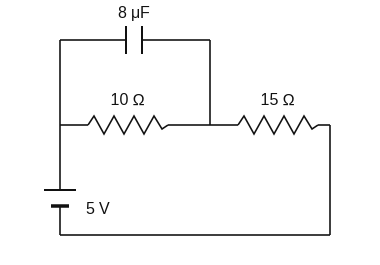
At steady state the charge on the capacitor, as shown in the circuit below, is _____ μC.
नीचे दर्शाए गए परिपथ में, स्थायी अवस्था में संधारित्र पर आवेश _____ μC है।
Show answer

Concept: At steady state no current flows through the capacitor branch; the capacitor charges to the potential difference across the element it is connected in parallel with.

  1. Current in the circuit flows only through the resistors: I=510+15=0.2 A.
  2. The 8 μF capacitor is in parallel with the 10 Ω resistor, so VC=I×10=0.2×10=2 V.
  3. Q=CVC=8 μF×2 V=16 μC.

Short trick: Ignore the capacitor, find the drop across its parallel resistor, then Q=CV.

Answer: 16

अवधारणा: स्थायी अवस्था में संधारित्र की शाखा से कोई धारा नहीं बहती; संधारित्र उस अवयव के विभवान्तर तक आवेशित होता है जिसके समान्तर वह जुड़ा है।

  1. परिपथ में धारा केवल प्रतिरोधकों से बहती है: I=510+15=0.2 A।
  2. 8 μF संधारित्र 10 Ω प्रतिरोधक के समान्तर है, अतः VC=I×10=0.2×10=2 V।
  3. Q=CVC=8 μF×2 V=16 μC।

शॉर्ट ट्रिक: संधारित्र को हटाकर उसके समान्तर प्रतिरोधक का विभव पतन निकालिए, फिर Q=CV।

उत्तर: 16

JEE Main 2025 (January) – Paper 1 (B.E./B.Tech)PhysicsCurrent Electricity – capacitor in DC circuit at steady stateJEE Main 2025 (January) – Paper 1 (B.E./B.Tech) 2025 · 23 Jan Shift 2 →
Q1776.
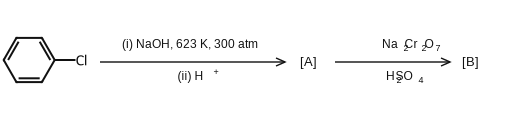
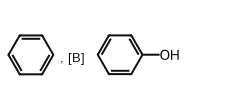
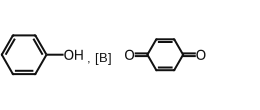
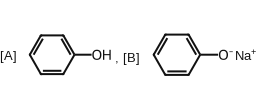
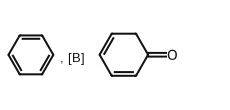
Identify the products [A] and [B], respectively in the following reaction :
निम्नलिखित अभिक्रिया में उत्पाद [A] तथा [B] को क्रमशः पहचानिए :
  1. A
  2. B
  3. C
  4. D
Show answer

Concept: Chlorobenzene gives phenol by the Dow process (NaOH, 623 K, 300 atm, then H+); phenol on oxidation with Na2Cr2O7/H2SO4 gives 1,4-benzoquinone.

  1. C6H5Cl + NaOH (623 K, 300 atm) → sodium phenoxide; acidification with H+ gives phenol, so [A] = phenol.
  2. Phenol is easily oxidised: with Na2Cr2O7/H2SO4 it gives the conjugated 1,4-benzoquinone, so [B] = p-benzoquinone.
  3. (A) and (D) show benzene as [A] – the C–Cl bond is replaced by –OH, not by –H; (C) stops at phenoxide and ignores the oxidation step.

Short trick: Phenol + acidified dichromate → p-benzoquinone is a standard NCERT reaction.

Answer: (B)

अवधारणा: क्लोरोबेंज़ीन डाउ प्रक्रम (NaOH, 623 K, 300 atm, फिर H+) द्वारा फ़िनॉल देता है; फ़िनॉल Na2Cr2O7/H2SO4 से ऑक्सीकरण पर 1,4-बेंज़ोक्विनोन देता है।

  1. C6H5Cl + NaOH (623 K, 300 atm) → सोडियम फ़िनॉक्साइड; H+ से अम्लीकरण पर फ़िनॉल बनता है, अतः [A] = फ़िनॉल।
  2. फ़िनॉल आसानी से ऑक्सीकृत होता है: Na2Cr2O7/H2SO4 से संयुग्मित 1,4-बेंज़ोक्विनोन बनता है, अतः [B] = p-बेंज़ोक्विनोन।
  3. (A) व (D) में [A] बेंज़ीन दिखाया गया है – C–Cl बंध –OH से प्रतिस्थापित होता है, –H से नहीं; (C) फ़िनॉक्साइड पर ही रुक जाता है और ऑक्सीकरण चरण छोड़ देता है।

शॉर्ट ट्रिक: फ़िनॉल + अम्लीय डाइक्रोमेट → p-बेंज़ोक्विनोन NCERT की मानक अभिक्रिया है।

उत्तर: (B)

JEE Main 2025 (January) – Paper 1 (B.E./B.Tech)ChemistryAlcohols, Phenols & Ethers – preparation and oxidation of phenolJEE Main 2025 (January) – Paper 1 (B.E./B.Tech) 2025 · 23 Jan Shift 2 →
Q1777.
Consider the following reactions
K2Cr2O7 →−H2OKOH [A] →−H2OH2SO4 [B] + K2SO4
The products [A] and [B], respectively are :
निम्नलिखित अभिक्रियाओं पर विचार कीजिए
K2Cr2O7 →−H2OKOH [A] →−H2OH2SO4 [B] + K2SO4
उत्पाद [A] तथा [B] क्रमशः हैं :
  1. AK2CrO4 and CrOK2CrO4 तथा CrO
  2. BK2CrO4 and Cr2O3K2CrO4 तथा Cr2O3
  3. CK2CrO4 and K2Cr2O7K2CrO4 तथा K2Cr2O7
  4. DK2Cr(OH)6 and Cr2O3K2Cr(OH)6 तथा Cr2O3
Show answer

Concept: Dichromate and chromate interconvert with pH: OH− gives yellow chromate, H+ gives orange dichromate; Cr stays in +6 state throughout.

  1. K2Cr2O7 + 2KOH → 2K2CrO4 + H2O, so [A] = K2CrO4 (yellow).
  2. 2K2CrO4 + H2SO4 → K2Cr2O7 + K2SO4 + H2O, so [B] = K2Cr2O7 (orange), matching the K2SO4 shown.
  3. CrO, Cr2O3 and K2Cr(OH)6 would need a change of oxidation state, which does not occur here – so the other sets are wrong.

Short trick: Base → chromate (yellow); acid → dichromate (orange). No redox, only condensation/hydrolysis.

Answer: (C)

अवधारणा: डाइक्रोमेट और क्रोमेट pH के साथ परस्पर परिवर्तित होते हैं: OH− से पीला क्रोमेट, H+ से नारंगी डाइक्रोमेट; Cr पूरे समय +6 अवस्था में रहता है।

  1. K2Cr2O7 + 2KOH → 2K2CrO4 + H2O, अतः [A] = K2CrO4 (पीला)।
  2. 2K2CrO4 + H2SO4 → K2Cr2O7 + K2SO4 + H2O, अतः [B] = K2Cr2O7 (नारंगी), जो दिए गए K2SO4 से मेल खाता है।
  3. CrO, Cr2O3 तथा K2Cr(OH)6 के लिए ऑक्सीकरण अवस्था बदलनी पड़ती, जो यहाँ नहीं होता – अतः शेष विकल्प गलत हैं।

शॉर्ट ट्रिक: क्षार → क्रोमेट (पीला); अम्ल → डाइक्रोमेट (नारंगी)। कोई अपचयोपचय नहीं।

उत्तर: (C)

JEE Main 2025 (January) – Paper 1 (B.E./B.Tech)Chemistryd- and f-Block – chromate–dichromate interconversionJEE Main 2025 (January) – Paper 1 (B.E./B.Tech) 2025 · 23 Jan Shift 2 →
Q1778.
The effect of temperature on spontaneity of reactions are represented as :
ΔHΔSTemperatureSpontaneity
(A)+−any TNon spontaneous
(B)++low Tspontaneous
(C)−−low TNon spontaneous
(D)−+any Tspontaneous
The incorrect combinations are :
अभिक्रियाओं की स्वतःप्रवर्तिता पर ताप के प्रभाव को इस प्रकार दर्शाया गया है :
ΔHΔSतापस्वतःप्रवर्तिता
(A)+−कोई भी Tस्वतःप्रवर्ती नहीं
(B)++निम्न Tस्वतःप्रवर्ती
(C)−−निम्न Tस्वतःप्रवर्ती नहीं
(D)−+कोई भी Tस्वतःप्रवर्ती
गलत संयोजन हैं :
  1. A(B) and (C) onlyकेवल (B) तथा (C)
  2. B(B) and (D) onlyकेवल (B) तथा (D)
  3. C(A) and (D) onlyकेवल (A) तथा (D)
  4. D(A) and (C) onlyकेवल (A) तथा (C)
Show answer

Concept: ΔG=ΔH−TΔS; a process is spontaneous when ΔG<0.

  1. (A) ΔH = +, ΔS = −: ΔG = (+) − T(−) is positive at every temperature → non-spontaneous at any T. Row (A) is correct.
  2. (B) ΔH = +, ΔS = +: ΔG becomes negative only at high T; at low T it is positive (non-spontaneous) → row (B) is incorrect.
  3. (C) ΔH = −, ΔS = −: ΔG is negative at low T, i.e. the reaction is spontaneous at low T → row (C) is incorrect.
  4. (D) ΔH = −, ΔS = +: both terms make ΔG negative at every temperature → spontaneous at any T. Row (D) is correct.
  5. Hence the incorrect combinations are (B) and (C). (B), (C) and (D) each include a correct row ((A) or (D)), so they are wrong.

Short trick: Signs (−, +) → always spontaneous; (+, −) → never; mixed signs → temperature decides (ΔH +, ΔS + needs high T; ΔH −, ΔS − needs low T).

Answer: (A) (B) and (C) only

अवधारणा: ΔG=ΔH−TΔS; प्रक्रम स्वतःप्रवर्ती होता है जब ΔG<0।

  1. (A) ΔH = +, ΔS = −: ΔG = (+) − T(−) प्रत्येक ताप पर धनात्मक → किसी भी T पर स्वतःप्रवर्ती नहीं। पंक्ति (A) सही है।
  2. (B) ΔH = +, ΔS = +: ΔG केवल उच्च T पर ऋणात्मक होता है; निम्न T पर धनात्मक (स्वतःप्रवर्ती नहीं) → पंक्ति (B) गलत है।
  3. (C) ΔH = −, ΔS = −: निम्न T पर ΔG ऋणात्मक है, अर्थात् अभिक्रिया निम्न T पर स्वतःप्रवर्ती है → पंक्ति (C) गलत है।
  4. (D) ΔH = −, ΔS = +: दोनों पद प्रत्येक ताप पर ΔG को ऋणात्मक बनाते हैं → किसी भी T पर स्वतःप्रवर्ती। पंक्ति (D) सही है।
  5. अतः गलत संयोजन (B) तथा (C) हैं। (B), (C) तथा (D) विकल्पों में प्रत्येक में एक सही पंक्ति ((A) या (D)) शामिल है, अतः वे गलत हैं।

शॉर्ट ट्रिक: चिह्न (−, +) → सदैव स्वतःप्रवर्ती; (+, −) → कभी नहीं; मिश्रित चिह्न → ताप निर्णय करता है (ΔH +, ΔS + को उच्च T चाहिए; ΔH −, ΔS − को निम्न T)।

उत्तर: (A) केवल (B) तथा (C)

JEE Main 2025 (January) – Paper 1 (B.E./B.Tech)ChemistryThermodynamics – spontaneity and Gibbs energyJEE Main 2025 (January) – Paper 1 (B.E./B.Tech) 2025 · 23 Jan Shift 2 →
Q1779.
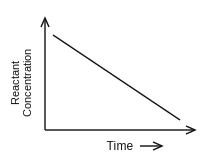
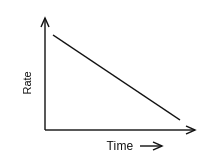
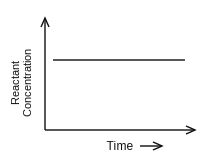
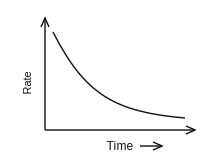
Which of the following graphs most appropriately represents a zero order reaction ?
निम्नलिखित में से कौन-सा ग्राफ शून्य कोटि अभिक्रिया को सबसे उपयुक्त रूप से दर्शाता है ?
  1. A
  2. B
  3. C
  4. D
Show answer

Concept: For a zero order reaction, rate =k[A]0=k, so [A]=[A]0−kt: the reactant concentration falls linearly with time while the rate stays constant.

  1. (A) shows reactant concentration decreasing as a straight line with time – exactly [A]=[A]0−kt. Correct.
  2. (B) shows the rate decreasing linearly with time – but a zero order rate is constant, so this is wrong.
  3. (C) shows the concentration constant with time – that would mean no reaction at all.
  4. (D) shows rate decaying exponentially – typical of a first order reaction, not zero order.

Short trick: Zero order → [A] vs t is a straight line of slope −k; rate vs t is a horizontal line.

Answer: (A)

अवधारणा: शून्य कोटि अभिक्रिया के लिए दर =k[A]0=k, अतः [A]=[A]0−kt: अभिकारक की सांद्रता समय के साथ रैखिक रूप से घटती है जबकि दर नियत रहती है।

  1. (A) में अभिकारक सांद्रता समय के साथ सरल रेखा में घटती दिखाई गई है – यही [A]=[A]0−kt है। सही।
  2. (B) में दर समय के साथ रैखिक घट रही है – परन्तु शून्य कोटि की दर नियत होती है, अतः गलत।
  3. (C) में सांद्रता समय के साथ नियत है – इसका अर्थ होता कि अभिक्रिया हो ही नहीं रही।
  4. (D) में दर चरघातांकी रूप से घट रही है – यह प्रथम कोटि का लक्षण है, शून्य कोटि का नहीं।

शॉर्ट ट्रिक: शून्य कोटि → [A] बनाम t ढाल −k की सरल रेखा; दर बनाम t क्षैतिज रेखा।

उत्तर: (A)

JEE Main 2025 (January) – Paper 1 (B.E./B.Tech)ChemistryChemical Kinetics – zero order reactionJEE Main 2025 (January) – Paper 1 (B.E./B.Tech) 2025 · 23 Jan Shift 2 →
Q1780.
Consider the reaction X2Y(g)=X2(g)+12Y2(g) The equation representing correct relationship between the degree of dissociation (x) of X2Y(g) with its equilibrium constant Kp is ______ . Assume x to be very very small.
अभिक्रिया X2Y(g)=X2(g)+12Y2(g) पर विचार कीजिए। X2Y(g) के वियोजन की मात्रा (x) तथा इसके साम्य स्थिरांक Kp के बीच सही संबंध दर्शाने वाला समीकरण ______ है। मान लीजिए x अत्यंत सूक्ष्म है।
  1. Ax=2Kpp3
  2. Bx=2Kp2p3
  3. Cx=Kpp3
  4. Dx=Kp2p3
Show answer

Concept: Write equilibrium moles, convert to partial pressures, apply Kp and use x≪1.

  1. Start with 1 mol X2Y: at equilibrium, moles are (1−x), x, x2; total =1+x2≈1.
  2. Partial pressures (total pressure p): pX2Y≈(1−x)p≈p, pX2≈xp, pY2≈x2p.
  3. Kp=pX2pY21/2pX2Y=xp(xp2)1/2p=x3/2p2.
  4. Squaring: Kp2=x3⋅p2 ⇒ x3=2Kp2p ⇒ x=2Kp2p3.

Short trick: Total Δn of products is 32, so x appears as x3/2 in Kp – squaring must give Kp2 in the final answer.

Answer: (B)

अवधारणा: साम्य पर मोल लिखिए, आंशिक दाबों में बदलिए, Kp लगाइए और x≪1 का उपयोग कीजिए।

  1. 1 मोल X2Y से प्रारम्भ: साम्य पर मोल (1−x), x, x2; कुल =1+x2≈1।
  2. आंशिक दाब (कुल दाब p): pX2Y≈(1−x)p≈p, pX2≈xp, pY2≈x2p।
  3. Kp=pX2pY21/2pX2Y=xp(xp2)1/2p=x3/2p2।
  4. वर्ग करने पर: Kp2=x3⋅p2 ⇒ x3=2Kp2p ⇒ x=2Kp2p3।

शॉर्ट ट्रिक: उत्पादों का कुल Δn 32 है, अतः Kp में x घात 32 में आता है – वर्ग करने पर उत्तर में Kp2 आना ही चाहिए।

उत्तर: (B)

JEE Main 2025 (January) – Paper 1 (B.E./B.Tech)ChemistryChemical Equilibrium – Kp and degree of dissociationJEE Main 2025 (January) – Paper 1 (B.E./B.Tech) 2025 · 23 Jan Shift 2 →