Q321.Let . The number of one-one functions such that , and , is _____.
माना है। ऐसे एकैकी फलनों की संख्या, जिनके लिए , तथा है, _____ है।
Show answer
Concept: Fix , then choose , then arrange the remaining 3 images in ways.
- , : .
- : – 3 ways; : – 3; : – 3; : – 3.
- Each case: fill the remaining 3 values in ways.
- Total .
Short trick: In every case exactly one of is used by or , leaving 3 choices for : .
Answer: 72
अवधारणा: निश्चित कीजिए, फिर चुनिए, फिर शेष 3 प्रतिबिंबों को प्रकार से व्यवस्थित कीजिए।
- , : ।
- : – 3 प्रकार; : – 3; : – 3; : – 3।
- प्रत्येक स्थिति में शेष 3 मानों को प्रकार से भरते हैं।
- कुल ।
शॉर्ट ट्रिक: प्रत्येक स्थिति में में से ठीक एक मान या लेता है, अतः के 3 विकल्प: ।
उत्तर: 72
JEE Main 2026 (April) – Paper 1 (B.E./B.Tech)MathematicsFunctions – counting one-one functionsJEE Main 2026 (April) – Paper 1 (B.E./B.Tech) 2026 · 5 Apr Shift 1
Q322.Two players A and B play a series of games of badminton. The player, who wins 5 games first, wins the series. Assuming that no game ends in a draw, the number of ways, in which player A wins the series is _____.
दो खिलाड़ी A और B बैडमिंटन के खेलों की एक श्रृंखला खेलते हैं। जो खिलाड़ी पहले 5 खेल जीतता है, वह श्रृंखला जीतता है। यह मानते हुए कि कोई भी खेल बराबरी (draw) पर समाप्त नहीं होता, खिलाड़ी A के श्रृंखला जीतने के तरीकों की संख्या _____ है।
Show answer
Concept: If A wins with B winning games (), the series has games, the last won by A; the losses are placed among the first games.
- Ways .
- .
Short trick: Hockey-stick identity: .
Answer: 126
अवधारणा: यदि A जीतता है और B, खेल () जीतता है, तो श्रृंखला में खेल होंगे, अंतिम A जीतेगा; B की जीतें पहले खेलों में रखी जाती हैं।
- तरीके ।
- ।
शॉर्ट ट्रिक: हॉकी-स्टिक सर्वसमिका: ।
उत्तर: 126
JEE Main 2026 (April) – Paper 1 (B.E./B.Tech)MathematicsPermutations and combinations – series of gamesJEE Main 2026 (April) – Paper 1 (B.E./B.Tech) 2026 · 5 Apr Shift 1
Q323.If the sum of the coefficients of and in the expansion of , , is zero, then the value of is _____.
यदि , , के प्रसार में तथा के गुणांकों का योग शून्य है, तो का मान _____ है।
Show answer
Concept: .
- : ; : , so and is a multiple of 7, i.e. , .
- Coefficients and have opposite signs, so the sum is zero iff .
- , .
- Check: , , ✓.
Short trick: Consecutive terms with equal binomial coefficients are the two middle terms of an odd power: with gives .
Answer: 21
अवधारणा: ।
- : ; : , अतः तथा , 7 का गुणज है, अर्थात् , ।
- गुणांक तथा विपरीत चिह्न के हैं, अतः योग शून्य तभी जब ।
- , ।
- जाँच: , , ✓।
शॉर्ट ट्रिक: समान द्विपद गुणांक वाले क्रमागत पद विषम घात के दो मध्य पद होते हैं: तथा से ।
उत्तर: 21
JEE Main 2026 (April) – Paper 1 (B.E./B.Tech)MathematicsBinomial theorem – general termJEE Main 2026 (April) – Paper 1 (B.E./B.Tech) 2026 · 5 Apr Shift 1
Q324.If , then is equal to _____.
यदि है, तो बराबर है _____।
Show answer
Concept: Write each term as ().
- and , so the term .
- Sum over to telescopes: .
- , so .
Short trick: Numerator difference, denominator product of and – the classic telescoping form.
Answer: 2048
अवधारणा: प्रत्येक पद को () के रूप में लिखिए।
- तथा , अतः पद ।
- से तक योग दूरदर्शी है: ।
- , अतः ।
शॉर्ट ट्रिक: अंश अंतर, हर ( और का गुणनफल) – दूरदर्शी का मानक रूप।
उत्तर: 2048
JEE Main 2026 (April) – Paper 1 (B.E./B.Tech)MathematicsInverse trigonometric functions – telescoping sumJEE Main 2026 (April) – Paper 1 (B.E./B.Tech) 2026 · 5 Apr Shift 1
Q325.Let be the solution of the differential equation , and let . Then the number of integral value of , for which the equation represents a circle of radius , is _____.
माना अवकल समीकरण , का हल है तथा माना है। तब के उन पूर्णांक मानों की संख्या, जिनके लिए समीकरण त्रिज्या वाले वृत्त को निरूपित करता है, _____ है।
Show answer
Concept: Homogeneous DE – put ; then a circle needs radius.
- . With : .
- ; at , : . So .
- Formally . But a cosine can never exceed : holds only for , so does not exist and is not defined.
- Circle : .
- .
- Taking the formal value , the number of integral values would be – but the data are inconsistent.
Short trick: Always check the range: forces , so is outside the domain of the solution.
Answer: Bonus – does not exist since is impossible; full marks to all (formal working with gives ).
अवधारणा: समघात अवकल समीकरण – रखिए; वृत्त के लिए त्रिज्या आवश्यक है।
- । से: ।
- ; पर : । अतः ।
- औपचारिक रूप से । परंतु कोज्या (cosine) का मान कभी से अधिक नहीं हो सकता: केवल के लिए सत्य है, अतः का अस्तित्व नहीं है और परिभाषित नहीं है।
- वृत्त : ।
- ।
- औपचारिक मान लेने पर पूर्णांक मानों की संख्या होगी – परंतु दिए गए आँकड़े असंगत हैं।
शॉर्ट ट्रिक: सदैव परिसर जाँचिए: से आवश्यक है, अतः हल के प्रांत से बाहर है।
उत्तर: बोनस – का अस्तित्व नहीं है क्योंकि असंभव है; सभी को पूरे अंक (औपचारिक रूप से लेने पर आता है)।
JEE Main 2026 (April) – Paper 1 (B.E./B.Tech)MathematicsDifferential equations – homogeneous; circleJEE Main 2026 (April) – Paper 1 (B.E./B.Tech) 2026 · 5 Apr Shift 1
Q326.In a Vernier calipers, when both jaws touch each other, zero of the Vernier scale is shifted to the right of zero of the main scale and 7th Vernier division coincides with a main scale reading. If the value of 1 main scale division is 1 mm and there are 10 Vernier scale divisions, then the Vernier caliper has
एक वर्नियर कैलिपर्स में, जब दोनों जबड़े एक-दूसरे को स्पर्श करते हैं, तो वर्नियर पैमाने का शून्य मुख्य पैमाने के शून्य से दाईं ओर विस्थापित है तथा वर्नियर का 7वाँ भाग मुख्य पैमाने के किसी पाठ्यांक के संपाती है। यदि मुख्य पैमाने के 1 भाग का मान 1 mm है तथा वर्नियर पैमाने पर 10 भाग हैं, तो वर्नियर कैलिपर्स में है
- A0.07 cm negative zero error0.07 cm ऋणात्मक शून्यांक त्रुटि
- B0.7 cm negative zero error0.7 cm ऋणात्मक शून्यांक त्रुटि
- C0.07 cm positive zero error0.07 cm धनात्मक शून्यांक त्रुटि
- D0.7 cm positive zero error0.7 cm धनात्मक शून्यांक त्रुटि
Show answer
Concept: Least count LC = 1 MSD − 1 VSD = 1 MSD/N. If the Vernier zero lies to the right of the main-scale zero with jaws closed, the zero error is positive and equals (coinciding division) × LC.
- LC mm.
- Vernier zero is to the right → positive zero error.
- Zero error mm cm.
Short trick: Right of zero → positive; magnitude = coinciding division × LC.
Answer: (C) 0.07 cm positive zero error
अवधारणा: अल्पतमांक LC = 1 MSD − 1 VSD = 1 MSD/N। जबड़े बंद होने पर यदि वर्नियर शून्य मुख्य पैमाने के शून्य के दाईं ओर हो तो शून्यांक त्रुटि धनात्मक होती है तथा उसका मान (संपाती भाग) × LC होता है।
- LC mm।
- वर्नियर शून्य दाईं ओर है → धनात्मक शून्यांक त्रुटि।
- शून्यांक त्रुटि mm cm।
शॉर्ट ट्रिक: शून्य के दाईं ओर → धनात्मक; मान = संपाती भाग × LC।
उत्तर: (C) 0.07 cm धनात्मक शून्यांक त्रुटि
JEE Main 2026 (April) – Paper 1 (B.E./B.Tech)PhysicsUnits & Measurements – Vernier callipers zero errorJEE Main 2026 (April) – Paper 1 (B.E./B.Tech) 2026 · 5 Apr Shift 1
Q327., and represents physical quantities inductance, capacitance and resistance respectively. The dimensional formula corresponds to ________.
, तथा क्रमशः भौतिक राशियों प्रेरकत्व, धारिता तथा प्रतिरोध को निरूपित करते हैं। विमीय सूत्र किसके संगत है? ________
- A
- B
- C
- D
Show answer
Concept: and is a time (since ), so . Also has the dimension of resistance.
- (A) ✔
- (B) ✘
- (C) , → ✘
- (D) = dimensionless ✘
Short trick: Resistance ÷ time = , and is time.
Answer: (A)
अवधारणा: तथा समय है (क्योंकि ), अतः । साथ ही की विमा प्रतिरोध की विमा है।
- (A) ✔
- (B) ✘
- (C) , → ✘
- (D) = विमाहीन ✘
शॉर्ट ट्रिक: प्रतिरोध ÷ समय = , तथा समय है।
उत्तर: (A)
JEE Main 2026 (April) – Paper 1 (B.E./B.Tech)PhysicsUnits & Dimensions – electrical quantitiesJEE Main 2026 (April) – Paper 1 (B.E./B.Tech) 2026 · 5 Apr Shift 1
Q328.When one moves from a point 16 km below the earth's surface to a point 16 km above the earth's surface. The change in g is approximately %. The value of is _____.
(Take radius of the earth = 6400 km.)
जब कोई पृथ्वी की सतह से 16 km नीचे स्थित बिंदु से पृथ्वी की सतह से 16 km ऊपर स्थित बिंदु तक जाता है, तो g में परिवर्तन लगभग % है। का मान _____ है।
(पृथ्वी की त्रिज्या = 6400 km लीजिए।)
- A0.12
- B0.25
- C0.50
- D0.75
Show answer
Concept: Depth : . Height : .
- → .
- → .
- Change → of .
Short trick: Change .
Answer: (B) 0.25
अवधारणा: गहराई पर: । ऊँचाई पर: ।
- → ।
- → ।
- परिवर्तन → का ।
शॉर्ट ट्रिक: परिवर्तन ।
उत्तर: (B) 0.25
JEE Main 2026 (April) – Paper 1 (B.E./B.Tech)PhysicsGravitation – variation of g with height and depthJEE Main 2026 (April) – Paper 1 (B.E./B.Tech) 2026 · 5 Apr Shift 1
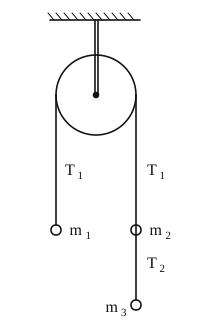
Q329.Three masses
kg,
kg and
kg are suspended from a fixed smooth frictionless pully as shown in the figure below. The value of
is ______
(take
m/s
2)
तीन द्रव्यमान
kg,
kg तथा
kg एक स्थिर चिकनी घर्षणरहित घिरनी से नीचे चित्र में दर्शाए अनुसार लटकाए गए हैं।
का मान ______ है
(
m/s
2 लीजिए)
- A5/3
- B2/3
- C3/5
- D2/5
Show answer
Concept: Treat (10 kg) on one side against (4 kg) on the other; all move with the same acceleration.
- m/s2 (right side goes down).
- goes up: N.
- goes down: N.
- .
Short trick: , → .
Answer: (A) 5/3
अवधारणा: एक ओर (10 kg) तथा दूसरी ओर (4 kg) मानिए; सभी समान त्वरण से गति करते हैं।
- m/s2 (दाईं ओर का भाग नीचे जाता है)।
- ऊपर जाता है: N।
- नीचे जाता है: N।
- ।
शॉर्ट ट्रिक: , → ।
उत्तर: (A) 5/3
JEE Main 2026 (April) – Paper 1 (B.E./B.Tech)PhysicsLaws of Motion – pulley system (Atwood machine)JEE Main 2026 (April) – Paper 1 (B.E./B.Tech) 2026 · 5 Apr Shift 1
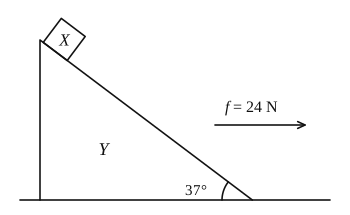
Q330.A wedge
with mass of 10 kg and all frictionless surfaces and the inclined surface making 37° with horizontal. A block
with mass 2 kg is placed at the highest point of the wedge as shown in figure is at rest. At
wedge (
) is pulled toward right with constant force (
) of 24 N. Taking the block
at rest at
, the time taken by it to slide down 8.8 m on the slope, while
is on the move, is_____ s.
(take
and
m/s
2)
10 kg द्रव्यमान का एक वेज
है जिसकी सभी सतहें घर्षणरहित हैं तथा आनत सतह क्षैतिज से 37° का कोण बनाती है। 2 kg द्रव्यमान का एक गुटका
चित्र में दर्शाए अनुसार वेज के उच्चतम बिंदु पर विरामावस्था में रखा है।
पर वेज (
) को 24 N के नियत बल (
) से दाईं ओर खींचा जाता है।
पर गुटके
को विरामावस्था में मानते हुए,
के गतिमान रहते हुए गुटके द्वारा ढलान पर 8.8 m नीचे फिसलने में लिया गया समय _____ s है।
(
तथा
m/s
2 लीजिए)
- A2
- B4
- C
- D
Show answer
Concept: In the wedge frame the block feels a pseudo force to the left; along the incline (which descends to the right) , where is the wedge's acceleration.
- Usual approach (block and wedge pushed together by ): m/s2.
- m/s2.
- → → s.
- Exact check: the wedge alone obeys with → → m/s2, m/s2, s ≈ 2 s.
- Either way the time is about 2 s; (B) 4 s, (C) ≈ 1.41 s and (D) ≈ 2.83 s are far off.
Short trick: m/s2; s.
Answer: (A) 2
अवधारणा: वेज के निर्देश तंत्र में गुटके पर बाईं ओर छद्म बल लगता है; आनत तल के अनुदिश (जो दाईं ओर नीचे जाता है) , जहाँ वेज का त्वरण है।
- सामान्य विधि (बल से गुटका व वेज साथ धकेले जाते हैं): m/s2।
- m/s2।
- → → s।
- यथार्थ जाँच: केवल वेज के लिए , जहाँ → → m/s2, m/s2, s ≈ 2 s।
- दोनों प्रकार से समय लगभग 2 s है; (B) 4 s, (C) ≈ 1.41 s तथा (D) ≈ 2.83 s बहुत दूर हैं।
शॉर्ट ट्रिक: m/s2; s।
उत्तर: (A) 2
JEE Main 2026 (April) – Paper 1 (B.E./B.Tech)PhysicsLaws of Motion – block on a moving wedgeJEE Main 2026 (April) – Paper 1 (B.E./B.Tech) 2026 · 5 Apr Shift 1
Q331.The Young's modulus of steel wire of radius and length is .
If the radius and length of the wire are doubled then the value of
त्रिज्या तथा लंबाई वाले स्टील के तार का यंग गुणांक है।
यदि तार की त्रिज्या तथा लंबाई दोगुनी कर दी जाएँ, तो का मान
- Aincreases by two timesदो गुना बढ़ जाता है
- Breduces by halfआधा हो जाता है
- Cremains unchangedअपरिवर्तित रहता है
- Dbecomes one fourthएक-चौथाई हो जाता है
Show answer
Concept: Young's modulus is a property of the material only; it does not depend on the dimensions of the wire.
- Changing or changes the extension for a given load (), not .
- The wire is still steel → remains unchanged. (A), (B), (D) wrongly treat as dimension-dependent.
Short trick: Elastic moduli depend only on material (and temperature).
Answer: (C) remains unchanged
अवधारणा: यंग गुणांक केवल पदार्थ का गुण है; यह तार की विमाओं पर निर्भर नहीं करता।
- या बदलने से दिए गए भार के लिए प्रसार बदलता है (), नहीं।
- तार अब भी स्टील का है → अपरिवर्तित रहता है। (A), (B), (D) गलती से को विमाओं पर निर्भर मानते हैं।
शॉर्ट ट्रिक: प्रत्यास्थता गुणांक केवल पदार्थ (तथा ताप) पर निर्भर करते हैं।
उत्तर: (C) अपरिवर्तित रहता है
JEE Main 2026 (April) – Paper 1 (B.E./B.Tech)PhysicsMechanical Properties of Solids – Young's modulusJEE Main 2026 (April) – Paper 1 (B.E./B.Tech) 2026 · 5 Apr Shift 1
Q332.Given below are two statements: one is labelled as Assertion A and the other is labelled as Reason R
Statement I: Change in internal energy of a system containing mole of ideal gas can be written as , where , = initial temperature, = final temperature.
Statement II: Relation between degree of freedom and is
Choose the correct answer from the options given below
नीचे दो कथन दिए गए हैं: एक को अभिकथन A तथा दूसरे को कारण R से चिह्नित किया गया है
कथन I: आदर्श गैस के मोल वाले निकाय की आंतरिक ऊर्जा में परिवर्तन को के रूप में लिखा जा सकता है, जहाँ , = प्रारंभिक ताप, = अंतिम ताप।
कथन II: स्वातंत्र्य कोटि तथा के बीच संबंध है
नीचे दिए गए विकल्पों में से सही उत्तर चुनिए
- ABoth A and R are true and R is the correct explanation of AA तथा R दोनों सत्य हैं तथा R, A की सही व्याख्या है
- BBoth A and R are true but R is NOT the correct explanation of AA तथा R दोनों सत्य हैं परंतु R, A की सही व्याख्या नहीं है
- CA is true but R is falseA सत्य है परंतु R असत्य है
- DA is false but R is trueA असत्य है परंतु R सत्य है
Show answer
Concept: For an ideal gas depends only on , so for any process; Mayer's relation with gives .
- Statement I (A): follows directly from → A is true.
- Statement II (R): with equipartition , → → R is true.
- A is derived from Mayer's relation and holds for every ideal gas regardless of how is counted; it does not need the degrees-of-freedom relation, so R is not the explanation of A. Hence (A) is wrong, and (C), (D) are wrong since both statements are true.
Short trick: is just Mayer's relation – no degrees of freedom needed.
Answer: (B) Both A and R are true but R is NOT the correct explanation of A
अवधारणा: आदर्श गैस के लिए केवल पर निर्भर करती है, अतः किसी भी प्रक्रम में ; मेयर संबंध तथा से प्राप्त होता है।
- कथन I (A): सीधे से प्राप्त होता है → A सत्य है।
- कथन II (R): ऊर्जा के समविभाजन से , → → R सत्य है।
- A मेयर संबंध से व्युत्पन्न है तथा प्रत्येक आदर्श गैस के लिए मान्य है, चाहे कैसे भी गिना जाए; इसके लिए स्वातंत्र्य कोटि संबंध आवश्यक नहीं, अतः R, A की व्याख्या नहीं है। इसलिए (A) गलत है, तथा (C), (D) गलत हैं क्योंकि दोनों कथन सत्य हैं।
शॉर्ट ट्रिक: केवल मेयर संबंध है – स्वातंत्र्य कोटि की आवश्यकता नहीं।
उत्तर: (B) A तथा R दोनों सत्य हैं परंतु R, A की सही व्याख्या नहीं है
JEE Main 2026 (April) – Paper 1 (B.E./B.Tech)PhysicsKinetic Theory – internal energy and degrees of freedomJEE Main 2026 (April) – Paper 1 (B.E./B.Tech) 2026 · 5 Apr Shift 1
Q333.Consider the following statements:
A. Zeroth law of thermodynamics gives concept of temperature
B. First law of thermodynamics gives concept of internal energy
C. In isothermal expansion of ideal gas,
D. Product of intensive and extensive variables is extensive
E. The ratio of any extensive variable to mass will be an extensive variable
Choose the correct combination of statements from the options given below:
निम्नलिखित कथनों पर विचार कीजिए:
A. ऊष्मागतिकी का शून्यांकी नियम ताप की अवधारणा देता है
B. ऊष्मागतिकी का प्रथम नियम आंतरिक ऊर्जा की अवधारणा देता है
C. आदर्श गैस के समतापीय प्रसार में,
D. गहन (intensive) तथा विस्तीर्ण (extensive) चरों का गुणनफल विस्तीर्ण होता है
E. किसी भी विस्तीर्ण चर का द्रव्यमान से अनुपात एक विस्तीर्ण चर होगा
नीचे दिए गए विकल्पों में से कथनों का सही संयोजन चुनिए:
- AC, D and E Onlyकेवल C, D तथा E
- BA, B and C Onlyकेवल A, B तथा C
- CA, B and D Onlyकेवल A, B तथा D
- DB, C and D Onlyकेवल B, C तथा D
Show answer
Concept: Zeroth law → thermal equilibrium → temperature; first law → internal energy as a state function. Intensive × extensive scales with system size; extensive ÷ mass is a specific (intensive) quantity.
- A: true.
- B: true.
- C: isothermal ideal gas → → ; so C is false.
- D: e.g. , density × volume = mass → extensive; true.
- E: e.g. volume/mass = specific volume, which is intensive; false.
- Correct set: A, B, D. (A), (B), (D) each contain the false statement C or E.
Short trick: Isothermal ideal gas: ; "per unit mass" always makes a quantity intensive.
Answer: (C) A, B and D Only
अवधारणा: शून्यांकी नियम → तापीय साम्य → ताप; प्रथम नियम → अवस्था फलन के रूप में आंतरिक ऊर्जा। गहन × विस्तीर्ण निकाय के आकार के अनुपात में बदलता है; विस्तीर्ण ÷ द्रव्यमान एक विशिष्ट (गहन) राशि है।
- A: सत्य।
- B: सत्य।
- C: आदर्श गैस का समतापीय प्रक्रम → → ; अतः C असत्य है।
- D: उदाहरण , घनत्व × आयतन = द्रव्यमान → विस्तीर्ण; सत्य।
- E: उदाहरण आयतन/द्रव्यमान = विशिष्ट आयतन, जो गहन है; असत्य।
- सही समुच्चय: A, B, D। (A), (B), (D) प्रत्येक में असत्य कथन C या E सम्मिलित है।
शॉर्ट ट्रिक: समतापीय आदर्श गैस: ; "प्रति इकाई द्रव्यमान" किसी राशि को सदैव गहन बना देता है।
उत्तर: (C) केवल A, B तथा D
JEE Main 2026 (April) – Paper 1 (B.E./B.Tech)PhysicsThermodynamics – laws and state variablesJEE Main 2026 (April) – Paper 1 (B.E./B.Tech) 2026 · 5 Apr Shift 1
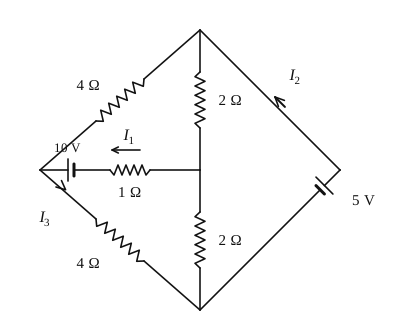
Q334.Refer to the figure given below. The values of
,
and
are ________.
नीचे दिए गए चित्र को देखिए।
,
तथा
के मान ________ हैं।
- A A, A, A
- B A, A, A
- C A, A, A
- D A, A, A
Show answer
Concept: Use superposition: keep one source at a time (the other replaced by a short circuit) and add the branch currents. Label the left node P, top node T, bottom node B, middle node M.
- Only 10 V: T and B are shorted. Between P and T/B: ; between M and T/B: . Loop current A through the 1 Ω (towards P), splitting 1.25 A into each 4 Ω; no net current through the 5 V branch.
- Only 5 V: P–T 4 Ω, P–B 4 Ω, M–T 2 Ω, M–B 2 Ω form a balanced bridge (4/4 = 2/2), so P and M are at the same potential → zero current in the 1 Ω. Battery current A; each 4 Ω carries 0.625 A (T → P → B).
- Superpose: A; A; lower 4 Ω: A (both downward from P to B).
- Check with node potentials (): V, V, → A ✔.
Short trick: The 5 V source sees a balanced Wheatstone bridge, so it never affects ; the 10 V source sees and shorted.
Answer: (A) A, A, A
अवधारणा: अध्यारोपण का प्रयोग कीजिए: एक समय पर एक ही स्रोत रखिए (दूसरे को लघुपथित करके) तथा शाखा धाराएँ जोड़िए। बाएँ नोड को P, ऊपरी को T, निचले को B तथा मध्य नोड को M कहिए।
- केवल 10 V: T तथा B लघुपथित। P तथा T/B के बीच: ; M तथा T/B के बीच: । पाश धारा A, 1 Ω में (P की ओर), प्रत्येक 4 Ω में 1.25 A; 5 V शाखा में कोई नेट धारा नहीं।
- केवल 5 V: P–T 4 Ω, P–B 4 Ω, M–T 2 Ω, M–B 2 Ω एक संतुलित सेतु बनाते हैं (4/4 = 2/2), अतः P तथा M समान विभव पर → 1 Ω में धारा शून्य। बैटरी धारा A; प्रत्येक 4 Ω में 0.625 A (T → P → B)।
- अध्यारोपण: A; A; निचला 4 Ω: A (दोनों P से B की ओर)।
- नोड विभवों से जाँच (): V, V, → A ✔।
शॉर्ट ट्रिक: 5 V स्रोत के लिए परिपथ संतुलित व्हीटस्टोन सेतु है, अतः वह को प्रभावित नहीं करता; 10 V स्रोत के लिए तथा लघुपथित हैं।
उत्तर: (A) A, A, A
JEE Main 2026 (April) – Paper 1 (B.E./B.Tech)PhysicsCurrent Electricity – Kirchhoff's laws / superpositionJEE Main 2026 (April) – Paper 1 (B.E./B.Tech) 2026 · 5 Apr Shift 1
Q335.An electron of mass is moving in an electric field ( = constant ), with an initial velocity ( = constant ). If , its de Broglie wavelength at time is ______.
( = charge of electron)
द्रव्यमान का एक इलेक्ट्रॉन विद्युत क्षेत्र ( = नियतांक ) में प्रारंभिक वेग ( = नियतांक ) से गति कर रहा है। यदि , तो समय पर इसकी दे-ब्रॉग्ली तरंगदैर्ध्य ______ है।
( = इलेक्ट्रॉन का आवेश)
- A
- B
- C
- D
Show answer
Concept: Force on electron , i.e. along , so the electron speeds up; .
- → .
- .
- Since : .
- (A), (B) use half the force; (D) has the wrong sign (electron would decelerate only if were along ).
Short trick: Field opposite to velocity → electron accelerates → λ decreases → "+" in denominator with force .
Answer: (C)
अवधारणा: इलेक्ट्रॉन पर बल , अर्थात् की दिशा में, अतः इलेक्ट्रॉन की चाल बढ़ती है; ।
- → ।
- ।
- चूँकि : ।
- (A), (B) आधे बल का प्रयोग करते हैं; (D) में चिह्न गलत है (इलेक्ट्रॉन का मंदन तभी होता जब , की दिशा में होता)।
शॉर्ट ट्रिक: क्षेत्र वेग के विपरीत → इलेक्ट्रॉन त्वरित → λ घटती है → हर में "+" तथा बल ।
उत्तर: (C)
JEE Main 2026 (April) – Paper 1 (B.E./B.Tech)PhysicsDual Nature – de Broglie wavelength of accelerated electronJEE Main 2026 (April) – Paper 1 (B.E./B.Tech) 2026 · 5 Apr Shift 1
Q336.In the hydrogen atom, the electron makes a transition from the higher orbit () to a lower orbit (). The ratio of the radius of the orbits in given by . The wavelength of photon emitted due to this transition is ______nm.
(Given Rydberg constant = /m)
हाइड्रोजन परमाणु में इलेक्ट्रॉन उच्च कक्षा () से निम्न कक्षा () में संक्रमण करता है। कक्षाओं की त्रिज्याओं का अनुपात दिया गया है। इस संक्रमण के कारण उत्सर्जित फोटॉन की तरंगदैर्ध्य ______nm है।
(रिडबर्ग नियतांक = /m दिया है)
- A121
- B242
- C486
- D974
Show answer
Concept: Bohr radius , so → , (Balmer Hβ line). .
- .
- m nm.
- (A) 121 nm would be 2 → 1 (Lyman α); the radii 16 : 4 correspond to = 16 and 4, i.e. 4 → 2.
Short trick: : read 16 : 4 directly as → 4 → 2 → Hβ = 486 nm.
Answer: (C) 486
अवधारणा: बोर त्रिज्या , अतः → , (बामर Hβ रेखा)। ।
- ।
- m nm।
- (A) 121 nm, 2 → 1 (लाइमन α) संक्रमण का होता; त्रिज्याएँ 16 : 4, = 16 तथा 4 के संगत हैं, अर्थात् 4 → 2।
शॉर्ट ट्रिक: : 16 : 4 को सीधे पढ़िए → 4 → 2 → Hβ = 486 nm।
उत्तर: (C) 486
JEE Main 2026 (April) – Paper 1 (B.E./B.Tech)PhysicsAtoms – Bohr model, hydrogen spectrumJEE Main 2026 (April) – Paper 1 (B.E./B.Tech) 2026 · 5 Apr Shift 1
Q337.A displacement current of 4.0 A can be set up in the space between two parallel plates of 6 μF capacitor. The rate of change of potential difference across the plates of the capacitor is nearly V/s. The value of is _______.
6 μF संधारित्र की दो समांतर प्लेटों के बीच के स्थान में 4.0 A की विस्थापन धारा स्थापित की जा सकती है। संधारित्र की प्लेटों के बीच विभवांतर में परिवर्तन की दर लगभग V/s है। का मान _______ है।
- A0.58
- B0.67
- C0.82
- D0.75
Show answer
Concept: .
- .
- V/s → .
Short trick: MV/s.
Answer: (B) 0.67
अवधारणा: ।
- ।
- V/s → ।
शॉर्ट ट्रिक: MV/s।
उत्तर: (B) 0.67
JEE Main 2026 (April) – Paper 1 (B.E./B.Tech)PhysicsElectromagnetic Waves – displacement currentJEE Main 2026 (April) – Paper 1 (B.E./B.Tech) 2026 · 5 Apr Shift 1
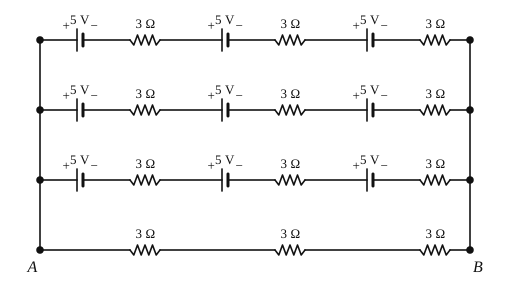
Q338.Refer to the figure given below, current between terminals
and
is __________ A.
नीचे दिए गए चित्र को देखिए, टर्मिनलों
तथा
के बीच धारा __________ A है।
- A12.5
- B1.25
- C7.5
- D5
Show answer
Concept: Each of the top three rows is a source of emf V (all cells aligned, + towards A) with internal resistance . Identical sources in parallel: same emf, resistance divided by their number. The bottom row (9 Ω, no cell) is the external load between A and B.
- Three identical (15 V, 9 Ω) branches in parallel → V, .
- Load: bottom row .
- A.
Short trick: Millman: V → A.
Answer: (B) 1.25
अवधारणा: ऊपर की तीनों पंक्तियों में से प्रत्येक V विद्युत वाहक बल (सभी सेल एक ही दिशा में, + सिरा A की ओर) तथा आंतरिक प्रतिरोध का स्रोत है। समान स्रोत समांतर में: विद्युत वाहक बल वही, प्रतिरोध उनकी संख्या से विभाजित। सबसे नीचे की पंक्ति (9 Ω, कोई सेल नहीं) A तथा B के बीच बाह्य भार है।
- तीन समान (15 V, 9 Ω) शाखाएँ समांतर में → V, ।
- भार: नीचे की पंक्ति ।
- A।
शॉर्ट ट्रिक: मिलमैन: V → A।
उत्तर: (B) 1.25
JEE Main 2026 (April) – Paper 1 (B.E./B.Tech)PhysicsCurrent Electricity – cells in parallelJEE Main 2026 (April) – Paper 1 (B.E./B.Tech) 2026 · 5 Apr Shift 1
Q339.In Young's double slit experiment, the fringe width of the interference pattern produced on the screen is 2.4 μm. If the experiment is carried out in another medium having refractive index 1.2, the fringe width will be ____ μm.
यंग के द्विझिरी प्रयोग में, पर्दे पर उत्पन्न व्यतिकरण प्रतिरूप की फ्रिंज चौड़ाई 2.4 μm है। यदि प्रयोग अपवर्तनांक 1.2 वाले किसी अन्य माध्यम में किया जाए, तो फ्रिंज चौड़ाई ____ μm होगी।
- A1.2
- B2
- C2.4
- D2.88
Show answer
Concept: and in a medium , so .
- μm.
Short trick: Fringe width shrinks by the factor μ.
Answer: (B) 2
अवधारणा: तथा माध्यम में , अतः ।
- μm।
शॉर्ट ट्रिक: फ्रिंज चौड़ाई μ गुना कम हो जाती है।
उत्तर: (B) 2
JEE Main 2026 (April) – Paper 1 (B.E./B.Tech)PhysicsWave Optics – YDSE in a mediumJEE Main 2026 (April) – Paper 1 (B.E./B.Tech) 2026 · 5 Apr Shift 1
Q340.A ray of light passing through an equilateral prism is having velocity m/s in the prism material, then the minimum angle of deviation is ________ degrees.
एक समबाहु प्रिज्म से गुजरने वाली प्रकाश किरण का प्रिज्म के पदार्थ में वेग m/s है, तो न्यूनतम विचलन कोण ________ डिग्री है।
- A45
- B30
- C28
- D58
Show answer
Concept: and with .
- .
- → .
- .
Short trick: with always gives .
Answer: (B) 30
अवधारणा: तथा , जहाँ ।
- ।
- → ।
- ।
शॉर्ट ट्रिक: के साथ सदैव देता है।
उत्तर: (B) 30
JEE Main 2026 (April) – Paper 1 (B.E./B.Tech)PhysicsRay Optics – prism minimum deviationJEE Main 2026 (April) – Paper 1 (B.E./B.Tech) 2026 · 5 Apr Shift 1

