Q341.Light source having wavelength 331 nm is used to generate photo-electrons whose stopping potential is 0.2 V. The work function of the used metal in the experiment is J. The value of is _____.
( J s, C and m/s)
331 nm तरंगदैर्ध्य वाले प्रकाश स्रोत का प्रयोग प्रकाश-इलेक्ट्रॉन उत्पन्न करने के लिए किया जाता है, जिनका निरोधी विभव 0.2 V है। प्रयोग में प्रयुक्त धातु का कार्य फलन J है। का मान _____ है।
( J s, C तथा m/s)
- A3.68
- B4.68
- C5.68
- D2.68
Show answer
Concept: Einstein's equation: .
- J.
- J.
- J → .
Short trick: exactly, so photon energy is J.
Answer: (C) 5.68
अवधारणा: आइंस्टीन का समीकरण: ।
- J।
- J।
- J → ।
शॉर्ट ट्रिक: यथार्थ, अतः फोटॉन ऊर्जा J।
उत्तर: (C) 5.68
JEE Main 2026 (April) – Paper 1 (B.E./B.Tech)PhysicsDual Nature – photoelectric effectJEE Main 2026 (April) – Paper 1 (B.E./B.Tech) 2026 · 5 Apr Shift 1
Q342.A compound microscope is designed with two symmetric biconvex lenses. The objective lens is cut vertically, creating two identical plano-convex lenses. One of them is used in place of original objective lens. To retain same magnification keeping the object distance unchanged, the tube length has to be
एक संयुक्त सूक्ष्मदर्शी दो सममित उभयोत्तल लेंसों से बनाया गया है। अभिदृश्यक लेंस को ऊर्ध्वाधरतः काटकर दो सर्वसम समतल-उत्तल लेंस बनाए जाते हैं। इनमें से एक को मूल अभिदृश्यक लेंस के स्थान पर प्रयुक्त किया जाता है। वस्तु दूरी अपरिवर्तित रखते हुए समान आवर्धन बनाए रखने के लिए नलिका की लंबाई को
- Aincreased two timesदो गुना बढ़ाना होगा
- Bincreased times गुना बढ़ाना होगा
- Cdecreased two timesदो गुना घटाना होगा
- Ddecreased times गुना घटाना होगा
Show answer
Concept: Symmetric biconvex lens: ; each plano-convex half: → . Magnifying power .
- Objective focal length doubles: ; eyepiece unchanged.
- For the same , → .
- So the tube length must be increased two times; (B), (C), (D) do not keep constant.
Short trick: Cutting a symmetric biconvex lens into two plano-convex halves doubles ; → double .
Answer: (A) increased two times
अवधारणा: सममित उभयोत्तल लेंस: ; प्रत्येक समतल-उत्तल अर्धभाग: → । आवर्धन क्षमता ।
- अभिदृश्यक की फोकस दूरी दोगुनी: ; नेत्रिका अपरिवर्तित।
- समान के लिए → ।
- अतः नलिका की लंबाई दो गुना बढ़ानी होगी; (B), (C), (D) को नियत नहीं रखते।
शॉर्ट ट्रिक: सममित उभयोत्तल लेंस को दो समतल-उत्तल भागों में काटने पर दोगुनी; → दोगुनी।
उत्तर: (A) दो गुना बढ़ाना होगा
JEE Main 2026 (April) – Paper 1 (B.E./B.Tech)PhysicsRay Optics – compound microscopeJEE Main 2026 (April) – Paper 1 (B.E./B.Tech) 2026 · 5 Apr Shift 1
Q343.Two wires as shown in the figure below, made of steel and have breaking stress of
N/m
2. Area of cross-section of upper wire is 0.008 cm
2 and of lower wire is 0.004 cm
2. The maximum mass that can be added to pan without breaking any wire is ______ kg.
(take
m/s
2)
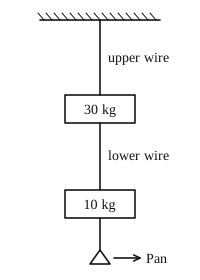
नीचे चित्र में दर्शाए अनुसार दो तार स्टील के बने हैं तथा उनका भंजन प्रतिबल
N/m
2 है। ऊपरी तार के अनुप्रस्थ काट का क्षेत्रफल 0.008 cm
2 तथा निचले तार का 0.004 cm
2 है। किसी भी तार के टूटे बिना पलड़े (pan) में जोड़ा जा सकने वाला अधिकतम द्रव्यमान ______ kg है।
(
m/s
2 लीजिए)
- A56
- B38
- C96
- D5.6
Show answer
Concept: Maximum tension a wire can bear breaking stress × area. Upper wire holds 30 kg + 10 kg + ; lower wire holds 10 kg + (pan mass neglected).
- Upper: N → → kg.
- Lower: N → → kg.
- Both must hold → kg. (A) 56 kg would break the lower wire.
Short trick: Check each wire separately; the smaller limit wins.
Answer: (B) 38
अवधारणा: कोई तार अधिकतम जितना तनाव सह सकता है भंजन प्रतिबल × क्षेत्रफल। ऊपरी तार 30 kg + 10 kg + को धारण करता है; निचला तार 10 kg + को (पलड़े का द्रव्यमान नगण्य)।
- ऊपरी: N → → kg।
- निचला: N → → kg।
- दोनों शर्तें आवश्यक → kg। (A) 56 kg पर निचला तार टूट जाएगा।
शॉर्ट ट्रिक: प्रत्येक तार अलग से जाँचिए; छोटी सीमा ही मान्य।
उत्तर: (B) 38
JEE Main 2026 (April) – Paper 1 (B.E./B.Tech)PhysicsMechanical Properties of Solids – breaking stressJEE Main 2026 (April) – Paper 1 (B.E./B.Tech) 2026 · 5 Apr Shift 1
Q344.An a.c. source of angular frequency is connected across a resistor and a capacitor in series. The current is observed as . Now the frequency of the source is changed to , (keeping the voltage unchanged) the current is found to be . The ratio of resistance to reactance at frequency is
कोणीय आवृत्ति का एक प्रत्यावर्ती स्रोत श्रेणीक्रम में जुड़े प्रतिरोधक तथा संधारित्र के सिरों पर जोड़ा जाता है। धारा प्रेक्षित होती है। अब स्रोत की आवृत्ति कर दी जाती है (वोल्टता अपरिवर्तित रखते हुए), तो धारा पाई जाती है। आवृत्ति पर प्रतिरोध तथा प्रतिघात का अनुपात है
- A
- B
- C
- D
Show answer
Concept: with ; at the reactance becomes .
- .
- → .
- .
Short trick: Impedance ratio 3 → .
Answer: (C)
अवधारणा: , जहाँ ; पर प्रतिघात हो जाता है।
- ।
- → ।
- ।
शॉर्ट ट्रिक: प्रतिबाधा अनुपात 3 → ।
उत्तर: (C)
JEE Main 2026 (April) – Paper 1 (B.E./B.Tech)PhysicsAlternating Current – series RC circuitJEE Main 2026 (April) – Paper 1 (B.E./B.Tech) 2026 · 5 Apr Shift 1
Q345.For the given logic circuit, which of the following inputs combination will make both LED−1 and LED−2 to glow?
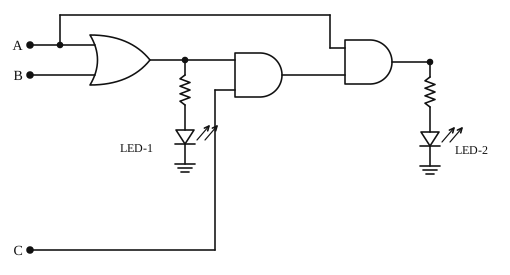
दिए गए लॉजिक परिपथ के लिए, निम्नलिखित में से कौन-सा निवेश संयोजन LED−1 तथा LED−2 दोनों को दीप्त करेगा?
- AA = 0, B = 1, C = 1
- BA = 1, B = 0, C = 0
- CA = 1, B = 0, C = 1
- DA = 1, B = 1, C = 0
Show answer
Concept: An LED connected from a gate output to ground glows when that output is 1.
- OR output drives LED−1.
- Middle AND: .
- Last AND: drives LED−2.
- Both glow ⇔ and ⇔ , (any ). Only (C) has , ; (A) has , (B) and (D) have .
Short trick: → LED−2 .
Answer: (C) A = 1, B = 0, C = 1
अवधारणा: गेट के निर्गत से भूसंपर्क तक जुड़ा LED तब दीप्त होता है जब वह निर्गत 1 हो।
- OR निर्गत , LED−1 को चलाता है।
- मध्य AND: ।
- अंतिम AND: , LED−2 को चलाता है।
- दोनों दीप्त ⇔ तथा ⇔ , (कोई भी )। केवल (C) में , है; (A) में , (B) तथा (D) में है।
शॉर्ट ट्रिक: → LED−2 ।
उत्तर: (C) A = 1, B = 0, C = 1
JEE Main 2026 (April) – Paper 1 (B.E./B.Tech)PhysicsSemiconductors – logic gatesJEE Main 2026 (April) – Paper 1 (B.E./B.Tech) 2026 · 5 Apr Shift 1
Q346.A cube has side length 5 cm and modulus of rigidity N/m2. The displacement produced by a force of 10 N in the upper face of cube is _____ mm.
एक घन की भुजा की लंबाई 5 cm तथा दृढ़ता गुणांक N/m2 है। घन के ऊपरी फलक पर 10 N के बल द्वारा उत्पन्न विस्थापन _____ mm है।
Show answer
Concept: Shear modulus → .
- m2, m.
- m.
- mm.
Short trick: For a cube m.
Answer: 2
अवधारणा: दृढ़ता गुणांक → ।
- m2, m।
- m।
- mm।
शॉर्ट ट्रिक: घन के लिए m।
उत्तर: 2
JEE Main 2026 (April) – Paper 1 (B.E./B.Tech)PhysicsMechanical Properties of Solids – shear modulusJEE Main 2026 (April) – Paper 1 (B.E./B.Tech) 2026 · 5 Apr Shift 1
Q347.From 18 m height above the ground a ball is dropped from rest. The height above the ground at which the magnitude of velocity equal to the magnitude of acceleration (in the same set of units) due to gravity is ____ m.
(Take m/s2 and neglect the air resistance)
भूमि से 18 m ऊँचाई से एक गेंद को विरामावस्था से गिराया जाता है। भूमि से वह ऊँचाई, जिस पर वेग का परिमाण गुरुत्वीय त्वरण के परिमाण (समान मात्रक पद्धति में) के बराबर हो, ____ m है।
( m/s2 लीजिए तथा वायु प्रतिरोध की उपेक्षा कीजिए)
Show answer
Concept: Free fall from rest: , where is the distance fallen.
- Required m/s.
- m.
- Height above ground m.
Short trick: ⇒ fallen m.
Answer: 13
अवधारणा: विराम से मुक्त पतन: , जहाँ गिरी हुई दूरी है।
- आवश्यक m/s।
- m।
- भूमि से ऊँचाई m।
शॉर्ट ट्रिक: ⇒ गिरी दूरी m।
उत्तर: 13
JEE Main 2026 (April) – Paper 1 (B.E./B.Tech)PhysicsKinematics – free fallJEE Main 2026 (April) – Paper 1 (B.E./B.Tech) 2026 · 5 Apr Shift 1
Q348.A transverse wave on a string is described by . where , are in cm and in seconds. The least distance between the two successive crests in the wave is ____ cm. (Nearest integer)
()
एक डोरी पर अनुप्रस्थ तरंग द्वारा वर्णित है, जहाँ , cm में तथा सेकंड में हैं। तरंग में दो क्रमागत शीर्षों (crests) के बीच न्यूनतम दूरी ____ cm है। (निकटतम पूर्णांक)
()
Show answer
Concept: Distance between successive crests = wavelength .
- cm−1.
- cm.
- Nearest integer: 349 cm.
Short trick: cm.
Answer: 349
अवधारणा: क्रमागत शीर्षों के बीच दूरी = तरंगदैर्ध्य ।
- cm−1।
- cm।
- निकटतम पूर्णांक: 349 cm।
शॉर्ट ट्रिक: cm।
उत्तर: 349
JEE Main 2026 (April) – Paper 1 (B.E./B.Tech)PhysicsWaves – wave equation, wavelengthJEE Main 2026 (April) – Paper 1 (B.E./B.Tech) 2026 · 5 Apr Shift 1
Q349.The charged particle moving in a uniform magnetic field of T has an acceleration m/s2. The value of is
T के एकसमान चुम्बकीय क्षेत्र में गतिमान आवेशित कण का त्वरण m/s2 है। का मान है
Show answer
Concept: Magnetic force is always perpendicular to , so .
- .
- .
Short trick: Dot product of acceleration with B is zero.
Answer: 12
अवधारणा: चुम्बकीय बल सदैव के लंबवत होता है, अतः ।
- ।
- ।
शॉर्ट ट्रिक: त्वरण तथा B का अदिश गुणनफल शून्य होता है।
उत्तर: 12
JEE Main 2026 (April) – Paper 1 (B.E./B.Tech)PhysicsMoving Charges – magnetic force perpendicular to fieldJEE Main 2026 (April) – Paper 1 (B.E./B.Tech) 2026 · 5 Apr Shift 1
Q350.In the given circuit below inductance values of
,
and
are same. The magnetic energy stored in the entire circuit is (
) and that stored in the
inductor is (
).
is _______.
(Ignore the mutual inductance if any)
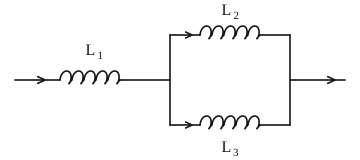
नीचे दिए गए परिपथ में
,
तथा
के प्रेरकत्व के मान समान हैं। संपूर्ण परिपथ में संचित चुम्बकीय ऊर्जा (
) है तथा
प्रेरक में संचित ऊर्जा (
) है।
का मान _______ है।
(अन्योन्य प्रेरकत्व, यदि कोई हो, की उपेक्षा कीजिए)
Show answer
Concept: Energy in an inductor . Current flows through and divides equally ( each) between the identical parallel inductors , .
- ; .
- .
- .
Short trick: Energies in ratio → total/one parallel coil .
Answer: 6
अवधारणा: प्रेरक में ऊर्जा । धारा , से प्रवाहित होकर समान समांतर प्रेरकों , में बराबर ( प्रत्येक) बँट जाती है।
- ; ।
- ।
- ।
शॉर्ट ट्रिक: ऊर्जाओं का अनुपात → कुल/एक समांतर कुंडली ।
उत्तर: 6
JEE Main 2026 (April) – Paper 1 (B.E./B.Tech)PhysicsElectromagnetic Induction – energy stored in inductorsJEE Main 2026 (April) – Paper 1 (B.E./B.Tech) 2026 · 5 Apr Shift 1
Q351.How many grams of residue is obtained by heating 2.76 g of silver carbonate?
(Given : Molar mass of C, O and Ag are 12, 16 and 108 g mol−1 respectively)
2.76 g सिल्वर कार्बोनेट को गर्म करने पर कितने ग्राम अवशेष प्राप्त होता है?
(दिया है : C, O तथा Ag के मोलर द्रव्यमान क्रमशः 12, 16 तथा 108 g mol−1 हैं)
- A1.08 g
- B2.16 g
- C3.24 g
- D4.32 g
Show answer
Concept: On strong heating silver carbonate decomposes completely to metallic silver: 2Ag2CO3 → 4Ag + 2CO2 + O2. The residue is Ag.
- Molar mass of Ag2CO3 = 2(108) + 12 + 3(16) = 276 g mol−1.
- Moles of Ag2CO3 = 2.76/276 = 0.01 mol.
- Each mole gives 2 mol Ag → 0.02 mol Ag = 0.02 × 108 = 2.16 g.
Short trick: All the silver stays behind: mass of Ag = 2.76 × (216/276) = 2.16 g.
Answer: (B) 2.16 g
अवधारणा: तीव्र गर्म करने पर सिल्वर कार्बोनेट पूर्णतः धात्विक सिल्वर में अपघटित हो जाता है: 2Ag2CO3 → 4Ag + 2CO2 + O2। अवशेष Ag है।
- Ag2CO3 का मोलर द्रव्यमान = 2(108) + 12 + 3(16) = 276 g mol−1।
- Ag2CO3 के मोल = 2.76/276 = 0.01 mol।
- प्रत्येक मोल से 2 mol Ag → 0.02 mol Ag = 0.02 × 108 = 2.16 g।
शॉर्ट ट्रिक: सारा सिल्वर बचा रहता है: Ag का द्रव्यमान = 2.76 × (216/276) = 2.16 g।
उत्तर: (B) 2.16 g
JEE Main 2026 (April) – Paper 1 (B.E./B.Tech)ChemistrySome Basic Concepts – stoichiometryJEE Main 2026 (April) – Paper 1 (B.E./B.Tech) 2026 · 5 Apr Shift 1
Q352.Arrange the following atomic orbitals of multi electron atoms in order of increasing energy.
Choose the correct answer from the options given below:
बहु-इलेक्ट्रॉन परमाणुओं के निम्नलिखित परमाणु कक्षकों को ऊर्जा के बढ़ते क्रम में व्यवस्थित कीजिए।
नीचे दिए गए विकल्पों में से सही उत्तर चुनिए:
- AC < D < B < A < E
- BB < A < E < C < D
- CE < C < D < B < A
- DE < B < A < D < C
Show answer
Concept: In multi-electron atoms orbital energy follows the (n + l) rule; for equal (n + l), the orbital with lower n has lower energy. The value of m does not affect the energy.
- A: 3d → n + l = 5
- B: 4s → n + l = 4
- C: 6p → n + l = 7
- D: 5p → n + l = 6
- E: 2p → n + l = 3
- Increasing order: E (3) < B (4) < A (5) < D (6) < C (7). (A), (B) and (C) do not follow increasing (n + l).
Short trick: Just write n + l: 5, 4, 7, 6, 3 and sort.
Answer: (D) E < B < A < D < C
अवधारणा: बहु-इलेक्ट्रॉन परमाणुओं में कक्षक ऊर्जा (n + l) नियम का पालन करती है; समान (n + l) होने पर कम n वाले कक्षक की ऊर्जा कम होती है। m का मान ऊर्जा को प्रभावित नहीं करता।
- A: 3d → n + l = 5
- B: 4s → n + l = 4
- C: 6p → n + l = 7
- D: 5p → n + l = 6
- E: 2p → n + l = 3
- बढ़ता क्रम: E (3) < B (4) < A (5) < D (6) < C (7)। (A), (B) तथा (C) बढ़ते (n + l) क्रम का पालन नहीं करते।
शॉर्ट ट्रिक: केवल n + l लिखिए: 5, 4, 7, 6, 3 और क्रम में लगाइए।
उत्तर: (D) E < B < A < D < C
JEE Main 2026 (April) – Paper 1 (B.E./B.Tech)ChemistryAtomic Structure – (n + l) ruleJEE Main 2026 (April) – Paper 1 (B.E./B.Tech) 2026 · 5 Apr Shift 1
Q353.Identify the correct statements from the following :
- Heisenberg uncertainty principle is applicable to electrons.
- The size of 2px orbital is less than the size of 3px orbital.
- The energy of 2s orbital of H atom is equal to the energy of 2s orbital of Li.
- The electronic configuration of Cr is [Ar] 3d5 4s1
Choose the correct answer from the options given below:
निम्नलिखित में से सही कथनों को पहचानिए :
- हाइज़ेनबर्ग अनिश्चितता सिद्धांत (uncertainty principle) इलेक्ट्रॉनों पर लागू होता है।
- 2px कक्षक का आकार 3px कक्षक के आकार से कम होता है।
- H परमाणु के 2s कक्षक की ऊर्जा, Li के 2s कक्षक की ऊर्जा के बराबर होती है।
- Cr का इलेक्ट्रॉनिक विन्यास [Ar] 3d5 4s1 है।
नीचे दिए गए विकल्पों में से सही उत्तर चुनिए:
- AA, B and C Onlyकेवल A, B और C
- BA, B and D Onlyकेवल A, B और D
- CB, C and D Onlyकेवल B, C और D
- DA, C and D Onlyकेवल A, C और D
Show answer
Concept: Energy of an orbital depends on the effective nuclear charge it experiences; orbital size grows with n.
- A – true: the uncertainty principle is significant for microscopic particles like electrons.
- B – true: size increases with n, so 2px is smaller than 3px.
- C – false: energy depends on nuclear charge; Li (Z = 3) attracts its 2s electron more strongly, so its 2s energy is lower (more negative) than that of H (Z = 1).
- D – true: Cr (Z = 24) has the half-filled stable configuration [Ar] 3d5 4s1.
- Correct: A, B, D. Options (A), (C), (D) all contain the false statement C.
Answer: (B) A, B and D Only
अवधारणा: किसी कक्षक की ऊर्जा उस पर लगने वाले प्रभावी नाभिकीय आवेश पर निर्भर करती है; कक्षक का आकार n के साथ बढ़ता है।
- A – सत्य: अनिश्चितता सिद्धांत इलेक्ट्रॉन जैसे सूक्ष्म कणों के लिए महत्वपूर्ण है।
- B – सत्य: आकार n के साथ बढ़ता है, अतः 2px, 3px से छोटा है।
- C – असत्य: ऊर्जा नाभिकीय आवेश पर निर्भर करती है; Li (Z = 3) अपने 2s इलेक्ट्रॉन को अधिक प्रबलता से आकर्षित करता है, अतः इसकी 2s ऊर्जा H (Z = 1) की तुलना में कम (अधिक ऋणात्मक) होती है।
- D – सत्य: Cr (Z = 24) का अर्धपूरित स्थायी विन्यास [Ar] 3d5 4s1 है।
- सही: A, B, D। विकल्प (A), (C), (D) सभी में असत्य कथन C शामिल है।
उत्तर: (B) केवल A, B और D
JEE Main 2026 (April) – Paper 1 (B.E./B.Tech)ChemistryAtomic Structure – quantum mechanical modelJEE Main 2026 (April) – Paper 1 (B.E./B.Tech) 2026 · 5 Apr Shift 1
Q354.What is the mole fraction of water in 10% by weight (w/w) of aqueous urea solution?
[Given: Molar mass of H, O, C and N are 1, 16, 12 and 14 g mol−1 respectively.]
यूरिया के 10% भार द्वारा (w/w) जलीय विलयन में जल का मोल अंश क्या है?
[दिया है: H, O, C तथा N के मोलर द्रव्यमान क्रमशः 1, 16, 12 तथा 14 g mol−1 हैं।]
- A0.825
- B0.032
- C0.867
- D0.967
Show answer
Concept: Mole fraction of water = nwater/(nwater + nurea).
- Take 100 g solution: urea = 10 g, water = 90 g.
- Urea NH2CONH2: M = 60 g mol−1 → n = 10/60 = 0.1667 mol.
- Water: n = 90/18 = 5 mol.
Short trick: Water is in large excess, so xwater must be close to 1 – only (D) fits.
Answer: (D) 0.967
अवधारणा: जल का मोल अंश = nजल/(nजल + nयूरिया)।
- 100 g विलयन लीजिए: यूरिया = 10 g, जल = 90 g।
- यूरिया NH2CONH2: M = 60 g mol−1 → n = 10/60 = 0.1667 mol।
- जल: n = 90/18 = 5 mol।
शॉर्ट ट्रिक: जल अत्यधिक मात्रा में है, अतः xजल 1 के निकट होना चाहिए – केवल (D) उपयुक्त है।
उत्तर: (D) 0.967
JEE Main 2026 (April) – Paper 1 (B.E./B.Tech)ChemistrySolutions – mole fractionJEE Main 2026 (April) – Paper 1 (B.E./B.Tech) 2026 · 5 Apr Shift 1
Q355.M3A2 is a sparingly soluble salt of molar mass g mol−1 and solubility g L−1.
The ratio of the molar concentration of the anion (A3−) to the solubility product of the salt is
M3A2 एक अल्प विलेय लवण है जिसका मोलर द्रव्यमान g mol−1 तथा विलेयता g L−1 है।
ऋणायन (A3−) की मोलर सांद्रता तथा लवण के विलेयता गुणनफल का अनुपात है
- A
- B
- C
- D
Show answer
Concept: For M3A2 ⇌ 3M2+ + 2A3−, with molar solubility s: Ksp = (3s)3(2s)2 = 108s5.
- Molar solubility mol L−1.
- [A3−] = 2s.
Short trick: Ratio ∝ s−4 = (y/x)4 with coefficient 2/108 = 1/54.
Answer: (A)
अवधारणा: M3A2 ⇌ 3M2+ + 2A3− के लिए, मोलर विलेयता s होने पर: Ksp = (3s)3(2s)2 = 108s5।
- मोलर विलेयता mol L−1।
- [A3−] = 2s।
शॉर्ट ट्रिक: अनुपात ∝ s−4 = (y/x)4, गुणांक 2/108 = 1/54।
उत्तर: (A)
JEE Main 2026 (April) – Paper 1 (B.E./B.Tech)ChemistryIonic Equilibrium – solubility productJEE Main 2026 (April) – Paper 1 (B.E./B.Tech) 2026 · 5 Apr Shift 1
Q356.Arrange the following resultant mixtures in increasing order of their pH values
- 10 mL 0.2 M Ca(OH)2 + 25 mL 0.1 M HCl
- 10 mL 0.01 M H2SO4 + 10 mL 0.01 M Ca(OH)2
- 10 mL 0.1 M H2SO4 + 10 mL 0.1 M KOH
Choose the correct answer from the options given below:
निम्नलिखित परिणामी मिश्रणों को उनके pH मानों के बढ़ते क्रम में व्यवस्थित कीजिए
- 10 mL 0.2 M Ca(OH)2 + 25 mL 0.1 M HCl
- 10 mL 0.01 M H2SO4 + 10 mL 0.01 M Ca(OH)2
- 10 mL 0.1 M H2SO4 + 10 mL 0.1 M KOH
नीचे दिए गए विकल्पों में से सही उत्तर चुनिए:
- AB < C < A
- BC < A < B
- CC < B < A
- DA < C < B
Show answer
Concept: Compare milliequivalents of H+ and OH−; whichever is in excess decides acidic/basic/neutral.
- A: OH− = 10 × 0.2 × 2 = 4 mmol; H+ = 25 × 0.1 = 2.5 mmol → excess OH− 1.5 mmol in 35 mL → [OH−] ≈ 0.043 M, pH ≈ 12.6 (basic).
- B: H+ = 10 × 0.01 × 2 = 0.2 mmol; OH− = 10 × 0.01 × 2 = 0.2 mmol → exact neutralisation, pH = 7.
- C: H+ = 10 × 0.1 × 2 = 2 mmol; OH− = 10 × 0.1 = 1 mmol → excess H+ 1 mmol in 20 mL → [H+] = 0.05 M, pH ≈ 1.3 (acidic).
- Increasing pH: C < B < A.
Short trick: Acidic < neutral < basic: C (acid left) < B (neutral) < A (base left).
Answer: (C) C < B < A
अवधारणा: H+ तथा OH− के मिलीतुल्यांकों की तुलना कीजिए; जो अधिकता में है वही अम्लीय/क्षारीय/उदासीन तय करता है।
- A: OH− = 10 × 0.2 × 2 = 4 mmol; H+ = 25 × 0.1 = 2.5 mmol → 35 mL में 1.5 mmol OH− अधिक → [OH−] ≈ 0.043 M, pH ≈ 12.6 (क्षारीय)।
- B: H+ = 10 × 0.01 × 2 = 0.2 mmol; OH− = 10 × 0.01 × 2 = 0.2 mmol → पूर्ण उदासीनीकरण, pH = 7।
- C: H+ = 10 × 0.1 × 2 = 2 mmol; OH− = 10 × 0.1 = 1 mmol → 20 mL में 1 mmol H+ अधिक → [H+] = 0.05 M, pH ≈ 1.3 (अम्लीय)।
- pH का बढ़ता क्रम: C < B < A।
शॉर्ट ट्रिक: अम्लीय < उदासीन < क्षारीय: C < B < A।
उत्तर: (C) C < B < A
JEE Main 2026 (April) – Paper 1 (B.E./B.Tech)ChemistryIonic Equilibrium – pH of mixturesJEE Main 2026 (April) – Paper 1 (B.E./B.Tech) 2026 · 5 Apr Shift 1
Q357.First order gas phase reaction
A → B + C
= initial pressure of gas A, = total pressure of the reaction mixture at time
Expression of rate constant (k) is
प्रथम कोटि गैस प्रावस्था अभिक्रिया
A → B + C
= गैस A का प्रारंभिक दाब, = समय पर अभिक्रिया मिश्रण का कुल दाब
वेग स्थिरांक (k) का व्यंजक है
- A
- B
- C
- D
Show answer
Concept: For a first-order reaction , where is the partial pressure of A at time t.
- At t: A = , B = x, C = x → , so .
- .
Short trick: Check at t = 0: pt = pi must give ln 1 = 0 – only (A) satisfies this.
Answer: (A)
अवधारणा: प्रथम कोटि अभिक्रिया के लिए , जहाँ समय t पर A का आंशिक दाब है।
- समय t पर: A = , B = x, C = x → , अतः ।
- ।
शॉर्ट ट्रिक: t = 0 पर जाँचें: pt = pi से ln 1 = 0 आना चाहिए – केवल (A) यह संतुष्ट करता है।
उत्तर: (A)
JEE Main 2026 (April) – Paper 1 (B.E./B.Tech)ChemistryChemical Kinetics – first order gas-phase reactionJEE Main 2026 (April) – Paper 1 (B.E./B.Tech) 2026 · 5 Apr Shift 1
Q358.Given below are two statements:
Statement I: The correct order of electronegativity of fluorine, oxygen and nitrogen is F > O > N.
Statement II: The oxidation state of oxygen in OF2 is +2 and in Na2O is −2.
In the light of the above statements, choose the correct answer from the options given below
नीचे दो कथन दिए गए हैं:
कथन I: फ्लुओरीन, ऑक्सीजन तथा नाइट्रोजन की विद्युतऋणात्मकता का सही क्रम F > O > N है।
कथन II: OF2 में ऑक्सीजन की ऑक्सीकरण अवस्था +2 तथा Na2O में −2 है।
उपर्युक्त कथनों के आलोक में, नीचे दिए गए विकल्पों में से सही उत्तर चुनिए
- ABoth Statement I and Statement II are trueकथन I और कथन II दोनों सत्य हैं
- BBoth Statement I and Statement II are falseकथन I और कथन II दोनों असत्य हैं
- CStatement I is true but Statement II is falseकथन I सत्य है परन्तु कथन II असत्य है
- DStatement I is false but Statement II is trueकथन I असत्य है परन्तु कथन II सत्य है
Show answer
Concept: Electronegativity increases across a period; F is the most electronegative element and always shows −1.
- Statement I: Pauling values F 4.0 > O 3.5 > N 3.0 → true.
- Statement II: in OF2, F = −1 each, so O = +2; in Na2O, Na = +1, so O = −2 → true.
Answer: (A) Both Statement I and Statement II are true
अवधारणा: आवर्त में विद्युतऋणात्मकता बढ़ती है; F सर्वाधिक विद्युतऋणात्मक तत्व है और सदैव −1 दर्शाता है।
- कथन I: पॉलिंग मान F 4.0 > O 3.5 > N 3.0 → सत्य।
- कथन II: OF2 में प्रत्येक F = −1, अतः O = +2; Na2O में Na = +1, अतः O = −2 → सत्य।
उत्तर: (A) कथन I और कथन II दोनों सत्य हैं
JEE Main 2026 (April) – Paper 1 (B.E./B.Tech)ChemistryPeriodic Properties – electronegativity & oxidation stateJEE Main 2026 (April) – Paper 1 (B.E./B.Tech) 2026 · 5 Apr Shift 1
Q359.Correct statements from the following are:
- Nitrogen in oxidation states from +1 to +4 disproportionates in acid medium.
- Nitrogen has the ability to form dπ - pπ multiple bonds with itself and other elements with small size and high electronegativity.
- N-N single bond is stronger than P-P single bond.
- Nitrogen has highest density in its group due to small size.
- The maximum covalency of nitrogen is four since it has only four valence orbitals for bonding.
Choose the correct answer from the options given below:
निम्नलिखित में से सही कथन हैं:
- +1 से +4 तक की ऑक्सीकरण अवस्थाओं में नाइट्रोजन अम्लीय माध्यम में असमानुपातित (disproportionate) होता है।
- नाइट्रोजन में स्वयं के साथ तथा छोटे आकार एवं उच्च विद्युतऋणात्मकता वाले अन्य तत्वों के साथ dπ - pπ बहुआबंध बनाने की क्षमता होती है।
- N-N एकल आबंध, P-P एकल आबंध से प्रबल होता है।
- छोटे आकार के कारण नाइट्रोजन का घनत्व अपने वर्ग में सर्वाधिक होता है।
- नाइट्रोजन की अधिकतम सहसंयोजकता चार है क्योंकि आबंधन के लिए इसके पास केवल चार संयोजकता कक्षक हैं।
नीचे दिए गए विकल्पों में से सही उत्तर चुनिए:
- AB, C and D Onlyकेवल B, C और D
- BC, D and E Onlyकेवल C, D और E
- CA, C and E Onlyकेवल A, C और E
- DA and E Onlyकेवल A और E
Show answer
Concept: Nitrogen differs from the rest of Group 15 because of its small size, high electronegativity and absence of d-orbitals.
- A – true: all oxidation states of N from +1 to +4 tend to disproportionate in acid solution (e.g. 3HNO2 → HNO3 + 2NO + H2O).
- B – false: nitrogen forms pπ–pπ multiple bonds; it has no d-orbitals, so it cannot form dπ–pπ bonds.
- C – false: the N–N single bond is weaker than P–P because of strong repulsion between lone pairs on the small N atoms.
- D – false: density increases down the group; nitrogen has the lowest density.
- E – true: N has only 2s and 2p (four) valence orbitals, so its maximum covalency is 4.
- Correct: A and E. (A), (B), (C) include at least one of the false statements B, C, D.
Answer: (D) A and E Only
अवधारणा: छोटे आकार, उच्च विद्युतऋणात्मकता तथा d-कक्षकों की अनुपस्थिति के कारण नाइट्रोजन वर्ग 15 के अन्य सदस्यों से भिन्न है।
- A – सत्य: +1 से +4 तक N की सभी ऑक्सीकरण अवस्थाएँ अम्लीय विलयन में असमानुपातित होने की प्रवृत्ति रखती हैं (जैसे 3HNO2 → HNO3 + 2NO + H2O)।
- B – असत्य: नाइट्रोजन pπ–pπ बहुआबंध बनाता है; इसमें d-कक्षक नहीं होते, अतः यह dπ–pπ आबंध नहीं बना सकता।
- C – असत्य: छोटे N परमाणुओं पर एकाकी युग्मों के बीच प्रबल प्रतिकर्षण के कारण N–N एकल आबंध, P–P से दुर्बल होता है।
- D – असत्य: वर्ग में नीचे जाने पर घनत्व बढ़ता है; नाइट्रोजन का घनत्व न्यूनतम है।
- E – सत्य: N में केवल 2s तथा 2p (चार) संयोजकता कक्षक हैं, अतः इसकी अधिकतम सहसंयोजकता 4 है।
- सही: A और E। (A), (B), (C) में असत्य कथन B, C, D में से कम से कम एक शामिल है।
उत्तर: (D) केवल A और E
JEE Main 2026 (April) – Paper 1 (B.E./B.Tech)Chemistryp-Block – Group 15 (nitrogen)JEE Main 2026 (April) – Paper 1 (B.E./B.Tech) 2026 · 5 Apr Shift 1
Q360.Which of the following is NOT a physical or chemical characteristics of interstitial compounds?
निम्नलिखित में से कौन-सा अंतराकाशी यौगिकों (interstitial compounds) का भौतिक या रासायनिक अभिलक्षण नहीं है?
- AThey have high melting points, higher than those of pure metals.इनके गलनांक उच्च होते हैं, शुद्ध धातुओं से भी अधिक।
- BThey are very soft and ionic in nature.ये अत्यंत नरम तथा आयनिक प्रकृति के होते हैं।
- CThey retain metallic conductivity.ये धात्विक चालकता बनाए रखते हैं।
- DThey are chemically inert and usually non-stoichiometric.ये रासायनिक रूप से अक्रिय तथा सामान्यतः अरससमीकरणमितीय (non-stoichiometric) होते हैं।
Show answer
Concept: Interstitial compounds (e.g. TiC, Mn4N, Fe3H) form when small atoms H, C, N occupy voids in metal lattices.
- (A) is a property: their melting points are higher than those of the pure metals.
- (B) is NOT a property: they are very hard (some borides approach diamond) and are not ionic.
- (C) is a property: they retain metallic conductivity.
- (D) is a property: they are chemically inert and usually non-stoichiometric.
Answer: (B) They are very soft and ionic in nature.
अवधारणा: अंतराकाशी यौगिक (जैसे TiC, Mn4N, Fe3H) तब बनते हैं जब छोटे परमाणु H, C, N धातु जालक के रिक्त स्थानों में स्थित हो जाते हैं।
- (A) एक गुण है: इनके गलनांक शुद्ध धातुओं से अधिक होते हैं।
- (B) गुण नहीं है: ये अत्यंत कठोर होते हैं (कुछ बोराइड हीरे के समान) तथा आयनिक नहीं होते।
- (C) एक गुण है: ये धात्विक चालकता बनाए रखते हैं।
- (D) एक गुण है: ये रासायनिक रूप से अक्रिय तथा सामान्यतः अरससमीकरणमितीय होते हैं।
उत्तर: (B) ये अत्यंत नरम तथा आयनिक प्रकृति के होते हैं।
JEE Main 2026 (April) – Paper 1 (B.E./B.Tech)Chemistryd-Block – interstitial compoundsJEE Main 2026 (April) – Paper 1 (B.E./B.Tech) 2026 · 5 Apr Shift 1

