Q421.A diode has Zener voltage of 10 V and maximum power dissipation of 0.5 W, then the minimum resistance to be used in series with this diode for safety when it is connected to a 25 V power supply is ______ .
एक डायोड की ज़ेनर वोल्टता 10 V तथा अधिकतम शक्ति क्षय (power dissipation) 0.5 W है, तब इसे 25 V की विद्युत आपूर्ति से जोड़ने पर सुरक्षा हेतु इस डायोड के श्रेणीक्रम में लगाया जाने वाला न्यूनतम प्रतिरोध ______ है।
Show answer
Concept: In breakdown the Zener holds across itself; the current through it must not exceed . The series resistor drops the remaining voltage.
- A.
- Voltage across the series resistor: V.
- (a smaller would push the current above 0.05 A).
Short trick: .
Answer: 300
अवधारणा: भंजन (breakdown) अवस्था में ज़ेनर अपने सिरों पर बनाए रखता है; इससे प्रवाहित धारा से अधिक नहीं होनी चाहिए। श्रेणी प्रतिरोध शेष वोल्टता को वहन करता है।
- A.
- श्रेणी प्रतिरोध के सिरों पर वोल्टता: V.
- (इससे कम होने पर धारा 0.05 A से अधिक हो जाएगी)।
शॉर्ट ट्रिक: .
उत्तर: 300
JEE Main 2026 (April) – Paper 1 (B.E./B.Tech)PhysicsSemiconductors – Zener diode (series resistance)JEE Main 2026 (April) – Paper 1 (B.E./B.Tech) 2026 · 4 Apr Shift 2
Q422.A gun mounted on the ground fires bullets in all directions with same speed. The farthest distance the bullets could reach is 6.4 m. The speed of the bullets from the gun is ______ m/s.
(take )
भूमि पर स्थापित एक बन्दूक सभी दिशाओं में समान चाल से गोलियाँ दागती है। गोलियाँ अधिकतम 6.4 m दूरी तक पहुँच सकती हैं। बन्दूक से निकलने वाली गोलियों की चाल ______ m/s है।
( लीजिए)
Show answer
Concept: For a ground-level projectile , which is largest at : .
- m.
- .
- m/s.
Short trick: Farthest reach on level ground = → m/s.
Answer: 8
अवधारणा: भूमि से भूमि तक प्रक्षेप्य के लिए , जो पर अधिकतम होती है: .
- m.
- .
- m/s.
शॉर्ट ट्रिक: समतल भूमि पर अधिकतम दूरी → m/s.
उत्तर: 8
JEE Main 2026 (April) – Paper 1 (B.E./B.Tech)PhysicsKinematics – maximum range of projectileJEE Main 2026 (April) – Paper 1 (B.E./B.Tech) 2026 · 4 Apr Shift 2
Q423.Two identical small bar magnets each of dipole moment
J/T are placed at a center to center separation of 10 cm, with their axes perpendicular to each other as shown in figure. The value of magnetic field at the point P midway between the magnets is
T. The value of
is ______.
( Tm/A)
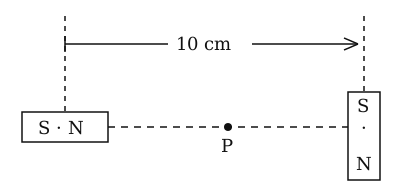
दो सर्वसम छोटे छड़ चुम्बक, प्रत्येक का द्विध्रुव आघूर्ण
J/T, केन्द्र से केन्द्र 10 cm की दूरी पर इस प्रकार रखे हैं कि उनके अक्ष परस्पर लम्बवत् हैं, जैसा कि चित्र में दर्शाया गया है। चुम्बकों के ठीक मध्य बिन्दु P पर चुम्बकीय क्षेत्र का मान
T है।
का मान ______ है।
( Tm/A)
Show answer
Concept: P is 5 cm from each centre. It lies on the axis of the left magnet () and on the equatorial line of the right magnet (). The two fields are perpendicular (horizontal and vertical), so add them as vectors.
- T.
- Axial field (left magnet, horizontal): T.
- Equatorial field (right magnet, vertical): T.
- T.
Short trick: Axial : equatorial at equal distance, so ; the in makes it T.
Answer: 12
अवधारणा: P प्रत्येक केन्द्र से 5 cm दूर है। यह बाएँ चुम्बक के अक्ष पर () तथा दाएँ चुम्बक की निरक्षीय रेखा (equatorial line) पर () स्थित है। दोनों क्षेत्र परस्पर लम्बवत् (क्षैतिज व ऊर्ध्वाधर) हैं, अतः इन्हें सदिश रूप से जोड़ते हैं।
- T.
- अक्षीय क्षेत्र (बायाँ चुम्बक, क्षैतिज): T.
- निरक्षीय क्षेत्र (दायाँ चुम्बक, ऊर्ध्वाधर): T.
- T.
शॉर्ट ट्रिक: समान दूरी पर अक्षीय : निरक्षीय , अतः ; में उपस्थित से यह T हो जाता है।
उत्तर: 12
JEE Main 2026 (April) – Paper 1 (B.E./B.Tech)PhysicsMagnetism – field of bar magnets (axial & equatorial)JEE Main 2026 (April) – Paper 1 (B.E./B.Tech) 2026 · 4 Apr Shift 2
Q424.A circular coil of radius 2 cm and 125 turns carries a current of 1 A. The coil is placed in a uniform magnetic field of magnitude 0.4 T. The axis of the coil makes an angle of 30° with the direction of the magnetic field. The torque acting on the coil is
N.m. The value of
is ______.
()
2 cm त्रिज्या तथा 125 फेरों वाली एक वृत्ताकार कुण्डली में 1 A धारा प्रवाहित हो रही है। कुण्डली को 0.4 T परिमाण के एकसमान चुम्बकीय क्षेत्र में रखा गया है। कुण्डली का अक्ष चुम्बकीय क्षेत्र की दिशा से 30° का कोण बनाता है। कुण्डली पर कार्यरत बल-आघूर्ण
N.m है।
का मान ______ है।
()
Show answer
Concept: , where is the angle between the coil's axis (its magnetic moment) and .
- .
- .
- N m N m.
Short trick: ; .
Answer: 314
अवधारणा: , जहाँ कुण्डली के अक्ष (उसके चुम्बकीय आघूर्ण) तथा के बीच का कोण है।
- .
- .
- N m N m.
शॉर्ट ट्रिक: ; .
उत्तर: 314
JEE Main 2026 (April) – Paper 1 (B.E./B.Tech)PhysicsMoving Charges & Magnetism – torque on a current loopJEE Main 2026 (April) – Paper 1 (B.E./B.Tech) 2026 · 4 Apr Shift 2
Q425.In a double slit experiment, when one of the slits is covered by a transparent mica sheet of refractive index 1.56, the central fringe shifts to the position of 7th bright fringe, obtained with both slits uncovered. If the light source wavelength is 450 nm, the thickness of mica sheet is m. The value of is ______.
एक द्वि-झिरी प्रयोग में, जब एक झिरी को 1.56 अपवर्तनांक वाली पारदर्शी अभ्रक (mica) की शीट से ढक दिया जाता है, तो केन्द्रीय फ्रिंज, दोनों झिरियाँ खुली रहने पर प्राप्त 7वीं दीप्त फ्रिंज की स्थिति पर विस्थापित हो जाती है। यदि प्रकाश स्रोत की तरंगदैर्ध्य 450 nm है, तो अभ्रक शीट की मोटाई m है। का मान ______ है।
Show answer
Concept: A sheet of thickness adds an extra optical path . Shifting the pattern by fringes needs .
- nm.
- nm.
- nm m.
Short trick: nm.
Answer: 5625
अवधारणा: मोटाई की शीट का अतिरिक्त प्रकाशीय पथ जोड़ती है। प्रतिरूप को फ्रिंज खिसकाने के लिए .
- nm.
- nm.
- nm m.
शॉर्ट ट्रिक: nm.
उत्तर: 5625
JEE Main 2026 (April) – Paper 1 (B.E./B.Tech)PhysicsWave Optics – YDSE fringe shift by thin sheetJEE Main 2026 (April) – Paper 1 (B.E./B.Tech) 2026 · 4 Apr Shift 2
Q426.The correct order of total number of atoms present in
(A) 2 moles of cyclohexane
(B) 684 g of sucrose
(C) 90.8 L of dihydrogen at STP
is:
निम्नलिखित में उपस्थित परमाणुओं की कुल संख्या का सही क्रम
(A) साइक्लोहेक्सेन के 2 मोल
(B) सुक्रोस के 684 g
(C) STP पर डाइहाइड्रोजन के 90.8 L
है:
- AC > A > B
- BC > B > A
- CB > C > A
- DB > A > C
Show answer
Concept: Total atoms = moles of molecules × atoms per molecule × NA; compare moles of atoms.
- (A) Cyclohexane C6H12 has 18 atoms: mol atoms.
- (B) Sucrose C12H22O11 ( g mol−1) has 45 atoms: mol → mol atoms.
- (C) At STP (1 bar, 273.15 K) molar volume = 22.7 L: mol H2 → mol atoms.
- Order: B (90) > A (36) > C (8).
Short trick: 2 mol of a 45-atom molecule beats 2 mol of an 18-atom molecule, and 4 mol of a diatomic gas gives only 8 mol atoms.
Answer: (D) B > A > C
अवधारणा: कुल परमाणु = अणुओं के मोल × प्रति अणु परमाणु × NA; परमाणुओं के मोलों की तुलना कीजिए।
- (A) साइक्लोहेक्सेन C6H12 में 18 परमाणु: mol परमाणु।
- (B) सुक्रोस C12H22O11 ( g mol−1) में 45 परमाणु: mol → mol परमाणु।
- (C) STP (1 bar, 273.15 K) पर मोलर आयतन = 22.7 L: mol H2 → mol परमाणु।
- क्रम: B (90) > A (36) > C (8)।
शॉर्ट ट्रिक: 45-परमाणु वाले अणु के 2 mol, 18-परमाणु वाले अणु के 2 mol से अधिक; द्विपरमाणुक गैस के 4 mol से केवल 8 mol परमाणु।
उत्तर: (D) B > A > C
JEE Main 2026 (April) – Paper 1 (B.E./B.Tech)ChemistryMole concept – number of atomsJEE Main 2026 (April) – Paper 1 (B.E./B.Tech) 2026 · 4 Apr Shift 2
Q427.The species having identical radii according to the Bohr's theory are:
A. H (first orbit)
B. He+ (first orbit)
C. He+ (Second orbit)
D. Li2+ (first orbit)
E. Be3+ (Second orbit)
Choose the correct answer from the options given below:
बोर सिद्धांत के अनुसार समान त्रिज्या वाली स्पीशीज़ हैं:
A. H (प्रथम कक्षा)
B. He+ (प्रथम कक्षा)
C. He+ (द्वितीय कक्षा)
D. Li2+ (प्रथम कक्षा)
E. Be3+ (द्वितीय कक्षा)
नीचे दिए गए विकल्पों में से सही उत्तर चुनिए:
- AA and C Onlyकेवल A और C
- BA and E Onlyकेवल A और E
- CB and E Onlyकेवल B और E
- DC and D Onlyकेवल C और D
Show answer
Concept: Bohr radius Å, so compare .
- A. H, n = 1, Z = 1:
- B. He+, n = 1, Z = 2:
- C. He+, n = 2, Z = 2:
- D. Li2+, n = 1, Z = 3:
- E. Be3+, n = 2, Z = 4:
- Only A and E have the same value (0.529 Å). The pairs in (A), (C) and (D) have different .
Short trick: Equal radius needs equal: H (1, 1) and Be3+ (2, 4) both give 1.
Answer: (B) A and E Only
अवधारणा: बोर त्रिज्या Å, अतः की तुलना कीजिए।
- A. H, n = 1, Z = 1:
- B. He+, n = 1, Z = 2:
- C. He+, n = 2, Z = 2:
- D. Li2+, n = 1, Z = 3:
- E. Be3+, n = 2, Z = 4:
- केवल A और E का मान समान (0.529 Å) है। (A), (C) तथा (D) के युग्मों में भिन्न है।
शॉर्ट ट्रिक: समान त्रिज्या के लिए समान होना चाहिए: H (1, 1) और Be3+ (2, 4) दोनों से 1 मिलता है।
उत्तर: (B) केवल A और E
JEE Main 2026 (April) – Paper 1 (B.E./B.Tech)ChemistryAtomic structure – Bohr radiusJEE Main 2026 (April) – Paper 1 (B.E./B.Tech) 2026 · 4 Apr Shift 2
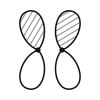
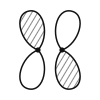
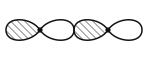
Q428.Which of the following pictorial diagram most correctly represents the π* (π - antibonding) molecular orbital between two atoms if the internuclear axis is taken to be in the z-direction () ?
यदि अंतरनाभिकीय अक्ष को z-दिशा () में लिया जाए, तो निम्नलिखित में से कौन-सा चित्रात्मक आरेख दो परमाणुओं के बीच π* (π - प्रतिआबंधी) आण्विक कक्षक को सबसे सही रूप में दर्शाता है?
- A

- B
- C
- D
Show answer
Concept: A π MO forms by sideways overlap of px (or py) orbitals, perpendicular to the z-axis. In π* the two p orbitals combine out of phase: the lobes above the axis have opposite signs, giving an extra nodal plane between the nuclei (perpendicular to the axis).
- (A) A single cloud above and below the axis, enclosing both nuclei – this is the π (bonding) MO.
- (B) Side-by-side p orbitals with like phases on the same side (both upper lobes shaded) – in-phase combination, i.e. π bonding before merging.
- (C) Upper lobes of opposite phase and lower lobes of opposite phase – out-of-phase sideways combination with a node between the nuclei → π*.
- (D) Lobes lie along the internuclear axis – that is a σ-type (pz) combination, not π.
Short trick: π* = lobes perpendicular to the axis + shading crosses diagonally (opposite phases face each other).
Answer: (C)
अवधारणा: π आण्विक कक्षक px (या py) कक्षकों के पार्श्व अतिव्यापन से बनता है, जो z-अक्ष के लंबवत होते हैं। π* में दोनों p कक्षक विपरीत कला (out of phase) में संयोजित होते हैं: अक्ष के ऊपर के पालियों के चिह्न विपरीत होते हैं, जिससे नाभिकों के बीच (अक्ष के लंबवत) एक अतिरिक्त नोडीय तल बनता है।
- (A) अक्ष के ऊपर और नीचे एक-एक सतत मेघ, जो दोनों नाभिकों को घेरता है – यह π (आबंधी) कक्षक है।
- (B) पास-पास के p कक्षक जिनके एक ही ओर की पालियाँ समान कला की हैं (दोनों ऊपरी पालियाँ छायांकित) – समान कला संयोजन, अर्थात π आबंधी।
- (C) ऊपरी पालियाँ विपरीत कला की और निचली पालियाँ भी विपरीत कला की – विपरीत कला में पार्श्व संयोजन, नाभिकों के बीच नोड → π*।
- (D) पालियाँ अंतरनाभिकीय अक्ष के अनुदिश हैं – यह σ-प्रकार (pz) संयोजन है, π नहीं।
शॉर्ट ट्रिक: π* = अक्ष के लंबवत पालियाँ + छायांकन तिरछे क्रॉस में (विपरीत कलाएँ आमने-सामने)।
उत्तर: (C)
JEE Main 2026 (April) – Paper 1 (B.E./B.Tech)ChemistryChemical bonding – molecular orbital shapesJEE Main 2026 (April) – Paper 1 (B.E./B.Tech) 2026 · 4 Apr Shift 2
Q429.At 27 °C, 0.1 M, 1 L K
4[Fe(CN)
6] aqueous solution and 0.1 M, 1 L FeCl
3 aqueous solution are placed in a container separated by a semi permeable membrane AB. Assume complete dissociation of both the solutes. Which of the following statement is
correct?
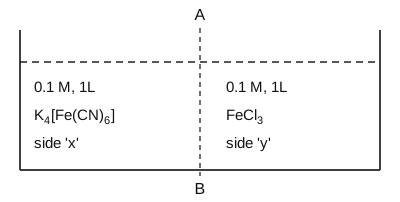
27 °C पर 0.1 M, 1 L K
4[Fe(CN)
6] जलीय विलयन तथा 0.1 M, 1 L FeCl
3 जलीय विलयन एक पात्र में अर्धपारगम्य झिल्ली AB द्वारा अलग करके रखे गए हैं। दोनों विलेयों का पूर्ण वियोजन मान लीजिए। निम्नलिखित में से कौन-सा कथन
सही है?
- ABlue color is formed on both sides.दोनों ओर नीला रंग बनता है।
- BIonic solutes in aqueous solution can pass through semi-permeable membrane.जलीय विलयन में आयनिक विलेय अर्धपारगम्य झिल्ली से गुजर सकते हैं।
- CSolution on side 'y' is hypotonic.ओर 'y' का विलयन अल्पपरासारी (hypotonic) है।
- DTo cause the reverse flow of solvent during osmosis, external pressure (any value) should be applied to side 'x'.परासरण के दौरान विलायक का उल्टा प्रवाह कराने के लिए ओर 'x' पर बाह्य दाब (कोई भी मान) लगाना चाहिए।
Show answer
Concept: A semi-permeable membrane lets only solvent pass. Osmotic pressure ; the side with lower is hypotonic.
- K4[Fe(CN)6] → 4K+ + [Fe(CN)6]4−: , M.
- FeCl3 → Fe3+ + 3Cl−: , M.
- Side 'y' (0.4 M particles) has lower osmotic pressure than side 'x' (0.5 M) → side 'y' is hypotonic. (C) is correct.
- (A) wrong: ions cannot cross the membrane, so Fe3+ never meets [Fe(CN)6]4− and no Prussian blue forms. (B) wrong: only solvent passes. (D) wrong: solvent flows from y to x; to reverse it, a pressure greater than the osmotic-pressure difference must be applied on side 'x' – not just any value.
Short trick: Compare : 5 × 0.1 vs 4 × 0.1 – the smaller one (FeCl3) is hypotonic.
Answer: (C) Solution on side 'y' is hypotonic.
अवधारणा: अर्धपारगम्य झिल्ली केवल विलायक को गुजरने देती है। परासरण दाब ; जिस ओर कम हो वह अल्पपरासारी है।
- K4[Fe(CN)6] → 4K+ + [Fe(CN)6]4−: , M।
- FeCl3 → Fe3+ + 3Cl−: , M।
- ओर 'y' (0.4 M कण) का परासरण दाब ओर 'x' (0.5 M) से कम है → ओर 'y' अल्पपरासारी है। (C) सही है।
- (A) गलत: आयन झिल्ली पार नहीं कर सकते, अतः Fe3+ का [Fe(CN)6]4− से मिलन नहीं होता और प्रशियन ब्लू नहीं बनता। (B) गलत: केवल विलायक गुजरता है। (D) गलत: विलायक y से x की ओर बहता है; इसे उलटने के लिए ओर 'x' पर परासरण दाबों के अंतर से अधिक दाब लगाना होगा – कोई भी मान नहीं।
शॉर्ट ट्रिक: की तुलना: 5 × 0.1 बनाम 4 × 0.1 – छोटा (FeCl3) अल्पपरासारी।
उत्तर: (C) ओर 'y' का विलयन अल्पपरासारी है।
JEE Main 2026 (April) – Paper 1 (B.E./B.Tech)ChemistrySolutions – osmosis, van 't Hoff factorJEE Main 2026 (April) – Paper 1 (B.E./B.Tech) 2026 · 4 Apr Shift 2
Q430.20 mL of a solution of acetic acid required 28.4 mL of 0.1 M NaOH for its neutralization. A solution (X) was prepared by mixing 20 mL of the above acetic acid and 14.2 mL of 0.1 M NaOH solution. What is the pH of the solution (X)?
(pKa value of acetic acid is 4.75).
ऐसीटिक अम्ल के एक विलयन के 20 mL के उदासीनीकरण के लिए 0.1 M NaOH के 28.4 mL की आवश्यकता हुई। उपर्युक्त ऐसीटिक अम्ल के 20 mL तथा 0.1 M NaOH विलयन के 14.2 mL को मिलाकर एक विलयन (X) बनाया गया। विलयन (X) की pH क्या है?
(ऐसीटिक अम्ल का pKa मान 4.75 है)।
- A7.0
- B4.75
- C3.5
- D4.82
Show answer
Concept: When exactly half of a weak acid is neutralised, [salt] = [acid] and the Henderson equation gives pH = pKa.
- Acetic acid in 20 mL = NaOH needed mmol.
- NaOH added in (X) mmol – exactly half.
- After reaction: CH3COOH = 1.42 mmol, CH3COO− = 1.42 mmol.
- pH .
Short trick: 14.2 is half of 28.4 → half-neutralisation → pH = pKa.
Answer: (B) 4.75
अवधारणा: जब दुर्बल अम्ल का ठीक आधा भाग उदासीन हो, तब [लवण] = [अम्ल] तथा हेंडरसन समीकरण से pH = pKa।
- 20 mL में ऐसीटिक अम्ल = आवश्यक NaOH mmol।
- (X) में मिलाया NaOH mmol – ठीक आधा।
- अभिक्रिया के बाद: CH3COOH = 1.42 mmol, CH3COO− = 1.42 mmol।
- pH ।
शॉर्ट ट्रिक: 14.2, 28.4 का आधा है → अर्ध-उदासीनीकरण → pH = pKa।
उत्तर: (B) 4.75
JEE Main 2026 (April) – Paper 1 (B.E./B.Tech)ChemistryIonic equilibrium – buffer (half-neutralisation)JEE Main 2026 (April) – Paper 1 (B.E./B.Tech) 2026 · 4 Apr Shift 2
Q431.Match the
LIST-I with
LIST-IIList-I
Reaction | List-II
Mechanism |
|---|
| A. Williamson Synthesis | I. Electrophilic addition |
| B. Friedel Craft Reaction | II. Free radical substitution |
| C. Bromination of vinyl benzene | III. Nucleophilic substitution |
| D. Chlorination of toluene in light | IV. Electrophilic substitution |
Choose the
correct answer from the options given below:
सूची-I का
सूची-II से मिलान कीजिए
सूची-I
अभिक्रिया | सूची-II
क्रियाविधि |
|---|
| A. विलियमसन संश्लेषण | I. इलेक्ट्रॉनस्नेही योगज |
| B. फ्रीडेल-क्राफ्ट्स अभिक्रिया | II. मुक्त मूलक प्रतिस्थापन |
| C. विनाइल बेंज़ीन का ब्रोमीनन | III. नाभिकस्नेही प्रतिस्थापन |
| D. प्रकाश में टॉलूईन का क्लोरीनन | IV. इलेक्ट्रॉनस्नेही प्रतिस्थापन |
नीचे दिए गए विकल्पों में से
सही उत्तर चुनिए:
- AA-III, B-I, C-II, D-IV
- BA-III, B-IV, C-II, D-I
- CA-III, B-IV, C-I, D-II
- DA-I, B-III, C-IV, D-II
Show answer
Concept: Identify the attacking species in each reaction.
- A. Williamson synthesis: RO− displaces X− from R′X (SN2) → nucleophilic substitution (III).
- B. Friedel–Crafts: R+/RCO+ (from AlCl3) attacks the benzene ring → electrophilic substitution (IV).
- C. Br2 adds across the side-chain C=C of vinyl benzene (styrene) → electrophilic addition (I).
- D. Cl2/hν on toluene substitutes the side-chain CH3 hydrogens via Cl• → free radical substitution (II).
- A-III, B-IV, C-I, D-II. (A) and (B) wrongly match C with II, (D) mismatches A and B.
Short trick: Light → free radical; Lewis-acid + benzene → EAS; alkene + Br2 → addition; alkoxide + alkyl halide → SN2.
Answer: (C) A-III, B-IV, C-I, D-II
अवधारणा: प्रत्येक अभिक्रिया में आक्रमणकारी स्पीशीज़ पहचानिए।
- A. विलियमसन संश्लेषण: RO−, R′X से X− को विस्थापित करता है (SN2) → नाभिकस्नेही प्रतिस्थापन (III)।
- B. फ्रीडेल–क्राफ्ट्स: R+/RCO+ (AlCl3 से) बेंज़ीन वलय पर आक्रमण करता है → इलेक्ट्रॉनस्नेही प्रतिस्थापन (IV)।
- C. Br2 विनाइल बेंज़ीन (स्टाइरीन) की पार्श्व श्रृंखला C=C पर जुड़ता है → इलेक्ट्रॉनस्नेही योगज (I)।
- D. टॉलूईन पर Cl2/hν, Cl• द्वारा पार्श्व CH3 के हाइड्रोजन प्रतिस्थापित करता है → मुक्त मूलक प्रतिस्थापन (II)।
- A-III, B-IV, C-I, D-II। (A) और (B) में C को II से मिलाया गया है, (D) में A और B गलत हैं।
शॉर्ट ट्रिक: प्रकाश → मुक्त मूलक; लूइस अम्ल + बेंज़ीन → EAS; ऐल्कीन + Br2 → योगज; ऐल्कॉक्साइड + ऐल्किल हैलाइड → SN2।
उत्तर: (C) A-III, B-IV, C-I, D-II
JEE Main 2026 (April) – Paper 1 (B.E./B.Tech)ChemistryOrganic reaction mechanisms – match the listJEE Main 2026 (April) – Paper 1 (B.E./B.Tech) 2026 · 4 Apr Shift 2
Q432.The 1st ionization enthalpy for Mg is +737 kJ/mol. The most probable estimated value of the 2nd ionization enthalpy of Mg is _________.
Mg की प्रथम आयनन एन्थैल्पी +737 kJ/mol है। Mg की द्वितीय आयनन एन्थैल्पी का सर्वाधिक संभावित अनुमानित मान _________ है।
- A−906 kJ/mol
- B−856 kJ/mol
- C+1450 kJ/mol
- D+590 kJ/mol
Show answer
Concept: Removing an electron always needs energy, so every ionisation enthalpy is positive, and IE2 > IE1 because the electron is removed from a positive ion.
- Negative values (A) and (B) are impossible for ionisation.
- (D) +590 kJ/mol is smaller than IE1 – impossible.
- Mg+ (3s1) → Mg2+ (Ne core) needs about twice IE1: ≈ +1450 kJ/mol (actual 1451 kJ/mol).
Short trick: Pick the only positive value larger than 737.
Answer: (C) +1450 kJ/mol
अवधारणा: इलेक्ट्रॉन हटाने में सदैव ऊर्जा लगती है, अतः प्रत्येक आयनन एन्थैल्पी धनात्मक है, और IE2 > IE1 क्योंकि इलेक्ट्रॉन धनायन से हटाया जाता है।
- ऋणात्मक मान (A) और (B) आयनन के लिए असंभव हैं।
- (D) +590 kJ/mol, IE1 से कम है – असंभव।
- Mg+ (3s1) → Mg2+ (Ne कोर) के लिए IE1 का लगभग दोगुना चाहिए: ≈ +1450 kJ/mol (वास्तविक 1451 kJ/mol)।
शॉर्ट ट्रिक: 737 से बड़ा एकमात्र धनात्मक मान चुनिए।
उत्तर: (C) +1450 kJ/mol
JEE Main 2026 (April) – Paper 1 (B.E./B.Tech)ChemistryPeriodic properties – ionisation enthalpyJEE Main 2026 (April) – Paper 1 (B.E./B.Tech) 2026 · 4 Apr Shift 2
Q433.The electronegativity of a group 13 element 'E' is same as that of Ge (on Pauling scale and upto one decimal point). The CORRECT statements about E3+ are
A. It can act as a reducing agent.
B. It can act as an oxidizing agent.
C. E3+ is more stable than E+.
D. The standard electrode potential value for E3+/E is positive.
Choose the correct answer from the options given below:
वर्ग 13 के एक तत्व 'E' की विद्युतऋणात्मकता Ge के समान है (पॉलिंग पैमाने पर तथा एक दशमलव स्थान तक)। E3+ के विषय में सही कथन हैं
A. यह अपचायक के रूप में कार्य कर सकता है।
B. यह ऑक्सीकारक के रूप में कार्य कर सकता है।
C. E3+, E+ से अधिक स्थायी है।
D. E3+/E के लिए मानक इलेक्ट्रोड विभव का मान धनात्मक है।
नीचे दिए गए विकल्पों में से सही उत्तर चुनिए:
- AA and C Onlyकेवल A और C
- BB and C Onlyकेवल B और C
- CB and D Onlyकेवल B और D
- DA and D Onlyकेवल A और D
Show answer
Concept: Pauling electronegativities (one decimal): B 2.0, Al 1.5, Ga 1.6, In 1.7, Tl 1.8; Ge = 1.8. So E = Tl, where the inert pair effect makes +1 the stable state.
- Tl+ is more stable than Tl3+, so Tl3+ readily gains 2 e− → it is a good oxidising agent. B ✔, A ✘.
- C ✘: E3+ is less stable than E+ for Tl.
- D ✔: E°(Tl3+/Tl) = +1.26 V (positive), unlike Al, Ga, In whose values are negative.
Short trick: Group 13 element as electronegative as Ge → heaviest, Tl → Tl3+ oxidising, positive E°.
Answer: (C) B and D Only
अवधारणा: पॉलिंग विद्युतऋणात्मकता (एक दशमलव तक): B 2.0, Al 1.5, Ga 1.6, In 1.7, Tl 1.8; Ge = 1.8। अतः E = Tl, जिसमें अक्रिय युग्म प्रभाव के कारण +1 अवस्था स्थायी है।
- Tl+, Tl3+ से अधिक स्थायी है, अतः Tl3+ आसानी से 2 e− ग्रहण करता है → यह प्रबल ऑक्सीकारक है। B ✔, A ✘।
- C ✘: Tl के लिए E3+, E+ से कम स्थायी है।
- D ✔: E°(Tl3+/Tl) = +1.26 V (धनात्मक), जबकि Al, Ga, In के मान ऋणात्मक हैं।
शॉर्ट ट्रिक: Ge जितना विद्युतऋणात्मक वर्ग 13 तत्व → सबसे भारी, Tl → Tl3+ ऑक्सीकारक, धनात्मक E°।
उत्तर: (C) केवल B और D
JEE Main 2026 (April) – Paper 1 (B.E./B.Tech)Chemistryp-Block (group 13) – inert pair effectJEE Main 2026 (April) – Paper 1 (B.E./B.Tech) 2026 · 4 Apr Shift 2
Q434.Pairs of elements with the same number of electrons in their respective 4f orbital are
[Atomic number. Eu-63, Gd-64, Dy-66, Ho-67, Tm-69, Yb-70, Lu-71, Hf-72]
A. (Eu and Gd)
B. (Dy and Ho)
C. (Yb and Hf)
D. (Lu and Tm)
Choose the correct answer from the options given below:
अपने-अपने 4f कक्षक में समान संख्या में इलेक्ट्रॉन वाले तत्वों के युग्म हैं
[परमाणु क्रमांक: Eu-63, Gd-64, Dy-66, Ho-67, Tm-69, Yb-70, Lu-71, Hf-72]
A. (Eu और Gd)
B. (Dy और Ho)
C. (Yb और Hf)
D. (Lu और Tm)
नीचे दिए गए विकल्पों में से सही उत्तर चुनिए:
- AB and C Onlyकेवल B और C
- BA and B Onlyकेवल A और B
- CA and D Onlyकेवल A और D
- DA and C Onlyकेवल A और C
Show answer
Concept: Write ground-state configurations after [Xe]; Gd (half-filled) and Lu, Hf (completely filled) put the extra electron(s) in 5d.
- Eu: 4f76s2; Gd: 4f75d16s2 → both 7. A ✔
- Dy: 4f106s2; Ho: 4f116s2 → 10 vs 11. B ✘
- Yb: 4f146s2; Hf: 4f145d26s2 → both 14. C ✔
- Lu: 4f145d16s2; Tm: 4f136s2 → 14 vs 13. D ✘
Short trick: 4f stays at 7 for Eu→Gd and at 14 for Yb→Lu→Hf; the extra electrons go to 5d.
Answer: (D) A and C Only
अवधारणा: [Xe] के बाद मूल अवस्था विन्यास लिखिए; Gd (अर्धपूरित) तथा Lu, Hf (पूर्णपूरित) में अतिरिक्त इलेक्ट्रॉन 5d में जाते हैं।
- Eu: 4f76s2; Gd: 4f75d16s2 → दोनों 7। A ✔
- Dy: 4f106s2; Ho: 4f116s2 → 10 बनाम 11। B ✘
- Yb: 4f146s2; Hf: 4f145d26s2 → दोनों 14। C ✔
- Lu: 4f145d16s2; Tm: 4f136s2 → 14 बनाम 13। D ✘
शॉर्ट ट्रिक: Eu→Gd में 4f पर 7 और Yb→Lu→Hf में 4f पर 14 ही रहते हैं; अतिरिक्त इलेक्ट्रॉन 5d में जाते हैं।
उत्तर: (D) केवल A और C
JEE Main 2026 (April) – Paper 1 (B.E./B.Tech)Chemistryf-Block – electronic configurationJEE Main 2026 (April) – Paper 1 (B.E./B.Tech) 2026 · 4 Apr Shift 2
Q435.Consider the metal complexes [Ni(en)3]2+ (A), [NiCl4]2− (B) and [Ni(NH3)6]2+(C). Choose the CORRECT option by considering the number of unpaired electrons present in (A), (B) and (C) respectively and the order of frequency of absorption.
धातु संकुलों [Ni(en)3]2+ (A), [NiCl4]2− (B) तथा [Ni(NH3)6]2+(C) पर विचार कीजिए। (A), (B) तथा (C) में क्रमशः उपस्थित अयुग्मित इलेक्ट्रॉनों की संख्या तथा अवशोषण की आवृत्ति के क्रम को ध्यान में रखते हुए सही विकल्प चुनिए।
- A2, 2, 2 and (A) > (C) > (B)2, 2, 2 तथा (A) > (C) > (B)
- B0, 2, 0 and (A) > (C) > (B)0, 2, 0 तथा (A) > (C) > (B)
- C2, 2, 0 and (B) > (C) > (A)2, 2, 0 तथा (B) > (C) > (A)
- D2, 2, 2 and (C) > (A) > (B)2, 2, 2 तथा (C) > (A) > (B)
Show answer
Concept: Ni2+ is 3d8. In octahedral fields d8 is always t2g6eg2 (2 unpaired) whatever the ligand; tetrahedral [NiCl4]2− (weak Cl−) also has 2 unpaired. Absorption frequency ∝ Δ: en > NH3 > Cl−, and .
- (A) [Ni(en)3]2+: octahedral, 2 unpaired.
- (B) [NiCl4]2−: tetrahedral, e4t24, 2 unpaired.
- (C) [Ni(NH3)6]2+: octahedral, 2 unpaired.
- Δ: (A) (en, stronger) > (C) (NH3) > (B) (Cl−, tetrahedral) → frequency (A) > (C) > (B).
- (B) wrongly makes octahedral d8 diamagnetic; (C) and (D) give wrong orders.
Short trick: Octahedral Ni(II) is always paramagnetic (2 unpaired); higher Δ ⇒ higher absorbed frequency.
Answer: (A) 2, 2, 2 and (A) > (C) > (B)
अवधारणा: Ni2+ 3d8 है। अष्टफलकीय क्षेत्र में d8 सदैव t2g6eg2 (2 अयुग्मित) होता है, लिगैंड कोई भी हो; चतुष्फलकीय [NiCl4]2− (दुर्बल Cl−) में भी 2 अयुग्मित। अवशोषण आवृत्ति ∝ Δ: en > NH3 > Cl−, तथा ।
- (A) [Ni(en)3]2+: अष्टफलकीय, 2 अयुग्मित।
- (B) [NiCl4]2−: चतुष्फलकीय, e4t24, 2 अयुग्मित।
- (C) [Ni(NH3)6]2+: अष्टफलकीय, 2 अयुग्मित।
- Δ: (A) (en, प्रबल) > (C) (NH3) > (B) (Cl−, चतुष्फलकीय) → आवृत्ति (A) > (C) > (B)।
- (B) में अष्टफलकीय d8 को गलत रूप से प्रतिचुंबकीय माना गया है; (C) और (D) में क्रम गलत है।
शॉर्ट ट्रिक: अष्टफलकीय Ni(II) सदैव अनुचुंबकीय (2 अयुग्मित); अधिक Δ ⇒ अधिक अवशोषित आवृत्ति।
उत्तर: (A) 2, 2, 2 तथा (A) > (C) > (B)
JEE Main 2026 (April) – Paper 1 (B.E./B.Tech)ChemistryCoordination compounds – CFT, magnetism, spectrochemical seriesJEE Main 2026 (April) – Paper 1 (B.E./B.Tech) 2026 · 4 Apr Shift 2
Q436.Consider the following molecules/species:
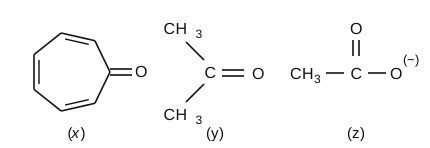
The correct order of carbon – oxygen double bond length is :
निम्नलिखित अणुओं/स्पीशीज़ पर विचार कीजिए:
कार्बन – ऑक्सीजन द्विआबंध लंबाई का सही क्रम है :
- A
- B
- C
- D
Show answer
Concept: The more single-bond character the C=O acquires through resonance, the lower its bond order and the longer the bond.
- (z) Acetate ion: two equivalent resonance structures share one π bond over two C–O bonds → bond order 1.5 → longest.
- (x) Tropone: the polar form C+–O− gives an aromatic tropylium (6π) ring, so C=O gains partial single-bond character, but the neutral form still dominates → bond order between 1.5 and 2.
- (y) Acetone: isolated C=O, no conjugation → bond order ≈ 2 → shortest.
- Order: z > x > y. Options (A), (B), (D) place either acetone or tropone above acetate.
Short trick: Equivalent resonance (carboxylate) > partial resonance (conjugated ketone) > no resonance (simple ketone).
Answer: (C)
अवधारणा: अनुनाद द्वारा C=O में जितना अधिक एकल-आबंध गुण आता है, आबंध कोटि उतनी कम और आबंध उतना लंबा होता है।
- (z) ऐसीटेट आयन: दो तुल्य अनुनादी संरचनाएँ एक π आबंध को दो C–O आबंधों पर बाँटती हैं → आबंध कोटि 1.5 → सबसे लंबा।
- (x) ट्रोपोन: ध्रुवीय रूप C+–O− से ऐरोमैटिक ट्रोपिलियम (6π) वलय बनता है, अतः C=O में आंशिक एकल-आबंध गुण आता है, पर उदासीन रूप प्रमुख रहता है → आबंध कोटि 1.5 और 2 के बीच।
- (y) ऐसीटोन: पृथक C=O, कोई संयुग्मन नहीं → आबंध कोटि ≈ 2 → सबसे छोटा।
- क्रम: z > x > y। विकल्प (A), (B), (D) में ऐसीटोन या ट्रोपोन को ऐसीटेट से ऊपर रखा गया है।
शॉर्ट ट्रिक: तुल्य अनुनाद (कार्बॉक्सिलेट) > आंशिक अनुनाद (संयुग्मित कीटोन) > अनुनाद नहीं (साधारण कीटोन)।
उत्तर: (C)
JEE Main 2026 (April) – Paper 1 (B.E./B.Tech)ChemistryResonance – C=O bond lengthJEE Main 2026 (April) – Paper 1 (B.E./B.Tech) 2026 · 4 Apr Shift 2
Q437.Consider |x| is the difference in oxidation states of Mn in highest manganese fluoride and highest manganese oxide. The ions with |x| number of unpaired electrons from the following are:
A. Sc3+
B. Zn2+
C. V2+
D. Fe2+
E. Co2+
Choose the correct answer from the options given below:
माना |x|, उच्चतम मैंगनीज़ फ्लुओराइड तथा उच्चतम मैंगनीज़ ऑक्साइड में Mn की ऑक्सीकरण अवस्थाओं का अंतर है। निम्नलिखित में से |x| अयुग्मित इलेक्ट्रॉनों वाले आयन हैं:
A. Sc3+
B. Zn2+
C. V2+
D. Fe2+
E. Co2+
नीचे दिए गए विकल्पों में से सही उत्तर चुनिए:
- AA and B Onlyकेवल A और B
- BC, D and E Onlyकेवल C, D और E
- CC and E Onlyकेवल C और E
- DB and E Onlyकेवल B और E
Show answer
Concept: Fluorine stabilises Mn only up to +4 (MnF4), while oxygen (via multiple bonding) reaches +7 (Mn2O7). So .
- A. Sc3+: 3d0 → 0 unpaired ✘
- B. Zn2+: 3d10 → 0 unpaired ✘
- C. V2+: 3d3 → 3 unpaired ✔
- D. Fe2+: 3d6 → 4 unpaired ✘
- E. Co2+: 3d7 → 3 unpaired ✔
- Hence C and E only; (B) would include D, which has 4 unpaired electrons.
Short trick: 3 unpaired electrons ↔ d3 or d7 (free ion, high spin).
Answer: (C) C and E Only
अवधारणा: फ्लुओरीन Mn को केवल +4 (MnF4) तक स्थायी करता है, जबकि ऑक्सीजन (बहु-आबंधन द्वारा) +7 (Mn2O7) तक पहुँचती है। अतः ।
- A. Sc3+: 3d0 → 0 अयुग्मित ✘
- B. Zn2+: 3d10 → 0 अयुग्मित ✘
- C. V2+: 3d3 → 3 अयुग्मित ✔
- D. Fe2+: 3d6 → 4 अयुग्मित ✘
- E. Co2+: 3d7 → 3 अयुग्मित ✔
- अतः केवल C और E; (B) में D भी शामिल है, जिसमें 4 अयुग्मित इलेक्ट्रॉन हैं।
शॉर्ट ट्रिक: 3 अयुग्मित इलेक्ट्रॉन ↔ d3 या d7 (मुक्त आयन, उच्च चक्रण)।
उत्तर: (C) केवल C और E
JEE Main 2026 (April) – Paper 1 (B.E./B.Tech)Chemistryd-Block – oxidation states of Mn, unpaired electronsJEE Main 2026 (April) – Paper 1 (B.E./B.Tech) 2026 · 4 Apr Shift 2
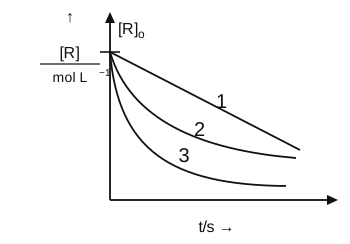
Q438.Consider the given graph showing variation of reactant concentration with time.
Three different reactions were started with identical initial concentration of reactants. Which of the following statement is correct?
समय के साथ अभिकारक सांद्रता में परिवर्तन दर्शाने वाले दिए गए ग्राफ पर विचार कीजिए।
तीन भिन्न अभिक्रियाएँ अभिकारकों की समान प्रारंभिक सांद्रता के साथ प्रारंभ की गईं। निम्नलिखित में से कौन-सा कथन सही है?
- AThe order of all the three reactions is same.तीनों अभिक्रियाओं की कोटि समान है।
- BThe rate constant of reaction 3 is larger than the rate constant of reaction 2 if the order of reaction is same for both.यदि दोनों अभिक्रियाओं की कोटि समान हो, तो अभिक्रिया 3 का वेग स्थिरांक अभिक्रिया 2 के वेग स्थिरांक से अधिक है।
- CThe SI unit of rate constant of reaction 1 is s−1.अभिक्रिया 1 के वेग स्थिरांक का SI मात्रक s−1 है।
- DThermal decomposition of HI on gold surface is an example of reaction 2.स्वर्ण पृष्ठ पर HI का तापीय अपघटन अभिक्रिया 2 का एक उदाहरण है।
Show answer
Concept: A straight-line fall of [R] with time means zero order (); an exponential-type curve means first (or higher) order. For the same order, a steeper fall means a larger k.
- Curve 1 is a straight line → zero order; curves 2 and 3 are curved → not zero order. So (A) is wrong.
- Curves 2 and 3 start at the same [R]0 and 3 falls faster; for the same order, rate ∝ k, so . (B) is correct.
- (C) wrong: for zero order k has units of concentration/time, mol L−1 s−1 (SI: mol m−3 s−1), not s−1.
- (D) wrong: decomposition of HI on a gold surface is zero order (surface saturated), i.e. like reaction 1, not 2.
Short trick: Straight line = zero order (HI on Au, k in conc·time−1); same order, steeper curve = bigger k.
Answer: (B) The rate constant of reaction 3 is larger than the rate constant of reaction 2 if the order of reaction is same for both.
अवधारणा: समय के साथ [R] का सरल रेखीय ह्रास शून्य कोटि दर्शाता है (); चरघातांकी प्रकार का वक्र प्रथम (या उच्च) कोटि दर्शाता है। समान कोटि के लिए अधिक तीव्र ह्रास का अर्थ है अधिक k।
- वक्र 1 सरल रेखा है → शून्य कोटि; वक्र 2 और 3 वक्रीय हैं → शून्य कोटि नहीं। अतः (A) गलत है।
- वक्र 2 और 3 समान [R]0 से प्रारंभ होते हैं और 3 तेज़ी से गिरता है; समान कोटि के लिए वेग ∝ k, अतः । (B) सही है।
- (C) गलत: शून्य कोटि के लिए k का मात्रक सांद्रता/समय, mol L−1 s−1 (SI: mol m−3 s−1) है, s−1 नहीं।
- (D) गलत: स्वर्ण पृष्ठ पर HI का अपघटन शून्य कोटि (पृष्ठ संतृप्त) है, अर्थात अभिक्रिया 1 जैसा, 2 नहीं।
शॉर्ट ट्रिक: सरल रेखा = शून्य कोटि (Au पर HI, k का मात्रक सांद्रता·समय−1); समान कोटि में अधिक ढलवाँ वक्र = बड़ा k।
उत्तर: (B) यदि दोनों अभिक्रियाओं की कोटि समान हो, तो अभिक्रिया 3 का वेग स्थिरांक अभिक्रिया 2 के वेग स्थिरांक से अधिक है।
JEE Main 2026 (April) – Paper 1 (B.E./B.Tech)ChemistryChemical kinetics – concentration–time graphsJEE Main 2026 (April) – Paper 1 (B.E./B.Tech) 2026 · 4 Apr Shift 2
Q439.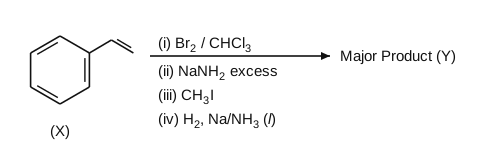
Compound (X) is subjected to the sequence of reactions as shown above. Molar mass of the major product (Y) formed is ______________ g mol
−1.
(Given molar mass in g mol
−1 C:12, H: 1, O: 16)
यौगिक (X) पर ऊपर दर्शाए अनुसार अभिक्रियाओं का अनुक्रम किया जाता है। बनने वाले मुख्य उत्पाद (Y) का मोलर द्रव्यमान ______________ g mol
−1 है।
(दिया है: मोलर द्रव्यमान g mol
−1 में C:12, H: 1, O: 16)
- A90
- B118
- C160
- D125
Show answer
Concept: Vicinal dibromide + excess NaNH2 → terminal alkyne (as its sodium salt); alkylation with CH3I; Na/liq. NH3 (Birch-type) reduces an internal alkyne to the trans-alkene.
- (i) Styrene + Br2/CHCl3 → C6H5CHBr–CH2Br.
- (ii) Excess NaNH2: double dehydrobromination → C6H5C≡CH, which is deprotonated to C6H5C≡C−Na+.
- (iii) CH3I: SN2 alkylation → C6H5C≡C–CH3 (1-phenylpropyne).
- (iv) Na/NH3(l): anti reduction → (E)-C6H5CH=CH–CH3 (trans-1-phenylpropene), C9H10.
- Molar mass g mol−1.
Short trick: Net change: styrene C8H8 gains one CH2 → C9H10 = 118.
Answer: (B) 118
अवधारणा: सन्निध डाइब्रोमाइड + आधिक्य NaNH2 → अंतस्थ ऐल्काइन (उसके सोडियम लवण के रूप में); CH3I से ऐल्किलन; Na/द्रव NH3 (बर्च-प्रकार) आंतरिक ऐल्काइन को ट्रांस-ऐल्कीन में अपचयित करता है।
- (i) स्टाइरीन + Br2/CHCl3 → C6H5CHBr–CH2Br।
- (ii) आधिक्य NaNH2: दोहरा विहाइड्रोब्रोमीनन → C6H5C≡CH, जो विप्रोटोनित होकर C6H5C≡C−Na+ बनता है।
- (iii) CH3I: SN2 ऐल्किलन → C6H5C≡C–CH3 (1-फेनिलप्रोपाइन)।
- (iv) Na/NH3(l): प्रति (anti) अपचयन → (E)-C6H5CH=CH–CH3 (ट्रांस-1-फेनिलप्रोपीन), C9H10।
- मोलर द्रव्यमान g mol−1।
शॉर्ट ट्रिक: कुल परिवर्तन: स्टाइरीन C8H8 में एक CH2 जुड़ता है → C9H10 = 118।
उत्तर: (B) 118
JEE Main 2026 (April) – Paper 1 (B.E./B.Tech)ChemistryHydrocarbons – alkyne synthesis and reductionJEE Main 2026 (April) – Paper 1 (B.E./B.Tech) 2026 · 4 Apr Shift 2
Q440.The following structures are
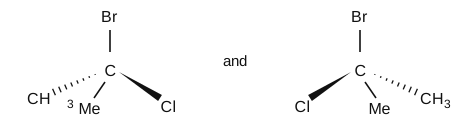
निम्नलिखित संरचनाएँ हैं
- Aenantiomers.प्रतिबिंबरूपी (enantiomers)।
- Bidentical molecules.सर्वसम अणु (identical molecules)।
- Cdiastereomers.अप्रतिबिंबी त्रिविम समावयवी (diastereomers)।
- Dmeso compounds.मीसो यौगिक।
Show answer
Concept: A carbon is a stereocentre only if its four groups are all different.
- Each structure is a carbon carrying Br, Cl, CH3 and Me – but Me is CH3, so the carbon has two identical methyl groups: CH3CBrCl–CH3 (2-bromo-2-chloropropane).
- The carbon is not chiral, so the molecule is superimposable on its mirror image; the two drawings are just different orientations of the same molecule.
- (A), (C) need a stereocentre; (D) meso needs two or more stereocentres with an internal mirror plane. None applies.
Short trick: Spot two identical groups (CH3 = Me) on the carbon → achiral → identical.
Answer: (B) identical molecules.
अवधारणा: कोई कार्बन त्रिविम केंद्र तभी होता है जब उसके चारों समूह भिन्न हों।
- प्रत्येक संरचना में कार्बन पर Br, Cl, CH3 और Me हैं – परंतु Me = CH3, अतः कार्बन पर दो समान मेथिल समूह हैं: CH3CBrCl–CH3 (2-ब्रोमो-2-क्लोरोप्रोपेन)।
- कार्बन किरैल नहीं है, अतः अणु अपने दर्पण प्रतिबिंब पर अध्यारोपित होता है; दोनों चित्र एक ही अणु के भिन्न अभिविन्यास हैं।
- (A), (C) के लिए त्रिविम केंद्र आवश्यक है; (D) मीसो के लिए दो या अधिक त्रिविम केंद्र तथा आंतरिक दर्पण तल चाहिए। कोई लागू नहीं।
शॉर्ट ट्रिक: कार्बन पर दो समान समूह (CH3 = Me) दिखें → अकिरैल → सर्वसम।
उत्तर: (B) सर्वसम अणु।
JEE Main 2026 (April) – Paper 1 (B.E./B.Tech)ChemistryStereochemistry – chirality, identical moleculesJEE Main 2026 (April) – Paper 1 (B.E./B.Tech) 2026 · 4 Apr Shift 2

