Q401.Match the LIST-I with LIST-II
| List-I | List-II |
|---|
| A. | Planck's constant | I. | |
| B. | Stopping potential | II. | |
| C. | Work function | III. | |
| D. | Threshold frequency | IV. | |
Choose the correct answer from the options given below:
सूची-I का सूची-II से मिलान कीजिए
| सूची-I | सूची-II |
|---|
| A. | प्लांक नियतांक | I. | |
| B. | निरोधी विभव (stopping potential) | II. | |
| C. | कार्य फलन | III. | |
| D. | देहली आवृत्ति | IV. | |
नीचे दिए गए विकल्पों में से सही उत्तर चुनिए:
- AA-III, B-IV, C-I, D-II
- BA-I, B-II, C-III, D-IV
- CA-IV, B-III, C-I, D-II
- DA-I, B-IV, C-III, D-II
Show answer
Concept: Work out each dimension from a defining equation.
- Planck's constant: → III.
- Stopping potential is a potential: → IV.
- Work function is an energy: → I.
- Threshold frequency: → II.
Short trick: Planck's constant has the dimension of angular momentum, (III); only option (A) pairs A with III.
Answer: (A) A-III, B-IV, C-I, D-II
अवधारणा: प्रत्येक राशि की विमा उसके परिभाषक समीकरण से निकालिए।
- प्लांक नियतांक: → III.
- निरोधी विभव एक विभव है: → IV.
- कार्य फलन एक ऊर्जा है: → I.
- देहली आवृत्ति: → II.
शॉर्ट ट्रिक: की विमा (III) याद हो तो केवल विकल्प (A) ही सम्भव रह जाता है।
उत्तर: (A) A-III, B-IV, C-I, D-II
JEE Main 2026 (April) – Paper 1 (B.E./B.Tech)PhysicsUnits & Dimensions – photoelectric quantitiesJEE Main 2026 (April) – Paper 1 (B.E./B.Tech) 2026 · 4 Apr Shift 2
Q402.Two cars and are moving in the same direction along a straight line with speeds 100 km/h and 80 km/h, respectively such that car is moving ahead of car . A person in car throws a stone with a speed so that it hits the car with a speed of 5 m/s. The value of is ______ km/h.
दो कारें तथा एक सरल रेखा के अनुदिश समान दिशा में क्रमशः 100 km/h तथा 80 km/h की चालों से इस प्रकार चल रही हैं कि कार , कार के आगे चल रही है। कार में बैठा एक व्यक्ति एक पत्थर को चाल से इस प्रकार फेंकता है कि वह कार से 5 m/s की चाल से टकराता है। का मान ______ km/h है।
- A18
- B28
- C38
- D48
Show answer
Concept: Work with velocities relative to car . The stone is thrown from car , so its ground speed is km/h in the direction of motion.
- Hitting speed relative to : km/h.
- Relative to : .
- km/h.
Short trick: The stone must beat 's 20 km/h lead by 18 km/h → .
Answer: (C) 38
अवधारणा: कार के सापेक्ष वेगों से गणना कीजिए। पत्थर कार से फेंका गया है, अतः गति की दिशा में उसकी ज़मीन के सापेक्ष चाल km/h है।
- के सापेक्ष टकराने की चाल: km/h।
- के सापेक्ष: ।
- km/h।
शॉर्ट ट्रिक: पत्थर को की 20 km/h की बढ़त से 18 km/h अधिक चाहिए → ।
उत्तर: (C) 38
JEE Main 2026 (April) – Paper 1 (B.E./B.Tech)PhysicsKinematics – relative motionJEE Main 2026 (April) – Paper 1 (B.E./B.Tech) 2026 · 4 Apr Shift 2
Q403.At , a body of mass 100 g starts moving under the influence of a force N. After 2 s its position is m. The ratio is ______.
पर, 100 g द्रव्यमान का एक पिंड बल N के प्रभाव में चलना प्रारम्भ करता है। 2 s पश्चात् इसकी स्थिति m है। अनुपात ______ है।
- A1 : 2
- B2 : 5
- C5 : 2
- D5 : 4
Show answer
Concept: Starting from rest under a constant force, with .
- .
- m.
- Compare with : ; .
- .
Short trick: — the common factors cancel.
Answer: (D) 5 : 4
अवधारणा: विरामावस्था से अचर बल के अधीन, , जहाँ ।
- ।
- m।
- से तुलना: ; ।
- ।
शॉर्ट ट्रिक: — उभयनिष्ठ गुणक कट जाते हैं।
उत्तर: (D) 5 : 4
JEE Main 2026 (April) – Paper 1 (B.E./B.Tech)PhysicsLaws of Motion – motion under constant forceJEE Main 2026 (April) – Paper 1 (B.E./B.Tech) 2026 · 4 Apr Shift 2
Q404.If and coordinates of a projectile as a function of time () are given as and , respectively, then the angle (in degrees) made by the projectile with horizontal when s is ______.
यदि किसी प्रक्षेप्य के तथा निर्देशांक समय () के फलन के रूप में क्रमशः तथा दिए गए हैं, तो s पर प्रक्षेप्य द्वारा क्षैतिज से बनाया गया कोण (डिग्री में) ______ है।
- A60
- B45
- C30
- D75
Show answer
Concept: The direction of motion is along the velocity: , where , .
- m/s (constant).
- ; at s, m/s.
- .
Short trick: The data is built so — spot and the angle is without further work.
Answer: (B) 45
अवधारणा: गति की दिशा वेग के अनुदिश होती है: , जहाँ , ।
- m/s (अचर)।
- ; s पर m/s।
- ।
शॉर्ट ट्रिक: आँकड़े ऐसे हैं कि — देखते ही कोण मिल जाता है।
उत्तर: (B) 45
JEE Main 2026 (April) – Paper 1 (B.E./B.Tech)PhysicsKinematics – projectile motionJEE Main 2026 (April) – Paper 1 (B.E./B.Tech) 2026 · 4 Apr Shift 2
Q405.The height in terms of radius of the earth (), at which the acceleration due to gravity becomes , where is acceleration due to gravity on earth's surface, is ______.
पृथ्वी की त्रिज्या () के पदों में वह ऊँचाई, जिस पर गुरुत्वीय त्वरण हो जाता है, जहाँ पृथ्वी की सतह पर गुरुत्वीय त्वरण है, ______ है।
- A
- B
- C
- D
Show answer
Concept: At height , (inverse-square law).
- .
- .
- .
Short trick: falls by factor at distance from the centre; → distance → height .
Answer: (C)
अवधारणा: ऊँचाई पर (व्युत्क्रम-वर्ग नियम)।
- ।
- ।
- ।
शॉर्ट ट्रिक: केन्द्र से दूरी पर का मान गुना घटता है; → दूरी → ऊँचाई ।
उत्तर: (C)
JEE Main 2026 (April) – Paper 1 (B.E./B.Tech)PhysicsGravitation – variation of g with heightJEE Main 2026 (April) – Paper 1 (B.E./B.Tech) 2026 · 4 Apr Shift 2
Q406.A metal string is suspended from a rigid support and its free end is attached to a block of mass . Second block having mass is suspended at the bottom of the first block using a string . The area of cross sections of strings and are same. The ratio of lengths of strings of to is 2 and the ratio of their Young's moduli is 0.5. The ratio of elongations in to is ______.
एक धातु की डोरी एक दृढ़ आधार से लटकी है तथा इसका मुक्त सिरा द्रव्यमान के एक ब्लॉक से जुड़ा है। द्रव्यमान का दूसरा ब्लॉक, पहले ब्लॉक के नीचे डोरी की सहायता से लटकाया गया है। डोरियों तथा के अनुप्रस्थ-काट के क्षेत्रफल समान हैं। तथा की डोरियों की लम्बाइयों का अनुपात 2 है तथा उनके यंग गुणांकों का अनुपात 0.5 है। तथा में दीर्घीकरणों (elongations) का अनुपात ______ है।
- A1
- B4
- C8
- D6
Show answer
Concept: Elongation . String supports both blocks, string only the lower one.
- Tensions: ; .
- (same area ).
- .
Short trick: Multiply the three ratios directly: — only the tension ratio needs thought.
Answer: (D) 6
अवधारणा: दीर्घीकरण । डोरी दोनों ब्लॉकों को, डोरी केवल निचले ब्लॉक को सँभालती है।
- तनाव: ; ।
- (क्षेत्रफल समान)।
- ।
शॉर्ट ट्रिक: तीनों अनुपातों का सीधा गुणा: — केवल तनाव का अनुपात सोचना है।
उत्तर: (D) 6
JEE Main 2026 (April) – Paper 1 (B.E./B.Tech)PhysicsElasticity – Young's modulus & elongationJEE Main 2026 (April) – Paper 1 (B.E./B.Tech) 2026 · 4 Apr Shift 2
Q407.A water spray gun is attached to a hose of cross sectional area 30 cm. The gun comprises of 10 perforations each of cross sectional area 15 mm. If the water flows in the hose with the speed of 50 cm/s, calculate the speed at which the water flows out from each perforation. (Neglect any edge effects)
एक जल फुहार गन (water spray gun) 30 cm अनुप्रस्थ-काट क्षेत्रफल की एक नली (hose) से जुड़ी है। गन में 15 mm अनुप्रस्थ-काट क्षेत्रफल वाले 10 छिद्र (perforations) हैं। यदि नली में जल 50 cm/s की चाल से बहता है, तो प्रत्येक छिद्र से जल के बाहर निकलने की चाल की गणना कीजिए। (किनारा प्रभावों की उपेक्षा कीजिए)
- A100 m/s
- B10 m/s
- C1000 m/s
- D m/s
Show answer
Concept: Equation of continuity: , the total outflow area being that of all 10 perforations.
- , m/s.
- Total hole area .
- m/s.
Short trick: Area shrinks by times → speed grows 20 times: m/s.
Answer: (B) 10 m/s
अवधारणा: सांतत्य समीकरण: , जहाँ कुल निर्गम क्षेत्रफल सभी 10 छिद्रों का है।
- , m/s।
- कुल छिद्र क्षेत्रफल ।
- m/s।
शॉर्ट ट्रिक: क्षेत्रफल गुना घटता है → चाल 20 गुनी: m/s।
उत्तर: (B) 10 m/s
JEE Main 2026 (April) – Paper 1 (B.E./B.Tech)PhysicsFluid Mechanics – equation of continuityJEE Main 2026 (April) – Paper 1 (B.E./B.Tech) 2026 · 4 Apr Shift 2
Q408.Given below are two statements: one is labelled as
Assertion A and the other is labelled as
Reason RAssertion A: If the average kinetic energy of H2 and O2 molecules, kept in two different sized containers are same, then their temperatures will be same.
Reason R: The r.m.s. speed of H2 and O2 molecules are same at same temperature.
Choose the correct answer from the options given below
नीचे दो कथन दिए गए हैं: एक को
अभिकथन A तथा दूसरे को
कारण R कहा गया है
अभिकथन A: यदि दो भिन्न आकार के पात्रों में रखे H2 तथा O2 अणुओं की औसत गतिज ऊर्जाएँ समान हैं, तो उनके ताप समान होंगे।
कारण R: समान ताप पर H2 तथा O2 अणुओं की वर्ग-माध्य-मूल (r.m.s.) चालें समान होती हैं।
नीचे दिए गए विकल्पों में से सही उत्तर चुनिए
- ABoth A and R are true and R is the correct explanation of AA तथा R दोनों सत्य हैं तथा R, A की सही व्याख्या है
- BBoth A and R are true but R is NOT the correct explanation of AA तथा R दोनों सत्य हैं परन्तु R, A की सही व्याख्या नहीं है
- CA is true but R is falseA सत्य है परन्तु R असत्य है
- DA is false but R is trueA असत्य है परन्तु R सत्य है
Show answer
Concept: Average translational kinetic energy per molecule — it depends only on temperature, not on the gas or the container size. depends on molar mass.
- A: Equal average KE . Container size is irrelevant. A is true.
- R: At the same , ; H2 () is 4 times faster than O2 (). R is false.
Short trick: KE per molecule is a pure thermometer; speed is not — lighter gas always moves faster at the same .
Answer: (C) A is true but R is false
अवधारणा: प्रति अणु औसत स्थानान्तरीय गतिज ऊर्जा — यह केवल ताप पर निर्भर करती है, गैस या पात्र के आकार पर नहीं। मोलर द्रव्यमान पर निर्भर करती है।
- A: समान औसत गतिज ऊर्जा । पात्र का आकार अप्रासंगिक है। A सत्य है।
- R: समान पर ; H2 (), O2 () से 4 गुना तेज़ है। R असत्य है।
शॉर्ट ट्रिक: प्रति अणु गतिज ऊर्जा शुद्ध 'थर्मामीटर' है; चाल नहीं — समान पर हल्की गैस सदा तेज़ चलती है।
उत्तर: (C) A सत्य है परन्तु R असत्य है
JEE Main 2026 (April) – Paper 1 (B.E./B.Tech)PhysicsKinetic Theory of Gases – kinetic energy & rms speedJEE Main 2026 (April) – Paper 1 (B.E./B.Tech) 2026 · 4 Apr Shift 2
Q409.The temperature of a metal strip having coefficient of linear expansion
is increased from
to
resulting in increase of its length by
. The temperature is further increased from
to
such that the increase in its length is
.
Given and , the value of is ______.
रेखीय प्रसार गुणांक
वाली एक धातु की पट्टी का ताप
से
तक बढ़ाने पर उसकी लम्बाई में
की वृद्धि होती है। ताप को आगे
से
तक इस प्रकार बढ़ाया जाता है कि लम्बाई में वृद्धि
है।
दिया है तथा , का मान ______ है।
- A
- B
- C
- D
Show answer
Concept: , where is the length at the start of each heating step. The second step starts from the already-expanded length.
- — both steps have the same temperature rise.
- Step 1: , new length .
- Step 2: .
- .
Short trick: Same but a slightly longer rod → exceeds by exactly the expansion factor .
Answer: (D)
अवधारणा: , जहाँ प्रत्येक तापन चरण के आरम्भ की लम्बाई है। दूसरा चरण पहले से प्रसारित लम्बाई से शुरू होता है।
- — दोनों चरणों में ताप-वृद्धि समान है।
- चरण 1: , नई लम्बाई ।
- चरण 2: ।
- ।
शॉर्ट ट्रिक: समान पर थोड़ी लम्बी छड़ → , से ठीक प्रसार-गुणक गुना बड़ा।
उत्तर: (D)
JEE Main 2026 (April) – Paper 1 (B.E./B.Tech)PhysicsThermal Properties – linear expansionJEE Main 2026 (April) – Paper 1 (B.E./B.Tech) 2026 · 4 Apr Shift 2
Q410.A uniform disc of radius
and mass
is free to oscillate about the axis
as shown in the figure. For small oscillations the time period is ______.
(g is acceleration due to gravity)
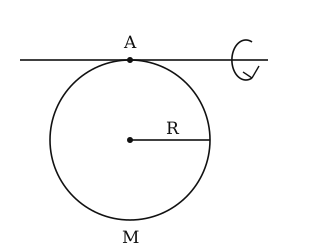
त्रिज्या तथा
द्रव्यमान की एक एकसमान चकती, चित्र में दर्शाए अनुसार अक्ष
के परितः दोलन करने के लिए स्वतंत्र है। लघु दोलनों के लिए आवर्तकाल ______ है।
(g गुरुत्वीय त्वरण है)
- A
- B
- C
- D
Show answer
Concept: Physical pendulum: , with the distance from the axis to the centre of mass. The axis is the tangent at the top point, lying in the plane of the disc (the disc swings out of its plane about this line).
- About a diameter, .
- Parallel-axis shift to the tangent: .
- , so .
Short trick: For a disc about a tangent in its plane, the equivalent length is — memorise (in-plane tangent) vs (tangent perpendicular to plane).
Answer: (A)
अवधारणा: भौतिक लोलक: , जहाँ अक्ष से द्रव्यमान-केन्द्र की दूरी है। अक्ष चकती के शीर्ष बिन्दु पर स्पर्श रेखा है, जो चकती के तल में है (चकती इस रेखा के परितः अपने तल से बाहर झूलती है)।
- व्यास के परितः ।
- समान्तर-अक्ष प्रमेय से स्पर्श रेखा तक: ।
- , अतः ।
शॉर्ट ट्रिक: तल में स्थित स्पर्श-अक्ष हेतु तुल्य लम्बाई — याद रखें: तल में स्पर्श रेखा → , तल के लम्बवत स्पर्श रेखा → ।
उत्तर: (A)
JEE Main 2026 (April) – Paper 1 (B.E./B.Tech)PhysicsOscillations – physical pendulumJEE Main 2026 (April) – Paper 1 (B.E./B.Tech) 2026 · 4 Apr Shift 2
Q411.A rigid dipole undergoes a simple harmonic motion about its centre in the presence of an electric field . If another electric field is introduced to the system, what will be the percentage change in the frequency of the oscillation (approximate)?
एक दृढ़ द्विध्रुव, विद्युत क्षेत्र की उपस्थिति में अपने केन्द्र के परितः सरल आवर्त गति करता है। यदि निकाय में एक अन्य विद्युत क्षेत्र लगा दिया जाए, तो दोलन की आवृत्ति में प्रतिशत परिवर्तन (लगभग) क्या होगा?
- A73%
- B63%
- C83%
- D53%
Show answer
Concept: A dipole oscillating about a field has , so the frequency , where is the magnitude of the net field.
- Net field: .
- .
- .
- Percentage change .
Short trick: is a Pythagorean triple-like set: ; then .
Answer: (A) 73%
अवधारणा: क्षेत्र के परितः दोलन करते द्विध्रुव के लिए , अतः आवृत्ति , जहाँ परिणामी क्षेत्र का परिमाण है।
- परिणामी क्षेत्र: ।
- ।
- ।
- प्रतिशत परिवर्तन ।
शॉर्ट ट्रिक: से ; फिर ।
उत्तर: (A) 73%
JEE Main 2026 (April) – Paper 1 (B.E./B.Tech)PhysicsElectrostatics – oscillation of a dipoleJEE Main 2026 (April) – Paper 1 (B.E./B.Tech) 2026 · 4 Apr Shift 2
Q412.From the circuit given below, the capacitance between terminals
and
shown in the circuit is ______
F.
(take F and F.)
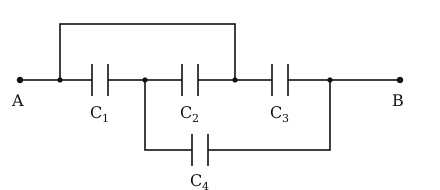
नीचे दिए गए परिपथ में, परिपथ में दर्शाए गए टर्मिनलों
तथा
के बीच धारिता ______
F है।
(F तथा F लीजिए।)
- A2
- B7/2
- C7/3
- D5/2
Show answer
Concept: Redraw by merging nodes joined by plain wires. The top wire connects terminal directly to the junction between and ; joins the – junction (call it ) to .
- joins to ; joins to the – junction (via the top wire). So between and : F.
- From , F leads to : series F.
- joins (via the top wire) straight to : F in parallel.
- F.
Short trick: Mark the wire-shorted nodes first — the maze collapses to – in series, all in parallel with .
Answer: (A) 2
अवधारणा: केवल तार से जुड़े नोडों को मिलाकर परिपथ पुनः खींचिए। ऊपरी तार टर्मिनल को सीधे – संधि से जोड़ता है; , – संधि (इसे कहें) को से जोड़ता है।
- , को से जोड़ता है; , को – संधि (ऊपरी तार से) से जोड़ता है। अतः और के बीच : F।
- से F, तक: श्रेणी में F।
- , (ऊपरी तार से) को सीधे से जोड़ता है: F समान्तर में।
- F।
शॉर्ट ट्रिक: पहले तार से लघुपथित नोड चिह्नित कीजिए — जाल सिमटकर – श्रेणी, और उसके समान्तर रह जाता है।
उत्तर: (A) 2
JEE Main 2026 (April) – Paper 1 (B.E./B.Tech)PhysicsCapacitance – series-parallel networkJEE Main 2026 (April) – Paper 1 (B.E./B.Tech) 2026 · 4 Apr Shift 2
Q413.Given below are two statements: one is labelled as
Assertion A and the other is labelled as
Reason RAssertion A: In electrostatics, a conductor does not store any net charge inside.
Reason R: Inside the capacitor (with no dielectric medium), the free charge carriers, if placed between the plates of capacitor, experience force and drift.
Choose the correct answer from the options given below
नीचे दो कथन दिए गए हैं: एक को
अभिकथन A तथा दूसरे को
कारण R कहा गया है
अभिकथन A: स्थिरवैद्युतिकी में, एक चालक अपने भीतर कोई नेट आवेश संचित नहीं करता।
कारण R: संधारित्र के भीतर (बिना परावैद्युत माध्यम के), मुक्त आवेश वाहक, यदि संधारित्र की प्लेटों के बीच रखे जाएँ, तो बल अनुभव करते हैं तथा अपवाहित (drift) होते हैं।
नीचे दिए गए विकल्पों में से सही उत्तर चुनिए
- ABoth A and R are true and R is the correct explanation of AA तथा R दोनों सत्य हैं तथा R, A की सही व्याख्या है
- BBoth A and R are true but R is NOT the correct explanation of AA तथा R दोनों सत्य हैं परन्तु R, A की सही व्याख्या नहीं है
- CA is true but R is falseA सत्य है परन्तु R असत्य है
- DA is false but R is trueA असत्य है परन्तु R सत्य है
Show answer
Concept: In electrostatic equilibrium inside a conductor, so by Gauss's law any net charge must sit on its surface. Between capacitor plates there is a field .
- A: True — if net charge existed inside, the interior field would be non-zero and free electrons would keep moving; equilibrium forces all excess charge to the surface.
- R: True — a free charge placed in the gap of a charged capacitor sits in field , feels and drifts towards a plate.
- But R describes the vacuum gap of a capacitor, not the interior of a conductor; the correct explanation of A is inside a conductor with Gauss's law. So R does not explain A.
Short trick: Both facts are standard-true, but one is about a conductor's interior and the other about the space between plates — different regions, so no explanation link.
Answer: (B) Both A and R are true but R is NOT the correct explanation of A
अवधारणा: स्थिरवैद्युत साम्य में चालक के भीतर होता है, अतः गाउस नियम से कोई भी नेट आवेश उसकी सतह पर ही रहता है। संधारित्र की प्लेटों के बीच तो क्षेत्र होता है।
- A: सत्य — यदि भीतर नेट आवेश होता, तो आन्तरिक क्षेत्र शून्य न होता और मुक्त इलेक्ट्रॉन चलते रहते; साम्यावस्था सारा अतिरिक्त आवेश सतह पर धकेल देती है।
- R: सत्य — आवेशित संधारित्र के अन्तराल में रखा मुक्त आवेश क्षेत्र में होता है, बल अनुभव करता है और किसी प्लेट की ओर अपवाहित होता है।
- परन्तु R संधारित्र के निर्वात अन्तराल की बात करता है, चालक के भीतरी भाग की नहीं; A की सही व्याख्या चालक के भीतर तथा गाउस नियम है। अतः R, A की व्याख्या नहीं करता।
शॉर्ट ट्रिक: दोनों तथ्य सत्य हैं, पर एक चालक के भीतर का है और दूसरा प्लेटों के बीच के स्थान का — क्षेत्र अलग-अलग हैं, अतः व्याख्या का सम्बन्ध नहीं।
उत्तर: (B) A तथा R दोनों सत्य हैं परन्तु R, A की सही व्याख्या नहीं है
JEE Main 2026 (April) – Paper 1 (B.E./B.Tech)PhysicsElectrostatics – conductors & capacitorsJEE Main 2026 (April) – Paper 1 (B.E./B.Tech) 2026 · 4 Apr Shift 2
Q414.A solenoid has a core made of material with relative permeability 400. The magnetic field produced in the interior of solenoid is 1.0 T. The magnetic intensity in SI units is
. The value of
is ______.
(Free space permeability SI units.)
एक परिनालिका (solenoid) का क्रोड 400 आपेक्षिक चुम्बकशीलता वाले पदार्थ का बना है। परिनालिका के भीतर उत्पन्न चुम्बकीय क्षेत्र 1.0 T है। SI मात्रकों में चुम्बकीय तीव्रता
है।
का मान ______ है।
(मुक्त आकाश की चुम्बकशीलता SI मात्रक।)
- A
- B
- C
- D
Show answer
Concept: , so .
- A/m.
- A/m.
- Comparing with : .
Short trick: ; — just shift the powers of ten.
Answer: (B)
अवधारणा: , अतः ।
- A/m।
- A/m।
- से तुलना करने पर: ।
शॉर्ट ट्रिक: ; — केवल दस की घातें खिसकाइए।
उत्तर: (B)
JEE Main 2026 (April) – Paper 1 (B.E./B.Tech)PhysicsMagnetism & Matter – magnetic intensity HJEE Main 2026 (April) – Paper 1 (B.E./B.Tech) 2026 · 4 Apr Shift 2
Q415.A magnetic field vector in an electromagnetic wave is represented by . Its associated electric field vector is ______.
एक विद्युत चुम्बकीय तरंग में चुम्बकीय क्षेत्र सदिश द्वारा निरूपित है। इससे सम्बद्ध विद्युत क्षेत्र सदिश ______ है।
- A
- B
- C
- D
Show answer
Concept: In an EM wave , and points along the propagation direction.
- The phase means the wave travels along .
- is along ; we need .
- Try : . ✓
- So , in phase with .
Short trick: fixes the magnitude instantly; then one cross product fixes the sign — options (B) and (D) die because can never be along the propagation direction.
Answer: (A)
अवधारणा: विद्युत चुम्बकीय तरंग में , तथा संचरण की दिशा में होता है।
- कला का अर्थ है कि तरंग दिशा में चलती है।
- , के अनुदिश है; हमें चाहिए।
- लें: । ✓
- अतः , जो के साथ समान कला में है।
शॉर्ट ट्रिक: से परिमाण तुरन्त; फिर एक सदिश गुणन से चिह्न — विकल्प (B) तथा (D) तुरन्त कट जाते हैं क्योंकि कभी संचरण दिशा के अनुदिश नहीं हो सकता।
उत्तर: (A)
JEE Main 2026 (April) – Paper 1 (B.E./B.Tech)PhysicsElectromagnetic Waves – E and B relationJEE Main 2026 (April) – Paper 1 (B.E./B.Tech) 2026 · 4 Apr Shift 2
Q416.A convex lens is made from glass material having refractive index of 1.4 with same radius of curvature on both sides. The ratio of its focal length and radius of curvature is ______.
एक उत्तल लेंस 1.4 अपवर्तनांक वाले काँच के पदार्थ का बना है तथा इसके दोनों ओर की वक्रता त्रिज्याएँ समान हैं। इसकी फोकस दूरी तथा वक्रता त्रिज्या का अनुपात ______ है।
- A0.5
- B2.5
- C0.8
- D1.25
Show answer
Concept: Lens maker's formula: with , for an equiconvex lens.
- .
- .
Short trick: Equiconvex: . With : .
Answer: (D) 1.25
अवधारणा: लेंस मेकर सूत्र: , समद्विउत्तल लेंस हेतु , ।
- ।
- ।
शॉर्ट ट्रिक: समद्विउत्तल: । पर: ।
उत्तर: (D) 1.25
JEE Main 2026 (April) – Paper 1 (B.E./B.Tech)PhysicsRay Optics – lens maker's formulaJEE Main 2026 (April) – Paper 1 (B.E./B.Tech) 2026 · 4 Apr Shift 2
Q417.An unpolarized light of certain intensity passes through a combination of two polarizers whose transmission axes are at 30° and 90°, respectively, with respect to the horizontal axis. A third polarizer with its transmission axis at 60° with the horizontal axis is placed between the two existing polarizers. The ratio of the output intensities with and without the third polarizer is ______.
किसी तीव्रता का अध्रुवित प्रकाश दो ध्रुवकों (polarizers) के संयोजन से गुजरता है, जिनके पारगमन अक्ष क्षैतिज अक्ष के सापेक्ष क्रमशः 30° तथा 90° पर हैं। क्षैतिज अक्ष से 60° पर पारगमन अक्ष वाला एक तीसरा ध्रुवक दोनों विद्यमान ध्रुवकों के बीच रखा जाता है। तीसरे ध्रुवक के साथ तथा उसके बिना निर्गत तीव्रताओं का अनुपात ______ है।
- A3/4
- B4/3
- C9/4
- D4/9
Show answer
Concept: Unpolarized light halves at the first polarizer; after that each polarizer transmits (Malus' law), being the angle between successive axes.
- Without the third: .
- With the third (30° → 60° → 90°, each step 30°): .
- Ratio .
Short trick: Splitting 60° into two 30° steps changes into ; ratio .
Answer: (C) 9/4
अवधारणा: अध्रुवित प्रकाश पहले ध्रुवक पर आधा रह जाता है; उसके बाद प्रत्येक ध्रुवक पारगमित करता है (मैलस का नियम), जहाँ क्रमागत अक्षों के बीच का कोण है।
- तीसरे ध्रुवक के बिना: ।
- तीसरे के साथ (30° → 60° → 90°, प्रत्येक चरण 30°): ।
- अनुपात ।
शॉर्ट ट्रिक: 60° को दो 30° चरणों में बाँटने से बदलकर हो जाता है; अनुपात ।
उत्तर: (C) 9/4
JEE Main 2026 (April) – Paper 1 (B.E./B.Tech)PhysicsWave Optics – polarization (Malus' law)JEE Main 2026 (April) – Paper 1 (B.E./B.Tech) 2026 · 4 Apr Shift 2
Q418.In Rutherford's alpha-particle scattering experiment, only a few alpha particles rebound back because
A. The size of gold nucleus is very small as compared to the size of gold atom.
B. Alpha particle and gold nucleus have equal charge.
C. The impact parameter is minimum for a few alpha particles.
D. A few alpha particles have very high kinetic energy.
E. Only a few alpha particles undergo head-on collision with the nuclei.
Choose the correct answer from the options given below:
रदरफोर्ड के ऐल्फा-कण प्रकीर्णन प्रयोग में, केवल कुछ ही ऐल्फा कण वापस लौटते हैं, क्योंकि
A. सोने के परमाणु के आकार की तुलना में सोने के नाभिक का आकार बहुत छोटा होता है।
B. ऐल्फा कण तथा सोने के नाभिक पर समान आवेश होता है।
C. कुछ ही ऐल्फा कणों के लिए संघट्ट प्राचल (impact parameter) न्यूनतम होता है।
D. कुछ ऐल्फा कणों की गतिज ऊर्जा बहुत अधिक होती है।
E. केवल कुछ ही ऐल्फा कण नाभिकों से सम्मुख (head-on) संघट्ट करते हैं।
नीचे दिए गए विकल्पों में से सही उत्तर चुनिए:
- AA, B Onlyकेवल A, B
- BB, E Onlyकेवल B, E
- CC, D Onlyकेवल C, D
- DA, C, E Onlyकेवल A, C, E
Show answer
Concept: Large-angle (backward) scattering happens only for nearly head-on approaches, i.e. an impact parameter close to zero — and the tiny nuclear size makes such approaches rare.
- A — correct: the nucleus occupies m in an atom of m, so very few alphas pass close enough to it.
- B — wrong: charges are (alpha) and (gold) — not equal; equality of charge is also not the cause of rebound.
- C — correct: rebound needs minimum (nearly zero) impact parameter, true only for a few particles.
- D — wrong: all alphas from the source have nearly the same kinetic energy; higher KE would in fact reduce deflection, not cause rebound.
- E — correct: only the rare head-on collisions reverse the alpha particle.
Short trick: Rebound ⇔ head-on ⇔ ⇔ tiny nucleus — statements A, C, E say the same physics three ways.
Answer: (D) A, C, E Only
अवधारणा: बड़े कोण (पीछे की ओर) का प्रकीर्णन केवल लगभग सम्मुख पहुँच पर होता है, अर्थात् शून्य के निकट संघट्ट प्राचल पर — और नाभिक का अति सूक्ष्म आकार ऐसी पहुँच को दुर्लभ बना देता है।
- A — सही: m के परमाणु में नाभिक केवल m घेरता है, अतः बहुत कम ऐल्फा कण ही उसके इतने निकट पहुँचते हैं।
- B — गलत: आवेश (ऐल्फा) तथा (सोना) हैं — समान नहीं; समान आवेश होना वापसी का कारण भी नहीं है।
- C — सही: वापस लौटने हेतु न्यूनतम (लगभग शून्य) संघट्ट प्राचल चाहिए, जो कुछ ही कणों के लिए होता है।
- D — गलत: स्रोत से सभी ऐल्फा कणों की गतिज ऊर्जा लगभग समान होती है; अधिक ऊर्जा विक्षेप घटाती है, वापसी नहीं कराती।
- E — सही: केवल दुर्लभ सम्मुख संघट्ट ही ऐल्फा कण को उलट देते हैं।
शॉर्ट ट्रिक: वापसी ⇔ सम्मुख संघट्ट ⇔ ⇔ सूक्ष्म नाभिक — कथन A, C, E एक ही भौतिकी के तीन रूप हैं।
उत्तर: (D) केवल A, C, E
JEE Main 2026 (April) – Paper 1 (B.E./B.Tech)PhysicsAtoms – Rutherford scatteringJEE Main 2026 (April) – Paper 1 (B.E./B.Tech) 2026 · 4 Apr Shift 2
Q419.The de Broglie wavelength associated with an electron accelerated through a potential difference V is and the de Broglie wavelength associated with a proton accelerated through the same potential difference is . If their corresponding masses are and , respectively, then the ratio of their de Broglie wavelengths is ______.
विभवान्तर V से त्वरित इलेक्ट्रॉन से सम्बद्ध दे ब्रॉग्ली तरंगदैर्घ्य है तथा समान विभवान्तर से त्वरित प्रोटॉन से सम्बद्ध दे ब्रॉग्ली तरंगदैर्घ्य है। यदि इनके संगत द्रव्यमान क्रमशः तथा हैं, तो इनकी दे ब्रॉग्ली तरंगदैर्घ्यों का अनुपात ______ है।
- A
- B
- C
- D
Show answer
Concept: For a charge accelerated through V, kinetic energy and .
- Electron and proton carry the same magnitude of charge and the same V.
- .
Short trick: Same ⇒ — the lighter particle has the longer wavelength, so the ratio must exceed 1: only (A) fits.
Answer: (A)
अवधारणा: V विभवान्तर से त्वरित आवेश हेतु गतिज ऊर्जा तथा ।
- इलेक्ट्रॉन तथा प्रोटॉन पर आवेश का परिमाण समान () है तथा V भी समान है।
- ।
शॉर्ट ट्रिक: समान ⇒ — हल्के कण की तरंगदैर्घ्य बड़ी होती है, अतः अनुपात 1 से बड़ा होना चाहिए: केवल (A) ही सम्भव।
उत्तर: (A)
JEE Main 2026 (April) – Paper 1 (B.E./B.Tech)PhysicsDual Nature – de Broglie wavelengthJEE Main 2026 (April) – Paper 1 (B.E./B.Tech) 2026 · 4 Apr Shift 2
Q420.Given below are two statements: one is labelled as
Assertion A and the other is labelled as
Reason RAssertion A: A diode under reverse-biased condition provides very small current which is nearly independent of voltage until a critical limit at which the current increases drastically.
Reason R: Below the critical voltage limit, only majority charge carriers flow which increases drastically above critical voltage.
choose the correct answer from the options given below
नीचे दो कथन दिए गए हैं: एक को
अभिकथन A तथा दूसरे को
कारण R कहा गया है
अभिकथन A: पश्चदिशिक बायस (reverse-biased) अवस्था में एक डायोड बहुत छोटी धारा देता है, जो एक क्रांतिक सीमा तक वोल्टता से लगभग स्वतंत्र रहती है; इस सीमा पर धारा तीव्रता से बढ़ जाती है।
कारण R: क्रांतिक वोल्टता सीमा से नीचे केवल बहुसंख्यक (majority) आवेश वाहक प्रवाहित होते हैं, जो क्रांतिक वोल्टता के ऊपर तीव्रता से बढ़ जाते हैं।
नीचे दिए गए विकल्पों में से सही उत्तर चुनिए
- ABoth A and R are true and R is the correct explanation of AA तथा R दोनों सत्य हैं तथा R, A की सही व्याख्या है
- BBoth A and R are true but R is NOT the correct explanation of AA तथा R दोनों सत्य हैं परन्तु R, A की सही व्याख्या नहीं है
- CA is true but R is falseA सत्य है परन्तु R असत्य है
- DA is false but R is trueA असत्य है परन्तु R सत्य है
Show answer
Concept: In reverse bias the tiny, voltage-independent saturation current is carried by minority carriers drifting across the junction; at breakdown (Zener/avalanche) the current rises sharply.
- A: True — this is exactly the reverse characteristic of a diode: a nearly constant reverse saturation current, then a drastic rise at the breakdown (critical) voltage.
- R: False — below breakdown the current is due to minority carriers, not majority carriers; majority carriers are blocked by the widened depletion region in reverse bias.
Short trick: Reverse bias ⇒ minority carriers. Any statement crediting majority carriers in reverse bias is false on sight.
Answer: (C) A is true but R is false
अवधारणा: पश्चदिशिक बायस में छोटी, वोल्टता-निरपेक्ष संतृप्ति धारा संधि के पार अपवाहित होते अल्पसंख्यक वाहकों से बनती है; भंजन (ज़ेनर/ऐवलांश) पर धारा तीव्रता से बढ़ती है।
- A: सत्य — यही डायोड का पश्चदिशिक अभिलक्षण है: लगभग अचर पश्च संतृप्ति धारा, फिर भंजन (क्रांतिक) वोल्टता पर तीव्र वृद्धि।
- R: असत्य — भंजन से नीचे धारा अल्पसंख्यक वाहकों के कारण होती है, बहुसंख्यक वाहकों के कारण नहीं; पश्चदिशिक बायस में चौड़ा हुआ ह्रासी क्षेत्र बहुसंख्यक वाहकों को रोक देता है।
शॉर्ट ट्रिक: पश्चदिशिक बायस ⇒ अल्पसंख्यक वाहक। पश्च बायस में बहुसंख्यक वाहकों को श्रेय देने वाला कथन देखते ही असत्य।
उत्तर: (C) A सत्य है परन्तु R असत्य है
JEE Main 2026 (April) – Paper 1 (B.E./B.Tech)PhysicsSemiconductors – reverse-biased diodeJEE Main 2026 (April) – Paper 1 (B.E./B.Tech) 2026 · 4 Apr Shift 2

