Q281.The products A and B in the following reactions, respectively are
निम्नलिखित अभिक्रियाओं में उत्पाद A तथा B क्रमशः हैं
- ACH3−CH2−CH2−NO2, CH3−CH2−CH2−CN
- BCH3−CH2−CH2−ONO, CH3−CH2−CH2−NC
- CCH3−CH2−CH2−ONO, CH3−CH2−CH2−CN
- DCH3−CH2−CH2−NO2, CH3−CH2−CH2−NC
Show answer
Concept: With silver salts of ambident nucleophiles, the covalent Ag–X bond forces attack through the atom bearing the lone pair of higher electron density: AgNO2 attacks through N, AgCN through N.
- AgNO2 + n-propyl bromide → nitrogen attacks carbon → A = CH3CH2CH2–NO2 (1-nitropropane), not the nitrite ester.
- AgCN + n-propyl bromide → nitrogen end attacks → B = CH3CH2CH2–NC (propyl isocyanide), not the nitrile.
- (KNO2/KCN, being ionic, would instead give R–ONO and R–CN.)
Short trick: "Ag binds O/C, so N attacks": silver salts give the N-products (R–NO2, R–NC); potassium salts give R–ONO, R–CN.
Answer: (D)
अवधारणा: उभयदंती नाभिकरागियों के सिल्वर लवणों में सहसंयोजक Ag–X आबंध के कारण आक्रमण उस परमाणु से होता है जिस पर इलेक्ट्रॉन घनत्व अधिक है: AgNO2 में N से, AgCN में N से।
- AgNO2 + n-प्रोपिल ब्रोमाइड → नाइट्रोजन कार्बन पर आक्रमण करता है → A = CH3CH2CH2–NO2 (1-नाइट्रोप्रोपेन), नाइट्राइट एस्टर नहीं।
- AgCN + n-प्रोपिल ब्रोमाइड → नाइट्रोजन सिरे से आक्रमण → B = CH3CH2CH2–NC (प्रोपिल आइसोसायनाइड), नाइट्राइल नहीं।
- (KNO2/KCN आयनिक होने से R–ONO तथा R–CN देते।)
शॉर्ट ट्रिक: "Ag, O/C को बाँध लेता है, अतः N आक्रमण करता है": सिल्वर लवण N-उत्पाद (R–NO2, R–NC) देते हैं; पोटैशियम लवण R–ONO, R–CN देते हैं।
उत्तर: (D)
JEE Main 2025 (January) – Paper 1 (B.E./B.Tech)ChemistryHaloalkanes – ambident nucleophiles (AgNO2/AgCN)JEE Main 2025 (January) – Paper 1 (B.E./B.Tech) 2025 · 28 Jan Shift 1
Q282.In a multielectron atom, which of the following orbitals described by three quantum numbers will have same energy in absence of electric and magnetic fields?
A.
B.
C.
D.
E.
Choose the correct answer from the options given below:
एक बहु-इलेक्ट्रॉन परमाणु में, तीन क्वांटम संख्याओं से वर्णित निम्नलिखित कक्षकों में से किनकी ऊर्जा, विद्युत तथा चुंबकीय क्षेत्रों की अनुपस्थिति में, समान होगी?
A.
B.
C.
D.
E.
नीचे दिए गए विकल्पों में से सही उत्तर चुनिए:
- AB and C Onlyकेवल B और C
- BA and B Onlyकेवल A और B
- CC and D Onlyकेवल C और D
- DD and E Onlyकेवल D और E
Show answer
Concept: In a multielectron atom the orbital energy depends on both and ; orbitals with the same and (differing only in ) are degenerate.
- D: (3d) and E: (3d) — same subshell, different → same energy. ✓
- A (1s) and B (2s) differ in — different energies.
- B (2s) and C (2p) have the same but different — in a multielectron atom 2s 2p, so not degenerate.
Short trick: Degenerate in a multielectron atom ⇔ identical pair; only D and E share .
Answer: (D)
अवधारणा: बहु-इलेक्ट्रॉन परमाणु में कक्षक की ऊर्जा तथा दोनों पर निर्भर करती है; समान व (केवल भिन्न) वाले कक्षक समभ्रंश (degenerate) होते हैं।
- D: (3d) तथा E: (3d) — समान उपकोश, भिन्न → समान ऊर्जा। ✓
- A (1s) तथा B (2s) में भिन्न है — ऊर्जाएँ भिन्न।
- B (2s) तथा C (2p) में समान पर भिन्न है — बहु-इलेक्ट्रॉन परमाणु में 2s 2p, अतः समभ्रंश नहीं।
शॉर्ट ट्रिक: बहु-इलेक्ट्रॉन परमाणु में समभ्रंश ⇔ युग्म समान; केवल D और E में समान है।
उत्तर: (D)
JEE Main 2025 (January) – Paper 1 (B.E./B.Tech)ChemistryAtomic structure – quantum numbers & degeneracyJEE Main 2025 (January) – Paper 1 (B.E./B.Tech) 2025 · 28 Jan Shift 1
Q283.A weak acid HA has degree of dissociation x. Which option gives the correct expression of ?
एक दुर्बल अम्ल HA की वियोजन की मात्रा x है। कौन-सा विकल्प का सही व्यंजक देता है?
- A0
- B
- C
- D
Show answer
Concept: Henderson–Hasselbalch relation: .
- For HA of initial concentration with degree of dissociation : , .
- .
Short trick: Dissociated over undissociated: the ratio inside the log is always , concentration cancels.
Answer: (D)
अवधारणा: हेंडरसन–हैसलबाल्च संबंध: ।
- प्रारंभिक सांद्रता तथा वियोजन की मात्रा वाले HA के लिए: , ।
- ।
शॉर्ट ट्रिक: वियोजित/अवियोजित: log के अंदर का अनुपात सदैव होता है, सांद्रता कट जाती है।
उत्तर: (D)
JEE Main 2025 (January) – Paper 1 (B.E./B.Tech)ChemistryIonic equilibrium – pH of weak acidJEE Main 2025 (January) – Paper 1 (B.E./B.Tech) 2025 · 28 Jan Shift 1
Q284.The molecules having square pyramidal geometry are
वर्ग पिरैमिडी (square pyramidal) ज्यामिति वाले अणु हैं
- ABrF5 & PCl5
- BSbF5 & PCl5
- CSbF5 & XeOF4
- DBrF5 & XeOF4
Show answer
Concept: Square pyramidal shape arises from six electron domains with one lone pair (AX5E type).
- BrF5: Br has 5 bond pairs + 1 lone pair → octahedral electron geometry, square pyramidal shape. ✓
- XeOF4: Xe has 4 Xe–F bonds + 1 Xe=O + 1 lone pair → square pyramidal. ✓
- PCl5 and SbF5: 5 bond pairs, no lone pair → trigonal bipyramidal, not square pyramidal.
Short trick: AX5E (or AX4YE like XeOF4) = square pyramid; plain AX5 = trigonal bipyramid.
Answer: (D)
अवधारणा: वर्ग पिरैमिडी आकृति छह इलेक्ट्रॉन क्षेत्रों में एक एकाकी युग्म होने पर बनती है (AX5E प्रकार)।
- BrF5: Br पर 5 आबंध युग्म + 1 एकाकी युग्म → अष्टफलकीय इलेक्ट्रॉन ज्यामिति, वर्ग पिरैमिडी आकृति। ✓
- XeOF4: Xe पर 4 Xe–F आबंध + 1 Xe=O + 1 एकाकी युग्म → वर्ग पिरैमिडी। ✓
- PCl5 तथा SbF5: 5 आबंध युग्म, कोई एकाकी युग्म नहीं → त्रिकोणीय द्विपिरैमिडी, वर्ग पिरैमिडी नहीं।
शॉर्ट ट्रिक: AX5E (या XeOF4 जैसा AX4YE) = वर्ग पिरैमिड; केवल AX5 = त्रिकोणीय द्विपिरैमिड।
उत्तर: (D)
JEE Main 2025 (January) – Paper 1 (B.E./B.Tech)ChemistryChemical bonding – VSEPR geometryJEE Main 2025 (January) – Paper 1 (B.E./B.Tech) 2025 · 28 Jan Shift 1
Q285.Consider the following elements In, Tl, Al, Pb, Sn and Ge. The most stable oxidation states of elements with highest and lowest first ionisation enthalpies, respectively, are
निम्नलिखित तत्वों In, Tl, Al, Pb, Sn तथा Ge पर विचार कीजिए। उच्चतम तथा निम्नतम प्रथम आयनन एन्थैल्पी वाले तत्वों की सर्वाधिक स्थायी ऑक्सीकरण अवस्थाएँ क्रमशः हैं
- A+4 and +1+4 और +1
- B+1 and +4+1 और +4
- C+4 and +3+4 और +3
- D+2 and +3+2 और +3
Show answer
Concept: Compare first ionisation enthalpies (kJ mol−1): group 13 — Al 577, In 558, Tl 589; group 14 — Ge 762, Sn 708, Pb 715.
- Highest ΔiH1: Ge (762 kJ mol−1). For Ge the inert pair effect is weak, so its most stable oxidation state is +4.
- Lowest ΔiH1: In (558 kJ mol−1). Indium is most stable in the +3 state (only Tl prefers +1 in group 13).
- Hence +4 and +3 respectively.
Short trick: Group 14 members have higher IE1 than group 13 of the same period; within these six, Ge is top, In is bottom.
Answer: (C)
अवधारणा: प्रथम आयनन एन्थैल्पियाँ (kJ mol−1) तुलना कीजिए: वर्ग 13 — Al 577, In 558, Tl 589; वर्ग 14 — Ge 762, Sn 708, Pb 715।
- उच्चतम ΔiH1: Ge (762 kJ mol−1)। Ge में निष्क्रिय युग्म प्रभाव (inert pair effect) दुर्बल है, अतः इसकी सर्वाधिक स्थायी ऑक्सीकरण अवस्था +4 है।
- निम्नतम ΔiH1: In (558 kJ mol−1)। इंडियम +3 अवस्था में सर्वाधिक स्थायी है (वर्ग 13 में केवल Tl, +1 पसंद करता है)।
- अतः क्रमशः +4 तथा +3।
शॉर्ट ट्रिक: समान आवर्त में वर्ग 14 के तत्वों की IE1 वर्ग 13 से अधिक होती है; इन छह में Ge शीर्ष पर, In सबसे नीचे।
उत्तर: (C)
JEE Main 2025 (January) – Paper 1 (B.E./B.Tech)Chemistryp-block – ionisation enthalpy & oxidation statesJEE Main 2025 (January) – Paper 1 (B.E./B.Tech) 2025 · 28 Jan Shift 1
Q286.| [A]0/mol L−1 | t1/2/min |
|---|
| 0.100 | 200 |
| 0.025 | 100 |
For a given reaction R → P, t
1/2 is related to [A]
0 as given in table. Given: log 2 = 0.30. Which of the following is true?
A. The order of the reaction is 1/2.
B. If [A]
0 is 1 M, then t
1/2 is
min
C. The order of the reaction changes to 1 if the concentration of reactant changes from 0.100 M to 0.500 M.
D. t
1/2 is 800 min for [A]
0 = 1.6 M
Choose the correct answer from the options given below:
| [A]0/mol L−1 | t1/2/min |
|---|
| 0.100 | 200 |
| 0.025 | 100 |
किसी अभिक्रिया R → P के लिए t
1/2 का [A]
0 से संबंध सारणी में दिया गया है। दिया है: log 2 = 0.30। निम्नलिखित में से कौन-सा सत्य है?
A. अभिक्रिया की कोटि 1/2 है।
B. यदि [A]
0, 1 M है, तो t
1/2,
min है
C. यदि अभिकारक की सांद्रता 0.100 M से 0.500 M हो जाए, तो अभिक्रिया की कोटि बदलकर 1 हो जाती है।
D. [A]
0 = 1.6 M के लिए t
1/2, 800 min है
नीचे दिए गए विकल्पों में से सही उत्तर चुनिए:
- AA and C Onlyकेवल A और C
- BA, B and D Onlyकेवल A, B और D
- CC and D Onlyकेवल C और D
- DA and B Onlyकेवल A और B
Show answer
Concept: For an nth-order reaction, .
- . Statement A is true.
- So . For M: min. Statement B is true.
- Order is a constant of the reaction; it does not change with concentration. Statement C is false.
- For M: min. Statement D is true.
Short trick: Conc. ×4 but only ×2 ⇒ ⇒ order 1/2 instantly.
Answer: (B)
अवधारणा: n कोटि की अभिक्रिया के लिए ।
- । कथन A सत्य है।
- अतः । M के लिए: min। कथन B सत्य है।
- कोटि अभिक्रिया का स्थिरांक है; यह सांद्रता के साथ नहीं बदलती। कथन C असत्य है।
- M के लिए: min। कथन D सत्य है।
शॉर्ट ट्रिक: सांद्रता ×4 पर केवल ×2 ⇒ ⇒ कोटि 1/2 तुरंत।
उत्तर: (B)
JEE Main 2025 (January) – Paper 1 (B.E./B.Tech)ChemistryChemical kinetics – order from half-lifeJEE Main 2025 (January) – Paper 1 (B.E./B.Tech) 2025 · 28 Jan Shift 1
Q287.Match the LIST-I with LIST-II
| LIST-I
(Redox Reaction) | | LIST-II
(Type of Redox Reaction) |
|---|
| A. | CH4(g) + 2O2(g) CO2(g) + 2H2O(l) | I. | Disproportionation reaction |
| B. | 2NaH(s) 2Na(s) + H2(g) | II. | Combination reaction |
| C. | V2O5(s) + 5Ca(s) 2V(s) + 5CaO(s) | III. | Decomposition reaction |
| D. | 2H2O2(aq) 2H2O(l) + O2(g) | IV. | Displacement reaction |
Choose the correct answer from the options given below:
सूची-I का सूची-II से मिलान कीजिए
| सूची-I
(रेडॉक्स अभिक्रिया) | | सूची-II
(रेडॉक्स अभिक्रिया का प्रकार) |
|---|
| A. | CH4(g) + 2O2(g) CO2(g) + 2H2O(l) | I. | असमानुपातन (disproportionation) अभिक्रिया |
| B. | 2NaH(s) 2Na(s) + H2(g) | II. | संयोजन (combination) अभिक्रिया |
| C. | V2O5(s) + 5Ca(s) 2V(s) + 5CaO(s) | III. | अपघटन (decomposition) अभिक्रिया |
| D. | 2H2O2(aq) 2H2O(l) + O2(g) | IV. | विस्थापन (displacement) अभिक्रिया |
नीचे दिए गए विकल्पों में से सही उत्तर चुनिए:
- AA-II, B-III, C-I, D-IV
- BA-III, B-IV, C-I, D-II
- CA-IV, B-I, C-II, D-III
- DA-II, B-III, C-IV, D-I
Show answer
Concept: Classify each redox change: combination (two or more substances → one product set by direct union), decomposition (one substance breaks up), displacement (one element displaces another), disproportionation (same element oxidised and reduced).
- A. Combustion of CH4 with O2 is a redox combination reaction → II.
- B. NaH alone breaks into Na and H2 → decomposition → III.
- C. Ca displaces V from V2O5 → displacement → IV.
- D. In H2O2, oxygen (−1) goes to −2 (H2O) and 0 (O2) → disproportionation → I.
- Thus A-II, B-III, C-IV, D-I; the other options misplace C and D.
Short trick: H2O2 is the classic disproportionation example — lock D-I first and only one option survives.
Answer: (D)
अवधारणा: प्रत्येक रेडॉक्स परिवर्तन को वर्गीकृत कीजिए: संयोजन (दो या अधिक पदार्थ मिलकर उत्पाद बनाएँ), अपघटन (एक पदार्थ टूटे), विस्थापन (एक तत्व दूसरे को विस्थापित करे), असमानुपातन (एक ही तत्व का ऑक्सीकरण और अपचयन दोनों)।
- A. CH4 का O2 के साथ दहन एक रेडॉक्स संयोजन अभिक्रिया है → II।
- B. NaH अकेले टूटकर Na और H2 देता है → अपघटन → III।
- C. Ca, V2O5 से V को विस्थापित करता है → विस्थापन → IV।
- D. H2O2 में ऑक्सीजन (−1) से −2 (H2O) तथा 0 (O2) में जाती है → असमानुपातन → I।
- अतः A-II, B-III, C-IV, D-I; शेष विकल्पों में C और D गलत मिलाए गए हैं।
शॉर्ट ट्रिक: H2O2 असमानुपातन का क्लासिक उदाहरण है — पहले D-I पक्का कीजिए, केवल एक विकल्प बचेगा।
उत्तर: (D)
JEE Main 2025 (January) – Paper 1 (B.E./B.Tech)ChemistryRedox reactions – typesJEE Main 2025 (January) – Paper 1 (B.E./B.Tech) 2025 · 28 Jan Shift 1
Q288.Given below are two statements:
Statement I: In the oxalic acid vs KMnO4 (in the presence of dil H2SO4) titration the solution needs to be heated initially to 60 ∘C, but no heating is required in Ferrous ammonium sulphate (FAS) vs KMnO4 titration (in the presence of dil H2SO4)
Statement II: In oxalic acid vs KMnO4 titration, the initial formation of MnSO4 takes place at high temperature, which then acts as catalyst for further reaction. In the case of FAS vs KMnO4, heating oxidizes Fe2+ into Fe3+ by oxygen of air and error may be introduced in the experiment.
In the light of the above statements, choose the correct answer from the options given below
नीचे दो कथन दिए गए हैं:
कथन I: ऑक्सैलिक अम्ल व KMnO4 (तनु H2SO4 की उपस्थिति में) अनुमापन में विलयन को प्रारंभ में 60 ∘C तक गर्म करना पड़ता है, परन्तु फेरस अमोनियम सल्फेट (FAS) व KMnO4 अनुमापन (तनु H2SO4 की उपस्थिति में) में गर्म करने की आवश्यकता नहीं होती।
कथन II: ऑक्सैलिक अम्ल व KMnO4 अनुमापन में, उच्च ताप पर प्रारंभ में MnSO4 बनता है, जो आगे की अभिक्रिया के लिए उत्प्रेरक का कार्य करता है। FAS व KMnO4 के प्रकरण में, गर्म करने पर वायु की ऑक्सीजन द्वारा Fe2+ का Fe3+ में ऑक्सीकरण हो जाता है और प्रयोग में त्रुटि आ सकती है।
उपर्युक्त कथनों के आलोक में, नीचे दिए गए विकल्पों में से सही उत्तर चुनिए
- ABoth Statement I and Statement II are falseकथन I और कथन II दोनों असत्य हैं
- BBoth Statement I and Statement II are trueकथन I और कथन II दोनों सत्य हैं
- CStatement I is false but Statement II is trueकथन I असत्य है परन्तु कथन II सत्य है
- DStatement I is true but Statement II is falseकथन I सत्य है परन्तु कथन II असत्य है
Show answer
Concept: The oxalic acid–permanganate reaction is slow at room temperature and is autocatalysed by Mn2+; the Fe2+–permanganate reaction is fast at room temperature.
- Oxalic acid titration: the mixture is warmed to about 60 ∘C because the first few drops of KMnO4 react slowly; once Mn2+ (as MnSO4) forms, it autocatalyses the reaction. Statement I correctly says heating is needed here and not in the FAS titration.
- FAS titration is never heated: on warming, dissolved/aerial O2 would oxidise Fe2+ to Fe3+, lowering the apparent strength and introducing error. This is exactly what Statement II says.
- Both statements are therefore true.
Short trick: "Heat oxalic, never heat ferrous" — Mn2+ autocatalysis in one, aerial oxidation error in the other.
Answer: (B)
अवधारणा: ऑक्सैलिक अम्ल–परमैंगनेट अभिक्रिया कक्ष ताप पर धीमी होती है और Mn2+ द्वारा स्व-उत्प्रेरित होती है; Fe2+–परमैंगनेट अभिक्रिया कक्ष ताप पर ही तीव्र होती है।
- ऑक्सैलिक अम्ल अनुमापन: मिश्रण को लगभग 60 ∘C तक गर्म करते हैं क्योंकि KMnO4 की प्रारंभिक बूँदें धीरे अभिक्रिया करती हैं; जैसे ही Mn2+ (MnSO4 रूप में) बनता है, वह अभिक्रिया को स्व-उत्प्रेरित करता है। कथन I सही कहता है कि यहाँ गर्म करना आवश्यक है और FAS अनुमापन में नहीं।
- FAS अनुमापन कभी गर्म नहीं करते: गर्म करने पर घुली/वायवीय O2, Fe2+ को Fe3+ में ऑक्सीकृत कर देगी, जिससे प्रयोग में त्रुटि आएगी। यही कथन II कहता है।
- अतः दोनों कथन सत्य हैं।
शॉर्ट ट्रिक: "ऑक्सैलिक गर्म करो, फेरस कभी नहीं" — एक में Mn2+ स्व-उत्प्रेरण, दूसरे में वायवीय ऑक्सीकरण की त्रुटि।
उत्तर: (B)
JEE Main 2025 (January) – Paper 1 (B.E./B.Tech)ChemistryPractical chemistry – KMnO4 titrationsJEE Main 2025 (January) – Paper 1 (B.E./B.Tech) 2025 · 28 Jan Shift 1
Q289.The metal ion whose electronic configuration is not affected by the nature of the ligand and which gives a violet colour in non-luminous flame under hot condition in borax bead test is
वह धातु आयन जिसका इलेक्ट्रॉनिक विन्यास लिगन्ड की प्रकृति से प्रभावित नहीं होता तथा जो बोरेक्स मनका परीक्षण (borax bead test) में अदीप्त ज्वाला में गर्म अवस्था में बैंगनी रंग देता है, है
- AMn2+
- BCr3+
- CNi2+
- DTi3+
Show answer
Concept: In an octahedral field a d8 ion always has the configuration t2g6eg2, whether the ligand is strong or weak; borax bead colours identify the metal.
- Ni2+ (3d8): t2g6eg2 with 2 unpaired electrons for every ligand — configuration independent of ligand nature. ✓
- In the borax bead test (bead held in the hot, non-luminous oxidising flame) nickel gives a violet bead when hot (brown on cooling). ✓
- Mn2+ (d5) changes from high-spin to low-spin with strong ligands, so its configuration depends on the ligand. Cr3+ (d3) has a fixed configuration but its borax bead is green, not violet; Ti3+ (d1) does not give a violet bead under these conditions.
Short trick: d3 and d8 are the two "ligand-proof" octahedral configurations; of these only Ni2+ (d8) matches the hot violet bead.
Answer: (C)
अवधारणा: अष्टफलकीय क्षेत्र में d8 आयन का विन्यास सदैव t2g6eg2 रहता है, लिगन्ड प्रबल हो या दुर्बल; बोरेक्स मनके के रंग धातु की पहचान कराते हैं।
- Ni2+ (3d8): प्रत्येक लिगन्ड के लिए t2g6eg2, 2 अयुग्मित इलेक्ट्रॉन — विन्यास लिगन्ड की प्रकृति से स्वतंत्र। ✓
- बोरेक्स मनका परीक्षण में (मनका गर्म, अदीप्त ऑक्सीकारी ज्वाला में) निकैल गर्म अवस्था में बैंगनी मनका देता है (ठंडा होने पर भूरा)। ✓
- Mn2+ (d5) प्रबल लिगन्डों के साथ उच्च-चक्रण से निम्न-चक्रण में बदल जाता है, अतः उसका विन्यास लिगन्ड पर निर्भर है। Cr3+ (d3) का विन्यास निश्चित है पर उसका मनका हरा होता है, बैंगनी नहीं; Ti3+ (d1) इन परिस्थितियों में बैंगनी मनका नहीं देता।
शॉर्ट ट्रिक: d3 और d8 ही दो "लिगन्ड-निरपेक्ष" अष्टफलकीय विन्यास हैं; इनमें से केवल Ni2+ (d8) गर्म बैंगनी मनके से मेल खाता है।
उत्तर: (C)
JEE Main 2025 (January) – Paper 1 (B.E./B.Tech)Chemistryd-block – CFT & borax bead testJEE Main 2025 (January) – Paper 1 (B.E./B.Tech) 2025 · 28 Jan Shift 1
Q290.The compounds that produce CO
2 with aqueous NaHCO
3 solution are:
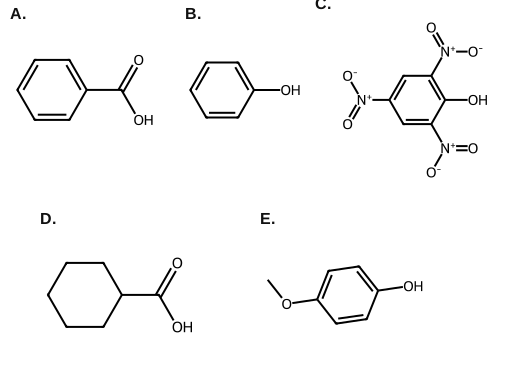
Choose the correct answer from the options given below:
वे यौगिक जो जलीय NaHCO
3 विलयन के साथ CO
2 उत्पन्न करते हैं, हैं:
नीचे दिए गए विकल्पों में से सही उत्तर चुनिए:
- AA, C and D Onlyकेवल A, C और D
- BA, B and E Onlyकेवल A, B और E
- CA and C Onlyकेवल A और C
- DA and B Onlyकेवल A और B
Show answer
Concept: NaHCO3 liberates CO2 only with acids stronger than carbonic acid (p ≈ 6.4): carboxylic acids and exceptionally acidic phenols.
- A. Benzoic acid (p ≈ 4.2) — reacts, gives CO2. ✓
- B. Phenol (p ≈ 10) — weaker than H2CO3, no CO2. ✗
- C. 2,4,6-Trinitrophenol (picric acid, p ≈ 0.4) — three –NO2 groups make it stronger than carbonic acid; gives CO2. ✓
- D. Cyclohexanecarboxylic acid — a carboxylic acid; gives CO2. ✓
- E. 4-Methoxyphenol — the +M methoxy group makes it even weaker than phenol; no CO2. ✗
Short trick: –COOH always fizzes with NaHCO3; among phenols only the nitro-loaded ones (picric acid type) do.
Answer: (A)
अवधारणा: NaHCO3 केवल कार्बोनिक अम्ल (p ≈ 6.4) से प्रबल अम्लों के साथ CO2 मुक्त करता है: कार्बोक्सिलिक अम्ल तथा असाधारण रूप से अम्लीय फ़िनॉल।
- A. बेंज़ोइक अम्ल (p ≈ 4.2) — अभिक्रिया कर CO2 देता है। ✓
- B. फ़िनॉल (p ≈ 10) — H2CO3 से दुर्बल, CO2 नहीं। ✗
- C. 2,4,6-ट्राइनाइट्रोफ़िनॉल (पिक्रिक अम्ल, p ≈ 0.4) — तीन –NO2 समूह इसे कार्बोनिक अम्ल से प्रबल बना देते हैं; CO2 देता है। ✓
- D. साइक्लोहेक्सेनकार्बोक्सिलिक अम्ल — कार्बोक्सिलिक अम्ल; CO2 देता है। ✓
- E. 4-मेथॉक्सीफ़िनॉल — +M मेथॉक्सी समूह इसे फ़िनॉल से भी दुर्बल बनाता है; CO2 नहीं। ✗
शॉर्ट ट्रिक: –COOH सदैव NaHCO3 से बुदबुदाहट देता है; फ़िनॉलों में केवल नाइट्रो-युक्त (पिक्रिक अम्ल जैसे) ही देते हैं।
उत्तर: (A)
JEE Main 2025 (January) – Paper 1 (B.E./B.Tech)ChemistryCarboxylic acids & phenols – acidity (NaHCO3 test)JEE Main 2025 (January) – Paper 1 (B.E./B.Tech) 2025 · 28 Jan Shift 1
Q291.What is the freezing point depression constant of a solvent, 50 g of which contain 1 g non volatile solute (molar mass 256 g mol−1) and the decrease in freezing point is 0.40 K?
उस विलायक का हिमांक अवनमन स्थिरांक क्या है, जिसके 50 g में 1 g अवाष्पशील विलेय (मोलर द्रव्यमान 256 g mol−1) घुला है तथा हिमांक में कमी 0.40 K है?
- A3.72 K kg mol−1
- B1.86 K kg mol−1
- C4.43 K kg mol−1
- D5.12 K kg mol−1
Show answer
Concept: , where is the molality of the solution.
- Moles of solute mol; mass of solvent kg.
- mol kg−1.
- K kg mol−1.
Short trick: Plug straight into .
Answer: (D)
अवधारणा: , जहाँ विलयन की मोललता है।
- विलेय के मोल mol; विलायक का द्रव्यमान kg।
- mol kg−1।
- K kg mol−1।
शॉर्ट ट्रिक: सीधे सूत्र में रखिए: ।
उत्तर: (D)
JEE Main 2025 (January) – Paper 1 (B.E./B.Tech)ChemistrySolutions – depression in freezing pointJEE Main 2025 (January) – Paper 1 (B.E./B.Tech) 2025 · 28 Jan Shift 1
Q292.Given below are two statements:
Statement I: Et2N−CH2−CH2−Cl will undergo alkaline hydrolysis at a faster rate than Et2CH−CH2−CH2−Cl.
Statement II: In Et2N−CH2−CH2−Cl, intramolecular substitution takes place first by involving lone pair of electrons on nitrogen.
In the light of the above statements, choose the most appropriate answer from the options given below
नीचे दो कथन दिए गए हैं:
कथन I: Et2N−CH2−CH2−Cl का क्षारीय जल-अपघटन, Et2CH−CH2−CH2−Cl की अपेक्षा तीव्र दर से होगा।
कथन II: Et2N−CH2−CH2−Cl में, नाइट्रोजन के एकाकी इलेक्ट्रॉन युग्म की भागीदारी से पहले अंतराअणुक प्रतिस्थापन होता है।
उपर्युक्त कथनों के आलोक में, नीचे दिए गए विकल्पों में से सबसे उपयुक्त उत्तर चुनिए
- AStatement I is incorrect but Statement II is correctकथन I गलत है परन्तु कथन II सही है
- BStatement I is correct but Statement II is incorrectकथन I सही है परन्तु कथन II गलत है
- CBoth Statement I and Statement II are correctकथन I और कथन II दोनों सही हैं
- DBoth Statement I and Statement II are incorrectकथन I और कथन II दोनों गलत हैं
Show answer
Concept: A lone pair on an atom β to the leaving group can attack intramolecularly (anchimeric assistance / neighbouring-group participation), enormously speeding up substitution.
- In Et2N−CH2−CH2−Cl the nitrogen lone pair displaces Cl− intramolecularly to form a strained cyclic aziridinium (three-membered ammonium) ion.
- The strained ring is then opened rapidly by OH−, so overall alkaline hydrolysis is much faster than for the simple chloride Et2CH−CH2−CH2−Cl, which must react by ordinary SN2. Statement I is correct.
- Statement II states exactly this mechanism (intramolecular substitution first, using the N lone pair) — it is correct and explains Statement I.
Short trick: β-halo amines (and mustards) always hydrolyse abnormally fast — think "cyclic onium intermediate".
Answer: (C)
अवधारणा: निर्गमन समूह के β-स्थान पर स्थित परमाणु का एकाकी युग्म अंतराअणुक आक्रमण कर सकता है (पड़ोसी समूह सहभागिता), जिससे प्रतिस्थापन अत्यंत तीव्र हो जाता है।
- Et2N−CH2−CH2−Cl में नाइट्रोजन का एकाकी युग्म अंतराअणुक रूप से Cl− को विस्थापित कर तनावयुक्त चक्रीय ऐज़िरिडिनियम (तीन-सदस्यीय अमोनियम) आयन बनाता है।
- फिर OH− इस तनावयुक्त वलय को तेज़ी से खोल देता है, अतः कुल क्षारीय जल-अपघटन, साधारण क्लोराइड Et2CH−CH2−CH2−Cl (जो सामान्य SN2 से अभिक्रिया करता है) की अपेक्षा बहुत तीव्र होता है। कथन I सही है।
- कथन II ठीक यही क्रियाविधि बताता है (पहले N एकाकी युग्म द्वारा अंतराअणुक प्रतिस्थापन) — यह सही है और कथन I की व्याख्या करता है।
शॉर्ट ट्रिक: β-हैलो ऐमीन (और मस्टर्ड) सदैव असामान्य रूप से तेज़ जल-अपघटित होते हैं — "चक्रीय ओनियम मध्यवर्ती" याद रखिए।
उत्तर: (C)
JEE Main 2025 (January) – Paper 1 (B.E./B.Tech)ChemistryHaloalkanes – anchimeric assistance (NGP)JEE Main 2025 (January) – Paper 1 (B.E./B.Tech) 2025 · 28 Jan Shift 1
Q293.Ice and water are placed in a closed container at a pressure of 1 atm and temperature 273.15 K. If pressure of the system is increased 2 times, keeping temperature constant, then identify correct observation from following
एक बंद पात्र में बर्फ और जल, 1 atm दाब तथा 273.15 K ताप पर रखे गए हैं। ताप स्थिर रखते हुए यदि निकाय का दाब 2 गुना कर दिया जाए, तो निम्नलिखित में से सही प्रेक्षण पहचानिए
- AVolume of system increases.निकाय का आयतन बढ़ता है।
- BThe solid phase (ice) disappears completely.ठोस कला (बर्फ) पूर्णतः लुप्त हो जाती है।
- CLiquid phase disappears completely.द्रव कला पूर्णतः लुप्त हो जाती है।
- DThe amount of ice decreases.बर्फ की मात्रा घट जाती है।
Show answer
Concept: For water the solid–liquid line in the phase diagram slopes backwards (ice is less dense than water), so increasing pressure lowers the melting point.
- At 1 atm and 273.15 K ice and water coexist on the fusion curve.
- At 2 atm the melting point falls slightly below 273.15 K; the point (273.15 K, 2 atm) now lies in the liquid region of the phase diagram.
- Since temperature is held constant, equilibrium can no longer be maintained — all the ice melts; the solid phase disappears completely, not merely decreases.
- (A) is wrong: melting of ice to denser water decreases the volume; (C) is wrong because it is the solid, not the liquid, that vanishes.
Short trick: Water's fusion line leans left: squeeze ice at constant T ⇒ it melts (ice-skating principle).
Answer: (B)
अवधारणा: जल के कला आरेख में ठोस–द्रव रेखा का ढाल ऋणात्मक है (बर्फ, जल से कम सघन है), अतः दाब बढ़ाने पर गलनांक घटता है।
- 1 atm तथा 273.15 K पर बर्फ और जल गलन-वक्र पर साम्य में हैं।
- 2 atm पर गलनांक 273.15 K से थोड़ा नीचे आ जाता है; बिंदु (273.15 K, 2 atm) अब कला आरेख के द्रव क्षेत्र में है।
- ताप स्थिर है, अतः साम्य बना नहीं रह सकता — सारी बर्फ पिघल जाती है; ठोस कला पूर्णतः लुप्त हो जाती है, केवल घटती नहीं।
- (A) गलत है: बर्फ के सघन जल में पिघलने से आयतन घटता है; (C) गलत है क्योंकि लुप्त ठोस होता है, द्रव नहीं।
शॉर्ट ट्रिक: जल की गलन रेखा बाईं ओर झुकी है: स्थिर T पर बर्फ दबाओ ⇒ वह पिघलती है (आइस-स्केटिंग सिद्धांत)।
उत्तर: (B)
JEE Main 2025 (January) – Paper 1 (B.E./B.Tech)ChemistryStates of matter – phase equilibrium of waterJEE Main 2025 (January) – Paper 1 (B.E./B.Tech) 2025 · 28 Jan Shift 1
Q294.The incorrect decreasing order of atomic radii is
परमाणु त्रिज्याओं का गलत घटता क्रम है
- ASi > P > Cl > F
- BBe > Mg > Al > Si
- CAl > B > N > F
- DMg > Al > C > O
Show answer
Concept: Atomic radius decreases across a period and increases down a group (Be 112 pm, Mg 160 pm, Al 143 pm, Si 118 pm).
- (A) Si (118) > P (110) > Cl (99) > F (64): correct across period 3, F smallest. ✓
- (B) Be (112 pm) is smaller than Mg (160 pm) — Be > Mg is wrong, so this decreasing order is incorrect. ✗
- (C) Al (143) > B (85) > N (70) > F (64): correct. ✓
- (D) Mg (160) > Al (143) > C (77) > O (66): correct. ✓
Short trick: Down a group radius always grows: any order starting "Be > Mg" is instantly wrong.
Answer: (B)
अवधारणा: परमाणु त्रिज्या आवर्त में बाएँ से दाएँ घटती है और वर्ग में नीचे बढ़ती है (Be 112 pm, Mg 160 pm, Al 143 pm, Si 118 pm)।
- (A) Si (118) > P (110) > Cl (99) > F (64): आवर्त 3 में सही, F सबसे छोटा। ✓
- (B) Be (112 pm), Mg (160 pm) से छोटा है — Be > Mg गलत है, अतः यह घटता क्रम गलत है। ✗
- (C) Al (143) > B (85) > N (70) > F (64): सही। ✓
- (D) Mg (160) > Al (143) > C (77) > O (66): सही। ✓
शॉर्ट ट्रिक: वर्ग में नीचे त्रिज्या सदैव बढ़ती है: "Be > Mg" से शुरू होने वाला कोई भी क्रम तुरंत गलत।
उत्तर: (B)
JEE Main 2025 (January) – Paper 1 (B.E./B.Tech)ChemistryPeriodicity – atomic radiiJEE Main 2025 (January) – Paper 1 (B.E./B.Tech) 2025 · 28 Jan Shift 1
Q295.Consider 'n' is the number of lone pair of electrons present in the equatorial position of the most stable structure of ClF3. The ions from the following with 'n' number of unpaired electrons are
A. V3+
B. Ti3+
C. Cu2+
D. Ni2+
E. Ti2+
Choose the correct answer from the options given below:
मान लीजिए ClF3 की सर्वाधिक स्थायी संरचना में विषुवतीय (equatorial) स्थिति में उपस्थित एकाकी इलेक्ट्रॉन युग्मों की संख्या 'n' है। निम्नलिखित में से 'n' अयुग्मित इलेक्ट्रॉनों वाले आयन हैं
A. V3+
B. Ti3+
C. Cu2+
D. Ni2+
E. Ti2+
नीचे दिए गए विकल्पों में से सही उत्तर चुनिए:
- AA and C Onlyकेवल A और C
- BA, D and E Onlyकेवल A, D और E
- CB and D Onlyकेवल B और D
- DB and C Onlyकेवल B और C
Show answer
Concept: ClF3 is T-shaped (trigonal bipyramidal electron geometry) with both lone pairs equatorial; count d-electrons for each ion.
- In the most stable structure of ClF3 the two lone pairs occupy equatorial positions ⇒ n = 2.
- A. V3+: 3d2 → 2 unpaired. ✓
- B. Ti3+: 3d1 → 1 unpaired. ✗
- C. Cu2+: 3d9 → 1 unpaired. ✗
- D. Ni2+: 3d8 → 2 unpaired. ✓
- E. Ti2+: 3d2 → 2 unpaired. ✓
Short trick: Lone pairs always prefer equatorial sites in a trigonal bipyramid, so ClF3 gives n = 2; then just pick the d2 and d8 ions.
Answer: (B)
अवधारणा: ClF3 T-आकृति का है (त्रिकोणीय द्विपिरैमिडी इलेक्ट्रॉन ज्यामिति) जिसमें दोनों एकाकी युग्म विषुवतीय हैं; प्रत्येक आयन के d-इलेक्ट्रॉन गिनिए।
- ClF3 की सर्वाधिक स्थायी संरचना में दोनों एकाकी युग्म विषुवतीय स्थिति में होते हैं ⇒ n = 2।
- A. V3+: 3d2 → 2 अयुग्मित। ✓
- B. Ti3+: 3d1 → 1 अयुग्मित। ✗
- C. Cu2+: 3d9 → 1 अयुग्मित। ✗
- D. Ni2+: 3d8 → 2 अयुग्मित। ✓
- E. Ti2+: 3d2 → 2 अयुग्मित। ✓
शॉर्ट ट्रिक: त्रिकोणीय द्विपिरैमिड में एकाकी युग्म सदैव विषुवतीय स्थान चुनते हैं, अतः ClF3 से n = 2; फिर बस d2 और d8 आयन चुन लीजिए।
उत्तर: (B)
JEE Main 2025 (January) – Paper 1 (B.E./B.Tech)ChemistryChemical bonding & d-block – lone pairs and unpaired electronsJEE Main 2025 (January) – Paper 1 (B.E./B.Tech) 2025 · 28 Jan Shift 1
Q296.The formation enthalpies, , for H(g) and O(g) are 220.0 and 250.0 kJ mol−1, respectively, at 298.15 K, and for H2O(g) is −242.0 kJ mol−1 at the same temperature. The average bond enthalpy of the O−H bond in water at 298.15 K is __________ kJ mol−1 (nearest integer).
298.15 K पर H(g) तथा O(g) की विरचन एन्थैल्पियाँ, , क्रमशः 220.0 तथा 250.0 kJ mol−1 हैं, और इसी ताप पर H2O(g) के लिए का मान −242.0 kJ mol−1 है। जल में O−H आबंध की औसत आबंध एन्थैल्पी 298.15 K पर __________ kJ mol−1 है (निकटतम पूर्णांक)।
Show answer
Concept: The average O−H bond enthalpy is half the enthalpy of atomisation of H2O(g): H2O(g) → 2H(g) + O(g).
- kJ mol−1.
- Two O−H bonds break, so average bond enthalpy kJ mol−1.
Short trick: Products (atoms) minus reactant (molecule), then divide by the number of equivalent bonds.
Answer: 466
अवधारणा: औसत O−H आबंध एन्थैल्पी, H2O(g) की परमाण्वीकरण एन्थैल्पी की आधी है: H2O(g) → 2H(g) + O(g)।
- kJ mol−1।
- दो O−H आबंध टूटते हैं, अतः औसत आबंध एन्थैल्पी kJ mol−1।
शॉर्ट ट्रिक: उत्पाद (परमाणु) में से अभिकारक (अणु) घटाइए, फिर समतुल्य आबंधों की संख्या से भाग दीजिए।
उत्तर: 466
JEE Main 2025 (January) – Paper 1 (B.E./B.Tech)ChemistryThermochemistry – bond enthalpyJEE Main 2025 (January) – Paper 1 (B.E./B.Tech) 2025 · 28 Jan Shift 1
Q297.The molarity of a 70% (mass/mass) aqueous solution of a monobasic acid (X) is __________ ×10−1 M (Nearest integer)
[Given: Density of aqueous solution of (X) is 1.25 g mL−1; Molar mass of the acid is 70 g mol−1]
एक एकक्षारकी अम्ल (X) के 70% (द्रव्यमान/द्रव्यमान) जलीय विलयन की मोलरता __________ ×10−1 M है (निकटतम पूर्णांक)
[दिया है: (X) के जलीय विलयन का घनत्व 1.25 g mL−1 है; अम्ल का मोलर द्रव्यमान 70 g mol−1 है]
Show answer
Concept: , where = mass %, = density (g mL−1).
- Take 100 g of solution: it has 70 g of acid mol.
- Volume of 100 g solution mL L.
- M M.
Short trick: M in one line.
Answer: 125
अवधारणा: , जहाँ = द्रव्यमान %, = घनत्व (g mL−1)।
- 100 g विलयन लीजिए: इसमें 70 g अम्ल mol है।
- 100 g विलयन का आयतन mL L।
- M M।
शॉर्ट ट्रिक: एक पंक्ति में: M।
उत्तर: 125
JEE Main 2025 (January) – Paper 1 (B.E./B.Tech)ChemistrySolutions – molarity from mass percentJEE Main 2025 (January) – Paper 1 (B.E./B.Tech) 2025 · 28 Jan Shift 1
Q298.Consider the following sequence of reactions:
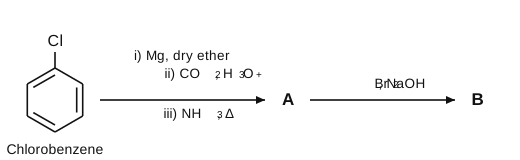
11.25 mg of chlorobenzene will produce __________ ×10
−1 mg of product B. (Consider the reactions result in complete conversion.)
[Given molar mass of C, H, O, N and Cl as 12, 1, 16, 14 and 35.5 g mol
−1 respectively]
निम्नलिखित अभिक्रिया अनुक्रम पर विचार कीजिए:
11.25 mg क्लोरोबेंज़ीन से __________ ×10
−1 mg उत्पाद B प्राप्त होगा। (मान लीजिए अभिक्रियाओं में पूर्ण रूपांतरण होता है।)
[दिया है: C, H, O, N तथा Cl के मोलर द्रव्यमान क्रमशः 12, 1, 16, 14 तथा 35.5 g mol
−1]
Show answer
Concept: Grignard carboxylation gives the acid; NH3/Δ gives the amide A; Br2/NaOH (Hofmann bromamide degradation) gives the amine B with one carbon less.
- C6H5Cl → (i) Mg/dry ether → C6H5MgCl; (ii) CO2, H3O+ → C6H5COOH; (iii) NH3, Δ → A = C6H5CONH2.
- A + Br2/NaOH → B = C6H5NH2 (aniline, M = 93 g mol−1).
- Moles of chlorobenzene mol; 1 : 1 stoichiometry throughout.
- Mass of B g mg mg.
Short trick: 11.25 mg is exactly 10−4 mol of PhCl (M = 112.5); the answer is just the molar mass of aniline read in units of 10−1 mg.
Answer: 93
अवधारणा: ग्रीन्यार कार्बोक्सिलन से अम्ल; NH3/Δ से ऐमाइड A; Br2/NaOH (हॉफमान ब्रोमामाइड निम्नीकरण) से एक कार्बन कम वाली ऐमीन B बनती है।
- C6H5Cl → (i) Mg/शुष्क ईथर → C6H5MgCl; (ii) CO2, H3O+ → C6H5COOH; (iii) NH3, Δ → A = C6H5CONH2।
- A + Br2/NaOH → B = C6H5NH2 (ऐनिलीन, M = 93 g mol−1)।
- क्लोरोबेंज़ीन के मोल mol; पूरे अनुक्रम में 1 : 1 रससमीकरणमिति।
- B का द्रव्यमान g mg mg।
शॉर्ट ट्रिक: 11.25 mg ठीक 10−4 mol PhCl है (M = 112.5); उत्तर, ऐनिलीन का मोलर द्रव्यमान ही 10−1 mg इकाई में है।
उत्तर: 93
JEE Main 2025 (January) – Paper 1 (B.E./B.Tech)ChemistryOrganic conversions – Grignard & Hofmann bromamide (stoichiometry)JEE Main 2025 (January) – Paper 1 (B.E./B.Tech) 2025 · 28 Jan Shift 1
Q299.Quantitative analysis of an organic compound (X) shows following % composition. C : 14.5%, Cl : 64.46%, H : 1.8%.
Empirical formula mass of the compound (X) is __________ ×10−1
(Given molar mass in g mol−1 of C : 12, H : 1, O : 16, Cl : 35.5)
एक कार्बनिक यौगिक (X) के मात्रात्मक विश्लेषण से निम्नलिखित % संघटन प्राप्त होता है। C : 14.5%, Cl : 64.46%, H : 1.8%।
यौगिक (X) का मूलानुपाती सूत्र द्रव्यमान __________ ×10−1 है
(दिया है: g mol−1 में मोलर द्रव्यमान C : 12, H : 1, O : 16, Cl : 35.5)
Show answer
Concept: The missing percentage is oxygen; find mole ratios and the simplest whole-number formula.
- O% .
- Relative moles: C ; H ; Cl ; O .
- Divide by 1.203: C : H : Cl : O ; multiply by 2 → C2H3Cl3O2 (chloral hydrate, CCl3CH(OH)2).
- Empirical formula mass .
Short trick: When ratios come out as 1 : 1.5, double everything — halves always mean a factor of 2.
Answer: 1655
अवधारणा: शेष प्रतिशत ऑक्सीजन का है; मोल अनुपात निकालकर सरलतम पूर्णांक सूत्र ज्ञात कीजिए।
- O% ।
- आपेक्षिक मोल: C ; H ; Cl ; O ।
- 1.203 से भाग देने पर: C : H : Cl : O ; 2 से गुणा कीजिए → C2H3Cl3O2 (क्लोरल हाइड्रेट, CCl3CH(OH)2)।
- मूलानुपाती सूत्र द्रव्यमान ।
शॉर्ट ट्रिक: अनुपात 1 : 1.5 आए तो सबको दोगुना कीजिए — आधे का अर्थ सदैव गुणक 2 होता है।
उत्तर: 1655
JEE Main 2025 (January) – Paper 1 (B.E./B.Tech)ChemistrySome basic concepts – empirical formulaJEE Main 2025 (January) – Paper 1 (B.E./B.Tech) 2025 · 28 Jan Shift 1
Q300.Given below is the plot of the molar conductivity vs
for KCl in aqueous solution.
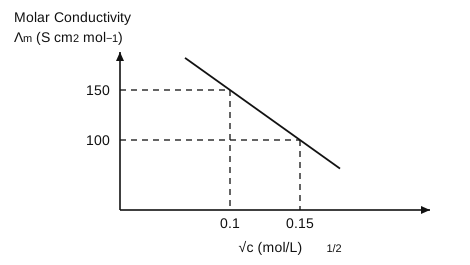
If, for the higher concentration of KCl solution, the resistance of the conductivity cell is 100 Ω, then the resistance of the same cell with the dilute solution is 'x' Ω. The value of x is __________ (Nearest integer)
जलीय विलयन में KCl के लिए मोलर चालकता व
का आलेख नीचे दिया गया है।
यदि KCl विलयन की अधिक सांद्रता के लिए चालकता सेल का प्रतिरोध 100 Ω है, तो तनु विलयन के साथ उसी सेल का प्रतिरोध 'x' Ω है। x का मान __________ है (निकटतम पूर्णांक)
Show answer
Concept: and, for the same cell, (cell constant fixed), so .
- From the plot: higher concentration — , M, S cm2 mol−1; dilute — , M, S cm2 mol−1.
- S cm−1; S cm−1.
- .
Short trick: : .
Answer: 150
अवधारणा: तथा एक ही सेल के लिए (सेल स्थिरांक नियत), अतः ।
- आलेख से: अधिक सांद्रता — , M, S cm2 mol−1; तनु — , M, S cm2 mol−1।
- S cm−1; S cm−1।
- ।
शॉर्ट ट्रिक: : ।
उत्तर: 150
JEE Main 2025 (January) – Paper 1 (B.E./B.Tech)ChemistryElectrochemistry – molar conductivity & cell resistanceJEE Main 2025 (January) – Paper 1 (B.E./B.Tech) 2025 · 28 Jan Shift 1

