Q241.Let for some function , and . Then is equal to
माना किसी फलन के लिए तथा हैं। तब बराबर है
- A
- B
- C
- D
Show answer
Concept: Differentiate both sides using the Leibniz rule and solve the resulting separable differential equation.
- Differentiating: .
- So .
- Integrating: .
- , hence .
Short trick: means is constant: .
Answer: (A)
अवधारणा: लाइबनिज़ नियम से दोनों पक्षों का अवकलन कीजिए और प्राप्त पृथक्करणीय अवकल समीकरण को हल कीजिए।
- अवकलन करने पर: ।
- अतः ।
- समाकलन करने पर: ।
- , अतः ।
शॉर्ट ट्रिक: का अर्थ है अचर है: ।
उत्तर: (A)
JEE Main 2025 (January) – Paper 1 (B.E./B.Tech)MathematicsDefinite integration – integral equationJEE Main 2025 (January) – Paper 1 (B.E./B.Tech) 2025 · 28 Jan Shift 1
Q242.If , then equals
यदि है, तो बराबर है
- A
- B
- C
- D
Show answer
Concept: For an even function , ; then integrate by parts.
- .
- .
- .
- , so .
- .
Short trick: halves the integrand over symmetric limits — never expand .
Answer: (D)
अवधारणा: सम फलन के लिए ; फिर का खण्डशः समाकलन कीजिए।
- ।
- ।
- ।
- , अतः ।
- ।
शॉर्ट ट्रिक: सममित सीमाओं पर समाकल्य को आधा कर देता है — का विस्तार कभी न कीजिए।
उत्तर: (D)
JEE Main 2025 (January) – Paper 1 (B.E./B.Tech)MathematicsDefinite integration – King's property with eˣJEE Main 2025 (January) – Paper 1 (B.E./B.Tech) 2025 · 28 Jan Shift 1
Q243.Let be a sequence such that , and , Then is equal to
माना एक अनुक्रम है जिसमें , तथा , हैं। तब बराबर है
- A
- B
- C
- D
Show answer
Concept: Solve the recurrence with its characteristic equation, then sum the resulting geometric part.
- Characteristic equation: , so .
- and give : .
- .
- Since , the sum equals .
Answer: (B)
अवधारणा: अभिलाक्षणिक समीकरण से पुनरावृत्ति को हल कीजिए, फिर प्राप्त गुणोत्तर भाग का योग निकालिए।
- अभिलाक्षणिक समीकरण: , अतः ।
- तथा से : ।
- ।
- चूँकि , योग के बराबर है।
उत्तर: (B)
JEE Main 2025 (January) – Paper 1 (B.E./B.Tech)MathematicsSequences – linear recurrence relationJEE Main 2025 (January) – Paper 1 (B.E./B.Tech) 2025 · 28 Jan Shift 1
Q244.The number of different 5 digit numbers greater than 50000 that can be formed using the digits , such that the sum of their first and last digits should not be more than 8, is
अंकों के प्रयोग से बनने वाली, से बड़ी, अंकों की ऐसी भिन्न-भिन्न संख्याओं की संख्या, जिनके पहले तथा अन्तिम अंकों का योग से अधिक न हो, है
- A
- B
- C
- D
Show answer
Concept: Count choices of (first digit, last digit) with the given sum restriction, multiply by free middle digits, then exclude itself.
- First digit (number ). Last digit must satisfy .
- : — ways; : — ways; : — ways. Total pairs.
- The three middle digits are unrestricted (repetition allowed): ways each.
- Count , but this includes (pair with middle ), which is not greater than .
- Required number .
Answer: (D)
अवधारणा: दी गई योग-शर्त के साथ (पहला अंक, अन्तिम अंक) के विकल्प गिनिए, बीच के स्वतंत्र अंकों से गुणा कीजिए, फिर स्वयं को हटाइए।
- पहला अंक (संख्या )। अन्तिम अंक के लिए होना चाहिए।
- : — प्रकार; : — प्रकार; : — प्रकार। कुल युग्म।
- बीच के तीन अंक स्वतंत्र हैं (पुनरावृत्ति मान्य): प्रत्येक के लिए प्रकार।
- गणना , परन्तु इसमें (युग्म तथा बीच में ) सम्मिलित है, जो से बड़ा नहीं है।
- अभीष्ट संख्या ।
उत्तर: (D)
JEE Main 2025 (January) – Paper 1 (B.E./B.Tech)MathematicsPermutations and combinations – counting digitsJEE Main 2025 (January) – Paper 1 (B.E./B.Tech) 2025 · 28 Jan Shift 1
Q245.The relation is:
संबंध तथा सम है है:
- Areflexive and symmetric but not transitiveस्वतुल्य तथा सममित है, परन्तु संक्रामक नहीं
- Ban equivalence relationएक तुल्यता संबंध है
- Csymmetric and transitive but not reflexiveसममित तथा संक्रामक है, परन्तु स्वतुल्य नहीं
- Dreflexive and transitive but not symmetricस्वतुल्य तथा संक्रामक है, परन्तु सममित नहीं
Show answer
Concept: is even exactly when and have the same parity — test reflexivity, symmetry and transitivity.
- Reflexive: is always even, so for every .
- Symmetric: , so .
- Transitive: if and are even, then is even, so .
- All three hold, so is an equivalence relation (its classes are the even and the odd integers); hence (A), (C) and (D) are all false.
Answer: (B)
अवधारणा: सम ठीक तभी है जब तथा की समता (parity) समान हो — स्वतुल्यता, सममिति तथा संक्रामकता की जाँच कीजिए।
- स्वतुल्य: सदैव सम है, अतः प्रत्येक के लिए ।
- सममित: , अतः ।
- संक्रामक: यदि तथा सम हैं, तो सम है, अतः ।
- तीनों गुण सत्य हैं, अतः एक तुल्यता संबंध है (इसके वर्ग सम तथा विषम पूर्णांक हैं); इसलिए (A), (C) और (D) सभी असत्य हैं।
उत्तर: (B)
JEE Main 2025 (January) – Paper 1 (B.E./B.Tech)MathematicsRelations – equivalence relationJEE Main 2025 (January) – Paper 1 (B.E./B.Tech) 2025 · 28 Jan Shift 1
Q246.Let where denotes greatest integer function. If and are the number of points, where is not continuous and is not differentiable, respectively, then equals ________.
माना जहाँ महत्तम पूर्णांक फलन (greatest integer function) को दर्शाता है। यदि तथा क्रमशः उन बिन्दुओं की संख्याएँ हैं, जहाँ संतत नहीं है तथा अवकलनीय नहीं है, तो बराबर है ________।
Show answer
Concept: Simplify the on each unit interval using , then check continuity and differentiability at the break points .
- On : , so . On : , so . At : .
- So .
- Continuity: at both sides give — continuous; at : LHL — discontinuous; at : LHL — discontinuous. So .
- Differentiability: fails at the discontinuities , and also at where the slope jumps from to . So .
- .
Answer: 5
अवधारणा: प्रत्येक एकक अन्तराल पर की सहायता से को सरल कीजिए, फिर विभाजन बिन्दुओं पर सांतत्य एवं अवकलनीयता जाँचिए।
- पर: , अतः । पर: , अतः । पर: ।
- अतः ।
- सांतत्य: पर दोनों ओर से मान — संतत; पर: बायीं सीमा — असंतत; पर: बायीं सीमा — असंतत। अतः ।
- अवकलनीयता: असांतत्य के बिन्दुओं पर तथा पर भी, जहाँ ढाल से हो जाती है, अवकलनीय नहीं है। अतः ।
- ।
उत्तर: 5
JEE Main 2025 (January) – Paper 1 (B.E./B.Tech)MathematicsContinuity and differentiability – greatest integer functionJEE Main 2025 (January) – Paper 1 (B.E./B.Tech) 2025 · 28 Jan Shift 1
Q247.Let denote the set of all real matrices of order and let . Let
,
,
.
If , then equals ________.
माना , कोटि के सभी वास्तविक आव्यूहों का समुच्चय है तथा है। माना
,
,
हैं।
यदि है, तो बराबर है ________।
Show answer
Concept: Count each set separately and apply inclusion–exclusion; note that a skew-symmetric matrix needs zero diagonal entries, but .
- : a symmetric matrix is fixed by its diagonal and upper entries: .
- : forces , so .
- : diagonal triples from with sum : gives orders, gives , gives — total ; the off-diagonal entries are free: .
- : symmetric with trace : diagonal choices upper entries ; intersections with are empty.
- , so .
Answer: 1613
अवधारणा: प्रत्येक समुच्चय को अलग गिनकर समावेशन–अपवर्जन लगाइए; ध्यान दीजिए कि विषम सममित आव्यूह के विकर्ण अवयव शून्य होने चाहिए, परन्तु ।
- : सममित आव्यूह अपने विकर्ण तथा ऊपरी अवयवों से निर्धारित होता है: ।
- : से , अतः ।
- : योग वाले के विकर्ण त्रिक: से क्रम, से , से — कुल ; शेष अवयव स्वतंत्र हैं: ।
- : शून्य अनुरेख वाले सममित आव्यूह: विकर्ण विकल्प ऊपरी अवयव ; के साथ सर्वनिष्ठ रिक्त हैं।
- , अतः ।
उत्तर: 1613
JEE Main 2025 (January) – Paper 1 (B.E./B.Tech)MathematicsMatrices – counting symmetric, skew-symmetric and trace-zero matricesJEE Main 2025 (January) – Paper 1 (B.E./B.Tech) 2025 · 28 Jan Shift 1
Q248.If , then the distance of the point from the line is ________.
यदि है, तो बिन्दु की रेखा से दूरी है ________।
Show answer
Concept: The alternating sum of odd binomial coefficients with powers of comes from : odd terms of equal with .
- With , , so .
- ; similarly .
- The difference is , so the sum is and .
- Distance of from : .
Answer: 5
अवधारणा: की घातों सहित विषम द्विपद गुणांकों का एकान्तर योग से मिलता है: के विषम पद के बराबर होते हैं, जहाँ ।
- के साथ , अतः ।
- ; इसी प्रकार ।
- अन्तर है, अतः योग तथा ।
- की से दूरी: ।
उत्तर: 5
JEE Main 2025 (January) – Paper 1 (B.E./B.Tech)MathematicsBinomial theorem – alternating sum and distance from a lineJEE Main 2025 (January) – Paper 1 (B.E./B.Tech) 2025 · 28 Jan Shift 1
Q249.Let be an ellipse. Ellipses 's are constructed such that their centres and eccentricities are same as that of , and the length of minor axis of is the length of major axis of . If is the area of the ellipse , then , is equal to ________.
माना एक दीर्घवृत्त है। दीर्घवृत्त इस प्रकार बनाए जाते हैं कि उनके केन्द्र तथा उत्केन्द्रताएँ के समान हैं, और के लघु अक्ष की लम्बाई के दीर्घ अक्ष की लम्बाई है। यदि दीर्घवृत्त का क्षेत्रफल है, तो बराबर है ________।
Show answer
Concept: Equal eccentricity keeps the ratio fixed; makes the areas a geometric progression.
- : , so for every (same eccentricity).
- .
- — a G.P. with ratio .
- .
- .
Answer: 54
अवधारणा: समान उत्केन्द्रता से अनुपात स्थिर रहता है; से क्षेत्रफल एक गुणोत्तर श्रेढ़ी बनाते हैं।
- : , अतः प्रत्येक के लिए (समान उत्केन्द्रता)।
- ।
- — सार्व अनुपात वाली गुणोत्तर श्रेढ़ी।
- ।
- ।
उत्तर: 54
JEE Main 2025 (January) – Paper 1 (B.E./B.Tech)MathematicsEllipse – geometric progression of areasJEE Main 2025 (January) – Paper 1 (B.E./B.Tech) 2025 · 28 Jan Shift 1
Q250.Let , and . If is a vector such that , and the angle between and is , then is equal to ________.
माना , तथा हैं। यदि एक ऐसा सदिश है कि , तथा और के बीच का कोण है, तो बराबर है ________।
Show answer
Concept: Extract and the dot products from the given conditions, use the Lagrange identity , and resolve along the orthogonal basis .
- , so and .
- , hence .
- , so .
- Write : , , and .
- Since : , i.e. or .
- Either way or . Required value .
Answer: 6
अवधारणा: दी गई शर्तों से तथा अदिश गुणनफल निकालिए, लग्रांज सर्वसमिका का प्रयोग कीजिए, तथा को लाम्बिक आधार में वियोजित कीजिए।
- , अतः तथा ।
- , अतः ।
- , अतः ।
- लिखिए: , , तथा ।
- चूँकि : , अर्थात् या ।
- दोनों स्थितियों में या । अभीष्ट मान ।
उत्तर: 6
JEE Main 2025 (January) – Paper 1 (B.E./B.Tech)MathematicsVector algebra – dot and cross productsJEE Main 2025 (January) – Paper 1 (B.E./B.Tech) 2025 · 28 Jan Shift 1
Q251.Three infinitely long wires with linear charge density are placed along the -axis, -axis and -axis respectively. Which of the following denotes an equipotential surface?
रेखीय आवेश घनत्व वाले तीन अनंत लंबे तार क्रमशः -अक्ष, -अक्ष तथा -अक्ष के अनुदिश रखे गए हैं। निम्नलिखित में से कौन-सा एक समविभव पृष्ठ (equipotential surface) को निरूपित करता है?
- A = constant = नियतांक
- B = constant = नियतांक
- C = constant = नियतांक
- D = constant = नियतांक
Show answer
Concept: The potential of an infinite line charge at perpendicular distance is constant; potentials add by superposition.
- Perpendicular distances of point from the -, - and -axes are , and .
- .
- = constant = constant.
Short trick: Sum of logarithms = logarithm of the product, so the product of the squared distances must stay constant.
Answer: (C) = constant
अवधारणा: अनंत रेखीय आवेश से लंबवत दूरी पर विभव नियतांक होता है; अध्यारोपण से विभव जुड़ते हैं।
- बिंदु की -, - तथा -अक्षों से लंबवत दूरियाँ क्रमशः , तथा हैं।
- ।
- = नियतांक = नियतांक।
शॉर्ट ट्रिक: लघुगणकों का योग = गुणनफल का लघुगणक, अतः वर्गित दूरियों का गुणनफल नियत रहना चाहिए।
उत्तर: (C) = नियतांक
JEE Main 2025 (January) – Paper 1 (B.E./B.Tech)PhysicsElectrostatic Potential – equipotential surfacesJEE Main 2025 (January) – Paper 1 (B.E./B.Tech) 2025 · 28 Jan Shift 1
Q252.Given below are two statements: one is labelled as Assertion A and the other is labelled as Reason R
Assertion A: A sound wave has higher speed in solids than gases.
Reason R: Gases have higher value of Bulk modulus than solids.
In the light of the above statements, choose the correct answer from the options given below
नीचे दो कथन दिए गए हैं: एक को अभिकथन A तथा दूसरे को कारण R कहा गया है
अभिकथन A: ध्वनि तरंग की चाल ठोसों में गैसों की अपेक्षा अधिक होती है।
कारण R: गैसों के आयतन प्रत्यास्थता गुणांक (Bulk modulus) का मान ठोसों से अधिक होता है।
उपर्युक्त कथनों के आलोक में, नीचे दिए गए विकल्पों में से सही उत्तर चुनिए
- ABoth A and R are true but R is NOT the correct explanation of AA तथा R दोनों सत्य हैं परंतु R, A की सही व्याख्या नहीं है
- BA is true but R is falseA सत्य है परंतु R असत्य है
- CA is false but R is trueA असत्य है परंतु R सत्य है
- DBoth A and R are true and R is the correct explanation of AA तथा R दोनों सत्य हैं तथा R, A की सही व्याख्या है
Show answer
Concept: Speed of sound ; it is the elastic modulus that decides the speed, and solids are far stiffer than gases.
- A: In solids the elastic modulus is enormously larger than in gases (the increase in modulus far outweighs the increase in density), so sound travels fastest in solids — A is true.
- R: Solids have a much higher Bulk modulus than gases (gases are easily compressible) — R is false.
Answer: (B) A is true but R is false
अवधारणा: ध्वनि की चाल ; चाल प्रत्यास्थता गुणांक पर निर्भर करती है, और ठोस गैसों की तुलना में कहीं अधिक दृढ़ होते हैं।
- A: ठोसों में प्रत्यास्थता गुणांक गैसों की अपेक्षा अत्यधिक बड़ा होता है (गुणांक की वृद्धि घनत्व की वृद्धि से कहीं अधिक होती है), अतः ध्वनि ठोसों में सबसे तेज़ चलती है — A सत्य है।
- R: ठोसों का आयतन प्रत्यास्थता गुणांक गैसों से बहुत अधिक होता है (गैसें आसानी से संपीड्य होती हैं) — R असत्य है।
उत्तर: (B) A सत्य है परंतु R असत्य है
JEE Main 2025 (January) – Paper 1 (B.E./B.Tech)PhysicsWaves – speed of sound in mediaJEE Main 2025 (January) – Paper 1 (B.E./B.Tech) 2025 · 28 Jan Shift 1
Q253.Two capacitors
and
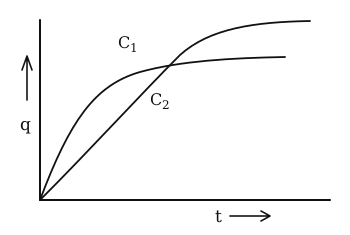
are connected in parallel to a battery. Charge-time graph is shown below for the two capacitors. The energy stored with them are
and
, respectively. Which of the given statements is true?
दो संधारित्र
तथा
एक बैटरी से समांतर क्रम में जुड़े हैं। दोनों संधारित्रों के लिए आवेश-समय ग्राफ नीचे दर्शाया गया है। इनमें संचित ऊर्जाएँ क्रमशः
तथा
हैं। दिए गए कथनों में से कौन-सा सत्य है?
- A
- B
- C
- D
Show answer
Concept: In parallel both capacitors reach the same final potential difference of the battery, so the final charge and energy are both proportional to .
- From the graph, the saturation (final) charge of is greater than that of : .
- Same .
- .
Short trick: In parallel, everything scales with the final charge — whichever curve saturates higher has the larger and larger .
Answer: (D)
अवधारणा: समांतर क्रम में दोनों संधारित्र बैटरी के समान अंतिम विभवांतर तक पहुँचते हैं, अतः अंतिम आवेश तथा ऊर्जा दोनों के अनुक्रमानुपाती हैं।
- ग्राफ से, का संतृप्त (अंतिम) आवेश से अधिक है: ।
- समान ।
- ।
शॉर्ट ट्रिक: समांतर क्रम में सब कुछ अंतिम आवेश के साथ बढ़ता है — जो वक्र ऊँचे स्तर पर संतृप्त होता है उसका तथा दोनों बड़े होंगे।
उत्तर: (D)
JEE Main 2025 (January) – Paper 1 (B.E./B.Tech)PhysicsCapacitance – capacitors in parallelJEE Main 2025 (January) – Paper 1 (B.E./B.Tech) 2025 · 28 Jan Shift 1
Q254.A thin prism with angle made of glass having refractive index 1.54, is combined with another thin prism made of glass having refractive index 1.72 to get dispersion without deviation. The angle of the prism in degrees is
अपवर्तनांक 1.54 वाले काँच से बना कोण का एक पतला प्रिज़्म , अपवर्तनांक 1.72 वाले काँच से बने दूसरे पतले प्रिज़्म के साथ इस प्रकार संयोजित किया जाता है कि विचलन रहित विक्षेपण (dispersion without deviation) प्राप्त हो। प्रिज़्म का कोण (डिग्री में) है
- A3
- B16/3
- C4
- D1.5
Show answer
Concept: For a thin prism the deviation is . For zero net deviation the two deviations must cancel: .
Answer: (A) 3
अवधारणा: पतले प्रिज़्म के लिए विचलन होता है। कुल विचलन शून्य होने के लिए दोनों विचलन एक-दूसरे को निरस्त करें: ।
उत्तर: (A) 3
JEE Main 2025 (January) – Paper 1 (B.E./B.Tech)PhysicsRay Optics – dispersion without deviationJEE Main 2025 (January) – Paper 1 (B.E./B.Tech) 2025 · 28 Jan Shift 1
Q255.A particle of mass '
' and charge '
' is fastened to one end '
' of a massless string having equilibrium length
, whose other end is fixed at point '
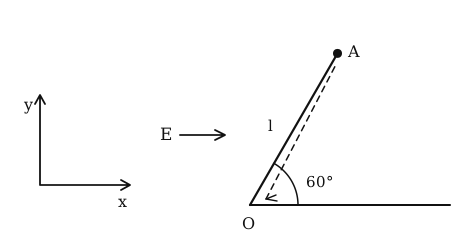
'. The whole system is placed on a frictionless horizontal plane and is initially at rest. If uniform electric field is switched on along the direction as shown in figure, then the speed of the particle when it crosses the x-axis is
द्रव्यमान '
' तथा आवेश '
' का एक कण, साम्यावस्था लंबाई
वाली द्रव्यमानहीन डोरी के एक सिरे '
' से बाँधा गया है, जिसका दूसरा सिरा बिंदु '
' पर स्थिर है। पूरा निकाय एक घर्षणरहित क्षैतिज तल पर रखा है और प्रारंभ में विरामावस्था में है। यदि चित्र में दर्शाई गई दिशा में एकसमान विद्युत क्षेत्र चालू कर दिया जाए, तो x-अक्ष को पार करते समय कण की चाल होगी
- A
- B
- C
- D
Show answer
Concept: The string tension does no work (always perpendicular to the circular motion about ), so the work-energy theorem needs only the work of the electric force along the -direction.
- Initial position of the particle: .
- When it crosses the x-axis (string taut): position , so displacement along is .
- .
Short trick: Only the -displacement matters: .
Answer: (B)
अवधारणा: डोरी का तनाव कोई कार्य नहीं करता ( के परितः वृत्तीय गति के सदैव लंबवत), अतः कार्य-ऊर्जा प्रमेय में केवल -दिशा में विद्युत बल का कार्य लेना है।
- कण की प्रारंभिक स्थिति: ।
- x-अक्ष पार करते समय (डोरी तनी हुई): स्थिति , अतः के अनुदिश विस्थापन ।
- ।
शॉर्ट ट्रिक: केवल -विस्थापन मायने रखता है: ।
उत्तर: (B)
JEE Main 2025 (January) – Paper 1 (B.E./B.Tech)PhysicsElectrostatics – work-energy theoremJEE Main 2025 (January) – Paper 1 (B.E./B.Tech) 2025 · 28 Jan Shift 1
Q256.Given below are two statements: one is labelled as Assertion A and the other is labelled as Reason R
Assertion A: In a central force field, the work done is independent of the path chosen.
Reason R: Every force encountered in mechanics does not have an associated potential energy.
In the light of the above statements, choose the most appropriate answer from the options given below
नीचे दो कथन दिए गए हैं: एक को अभिकथन A तथा दूसरे को कारण R कहा गया है
अभिकथन A: केंद्रीय बल क्षेत्र में किया गया कार्य, चुने गए पथ पर निर्भर नहीं करता।
कारण R: यांत्रिकी में मिलने वाले प्रत्येक बल के साथ कोई संबद्ध स्थितिज ऊर्जा नहीं होती।
उपर्युक्त कथनों के आलोक में, नीचे दिए गए विकल्पों में से सर्वाधिक उपयुक्त उत्तर चुनिए
- AA is false but R is trueA असत्य है परंतु R सत्य है
- BBoth A and R are true but R is NOT the correct explanation of AA तथा R दोनों सत्य हैं परंतु R, A की सही व्याख्या नहीं है
- CA is true but R is falseA सत्य है परंतु R असत्य है
- DBoth A and R are true and R is the correct explanation of AA तथा R दोनों सत्य हैं तथा R, A की सही व्याख्या है
Show answer
Concept: A central force is conservative, and only conservative forces have an associated potential energy.
- A: A central force is conservative, so the work done between two points is path independent — A is true.
- R: Non-conservative forces such as friction have no associated potential energy, so indeed not every mechanical force has one — R is also true.
- But R talks about forces lacking a potential energy; it does not explain why work in a central field is path independent. Hence R is not the correct explanation of A.
Answer: (B) Both A and R are true but R is NOT the correct explanation of A
अवधारणा: केंद्रीय बल संरक्षी होता है, और केवल संरक्षी बलों के साथ ही स्थितिज ऊर्जा संबद्ध होती है।
- A: केंद्रीय बल संरक्षी है, अतः दो बिंदुओं के बीच किया गया कार्य पथ पर निर्भर नहीं करता — A सत्य है।
- R: घर्षण जैसे असंरक्षी बलों की कोई संबद्ध स्थितिज ऊर्जा नहीं होती, अतः वास्तव में हर यांत्रिक बल की स्थितिज ऊर्जा नहीं होती — R भी सत्य है।
- परंतु R उन बलों की बात करता है जिनकी स्थितिज ऊर्जा नहीं होती; यह नहीं समझाता कि केंद्रीय क्षेत्र में कार्य पथ-स्वतंत्र क्यों है। अतः R, A की सही व्याख्या नहीं है।
उत्तर: (B) A तथा R दोनों सत्य हैं परंतु R, A की सही व्याख्या नहीं है
JEE Main 2025 (January) – Paper 1 (B.E./B.Tech)PhysicsWork, Energy and Power – conservative forcesJEE Main 2025 (January) – Paper 1 (B.E./B.Tech) 2025 · 28 Jan Shift 1
Q257.Choose the correct nuclear process from the below options
[p: proton, n: neutron, e: electron, e: positron, : neutrino, : antineutrino]
नीचे दिए गए विकल्पों में से सही नाभिकीय प्रक्रिया चुनिए
[p: प्रोटॉन, n: न्यूट्रॉन, e: इलेक्ट्रॉन, e: पॉज़िट्रॉन, : न्यूट्रिनो, : प्रतिन्यूट्रिनो]
- A
- B
- C
- D
Show answer
Concept: In decay a neutron converts into a proton; charge and lepton number must both be conserved.
- Charge conservation: , so an electron must be emitted — options with (A) and (B) violate charge conservation.
- Lepton number conservation: carries lepton number , so a particle with lepton number , the antineutrino , must accompany it — option (C) with gives lepton number , which is wrong.
- Correct process: .
Answer: (D)
अवधारणा: क्षय में न्यूट्रॉन, प्रोटॉन में बदलता है; आवेश तथा लेप्टॉन संख्या दोनों संरक्षित रहनी चाहिए।
- आवेश संरक्षण: , अतः इलेक्ट्रॉन उत्सर्जित होना चाहिए — वाले विकल्प (A) तथा (B) आवेश संरक्षण का उल्लंघन करते हैं।
- लेप्टॉन संख्या संरक्षण: की लेप्टॉन संख्या है, अतः उसके साथ लेप्टॉन संख्या वाला कण, प्रतिन्यूट्रिनो , होना चाहिए — वाला विकल्प (C) लेप्टॉन संख्या देता है, जो गलत है।
- सही प्रक्रिया: ।
उत्तर: (D)
JEE Main 2025 (January) – Paper 1 (B.E./B.Tech)PhysicsNuclei – beta decayJEE Main 2025 (January) – Paper 1 (B.E./B.Tech) 2025 · 28 Jan Shift 1
Q258.A hemispherical vessel is completely filled with a liquid of refractive index
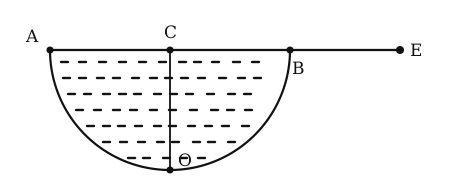
. A small coin is kept at the lowest point (O) of the vessel as shown in figure. The minimum value of the refractive index of the liquid so that a person can see the coin from point E (at the level of the vessel) is
एक अर्धगोलीय बर्तन, अपवर्तनांक
वाले द्रव से पूर्णतः भरा है। चित्रानुसार बर्तन के निम्नतम बिंदु (O) पर एक छोटा सिक्का रखा है। द्रव के अपवर्तनांक का वह न्यूनतम मान, जिससे कोई व्यक्ति बिंदु E (बर्तन के तल के स्तर पर) से सिक्के को देख सके, है
- A
- B
- C
- D
Show answer
Concept: To be seen from E (grazing along the liquid surface), the ray O→B must refract at the surface at , i.e. hit the surface exactly at the critical angle: .
- Let the radius be . O is at depth below the centre C of the flat surface, and B is on the rim at horizontal distance from C.
- The ray OB therefore makes with the normal (vertical) at B.
- For grazing emergence towards E: .
Short trick: The O→rim ray of a hemisphere always meets the flat surface at , so .
Answer: (D)
अवधारणा: E से दिखने के लिए (द्रव सतह के सहारे स्पर्शीय निर्गमन), किरण O→B को सतह पर पर अपवर्तित होना चाहिए, अर्थात सतह पर ठीक क्रांतिक कोण पर पड़ना चाहिए: ।
- त्रिज्या मानें। O, समतल सतह के केंद्र C से गहराई पर है, तथा B किनारे पर C से क्षैतिज दूरी पर है।
- अतः किरण OB, B पर अभिलंब (ऊर्ध्वाधर) से कोण बनाती है।
- E की ओर स्पर्शीय निर्गमन के लिए: ।
शॉर्ट ट्रिक: अर्धगोले में O से किनारे तक की किरण समतल सतह से सदैव पर मिलती है, अतः ।
उत्तर: (D)
JEE Main 2025 (January) – Paper 1 (B.E./B.Tech)PhysicsRay Optics – total internal reflectionJEE Main 2025 (January) – Paper 1 (B.E./B.Tech) 2025 · 28 Jan Shift 1
Q259.A Carnot engine (E) is working between two temperatures 473 K and 273 K. In a new system two engines - engine works between 473 K to 373 K and engine works between 373 K to 273 K. If , and are the efficiencies of the engines E, and , respectively, then
एक कार्नो इंजन (E) दो तापों 473 K तथा 273 K के बीच कार्य कर रहा है। एक नए निकाय में दो इंजन हैं - इंजन , 473 K से 373 K के बीच तथा इंजन , 373 K से 273 K के बीच कार्य करता है। यदि , तथा क्रमशः इंजन E, तथा की दक्षताएँ हों, तो
- A
- B
- C
- D
Show answer
Concept: Carnot efficiency ; just compute all three.
- ,
- , so .
Short trick: Exactly: (since ), which is always less than .
Answer: (D)
अवधारणा: कार्नो दक्षता ; तीनों की गणना कीजिए।
- ,
- , अतः ।
शॉर्ट ट्रिक: यथार्थतः: (क्योंकि ), जो सदैव से कम है।
उत्तर: (D)
JEE Main 2025 (January) – Paper 1 (B.E./B.Tech)PhysicsThermodynamics – Carnot engineJEE Main 2025 (January) – Paper 1 (B.E./B.Tech) 2025 · 28 Jan Shift 1
Q260.Consider a long thin conducting wire carrying a uniform current I. A particle having mass "M" and charge "" is released at a distance "" from the wire with a speed along the direction of current in the wire. The particle gets attracted to the wire due to magnetic force. The particle turns round when it is at distance from the wire. The value of is [ is vacuum permeability]
एकसमान धारा I ले जा रहे एक लंबे पतले चालक तार पर विचार कीजिए। द्रव्यमान "M" तथा आवेश "" वाला एक कण, तार से "" दूरी पर, तार में धारा की दिशा के अनुदिश चाल से छोड़ा जाता है। चुंबकीय बल के कारण कण तार की ओर आकर्षित होता है। तार से दूरी पर कण मुड़ जाता (turns round) है। का मान है [ निर्वात की चुंबकशीलता है]
- A
- B
- C
- D
Show answer
Concept: Magnetic force does no work, so the speed stays . Writing Newton's law for the component parallel to the wire links the change of that component to .
- Let the wire lie along the -axis with current , and the particle move in the - plane; .
- Component parallel to the wire: .
- Integrating: .
- "Turns round" means the velocity has reversed: (speed is still , perpendicular component zero at the turning point). So .
- .
Answer: (A)
अवधारणा: चुंबकीय बल कोई कार्य नहीं करता, अतः चाल ही रहती है। तार के समांतर घटक के लिए न्यूटन का नियम लिखने पर उस घटक का परिवर्तन से जुड़ जाता है।
- माना तार -अक्ष के अनुदिश है जिसमें धारा है, तथा कण - तल में चलता है; ।
- तार के समांतर घटक: ।
- समाकलन करने पर: ।
- "मुड़ जाता है" का अर्थ है वेग उलट गया: (चाल अब भी है, मोड़-बिंदु पर लंबवत घटक शून्य)। अतः ।
- ।
उत्तर: (A)
JEE Main 2025 (January) – Paper 1 (B.E./B.Tech)PhysicsMoving Charges and Magnetism – charge near a current-carrying wireJEE Main 2025 (January) – Paper 1 (B.E./B.Tech) 2025 · 28 Jan Shift 1

