Q201.Concentrated nitric acid is labelled as 75% by mass. The volume in mL of the solution which contains 30 g of nitric acid is ____. Given : Density of nitric acid solution is 1.25 g/mL.
सान्द्र नाइट्रिक अम्ल पर द्रव्यमान अनुसार 75% लेबल लगा है। उस विलयन का mL में आयतन, जिसमें 30 g नाइट्रिक अम्ल है, ____ है। दिया गया है : नाइट्रिक अम्ल विलयन का घनत्व 1.25 g/mL है।
- A40
- B32
- C45
- D55
Show answer
Concept: Mass % gives mass of solute per 100 g of solution; volume = mass of solution / density.
- 75% by mass ⇒ 75 g HNO3 is present in 100 g solution.
- Mass of solution containing 30 g HNO3 = g.
- Volume = mL.
Short trick: mL.
Answer: (B) 32 mL
अवधारणा: द्रव्यमान % से 100 g विलयन में विलेय का द्रव्यमान मिलता है; आयतन = विलयन का द्रव्यमान / घनत्व।
- द्रव्यमान अनुसार 75% ⇒ 100 g विलयन में 75 g HNO3 है।
- 30 g HNO3 वाले विलयन का द्रव्यमान = g।
- आयतन = mL।
शॉर्ट ट्रिक: mL।
उत्तर: (B) 32 mL
JEE Main 2025 (January) – Paper 1 (B.E./B.Tech)ChemistrySolutions – concentration termsJEE Main 2025 (January) – Paper 1 (B.E./B.Tech) 2025 · 28 Jan Shift 2
Q202.Given below are two statements :
Statement (I) : 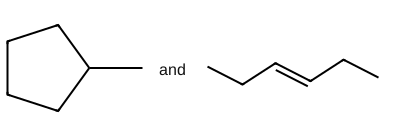
are isomeric compounds.
Statement (II) : 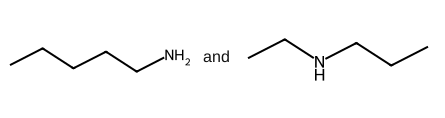
are functional group isomers.
नीचे दो कथन दिए गए हैं :
कथन (I) : समावयवी यौगिक हैं।
कथन (II) : क्रियात्मक समूह समावयवी हैं।
- ABoth Statement (I) and Statement (II) are false.कथन (I) और कथन (II) दोनों असत्य हैं।
- BBoth Statement (I) and Statement (II) are true.कथन (I) और कथन (II) दोनों सत्य हैं।
- CStatement (I) is false but Statement (II) is true.कथन (I) असत्य है परन्तु कथन (II) सत्य है।
- DStatement (I) is true but Statement (II) is false.कथन (I) सत्य है परन्तु कथन (II) असत्य है।
Show answer
Concept: Isomers have the same molecular formula; functional (group) isomers additionally belong to different classes of compounds.
- Statement (I): methylcyclopentane and hex-3-ene both have the molecular formula C6H12 → they are isomers. Statement (I) is true.
- Statement (II): pentan-1-amine (a 1° amine) and N-ethylpropan-1-amine (a 2° amine) both have the formula C5H13N but contain different amine functional classes (–NH2 vs >NH) → functional group isomers. Statement (II) is true.
Short trick: A ring is "one degree of unsaturation", just like one C=C – so cycloalkanes and alkenes of equal carbon count are always isomers (CnH2n).
Answer: (B) Both statements are true.
अवधारणा: समावयवियों का अणुसूत्र समान होता है; क्रियात्मक समूह समावयवी इसके साथ-साथ भिन्न वर्गों के यौगिक होते हैं।
- कथन (I): मेथिलसाइक्लोपेन्टेन तथा हेक्स-3-ईन दोनों का अणुसूत्र C6H12 है → ये समावयवी हैं। कथन (I) सत्य है।
- कथन (II): पेन्टेन-1-ऐमीन (1° ऐमीन) तथा N-एथिलप्रोपेन-1-ऐमीन (2° ऐमीन) दोनों का सूत्र C5H13N है, परन्तु ऐमीन के भिन्न वर्ग (–NH2 बनाम >NH) हैं → क्रियात्मक समूह समावयवी। कथन (II) सत्य है।
शॉर्ट ट्रिक: वलय (ring) भी एक असंतृप्तता कोटि है, C=C की तरह – अतः समान कार्बन संख्या वाले साइक्लोऐल्केन और ऐल्कीन सदैव समावयवी होते हैं (CnH2n)।
उत्तर: (B) दोनों कथन सत्य हैं।
JEE Main 2025 (January) – Paper 1 (B.E./B.Tech)ChemistryOrganic chemistry – isomerismJEE Main 2025 (January) – Paper 1 (B.E./B.Tech) 2025 · 28 Jan Shift 2
Q203.Identify product , and in the following reaction sequence.
CH3−C≡CH [A] [B] + [C]
निम्नलिखित अभिक्रिया अनुक्रम में उत्पाद , तथा को पहचानिए।
CH3−C≡CH [A] [B] + [C]
- A[A] : CH2=CH2, [B] : H3C−CO−CH3, [C] : HCHO
- B[A] : CH3−CH=CH2, [B] : CH3CHO, [C] : CH3CH2OH
- C[A] : CH3−CH=CH2, [B] : CH3CHO, [C] : HCHO
- D[A] : CH3CH2CH3, [B] : CH3CHO, [C] : HCHO
Show answer
Concept: Addition of one mole of H2 converts an alkyne to an alkene; reductive ozonolysis (O3; Zn, H2O) cleaves the C=C bond to two carbonyl compounds.
- Propyne + H2/Pd-C (one mole of H2 adds across C≡C) → [A] = propene, CH3–CH=CH2. The next step is ozonolysis, so [A] must contain a C=C bond.
- Ozonolysis cleaves CH3–CH=CH2 at the double bond: CH3CH= gives [B] = CH3CHO and =CH2 gives [C] = HCHO.
- (A) is wrong: ethene would mean a carbon is lost. (B) is wrong: Zn/H2O work-up gives aldehydes, not ethanol. (D) is wrong: propane has no C=C, so it cannot undergo ozonolysis.
Short trick: Replace C=C by two C=O to write ozonolysis products instantly.
Answer: (C)
अवधारणा: एक मोल H2 जुड़ने पर ऐल्काइन ऐल्कीन बनता है; अपचायी ओज़ोनी-अपघटन (O3; Zn, H2O) C=C आबंध को तोड़कर दो कार्बोनिल यौगिक देता है।
- प्रोपाइन + H2/Pd-C (C≡C पर एक मोल H2 जुड़ता है) → [A] = प्रोपीन, CH3–CH=CH2। अगला चरण ओज़ोनी-अपघटन है, अतः [A] में C=C होना आवश्यक है।
- ओज़ोनी-अपघटन CH3–CH=CH2 को द्विआबंध पर तोड़ता है: CH3CH= से [B] = CH3CHO तथा =CH2 से [C] = HCHO।
- (A) गलत: एथीन बनने पर एक कार्बन लुप्त हो जाता। (B) गलत: Zn/H2O से ऐल्डिहाइड मिलते हैं, एथेनॉल नहीं। (D) गलत: प्रोपेन में C=C नहीं है, अतः ओज़ोनी-अपघटन संभव नहीं।
शॉर्ट ट्रिक: C=C को दो C=O से बदल दीजिए – ओज़ोनी-अपघटन के उत्पाद तुरंत लिख जाते हैं।
उत्तर: (C)
JEE Main 2025 (January) – Paper 1 (B.E./B.Tech)ChemistryHydrocarbons – hydrogenation & ozonolysisJEE Main 2025 (January) – Paper 1 (B.E./B.Tech) 2025 · 28 Jan Shift 2
Q204.The total number of compounds from below when treated with hot KMnO
4 giving benzoic acid is :
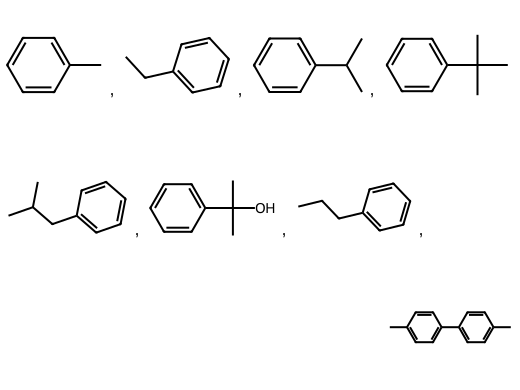
नीचे दिए गए यौगिकों में से गर्म KMnO
4 के साथ अभिकृत करने पर बेन्जोइक अम्ल देने वाले यौगिकों की कुल संख्या है :
- A6
- B3
- C5
- D4
Show answer
Concept: Hot KMnO4 oxidises any alkyl side chain to –COOH, but only if the benzylic carbon carries at least one H.
- Give benzoic acid (benzylic H present): toluene, ethylbenzene, isopropylbenzene (cumene), isobutylbenzene (PhCH2CH(CH3)2) and n-propylbenzene → 5 compounds.
- tert-Butylbenzene: benzylic carbon has no H → resistant, no benzoic acid.
- 2-Phenylpropan-2-ol, PhC(CH3)2OH: again no benzylic H → no benzoic acid.
- 4,4′-Dimethylbiphenyl: oxidation gives biphenyl-4,4′-dicarboxylic acid, not benzoic acid.
Short trick: "No benzylic H → no oxidation"; and the aromatic core always survives, so a biphenyl can never shrink to benzoic acid.
Answer: (C) 5
अवधारणा: गर्म KMnO4 किसी भी ऐल्किल पार्श्व-शृंखला को –COOH में ऑक्सीकृत करता है, परन्तु तभी जब बेन्जाइलिक कार्बन पर कम से कम एक H हो।
- बेन्जोइक अम्ल देते हैं (बेन्जाइलिक H उपस्थित): टॉलूईन, एथिलबेन्जीन, आइसोप्रोपिलबेन्जीन (क्यूमीन), आइसोब्यूटिलबेन्जीन (PhCH2CH(CH3)2) तथा n-प्रोपिलबेन्जीन → 5 यौगिक।
- tert-ब्यूटिलबेन्जीन: बेन्जाइलिक कार्बन पर H नहीं → ऑक्सीकरण नहीं होता।
- 2-फेनिलप्रोपेन-2-ऑल, PhC(CH3)2OH: बेन्जाइलिक H नहीं → बेन्जोइक अम्ल नहीं।
- 4,4′-डाइमेथिलबाइफेनिल: ऑक्सीकरण से बाइफेनिल-4,4′-डाइकार्बोक्सिलिक अम्ल बनता है, बेन्जोइक अम्ल नहीं।
शॉर्ट ट्रिक: "बेन्जाइलिक H नहीं → ऑक्सीकरण नहीं"; ऐरोमैटिक वलय सुरक्षित रहता है, अतः बाइफेनिल कभी बेन्जोइक अम्ल नहीं दे सकता।
उत्तर: (C) 5
JEE Main 2025 (January) – Paper 1 (B.E./B.Tech)ChemistryHydrocarbons – side-chain oxidation of arenesJEE Main 2025 (January) – Paper 1 (B.E./B.Tech) 2025 · 28 Jan Shift 2
Q205.Match List - I with List - II.
List - I
(Complex) | List - II
(Hybridisation of central metal ion) |
|---|
| (A) | [CoF6]3− | (I) | d2sp3 |
| (B) | [NiCl4]2− | (II) | sp3 |
| (C) | [Co(NH3)6]3+ | (III) | sp3d2 |
| (D) | [Ni(CN)4]2− | (IV) | dsp2 |
Choose the correct answer from the options given below :
सूची-I का सूची-II से मिलान कीजिए।
सूची - I
(संकुल) | सूची - II
(केंद्रीय धातु आयन का संकरण) |
|---|
| (A) | [CoF6]3− | (I) | d2sp3 |
| (B) | [NiCl4]2− | (II) | sp3 |
| (C) | [Co(NH3)6]3+ | (III) | sp3d2 |
| (D) | [Ni(CN)4]2− | (IV) | dsp2 |
नीचे दिए गए विकल्पों में से सही उत्तर चुनिए :
- A(A)-(I), (B)-(IV), (C)-(III), (D)-(II)
- B(A)-(I), (B)-(II), (C)-(III), (D)-(IV)
- C(A)-(III), (B)-(IV), (C)-(I), (D)-(II)
- D(A)-(III), (B)-(II), (C)-(I), (D)-(IV)
Show answer
Concept: Weak-field ligands give high-spin (outer-orbital) complexes, strong-field ligands give low-spin (inner-orbital) complexes; for d8 ions strong-field CN− forces square-planar dsp2.
- (A) [CoF6]3−: Co3+ (d6) with weak F− → high-spin, outer d orbitals used → sp3d2 = (III).
- (B) [NiCl4]2−: Ni2+ (d8) with weak Cl− → tetrahedral sp3 = (II).
- (C) [Co(NH3)6]3+: strong-field NH3 on Co3+ → low-spin, inner d2sp3 = (I).
- (D) [Ni(CN)4]2−: Ni2+ (d8) with strong CN− → square planar dsp2 = (IV).
Short trick: F−/Cl− → outer (sp3d2/sp3); NH3/CN− → inner (d2sp3/dsp2).
Answer: (D)
अवधारणा: दुर्बल क्षेत्र लिगन्ड उच्च-चक्रण (बाह्य-कक्षक) संकुल देते हैं, प्रबल क्षेत्र लिगन्ड निम्न-चक्रण (आंतरिक-कक्षक); d8 आयन पर प्रबल CN− वर्ग-समतलीय dsp2 देता है।
- (A) [CoF6]3−: Co3+ (d6), दुर्बल F− → उच्च-चक्रण, बाह्य d कक्षक → sp3d2 = (III)।
- (B) [NiCl4]2−: Ni2+ (d8), दुर्बल Cl− → चतुष्फलकीय sp3 = (II)।
- (C) [Co(NH3)6]3+: Co3+ पर प्रबल NH3 → निम्न-चक्रण, आंतरिक d2sp3 = (I)।
- (D) [Ni(CN)4]2−: Ni2+ (d8), प्रबल CN− → वर्ग-समतलीय dsp2 = (IV)।
शॉर्ट ट्रिक: F−/Cl− → बाह्य (sp3d2/sp3); NH3/CN− → आंतरिक (d2sp3/dsp2)।
उत्तर: (D)
JEE Main 2025 (January) – Paper 1 (B.E./B.Tech)ChemistryCoordination compounds – VBT hybridisationJEE Main 2025 (January) – Paper 1 (B.E./B.Tech) 2025 · 28 Jan Shift 2
Q206.Identify correct statements : (A) Primary amines do not give diazonium salts when treated with NaNO2 in acidic condition. (B) Aliphatic and aromatic primary amines on heating with CHCl3 and ethanolic KOH form carbylamines. (C) Secondary and tertiary amines also give carbylamine test. (D) Benzenesulfonyl chloride is known as Hinsberg's reagent. (E) Tertiary amines reacts with benzenesulfonyl chloride very easily. Choose the correct answer from the options given below :
सही कथनों को पहचानिए : (A) प्राथमिक ऐमीन अम्लीय माध्यम में NaNO2 के साथ अभिकृत करने पर डाइऐज़ोनियम लवण नहीं देते। (B) ऐलिफैटिक तथा ऐरोमैटिक प्राथमिक ऐमीन CHCl3 और एथेनॉलिक KOH के साथ गर्म करने पर कार्बिलऐमीन बनाते हैं। (C) द्वितीयक और तृतीयक ऐमीन भी कार्बिलऐमीन परीक्षण देते हैं। (D) बेन्जीनसल्फोनिल क्लोराइड हिन्सबर्ग अभिकर्मक के नाम से जाना जाता है। (E) तृतीयक ऐमीन बेन्जीनसल्फोनिल क्लोराइड से बहुत सरलता से अभिक्रिया करते हैं। नीचे दिए गए विकल्पों में से सही उत्तर चुनिए :
- A(A) and (B) onlyकेवल (A) और (B)
- B(D) and (E) onlyकेवल (D) और (E)
- C(B) and (D) onlyकेवल (B) और (D)
- D(B) and (C) onlyकेवल (B) और (C)
Show answer
Concept: Diazotisation and the carbylamine (isocyanide) test are reactions of primary amines; Hinsberg's reagent is C6H5SO2Cl.
- (A) False – primary amines DO give diazonium salts with NaNO2/HCl (aromatic ones give stable salts at 273–278 K; aliphatic ones give unstable salts).
- (B) True – all primary amines (aliphatic and aromatic) heated with CHCl3 + ethanolic KOH give foul-smelling carbylamines (isocyanides).
- (C) False – 2° and 3° amines do not give the carbylamine test; it is specific for 1° amines.
- (D) True – benzenesulfonyl chloride is Hinsberg's reagent, used to distinguish 1°, 2° and 3° amines.
- (E) False – tertiary amines have no N–H, so they do not react with benzenesulfonyl chloride.
Answer: (C) (B) and (D) only
अवधारणा: डाइऐज़ोटीकरण तथा कार्बिलऐमीन (आइसोसायनाइड) परीक्षण प्राथमिक ऐमीनों की अभिक्रियाएँ हैं; हिन्सबर्ग अभिकर्मक C6H5SO2Cl है।
- (A) असत्य – प्राथमिक ऐमीन NaNO2/HCl से डाइऐज़ोनियम लवण देते ही हैं (ऐरोमैटिक 273–278 K पर स्थायी लवण; ऐलिफैटिक अस्थायी लवण)।
- (B) सत्य – सभी प्राथमिक ऐमीन (ऐलिफैटिक तथा ऐरोमैटिक) CHCl3 + एथेनॉलिक KOH के साथ गर्म करने पर दुर्गंधयुक्त कार्बिलऐमीन (आइसोसायनाइड) देते हैं।
- (C) असत्य – 2° और 3° ऐमीन कार्बिलऐमीन परीक्षण नहीं देते; यह केवल 1° ऐमीनों के लिए विशिष्ट है।
- (D) सत्य – बेन्जीनसल्फोनिल क्लोराइड ही हिन्सबर्ग अभिकर्मक है, जिससे 1°, 2°, 3° ऐमीनों में भेद किया जाता है।
- (E) असत्य – तृतीयक ऐमीन में N–H नहीं होता, अतः वे बेन्जीनसल्फोनिल क्लोराइड से अभिक्रिया नहीं करते।
उत्तर: (C) केवल (B) और (D)
JEE Main 2025 (January) – Paper 1 (B.E./B.Tech)ChemistryAmines – reactions and testsJEE Main 2025 (January) – Paper 1 (B.E./B.Tech) 2025 · 28 Jan Shift 2
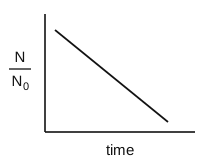
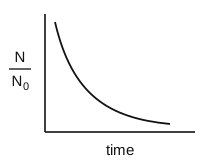
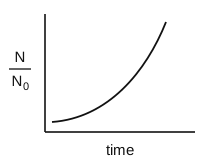
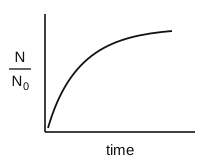
Q207.For bacterial growth in a cell culture, growth law is very similar to the law of radioactive decay. Which of the following graphs is most suitable to represent bacterial colony growth ? Where N - Number of Bacteria at any time, N0 - Initial number of Bacteria.
कोशिका संवर्धन (cell culture) में जीवाणु वृद्धि का नियम रेडियोऐक्टिव क्षय के नियम से अत्यंत मिलता-जुलता है। जीवाणु कॉलोनी की वृद्धि को निरूपित करने के लिए निम्नलिखित में से कौन-सा ग्राफ सर्वाधिक उपयुक्त है? जहाँ N - किसी समय जीवाणुओं की संख्या, N0 - जीवाणुओं की प्रारंभिक संख्या।
- A
- B
- C
- D
Show answer
Concept: Radioactive decay is first order: . Growth follows the same law with a positive exponent: .
- For growth, : it starts at 1 at and rises faster and faster – an upward, concave-up exponential curve.
- (A) shows a linear decrease and (B) an exponential decay – both describe loss, not growth.
- (D) shows saturation (levelling off), which never does.
- Only (C) shows the ever-steepening exponential rise.
Answer: (C)
अवधारणा: रेडियोऐक्टिव क्षय प्रथम कोटि का है: । वृद्धि उसी नियम से, परन्तु धनात्मक घातांक के साथ होती है: ।
- वृद्धि के लिए : पर मान 1 से प्रारंभ होकर उत्तरोत्तर तेज़ी से बढ़ता है – ऊपर की ओर अवतल (concave-up) चरघातांकी वक्र।
- (A) रैखिक कमी तथा (B) चरघातांकी क्षय दर्शाते हैं – दोनों ह्रास हैं, वृद्धि नहीं।
- (D) संतृप्ति (समतल होना) दर्शाता है, जो में कभी नहीं होता।
- केवल (C) निरंतर तीव्र होती चरघातांकी वृद्धि दर्शाता है।
उत्तर: (C)
JEE Main 2025 (January) – Paper 1 (B.E./B.Tech)ChemistryChemical kinetics – exponential growth lawJEE Main 2025 (January) – Paper 1 (B.E./B.Tech) 2025 · 28 Jan Shift 2
Q208.The amphoteric oxide among V2O3, V2O4 and V2O5, upon reaction with alkali leads to formation of an oxide anion. The oxidation state of V in the oxide anion is :
V2O3, V2O4 तथा V2O5 में से उभयधर्मी ऑक्साइड, क्षार से अभिक्रिया करने पर एक ऑक्साइड ऋणायन बनाता है। इस ऑक्साइड ऋणायन में V की ऑक्सीकरण अवस्था है :
- A+3
- B+4
- C+7
- D+5
Show answer
Concept: Basic character of transition-metal oxides falls and acidic character rises with oxidation state; V2O5 is amphoteric.
- V2O3 is basic, VO2 (V2O4) is largely basic/weakly amphoteric, while V2O5 is the amphoteric oxide (dissolves in both acid and alkali).
- With alkali: V2O5 + 6NaOH → 2Na3VO4 + 3H2O, giving the vanadate ion VO43−.
- In VO43−: x + 4(−2) = −3 ⇒ x = +5.
Short trick: The oxidation state of V does not change in an acid–base reaction; V2O5 is already +5.
Answer: (D) +5
अवधारणा: ऑक्सीकरण अवस्था बढ़ने के साथ संक्रमण धातु ऑक्साइडों का क्षारकीय गुण घटता तथा अम्लीय गुण बढ़ता है; V2O5 उभयधर्मी है।
- V2O3 क्षारकीय है, VO2 (V2O4) मुख्यतः क्षारकीय/अल्प उभयधर्मी, जबकि V2O5 उभयधर्मी ऑक्साइड है (अम्ल और क्षार दोनों में घुलता है)।
- क्षार के साथ: V2O5 + 6NaOH → 2Na3VO4 + 3H2O, अर्थात् वैनेडेट आयन VO43− बनता है।
- VO43− में: x + 4(−2) = −3 ⇒ x = +5।
शॉर्ट ट्रिक: अम्ल–क्षार अभिक्रिया में V की ऑक्सीकरण अवस्था नहीं बदलती; V2O5 में वह पहले से +5 है।
उत्तर: (D) +5
JEE Main 2025 (January) – Paper 1 (B.E./B.Tech)Chemistryd-block – oxides of vanadiumJEE Main 2025 (January) – Paper 1 (B.E./B.Tech) 2025 · 28 Jan Shift 2
Q209.Arrange the following in increasing order of solubility product : Ca(OH)2, AgBr, PbS, HgS
निम्नलिखित को विलेयता गुणनफल के बढ़ते क्रम में व्यवस्थित कीजिए : Ca(OH)2, AgBr, PbS, HgS
- AHgS < AgBr < PbS < Ca(OH)2
- BCa(OH)2 < AgBr < HgS < PbS
- CPbS < HgS < Ca(OH)2 < AgBr
- DHgS < PbS < AgBr < Ca(OH)2
Show answer
Concept: Ksp measures how far a sparingly soluble salt dissolves; metal sulphides of soft heavy metals are the least soluble.
- Approximate Ksp values: HgS ≈ 10−54 (one of the most insoluble salts known).
- PbS ≈ 10−28; AgBr ≈ 5 × 10⁻¹³; Ca(OH)2 ≈ 5.5 × 10⁻⁶ (noticeably soluble, lime water).
- Increasing Ksp: HgS < PbS < AgBr < Ca(OH)2.
Short trick: Softer cation + S2− → more covalent, less soluble: HgS < PbS; halides come next and hydroxides of alkaline-earth metals are the most soluble of such sets.
Answer: (D)
अवधारणा: Ksp बताता है कि अल्प-विलेय लवण कितना घुलता है; भारी (soft) धातुओं के सल्फाइड सबसे कम विलेय होते हैं।
- लगभग Ksp मान: HgS ≈ 10−54 (ज्ञात सबसे अविलेय लवणों में से एक)।
- PbS ≈ 10−28; AgBr ≈ 5 × 10⁻¹³; Ca(OH)2 ≈ 5.5 × 10⁻⁶ (चूने का पानी, पर्याप्त विलेय)।
- बढ़ता Ksp: HgS < PbS < AgBr < Ca(OH)2।
शॉर्ट ट्रिक: नरम धनायन + S2− → अधिक सहसंयोजी, कम विलेय: HgS < PbS; फिर हैलाइड, और क्षारीय-मृदा धातुओं के हाइड्रॉक्साइड ऐसे समुच्चय में सबसे अधिक विलेय।
उत्तर: (D)
JEE Main 2025 (January) – Paper 1 (B.E./B.Tech)ChemistryIonic equilibrium – solubility productJEE Main 2025 (January) – Paper 1 (B.E./B.Tech) 2025 · 28 Jan Shift 2
Q210.The purification method based on the following physical transformation is :
Solid (X) —Heat→ Vapour (X) —Cool→ Solid (X)
निम्नलिखित भौतिक रूपांतरण पर आधारित शोधन विधि है :
ठोस (X) —ऊष्मा (Heat)→ वाष्प (X) —शीतलन (Cool)→ ठोस (X)
- ADistillationआसवन
- BExtractionनिष्कर्षण
- CSublimationऊर्ध्वपातन
- DCrystallizationक्रिस्टलीकरण
Show answer
Concept: Sublimation is the direct conversion of a solid to vapour on heating, and of the vapour back to solid on cooling, without passing through the liquid state.
- The given change is Solid → Vapour → Solid, with no liquid stage anywhere – this is exactly sublimation.
- It purifies sublimable solids (naphthalene, camphor, benzoic acid) from non-volatile impurities.
- (A) Distillation involves liquid → vapour → liquid; (B) extraction uses a solvent; (D) crystallization separates a solid from its saturated solution – none of them match.
Answer: (C) Sublimation
अवधारणा: ऊर्ध्वपातन में ठोस गर्म करने पर सीधे वाष्प में तथा वाष्प ठंडा करने पर सीधे ठोस में बदलता है, बीच में द्रव अवस्था नहीं आती।
- दिया गया परिवर्तन ठोस → वाष्प → ठोस है, कहीं भी द्रव अवस्था नहीं – यही ऊर्ध्वपातन है।
- इससे ऊर्ध्वपातनीय ठोस (नैफ्थैलीन, कपूर, बेन्जोइक अम्ल) अवाष्पशील अशुद्धियों से शुद्ध किए जाते हैं।
- (A) आसवन में द्रव → वाष्प → द्रव होता है; (B) निष्कर्षण में विलायक प्रयुक्त होता है; (D) क्रिस्टलीकरण संतृप्त विलयन से ठोस पृथक् करता है – कोई भी मेल नहीं खाता।
उत्तर: (C) ऊर्ध्वपातन
JEE Main 2025 (January) – Paper 1 (B.E./B.Tech)ChemistryPurification of organic compounds – sublimationJEE Main 2025 (January) – Paper 1 (B.E./B.Tech) 2025 · 28 Jan Shift 2
Q211.Which of the following is/are not correct with respect to energy of atomic orbitals of hydrogen atom? (A) 1s < 2p < 3d < 4s (B) 1s < 2s = 2p < 3s = 3p (C) 1s < 2s < 2p < 3s < 3p (D) 1s < 2s < 4s < 3d Choose the correct answer from the options given below :
हाइड्रोजन परमाणु के परमाणु कक्षकों की ऊर्जा के संदर्भ में निम्नलिखित में से कौन-सा/से सही नहीं है/हैं? (A) 1s < 2p < 3d < 4s (B) 1s < 2s = 2p < 3s = 3p (C) 1s < 2s < 2p < 3s < 3p (D) 1s < 2s < 4s < 3d नीचे दिए गए विकल्पों में से सही उत्तर चुनिए :
- A(A) and (C) onlyकेवल (A) और (C)
- B(B) and (D) onlyकेवल (B) और (D)
- C(C) and (D) onlyकेवल (C) और (D)
- D(A) and (B) onlyकेवल (A) और (B)
Show answer
Concept: In hydrogen (one electron) the orbital energy depends only on n: all orbitals of the same n are degenerate; (n + l) rule does not apply.
- (A) 1s < 2p < 3d < 4s: n = 1 < 2 < 3 < 4 → correct.
- (B) 1s < 2s = 2p < 3s = 3p: same-n orbitals equal → correct.
- (C) says 2s < 2p and 3s < 3p, but for H, 2s = 2p and 3s = 3p → NOT correct.
- (D) says 4s < 3d, but for H, 3d (n = 3) lies below 4s (n = 4) → NOT correct.
Short trick: For H-atom just compare n; any statement using the (n + l) order is wrong.
Answer: (C) (C) and (D) only
अवधारणा: हाइड्रोजन (एक-इलेक्ट्रॉन) में कक्षक की ऊर्जा केवल n पर निर्भर करती है: समान n के सभी कक्षक समभ्रंश (degenerate) होते हैं; (n + l) नियम लागू नहीं होता।
- (A) 1s < 2p < 3d < 4s: n = 1 < 2 < 3 < 4 → सही।
- (B) 1s < 2s = 2p < 3s = 3p: समान n के कक्षक बराबर → सही।
- (C) में 2s < 2p तथा 3s < 3p कहा गया है, परन्तु H के लिए 2s = 2p तथा 3s = 3p → सही नहीं।
- (D) में 4s < 3d कहा गया है, परन्तु H के लिए 3d (n = 3) की ऊर्जा 4s (n = 4) से कम है → सही नहीं।
शॉर्ट ट्रिक: H-परमाणु में केवल n की तुलना कीजिए; (n + l) क्रम वाला कोई भी कथन गलत होगा।
उत्तर: (C) केवल (C) और (D)
JEE Main 2025 (January) – Paper 1 (B.E./B.Tech)ChemistryAtomic structure – energies of H-atom orbitalsJEE Main 2025 (January) – Paper 1 (B.E./B.Tech) 2025 · 28 Jan Shift 2
Q212.Consider an elementary reaction A(g) + B(g) → C(g) + D(g) If the volume of reaction mixture is suddenly reduced to of its initial volume, the reaction rate will become 'x' times of the original reaction rate. The value of x is :
एक प्राथमिक अभिक्रिया A(g) + B(g) → C(g) + D(g) पर विचार कीजिए। यदि अभिक्रिया मिश्रण का आयतन अचानक घटाकर प्रारंभिक आयतन का कर दिया जाए, तो अभिक्रिया दर मूल दर की 'x' गुना हो जाएगी। x का मान है :
- A3
- B
- C9
- D
Show answer
Concept: For an elementary reaction the rate law follows the stoichiometry: rate = k[A][B].
- When volume becomes , each concentration becomes 3 times: [A] → 3[A], [B] → 3[B].
- New rate = k(3[A])(3[B]) = 9 k[A][B] = 9 × original rate.
- Hence x = 9.
Short trick: Volume ÷ n ⇒ rate × n(order); here order = 2, so 32 = 9.
Answer: (C) 9
अवधारणा: प्राथमिक अभिक्रिया के लिए दर नियम रससमीकरणमिति के अनुसार होता है: दर = k[A][B]।
- आयतन होने पर प्रत्येक सांद्रता 3 गुना हो जाती है: [A] → 3[A], [B] → 3[B]।
- नई दर = k(3[A])(3[B]) = 9 k[A][B] = मूल दर की 9 गुना।
- अतः x = 9।
शॉर्ट ट्रिक: आयतन ÷ n ⇒ दर × n(कोटि); यहाँ कोटि = 2, अतः 32 = 9।
उत्तर: (C) 9
JEE Main 2025 (January) – Paper 1 (B.E./B.Tech)ChemistryChemical kinetics – rate law of elementary reactionJEE Main 2025 (January) – Paper 1 (B.E./B.Tech) 2025 · 28 Jan Shift 2
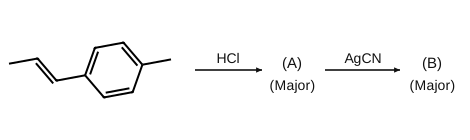
Q213.The product
formed in the following reaction sequence is :
निम्नलिखित अभिक्रिया अनुक्रम में बनने वाला उत्पाद
है :
- A
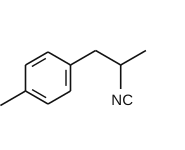
- B
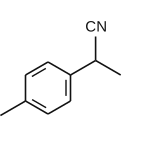
- C
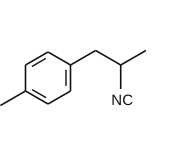
- D
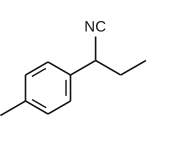
Show answer
Concept: HCl adds to an alkene through the more stable carbocation (Markovnikov); AgCN is an ambident reagent that bonds mainly through N, giving isocyanides.
- Protonation of 1-(4-methylphenyl)prop-1-ene gives the resonance-stabilised benzylic cation Ar–+CH–CH2CH3.
- Cl− attacks it: (A) = 1-chloro-1-(4-methylphenyl)propane (benzylic chloride).
- With AgCN, Ag+ abstracts Cl− (SN1 via the same benzylic cation); since the C of CN is blocked by the covalent Ag–C bond, nitrogen attacks: (B) = benzylic isocyanide Ar–CH(NC)–CH2CH3.
- (B) is wrong – it is a nitrile (–CN, the KCN-type product, not the AgCN product) and its side chain has only two carbons, whereas the substrate's side chain has three. (A) and (C) (identical structures) are wrong – they place the NC group on the non-benzylic carbon (anti-Markovnikov skeleton).
Short trick: KCN → cyanide (R–CN); AgCN → isocyanide (R–NC). The halide always sits on the benzylic carbon first.
Answer: (D)
अवधारणा: HCl ऐल्कीन पर अधिक स्थायी कार्बधनायन (मार्कोनिकॉव) के माध्यम से जुड़ता है; AgCN उभयदंती अभिकर्मक है जो मुख्यतः N से आबंध बनाकर आइसोसायनाइड देता है।
- 1-(4-मेथिलफेनिल)प्रोप-1-ईन के प्रोटॉनीकरण से अनुनाद-स्थायीकृत बेन्जाइलिक धनायन Ar–+CH–CH2CH3 बनता है।
- Cl− के आक्रमण से (A) = 1-क्लोरो-1-(4-मेथिलफेनिल)प्रोपेन (बेन्जाइलिक क्लोराइड)।
- AgCN के साथ Ag+, Cl− को खींच लेता है (उसी बेन्जाइलिक धनायन से SN1); CN का C सहसंयोजी Ag–C आबंध से अवरुद्ध है, अतः नाइट्रोजन आक्रमण करता है: (B) = बेन्जाइलिक आइसोसायनाइड Ar–CH(NC)–CH2CH3।
- (B) गलत – यह नाइट्राइल (–CN, KCN जैसा उत्पाद, AgCN का नहीं) है और इसकी पार्श्व-शृंखला में केवल दो कार्बन हैं, जबकि अभिक्रियक की पार्श्व-शृंखला में तीन कार्बन हैं। (A) और (C) (समान संरचनाएँ) गलत – इनमें NC समूह गैर-बेन्जाइलिक कार्बन पर है (anti-मार्कोनिकॉव ढाँचा)।
शॉर्ट ट्रिक: KCN → सायनाइड (R–CN); AgCN → आइसोसायनाइड (R–NC)। हैलाइड सदैव पहले बेन्जाइलिक कार्बन पर बैठता है।
उत्तर: (D)
JEE Main 2025 (January) – Paper 1 (B.E./B.Tech)ChemistryHaloalkanes – Markovnikov addition and AgCNJEE Main 2025 (January) – Paper 1 (B.E./B.Tech) 2025 · 28 Jan Shift 2
Q214.Assume a living cell with 0.9%(ω/ω) of glucose solution (aqueous). This cell is immersed in another solution having equal mole fraction of glucose and water. (Consider the data upto first decimal place only) The cell will :
मान लीजिए कि एक जीवित कोशिका में 0.9%(ω/ω) ग्लूकोस विलयन (जलीय) है। इस कोशिका को ग्लूकोस और जल के समान मोल-अंश वाले एक अन्य विलयन में डुबोया जाता है। (आँकड़ों को केवल दशमलव के प्रथम स्थान तक लीजिए) कोशिका :
- Ashow no change in volume since solution is 0.9%(ω/ω)आयतन में कोई परिवर्तन नहीं दर्शाएगी, क्योंकि विलयन 0.9%(ω/ω) है
- Bshrink since solution is 0.5%(ω/ω)सिकुड़ जाएगी, क्योंकि विलयन 0.5%(ω/ω) है
- Cswell up since solution is 1%(ω/ω)फूल जाएगी, क्योंकि विलयन 1%(ω/ω) है
- DNone of theseइनमें से कोई नहीं
Show answer
Concept: Water moves by osmosis from lower to higher solute concentration; convert mole fraction to mass % to compare.
- Equal mole fractions ⇒ 1 mol glucose (180 g) per 1 mol water (18 g).
- Mass % of glucose = (ω/ω) – an extremely concentrated (hypertonic) solution.
- The cell (0.9%) would indeed shrink, but (B) justifies shrinking with a wrong concentration (0.5%); (A) and (C) quote wrong concentrations too.
- Since no option states the correct reason/concentration, the answer is "None of these".
Answer: (D) None of these
अवधारणा: परासरण द्वारा जल कम सांद्रता से अधिक सांद्रता की ओर जाता है; तुलना के लिए मोल-अंश को द्रव्यमान % में बदलिए।
- समान मोल-अंश ⇒ 1 मोल ग्लूकोस (180 g) प्रति 1 मोल जल (18 g)।
- ग्लूकोस का द्रव्यमान % = (ω/ω) – अत्यंत सांद्र (अतिपरासारी) विलयन।
- कोशिका (0.9%) वास्तव में सिकुड़ेगी, परन्तु (B) में सिकुड़ने का कारण गलत सांद्रता (0.5%) दी गई है; (A) और (C) में भी सांद्रताएँ गलत हैं।
- चूँकि किसी विकल्प में सही कारण/सांद्रता नहीं है, उत्तर "इनमें से कोई नहीं" है।
उत्तर: (D) इनमें से कोई नहीं
JEE Main 2025 (January) – Paper 1 (B.E./B.Tech)ChemistrySolutions – osmosis and tonicityJEE Main 2025 (January) – Paper 1 (B.E./B.Tech) 2025 · 28 Jan Shift 2
Q215.Given below are two statements : Statement (I): According to the Law of Octaves, the elements were arranged in the increasing order of their atomic number. Statement (II): Meyer observed a periodically repeated pattern upon plotting physical properties of certain elements against their respective atomic numbers. In the light of the above statements, choose the correct answer from the options given below :
नीचे दो कथन दिए गए हैं : कथन (I): अष्टक नियम के अनुसार, तत्वों को उनके परमाणु क्रमांक के बढ़ते क्रम में व्यवस्थित किया गया था। कथन (II): मेयर ने कुछ तत्वों के भौतिक गुणों को उनके परमाणु क्रमांकों के सापेक्ष आलेखित करने पर आवर्ती रूप से दोहराया जाने वाला पैटर्न देखा। उपर्युक्त कथनों के आलोक में, नीचे दिए गए विकल्पों में से सही उत्तर चुनिए :
- ABoth Statement (I) and Statement (II) are false.कथन (I) और कथन (II) दोनों असत्य हैं।
- BBoth Statement (I) and Statement (II) are true.कथन (I) और कथन (II) दोनों सत्य हैं।
- CStatement (I) is false but Statement (II) is true.कथन (I) असत्य है परन्तु कथन (II) सत्य है।
- DStatement (I) is true but Statement (II) is false.कथन (I) सत्य है परन्तु कथन (II) असत्य है।
Show answer
Concept: Newlands' Law of Octaves used increasing atomic mass (atomic number was unknown then); Lothar Meyer plotted physical properties such as atomic volume and found a periodically repeating pattern.
- Statement (I): Newlands (1865) arranged elements in increasing order of atomic mass, and every eighth element resembled the first – not atomic number. So Statement (I) is false.
- Statement (II): Meyer's plots of physical properties (atomic volume, melting and boiling points) of elements did show a periodically repeated pattern – this observation is correct, so Statement (II) is taken as true.
- Hence Statement (I) false, Statement (II) true.
Short trick: Every pre-Moseley classification (Dobereiner, Newlands, Meyer, Mendeleev) was based on atomic mass; Moseley (1913) introduced atomic number.
Answer: (C)
अवधारणा: न्यूलैंड्स के अष्टक नियम में परमाणु द्रव्यमान का बढ़ता क्रम प्रयुक्त हुआ था (तब परमाणु क्रमांक ज्ञात नहीं था); लोथर मेयर ने परमाणु आयतन जैसे भौतिक गुणों को आलेखित कर आवर्ती पैटर्न पाया।
- कथन (I): न्यूलैंड्स (1865) ने तत्वों को बढ़ते परमाणु द्रव्यमान के क्रम में रखा था और हर आठवाँ तत्व पहले जैसा था – परमाणु क्रमांक के क्रम में नहीं। अतः कथन (I) असत्य है।
- कथन (II): मेयर के भौतिक गुणों (परमाणु आयतन, गलनांक, क्वथनांक) के आलेखों में आवर्ती रूप से दोहराया जाने वाला पैटर्न वास्तव में दिखा – यह प्रेक्षण सही है, अतः कथन (II) सत्य माना जाता है।
- अतः कथन (I) असत्य, कथन (II) सत्य।
शॉर्ट ट्रिक: मोज़ले से पहले के सभी वर्गीकरण (डोबेराइनर, न्यूलैंड्स, मेयर, मेंडेलीव) परमाणु द्रव्यमान पर आधारित थे; परमाणु क्रमांक मोज़ले (1913) ने दिया।
उत्तर: (C)
JEE Main 2025 (January) – Paper 1 (B.E./B.Tech)ChemistryClassification of elements – historical developmentJEE Main 2025 (January) – Paper 1 (B.E./B.Tech) 2025 · 28 Jan Shift 2
Q216.Match List - I with List - II.
List - I
(Saccharides) | List - II
(Glycosidic-linkages found) |
|---|
| (A) | Sucrose | (I) | α 1−4 |
| (B) | Maltose | (II) | α 1−4 and α 1−6 |
| (C) | Lactose | (III) | α 1−β 2 |
| (D) | Amylopectin | (IV) | β 1−4 |
Choose the correct answer from the options given below :
सूची-I का सूची-II से मिलान कीजिए।
सूची - I
(शर्कराएँ) | सूची - II
(पाई जाने वाली ग्लाइकोसाइडिक बंधताएँ) |
|---|
| (A) | सुक्रोस | (I) | α 1−4 |
| (B) | माल्टोस | (II) | α 1−4 तथा α 1−6 |
| (C) | लैक्टोस | (III) | α 1−β 2 |
| (D) | ऐमाइलोपेक्टिन | (IV) | β 1−4 |
नीचे दिए गए विकल्पों में से सही उत्तर चुनिए :
- A(A)-(IV), (B)-(II), (C)-(I), (D)-(III)
- B(A)-(I), (B)-(II), (C)-(III), (D)-(IV)
- C(A)-(III), (B)-(I), (C)-(IV), (D)-(II)
- D(A)-(II), (B)-(IV), (C)-(III), (D)-(I)
Show answer
Concept: The glycosidic linkage is named by the anomeric configurations and the carbon numbers joined.
- (A) Sucrose: C1 of α-D-glucose joined to C2 of β-D-fructose → α1–β2 = (III).
- (B) Maltose: two α-D-glucose units joined C1–C4 → α1–4 = (I).
- (C) Lactose: C1 of β-D-galactose joined to C4 of glucose → β1–4 = (IV).
- (D) Amylopectin: α1–4 chains with α1–6 branches = (II).
Short trick: "Lactose → beta" (milk sugar is the β1–4 one); branching (1–6) appears only in amylopectin/glycogen.
Answer: (C)
अवधारणा: ग्लाइकोसाइडिक बंधता का नाम ऐनोमेरिक विन्यास तथा जुड़ने वाले कार्बन क्रमांकों से रखा जाता है।
- (A) सुक्रोस: α-D-ग्लूकोस के C1 और β-D-फ्रक्टोस के C2 के बीच → α1–β2 = (III)।
- (B) माल्टोस: दो α-D-ग्लूकोस इकाइयाँ C1–C4 से जुड़ी → α1–4 = (I)।
- (C) लैक्टोस: β-D-गैलेक्टोस का C1 ग्लूकोस के C4 से जुड़ा → β1–4 = (IV)।
- (D) ऐमाइलोपेक्टिन: α1–4 शृंखलाएँ तथा α1–6 शाखाएँ = (II)।
शॉर्ट ट्रिक: "लैक्टोस → बीटा" (दुग्ध शर्करा β1–4 वाली है); शाखन (1–6) केवल ऐमाइलोपेक्टिन/ग्लाइकोजन में मिलता है।
उत्तर: (C)
JEE Main 2025 (January) – Paper 1 (B.E./B.Tech)ChemistryBiomolecules – glycosidic linkagesJEE Main 2025 (January) – Paper 1 (B.E./B.Tech) 2025 · 28 Jan Shift 2
Q217.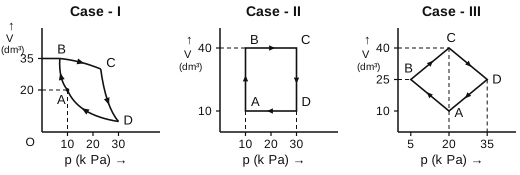
An ideal gas undergoes a cyclic transformation starting from the point
and coming back to the same point by tracing the path
as shown in the three cases above. Choose the correct option regarding
:
एक आदर्श गैस बिंदु
से प्रारंभ होकर, ऊपर दर्शाए गए तीनों प्रकरणों के अनुसार
पथ से चलते हुए उसी बिंदु पर वापस आकर एक चक्रीय रूपांतरण करती है।
के संबंध में सही विकल्प चुनिए :
- AΔU( Case-I ) = ΔU( Case-II ) = ΔU( Case-III )ΔU( प्रकरण-I ) = ΔU( प्रकरण-II ) = ΔU( प्रकरण-III )
- BΔU( Case-I ) > ΔU( Case-III ) > ΔU( Case-II )ΔU( प्रकरण-I ) > ΔU( प्रकरण-III ) > ΔU( प्रकरण-II )
- CΔU( Case-III ) > ΔU( Case-II ) > ΔU( Case-I )ΔU( प्रकरण-III ) > ΔU( प्रकरण-II ) > ΔU( प्रकरण-I )
- DΔU( Case-I ) > ΔU( Case-II ) > ΔU( Case-III )ΔU( प्रकरण-I ) > ΔU( प्रकरण-II ) > ΔU( प्रकरण-III )
Show answer
Concept: Internal energy U is a state function – it depends only on the state, not on the path.
- In every case the gas returns to the same initial point A, so initial and final states are identical.
- Therefore ΔU = Ufinal − Uinitial = 0 for each cycle, whatever its shape (curved loop, square or diamond).
- Hence ΔU(Case-I) = ΔU(Case-II) = ΔU(Case-III) = 0. The shapes only change the work w (area enclosed), not ΔU.
Short trick: Cyclic process ⇒ Δ(any state function) = 0; only q and w depend on the path.
Answer: (A)
अवधारणा: आंतरिक ऊर्जा U एक अवस्था फलन है – यह केवल अवस्था पर निर्भर करती है, पथ पर नहीं।
- प्रत्येक प्रकरण में गैस उसी प्रारंभिक बिंदु A पर लौट आती है, अतः प्रारंभिक और अंतिम अवस्थाएँ समान हैं।
- अतः प्रत्येक चक्र के लिए ΔU = Uअंतिम − Uप्रारंभिक = 0, चाहे चक्र का आकार कुछ भी हो (वक्र लूप, वर्ग या समचतुर्भुज)।
- अतः ΔU(प्रकरण-I) = ΔU(प्रकरण-II) = ΔU(प्रकरण-III) = 0। आकार केवल कार्य w (घिरा क्षेत्रफल) बदलता है, ΔU नहीं।
शॉर्ट ट्रिक: चक्रीय प्रक्रम ⇒ Δ(कोई भी अवस्था फलन) = 0; केवल q और w पथ पर निर्भर हैं।
उत्तर: (A)
JEE Main 2025 (January) – Paper 1 (B.E./B.Tech)ChemistryThermodynamics – internal energy in cyclic processJEE Main 2025 (January) – Paper 1 (B.E./B.Tech) 2025 · 28 Jan Shift 2
Q218.Identify the inorganic sulphides that are yellow in colour : (A) (NH4)2S (B) PbS (C) CuS (D) As2S3 (E) As2S5 Choose the correct answer from the options given below :
पीले रंग के अकार्बनिक सल्फाइडों को पहचानिए : (A) (NH4)2S (B) PbS (C) CuS (D) As2S3 (E) As2S5 नीचे दिए गए विकल्पों में से सही उत्तर चुनिए :
- A(A), (D) and (E) onlyकेवल (A), (D) और (E)
- B(D) and (E) onlyकेवल (D) और (E)
- C(A) and (B) onlyकेवल (A) और (B)
- D(A) and (C) onlyकेवल (A) और (C)
Show answer
Concept: Colours of common sulphides met in qualitative analysis.
- (A) (NH4)2S: ammonium sulphide (the familiar "yellow ammonium sulphide" of qualitative analysis) is yellow → yes.
- (B) PbS: black (galena) → no. (C) CuS: black → no.
- (D) As2S3: bright yellow (orpiment) → yes. (E) As2S5: yellow → yes.
- Yellow sulphides: (A), (D), (E).
Short trick: Group-II sulphides of As are yellow; those of Pb, Cu, Hg are black.
Answer: (A) (A), (D) and (E) only
अवधारणा: गुणात्मक विश्लेषण में मिलने वाले सामान्य सल्फाइडों के रंग।
- (A) (NH4)2S: अमोनियम सल्फाइड (गुणात्मक विश्लेषण का परिचित "पीला अमोनियम सल्फाइड") पीला होता है → हाँ।
- (B) PbS: काला (गैलेना) → नहीं। (C) CuS: काला → नहीं।
- (D) As2S3: चमकीला पीला (हरताल/ऑर्पिमेंट) → हाँ। (E) As2S5: पीला → हाँ।
- पीले सल्फाइड: (A), (D), (E)।
शॉर्ट ट्रिक: As के सल्फाइड पीले; Pb, Cu, Hg के सल्फाइड काले होते हैं।
उत्तर: (A) केवल (A), (D) और (E)
JEE Main 2025 (January) – Paper 1 (B.E./B.Tech)ChemistryInorganic chemistry – colours of sulphidesJEE Main 2025 (January) – Paper 1 (B.E./B.Tech) 2025 · 28 Jan Shift 2
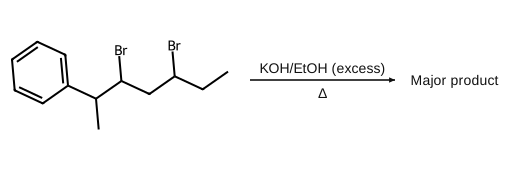
Q219.The major product of the following reaction is :
निम्नलिखित अभिक्रिया का मुख्य उत्पाद है :
- A2-Phenylhepta-2,5-diene2-फेनिलहेप्टा-2,5-डाइईन
- B6-Phenylhepta-2,4-diene6-फेनिलहेप्टा-2,4-डाइईन
- C6-Phenylhepta-3,5-diene6-फेनिलहेप्टा-3,5-डाइईन
- D2-Phenylhepta-2,4-diene2-फेनिलहेप्टा-2,4-डाइईन
Show answer
Concept: Alcoholic KOH causes E2 elimination; with excess base both C–Br bonds are eliminated, and the major alkene is the more substituted, conjugated one (Saytzeff).
- The substrate is 3,5-dibromo-2-phenylheptane: C1–C2(Ph)–C3(Br)–C4–C5(Br)–C6–C7.
- Elimination at C3–Br occurs towards C2, giving the C2=C3 double bond that is trisubstituted and conjugated with the benzene ring.
- Elimination at C5–Br occurs towards C4, giving C4=C5 and hence a conjugated diene.
- Product: CH3–C(Ph)=CH–CH=CH–CH2–CH3 = 2-phenylhepta-2,4-diene; (A), (B), (C) are not fully conjugated with each other and the ring, so they are minor.
Short trick: Aim every new C=C towards maximum conjugation (ring + diene) – that is always the Saytzeff/major product here.
Answer: (D) 2-Phenylhepta-2,4-diene
अवधारणा: ऐल्कोहॉलिक KOH E2 विलोपन कराता है; आधिक्य क्षार से दोनों C–Br विलोपित होते हैं, और मुख्य ऐल्कीन अधिक प्रतिस्थापित, संयुग्मित वाला होता है (सेत्ज़ेफ नियम)।
- अभिक्रियक 3,5-डाइब्रोमो-2-फेनिलहेप्टेन है: C1–C2(Ph)–C3(Br)–C4–C5(Br)–C6–C7।
- C3–Br का विलोपन C2 की ओर होता है, जिससे C2=C3 द्विआबंध बनता है जो त्रि-प्रतिस्थापित तथा बेन्जीन वलय से संयुग्मित है।
- C5–Br का विलोपन C4 की ओर होता है, जिससे C4=C5 बनता है और संयुग्मित डाइईन प्राप्त होता है।
- उत्पाद: CH3–C(Ph)=CH–CH=CH–CH2–CH3 = 2-फेनिलहेप्टा-2,4-डाइईन; (A), (B), (C) परस्पर तथा वलय से पूर्ण संयुग्मित नहीं हैं, अतः गौण उत्पाद हैं।
शॉर्ट ट्रिक: हर नया C=C अधिकतम संयुग्मन (वलय + डाइईन) की ओर बनाइए – वही सेत्ज़ेफ/मुख्य उत्पाद होगा।
उत्तर: (D) 2-फेनिलहेप्टा-2,4-डाइईन
JEE Main 2025 (January) – Paper 1 (B.E./B.Tech)ChemistryHaloalkanes – double dehydrohalogenationJEE Main 2025 (January) – Paper 1 (B.E./B.Tech) 2025 · 28 Jan Shift 2
Q220.Identify correct conversion during acidic hydrolysis from the following : (A) starch gives galactose. (B) cane sugar gives equal amount of glucose and fructose. (C) milk sugar gives glucose and galactose. (D) amylopectin gives glucose and fructose. (E) amylose gives only glucose. Choose the correct answer from the options given below :
निम्नलिखित में से अम्लीय जल-अपघटन के दौरान सही रूपांतरण पहचानिए : (A) स्टार्च गैलेक्टोस देता है। (B) इक्षु शर्करा (cane sugar) समान मात्रा में ग्लूकोस और फ्रक्टोस देती है। (C) दुग्ध शर्करा (milk sugar) ग्लूकोस और गैलेक्टोस देती है। (D) ऐमाइलोपेक्टिन ग्लूकोस और फ्रक्टोस देता है। (E) ऐमाइलोस केवल ग्लूकोस देता है। नीचे दिए गए विकल्पों में से सही उत्तर चुनिए :
- A(A), (B) and (C) onlyकेवल (A), (B) और (C)
- B(B), (C) and (E) onlyकेवल (B), (C) और (E)
- C(C), (D) and (E) onlyकेवल (C), (D) और (E)
- D(B), (C) and (D) onlyकेवल (B), (C) और (D)
Show answer
Concept: Starch (amylose + amylopectin) is a polymer of only α-D-glucose; sucrose → glucose + fructose; lactose → glucose + galactose.
- (A) False – starch hydrolyses to glucose only, never galactose.
- (B) True – cane sugar (sucrose) gives equimolar glucose and fructose (invert sugar).
- (C) True – milk sugar (lactose) gives glucose and galactose.
- (D) False – amylopectin is a glucose polymer; it gives only glucose, no fructose.
- (E) True – amylose, the linear component of starch, gives only glucose.
Short trick: Anything from starch (amylose/amylopectin/glycogen) hydrolyses to glucose alone; "gal" comes only from lactose.
Answer: (B) (B), (C) and (E) only
अवधारणा: स्टार्च (ऐमाइलोस + ऐमाइलोपेक्टिन) केवल α-D-ग्लूकोस का बहुलक है; सुक्रोस → ग्लूकोस + फ्रक्टोस; लैक्टोस → ग्लूकोस + गैलेक्टोस।
- (A) असत्य – स्टार्च के जल-अपघटन से केवल ग्लूकोस मिलता है, गैलेक्टोस कभी नहीं।
- (B) सत्य – इक्षु शर्करा (सुक्रोस) समान मोल ग्लूकोस और फ्रक्टोस (इन्वर्ट शुगर) देती है।
- (C) सत्य – दुग्ध शर्करा (लैक्टोस) ग्लूकोस और गैलेक्टोस देती है।
- (D) असत्य – ऐमाइलोपेक्टिन ग्लूकोस का बहुलक है; केवल ग्लूकोस देता है, फ्रक्टोस नहीं।
- (E) सत्य – स्टार्च का रेखीय घटक ऐमाइलोस केवल ग्लूकोस देता है।
शॉर्ट ट्रिक: स्टार्च-परिवार (ऐमाइलोस/ऐमाइलोपेक्टिन/ग्लाइकोजन) से केवल ग्लूकोस; "गैलेक्टोस" केवल लैक्टोस से आता है।
उत्तर: (B) केवल (B), (C) और (E)
JEE Main 2025 (January) – Paper 1 (B.E./B.Tech)ChemistryBiomolecules – hydrolysis of carbohydratesJEE Main 2025 (January) – Paper 1 (B.E./B.Tech) 2025 · 28 Jan Shift 2

