Q161.Let be a twice differentiable function such that . If for all , and , then is equal to :
माना एक दो बार अवकलनीय फलन है जिसके लिए है। यदि सभी के लिए , तथा हैं, तो बराबर है :
- A
- B
- C
- D
Show answer
Concept: Apply integration by parts to each given integral and use .
- .
- Since : .
- .
- .
- .
Short trick: The second integral already contains the first after one by-parts step – chain them instead of recomputing.
Answer: (A)
अवधारणा: दिए गए प्रत्येक समाकल पर खंडशः समाकलन (integration by parts) लगाइए तथा का उपयोग कीजिए।
- ।
- चूँकि : ।
- ।
- ।
- ।
शॉर्ट ट्रिक: एक बार खंडशः समाकलन करते ही दूसरे समाकल में पहला समाकल प्रकट हो जाता है – दोबारा गणना न करके उन्हें जोड़िए।
उत्तर: (A)
JEE Main 2025 (January) – Paper 1 (B.E./B.Tech)MathematicsDefinite integration – integration by partsJEE Main 2025 (January) – Paper 1 (B.E./B.Tech) 2025 · 28 Jan Shift 2
Q162.For positive integers , if and , then the value of is :
धनात्मक पूर्णांकों के लिए, यदि तथा है, तो का मान है :
- A
- B
- C
- D
Show answer
Concept: Factor the quadratic and split by partial fractions so the sum telescopes.
- .
- .
- .
- .
Short trick: , so the factor 507 cancels instantly, leaving .
Answer: (B)
अवधारणा: द्विघात को गुणनखंडित कर को आंशिक भिन्नों में तोड़िए ताकि योग दूरबीनी बन जाए।
- ।
- ।
- ।
- ।
शॉर्ट ट्रिक: , अतः 507 तुरंत कट जाता है और शेष रहता है।
उत्तर: (B)
JEE Main 2025 (January) – Paper 1 (B.E./B.Tech)MathematicsSequences and series – telescoping sumJEE Main 2025 (January) – Paper 1 (B.E./B.Tech) 2025 · 28 Jan Shift 2
Q163.Let be a polynomial of degree 2, satisfying . If , then the sum of squares of all possible values of is :
माना घात 2 का एक बहुपद है, जो को संतुष्ट करता है। यदि , तो के सभी संभव मानों के वर्गों का योग है :
- A
- B
- C
- D
Show answer
Concept: The only polynomials satisfying are .
- Degree 2 gives or .
- The codomain is : is rejected; for all , so .
- : .
- Sum of squares .
Short trick: For , sum of squares of roots – no need to find the roots.
Answer: (B)
अवधारणा: को संतुष्ट करने वाले बहुपद केवल होते हैं।
- घात 2 से अथवा ।
- सहप्रांत है: अस्वीकार्य; प्रत्येक के लिए, अतः ।
- : ।
- वर्गों का योग ।
शॉर्ट ट्रिक: के लिए मूलों के वर्गों का योग योगगुणनफल – मूल निकालने की आवश्यकता नहीं।
उत्तर: (B)
JEE Main 2025 (January) – Paper 1 (B.E./B.Tech)MathematicsFunctions – functional equation of polynomialsJEE Main 2025 (January) – Paper 1 (B.E./B.Tech) 2025 · 28 Jan Shift 2
Q164.If and are the points of intersection of the circle and the hyperbola and a point P moves on the line , then the centroid of lies on the line :
यदि वृत्त तथा अतिपरवलय के प्रतिच्छेदन बिंदु तथा हैं और एक बिंदु P रेखा पर चलता है, तो का केन्द्रक (centroid) जिस रेखा पर स्थित है, वह है :
- A
- B
- C
- D
Show answer
Concept: Find , by eliminating , then eliminate the parameter of P from the centroid coordinates.
- From the circle, . Substituting in the hyperbola: .
- or ; only gives . So , and .
- Let . Centroid : , .
- From : ; then .
- Locus: .
Short trick: and are symmetric about the -axis, so – only the sum is needed for the centroid.
Answer: (C)
अवधारणा: का विलोपन कर , निकालिए, फिर केन्द्रक के निर्देशांकों से P के प्राचल का विलोपन कीजिए।
- वृत्त से । अतिपरवलय में रखने पर: ।
- अथवा ; केवल से मिलता है। अतः , तथा ।
- माना । केन्द्रक : , ।
- से: ; तब ।
- बिन्दुपथ: ।
शॉर्ट ट्रिक: तथा , -अक्ष के सापेक्ष सममित हैं, अतः – केन्द्रक के लिए केवल योग चाहिए।
उत्तर: (C)
JEE Main 2025 (January) – Paper 1 (B.E./B.Tech)MathematicsConic sections – circle, hyperbola and locus of centroidJEE Main 2025 (January) – Paper 1 (B.E./B.Tech) 2025 · 28 Jan Shift 2
Q165.If , , then is equal to :
यदि , , तो बराबर है :
- A
- B
- C
- D
Show answer
Concept: Rationalise the fourth root with , .
- .
- Divide: , so .
- With : .
- .
- .
Short trick: For inside, substitute – the integrand becomes a polynomial plus .
Answer: (A)
अवधारणा: चतुर्थ मूल को , प्रतिस्थापन से सरल कीजिए।
- ।
- भाग देने पर: , अतः ।
- रखने पर: ।
- ।
- ।
शॉर्ट ट्रिक: दिखे तो रखिए – समाकल्य एक बहुपद और में बदल जाता है।
उत्तर: (A)
JEE Main 2025 (January) – Paper 1 (B.E./B.Tech)MathematicsIndefinite integration – substitutionJEE Main 2025 (January) – Paper 1 (B.E./B.Tech) 2025 · 28 Jan Shift 2
Q166.The area of the region bounded by the curves and is :
वक्रों तथा से घिरे क्षेत्र का क्षेत्रफल है :
- A
- B
- C
- D
Show answer
Concept: Both curves are symmetric about the -axis; integrate with respect to between the two -expressions.
- Curves: and . Intersection: .
- For , , so Area .
- .
- .
Short trick: Use symmetry: compute – the arctangent evaluation is immediate at .
Answer: (B)
अवधारणा: दोनों वक्र -अक्ष के सापेक्ष सममित हैं; दोनों -व्यंजकों के बीच के सापेक्ष समाकलन कीजिए।
- वक्र: तथा । प्रतिच्छेदन: ।
- के लिए , अतः क्षेत्रफल ।
- ।
- ।
शॉर्ट ट्रिक: सममिति का उपयोग कर लीजिए – पर का मान तुरंत मिलता है।
उत्तर: (B)
JEE Main 2025 (January) – Paper 1 (B.E./B.Tech)MathematicsArea under curvesJEE Main 2025 (January) – Paper 1 (B.E./B.Tech) 2025 · 28 Jan Shift 2
Q167.The square of the distance of the point from the line in the direction of the vector is :
रेखा से, सदिश की दिशा में, बिंदु की दूरी का वर्ग है :
- A
- B
- C
- D
Show answer
Concept: Distance in a given direction = distance from the point to where the line through the point along that direction meets the given line.
- Point ; line : ; direction .
- Set on : , , .
- Third equation: ; first: . Subtracting, (second equation checks: ).
- Distance .
- Square of the distance .
Short trick: Once is found, distance – here , so it is simply .
Answer: (D)
अवधारणा: दी गई दिशा में दूरी = बिंदु से उस बिंदु तक की दूरी, जहाँ बिंदु से उस दिशा में खींची गई रेखा दी गई रेखा से मिलती है।
- बिंदु ; रेखा : ; दिशा ।
- को पर रखिए: , , ।
- तीसरे समीकरण से: ; पहले से: । घटाने पर (दूसरा समीकरण संतुष्ट: )।
- दूरी ।
- दूरी का वर्ग ।
शॉर्ट ट्रिक: मिलते ही दूरी – यहाँ , अतः उत्तर सीधे ।
उत्तर: (D)
JEE Main 2025 (January) – Paper 1 (B.E./B.Tech)Mathematics3D geometry – distance along a given directionJEE Main 2025 (January) – Paper 1 (B.E./B.Tech) 2025 · 28 Jan Shift 2
Q168.If the midpoint of a chord of the ellipse is , and the length of the chord is , then is :
यदि दीर्घवृत्त की एक जीवा का मध्य-बिंदु है तथा जीवा की लंबाई है, तो है :
- A
- B
- C
- D
Show answer
Concept: The chord with midpoint is ; solve it with the ellipse for the end points.
- : , i.e. .
- Put in the ellipse: .
- or : end points and .
- Length, so length .
- Comparing with : .
Short trick: The quadratic in has no constant term, so one end point has – the arithmetic collapses.
Answer: (B)
अवधारणा: मध्य-बिंदु वाली जीवा का समीकरण होता है; इसे दीर्घवृत्त के साथ हल कर छोर-बिंदु निकालिए।
- : , अर्थात ।
- को दीर्घवृत्त में रखने पर: ।
- अथवा : छोर-बिंदु तथा ।
- लंबाई, अतः लंबाई ।
- से तुलना करने पर: ।
शॉर्ट ट्रिक: के द्विघात में अचर पद नहीं है, अतः एक छोर-बिंदु पर – गणना अत्यंत सरल हो जाती है।
उत्तर: (B)
JEE Main 2025 (January) – Paper 1 (B.E./B.Tech)MathematicsEllipse – chord with a given midpointJEE Main 2025 (January) – Paper 1 (B.E./B.Tech) 2025 · 28 Jan Shift 2
Q169.If and are the roots of , , then is equal to :
यदि तथा , समीकरण , के मूल हैं, तो बराबर है :
- A
- B
- C
- D
Show answer
Concept: Try simple values first; a quadratic with complex coefficients can still have an obvious root.
- Test : . So is a root.
- Sum of roots , so the other root .
- Thus ; .
- (the expression is symmetric, so the labelling of the roots does not matter).
Short trick: Coefficients sum to zero (), so is a root by inspection.
Answer: (D)
अवधारणा: पहले सरल मान आज़माइए; सम्मिश्र गुणांकों वाले द्विघात का भी कोई स्पष्ट मूल हो सकता है।
- रखिए: । अतः एक मूल है।
- मूलों का योग , अतः दूसरा मूल ।
- अतः ; ।
- (व्यंजक सममित है, अतः मूलों का नामकरण बदलने से उत्तर नहीं बदलता)।
शॉर्ट ट्रिक: गुणांकों का योग शून्य है (), अतः निरीक्षण मात्र से एक मूल है।
उत्तर: (D)
JEE Main 2025 (January) – Paper 1 (B.E./B.Tech)MathematicsComplex numbers – quadratic with complex coefficientsJEE Main 2025 (January) – Paper 1 (B.E./B.Tech) 2025 · 28 Jan Shift 2
Q170.Two equal sides of an isosceles triangle are along and . If is the slope of its third side, then the sum, of all possible distinct values of , is :
एक समद्विबाहु त्रिभुज की दो बराबर भुजाएँ तथा के अनुदिश हैं। यदि इसकी तीसरी भुजा की ढाल (slope) है, तो के सभी संभव भिन्न मानों का योग है :
- A
- B
- C
- D
Show answer
Concept: The base of an isosceles triangle makes equal angles with the two equal sides: equate the tangents of the angles.
- Slopes of the equal sides: and .
- Equal angles: , i.e. .
- With the sign: , no real .
- With the sign: .
- Sum of distinct values .
Short trick: The required sum is just the sum of roots of , i.e. by Vieta – no need to compute the roots.
Answer: (C)
अवधारणा: समद्विबाहु त्रिभुज का आधार दोनों बराबर भुजाओं से समान कोण बनाता है: कोणों की स्पर्शज्याएँ बराबर रखिए।
- बराबर भुजाओं की ढालें: तथा ।
- समान कोण: , अर्थात ।
- चिह्न लेने पर: , कोई वास्तविक नहीं।
- चिह्न लेने पर: ।
- भिन्न मानों का योग ।
शॉर्ट ट्रिक: अभीष्ट योग के मूलों का योग ही है, अर्थात विएटा से – मूल निकालने की आवश्यकता नहीं।
उत्तर: (C)
JEE Main 2025 (January) – Paper 1 (B.E./B.Tech)MathematicsStraight lines – isosceles triangle, equal anglesJEE Main 2025 (January) – Paper 1 (B.E./B.Tech) 2025 · 28 Jan Shift 2
Q171.Let A and B be the two points of intersection of the line and the mirror image of the parabola with respect to the line . If denotes the distance between A and B, and denotes the area of , where is the focus of the parabola , then the value of is
माना रेखा तथा, रेखा के सापेक्ष परवलय के दर्पण प्रतिबिंब, के प्रतिच्छेदन बिंदु A तथा B हैं। यदि A तथा B के बीच की दूरी है और का क्षेत्रफल है, जहाँ परवलय की नाभि है, तो का मान है
Show answer
Concept: Reflection in the line maps ; reflect the parabola, intersect with .
- For : . A point lies on the image iff its pre-image satisfies : .
- Image parabola: .
- Put : or . So , and .
- Focus of is ; its distance from the line is .
- , so .
Short trick: For the mirror line the reflection is the swap-and-negate map – no foot-of-perpendicular computation needed.
Answer: 14
अवधारणा: रेखा में परावर्तन देता है; परवलय का प्रतिबिंब लेकर से प्रतिच्छेद कीजिए।
- के लिए: । बिंदु प्रतिबिंब पर होगा यदि उसका पूर्व-प्रतिबिंब , को संतुष्ट करे: ।
- प्रतिबिंब परवलय: ।
- रखने पर: अथवा । अतः , तथा ।
- की नाभि है; रेखा से इसकी दूरी है।
- , अतः ।
शॉर्ट ट्रिक: दर्पण रेखा के लिए परावर्तन सीधा अदल-बदल नियम है – लंब-पाद निकालने की आवश्यकता नहीं।
उत्तर: 14
JEE Main 2025 (January) – Paper 1 (B.E./B.Tech)MathematicsParabola – reflection of a conicJEE Main 2025 (January) – Paper 1 (B.E./B.Tech) 2025 · 28 Jan Shift 2
Q172.The number of natural numbers, between 212 and 999, such that the sum of their digits is 15, is
212 तथा 999 के बीच की उन प्राकृत संख्याओं की संख्या, जिनके अंकों का योग 15 है, है
Show answer
Concept: Count all 3-digit numbers with digit sum 15 by stars and bars with digit caps, then remove those not exceeding 212.
- Digits , , . Put : with , .
- Unrestricted solutions: . Subtract : ; : ; : (no double violations). Total .
- Now remove numbers with digit sum 15. With : , : 5 numbers (159, 168, 177, 186, 195).
- With and number : needs , impossible with . The end points 212 and 999 themselves do not have digit sum 15.
- Required count .
Short trick: Cap violations for a digit are easiest by substituting and recounting – two symmetric cases here.
Answer: 64
अवधारणा: अंक-योग 15 वाली सभी 3-अंकीय संख्याएँ, अंक-सीमाओं सहित स्टार्स एंड बार्स (stars and bars) से गिनिए, फिर 212 तक की संख्याएँ घटाइए।
- अंक , , । रखने पर: , जहाँ , ।
- बिना प्रतिबंध हल: । घटाइए : ; : ; : (दोहरा उल्लंघन संभव नहीं)। कुल ।
- अब 212 तक की, अंक-योग 15 वाली संख्याएँ हटाइए। के लिए: , : 5 संख्याएँ (159, 168, 177, 186, 195)।
- तथा संख्या के लिए: में चाहिए, जो के साथ असंभव है। स्वयं 212 तथा 999 का अंक-योग 15 नहीं है।
- अभीष्ट संख्या ।
शॉर्ट ट्रिक: किसी अंक के होने के उल्लंघन, रखकर पुनः गिनने से सरलता से मिलते हैं – यहाँ दो सममित स्थितियाँ हैं।
उत्तर: 64
JEE Main 2025 (January) – Paper 1 (B.E./B.Tech)MathematicsCombinatorics – numbers with given digit sumJEE Main 2025 (January) – Paper 1 (B.E./B.Tech) 2025 · 28 Jan Shift 2
Q173.If is the solution of the differential equation, , , , then is equal to
यदि अवकल समीकरण , , का हल है, तो बराबर है
Show answer
Concept: Substitute , since turns the equation into a linear ODE in .
- , so the equation becomes .
- Integrating factor : (check: gives ).
- At , and , forcing .
- So ; at , .
- .
Short trick: Try the particular solution first – it fits with , and the initial condition kills the homogeneous part.
Answer: 4
अवधारणा: रखिए, क्योंकि से समीकरण में रैखिक अवकल समीकरण बन जाता है।
- , अतः समीकरण बनता है: ।
- समाकलन गुणक : (जाँच: से )।
- पर तथा , जिससे ।
- अतः ; पर ।
- ।
शॉर्ट ट्रिक: पहले विशेष हल आज़माइए – से यह ठीक बैठता है और प्रारंभिक प्रतिबंध समघात भाग को शून्य कर देता है।
उत्तर: 4
JEE Main 2025 (January) – Paper 1 (B.E./B.Tech)MathematicsDifferential equations – linear first orderJEE Main 2025 (January) – Paper 1 (B.E./B.Tech) 2025 · 28 Jan Shift 2
Q174.The interior angles of a polygon with n sides, are in an A.P. with common difference . If the largest interior angle of the polygon is , then n is equal to
n भुजाओं वाले एक बहुभुज के अंतःकोण, सार्व अंतर वाली एक समांतर श्रेणी (A.P.) में हैं। यदि बहुभुज का सबसे बड़ा अंतःकोण है, तो n बराबर है
Show answer
Concept: Sum of interior angles of an -gon is ; A.P. sum with largest term known.
- Largest angle: .
- Sum: .
- Equate: .
- (rejecting ).
- Check: smallest angle , mean , consistent.
Short trick: Write the sum as and equate to – one clean quadratic.
Answer: 20
अवधारणा: -भुज के अंतःकोणों का योग होता है; सबसे बड़ा पद ज्ञात होने पर A.P. का योग लगाइए।
- सबसे बड़ा कोण: ।
- योग: ।
- बराबर रखने पर: ।
- ( अस्वीकार्य)।
- जाँच: सबसे छोटा कोण , माध्य , संगत।
शॉर्ट ट्रिक: योग को पहले व अंतिम पद का माध्य लिखकर के बराबर रखिए – एक ही साफ द्विघात मिलता है।
उत्तर: 20
JEE Main 2025 (January) – Paper 1 (B.E./B.Tech)MathematicsArithmetic progression – interior angles of a polygonJEE Main 2025 (January) – Paper 1 (B.E./B.Tech) 2025 · 28 Jan Shift 2
Q175.Let . Then is equal to
माना है। तब बराबर है
Show answer
Concept: makes the series telescope; then use .
- With , each term equals .
- as . Hence .
- .
- As : and , so the limit .
Short trick: whenever ; here , so the answer is immediately.
Answer: 1
अवधारणा: से श्रेणी दूरबीनी बन जाती है; फिर का उपयोग कीजिए।
- रखने पर प्रत्येक पद के बराबर है।
- जब । अतः ।
- ।
- पर: तथा , अतः सीमा ।
शॉर्ट ट्रिक: जब भी , तब ; यहाँ , अतः उत्तर तुरंत ।
उत्तर: 1
JEE Main 2025 (January) – Paper 1 (B.E./B.Tech)MathematicsLimits – telescoping trigonometric seriesJEE Main 2025 (January) – Paper 1 (B.E./B.Tech) 2025 · 28 Jan Shift 2
Q176.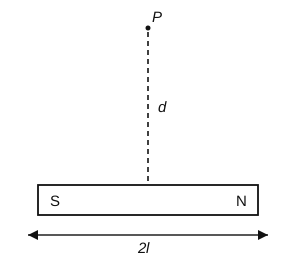
A bar magnet has total length
units and the field point
is at a distance
units from the centre of the magnet. If the relative uncertainty of length measurement is
, then uncertainty of the magnetic field at point
is :
एक छड़ चुम्बक की कुल लम्बाई
मात्रक है तथा क्षेत्र बिंदु
चुम्बक के केंद्र से
मात्रक की दूरी पर है। यदि लम्बाई मापन की आपेक्षिक अनिश्चितता
है, तो बिंदु
पर चुम्बकीय क्षेत्र की अनिश्चितता है :
- A
- B
- C
- D
Show answer
Concept: lies on the equatorial (broad-side) line of the magnet, where ( = pole strength). Relative errors of each length factor add.
- , so .
- Every length ( and ) has uncertainty, so and , hence .
- .
Short trick: For the error multiplies by : here .
Answer: (A)
अवधारणा: बिंदु चुम्बक की निरक्षीय (अनुप्रस्थ) रेखा पर है, जहाँ ( = ध्रुव प्राबल्य)। प्रत्येक लम्बाई गुणक की आपेक्षिक त्रुटियाँ जुड़ती हैं।
- , अतः ।
- प्रत्येक लम्बाई ( तथा ) में अनिश्चितता है, अतः तथा , इसलिए ।
- ।
शॉर्ट ट्रिक: के लिए त्रुटि गुना हो जाती है: यहाँ ।
उत्तर: (A)
JEE Main 2025 (January) – Paper 1 (B.E./B.Tech)PhysicsUnits & Measurements – error analysisJEE Main 2025 (January) – Paper 1 (B.E./B.Tech) 2025 · 28 Jan Shift 2
Q177.A concave mirror produces an image of an object such that the distance between the object and image is 20 cm. If the magnification of the image is '', then the magnitude of the radius of curvature of the mirror is :
एक अवतल दर्पण किसी वस्तु का प्रतिबिम्ब इस प्रकार बनाता है कि वस्तु और प्रतिबिम्ब के बीच की दूरी 20 cm है। यदि प्रतिबिम्ब का आवर्धन '' है, तो दर्पण की वक्रता त्रिज्या का परिमाण है :
- A30 cm
- B3.75 cm
- C15 cm
- D7.5 cm
Show answer
Concept: Mirror magnification and mirror formula , .
- . The image is real, on the same side as the object.
- Distance between object and image .
- With sign convention: . So .
- .
Short trick: for gives at once; then .
Answer: (C) 15 cm
अवधारणा: दर्पण का आवर्धन तथा दर्पण सूत्र , ।
- । प्रतिबिम्ब वास्तविक है, वस्तु की ओर ही बनता है।
- वस्तु और प्रतिबिम्ब के बीच दूरी ।
- चिह्न परिपाटी से: । अतः ।
- ।
शॉर्ट ट्रिक: के लिए से तुरंत मिलता है; फिर ।
उत्तर: (C) 15 cm
JEE Main 2025 (January) – Paper 1 (B.E./B.Tech)PhysicsRay Optics – spherical mirrorsJEE Main 2025 (January) – Paper 1 (B.E./B.Tech) 2025 · 28 Jan Shift 2
Q178.The velocity-time graph of an object moving along a straight line is shown in figure. What is the distance covered by the object between
to
s?
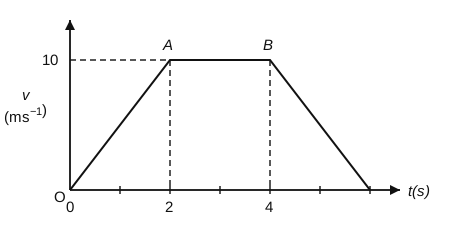
सरल रेखा में गतिमान किसी वस्तु का वेग-समय ग्राफ चित्र में दिखाया गया है।
से
s के बीच वस्तु द्वारा तय की गई दूरी क्या है?
- A30 m
- B11 m
- C10 m
- D13 m
Show answer
Concept: Distance = area under the velocity-time graph (velocity is non-negative here).
- From to s: velocity rises uniformly from 0 to 10 m/s. Area m.
- From s to s: velocity is constant at 10 m/s. Area m.
- Total distance m.
Short trick: Triangle + rectangle: m.
Answer: (A) 30 m
अवधारणा: दूरी = वेग-समय ग्राफ के नीचे का क्षेत्रफल (यहाँ वेग ऋणात्मक नहीं है)।
- से s तक: वेग एकसमान रूप से 0 से 10 m/s तक बढ़ता है। क्षेत्रफल m।
- s से s तक: वेग 10 m/s पर नियत है। क्षेत्रफल m।
- कुल दूरी m।
शॉर्ट ट्रिक: त्रिभुज + आयत: m।
उत्तर: (A) 30 m
JEE Main 2025 (January) – Paper 1 (B.E./B.Tech)PhysicsKinematics – velocity-time graphJEE Main 2025 (January) – Paper 1 (B.E./B.Tech) 2025 · 28 Jan Shift 2
Q179.A body of mass 4 kg is placed on a plane at a point P having coordinate m. Under the action of force N, it moves to a new point Q having coordinates m in 4 sec. The average power and instanteous power at the end of 4 sec are in the ratio of :
4 kg द्रव्यमान का एक पिंड किसी समतल पर निर्देशांक m वाले बिंदु P पर रखा है। बल N के प्रभाव में यह 4 सेकंड में निर्देशांक m वाले नये बिंदु Q पर पहुँच जाता है। 4 सेकंड के अंत पर औसत शक्ति तथा तात्क्षणिक शक्ति का अनुपात है :
- A13 : 6
- B4 : 3
- C1 : 2
- D6 : 13
Show answer
Concept: Average power ; instantaneous power . The body starts from rest, so .
- Displacement m.
- J W.
- ; at s, m/s.
- W.
- .
Short trick: Starting from rest under constant force, — compute the two dot products only.
Answer: (D) 6 : 13
अवधारणा: औसत शक्ति ; तात्क्षणिक शक्ति । पिंड विरामावस्था से चलता है, अतः ।
- विस्थापन m।
- J W।
- ; s पर, m/s।
- W।
- ।
शॉर्ट ट्रिक: विरामावस्था से नियत बल में के लिए केवल दो अदिश गुणनफल तथा निकालिए।
उत्तर: (D) 6 : 13
JEE Main 2025 (January) – Paper 1 (B.E./B.Tech)PhysicsWork, Energy & PowerJEE Main 2025 (January) – Paper 1 (B.E./B.Tech) 2025 · 28 Jan Shift 2
Q180.Match List - I with List - II.
| List - I | List - II |
|---|
| (A) | Angular Impulse | (I) | |
| (B) | Latent Heat | (II) | |
| (C) | Electrical resistivity | (III) | |
| (D) | Electromotive force | (IV) | |
सूची-I का सूची-II से मिलान कीजिए।
| सूची-I | सूची-II |
|---|
| (A) | कोणीय आवेग (Angular Impulse) | (I) | |
| (B) | गुप्त ऊष्मा (Latent Heat) | (II) | |
| (C) | वैद्युत प्रतिरोधकता (Electrical resistivity) | (III) | |
| (D) | विद्युत वाहक बल (Electromotive force) | (IV) | |
- A(A)-(II), (B)-(I), (C)-(IV), (D)-(III)
- B(A)-(I), (B)-(III), (C)-(IV), (D)-(II)
- C(A)-(III), (B)-(I), (C)-(II), (D)-(IV)
- D(A)-(III), (B)-(I), (C)-(IV), (D)-(II)
Show answer
Concept: Work out each dimension from a defining formula.
- (A) Angular impulse = change in angular momentum : → (III).
- (B) Latent heat (J/kg): → (I).
- (C) Resistivity ; with : → (IV).
- (D) EMF : → (II).
- So A-III, B-I, C-IV, D-II. (A), (B) and (C) fail because each misplaces at least one pair — e.g. (A) gives angular impulse the EMF dimension, (B) gives it latent heat's, (C) swaps resistivity and EMF.
Short trick: Any quantity 'per unit charge' carries and resistance-type quantities carry — that fixes (C) and (D) instantly.
Answer: (D) (A)-(III), (B)-(I), (C)-(IV), (D)-(II)
अवधारणा: प्रत्येक राशि की विमा उसके परिभाषा-सूत्र से निकालिए।
- (A) कोणीय आवेग = कोणीय संवेग में परिवर्तन : → (III)।
- (B) गुप्त ऊष्मा (J/kg): → (I)।
- (C) प्रतिरोधकता ; लेने पर: → (IV)।
- (D) विद्युत वाहक बल : → (II)।
- अतः A-III, B-I, C-IV, D-II। विकल्प (A), (B) और (C) गलत हैं क्योंकि प्रत्येक में कम से कम एक जोड़ी गलत है — जैसे (A) कोणीय आवेग को EMF की विमा देता है, (B) उसे गुप्त ऊष्मा की, और (C) प्रतिरोधकता तथा EMF को आपस में बदल देता है।
शॉर्ट ट्रिक: 'प्रति एकांक आवेश' वाली राशि में तथा प्रतिरोध-प्रकार की राशि में आता है — इससे (C) और (D) तुरंत तय हो जाते हैं।
उत्तर: (D) (A)-(III), (B)-(I), (C)-(IV), (D)-(II)
JEE Main 2025 (January) – Paper 1 (B.E./B.Tech)PhysicsUnits & Measurements – dimensionsJEE Main 2025 (January) – Paper 1 (B.E./B.Tech) 2025 · 28 Jan Shift 2

