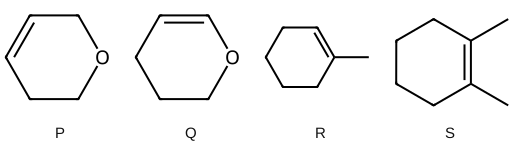
Q441.Following are the four molecules "P", "Q", "R" and "S". Which one among the four molecules will react with
H−Br
(aq) at the fastest rate?
निम्नलिखित चार अणु "P", "Q", "R" तथा "S" हैं। इन चारों में से कौन-सा अणु
H−Br
(aq) से सबसे तीव्र गति से अभिक्रिया करेगा?
- AR
- BP
- CQ
- DS
Show answer
Concept: The rate of HBr addition is decided by the stability of the carbocation formed on protonation; a vinyl ether gives an oxocarbenium ion (C=O+ resonance), which is far more stable than ordinary 3° carbocations.
- Q is an enol (vinyl) ether – the C=C is directly attached to the ring oxygen. Protonation at the β-carbon gives a cation in which the oxygen lone pair delocalises: every atom gets an octet (oxocarbenium) – most stable intermediate, hence fastest reaction.
- P also contains oxygen, but its C=C is not conjugated with O; oxygen then acts only by its electron-withdrawing −I effect and slows the addition.
- R (1-methylcyclohexene) and S (1,2-dimethylcyclohexene) form ordinary 3° alkyl carbocations – stabilised only by hyperconjugation/+I, much less than the oxocarbenium of Q.
Short trick: C=C−O−R (vinyl ether) + H+ → oxocarbenium → fastest Markovnikov addition.
Answer: (C)
अवधारणा: HBr योग की दर प्रोटॉनन से बनने वाले कार्बधनायन के स्थायित्व से तय होती है; वाइनिल ईथर ऑक्सोकार्बेनियम आयन (C=O+ अनुनाद) देता है, जो साधारण 3° कार्बधनायनों से कहीं अधिक स्थायी है।
- Q एक ईनॉल (वाइनिल) ईथर है – C=C सीधे वलय के ऑक्सीजन से जुड़ा है। β-कार्बन पर प्रोटॉनन से ऐसा धनायन बनता है जिसमें ऑक्सीजन का एकाकी युग्म विस्थानीकृत होता है: प्रत्येक परमाणु का अष्टक पूर्ण (ऑक्सोकार्बेनियम) – सर्वाधिक स्थायी मध्यवर्ती, अतः अभिक्रिया सबसे तीव्र।
- P में भी ऑक्सीजन है, परन्तु उसका C=C ऑक्सीजन से संयुग्मित नहीं; तब ऑक्सीजन केवल इलेक्ट्रॉन-आकर्षी −I प्रभाव से योग को धीमा करता है।
- R (1-मेथिलसाइक्लोहेक्सीन) तथा S (1,2-डाइमेथिलसाइक्लोहेक्सीन) साधारण 3° ऐल्किल कार्बधनायन बनाते हैं – केवल अतिसंयुग्मन/+I से स्थायी, जो Q के ऑक्सोकार्बेनियम से बहुत कम है।
शॉर्ट ट्रिक: C=C−O−R (वाइनिल ईथर) + H+ → ऑक्सोकार्बेनियम → सबसे तीव्र मार्कोनिकोव योग।
उत्तर: (C)
JEE Main 2025 (January) – Paper 1 (B.E./B.Tech)ChemistryAlkenes – electrophilic addition of HBrJEE Main 2025 (January) – Paper 1 (B.E./B.Tech) 2025 · 24 Jan Shift 1
Q442.For the given cell The standard cell potential of the above reaction is
Given:
दिए गए सेल के लिए उपर्युक्त अभिक्रिया का मानक सेल विभव है
दिया है:
- A
- B
- C
- D
Show answer
Concept: Electrode potentials are not additive, but ΔG° (= −nFE°) is. Combine half-reactions through their ΔG° values.
- Required anode half-reaction: Fe2+ → Fe3+ + e−. First find .
- Fe3+ + 3e− → Fe: ΔG° = −3Fz. Fe2+ + 2e− → Fe: ΔG° = −2Fy.
- Subtracting: Fe3+ + e− → Fe2+: ΔG° = −3Fz + 2Fy = −F(3z − 2y) ⇒ .
- .
Answer: (C)
अवधारणा: इलेक्ट्रोड विभव योगशील नहीं होते, परन्तु ΔG° (= −nFE°) योगशील है। अर्ध-अभिक्रियाओं को उनके ΔG° से जोड़िए।
- अपेक्षित ऐनोड अर्ध-अभिक्रिया: Fe2+ → Fe3+ + e−। पहले ज्ञात करें।
- Fe3+ + 3e− → Fe: ΔG° = −3Fz। Fe2+ + 2e− → Fe: ΔG° = −2Fy।
- घटाने पर: Fe3+ + e− → Fe2+: ΔG° = −3Fz + 2Fy = −F(3z − 2y) ⇒ ।
- ।
उत्तर: (C)
JEE Main 2025 (January) – Paper 1 (B.E./B.Tech)ChemistryElectrochemistry – combining electrode potentialsJEE Main 2025 (January) – Paper 1 (B.E./B.Tech) 2025 · 24 Jan Shift 1
Q443.The large difference between the melting and boiling points of oxygen and sulphur may be explained on the basis of
ऑक्सीजन तथा सल्फर के गलनांक एवं क्वथनांक में बड़े अन्तर की व्याख्या किस आधार पर की जा सकती है?
- AAtomicityपरमाणुकता (Atomicity)
- BElectron gain enthalpyइलेक्ट्रॉन लब्धि एन्थैल्पी
- CElectronegativityविद्युत् ऋणात्मकता
- DAtomic sizeपरमाणु आकार
Show answer
Concept: Melting/boiling points of molecular solids depend on the size of the molecule and hence on the strength of London dispersion forces.
- Oxygen exists as small diatomic O2 molecules – very weak dispersion forces – gas at room temperature (m.p. ≈ 55 K).
- Sulphur exists as large puckered S8 rings – much stronger dispersion forces – solid (m.p. ≈ 393 K).
- This difference in the number of atoms per molecule, i.e. atomicity (O2 vs S8), explains the large gap.
- Electron gain enthalpy, electronegativity and atomic size differences cannot account for such a huge difference in physical state of the elements.
Answer: (A)
अवधारणा: आण्विक ठोसों के गलनांक/क्वथनांक अणु के आकार और इसलिए लन्दन परिक्षेपण बलों की प्रबलता पर निर्भर करते हैं।
- ऑक्सीजन छोटे द्विपरमाणुक O2 अणुओं के रूप में रहती है – अत्यन्त दुर्बल परिक्षेपण बल – कमरे के ताप पर गैस (गलनांक ≈ 55 K)।
- सल्फर बड़े वलित S8 वलयों के रूप में रहता है – कहीं अधिक प्रबल परिक्षेपण बल – ठोस (गलनांक ≈ 393 K)।
- प्रति अणु परमाणुओं की संख्या का यह अन्तर, अर्थात् परमाणुकता (O2 बनाम S8), इस बड़े अन्तर की व्याख्या करता है।
- इलेक्ट्रॉन लब्धि एन्थैल्पी, विद्युत् ऋणात्मकता या परमाणु आकार के अन्तर से तत्वों की भौतिक अवस्था का इतना बड़ा अन्तर नहीं समझाया जा सकता।
उत्तर: (A)
JEE Main 2025 (January) – Paper 1 (B.E./B.Tech)Chemistryp-block – oxygen vs sulphurJEE Main 2025 (January) – Paper 1 (B.E./B.Tech) 2025 · 24 Jan Shift 1
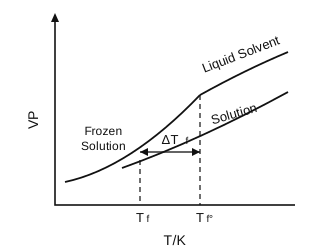
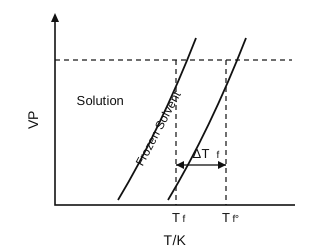
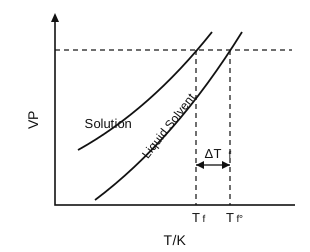
Q444.Consider the given plots of vapour pressure (VP) vs temperature (T/K). Which amongst the following options is correct graphical representation showing ΔTf, depression in the freezing point of a solvent in a solution?
वाष्प दाब (VP) बनाम ताप (T/K) के दिए गए आलेखों पर विचार कीजिए। निम्नलिखित विकल्पों में से कौन-सा, विलयन में विलायक के हिमांक के अवनमन ΔTf को दर्शाने वाला सही आलेखीय निरूपण है?
- A
- B
- C
- D
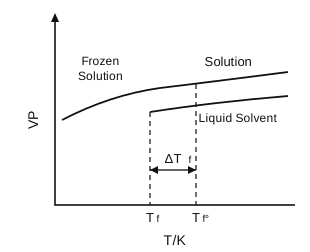
Show answer
Concept: By Raoult's law the vapour pressure of a solution is lower than that of the pure liquid solvent at every temperature. The freezing point is the temperature at which the vapour-pressure curve of the solid (frozen) solvent crosses the liquid/solution curve.
- The solid-phase curve crosses the pure-liquid-solvent curve at Tf° and the (lower) solution curve at Tf, with Tf < Tf°; ΔTf = Tf° − Tf is read along the temperature axis. This is exactly what option (A) shows: solution curve below the liquid-solvent curve and both freezing points located at intersections with the solid curve.
- (B) and (C) wrongly locate Tf and Tf° on a horizontal constant-VP line instead of at intersections with the solid-solvent curve.
- (C) and (D) also draw the solution curve above the solvent curve, which violates Raoult's law for a non-volatile solute.
Answer: (A)
अवधारणा: राउल्ट के नियम से विलयन का वाष्प दाब प्रत्येक ताप पर शुद्ध द्रव विलायक से कम होता है। हिमांक वह ताप है जिस पर ठोस (जमे) विलायक का वाष्प-दाब वक्र द्रव/विलयन वक्र को काटता है।
- ठोस-प्रावस्था वक्र शुद्ध द्रव विलायक वक्र को Tf° पर तथा (नीचे वाले) विलयन वक्र को Tf पर काटता है, जहाँ Tf < Tf°; ΔTf = Tf° − Tf ताप अक्ष पर पढ़ा जाता है। विकल्प (A) ठीक यही दर्शाता है: विलयन वक्र द्रव विलायक वक्र के नीचे तथा दोनों हिमांक ठोस वक्र के प्रतिच्छेदों पर।
- (B) तथा (C) में Tf और Tf° को ठोस-विलायक वक्र के प्रतिच्छेदों के बजाय किसी क्षैतिज स्थिर-VP रेखा पर गलत ढंग से दिखाया गया है।
- (C) तथा (D) में विलयन वक्र विलायक वक्र के ऊपर खींचा गया है, जो अवाष्पशील विलेय के लिए राउल्ट के नियम का उल्लंघन है।
उत्तर: (A)
JEE Main 2025 (January) – Paper 1 (B.E./B.Tech)ChemistrySolutions – depression in freezing pointJEE Main 2025 (January) – Paper 1 (B.E./B.Tech) 2025 · 24 Jan Shift 1
Q445.Which of the following linear combination of atomic orbitals will lead to formation of molecular orbitals in homonuclear diatomic molecules [internuclear axis in z-direction]?
A. 2pz and 2px
B. 2s and 2px
C. 3dxy and 3dx²−y²
D. 2s and 2pz
E. 2pz and 3dx²−y²
Choose the correct answer from the options given below:
समनाभिकीय द्विपरमाणुक अणुओं में [अंतरानाभिकीय अक्ष z-दिशा में] परमाणु कक्षकों का निम्नलिखित में से कौन-सा रैखिक संयोजन आण्विक कक्षकों के निर्माण की ओर ले जाएगा?
A. 2pz तथा 2px
B. 2s तथा 2px
C. 3dxy तथा 3dx²−y²
D. 2s तथा 2pz
E. 2pz तथा 3dx²−y²
नीचे दिए गए विकल्पों में से सही उत्तर चुनिए:
- AA and B Onlyकेवल A और B
- BD Onlyकेवल D
- CE Onlyकेवल E
- DC and D Onlyकेवल C और D
Show answer
Concept: Two atomic orbitals combine into molecular orbitals only if they have the same symmetry about the internuclear (z) axis and give non-zero net overlap: σ-type (s, pz, dz²) mixes with σ-type, π with π, δ with δ.
- A. 2pz (σ) with 2px (π): different symmetry → net overlap cancels → no MO.
- B. 2s (σ) with 2px (π): bonding and antibonding overlaps cancel → no MO.
- C. 3dxy and 3dx²−y²: both δ-type but of mutually orthogonal components (sin 2φ vs cos 2φ) → zero overlap → no MO.
- D. 2s and 2pz: both σ-symmetric about z-axis → non-zero overlap → MOs form. ✓
- E. 2pz (σ) with 3dx²−y² (δ): different symmetry → no MO.
- Hence only D leads to MO formation.
Answer: (B)
अवधारणा: दो परमाणु कक्षक आण्विक कक्षक तभी बनाते हैं जब उनकी अंतरानाभिकीय (z) अक्ष के परितः सममिति समान हो और नेट अतिव्यापन शून्य न हो: σ-प्रकार (s, pz, dz²) σ-प्रकार से, π π से, δ δ से मिलते हैं।
- A. 2pz (σ) और 2px (π): भिन्न सममिति → नेट अतिव्यापन निरस्त → MO नहीं।
- B. 2s (σ) और 2px (π): बन्धक व प्रतिबन्धक अतिव्यापन निरस्त → MO नहीं।
- C. 3dxy और 3dx²−y²: दोनों δ-प्रकार, परन्तु परस्पर लम्बकोणीय घटक (sin 2φ बनाम cos 2φ) → शून्य अतिव्यापन → MO नहीं।
- D. 2s और 2pz: दोनों z-अक्ष के परितः σ-सममित → अशून्य अतिव्यापन → MO बनते हैं। ✓
- E. 2pz (σ) और 3dx²−y² (δ): भिन्न सममिति → MO नहीं।
- अतः केवल D से MO बनते हैं।
उत्तर: (B)
JEE Main 2025 (January) – Paper 1 (B.E./B.Tech)ChemistryMolecular orbital theory – LCAOJEE Main 2025 (January) – Paper 1 (B.E./B.Tech) 2025 · 24 Jan Shift 1
Q446.Xg of benzoic acid on reaction with aq NaHCO3 released CO2 that occupied 11.2 L volume at STP. X is _____ g.
X ग्राम बेन्ज़ोइक अम्ल, जलीय NaHCO3 से अभिक्रिया करने पर इतनी CO2 मुक्त करता है जो STP पर 11.2 L आयतन घेरती है। X का मान _____ ग्राम है।
Show answer
Concept: C6H5COOH + NaHCO3 → C6H5COONa + H2O + CO2; 1 mol acid releases 1 mol CO2; at STP 1 mol gas = 22.4 L.
- Moles of CO2 = 11.2 L ÷ 22.4 L mol−1 = 0.5 mol.
- 1 : 1 stoichiometry ⇒ moles of benzoic acid = 0.5 mol.
- Molar mass of C6H5COOH = 7(12) + 6(1) + 2(16) = 122 g mol−1.
- X = 0.5 × 122 = 61 g.
Answer: 61
अवधारणा: C6H5COOH + NaHCO3 → C6H5COONa + H2O + CO2; 1 मोल अम्ल 1 मोल CO2 मुक्त करता है; STP पर 1 मोल गैस = 22.4 L।
- CO2 के मोल = 11.2 L ÷ 22.4 L mol−1 = 0.5 मोल।
- 1 : 1 रससमीकरणमिति ⇒ बेन्ज़ोइक अम्ल के मोल = 0.5 मोल।
- C6H5COOH का मोलर द्रव्यमान = 7(12) + 6(1) + 2(16) = 122 g mol−1।
- X = 0.5 × 122 = 61 ग्राम।
उत्तर: 61
JEE Main 2025 (January) – Paper 1 (B.E./B.Tech)ChemistryStoichiometry – mole conceptJEE Main 2025 (January) – Paper 1 (B.E./B.Tech) 2025 · 24 Jan Shift 1
Q447.Consider the following reaction occurring in the blast furnace: 'x' kg of iron is produced when kg Fe3O4 and kg CO are brought together in the furnace. The value of 'x' is _____. (nearest integer) Given: molar mass of Fe3O4 = 232 g mol−1, molar mass of CO = 28 g mol−1, molar mass of Fe = 56 g mol−1
वात्या भट्ठी (blast furnace) में होने वाली निम्न अभिक्रिया पर विचार कीजिए: भट्ठी में kg Fe3O4 तथा kg CO को एक साथ लाने पर 'x' kg लोहा उत्पन्न होता है। 'x' का मान _____ है। (निकटतम पूर्णांक) दिया है: Fe3O4 का मोलर द्रव्यमान = 232 g mol−1, CO का मोलर द्रव्यमान = 28 g mol−1, Fe का मोलर द्रव्यमान = 56 g mol−1
Show answer
Concept: Identify the limiting reagent, then use mole ratios.
- Moles of Fe3O4 = mol; moles of CO = mol.
- Each mole of Fe3O4 needs 4 mol CO, so mol CO can reduce only mol Fe3O4 ⇒ CO is the limiting reagent.
- Moles of Fe formed = mol.
- Mass of Fe = g = 420 kg.
Answer: 420
अवधारणा: सीमान्त अभिकर्मक पहचानिए, फिर मोल अनुपात का प्रयोग कीजिए।
- Fe3O4 के मोल = मोल; CO के मोल = मोल।
- प्रत्येक मोल Fe3O4 को 4 मोल CO चाहिए, अतः मोल CO केवल मोल Fe3O4 को अपचयित कर सकती है ⇒ CO सीमान्त अभिकर्मक है।
- बने Fe के मोल = मोल।
- Fe का द्रव्यमान = g = 420 kg।
उत्तर: 420
JEE Main 2025 (January) – Paper 1 (B.E./B.Tech)ChemistryStoichiometry – limiting reagentJEE Main 2025 (January) – Paper 1 (B.E./B.Tech) 2025 · 24 Jan Shift 1
Q448.37.8 g N2O5 was taken in a 1 L reaction vessel and allowed to undergo the following reaction at 500 K: The total pressure at equilibrium was found to be 18.65 bar. Then, Kp = ______ [nearest integer] Assume N2O5 to behave ideally under these conditions. Given: R = 0.082 bar L mol−1 K−1
एक 1 L अभिक्रिया पात्र में 37.8 g N2O5 लेकर 500 K पर निम्न अभिक्रिया होने दी गई: साम्य पर कुल दाब 18.65 bar पाया गया। तब Kp = ______ [निकटतम पूर्णांक] मानिए कि इन परिस्थितियों में N2O5 आदर्श व्यवहार करता है। दिया है: R = 0.082 bar L mol−1 K−1
Show answer
Concept: Find the initial pressure from PV = nRT, use the pressure change to get equilibrium partial pressures, then Kp .
- Moles of N2O5 = 37.8 ÷ 108 = 0.35 mol; initial pressure bar.
- Let O2 formed have pressure : N2O5 = , N2O4 = , O2 = ; total = ⇒ bar.
- So bar, bar, bar.
- Kp bar .
Answer: 962
अवधारणा: PV = nRT से प्रारम्भिक दाब निकालिए, दाब परिवर्तन से साम्य आंशिक दाब ज्ञात कीजिए, फिर Kp ।
- N2O5 के मोल = 37.8 ÷ 108 = 0.35 मोल; प्रारम्भिक दाब bar।
- माना बनी O2 का दाब है: N2O5 = , N2O4 = , O2 = ; कुल = ⇒ bar।
- अतः bar, bar, bar।
- Kp bar ।
उत्तर: 962
JEE Main 2025 (January) – Paper 1 (B.E./B.Tech)ChemistryChemical equilibrium – KpJEE Main 2025 (January) – Paper 1 (B.E./B.Tech) 2025 · 24 Jan Shift 1
Q449.Among the following cations, the number of cations which will give characteristic precipitate in their identification tests with K4[Fe(CN)6] is _____.
Cu2+, Fe3+, Ba2+, Ca2+, NH4+, Mg2+, Zn2+
निम्नलिखित धनायनों में से उन धनायनों की संख्या _____ है जो अपने अभिज्ञान परीक्षणों में K4[Fe(CN)6] के साथ अभिलाक्षणिक अवक्षेप देते हैं।
Cu2+, Fe3+, Ba2+, Ca2+, NH4+, Mg2+, Zn2+
Show answer
Concept: In qualitative salt analysis, potassium ferrocyanide gives characteristic coloured precipitates with Cu2+, Fe3+ and Zn2+.
- Cu2+: chocolate-brown precipitate of Cu2[Fe(CN)6] – confirmatory test for copper.
- Fe3+: Prussian-blue precipitate of Fe4[Fe(CN)6]3 – confirmatory test for ferric ion.
- Zn2+: white (bluish-white) precipitate of Zn2[Fe(CN)6] – confirmatory test for zinc.
- Ba2+ and Ca2+ are identified by flame test/(NH4)2CO3–oxalate tests, NH4+ by Nessler's reagent and Mg2+ by Na2HPO4 – none of these uses K4[Fe(CN)6].
- Hence 3 cations.
Answer: 3
अवधारणा: गुणात्मक लवण विश्लेषण में पोटैशियम फेरोसायनाइड Cu2+, Fe3+ तथा Zn2+ के साथ अभिलाक्षणिक रंगीन अवक्षेप देता है।
- Cu2+: Cu2[Fe(CN)6] का चॉकलेटी-भूरा अवक्षेप – ताँबे का पुष्टिकारक परीक्षण।
- Fe3+: Fe4[Fe(CN)6]3 का प्रशियन-नीला अवक्षेप – फेरिक आयन का पुष्टिकारक परीक्षण।
- Zn2+: Zn2[Fe(CN)6] का श्वेत (नीलाभ-श्वेत) अवक्षेप – जिंक का पुष्टिकारक परीक्षण।
- Ba2+ तथा Ca2+ की पहचान ज्वाला परीक्षण/(NH4)2CO3–ऑक्सैलेट परीक्षणों से, NH4+ की नेस्लर अभिकर्मक से तथा Mg2+ की Na2HPO4 से होती है – इनमें K4[Fe(CN)6] प्रयुक्त नहीं होता।
- अतः 3 धनायन।
उत्तर: 3
JEE Main 2025 (January) – Paper 1 (B.E./B.Tech)ChemistryQualitative analysis – tests of cationsJEE Main 2025 (January) – Paper 1 (B.E./B.Tech) 2025 · 24 Jan Shift 1
Q450.Standard entropies of X2, Y2 and XY5 are 70, 50 and 110 J K−1 mol−1 respectively. The temperature in Kelvin at which the reaction , will be at equilibrium is _______. (Nearest integer)
X2, Y2 तथा XY5 की मानक एन्ट्रॉपियाँ क्रमशः 70, 50 तथा 110 J K−1 mol−1 हैं। वह ताप (केल्विन में) _______ है जिस पर अभिक्रिया , साम्य में होगी। (निकटतम पूर्णांक)
Show answer
Concept: At equilibrium ΔG° = 0, so T = ΔH°/ΔS°.
- .
- .
Answer: 700
अवधारणा: साम्य पर ΔG° = 0, अतः T = ΔH°/ΔS°।
- ।
- ।
उत्तर: 700
JEE Main 2025 (January) – Paper 1 (B.E./B.Tech)ChemistryThermodynamics – equilibrium temperatureJEE Main 2025 (January) – Paper 1 (B.E./B.Tech) 2025 · 24 Jan Shift 1
Q451.The distance of the line from the point along the line is :
बिंदु से, रेखा के अनुदिश, रेखा की दूरी है :
- A
- B
- C
- D
Show answer
Concept: Walk from the point along the given direction and find where this ray meets the given line; the distance travelled is the required distance.
- Points along the direction from : .
- Substituting in : . Every ratio vanishes at , so the ray meets the line at .
- Distance .
Short trick: Each numerator is a multiple of , so can be spotted at sight — no equations to solve.
Answer: (C)
अवधारणा: बिंदु से दी गई दिशा के अनुदिश चलकर देखें कि यह किरण दी गई रेखा से कहाँ मिलती है; तय की गई दूरी ही अभीष्ट दूरी है।
- से दिशा के अनुदिश बिंदु: ।
- में रखने पर: । पर प्रत्येक अनुपात शून्य हो जाता है, अतः किरण रेखा से पर मिलती है।
- दूरी ।
शॉर्ट ट्रिक: प्रत्येक अंश का गुणज है, अतः देखते ही मिल जाता है — कोई समीकरण हल करने की आवश्यकता नहीं।
उत्तर: (C)
JEE Main 2025 (January) – Paper 1 (B.E./B.Tech)Mathematics3D Geometry – distance along a given lineJEE Main 2025 (January) – Paper 1 (B.E./B.Tech) 2025 · 23 Jan Shift 2
Q452.Let and . If or , then is :
माना तथा हैं। यदि या है, तो है :
- A15
- B24
- C18
- D12
Show answer
Concept: On the coordinate axes both inequalities become conditions on a single variable, which pin the points down exactly.
- For : gives and gives , so , i.e. .
- For : similarly , i.e. .
- and each point gives .
- .
Short trick: and with force , so only the 4 axis vertices of the square survive.
Answer: (D) 12
अवधारणा: निर्देशांक अक्षों पर दोनों असमिकाएँ एक ही चर की शर्तें बन जाती हैं, जिनसे बिंदु पूर्णतः निर्धारित हो जाते हैं।
- के लिए: से तथा से , अतः अर्थात् ।
- के लिए: इसी प्रकार अर्थात् ।
- तथा प्रत्येक बिंदु पर ।
- ।
शॉर्ट ट्रिक: , तथा से बाध्य है, अतः वर्ग के केवल 4 अक्षीय शीर्ष ही बचते हैं।
उत्तर: (D) 12
JEE Main 2025 (January) – Paper 1 (B.E./B.Tech)MathematicsSets – intersection of regions in the planeJEE Main 2025 (January) – Paper 1 (B.E./B.Tech) 2025 · 23 Jan Shift 2
Q453.Let . Define a relation on as : . Statement I : is an equivalence relation. Statement II : For some , the set represents a line parallel to . In the light of the above statements, choose the correct answer from the options given below :
माना है। पर एक संबंध इस प्रकार परिभाषित कीजिए : । कथन I : एक तुल्यता संबंध (equivalence relation) है। कथन II : किसी के लिए, समुच्चय , रेखा के समांतर एक रेखा को निरूपित करता है। उपर्युक्त कथनों के आलोक में, नीचे दिए गए विकल्पों में से सही उत्तर चुनिए :
- ABoth Statement I and Statement II are falseकथन I तथा कथन II दोनों असत्य हैं
- BStatement I is true but Statement II is falseकथन I सत्य है परन्तु कथन II असत्य है
- CBoth Statement I and Statement II are trueकथन I तथा कथन II दोनों सत्य हैं
- DStatement I is false but Statement II is trueकथन I असत्य है परन्तु कथन II सत्य है
Show answer
Concept: Test reflexive, symmetric and transitive; then identify the equivalence class geometrically.
- Reflexive: . Symmetric: . Transitive: . So is an equivalence relation — Statement I is true.
- is the horizontal line , parallel to the -axis for every — never parallel to (slope 1). Statement II is false.
- So (B) is correct; (A) and (D) wrongly reject Statement I, and (C) wrongly accepts Statement II.
Short trick: A relation defined by equality of any function of the coordinates () is automatically an equivalence relation.
Answer: (B)
अवधारणा: स्वतुल्य, सममित तथा संक्रामक की जाँच कीजिए; फिर तुल्यता वर्ग की ज्यामितीय पहचान कीजिए।
- स्वतुल्य: । सममित: । संक्रामक: । अतः तुल्यता संबंध है — कथन I सत्य है।
- क्षैतिज रेखा है, जो प्रत्येक के लिए -अक्ष के समांतर है — यह कभी भी (ढाल 1) के समांतर नहीं है। कथन II असत्य है।
- अतः (B) सही है; (A) तथा (D) कथन I को गलत ठहराते हैं और (C) कथन II को गलत रूप से स्वीकार करता है।
शॉर्ट ट्रिक: निर्देशांकों के किसी फलन की समानता () से परिभाषित संबंध स्वतः तुल्यता संबंध होता है।
उत्तर: (B)
JEE Main 2025 (January) – Paper 1 (B.E./B.Tech)MathematicsRelations – equivalence relationJEE Main 2025 (January) – Paper 1 (B.E./B.Tech) 2025 · 23 Jan Shift 2
Q454.Let , where is the constant of integration. If , then equals :
माना है, जहाँ समाकलन अचर है। यदि है, तो बराबर है :
- A48
- B55
- C62
- D47
Show answer
Concept: Repeated integration by parts; and since is an antiderivative, is just the integrand.
- (by parts thrice).
- .
- .
- , so .
- .
Short trick: Never differentiate the big expression — by the definition of an antiderivative.
Answer: (B) 55
अवधारणा: बार-बार खंडशः समाकलन; तथा चूँकि प्रतिअवकलज है, स्वयं समाकल्य ही है।
- (तीन बार खंडशः समाकलन से)।
- ।
- ।
- , अतः ।
- ।
शॉर्ट ट्रिक: बड़े व्यंजक का अवकलन कभी न करें — प्रतिअवकलज की परिभाषा से ही ।
उत्तर: (B) 55
JEE Main 2025 (January) – Paper 1 (B.E./B.Tech)MathematicsIndefinite Integration – integration by partsJEE Main 2025 (January) – Paper 1 (B.E./B.Tech) 2025 · 23 Jan Shift 2
Q455.A rod of length eight units moves such that its ends and always lie on the lines and , respectively. If the locus of the point , that divides the rod internally in the ratio is , then is equal to :
आठ इकाई लंबाई की एक छड़ इस प्रकार गति करती है कि इसके सिरे तथा सदैव क्रमशः रेखाओं तथा पर स्थित रहते हैं। यदि छड़ को के अनुपात में आंतरिक रूप से विभाजित करने वाले बिंदु का बिन्दुपथ है, तो बराबर है :
- A22
- B21
- C23
- D24
Show answer
Concept: Parametrise the two ends, use the section formula, and eliminate the parameters with the length condition.
- on and on .
- divides in ratio : , so and .
- Length: . Substituting, , i.e. .
- This is , so .
- .
Short trick: The printed coefficient checks your section-formula direction: must appear — it does.
Answer: (C) 23
अवधारणा: दोनों सिरों को प्राचलिक रूप में लिखिए, विभाजन सूत्र लगाइए और लंबाई की शर्त से प्राचलों का विलोपन कीजिए।
- पर तथा पर ।
- , को में विभाजित करता है: , अतः तथा ।
- लंबाई: । प्रतिस्थापन से , अर्थात् ।
- यह है, अतः ।
- ।
शॉर्ट ट्रिक: छपा गुणांक आपके विभाजन सूत्र की दिशा की जाँच कर देता है: आना चाहिए — और आता है।
उत्तर: (C) 23
JEE Main 2025 (January) – Paper 1 (B.E./B.Tech)MathematicsStraight Lines – locus of a dividing pointJEE Main 2025 (January) – Paper 1 (B.E./B.Tech) 2025 · 23 Jan Shift 2
Q456.If the square of the shortest distance between the lines and is , where are coprime numbers, then is equal to :
यदि रेखाओं तथा के बीच की न्यूनतम दूरी का वर्ग है, जहाँ असहभाज्य (coprime) संख्याएँ हैं, तो बराबर है :
- A21
- B9
- C14
- D6
Show answer
Concept: Shortest distance .
- ; .
- .
- SD , so SD.
- are coprime, .
Short trick: The direction vectors have proportional first two components, so the cross product lies in the -plane — the -part of never matters.
Answer: (B) 9
अवधारणा: न्यूनतम दूरी ।
- ; ।
- ।
- न्यूनतम दूरी , अतः दूरी का वर्ग ।
- असहभाज्य हैं, ।
शॉर्ट ट्रिक: दिक्-सदिशों के पहले दो घटक समानुपाती हैं, अतः सदिश गुणनफल -तल में है — का -भाग कभी प्रभाव नहीं डालता।
उत्तर: (B) 9
JEE Main 2025 (January) – Paper 1 (B.E./B.Tech)Mathematics3D Geometry – shortest distance between skew linesJEE Main 2025 (January) – Paper 1 (B.E./B.Tech) 2025 · 23 Jan Shift 2
Q457. is equal to :
बराबर है :
- A
- B
- C
- D
Show answer
Concept: Split into a rational part (ratio of leading coefficients) and a part handled by .
- as .
- .
- Exponent limit: , so this factor .
- Limit .
Short trick: ; here gives instantly.
Answer: (C)
अवधारणा: परिमेय भाग (अग्रणी गुणांकों का अनुपात) तथा भाग, जिसे से हल करते हैं, में बाँटिए।
- पर ।
- ।
- घातांक की सीमा: , अतः यह गुणनखंड ।
- सीमा ।
शॉर्ट ट्रिक: ; यहाँ से तुरंत ।
उत्तर: (C)
JEE Main 2025 (January) – Paper 1 (B.E./B.Tech)MathematicsLimits – <math display="inline" xmlns="http://www.w3.org/1998/Math/MathML"><msup><mn>1</mn><mrow data-mjx-texclass="ORD"><mi mathvariant="normal">∞</mi></mrow></msup></math> formJEE Main 2025 (January) – Paper 1 (B.E./B.Tech) 2025 · 23 Jan Shift 2
Q458.Let the point A divide the line segment joining the points and internally in the ratio . If is the origin and , then the value of is :
माना बिंदु , बिंदुओं तथा को मिलाने वाले रेखाखंड को के अनुपात में आंतरिक रूप से विभाजित करता है। यदि मूलबिंदु है तथा है, तो का मान है :
- A
- B14
- C3
- D7
Show answer
Concept: Section formula for , then direct computation of the dot and cross products.
- .
- .
- With and : , and , so .
- Equation: . Multiplying by and simplifying: , so (as ).
Short trick: makes the cross product's third component vanish and the first two equal in size — halving the algebra.
Answer: (D) 7
अवधारणा: के लिए विभाजन सूत्र, फिर अदिश एवं सदिश गुणनफलों की सीधी गणना।
- ।
- ।
- तथा से: , तथा , अतः ।
- समीकरण: । से गुणा कर सरल करने पर: , अतः (क्योंकि )।
शॉर्ट ट्रिक: होने से सदिश गुणनफल का तीसरा घटक शून्य तथा पहले दो परिमाण में बराबर हो जाते हैं — बीजगणित आधा हो जाता है।
उत्तर: (D) 7
JEE Main 2025 (January) – Paper 1 (B.E./B.Tech)MathematicsVector Algebra – section formula, dot and cross productJEE Main 2025 (January) – Paper 1 (B.E./B.Tech) 2025 · 23 Jan Shift 2
Q459.The length of the chord of the ellipse , whose mid-point is , is :
दीर्घवृत्त की उस जीवा की लंबाई, जिसका मध्य-बिंदु है, है :
- A
- B
- C
- D
Show answer
Concept: Chord with mid-point : ; then intersect with the ellipse.
- : , i.e. , so the chord is .
- Substitute in the ellipse: , so .
- ; slope gives length .
Short trick: For a chord of slope : length ; with just multiply by .
Answer: (C)
अवधारणा: मध्य-बिंदु वाली जीवा: ; फिर दीर्घवृत्त के साथ प्रतिच्छेद कीजिए।
- : , अर्थात् , अतः जीवा है।
- दीर्घवृत्त में रखने पर: , अतः ।
- ; ढाल से लंबाई ।
शॉर्ट ट्रिक: ढाल वाली जीवा के लिए: लंबाई ; पर केवल से गुणा कीजिए।
उत्तर: (C)
JEE Main 2025 (January) – Paper 1 (B.E./B.Tech)MathematicsEllipse – chord with a given mid-pointJEE Main 2025 (January) – Paper 1 (B.E./B.Tech) 2025 · 23 Jan Shift 2
Q460.The system of equations , , , has no solution if :
समीकरण निकाय , , का कोई हल नहीं है, यदि :
- A
- B
- C
- D
Show answer
Concept: No solution coefficient determinant together with an inconsistent reduced equation.
- , so gives .
- With : ; .
- . For no solution we need .
- So ; option (D) would give infinitely many solutions, (A) and (B) keep (unique solution).
Short trick: Row-reduce once — the single condition falls out with simultaneously.
Answer: (C)
अवधारणा: कोई हल नहीं गुणांक सारणिक तथा समानीत समीकरण असंगत।
- , अतः से ।
- के साथ: ; ।
- । कोई हल न होने के लिए चाहिए।
- अतः ; विकल्प (D) से अनंत हल मिलते, (A) तथा (B) में रहता (अद्वितीय हल)।
शॉर्ट ट्रिक: एक बार पंक्ति-समानयन कीजिए — के साथ ही एकमात्र शर्त निकल आती है।
उत्तर: (C)
JEE Main 2025 (January) – Paper 1 (B.E./B.Tech)MathematicsDeterminants – consistency of a linear systemJEE Main 2025 (January) – Paper 1 (B.E./B.Tech) 2025 · 23 Jan Shift 2

