Q481.Water of mass gram is slowly heated to increase the temperature from to . The change in entropy of the water, given specific heat of water is , is :
ग्राम द्रव्यमान के जल को धीरे-धीरे गर्म करके उसका ताप से किया जाता है। जल की एन्ट्रॉपी (entropy) में परिवर्तन, जबकि जल की विशिष्ट ऊष्मा है, होगा :
- A
- Bzeroशून्य
- C
- D
Show answer
Concept: For reversible (slow) heating, .
- .
- With the given specific heat (in the stated units), .
- Entropy increases on heating (), so (B) and (C) are ruled out; (D) would follow only if , which ignores division by .
Short trick: Slow heating at variable always gives the logarithmic form .
Answer: (A)
अवधारणा: उत्क्रमणीय (धीमे) तापन के लिए ।
- ।
- दी गई विशिष्ट ऊष्मा (दिए गए मात्रकों में) रखने पर ।
- गर्म करने पर एन्ट्रॉपी बढ़ती है (), अतः (B) तथा (C) असंभव हैं; (D) तभी आता जब होता, जिसमें से भाग छूट गया है।
शॉर्ट ट्रिक: परिवर्ती ताप पर धीमे तापन में सदैव लघुगणकीय रूप आता है।
उत्तर: (A)
JEE Main 2025 (January) – Paper 1 (B.E./B.Tech)PhysicsThermodynamics – entropy changeJEE Main 2025 (January) – Paper 1 (B.E./B.Tech) 2025 · 23 Jan Shift 2
Q482.Water flows in a horizontal pipe whose one end is closed with a valve. The reading of the pressure gauge attached to the pipe is . The reading of the pressure gauge falls to when the valve is opened. The speed of water flowing in the pipe is proportional to
एक क्षैतिज पाइप, जिसका एक सिरा वाल्व से बंद है, में जल बहता है। पाइप से जुड़े दाबमापी (pressure gauge) का पाठ्यांक है। वाल्व खोलने पर दाबमापी का पाठ्यांक गिरकर हो जाता है। पाइप में बहते जल की चाल अनुक्रमानुपाती है
- A
- B
- C
- D
Show answer
Concept: Bernoulli's equation for a horizontal pipe: .
- Valve closed: water at rest, gauge reads static pressure .
- Valve open: .
- .
Short trick: Pressure drop converts to kinetic energy: .
Answer: (D)
अवधारणा: क्षैतिज पाइप के लिए बरनूली समीकरण: ।
- वाल्व बंद: जल स्थिर है, दाबमापी स्थैतिक दाब दर्शाता है।
- वाल्व खुला: ।
- ।
शॉर्ट ट्रिक: दाब में कमी गतिज ऊर्जा में बदलती है: ।
उत्तर: (D)
JEE Main 2025 (January) – Paper 1 (B.E./B.Tech)PhysicsFluid Mechanics – Bernoulli's principleJEE Main 2025 (January) – Paper 1 (B.E./B.Tech) 2025 · 23 Jan Shift 2
Q483.A concave mirror of focal length in air is dipped in a liquid of refractive index . Its focal length in the liquid will be:
वायु में फोकस दूरी वाले एक अवतल दर्पण को अपवर्तनांक के द्रव में डुबोया जाता है। द्रव में इसकी फोकस दूरी होगी:
- A
- B
- C
- D
Show answer
Concept: A mirror works by reflection, and the law of reflection does not depend on the surrounding medium.
- For a mirror, , which involves only the geometry (radius of curvature ).
- Dipping in a liquid changes neither nor the law of reflection, so is unchanged.
- Options (A), (C), (D) would apply to lenses (refraction), not to mirrors.
Short trick: Mirror formulae never contain — focal length of a mirror is medium-independent.
Answer: (B)
अवधारणा: दर्पण परावर्तन से कार्य करता है, और परावर्तन का नियम माध्यम पर निर्भर नहीं करता।
- दर्पण के लिए , जो केवल ज्यामिति (वक्रता त्रिज्या ) पर निर्भर है।
- द्रव में डुबोने से न बदलता है न परावर्तन का नियम, अतः अपरिवर्तित रहती है।
- विकल्प (A), (C), (D) लेंस (अपवर्तन) पर लागू होते, दर्पण पर नहीं।
शॉर्ट ट्रिक: दर्पण के सूत्रों में कभी नहीं आता — दर्पण की फोकस दूरी माध्यम से स्वतंत्र होती है।
उत्तर: (B)
JEE Main 2025 (January) – Paper 1 (B.E./B.Tech)PhysicsRay Optics – mirrorsJEE Main 2025 (January) – Paper 1 (B.E./B.Tech) 2025 · 23 Jan Shift 2
Q484.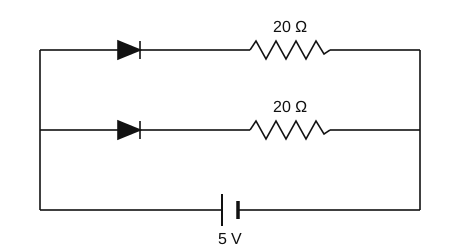
What is the current through the battery in the circuit shown below
नीचे दर्शाए गए परिपथ में बैटरी से प्रवाहित धारा क्या है
- A1.5 A
- B0.5 A
- C0.25 A
- D1.0 A
Show answer
Concept: An ideal diode conducts (zero resistance) when forward biased and blocks when reverse biased.
- Both diodes point in the direction of conventional current driven by the 5 V battery, so both are forward biased and act as plain wires.
- The two resistors are then in parallel: .
- .
Short trick: Both branches conduct → two equal resistors in parallel halve the resistance.
Answer: (B)
अवधारणा: आदर्श डायोड अग्र अभिनत (forward biased) होने पर चालन करता है (शून्य प्रतिरोध) तथा पश्च अभिनत होने पर धारा रोकता है।
- दोनों डायोड 5 V बैटरी द्वारा चलाई गई पारंपरिक धारा की दिशा में हैं, अतः दोनों अग्र अभिनत हैं और सीधे तार की तरह व्यवहार करते हैं।
- तब दोनों प्रतिरोध समान्तर क्रम में हैं: ।
- ।
शॉर्ट ट्रिक: दोनों शाखाएँ चालन करती हैं → दो समान प्रतिरोध समान्तर में प्रतिरोध आधा कर देते हैं।
उत्तर: (B)
JEE Main 2025 (January) – Paper 1 (B.E./B.Tech)PhysicsSemiconductors – diode circuitsJEE Main 2025 (January) – Paper 1 (B.E./B.Tech) 2025 · 23 Jan Shift 2
Q485.The refractive index of the material of a glass prism is . The angle of minimum deviation is equal to the angle of the prism. What is the angle of the prism?
एक काँच के प्रिज़्म के पदार्थ का अपवर्तनांक है। न्यूनतम विचलन कोण, प्रिज़्म कोण के बराबर है। प्रिज़्म का कोण क्या है?
- A
- B
- C
- D
Show answer
Concept: Prism formula: .
- Given : .
- .
- .
Short trick: When , ; (a standard result).
Answer: (A)
अवधारणा: प्रिज़्म सूत्र: ।
- दिया है : ।
- ।
- ।
शॉर्ट ट्रिक: जब हो तो ; (मानक परिणाम)।
उत्तर: (A)
JEE Main 2025 (January) – Paper 1 (B.E./B.Tech)PhysicsRay Optics – prismJEE Main 2025 (January) – Paper 1 (B.E./B.Tech) 2025 · 23 Jan Shift 2
Q486.The width of one of the two slits in Young's double slit experiment is d while that of the other slit is d. If the ratio of the maximum to the minimum intensity in the interference pattern on the screen is 9 : 4 then what is the value of ? (Assume that the field strength varies according to the slit width.)
यंग के द्विझिरी प्रयोग में एक झिरी की चौड़ाई d है जबकि दूसरी झिरी की चौड़ाई d है। यदि पर्दे पर व्यतिकरण प्रतिरूप में अधिकतम व न्यूनतम तीव्रताओं का अनुपात 9 : 4 है, तो का मान क्या है? (मान लीजिए कि क्षेत्र की तीव्रता झिरी की चौड़ाई के अनुसार बदलती है।)
- A4
- B5
- C3
- D2
Show answer
Concept: If the amplitudes from the slits are and , then .
- Field strength slit width, so , i.e. .
- .
- .
Short trick: → componendo–dividendo gives .
Answer: (B)
अवधारणा: यदि झिरियों से आयाम तथा हों, तो ।
- क्षेत्र की तीव्रता झिरी की चौड़ाई, अतः , अर्थात् ।
- ।
- ।
शॉर्ट ट्रिक: → योगान्तरानुपात से ।
उत्तर: (B)
JEE Main 2025 (January) – Paper 1 (B.E./B.Tech)PhysicsWave Optics – Young's double slit experimentJEE Main 2025 (January) – Paper 1 (B.E./B.Tech) 2025 · 23 Jan Shift 2
Q487.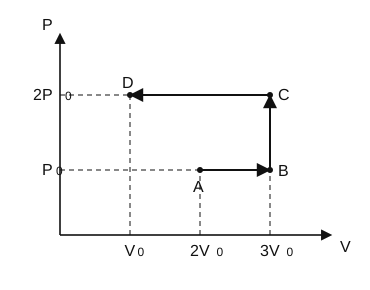
Using the given
diagram, the work done by an ideal gas along the path ABCD is :
दिए गए
आरेख के अनुसार, पथ ABCD के अनुदिश आदर्श गैस द्वारा किया गया कार्य है :
- A
- B
- C
- D
Show answer
Concept: Work done by the gas — positive during expansion, negative during compression, zero at constant volume.
- : .
- : constant volume, .
- : .
- .
Short trick: Only horizontal segments do work: (right) and (left) → .
Answer: (C)
अवधारणा: गैस द्वारा किया गया कार्य — प्रसार में धनात्मक, संपीडन में ऋणात्मक, नियत आयतन पर शून्य।
- : ।
- : नियत आयतन, ।
- : ।
- ।
शॉर्ट ट्रिक: केवल क्षैतिज खंड ही कार्य करते हैं: (दाएँ) तथा (बाएँ) → ।
उत्तर: (C)
JEE Main 2025 (January) – Paper 1 (B.E./B.Tech)PhysicsThermodynamics – work done in P–V diagramJEE Main 2025 (January) – Paper 1 (B.E./B.Tech) 2025 · 23 Jan Shift 2
Q488.A plane electromagnetic wave of frequency 20 MHz travels in free space along the direction. At a particular point in space and time, the electric field vector of the wave is . Then, the magnetic field vector of the wave at that point is
20 MHz आवृत्ति की एक समतल विद्युत चुम्बकीय तरंग मुक्त आकाश में दिशा में चलती है। आकाश व समय के किसी विशेष बिंदु पर तरंग का विद्युत क्षेत्र सदिश है। तब उस बिंदु पर तरंग का चुम्बकीय क्षेत्र सदिश है
- A
- B
- C
- D
Show answer
Concept: In an EM wave in free space, , and points along the propagation direction.
- .
- Wave along , along → must be along so that .
Short trick: — just divide by ; direction from .
Answer: (B)
अवधारणा: मुक्त आकाश में विद्युत चुम्बकीय तरंग के लिए , तथा संचरण की दिशा में होता है।
- ।
- तरंग में, में → दिशा में होगा ताकि हो।
शॉर्ट ट्रिक: — केवल को से भाग दीजिए; दिशा से।
उत्तर: (B)
JEE Main 2025 (January) – Paper 1 (B.E./B.Tech)PhysicsElectromagnetic WavesJEE Main 2025 (January) – Paper 1 (B.E./B.Tech) 2025 · 23 Jan Shift 2
Q489.The equation of a transverse wave travelling along a string is mm, where is in mm and is in second. The velocity of the wave is :
एक डोरी के अनुदिश चलती अनुप्रस्थ तरंग का समीकरण mm है, जहाँ mm में तथा सेकंड में है। तरंग का वेग है :
- A m/s
- B m/s
- C m/s
- D m/s
Show answer
Concept: For the wave moves along with speed .
- , .
- .
- Since the phase is , the wave travels in the direction: m/s.
Short trick: Same sign of and → negative direction; .
Answer: (B)
अवधारणा: के लिए तरंग दिशा में चाल से चलती है।
- , ।
- ।
- कला होने से तरंग दिशा में चलती है: m/s।
शॉर्ट ट्रिक: तथा का समान चिह्न → ऋणात्मक दिशा; ।
उत्तर: (B)
JEE Main 2025 (January) – Paper 1 (B.E./B.Tech)PhysicsWaves – travelling wave on a stringJEE Main 2025 (January) – Paper 1 (B.E./B.Tech) 2025 · 23 Jan Shift 2
Q490.Given below are two statements. One is labelled as Assertion (A) and the other is labelled as Reason (R).
Assertion (A) : The binding energy per nucleon is found to be practically independent of the atomic number A, for nuclei with mass numbers between 30 and 170.
Reason (R): Nuclear force is long range.
In the light of the above statements, choose the correct answer from the options given below :
नीचे दो कथन दिए गए हैं। एक को अभिकथन (A) तथा दूसरे को कारण (R) कहा गया है।
अभिकथन (A) : 30 से 170 के बीच द्रव्यमान संख्या वाले नाभिकों के लिए प्रति न्यूक्लिऑन बंधन ऊर्जा व्यावहारिक रूप से परमाणु संख्या A से स्वतंत्र पाई जाती है।
कारण (R): नाभिकीय बल दीर्घ परास (long range) का होता है।
उपर्युक्त कथनों के आलोक में, नीचे दिए गए विकल्पों में से सही उत्तर चुनिए :
- A(A) is true but (R) is false(A) सत्य है परन्तु (R) असत्य है
- B(A) is false but (R) is true(A) असत्य है परन्तु (R) सत्य है
- CBoth (A) and (R) are true and (R) is the correct explanation of (A)(A) तथा (R) दोनों सत्य हैं तथा (R), (A) की सही व्याख्या है
- DBoth (A) and (R) are true but (R) is NOT the correct explanation of (A)(A) तथा (R) दोनों सत्य हैं परन्तु (R), (A) की सही व्याख्या नहीं है
Show answer
Concept: The binding-energy-per-nucleon curve is nearly flat ( MeV) for because the nuclear force is short-ranged and saturates.
- (A) is true — this is the well-known plateau of the curve.
- (R) is false — the nuclear force is short range (a few fm); each nucleon interacts only with its nearest neighbours, which is exactly why saturates.
- So (A) true, (R) false — options (B), (C), (D) are wrong since each requires (R) to be true or (A) to be false.
Answer: (A)
अवधारणा: के लिए प्रति न्यूक्लिऑन बंधन ऊर्जा वक्र लगभग समतल ( MeV) रहता है, क्योंकि नाभिकीय बल लघु परास का है और संतृप्त (saturate) हो जाता है।
- (A) सत्य है — यह वक्र का प्रसिद्ध समतल भाग है।
- (R) असत्य है — नाभिकीय बल लघु परास (कुछ fm) का होता है; प्रत्येक न्यूक्लिऑन केवल निकटतम पड़ोसियों से अन्योन्यक्रिया करता है, इसी कारण संतृप्त होता है।
- अतः (A) सत्य, (R) असत्य — विकल्प (B), (C), (D) गलत हैं क्योंकि उनमें या तो (R) सत्य या (A) असत्य होना चाहिए।
उत्तर: (A)
JEE Main 2025 (January) – Paper 1 (B.E./B.Tech)PhysicsNuclear Physics – binding energyJEE Main 2025 (January) – Paper 1 (B.E./B.Tech) 2025 · 23 Jan Shift 2
Q491.If a satellite orbiting the Earth is 9 times closer to the Earth than the Moon, what is the time period of rotation of the satellite? Given rotational time period of Moon days and gravitational attraction between the satellite and the moon is neglected.
यदि पृथ्वी की परिक्रमा करता एक उपग्रह, चन्द्रमा की तुलना में पृथ्वी से 9 गुना निकट है, तो उपग्रह के परिक्रमण का आवर्तकाल क्या है? दिया है, चन्द्रमा का परिक्रमण आवर्तकाल दिन तथा उपग्रह व चन्द्रमा के बीच गुरुत्वीय आकर्षण नगण्य है।
- A27 days27 दिन
- B1 day1 दिन
- C81 days81 दिन
- D3 days3 दिन
Show answer
Concept: Kepler's third law: .
- .
- .
- day.
Short trick: — distance ratio 9 cuts the period by exactly 27.
Answer: (B)
अवधारणा: केप्लर का तृतीय नियम: ।
- ।
- ।
- दिन।
शॉर्ट ट्रिक: — दूरी का अनुपात 9 होने पर आवर्तकाल ठीक 27 गुना घट जाता है।
उत्तर: (B)
JEE Main 2025 (January) – Paper 1 (B.E./B.Tech)PhysicsGravitation – Kepler's third lawJEE Main 2025 (January) – Paper 1 (B.E./B.Tech) 2025 · 23 Jan Shift 2
Q492.A circular disk of radius R meter and mass M kg is rotating around the axis perpendicular to the disk. An external torque is applied to the disk such that , where is the angular position of the rotating disc as a function of time . How much power is delivered by the applied torque, when s ?
R मीटर त्रिज्या तथा M kg द्रव्यमान की एक वृत्ताकार चकती, चकती के लम्बवत् अक्ष के परितः घूर्णन कर रही है। चकती पर एक बाह्य बल आघूर्ण इस प्रकार लगाया जाता है कि , जहाँ घूमती चकती की कोणीय स्थिति है, समय के फलन के रूप में। s पर लगाए गए बल आघूर्ण द्वारा कितनी शक्ति दी जाती है?
- A
- B
- C
- D
Show answer
Concept: with ; for a disc .
- ; .
- .
- At s: .
- watt.
Short trick: .
Answer: (D)
अवधारणा: जहाँ ; चकती के लिए ।
- ; ।
- ।
- s पर: ।
- वाट।
शॉर्ट ट्रिक: ।
उत्तर: (D)
JEE Main 2025 (January) – Paper 1 (B.E./B.Tech)PhysicsRotational Motion – torque and powerJEE Main 2025 (January) – Paper 1 (B.E./B.Tech) 2025 · 23 Jan Shift 2
Q493.The energy of a system is given as , where is the time and . The errors in the measurement of and are 1.2% and 1.6%, respectively. At s, maximum percentage error in the energy is :
किसी निकाय की ऊर्जा दी गई है, जहाँ समय है तथा । तथा के मापन में त्रुटियाँ क्रमशः 1.2% तथा 1.6% हैं। s पर ऊर्जा में अधिकतम प्रतिशत त्रुटि है :
- A6%
- B8.4%
- C11.6%
- D4%
Show answer
Concept: Taking log and differentiating : (errors added for the maximum).
- .
- of , so .
- Maximum error .
Short trick: For the error contribution is .
Answer: (A)
अवधारणा: का लघुगणक लेकर अवकलन करने पर: (अधिकतम त्रुटि के लिए त्रुटियाँ जोड़ी जाती हैं)।
- ।
- का , अतः ।
- अधिकतम त्रुटि ।
शॉर्ट ट्रिक: से त्रुटि का योगदान ।
उत्तर: (A)
JEE Main 2025 (January) – Paper 1 (B.E./B.Tech)PhysicsUnits & Measurements – error analysisJEE Main 2025 (January) – Paper 1 (B.E./B.Tech) 2025 · 23 Jan Shift 2
Q494.Match List - I with List - II.
| List - I | List - II |
|---|
| (A) | Permeability of free space | (I) | |
| (B) | Magnetic field | (II) | |
| (C) | Magnetic moment | (III) | |
| (D) | Torsional constant | (IV) | |
Choose the correct answer from the options given below :
सूची - I का सूची - II से मिलान कीजिए।
| सूची - I | सूची - II |
|---|
| (A) | मुक्त आकाश की चुम्बकशीलता | (I) | |
| (B) | चुम्बकीय क्षेत्र | (II) | |
| (C) | चुम्बकीय आघूर्ण | (III) | |
| (D) | मरोड़ी नियतांक (torsional constant) | (IV) | |
नीचे दिए गए विकल्पों में से सही उत्तर चुनिए :
- A(A)-(IV), (B)-(III), (C)-(I), (D)-(II)
- B(A)-(III), (B)-(II), (C)-(IV), (D)-(I)
- C(A)-(I), (B)-(IV), (C)-(II), (D)-(III)
- D(A)-(II), (B)-(I), (C)-(III), (D)-(IV)
Show answer
Concept: Derive each dimension from a defining formula.
- (A) From : → (III).
- (B) From : → (II).
- (C) Magnetic moment : → (IV).
- (D) Torsional constant : → (I).
- So (A)-(III), (B)-(II), (C)-(IV), (D)-(I); the other options mismatch at least (A) or (C).
Short trick: gives the only option set with (C)-(IV); that alone selects the answer.
Answer: (B)
अवधारणा: प्रत्येक राशि की विमा उसके परिभाषक सूत्र से निकालिए।
- (A) से: → (III)।
- (B) से: → (II)।
- (C) चुम्बकीय आघूर्ण : → (IV)।
- (D) मरोड़ी नियतांक : → (I)।
- अतः (A)-(III), (B)-(II), (C)-(IV), (D)-(I); शेष विकल्पों में कम से कम (A) या (C) का मिलान गलत है।
शॉर्ट ट्रिक: से (C)-(IV) केवल एक ही विकल्प में है; इसी से उत्तर मिल जाता है।
उत्तर: (B)
JEE Main 2025 (January) – Paper 1 (B.E./B.Tech)PhysicsUnits & Measurements – dimensionsJEE Main 2025 (January) – Paper 1 (B.E./B.Tech) 2025 · 23 Jan Shift 2
Q495.In photoelectric effect an em-wave is incident on a metal surface and electrons are ejected from the surface. If the work function of the metal is 2.14 eV and stopping potential is 2 V , what is the wavelength of the em-wave ? (Given hc eVnm where h is the Planck's constant and c is the speed of light in vaccum.)
प्रकाश विद्युत प्रभाव में एक विद्युत चुम्बकीय तरंग किसी धातु की सतह पर आपतित होती है और सतह से इलेक्ट्रॉन उत्सर्जित होते हैं। यदि धातु का कार्य फलन 2.14 eV तथा निरोधी विभव 2 V है, तो विद्युत चुम्बकीय तरंग की तरंगदैर्घ्य क्या है? (दिया है hc eVnm, जहाँ h प्लांक नियतांक तथा c निर्वात में प्रकाश की चाल है।)
- A300 nm
- B400 nm
- C600 nm
- D200 nm
Show answer
Concept: Einstein's photoelectric equation: .
- .
- .
Short trick: → must be exactly 300 nm.
Answer: (A)
अवधारणा: आइंस्टीन का प्रकाश विद्युत समीकरण: ।
- ।
- ।
शॉर्ट ट्रिक: → ठीक 300 nm होगा।
उत्तर: (A)
JEE Main 2025 (January) – Paper 1 (B.E./B.Tech)PhysicsModern Physics – photoelectric effectJEE Main 2025 (January) – Paper 1 (B.E./B.Tech) 2025 · 23 Jan Shift 2
Q496.A time varying potential difference is applied between the plates of a parallel plate capacitor of capacitance F . The dielectric constant of the medium between the capacitor plates is 1 . It produces an instantaneous displacement current of 0.25 mA in the intervening space between the capacitor plates, the magnitude of the rate of change of the potential difference will be _____ .
F धारिता के एक समान्तर पट्टिका संधारित्र की पट्टिकाओं के बीच एक समय-परिवर्ती विभवान्तर लगाया जाता है। संधारित्र की पट्टिकाओं के बीच माध्यम का परावैद्युतांक 1 है। यह पट्टिकाओं के बीच के स्थान में 0.25 mA की तात्क्षणिक विस्थापन धारा उत्पन्न करता है। विभवान्तर के परिवर्तन की दर का परिमाण _____ होगा।
Show answer
Concept: The displacement current between capacitor plates equals the conduction current charging it: .
- .
- .
Short trick: .
Answer: 100
अवधारणा: संधारित्र की पट्टिकाओं के बीच विस्थापन धारा उसे आवेशित करने वाली चालन धारा के बराबर होती है: ।
- ।
- ।
शॉर्ट ट्रिक: ।
उत्तर: 100
JEE Main 2025 (January) – Paper 1 (B.E./B.Tech)PhysicsElectromagnetic Waves – displacement currentJEE Main 2025 (January) – Paper 1 (B.E./B.Tech) 2025 · 23 Jan Shift 2
Q497.In a series LCR circuit, a resistor of , a capacitor of 25 nF and an inductor of 100 mH are used. For maximum current in the circuit, the angular frequency of the ac source is _____ radians .
एक श्रेणी LCR परिपथ में का प्रतिरोधक, 25 nF का संधारित्र तथा 100 mH का प्रेरक प्रयुक्त हैं। परिपथ में अधिकतम धारा के लिए ac स्रोत की कोणीय आवृत्ति _____ रेडियन है।
Show answer
Concept: Current in a series LCR circuit is maximum at resonance: (independent of ).
- .
- .
- So the required value is 2.
Short trick: — reciprocal is .
Answer: 2
अवधारणा: श्रेणी LCR परिपथ में धारा अनुनाद पर अधिकतम होती है: ( से स्वतंत्र)।
- ।
- ।
- अतः अभीष्ट मान 2 है।
शॉर्ट ट्रिक: — व्युत्क्रम ।
उत्तर: 2
JEE Main 2025 (January) – Paper 1 (B.E./B.Tech)PhysicsAlternating Current – LCR resonanceJEE Main 2025 (January) – Paper 1 (B.E./B.Tech) 2025 · 23 Jan Shift 2
Q498.An air bubble of radius 1.0 mm is observed at a depth of 20 cm below the free surface of a liquid having surface tension and density . The difference between pressure inside the bubble and atmospheric pressure is _____ . (Take )
पृष्ठ तनाव तथा घनत्व वाले द्रव की मुक्त सतह से 20 cm गहराई पर 1.0 mm त्रिज्या का एक वायु का बुलबुला देखा जाता है। बुलबुले के भीतर के दाब तथा वायुमंडलीय दाब का अंतर _____ है। ( लीजिए)
Show answer
Concept: Pressure just outside the bubble at depth is ; an air bubble in a liquid has one surface, so the inside exceeds the outside by .
- .
- .
- .
Short trick: Bubble inside a liquid → (one surface), not .
Answer: 2190
अवधारणा: गहराई पर बुलबुले के ठीक बाहर दाब है; द्रव के भीतर वायु के बुलबुले की एक ही सतह होती है, अतः भीतर का दाब बाहर से अधिक होता है।
- ।
- ।
- ।
शॉर्ट ट्रिक: द्रव के भीतर बुलबुला → (एक सतह), नहीं।
उत्तर: 2190
JEE Main 2025 (January) – Paper 1 (B.E./B.Tech)PhysicsFluid Mechanics – surface tension and excess pressureJEE Main 2025 (January) – Paper 1 (B.E./B.Tech) 2025 · 23 Jan Shift 2
Q499.A satellite of mass is revolving around earth in a circular orbit at a height of from earth surface. The angular momentum of the satellite is . The value of is ______ , where and are the mass and radius of earth, respectively. ( is the gravitational constant)
द्रव्यमान का एक उपग्रह पृथ्वी की सतह से ऊँचाई पर वृत्तीय कक्षा में पृथ्वी की परिक्रमा कर रहा है। उपग्रह का कोणीय संवेग है। का मान ______ है, जहाँ तथा क्रमशः पृथ्वी के द्रव्यमान तथा त्रिज्या हैं। ( गुरुत्वाकर्षण नियतांक है)
Show answer
Concept: For a circular orbit of radius , orbital speed and angular momentum .
- Orbit radius .
- .
- Comparing with : .
Short trick: — the factor 4 cancels the squared.
Answer: 3
अवधारणा: त्रिज्या की वृत्तीय कक्षा के लिए कक्षीय चाल तथा कोणीय संवेग ।
- कक्षा की त्रिज्या ।
- ।
- से तुलना करने पर: ।
शॉर्ट ट्रिक: — गुणांक 4, के वर्ग को काट देता है।
उत्तर: 3
JEE Main 2025 (January) – Paper 1 (B.E./B.Tech)PhysicsGravitation – orbital angular momentumJEE Main 2025 (January) – Paper 1 (B.E./B.Tech) 2025 · 23 Jan Shift 2
Q500.At steady state the charge on the capacitor, as shown in the circuit below, is _____
.
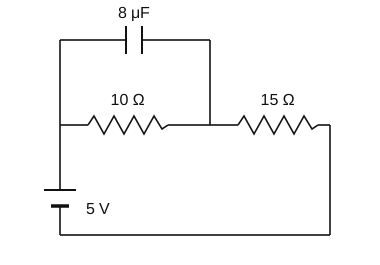
नीचे दर्शाए गए परिपथ में, स्थायी अवस्था में संधारित्र पर आवेश _____
है।
Show answer
Concept: At steady state no current flows through the capacitor branch; the capacitor charges to the potential difference across the element it is connected in parallel with.
- Current in the circuit flows only through the resistors: .
- The capacitor is in parallel with the resistor, so .
- .
Short trick: Ignore the capacitor, find the drop across its parallel resistor, then .
Answer: 16
अवधारणा: स्थायी अवस्था में संधारित्र की शाखा से कोई धारा नहीं बहती; संधारित्र उस अवयव के विभवान्तर तक आवेशित होता है जिसके समान्तर वह जुड़ा है।
- परिपथ में धारा केवल प्रतिरोधकों से बहती है: ।
- संधारित्र प्रतिरोधक के समान्तर है, अतः ।
- ।
शॉर्ट ट्रिक: संधारित्र को हटाकर उसके समान्तर प्रतिरोधक का विभव पतन निकालिए, फिर ।
उत्तर: 16
JEE Main 2025 (January) – Paper 1 (B.E./B.Tech)PhysicsCurrent Electricity – capacitor in DC circuit at steady stateJEE Main 2025 (January) – Paper 1 (B.E./B.Tech) 2025 · 23 Jan Shift 2

