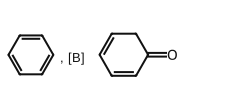
Q501.Identify the products [A] and [B], respectively in the following reaction :
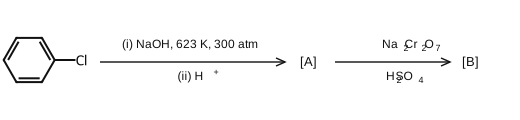
निम्नलिखित अभिक्रिया में उत्पाद [A] तथा [B] को क्रमशः पहचानिए :
- A
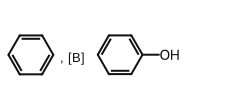
- B
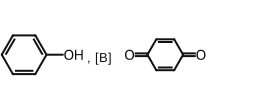
- C
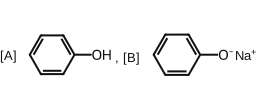
- D
Show answer
Concept: Chlorobenzene gives phenol by the Dow process (NaOH, 623 K, 300 atm, then H+); phenol on oxidation with Na2Cr2O7/H2SO4 gives 1,4-benzoquinone.
- C6H5Cl + NaOH (623 K, 300 atm) → sodium phenoxide; acidification with H+ gives phenol, so [A] = phenol.
- Phenol is easily oxidised: with Na2Cr2O7/H2SO4 it gives the conjugated 1,4-benzoquinone, so [B] = p-benzoquinone.
- (A) and (D) show benzene as [A] – the C–Cl bond is replaced by –OH, not by –H; (C) stops at phenoxide and ignores the oxidation step.
Short trick: Phenol + acidified dichromate → p-benzoquinone is a standard NCERT reaction.
Answer: (B)
अवधारणा: क्लोरोबेंज़ीन डाउ प्रक्रम (NaOH, 623 K, 300 atm, फिर H+) द्वारा फ़िनॉल देता है; फ़िनॉल Na2Cr2O7/H2SO4 से ऑक्सीकरण पर 1,4-बेंज़ोक्विनोन देता है।
- C6H5Cl + NaOH (623 K, 300 atm) → सोडियम फ़िनॉक्साइड; H+ से अम्लीकरण पर फ़िनॉल बनता है, अतः [A] = फ़िनॉल।
- फ़िनॉल आसानी से ऑक्सीकृत होता है: Na2Cr2O7/H2SO4 से संयुग्मित 1,4-बेंज़ोक्विनोन बनता है, अतः [B] = p-बेंज़ोक्विनोन।
- (A) व (D) में [A] बेंज़ीन दिखाया गया है – C–Cl बंध –OH से प्रतिस्थापित होता है, –H से नहीं; (C) फ़िनॉक्साइड पर ही रुक जाता है और ऑक्सीकरण चरण छोड़ देता है।
शॉर्ट ट्रिक: फ़िनॉल + अम्लीय डाइक्रोमेट → p-बेंज़ोक्विनोन NCERT की मानक अभिक्रिया है।
उत्तर: (B)
JEE Main 2025 (January) – Paper 1 (B.E./B.Tech)ChemistryAlcohols, Phenols & Ethers – preparation and oxidation of phenolJEE Main 2025 (January) – Paper 1 (B.E./B.Tech) 2025 · 23 Jan Shift 2
Q502.Consider the following reactions
K2Cr2O7 [A] [B] + K2SO4
The products [A] and [B], respectively are :
निम्नलिखित अभिक्रियाओं पर विचार कीजिए
K2Cr2O7 [A] [B] + K2SO4
उत्पाद [A] तथा [B] क्रमशः हैं :
- AK2CrO4 and CrOK2CrO4 तथा CrO
- BK2CrO4 and Cr2O3K2CrO4 तथा Cr2O3
- CK2CrO4 and K2Cr2O7K2CrO4 तथा K2Cr2O7
- DK2Cr(OH)6 and Cr2O3K2Cr(OH)6 तथा Cr2O3
Show answer
Concept: Dichromate and chromate interconvert with pH: OH− gives yellow chromate, H+ gives orange dichromate; Cr stays in +6 state throughout.
- K2Cr2O7 + 2KOH → 2K2CrO4 + H2O, so [A] = K2CrO4 (yellow).
- 2K2CrO4 + H2SO4 → K2Cr2O7 + K2SO4 + H2O, so [B] = K2Cr2O7 (orange), matching the K2SO4 shown.
- CrO, Cr2O3 and K2Cr(OH)6 would need a change of oxidation state, which does not occur here – so the other sets are wrong.
Short trick: Base → chromate (yellow); acid → dichromate (orange). No redox, only condensation/hydrolysis.
Answer: (C)
अवधारणा: डाइक्रोमेट और क्रोमेट pH के साथ परस्पर परिवर्तित होते हैं: OH− से पीला क्रोमेट, H+ से नारंगी डाइक्रोमेट; Cr पूरे समय +6 अवस्था में रहता है।
- K2Cr2O7 + 2KOH → 2K2CrO4 + H2O, अतः [A] = K2CrO4 (पीला)।
- 2K2CrO4 + H2SO4 → K2Cr2O7 + K2SO4 + H2O, अतः [B] = K2Cr2O7 (नारंगी), जो दिए गए K2SO4 से मेल खाता है।
- CrO, Cr2O3 तथा K2Cr(OH)6 के लिए ऑक्सीकरण अवस्था बदलनी पड़ती, जो यहाँ नहीं होता – अतः शेष विकल्प गलत हैं।
शॉर्ट ट्रिक: क्षार → क्रोमेट (पीला); अम्ल → डाइक्रोमेट (नारंगी)। कोई अपचयोपचय नहीं।
उत्तर: (C)
JEE Main 2025 (January) – Paper 1 (B.E./B.Tech)Chemistryd- and f-Block – chromate–dichromate interconversionJEE Main 2025 (January) – Paper 1 (B.E./B.Tech) 2025 · 23 Jan Shift 2
Q503.The effect of temperature on spontaneity of reactions are represented as :
| ΔH | ΔS | Temperature | Spontaneity |
|---|
| (A) | + | − | any T | Non spontaneous |
| (B) | + | + | low T | spontaneous |
| (C) | − | − | low T | Non spontaneous |
| (D) | − | + | any T | spontaneous |
The incorrect combinations are :
अभिक्रियाओं की स्वतःप्रवर्तिता पर ताप के प्रभाव को इस प्रकार दर्शाया गया है :
| ΔH | ΔS | ताप | स्वतःप्रवर्तिता |
|---|
| (A) | + | − | कोई भी T | स्वतःप्रवर्ती नहीं |
| (B) | + | + | निम्न T | स्वतःप्रवर्ती |
| (C) | − | − | निम्न T | स्वतःप्रवर्ती नहीं |
| (D) | − | + | कोई भी T | स्वतःप्रवर्ती |
गलत संयोजन हैं :
- A(B) and (C) onlyकेवल (B) तथा (C)
- B(B) and (D) onlyकेवल (B) तथा (D)
- C(A) and (D) onlyकेवल (A) तथा (D)
- D(A) and (C) onlyकेवल (A) तथा (C)
Show answer
Concept: ; a process is spontaneous when .
- (A) ΔH = +, ΔS = −: ΔG = (+) − T(−) is positive at every temperature → non-spontaneous at any T. Row (A) is correct.
- (B) ΔH = +, ΔS = +: ΔG becomes negative only at high T; at low T it is positive (non-spontaneous) → row (B) is incorrect.
- (C) ΔH = −, ΔS = −: ΔG is negative at low T, i.e. the reaction is spontaneous at low T → row (C) is incorrect.
- (D) ΔH = −, ΔS = +: both terms make ΔG negative at every temperature → spontaneous at any T. Row (D) is correct.
- Hence the incorrect combinations are (B) and (C). (B), (C) and (D) each include a correct row ((A) or (D)), so they are wrong.
Short trick: Signs (−, +) → always spontaneous; (+, −) → never; mixed signs → temperature decides (ΔH +, ΔS + needs high T; ΔH −, ΔS − needs low T).
Answer: (A) (B) and (C) only
अवधारणा: ; प्रक्रम स्वतःप्रवर्ती होता है जब ।
- (A) ΔH = +, ΔS = −: ΔG = (+) − T(−) प्रत्येक ताप पर धनात्मक → किसी भी T पर स्वतःप्रवर्ती नहीं। पंक्ति (A) सही है।
- (B) ΔH = +, ΔS = +: ΔG केवल उच्च T पर ऋणात्मक होता है; निम्न T पर धनात्मक (स्वतःप्रवर्ती नहीं) → पंक्ति (B) गलत है।
- (C) ΔH = −, ΔS = −: निम्न T पर ΔG ऋणात्मक है, अर्थात् अभिक्रिया निम्न T पर स्वतःप्रवर्ती है → पंक्ति (C) गलत है।
- (D) ΔH = −, ΔS = +: दोनों पद प्रत्येक ताप पर ΔG को ऋणात्मक बनाते हैं → किसी भी T पर स्वतःप्रवर्ती। पंक्ति (D) सही है।
- अतः गलत संयोजन (B) तथा (C) हैं। (B), (C) तथा (D) विकल्पों में प्रत्येक में एक सही पंक्ति ((A) या (D)) शामिल है, अतः वे गलत हैं।
शॉर्ट ट्रिक: चिह्न (−, +) → सदैव स्वतःप्रवर्ती; (+, −) → कभी नहीं; मिश्रित चिह्न → ताप निर्णय करता है (ΔH +, ΔS + को उच्च T चाहिए; ΔH −, ΔS − को निम्न T)।
उत्तर: (A) केवल (B) तथा (C)
JEE Main 2025 (January) – Paper 1 (B.E./B.Tech)ChemistryThermodynamics – spontaneity and Gibbs energyJEE Main 2025 (January) – Paper 1 (B.E./B.Tech) 2025 · 23 Jan Shift 2
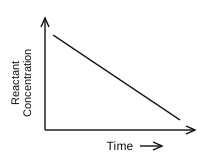
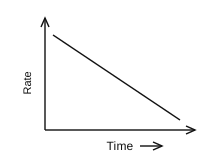
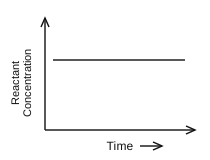
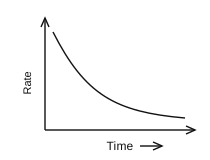
Q504.Which of the following graphs most appropriately represents a zero order reaction ?
निम्नलिखित में से कौन-सा ग्राफ शून्य कोटि अभिक्रिया को सबसे उपयुक्त रूप से दर्शाता है ?
- A
- B
- C
- D
Show answer
Concept: For a zero order reaction, rate , so : the reactant concentration falls linearly with time while the rate stays constant.
- (A) shows reactant concentration decreasing as a straight line with time – exactly . Correct.
- (B) shows the rate decreasing linearly with time – but a zero order rate is constant, so this is wrong.
- (C) shows the concentration constant with time – that would mean no reaction at all.
- (D) shows rate decaying exponentially – typical of a first order reaction, not zero order.
Short trick: Zero order → [A] vs t is a straight line of slope −k; rate vs t is a horizontal line.
Answer: (A)
अवधारणा: शून्य कोटि अभिक्रिया के लिए दर , अतः : अभिकारक की सांद्रता समय के साथ रैखिक रूप से घटती है जबकि दर नियत रहती है।
- (A) में अभिकारक सांद्रता समय के साथ सरल रेखा में घटती दिखाई गई है – यही है। सही।
- (B) में दर समय के साथ रैखिक घट रही है – परन्तु शून्य कोटि की दर नियत होती है, अतः गलत।
- (C) में सांद्रता समय के साथ नियत है – इसका अर्थ होता कि अभिक्रिया हो ही नहीं रही।
- (D) में दर चरघातांकी रूप से घट रही है – यह प्रथम कोटि का लक्षण है, शून्य कोटि का नहीं।
शॉर्ट ट्रिक: शून्य कोटि → [A] बनाम t ढाल −k की सरल रेखा; दर बनाम t क्षैतिज रेखा।
उत्तर: (A)
JEE Main 2025 (January) – Paper 1 (B.E./B.Tech)ChemistryChemical Kinetics – zero order reactionJEE Main 2025 (January) – Paper 1 (B.E./B.Tech) 2025 · 23 Jan Shift 2
Q505.Consider the reaction The equation representing correct relationship between the degree of dissociation (x) of X2Y(g) with its equilibrium constant Kp is ______ . Assume x to be very very small.
अभिक्रिया पर विचार कीजिए। X2Y(g) के वियोजन की मात्रा (x) तथा इसके साम्य स्थिरांक Kp के बीच सही संबंध दर्शाने वाला समीकरण ______ है। मान लीजिए x अत्यंत सूक्ष्म है।
- A
- B
- C
- D
Show answer
Concept: Write equilibrium moles, convert to partial pressures, apply and use .
- Start with 1 mol X2Y: at equilibrium, moles are , , ; total .
- Partial pressures (total pressure p): , , .
- .
- Squaring: .
Short trick: Total Δn of products is , so x appears as in – squaring must give in the final answer.
Answer: (B)
अवधारणा: साम्य पर मोल लिखिए, आंशिक दाबों में बदलिए, लगाइए और का उपयोग कीजिए।
- 1 मोल X2Y से प्रारम्भ: साम्य पर मोल , , ; कुल ।
- आंशिक दाब (कुल दाब p): , , ।
- ।
- वर्ग करने पर: ।
शॉर्ट ट्रिक: उत्पादों का कुल Δn है, अतः में x घात में आता है – वर्ग करने पर उत्तर में आना ही चाहिए।
उत्तर: (B)
JEE Main 2025 (January) – Paper 1 (B.E./B.Tech)ChemistryChemical Equilibrium – Kp and degree of dissociationJEE Main 2025 (January) – Paper 1 (B.E./B.Tech) 2025 · 23 Jan Shift 2
Q506.Given below are two statements : Consider the following reaction
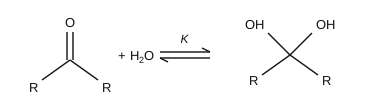
Statement (I) : In the case of formaldehyde (HCHO), K is about 2280, due to small substituents, hydration is faster.
Statement (II) : In the case of trichloro acetaldehyde (CCl
3CHO), K is about 2000 due to −I effect of −Cl.
In the light of the above statements, choose the correct answer from the options given below :
नीचे दो कथन दिए गए हैं : निम्नलिखित अभिक्रिया पर विचार कीजिए
कथन (I) : फॉर्मैल्डिहाइड (HCHO) की स्थिति में K लगभग 2280 है, छोटे प्रतिस्थापियों के कारण जलयोजन (hydration) तीव्र होता है।
कथन (II) : ट्राइक्लोरोऐसीटैल्डिहाइड (CCl
3CHO) की स्थिति में −Cl के −I प्रभाव के कारण K लगभग 2000 है।
उपर्युक्त कथनों के आलोक में, नीचे दिए गए विकल्पों में से सही उत्तर चुनिए :
- ABoth Statement I and Statement II are falseकथन I तथा कथन II दोनों असत्य हैं
- BStatement I is true but Statement II is falseकथन I सत्य है परन्तु कथन II असत्य है
- CStatement I is false but Statement II is trueकथन I असत्य है परन्तु कथन II सत्य है
- DBoth Statement I and Statement II are trueकथन I तथा कथन II दोनों सत्य हैं
Show answer
Concept: The hydration equilibrium constant of a carbonyl compound increases when the carbonyl carbon is more electrophilic and less crowded.
- In HCHO the substituents are only two small H atoms: no steric hindrance and no electron-donating alkyl group, so hydration is fast and extensive; K ≈ 2280. Statement I is true.
- In CCl3CHO the strong −I effect of the three Cl atoms pulls electron density away, making the carbonyl carbon highly electrophilic; K ≈ 2000 and the stable hydrate (chloral hydrate) is formed. Statement II is true.
- Hence both statements are correct.
Short trick: Small substituents (HCHO) or strong −I groups (CCl3) → large hydration K.
Answer: (D)
अवधारणा: कार्बोनिल यौगिक का जलयोजन साम्य स्थिरांक तब बढ़ता है जब कार्बोनिल कार्बन अधिक इलेक्ट्रॉनरागी तथा कम संकुलित हो।
- HCHO में प्रतिस्थापी केवल दो छोटे H परमाणु हैं: न त्रिविम बाधा, न इलेक्ट्रॉनदाता ऐल्किल समूह, अतः जलयोजन तीव्र व व्यापक होता है; K ≈ 2280। कथन I सत्य है।
- CCl3CHO में तीन Cl परमाणुओं का प्रबल −I प्रभाव इलेक्ट्रॉन घनत्व खींच लेता है, जिससे कार्बोनिल कार्बन अत्यधिक इलेक्ट्रॉनरागी हो जाता है; K ≈ 2000 तथा स्थायी हाइड्रेट (क्लोरल हाइड्रेट) बनता है। कथन II सत्य है।
- अतः दोनों कथन सही हैं।
शॉर्ट ट्रिक: छोटे प्रतिस्थापी (HCHO) या प्रबल −I समूह (CCl3) → बड़ा जलयोजन K।
उत्तर: (D)
JEE Main 2025 (January) – Paper 1 (B.E./B.Tech)ChemistryAldehydes & Ketones – hydration of carbonyl compoundsJEE Main 2025 (January) – Paper 1 (B.E./B.Tech) 2025 · 23 Jan Shift 2
Q507.Given below are two statements :
Statement (I) : For a given shell, the total number of allowed orbitals is given by n2.
Statement (II) : For any subshell, the spatial orientation of the orbitals is given by −l to +l values including zero.
In the light of the above statements, choose the correct answer from the options given below :
नीचे दो कथन दिए गए हैं :
कथन (I) : किसी दिए गए कोश के लिए अनुमत कक्षकों की कुल संख्या n2 द्वारा दी जाती है।
कथन (II) : किसी भी उपकोश के लिए कक्षकों का त्रिविम अभिविन्यास (spatial orientation) शून्य सहित −l से +l मानों द्वारा दिया जाता है।
उपर्युक्त कथनों के आलोक में, नीचे दिए गए विकल्पों में से सही उत्तर चुनिए :
- ABoth Statement I and Statement II are falseकथन I तथा कथन II दोनों असत्य हैं
- BStatement I is true but Statement II is falseकथन I सत्य है परन्तु कथन II असत्य है
- CBoth Statement I and Statement II are trueकथन I तथा कथन II दोनों सत्य हैं
- DStatement I is false but Statement II is trueकथन I असत्य है परन्तु कथन II सत्य है
Show answer
Concept: For shell n, l runs 0 … (n−1) and each subshell has (2l+1) orbitals given by the magnetic quantum number ml.
- Total orbitals in a shell (e.g. n = 2: one s + three p = 4 = 22). Statement I is true.
- For a subshell of azimuthal quantum number l, ml takes the values −l, …, 0, …, +l, and ml describes the spatial orientation of the orbitals. Statement II is true.
- So both statements are correct.
Short trick: Orbitals per shell = n2; electrons per shell = 2n2; orientations per subshell = 2l+1.
Answer: (C)
अवधारणा: कोश n के लिए l के मान 0 … (n−1) होते हैं तथा प्रत्येक उपकोश में चुंबकीय क्वांटम संख्या ml द्वारा निर्धारित (2l+1) कक्षक होते हैं।
- किसी कोश में कुल कक्षक (जैसे n = 2: एक s + तीन p = 4 = 22)। कथन I सत्य है।
- दिगंशी क्वांटम संख्या l वाले उपकोश के लिए ml के मान −l, …, 0, …, +l होते हैं, और ml ही कक्षकों का त्रिविम अभिविन्यास बताता है। कथन II सत्य है।
- अतः दोनों कथन सही हैं।
शॉर्ट ट्रिक: प्रति कोश कक्षक = n2; प्रति कोश इलेक्ट्रॉन = 2n2; प्रति उपकोश अभिविन्यास = 2l+1।
उत्तर: (C)
JEE Main 2025 (January) – Paper 1 (B.E./B.Tech)ChemistryAtomic Structure – quantum numbers and orbitalsJEE Main 2025 (January) – Paper 1 (B.E./B.Tech) 2025 · 23 Jan Shift 2
Q508.Standard electrode potentials for a few half cells are mentioned below :
Which one of the following cells gives the most negative value of ?
कुछ अर्ध-सेलों के मानक इलेक्ट्रोड विभव नीचे दिए गए हैं :
निम्नलिखित में से कौन-सा सेल का सबसे अधिक ऋणात्मक मान देता है ?
- AZn | Zn2+(1M) || Ag+(1M) | Ag
- BZn | Zn2+(1M) || Mg2+(1M) | Mg
- CAg | Ag+(1M) || Mg2+(1M) | Mg
- DCu | Cu2+(1M) || Ag+(1M) | Ag
Show answer
Concept: with ; the most negative ΔG° corresponds to the largest positive E°cell.
- (A) Zn | Zn2+ || Ag+ | Ag: V.
- (B) Zn | Zn2+ || Mg2+ | Mg: V.
- (C) Ag | Ag+ || Mg2+ | Mg: V.
- (D) Cu | Cu2+ || Ag+ | Ag: V.
- The largest positive EMF (+1.56 V) is for the Zn–Ag cell, so it has the most negative ΔG° (for n = 2, ΔG° = −2 × 96500 × 1.56 ≈ −301 kJ).
Short trick: Pick the pair with the greatest gap: lowest E° as anode (Zn among those used as anode) and highest E° as cathode (Ag).
Answer: (A)
अवधारणा: तथा ; सबसे ऋणात्मक ΔG° सबसे बड़े धनात्मक E°cell से मिलता है।
- (A) Zn | Zn2+ || Ag+ | Ag: V।
- (B) Zn | Zn2+ || Mg2+ | Mg: V।
- (C) Ag | Ag+ || Mg2+ | Mg: V।
- (D) Cu | Cu2+ || Ag+ | Ag: V।
- सबसे बड़ा धनात्मक EMF (+1.56 V) Zn–Ag सेल का है, अतः उसका ΔG° सबसे ऋणात्मक है (n = 2 के लिए ΔG° = −2 × 96500 × 1.56 ≈ −301 kJ)।
शॉर्ट ट्रिक: सबसे बड़ा अंतर चुनिए: न्यूनतम E° ऐनोड (Zn) और अधिकतम E° कैथोड (Ag)।
उत्तर: (A)
JEE Main 2025 (January) – Paper 1 (B.E./B.Tech)ChemistryElectrochemistry – cell EMF and ΔG°JEE Main 2025 (January) – Paper 1 (B.E./B.Tech) 2025 · 23 Jan Shift 2
Q509.The α-Helix and β - Pleated sheet structures of protein are associated with its :
प्रोटीन की α-हेलिक्स तथा β-प्लीटेड शीट संरचनाएँ इसकी किस संरचना से संबंधित हैं :
- Atertiary structureतृतीयक संरचना
- Bquaternary structureचतुर्थक संरचना
- Csecondary structureद्वितीयक संरचना
- Dprimary structureप्राथमिक संरचना
Show answer
Concept: The secondary structure of a protein is the regular local folding of the polypeptide backbone held by hydrogen bonds between C=O and N–H groups.
- α-helix and β-pleated sheet are the two common regular arrangements stabilised by backbone H-bonding – they define the secondary structure.
- Primary structure (D) is only the amino-acid sequence; tertiary (A) is the overall 3-D folding of one chain; quaternary (B) is the assembly of more than one polypeptide chain – none of these describes α-helix/β-sheet.
Short trick: Sequence → 1°, helix/sheet → 2°, 3-D fold → 3°, multi-chain → 4°.
Answer: (C)
अवधारणा: प्रोटीन की द्वितीयक संरचना पॉलिपेप्टाइड शृंखला की वह नियमित स्थानीय वलन है जो C=O तथा N–H समूहों के बीच हाइड्रोजन बंधों से स्थायी होती है।
- α-हेलिक्स तथा β-प्लीटेड शीट मुख्य शृंखला के H-बंधन से स्थायी दो सामान्य नियमित विन्यास हैं – ये द्वितीयक संरचना को परिभाषित करते हैं।
- प्राथमिक संरचना (D) केवल ऐमीनो अम्ल अनुक्रम है; तृतीयक (A) एक शृंखला की समग्र त्रिविम वलन है; चतुर्थक (B) एक से अधिक पॉलिपेप्टाइड शृंखलाओं का संयोजन है – इनमें से कोई α-हेलिक्स/β-शीट का वर्णन नहीं करता।
शॉर्ट ट्रिक: अनुक्रम → 1°, हेलिक्स/शीट → 2°, त्रिविम वलन → 3°, बहु-शृंखला → 4°।
उत्तर: (C)
JEE Main 2025 (January) – Paper 1 (B.E./B.Tech)ChemistryBiomolecules – structure of proteinsJEE Main 2025 (January) – Paper 1 (B.E./B.Tech) 2025 · 23 Jan Shift 2
Q510.Given below are the atomic numbers of some group 14 elements. The atomic number of the element with lowest melting point is :
नीचे वर्ग 14 के कुछ तत्वों के परमाणु क्रमांक दिए गए हैं। न्यूनतम गलनांक वाले तत्व का परमाणु क्रमांक है :
- A6
- B82
- C14
- D50
Show answer
Concept: Melting points in group 14 fall from C to Sn as the strong covalent network weakens, but Pb melts higher than Sn because its metallic packing is more efficient.
- Approximate melting points: C (Z = 6) ≈ 4373 K, Si (Z = 14) ≈ 1693 K, Ge ≈ 1218 K, Sn (Z = 50) ≈ 505 K, Pb (Z = 82) ≈ 600 K.
- The lowest value belongs to tin, Sn, whose atomic number is 50.
- (A) C and (C) Si have giant covalent lattices (very high m.p.); (B) Pb melts at about 600 K, higher than Sn.
Short trick: In group 14 the melting-point order is C > Si > Ge > Pb > Sn – tin is the anomaly at the bottom.
Answer: (D)
अवधारणा: वर्ग 14 में गलनांक C से Sn तक घटते हैं क्योंकि प्रबल सहसंयोजक जालक दुर्बल होता जाता है, परन्तु Pb का गलनांक Sn से अधिक होता है क्योंकि इसकी धात्विक संकुलन दक्षता अधिक है।
- लगभग गलनांक: C (Z = 6) ≈ 4373 K, Si (Z = 14) ≈ 1693 K, Ge ≈ 1218 K, Sn (Z = 50) ≈ 505 K, Pb (Z = 82) ≈ 600 K।
- न्यूनतम मान टिन (Sn) का है, जिसका परमाणु क्रमांक 50 है।
- (A) C तथा (C) Si के विशाल सहसंयोजक जालक होते हैं (बहुत उच्च गलनांक); (B) Pb लगभग 600 K पर पिघलता है, जो Sn से अधिक है।
शॉर्ट ट्रिक: वर्ग 14 में गलनांक क्रम C > Si > Ge > Pb > Sn – सबसे नीचे टिन अपवाद है।
उत्तर: (D)
JEE Main 2025 (January) – Paper 1 (B.E./B.Tech)Chemistryp-Block – group 14 trends in melting pointJEE Main 2025 (January) – Paper 1 (B.E./B.Tech) 2025 · 23 Jan Shift 2
Q511.Given below are two statements about X-ray spectra of elements :
Statement (I) : A plot of ( = frequency of X-rays emitted) vs atomic mass is a straight line.
Statement (II) : A plot of ( = frequency of X-rays emitted) vs atomic number is a straight line.
In the light of the above statements, choose the correct answer from the options given below :
तत्वों के X-किरण स्पेक्ट्रम के बारे में नीचे दो कथन दिए गए हैं :
कथन (I) : ( = उत्सर्जित X-किरणों की आवृत्ति) बनाम परमाणु द्रव्यमान का आलेख एक सरल रेखा है।
कथन (II) : ( = उत्सर्जित X-किरणों की आवृत्ति) बनाम परमाणु क्रमांक का आलेख एक सरल रेखा है।
उपर्युक्त कथनों के आलोक में, नीचे दिए गए विकल्पों में से सही उत्तर चुनिए :
- ABoth Statement I and Statement II are trueकथन I तथा कथन II दोनों सत्य हैं
- BStatement I is false but Statement II is trueकथन I असत्य है परन्तु कथन II सत्य है
- CBoth Statement I and Statement II are falseकथन I तथा कथन II दोनों असत्य हैं
- DStatement I is true but Statement II is falseकथन I सत्य है परन्तु कथन II असत्य है
Show answer
Concept: Moseley's law: – the square root of the frequency of characteristic X-rays varies linearly with the atomic number Z, not with atomic mass.
- Statement I plots against atomic mass: Moseley showed that it is the atomic number, not the mass, that gives a straight line – Statement I is false.
- Statement II plots (not ) against Z: since , this plot is a parabola, not a straight line – Statement II is false.
- Hence both statements are false.
Short trick: Only vs Z is linear; any other combination (mass, or v itself) is not.
Answer: (C)
अवधारणा: मोज़ले का नियम: – अभिलाक्षणिक X-किरणों की आवृत्ति का वर्गमूल परमाणु क्रमांक Z के साथ रैखिक बदलता है, परमाणु द्रव्यमान के साथ नहीं।
- कथन I में को परमाणु द्रव्यमान के विरुद्ध आलेखित किया गया है: मोज़ले ने दिखाया कि सरल रेखा परमाणु क्रमांक से मिलती है, द्रव्यमान से नहीं – कथन I असत्य।
- कथन II में Z के विरुद्ध ( नहीं) है: चूँकि , यह आलेख परवलय है, सरल रेखा नहीं – कथन II असत्य।
- अतः दोनों कथन असत्य हैं।
शॉर्ट ट्रिक: केवल बनाम Z रैखिक है; अन्य कोई संयोजन (द्रव्यमान या स्वयं v) नहीं।
उत्तर: (C)
JEE Main 2025 (January) – Paper 1 (B.E./B.Tech)ChemistryAtomic Structure – Moseley's lawJEE Main 2025 (January) – Paper 1 (B.E./B.Tech) 2025 · 23 Jan Shift 2
Q512.Identify A, B and C in the given below reaction sequence
A Pb(NO3)2 B C
नीचे दिए गए अभिक्रिया अनुक्रम में A, B तथा C को पहचानिए
A Pb(NO3)2 B C
- APbCl2, PbSO4, PbCrO4
- BPbS, PbSO4, Pb(CH3COO)2
- CPbCl2, Pb(SO4)2, PbCrO4
- DPbS, PbSO4, PbCrO4
Show answer
Concept: Classic lead chemistry: galena dissolves in HNO3; Pb2+ gives white PbSO4, which dissolves in ammonium acetate and finally precipitates yellow PbCrO4.
- A + HNO3 → Pb(NO3)2: the sulphide ore PbS dissolves in dilute HNO3, so A = PbS. (PbCl2 would introduce chloride, not match this step's typical use.)
- Pb(NO3)2 + H2SO4 → PbSO4 (white ppt.), so B = PbSO4; lead is +2, so Pb(SO4)2 of (C) is wrong.
- PbSO4 dissolves in ammonium acetate (soluble lead acetate forms in acetic acid medium) and K2CrO4 then precipitates yellow PbCrO4, so C = PbCrO4 – (B) stops at the acetate and misses the final product.
Short trick: PbS → Pb(NO3)2 → PbSO4 → (acetate) → PbCrO4 (yellow) is the standard confirmatory chain for Pb2+.
Answer: (D)
अवधारणा: लेड की प्रसिद्ध रसायन: गैलेना HNO3 में घुलता है; Pb2+ सफेद PbSO4 देता है, जो अमोनियम ऐसीटेट में घुलकर अंत में पीला PbCrO4 अवक्षेपित करता है।
- A + HNO3 → Pb(NO3)2: सल्फाइड अयस्क PbS तनु HNO3 में घुल जाता है, अतः A = PbS। (PbCl2 से क्लोराइड आता, जो इस चरण से मेल नहीं खाता।)
- Pb(NO3)2 + H2SO4 → PbSO4 (सफेद अवक्षेप), अतः B = PbSO4; लेड +2 में है, अतः (C) का Pb(SO4)2 गलत है।
- PbSO4 अमोनियम ऐसीटेट में घुल जाता है (ऐसीटिक अम्ल माध्यम में विलेय लेड ऐसीटेट बनता है) और फिर K2CrO4 पीला PbCrO4 अवक्षेपित करता है, अतः C = PbCrO4 – (B) ऐसीटेट पर ही रुककर अंतिम उत्पाद छोड़ देता है।
शॉर्ट ट्रिक: PbS → Pb(NO3)2 → PbSO4 → (ऐसीटेट) → PbCrO4 (पीला) Pb2+ की मानक पुष्टि शृंखला है।
उत्तर: (D)
JEE Main 2025 (January) – Paper 1 (B.E./B.Tech)Chemistryp-Block / Qualitative analysis – compounds of leadJEE Main 2025 (January) – Paper 1 (B.E./B.Tech) 2025 · 23 Jan Shift 2
Q513.Given below are two statements :
Statement (I) : The boiling points of alcohols and phenols increase with increase in the number of C-atoms.
Statement (II) : The boiling points of alcohols and phenols are higher in comparison to other class of compounds such as ethers, haloalkanes.
In the light of the above statements, choose the correct answer from the options given below :
नीचे दो कथन दिए गए हैं :
कथन (I) : ऐल्कोहॉलों तथा फ़िनॉलों के क्वथनांक C-परमाणुओं की संख्या बढ़ने के साथ बढ़ते हैं।
कथन (II) : ऐल्कोहॉलों तथा फ़िनॉलों के क्वथनांक ईथर, हैलोऐल्केन जैसे अन्य वर्गों के यौगिकों की तुलना में उच्च होते हैं।
उपर्युक्त कथनों के आलोक में, नीचे दिए गए विकल्पों में से सही उत्तर चुनिए :
- ABoth Statement I and Statement II are falseकथन I तथा कथन II दोनों असत्य हैं
- BBoth Statement I and Statement II are trueकथन I तथा कथन II दोनों सत्य हैं
- CStatement I is false but Statement II is trueकथन I असत्य है परन्तु कथन II सत्य है
- DStatement I is true but Statement II is falseकथन I सत्य है परन्तु कथन II असत्य है
Show answer
Concept: Boiling point rises with molecular size (van der Waals forces) and is specially high where intermolecular hydrogen bonding exists.
- With more C-atoms the surface area and van der Waals attraction increase, so b.p. of alcohols and phenols increases with the number of carbons – Statement I is true.
- The –OH group forms strong intermolecular H-bonds; ethers and haloalkanes of comparable molar mass cannot H-bond among themselves, so alcohols/phenols boil much higher – Statement II is true.
- Therefore both statements are correct.
Short trick: H-bonding (–OH) > dipole (C–X, C–O–C) > dispersion: that single order settles both statements.
Answer: (B)
अवधारणा: क्वथनांक आण्विक आकार (वान्डरवाल्स बल) के साथ बढ़ता है और अंतराआण्विक हाइड्रोजन बंधन होने पर विशेष रूप से उच्च होता है।
- C-परमाणु बढ़ने पर पृष्ठीय क्षेत्रफल व वान्डरवाल्स आकर्षण बढ़ते हैं, अतः ऐल्कोहॉलों व फ़िनॉलों का क्वथनांक कार्बन संख्या के साथ बढ़ता है – कथन I सत्य।
- –OH समूह प्रबल अंतराआण्विक H-बंध बनाता है; तुलनीय मोलर द्रव्यमान के ईथर व हैलोऐल्केन आपस में H-बंध नहीं बना सकते, अतः ऐल्कोहॉल/फ़िनॉल बहुत उच्च ताप पर उबलते हैं – कथन II सत्य।
- अतः दोनों कथन सही हैं।
शॉर्ट ट्रिक: H-बंधन (–OH) > द्विध्रुव (C–X, C–O–C) > परिक्षेपण: यही क्रम दोनों कथन तय कर देता है।
उत्तर: (B)
JEE Main 2025 (January) – Paper 1 (B.E./B.Tech)ChemistryAlcohols & Phenols – boiling pointsJEE Main 2025 (January) – Paper 1 (B.E./B.Tech) 2025 · 23 Jan Shift 2
Q514.Consider a binary solution of two volatile liquid components 1 and 2. and are the mole fractions of component 1 in liquid and vapour phase, respectively. The slope and intercept of the linear plot of vs are given respectively as:
दो वाष्पशील द्रव घटकों 1 तथा 2 के एक द्विअंगी विलयन पर विचार कीजिए। तथा क्रमशः द्रव तथा वाष्प प्रावस्था में घटक 1 के मोल अंश हैं। बनाम के रैखिक आलेख की प्रवणता (slope) तथा अंतःखंड (intercept) क्रमशः हैं:
- A
- B
- C
- D
Show answer
Concept: Dalton + Raoult: ; rearrange into a straight line in and .
- .
- Solve for : .
- So slope and intercept .
- (C) has the sign of the intercept reversed, while (A) and (D) invert the slope.
Short trick: With on the y-axis the slope must contain on top (swap of the familiar -form).
Answer: (B)
अवधारणा: डाल्टन + राउल्ट: ; इसे तथा में सरल रेखा के रूप में लिखिए।
- ।
- के लिए हल करने पर: ।
- अतः प्रवणता तथा अंतःखंड ।
- (C) में अंतःखंड का चिह्न उल्टा है, जबकि (A) व (D) में प्रवणता उलटी है।
शॉर्ट ट्रिक: जब y-अक्ष पर हो तो प्रवणता के अंश में आना चाहिए।
उत्तर: (B)
JEE Main 2025 (January) – Paper 1 (B.E./B.Tech)ChemistrySolutions – Raoult's law for two volatile liquidsJEE Main 2025 (January) – Paper 1 (B.E./B.Tech) 2025 · 23 Jan Shift 2
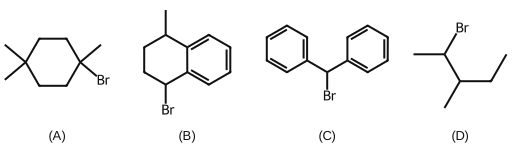
Q515.The ascending order of relative rate of solvolysis of following compounds is :
निम्नलिखित यौगिकों की विलेय-अपघटन (solvolysis) की आपेक्षिक दर का आरोही क्रम है :
- A(C) < (B) < (A) < (D)
- B(D) < (A) < (B) < (C)
- C(D) < (B) < (A) < (C)
- D(C) < (D) < (B) < (A)
Show answer
Concept: Solvolysis follows the SN1 path, so the rate is governed by the stability of the carbocation formed on ionisation of C–Br.
- (C) Ph2CHBr ionises to the benzhydryl cation Ph2CH+, stabilised by resonance with two benzene rings – fastest.
- (B) gives a secondary benzylic carbocation (resonance with one ring) – next fastest.
- (A) gives a simple tertiary alkyl carbocation (only hyperconjugation/induction) – slower than benzylic.
- (D) 2-bromo-3-methylpentane gives an ordinary secondary alkyl carbocation – slowest.
- Ascending order: (D) < (A) < (B) < (C).
Short trick: Cation stability: dibenzylic > monobenzylic > 3° alkyl > 2° alkyl – solvolysis rate follows the same order.
Answer: (B)
अवधारणा: विलेय-अपघटन SN1 पथ से होता है, अतः दर C–Br के आयनन से बने कार्बधनायन के स्थायित्व से निर्धारित होती है।
- (C) Ph2CHBr आयनित होकर बेंज़हाइड्रिल धनायन Ph2CH+ देता है, जो दो बेंज़ीन वलयों के अनुनाद से स्थायी है – सबसे तीव्र।
- (B) द्वितीयक बेंज़िलिक कार्बधनायन देता है (एक वलय से अनुनाद) – उससे धीमा।
- (A) साधारण तृतीयक ऐल्किल कार्बधनायन देता है (केवल अतिसंयुग्मन/प्रेरणिक प्रभाव) – बेंज़िलिक से धीमा।
- (D) 2-ब्रोमो-3-मेथिलपेन्टेन साधारण द्वितीयक ऐल्किल कार्बधनायन देता है – सबसे धीमा।
- आरोही क्रम: (D) < (A) < (B) < (C)।
शॉर्ट ट्रिक: धनायन स्थायित्व: द्विबेंज़िलिक > एकबेंज़िलिक > 3° ऐल्किल > 2° ऐल्किल – विलेय-अपघटन दर भी यही क्रम।
उत्तर: (B)
JEE Main 2025 (January) – Paper 1 (B.E./B.Tech)ChemistryHaloalkanes & Haloarenes – SN1 solvolysisJEE Main 2025 (January) – Paper 1 (B.E./B.Tech) 2025 · 23 Jan Shift 2
Q516.Match List - I with List - II.
| List - I | List - II |
|---|
| (A) | Bronze | (I) | Cu, Ni |
| (B) | Brass | (II) | Fe, Cr, Ni, C |
| (C) | UK silver coin | (III) | Cu, Zn |
| (D) | Stainless steel | (IV) | Cu, Sn |
Choose the correct answer from the options given below :
सूची-I का सूची-II से मिलान कीजिए।
| सूची - I | सूची - II |
|---|
| (A) | काँसा (Bronze) | (I) | Cu, Ni |
| (B) | पीतल (Brass) | (II) | Fe, Cr, Ni, C |
| (C) | UK चाँदी का सिक्का | (III) | Cu, Zn |
| (D) | स्टेनलेस स्टील | (IV) | Cu, Sn |
नीचे दिए गए विकल्पों में से सही उत्तर चुनिए :
- A(A)-(IV), (B)-(II), (C)-(III), (D)-(I)
- B(A)-(IV), (B)-(III), (C)-(I), (D)-(II)
- C(A)-(III), (B)-(IV), (C)-(II), (D)-(I)
- D(A)-(III), (B)-(I), (C)-(IV), (D)-(II)
Show answer
Concept: Compositions of common alloys.
- (A) Bronze = copper + tin → (IV) Cu, Sn.
- (B) Brass = copper + zinc → (III) Cu, Zn.
- (C) Modern UK “silver” coins are cupronickel = copper + nickel → (I) Cu, Ni.
- (D) Stainless steel = iron with chromium, nickel and carbon → (II) Fe, Cr, Ni, C.
- The other options swap bronze/brass or coin/steel compositions, which contradicts these standard formulations.
Short trick: Bronze–tin, brass–zinc; coins are cupronickel.
Answer: (B)
अवधारणा: सामान्य मिश्रातुओं का संघटन।
- (A) काँसा = ताँबा + टिन → (IV) Cu, Sn।
- (B) पीतल = ताँबा + जस्ता → (III) Cu, Zn।
- (C) आधुनिक UK “चाँदी” के सिक्के क्यूप्रोनिकल = ताँबा + निकल → (I) Cu, Ni।
- (D) स्टेनलेस स्टील = लोहा + क्रोमियम, निकल व कार्बन → (II) Fe, Cr, Ni, C।
- अन्य विकल्प काँसा/पीतल या सिक्का/स्टील के संघटन आपस में बदल देते हैं, जो मानक संघटनों के विरुद्ध है।
शॉर्ट ट्रिक: काँसा–टिन, पीतल–जस्ता; सिक्के क्यूप्रोनिकल होते हैं।
उत्तर: (B)
JEE Main 2025 (January) – Paper 1 (B.E./B.Tech)ChemistryGeneral Principles of Metallurgy – alloysJEE Main 2025 (January) – Paper 1 (B.E./B.Tech) 2025 · 23 Jan Shift 2
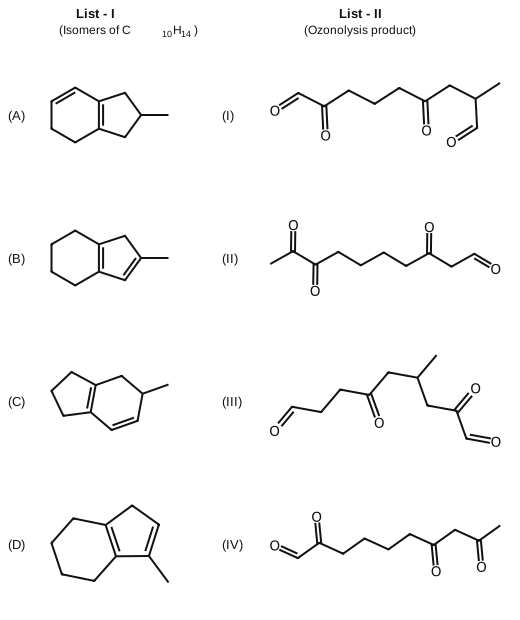
Q517.Match List - I with List - II.
Choose the correct answer from the options given below :
सूची-I का सूची-II से मिलान कीजिए।
नीचे दिए गए विकल्पों में से सही उत्तर चुनिए :
- A(A)-(I), (B)-(IV), (C)-(III), (D)-(II)
- B(A)-(III), (B)-(II), (C)-(I), (D)-(IV)
- C(A)-(III), (B)-(IV), (C)-(I), (D)-(II)
- D(A)-(II), (B)-(III), (C)-(I), (D)-(IV)
Show answer
Concept: Ozonolysis cleaves every C=C into two C=O groups. Each bicyclic diene has one C=C at the ring fusion (tetra-substituted → two ketone carbons) and one C=C in a ring; opening both rings gives a single chain with four carbonyls, whose pattern identifies the parent diene.
- (A): the methyl sits on the saturated CH2–CH(CH3)–CH2 part of the five-membered ring and the second C=C (CH=CH) is in the six-membered ring → chain OHC–CH2CH2–CO–CH2–CH(CH3)–CH2–CO–CHO = (III).
- (B): the 5-ring C=C carries the methyl on the carbon away from the fusion → cleavage gives a CH3CO–CH2– end and an OHC–CO– end: OHC–CO–(CH2)4–CO–CH2–COCH3 = (IV).
- (C): both C=C lie in the six-membered ring (fusion + CH=CH) with the methyl on the sp3 CH → OHC–CH(CH3)–CH2–CO–(CH2)3–CO–CHO = (I).
- (D): the methyl is on the 5-ring alkene carbon attached to the fusion → CH3–CO–CO– end: CH3CO–CO–(CH2)4–CO–CH2–CHO = (II).
- Thus (A)-(III), (B)-(IV), (C)-(I), (D)-(II); the other combinations pair at least one diene with a product whose carbonyl pattern (position of CH3 and of the –CO–CHO/–CO–COCH3 ends) cannot arise from it.
Short trick: A methyl on a double-bond carbon ends up α to a C=O (methyl ketone / α-diketone); a methyl on an sp3 carbon stays as a CH(CH3) inside the chain.
Answer: (C)
अवधारणा: ओज़ोनी अपघटन प्रत्येक C=C को दो C=O में तोड़ देता है। प्रत्येक द्विचक्रीय डाईन में एक C=C वलय-संधि पर (चतुःप्रतिस्थापित → दो कीटोन कार्बन) तथा एक C=C किसी वलय में है; दोनों वलय खुलने पर चार कार्बोनिल वाली एक शृंखला बनती है, जिसका प्रारूप मूल डाईन की पहचान कराता है।
- (A): मेथिल पाँच-सदस्यीय वलय के संतृप्त CH2–CH(CH3)–CH2 भाग पर है और दूसरा C=C (CH=CH) छह-सदस्यीय वलय में है → शृंखला OHC–CH2CH2–CO–CH2–CH(CH3)–CH2–CO–CHO = (III)।
- (B): 5-वलय के C=C पर मेथिल संधि से दूर वाले कार्बन पर है → विदलन से एक सिरा CH3CO–CH2– तथा दूसरा OHC–CO– बनता है: OHC–CO–(CH2)4–CO–CH2–COCH3 = (IV)।
- (C): दोनों C=C छह-सदस्यीय वलय में हैं (संधि + CH=CH) और मेथिल sp3 CH पर है → OHC–CH(CH3)–CH2–CO–(CH2)3–CO–CHO = (I)।
- (D): मेथिल 5-वलय के उस ऐल्कीन कार्बन पर है जो संधि से जुड़ा है → CH3–CO–CO– सिरा: CH3CO–CO–(CH2)4–CO–CH2–CHO = (II)।
- अतः (A)-(III), (B)-(IV), (C)-(I), (D)-(II); शेष संयोजनों में कम-से-कम एक डाईन ऐसे उत्पाद से जोड़ी गई है जिसका कार्बोनिल प्रारूप (CH3 तथा –CO–CHO/–CO–COCH3 सिरों की स्थिति) उससे नहीं बन सकता।
शॉर्ट ट्रिक: द्विबंध कार्बन पर बैठा मेथिल C=O के α पर पहुँचता है (मेथिल कीटोन / α-डाइकीटोन); sp3 कार्बन का मेथिल शृंखला के भीतर CH(CH3) ही रहता है।
उत्तर: (C)
JEE Main 2025 (January) – Paper 1 (B.E./B.Tech)ChemistryHydrocarbons – ozonolysis of alkenesJEE Main 2025 (January) – Paper 1 (B.E./B.Tech) 2025 · 23 Jan Shift 2
Q518.pH of water is 7 at 25∘C. If water is heated to 80∘C., it's pH will :
25∘C पर जल का pH 7 है। यदि जल को 80∘C तक गर्म किया जाए, तो इसका pH :
- ADecreaseघटेगा
- BH+ concentration increases, OH− concentration decreasesH+ सांद्रता बढ़ेगी, OH− सांद्रता घटेगी
- CRemains the sameसमान रहेगा
- DIncreaseबढ़ेगा
Show answer
Concept: Self-ionisation of water is endothermic, so Kw increases with temperature.
- At 80 °C, Kw > 10−14, so [H+] = [OH−] = √Kw > 10−7 M.
- pH = −log[H+] therefore falls below 7, although the water is still neutral ([H+] = [OH−]).
- (B) is wrong because both ion concentrations increase equally; (C) and (D) contradict the increase of Kw.
Short trick: Hot water: neutral but pH < 7 – neutrality means equality of the two ions, not pH = 7.
Answer: (A)
अवधारणा: जल का स्व-आयनन ऊष्माशोषी है, अतः ताप बढ़ने पर Kw बढ़ता है।
- 80 °C पर Kw > 10−14, अतः [H+] = [OH−] = √Kw > 10−7 M।
- pH = −log[H+] इसलिए 7 से नीचे गिर जाता है, यद्यपि जल अब भी उदासीन है ([H+] = [OH−])।
- (B) गलत है क्योंकि दोनों आयनों की सांद्रता समान रूप से बढ़ती है; (C) व (D) Kw के बढ़ने के विरुद्ध हैं।
शॉर्ट ट्रिक: गर्म जल: उदासीन परन्तु pH < 7 – उदासीनता दोनों आयनों की समानता है, pH = 7 नहीं।
उत्तर: (A)
JEE Main 2025 (January) – Paper 1 (B.E./B.Tech)ChemistryIonic Equilibrium – ionic product of waterJEE Main 2025 (January) – Paper 1 (B.E./B.Tech) 2025 · 23 Jan Shift 2
Q519.Identify the coordination complexes in which the central metal ion has d4 configuration.
(A) [FeO4]2−
(B) [Mn(CN)6]3−
(C) [Fe(CN)6]3−
(D) Cr2(O−C(=O)−Me)4(H2O)2
(E) [NiF6]2−
Choose the correct answer from the options given below :
उन उपसहसंयोजन संकुलों को पहचानिए जिनमें केंद्रीय धातु आयन का d4 विन्यास है।
(A) [FeO4]2−
(B) [Mn(CN)6]3−
(C) [Fe(CN)6]3−
(D) Cr2(O−C(=O)−Me)4(H2O)2
(E) [NiF6]2−
नीचे दिए गए विकल्पों में से सही उत्तर चुनिए :
- A(B), (C) and (D) onlyकेवल (B), (C) तथा (D)
- B(C) and (E) onlyकेवल (C) तथा (E)
- C(B) and (D) onlyकेवल (B) तथा (D)
- D(A), (B) and (E) onlyकेवल (A), (B) तथा (E)
Show answer
Concept: Count d-electrons as (group number of metal) − (oxidation state).
- (A) [FeO4]2−: Fe is +6 → 3d2.
- (B) [Mn(CN)6]3−: Mn is +3 → 3d4. ✔
- (C) [Fe(CN)6]3−: Fe is +3 → 3d5.
- (D) Cr2(OOC–Me)4(H2O)2 (chromium(II) acetate): each acetate is −1, so Cr is +2 → 3d4. ✔
- (E) [NiF6]2−: Ni is +4 → 3d6.
- Only (B) and (D) are d4.
Short trick: Mn3+ and Cr2+ are the classic d4 ions.
Answer: (C)
अवधारणा: d-इलेक्ट्रॉन = (धातु की वर्ग संख्या) − (ऑक्सीकरण अवस्था)।
- (A) [FeO4]2−: Fe +6 → 3d2।
- (B) [Mn(CN)6]3−: Mn +3 → 3d4। ✔
- (C) [Fe(CN)6]3−: Fe +3 → 3d5।
- (D) Cr2(OOC–Me)4(H2O)2 (क्रोमियम(II) ऐसीटेट): प्रत्येक ऐसीटेट −1, अतः Cr +2 → 3d4। ✔
- (E) [NiF6]2−: Ni +4 → 3d6।
- केवल (B) तथा (D) d4 हैं।
शॉर्ट ट्रिक: Mn3+ तथा Cr2+ प्रसिद्ध d4 आयन हैं।
उत्तर: (C)
JEE Main 2025 (January) – Paper 1 (B.E./B.Tech)ChemistryCoordination Compounds – d-electron configurationJEE Main 2025 (January) – Paper 1 (B.E./B.Tech) 2025 · 23 Jan Shift 2
Q520.When a non-volatile solute is added to the solvent, the vapour pressure of the solvent decreases by 10 mm of Hg . The mole fraction of the solute in the solution is 0.2 . What would be the mole fraction of the solvent if decrease in vapour pressure is 20 mm of Hg ?
जब किसी विलायक में एक अवाष्पशील विलेय मिलाया जाता है, तो विलायक का वाष्प दाब 10 mm Hg घट जाता है। विलयन में विलेय का मोल अंश 0.2 है। यदि वाष्प दाब में कमी 20 mm Hg हो, तो विलायक का मोल अंश क्या होगा ?
- A0.8
- B0.4
- C0.2
- D0.6
Show answer
Concept: Relative lowering of vapour pressure: .
- First case: mm Hg.
- Second case: .
- Mole fraction of solvent .
Short trick: Doubling Δp doubles (0.2 → 0.4), so solvent fraction is 0.6.
Answer: (D)
अवधारणा: वाष्प दाब का आपेक्षिक अवनमन: ।
- पहली स्थिति: mm Hg।
- दूसरी स्थिति: ।
- विलायक का मोल अंश ।
शॉर्ट ट्रिक: Δp दुगुना → दुगुना (0.2 → 0.4), अतः विलायक अंश 0.6।
उत्तर: (D)
JEE Main 2025 (January) – Paper 1 (B.E./B.Tech)ChemistrySolutions – relative lowering of vapour pressureJEE Main 2025 (January) – Paper 1 (B.E./B.Tech) 2025 · 23 Jan Shift 2

