Q541.The value of is
का मान है
- A2
- B
- C1
- D
Show answer
Concept: Substitute , then use .
- ; limits become to . With , .
- Replacing (here ): .
- Adding the two forms: .
Short trick: Whenever the integrand is , the answer is simply .
Answer: (C) 1
अवधारणा: प्रतिस्थापित कीजिए, फिर गुणधर्म का प्रयोग कीजिए।
- ; सीमाएँ से हो जाती हैं। लेने पर ।
- रखने पर (यहाँ ): ।
- दोनों रूपों को जोड़ने पर: ।
शॉर्ट ट्रिक: जब समाकल्य रूप का हो, तो उत्तर सीधे होता है।
उत्तर: (C) 1
JEE Main 2025 (January) – Paper 1 (B.E./B.Tech)MathematicsDefinite Integration – King's propertyJEE Main 2025 (January) – Paper 1 (B.E./B.Tech) 2025 · 23 Jan Shift 1
Q542.Let , be the equation of a circle with center at . If the area of the triangle, whose vertices are at the points , and is 11 square units, then equals:
माना , एक वृत्त का समीकरण है जिसका केन्द्र है। यदि उस त्रिभुज का क्षेत्रफल, जिसके शीर्ष बिन्दु , तथा हैं, 11 वर्ग इकाई है, तो बराबर है:
- A50
- B100
- C
- D
Show answer
Concept: Put (so ), square the modulus equation to get the circle, then use area base height.
- : .
- , so .
- and both lie on the y-axis: base , height .
- .
Answer: (B) 100
अवधारणा: रखिए (तब ), मापांक समीकरण का वर्ग कर वृत्त प्राप्त कीजिए, फिर क्षेत्रफल आधार ऊँचाई का प्रयोग कीजिए।
- : ।
- , अतः ।
- तथा दोनों y-अक्ष पर हैं: आधार , ऊँचाई ।
- ।
उत्तर: (B) 100
JEE Main 2025 (January) – Paper 1 (B.E./B.Tech)MathematicsComplex Numbers – locus as a circleJEE Main 2025 (January) – Paper 1 (B.E./B.Tech) 2025 · 23 Jan Shift 1
Q543.The value of is
का मान है
- A
- B1
- C0
- D
Show answer
Concept: .
- .
- , so the expression .
- Hence .
Answer: (B) 1
अवधारणा: ।
- ।
- , अतः व्यंजक ।
- अतः ।
उत्तर: (B) 1
JEE Main 2025 (January) – Paper 1 (B.E./B.Tech)MathematicsTrigonometric IdentitiesJEE Main 2025 (January) – Paper 1 (B.E./B.Tech) 2025 · 23 Jan Shift 1
Q544.Let . If , , then is equal to
माना है। यदि , है, तो बराबर है
- A22
- B39
- C40
- D26
Show answer
Concept: For -type integrands, substitute .
- Write . With , .
- .
- .
- So , and .
Answer: (B) 39
अवधारणा: प्रकार के समाकल्य के लिए प्रतिस्थापित कीजिए।
- लिखिए। लेने पर ।
- ।
- ।
- अतः , तथा ।
उत्तर: (B) 39
JEE Main 2025 (January) – Paper 1 (B.E./B.Tech)MathematicsIndefinite Integration – standard substitutionJEE Main 2025 (January) – Paper 1 (B.E./B.Tech) 2025 · 23 Jan Shift 1
Q545.If , then is equal to
यदि है, तो बराबर है
- A
- B
- C
- D
Show answer
Concept: Write with , ; then only when .
- , where , , i.e. .
- For and , .
- Hence .
Answer: (C)
अवधारणा: लिखिए, जहाँ , ; तब केवल के लिए।
- , जहाँ , , अर्थात् ।
- तथा के लिए ।
- अतः ।
उत्तर: (C)
JEE Main 2025 (January) – Paper 1 (B.E./B.Tech)MathematicsInverse Trigonometric FunctionsJEE Main 2025 (January) – Paper 1 (B.E./B.Tech) 2025 · 23 Jan Shift 1
Q546.Let the circle touch the line , have the centre on the positive x-axis, and cut off a chord of length along the line . Let be the hyperbola , whose one of the foci is the centre of and the length of the transverse axis is the diameter of . Then is equal to ______
माना वृत्त , रेखा को स्पर्श करता है, इसका केन्द्र धनात्मक x-अक्ष पर है, तथा यह रेखा के अनुदिश लम्बाई की जीवा काटता है। माना एक अतिपरवलय है, जिसकी एक नाभि वृत्त का केन्द्र है तथा जिसके अनुप्रस्थ अक्ष की लम्बाई, के व्यास के बराबर है। तब बराबर है ______
Show answer
Concept: Tangency gives radius distance to the tangent line; a chord of length satisfies ; for the hyperbola, .
- Centre , : ; distance to is ; half-chord .
- (taking ).
- So centre and .
- Transverse axis: ; focus : .
- .
Answer: 19
अवधारणा: स्पर्श से त्रिज्या स्पर्श रेखा तक की दूरी; लम्बाई की जीवा के लिए ; अतिपरवलय के लिए ।
- केन्द्र , : ; रेखा तक दूरी ; अर्ध-जीवा ।
- ( लेने पर)।
- अतः केन्द्र तथा ।
- अनुप्रस्थ अक्ष: ; नाभि : ।
- ।
उत्तर: 19
JEE Main 2025 (January) – Paper 1 (B.E./B.Tech)MathematicsCircle & HyperbolaJEE Main 2025 (January) – Paper 1 (B.E./B.Tech) 2025 · 23 Jan Shift 1
Q547.If the equation has equal roots, where and , then is equal to
यदि समीकरण के मूल समान हैं, जहाँ तथा है, तो बराबर है
Show answer
Concept: The coefficients add to zero, so is a root; with equal roots both roots are 1, so the product of roots equals 1 (equivalently is the harmonic mean of and ).
- is always a root; equal roots → both roots are .
- Product of roots: .
- .
- .
Answer: 117
अवधारणा: गुणांकों का योग शून्य है, अतः एक मूल है; समान मूलों की स्थिति में दोनों मूल 1 होंगे, अतः मूलों का गुणनफल 1 होगा (अर्थात् , तथा का हरात्मक माध्य है)।
- सदैव एक मूल है; समान मूल → दोनों मूल ।
- मूलों का गुणनफल: ।
- ।
- ।
उत्तर: 117
JEE Main 2025 (January) – Paper 1 (B.E./B.Tech)MathematicsQuadratic Equations – equal rootsJEE Main 2025 (January) – Paper 1 (B.E./B.Tech) 2025 · 23 Jan Shift 1
Q548.If the set of all values of , for which the equation has three distinct real roots, is the interval , then is equal to ______
यदि के उन सभी मानों का समुच्चय, जिनके लिए समीकरण के तीन भिन्न वास्तविक मूल हैं, अन्तराल है, तो बराबर है ______
Show answer
Concept: has three distinct solutions of exactly when lies strictly between the local minimum and local maximum values of .
- .
- Local maximum: ; local minimum: .
- Three distinct real roots ⟺ , so .
- .
Answer: 30
अवधारणा: के लिए के तीन भिन्न हल ठीक तभी होते हैं जब , के स्थानीय निम्निष्ठ तथा स्थानीय उच्चिष्ठ मानों के बीच हो।
- ।
- स्थानीय उच्चिष्ठ: ; स्थानीय निम्निष्ठ: ।
- तीन भिन्न वास्तविक मूल ⟺ , अतः ।
- ।
उत्तर: 30
JEE Main 2025 (January) – Paper 1 (B.E./B.Tech)MathematicsApplications of Derivatives – roots of a cubicJEE Main 2025 (January) – Paper 1 (B.E./B.Tech) 2025 · 23 Jan Shift 1
Q549.The sum of all rational terms in the expansion of is equal to
के प्रसार में सभी परिमेय पदों का योग बराबर है
Show answer
Concept: By the multinomial theorem the general term is with ; it is rational exactly when is a multiple of 3 and is even.
- List all with , even, , and add :
- ; ; ; ; ; ; .
- Sum .
Short trick: is rational only for and only for even — just 7 triples survive, so the sum is quick to tally.
Answer: 612
अवधारणा: बहुपद प्रमेय से व्यापक पद है, जहाँ ; यह ठीक तभी परिमेय है जब , 3 का गुणज हो तथा सम हो।
- , सम तथा वाले सभी लेकर जोड़िए:
- ; ; ; ; ; ; ।
- योग ।
शॉर्ट ट्रिक: केवल के लिए तथा केवल सम के लिए परिमेय है — कुल 7 ही पद बचते हैं, अतः योग शीघ्र निकल जाता है।
उत्तर: 612
JEE Main 2025 (January) – Paper 1 (B.E./B.Tech)MathematicsBinomial Theorem – rational termsJEE Main 2025 (January) – Paper 1 (B.E./B.Tech) 2025 · 23 Jan Shift 1
Q550.If the area of the larger portion bounded between the curves and is , , then is equal to
यदि वक्रों तथा के बीच घिरे बड़े भाग का क्षेत्रफल , है, तो बराबर है
Show answer
Concept: The V-shaped graph (vertex inside the circle) splits the disc into two parts; the region above the V equals (triangle) (circular segment on the chord joining the intersection points).
- Intersections: for , → ; for , symmetry gives .
- For , : , so the chord subtends at the centre.
- Triangle , , : area ; segment on : .
- Smaller portion ; larger portion .
- , , so .
Answer: 77
अवधारणा: V-आकृति वाला ग्राफ (शीर्ष , वृत्त के भीतर) वृत्तीय क्षेत्र को दो भागों में बाँटता है; V के ऊपर का क्षेत्र (त्रिभुज) (प्रतिच्छेद बिन्दुओं को मिलाने वाली जीवा पर वृत्तखण्ड)।
- प्रतिच्छेद बिन्दु: के लिए → ; के लिए सममिति से ।
- , के लिए: , अतः जीवा केन्द्र पर अन्तरित करती है।
- त्रिभुज , , : क्षेत्रफल ; जीवा पर वृत्तखण्ड: ।
- छोटा भाग ; बड़ा भाग ।
- , , अतः ।
उत्तर: 77
JEE Main 2025 (January) – Paper 1 (B.E./B.Tech)MathematicsArea Under CurvesJEE Main 2025 (January) – Paper 1 (B.E./B.Tech) 2025 · 23 Jan Shift 1
Q551.A point particle of charge
is located at P along the axis of an electric dipole 1 at a distance
as shown in the figure. The point P is also on the equatorial plane of a second electric dipole 2 at a distance
. The dipoles are made of opposite charge
separated by a distance
. For the charge particle at P not to experience any net force, which of the following correctly describes the situation?
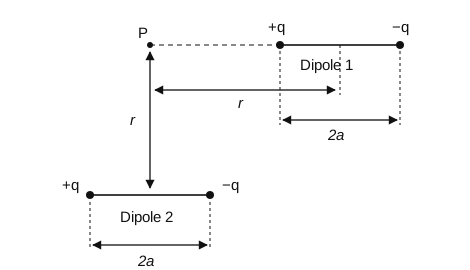
चित्र में दर्शाए अनुसार एक बिंदु कण, जिस पर आवेश
है, विद्युत द्विध्रुव 1 के अक्ष (axis) पर दूरी
पर बिंदु P पर स्थित है। बिंदु P एक दूसरे विद्युत द्विध्रुव 2 के निरक्षीय तल (equatorial plane) पर भी दूरी
पर है। द्विध्रुव, दूरी
से पृथक विपरीत आवेशों
से बने हैं। P पर स्थित आवेशित कण पर कोई नेट बल न लगे, इसके लिए निम्नलिखित में से कौन-सा कथन स्थिति का सही वर्णन करता है?
- A
- B
- C
- D
Show answer
Concept: Exact (not small-) dipole fields. Axial field: ; equatorial field: , with . The two fields at P are oppositely directed, so the net force on vanishes when their magnitudes are equal.
- Equate the magnitudes: .
- So . Put and divide by : .
- Test the options. For : LHS , RHS — nearly equal. For the two sides differ by orders of magnitude.
- Hence the force balances when .
Short trick: For the axial field () is always double the equatorial field () — they can never cancel. So the answer must be a large ; checking works at once.
Answer: (D)
अवधारणा: द्विध्रुव के यथार्थ (बिना सन्निकटन) क्षेत्र। अक्षीय क्षेत्र: ; निरक्षीय क्षेत्र: , जहाँ । P पर दोनों क्षेत्र विपरीत दिशा में हैं, अतः परिमाण बराबर होने पर पर नेट बल शून्य होगा।
- परिमाण बराबर रखें: ।
- अतः । रखकर से भाग दें: ।
- विकल्प जाँचें। के लिए: बायाँ पक्ष , दायाँ पक्ष — लगभग बराबर। के लिए दोनों पक्ष बहुत भिन्न हैं।
- अतः बल संतुलन पर होता है।
शॉर्ट ट्रिक: के लिए अक्षीय क्षेत्र () सदैव निरक्षीय क्षेत्र () का दुगुना होता है — वे कभी निरस्त नहीं हो सकते। अतः उत्तर बड़ा ही होगा; रखते ही संतुलन मिल जाता है।
उत्तर: (D)
JEE Main 2025 (January) – Paper 1 (B.E./B.Tech)PhysicsElectrostatics – electric dipoleJEE Main 2025 (January) – Paper 1 (B.E./B.Tech) 2025 · 23 Jan Shift 1
Q552.A spherical surface of radius of curvature , separates air from glass (refractive index ). The centre of curvature is in the glass medium. A point object 'O' placed in air on the optic axis of the surface, so that its real image is formed at 'I' inside glass. The line OI intersects the spherical surface at P and . The distance PO equals to
वक्रता त्रिज्या का एक गोलीय पृष्ठ, वायु को काँच (अपवर्तनांक ) से पृथक करता है। वक्रता केंद्र काँच माध्यम में है। एक बिंदु वस्तु 'O' वायु में पृष्ठ के मुख्य अक्ष पर इस प्रकार रखी है कि उसका वास्तविक प्रतिबिंब काँच के भीतर 'I' पर बनता है। रेखा OI गोलीय पृष्ठ को P पर काटती है तथा है। दूरी PO बराबर है
- A5 R
- B3 R
- C1.5 R
- D2 R
Show answer
Concept: Refraction at a single spherical surface: (sign convention: distances from P, light travels from air into glass, positive as centre of curvature lies in glass).
- Let . Then (object in air) and (real image in glass).
- .
Short trick: With , the equation collapses to , so .
Answer: (A)
अवधारणा: एकल गोलीय पृष्ठ पर अपवर्तन: (चिह्न परिपाटी: दूरियाँ P से, प्रकाश वायु से काँच में जाता है, वक्रता केंद्र काँच में होने से धनात्मक)।
- मान लें । तब (वस्तु वायु में) तथा (वास्तविक प्रतिबिंब काँच में)।
- ।
शॉर्ट ट्रिक: होने पर समीकरण बन जाता है, अतः ।
उत्तर: (A)
JEE Main 2025 (January) – Paper 1 (B.E./B.Tech)PhysicsRay optics – refraction at spherical surfaceJEE Main 2025 (January) – Paper 1 (B.E./B.Tech) 2025 · 23 Jan Shift 1
Q553.The position of a particle moving on -axis is given by , where is time. The dimension of is
-अक्ष पर गतिमान एक कण की स्थिति द्वारा दी जाती है, जहाँ समय है। की विमा है
- A
- B
- C
- D
Show answer
Concept: Every term added to give position must itself have the dimension of length; arguments of and are dimensionless.
- ; similarly and .
- .
- .
Short trick: In , one (from , or ) cancels, leaving times the carried by .
Answer: (A)
अवधारणा: स्थिति देने वाले प्रत्येक जोड़े गए पद की विमा लंबाई की होनी चाहिए; व के कोणांक विमाहीन होते हैं।
- ; इसी प्रकार तथा ।
- ।
- ।
शॉर्ट ट्रिक: में एक (, या से) कट जाता है, शेष रहता है और वाला ।
उत्तर: (A)
JEE Main 2025 (January) – Paper 1 (B.E./B.Tech)PhysicsUnits and dimensionsJEE Main 2025 (January) – Paper 1 (B.E./B.Tech) 2025 · 23 Jan Shift 1
Q554.Given a thin convex lens (refractive index ), kept in a liquid (refractive index , ) having radii of curvatures and . Its second surface is silver polished. Where should an object be placed on the optic axis so that a real and inverted image is formed at the same place?
एक पतला उत्तल लेंस (अपवर्तनांक ) एक द्रव (अपवर्तनांक , ) में रखा है, जिसकी वक्रता त्रिज्याएँ तथा हैं। इसके दूसरे पृष्ठ पर चाँदी की पॉलिश (silver polish) की गई है। मुख्य अक्ष पर वस्तु कहाँ रखी जाए कि वास्तविक एवं उल्टा प्रतिबिंब उसी स्थान पर बने?
- A
- B
- C
- D
Show answer
Concept: A lens silvered on its back face acts as an equivalent mirror with power . An object kept at the centre of curvature of this equivalent mirror () forms a real, inverted image at the same place.
- Lens in liquid: (convex: , ).
- Silvered second surface is a concave mirror: .
- .
- Required object distance .
Short trick: "Real, inverted image at the object itself" always means the object sits at (centre of curvature) of the equivalent mirror — just compute .
Answer: (A)
अवधारणा: पिछले पृष्ठ पर पॉलिश किया लेंस एक तुल्य दर्पण की तरह कार्य करता है जिसकी क्षमता होती है। इस तुल्य दर्पण के वक्रता केंद्र () पर रखी वस्तु का वास्तविक, उल्टा प्रतिबिंब उसी स्थान पर बनता है।
- द्रव में लेंस: (उत्तल: , )।
- पॉलिश किया दूसरा पृष्ठ अवतल दर्पण है: ।
- ।
- अभीष्ट वस्तु दूरी ।
शॉर्ट ट्रिक: "वस्तु के स्थान पर ही वास्तविक, उल्टा प्रतिबिंब" का अर्थ सदैव है कि वस्तु तुल्य दर्पण के (वक्रता केंद्र) पर है — बस निकालें।
उत्तर: (A)
JEE Main 2025 (January) – Paper 1 (B.E./B.Tech)PhysicsRay optics – silvered lensJEE Main 2025 (January) – Paper 1 (B.E./B.Tech) 2025 · 23 Jan Shift 1
Q555.Refer to the circuit diagram given in the figure. which of the following observations are correct?
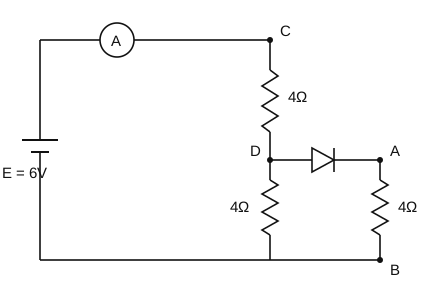
A. Total resistance of circuit is
B. Current in Ammeter is 1 A
C. Potential across AB is 4 Volts.
D. Potential across CD is 4 Volts
E. Total resistance of the circuit is
.
Choose the correct answer from the options given below:
चित्र में दिए गए परिपथ आरेख के आधार पर, निम्नलिखित में से कौन-से प्रेक्षण सही हैं?
A. परिपथ का कुल प्रतिरोध
है
B. अमीटर में धारा 1 A है
C. AB के सिरों पर विभव 4 वोल्ट है।
D. CD के सिरों पर विभव 4 वोल्ट है
E. परिपथ का कुल प्रतिरोध
है।
नीचे दिए गए विकल्पों में से सही उत्तर चुनिए:
- AA, B and D Onlyकेवल A, B तथा D
- BA, B and C Onlyकेवल A, B तथा C
- CA, C and D Onlyकेवल A, C तथा D
- DB, C and E Onlyकेवल B, C तथा E
Show answer
Concept: The diode is forward biased (current can flow from D through it towards A), so it behaves as an ideal conductor. Then reduce the network.
- From D two parallel paths reach the bottom rail: the direct , and the diode + (AB). Parallel value .
- Total resistance — A is correct, E is wrong.
- Ammeter current A — B is correct.
- V — D is correct.
- Across the parallel pair: V, which splits the current equally (A each). So V, not 4 V — C is wrong.
Short trick: Series 4 Ω takes 4 V of the 6 V; only 2 V is left for the parallel part, so AB can never be at 4 V.
Answer: (A) A, B and D Only
अवधारणा: डायोड अग्र अभिनत (forward biased) है (धारा D से होकर A की ओर बह सकती है), अतः यह आदर्श चालक की तरह व्यवहार करता है। अब परिपथ को सरल करें।
- D से नीचे की पट्टी तक दो समांतर पथ हैं: सीधा , तथा डायोड + (AB)। समांतर मान ।
- कुल प्रतिरोध — A सही, E गलत।
- अमीटर की धारा A — B सही।
- V — D सही।
- समांतर युग्म पर: V, धारा बराबर बँटती है (A प्रत्येक)। अतः V, 4 V नहीं — C गलत।
शॉर्ट ट्रिक: श्रेणी वाला 4 Ω, 6 V में से 4 V ले लेता है; समांतर भाग के लिए केवल 2 V बचता है, अतः AB पर 4 V कभी नहीं हो सकता।
उत्तर: (A) केवल A, B तथा D
JEE Main 2025 (January) – Paper 1 (B.E./B.Tech)PhysicsCurrent electricity – circuit with diodeJEE Main 2025 (January) – Paper 1 (B.E./B.Tech) 2025 · 23 Jan Shift 1
Q556.Given below are two statements:
Statement I: The hot water flows faster than cold water
Statement II: Soap water has higher surface tension as compared to fresh water.
In the light above statements, choose the correct answer from the options given below
नीचे दो कथन दिए गए हैं:
कथन I: गर्म पानी, ठंडे पानी की अपेक्षा तेज़ी से बहता है
कथन II: साबुन के पानी का पृष्ठ तनाव (surface tension), स्वच्छ पानी की अपेक्षा अधिक होता है।
उपर्युक्त कथनों के आलोक में, नीचे दिए गए विकल्पों में से सही उत्तर चुनिए
- AStatement I is true but Statement II is falseकथन I सत्य है परंतु कथन II असत्य है
- BStatement I is false but Statement II is trueकथन I असत्य है परंतु कथन II सत्य है
- CBoth Statement I and Statement II are falseकथन I और कथन II दोनों असत्य हैं
- DBoth Statement I and Statement II are trueकथन I और कथन II दोनों सत्य हैं
Show answer
Concept: Viscosity of liquids decreases on heating; dissolving soap/detergent lowers the surface tension of water.
- Statement I: On heating, the viscosity of water falls, so hot water meets less internal friction and flows faster than cold water — true.
- Statement II: Soap molecules accumulate at the surface and reduce surface tension (that is why soap water spreads and wets better) — soap water has lower surface tension than fresh water, so the statement is false.
Short trick: Soap always lowers surface tension — that is the whole point of a detergent.
Answer: (A) Statement I is true but Statement II is false
अवधारणा: गर्म करने पर द्रवों की श्यानता (viscosity) घटती है; साबुन/अपमार्जक घोलने पर पानी का पृष्ठ तनाव घटता है।
- कथन I: गर्म करने पर पानी की श्यानता घट जाती है, अतः गर्म पानी को आंतरिक घर्षण कम मिलता है और वह ठंडे पानी से तेज़ बहता है — सत्य।
- कथन II: साबुन के अणु सतह पर एकत्र होकर पृष्ठ तनाव घटा देते हैं (इसीलिए साबुन का पानी बेहतर फैलता और भिगोता है) — साबुन के पानी का पृष्ठ तनाव स्वच्छ पानी से कम होता है, अतः कथन असत्य।
शॉर्ट ट्रिक: साबुन सदैव पृष्ठ तनाव घटाता है — अपमार्जक का यही तो कार्य है।
उत्तर: (A) कथन I सत्य है परंतु कथन II असत्य है
JEE Main 2025 (January) – Paper 1 (B.E./B.Tech)PhysicsFluid mechanics – viscosity and surface tensionJEE Main 2025 (January) – Paper 1 (B.E./B.Tech) 2025 · 23 Jan Shift 1
Q557.Consider a circular disc of radius 20 cm with centre located at the origin. A circular hole of radius 5 cm is cut from this disc in such a way that the edge of the hole touches the edge of the disc. The distance of centre of mass of residual or remaining disc from the origin will be
मूल बिंदु पर केंद्र वाली 20 cm त्रिज्या की एक वृत्ताकार चकती लीजिए। इस चकती से 5 cm त्रिज्या का एक वृत्ताकार छिद्र इस प्रकार काटा जाता है कि छिद्र का किनारा चकती के किनारे को स्पर्श करता है। शेष बची चकती के द्रव्यमान केंद्र की मूल बिंदु से दूरी होगी
- A2.0 cm
- B1.5 cm
- C1.0 cm
- D0.5 cm
Show answer
Concept: Treat the hole as negative mass. For a uniform disc of radius with a hole of radius whose centre is at distance from the disc centre: .
- The hole touches the edge internally, so its centre is at cm from the origin.
- cm.
- Distance of the centre of mass of the remaining disc from the origin cm (on the side opposite to the hole).
Short trick: Masses scale as areas: ; shift cm.
Answer: (C) 1.0 cm
अवधारणा: छिद्र को ऋणात्मक द्रव्यमान मानें। त्रिज्या की एकसमान चकती में त्रिज्या का छिद्र, जिसका केंद्र चकती के केंद्र से दूरी पर है: ।
- छिद्र किनारे को भीतर से छूता है, अतः उसका केंद्र मूल बिंदु से cm पर है।
- cm।
- शेष चकती के द्रव्यमान केंद्र की मूल बिंदु से दूरी cm (छिद्र के विपरीत ओर)।
शॉर्ट ट्रिक: द्रव्यमान क्षेत्रफल के अनुपात में: ; विस्थापन cm।
उत्तर: (C) 1.0 cm
JEE Main 2025 (January) – Paper 1 (B.E./B.Tech)PhysicsCentre of mass – disc with cavityJEE Main 2025 (January) – Paper 1 (B.E./B.Tech) 2025 · 23 Jan Shift 1
Q558.The electric flux is where and are linear and surface charge density, respectively. represents
विद्युत फ्लक्स है, जहाँ तथा क्रमशः रैखिक एवं पृष्ठ आवेश घनत्व हैं। निरूपित करता है
- Aelectric fieldविद्युत क्षेत्र
- Bareaक्षेत्रफल
- Cchargeआवेश
- Ddisplacementविस्थापन
Show answer
Concept: Both terms must have the dimension of electric flux. , .
- .
- .
- — the dimension of length, i.e. displacement.
Short trick: dimensionally .
Answer: (D) displacement
अवधारणा: दोनों पदों की विमा विद्युत फ्लक्स की होनी चाहिए। , ।
- ।
- ।
- — लंबाई की विमा, अर्थात विस्थापन।
शॉर्ट ट्रिक: विमीय रूप से ।
उत्तर: (D) विस्थापन
JEE Main 2025 (January) – Paper 1 (B.E./B.Tech)PhysicsUnits and dimensions – electric fluxJEE Main 2025 (January) – Paper 1 (B.E./B.Tech) 2025 · 23 Jan Shift 1
Q559.A sub-atomic particle of mass kg is moving with a velocity m/s. Under the matter wave consideration, the particle will behave closely like J.s
kg द्रव्यमान का एक उप-परमाण्विक कण m/s वेग से गतिमान है। द्रव्य तरंग (matter wave) की दृष्टि से यह कण लगभग किसके समान व्यवहार करेगा? J.s
- AVisible radiationदृश्य विकिरण
- BGamma raysगामा किरणें
- CInfra-red radiationअवरक्त (इन्फ्रा-रेड) विकिरण
- DX-raysX-किरणें
Show answer
Concept: de Broglie wavelength ; then compare with the electromagnetic spectrum.
- m.
- Å nm, which lies in the X-ray region (– nm).
- Visible light is 400–700 nm, infra-red is longer still, and gamma rays are shorter than about nm — none of these match.
Short trick: ; powers: m → a few Å → X-rays.
Answer: (D) X-rays
अवधारणा: डी-ब्रॉग्ली तरंगदैर्घ्य ; फिर विद्युतचुंबकीय स्पेक्ट्रम से तुलना करें।
- m।
- Å nm, जो X-किरण क्षेत्र (– nm) में आता है।
- दृश्य प्रकाश 400–700 nm, अवरक्त उससे भी लंबा, तथा गामा किरणें लगभग nm से छोटी होती हैं — इनमें से कोई मेल नहीं खाता।
शॉर्ट ट्रिक: ; घातें: m → कुछ Å → X-किरणें।
उत्तर: (D) X-किरणें
JEE Main 2025 (January) – Paper 1 (B.E./B.Tech)PhysicsDual nature – matter wavesJEE Main 2025 (January) – Paper 1 (B.E./B.Tech) 2025 · 23 Jan Shift 1
Q560.Consider a moving coil galvanomenter (MCG):
A. The torsional constant in moving coil galvanometer has dimentions
B. Increasing the current sensitivity may not necessarily increase the voltage sensitivity.
C. If we increase number of turns to its double , then the voltage sensitivity doubles.
D. MCG can be converted into an ammeter by introducing a shunt resistance of large value in parallel with galvanometer.
E. Current sensitivity of MCG depends inversely on number of turns of coil.
Choose the correct answer from the options given below:
एक चल कुंडली धारामापी (MCG) पर विचार कीजिए:
A. चल कुंडली धारामापी में ऐंठन नियतांक (torsional constant) की विमाएँ हैं
B. धारा सुग्राहिता बढ़ाने से वोल्टता सुग्राहिता का बढ़ना आवश्यक नहीं है।
C. यदि फेरों की संख्या को दुगुना कर दें, तो वोल्टता सुग्राहिता दुगुनी हो जाती है।
D. धारामापी के समांतर बड़े मान का शंट प्रतिरोध लगाकर MCG को अमीटर में बदला जा सकता है।
E. MCG की धारा सुग्राहिता कुंडली के फेरों की संख्या के व्युत्क्रमानुपाती होती है।
नीचे दिए गए विकल्पों में से सही उत्तर चुनिए:
- AA, D Onlyकेवल A, D
- BA, B, E Onlyकेवल A, B, E
- CB, D, E Onlyकेवल B, D, E
- DA, B Onlyकेवल A, B
Show answer
Concept: For an MCG, current sensitivity and voltage sensitivity , where is the torsional constant and the coil resistance.
- A: = torque per unit twist; torque has dimensions and angle is dimensionless, so — correct.
- B: Doubling doubles current sensitivity, but also roughly doubles (more wire), so voltage sensitivity need not rise — correct.
- C: With , as well, so stays nearly unchanged, it does not double — wrong.
- D: An ammeter needs a small shunt in parallel, not a large one — wrong.
- E: Current sensitivity is directly proportional to , not inverse — wrong.
Short trick: Remember the pair: current sensitivity ; voltage sensitivity — and grows with .
Answer: (D) A, B Only
अवधारणा: MCG के लिए धारा सुग्राहिता तथा वोल्टता सुग्राहिता , जहाँ ऐंठन नियतांक और कुंडली का प्रतिरोध है।
- A: = प्रति एकांक ऐंठन बल-आघूर्ण; बल-आघूर्ण की विमाएँ हैं और कोण विमाहीन है, अतः — सही।
- B: दुगुना करने पर धारा सुग्राहिता दुगुनी होती है, परंतु भी लगभग दुगुना हो जाता है (तार अधिक), अतः वोल्टता सुग्राहिता का बढ़ना आवश्यक नहीं — सही।
- C: के साथ भी, अतः लगभग अपरिवर्तित रहती है, दुगुनी नहीं होती — गलत।
- D: अमीटर के लिए समांतर में छोटा शंट चाहिए, बड़ा नहीं — गलत।
- E: धारा सुग्राहिता के अनुक्रमानुपाती है, व्युत्क्रमानुपाती नहीं — गलत।
शॉर्ट ट्रिक: यह जोड़ी याद रखें: धारा सुग्राहिता ; वोल्टता सुग्राहिता — और , के साथ बढ़ता है।
उत्तर: (D) केवल A, B
JEE Main 2025 (January) – Paper 1 (B.E./B.Tech)PhysicsMoving coil galvanometerJEE Main 2025 (January) – Paper 1 (B.E./B.Tech) 2025 · 23 Jan Shift 1

