Q521.0.01 mole of an organic compound (X) containing 10% hydrogen, on complete combustion produced 0.9 g H2O . Molar mass of (X) is _____ g mol−1.
10% हाइड्रोजन युक्त एक कार्बनिक यौगिक (X) के 0.01 मोल के पूर्ण दहन से 0.9 g H2O उत्पन्न हुआ। (X) का मोलर द्रव्यमान _____ g mol−1 है।
Show answer
Concept: All hydrogen of the compound appears in the water formed; combine it with the mass-percent of H.
- Moles of H2O mol → moles of H atoms mol → mass of H g.
- H is 10% of the compound: mass of X burnt g.
- This mass corresponds to 0.01 mol, so .
Short trick: g of H = g of H2O ÷ 9; then divide by the H-fraction and by the moles.
Answer: 100
अवधारणा: यौगिक का सारा हाइड्रोजन बने जल में जाता है; इसे H के द्रव्यमान-प्रतिशत से जोड़िए।
- H2O के मोल mol → H परमाणुओं के मोल mol → H का द्रव्यमान g।
- H यौगिक का 10% है: जले हुए X का द्रव्यमान g।
- यह द्रव्यमान 0.01 mol का है, अतः ।
शॉर्ट ट्रिक: H का ग्राम = H2O का ग्राम ÷ 9; फिर H-अंश व मोल से भाग दीजिए।
उत्तर: 100
JEE Main 2025 (January) – Paper 1 (B.E./B.Tech)ChemistrySome Basic Concepts – molar mass from combustion dataJEE Main 2025 (January) – Paper 1 (B.E./B.Tech) 2025 · 23 Jan Shift 2
Q522.A compound ' X ' absorbs 2 moles of hydrogen and ' X ' upon oxidation with KMnO4 | H+ gives
CH3−CO−CH3, CH3−CO−OH and CH3−CO−CH2CH2−CO−OH.
The total number of σ bonds present in the compound ' X ' is ______
एक यौगिक ' X ' हाइड्रोजन के 2 मोल अवशोषित करता है तथा ' X ' KMnO4 | H+ के साथ ऑक्सीकरण पर
CH3−CO−CH3, CH3−CO−OH तथा CH3−CO−CH2CH2−CO−OH देता है।
यौगिक ' X ' में उपस्थित σ बंधों की कुल संख्या ______ है।
Show answer
Concept: Two moles of H2 absorbed → two C=C; oxidative cleavage with KMnO4/H+ converts each doubly-bonded carbon into C=O (–COOH if it carried an H). Rebuild X by joining the fragments at their carbonyl carbons.
- CH3COCH3 comes from a (CH3)2C= end; CH3COOH from a CH3–CH= end; CH3CO–CH2CH2–COOH from the middle piece =C(CH3)–CH2CH2–CH=.
- Joining: X = (CH3)2C=C(CH3)–CH2CH2–CH=CH–CH3 (2,3-dimethylocta-2,6-diene), C10H18, which indeed adds 2 H2.
- σ count: C–C σ bonds (10 carbons, acyclic; each C=C contributes one σ) and C–H σ bonds .
- Total σ .
Short trick: For an acyclic CnHm molecule, σ bonds regardless of how many π bonds it has.
Answer: 27
अवधारणा: 2 मोल H2 अवशोषण → दो C=C; KMnO4/H+ से ऑक्सीकारी विदलन प्रत्येक द्विबंधित कार्बन को C=O (H होने पर –COOH) में बदलता है। खंडों को कार्बोनिल कार्बनों पर जोड़कर X बनाइए।
- CH3COCH3 (CH3)2C= सिरे से; CH3COOH CH3–CH= सिरे से; CH3CO–CH2CH2–COOH बीच वाले खंड =C(CH3)–CH2CH2–CH= से।
- जोड़ने पर: X = (CH3)2C=C(CH3)–CH2CH2–CH=CH–CH3 (2,3-डाइमेथिलऑक्टा-2,6-डाईन), C10H18, जो वास्तव में 2 H2 जोड़ता है।
- σ गणना: C–C σ बंध (10 कार्बन, अचक्रीय; प्रत्येक C=C में एक σ) तथा C–H σ बंध ।
- कुल σ ।
शॉर्ट ट्रिक: अचक्रीय CnHm अणु में σ बंध , π बंधों की संख्या चाहे जो हो।
उत्तर: 27
JEE Main 2025 (January) – Paper 1 (B.E./B.Tech)ChemistryOrganic Chemistry – structure elucidation and σ bondsJEE Main 2025 (January) – Paper 1 (B.E./B.Tech) 2025 · 23 Jan Shift 2
Q523.When 81.0 g of aluminium is allowed to react with 128.0 g of oxygen gas, the mass of aluminium oxide produced in grams is_______ - (Nearest integer) Given : Molar mass of Al is 27.0 g mol−1 Molar mass of O is 16.0 g mol−1
जब 81.0 g ऐलुमिनियम को 128.0 g ऑक्सीजन गैस के साथ अभिक्रिया करने दिया जाता है, तो उत्पन्न ऐलुमिनियम ऑक्साइड का द्रव्यमान (ग्राम में) _______ है। (निकटतम पूर्णांक) दिया है : Al का मोलर द्रव्यमान 27.0 g mol−1, O का मोलर द्रव्यमान 16.0 g mol−1
Show answer
Concept: ; find the limiting reagent, then the product mass.
- Moles: Al mol; O2 mol.
- 3 mol Al needs mol O2 (< 4 mol available) → Al is limiting.
- Al2O3 formed mol; .
- Mass g.
Short trick: Divide moles by coefficients (3/4 = 0.75 vs 4/3 = 1.33): smaller ratio (Al) limits.
Answer: 153
अवधारणा: ; सीमांत अभिकर्मक निकालकर उत्पाद का द्रव्यमान ज्ञात कीजिए।
- मोल: Al mol; O2 mol।
- 3 mol Al को mol O2 चाहिए (उपलब्ध 4 mol से कम) → Al सीमांत है।
- बना Al2O3 mol; ।
- द्रव्यमान g।
शॉर्ट ट्रिक: मोल ÷ गुणांक (3/4 = 0.75 बनाम 4/3 = 1.33): छोटा अनुपात (Al) सीमांत।
उत्तर: 153
JEE Main 2025 (January) – Paper 1 (B.E./B.Tech)ChemistryMole Concept – limiting reagentJEE Main 2025 (January) – Paper 1 (B.E./B.Tech) 2025 · 23 Jan Shift 2
Q524.The bond dissociation enthalpy of X2, calculated from the given data is ______ . (Nearest integer)
[Given : M+X− is a pure ionic compound and X forms a diatomic molecule X2 in gaseous state]
दिए गए आँकड़ों से परिकलित X2 की बंध वियोजन एन्थैल्पी ______ है। (निकटतम पूर्णांक)
[दिया है : M+X− एक शुद्ध आयनिक यौगिक है तथा X गैसीय अवस्था में द्विपरमाणुक अणु X2 बनाता है]
Show answer
Concept: Born–Haber cycle: (lattice enthalpy as given is for breaking the solid, so formation of the solid from gaseous ions contributes ).
- Substitute (all in kJ mol−1): .
- .
- .
Short trick: Only ½X2 is used, so the unknown enters as D/2 – don't forget to double at the end.
Answer: 200
अवधारणा: बॉर्न–हैबर चक्र: (दी गई जालक एन्थैल्पी ठोस तोड़ने की है, अतः गैसीय आयनों से ठोस बनने का योगदान )।
- मान रखिए (सभी kJ mol−1 में): ।
- ।
- ।
शॉर्ट ट्रिक: केवल ½X2 प्रयुक्त है, अतः अज्ञात D/2 के रूप में आता है – अंत में दुगुना करना न भूलिए।
उत्तर: 200
JEE Main 2025 (January) – Paper 1 (B.E./B.Tech)ChemistryThermochemistry – Born–Haber cycleJEE Main 2025 (January) – Paper 1 (B.E./B.Tech) 2025 · 23 Jan Shift 2
Q525.Consider the following sequence of reactions.
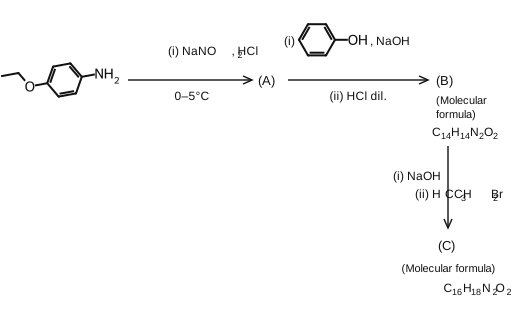
Total number of sp
3 hybridised carbon atoms in the major product C formed is________
निम्नलिखित अभिक्रिया अनुक्रम पर विचार कीजिए।
बने मुख्य उत्पाद C में sp
3 संकरित कार्बन परमाणुओं की कुल संख्या ________ है।
Show answer
Concept: Diazotisation → azo coupling with phenol → Williamson etherification of the phenolic –OH.
- 4-Ethoxyaniline + NaNO2/HCl at 0–5 °C gives the diazonium salt (A), 4-ethoxybenzenediazonium chloride.
- (A) couples with phenol in NaOH (coupling at the para position), and mild acidification gives the azo dye (B): 4-[(4-ethoxyphenyl)diazenyl]phenol, C14H14N2O2.
- (B) + NaOH forms the phenoxide, which reacts with CH3CH2Br (Williamson synthesis) to give (C): 1-ethoxy-4-[(4-ethoxyphenyl)diazenyl]benzene – both rings now carry –OC2H5; formula C16H18N2O2.
- In (C) the aromatic carbons and the –N=N– unit are sp2; the only sp3 carbons are the two –OCH2CH3 groups: .
Short trick: In an aromatic azo dye, count only the carbons of the alkoxy/alkyl chains for sp3.
Answer: 4
अवधारणा: डाइएज़ोटीकरण → फ़िनॉल के साथ ऐज़ो युग्मन → फ़िनॉलिक –OH का विलियमसन ईथरीकरण।
- 4-एथॉक्सीऐनिलीन + NaNO2/HCl (0–5 °C) डाइएज़ोनियम लवण (A), 4-एथॉक्सीबेंज़ीनडाइएज़ोनियम क्लोराइड देता है।
- (A) NaOH में फ़िनॉल से युग्मित होता है (पैरा स्थिति पर), तथा मंद अम्लीकरण से ऐज़ो रंजक (B) मिलता है: 4-[(4-एथॉक्सीफ़ेनिल)डाइऐज़ेनिल]फ़िनॉल, C14H14N2O2।
- (B) + NaOH से फ़िनॉक्साइड बनता है, जो CH3CH2Br से (विलियमसन संश्लेषण) (C) देता है – अब दोनों वलयों पर –OC2H5 है; सूत्र C16H18N2O2।
- (C) में ऐरोमैटिक कार्बन तथा –N=N– इकाई sp2 हैं; sp3 कार्बन केवल दोनों –OCH2CH3 समूहों के हैं: ।
शॉर्ट ट्रिक: ऐरोमैटिक ऐज़ो रंजक में sp3 के लिए केवल ऐल्कॉक्सी/ऐल्किल शृंखलाओं के कार्बन गिनिए।
उत्तर: 4
JEE Main 2025 (January) – Paper 1 (B.E./B.Tech)ChemistryDiazonium Salts – azo coupling and Williamson synthesisJEE Main 2025 (January) – Paper 1 (B.E./B.Tech) 2025 · 23 Jan Shift 2
Q526.If the first term of an A.P. is 3 and the sum of its first four terms is equal to one-fifth of the sum of the next four terms, then the sum of the first 20 terms is equal to
यदि किसी समान्तर श्रेढ़ी (A.P.) का प्रथम पद 3 है तथा इसके प्रथम चार पदों का योग, अगले चार पदों के योग के पाँचवें भाग के बराबर है, तो प्रथम 20 पदों का योग बराबर है
- A
- B
- C
- D
Show answer
Concept: For an A.P., ; the sum of the next four terms after the first four is .
- Given .
- With : and .
- .
- .
Answer: (A)
अवधारणा: समान्तर श्रेढ़ी में ; प्रथम चार पदों के बाद के अगले चार पदों का योग होता है।
- दिया है ।
- लेने पर: तथा ।
- ।
- ।
उत्तर: (A)
JEE Main 2025 (January) – Paper 1 (B.E./B.Tech)MathematicsSequences & Series – A.P.JEE Main 2025 (January) – Paper 1 (B.E./B.Tech) 2025 · 23 Jan Shift 1
Q527.One die has two faces marked 1 , two faces marked 2 , one face marked 3 and one face marked 4 . Another die has one face marked 1 , two faces marked 2 , two faces marked 3 and one face marked 4. The probability of getting the sum of numbers to be 4 or 5 , when both the dice are thrown together, is
एक पासे के दो फलकों पर 1, दो फलकों पर 2, एक फलक पर 3 तथा एक फलक पर 4 अंकित है। एक अन्य पासे के एक फलक पर 1, दो फलकों पर 2, दो फलकों पर 3 तथा एक फलक पर 4 अंकित है। दोनों पासों को एक साथ फेंकने पर संख्याओं का योग 4 या 5 प्राप्त होने की प्रायिकता है
- A
- B
- C
- D
Show answer
Concept: Count favourable face-pairs out of equally likely outcomes, using the number of faces carrying each mark.
- Die 1 face counts: ; Die 2: .
- Sum : , , → ways.
- Sum : , , , → ways.
- Probability .
Answer: (B)
अवधारणा: समसम्भाव्य परिणामों में से अनुकूल फलक-युग्मों को गिनें, प्रत्येक अंक वाले फलकों की संख्या का उपयोग करते हुए।
- पासा 1 के फलक: ; पासा 2 के फलक: ।
- योग : , , → तरीके।
- योग : , , , → तरीके।
- प्रायिकता ।
उत्तर: (B)
JEE Main 2025 (January) – Paper 1 (B.E./B.Tech)MathematicsProbability – non-standard diceJEE Main 2025 (January) – Paper 1 (B.E./B.Tech) 2025 · 23 Jan Shift 1
Q528.Let the position vectors of the vertices and of a tetrahedron be , and respectively. The altitude from the vertex to the opposite face meets the median line segment through of the triangle at the point . If the length of is and the volume of the tetrahedron is , then the position vector of is
माना एक चतुष्फलक (tetrahedron) के शीर्षों तथा के स्थिति सदिश क्रमशः , तथा हैं। शीर्ष से सम्मुख फलक पर डाला गया शीर्षलम्ब, त्रिभुज की से होकर जाने वाली माध्यिका रेखाखण्ड को बिन्दु पर मिलता है। यदि की लम्बाई है तथा चतुष्फलक का आयतन है, तो का स्थिति सदिश है
- A
- B
- C
- D
Show answer
Concept: is the foot of the altitude from , so plane and ; Volume .
- , , ; midpoint of is , so , with , .
- , so area . Then .
- , so .
- .
Answer: (D)
अवधारणा: , से डाले गए शीर्षलम्ब का पाद है, अतः समतल तथा ; आयतन का क्षेत्रफल।
- , , ; का मध्य-बिन्दु है, अतः , जहाँ , ।
- , अतः क्षेत्रफल । तब ।
- , अतः ।
- ।
उत्तर: (D)
JEE Main 2025 (January) – Paper 1 (B.E./B.Tech)MathematicsVector Algebra & 3D – tetrahedronJEE Main 2025 (January) – Paper 1 (B.E./B.Tech) 2025 · 23 Jan Shift 1
Q529.If , and are non-singular matrices of same order, then the inverse of , is equal to
यदि तथा समान कोटि के व्युत्क्रमणीय (non-singular) आव्यूह हैं, तो का व्युत्क्रम बराबर है
- A
- B
- C
- D
Show answer
Concept: , so ; also .
- Required inverse .
- .
- Option (D): — the same expression. Options (A), (B) and (C) do not simplify to this.
Answer: (D)
अवधारणा: , अतः ; साथ ही ।
- अभीष्ट व्युत्क्रम ।
- ।
- विकल्प (D): — यही व्यंजक है। विकल्प (A), (B) तथा (C) इस रूप में सरल नहीं होते।
उत्तर: (D)
JEE Main 2025 (January) – Paper 1 (B.E./B.Tech)MathematicsMatrices – adjoint and inverseJEE Main 2025 (January) – Paper 1 (B.E./B.Tech) 2025 · 23 Jan Shift 1
Q530.Marks obtains by all the students of class 12 are presented in a freqency distribution with classes of equal width. Let the median of this grouped data be 14 with median class interval 12-18 and median class frequency 12 . If the number of students whose marks are less than 12 is 18 , then the total number of students is
कक्षा 12 के सभी विद्यार्थियों द्वारा प्राप्त अंकों को समान चौड़ाई के वर्गों वाले एक बारम्बारता बंटन में प्रस्तुत किया गया है। माना इन वर्गीकृत आँकड़ों की माध्यिका 14 है, माध्यिका वर्ग अन्तराल 12-18 है तथा माध्यिका वर्ग की बारम्बारता 12 है। यदि 12 से कम अंक प्राप्त करने वाले विद्यार्थियों की संख्या 18 है, तो विद्यार्थियों की कुल संख्या है
- A52
- B48
- C44
- D40
Show answer
Concept: Median of grouped data: , where = lower limit, = cumulative frequency before the median class, = its frequency, = class width.
- Here , , , , Median .
- .
- .
Answer: (C) 44
अवधारणा: वर्गीकृत आँकड़ों की माध्यिका: , जहाँ = निम्न सीमा, = माध्यिका वर्ग से पहले की संचयी बारम्बारता, = उसकी बारम्बारता, = वर्ग चौड़ाई।
- यहाँ , , , , माध्यिका ।
- ।
- ।
उत्तर: (C) 44
JEE Main 2025 (January) – Paper 1 (B.E./B.Tech)MathematicsStatistics – median of grouped dataJEE Main 2025 (January) – Paper 1 (B.E./B.Tech) 2025 · 23 Jan Shift 1
Q531.Let a curve pass through the points and . If the curve satisfies the differential equation , then is equal to
माना एक वक्र बिन्दुओं तथा से होकर जाता है। यदि यह वक्र अवकल समीकरण को सन्तुष्ट करता है, तो बराबर है
- A4
- B32
- C8
- D16
Show answer
Concept: Separate the variables and integrate: .
- Both integrals are logarithmic: , i.e. .
- Point : , so .
- At : , so .
Short trick: — the numerator is exactly the derivative of the denominator, so both sides integrate to logarithms at sight.
Answer: (C) 8
अवधारणा: चरों को पृथक् कर समाकलन कीजिए: ।
- दोनों समाकलन लघुगणकीय हैं: , अर्थात् ।
- बिन्दु : , अतः ।
- पर: , अतः ।
शॉर्ट ट्रिक: — अंश, हर का अवकलज ही है, अतः दोनों पक्ष सीधे लघुगणक में समाकलित हो जाते हैं।
उत्तर: (C) 8
JEE Main 2025 (January) – Paper 1 (B.E./B.Tech)MathematicsDifferential Equations – variable separableJEE Main 2025 (January) – Paper 1 (B.E./B.Tech) 2025 · 23 Jan Shift 1
Q532.If the function is continuous at , then is equal to
यदि फलन , पर सतत है, तो बराबर है
- A20
- B5
- C8
- D10
Show answer
Concept: Continuity at : LHL RHL ; use and .
- LHL .
- RHL .
- and give , .
- .
Answer: (D) 10
अवधारणा: पर सांतत्यता: बायाँ सीमान्त दायाँ सीमान्त ; तथा का प्रयोग कीजिए।
- बायाँ सीमान्त ।
- दायाँ सीमान्त ।
- तथा से , ।
- ।
उत्तर: (D) 10
JEE Main 2025 (January) – Paper 1 (B.E./B.Tech)MathematicsContinuity of a functionJEE Main 2025 (January) – Paper 1 (B.E./B.Tech) 2025 · 23 Jan Shift 1
Q533.If the line intersects the parabola at the points and , then at the vertex of the parabola, the line segment subtends an angle equal to
यदि रेखा , परवलय को बिन्दुओं तथा पर प्रतिच्छेद करती है, तो परवलय के शीर्ष पर रेखाखण्ड द्वारा अन्तरित कोण बराबर है
- A
- B
- C
- D
Show answer
Concept: Find , by solving line and parabola together; the angle between and ( = vertex, origin) is .
- in : .
- , ; vertex of is .
- Slopes: , .
- .
Answer: (B)
अवधारणा: रेखा तथा परवलय को साथ हल कर , ज्ञात कीजिए; तथा ( = शीर्ष, मूलबिन्दु) के बीच कोण से मिलता है।
- को में रखने पर: ।
- , ; परवलय का शीर्ष है।
- ढाल: , ।
- ।
उत्तर: (B)
JEE Main 2025 (January) – Paper 1 (B.E./B.Tech)MathematicsParabola – angle subtended by a chordJEE Main 2025 (January) – Paper 1 (B.E./B.Tech) 2025 · 23 Jan Shift 1
Q534.Let be the foot of the perpendicular from the point on the line . Then the area of the right angled triangle , where is the point , is
माना बिन्दु से रेखा पर डाले गए लम्ब का पाद है। तब समकोण त्रिभुज का क्षेत्रफल, जहाँ बिन्दु है, है
- A
- B
- C
- D
Show answer
Concept: The foot of the perpendicular satisfies ; area of a right triangle (product of the legs).
- General point of the line: . .
- , so .
- , ; , so the right angle is at .
- Area .
Answer: (D)
अवधारणा: लम्ब के पाद के लिए ; समकोण त्रिभुज का क्षेत्रफल (समकोण बनाने वाली भुजाओं का गुणनफल)।
- रेखा का व्यापक बिन्दु: । ।
- , अतः ।
- , ; , अतः समकोण पर है।
- क्षेत्रफल ।
उत्तर: (D)
JEE Main 2025 (January) – Paper 1 (B.E./B.Tech)Mathematics3D Geometry – foot of perpendicularJEE Main 2025 (January) – Paper 1 (B.E./B.Tech) 2025 · 23 Jan Shift 1
Q535.Let the arc of a circle subtend a right angle at the centre . If the point on the arc , divides the arc such that , and , then is equal to
माना एक वृत्त का चाप केन्द्र पर समकोण अन्तरित करता है। यदि चाप पर स्थित बिन्दु , चाप को इस प्रकार विभाजित करता है कि (चाप की लम्बाई)/(चाप की लम्बाई) है, तथा है, तो बराबर है
- A
- B
- C
- D
Show answer
Concept: Arc lengths are proportional to central angles; take as origin with along the x-axis and compare components.
- and arc : arc , so , .
- With unit radius: , , .
- y: ; x: .
- Since : .
- .
Answer: (B)
अवधारणा: चापों की लम्बाइयाँ केन्द्रीय कोणों के समानुपाती होती हैं; को मूलबिन्दु तथा को x-अक्ष पर लेकर घटकों की तुलना कीजिए।
- तथा चाप : चाप , अतः , ।
- इकाई त्रिज्या लेने पर: , , ।
- y-घटक: ; x-घटक: ।
- चूँकि : ।
- ।
उत्तर: (B)
JEE Main 2025 (January) – Paper 1 (B.E./B.Tech)MathematicsVector Algebra – resolution of vectorsJEE Main 2025 (January) – Paper 1 (B.E./B.Tech) 2025 · 23 Jan Shift 1
Q536.Let and . Then the domain of is
माना तथा है। तब का प्रान्त (domain) है
- A
- B
- C
- D
Show answer
Concept: is defined where exists and .
- Denominator: for every real (both squares cannot vanish together), so is defined on .
- Numerator: for all .
- Hence for every real , so is defined for all .
Answer: (D)
अवधारणा: वहीं परिभाषित है जहाँ परिभाषित है तथा है।
- हर: प्रत्येक वास्तविक के लिए (दोनों वर्ग एक साथ शून्य नहीं हो सकते), अतः पूरे पर परिभाषित है।
- अंश: सभी के लिए।
- अतः प्रत्येक वास्तविक के लिए है, इसलिए सभी के लिए परिभाषित है।
उत्तर: (D)
JEE Main 2025 (January) – Paper 1 (B.E./B.Tech)MathematicsFunctions – domain of a composite functionJEE Main 2025 (January) – Paper 1 (B.E./B.Tech) 2025 · 23 Jan Shift 1
Q537.If the system of equations
has infinitely many solutions, then is equal to
यदि समीकरण निकाय
के अपरिमित रूप से अनेक हल हैं, तो बराबर है
- A6
- B10
- C20
- D12
Show answer
Concept: Infinitely many solutions need together with a consistent system (the zero determinant value must also make ).
- simplifies to , i.e. .
- For the system is inconsistent (the ranks of the coefficient and augmented matrices differ), so it is rejected.
- For the three equations are consistent and dependent → infinitely many solutions.
- .
Answer: (D) 12
अवधारणा: अपरिमित रूप से अनेक हलों के लिए के साथ-साथ निकाय का संगत (consistent) होना आवश्यक है (उसी मान पर भी हों)।
- सरल करने पर , अर्थात् ।
- के लिए निकाय असंगत है (गुणांक आव्यूह तथा संवर्धित आव्यूह की जातियाँ (ranks) भिन्न हैं), अतः यह मान अस्वीकार्य है।
- के लिए तीनों समीकरण संगत तथा परस्पर आश्रित हैं → अपरिमित रूप से अनेक हल।
- ।
उत्तर: (D) 12
JEE Main 2025 (January) – Paper 1 (B.E./B.Tech)MathematicsSystem of Linear EquationsJEE Main 2025 (January) – Paper 1 (B.E./B.Tech) 2025 · 23 Jan Shift 1
Q538.The number of words, which can be formed using all the letters of the word "DAUGHTER", so that all the vowels never come together, is
शब्द "DAUGHTER" के सभी अक्षरों का प्रयोग करके बनाए जा सकने वाले ऐसे शब्दों की संख्या, जिनमें सभी स्वर कभी एक साथ नहीं आते, है
- A36000
- B37000
- C34000
- D35000
Show answer
Concept: (All vowels never together) (total arrangements) (arrangements with all vowels together, treating them as one block).
- DAUGHTER has 8 distinct letters with vowels A, U, E.
- Total arrangements .
- All three vowels together: treat AUE as one block → .
- Required .
Answer: (A) 36000
अवधारणा: (सभी स्वर कभी एक साथ नहीं) (कुल विन्यास) (सभी स्वर एक साथ वाले विन्यास, उन्हें एक ब्लॉक मानकर)।
- DAUGHTER में 8 भिन्न अक्षर हैं, जिनमें स्वर A, U, E हैं।
- कुल विन्यास ।
- तीनों स्वर एक साथ: AUE को एक ब्लॉक मानें → ।
- अभीष्ट संख्या ।
उत्तर: (A) 36000
JEE Main 2025 (January) – Paper 1 (B.E./B.Tech)MathematicsPermutations & CombinationsJEE Main 2025 (January) – Paper 1 (B.E./B.Tech) 2025 · 23 Jan Shift 1
Q539.Let be a relation defined on the set . Then the minimum number of elements, needed to be added in so that becomes an equivalence relation, is:
माना समुच्चय पर परिभाषित एक संबंध है। तब में जोड़े जाने वाले अवयवों की वह न्यूनतम संख्या, जिससे एक तुल्यता संबंध (equivalence relation) बन जाए, है:
- A10
- B7
- C8
- D9
Show answer
Concept: An equivalence relation partitions the set into classes; if elements fall in one class, every ordered pair among them must be present.
- and force into a single equivalence class (symmetry and transitivity link them all).
- So the relation must contain all pairs on plus for reflexivity of 4 → pairs in total.
- already has 3 of these pairs, so the minimum number to be added .
Answer: (B) 7
अवधारणा: तुल्यता संबंध समुच्चय को वर्गों में विभाजित करता है; यदि अवयव एक ही वर्ग में हों, तो उनके बीच के सभी क्रमित युग्म संबंध में होने चाहिए।
- तथा के कारण (सममितता तथा संक्रामकता से) एक ही तुल्यता वर्ग में आ जाते हैं।
- अतः संबंध में पर सभी युग्म तथा 4 की स्वतुल्यता हेतु होना चाहिए → कुल युग्म।
- में इनमें से 3 युग्म पहले से हैं, अतः जोड़े जाने वाले युग्मों की न्यूनतम संख्या ।
उत्तर: (B) 7
JEE Main 2025 (January) – Paper 1 (B.E./B.Tech)MathematicsRelations – equivalence relationJEE Main 2025 (January) – Paper 1 (B.E./B.Tech) 2025 · 23 Jan Shift 1
Q540.Let the area of a with vertices , and be 35 square units. If its orthocenter and centroid are and respectively, then is equal to
माना शीर्षों , तथा वाले त्रिभुज का क्षेत्रफल 35 वर्ग इकाई है। यदि इसके लम्बकेन्द्र (orthocenter) तथा केन्द्रक (centroid) क्रमशः तथा हैं, तो बराबर है
- A
- B
- C2
- D3
Show answer
Concept: is horizontal, so the altitude from is vertical and passes through the orthocentre; each altitude is perpendicular to the opposite side.
- lies on with length 7; area .
- Altitude from is the vertical line ; it passes through , so .
- Altitude from passes through : must be : (consistent with the area).
- Centroid: , ; .
Answer: (D) 3
अवधारणा: क्षैतिज है, अतः से डाला गया शीर्षलम्ब ऊर्ध्वाधर होगा और लम्बकेन्द्र से होकर जाएगा; प्रत्येक शीर्षलम्ब सम्मुख भुजा पर लम्ब होता है।
- , रेखा पर है और इसकी लम्बाई 7 है; क्षेत्रफल ।
- से शीर्षलम्ब ऊर्ध्वाधर रेखा है; यह से होकर जाता है, अतः ।
- से शीर्षलम्ब से होकर जाता है: का पर लम्ब होना आवश्यक है: (क्षेत्रफल से संगत)।
- केन्द्रक: , ; ।
उत्तर: (D) 3
JEE Main 2025 (January) – Paper 1 (B.E./B.Tech)MathematicsStraight Lines – orthocentre and centroidJEE Main 2025 (January) – Paper 1 (B.E./B.Tech) 2025 · 23 Jan Shift 1

