Q561. | LIST-I | | LIST-II |
|---|
| A. | Pressure varies inversely with volume of an ideal gas. | I. | Adiabatic process |
| B. | Heat absorbed goes partly to increase internal energy and partly to do work. | II. | Isochoric process |
| C. | Heat is neither absorbed nor released by a system. | III. | Isothermal process |
| D. | No work is done on or by a gas. | IV. | Isobaric process |
| सूची-I | | सूची-II |
|---|
| A. | आदर्श गैस का दाब, आयतन के व्युत्क्रमानुपाती बदलता है। | I. | रुद्धोष्म प्रक्रम |
| B. | अवशोषित ऊष्मा का कुछ भाग आंतरिक ऊर्जा बढ़ाने में तथा कुछ भाग कार्य करने में जाता है। | II. | समआयतनिक प्रक्रम |
| C. | निकाय द्वारा ऊष्मा न अवशोषित होती है, न उत्सर्जित। | III. | समतापी प्रक्रम |
| D. | गैस पर या गैस द्वारा कोई कार्य नहीं होता। | IV. | समदाबी प्रक्रम |
- AA-III, B-IV, C-I, D-II
- BA-I, B-IV, C-II, D-III
- CA-III, B-I, C-IV, D-II
- DA-I, B-III, C-II, D-IV
Show answer
Concept: Identify each thermodynamic process from its defining property and the first law .
- A: means constant, i.e. Boyle's law at constant temperature → Isothermal (III).
- B: with all three non-zero happens at constant pressure → Isobaric (IV).
- C: No heat exchange () → Adiabatic (I).
- D: means constant volume → Isochoric (II).
- So A-III, B-IV, C-I, D-II. Options (B), (C), (D) each mismatch at least one pair (e.g. (C) pairs "no heat" with isochoric, (B) and (D) pair with adiabatic, which actually has const).
Short trick: const → isothermal; → adiabatic; → isochoric; the "partly-partly" statement is the isobaric one.
Answer: (A) A-III, B-IV, C-I, D-II
अवधारणा: प्रत्येक ऊष्मागतिक प्रक्रम को उसके परिभाषक गुण तथा प्रथम नियम से पहचानें।
- A: का अर्थ नियत, अर्थात नियत ताप पर बॉयल का नियम → समतापी (III)।
- B: में तीनों अशून्य — यह नियत दाब पर होता है → समदाबी (IV)।
- C: ऊष्मा का आदान-प्रदान नहीं () → रुद्धोष्म (I)।
- D: अर्थात आयतन नियत → समआयतनिक (II)।
- अतः A-III, B-IV, C-I, D-II। विकल्प (B), (C), (D) में कम-से-कम एक युग्म गलत है (जैसे (C) में "ऊष्मा नहीं" को समआयतनिक से, (B) व (D) में को रुद्धोष्म से जोड़ा गया है, जबकि रुद्धोष्म में नियत होता है)।
शॉर्ट ट्रिक: नियत → समतापी; → रुद्धोष्म; → समआयतनिक; "कुछ भाग–कुछ भाग" वाला कथन समदाबी का है।
उत्तर: (A) A-III, B-IV, C-I, D-II
JEE Main 2025 (January) – Paper 1 (B.E./B.Tech)PhysicsThermodynamics – processes (match the list)JEE Main 2025 (January) – Paper 1 (B.E./B.Tech) 2025 · 23 Jan Shift 1
Q562.The electric field of an electromagnetic wave in free space is . The associated magnetic field in Tesla is
मुक्त आकाश में एक विद्युतचुंबकीय तरंग का विद्युत क्षेत्र है। संबद्ध चुंबकीय क्षेत्र (टेस्ला में) है
- A
- B
- C
- D
Show answer
Concept: For an EM wave, , where is the propagation direction read from the phase.
- Phase , so the wave vector is along , i.e. . (Check: m/s .)
- Electric field direction , amplitude N/C.
- (unit vector here means ).
- So T.
Short trick: with ; only options (B) and (C) have the minus sign from , and only (C) keeps the factor 5.
Answer: (C)
अवधारणा: विद्युतचुंबकीय तरंग के लिए , जहाँ कला (phase) से प्राप्त संचरण दिशा है।
- कला , अतः तरंग सदिश के अनुदिश है, अर्थात । (जाँच: m/s ।)
- विद्युत क्षेत्र की दिशा , आयाम N/C।
- (यहाँ से आशय )।
- अतः T।
शॉर्ट ट्रिक: जिसमें ; ऋण चिह्न से केवल विकल्प (B) व (C) में है, और 5 का गुणांक केवल (C) में सुरक्षित है।
उत्तर: (C)
JEE Main 2025 (January) – Paper 1 (B.E./B.Tech)PhysicsElectromagnetic wavesJEE Main 2025 (January) – Paper 1 (B.E./B.Tech) 2025 · 23 Jan Shift 1
Q563.A gun fires a lead bullet of temperature 300 K into a wooden block. The bullet having melting temperature of 600 K penetrates into the block and melts down. If the total heat required for the process is 625 J, then the mass of the bullet is ______ grams. (Latent heat of fusion of lead and specific heat capacity of lead )
एक बंदूक 300 K ताप की सीसे (lead) की गोली लकड़ी के गुटके में दागती है। 600 K गलनांक वाली यह गोली गुटके में धँसकर पिघल जाती है। यदि इस प्रक्रिया के लिए कुल आवश्यक ऊष्मा 625 J है, तो गोली का द्रव्यमान ______ ग्राम है। (सीसे की गलन की गुप्त ऊष्मा तथा सीसे की विशिष्ट ऊष्मा धारिता )
- A10
- B20
- C5
- D15
Show answer
Concept: Total heat = heat to raise temperature to the melting point + latent heat of melting: .
- K.
- .
- kg g.
Short trick: kJ/kg; J kJ/kg g directly.
Answer: (A) 10
अवधारणा: कुल ऊष्मा = गलनांक तक ताप बढ़ाने की ऊष्मा + गलन की गुप्त ऊष्मा: ।
- K।
- ।
- kg g।
शॉर्ट ट्रिक: kJ/kg; J kJ/kg g सीधे।
उत्तर: (A) 10
JEE Main 2025 (January) – Paper 1 (B.E./B.Tech)PhysicsCalorimetry – heat and change of stateJEE Main 2025 (January) – Paper 1 (B.E./B.Tech) 2025 · 23 Jan Shift 1
Q564.What is the lateral shift of a ray refracted through a parallel-sided glass slab of thickness '' in terms of the angle of incidence '' and angle of refraction '', if the glass slab is placed in air medium?
वायु माध्यम में रखी '' मोटाई की समांतर फलकों वाली काँच की पट्टिका (glass slab) से अपवर्तित किरण का पार्श्व विस्थापन (lateral shift), आपतन कोण '' तथा अपवर्तन कोण '' के पदों में क्या है?
- A
- B
- C
- D
Show answer
Concept: In a parallel-sided slab the emergent ray is parallel to the incident ray but laterally displaced. Geometry of the refracted ray inside the slab gives the shift.
- The ray travels a path length inside the slab (h = thickness).
- The lateral shift is the perpendicular distance between incident and emergent rays: .
- Hence .
Short trick: At normal incidence () the shift must vanish — options (C) and (D) fail at once; (A) gives the wrong limit standard form, while (B) is the memorised slab formula.
Answer: (B)
अवधारणा: समांतर फलकों वाली पट्टिका से निर्गत किरण, आपतित किरण के समांतर परंतु पार्श्वतः विस्थापित होती है। पट्टिका के भीतर अपवर्तित किरण की ज्यामिति से विस्थापन मिलता है।
- पट्टिका के भीतर किरण की पथ लंबाई (h = मोटाई)।
- पार्श्व विस्थापन, आपतित व निर्गत किरणों के बीच की लंब दूरी है: ।
- अतः ।
शॉर्ट ट्रिक: अभिलंब आपतन () पर विस्थापन शून्य होना चाहिए — विकल्प (C) व (D) तुरंत असफल; (A) सही सीमा नहीं देता, जबकि (B) पट्टिका का मानक सूत्र है।
उत्तर: (B)
JEE Main 2025 (January) – Paper 1 (B.E./B.Tech)PhysicsRay optics – lateral shift in glass slabJEE Main 2025 (January) – Paper 1 (B.E./B.Tech) 2025 · 23 Jan Shift 1
Q565.A radioactive nucleus has 3 times the decay constant as compared to the decay constant of another radioactive nucleus . If initial number of both nuclei are the same, what is the ratio of number of nuclei of to the number of nuclei of , after one half-life of ?
एक रेडियोऐक्टिव नाभिक का क्षय नियतांक, दूसरे रेडियोऐक्टिव नाभिक के क्षय नियतांक का 3 गुना है। यदि दोनों नाभिकों की प्रारंभिक संख्या समान है, तो की एक अर्ध-आयु के पश्चात के नाभिकों की संख्या का के नाभिकों की संख्या से अनुपात क्या है?
- A1/8
- B8
- C4
- D1/4
Show answer
Concept: Radioactive decay law ; one half-life of means .
- After : .
- .
- .
Short trick: In one half-life of , completes 3 half-lives: left , left ; ratio .
Answer: (D) 1/4
अवधारणा: रेडियोऐक्टिव क्षय नियम ; की एक अर्ध-आयु का अर्थ ।
- के पश्चात: ।
- ।
- ।
शॉर्ट ट्रिक: की एक अर्ध-आयु में की 3 अर्ध-आयु पूरी होती हैं: शेष , शेष ; अनुपात ।
उत्तर: (D) 1/4
JEE Main 2025 (January) – Paper 1 (B.E./B.Tech)PhysicsNuclear physics – radioactive decayJEE Main 2025 (January) – Paper 1 (B.E./B.Tech) 2025 · 23 Jan Shift 1
Q566.A light hollow cube of side length 10 cm and mass 10 g, is floating in water. It is pushed down and released to execute simple harmonic oscillations. The time period of oscillations is s, where the value of is (Acceleration due to gravity, , density of water )
10 cm भुजा तथा 10 g द्रव्यमान का एक हल्का खोखला घन पानी में तैर रहा है। इसे नीचे दबाकर छोड़ने पर यह सरल आवर्त दोलन करता है। दोलनों का आवर्तकाल s है, जहाँ का मान है (गुरुत्वीय त्वरण , पानी का घनत्व )
- A6
- B2
- C4
- D1
Show answer
Concept: A floating body pushed down by feels an extra buoyant restoring force , giving SHM with .
- g kg; cross-sectional area ; .
- N/m.
- s.
- Comparing with s: .
Short trick: — the whole answer is just .
Answer: (B) 2
अवधारणा: तैरते पिंड को नीचे दबाने पर अतिरिक्त उत्प्लावन प्रत्यानयन बल लगता है, जिससे सरल आवर्त गति होती है: ।
- g kg; अनुप्रस्थ काट क्षेत्रफल ; ।
- N/m।
- s।
- s से तुलना करने पर: ।
शॉर्ट ट्रिक: — पूरा उत्तर बस है।
उत्तर: (B) 2
JEE Main 2025 (January) – Paper 1 (B.E./B.Tech)PhysicsOscillations – SHM of floating bodyJEE Main 2025 (January) – Paper 1 (B.E./B.Tech) 2025 · 23 Jan Shift 1
Q567.Regarding self-inductance:
A. The self-inductance of the coil depends on its geometry.
B. Self-inductance does not depend on the permeability of the medium.
C. Self-induced e.m.f. opposes any change in the current in a circuit.
D. Self-inductance is electromagnetic analogue of mass in mechanics.
E. Work needs to be done against self-induced e.m.f. in establishing the current.
Choose the correct answer from the options given below:
स्वप्रेरकत्व (self-inductance) के संबंध में:
A. कुंडली का स्वप्रेरकत्व उसकी ज्यामिति पर निर्भर करता है।
B. स्वप्रेरकत्व माध्यम की चुंबकशीलता (permeability) पर निर्भर नहीं करता।
C. स्वप्रेरित विद्युत वाहक बल (e.m.f.) परिपथ में धारा के किसी भी परिवर्तन का विरोध करता है।
D. स्वप्रेरकत्व, यांत्रिकी में द्रव्यमान का विद्युतचुंबकीय अनुरूप (analogue) है।
E. धारा स्थापित करने में स्वप्रेरित e.m.f. के विरुद्ध कार्य करना पड़ता है।
नीचे दिए गए विकल्पों में से सही उत्तर चुनिए:
- AA, B, C, E onlyकेवल A, B, C, E
- BB, C, D, E onlyकेवल B, C, D, E
- CA, C, D, E onlyकेवल A, C, D, E
- DA, B, C, D onlyकेवल A, B, C, D
Show answer
Concept: For a solenoid-like coil — it depends on geometry and on the permeability of the medium; self-induced e.m.f. follows Lenz's law.
- A: depends on turns, length, area — geometry — true.
- B: (e.g. an iron core raises enormously) — false.
- C: By Lenz's law the self-induced e.m.f. opposes any change of current — true.
- D: opposes change of current just as mass (inertia) opposes change of velocity; energy — true.
- E: Establishing a current requires work against the back e.m.f., stored as — true.
- Correct: A, C, D, E.
Short trick: Spot the single false statement (B — permeability definitely matters) and pick the option that omits only B.
Answer: (C) A, C, D, E only
अवधारणा: परिनालिका-सदृश कुंडली के लिए — यह ज्यामिति और माध्यम की चुंबकशीलता दोनों पर निर्भर है; स्वप्रेरित e.m.f. लेंज़ के नियम का पालन करता है।
- A: फेरों, लंबाई, क्षेत्रफल — अर्थात ज्यामिति — पर निर्भर है — सत्य।
- B: (जैसे लोहे की क्रोड को बहुत बढ़ा देती है) — असत्य।
- C: लेंज़ के नियम से स्वप्रेरित e.m.f. धारा के हर परिवर्तन का विरोध करता है — सत्य।
- D: जैसे द्रव्यमान (जड़त्व) वेग-परिवर्तन का विरोध करता है, वैसे धारा-परिवर्तन का; ऊर्जा — सत्य।
- E: धारा स्थापित करने में विरोधी e.m.f. के विरुद्ध कार्य करना पड़ता है, जो के रूप में संचित होता है — सत्य।
- सही: A, C, D, E।
शॉर्ट ट्रिक: एकमात्र असत्य कथन (B — चुंबकशीलता निश्चित रूप से प्रभाव डालती है) पहचानें और वही विकल्प चुनें जिसमें केवल B नहीं है।
उत्तर: (C) केवल A, C, D, E
JEE Main 2025 (January) – Paper 1 (B.E./B.Tech)PhysicsElectromagnetic induction – self-inductanceJEE Main 2025 (January) – Paper 1 (B.E./B.Tech) 2025 · 23 Jan Shift 1
Q568.The motion of an airplane is represented by velocity-time graph as shown below. The distance covered by airplane in the first 30.5 second is ______ km.
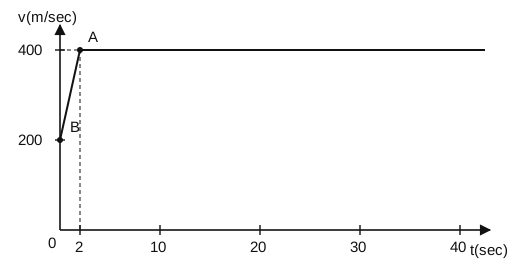
एक वायुयान की गति नीचे दर्शाए गए वेग-समय ग्राफ द्वारा निरूपित है। पहले 30.5 सेकंड में वायुयान द्वारा तय की गई दूरी ______ km है।
- A12
- B3
- C6
- D9
Show answer
Concept: Distance = area under the velocity-time graph.
- From to s the velocity rises linearly from 200 m/s (B) to 400 m/s (A): area = m.
- From s to s the velocity is constant at 400 m/s: area = m.
- Total distance m km.
Short trick: Nearly the whole time is at 400 m/s: km; the small trapezoidal correction brings it to exactly 12 km — only option (A) is close.
Answer: (A) 12
अवधारणा: दूरी = वेग-समय ग्राफ के नीचे का क्षेत्रफल।
- से s तक वेग 200 m/s (B) से 400 m/s (A) तक रैखिक बढ़ता है: क्षेत्रफल = m।
- s से s तक वेग 400 m/s पर नियत है: क्षेत्रफल = m।
- कुल दूरी m km।
शॉर्ट ट्रिक: लगभग पूरा समय 400 m/s पर है: km; छोटे समलंब संशोधन से ठीक 12 km — केवल विकल्प (A) निकट है।
उत्तर: (A) 12
JEE Main 2025 (January) – Paper 1 (B.E./B.Tech)PhysicsKinematics – velocity-time graphJEE Main 2025 (January) – Paper 1 (B.E./B.Tech) 2025 · 23 Jan Shift 1
Q569.Identify the valid statements relevant to the given circuit at the instant when the key is closed.
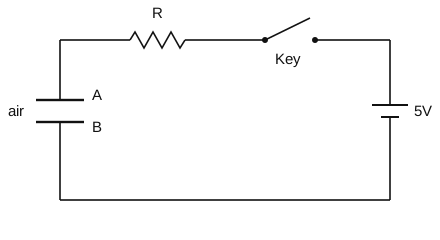
A. There will be no current through resistor R.
B. There will be maximum current in the connecting wires.
C. Potential difference between the capacitor plates A and B is minimum.
D. Charge on the capacitor plates is minimum.
Choose the correct answer from the options given below:
कुंजी (key) बंद करने के क्षण पर, दिए गए परिपथ से संबंधित मान्य कथनों की पहचान कीजिए।
A. प्रतिरोध R से कोई धारा नहीं बहेगी।
B. संयोजक तारों में अधिकतम धारा होगी।
C. संधारित्र की प्लेटों A तथा B के बीच विभवांतर न्यूनतम है।
D. संधारित्र की प्लेटों पर आवेश न्यूनतम है।
नीचे दिए गए विकल्पों में से सही उत्तर चुनिए:
- AA, C Onlyकेवल A, C
- BA, B, D Onlyकेवल A, B, D
- CC, D Onlyकेवल C, D
- DB, C, D Onlyकेवल B, C, D
Show answer
Concept: At the instant of switching on, an uncharged capacitor behaves like a plain conducting wire (, ), so the charging current is maximum: .
- B: At the current everywhere in the series loop is maximum () — true.
- C: , its minimum value — true.
- D: , minimum — true.
- A: The same maximum current flows through R too (R is in series with the capacitor), so "no current through R" is false.
Short trick: Capacitor at → short circuit; capacitor at → open circuit. "Key just closed" means short circuit: maximum current, zero charge, zero voltage.
Answer: (D) B, C, D Only
अवधारणा: कुंजी बंद करने के क्षण पर अनावेशित संधारित्र सीधे चालक तार की तरह व्यवहार करता है (, ), अतः आवेशन धारा अधिकतम होती है: ।
- B: पर श्रेणी लूप में हर जगह धारा अधिकतम () है — सत्य।
- C: , न्यूनतम मान — सत्य।
- D: , न्यूनतम — सत्य।
- A: वही अधिकतम धारा R से होकर भी बहती है (R संधारित्र के श्रेणीक्रम में है), अतः "R से कोई धारा नहीं" असत्य है।
शॉर्ट ट्रिक: पर संधारित्र → लघु पथ (short); पर → खुला परिपथ। "कुंजी अभी बंद हुई" का अर्थ short: अधिकतम धारा, शून्य आवेश, शून्य वोल्टता।
उत्तर: (D) केवल B, C, D
JEE Main 2025 (January) – Paper 1 (B.E./B.Tech)PhysicsCapacitors – transient at switch-onJEE Main 2025 (January) – Paper 1 (B.E./B.Tech) 2025 · 23 Jan Shift 1
Q570.A solid sphere of mass '' and radius '' is allowed to roll without slipping from the highest point of an inclined plane of length '' and makes an angle with the horizontal. The speed of the particle at the bottom of the plane is . If the angle of inclination is increased to while keeping constant. Then the new speed of the sphere at the bottom of the plane is . The ratio is
'' द्रव्यमान तथा '' त्रिज्या का एक ठोस गोला, क्षैतिज से कोण बनाने वाले '' लंबाई के नत समतल के उच्चतम बिंदु से बिना फिसले लुढ़कने दिया जाता है। समतल की तली पर इसकी चाल है। को नियत रखते हुए नति कोण कर देने पर तली पर गोले की नई चाल है। अनुपात है
- A
- B
- C
- D
Show answer
Concept: Rolling without slipping down an incline of length : energy conservation gives ; for a solid sphere , so .
- (same , same sphere).
- .
- So .
Short trick: Height fallen , so — the moment of inertia factor cancels in the ratio.
Answer: (A)
अवधारणा: लंबाई के नत समतल पर बिना फिसले लुढ़कने में ऊर्जा संरक्षण से ; ठोस गोले के लिए , अतः ।
- (समान , समान गोला)।
- ।
- अतः ।
शॉर्ट ट्रिक: गिरी ऊँचाई , अतः — जड़त्व आघूर्ण वाला गुणक अनुपात में कट जाता है।
उत्तर: (A)
JEE Main 2025 (January) – Paper 1 (B.E./B.Tech)PhysicsRotational motion – rolling on inclineJEE Main 2025 (January) – Paper 1 (B.E./B.Tech) 2025 · 23 Jan Shift 1
Q571.A positive ion A and a negative ion B has charges C and C, and masses kg and kg respectively. At an instant, the ions are separated by a certain distance . At that instant the ratio of the magnitudes of electrostatic force to gravitational force is , where the value of is ______. (Take and universal gravitational constant as )
Assume that charge may not be an integral multiple of electrons.
एक धनायन A तथा एक ऋणायन B पर क्रमशः C तथा C आवेश और kg तथा kg द्रव्यमान हैं। किसी क्षण दोनों आयन एक निश्चित दूरी से पृथक हैं। उस क्षण स्थिरवैद्युत बल तथा गुरुत्वाकर्षण बल के परिमाणों का अनुपात है, जहाँ का मान ______ है। ( तथा सार्वत्रिक गुरुत्वाकर्षण नियतांक लीजिए)
मान लीजिए कि आवेश, इलेक्ट्रॉन आवेश का पूर्णांक गुणज नहीं भी हो सकता है।
Show answer
Concept: Both forces follow inverse-square laws, so cancels in the ratio: .
- Numerator: .
- Denominator: .
- .
- So and .
Short trick: ; powers: .
Answer: 5
अवधारणा: दोनों बल व्युत्क्रम-वर्ग नियम का पालन करते हैं, अतः अनुपात में कट जाता है: ।
- अंश: ।
- हर: ।
- ।
- अतः तथा ।
शॉर्ट ट्रिक: ; घातें: ।
उत्तर: 5
JEE Main 2025 (January) – Paper 1 (B.E./B.Tech)PhysicsElectrostatics – Coulomb vs gravitational forceJEE Main 2025 (January) – Paper 1 (B.E./B.Tech) 2025 · 23 Jan Shift 1
Q572.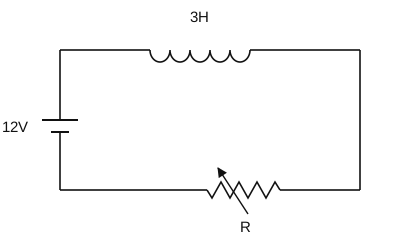
In the given circuit the sliding contact is pulled outwards such that electric current in the circuit changes at the rate of 8 A/s. At an instant when R is
, the value of the current in the circuit will be ______ A.
दिए गए परिपथ में सर्पी संपर्क (sliding contact) को बाहर की ओर इस प्रकार खींचा जाता है कि परिपथ में विद्युत धारा 8 A/s की दर से बदलती है। जिस क्षण R का मान
है, उस क्षण परिपथ में धारा का मान ______ A होगा।
Show answer
Concept: Kirchhoff's voltage law for an L-R circuit: . Pulling the rheostat contact outwards increases R, so the current is decreasing: A/s.
- A.
Short trick: A — the inductor's e.m.f. aids the battery while the current falls.
Answer: 3
अवधारणा: L-R परिपथ के लिए किरचॉफ का वोल्टता नियम: । धारा नियंत्रक (rheostat) का संपर्क बाहर खींचने से R बढ़ता है, अतः धारा घट रही है: A/s।
- A।
शॉर्ट ट्रिक: A — धारा घटते समय प्रेरक का e.m.f. बैटरी की सहायता करता है।
उत्तर: 3
JEE Main 2025 (January) – Paper 1 (B.E./B.Tech)PhysicsElectromagnetic induction – L-R circuitJEE Main 2025 (January) – Paper 1 (B.E./B.Tech) 2025 · 23 Jan Shift 1
Q573.Two particles are located at equal distance from origin. The position vectors of those are represented by and , respectively. If both the vectors are at right angle to each other, the value of is ______.
दो कण मूल बिंदु से समान दूरी पर स्थित हैं। उनके स्थिति सदिश क्रमशः तथा द्वारा निरूपित हैं। यदि दोनों सदिश परस्पर लंबवत हैं, तो का मान ______ है।
Show answer
Concept: Equal distances give ; perpendicularity gives . Two equations, two unknowns (, ).
- : .
- : .
- With : — rejected. With : .
- .
Short trick: The term must combine with to kill the constant 4; only works, giving at once.
Answer: 3
अवधारणा: समान दूरी से ; लंबवतता से । दो समीकरण, दो अज्ञात (, )।
- : ।
- : ।
- लेने पर: — अस्वीकार्य। लेने पर: ।
- ।
शॉर्ट ट्रिक: नियतांक 4 को समाप्त करने के लिए पद को के साथ मिलना होगा; केवल से यह संभव है, जिससे तुरंत ।
उत्तर: 3
JEE Main 2025 (January) – Paper 1 (B.E./B.Tech)PhysicsVectors – perpendicular vectorsJEE Main 2025 (January) – Paper 1 (B.E./B.Tech) 2025 · 23 Jan Shift 1
Q574.An ideal gas initially at temperature, is compressed suddenly to one fourth of its volume. If the ratio of specific heat at constant pressure to that at constant volume is , the change in temperature due to the thermodynamic process is ______ K.
प्रारंभ में ताप पर स्थित एक आदर्श गैस को अचानक संपीडित कर उसके आयतन का एक-चौथाई कर दिया जाता है। यदि नियत दाब पर विशिष्ट ऊष्मा का नियत आयतन पर विशिष्ट ऊष्मा से अनुपात है, तो इस ऊष्मागतिक प्रक्रम के कारण ताप में परिवर्तन ______ K है।
Show answer
Concept: A sudden compression is adiabatic: constant, with .
- K; .
- K.
- K.
Short trick: and — the temperature simply doubles, so the rise equals the initial 273 K.
Answer: 273
अवधारणा: अचानक संपीडन रुद्धोष्म होता है: नियत, जहाँ ।
- K; ।
- K।
- K।
शॉर्ट ट्रिक: तथा — ताप बस दुगुना हो जाता है, अतः वृद्धि प्रारंभिक 273 K के बराबर है।
उत्तर: 273
JEE Main 2025 (January) – Paper 1 (B.E./B.Tech)PhysicsThermodynamics – adiabatic processJEE Main 2025 (January) – Paper 1 (B.E./B.Tech) 2025 · 23 Jan Shift 1
Q575.A force acts on a particle in a plane . The work done by this force during a displacement from to is ______ Joule (round off to the nearest integer)
एक बल किसी कण पर समतल में कार्य करता है। से तक विस्थापन के दौरान इस बल द्वारा किया गया कार्य ______ जूल है (निकटतम पूर्णांक तक सन्निकटित कीजिए)
Show answer
Concept: Work by a variable force: . The given plane supplies the constraint to be used in the -integration.
- , with in the first integral.
- J.
- J.
- J.
Short trick: The -part is tiny (); almost all the work comes from — compute that first and add .
Answer: 152
अवधारणा: परिवर्ती बल द्वारा कार्य: । दिया गया समतल -समाकलन में प्रयुक्त होने वाला बंधन देता है।
- , जहाँ पहले समाकल में ।
- J।
- J।
- J।
शॉर्ट ट्रिक: -वाला भाग बहुत छोटा () है; लगभग पूरा कार्य से आता है — पहले वही निकालें और जोड़ दें।
उत्तर: 152
JEE Main 2025 (January) – Paper 1 (B.E./B.Tech)PhysicsWork, energy and power – work by variable forceJEE Main 2025 (January) – Paper 1 (B.E./B.Tech) 2025 · 23 Jan Shift 1
Q576.Given below are two statements:
Statement I: Fructose does not contain an aldehydic group but still reduces Tollen's reagent
Statement II: In the presence of base, fructose undergoes rearrangement to give glucose.
In the light of the above statements, choose the correct answer from the options given below
नीचे दो कथन दिए गए हैं:
कथन I: फ्रक्टोस में ऐल्डिहाइडिक समूह नहीं होता, फिर भी यह टॉलेन अभिकर्मक (Tollen's reagent) को अपचयित करता है।
कथन II: क्षार की उपस्थिति में फ्रक्टोस पुनर्विन्यास (rearrangement) द्वारा ग्लूकोस देता है।
उपर्युक्त कथनों के आलोक में, नीचे दिए गए विकल्पों में से सही उत्तर चुनिए
- ABoth Statement I and Statement II are trueकथन I और कथन II दोनों सत्य हैं
- BBoth Statement I and Statement II are falseकथन I और कथन II दोनों असत्य हैं
- CStatement I is true but Statement II is falseकथन I सत्य है परन्तु कथन II असत्य है
- DStatement I is false but Statement II is trueकथन I असत्य है परन्तु कथन II सत्य है
Show answer
Concept: Tollen's test is done in an alkaline medium; in base, ketoses isomerise to aldoses (Lobry de Bruyn–van Ekenstein rearrangement).
- Fructose is a ketohexose – it has a ketonic C=O, no –CHO group.
- In the basic medium of Tollen's reagent, fructose tautomerises through an enediol intermediate to glucose (and mannose), which contain the –CHO group.
- The aldose so formed reduces Ag(NH3)2+ to a silver mirror, so fructose is a reducing sugar.
- Hence Statement I is true, and Statement II correctly explains it – both are true.
Short trick: All monosaccharides (even ketoses) are reducing sugars – base converts ketose → aldose.
Answer: (A)
अवधारणा: टॉलेन परीक्षण क्षारीय माध्यम में होता है; क्षार में कीटोस, ऐल्डोस में समावयवित हो जाते हैं (लोब्री डी ब्रुइन–वान एकेन्स्टाइन पुनर्विन्यास)।
- फ्रक्टोस एक कीटोहेक्सोस है – इसमें कीटोनिक C=O है, –CHO समूह नहीं।
- टॉलेन अभिकर्मक के क्षारीय माध्यम में फ्रक्टोस ईनडाइऑल (enediol) मध्यवर्ती से होकर ग्लूकोस (तथा मैनोस) में बदल जाता है, जिनमें –CHO समूह होता है।
- इस प्रकार बना ऐल्डोस Ag(NH3)2+ को रजत दर्पण में अपचयित करता है, अतः फ्रक्टोस अपचायक शर्करा है।
- अतः कथन I सत्य है और कथन II उसकी सही व्याख्या करता है – दोनों सत्य हैं।
शॉर्ट ट्रिक: सभी मोनोसैकेराइड (कीटोस भी) अपचायक शर्कराएँ हैं – क्षार कीटोस → ऐल्डोस बदल देता है।
उत्तर: (A)
JEE Main 2025 (January) – Paper 1 (B.E./B.Tech)ChemistryBiomolecules – carbohydrates (fructose)JEE Main 2025 (January) – Paper 1 (B.E./B.Tech) 2025 · 23 Jan Shift 1
Q577.The complex that shows Facial - Meridional isomerism is:
वह संकुल जो फलकीय–रेखांशिक (Facial–Meridional) समावयवता दर्शाता है:
- A[Co(en)2Cl2]+
- B[Co(en)3]3+
- C[Co(NH3)3Cl3]
- D[Co(NH3)4Cl2]+
Show answer
Concept: Facial (fac) and meridional (mer) isomerism arises only in octahedral complexes of the type [Ma3b3].
- [Co(NH3)3Cl3] is of the [Ma3b3] type: the three Cl− may occupy one triangular face (fac) or lie on a meridian (mer).
- (A) [Co(en)2Cl2]+ shows cis–trans (and optical) isomerism, not fac–mer.
- (B) [Co(en)3]3+ shows only optical isomerism.
- (D) [Co(NH3)4Cl2]+ ([Ma4b2]) shows cis–trans isomerism.
Short trick: fac–mer ⇔ [Ma3b3] only.
Answer: (C)
अवधारणा: फलकीय (fac) तथा रेखांशिक (mer) समावयवता केवल [Ma3b3] प्रकार के अष्टफलकीय संकुलों में होती है।
- [Co(NH3)3Cl3], [Ma3b3] प्रकार का है: तीनों Cl− एक त्रिभुजाकार फलक पर (fac) या एक मध्याह्न रेखा पर (mer) स्थित हो सकते हैं।
- (A) [Co(en)2Cl2]+ समपक्ष–विपक्ष (तथा ध्रुवण) समावयवता दर्शाता है, fac–mer नहीं।
- (B) [Co(en)3]3+ केवल ध्रुवण (optical) समावयवता दर्शाता है।
- (D) [Co(NH3)4Cl2]+ ([Ma4b2]) समपक्ष–विपक्ष समावयवता दर्शाता है।
शॉर्ट ट्रिक: fac–mer ⇔ केवल [Ma3b3]।
उत्तर: (C)
JEE Main 2025 (January) – Paper 1 (B.E./B.Tech)ChemistryCoordination compounds – isomerismJEE Main 2025 (January) – Paper 1 (B.E./B.Tech) 2025 · 23 Jan Shift 1
Q578.
In the above diagram, the standard electrode potentials are given in volts (over the arrow). The value of is
उपर्युक्त आरेख में मानक इलेक्ट्रोड विभव वोल्ट में (तीर के ऊपर) दिए गए हैं। का मान है
- A2.1 V
- B1.7 V
- C1.4 V
- D1.2 V
Show answer
Concept: Electrode potentials are not additive, but is. For successive steps, .
- FeO42− (Fe in +6) → Fe3+: , V.
- Fe3+ → Fe2+: , V.
- FeO42− → Fe2+ involves electrons.
- V.
Short trick: Weight each step's potential by its electron count and divide by total electrons.
Answer: (B)
अवधारणा: इलेक्ट्रोड विभव योगशील नहीं होते, परन्तु योगशील है। क्रमिक पदों के लिए ।
- FeO42− (Fe, +6 अवस्था) → Fe3+: , V।
- Fe3+ → Fe2+: , V।
- FeO42− → Fe2+ में कुल इलेक्ट्रॉन लगते हैं।
- V।
शॉर्ट ट्रिक: प्रत्येक पद के विभव को उसके इलेक्ट्रॉनों की संख्या से भारित कर कुल इलेक्ट्रॉनों से भाग दीजिए।
उत्तर: (B)
JEE Main 2025 (January) – Paper 1 (B.E./B.Tech)ChemistryElectrochemistry – electrode potentials (Latimer diagram)JEE Main 2025 (January) – Paper 1 (B.E./B.Tech) 2025 · 23 Jan Shift 1
Q579.The element that does not belong to the same period of the remaining elements (modern periodic table) is:
वह तत्त्व जो (आधुनिक आवर्त सारणी में) शेष तत्त्वों के आवर्त से सम्बन्धित नहीं है:
- AIridiumइरीडियम (Iridium)
- BPlatinumप्लैटिनम (Platinum)
- COsmiumऑस्मियम (Osmium)
- DPalladiumपैलेडियम (Palladium)
Show answer
Concept: Os, Ir, Pt are consecutive 5d-series elements, while Pd belongs to the 4d series.
- Osmium (Z = 76), Iridium (Z = 77) and Platinum (Z = 78) all lie in period 6 (5d transition series).
- Palladium (Z = 46) lies in period 5 (4d transition series), in the same group (10) as platinum.
- Hence palladium is the odd one out.
Short trick: Fe–Ru–Os, Co–Rh–Ir, Ni–Pd–Pt are vertical triads; Os, Ir, Pt sit side-by-side in period 6, Pd one row above.
Answer: (D)
अवधारणा: Os, Ir, Pt क्रमागत 5d-श्रेणी के तत्त्व हैं, जबकि Pd 4d-श्रेणी का तत्त्व है।
- ऑस्मियम (Z = 76), इरीडियम (Z = 77) तथा प्लैटिनम (Z = 78) तीनों आवर्त 6 (5d संक्रमण श्रेणी) में हैं।
- पैलेडियम (Z = 46) आवर्त 5 (4d संक्रमण श्रेणी) में है, प्लैटिनम के ही वर्ग (10) में।
- अतः पैलेडियम भिन्न है।
शॉर्ट ट्रिक: Fe–Ru–Os, Co–Rh–Ir, Ni–Pd–Pt ऊर्ध्वाधर त्रिक हैं; Os, Ir, Pt आवर्त 6 में साथ-साथ हैं, Pd एक आवर्त ऊपर।
उत्तर: (D)
JEE Main 2025 (January) – Paper 1 (B.E./B.Tech)ChemistryPeriodic table – d-block periodsJEE Main 2025 (January) – Paper 1 (B.E./B.Tech) 2025 · 23 Jan Shift 1
Q580.Match the LIST-I with LIST-II
LIST-I
(Classification of molecules based on octet rule) | LIST-II
(Example) |
|---|
| A. | Molecules obeying octet rule | I. | NO, NO2 |
| B. | Molecules with incomplete octet | II. | BCl3, AlCl3 |
| C. | Molecules with incomplete octet with odd electron | III. | H2SO4, PCl5 |
| D. | Molecules with expanded octet | IV. | CCl4, CO2 |
Choose the correct answer from the options given below:
सूची-I का सूची-II से मिलान कीजिए
सूची-I
(अष्टक नियम के आधार पर अणुओं का वर्गीकरण) | सूची-II
(उदाहरण) |
|---|
| A. | अष्टक नियम का पालन करने वाले अणु | I. | NO, NO2 |
| B. | अपूर्ण अष्टक वाले अणु | II. | BCl3, AlCl3 |
| C. | विषम इलेक्ट्रॉन सहित अपूर्ण अष्टक वाले अणु | III. | H2SO4, PCl5 |
| D. | प्रसारित अष्टक वाले अणु | IV. | CCl4, CO2 |
नीचे दिए गए विकल्पों में से सही उत्तर चुनिए:
- AA-IV, B-I, C-III, D-II
- BA-IV, B-II, C-I, D-III
- CA-II, B-IV, C-III, D-I
- DA-III, B-II, C-I, D-IV
Show answer
Concept: Octet rule – central atom with 8 electrons; exceptions: incomplete octet (electron-deficient), odd-electron species, expanded octet (more than 8 electrons).
- A → IV: in CCl4 and CO2, carbon has exactly 8 electrons – octet obeyed.
- B → II: BCl3 (6 e− on B) and AlCl3 (6 e− on Al) have incomplete octets.
- C → I: NO (11 valence e−) and NO2 (17 valence e−) are odd-electron molecules with incomplete octet on N.
- D → III: in H2SO4 (12 e− on S) and PCl5 (10 e− on P) the octet is expanded.
Short trick: Group 13 halides → incomplete; NO/NO2/ClO2 → odd electron; period-3 onwards (S, P) → expansion possible.
Answer: (B)
अवधारणा: अष्टक नियम – केन्द्रीय परमाणु पर 8 इलेक्ट्रॉन; अपवाद: अपूर्ण अष्टक (इलेक्ट्रॉन-न्यून), विषम-इलेक्ट्रॉन स्पीशीज़, प्रसारित अष्टक (8 से अधिक इलेक्ट्रॉन)।
- A → IV: CCl4 तथा CO2 में कार्बन पर ठीक 8 इलेक्ट्रॉन हैं – अष्टक नियम का पालन।
- B → II: BCl3 (B पर 6 e−) तथा AlCl3 (Al पर 6 e−) में अपूर्ण अष्टक है।
- C → I: NO (11 संयोजी e−) तथा NO2 (17 संयोजी e−) विषम-इलेक्ट्रॉन अणु हैं, N पर अपूर्ण अष्टक।
- D → III: H2SO4 (S पर 12 e−) तथा PCl5 (P पर 10 e−) में प्रसारित अष्टक है।
शॉर्ट ट्रिक: वर्ग 13 के हैलाइड → अपूर्ण; NO/NO2/ClO2 → विषम इलेक्ट्रॉन; आवर्त-3 से आगे (S, P) → अष्टक प्रसार सम्भव।
उत्तर: (B)
JEE Main 2025 (January) – Paper 1 (B.E./B.Tech)ChemistryChemical bonding – octet rule and its exceptionsJEE Main 2025 (January) – Paper 1 (B.E./B.Tech) 2025 · 23 Jan Shift 1

