Q2101.
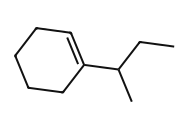
Which of the following is not the product of dehydration of 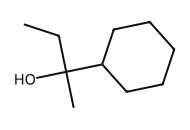 ?
?निम्नलिखित में से कौन के निर्जलीकरण का उत्पाद नहीं है?
के निर्जलीकरण का उत्पाद नहीं है?- A
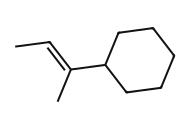
- B
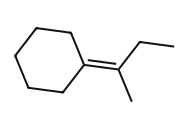
- C
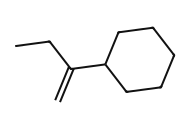
- D
Show answer
Concept: Dehydration of a 3° alcohol is E1: loss of water gives a 3° carbocation, then H+ is lost from any adjacent carbon.
- The alcohol (2-cyclohexylbutan-2-ol) gives a 3° cation on the side-chain carbon; it is already 3°, so no rearrangement occurs.
- H+ lost from CH2 of ethyl → (A) 2-cyclohexylbut-2-ene; from ring CH → (B) (butan-2-ylidene)cyclohexane; from CH3 → (C) 2-cyclohexylbut-1-ene.
- (D) has the C=C inside the ring and the side-chain carbon as CH – the double bond is not adjacent to the cation centre, so it cannot form without a rearrangement.
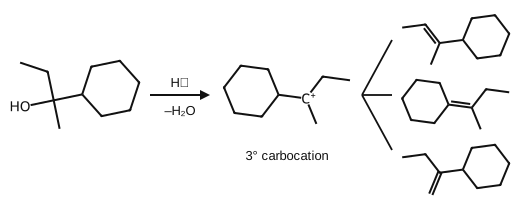
Short trick: In E1, the new C=C must touch the carbon that carried OH. (D) is the only option where it does not.
Answer: (D) 1-(butan-2-yl)cyclohexene – C=C inside the ring
अवधारणा: 3° ऐल्कोहॉल का निर्जलीकरण E1 है: जल निकलने से 3° कार्बधनायन बनता है, फिर किसी भी समीपवर्ती कार्बन से H+ निकलता है।
- ऐल्कोहॉल (2-साइक्लोहेक्सिलब्यूटेन-2-ऑल) पार्श्व-शृंखला के कार्बन पर 3° धनायन देता है; यह पहले से 3° है, अतः कोई पुनर्विन्यास नहीं होता।
- एथिल के CH2 से H+ निकलने पर → (A) 2-साइक्लोहेक्सिलब्यूट-2-ईन; वलय के CH से → (B) (ब्यूटेन-2-इलिडीन)साइक्लोहेक्सेन; CH3 से → (C) 2-साइक्लोहेक्सिलब्यूट-1-ईन।
- (D) में C=C वलय के भीतर है तथा पार्श्व-शृंखला का कार्बन CH है – द्विआबंध धनायन केंद्र के समीप नहीं है, अतः यह पुनर्विन्यास के बिना नहीं बन सकता।
शॉर्ट ट्रिक: E1 में नया C=C उसी कार्बन को छूना चाहिए जिस पर OH था। (D) ही एकमात्र विकल्प है जहाँ ऐसा नहीं है।
उत्तर: (D) 1-(ब्यूटेन-2-इल)साइक्लोहेक्सीन – वलय के भीतर C=C