Q2181.Doctors use stethoscope to hear the sound; produced during each cardiac cycle. The second sound is heard when:
प्रत्येक हृद् चक्र के दौरान उत्पन्न ध्वनि सुनने के लिए डॉक्टर स्टेथोस्कोप का उपयोग करते हैं। दूसरी ध्वनि तब सुनाई देती है जब:
- AAV node receives signal from SA nodeAV पर्व SA पर्व से संकेत प्राप्त करता है
- BAV valves open upAV कपाट खुलते हैं
- CVentricular walls vibrate due to gushing of blood from atriaआलिंदों से रक्त के तेज़ प्रवाह के कारण निलय भित्तियाँ कंपन करती हैं
- DSemilunar valves close down after the blood flows into vessels from ventriclesनिलयों से रक्त के वाहिकाओं में प्रवाहित होने के बाद अर्धचंद्राकार कपाट बंद होते हैं
Show answer
Concept: Two heart sounds per cycle: first sound "lub" – closure of tricuspid and bicuspid (AV) valves at the start of ventricular systole; second sound "dub" – closure of the semilunar valves at the start of ventricular diastole.
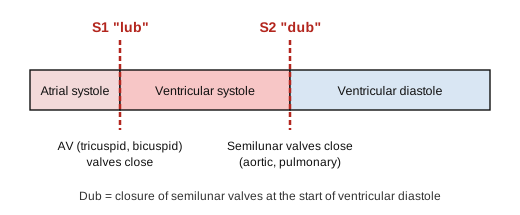
- (A) SA → AV node conduction is electrical – it makes no audible sound.
- (B) Opening of valves is silent; AV valve closure gives the first sound.
- (C) Ventricular filling by atrial blood is not the second sound.
- (D) Correct – semilunar valve closure = "dub".
Short trick: Lub = AV valves shut (systole starts); Dub = semilunar valves shut (diastole starts). Sounds come only from valves closing.
Answer: (D) Semilunar valves close down after the blood flows into vessels from ventricles
अवधारणा: प्रति चक्र दो हृदय ध्वनियाँ: पहली ध्वनि "लब" – निलय प्रकुंचन के आरंभ में त्रिवलनी व द्विवलनी (AV) कपाटों का बंद होना; दूसरी ध्वनि "डब" – निलय अनुशिथिलन के आरंभ में अर्धचंद्राकार कपाटों का बंद होना।
- (A) SA → AV पर्व का संचरण विद्युत है – इससे कोई सुनाई देने वाली ध्वनि नहीं होती।
- (B) कपाटों का खुलना ध्वनिरहित है; AV कपाटों के बंद होने से पहली ध्वनि होती है।
- (C) आलिंद रक्त से निलय का भरना दूसरी ध्वनि नहीं है।
- (D) सही – अर्धचंद्राकार कपाटों का बंद होना = "डब"।
शॉर्ट ट्रिक: लब = AV कपाट बंद (प्रकुंचन आरंभ); डब = अर्धचंद्राकार कपाट बंद (अनुशिथिलन आरंभ)। ध्वनि केवल कपाटों के बंद होने से।
उत्तर: (D) निलयों से रक्त के वाहिकाओं में प्रवाहित होने के बाद अर्धचंद्राकार कपाट बंद होते हैं
NEET UGBiologyBody fluids and circulation – heart soundsNEET UG 2015 · 25 Jul Shift 1
Q2182.During ecological succession:
पारिस्थितिक अनुक्रमण के दौरान:
- AThe changes lead to a community that is in near equilibrium with the environment and is called pioneer communityपरिवर्तनों से एक ऐसा समुदाय बनता है जो पर्यावरण के साथ लगभग साम्यावस्था में होता है और जिसे पुरोगामी (pioneer) समुदाय कहते हैं
- BThe gradual and predictable change in species composition occurs in a given areaकिसी दिए गए क्षेत्र में जातीय संघटन में क्रमिक और पूर्वानुमेय परिवर्तन होता है
- CThe establishment of a new biotic community is very fast in its primary phaseप्राथमिक चरण में नए जैविक समुदाय की स्थापना बहुत तीव्र होती है
- DThe number and types of animals remain constantजंतुओं की संख्या और प्रकार स्थिर रहते हैं
Show answer
Concept: NCERT: the gradual and fairly predictable change in the species composition of a given area is called ecological succession; it ends in a climax community that is in near equilibrium with the environment.
- (A) Wrong – the community in near equilibrium is the climax community; the pioneer community is the first to colonise.
- (B) Correct – the NCERT definition.
- (C) Wrong – primary succession (on bare rock) is very slow, taking hundreds to thousands of years.
- (D) Wrong – the number and types of animals and decomposers change during succession.
Short trick: Pioneer = first; Climax = final, stable. Primary succession = slow (no soil), secondary = faster (soil present).
Answer: (B) The gradual and predictable change in species composition occurs in a given area
अवधारणा: NCERT: किसी दिए गए क्षेत्र के जातीय संघटन में क्रमिक और लगभग पूर्वानुमेय परिवर्तन को पारिस्थितिक अनुक्रमण कहते हैं; इसका अंत चरम (climax) समुदाय में होता है जो पर्यावरण के साथ लगभग साम्यावस्था में होता है।
- (A) गलत – लगभग साम्यावस्था वाला समुदाय चरम समुदाय है; पुरोगामी समुदाय सबसे पहले बसने वाला है।
- (B) सही – NCERT परिभाषा।
- (C) गलत – प्राथमिक अनुक्रमण (नग्न चट्टान पर) बहुत धीमा है, सैकड़ों से हज़ारों वर्ष लगते हैं।
- (D) गलत – अनुक्रमण के दौरान जंतुओं और अपघटकों की संख्या व प्रकार बदलते हैं।
शॉर्ट ट्रिक: पुरोगामी = पहला; चरम = अंतिम, स्थिर। प्राथमिक अनुक्रमण = धीमा (मृदा नहीं), द्वितीयक = तेज़ (मृदा उपस्थित)।
उत्तर: (B) किसी दिए गए क्षेत्र में जातीय संघटन में क्रमिक और पूर्वानुमेय परिवर्तन होता है
NEET UGBiologyEcosystem – ecological successionNEET UG 2015 · 25 Jul Shift 1
Q2183.In the following human pedigree, the filled symbols represent the affected individuals. Identify the type of given pedigree.
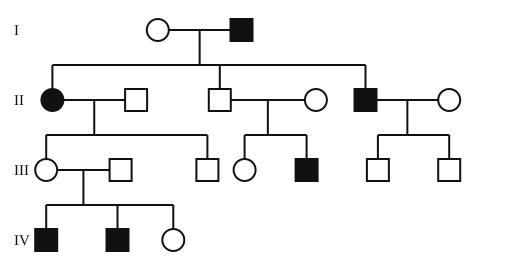
निम्नलिखित मानव वंशावली में भरे हुए प्रतीक प्रभावित व्यक्तियों को दर्शाते हैं। दी गई वंशावली का प्रकार पहचानिए।
- AX-linked dominantX-सहलग्न प्रभावी
- BAutosomal dominantअलिंगसूत्री प्रभावी
- CX-linked recessiveX-सहलग्न अप्रभावी
- DAutosomal recessiveअलिंगसूत्री अप्रभावी
Show answer
Concept: Test each mode against the key crosses: a dominant trait cannot appear in a child of two unaffected parents; an X-linked recessive trait in a mother must appear in all her sons.
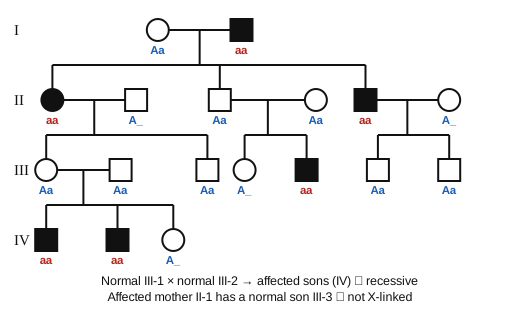
- Generation IV: two affected sons are born to unaffected parents III-1 and III-2 (also III-5 to unaffected II-3 × II-4) → the trait is recessive; (A) and (B) are ruled out.
- II-1 is an affected female, yet her son III-3 is normal. Under X-linked recessive inheritance an affected mother (XaXa) passes Xa to every son → all sons would be affected. So (C) is ruled out.
- Autosomal recessive fits everyone: I-1 Aa × I-2 aa; II-1 aa; III-1 Aa × III-2 Aa → ¼ aa (IV-1, IV-2 affected), daughter IV-3 normal. Both sexes are affected equally, and the trait skips generations.
Short trick: Affected child from two normal parents → recessive. Then look for an affected mother with a normal son – if present, it cannot be X-linked → autosomal recessive.
Answer: (D) Autosomal recessive
अवधारणा: प्रमुख संकरणों से प्रत्येक प्रकार को जाँचें: प्रभावी लक्षण दो अप्रभावित जनकों की संतान में प्रकट नहीं हो सकता; X-सहलग्न अप्रभावी लक्षण वाली माता के सभी पुत्रों में लक्षण प्रकट होना चाहिए।
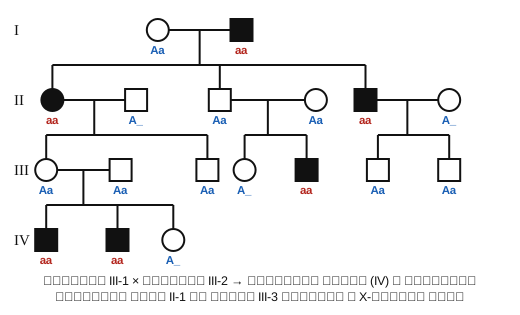
- पीढ़ी IV: अप्रभावित जनकों III-1 और III-2 से दो प्रभावित पुत्र जन्मे (तथा अप्रभावित II-3 × II-4 से III-5) → लक्षण अप्रभावी है; (A) और (B) निरस्त।
- II-1 प्रभावित स्त्री है, फिर भी उसका पुत्र III-3 सामान्य है। X-सहलग्न अप्रभावी वंशागति में प्रभावित माता (XaXa) हर पुत्र को Xa देती है → सभी पुत्र प्रभावित होते। अतः (C) निरस्त।
- अलिंगसूत्री अप्रभावी सब पर ठीक बैठता है: I-1 Aa × I-2 aa; II-1 aa; III-1 Aa × III-2 Aa → ¼ aa (IV-1, IV-2 प्रभावित), पुत्री IV-3 सामान्य। दोनों लिंग समान रूप से प्रभावित और लक्षण पीढ़ियाँ छोड़ता है।
शॉर्ट ट्रिक: दो सामान्य जनकों से प्रभावित संतान → अप्रभावी। फिर देखें कि क्या कोई प्रभावित माता का पुत्र सामान्य है – यदि हाँ, तो X-सहलग्न नहीं → अलिंगसूत्री अप्रभावी।
उत्तर: (D) अलिंगसूत्री अप्रभावी
NEET UGBiologyPrinciples of inheritance – pedigree analysisNEET UG 2015 · 25 Jul Shift 1
Q2184.Balbiani rings are sites of :
बालबियानी वलय (Balbiani rings) किसके स्थल हैं?
- ARNA and protein synthesisRNA और प्रोटीन संश्लेषण
- BLipid synthesisलिपिड संश्लेषण
- CNucleotide synthesisन्यूक्लियोटाइड संश्लेषण
- DPolysaccharide synthesisपॉलीसैकेराइड संश्लेषण
Show answer
Concept: Balbiani rings are very large puffs on the polytene (salivary gland) chromosomes of insect larvae such as Chironomus. In a puff the DNA is uncoiled and actively transcribed, producing mRNA that is translated into (salivary) proteins.
- (A) Correct – active transcription (RNA) leading to protein synthesis.
- (B), (C), (D) Lipid, nucleotide and polysaccharide synthesis are enzymatic cytoplasmic processes – not functions of chromosome puffs.
Short trick: Puff = gene switched ON → RNA → protein. Balbiani ring = giant puff.
Answer: (A) RNA and protein synthesis
अवधारणा: बालबियानी वलय Chironomus जैसे कीट लार्वा के पॉलीटीन (लार ग्रंथि) गुणसूत्रों पर बहुत बड़े पफ़ होते हैं। पफ़ में DNA खुला रहता है और सक्रिय अनुलेखन होता है, जिससे mRNA बनता है जो (लार) प्रोटीन में अनूदित होता है।
- (A) सही – सक्रिय अनुलेखन (RNA) से प्रोटीन संश्लेषण।
- (B), (C), (D) लिपिड, न्यूक्लियोटाइड और पॉलीसैकेराइड संश्लेषण कोशिकाद्रव्य की एंज़ाइमी क्रियाएँ हैं – गुणसूत्र पफ़ के कार्य नहीं।
शॉर्ट ट्रिक: पफ़ = जीन "ON" → RNA → प्रोटीन। बालबियानी वलय = विशाल पफ़।
उत्तर: (A) RNA और प्रोटीन संश्लेषण
NEET UGBiologyMolecular basis of inheritance – polytene chromosomesNEET UG 2015 · 25 Jul Shift 1
Q2185.Name the pulmonary disease in which alveolar surface area involved in gas exchange is drastically reduced due to damage in the alveolar walls :
उस फुप्फुसीय रोग का नाम बताइए जिसमें कूपिका भित्तियों की क्षति के कारण गैस विनिमय में शामिल कूपिका सतह क्षेत्र अत्यधिक घट जाता है:
- AAsthmaदमा (Asthma)
- BPleurisyप्लूरिसी (Pleurisy)
- CEmphysemaवातस्फीति (Emphysema)
- DPneumoniaन्यूमोनिया (Pneumonia)
Show answer
Concept: NCERT: emphysema is a chronic disorder in which alveolar walls are damaged, so the respiratory surface is decreased; cigarette smoking is a major cause.
- (A) Asthma – wheezing due to inflammation of bronchi and bronchioles.
- (B) Pleurisy – inflammation of the pleural membranes.
- (C) Correct – emphysema.
- (D) Pneumonia – infection; alveoli fill with fluid/mucus but the walls are not destroyed.
Short trick: Emphysema = "Empty, enlarged air sacs" – walls broken, surface lost (smoker's lung).
Answer: (C) Emphysema
अवधारणा: NCERT: वातस्फीति एक दीर्घकालिक विकार है जिसमें कूपिका भित्तियाँ क्षतिग्रस्त हो जाती हैं, जिससे श्वसन सतह घट जाती है; धूम्रपान इसका प्रमुख कारण है।
- (A) दमा – श्वसनी और श्वसनिकाओं की सूजन के कारण घरघराहट।
- (B) प्लूरिसी – फुप्फुसावरण झिल्लियों की सूजन।
- (C) सही – वातस्फीति।
- (D) न्यूमोनिया – संक्रमण; कूपिकाओं में द्रव/श्लेष्म भरता है, पर भित्तियाँ नष्ट नहीं होतीं।
शॉर्ट ट्रिक: वातस्फीति = "फूली, खाली वायु-थैलियाँ" – भित्तियाँ टूटीं, सतह घटी (धूम्रपायी का फेफड़ा)।
उत्तर: (C) वातस्फीति (Emphysema)
NEET UGBiologyBreathing and exchange of gases – respiratory disordersNEET UG 2015 · 25 Jul Shift 1
Q2186.Which the following are most suitable indicator of SO2 pollution in the environment ?
पर्यावरण में SO2 प्रदूषण के सबसे उपयुक्त सूचक निम्नलिखित में से कौन-से हैं?
- AFungiकवक
- BLichensलाइकेन
- CConifersशंकुधारी (Conifers)
- DAlgaeशैवाल
Show answer
Concept: NCERT: lichens are very good pollution indicators – they do not grow in polluted areas. Their algal partner (phycobiont) is highly sensitive to SO2, so lichens disappear where SO2 levels are high.
- (A) Fungi alone are comparatively tolerant and are not standard SO2 indicators.
- (B) Correct – lichens.
- (C) Conifers are affected by pollution but are not used as sensitive indicators.
- (D) Free algae are better known as indicators of water pollution (eutrophication).
Short trick: No lichens on the trees → the air has SO2. (Also recall: lichens on tree bark in unpolluted areas, industrial melanism story.)
Answer: (B) Lichens
अवधारणा: NCERT: लाइकेन बहुत अच्छे प्रदूषण सूचक हैं – ये प्रदूषित क्षेत्रों में नहीं उगते। इनका शैवाल साथी (फाइकोबायंट) SO2 के प्रति अति संवेदनशील होता है, अतः जहाँ SO2 अधिक होता है वहाँ लाइकेन लुप्त हो जाते हैं।
- (A) केवल कवक अपेक्षाकृत सहनशील हैं और मानक SO2 सूचक नहीं हैं।
- (B) सही – लाइकेन।
- (C) शंकुधारी प्रदूषण से प्रभावित होते हैं पर संवेदनशील सूचक के रूप में प्रयुक्त नहीं होते।
- (D) मुक्त शैवाल जल प्रदूषण (सुपोषण) के सूचक के रूप में अधिक जाने जाते हैं।
शॉर्ट ट्रिक: पेड़ों पर लाइकेन नहीं → वायु में SO2 है। (औद्योगिक मेलानिज़्म की कहानी में भी अप्रदूषित क्षेत्रों की छाल पर लाइकेन याद करें।)
उत्तर: (B) लाइकेन
NEET UGBiologyEnvironmental issues – pollution indicatorsNEET UG 2015 · 25 Jul Shift 1
Q2187.Satellite DNA is important because it :
अनुषंगी DNA (Satellite DNA) महत्वपूर्ण है, क्योंकि यह:
- ACodes for enzymes needed for DNA replicationDNA प्रतिकृतीयन के लिए आवश्यक एंज़ाइमों का कूटलेखन करता है
- BCodes for proteins needed in cell cycleकोशिका चक्र में आवश्यक प्रोटीनों का कूटलेखन करता है
- CShows high degree of polymorphism in population and also the same degree of polymorphism in an individual, which is heritable from parents to childrenसमष्टि में उच्च स्तर की बहुरूपता दर्शाता है और किसी व्यष्टि में भी समान स्तर की बहुरूपता दर्शाता है, जो जनकों से संतानों में वंशागत होती है
- DDoes not code for proteins and is same in all members of the populationप्रोटीनों का कूटलेखन नहीं करता और समष्टि के सभी सदस्यों में समान होता है
Show answer
Concept: Satellite DNA = highly repetitive, non-coding DNA (separates as a satellite band in density-gradient centrifugation). Its repeat number varies greatly between individuals (high polymorphism) but is the same in every tissue of one individual and is inherited – the basis of DNA fingerprinting.
- (A), (B) Wrong – satellite DNA does not code for any protein/enzyme.
- (C) Correct – polymorphic, same in all cells of an individual, heritable.
- (D) First half is true (non-coding) but it is not the same in all members – it is highly variable, which is why it can identify people.
Short trick: Satellite DNA = "non-coding but unique" → DNA fingerprinting (VNTRs, Alec Jeffreys).
Answer: (C) Shows high degree of polymorphism in population and also the same degree of polymorphism in an individual, which is heritable from parents to children
अवधारणा: अनुषंगी DNA = अत्यधिक पुनरावृत्त, अकूटलेखी DNA (घनत्व प्रवणता अपकेंद्रण में अलग अनुषंगी पट्टी बनाता है)। इसकी पुनरावृत्ति संख्या व्यक्तियों में बहुत भिन्न होती है (उच्च बहुरूपता) परंतु एक व्यक्ति के सभी ऊतकों में समान होती है और वंशागत होती है – यही DNA फ़िंगरप्रिंटिंग का आधार है।
- (A), (B) गलत – अनुषंगी DNA किसी प्रोटीन/एंज़ाइम का कूटलेखन नहीं करता।
- (C) सही – बहुरूपी, एक व्यक्ति की सभी कोशिकाओं में समान, वंशागत।
- (D) पहला भाग सही (अकूटलेखी) पर यह सभी सदस्यों में समान नहीं होता – अत्यधिक परिवर्तनशील होता है, इसीलिए व्यक्तियों की पहचान कर पाता है।
शॉर्ट ट्रिक: अनुषंगी DNA = "अकूटलेखी पर अद्वितीय" → DNA फ़िंगरप्रिंटिंग (VNTR, एलेक जेफ़्रीज़)।
उत्तर: (C) समष्टि में उच्च स्तर की बहुरूपता दर्शाता है और किसी व्यष्टि में भी समान स्तर की बहुरूपता दर्शाता है, जो जनकों से संतानों में वंशागत होती है
NEET UGBiologyMolecular basis of inheritance – satellite DNA and DNA fingerprintingNEET UG 2015 · 25 Jul Shift 1
Q2188.Industrial melanism is an example of:
औद्योगिक मेलानिज़्म (Industrial melanism) किसका उदाहरण है?
- ANeo Lamarckismनव-लैमार्कवाद
- BNeo Darwinismनव-डार्विनवाद
- CNatural selectionप्राकृतिक वरण
- DMutationउत्परिवर्तन
Show answer
Concept: In England after industrialisation, tree trunks became dark with soot and lichens died; dark (melanic) peppered moths (Biston betularia) escaped predatory birds and increased, while white moths were eaten. Nature selected the better-camouflaged form – NCERT's example of natural selection.
- (A) Neo-Lamarckism – inheritance of acquired characters; moths did not "acquire" dark colour.
- (B) Neo-Darwinism is the broader modern theory; the specific process shown is natural selection.
- (C) Correct – natural selection (directional).
- (D) Melanic forms already existed; the change in frequency is due to selection, not new mutation.
Short trick: Peppered moth = textbook case of natural selection by predation (directional selection).
Answer: (C) Natural selection
अवधारणा: इंग्लैंड में औद्योगीकरण के बाद पेड़ों के तने कालिख से काले हो गए और लाइकेन मर गए; गहरे (मेलानिक) पेपर्ड मॉथ (Biston betularia) शिकारी पक्षियों से बच गए और बढ़ गए, जबकि सफ़ेद मॉथ खा लिए गए। प्रकृति ने बेहतर छद्मावरण वाले रूप का चयन किया – NCERT का प्राकृतिक वरण का उदाहरण।
- (A) नव-लैमार्कवाद – उपार्जित लक्षणों की वंशागति; मॉथ ने गहरा रंग "उपार्जित" नहीं किया।
- (B) नव-डार्विनवाद व्यापक आधुनिक सिद्धांत है; यहाँ दिखाई गई विशिष्ट प्रक्रिया प्राकृतिक वरण है।
- (C) सही – प्राकृतिक वरण (दिशात्मक)।
- (D) मेलानिक रूप पहले से मौजूद थे; आवृत्ति में परिवर्तन वरण के कारण है, नए उत्परिवर्तन से नहीं।
शॉर्ट ट्रिक: पेपर्ड मॉथ = परभक्षण द्वारा प्राकृतिक वरण का पाठ्यपुस्तकीय उदाहरण (दिशात्मक वरण)।
उत्तर: (C) प्राकृतिक वरण
NEET UGBiologyEvolution – natural selectionNEET UG 2015 · 25 Jul Shift 1
Q2189.A column of water within xylem vessels of tall trees does not break under its weight because of :
ऊँचे वृक्षों की जाइलम वाहिकाओं में जल का स्तंभ अपने भार से क्यों नहीं टूटता?
- APositive root pressureधनात्मक मूल दाब
- BDissolved sugars in waterजल में घुली शर्कराएँ
- CTensile strength of waterजल का तनन सामर्थ्य
- DLignification of xylem vesselsजाइलम वाहिकाओं का लिग्नीकरण
Show answer
Concept: Cohesion–tension–transpiration pull model: water molecules cohere (hydrogen bonds), adhere to the vessel walls, and together give water a very high tensile strength – the ability to resist a pulling force – so the continuous column does not break.
- (A) Root pressure is small (pushes water only a few metres) and cannot hold a tall column.
- (B) Dissolved sugars move in phloem, not relevant to the xylem column.
- (C) Correct – high tensile strength (from cohesion).
- (D) Lignin strengthens vessel walls against collapse but does not hold the water column together.
Short trick: Water in xylem = a "steel rope" pulled from the top: Cohesion + Adhesion + Tensile strength.
Answer: (C) Tensile strength of water
अवधारणा: संसंजन–तनाव–वाष्पोत्सर्जन कर्षण मॉडल: जल अणु परस्पर संसंजित (हाइड्रोजन बंध) रहते हैं, वाहिका भित्तियों से आसंजित होते हैं, और मिलकर जल को बहुत उच्च तनन सामर्थ्य देते हैं – खिंचाव बल का प्रतिरोध करने की क्षमता – अतः सतत स्तंभ नहीं टूटता।
- (A) मूल दाब कम होता है (जल को कुछ मीटर ही धकेलता है) और ऊँचे स्तंभ को नहीं थाम सकता।
- (B) घुली शर्कराएँ फ्लोएम में चलती हैं, जाइलम स्तंभ से असंबंधित।
- (C) सही – उच्च तनन सामर्थ्य (संसंजन से)।
- (D) लिग्निन वाहिका भित्तियों को पिचकने से बचाता है पर जल स्तंभ को जोड़े नहीं रखता।
शॉर्ट ट्रिक: जाइलम में जल = ऊपर से खींची जा रही "स्टील की रस्सी": संसंजन + आसंजन + तनन सामर्थ्य।
उत्तर: (C) जल का तनन सामर्थ्य
NEET UGBiologyTransport in plants – cohesion–tensionNEET UG 2015 · 25 Jul Shift 1
Q2190.The introduction of t-DNA into plants involves:
पौधों में t-DNA के प्रवेश में शामिल है:
- AAllowing the plant roots to stand in waterपौधे की जड़ों को जल में खड़ा रहने देना
- BInfection of the plant by Agrobacterium tumefaciensAgrobacterium tumefaciens द्वारा पौधे का संक्रमण
- CAltering the pH of the soil, then heat shocking the plantsमृदा का pH बदलना, फिर पौधों को ऊष्मा आघात देना
- DExposing the plants to cold for a brief periodपौधों को कुछ समय के लिए ठंड में रखना
Show answer
Concept: Agrobacterium tumefaciens, a pathogen of dicots, carries the Ti plasmid; on infection it transfers a piece of DNA (T-DNA) into the plant genome, transforming normal cells into tumour cells. Disarmed Ti plasmids are used as vectors – a "natural genetic engineer".
- (A), (C), (D) Standing in water, soil pH change with heat shock, or cold exposure do not transfer DNA into plant cells. (Heat shock is used to make bacterial cells take up DNA, not whole plants.)
- (B) Correct – infection by A. tumefaciens.
Short trick: T-DNA = "Transferred DNA" of the Ti (tumour-inducing) plasmid of Agrobacterium.
Answer: (B) Infection of the plant by Agrobacterium tumefaciens
अवधारणा: Agrobacterium tumefaciens, द्विबीजपत्रियों का रोगजनक, Ti प्लाज़्मिड रखता है; संक्रमण पर यह DNA का एक भाग (T-DNA) पौधे के जीनोम में स्थानांतरित कर सामान्य कोशिकाओं को अर्बुद कोशिकाओं में बदल देता है। निरस्त्र Ti प्लाज़्मिड वाहक के रूप में प्रयुक्त होते हैं – "प्राकृतिक आनुवंशिक इंजीनियर"।
- (A), (C), (D) जल में खड़ा रखना, मृदा pH परिवर्तन व ऊष्मा आघात, या ठंड में रखना पादप कोशिकाओं में DNA स्थानांतरित नहीं करते। (ऊष्मा आघात जीवाणु कोशिकाओं में DNA प्रवेश कराने हेतु है, पूरे पौधों के लिए नहीं।)
- (B) सही – A. tumefaciens द्वारा संक्रमण।
शॉर्ट ट्रिक: T-DNA = Agrobacterium के Ti (अर्बुद-प्रेरक) प्लाज़्मिड का "स्थानांतरित DNA"।
उत्तर: (B) Agrobacterium tumefaciens द्वारा पौधे का संक्रमण
NEET UGBiologyBiotechnology – Agrobacterium-mediated transferNEET UG 2015 · 25 Jul Shift 1
Q2191.Pick up the wrong statement :
गलत कथन चुनिए:
- ANuclear membrane is present in Moneraमोनेरा में केंद्रक झिल्ली उपस्थित होती है
- BCell wall is absent in Animaliaऐनिमेलिया में कोशिका भित्ति अनुपस्थित होती है
- CProtista have photosynthetic and heterotrophic modes of nutritionप्रोटिस्टा में प्रकाशसंश्लेषी और विषमपोषी दोनों पोषण विधियाँ होती हैं
- DSome fungi are edibleकुछ कवक खाने योग्य होते हैं
Show answer
Concept: Monera (bacteria, cyanobacteria) are prokaryotes – they lack a nuclear membrane and membrane-bound organelles.
- (A) Wrong statement → the answer: Monera have no nuclear membrane.
- (B) True – animal cells lack a cell wall.
- (C) True – protists include photosynthetic forms (diatoms, euglenoids) and heterotrophs (protozoans).
- (D) True – mushrooms, morels, truffles are edible fungi.
Short trick: Monera = "Mono"-cellular prokaryotes → no nucleus envelope.
Answer: (A) Nuclear membrane is present in Monera
अवधारणा: मोनेरा (जीवाणु, सायनोबैक्टीरिया) प्राक्केंद्रकी हैं – इनमें केंद्रक झिल्ली और झिल्ली-बद्ध कोशिकांग नहीं होते।
- (A) गलत कथन → यही उत्तर: मोनेरा में केंद्रक झिल्ली नहीं होती।
- (B) सत्य – जंतु कोशिकाओं में कोशिका भित्ति नहीं होती।
- (C) सत्य – प्रोटिस्टा में प्रकाशसंश्लेषी (डायटम, यूग्लीनॉइड) और विषमपोषी (प्रोटोज़ोआ) दोनों रूप हैं।
- (D) सत्य – मशरूम, मोरेल, ट्रफ़ल खाने योग्य कवक हैं।
शॉर्ट ट्रिक: मोनेरा = प्राक्केंद्रकी → केंद्रक आवरण नहीं।
उत्तर: (A) मोनेरा में केंद्रक झिल्ली उपस्थित होती है
NEET UGBiologyBiological classification – five kingdomsNEET UG 2015 · 25 Jul Shift 1
Q2192.In photosynthesis, the light-independent reactions take place at :
प्रकाश-संश्लेषण में प्रकाश-अनाश्रित (light-independent) अभिक्रियाएँ कहाँ होती हैं?
- AStromal matrixपीठिका आधात्री (Stromal matrix)
- BThylakoid lumenथायलाकॉइड गुहा (lumen)
- CPhotosystem - Iप्रकाश-तंत्र - I
- DPhotosystem-IIप्रकाश-तंत्र - II
Show answer
Concept: Light reactions (photolysis, ETS, photophosphorylation) occur on thylakoid membranes; the biosynthetic phase (Calvin cycle – CO2 fixation by RuBisCO using ATP and NADPH) occurs in the stroma, which contains the required enzymes.
- (A) Correct – stroma.
- (B) Thylakoid lumen – site of water splitting and H+ accumulation.
- (C), (D) Photosystems I and II are pigment complexes of the light reactions in the thylakoid membrane.
Short trick: "Light → thylakoid membrane; Dark → stroma (the soluble matrix with RuBisCO)."
Answer: (A) Stromal matrix
अवधारणा: प्रकाश अभिक्रियाएँ (जल-अपघटन, इलेक्ट्रॉन परिवहन, प्रकाश-फॉस्फोरिलीकरण) थायलाकॉइड झिल्लियों पर होती हैं; जैव-संश्लेषी चरण (कैल्विन चक्र – ATP व NADPH द्वारा RuBisCO से CO2 स्थिरीकरण) पीठिका में होता है, जिसमें आवश्यक एंज़ाइम होते हैं।
- (A) सही – पीठिका।
- (B) थायलाकॉइड गुहा – जल-अपघटन और H+ संचय का स्थल।
- (C), (D) प्रकाश-तंत्र I व II थायलाकॉइड झिल्ली में प्रकाश अभिक्रियाओं के वर्णक संकुल हैं।
शॉर्ट ट्रिक: "प्रकाश → थायलाकॉइड झिल्ली; अंधकार → पीठिका (RuBisCO युक्त विलेय आधात्री)।"
उत्तर: (A) पीठिका आधात्री (Stromal matrix)
NEET UGBiologyPhotosynthesis – site of Calvin cycleNEET UG 2015 · 25 Jul Shift 1
Q2193.Which of the following immunoglobulins does constitute the largest percentage in human milk?
मानव दुग्ध में निम्नलिखित में से कौन-सा इम्यूनोग्लोबुलिन सबसे अधिक प्रतिशत में होता है?
- AIgG
- BIgD
- CIgM
- DIgA
Show answer
Concept: NCERT: colostrum (yellowish first milk) has abundant IgA antibodies that protect the infant – passive immunity. Secretory IgA is the antibody of body secretions (milk, saliva, tears, mucus).
- (A) IgG – main antibody of blood; crosses the placenta (only a minor fraction in milk).
- (B) IgD – B-cell surface receptor, trace amounts.
- (C) IgM – first antibody of the primary response, pentamer in blood.
- (D) Correct – IgA dominates milk/colostrum.
Short trick: IgA = "Antibody of milk/secretions"; IgG = "Goes through placenta".
Answer: (D) IgA
अवधारणा: NCERT: खीस (कोलोस्ट्रम – पीला प्रथम दूध) में प्रचुर IgA प्रतिरक्षी होते हैं जो शिशु की रक्षा करते हैं – निष्क्रिय प्रतिरक्षा। स्रावी IgA शरीर स्रावों (दूध, लार, आँसू, श्लेष्म) का प्रतिरक्षी है।
- (A) IgG – रक्त का मुख्य प्रतिरक्षी; अपरा पार करता है (दूध में अल्प अंश ही)।
- (B) IgD – B-कोशिका सतह ग्राही, अल्प मात्रा।
- (C) IgM – प्राथमिक अनुक्रिया का पहला प्रतिरक्षी, रक्त में पंचतयी।
- (D) सही – दूध/खीस में IgA प्रमुख।
शॉर्ट ट्रिक: IgA = "दूध/स्रावों का प्रतिरक्षी"; IgG = "अपरा पार करता है"।
उत्तर: (D) IgA
NEET UGBiologyHuman health and disease – immunoglobulinsNEET UG 2015 · 25 Jul Shift 1
Q2194.Which of the following pairs is not correctly matched?
(Mode of reproduction – Example)
निम्नलिखित में से कौन-सा युग्म सही सुमेलित नहीं है?
(जनन की विधि – उदाहरण)
- ARhizome – Bananaप्रकंद – केला
- BBinary fission – Sargassumद्विविभाजन – Sargassum
- CConidia – Penicilliumकोनिडिया – Penicillium
- DOffset – Water hyacinthभूस्तारिका – जलकुंभी
Show answer
Concept: Binary fission is the division of a unicellular organism into two (bacteria, Amoeba, Paramecium). Sargassum is a large multicellular brown alga that reproduces vegetatively by fragmentation and sexually (oogamy) – never by binary fission.
- (A) Rhizome – Banana: correct (NCERT: vegetative propagules include the rhizome of banana and ginger).
- (B) Binary fission – Sargassum: not correctly matched; binary fission belongs to unicellular organisms.
- (C) Conidia – Penicillium: correct (exogenous asexual spores).
- (D) Offset – Water hyacinth: correct (NCERT: offset of water hyacinth; it spreads rapidly, "terror of Bengal").
Short trick: Binary fission needs ONE cell to split – any multicellular seaweed (Sargassum) is automatically out.
Answer: (B) Binary fission – Sargassum
अवधारणा: द्विविभाजन एककोशिकीय जीव का दो में विभाजन है (जीवाणु, Amoeba, Paramecium)। Sargassum एक बड़ा बहुकोशिकीय भूरा शैवाल है जो कायिक रूप से विखंडन (fragmentation) और लैंगिक रूप से (अंडयुग्मन) जनन करता है – द्विविभाजन से कभी नहीं।
- (A) प्रकंद – केला: सही (NCERT: केले और अदरक का प्रकंद कायिक प्रवर्धक है)।
- (B) द्विविभाजन – Sargassum: सही सुमेलित नहीं; द्विविभाजन एककोशिकीय जीवों में होता है।
- (C) कोनिडिया – Penicillium: सही (बहिर्जात अलैंगिक बीजाणु)।
- (D) भूस्तारिका – जलकुंभी: सही (NCERT: जलकुंभी की भूस्तारिका; यह तेज़ी से फैलती है, "बंगाल का आतंक")।
शॉर्ट ट्रिक: द्विविभाजन में एक ही कोशिका बँटती है – कोई भी बहुकोशिकीय समुद्री शैवाल (Sargassum) अपने-आप बाहर।
उत्तर: (B) द्विविभाजन – Sargassum
NEET UGBiologyReproduction in organisms – asexual reproductionNEET UG 2015 · 25 Jul Shift 1
Q2195.The UN conference of Parties on climate change in the year 2012 was held at :
वर्ष 2012 में जलवायु परिवर्तन पर संयुक्त राष्ट्र पक्षकार सम्मेलन (COP) कहाँ आयोजित हुआ था?
- AWarsawवारसॉ
- BDurbanडरबन
- CDohaदोहा
- DLimaलीमा
Show answer
Concept: The UNFCCC Conference of the Parties (COP) meets every year. COP-18 (2012) was held at Doha, Qatar, where the Kyoto Protocol was extended to a second commitment period (2013–2020) – the "Doha Amendment".
- (A) Warsaw – COP-19, 2013.
- (B) Durban – COP-17, 2011.
- (C) Correct – Doha, COP-18, 2012.
- (D) Lima – COP-20, 2014.
Short trick: Run 2011→2014 in order: Durban → Doha → Warsaw → Lima ("D-D-W-L"); then Paris (COP-21, 2015). 2012 = the second "D" = Doha.
Answer: (C) Doha
अवधारणा: UNFCCC का पक्षकार सम्मेलन (COP) प्रतिवर्ष होता है। COP-18 (2012) दोहा, क़तर में हुआ था, जहाँ क्योटो प्रोटोकॉल को दूसरी प्रतिबद्धता अवधि (2013–2020) तक बढ़ाया गया – "दोहा संशोधन"।
- (A) वारसॉ – COP-19, 2013।
- (B) डरबन – COP-17, 2011।
- (C) सही – दोहा, COP-18, 2012।
- (D) लीमा – COP-20, 2014।
शॉर्ट ट्रिक: 2011→2014 का क्रम: डरबन → दोहा → वारसॉ → लीमा ("D-D-W-L"); फिर पेरिस (COP-21, 2015)। 2012 = दूसरा "D" = दोहा।
उत्तर: (C) दोहा
NEET UGBiologyEnvironmental issues – climate conferencesNEET UG 2015 · 25 Jul Shift 1
Q2196.In the spectrum of hydrogen, the ratio of the longest wavelength in the Lyman series to the longest wavelength in the Balmer series is:
हाइड्रोजन के स्पेक्ट्रम में, लाइमन श्रेणी की सबसे लंबी तरंगदैर्ध्य तथा बामर श्रेणी की सबसे लंबी तरंगदैर्ध्य का अनुपात है:
- A
- B
- C
- D
Show answer
Concept: ; the longest wavelength of a series comes from the smallest energy gap (next level down).
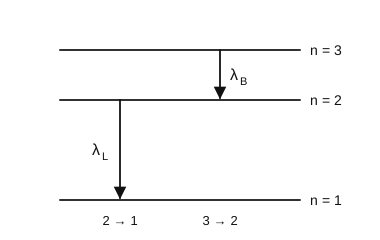
- Lyman longest: 2 → 1: .
- Balmer longest: 3 → 2: .
- .
Short trick: Lyman lines are UV (short), Balmer lines visible (long) – so the ratio must be less than 1: only (A) and (B) survive; a one-line calculation gives (A).
Answer: (A)
अवधारणा: ; किसी श्रेणी की सबसे लंबी तरंगदैर्ध्य सबसे छोटे ऊर्जा-अंतर (ठीक अगले स्तर से संक्रमण) से मिलती है।
- लाइमन की सबसे लंबी: 2 → 1: ।
- बामर की सबसे लंबी: 3 → 2: ।
- ।
शॉर्ट ट्रिक: लाइमन रेखाएँ पराबैंगनी (छोटी λ), बामर दृश्य (लंबी λ) – अतः अनुपात 1 से कम होगा: केवल (A) व (B) बचते हैं; गणना से (A)।
उत्तर: (A)
NEET UGPhysicsAtoms – hydrogen spectrum (Lyman & Balmer series)NEET UG 2015 · 25 Jul Shift 1
Q2197.The energy of the em waves is of the order of 15 keV. To which part of the spectrum does it belong?
विद्युत-चुंबकीय तरंगों की ऊर्जा 15 keV की कोटि की है। यह स्पेक्ट्रम के किस भाग से संबंधित है?
- Aγ-raysγ-किरणें
- BX-raysX-किरणें
- CInfra-red raysअवरक्त (infra-red) किरणें
- DUltraviolet raysपराबैंगनी (ultraviolet) किरणें
Show answer
Concept: ; with eV Å, λ(Å) = 12400 / E(eV).
- Å m.
- X-rays span roughly 1 nm to 10−3 nm (energies ~100 eV to ~100 keV) → 0.83 Å lies in the X-ray band.
- γ-rays are mostly > 100 keV (nuclear origin); UV is only ~3–100 eV; infra-red is below ~1.7 eV.
Short trick: Remember the ladder: visible ≈ 2–3 eV, UV ≈ 10 eV, X-ray ≈ keV, γ-ray ≈ MeV. "keV → X-ray".
Answer: (B) X-rays
अवधारणा: ; eV Å लेने पर λ(Å) = 12400 / E(eV)।
- Å m।
- X-किरणों का परिसर लगभग 1 nm से 10−3 nm (ऊर्जा ~100 eV से ~100 keV) है → 0.83 Å, X-किरण क्षेत्र में है।
- γ-किरणें प्रायः > 100 keV (नाभिकीय उद्गम); पराबैंगनी केवल ~3–100 eV; अवरक्त ~1.7 eV से कम।
शॉर्ट ट्रिक: सीढ़ी याद रखें: दृश्य ≈ 2–3 eV, UV ≈ 10 eV, X-किरण ≈ keV, γ-किरण ≈ MeV। "keV → X-किरण"।
उत्तर: (B) X-किरणें
NEET UGPhysicsElectromagnetic waves – EM spectrumNEET UG 2015 · 25 Jul Shift 1
Q2198.An electron moves on a straight line path XY as shown. The abcd is a coil adjacent to the path of electron. What will be the direction of current, if any, induced in the coil?
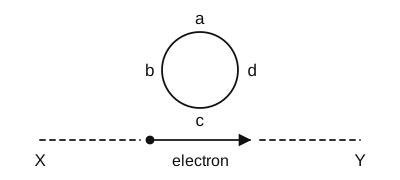
एक इलेक्ट्रॉन दर्शाए अनुसार सरल रेखीय पथ XY पर गति करता है। abcd इलेक्ट्रॉन के पथ के निकट स्थित एक कुंडली है। कुंडली में प्रेरित धारा (यदि कोई हो) की दिशा क्या होगी?
- ANo current inducedकोई धारा प्रेरित नहीं होगी
- Babcd
- Cadcb
- DThe current will reverse its direction as the electron goes past the coilजैसे ही इलेक्ट्रॉन कुंडली के आगे निकलेगा, धारा की दिशा उलट जाएगी
Show answer
Concept: A moving electron is a current; its magnetic field through the coil changes as it approaches and recedes. Lenz's law: induced current opposes the change in flux.
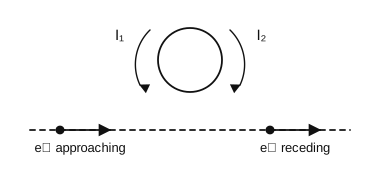
- Electron moving X → Y = conventional current Y → X below the coil; its field through the coil is into the page.
- Approaching: flux (into page) increases → induced current makes field out of page → anticlockwise (I1).
- Receding: flux decreases → induced current tries to keep it → clockwise (I2).
- So the current exists (A wrong) and is not one fixed sense (B, C wrong) – it reverses (D).
Short trick: Flux rises then falls ⇒ emf = −dΦ/dt changes sign ⇒ current always reverses when a charge/magnet passes by.
Answer: (D) The current reverses its direction as the electron goes past the coil
अवधारणा: गतिमान इलेक्ट्रॉन एक धारा है; पास आने व दूर जाने पर कुंडली से होकर इसका चुंबकीय फ्लक्स बदलता है। लेंज़ का नियम: प्रेरित धारा फ्लक्स-परिवर्तन का विरोध करती है।
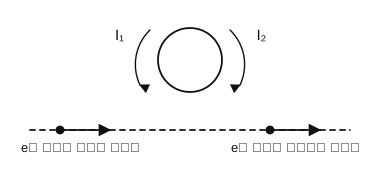
- इलेक्ट्रॉन X → Y = कुंडली के नीचे परंपरागत धारा Y → X; इसका क्षेत्र कुंडली में पृष्ठ के अंदर की ओर है।
- पास आते समय: फ्लक्स (अंदर की ओर) बढ़ता है → प्रेरित धारा बाहर की ओर क्षेत्र बनाती है → वामावर्त (I1)।
- दूर जाते समय: फ्लक्स घटता है → प्रेरित धारा उसे बनाए रखने का प्रयास करती है → दक्षिणावर्त (I2)।
- अतः धारा प्रेरित होती है (A गलत) और एक ही दिशा में नहीं रहती (B, C गलत) – दिशा उलटती है (D)।
शॉर्ट ट्रिक: फ्लक्स पहले बढ़ता फिर घटता है ⇒ emf = −dΦ/dt का चिह्न बदलता है ⇒ आवेश/चुंबक के पास से गुजरने पर धारा सदैव उलटती है।
उत्तर: (D) इलेक्ट्रॉन के कुंडली से आगे निकलने पर धारा की दिशा उलट जाती है
NEET UGPhysicsElectromagnetic induction – Lenz's lawNEET UG 2015 · 25 Jul Shift 1
Q2199.The cylindrical tube of a spray pump has radius R, one end of which has n fine holes, each of radius r. If the speed of the liquid in the tube is V, the speed of the ejection of the liquid through the holes is :
एक स्प्रे पंप की बेलनाकार नली की त्रिज्या R है, जिसके एक सिरे पर n महीन छिद्र हैं, प्रत्येक की त्रिज्या r है। यदि नली में द्रव की चाल V है, तो छिद्रों से द्रव के बाहर निकलने की चाल है:
- A
- B
- C
- D
Show answer
Concept: Equation of continuity: volume flow rate in = volume flow rate out, .
- Inflow: .
- Outflow through n holes: .
- .
Short trick: Dimension check: answer must have dimension of V, so R² must be over r² – kills (A); n appears only once (total area n·πr²) – kills (B) and (D).
Answer: (C)
अवधारणा: सांतत्य समीकरण: अंदर आने वाली आयतन प्रवाह दर = बाहर जाने वाली आयतन प्रवाह दर, ।
- अंतर्प्रवाह: ।
- n छिद्रों से बहिर्प्रवाह: ।
- ।
शॉर्ट ट्रिक: विमीय जाँच: उत्तर की विमा V जैसी होनी चाहिए, अतः R² के नीचे r² होगा – (A) बाहर; n केवल एक बार आता है (कुल क्षेत्रफल n·πr²) – (B) व (D) बाहर।
उत्तर: (C)
NEET UGPhysicsFluid mechanics – equation of continuityNEET UG 2015 · 25 Jul Shift 1
Q2200.The Young’s modulus of steel is twice that of brass. Two wires of same length and of same area of cross section, one of steel and another of brass are suspended from the same roof. If we want the lower ends of the wires to be at the same level, then the weights added to the steel and brass wires must be in the ratio of:
स्टील का यंग प्रत्यास्थता गुणांक पीतल का दोगुना है। समान लंबाई तथा समान अनुप्रस्थ-काट क्षेत्रफल के दो तार, एक स्टील का तथा दूसरा पीतल का, एक ही छत से लटकाए गए हैं। यदि हम चाहते हैं कि तारों के निचले सिरे समान स्तर पर रहें, तो स्टील तथा पीतल के तारों में जोड़े गए भारों का अनुपात होना चाहिए:
- A1 : 1
- B1 : 2
- C2 : 1
- D4 : 2
Show answer
Concept: .
- Same level ⇒ equal extensions: .
- ⇒ 2 : 1.
- Note: (D) 4 : 2 is numerically the same ratio but the expected simplest form is (C).
Short trick: Equal stretch ⇒ W ∝ Y (stiffer wire needs more load).
Answer: (C) 2 : 1
अवधारणा: ।
- समान स्तर ⇒ समान विस्तार: ।
- ⇒ 2 : 1।
- ध्यान दें: (D) 4 : 2 संख्यात्मक रूप से वही अनुपात है, परंतु अपेक्षित सरलतम रूप (C) है।
शॉर्ट ट्रिक: समान खिंचाव ⇒ W ∝ Y (कठोर तार को अधिक भार चाहिए)।
उत्तर: (C) 2 : 1
NEET UGPhysicsMechanical properties of solids – Young's modulusNEET UG 2015 · 25 Jul Shift 1

