Q2201.A potentiometer wire of length L and a resistance r are connected in series with a battery of e.m.f. and a resistance . An unknown e.m.f. E is balanced at a length of the potentiometer wire. The e.m.f. E will be given by:
लंबाई L तथा प्रतिरोध r का एक विभवमापी तार, विद्युत वाहक बल की बैटरी तथा प्रतिरोध के साथ श्रेणीक्रम में जुड़ा है। एक अज्ञात विद्युत वाहक बल E, विभवमापी तार की लंबाई पर संतुलित होता है। विद्युत वाहक बल E होगा:
- A
- B
- C
- D
Show answer
Concept: E = k l, where k = potential gradient = (p.d. across wire)/L.
- Current in primary: (battery internal resistance neglected).
- P.d. across wire: .
- ⇒ .
Short trick: E must increase with l (balancing length) – (A) and (B) have l in the denominator; (D) ignores r1.
Answer: (C)
अवधारणा: E = k l, जहाँ k = विभव प्रवणता = (तार के सिरों पर विभवांतर)/L।
- प्राथमिक परिपथ में धारा: (बैटरी का आंतरिक प्रतिरोध नगण्य)।
- तार के सिरों पर विभवांतर: ।
- ⇒ ।
शॉर्ट ट्रिक: E, संतुलन लंबाई l के साथ बढ़ना चाहिए – (A) व (B) में l हर में है; (D) में r1 की उपेक्षा है।
उत्तर: (C)
NEET UGPhysicsCurrent electricity – potentiometerNEET UG 2015 · 25 Jul Shift 1
Q2202.A particle is executing a simple harmonic motion. Its maximum acceleration is α and maximum velocity is β. Then, its time period of vibration will be:
एक कण सरल आवर्त गति कर रहा है। इसका अधिकतम त्वरण α तथा अधिकतम वेग β है। तब, इसका कंपन आवर्तकाल होगा:
- A
- B
- C
- D
Show answer
Concept: In SHM: , .
- .
- .
Short trick: Only (A) has dimension of time ([v]/[a] = s) and the 2π of a period.
Answer: (A)
अवधारणा: सरल आवर्त गति में: , ।
- ।
- ।
शॉर्ट ट्रिक: केवल (A) की विमा समय की है ([v]/[a] = s) और उसमें आवर्तकाल का 2π है।
उत्तर: (A)
NEET UGPhysicsOscillations – SHM maximum velocity and accelerationNEET UG 2015 · 25 Jul Shift 1
Q2203.If vectors and are functions of times, then the value of t at which they are orthogonal to each other is:
यदि सदिश तथा समय के फलन हैं, तो t का वह मान जिस पर वे परस्पर लंबवत होंगे, है:
- A
- B
- C
- D
Show answer
Concept: Two vectors are orthogonal when .
- .
- .
Short trick: Both are unit vectors at angles ωt and ωt/2; the angle between them is ωt/2 – set it to 90°.
Answer: (D)
अवधारणा: दो सदिश लंबवत होते हैं जब ।
- ।
- ।
शॉर्ट ट्रिक: दोनों एकांक सदिश हैं जो ωt तथा ωt/2 कोण पर हैं; उनके बीच का कोण ωt/2 है – इसे 90° रखें।
उत्तर: (D)
NEET UGPhysicsVectors – dot product and orthogonalityNEET UG 2015 · 25 Jul Shift 1
Q2204.A source of sound S emitting waves of frequency 100 Hz and an observer O are located at some distance from each other. The source is moving with a speed of 19.4 m s
−1 at an angle of 60° with the source observer line as shown in the figure. The observer is at rest. The apparent frequency observed by the observer (velocity of sound in air 330 m s
−1), is:
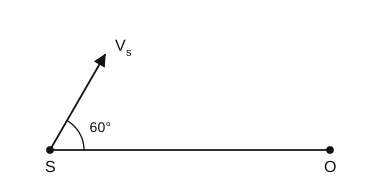
100 Hz आवृत्ति की तरंगें उत्सर्जित करने वाला एक ध्वनि स्रोत S तथा एक प्रेक्षक O एक-दूसरे से कुछ दूरी पर स्थित हैं। स्रोत, चित्र में दर्शाए अनुसार स्रोत-प्रेक्षक रेखा से 60° के कोण पर 19.4 m s
−1 की चाल से गतिमान है। प्रेक्षक विरामावस्था में है। प्रेक्षक द्वारा प्रेक्षित आभासी आवृत्ति (वायु में ध्वनि का वेग 330 m s
−1) है:
- A97 Hz
- B100 Hz
- C103 Hz
- D106 Hz
Show answer
Concept: Doppler effect uses only the velocity component along the source–observer line: (source approaching).
- Component towards O: .
- Hz.
Short trick: Source has a component towards O ⇒ f' > 100 Hz (kills A, B); small speed ⇒ f' ≈ f(1 + vscosθ/v) = 100(1 + 9.7/330) ≈ 103 Hz.
Answer: (C) 103 Hz
अवधारणा: डॉप्लर प्रभाव में केवल स्रोत–प्रेक्षक रेखा के अनुदिश वेग-घटक लिया जाता है: (स्रोत पास आ रहा)।
- O की ओर घटक: ।
- Hz।
शॉर्ट ट्रिक: स्रोत का O की ओर घटक है ⇒ f' > 100 Hz ((A), (B) बाहर); कम चाल ⇒ f' ≈ f(1 + vscosθ/v) = 100(1 + 9.7/330) ≈ 103 Hz।
उत्तर: (C) 103 Hz
NEET UGPhysicsWaves – Doppler effect (source moving at an angle)NEET UG 2015 · 25 Jul Shift 1
Q2205.An automobile moves on a road with a speed of 54 km h−1. The radius of its wheels is 0.45 m and the moment of inertia of the wheel about its axis of rotation is 3 kg m2. If the vehicle is brought to rest in 15 s, the magnitude of average torque transmitted by its brakes to the wheel is:
एक ऑटोमोबाइल सड़क पर 54 km h−1 की चाल से चल रहा है। इसके पहियों की त्रिज्या 0.45 m है तथा घूर्णन अक्ष के परितः पहिए का जड़त्व आघूर्ण 3 kg m2 है। यदि वाहन को 15 s में विराम में लाया जाता है, तो इसके ब्रेकों द्वारा पहिए को स्थानांतरित औसत बल-आघूर्ण का परिमाण है:
- A2.86 kg m2 s−2
- B6.66 kg m2 s−2
- C8.58 kg m2 s−2
- D10.86 kg m2 s−2
Show answer
Concept: Rolling: ω = v/R; average torque τ = Iα = IΔω/Δt.
- v = 54 km h−1 = 15 m s−1 ⇒ rad s−1.
- rad s−2.
- N m (= kg m2 s−2).
Short trick: τ = I v /(R t) = 3 × 15 /(0.45 × 15) = 3/0.45 = 6.67 – the 15s cancel!
Answer: (B) 6.66 kg m2 s−2
अवधारणा: लोटनिक गति: ω = v/R; औसत बल-आघूर्ण τ = Iα = IΔω/Δt।
- v = 54 km h−1 = 15 m s−1 ⇒ rad s−1।
- rad s−2।
- N m (= kg m2 s−2)।
शॉर्ट ट्रिक: τ = I v /(R t) = 3 × 15 /(0.45 × 15) = 3/0.45 = 6.67 – दोनों 15 कट जाते हैं!
उत्तर: (B) 6.66 kg m2 s−2
NEET UGPhysicsRotational motion – torque and angular retardationNEET UG 2015 · 25 Jul Shift 1
Q2206.A rectangular coil of length 0.12 m and width 0.1 m having 50 turns of wire is suspended vertically in a uniform magnetic field of strength 0.2 Weber/m2. The coil carries a current of 2 A. If the plane of the coil is inclined at an angle of 30° with the direction of the field, the torque required to keep coil in stable equilibrium will be:
लंबाई 0.12 m तथा चौड़ाई 0.1 m की तार के 50 फेरों वाली एक आयताकार कुंडली 0.2 Weber/m2 तीव्रता के एकसमान चुंबकीय क्षेत्र में ऊर्ध्वाधर लटकाई गई है। कुंडली में 2 A की धारा प्रवाहित हो रही है। यदि कुंडली का तल क्षेत्र की दिशा से 30° के कोण पर झुका है, तो कुंडली को स्थायी संतुलन में रखने के लिए आवश्यक बल-आघूर्ण होगा:
- A0.12 Nm
- B0.15 Nm
- C0.20 Nm
- D0.24 Nm
Show answer
Concept: , where θ is the angle between the area vector (normal, ) and .
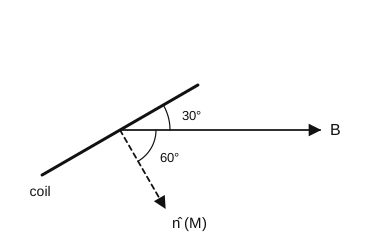
- Plane makes 30° with ⇒ normal makes θ = 90° − 30° = 60°.
- N m.
- The applied torque must balance this magnetic torque.
Short trick: Plane angle given ⇒ use cos of it: τ = NIAB cos30°. Max torque NIAB = 0.24 (option D) is for plane parallel to B – a trap.
Answer: (C) 0.20 Nm
अवधारणा: , जहाँ θ क्षेत्रफल सदिश (अभिलंब, ) तथा के बीच का कोण है।
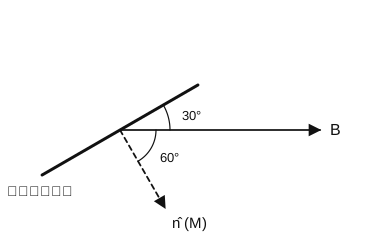
- तल से 30° बनाता है ⇒ अभिलंब θ = 90° − 30° = 60° बनाता है।
- N m।
- लगाया गया बल-आघूर्ण इस चुंबकीय बल-आघूर्ण को संतुलित करना चाहिए।
शॉर्ट ट्रिक: तल का कोण दिया हो ⇒ उसका cos लें: τ = NIAB cos30°। अधिकतम बल-आघूर्ण NIAB = 0.24 (विकल्प D) तल के B के समांतर होने पर है – जाल।
उत्तर: (C) 0.20 Nm
NEET UGPhysicsMoving charges and magnetism – torque on a current loopNEET UG 2015 · 25 Jul Shift 1
Q2207.A parallel plate air capacitor has capacity ‘C’, distance of separation between plates is ‘d’ and potential difference ‘V’ is applied between the plates. Force of attraction between the plates of the parallel plate air capacitor is:
एक समांतर प्लेट वायु संधारित्र की धारिता ‘C’ है, प्लेटों के बीच पृथक्करण दूरी ‘d’ है तथा प्लेटों के बीच विभवांतर ‘V’ लगाया गया है। समांतर प्लेट वायु संधारित्र की प्लेटों के बीच आकर्षण बल है:
- A
- B
- C
- D
Show answer
Concept: Each plate feels the field of the other plate only: .
- and .
- .
- Check: energy ⇒ – same.
Short trick: F = U/d = (½CV²)/d. Dimension check: CV² is energy, energy/length is force → only (C), (D); the ½ picks (C).
Answer: (C)
अवधारणा: प्रत्येक प्लेट केवल दूसरी प्लेट का क्षेत्र अनुभव करती है: ।
- तथा ।
- ।
- जाँच: ऊर्जा ⇒ – वही।
शॉर्ट ट्रिक: F = U/d = (½CV²)/d। विमीय जाँच: CV² ऊर्जा है, ऊर्जा/लंबाई = बल → केवल (C), (D); ½ के कारण (C)।
उत्तर: (C)
NEET UGPhysicsElectrostatics – force between capacitor platesNEET UG 2015 · 25 Jul Shift 1
Q2208.Two vessels separately contain two ideal gases A and B at the same temperature, the pressure of A being twice that of B. Under such conditions, the density of A is found to be 1.5 times the density of B. The ratio of molecular weight of A and B is:
दो पात्रों में अलग-अलग दो आदर्श गैसें A तथा B समान ताप पर भरी हैं, A का दाब B के दाब का दोगुना है। इन परिस्थितियों में A का घनत्व B के घनत्व का 1.5 गुना पाया जाता है। A तथा B के अणुभारों का अनुपात है:
- A
- B
- C
- D2
Show answer
Concept: .
- Same T: .
- .
Short trick: M ∝ ρ/P at fixed T: (1.5)/(2) = 0.75.
Answer: (C)
अवधारणा: ।
- समान T: ।
- ।
शॉर्ट ट्रिक: नियत T पर M ∝ ρ/P: (1.5)/(2) = 0.75।
उत्तर: (C)
NEET UGPhysicsKinetic theory – ideal gas equation with densityNEET UG 2015 · 25 Jul Shift 1
Q2209.A satellite S is moving in an elliptical orbit around the earth. The mass of the satellite is very small compared to the mass of the earth. Then,
एक उपग्रह S पृथ्वी के परितः दीर्घवृत्तीय कक्षा में गति कर रहा है। उपग्रह का द्रव्यमान पृथ्वी के द्रव्यमान की तुलना में बहुत कम है। तब,
- AThe acceleration of S is always directed towards the centre of the earthS का त्वरण सदैव पृथ्वी के केंद्र की ओर निर्दिष्ट होता है
- BThe angular momentum of S about the centre of the earth changes in direction, but its magnitude remains constantपृथ्वी के केंद्र के परितः S के कोणीय संवेग की दिशा बदलती है, परंतु उसका परिमाण नियत रहता है
- CThe total mechanical energy of S varies periodically with timeS की कुल यांत्रिक ऊर्जा समय के साथ आवर्ती रूप से बदलती है
- DThe linear momentum of S remains constant in magnitudeS के रैखिक संवेग का परिमाण नियत रहता है
Show answer
Concept: The only force on S is earth's gravity, a central force directed towards the earth's centre.
- (A) a = F/m, and F is always towards the centre ⇒ correct.
- (B) Central force ⇒ torque about centre = 0 ⇒ angular momentum constant in magnitude AND direction ⇒ wrong.
- (C) Gravity is conservative ⇒ total mechanical energy is constant ⇒ wrong.
- (D) Speed is greatest at perigee and least at apogee ⇒ |p| changes ⇒ wrong.
Short trick: Central force ⇒ L conserved (fully), E conserved, but speed changes (Kepler's 2nd law).
Answer: (A) The acceleration of S is always directed towards the centre of the earth
अवधारणा: S पर एकमात्र बल पृथ्वी का गुरुत्व है, जो पृथ्वी के केंद्र की ओर निर्दिष्ट केंद्रीय बल है।
- (A) a = F/m, तथा F सदैव केंद्र की ओर ⇒ सही।
- (B) केंद्रीय बल ⇒ केंद्र के परितः बल-आघूर्ण = 0 ⇒ कोणीय संवेग का परिमाण तथा दिशा दोनों नियत ⇒ गलत।
- (C) गुरुत्व संरक्षी बल है ⇒ कुल यांत्रिक ऊर्जा नियत ⇒ गलत।
- (D) चाल उपभू पर अधिकतम तथा अपभू पर न्यूनतम ⇒ |p| बदलता है ⇒ गलत।
शॉर्ट ट्रिक: केंद्रीय बल ⇒ L (पूर्णतः) संरक्षित, E संरक्षित, परंतु चाल बदलती है (केप्लर का द्वितीय नियम)।
उत्तर: (A) S का त्वरण सदैव पृथ्वी के केंद्र की ओर निर्दिष्ट होता है
NEET UGPhysicsGravitation – satellite in elliptical orbitNEET UG 2015 · 25 Jul Shift 1
Q2210.In the given figure, a diode D is connected to an external resistance R = 100 Ω and an e.m.f. of 3.5 V. If the barrier potential developed across the diode is 0.5 V, the current in the circuit will be:
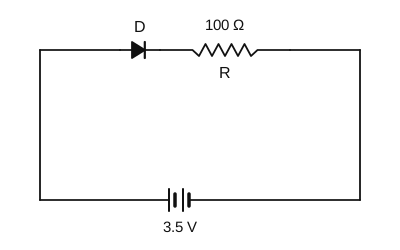
दिए गए चित्र में, एक डायोड D बाह्य प्रतिरोध R = 100 Ω तथा 3.5 V के विद्युत वाहक बल से जुड़ा है। यदि डायोड के सिरों पर उत्पन्न रोधिका विभव 0.5 V है, तो परिपथ में धारा होगी:
- A35 mA
- B30 mA
- C40 mA
- D20 mA
Show answer
Concept: A forward-biased diode drops (approximately) its barrier potential; the rest of the emf appears across R.
- From the figure, the positive (long-plate) terminal drives current into the anode of D ⇒ forward biased.
- A = 30 mA.
Short trick: (A) 35 mA is the trap that ignores the 0.5 V barrier.
Answer: (B) 30 mA
अवधारणा: अग्र-अभिनत डायोड पर (लगभग) उसका रोधिका विभव गिरता है; शेष विद्युत वाहक बल R पर आता है।
- चित्र से, धनात्मक (लंबी प्लेट) टर्मिनल D के एनोड में धारा भेजता है ⇒ अग्र-अभिनत।
- A = 30 mA।
शॉर्ट ट्रिक: (A) 35 mA वह जाल है जिसमें 0.5 V रोधिका की उपेक्षा की गई है।
उत्तर: (B) 30 mA
NEET UGPhysicsSemiconductors – forward-biased diode with barrier potentialNEET UG 2015 · 25 Jul Shift 1
Q2211.A remote-sensing satellite of earth revolves in a circular orbit at a height of m above the surface of earth. If earth’s radius is m and g = 9.8 m s−2, then the orbital speed of the satellite is:
पृथ्वी का एक सुदूर-संवेदी (remote-sensing) उपग्रह पृथ्वी की सतह से m की ऊँचाई पर वृत्तीय कक्षा में परिक्रमा करता है। यदि पृथ्वी की त्रिज्या m तथा g = 9.8 m s−2 है, तो उपग्रह की कक्षीय चाल है:
- A6.67 km s−1
- B7.76 km s−1
- C8.56 km s−1
- D9.13 km s−1
Show answer
Concept: (using GM = gR²).
- R + h = 6.38 × 10⁶ + 0.25 × 106 = 6.63 × 10⁶ m.
- m s−1.
Short trick: Near-surface orbit speed ≈ 7.9 km/s; a slightly higher orbit must be a little slower → 7.76.
Answer: (B) 7.76 km s−1
अवधारणा: (GM = gR² प्रयोग करके)।
- R + h = 6.38 × 10⁶ + 0.25 × 106 = 6.63 × 10⁶ m।
- m s−1।
शॉर्ट ट्रिक: सतह के निकट कक्षीय चाल ≈ 7.9 km/s; थोड़ी ऊँची कक्षा में चाल थोड़ी कम → 7.76।
उत्तर: (B) 7.76 km s−1
NEET UGPhysicsGravitation – orbital speed of a satelliteNEET UG 2015 · 25 Jul Shift 1
Q2212.The position vector of a particle as a function of time is given by:
Where R is in meters, t is in seconds and and denote unit vectors along x- and y-directions, respectively. Which one of the following statements is wrong for the motion of particle?
किसी कण का स्थिति सदिश समय के फलन के रूप में दिया गया है:
जहाँ R मीटर में, t सेकंड में है तथा और क्रमशः x- तथा y-दिशाओं के अनुदिश एकांक सदिश हैं। कण की गति के लिए निम्नलिखित में से कौन-सा कथन गलत है?
- APath of the particle is a circle of radius 4 meterकण का पथ 4 मीटर त्रिज्या का एक वृत्त है
- BAcceleration vector is along त्वरण सदिश के अनुदिश है
- CMagnitude of acceleration vector is , where v is the velocity of particleत्वरण सदिश का परिमाण है, जहाँ v कण का वेग है
- DMagnitude of the velocity of particle is 8 meter/secondकण के वेग का परिमाण 8 मीटर/सेकंड है
Show answer
Concept: x = 4 sin2πt, y = 4 cos2πt ⇒ x² + y² = 16: uniform circular motion with R = 4 m, ω = 2π rad s−1.
- (A) radius 4 m – true.
- ⇒ along – (B) true; magnitude ω²R = v²/R – (C) true.
- Speed v = ωR = 2π × 4 = 8π ≈ 25.1 m s−1, not 8 m s−1 ⇒ (D) is the wrong statement.
Short trick: v = ωR: the "2π" inside the sine never disappears – 8 m/s forgets it.
Answer: (D) Magnitude of the velocity of particle is 8 meter/second
अवधारणा: x = 4 sin2πt, y = 4 cos2πt ⇒ x² + y² = 16: R = 4 m तथा ω = 2π rad s−1 वाली एकसमान वृत्तीय गति।
- (A) त्रिज्या 4 m – सत्य।
- ⇒ के अनुदिश – (B) सत्य; परिमाण ω²R = v²/R – (C) सत्य।
- चाल v = ωR = 2π × 4 = 8π ≈ 25.1 m s−1, 8 m s−1 नहीं ⇒ (D) गलत कथन है।
शॉर्ट ट्रिक: v = ωR: sine के अंदर का "2π" कभी गायब नहीं होता – 8 m/s में यह भुला दिया गया है।
उत्तर: (D) कण के वेग का परिमाण 8 मीटर/सेकंड है
NEET UGPhysicsMotion in a plane – uniform circular motionNEET UG 2015 · 25 Jul Shift 1
Q2213.A string is stretched between fixed points separated by 75.0 cm. It is observed to have resonant frequencies of 420 Hz and 315 Hz. There are no other resonant frequencies between these two. The lowest resonant frequency for this string is:
एक डोरी 75.0 cm की दूरी पर स्थित दो स्थिर बिंदुओं के बीच तनी हुई है। इसकी अनुनादी आवृत्तियाँ 420 Hz तथा 315 Hz प्रेक्षित की जाती हैं। इन दोनों के बीच कोई अन्य अनुनादी आवृत्ति नहीं है। इस डोरी की न्यूनतम अनुनादी आवृत्ति है:
- A105 Hz
- B155 Hz
- C205 Hz
- D10.5 Hz
Show answer
Concept: For a string fixed at both ends, resonant frequencies are (all integer multiples of the fundamental).
- Consecutive resonances differ by : Hz.
- Check: 315 = 3 × 10⁵ and 420 = 4 × 10⁵ ✓.
- The lowest resonant frequency is the fundamental = 105 Hz.
Short trick: Lowest frequency = difference of two consecutive resonances (for a closed pipe it would be half the difference).
Answer: (A) 105 Hz
अवधारणा: दोनों सिरों पर बंधी डोरी के लिए अनुनादी आवृत्तियाँ हैं (मूल आवृत्ति के सभी पूर्णांक गुणज)।
- क्रमागत अनुनादों का अंतर होता है: Hz।
- जाँच: 315 = 3 × 10⁵ तथा 420 = 4 × 10⁵ ✓।
- न्यूनतम अनुनादी आवृत्ति मूल आवृत्ति = 105 Hz है।
शॉर्ट ट्रिक: न्यूनतम आवृत्ति = दो क्रमागत अनुनादों का अंतर (एक सिरे पर बंद नली में यह अंतर का आधा होता)।
उत्तर: (A) 105 Hz
NEET UGPhysicsWaves – stationary waves on a stringNEET UG 2015 · 25 Jul Shift 1
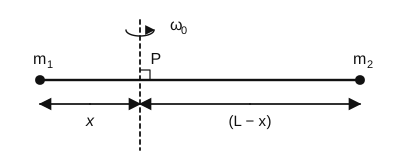
Q2214.Point masses
and
are placed at the opposite ends of rigid rod of length L, and negligible mass. The rod is to be set rotating about an axis perpendicular to it. The position of point P on this rod through which the axis should pass so that the work required to set the rod rotating with angular velocity
is minimum, is given by:
बिंदु द्रव्यमान
तथा
, लंबाई L तथा नगण्य द्रव्यमान की एक दृढ़ छड़ के विपरीत सिरों पर रखे हैं। छड़ को उसके लंबवत एक अक्ष के परितः घुमाना है। छड़ पर बिंदु P की वह स्थिति, जिससे होकर अक्ष गुज़रनी चाहिए ताकि छड़ को कोणीय वेग
से घुमाने के लिए आवश्यक कार्य न्यूनतम हो, दी जाती है:
- A
- B
- C
- D
Show answer
Concept: Work = rotational KE = ; for fixed ω0 it is least when I is least, i.e. axis through the centre of mass.
- .
- .
- (the centre of mass, measured from m1).
Short trick: Distance from m1 carries the OTHER mass on top: x = m2L/(m1+m2). Options (C), (D) fail the dimension/limit check (x can exceed L).
Answer: (A)
अवधारणा: कार्य = घूर्णी गतिज ऊर्जा = ; नियत ω0 के लिए यह तब न्यूनतम है जब I न्यूनतम हो, अर्थात अक्ष द्रव्यमान केंद्र से गुज़रे।
- ।
- ।
- (m1 से मापा गया द्रव्यमान केंद्र)।
शॉर्ट ट्रिक: m1 से दूरी के अंश में दूसरा द्रव्यमान आता है: x = m2L/(m1+m2)। (C), (D) सीमा-जाँच में विफल (x, L से अधिक हो सकता है)।
उत्तर: (A)
NEET UGPhysicsRotational motion – moment of inertia minimum about centre of massNEET UG 2015 · 25 Jul Shift 1
Q2215.At the first minimum adjacent to the central maximum of a single-slit diffraction pattern, the phase difference between the Huygen’s wavelet from the edge of the slit and the wavelet from the midpoint of the slit is:
एकल-झिरी विवर्तन पैटर्न में केंद्रीय उच्चिष्ठ के निकटवर्ती प्रथम निम्निष्ठ पर, झिरी के किनारे से आने वाली हाइगेंस तरंगिका तथा झिरी के मध्य बिंदु से आने वाली तरंगिका के बीच कलांतर है:
- A radian रेडियन
- B radian रेडियन
- C radian रेडियन
- Dπ radianπ रेडियन
Show answer
Concept: First minimum: – path difference between the two edges is λ; split the slit into two halves.
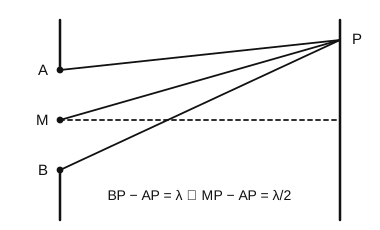
- Edge A to midpoint M is half the slit ⇒ path difference = λ/2.
- Phase difference .
- So every wavelet of the upper half cancels its partner in the lower half – that is why it is a minimum.
Short trick: Half-slit pairing: edge ↔ midpoint must be out of phase (π) for darkness.
Answer: (D) π radian
अवधारणा: प्रथम निम्निष्ठ: – दोनों किनारों के बीच पथांतर λ है; झिरी को दो अर्धों में बाँटें।
- किनारे A से मध्य बिंदु M तक झिरी का आधा भाग ⇒ पथांतर = λ/2।
- कलांतर ।
- अतः ऊपरी अर्ध की प्रत्येक तरंगिका, निचले अर्ध की अपनी जोड़ीदार तरंगिका को निरस्त कर देती है – इसीलिए निम्निष्ठ बनता है।
शॉर्ट ट्रिक: अर्ध-झिरी युग्मन: अँधेरे के लिए किनारा ↔ मध्य बिंदु विपरीत कला (π) में होने चाहिए।
उत्तर: (D) π रेडियन
NEET UGPhysicsWave optics – single slit diffractionNEET UG 2015 · 25 Jul Shift 1
Q2216.A force is acting at a point . The value of α for which angular momentum about origin is conserved is:
एक बल बिंदु पर कार्य कर रहा है। α का वह मान जिसके लिए मूल बिंदु के परितः कोणीय संवेग संरक्षित रहता है, है:
- A1
- B−1
- C2
- DZeroशून्य
Show answer
Concept: Angular momentum is conserved when torque , i.e. .
- Components must be proportional: .
- .
- Check: ⇒ cross product zero ✓.
Short trick: j and k parts already say F = −½ r, so α = −½ × 2 = −1.
Answer: (B) −1
अवधारणा: कोणीय संवेग तब संरक्षित रहता है जब बल-आघूर्ण , अर्थात ।
- घटक समानुपाती होने चाहिए: ।
- ।
- जाँच: ⇒ सदिश गुणनफल शून्य ✓।
शॉर्ट ट्रिक: j व k भाग पहले ही बताते हैं कि F = −½ r, अतः α = −½ × 2 = −1।
उत्तर: (B) −1
NEET UGPhysicsRotational motion – conservation of angular momentum (torque = 0)NEET UG 2015 · 25 Jul Shift 1
Q2217.Two particles A and B move with constant velocities and . At the initial moment their position vectors are and respectively. The condition for particles A and B for their collision is:
दो कण A तथा B नियत वेगों तथा से गति करते हैं। प्रारंभिक क्षण पर उनके स्थिति सदिश क्रमशः तथा हैं। कणों A तथा B की टक्कर के लिए शर्त है:
- A
- B
- C
- D
Show answer
Concept: Collision at time t: .
- with t > 0.
- So and point the same way: their unit vectors are equal – (B).
- (A), (C) are not the condition; (D) equates a position to a velocity (wrong dimensions, wrong sign).
Short trick: In B's frame, A must move straight at B: relative velocity of B w.r.t. A must point from B to A … i.e. unit vectors equal.
Answer: (B)
अवधारणा: समय t पर टक्कर: ।
- , जहाँ t > 0।
- अतः तथा एक ही दिशा में हैं: उनके एकांक सदिश बराबर हैं – (B)।
- (A), (C) शर्त नहीं हैं; (D) स्थिति को वेग के बराबर रखता है (गलत विमा, गलत चिह्न)।
शॉर्ट ट्रिक: B के निर्देश-तंत्र में A को सीधे B की ओर आना चाहिए: A के सापेक्ष B का आपेक्षिक वेग B से A की ओर निर्दिष्ट होना चाहिए … अर्थात दोनों एकांक सदिश बराबर।
उत्तर: (B)
NEET UGPhysicsMotion in a plane – relative velocity and collision conditionNEET UG 2015 · 25 Jul Shift 1
Q2218.A nucleus of uranium decays at rest into nuclei of thorium and helium. Then:
विरामावस्था में यूरेनियम का एक नाभिक थोरियम तथा हीलियम के नाभिकों में क्षयित होता है। तब:
- AThe helium nucleus has less kinetic energy than the thorium nucleusहीलियम नाभिक की गतिज ऊर्जा थोरियम नाभिक से कम है
- BThe helium nucleus has more kinetic energy than the thorium nucleusहीलियम नाभिक की गतिज ऊर्जा थोरियम नाभिक से अधिक है
- CThe helium nucleus has less momentum than the thorium nucleusहीलियम नाभिक का संवेग थोरियम नाभिक से कम है
- DThe helium nucleus has more momentum than the thorium nucleusहीलियम नाभिक का संवेग थोरियम नाभिक से अधिक है
Show answer
Concept: Momentum conservation (initially at rest): in magnitude; .
- Equal momenta ⇒ (C) and (D) are wrong.
- ⇒ helium has far more KE – (B); (A) wrong.
Short trick: Equal p, so the lighter fragment runs away with the energy (≈ 98% of Q goes to the α-particle).
Answer: (B) The helium nucleus has more kinetic energy than the thorium nucleus
अवधारणा: संवेग संरक्षण (प्रारंभ में विराम): परिमाण में ; ।
- समान संवेग ⇒ (C) व (D) गलत।
- ⇒ हीलियम की गतिज ऊर्जा कहीं अधिक – (B); (A) गलत।
शॉर्ट ट्रिक: p समान है, अतः हल्का खंड ऊर्जा ले जाता है (Q का ≈ 98% α-कण को मिलता है)।
उत्तर: (B) हीलियम नाभिक की गतिज ऊर्जा थोरियम नाभिक से अधिक है
NEET UGPhysicsNuclei – alpha decay, momentum and kinetic energy sharingNEET UG 2015 · 25 Jul Shift 1
Q2219.Two metal wires of identical dimensions are connected in series. If and are the conductivities of the metal wires respectively, the effective conductivity of the combination is:
समान विमाओं वाले धातु के दो तार श्रेणीक्रम में जुड़े हैं। यदि तथा क्रमशः धातु के तारों की चालकताएँ हैं, तो संयोजन की प्रभावी चालकता है:
- A
- B
- C
- D
Show answer
Concept: ; in series resistances add; the combination has length 2ℓ and area A.
- .
- Also .
- .
Short trick: Limit check σ1 = σ2 = σ ⇒ σeq must be σ: only (B) gives σ (A gives σ/2; C, D have wrong dimensions).
Answer: (B)
अवधारणा: ; श्रेणी में प्रतिरोध जुड़ते हैं; संयोजन की लंबाई 2ℓ तथा क्षेत्रफल A है।
- ।
- साथ ही ।
- ।
शॉर्ट ट्रिक: सीमा-जाँच σ1 = σ2 = σ ⇒ σeq = σ होना चाहिए: केवल (B) σ देता है ((A) σ/2 देता है; (C), (D) की विमा गलत)।
उत्तर: (B)
NEET UGPhysicsCurrent electricity – effective conductivity of series combinationNEET UG 2015 · 25 Jul Shift 1
Q2220.Light of wavelength 500 nm is incident on a metal with work function 2.28 eV. The de Broglie wavelength of the emitted electron is:
500 nm तरंगदैर्ध्य का प्रकाश 2.28 eV कार्य-फलन वाली एक धातु पर आपतित होता है। उत्सर्जित इलेक्ट्रॉन की दे ब्रॉग्ली तरंगदैर्ध्य है:
- A m
- B m
- C m
- D m
Show answer
Concept: Einstein: ; de Broglie – the fastest electrons have the shortest λe.
- Photon energy eV ⇒ eV.
- m, i.e. ≈ 2.8 × 10⁻⁹ m (2 significant figures).
- Electrons come out with K ≤ Kmax, so λe ≥ λmin ⇒ λ ≥ 2.8 × 10⁻⁹ m.
Short trick: For electrons λ(nm) ≈ 1.23/√K(eV) = 1.23/√0.2 ≈ 2.75 nm; and since K can be less than Kmax, the inequality must be "≥".
Answer: (D) m
अवधारणा: आइंस्टाइन: ; दे ब्रॉग्ली – सबसे तेज़ इलेक्ट्रॉनों की λe सबसे छोटी होती है।
- फोटॉन ऊर्जा eV ⇒ eV।
- m, अर्थात ≈ 2.8 × 10⁻⁹ m (2 सार्थक अंकों तक)।
- इलेक्ट्रॉन K ≤ Kmax के साथ निकलते हैं, अतः λe ≥ λmin ⇒ λ ≥ 2.8 × 10⁻⁹ m।
शॉर्ट ट्रिक: इलेक्ट्रॉन के लिए λ(nm) ≈ 1.23/√K(eV) = 1.23/√0.2 ≈ 2.75 nm; और K, Kmax से कम हो सकती है, अतः असमिका "≥" होगी।
उत्तर: (D) m
NEET UGPhysicsDual nature – photoelectric effect and de Broglie wavelengthNEET UG 2015 · 25 Jul Shift 1

