NEET UG · 2,240 questions

NEET UG 2015, 2016, 2017, 2018, 2019, 2020, 2021, 2022, 2023, 2024, 2025, 2026 PYQs

Real previous year questions, subject-wise. Try the question, then open the answer and the explanation in Hindi & English – free, no login.

Courses – airGurukul

2,240 questions.

Q2161.
If you suspect major deficiency of antibodies in a person, to which of the following would you look for confirmatory evidence?
यदि आपको किसी व्यक्ति में प्रतिरक्षियों (antibodies) की भारी कमी का संदेह हो, तो पुष्टिकारक प्रमाण के लिए आप निम्नलिखित में से किसकी जाँच करेंगे?
  1. ASerum globulinsसीरम ग्लोबुलिन
  2. BFibrinogin in plasmaप्लाज्मा में फाइब्रिनोजन
  3. CSerum albuminsसीरम ऐल्बुमिन
  4. DHaemocytesहीमोसाइट
Show answer

Concept: Plasma proteins: fibrinogen (clotting), albumin (osmotic balance) and globulins (defence). Antibodies are immunoglobulins – the γ-globulin fraction of serum.

  1. (A) Correct – low serum (γ-)globulin confirms antibody deficiency.
  2. (B) Fibrinogen is a clotting factor.
  3. (C) Albumin maintains colloidal osmotic pressure.
  4. (D) Haemocytes are blood cells (of invertebrates) – not antibodies.

Short trick: Globulin → "Guard"; Albumin → osmotic "balance"; Fibrinogen → "fibrin clot".

Answer: (A) Serum globulins

अवधारणा: प्लाज्मा प्रोटीन: फाइब्रिनोजन (स्कंदन), ऐल्बुमिन (परासरण संतुलन) और ग्लोबुलिन (रक्षा)। प्रतिरक्षी इम्यूनोग्लोबुलिन हैं – सीरम का γ-ग्लोबुलिन अंश।

  1. (A) सही – सीरम (γ-)ग्लोबुलिन की कमी प्रतिरक्षी-अल्पता की पुष्टि करती है।
  2. (B) फाइब्रिनोजन स्कंदन कारक है।
  3. (C) ऐल्बुमिन कोलॉइडी परासरण दाब बनाए रखता है।
  4. (D) हीमोसाइट रक्त कोशिकाएँ (अकशेरुकियों की) हैं – प्रतिरक्षी नहीं।

शॉर्ट ट्रिक: ग्लोबुलिन → "गार्ड" (रक्षा); ऐल्बुमिन → परासरण "संतुलन"; फाइब्रिनोजन → "फाइब्रिन थक्का"।

उत्तर: (A) सीरम ग्लोबुलिन
NEET UGBiologyBody fluids – plasma proteins and antibodiesNEET UG 2015 · 25 Jul Shift 1
Q2162.
In human females, meiosis-II is not completed until?
मानव मादाओं में अर्धसूत्रीविभाजन-II (meiosis-II) कब तक पूर्ण नहीं होता?
  1. ABirthजन्म
  2. BPubertyयौवनारंभ
  3. CFertilizationनिषेचन
  4. DUterine implantationगर्भाशय में अंतर्रोपण
Show answer

Concept: Primary oocytes enter meiosis-I in the foetus and stay arrested in prophase-I until puberty; meiosis-I is completed just before ovulation, giving the secondary oocyte, which is arrested in metaphase-II. Meiosis-II is completed only when a sperm enters it (fertilisation), forming the ovum and second polar body.

  1. (A) Birth – oocytes are then still in prophase-I.
  2. (B) Puberty – only resumes meiosis-I in each cycle.
  3. (C) Correct – sperm entry triggers completion of meiosis-II.
  4. (D) Implantation (about day 7) occurs long after meiosis is over.

Short trick: Two pauses: Prophase-I till puberty, Metaphase-II till the sperm arrives. No sperm → meiosis-II never completes.

Answer: (C) Fertilization

अवधारणा: प्राथमिक अंडक भ्रूणावस्था में अर्धसूत्री-I शुरू करके यौवनारंभ तक प्रोफेज-I में रुके रहते हैं; अंडोत्सर्ग से ठीक पहले अर्धसूत्री-I पूरा होकर द्वितीयक अंडक बनता है, जो मेटाफेज-II में रुक जाता है। अर्धसूत्री-II तभी पूर्ण होता है जब शुक्राणु उसमें प्रवेश करता है (निषेचन) – इससे अंडाणु और द्वितीय ध्रुवीय काय बनते हैं।

  1. (A) जन्म – तब अंडक प्रोफेज-I में ही होते हैं।
  2. (B) यौवनारंभ – प्रत्येक चक्र में केवल अर्धसूत्री-I पुनः आरंभ होता है।
  3. (C) सही – शुक्राणु प्रवेश से अर्धसूत्री-II पूर्ण होता है।
  4. (D) अंतर्रोपण (लगभग 7वाँ दिन) अर्धसूत्रीविभाजन समाप्त होने के बहुत बाद होता है।

शॉर्ट ट्रिक: दो विराम: प्रोफेज-I यौवनारंभ तक, मेटाफेज-II शुक्राणु आने तक। शुक्राणु नहीं → अर्धसूत्री-II कभी पूर्ण नहीं।

उत्तर: (C) निषेचन

NEET UGBiologyHuman reproduction – oogenesisNEET UG 2015 · 25 Jul Shift 1
Q2163.
Which of the following layers in an antral follicle is acellular?
गुहिकीय (antral) पुटक की निम्नलिखित में से कौन-सी परत अकोशिकीय है?
  1. AZona pellucidaज़ोना पेलुसिडा
  2. BGranulosaग्रैनुलोसा
  3. CTheca internaथीका इंटर्ना
  4. DStromaस्ट्रोमा (पीठिका)
Show answer

Concept: The zona pellucida is a non-cellular glycoprotein layer that surrounds the oocyte; it is laid down between the oocyte and the granulosa cells. All other layers of the follicle are made of cells.

  1. (A) Correct – zona pellucida is acellular (glycoprotein).
  2. (B) Granulosa – layers of follicular (granulosa) cells.
  3. (C) Theca interna – vascular cellular layer that secretes estrogen precursors.
  4. (D) Stroma – cellular connective tissue of the ovary.

Short trick: Zona = "zone" of jelly (glycoprotein) – the only layer with no cells; it also blocks polyspermy.

Answer: (A) Zona pellucida

अवधारणा: ज़ोना पेलुसिडा अंडक को घेरने वाली ग्लाइकोप्रोटीन की अकोशिकीय परत है; यह अंडक और ग्रैनुलोसा कोशिकाओं के बीच बनती है। पुटक की शेष सभी परतें कोशिकाओं से बनी होती हैं।

  1. (A) सही – ज़ोना पेलुसिडा अकोशिकीय (ग्लाइकोप्रोटीन) है।
  2. (B) ग्रैनुलोसा – पुटकीय (ग्रैनुलोसा) कोशिकाओं की परतें।
  3. (C) थीका इंटर्ना – एस्ट्रोजन पूर्ववर्ती स्रावित करने वाली संवहनी कोशिकीय परत।
  4. (D) स्ट्रोमा – अंडाशय का कोशिकीय संयोजी ऊतक।

शॉर्ट ट्रिक: ज़ोना = जेली (ग्लाइकोप्रोटीन) का "क्षेत्र" – बिना कोशिकाओं वाली एकमात्र परत; यह बहुशुक्राणुता भी रोकती है।

उत्तर: (A) ज़ोना पेलुसिडा

NEET UGBiologyHuman reproduction – ovarian follicleNEET UG 2015 · 25 Jul Shift 1
Q2164.
In his classic experiments on pea plants, Mendel did not use:
मटर के पौधों पर अपने प्रसिद्ध प्रयोगों में मेंडल ने किसका उपयोग नहीं किया?
  1. AFlower positionपुष्प की स्थिति
  2. BSeed colourबीज का रंग
  3. CPod lengthफली की लंबाई
  4. DSeed shapeबीज की आकृति
Show answer

Concept: Mendel's seven contrasting pairs: stem height (tall/dwarf), flower colour (violet/white), flower position (axial/terminal), pod shape (inflated/constricted), pod colour (green/yellow), seed shape (round/wrinkled), seed colour (yellow/green).

  1. (A) Flower position – used (axial dominant).
  2. (B) Seed colour – used (yellow dominant).
  3. (C) Correct – pod length was never one of his characters (he used pod shape and pod colour).
  4. (D) Seed shape – used (round dominant).

Short trick: Pod gives 2 traits – shape and colour, never length. Mnemonic for 7 traits: "Stem, Flower ×2, Pod ×2, Seed ×2".

Answer: (C) Pod length

अवधारणा: मेंडल के सात विपरीत लक्षण-युग्म: तने की ऊँचाई (लंबा/बौना), पुष्प का रंग (बैंगनी/सफ़ेद), पुष्प की स्थिति (अक्षीय/शीर्षस्थ), फली की आकृति (फूली/संकुचित), फली का रंग (हरा/पीला), बीज की आकृति (गोल/झुर्रीदार), बीज का रंग (पीला/हरा)।

  1. (A) पुष्प की स्थिति – उपयोग की गई (अक्षीय प्रभावी)।
  2. (B) बीज का रंग – उपयोग किया गया (पीला प्रभावी)।
  3. (C) सही – फली की लंबाई उनके लक्षणों में कभी नहीं थी (उन्होंने फली की आकृति और रंग लिए)।
  4. (D) बीज की आकृति – उपयोग की गई (गोल प्रभावी)।

शॉर्ट ट्रिक: फली से 2 लक्षण – आकृति और रंग, लंबाई कभी नहीं। 7 लक्षणों के लिए याद रखें: "तना, पुष्प ×2, फली ×2, बीज ×2"।

उत्तर: (C) फली की लंबाई

NEET UGBiologyPrinciples of inheritance – Mendel's charactersNEET UG 2015 · 25 Jul Shift 1
Q2165.
Which one of the following fruits is parthenocarpic?
निम्नलिखित में से कौन-सा फल अनिषेकफलीय (parthenocarpic) है?
  1. ABananaकेला
  2. BBrinjalबैंगन
  3. CAppleसेब
  4. DJackfruitकटहल
Show answer

Concept: Parthenocarpy = development of fruit without fertilisation, giving seedless fruits. NCERT: banana is one such example; parthenocarpy can also be induced by growth hormones.

  1. (A) Correct – cultivated banana is seedless (parthenocarpic).
  2. (B) Brinjal – normal seeded fruit (berry).
  3. (C) Apple – false fruit (pome) formed after fertilisation, has seeds.
  4. (D) Jackfruit – composite fruit (sorosis) with seeds.

Short trick: Seedless = Parthenocarpic → Banana (NCERT example).

Answer: (A) Banana

अवधारणा: अनिषेकफलन = निषेचन के बिना फल का विकास, जिससे बीजरहित फल बनते हैं। NCERT: केला ऐसा ही एक उदाहरण है; वृद्धि हॉर्मोनों द्वारा भी अनिषेकफलन प्रेरित किया जा सकता है।

  1. (A) सही – उगाया जाने वाला केला बीजरहित (अनिषेकफलीय) होता है।
  2. (B) बैंगन – सामान्य बीजयुक्त फल (बेरी)।
  3. (C) सेब – निषेचन के बाद बना कूटफल (पोम), बीजयुक्त।
  4. (D) कटहल – संग्रथित फल (सोरोसिस), बीजयुक्त।

शॉर्ट ट्रिक: बीजरहित = अनिषेकफलीय → केला (NCERT उदाहरण)।

उत्तर: (A) केला

NEET UGBiologySexual reproduction in flowering plants – parthenocarpyNEET UG 2015 · 25 Jul Shift 1
Q2166.
In angiosperms, microsporogenesis and megasporogenesis :
आवृतबीजियों में लघुबीजाणुजनन और गुरुबीजाणुजनन:
  1. AOccur in ovuleबीजांड में होते हैं
  2. BOccur in antherपरागकोश में होते हैं
  3. CForm gametes without further divisionsबिना आगे के विभाजनों के युग्मक बनाते हैं
  4. DInvolve meiosisअर्धसूत्रीविभाजन शामिल करते हैं
Show answer

Concept: Microsporogenesis: microspore mother cell (2n) in the anther → meiosis → microspore tetrad (n). Megasporogenesis: megaspore mother cell (2n) in the ovule (nucellus) → meiosis → 4 megaspores (n). The common feature is meiosis.

  1. (A) Only megasporogenesis occurs in the ovule.
  2. (B) Only microsporogenesis occurs in the anther.
  3. (C) Wrong – spores divide further by mitosis to form the male and female gametophytes, which then produce gametes.
  4. (D) Correct – both involve meiosis (2n → n).

Short trick: "Sporo-genesis" always = meiosis (spore mother cell 2n → spores n); "gameto-genesis" in plants = mitosis.

Answer: (D) Involve meiosis

अवधारणा: लघुबीजाणुजनन: परागकोश में लघुबीजाणु मातृ कोशिका (2n) → अर्धसूत्रीविभाजन → लघुबीजाणु चतुष्क (n)। गुरुबीजाणुजनन: बीजांड (बीजांडकाय) में गुरुबीजाणु मातृ कोशिका (2n) → अर्धसूत्रीविभाजन → 4 गुरुबीजाणु (n)। दोनों में सामान्य बात अर्धसूत्रीविभाजन है।

  1. (A) बीजांड में केवल गुरुबीजाणुजनन होता है।
  2. (B) परागकोश में केवल लघुबीजाणुजनन होता है।
  3. (C) गलत – बीजाणु समसूत्री विभाजन द्वारा आगे विभाजित होकर नर व मादा युग्मकोद्भिद बनाते हैं, जो फिर युग्मक बनाते हैं।
  4. (D) सही – दोनों में अर्धसूत्रीविभाजन (2n → n) होता है।

शॉर्ट ट्रिक: "बीजाणु-जनन" सदैव = अर्धसूत्री (मातृ कोशिका 2n → बीजाणु n); पौधों में "युग्मक-जनन" = समसूत्री।

उत्तर: (D) अर्धसूत्रीविभाजन शामिल करते हैं

NEET UGBiologySexual reproduction in flowering plants – sporogenesisNEET UG 2015 · 25 Jul Shift 1
Q2167.
A gene showing codominance has:
सहप्रभाविता (codominance) प्रदर्शित करने वाले जीन में:
  1. ABoth alleles independently expressed in the heterozygoteविषमयुग्मज में दोनों युग्मविकल्पी स्वतंत्र रूप से अभिव्यक्त होते हैं
  2. BOne allele dominant on the otherएक युग्मविकल्पी दूसरे पर प्रभावी होता है
  3. CAlleles tightly linked on the same chromosomeयुग्मविकल्पी एक ही गुणसूत्र पर दृढ़ता से सहलग्न होते हैं
  4. DAlleles that are recessive to each otherयुग्मविकल्पी एक-दूसरे के प्रति अप्रभावी होते हैं
Show answer

Concept: In codominance the F1 (heterozygote) resembles both parents – each allele makes its own product. Example: ABO blood group, IAIB → both A and B antigens (AB group).

  1. (A) Correct – both alleles expressed independently.
  2. (B) Describes complete dominance.
  3. (C) Describes linkage – a relation between different genes, not between alleles.
  4. (D) Alleles recessive to each other is not a real inheritance pattern.

Short trick: Co = "together": both show fully (AB blood). Incomplete dominance = blend (pink snapdragon).

Answer: (A) Both alleles independently expressed in the heterozygote

अवधारणा: सहप्रभाविता में F1 (विषमयुग्मज) दोनों जनकों जैसा होता है – प्रत्येक युग्मविकल्पी अपना उत्पाद बनाता है। उदाहरण: ABO रक्त समूह, IAIB → A और B दोनों प्रतिजन (AB समूह)।

  1. (A) सही – दोनों युग्मविकल्पी स्वतंत्र रूप से अभिव्यक्त।
  2. (B) पूर्ण प्रभाविता का वर्णन है।
  3. (C) सहलग्नता का वर्णन है – यह भिन्न जीनों के बीच संबंध है, युग्मविकल्पियों के बीच नहीं।
  4. (D) एक-दूसरे के प्रति अप्रभावी युग्मविकल्पी कोई वास्तविक वंशागति प्रतिरूप नहीं है।

शॉर्ट ट्रिक: सह = "साथ-साथ": दोनों पूर्ण रूप से दिखते हैं (AB रक्त)। अपूर्ण प्रभाविता = मिश्रण (गुलाबी स्नैपड्रैगन)।

उत्तर: (A) विषमयुग्मज में दोनों युग्मविकल्पी स्वतंत्र रूप से अभिव्यक्त होते हैं

NEET UGBiologyPrinciples of inheritance – codominanceNEET UG 2015 · 25 Jul Shift 1
Q2168.
The chitinous exoskeleton of arthropods is formed by the polymerisation of :
संधिपादों (arthropods) का काइटिनी बाह्यकंकाल किसके बहुलकीकरण से बनता है?
  1. ALipoglycansलिपोग्लाइकेन
  2. BKeratin sulphate and chondroitin sulphateकेराटिन सल्फेट और कॉण्ड्रॉइटिन सल्फेट
  3. CD-glucosamineD-ग्लूकोसामीन
  4. DN-acetyl glucosamineN-ऐसीटिल ग्लूकोसामीन
Show answer

Concept: Chitin is a structural homopolysaccharide (complex polysaccharide) made of β-1,4 linked N-acetyl glucosamine units – found in the arthropod exoskeleton and fungal cell walls.

  1. (A) Lipoglycans – lipid-linked sugars of cell envelopes, not chitin.
  2. (B) Keratan/chondroitin sulphates – components of cartilage matrix.
  3. (C) D-glucosamine alone (without the acetyl group) forms chitosan, not chitin.
  4. (D) Correct – N-acetyl glucosamine.

Short trick: Chitin = "N-A-G" polymer (N-Acetyl Glucosamine) – arthropods and fungi share it.

Answer: (D) N-acetyl glucosamine

अवधारणा: काइटिन β-1,4 बंधों से जुड़ी N-ऐसीटिल ग्लूकोसामीन इकाइयों से बना संरचनात्मक समबहुशर्करा (जटिल पॉलीसैकेराइड) है – यह संधिपादों के बाह्यकंकाल और कवक कोशिका भित्ति में पाया जाता है।

  1. (A) लिपोग्लाइकेन – कोशिका आवरण की लिपिड-युक्त शर्कराएँ, काइटिन नहीं।
  2. (B) केराटन/कॉण्ड्रॉइटिन सल्फेट – उपास्थि आधात्री के घटक।
  3. (C) केवल D-ग्लूकोसामीन (ऐसीटिल समूह रहित) काइटोसन बनाता है, काइटिन नहीं।
  4. (D) सही – N-ऐसीटिल ग्लूकोसामीन।

शॉर्ट ट्रिक: काइटिन = "N-A-G" बहुलक (N-ऐसीटिल ग्लूकोसामीन) – संधिपाद और कवक दोनों में।

उत्तर: (D) N-ऐसीटिल ग्लूकोसामीन

NEET UGBiologyBiomolecules – chitinNEET UG 2015 · 25 Jul Shift 1
Q2169.
The imperfect fungi which are decomposers of litter and help in mineral cycling belong to:
वे अपूर्ण कवक जो कूड़े-करकट (litter) के अपघटक हैं और खनिज चक्रण में सहायता करते हैं, किस वर्ग के हैं?
  1. AAscomycetesऐस्कोमाइसिटीज़
  2. BDeuteromycetesड्यूटेरोमाइसिटीज़
  3. CBasidiomycetesबेसिडियोमाइसिटीज़
  4. DPhycomycetesफाइकोमाइसिटीज़
Show answer

Concept: Deuteromycetes are called imperfect fungi because only their asexual (conidial) stage is known. NCERT: some are saprophytes or parasites, while a large number are decomposers of litter and help in mineral cycling (e.g. Alternaria, Colletotrichum, Trichoderma).

  1. (A) Ascomycetes – sac fungi; sexual stage (ascospores) known.
  2. (B) Correct – imperfect fungi = Deuteromycetes.
  3. (C) Basidiomycetes – club fungi; basidiospores known.
  4. (D) Phycomycetes – algal fungi; zygospores/oospores known.

Short trick: "Deutero" = second-class/imperfect → no known sexual stage. Imperfect fungi = Deuteromycetes.

Answer: (B) Deuteromycetes

अवधारणा: ड्यूटेरोमाइसिटीज़ को अपूर्ण कवक कहते हैं क्योंकि इनकी केवल अलैंगिक (कोनिडिया) अवस्था ज्ञात है। NCERT: कुछ मृतोपजीवी या परजीवी हैं, जबकि अधिकांश कूड़े-करकट के अपघटक हैं और खनिज चक्रण में सहायक हैं (जैसे Alternaria, Colletotrichum, Trichoderma)।

  1. (A) ऐस्कोमाइसिटीज़ – थैली कवक; लैंगिक अवस्था (ऐस्कोबीजाणु) ज्ञात।
  2. (B) सही – अपूर्ण कवक = ड्यूटेरोमाइसिटीज़।
  3. (C) बेसिडियोमाइसिटीज़ – गदा कवक; बेसिडियोबीजाणु ज्ञात।
  4. (D) फाइकोमाइसिटीज़ – शैवाल-सदृश कवक; युग्माणु/निषिक्ताण्ड ज्ञात।

शॉर्ट ट्रिक: "ड्यूटेरो" = दूसरी श्रेणी/अपूर्ण → लैंगिक अवस्था अज्ञात। अपूर्ण कवक = ड्यूटेरोमाइसिटीज़।

उत्तर: (B) ड्यूटेरोमाइसिटीज़

NEET UGBiologyBiological classification – DeuteromycetesNEET UG 2015 · 25 Jul Shift 1
Q2170.
The wings of a bird and the wings of an insect are :
पक्षी के पंख और कीट के पंख हैं:
  1. AHomologous structures and represent convergent evolutionसमजात संरचनाएँ और अभिसारी विकास दर्शाती हैं
  2. BHomologous structures and represent divergent evolutionसमजात संरचनाएँ और अपसारी विकास दर्शाती हैं
  3. CAnalogous structures and represent convergent evolutionसमरूप संरचनाएँ और अभिसारी विकास दर्शाती हैं
  4. DPhylogenetic structures and represent divergent evolutionजातिवृत्तीय संरचनाएँ और अपसारी विकास दर्शाती हैं
Show answer

Concept: Analogous organs have different anatomy and origin but perform the same function; they arise when unrelated groups adapt to similar needs – convergent evolution. Bird wing = modified forelimb with bones; insect wing = cuticular outgrowth of the body wall.

  1. (A) Homologous structures go with divergent, not convergent, evolution – and these wings are not homologous.
  2. (B) Wrong – different origin, so not homologous.
  3. (C) Correct – analogous + convergent.
  4. (D) "Phylogenetic structures" is not a category of organs.

Short trick: Same Function, different origin = Analogous = Convergent ("A-C"). Same origin, different function = Homologous = Divergent ("H-D").

Answer: (C) Analogous structures and represent convergent evolution

अवधारणा: समरूप अंगों की शारीरिकी और उत्पत्ति भिन्न होती है परंतु कार्य एक-सा; ये तब बनते हैं जब असंबंधित समूह समान आवश्यकताओं के लिए अनुकूलित होते हैं – अभिसारी विकास। पक्षी का पंख = अस्थियों सहित रूपांतरित अग्रपाद; कीट का पंख = देहभित्ति का उपचर्मीय उद्वर्ध।

  1. (A) समजात संरचनाएँ अपसारी विकास से जुड़ी हैं, अभिसारी से नहीं – और ये पंख समजात भी नहीं हैं।
  2. (B) गलत – उत्पत्ति भिन्न है, अतः समजात नहीं।
  3. (C) सही – समरूप + अभिसारी।
  4. (D) "जातिवृत्तीय संरचनाएँ" अंगों की कोई श्रेणी नहीं है।

शॉर्ट ट्रिक: समान कार्य, भिन्न उत्पत्ति = समरूप = अभिसारी। समान उत्पत्ति, भिन्न कार्य = समजात = अपसारी।

उत्तर: (C) समरूप संरचनाएँ और अभिसारी विकास दर्शाती हैं

NEET UGBiologyEvolution – analogous organsNEET UG 2015 · 25 Jul Shift 1
Q2171.
Flower are unisexual in:
पुष्प एकलिंगी होते हैं:
  1. AOnionप्याज़ में
  2. BPeaमटर में
  3. CCucumberखीरे में
  4. DChina roseगुड़हल (China rose) में
Show answer

Concept: Cucumber (family Cucurbitaceae) is monoecious – separate male and female (unisexual) flowers on the same plant.

  1. (A) Onion (Liliaceae) – bisexual flowers.
  2. (B) Pea (Fabaceae) – bisexual flowers.
  3. (C) Correct – cucumber has unisexual flowers.
  4. (D) China rose (Malvaceae) – bisexual flowers.

Short trick: Cucurbits (cucumber, pumpkin, gourds) and maize = classic monoecious, unisexual-flower plants.

Answer: (C) Cucumber

अवधारणा: खीरा (कुल कुकुरबिटेसी) उभयलिंगाश्रयी (monoecious) है – एक ही पौधे पर अलग-अलग नर और मादा (एकलिंगी) पुष्प।

  1. (A) प्याज़ (लिलिएसी) – द्विलिंगी पुष्प।
  2. (B) मटर (फैबेसी) – द्विलिंगी पुष्प।
  3. (C) सही – खीरे में एकलिंगी पुष्प।
  4. (D) गुड़हल (मालवेसी) – द्विलिंगी पुष्प।

शॉर्ट ट्रिक: कुकुरबिट (खीरा, कद्दू, लौकी) और मक्का = एकलिंगी पुष्प वाले उभयलिंगाश्रयी पौधों के प्रमुख उदाहरण।

उत्तर: (C) खीरे में

NEET UGBiologyMorphology of flowering plants – unisexual flowersNEET UG 2015 · 25 Jul Shift 1
Q2172.
Increase in concentration of the toxicant at successive trophic levels is known as :
क्रमिक पोषी स्तरों पर विषाक्त पदार्थ की सांद्रता में वृद्धि कहलाती है:
  1. ABiogeochemical cyclingजैवभूरासायनिक चक्रण
  2. BBiomagnificationजैव-आवर्धन
  3. CBiodeteriorationजैव-निम्नीकरण (Biodeterioration)
  4. DBiotransformationजैव-रूपांतरण
Show answer

Concept: Biomagnification: a toxic substance (e.g. DDT, mercury) that cannot be metabolised or excreted accumulates in an organism and is passed on, so its concentration rises at each successive trophic level (DDT: 0.003 ppb in water → 25 ppm in fish-eating birds).

  1. (A) Biogeochemical cycling – movement of nutrients between living and non-living parts.
  2. (B) Correct.
  3. (C) Biodeterioration – damage to materials by organisms.
  4. (D) Biotransformation – chemical change of a substance inside an organism (metabolism).

Short trick: "Magnify" = gets bigger up the food chain. DDT → thin eggshells in birds (NCERT).

Answer: (B) Biomagnification

अवधारणा: जैव-आवर्धन: विषाक्त पदार्थ (जैसे DDT, पारा) जिसका उपापचय या उत्सर्जन नहीं हो पाता, जीव में संचित होकर आगे बढ़ता है, अतः प्रत्येक क्रमिक पोषी स्तर पर इसकी सांद्रता बढ़ती है (DDT: जल में 0.003 ppb → मछली खाने वाले पक्षियों में 25 ppm)।

  1. (A) जैवभूरासायनिक चक्रण – जीवित और अजीवित घटकों के बीच पोषकों का संचलन।
  2. (B) सही।
  3. (C) जैव-निम्नीकरण – जीवों द्वारा पदार्थों की क्षति।
  4. (D) जैव-रूपांतरण – जीव के भीतर किसी पदार्थ का रासायनिक परिवर्तन (उपापचय)।

शॉर्ट ट्रिक: "आवर्धन" = खाद्य शृंखला में ऊपर जाते हुए बढ़ता है। DDT → पक्षियों में पतले अंडकवच (NCERT)।

उत्तर: (B) जैव-आवर्धन

NEET UGBiologyEnvironmental issues – biomagnificationNEET UG 2015 · 25 Jul Shift 1
Q2173.
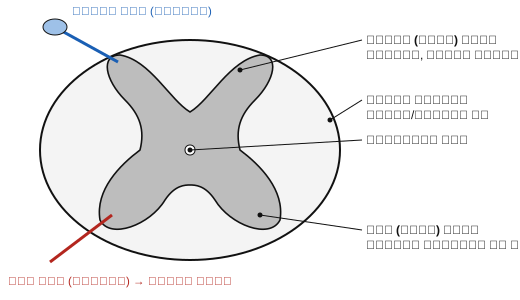
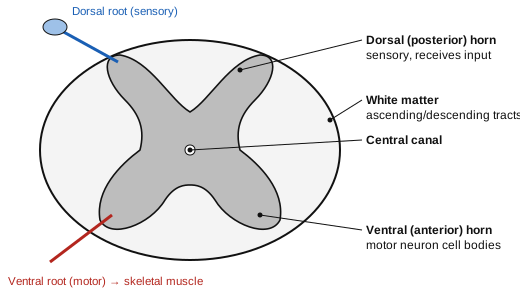
Destruction of the anterior horn cells of the spinal cord would result in loss of :-
मेरुरज्जु की अग्र शृंग (anterior horn) कोशिकाओं के नष्ट होने पर किसकी हानि होगी?
  1. AIntegrating impulsesसमाकलन आवेग
  2. BSensory impulsesसंवेदी आवेग
  3. CVoluntary motor impulsesऐच्छिक प्रेरक आवेग
  4. DCommissural impulsesसंयोजी (commissural) आवेग
Show answer

Concept: Grey matter of the spinal cord: dorsal (posterior) horns receive sensory fibres; ventral (anterior) horns contain cell bodies of lower motor neurons whose axons leave through the ventral root to skeletal muscles. Their destruction (e.g. poliomyelitis) causes loss of voluntary movement (flaccid paralysis).

  1. (A) Integration is mainly by interneurons/brain, not specifically anterior horns.
  2. (B) Sensory impulses enter via dorsal root to the dorsal horn.
  3. (C) Correct – anterior horn = motor neurons.
  4. (D) Commissural fibres cross between the two sides (white/grey commissure).

Short trick: Bell–Magendie rule: Dorsal = sensory (D-in), Ventral/Anterior = motor (out to muscles). Polio kills anterior horn cells → paralysis.

Answer: (C) Voluntary motor impulses

अवधारणा: मेरुरज्जु का धूसर द्रव्य: पृष्ठ (पश्च) शृंग संवेदी तंतु ग्रहण करते हैं; अधर (अग्र) शृंग में निम्न प्रेरक न्यूरॉनों के कोशिकाकाय होते हैं जिनके तंत्रिकाक्ष अधर मूल से कंकाल पेशियों तक जाते हैं। इनके नष्ट होने पर (जैसे पोलियो) ऐच्छिक गति की हानि (शिथिल पक्षाघात) होती है।

  1. (A) समाकलन मुख्यतः अंतर्न्यूरॉन/मस्तिष्क द्वारा होता है, विशेष रूप से अग्र शृंगों द्वारा नहीं।
  2. (B) संवेदी आवेग पृष्ठ मूल से पृष्ठ शृंग में आते हैं।
  3. (C) सही – अग्र शृंग = प्रेरक न्यूरॉन।
  4. (D) संयोजी तंतु दोनों पार्श्वों के बीच पार करते हैं (श्वेत/धूसर संयोजिका)।

शॉर्ट ट्रिक: बेल–मैजेंडी नियम: पृष्ठ = संवेदी (अंदर), अधर/अग्र = प्रेरक (पेशियों की ओर बाहर)। पोलियो अग्र शृंग कोशिकाएँ नष्ट करता है → पक्षाघात।

उत्तर: (C) ऐच्छिक प्रेरक आवेग

NEET UGBiologyNeural control – spinal cordNEET UG 2015 · 25 Jul Shift 1
Q2174.
Roots play insignificant role in absorption of water in :
किसमें जल के अवशोषण में जड़ों की भूमिका नगण्य होती है?
  1. AWheatगेहूँ
  2. BSunflowerसूरजमुखी
  3. CPistia
  4. DPeaमटर
Show answer

Concept: Pistia (water lettuce) is a free-floating hydrophyte; its whole body surface is in contact with water and absorbs it directly, so its roots are poorly developed and serve mainly for balancing, not absorption.

  1. (A), (B), (D) Wheat, sunflower and pea are mesophytes – roots (root hairs) are the main organs of water absorption.
  2. (C) Correct – Pistia.

Short trick: Floating aquatic plants (Pistia, Eichhornia, Lemna) "drink" through the whole surface – roots act as balancers.

Answer: (C) Pistia

अवधारणा: Pistia (वॉटर लेट्यूस) एक मुक्त-प्लावी जलोद्भिद है; इसका पूरा शरीर जल के संपर्क में रहकर उसे सीधे अवशोषित करता है, अतः इसकी जड़ें अल्पविकसित होती हैं और मुख्यतः संतुलन का काम करती हैं, अवशोषण का नहीं।

  1. (A), (B), (D) गेहूँ, सूरजमुखी और मटर समोद्भिद हैं – इनमें जड़ें (मूलरोम) जल अवशोषण के मुख्य अंग हैं।
  2. (C) सही – Pistia।

शॉर्ट ट्रिक: प्लावी जलीय पौधे (Pistia, Eichhornia, Lemna) पूरी सतह से "पानी पीते" हैं – जड़ें संतुलक का काम करती हैं।

उत्तर: (C) Pistia

NEET UGBiologyPlant water relations – hydrophytesNEET UG 2015 · 25 Jul Shift 1
Q2175.
Match the columns and identify the correct option:
Column IColumn II
(a)Thylakoids(i)Disc-Shaped sacs in Golgi apparatus
(b)Cristae(ii)Condensed structure of DNA
(c)Cisternae(iii)Flat membranous sacs in stroma
(d)Chromatin(iv)Infoldings in mitochondria
स्तंभों का मिलान कीजिए और सही विकल्प पहचानिए:
स्तंभ Iस्तंभ II
(a)थायलाकॉइड(i)गॉल्जी उपकरण में चक्रिका-आकार की थैलियाँ
(b)क्रिस्टी(ii)DNA की संघनित संरचना
(c)सिस्टर्नी(iii)पीठिका (stroma) में चपटी झिल्लीमय थैलियाँ
(d)क्रोमैटिन(iv)सूत्रकणिका (माइटोकॉन्ड्रिया) में अंतर्वलन
  1. A(a)-(iii), (b)-(iv), (c)-(ii), (d)-(i)
  2. B(a)-(iv), (b)-(iii), (c)-(i), (d)-(ii)
  3. C(a)-(iii), (b)-(iv), (c)-(i), (d)-(ii)
  4. D(a)-(iii), (b)-(i), (c)-(iv), (d)-(ii)
Show answer

Concept: Recall where each membrane structure lies: thylakoids – flattened sacs in the chloroplast stroma; cristae – infoldings of the inner mitochondrial membrane; cisternae – flat disc-shaped sacs of the Golgi apparatus; chromatin – DNA condensed with histones.

  1. (a) Thylakoids → (iii) flat membranous sacs in stroma.
  2. (b) Cristae → (iv) infoldings in mitochondria.
  3. (c) Cisternae → (i) disc-shaped sacs in Golgi apparatus.
  4. (d) Chromatin → (ii) condensed structure of DNA.
  5. So the match is a-iii, b-iv, c-i, d-ii = (C). (A) wrongly pairs cisternae with DNA; (B) swaps thylakoids and cristae; (D) pairs cristae with Golgi.

Short trick: a-iii and b-iv are in three options, so just decide c: cisternae belong to Golgi (i) → only (C) has c-i with a-iii, b-iv.

Answer: (C) (a)-(iii), (b)-(iv), (c)-(i), (d)-(ii)

अवधारणा: हर झिल्लीमय संरचना का स्थान याद करें: थायलाकॉइड – हरितलवक की पीठिका में चपटी थैलियाँ; क्रिस्टी – सूत्रकणिका की आंतरिक झिल्ली के अंतर्वलन; सिस्टर्नी – गॉल्जी उपकरण की चपटी चक्रिका-आकार थैलियाँ; क्रोमैटिन – हिस्टोन सहित संघनित DNA।

  1. (a) थायलाकॉइड → (iii) पीठिका में चपटी झिल्लीमय थैलियाँ।
  2. (b) क्रिस्टी → (iv) सूत्रकणिका में अंतर्वलन।
  3. (c) सिस्टर्नी → (i) गॉल्जी उपकरण में चक्रिका-आकार थैलियाँ।
  4. (d) क्रोमैटिन → (ii) DNA की संघनित संरचना।
  5. अतः मिलान a-iii, b-iv, c-i, d-ii = (C)। (A) सिस्टर्नी को DNA से जोड़ता है; (B) थायलाकॉइड और क्रिस्टी उलट देता है; (D) क्रिस्टी को गॉल्जी से जोड़ता है।

शॉर्ट ट्रिक: a-iii और b-iv तीन विकल्पों में हैं, अतः केवल c तय करें: सिस्टर्नी गॉल्जी की (i) → a-iii, b-iv के साथ c-i केवल (C) में है।

उत्तर: (C) (a)-(iii), (b)-(iv), (c)-(i), (d)-(ii)

NEET UGBiologyCell – organelle structuresNEET UG 2015 · 25 Jul Shift 1
Q2176.
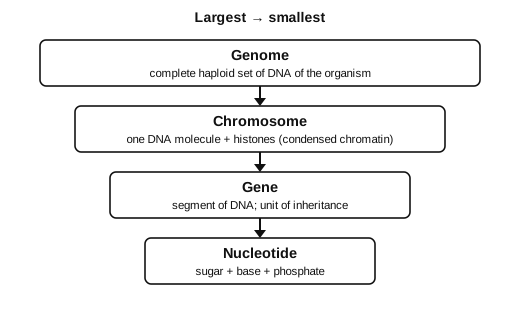
Identify the correct order of organisation of genetic material from largest to smallest :
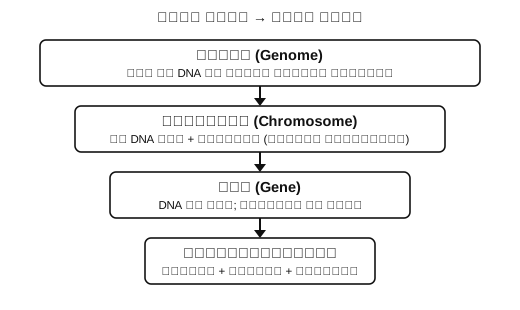
आनुवंशिक पदार्थ के संगठन का सबसे बड़े से सबसे छोटे तक सही क्रम पहचानिए:
  1. AChromosome, genome, nucleotide, geneगुणसूत्र, जीनोम, न्यूक्लियोटाइड, जीन
  2. BChromosome, gene, genome, nucleotideगुणसूत्र, जीन, जीनोम, न्यूक्लियोटाइड
  3. CGenome, chromosomes, nucleotide, geneजीनोम, गुणसूत्र, न्यूक्लियोटाइड, जीन
  4. DGenome, chromosome, gene, nucleotideजीनोम, गुणसूत्र, जीन, न्यूक्लियोटाइड
Show answer

Concept: Genome = the entire haploid DNA content (all chromosomes); each chromosome is one long DNA molecule carrying many genes; each gene is a DNA segment made of many nucleotides.

  1. Genome ⊃ chromosome ⊃ gene ⊃ nucleotide → (D).
  2. (A), (B) put chromosome above genome – wrong, a genome contains all the chromosomes.
  3. (C) puts nucleotide above gene – wrong, a gene is made of nucleotides.

Short trick: Think of a library: Genome = library, Chromosome = book, Gene = sentence, Nucleotide = letter.

Answer: (D) Genome, chromosome, gene, nucleotide

अवधारणा: जीनोम = संपूर्ण अगुणित DNA (सभी गुणसूत्र); प्रत्येक गुणसूत्र एक लंबा DNA अणु है जिस पर अनेक जीन होते हैं; प्रत्येक जीन अनेक न्यूक्लियोटाइडों से बना DNA का खंड है।

  1. जीनोम ⊃ गुणसूत्र ⊃ जीन ⊃ न्यूक्लियोटाइड → (D)।
  2. (A), (B) गुणसूत्र को जीनोम से बड़ा बताते हैं – गलत, जीनोम में सभी गुणसूत्र होते हैं।
  3. (C) न्यूक्लियोटाइड को जीन से बड़ा बताता है – गलत, जीन न्यूक्लियोटाइडों से बना है।

शॉर्ट ट्रिक: पुस्तकालय की तरह सोचें: जीनोम = पुस्तकालय, गुणसूत्र = पुस्तक, जीन = वाक्य, न्यूक्लियोटाइड = अक्षर।

उत्तर: (D) जीनोम, गुणसूत्र, जीन, न्यूक्लियोटाइड

NEET UGBiologyMolecular basis of inheritance – organisation of genetic materialNEET UG 2015 · 25 Jul Shift 1
Q2177.
Which one of the following hormones though synthesis elsewhere, is stored and released by the master gland?
निम्नलिखित में से कौन-सा हॉर्मोन, संश्लेषण अन्यत्र होने पर भी, मास्टर ग्रंथि द्वारा संचित और मुक्त किया जाता है?
  1. AMelanocyte stimulating hormoneमेलानोसाइट उद्दीपक हॉर्मोन
  2. BAntidiuretic hormoneप्रतिमूत्रल हॉर्मोन (ADH)
  3. CLuteinizing hormoneल्यूटीनाइज़िंग हॉर्मोन
  4. DProlactinप्रोलैक्टिन
Show answer

Concept: The pituitary is called the master gland. Its posterior lobe (neurohypophysis) does not make hormones: oxytocin and vasopressin (ADH) are synthesised by hypothalamic neurons, transported down their axons, stored in the neurohypophysis and released from there.

  1. (A) MSH – made by the pars intermedia of the pituitary itself.
  2. (B) Correct – ADH is made in the hypothalamus, stored/released by the posterior pituitary.
  3. (C) LH – synthesised by the anterior pituitary.
  4. (D) Prolactin – synthesised by the anterior pituitary.

Short trick: Posterior pituitary = "warehouse" for 2 hypothalamic hormones: Oxytocin and ADH ("OA").

Answer: (B) Antidiuretic hormone

अवधारणा: पीयूष ग्रंथि को मास्टर ग्रंथि कहते हैं। इसकी पश्च पालि (न्यूरोहाइपोफ़ाइसिस) हॉर्मोन नहीं बनाता: ऑक्सीटोसिन और वैसोप्रेसिन (ADH) हाइपोथैलेमस के न्यूरॉनों द्वारा संश्लेषित होकर उनके तंत्रिकाक्षों से नीचे आते हैं, न्यूरोहाइपोफ़ाइसिस में संचित होते हैं और वहीं से मुक्त होते हैं।

  1. (A) MSH – स्वयं पीयूष के मध्य पालि (pars intermedia) द्वारा निर्मित।
  2. (B) सही – ADH हाइपोथैलेमस में बनता है, पश्च पीयूष द्वारा संचित/मुक्त होता है।
  3. (C) LH – अग्र पीयूष द्वारा संश्लेषित।
  4. (D) प्रोलैक्टिन – अग्र पीयूष द्वारा संश्लेषित।

शॉर्ट ट्रिक: पश्च पीयूष = हाइपोथैलेमस के 2 हॉर्मोनों का "गोदाम": ऑक्सीटोसिन और ADH।

उत्तर: (B) प्रतिमूत्रल हॉर्मोन (ADH)

NEET UGBiologyChemical coordination – posterior pituitaryNEET UG 2015 · 25 Jul Shift 1
Q2178.
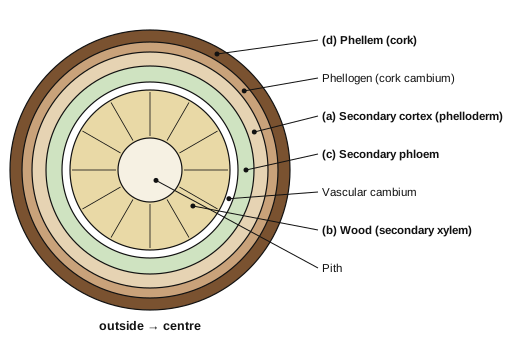
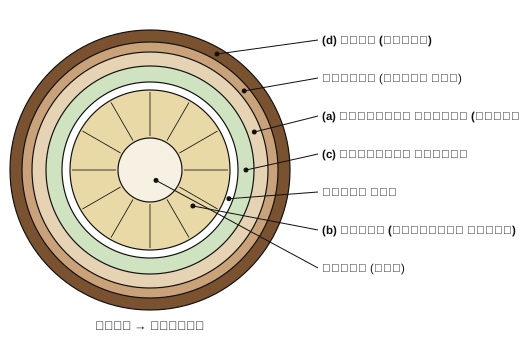
Read the different components from (a) to (d) in the list given below and tell the correct order of the components with reference to their arrangement from outer side to inner side in a woody dicot stem:
(a) Secondary cortex
(b) Wood
(c) Secondary phloem
(d) Phellem
The correct order is :
नीचे दी गई सूची में (a) से (d) तक के विभिन्न घटकों को पढ़िए और काष्ठीय द्विबीजपत्री तने में बाहर से अंदर की ओर उनकी व्यवस्था के संदर्भ में घटकों का सही क्रम बताइए:
(a) द्वितीयक वल्कुट (Secondary cortex)
(b) काष्ठ (Wood)
(c) द्वितीयक फ्लोएम
(d) फेलम (Phellem)
सही क्रम है:
  1. A(d), (c), (a), (b)
  2. B(c), (d), (b), (a)
  3. C(a), (b), (d), (c)
  4. D(d), (a), (c), (b)
Show answer

Concept: In a woody dicot stem the periderm forms outside: phellogen cuts phellem (cork) outwards and phelloderm (secondary cortex) inwards. Vascular cambium cuts secondary phloem outwards and secondary xylem (wood) inwards.

  1. Outermost: (d) phellem (cork).
  2. Then (a) secondary cortex (phelloderm) – just inside the phellogen.
  3. Then (c) secondary phloem – outside the vascular cambium.
  4. Innermost: (b) wood (secondary xylem) – inside the cambium. Order d, a, c, b = (D).
  5. (A) places secondary phloem outside secondary cortex; (B) and (C) start with an inner tissue – all wrong.

Short trick: Each cambium gives "outside → phellem / phloem, inside → phelloderm / xylem". Read outward-in: Cork → Phelloderm → Phloem → Wood.

Answer: (D) (d), (a), (c), (b)

अवधारणा: काष्ठीय द्विबीजपत्री तने में परिचर्म बाहर बनता है: कॉर्क एधा (फेलोजन) बाहर की ओर फेलम (कॉर्क) और अंदर की ओर फेलोडर्म (द्वितीयक वल्कुट) बनाती है। संवहन एधा बाहर की ओर द्वितीयक फ्लोएम और अंदर की ओर द्वितीयक जाइलम (काष्ठ) बनाती है।

  1. सबसे बाहर: (d) फेलम (कॉर्क)।
  2. फिर (a) द्वितीयक वल्कुट (फेलोडर्म) – फेलोजन के ठीक अंदर।
  3. फिर (c) द्वितीयक फ्लोएम – संवहन एधा के बाहर।
  4. सबसे अंदर: (b) काष्ठ (द्वितीयक जाइलम) – एधा के अंदर। क्रम d, a, c, b = (D)।
  5. (A) द्वितीयक फ्लोएम को द्वितीयक वल्कुट के बाहर रखता है; (B) और (C) भीतरी ऊतक से शुरू करते हैं – सभी गलत।

शॉर्ट ट्रिक: प्रत्येक एधा: "बाहर → फेलम / फ्लोएम, अंदर → फेलोडर्म / जाइलम"। बाहर से अंदर पढ़ें: कॉर्क → फेलोडर्म → फ्लोएम → काष्ठ।

उत्तर: (D) (d), (a), (c), (b)

NEET UGBiologyAnatomy of flowering plants – secondary growthNEET UG 2015 · 25 Jul Shift 1
Q2179.
Which of the following joints would allow no movement?
निम्नलिखित में से कौन-सी संधि कोई गति नहीं होने देगी?
  1. ABall and Socket jointकंदुक-खल्लिका संधि
  2. BFibrous jointरेशीय संधि
  3. CCartilaginous jointउपास्थियुक्त संधि
  4. DSynovial jointसाइनोवियल संधि
Show answer

Concept: NCERT: fibrous joints do not allow any movement – the bones are held by dense fibrous connective tissue (e.g. sutures of the skull). Cartilaginous joints allow limited movement; synovial joints allow considerable movement.

  1. (A) Ball and socket (a synovial joint, e.g. shoulder) – freest movement.
  2. (B) Correct – fibrous = immovable.
  3. (C) Cartilaginous (between vertebrae) – limited movement.
  4. (D) Synovial – freely movable.

Short trick: F-C-S = "Fixed – Cushioned – Swinging": Fibrous (none) → Cartilaginous (little) → Synovial (much).

Answer: (B) Fibrous joint

अवधारणा: NCERT: रेशीय संधियाँ कोई गति नहीं होने देतीं – अस्थियाँ सघन रेशीय संयोजी ऊतक से जुड़ी रहती हैं (जैसे खोपड़ी के सीवन)। उपास्थियुक्त संधियाँ सीमित गति और साइनोवियल संधियाँ पर्याप्त गति होने देती हैं।

  1. (A) कंदुक-खल्लिका (एक साइनोवियल संधि, जैसे कंधा) – सर्वाधिक गति।
  2. (B) सही – रेशीय = अचल।
  3. (C) उपास्थियुक्त (कशेरुकाओं के बीच) – सीमित गति।
  4. (D) साइनोवियल – स्वतंत्र रूप से चल।

शॉर्ट ट्रिक: रे-उ-सा क्रम: रेशीय (गति नहीं) → उपास्थियुक्त (थोड़ी) → साइनोवियल (अधिक)।

उत्तर: (B) रेशीय संधि

NEET UGBiologyLocomotion and movement – jointsNEET UG 2015 · 25 Jul Shift 1
Q2180.
Which one of the following is not applicable to RNA?
निम्नलिखित में से कौन-सा RNA पर लागू नहीं होता?
  1. AChargaff's ruleशार्गाफ़ का नियम
  2. BComplementary base pairingपूरक क्षारक युग्मन
  3. C5' phosphoryl and 3' hydroxyl ends5' फॉस्फोरिल और 3' हाइड्रॉक्सिल सिरे
  4. DHeterocyclic nitrogenous basesविषमचक्रीय नाइट्रोजनी क्षारक
Show answer

Concept: Chargaff's rule (A = T, G = C, so purines = pyrimidines) holds for double-stranded DNA because of base pairing between two strands. RNA is mostly single-stranded, so its base ratios do not follow this rule.

  1. (A) Correct – Chargaff's rule is not applicable to (single-stranded) RNA.
  2. (B) RNA does show complementary pairing – in tRNA stems, with DNA during transcription, codon–anticodon pairing.
  3. (C) Every polynucleotide chain, RNA included, has a 5' phosphate end and a 3' OH end.
  4. (D) A, G, C, U are heterocyclic nitrogenous bases.

Short trick: Chargaff needs two strands to balance – RNA has one, so the 1:1 rule fails.

Answer: (A) Chargaff's rule

अवधारणा: शार्गाफ़ का नियम (A = T, G = C, अतः प्यूरीन = पिरिमिडीन) द्विरज्जुक DNA पर लागू होता है क्योंकि दोनों रज्जुकों के क्षारक युग्मित होते हैं। RNA प्रायः एकरज्जुक होता है, अतः उसके क्षारक अनुपात इस नियम का पालन नहीं करते।

  1. (A) सही – शार्गाफ़ का नियम (एकरज्जुक) RNA पर लागू नहीं होता।
  2. (B) RNA में पूरक युग्मन होता है – tRNA के स्तंभों में, अनुलेखन में DNA के साथ, कोडॉन–ऐंटिकोडॉन युग्मन।
  3. (C) RNA सहित प्रत्येक पॉलीन्यूक्लियोटाइड शृंखला में 5' फॉस्फेट सिरा और 3' OH सिरा होता है।
  4. (D) A, G, C, U विषमचक्रीय नाइट्रोजनी क्षारक हैं।

शॉर्ट ट्रिक: शार्गाफ़ के संतुलन के लिए दो रज्जुक चाहिए – RNA में एक है, अतः 1:1 नियम विफल।

उत्तर: (A) शार्गाफ़ का नियम

NEET UGBiologyMolecular basis of inheritance – nucleic acidsNEET UG 2015 · 25 Jul Shift 1