NEET UG · 2,240 questions

NEET UG 2015, 2016, 2017, 2018, 2019, 2020, 2021, 2022, 2023, 2024, 2025, 2026 PYQs

Real previous year questions, subject-wise. Try the question, then open the answer and the explanation in Hindi & English – free, no login.

Courses – airGurukul

2,240 questions.

Q541.
Given below are two statements : one is labelled as Assertion A and the other is labelled as Reason R.
Assertion A: Breast-feeding during initial period of infant growth is recommended by doctors for bringing a healthy baby.
Reason R: Colostrum Contains several antibodies absolutely essential to develop resistance for the new-born baby.
In the light of the above statements, choose the most appropriate answer from the options given below:
नीचे दो कथन दिए गए हैं : एक को अभिकथन A तथा दूसरे को कारण R कहा गया है।
अभिकथन A: शिशु वृद्धि की प्रारंभिक अवधि में स्तनपान की सलाह चिकित्सक स्वस्थ शिशु के लिए देते हैं।
कारण R: खीस (कोलोस्ट्रम) में अनेक प्रतिरक्षी होते हैं जो नवजात शिशु में प्रतिरोध क्षमता विकसित करने के लिए अत्यंत आवश्यक हैं।
उपर्युक्त कथनों के आलोक में, नीचे दिए गए विकल्पों में से सबसे उपयुक्त उत्तर चुनिए:
  1. ABoth A and R are correct, but R is NOT the correct explanation of A.A और R दोनों सही हैं, परन्तु R, A की सही व्याख्या नहीं है।
  2. BA is correct but R is not correct.A सही है परन्तु R सही नहीं है।
  3. CA is not correct but R is correct.A सही नहीं है परन्तु R सही है।
  4. DBoth A and R are correct, and R is the correct explanation of A.A और R दोनों सही हैं, तथा R, A की सही व्याख्या है।
Show answer

Concept: Milk of the first few days of lactation (colostrum) carries IgA antibodies – natural passive immunity.

  1. A – doctors recommend breast-feeding in the initial period for bringing up a healthy baby → correct.
  2. R – colostrum contains several antibodies absolutely essential to develop resistance in the new-born → correct.
  3. The antibodies in colostrum are exactly why early breast-feeding gives a healthy baby → R explains A.

Short trick: Colostrum → IgA → passive immunity → healthy baby: a direct cause-effect chain, so (D).

Answer: (D) Both A and R are correct, and R is the correct explanation of A.

अवधारणा: दुग्धस्रवण के प्रथम कुछ दिनों का दूध (खीस) IgA प्रतिरक्षी देता है – प्राकृतिक निष्क्रिय प्रतिरक्षा।

  1. A – स्वस्थ शिशु के लिए चिकित्सक प्रारंभिक अवधि में स्तनपान की सलाह देते हैं → सही।
  2. R – खीस में नवजात में प्रतिरोध विकसित करने हेतु अत्यंत आवश्यक अनेक प्रतिरक्षी होते हैं → सही।
  3. खीस के प्रतिरक्षी ही कारण हैं कि प्रारंभिक स्तनपान से शिशु स्वस्थ रहता है → R, A की व्याख्या करता है।

शॉर्ट ट्रिक: खीस → IgA → निष्क्रिय प्रतिरक्षा → स्वस्थ शिशु: सीधा कारण-प्रभाव, अतः (D)।

उत्तर: (D) A और R दोनों सही हैं, तथा R, A की सही व्याख्या है।

NEET UGZoologyHuman reproduction – lactation and colostrumNEET UG 2024 · 5 May Shift 1
Q542.
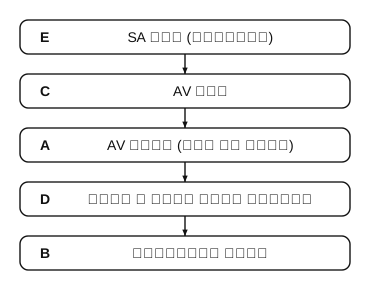
Following are the stages of pathway for conduction of an action potential through the heart
A. AV bundle
B. Purkinje fibres
C. AV node
D. Bundle branches
E. SA node
Choose the correct sequence of pathway from the options given below
हृदय में क्रिया विभव के चालन पथ की अवस्थाएँ नीचे दी गई हैं
A. AV बंडल
B. पुरकिंजे तंतु
C. AV नोड
D. बंडल शाखाएँ
E. SA नोड
नीचे दिए गए विकल्पों में से पथ का सही क्रम चुनिए
  1. AA-E-C-B-D
  2. BB-D-E-C-A
  3. CE-A-D-B-C
  4. DE-C-A-D-B
Show answer

Concept: Nodal tissue is autoexcitable; SAN is the pacemaker and the impulse spreads in a fixed order.

  1. SA node (E) in right upper corner of right atrium generates the impulse.
  2. AV node (C) in lower left corner of right atrium receives it.
  3. AV bundle (A) passes through the atrio-ventricular septum.
  4. It divides into right and left bundle branches (D) on the interventricular septum.
  5. Purkinje fibres (B) spread it through ventricular muscle.

Short trick: "SA → AV → His → Branches → Purkinje": always starts with E and ends with B – only (D).

Answer: (D) E-C-A-D-B

अवधारणा: नोडीय ऊतक स्वउत्तेजनशील है; SAN गति-प्रेरक है और आवेग एक निश्चित क्रम में फैलता है।

  1. SA नोड (E), दाएँ अलिंद के ऊपरी दाएँ कोने में, आवेग उत्पन्न करता है।
  2. AV नोड (C), दाएँ अलिंद के निचले बाएँ कोने में, इसे ग्रहण करता है।
  3. AV बंडल (A) अलिंद-निलय पट से गुज़रता है।
  4. यह अंतर-निलय पट पर दाईं व बाईं बंडल शाखाओं (D) में बँटता है।
  5. पुरकिंजे तंतु (B) इसे निलय पेशी में फैलाते हैं।

शॉर्ट ट्रिक: "SA → AV → हिस → शाखाएँ → पुरकिंजे": सदा E से शुरू, B पर अंत – केवल (D)।

उत्तर: (D) E-C-A-D-B

NEET UGZoologyBody fluids and circulation – conducting system of heartNEET UG 2024 · 5 May Shift 1
Q543.
Which one is the correct product of DNA dependent RNA polymerase to the given template?
3’TACATGGCAAATATCCATTCA5’
दिए गए टेम्पलेट के लिए DNA आश्रित RNA पॉलिमरेज़ का सही उत्पाद कौन-सा है?
3’TACATGGCAAATATCCATTCA5’
  1. A5’AUGUAAAGUUUAUAGGUAAGU3’
  2. B5’AUGUACCGUUUAUAGGGAAGU3’
  3. C5’ATGTACCGTTTATAGGTAAGT3’
  4. D5’AUGUACCGUUUAUAGGUAAGU3’
Show answer

Concept: RNA polymerase builds RNA 5′→3′, complementary and antiparallel to the 3′→5′ template, with U in place of T.

  1. Template 3′-T A C A T G G C A A A T A T C C A T T C A-5′.
  2. Pair each base: T→A, A→U, C→G, G→C.
  3. Product: 5′-A U G U A C C G U U U A U A G G U A A G U-3′.
  4. (A) has "AA" at positions 6–7 instead of "CC"; (B) has "GGG" instead of "GGU" near the end; (C) contains T, so it is DNA, not RNA. Only (D) matches.

Short trick: Reject any option with T (not RNA), then compare only the bases opposite the template’s "GGC" (→ CCG) and "ATT" (→ UAA).

Answer: (D) 5′AUGUACCGUUUAUAGGUAAGU3′

अवधारणा: RNA पॉलिमरेज़ RNA को 5′→3′ दिशा में, 3′→5′ टेम्पलेट के पूरक व प्रतिसमांतर, T के स्थान पर U रखकर बनाता है।

  1. टेम्पलेट 3′-T A C A T G G C A A A T A T C C A T T C A-5′।
  2. प्रत्येक क्षारक युग्मित करें: T→A, A→U, C→G, G→C।
  3. उत्पाद: 5′-A U G U A C C G U U U A U A G G U A A G U-3′।
  4. (A) में स्थान 6–7 पर "CC" के बजाय "AA" है; (B) में अंत के पास "GGU" के बजाय "GGG" है; (C) में T है, अतः वह DNA है, RNA नहीं। केवल (D) मेल खाता है।

शॉर्ट ट्रिक: जिस विकल्प में T हो (RNA नहीं) उसे हटाएँ, फिर केवल टेम्पलेट के "GGC" (→ CCG) व "ATT" (→ UAA) के सामने के क्षारक मिलाएँ।

उत्तर: (D) 5′AUGUACCGUUUAUAGGUAAGU3′

NEET UGZoologyMolecular basis of inheritance – transcriptionNEET UG 2024 · 5 May Shift 1
Q544.
Match List I with List II:
List IList II
A. α-1 antitrypsinI. Cotton bollworm
B. Cry 1AbII. ADA deficiency
C. Cry 1AcIII. Emphysema
D. Enzyme replacement therapyIV. Corn borer
Choose the correct answer from the options given below:
सूची-I का सूची-II से मिलान कीजिए :
सूची Iसूची II
A. α-1 ऐंटीट्रिप्सिनI. कपास का बॉलवर्म
B. Cry 1AbII. ADA की कमी
C. Cry 1AcIII. वातस्फीति (Emphysema)
D. एंजाइम प्रतिस्थापन चिकित्साIV. मक्का छेदक (Corn borer)
नीचे दिए गए विकल्पों में से सही उत्तर चुनिए :
  1. AA-III, B-I, C-II, D-IV
  2. BA-III, B-IV, C-I, D-II
  3. CA-II, B-IV, C-I, D-III
  4. DA-II, B-I, C-IV, D-III
Show answer

Concept: Applications of biotechnology in medicine and agriculture (NCERT).

  1. α-1-antitrypsin (from transgenic animals) is used to treat emphysema → A-III.
  2. cryIAb gene product controls corn borer → B-IV.
  3. cryIAc (and cryIIAb) products control cotton bollworms → C-I.
  4. Enzyme replacement therapy (functional ADA by injection) treats ADA deficiency → D-II.

Short trick: "cryIAc → cotton, cryIAb → corn borer".

Answer: (B) A-III, B-IV, C-I, D-II

अवधारणा: चिकित्सा व कृषि में जैव प्रौद्योगिकी के अनुप्रयोग (NCERT)।

  1. α-1-ऐंटीट्रिप्सिन (पारजीनी जंतुओं से) वातस्फीति के उपचार में प्रयुक्त → A-III।
  2. cryIAb जीन का उत्पाद मक्का छेदक को नियंत्रित करता है → B-IV।
  3. cryIAc (व cryIIAb) के उत्पाद कपास बॉलवर्म को नियंत्रित करते हैं → C-I।
  4. एंजाइम प्रतिस्थापन चिकित्सा (इंजेक्शन से क्रियाशील ADA) ADA की कमी का उपचार करती है → D-II।

शॉर्ट ट्रिक: "cryIAc → cotton (कपास), cryIAb → corn borer (मक्का छेदक)"।

उत्तर: (B) A-III, B-IV, C-I, D-II

NEET UGZoologyBiotechnology – applicationsNEET UG 2024 · 5 May Shift 1
Q545.
The “Ti plasmid” of Agrobacterium tumefaciens stands for
एग्रोबैक्टीरियम ट्यूमीफेसिएंस के “Ti प्लाज्मिड” का पूर्ण रूप है
  1. ATumor independent plasmidट्यूमर स्वतंत्र प्लाज्मिड (Tumor independent plasmid)
  2. BTumor inducing plasmidट्यूमर उत्प्रेरक प्लाज्मिड (Tumor inducing plasmid)
  3. CTemperature independent plasmidताप स्वतंत्र प्लाज्मिड (Temperature independent plasmid)
  4. DTumour inhibiting plasmidट्यूमर निरोधी प्लाज्मिड (Tumour inhibiting plasmid)
Show answer

Concept: A. tumefaciens transfers T-DNA into dicot cells and causes crown gall tumours.

  1. Ti = Tumour inducing plasmid – it transforms normal plant cells into tumour cells.
  2. It has been disarmed (made non-pathogenic) and is used as a cloning vector to deliver genes into plants.
  3. It neither inhibits tumours nor has anything to do with temperature or "independence".

Short trick: The bacterium causes crown gall, so its plasmid must induce tumours – "Ti = Tumour inducer".

Answer: (B) Tumor inducing plasmid

अवधारणा: A. ट्यूमीफेसिएंस द्विबीजपत्री कोशिकाओं में T-DNA स्थानांतरित कर क्राउन गॉल ट्यूमर उत्पन्न करता है।

  1. Ti = ट्यूमर उत्प्रेरक प्लाज्मिड – यह सामान्य पादप कोशिकाओं को ट्यूमर कोशिकाओं में बदल देता है।
  2. इसे निरस्त्र (अरोगजनक) कर पौधों में जीन पहुँचाने हेतु क्लोनिंग संवाहक के रूप में प्रयोग किया जाता है।
  3. यह न तो ट्यूमर रोकता है, न ही इसका ताप या "स्वतंत्रता" से कोई संबंध है।

शॉर्ट ट्रिक: जीवाणु क्राउन गॉल करता है, अतः उसका प्लाज्मिड ट्यूमर उत्प्रेरक है – "Ti = Tumour inducer"।

उत्तर: (B) ट्यूमर उत्प्रेरक प्लाज्मिड

NEET UGZoologyBiotechnology – vectors (Ti plasmid)NEET UG 2024 · 5 May Shift 1
Q546.
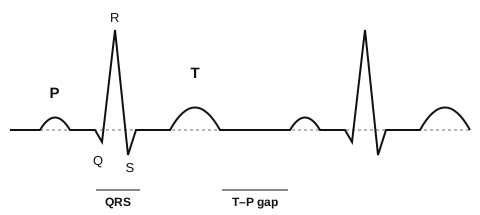
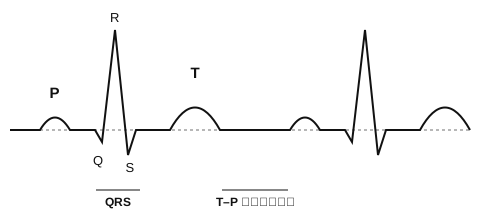
Match List I with List II:
List IList II
A. P WaveI. Heart muscles are electrically silent.
B. QRS complexII. Depolarisation of ventricles.
C. T waveIII. Depolarisation of atria.
D. T-P gapIV. Repolarisation of ventricles.
Choose the correct answer from the options given below:
सूची-I का सूची-II से मिलान कीजिए :
सूची Iसूची II
A. P तरंगI. हृदय पेशियाँ विद्युतीय रूप से निष्क्रिय (शांत) रहती हैं।
B. QRS सम्मिश्रII. निलयों का विध्रुवण।
C. T तरंगIII. अलिंदों का विध्रुवण।
D. T-P अंतरालIV. निलयों का पुनर्ध्रुवण।
नीचे दिए गए विकल्पों में से सही उत्तर चुनिए :
  1. AA-III, B-II, C-IV, D-I
  2. BA-II, B-III, C-I, D-IV
  3. CA-IV, B-II, C-I, D-III
  4. DA-I, B-III, C-IV, D-II
Show answer

Concept: ECG waves record electrical events of the cardiac cycle.

  1. P wave – depolarisation of atria (atrial contraction follows) → A-III.
  2. QRS complex – depolarisation of ventricles (ventricular contraction begins) → B-II.
  3. T wave – repolarisation of ventricles (end of systole) → C-IV.
  4. T-P gap – period between beats when heart muscle is electrically silent → D-I.

Short trick: "P = Pre-ventricle (atria), QRS = big ventricles, T = Turn-back (repolarise), gap = silence".

Answer: (A) A-III, B-II, C-IV, D-I

अवधारणा: ECG तरंगें हृद चक्र की विद्युतीय घटनाएँ दर्शाती हैं।

  1. P तरंग – अलिंदों का विध्रुवण (इसके बाद अलिंद संकुचन) → A-III।
  2. QRS सम्मिश्र – निलयों का विध्रुवण (निलय संकुचन आरंभ) → B-II।
  3. T तरंग – निलयों का पुनर्ध्रुवण (प्रकुंचन का अंत) → C-IV।
  4. T-P अंतराल – दो धड़कनों के बीच का समय जब हृदय पेशी विद्युतीय रूप से शांत रहती है → D-I।

शॉर्ट ट्रिक: "P = अलिंद, QRS = बड़े निलय, T = वापसी (पुनर्ध्रुवण), अंतराल = शांति"।

उत्तर: (A) A-III, B-II, C-IV, D-I

NEET UGZoologyBody fluids and circulation – ECGNEET UG 2024 · 5 May Shift 1
Q547.
Given below are two statements :
Statement I : Gause’s competitive exclusion principle states that two closely related species competing for different resources cannot exist indefinitely.
Statement II : According to Gause’s principle, during competition, the inferior will be eliminated. This may be true if resources are limiting.
In the light of the above statements. choose the correct answer from the options given below :
नीचे दो कथन दिए गए हैं :
कथन I : गॉज़ का प्रतिस्पर्धी अपवर्जन सिद्धांत कहता है कि भिन्न संसाधनों के लिए प्रतिस्पर्धा करने वाली दो निकट संबंधित जातियाँ अनिश्चित काल तक अस्तित्व में नहीं रह सकतीं।
कथन II : गॉज़ के सिद्धांत के अनुसार, प्रतिस्पर्धा के दौरान हीन जाति समाप्त हो जाएगी। यह तब सत्य हो सकता है यदि संसाधन सीमित हों।
उपर्युक्त कथनों के आलोक में, नीचे दिए गए विकल्पों में से सही उत्तर चुनिए :
  1. ABoth Statement I and Statement II are false.कथन I और कथन II दोनों असत्य हैं।
  2. BStatement I is true but Statement II is false.कथन I सत्य है परन्तु कथन II असत्य है।
  3. CStatement I is false but Statement II is true.कथन I असत्य है परन्तु कथन II सत्य है।
  4. DBoth Statement I and Statement II are true.कथन I और कथन II दोनों सत्य हैं।
Show answer

Concept: Gause: two closely related species competing for the same resources cannot co-exist indefinitely; the competitively inferior one is eliminated – true if resources are limiting.

  1. Statement I says "different resources" – species using different resources do not compete and can co-exist → false.
  2. Statement II – the inferior is eliminated, and this may be true if resources are limiting, but not otherwise → true (NCERT line).

Short trick: Competitive exclusion needs the SAME resource – "different" is the planted error.

Answer: (C) Statement I is false but Statement II is true.

अवधारणा: गॉज़: समान संसाधनों के लिए प्रतिस्पर्धा करने वाली दो निकट संबंधित जातियाँ अनिश्चित काल तक सह-अस्तित्व में नहीं रह सकतीं; प्रतिस्पर्धा में हीन जाति समाप्त हो जाती है – यह संसाधन सीमित होने पर सत्य है।

  1. कथन I में "भिन्न संसाधन" लिखा है – भिन्न संसाधन उपयोग करने वाली जातियाँ प्रतिस्पर्धा नहीं करतीं और सह-अस्तित्व रख सकती हैं → असत्य।
  2. कथन II – हीन जाति समाप्त होती है, और यह संसाधन सीमित होने पर सत्य हो सकता है, अन्यथा नहीं → सत्य (NCERT पंक्ति)।

शॉर्ट ट्रिक: प्रतिस्पर्धी अपवर्जन के लिए समान संसाधन चाहिए – "भिन्न" लगाई गई गलती है।

उत्तर: (C) कथन I असत्य है परन्तु कथन II सत्य है।

NEET UGZoologyOrganisms and populations – competitionNEET UG 2024 · 5 May Shift 1
Q548.
Given below are two statements :
Statement I : Mitochondria and chloroplasts are both double membrane bound organelles.
Statement II : Inner membrane of Mitochondria is relatively less permeable, as compared to chloroplast.
In the light of the above statements. choose the correct answer from the options given below :
नीचे दो कथन दिए गए हैं :
कथन I : सूत्रकणिका और हरितलवक दोनों दोहरी झिल्ली से घिरे कोशिकांग हैं।
कथन II : हरितलवक की तुलना में सूत्रकणिका की आंतरिक झिल्ली अपेक्षाकृत कम पारगम्य है।
उपर्युक्त कथनों के आलोक में, नीचे दिए गए विकल्पों में से सही उत्तर चुनिए :
  1. ABoth Statement I and Statement II are incorrect.कथन I और कथन II दोनों गलत हैं।
  2. BStatement I is correct but Statement II is incorrect.कथन I सही है परन्तु कथन II गलत है।
  3. CStatement I is incorrect but Statement II is correct.कथन I गलत है परन्तु कथन II सही है।
  4. DBoth Statement I and Statement II are correct.कथन I और कथन II दोनों सही हैं।
Show answer

Concept: NCERT: "Like mitochondria, the chloroplasts are also double membrane bound. Of the two, the inner chloroplast membrane is relatively less permeable."

  1. Statement I – both organelles have an outer and an inner membrane → correct.
  2. Statement II – NCERT states the inner chloroplast membrane is the relatively less permeable one; the statement attributes this to the mitochondrion as compared to chloroplast → incorrect.

Short trick: NCERT phrase "relatively less permeable" belongs to the chloroplast chapter line – any statement shifting it to mitochondria is the error.

Answer: (B) Statement I is correct but Statement II is incorrect.

अवधारणा: NCERT: "सूत्रकणिका की भाँति हरितलवक भी दोहरी झिल्ली से घिरे होते हैं। दोनों में से हरितलवक की आंतरिक झिल्ली अपेक्षाकृत कम पारगम्य है।"

  1. कथन I – दोनों कोशिकांगों में बाहरी व आंतरिक झिल्ली होती है → सही।
  2. कथन II – NCERT के अनुसार हरितलवक की आंतरिक झिल्ली अपेक्षाकृत कम पारगम्य है; कथन यह गुण हरितलवक की तुलना में सूत्रकणिका को देता है → गलत।

शॉर्ट ट्रिक: NCERT वाक्यांश "अपेक्षाकृत कम पारगम्य" हरितलवक की पंक्ति का है – इसे सूत्रकणिका पर ले जाने वाला कथन गलत है।

उत्तर: (B) कथन I सही है परन्तु कथन II गलत है।

NEET UGZoologyCell – mitochondria and plastidsNEET UG 2024 · 5 May Shift 1
Q549.
Choose the correct statement given below regarding juxta medullary nephron.
जक्स्टा मेड्यूलरी वृक्काणु के संबंध में नीचे दिया गया सही कथन चुनिए।
  1. ARenal corpuscle of juxta medullary nephron lies in the outer portion of the renal medulla.जक्स्टा मेड्यूलरी वृक्काणु का वृक्क कणिका वृक्क मध्यांश (medulla) के बाहरी भाग में स्थित होता है।
  2. BLoop of Henle of juxta medullary nephron runs deep into medulla.जक्स्टा मेड्यूलरी वृक्काणु का हेनले लूप मध्यांश में गहराई तक जाता है।
  3. CJuxta medullary nephrons outnumber the cortical nephrons.जक्स्टा मेड्यूलरी वृक्काणुओं की संख्या वल्कुटीय वृक्काणुओं से अधिक होती है।
  4. DJuxta medullary nephrons are located in the columns of Bertini.जक्स्टा मेड्यूलरी वृक्काणु बर्टिनी स्तंभों में स्थित होते हैं।
Show answer

Concept: Nephrons are cortical (short loop, majority) or juxta medullary (long loop, deep in medulla).

  1. (A) Wrong – the Malpighian (renal) corpuscle, PCT and DCT of every nephron lie in the cortex.
  2. (B) Correct – in juxta medullary nephrons the loop of Henle is very long and runs deep into the medulla.
  3. (C) Wrong – the majority are cortical nephrons with short loops.
  4. (D) Wrong – columns of Bertini are cortical extensions between medullary pyramids; nephrons are not "located" there.

Short trick: "Juxta-medullary = next to medulla → long loop goes deep". The corpuscle is always in the cortex.

Answer: (B) Loop of Henle of juxta medullary nephron runs deep into medulla.

अवधारणा: वृक्काणु वल्कुटीय (छोटा लूप, अधिकांश) या जक्स्टा मेड्यूलरी (लंबा लूप, मध्यांश में गहरा) होते हैं।

  1. (A) गलत – प्रत्येक वृक्काणु का मैल्पीघी (वृक्क) कणिका, PCT व DCT वल्कुट में होते हैं।
  2. (B) सही – जक्स्टा मेड्यूलरी वृक्काणुओं में हेनले लूप बहुत लंबा होता है और मध्यांश में गहराई तक जाता है।
  3. (C) गलत – अधिकांश वृक्काणु छोटे लूप वाले वल्कुटीय होते हैं।
  4. (D) गलत – बर्टिनी स्तंभ मध्यांश पिरामिडों के बीच वल्कुट के प्रसार हैं; वृक्काणु वहाँ "स्थित" नहीं होते।

शॉर्ट ट्रिक: "जक्स्टा-मेड्यूलरी = मध्यांश के पास → लंबा लूप गहराई तक"। कणिका सदा वल्कुट में।

उत्तर: (B) जक्स्टा मेड्यूलरी वृक्काणु का हेनले लूप मध्यांश में गहराई तक जाता है।

NEET UGZoologyExcretion – juxta medullary nephronNEET UG 2024 · 5 May Shift 1
Q550.
Match List I with List II:
List IList II
A. Exophthalmic goiterI. Excess secretion of cortisol, moon face & hyperglycemia
B. AcromegalyII. Hypo-secretion of thyroid hormone and stunted growth.
C. Cushing’s syndromeIII. Hyper secretion of thyroid hormone & protruding eye balls.
D. CretinismIV. Excessive secretion of growth hormone.
Choose the correct answer from the options given below:
सूची-I का सूची-II से मिलान कीजिए :
सूची Iसूची II
A. नेत्रोत्सेधी गलगंड (Exophthalmic goiter)I. कॉर्टिसॉल का अधिक स्राव, चंद्रमुख (moon face) व अतिग्लूकोसरक्तता
B. अतिकायता (Acromegaly)II. थायरॉइड हॉर्मोन का अल्पस्राव तथा अवरुद्ध वृद्धि।
C. कुशिंग सिंड्रोमIII. थायरॉइड हॉर्मोन का अतिस्राव व उभरे हुए नेत्रगोलक।
D. क्रेटिनता (Cretinism)IV. वृद्धि हॉर्मोन का अत्यधिक स्राव।
नीचे दिए गए विकल्पों में से सही उत्तर चुनिए :
  1. AA-IV, B-II, C-I, D-III
  2. BA-III, B-IV, C-II, D-I
  3. CA-III, B-IV, C-I, D-II
  4. DA-I, B-III, C-II, D-IV
Show answer

Concept: Endocrine disorders from hyper- or hypo-secretion.

  1. Exophthalmic goitre (Graves’ disease) – hyperthyroidism with protruding eyeballs → A-III.
  2. Acromegaly – excess GH in adults → B-IV.
  3. Cushing’s syndrome – excess cortisol: moon face, hyperglycaemia → C-I.
  4. Cretinism – hypothyroidism during development: stunted growth, mental retardation → D-II.

Short trick: "Exo-ophthalmic = eyes out → hyper-thyroid"; "Cushing = Cortisol"; "Cretin = child, low thyroid".

Answer: (C) A-III, B-IV, C-I, D-II

अवधारणा: अति- या अल्प-स्राव से होने वाले अंतःस्रावी विकार।

  1. नेत्रोत्सेधी गलगंड (ग्रेव्स रोग) – अतिथायरॉइडता, उभरे नेत्रगोलक → A-III।
  2. अतिकायता – वयस्क में GH का अधिक्य → B-IV।
  3. कुशिंग सिंड्रोम – कॉर्टिसॉल अधिक्य: चंद्रमुख, अतिग्लूकोसरक्तता → C-I।
  4. क्रेटिनता – विकास काल में अल्पथायरॉइडता: अवरुद्ध वृद्धि, मानसिक मंदता → D-II।

शॉर्ट ट्रिक: "Exophthalmic = आँखें बाहर → अतिथायरॉइड"; "Cushing = Cortisol"; "Cretin = बच्चा, कम थायरॉइड"।

उत्तर: (C) A-III, B-IV, C-I, D-II

NEET UGZoologyChemical coordination – hormonal disordersNEET UG 2024 · 5 May Shift 1
Q551.
Match List I with List II:
List IList II
A. Unicellular glandular epitheliumI. Salivary Glands
B. Compound epitheliumII. Pancreas
C. Multicellular glandular epitheliumIII. Goblet cells of alimentary canal
D. Endocrine glandular epitheliumIV. Moist surface of buccal cavity
Choose the correct answer from the options given below:
सूची-I का सूची-II से मिलान कीजिए :
सूची Iसूची II
A. एककोशिकीय ग्रंथिल उपकलाI. लार ग्रंथियाँ
B. संयुक्त उपकलाII. अग्न्याशय
C. बहुकोशिकीय ग्रंथिल उपकलाIII. आहारनाल की गॉब्लेट कोशिकाएँ
D. अंतःस्रावी ग्रंथिल उपकलाIV. मुख गुहा की नम सतह
नीचे दिए गए विकल्पों में से सही उत्तर चुनिए :
  1. AA-IV, B-III, C-I, D-II
  2. BA-III, B-IV, C-I, D-II
  3. CA-II, B-I, C-IV, D-III
  4. DA-II, B-I, C-III, D-IV
Show answer

Concept: Glandular epithelium is unicellular or multicellular, exocrine or endocrine; compound epithelium is protective.

  1. Unicellular gland – isolated goblet cells of the alimentary canal → A-III.
  2. Compound (multi-layered) epithelium – lines the moist surface of buccal cavity, pharynx → B-IV.
  3. Multicellular gland – clusters of cells such as salivary glands → C-I.
  4. Endocrine glandular epithelium – ductless, e.g. islets of the pancreas → D-II.

Short trick: Goblet cell = single cell = unicellular is the anchor (A-III only in (B)).

Answer: (B) A-III, B-IV, C-I, D-II

अवधारणा: ग्रंथिल उपकला एककोशिकीय या बहुकोशिकीय, बहिःस्रावी या अंतःस्रावी होती है; संयुक्त उपकला सुरक्षात्मक है।

  1. एककोशिकीय ग्रंथि – आहारनाल की पृथक गॉब्लेट कोशिकाएँ → A-III।
  2. संयुक्त (बहुस्तरीय) उपकला – मुख गुहा, ग्रसनी की नम सतह का आस्तरण → B-IV।
  3. बहुकोशिकीय ग्रंथि – कोशिकाओं के समूह, जैसे लार ग्रंथियाँ → C-I।
  4. अंतःस्रावी ग्रंथिल उपकला – नलिकाविहीन, जैसे अग्न्याशय के द्वीप → D-II।

शॉर्ट ट्रिक: गॉब्लेट कोशिका = एक कोशिका = एककोशिकीय (A-III केवल (B) में)।

उत्तर: (B) A-III, B-IV, C-I, D-II

NEET UGZoologyStructural organisation – epithelial tissueNEET UG 2024 · 5 May Shift 1
Q552.
Match List I with List II:
List IList II
A. RNA polymerase IIII. snRNP’s
B. Termination of transcriptionII. Promotor
C. Splicing of ExonsIII. Rho factor
D. TATA boxIV. SnRNAs, tRNA
Choose the correct answer from the options given below:
सूची-I का सूची-II से मिलान कीजिए :
सूची Iसूची II
A. RNA पॉलिमरेज़ IIII. snRNP’s
B. अनुलेखन का समापनII. उन्नायक (Promotor)
C. एक्सॉनों का स्प्लाइसिंगIII. रो (Rho) कारक
D. TATA बॉक्सIV. SnRNAs, tRNA
नीचे दिए गए विकल्पों में से सही उत्तर चुनिए :
  1. AA-III, B-II, C-IV, D-I
  2. BA-III, B-IV, C-I, D-II
  3. CA-IV, B-III, C-I, D-II
  4. DA-II, B-IV, C-I, D-III
Show answer

Concept: Transcription machinery (NCERT "Molecular Basis of Inheritance").

  1. RNA polymerase III transcribes tRNA, 5S rRNA and snRNAs → A-IV.
  2. Termination of transcription in bacteria is aided by the rho (ρ) factor → B-III.
  3. Splicing (removal of introns, joining of exons) is carried out by snRNPs (spliceosome) → C-I.
  4. TATA box is part of the promoter → D-II.

Short trick: "Pol I – rRNA, Pol II – mRNA (hnRNA), Pol III – tRNA + small RNAs"; σ starts, ρ stops.

Answer: (C) A-IV, B-III, C-I, D-II

अवधारणा: अनुलेखन तंत्र (NCERT "वंशागति का आणविक आधार")।

  1. RNA पॉलिमरेज़ III tRNA, 5S rRNA व snRNAs का अनुलेखन करता है → A-IV।
  2. जीवाणुओं में अनुलेखन का समापन रो (ρ) कारक की सहायता से → B-III।
  3. स्प्लाइसिंग (इंट्रॉन हटाना, एक्सॉन जोड़ना) snRNPs (स्प्लाइसोसोम) द्वारा → C-I।
  4. TATA बॉक्स उन्नायक का भाग है → D-II।

शॉर्ट ट्रिक: "Pol I – rRNA, Pol II – mRNA (hnRNA), Pol III – tRNA + छोटे RNA"; σ आरंभ, ρ समापन।

उत्तर: (C) A-IV, B-III, C-I, D-II

NEET UGZoologyMolecular basis of inheritance – transcription machineryNEET UG 2024 · 5 May Shift 1
Q553.
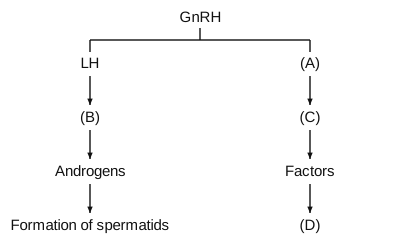
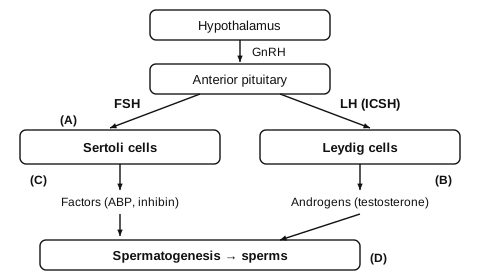
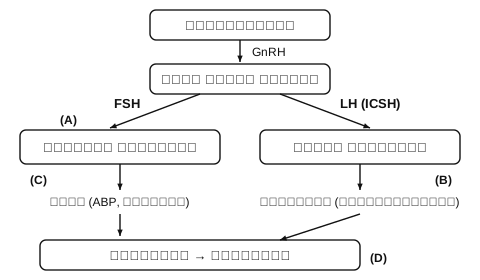
Identify the correct option (A), (B), (C), (D) with respect to spermatogenesis.
शुक्रजनन के संदर्भ में (A), (B), (C), (D) के लिए सही विकल्प पहचानिए।
  1. AICSH, Interstitial cells, Leydig cells, spermatogenesisICSH, अंतराली कोशिकाएँ, लीडिग कोशिकाएँ, शुक्रजनन
  2. BFSH, Sertoli cells, Leydig cells, spermatogenesisFSH, सर्टोली कोशिकाएँ, लीडिग कोशिकाएँ, शुक्रजनन
  3. CICSH, Leydig cells, Sertoli cells, spermatogenesisICSH, लीडिग कोशिकाएँ, सर्टोली कोशिकाएँ, शुक्रजनन
  4. DFSH, Leydig cells, Sertoli cells, spermatogenesisFSH, लीडिग कोशिकाएँ, सर्टोली कोशिकाएँ, शुक्रजनन
Show answer

Concept: GnRH from hypothalamus → anterior pituitary releases LH and FSH; LH → Leydig cells → androgens; FSH → Sertoli cells → factors → spermiogenesis.

  1. The LH branch is already given, so the other gonadotropin (A) = FSH (ICSH is just another name of LH, so options (A) and (C) are out).
  2. LH acts on (B) = Leydig cells, which secrete androgens.
  3. FSH acts on (C) = Sertoli cells, which secrete factors (ABP, inhibin).
  4. These factors help (D) = spermatogenesis (spermiogenesis).
  5. So (A) FSH, (B) Leydig cells, (C) Sertoli cells, (D) spermatogenesis.

Short trick: "L → L" (LH → Leydig) and "F → S" (FSH → Sertoli). ICSH = LH, so it can never be the second branch.

Answer: (D) FSH, Leydig cells, Sertoli cells, spermatogenesis

अवधारणा: हाइपोथैलेमस से GnRH → अग्र पीयूष से LH व FSH; LH → लीडिग कोशिकाएँ → ऐंड्रोजन; FSH → सर्टोली कोशिकाएँ → कारक → शुक्राणुजनन।

  1. LH शाखा पहले से दी है, अतः दूसरा गोनैडोट्रॉपिन (A) = FSH (ICSH, LH का ही दूसरा नाम है, अतः विकल्प (A) व (C) बाहर)।
  2. LH (B) = लीडिग कोशिकाओं पर कार्य करता है, जो ऐंड्रोजन स्रावित करती हैं।
  3. FSH (C) = सर्टोली कोशिकाओं पर कार्य करता है, जो कारक (ABP, इनहिबिन) स्रावित करती हैं।
  4. ये कारक (D) = शुक्रजनन (शुक्राणुजनन) में सहायक हैं।
  5. अतः (A) FSH, (B) लीडिग कोशिकाएँ, (C) सर्टोली कोशिकाएँ, (D) शुक्रजनन।

शॉर्ट ट्रिक: "L → L" (LH → लीडिग) तथा "F → S" (FSH → सर्टोली)। ICSH = LH, अतः यह दूसरी शाखा नहीं हो सकता।

उत्तर: (D) FSH, लीडिग कोशिकाएँ, सर्टोली कोशिकाएँ, शुक्रजनन

NEET UGZoologyHuman reproduction – hormonal control of spermatogenesisNEET UG 2024 · 5 May Shift 1
Q554.
Regarding catalytic cycle of an enzyme action, select the correct sequential steps :
A. Substrate enzyme complex formation.
B. Free enzyme ready to bind with another substrate.
C. Release of products.
D. Chemical bonds of the substrate broken.
E. Substrate binding to active site.
Choose the correct answer from the options given below :
एंजाइम क्रिया के उत्प्रेरक चक्र के संबंध में सही क्रमिक चरण चुनिए :
A. क्रियाधार-एंजाइम सम्मिश्र का बनना।
B. मुक्त एंजाइम दूसरे क्रियाधार से जुड़ने को तैयार।
C. उत्पादों का मुक्त होना।
D. क्रियाधार के रासायनिक आबंधों का टूटना।
E. सक्रिय स्थल से क्रियाधार का जुड़ना।
नीचे दिए गए विकल्पों में से सही उत्तर चुनिए :
  1. AA, E, B, D, C
  2. BB, A, C, D, E
  3. CE, D, C, B, A
  4. DE, A, D, C, B
Show answer

Concept: Catalytic cycle (NCERT): bind → induced fit (ES complex) → bonds broken → products released → enzyme free again.

  1. E – substrate binds to the active site.
  2. A – enzyme alters shape around it, forming the enzyme–substrate complex.
  3. D – active site breaks chemical bonds of the substrate (enzyme–product complex).
  4. C – products are released.
  5. B – free enzyme is ready to bind another substrate.

Short trick: Starts with binding (E) and ends with free enzyme (B) – only (D) does both.

Answer: (D) E, A, D, C, B

अवधारणा: उत्प्रेरक चक्र (NCERT): जुड़ना → प्रेरित अनुरूपता (ES सम्मिश्र) → आबंध टूटना → उत्पाद मुक्त → एंजाइम पुनः मुक्त।

  1. E – क्रियाधार सक्रिय स्थल से जुड़ता है।
  2. A – एंजाइम उसके चारों ओर आकार बदलता है, एंजाइम-क्रियाधार सम्मिश्र बनता है।
  3. D – सक्रिय स्थल क्रियाधार के रासायनिक आबंध तोड़ता है (एंजाइम-उत्पाद सम्मिश्र)।
  4. C – उत्पाद मुक्त होते हैं।
  5. B – मुक्त एंजाइम दूसरे क्रियाधार से जुड़ने को तैयार।

शॉर्ट ट्रिक: जुड़ने (E) से आरंभ और मुक्त एंजाइम (B) पर अंत – दोनों केवल (D) में।

उत्तर: (D) E, A, D, C, B

NEET UGZoologyBiomolecules – enzyme catalytic cycleNEET UG 2024 · 5 May Shift 1
Q555.
The following are the statements about non-chordates :
A. Pharynx is perforated by gill slits.
B. Notochord is absent.
C. Central nervous system is dorsal.
D. Heart is dorsal if present.
E. Post anal tail is absent.
Choose the most appropriate answer from the options given below :
अरज्जुकियों (non-chordates) के बारे में निम्नलिखित कथन दिए गए हैं :
A. ग्रसनी क्लोम छिद्रों (gill slits) द्वारा छिद्रित होती है।
B. पृष्ठरज्जु अनुपस्थित होता है।
C. केंद्रीय तंत्रिका तंत्र पृष्ठीय होता है।
D. हृदय, यदि उपस्थित हो, तो पृष्ठीय होता है।
E. गुदा-पश्च पुच्छ अनुपस्थित होती है।
नीचे दिए गए विकल्पों में से सबसे उपयुक्त उत्तर चुनिए :
  1. AA, B & D onlyकेवल A, B और D
  2. BB, D & E onlyकेवल B, D और E
  3. CB, C & D onlyकेवल B, C और D
  4. DA & C onlyकेवल A और C
Show answer

Concept: Chordates vs non-chordates (NCERT table).

  1. A. Pharyngeal gill slits are absent in non-chordates (a chordate feature) ✘.
  2. B. Notochord absent ✔.
  3. C. CNS is ventral, solid and double in non-chordates ✘.
  4. D. Heart is dorsal (if present) ✔.
  5. E. Post-anal tail absent ✔.
  6. Correct: B, D and E.

Short trick: Non-chordates are the exact opposite of chordates in every feature – no notochord, no gill slits, no post-anal tail, ventral CNS and dorsal heart (chordate heart is ventral).

Answer: (B) B, D & E only

अवधारणा: रज्जुकी बनाम अरज्जुकी (NCERT तालिका)।

  1. A. ग्रसनी क्लोम छिद्र अरज्जुकियों में अनुपस्थित (यह रज्जुकी लक्षण है) ✘।
  2. B. पृष्ठरज्जु अनुपस्थित ✔।
  3. C. अरज्जुकियों में केंद्रीय तंत्रिका तंत्र अधरीय, ठोस व दोहरा ✘।
  4. D. हृदय पृष्ठीय (यदि उपस्थित) ✔।
  5. E. गुदा-पश्च पुच्छ अनुपस्थित ✔।
  6. सही: B, D और E।

शॉर्ट ट्रिक: अरज्जुकी हर लक्षण में रज्जुकियों के ठीक विपरीत हैं – पृष्ठरज्जु नहीं, क्लोम छिद्र नहीं, गुदा-पश्च पुच्छ नहीं, अधरीय CNS तथा पृष्ठीय हृदय (रज्जुकी में हृदय अधरीय)।

उत्तर: (B) केवल B, D और E

NEET UGZoologyAnimal kingdom – chordates vs non-chordatesNEET UG 2024 · 5 May Shift 1
Q556.
Match List I with List II:
List IList II
A. The structures used for storing of food.I. Gizzard
B. Ring 6-8 blind tubules at junction of foregut and midgut.II. Gastric Caeca
C. Ring of 100-150 yellow coloured thin filaments at junction of midgut and hindgutIII. Malpighian tubules
D. The structures used for grinding the food.IV. Crop
Choose the correct answer from the options given below:
सूची-I का सूची-II से मिलान कीजिए :
सूची Iसूची II
A. भोजन संग्रहण हेतु प्रयुक्त संरचनाएँ।I. पेषणी (Gizzard)
B. अग्रांत्र व मध्यांत्र के संधि-स्थल पर 6-8 अंधनलिकाओं का वलय।II. जठर अंधनाल (Gastric Caeca)
C. मध्यांत्र व पश्चांत्र के संधि-स्थल पर 100-150 पीले रंग के पतले तंतुओं का वलयIII. मैल्पीघी नलिकाएँ
D. भोजन पीसने हेतु प्रयुक्त संरचनाएँ।IV. अन्नपुट (Crop)
नीचे दिए गए विकल्पों में से सही उत्तर चुनिए :
  1. AA-I, B-II, C-III, D-IV
  2. BA-IV, B-III, C-II, D-I
  3. CA-III, B-II, C-IV, D-I
  4. DA-IV, B-II, C-III, D-I
Show answer

Concept: Alimentary canal of cockroach: foregut (crop, gizzard), midgut (with gastric caeca), hindgut (Malpighian tubules at junction).

  1. Crop – sac-like, stores food → A-IV.
  2. Gastric (hepatic) caeca – 6–8 blind tubules at foregut–midgut junction, secrete digestive juice → B-II.
  3. Malpighian tubules – 100–150 yellow filaments at midgut–hindgut junction, excretory → C-III.
  4. Gizzard (proventriculus) – chitinous teeth, grinds food → D-I.

Short trick: Order along the gut: Crop → Gizzard → caeca → midgut → Malpighian tubules → hindgut.

Answer: (D) A-IV, B-II, C-III, D-I

अवधारणा: कॉकरोच की आहारनाल: अग्रांत्र (अन्नपुट, पेषणी), मध्यांत्र (जठर अंधनाल सहित), पश्चांत्र (संधि पर मैल्पीघी नलिकाएँ)।

  1. अन्नपुट – थैलीनुमा, भोजन संग्रहित करता है → A-IV।
  2. जठर (यकृत) अंधनाल – अग्रांत्र-मध्यांत्र संधि पर 6–8 अंधनलिकाएँ, पाचक रस स्रावित → B-II।
  3. मैल्पीघी नलिकाएँ – मध्यांत्र-पश्चांत्र संधि पर 100–150 पीले तंतु, उत्सर्जी → C-III।
  4. पेषणी (प्रोवेंट्रिकुलस) – काइटिनी दाँत, भोजन पीसती है → D-I।

शॉर्ट ट्रिक: आहारनाल में क्रम: अन्नपुट → पेषणी → अंधनाल → मध्यांत्र → मैल्पीघी नलिकाएँ → पश्चांत्र।

उत्तर: (D) A-IV, B-II, C-III, D-I

NEET UGZoologyStructural organisation – digestive system of cockroachNEET UG 2024 · 5 May Shift 1
Q557.
Given below are two statements :
Statement I : The cerebral hemispheres are connected by nerve tract known as corpus callosum.
Statement II : The brain stem consists of the medulla oblongata, pons and cerebrum.
In the light of the above statements, choose the most appropriate answer from the options given below :
नीचे दो कथन दिए गए हैं :
कथन I : प्रमस्तिष्क गोलार्ध कॉर्पस कैलोसम नामक तंत्रिका पथ द्वारा जुड़े होते हैं।
कथन II : मस्तिष्क स्तंभ (brain stem) मेडुला ऑब्लांगेटा, पोंस तथा प्रमस्तिष्क (cerebrum) से बना होता है।
उपर्युक्त कथनों के आलोक में, नीचे दिए गए विकल्पों में से सबसे उपयुक्त उत्तर चुनिए :
  1. ABoth Statement I and Statement II are incorrect.कथन I और कथन II दोनों गलत हैं।
  2. BStatement I is correct but Statement II is incorrect.कथन I सही है परन्तु कथन II गलत है।
  3. CStatement I is incorrect but Statement II is correct.कथन I गलत है परन्तु कथन II सही है।
  4. DBoth Statement I and Statement II are correct.कथन I और कथन II दोनों सही हैं।
Show answer

Concept: Corpus callosum joins the two cerebral hemispheres; brain stem = midbrain + pons + medulla oblongata.

  1. Statement I – the hemispheres are connected by a tract of nerve fibres, the corpus callosum → correct.
  2. Statement II – brain stem is midbrain, pons and medulla; the cerebrum is forebrain, not brain stem → incorrect.

Short trick: Brain stem = "M-P-M" (Midbrain, Pons, Medulla) – no "cerebrum".

Answer: (B) Statement I is correct but Statement II is incorrect.

अवधारणा: कॉर्पस कैलोसम दोनों प्रमस्तिष्क गोलार्धों को जोड़ता है; मस्तिष्क स्तंभ = मध्यमस्तिष्क + पोंस + मेडुला ऑब्लांगेटा।

  1. कथन I – गोलार्ध तंत्रिका तंतुओं के पथ कॉर्पस कैलोसम द्वारा जुड़े हैं → सही।
  2. कथन II – मस्तिष्क स्तंभ मध्यमस्तिष्क, पोंस व मेडुला से बना है; प्रमस्तिष्क अग्रमस्तिष्क का भाग है, मस्तिष्क स्तंभ का नहीं → गलत।

शॉर्ट ट्रिक: मस्तिष्क स्तंभ = "M-P-M" (मध्यमस्तिष्क, पोंस, मेडुला) – "प्रमस्तिष्क" नहीं।

उत्तर: (B) कथन I सही है परन्तु कथन II गलत है।

NEET UGZoologyNeural control – human brainNEET UG 2024 · 5 May Shift 1
Q558.
Match List I with List II:
List IList II
A. Mesozoic EraI. Lower invertebrates
B. Proterozoic EraII. Fish & Amphibia
C. Cenozoic EraIII. Birds & Reptiles
D. Paleozoic EraIV. Mammals
Choose the correct answer from the options given below:
सूची-I का सूची-II से मिलान कीजिए :
सूची Iसूची II
A. मीसोज़ोइक महाकल्पI. निम्न अकशेरुकी
B. प्रोटेरोज़ोइक महाकल्पII. मछलियाँ एवं उभयचर
C. सीनोज़ोइक महाकल्पIII. पक्षी एवं सरीसृप
D. पैलियोज़ोइक महाकल्पIV. स्तनधारी
नीचे दिए गए विकल्पों में से सही उत्तर चुनिए :
  1. AA-III, B-I, C-II, D-IV
  2. BA-I, B-II, C-IV, D-III
  3. CA-III, B-I, C-IV, D-II
  4. DA-II, B-I, C-III, D-IV
Show answer

Concept: Dominant life of each era.

  1. Proterozoic – oldest of these, life mainly lower invertebrates → B-I.
  2. Paleozoic – age of fishes and amphibians → D-II.
  3. Mesozoic – age of reptiles (dinosaurs); birds appeared → A-III.
  4. Cenozoic – age of mammals → C-IV.

Short trick: Order "Proterozoic → Paleozoic → Mesozoic → Cenozoic" = invertebrates → fish/amphibia → reptiles/birds → mammals.

Answer: (C) A-III, B-I, C-IV, D-II

अवधारणा: प्रत्येक महाकल्प का प्रमुख जीवन।

  1. प्रोटेरोज़ोइक – इनमें सबसे प्राचीन, मुख्यतः निम्न अकशेरुकी → B-I।
  2. पैलियोज़ोइक – मछलियों व उभयचरों का युग → D-II।
  3. मीसोज़ोइक – सरीसृपों (डायनासोर) का युग; पक्षी प्रकट हुए → A-III।
  4. सीनोज़ोइक – स्तनधारियों का युग → C-IV।

शॉर्ट ट्रिक: क्रम "प्रोटेरो → पैलियो → मीसो → सीनो" = अकशेरुकी → मछली/उभयचर → सरीसृप/पक्षी → स्तनधारी।

उत्तर: (C) A-III, B-I, C-IV, D-II

NEET UGZoologyEvolution – geological time scaleNEET UG 2024 · 5 May Shift 1
Q559.
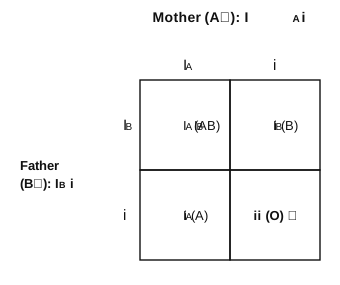
As per ABO blood grouping system, the blood group of father is B+, mother is A+ and child is O+. Their respective genotype can be
A. IBi/IAi/ii
B. IBIB/IAIA/ii
C. IAIB/iIA/iBi
D. IAi/IBi/IAi
E. iIB/iIA/IAIB
Choose the most appropriate answer from the options given below.
ABO रुधिर वर्ग पद्धति के अनुसार, पिता का रुधिर वर्ग B+, माता का A+ तथा संतान का O+ है। उनके क्रमशः जीनप्ररूप हो सकते हैं
A. IBi/IAi/ii
B. IBIB/IAIA/ii
C. IAIB/iIA/iBi
D. IAi/IBi/IAi
E. iIB/iIA/IAIB
नीचे दिए गए विकल्पों में से सबसे उपयुक्त उत्तर चुनिए।
  1. AB onlyकेवल B
  2. BC & BC और B
  3. CD & E onlyकेवल D और E
  4. DA onlyकेवल A
Show answer

Concept: Group O child must be ii, so each parent must carry an i allele; IA and IB are dominant over i.

  1. Child O → genotype ii; father B → IBIB or IBi; mother A → IAIA or IAi.
  2. To give i to the child: father IBi, mother IAi (see the cross) → set A ✔.
  3. B: homozygous parents IBIB × IAIA can only give IAIB (AB) children ✘.
  4. C: father IAIB is group AB, not B ✘.
  5. D: father IAi is group A, and child IAi is A, not O ✘.
  6. E: child IAIB is AB, not O ✘.

Short trick: Just check the child: only "ii" can be O. Only set A ends in ii with heterozygous parents.

Answer: (D) A only

अवधारणा: O वर्ग की संतान ii होनी चाहिए, अतः प्रत्येक जनक में i युग्मविकल्पी होना आवश्यक; IA व IB, i पर प्रभावी हैं।

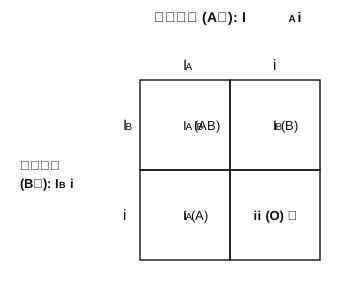
  1. संतान O → जीनप्ररूप ii; पिता B → IBIB या IBi; माता A → IAIA या IAi।
  2. संतान को i देने के लिए: पिता IBi, माता IAi (क्रॉस देखें) → समुच्चय A ✔।
  3. B: समयुग्मजी जनक IBIB × IAIA से केवल IAIB (AB) संतान ✘।
  4. C: पिता IAIB वर्ग AB है, B नहीं ✘।
  5. D: पिता IAi वर्ग A है, तथा संतान IAi भी A है, O नहीं ✘।
  6. E: संतान IAIB वर्ग AB है, O नहीं ✘।

शॉर्ट ट्रिक: केवल संतान जाँचें: केवल "ii" ही O हो सकता है। विषमयुग्मजी जनकों सहित ii केवल समुच्चय A में।

उत्तर: (D) केवल A

NEET UGZoologyPrinciples of inheritance – ABO blood groupNEET UG 2024 · 5 May Shift 1
Q560.
Given below are two statements :
Statement I : Bone marrow is the main lymphoid organ where all blood cells including lymphocytes are produced.
Statement II : Both Bone marrow and thymus provide micro environments for the development and maturation of T-lymphocytes.
In the light of the above statements, choose the most appropriate answer from the options given below :
नीचे दो कथन दिए गए हैं :
कथन I : अस्थि मज्जा मुख्य लसीकाभ अंग है जहाँ लसीकाणुओं सहित सभी रुधिर कोशिकाएँ उत्पन्न होती हैं।
कथन II : अस्थि मज्जा और थाइमस दोनों T-लसीकाणुओं के परिवर्धन और परिपक्वन के लिए सूक्ष्म-पर्यावरण प्रदान करते हैं।
उपर्युक्त कथनों के आलोक में, नीचे दिए गए विकल्पों में से सबसे उपयुक्त उत्तर चुनिए :
  1. ABoth Statement I and Statement II are incorrect.कथन I और कथन II दोनों गलत हैं।
  2. BStatement I is correct but Statement II is incorrect.कथन I सही है परन्तु कथन II गलत है।
  3. CStatement I is incorrect but Statement II is correct.कथन I गलत है परन्तु कथन II सही है।
  4. DBoth Statement I and Statement II are correct.कथन I और कथन II दोनों सही हैं।
Show answer

Concept: Primary lymphoid organs = bone marrow and thymus (NCERT).

  1. Statement I – NCERT: "The bone marrow is the main lymphoid organ where all blood cells including lymphocytes are produced" → correct.
  2. Statement II – NCERT: "Both bone-marrow and thymus provide micro-environments for the development and maturation of T-lymphocytes" → correct.

Short trick: Both are verbatim NCERT lines – when both statements read like the textbook, choose "both correct".

Answer: (D) Both Statement I and Statement II are correct.

अवधारणा: प्राथमिक लसीकाभ अंग = अस्थि मज्जा व थाइमस (NCERT)।

  1. कथन I – NCERT: "अस्थि मज्जा मुख्य लसीकाभ अंग है जहाँ लसीकाणुओं सहित सभी रुधिर कोशिकाएँ उत्पन्न होती हैं" → सही।
  2. कथन II – NCERT: "अस्थि मज्जा और थाइमस दोनों T-लसीकाणुओं के परिवर्धन और परिपक्वन के लिए सूक्ष्म-पर्यावरण प्रदान करते हैं" → सही।

शॉर्ट ट्रिक: दोनों NCERT की शब्दशः पंक्तियाँ हैं – जब दोनों कथन पाठ्यपुस्तक जैसे हों, "दोनों सही" चुनें।

उत्तर: (D) कथन I और कथन II दोनों सही हैं।

NEET UGZoologyHuman health and disease – lymphoid organsNEET UG 2024 · 5 May Shift 1