NEET UG · 2,240 questions

NEET UG 2015, 2016, 2017, 2018, 2019, 2020, 2021, 2022, 2023, 2024, 2025, 2026 PYQs

Real previous year questions, subject-wise. Try the question, then open the answer and the explanation in Hindi & English – free, no login.

Courses – airGurukul

2,240 questions.

Q561.
The minimum wavelength of X-rays produced by an electron accelerated through a potential difference of V volts is proportional to:
V वोल्ट के विभवान्तर से त्वरित इलेक्ट्रॉन द्वारा उत्पन्न X-किरणों की न्यूनतम तरंगदैर्ध्य किसके समानुपाती होती है?
  1. AV
  2. B1V
  3. C1V
  4. DV2
Show answer

Concept: The whole kinetic energy eV of the electron can go into one X-ray photon; that photon has the largest energy and so the smallest wavelength.

  1. eV=hcλmin
  2. λmin=hceV
  3. h,c,e are constants, so λmin∝1V.

Short trick: Remember λmin(Å)≈12400V – a pure 1/V law (do not confuse with de Broglie λ∝1/V for the electron itself).

Answer: (B) 1V

अवधारणा: इलेक्ट्रॉन की पूरी गतिज ऊर्जा eV एक X-किरण फोटॉन में जा सकती है; उस फोटॉन की ऊर्जा अधिकतम और तरंगदैर्ध्य न्यूनतम होती है।

  1. eV=hcλmin
  2. λmin=hceV
  3. h,c,e नियतांक हैं, अतः λmin∝1V।

शॉर्ट ट्रिक: याद रखें λmin(Å)≈12400V – शुद्ध 1/V नियम (इलेक्ट्रॉन की दे-ब्रॉग्ली तरंगदैर्ध्य λ∝1/V से भ्रमित न हों)।

उत्तर: (B) 1V

NEET UGPhysicsDual nature – X-rays (Duane–Hunt law)NEET UG 2023 · 7 May Shift 1
Q562.
A carnot engine has an efficiency of 50% when its source is at a temperature 327∘C. The temperature of the sink is:
एक कार्नो इंजन की दक्षता 50% है जब उसके स्रोत का ताप 327∘C है। सिंक (अभिगम) का ताप है:
  1. A27∘C
  2. B15∘C
  3. C100∘C
  4. D200∘C
Show answer

Concept: Carnot efficiency η=1−T2T1 with temperatures in kelvin.

  1. T1=327+273=600 K
  2. 0.5=1−T2600⇒T2=300 K
  3. T2=300−273=27∘C

Short trick: 50% efficiency means T2=T1/2 (in K): 600/2=300 K=27∘C. Never halve the Celsius value.

Answer: (A) 27∘C

अवधारणा: कार्नो दक्षता η=1−T2T1, ताप केल्विन में।

  1. T1=327+273=600 K
  2. 0.5=1−T2600⇒T2=300 K
  3. T2=300−273=27∘C

शॉर्ट ट्रिक: 50% दक्षता का अर्थ है T2=T1/2 (K में): 600/2=300 K=27∘C। सेल्सियस मान को आधा कभी न करें।

उत्तर: (A) 27∘C

NEET UGPhysicsThermodynamics – Carnot engineNEET UG 2023 · 7 May Shift 1
Q563.
A bullet is fired from a gun at the speed of 280 m s−1 in the direction 30∘ above the horizontal. The maximum height attained by the bullet is (g=9.8 m s−2, sin⁡30∘=0.5):
एक गोली बन्दूक से 280 m s−1 की चाल से क्षैतिज से 30∘ ऊपर की दिशा में दागी जाती है। गोली द्वारा प्राप्त अधिकतम ऊँचाई है (g=9.8 m s−2, sin⁡30∘=0.5):
  1. A2800 m
  2. B2000 m
  3. C1000 m
  4. D3000 m
Show answer

Concept: Maximum height of a projectile H=u2sin2⁡θ2g.

  1. usin⁡θ=280×0.5=140 m s−1
  2. H=14022×9.8=1960019.6
  3. H=1000 m

Short trick: Only the vertical component matters: H=(uy)22g=140219.6; note 1402=19600.

Answer: (C) 1000 m

अवधारणा: प्रक्षेप्य की अधिकतम ऊँचाई H=u2sin2⁡θ2g।

  1. usin⁡θ=280×0.5=140 m s−1
  2. H=14022×9.8=1960019.6
  3. H=1000 m

शॉर्ट ट्रिक: केवल ऊर्ध्वाधर घटक मायने रखता है: H=(uy)22g=140219.6; ध्यान दें 1402=19600।

उत्तर: (C) 1000 m

NEET UGPhysicsKinematics – projectile motionNEET UG 2023 · 7 May Shift 1
Q564.
In a series LCR circuit, the inductance L is 10 mH, capacitance C is 1 μF and resistance R is 100 Ω. The frequency at which resonance occurs is:
एक श्रेणी LCR परिपथ में प्रेरकत्व L = 10 mH, धारिता C = 1 μF तथा प्रतिरोध R = 100 Ω है। वह आवृत्ति जिस पर अनुनाद होता है, है:
  1. A15.9 rad/s
  2. B15.9 kHz
  3. C1.59 rad/s
  4. D1.59 kHz
Show answer

Concept: At resonance XL=XC, so f0=12πLC (R does not affect it).

  1. LC=10×10−3×1×10−6=10−8 s2
  2. LC=10−4 s⇒ω0=104 rad s−1
  3. f0=1042π=1591.5 Hz≈1.59 kHz

Short trick: ω0=104 rad/s is not in the options; divide by 2π≈6.28 → 1.59 kHz. Options in rad/s with 1.59 or 15.9 are traps.

Answer: (D) 1.59 kHz

अवधारणा: अनुनाद पर XL=XC, अतः f0=12πLC (R का इस पर प्रभाव नहीं)।

  1. LC=10×10−3×1×10−6=10−8 s2
  2. LC=10−4 s⇒ω0=104 rad s−1
  3. f0=1042π=1591.5 Hz≈1.59 kHz

शॉर्ट ट्रिक: ω0=104 rad/s विकल्पों में नहीं है; 2π≈6.28 से भाग दें → 1.59 kHz। rad/s वाले 1.59 या 15.9 विकल्प जाल हैं।

उत्तर: (D) 1.59 kHz

NEET UGPhysicsAlternating current – LCR resonanceNEET UG 2023 · 7 May Shift 1
Q565.
Given below are two statements:
Statement I: Photovoltaic devices can convert optical radiation into electricity.
Statement II: Zener diode is designed to operate under reverse bias in breakdown region.
In the light of the above statements, choose the most appropriate answer from the options given below:
नीचे दो कथन दिए गए हैं:
कथन I: प्रकाश-वोल्टीय (photovoltaic) युक्तियाँ प्रकाशीय विकिरण को विद्युत में परिवर्तित कर सकती हैं।
कथन II: ज़ेनर डायोड को भंजन क्षेत्र (breakdown region) में पश्च बायस (reverse bias) में कार्य करने के लिए बनाया जाता है।
उपर्युक्त कथनों के आलोक में, नीचे दिए गए विकल्पों में से सबसे उपयुक्त उत्तर चुनिए:
  1. ABoth Statement I and Statement II are correct.कथन I और कथन II दोनों सही हैं।
  2. BBoth Statement I and Statement II are incorrect.कथन I और कथन II दोनों गलत हैं।
  3. CStatement I is correct but Statement II is incorrectकथन I सही है लेकिन कथन II गलत है।
  4. DStatement I is incorrect but Statement II is correct.कथन I गलत है लेकिन कथन II सही है।
Show answer

Concept: Solar cells (photovoltaic devices) generate emf from light; a Zener diode is a heavily doped diode used as a voltage regulator in reverse breakdown.

  1. Statement I: a solar cell is a p-n junction that produces an emf when light falls on it – it converts optical radiation into electrical energy. Correct.
  2. Statement II: a Zener diode is specially made to work in the reverse-bias breakdown region, where voltage stays nearly constant. Correct.
  3. Hence options (B), (C) and (D), which call either statement incorrect, are wrong.

Short trick: Photo-voltaic = light → voltage; Zener = “reverse and breakdown” – that is its job, not a fault.

Answer: (A) Both statements are correct.

अवधारणा: सौर सेल (प्रकाश-वोल्टीय युक्ति) प्रकाश से विद्युत वाहक बल उत्पन्न करता है; ज़ेनर डायोड अत्यधिक अपमिश्रित डायोड है जो पश्च भंजन में वोल्टता नियंत्रक की तरह काम करता है।

  1. कथन I: सौर सेल एक p-n संधि है जिस पर प्रकाश पड़ने से विद्युत वाहक बल उत्पन्न होता है – यह प्रकाशीय विकिरण को विद्युत ऊर्जा में बदलता है। सही।
  2. कथन II: ज़ेनर डायोड विशेष रूप से पश्च बायस के भंजन क्षेत्र में कार्य करने हेतु बनाया जाता है, जहाँ वोल्टता लगभग स्थिर रहती है। सही।
  3. अतः विकल्प (B), (C) और (D), जो किसी कथन को गलत बताते हैं, गलत हैं।

शॉर्ट ट्रिक: फोटो-वोल्टीय = प्रकाश → वोल्टता; ज़ेनर = “पश्च बायस और भंजन” – यही इसका काम है, दोष नहीं।

उत्तर: (A) दोनों कथन सही हैं।

NEET UGPhysicsSemiconductor electronics – photodiode/solar cell and Zener diodeNEET UG 2023 · 7 May Shift 1
Q566.
Light travels a distance x in time t1 in air and 10x in time t2 in another denser medium. What is the critical angle for this medium?
प्रकाश वायु में t1 समय में x दूरी तथा किसी अन्य सघन माध्यम में t2 समय में 10x दूरी तय करता है। इस माध्यम के लिए क्रांतिक कोण क्या है?
  1. Asin−1⁡(t2t1)
  2. Bsin−1⁡(10t2t1)
  3. Csin−1⁡(t110t2)
  4. Dsin−1⁡(10t1t2)
Show answer

Concept: μ=cv and for the denser-to-air boundary sin⁡C=1μ=vc.

  1. Speed in air c=xt1; speed in medium v=10xt2
  2. sin⁡C=vc=10x/t2x/t1=10t1t2
  3. C=sin−1⁡(10t1t2)

Short trick: sin⁡C = (speed in denser medium)/(speed in air) – a ratio less than 1; just divide the two speeds.

Answer: (D) sin−1⁡(10t1t2)

अवधारणा: μ=cv तथा सघन-से-वायु सीमा के लिए sin⁡C=1μ=vc।

  1. वायु में चाल c=xt1; माध्यम में चाल v=10xt2
  2. sin⁡C=vc=10x/t2x/t1=10t1t2
  3. C=sin−1⁡(10t1t2)

शॉर्ट ट्रिक: sin⁡C = (सघन माध्यम में चाल)/(वायु में चाल) – 1 से कम अनुपात; बस दोनों चालों का भाग करें।

उत्तर: (D) sin−1⁡(10t1t2)

NEET UGPhysicsRay optics – refractive index and critical angleNEET UG 2023 · 7 May Shift 1
Q567.
In hydrogen spectrum, the shortest wavelength in the Balmer series is λ. The shortest wavelength in the Bracket series is:
हाइड्रोजन स्पेक्ट्रम में बामर श्रेणी की लघुतम तरंगदैर्ध्य λ है। ब्रैकेट श्रेणी की लघुतम तरंगदैर्ध्य है:
  1. A2λ
  2. B4λ
  3. C9λ
  4. D16λ
Show answer

Concept: Shortest wavelength (series limit) corresponds to n2=∞: 1λmin=Rn12, i.e. λmin∝n12.

  1. Balmer: n1=2⇒λ=4R
  2. Brackett: n1=4⇒λ′=16R
  3. λ′λ=164=4⇒λ′=4λ

Short trick: Series limit ∝n12: Lyman 1, Balmer 4, Paschen 9, Brackett 16, Pfund 25 → Brackett/Balmer = 16/4 = 4.

Answer: (B) 4λ

अवधारणा: लघुतम तरंगदैर्ध्य (श्रेणी सीमा) n2=∞ के संगत है: 1λmin=Rn12, अर्थात् λmin∝n12।

  1. बामर: n1=2⇒λ=4R
  2. ब्रैकेट: n1=4⇒λ′=16R
  3. λ′λ=164=4⇒λ′=4λ

शॉर्ट ट्रिक: श्रेणी सीमा ∝n12: लाइमन 1, बामर 4, पाशन 9, ब्रैकेट 16, फुंड 25 → ब्रैकेट/बामर = 16/4 = 4।

उत्तर: (B) 4λ

NEET UGPhysicsAtoms – hydrogen spectrum series limitsNEET UG 2023 · 7 May Shift 1
Q568.
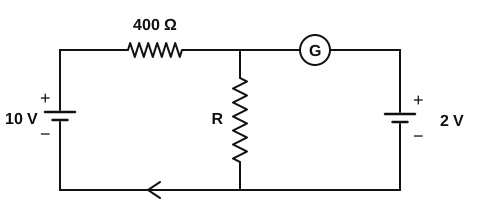
If the galvanometer G does not show any deflection in the circuit shown, the value of R is given by:
यदि दर्शाए गए परिपथ में गैल्वेनोमीटर G कोई विक्षेप नहीं दर्शाता है, तो R का मान है:
  1. A200 Ω
  2. B50 Ω
  3. C100 Ω
  4. D400 Ω
Show answer

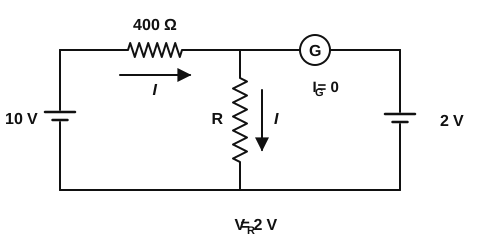
Concept: No deflection ⇒ no current in the G–2 V branch, so the p.d. across R must equal 2 V; the 10 V cell drives the same current through 400 Ω and R in series.

  1. Current I=10400+R
  2. VR=IR=10R400+R=2
  3. 10R=800+2R⇒8R=800⇒R=100 Ω
  4. Check: I=10500=150 A, drop on 400 Ω = 8 V, on R = 2 V ✓

Short trick: Potential divider: 10 V splits as 8 V : 2 V = 400 : R ⇒ R = 100 Ω.

Answer: (C) 100 Ω

अवधारणा: विक्षेप शून्य ⇒ G–2 V शाखा में धारा शून्य, अतः R के सिरों पर विभवान्तर 2 V होना चाहिए; 10 V सेल 400 Ω और R में (श्रेणी में) एक ही धारा भेजता है।

  1. धारा I=10400+R
  2. VR=IR=10R400+R=2
  3. 10R=800+2R⇒8R=800⇒R=100 Ω
  4. जाँच: I=10500=150 A, 400 Ω पर पतन = 8 V, R पर = 2 V ✓

शॉर्ट ट्रिक: विभव विभाजक: 10 V का बँटवारा 8 V : 2 V = 400 : R ⇒ R = 100 Ω।

उत्तर: (C) 100 Ω

NEET UGPhysicsCurrent electricity – Kirchhoff’s laws (null galvanometer)NEET UG 2023 · 7 May Shift 1
Q569.
The amount of energy required to form a soap bubble of radius 2 cm from a soap solution is nearly: (Surface tension of soap solutions =0.03 N m−1)
साबुन के विलयन से 2 cm त्रिज्या का साबुन का बुलबुला बनाने के लिए आवश्यक ऊर्जा लगभग है: (साबुन के विलयन का पृष्ठ तनाव =0.03 N m−1)
  1. A30.16×10−4 J
  2. B5.06×10−4 J
  3. C3.01×10−4 J
  4. D50.1×10−4 J
Show answer

Concept: Work done = surface tension × increase in surface area; a bubble has two surfaces (inner and outer), so W=T×2×4πr2.

  1. r=2×10⁻² m⇒4πr2=4π×4×10−4=16π×10−4 m2
  2. W=0.03×2×16π×10−4=0.96π×10−4
  3. W=3.016×10⁻⁴ J≈3.01×10⁻⁴ J

Short trick: Bubble = 2 surfaces → W=8πr2T; a drop has only one (4πr2T). Forgetting the 2 gives 1.5×10⁻⁴ J, which is not offered.

Answer: (C) 3.01×10⁻⁴ J

अवधारणा: किया गया कार्य = पृष्ठ तनाव × पृष्ठ क्षेत्रफल में वृद्धि; बुलबुले के दो पृष्ठ (भीतरी और बाहरी) होते हैं, अतः W=T×2×4πr2।

  1. r=2×10⁻² m⇒4πr2=4π×4×10−4=16π×10−4 m2
  2. W=0.03×2×16π×10−4=0.96π×10−4
  3. W=3.016×10⁻⁴ J≈3.01×10⁻⁴ J

शॉर्ट ट्रिक: बुलबुला = 2 पृष्ठ → W=8πr2T; बूँद का केवल एक पृष्ठ (4πr2T)। 2 भूलने पर 1.5×10⁻⁴ J आता है, जो विकल्पों में नहीं है।

उत्तर: (C) 3.01×10⁻⁴ J

NEET UGPhysicsMechanical properties of fluids – surface energy of soap bubbleNEET UG 2023 · 7 May Shift 1
Q570.
The magnetic energy stored in an inductor of inductance 4 μH carrying a current of 2 A is:
2 A धारा प्रवाहित करने वाले 4 μH प्रेरकत्व के प्रेरक में संचित चुम्बकीय ऊर्जा है:
  1. A4 μJ
  2. B4 mJ
  3. C8 mJ
  4. D8 μJ
Show answer

Concept: Energy stored in the magnetic field of an inductor U=12LI2.

  1. U=12×4×10−6×22
  2. U=8×10⁻⁶ J=8 μJ

Short trick: Prefix stays: μH × A² gives μJ. 12×4×4=8 → 8 μJ.

Answer: (D) 8 μJ

अवधारणा: प्रेरक के चुम्बकीय क्षेत्र में संचित ऊर्जा U=12LI2।

  1. U=12×4×10−6×22
  2. U=8×10⁻⁶ J=8 μJ

शॉर्ट ट्रिक: उपसर्ग वही रहता है: μH × A² से μJ मिलता है। 12×4×4=8 → 8 μJ।

उत्तर: (D) 8 μJ

NEET UGPhysicsElectromagnetic induction – energy stored in inductorNEET UG 2023 · 7 May Shift 1
Q571.
A 12V, 60W lamp is connected to secondary of step down transformer, whose primary is connected to ac mains of 220V. Assuming the transformer to be ideal, what is the current in the primary winding?
एक 12V, 60W का लैम्प एक अपचायी (step-down) ट्रांसफॉर्मर की द्वितीयक कुंडली से जुड़ा है, जिसकी प्राथमिक कुंडली 220V के ac मेन्स से जुड़ी है। ट्रांसफॉर्मर को आदर्श मानते हुए प्राथमिक कुंडली में धारा क्या है?
  1. A0.27 A
  2. B2.7 A
  3. C3.7 A
  4. D0.37 A
Show answer

Concept: Ideal transformer: input power = output power, VpIp=VsIs.

  1. Output power = 60 W (lamp works at rated 12 V)
  2. 220×Ip=60
  3. Ip=60220=0.273 A≈0.27 A

Short trick: Primary current = power / mains voltage; secondary current would be 60/12=5 A – a step-down transformer steps current up.

Answer: (A) 0.27 A

अवधारणा: आदर्श ट्रांसफॉर्मर: निवेशी शक्ति = निर्गत शक्ति, VpIp=VsIs।

  1. निर्गत शक्ति = 60 W (लैम्प अपनी निर्धारित 12 V पर कार्य करता है)
  2. 220×Ip=60
  3. Ip=60220=0.273 A≈0.27 A

शॉर्ट ट्रिक: प्राथमिक धारा = शक्ति / मेन्स वोल्टता; द्वितीयक धारा 60/12=5 A होगी – अपचायी ट्रांसफॉर्मर धारा को बढ़ाता है।

उत्तर: (A) 0.27 A

NEET UGPhysicsAlternating current – ideal transformerNEET UG 2023 · 7 May Shift 1
Q572.
An electric dipole is placed at an angle of 30∘ with an electric field of intensity 2×10⁵ N C−1. It experiences a torque equal to 4 N m. Calculate the magnitude of charge on the dipole, if the dipole length is 2 cm.
एक विद्युत द्विध्रुव 2×10⁵ N C−1 तीव्रता के विद्युत क्षेत्र से 30∘ के कोण पर रखा है। इस पर 4 N m का बल-आघूर्ण लगता है। यदि द्विध्रुव की लम्बाई 2 cm है, तो द्विध्रुव पर आवेश का परिमाण ज्ञात कीजिए।
  1. A8 mC
  2. B6 mC
  3. C4 mC
  4. D2 mC
Show answer

Concept: Torque on a dipole τ=pEsin⁡θ with p=q×2a (charge × length).

  1. 4=q×0.02×2×105×sin⁡30∘
  2. 4=q×0.02×2×105×0.5=2000q
  3. q=2×10⁻³ C=2 mC

Short trick: pEsin⁡θ=q×(0.02×10⁵)=2000q → q=4/2000 = 2 mC.

Answer: (D) 2 mC

अवधारणा: द्विध्रुव पर बल-आघूर्ण τ=pEsin⁡θ, जहाँ p=q×2a (आवेश × लम्बाई)।

  1. 4=q×0.02×2×105×sin⁡30∘
  2. 4=q×0.02×2×105×0.5=2000q
  3. q=2×10⁻³ C=2 mC

शॉर्ट ट्रिक: pEsin⁡θ=q×(0.02×10⁵)=2000q → q=4/2000 = 2 mC।

उत्तर: (D) 2 mC

NEET UGPhysicsElectrostatics – torque on electric dipoleNEET UG 2023 · 7 May Shift 1
Q573.
A vehicle travels half the distance with speed v and the remaining distance with speed 2v. Its average speed is
एक वाहन आधी दूरी v चाल से तथा शेष दूरी 2v चाल से तय करता है। इसकी औसत चाल है
  1. Av3
  2. B2v3
  3. C4v3
  4. D3v4
Show answer

Concept: Average speed = total distance / total time. For equal distances it is the harmonic mean 2v1v2v1+v2.

  1. Let total distance = 2d. Time =dv+d2v=3d2v
  2. vavg=2d3d/2v=4v3

Short trick: Equal distances ⇒ 2v1v2v1+v2=2⋅v⋅2v3v=4v3; it must lie between v and 2v, which only 4v3 does.

Answer: (C) 4v3

अवधारणा: औसत चाल = कुल दूरी / कुल समय। समान दूरियों के लिए यह हरात्मक माध्य 2v1v2v1+v2 है।

  1. माना कुल दूरी = 2d। समय =dv+d2v=3d2v
  2. vavg=2d3d/2v=4v3

शॉर्ट ट्रिक: समान दूरियाँ ⇒ 2v1v2v1+v2=2⋅v⋅2v3v=4v3; उत्तर v और 2v के बीच होना चाहिए, ऐसा केवल 4v3 है।

उत्तर: (C) 4v3

NEET UGPhysicsKinematics – average speedNEET UG 2023 · 7 May Shift 1
Q574.
Let a wire be suspended from the ceiling (rigid support) and stretched by a weight W attached at its free end. The longitudinal stress at any point of cross-sectional area A of the wire is:
एक तार छत (दृढ़ आधार) से लटकाया गया है तथा उसके मुक्त सिरे पर लगे भार W द्वारा खींचा गया है। तार के अनुप्रस्थ काट क्षेत्रफल A वाले किसी भी बिंदु पर अनुदैर्ध्य प्रतिबल है:
  1. A2WA
  2. BWA
  3. CW2A
  4. DZeroशून्य
Show answer

Concept: Longitudinal stress = restoring (tensile) force per unit cross-sectional area.

  1. Treating the wire as light, the tension at every section equals the hanging weight W.
  2. Stress =FA=WA
  3. 2W/A would double-count the support reaction; W/2A has no basis; zero would mean no tension.

Short trick: Tension in a light string/wire = load hung on it ⇒ stress = W/A everywhere.

Answer: (B) WA

अवधारणा: अनुदैर्ध्य प्रतिबल = प्रति एकांक अनुप्रस्थ काट क्षेत्रफल पर प्रत्यानयन (तनन) बल।

  1. तार को हल्का मानने पर प्रत्येक काट पर तनाव लटके भार W के बराबर है।
  2. प्रतिबल =FA=WA
  3. 2W/A में आधार की प्रतिक्रिया दो बार गिन ली गई है; W/2A का कोई आधार नहीं; शून्य का अर्थ होगा कोई तनाव नहीं।

शॉर्ट ट्रिक: हल्के तार/डोरी में तनाव = लटका भार ⇒ हर जगह प्रतिबल = W/A।

उत्तर: (B) WA

NEET UGPhysicsMechanical properties of solids – stressNEET UG 2023 · 7 May Shift 1
Q575.
If ∮sE→⋅dS→=0 over a surface, then:
यदि किसी पृष्ठ पर ∮sE→⋅dS→=0 है, तो:
  1. Athe number of flux lines entering the surface must be equal to the number of flux lines leaving it.पृष्ठ में प्रवेश करने वाली फ्लक्स रेखाओं की संख्या, उससे बाहर निकलने वाली फ्लक्स रेखाओं की संख्या के बराबर होनी चाहिए।
  2. Bthe magnitude of electric field on the surface is constantपृष्ठ पर विद्युत क्षेत्र का परिमाण नियत है।
  3. Call the charges must necessarily be inside the surface.सभी आवेश आवश्यक रूप से पृष्ठ के अंदर होने चाहिए।
  4. Dthe electric field inside the surface is necessarily uniform.पृष्ठ के अंदर विद्युत क्षेत्र आवश्यक रूप से एकसमान है।
Show answer

Concept: Net flux through a closed surface = qenc/ε0; zero net flux means inward flux = outward flux.

  1. (A) Zero net flux ⇒ lines entering = lines leaving. Correct.
  2. (B) E can vary from point to point on the surface (e.g. a dipole field); only the total flux is zero. Wrong.
  3. (C) Charges may be outside; zero flux only says the net enclosed charge is zero. Wrong.
  4. (D) Nothing forces E inside to be uniform. Wrong.

Short trick: Zero flux tells you only about the count of lines (in = out) and net enclosed charge = 0 – nothing about E itself.

Answer: (A) Lines entering = lines leaving.

अवधारणा: बंद पृष्ठ से कुल फ्लक्स = qenc/ε0; कुल फ्लक्स शून्य का अर्थ है भीतर आने वाला फ्लक्स = बाहर जाने वाला फ्लक्स।

  1. (A) कुल फ्लक्स शून्य ⇒ प्रवेश करने वाली रेखाएँ = निकलने वाली रेखाएँ। सही।
  2. (B) पृष्ठ पर E बिंदु-दर-बिंदु बदल सकता है (जैसे द्विध्रुव क्षेत्र); केवल कुल फ्लक्स शून्य है। गलत।
  3. (C) आवेश बाहर भी हो सकते हैं; शून्य फ्लक्स केवल बताता है कि परिबद्ध कुल आवेश शून्य है। गलत।
  4. (D) अंदर E का एकसमान होना आवश्यक नहीं। गलत।

शॉर्ट ट्रिक: शून्य फ्लक्स केवल रेखाओं की संख्या (अंदर = बाहर) और परिबद्ध कुल आवेश = 0 बताता है – E के बारे में कुछ नहीं।

उत्तर: (A) प्रवेश करने वाली रेखाएँ = निकलने वाली रेखाएँ।

NEET UGPhysicsElectrostatics – Gauss’s lawNEET UG 2023 · 7 May Shift 1
Q576.
The work functions of Caesium (Cs), Potassium (K) and Sodium (Na) are 2.14 eV, 2.30 eV and 2.75 eV respectively. If incident electromagnetic radiation has an incident energy of 2.20 eV, which of these photosensitive surfaces may emit photoelectrons?
सीज़ियम (Cs), पोटैशियम (K) तथा सोडियम (Na) के कार्य फलन क्रमशः 2.14 eV, 2.30 eV तथा 2.75 eV हैं। यदि आपतित विद्युत-चुम्बकीय विकिरण की ऊर्जा 2.20 eV है, तो इनमें से कौन-सा/से प्रकाश-सुग्राही पृष्ठ प्रकाश-इलेक्ट्रॉन उत्सर्जित कर सकता/सकते है/हैं?
  1. ACs onlyकेवल Cs
  2. BBoth Na and KNa और K दोनों
  3. CK onlyकेवल K
  4. DNa onlyकेवल Na
Show answer

Concept: Photoemission occurs only if photon energy hν≥ϕ0 (work function).

  1. Cs: 2.20 eV > 2.14 eV → emits.
  2. K: 2.20 eV < 2.30 eV → no emission.
  3. Na: 2.20 eV < 2.75 eV → no emission.

Short trick: Just compare: only the metal with work function below 2.20 eV (Cs, the most reactive alkali) qualifies.

Answer: (A) Cs only

अवधारणा: प्रकाश-उत्सर्जन तभी होता है जब फोटॉन ऊर्जा hν≥ϕ0 (कार्य फलन)।

  1. Cs: 2.20 eV > 2.14 eV → उत्सर्जन होगा।
  2. K: 2.20 eV < 2.30 eV → उत्सर्जन नहीं।
  3. Na: 2.20 eV < 2.75 eV → उत्सर्जन नहीं।

शॉर्ट ट्रिक: केवल तुलना करें: जिसका कार्य फलन 2.20 eV से कम है वही (Cs, सबसे सक्रिय क्षार धातु) उत्सर्जन करेगा।

उत्तर: (A) केवल Cs

NEET UGPhysicsDual nature – photoelectric effect (work function)NEET UG 2023 · 7 May Shift 1
Q577.
The temperature of gas is −50∘C. To what temperature the gas should be heated so that the rms speed is increased by 3 times?
किसी गैस का ताप −50∘C है। गैस को किस ताप तक गर्म किया जाए कि उसकी वर्ग-माध्य-मूल (rms) चाल में 3 गुना वृद्धि हो जाए?
  1. A669∘C
  2. B3295∘C
  3. C3097 K
  4. D223 K
Show answer

Concept: vrms=3RTM⇒vrms∝T (T in kelvin).

  1. T1=−50+273=223 K
  2. “Increased by 3 times” ⇒ increase = 3v, new speed =v+3v=4v
  3. T2T1=42=16⇒T2=16×223=3568 K
  4. T2=3568−273=3295∘C

Short trick: Speed × 4 ⇒ T (kelvin) × 16. (If it meant “becomes 3 times”, T₂ = 9 × 223 = 2007 K = 1734 °C – not an option, confirming the 4× reading.)

Answer: (B) 3295∘C

अवधारणा: vrms=3RTM⇒vrms∝T (T केल्विन में)।

  1. T1=−50+273=223 K
  2. “3 गुना वृद्धि” ⇒ वृद्धि = 3v, नई चाल =v+3v=4v
  3. T2T1=42=16⇒T2=16×223=3568 K
  4. T2=3568−273=3295∘C

शॉर्ट ट्रिक: चाल × 4 ⇒ ताप (केल्विन) × 16। (यदि अर्थ “3 गुना हो जाए” होता, तो T₂ = 9 × 223 = 2007 K = 1734 °C – जो विकल्प में नहीं, अतः 4 गुना वाला अर्थ सही है।)

उत्तर: (B) 3295∘C

NEET UGPhysicsKinetic theory – rms speed and temperatureNEET UG 2023 · 7 May Shift 1
Q578.
The ratio of frequencies of fundamental harmonic produced by an open pipe to that of closed pipe having the same length is:
समान लम्बाई के खुले पाइप तथा बंद पाइप द्वारा उत्पन्न मूल हार्मोनिक की आवृत्तियों का अनुपात है:
  1. A1 : 2
  2. B2 : 1
  3. C1 : 3
  4. D3 : 1
Show answer

Concept: Open pipe: L=λ2⇒fo=v2L. Closed pipe: L=λ4⇒fc=v4L.

  1. fofc=v/2Lv/4L=2
  2. Ratio = 2 : 1

Short trick: Closed pipe fundamental is an octave lower (half the frequency) than an open pipe of the same length.

Answer: (B) 2 : 1

अवधारणा: खुला पाइप: L=λ2⇒fo=v2L। बंद पाइप: L=λ4⇒fc=v4L।

  1. fofc=v/2Lv/4L=2
  2. अनुपात = 2 : 1

शॉर्ट ट्रिक: समान लम्बाई के खुले पाइप की तुलना में बंद पाइप की मूल आवृत्ति आधी (एक सप्तक नीचे) होती है।

उत्तर: (B) 2 : 1

NEET UGPhysicsWaves – organ pipesNEET UG 2023 · 7 May Shift 1
Q579.
Resistance of a carbon resistor determined from colour codes is (22000±5%) Ω. The colour of third band must be:
वर्ण कोड से ज्ञात किसी कार्बन प्रतिरोधक का प्रतिरोध (22000±5%) Ω है। तीसरी पट्टी का रंग होना चाहिए:
  1. ARedलाल
  2. BGreenहरा
  3. COrangeनारंगी
  4. DYellowपीला
Show answer

Concept: Bands: 1st digit, 2nd digit, multiplier (power of 10), tolerance. Digits: Black 0, Brown 1, Red 2, Orange 3, Yellow 4, Green 5 …

  1. 22000=22×103
  2. Band 1 = 2 (Red), Band 2 = 2 (Red)
  3. Band 3 = multiplier 103 → Orange
  4. ±5% → Gold (4th band)

Short trick: “B B ROY of Great Britain has a Very Good Wife” → B0 B1 R2 O3 Y4 G5 B6 V7 G8 W9; third band = number of zeros = 3 → Orange.

Answer: (C) Orange

अवधारणा: पट्टियाँ: पहला अंक, दूसरा अंक, गुणक (10 की घात), सहनशीलता। अंक: काला 0, भूरा 1, लाल 2, नारंगी 3, पीला 4, हरा 5 …

  1. 22000=22×103
  2. पट्टी 1 = 2 (लाल), पट्टी 2 = 2 (लाल)
  3. पट्टी 3 = गुणक 103 → नारंगी
  4. ±5% → सुनहरा (चौथी पट्टी)

शॉर्ट ट्रिक: “B B ROY of Great Britain has a Very Good Wife” → B0 B1 R2 O3 Y4 G5 B6 V7 G8 W9; तीसरी पट्टी = शून्यों की संख्या = 3 → नारंगी।

उत्तर: (C) नारंगी

NEET UGPhysicsCurrent electricity – colour code of carbon resistorNEET UG 2023 · 7 May Shift 1
Q580.
For Young's double slit experiment, two statements are given below:
Statement I: If screen is moved away from the plane of slits, angular separation of the fringes remains constant.
Statement II: If the monochromatic source is replaced by another monochromatic source of larger wavelength, the angular separation of fringes decreases.
In the light of the above statements, choose answer from the options given below:
यंग के द्वि-झिरी प्रयोग के लिए नीचे दो कथन दिए गए हैं:
कथन I: यदि पर्दे को झिरियों के तल से दूर ले जाया जाए, तो फ्रिंजों का कोणीय पृथक्करण नियत रहता है।
कथन II: यदि एकवर्णी स्रोत को अधिक तरंगदैर्ध्य वाले दूसरे एकवर्णी स्रोत से बदल दिया जाए, तो फ्रिंजों का कोणीय पृथक्करण घट जाता है।
उपर्युक्त कथनों के आलोक में, नीचे दिए गए विकल्पों में से उत्तर चुनिए:
  1. ABoth Statement I and Statement II are true.कथन I और कथन II दोनों सत्य हैं।
  2. BBoth Statement I and Statement II are falseकथन I और कथन II दोनों असत्य हैं।
  3. CStatement I is true but Statement II is falseकथन I सत्य है लेकिन कथन II असत्य है।
  4. DStatement I is false but Statement II is true.कथन I असत्य है लेकिन कथन II सत्य है।
Show answer

Concept: Angular fringe width θ=βD=λd – it depends only on wavelength and slit separation.

  1. Statement I: θ=λ/d has no D, so moving the screen changes linear fringe width β but not θ. True.
  2. Statement II: θ∝λ; a larger wavelength increases θ. So “decreases” is false.
  3. Hence I true, II false → option (C). (A) and (D) call II true; (B) calls I false – all wrong.

Short trick: β = λD/d changes with D; θ = λ/d does not. Red light → wider fringes, both linear and angular.

Answer: (C) Statement I is true but Statement II is false.

अवधारणा: कोणीय फ्रिंज चौड़ाई θ=βD=λd – यह केवल तरंगदैर्ध्य और झिरी-अंतराल पर निर्भर है।

  1. कथन I: θ=λ/d में D नहीं है, अतः पर्दा हटाने से रैखिक फ्रिंज चौड़ाई β बदलती है पर θ नहीं। सत्य।
  2. कथन II: θ∝λ; अधिक तरंगदैर्ध्य से θ बढ़ता है। अतः “घटता है” असत्य है।
  3. अतः I सत्य, II असत्य → विकल्प (C)। (A) और (D) II को सत्य मानते हैं; (B) I को असत्य मानता है – सभी गलत।

शॉर्ट ट्रिक: β = λD/d, D के साथ बदलता है; θ = λ/d नहीं बदलता। लाल प्रकाश → चौड़ी फ्रिंजें, रैखिक और कोणीय दोनों।

उत्तर: (C) कथन I सत्य है लेकिन कथन II असत्य है।

NEET UGPhysicsWave optics – Young’s double slit experimentNEET UG 2023 · 7 May Shift 1