Q601.In the figure shown here, what is the equivalent focal length of the combination of lenses (Assume that all layers are thin)?
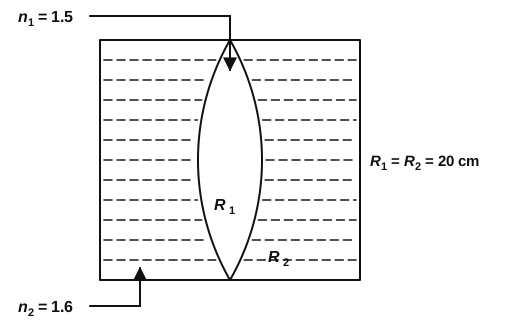
यहाँ दर्शाए गए चित्र में लेंसों के संयोजन की तुल्य फोकस दूरी क्या है (मान लीजिए सभी परतें पतली हैं)?
- A40 cm
- B−40 cm
- C−100 cm
- D−50 cm
Show answer
Concept: Split the system into three thin lenses in contact and use for each; then .
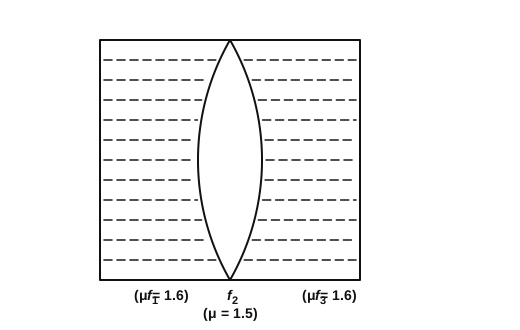
- Middle biconvex lens (, R = 20 cm each side): ⇒ cm
- Each outer layer () is plano-concave with R = 20 cm:
- cm (diverging)
Short trick: Power way: P ∝ (μ − 1)/R: two concave layers give 2 × 0.6 = 1.2, the convex core gives 2 × 0.5 = 1.0 ⇒ net −0.2/20 = −1/100 cm⁻¹.
Answer: (C) −100 cm
अवधारणा: निकाय को सम्पर्क में रखे तीन पतले लेंसों में बाँटें और प्रत्येक के लिए लगाएँ; फिर ।
- बीच का उभयोत्तल लेंस (, दोनों ओर R = 20 cm): ⇒ cm
- प्रत्येक बाहरी परत () R = 20 cm वाला समतल-अवतल लेंस है:
- cm (अपसारी)
शॉर्ट ट्रिक: क्षमता विधि: P ∝ (μ − 1)/R: दो अवतल परतें 2 × 0.6 = 1.2, उत्तल कोर 2 × 0.5 = 1.0 देता है ⇒ कुल −0.2/20 = −1/100 cm⁻¹।
उत्तर: (C) −100 cm
NEET UGPhysicsRay optics – combination of thin lenses (lens maker’s formula)NEET UG 2023 · 7 May Shift 1
Q602.An electric dipole is placed as shown in the figure,
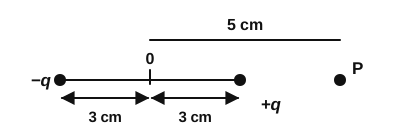
The electric potential (in
V) at point P due to the dipole is (
= permittivity of free space and
):
एक विद्युत द्विध्रुव चित्र में दर्शाए अनुसार रखा गया है,
द्विध्रुव के कारण बिंदु P पर विद्युत विभव (
V में) है (
= मुक्त आकाश की विद्युतशीलता तथा
):
- A
- B
- C
- D
Show answer
Concept: Potential is a scalar: (exact, since P is not far from the dipole).
- P is 5 cm from the centre O; +q is 3 cm from O on the same side ⇒ = 2 cm = 0.02 m; −q is on the other side ⇒ = 8 cm = 0.08 m.
- V
Short trick: Do not use the short-dipole formula here (r is not ≫ a); add the two point-charge potentials directly.
Answer: (A)
अवधारणा: विभव अदिश है: (यथार्थ, क्योंकि P द्विध्रुव से बहुत दूर नहीं है)।
- P केंद्र O से 5 cm दूर है; +q उसी ओर O से 3 cm पर ⇒ = 2 cm = 0.02 m; −q दूसरी ओर ⇒ = 8 cm = 0.08 m।
- V
शॉर्ट ट्रिक: यहाँ लघु द्विध्रुव सूत्र न लगाएँ (r ≫ a नहीं है); दोनों बिंदु-आवेशों के विभव सीधे जोड़ें।
उत्तर: (A)
NEET UGPhysicsElectrostatics – potential due to a dipole (axial point)NEET UG 2023 · 7 May Shift 1
Q603.A horizontal bridge is built across a river. A student standing on the bridge throws a small ball vertically upwards with a velocity . The ball strikes the water surface after 4 s. The height of bridge above water surface is (Take ):
एक नदी पर एक क्षैतिज पुल बना है। पुल पर खड़ा एक छात्र एक छोटी गेंद को वेग से ऊर्ध्वाधरतः ऊपर फेंकता है। गेंद 4 s बाद जल की सतह से टकराती है। जल की सतह से पुल की ऊँचाई है ( लीजिए):
- A56 m
- B60 m
- C64 m
- D68 m
Show answer
Concept: Take upward positive; the displacement from bridge to water is : .
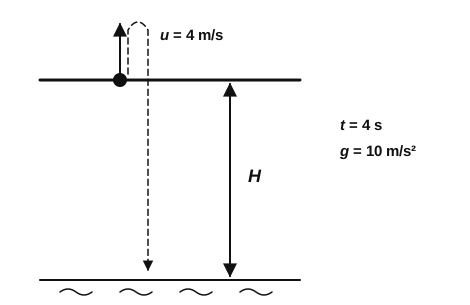
Short trick: Free-fall 4 s from rest drops 80 m; the 4 m/s upward throw gives back = 16 m ⇒ 80 − 16 = 64 m.
Answer: (C) 64 m
अवधारणा: ऊपर की दिशा धनात्मक लें; पुल से जल तक विस्थापन है: ।
शॉर्ट ट्रिक: विराम से 4 s मुक्त पतन में 80 m गिरती; 4 m/s ऊपर फेंकने से = 16 m वापस ⇒ 80 − 16 = 64 m।
उत्तर: (C) 64 m
NEET UGPhysicsKinematics – motion under gravityNEET UG 2023 · 7 May Shift 1
Q604.Calculate the maximum acceleration of a moving car so that a body lying on the floor of the car remains stationary. The coefficient of static friction between the body and the floor is 0.15 ()
चलती हुई कार का वह अधिकतम त्वरण ज्ञात कीजिए जिससे कार के फर्श पर रखा पिंड स्थिर बना रहे। पिंड तथा फर्श के बीच स्थैतिक घर्षण गुणांक 0.15 है ()
- A
- B
- C
- D
Show answer
Concept: Static friction is the only horizontal force that can accelerate the body with the car; it cannot exceed .
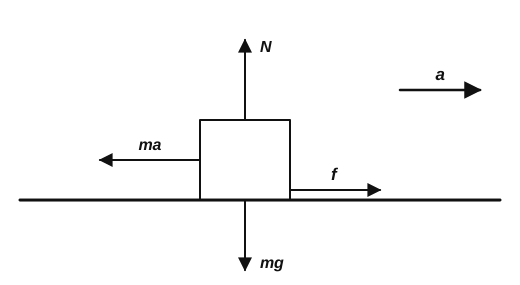
- In the car frame the pseudo force (backward) must be balanced by friction .
Short trick: – mass cancels; 0.15 × 10 = 1.5.
Answer: (C)
अवधारणा: स्थैतिक घर्षण ही एकमात्र क्षैतिज बल है जो पिंड को कार के साथ त्वरित कर सकता है; यह से अधिक नहीं हो सकता।
- कार के निर्देश तंत्र में छद्म बल (पीछे की ओर) को घर्षण संतुलित करता है।
शॉर्ट ट्रिक: – द्रव्यमान कट जाता है; 0.15 × 10 = 1.5।
उत्तर: (C)
NEET UGPhysicsLaws of motion – static friction (pseudo force)NEET UG 2023 · 7 May Shift 1
Q605.10 resistors, each of resistance R are connected in series to a battery of emf E and negligible internal resistance. Then those are connected in parallel to the same battery, the current is increased n times. The value of n is:
दस प्रतिरोधक, प्रत्येक का प्रतिरोध R, विद्युत वाहक बल E तथा नगण्य आंतरिक प्रतिरोध वाली बैटरी से श्रेणी में जोड़े जाते हैं। फिर उन्हें उसी बैटरी से समांतर में जोड़ने पर धारा n गुना बढ़ जाती है। n का मान है:
- A10
- B100
- C1
- D1000
Show answer
Concept: Series: ; parallel: ; with an ideal battery .
Short trick: ⇒ current ratio = = 100.
Answer: (B) 100
अवधारणा: श्रेणी: ; समांतर: ; आदर्श बैटरी के साथ ।
शॉर्ट ट्रिक: ⇒ धारा अनुपात = = 100।
उत्तर: (B) 100
NEET UGPhysicsCurrent electricity – series and parallel combination of resistorsNEET UG 2023 · 7 May Shift 1
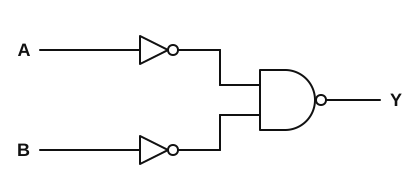
Q606.For the following logic circuit, the truth table is:
निम्नलिखित तर्क परिपथ के लिए सत्यमान सारणी है:
- A
- B
- C
- D
Show answer
Concept: Inputs pass through NOT gates and then a NAND gate: ; by De Morgan’s theorem this is .
- → OR gate
- OR table: 00→0, 01→1, 10→1, 11→1 = option (B).
- (A) is NAND, (C) is just NOT B, (D) is AND – all wrong.
Short trick: Bubbles on inputs + NAND = OR (inverted inputs into NAND); likewise bubbles on inputs + NOR = AND.
Answer: (B) OR-gate truth table 0, 1, 1, 1
अवधारणा: निवेश NOT द्वारों से होकर NAND द्वार में जाते हैं: ; डी-मॉर्गन प्रमेय से यह है।
- → OR द्वार
- OR सारणी: 00→0, 01→1, 10→1, 11→1 = विकल्प (B)।
- (A) NAND है, (C) केवल NOT B है, (D) AND है – सभी गलत।
शॉर्ट ट्रिक: निवेशों पर बबल + NAND = OR; इसी प्रकार निवेशों पर बबल + NOR = AND।
उत्तर: (B) OR द्वार की सत्यमान सारणी 0, 1, 1, 1
NEET UGPhysicsSemiconductor electronics – logic gates (NOT + NAND = OR)NEET UG 2023 · 7 May Shift 1
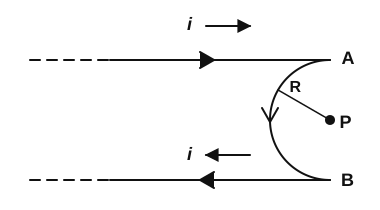
Q607.A very long conducting wire is bent in a semi-circular shape from A to B as shown in figure. The magnetic field at point P for steady current configuration is given by:
एक बहुत लंबे चालक तार को चित्र में दर्शाए अनुसार A से B तक अर्धवृत्ताकार आकार में मोड़ा गया है। स्थायी धारा विन्यास के लिए बिंदु P पर चुम्बकीय क्षेत्र है:
- A pointed into the page पृष्ठ के अंदर की ओर
- B pointed away from the page पृष्ठ से बाहर की ओर
- C pointed away from the page पृष्ठ से बाहर की ओर
- D pointed into the page पृष्ठ के अंदर की ओर
Show answer
Concept: Semi-infinite straight wire ending at the foot of the perpendicular: . Semicircular arc at its centre: .
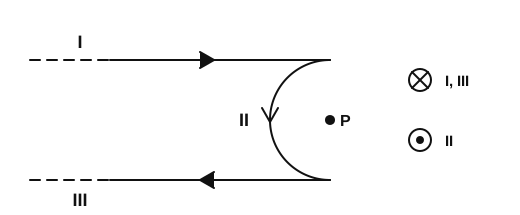
- Part I (upper wire, current → , P below it): into the page.
- Part III (lower wire, current ←, P above it): into the page.
- Part II (arc A → B round the left, anticlockwise about P): out of the page.
- Net ; since , the arc wins → out of the page.
Short trick: Arc term vs two wire terms each; so direction = arc’s direction (out).
Answer: (C) pointed away from the page
अवधारणा: लम्ब के पाद पर समाप्त होने वाला अर्ध-अनंत सीधा तार: । अर्धवृत्ताकार चाप के केंद्र पर: ।
- भाग I (ऊपरी तार, धारा → , P इसके नीचे): पृष्ठ के अंदर।
- भाग III (निचला तार, धारा ←, P इसके ऊपर): पृष्ठ के अंदर।
- भाग II (चाप A → B बाईं ओर से, P के परितः वामावर्त): पृष्ठ से बाहर।
- कुल ; चूँकि , चाप प्रबल → पृष्ठ से बाहर।
शॉर्ट ट्रिक: चाप पद बनाम दो तार पद, प्रत्येक ; अतः दिशा = चाप की दिशा (बाहर)।
उत्तर: (C) पृष्ठ से बाहर की ओर
NEET UGPhysicsMoving charges and magnetism – field due to straight wires and semicircular arcNEET UG 2023 · 7 May Shift 1
Q608.The resistance of platinum wire at is and at . The temperature coefficient of resistance of the wire is:
प्लैटिनम के तार का प्रतिरोध पर तथा पर है। तार का प्रतिरोध ताप गुणांक है:
- A
- B
- C
- D
Show answer
Concept: .
Short trick: Fractional rise 4.8/2 = 2.4 over 80 °C → 2.4/80 = 0.03.
Answer: (C)
अवधारणा: ।
शॉर्ट ट्रिक: आंशिक वृद्धि 4.8/2 = 2.4, 80 °C में → 2.4/80 = 0.03।
उत्तर: (C)
NEET UGPhysicsCurrent electricity – temperature coefficient of resistanceNEET UG 2023 · 7 May Shift 1
Q609.A wire carrying a current I along the positive x-axis has length L. It is kept in a magnetic field T. The magnitude of the magnetic force acting on the wire is:
धनात्मक x-अक्ष के अनुदिश धारा I प्रवाहित करने वाले तार की लम्बाई L है। इसे चुम्बकीय क्षेत्र T में रखा गया है। तार पर लगने वाले चुम्बकीय बल का परिमाण है:
- A3IL
- B IL
- C5IL
- D IL
Show answer
Concept: with .
- , ,
Short trick: Only the components of B perpendicular to the wire matter: ; the part (along the wire) gives no force.
Answer: (C) 5IL
अवधारणा: , जहाँ ।
- , ,
शॉर्ट ट्रिक: केवल तार के लंबवत B के घटक मायने रखते हैं: ; भाग (तार के अनुदिश) कोई बल नहीं देता।
उत्तर: (C) 5IL
NEET UGPhysicsMoving charges and magnetism – force on a current-carrying wireNEET UG 2023 · 7 May Shift 1
Q610.Two thin lenses are of same focal lengths (f), but one is convex and the other one is concave. When they are placed in contact with each other, the equivalent focal length of the combination will be:
दो पतले लेंसों की फोकस दूरियाँ समान (f) हैं, परंतु एक उत्तल तथा दूसरा अवतल है। जब इन्हें एक-दूसरे के सम्पर्क में रखा जाता है, तो संयोजन की तुल्य फोकस दूरी होगी:
- AZeroशून्य
- B
- C
- DInfiniteअनंत
Show answer
Concept: Lenses in contact: (powers add).
- – the combination behaves like a plane glass plate (power zero).
Short trick: Equal and opposite powers cancel: P = 0 ⇒ F = ∞.
Answer: (D) Infinite
अवधारणा: सम्पर्क में रखे लेंस: (क्षमताएँ जुड़ती हैं)।
- – संयोजन एक समतल काँच की पट्टिका जैसा व्यवहार करता है (क्षमता शून्य)।
शॉर्ट ट्रिक: समान और विपरीत क्षमताएँ निरस्त होती हैं: P = 0 ⇒ F = ∞।
उत्तर: (D) अनंत
NEET UGPhysicsRay optics – lenses in contactNEET UG 2023 · 7 May Shift 1
Q611.Select the correct statements from the following:
A. Atoms of all elements are composed of two fundamental particles.
B. The mass of the electron is 9.10939 × 10⁻³¹ kg.
C. All the isotopes of a given element show same chemical properties
D. Protons and electrons are, collectively known as nucleons.
E. Dalton's atomic theory, regarded the atom as an ultimate particle of matter.
Choose the correct answer from the options given below.
निम्नलिखित में से सही कथनों का चयन कीजिए:
A. सभी तत्वों के परमाणु दो मूलभूत कणों से बने होते हैं।
B. इलेक्ट्रॉन का द्रव्यमान 9.10939 × 10⁻³¹ kg है।
C. किसी दिए गए तत्व के सभी समस्थानिक (isotopes) समान रासायनिक गुण दर्शाते हैं।
D. प्रोटॉन और इलेक्ट्रॉन सामूहिक रूप से न्यूक्लिऑन (nucleons) कहलाते हैं।
E. डाल्टन के परमाणु सिद्धान्त ने परमाणु को द्रव्य का अंतिम कण माना।
नीचे दिए गए विकल्पों में से सही उत्तर चुनिए।
- AA, B and C onlyकेवल A, B और C
- BC, D and E onlyकेवल C, D और E
- CA and E onlyकेवल A और E
- DB, C and E onlyकेवल B, C और E
Show answer
Concept: An atom has three fundamental particles (e–, p+, n); nucleons = particles in the nucleus (p + n).
- A – false: there are three fundamental particles (electron, proton, neutron).
- B – true: me = 9.10939 × 10⁻³¹ kg (NCERT value).
- C – true: isotopes have the same electronic configuration, so the same chemistry.
- D – false: nucleons are protons and neutrons, not electrons.
- E – true: Dalton treated the atom as the ultimate, indivisible particle.
- Correct set = B, C, E.
Short trick: Nucleons live in the nucleus – electrons never count. Strike A and D, only option (D) survives.
Answer: (D) B, C and E only
अवधारणा: परमाणु में तीन मूलभूत कण होते हैं (e–, p+, n); न्यूक्लिऑन = नाभिक में उपस्थित कण (p + n)।
- A – असत्य: मूलभूत कण तीन हैं (इलेक्ट्रॉन, प्रोटॉन, न्यूट्रॉन)।
- B – सत्य: me = 9.10939 × 10⁻³¹ kg (NCERT मान)।
- C – सत्य: समस्थानिकों का इलेक्ट्रॉनिक विन्यास समान होता है, अतः रासायनिक गुण समान होते हैं।
- D – असत्य: न्यूक्लिऑन प्रोटॉन और न्यूट्रॉन हैं, इलेक्ट्रॉन नहीं।
- E – सत्य: डाल्टन ने परमाणु को अंतिम, अविभाज्य कण माना।
- सही समूह = B, C, E।
शॉर्ट ट्रिक: न्यूक्लिऑन नाभिक में रहते हैं – इलेक्ट्रॉन कभी नहीं गिने जाते। A और D हटाइए, केवल विकल्प (D) बचता है।
उत्तर: (D) केवल B, C और E
NEET UGChemistryStructure of atom – subatomic particlesNEET UG 2023 · 7 May Shift 1
Q612.Given below are two statements: one is labelled as Assertion A and the other is labelled as Reason R:
Assertion A: A reaction can have zero activation energy.
Reasons R: The minimum extra amount of energy absorbed by reactant molecules so that their energy becomes equal to threshold value, is called activation energy.
In the light of the above statements, choose the correct answer from the options given below :
नीचे दो कथन दिए गए हैं: एक को अभिकथन A और दूसरे को कारण R के रूप में लिखा गया है:
अभिकथन A: किसी अभिक्रिया की सक्रियण ऊर्जा शून्य हो सकती है।
कारण R: अभिकारक अणुओं द्वारा अवशोषित वह न्यूनतम अतिरिक्त ऊर्जा, जिससे उनकी ऊर्जा देहली (threshold) मान के बराबर हो जाए, सक्रियण ऊर्जा कहलाती है।
उपर्युक्त कथनों के आलोक में, नीचे दिए गए विकल्पों में से सही उत्तर चुनिए:
- ABoth A and R are true and R is the correct explanation of AA और R दोनों सत्य हैं तथा R, A की सही व्याख्या है
- BBoth A and R are true and R is not the correct explanation of AA और R दोनों सत्य हैं परन्तु R, A की सही व्याख्या नहीं है
- CA is true but R is false.A सत्य है परन्तु R असत्य है
- DA is false but R is true.A असत्य है परन्तु R सत्य है
Show answer
Concept: Ea = threshold energy – average energy of reactants. If reactants already possess the threshold energy, Ea = 0.
- A – true: e.g. combination of two free radicals (radical–radical recombination) needs no extra energy, Ea ≈ 0.
- R – true: it is the NCERT definition of activation energy.
- But the definition does not tell us why some reactions have zero Ea; that is due to reactants already being at the threshold level.
- So both true, R is not the explanation of A.
Short trick: Definitions rarely 'explain' a special case – when R is just a definition, think option (B).
Answer: (B) Both A and R are true and R is not the correct explanation of A
अवधारणा: Ea = देहली ऊर्जा – अभिकारकों की औसत ऊर्जा। यदि अभिकारकों के पास पहले से देहली ऊर्जा हो, तो Ea = 0।
- A – सत्य: जैसे दो मुक्त मूलकों (free radicals) का संयोजन बिना अतिरिक्त ऊर्जा के होता है, Ea ≈ 0।
- R – सत्य: यह सक्रियण ऊर्जा की NCERT परिभाषा है।
- परन्तु यह परिभाषा नहीं बताती कि कुछ अभिक्रियाओं की Ea शून्य क्यों होती है; ऐसा इसलिए है क्योंकि अभिकारक पहले से देहली स्तर पर होते हैं।
- अतः दोनों सत्य हैं, पर R, A की व्याख्या नहीं है।
शॉर्ट ट्रिक: परिभाषा किसी विशेष स्थिति की 'व्याख्या' प्रायः नहीं करती – जब R केवल परिभाषा हो, विकल्प (B) सोचिए।
उत्तर: (B) A और R दोनों सत्य हैं परन्तु R, A की सही व्याख्या नहीं है
NEET UGChemistryChemical kinetics – activation energyNEET UG 2023 · 7 May Shift 1
Q613.A compound is formed by two elements A and B. The element B forms cubic close packed structure and atoms of A occupy 1/3 of tetrahedral voids. If the formula of the compound is AxBy, then the value of x + y is in option
एक यौगिक दो तत्वों A और B से बना है। तत्व B घनीय निविड संकुलित (ccp) संरचना बनाता है तथा A के परमाणु चतुष्फलकीय रिक्तियों (tetrahedral voids) के 1/3 भाग को घेरते हैं। यदि यौगिक का सूत्र AxBy है, तो x + y का मान किस विकल्प में है?
- A5
- B4
- C3
- D2
Show answer
Concept: In ccp (fcc), atoms per unit cell = 4 and tetrahedral voids = 2 × atoms = 8.
- B atoms per cell = 4; tetrahedral voids = 8.
- A occupies 1/3 of 8 = 8/3 voids.
- A : B = 8/3 : 4 = 2 : 3 → formula A2B3.
- x + y = 2 + 3 = 5.
Short trick: Per B atom there are 2 T-voids; A = (1/3)×2 = 2/3 per B → A2/3B1 = A2B3.
Answer: (A) 5
अवधारणा: ccp (fcc) में प्रति एकक कोष्ठिका परमाणु = 4 तथा चतुष्फलकीय रिक्तियाँ = 2 × परमाणु = 8।
- प्रति कोष्ठिका B परमाणु = 4; चतुष्फलकीय रिक्तियाँ = 8।
- A, 8 का 1/3 = 8/3 रिक्तियाँ घेरता है।
- A : B = 8/3 : 4 = 2 : 3 → सूत्र A2B3।
- x + y = 2 + 3 = 5।
शॉर्ट ट्रिक: प्रति B परमाणु 2 T-रिक्तियाँ; A = (1/3)×2 = 2/3 प्रति B → A2/3B1 = A2B3।
उत्तर: (A) 5
NEET UGChemistrySolid state – voids and formulaNEET UG 2023 · 7 May Shift 1
Q614.Given below are two statements: one is labelled as Assertion A and the other is labelled as Reason R
Assertion A: Metallic sodium dissolves in liquid ammonia giving a deep blue solution. which is paramagnetic.
Reasons R: The deep blue solution is due to the formation of amide.
In the light of the above statements, choose the correct answer from the options given below:
नीचे दो कथन दिए गए हैं: एक को अभिकथन A और दूसरे को कारण R के रूप में लिखा गया है:
अभिकथन A: धात्विक सोडियम द्रव अमोनिया में घुलकर गहरा नीला विलयन देता है, जो अनुचुम्बकीय (paramagnetic) होता है।
कारण R: गहरा नीला विलयन ऐमाइड (amide) बनने के कारण होता है।
उपर्युक्त कथनों के आलोक में, नीचे दिए गए विकल्पों में से सही उत्तर चुनिए:
- ABoth A and R are true and R is the correct explanation of A.A और R दोनों सत्य हैं तथा R, A की सही व्याख्या है
- BBoth A and R are true but R is NOT the correct explanation of A.A और R दोनों सत्य हैं परन्तु R, A की सही व्याख्या नहीं है
- CA is true but R. is false.A सत्य है परन्तु R असत्य है
- DA is false but R is true.A असत्य है परन्तु R सत्य है
Show answer
Concept: Alkali metals dissolve in liquid NH3: M + (x + y)NH3 → [M(NH3)x]+ + [e(NH3)y]–.
- The ammoniated (solvated) electron absorbs in the visible region → deep blue colour.
- Unpaired ammoniated electrons make the solution paramagnetic → A is true.
- Amide (NaNH2) forms only slowly on standing and is colourless; it is not the cause of the blue colour → R is false.
Short trick: Blue = ammoniated electron; amide = colourless, slow, with H2 liberation.
Answer: (C) A is true but R is false
अवधारणा: क्षार धातुएँ द्रव NH3 में घुलती हैं: M + (x + y)NH3 → [M(NH3)x]+ + [e(NH3)y]–।
- अमोनियायुक्त (विलायकयोजित) इलेक्ट्रॉन दृश्य क्षेत्र में प्रकाश अवशोषित करता है → गहरा नीला रंग।
- अयुग्मित अमोनियायुक्त इलेक्ट्रॉन विलयन को अनुचुम्बकीय बनाते हैं → A सत्य है।
- ऐमाइड (NaNH2) रखे रहने पर धीरे-धीरे बनता है और रंगहीन होता है; यह नीले रंग का कारण नहीं है → R असत्य है।
शॉर्ट ट्रिक: नीला = अमोनियायुक्त इलेक्ट्रॉन; ऐमाइड = रंगहीन, धीमा, H2 मुक्त होने के साथ।
उत्तर: (C) A सत्य है परन्तु R असत्य है
NEET UGChemistrys-Block – alkali metals in liquid ammoniaNEET UG 2023 · 7 May Shift 1
Q615.Amongst the following, the total number of species NOT having eight electrons around central atom in its outer most shell, is
NH3, AlCl3, BeCl2, CCl4, PCl5
निम्नलिखित में से उन स्पीशीज़ की कुल संख्या, जिनमें केन्द्रीय परमाणु के बाह्यतम कोश में आठ इलेक्ट्रॉन नहीं हैं, है
NH3, AlCl3, BeCl2, CCl4, PCl5
- A3
- B2
- C4
- D1
Show answer
Concept: Electrons around central atom = its valence electrons + one per bond formed (for neutral single-bonded molecules).
- NH3: 3 bond pairs + 1 lone pair = 8 ✔
- AlCl3: 3 bond pairs = 6 (incomplete octet) ✘
- BeCl2: 2 bond pairs = 4 (incomplete octet) ✘
- CCl4: 4 bond pairs = 8 ✔
- PCl5: 5 bond pairs = 10 (expanded octet) ✘
- Species without 8 electrons = 3.
Short trick: Group 2/13 central atoms → less than octet; period-3+ with 5 or 6 bonds → more than octet.
Answer: (A) 3
अवधारणा: केन्द्रीय परमाणु के चारों ओर इलेक्ट्रॉन = उसके संयोजकता इलेक्ट्रॉन + प्रत्येक बने आबंध के लिए एक (उदासीन एकल-आबंधित अणुओं में)।
- NH3: 3 आबंध युग्म + 1 एकाकी युग्म = 8 ✔
- AlCl3: 3 आबंध युग्म = 6 (अपूर्ण अष्टक) ✘
- BeCl2: 2 आबंध युग्म = 4 (अपूर्ण अष्टक) ✘
- CCl4: 4 आबंध युग्म = 8 ✔
- PCl5: 5 आबंध युग्म = 10 (विस्तारित अष्टक) ✘
- 8 इलेक्ट्रॉन न रखने वाली स्पीशीज़ = 3।
शॉर्ट ट्रिक: वर्ग 2/13 के केन्द्रीय परमाणु → अष्टक से कम; आवर्त-3 या आगे के, 5 या 6 आबंधों वाले → अष्टक से अधिक।
उत्तर: (A) 3
NEET UGChemistryChemical bonding – octet rule exceptionsNEET UG 2023 · 7 May Shift 1
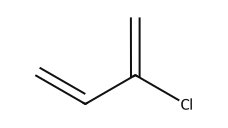
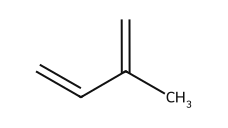
Q616.Which amongst the following molecules on polymerization produces neoprene?
निम्नलिखित में से कौन-सा अणु बहुलकीकरण पर निओप्रीन (neoprene) बनाता है?
- AH2C = CH–CH = CH2
- B
- CH2C = CH– C ≡ CH
- D
Show answer
Concept: Neoprene is the addition polymer of chloroprene (2-chlorobuta-1,3-diene).
- n CH2=C(Cl)–CH=CH2 → –(CH2–C(Cl)=CH–CH2)n– (neoprene).
- (A) buta-1,3-diene → polybutadiene / Buna rubbers.
- (C) vinylacetylene is an intermediate for making chloroprene, not the monomer itself.
- (D) isoprene (2-methylbuta-1,3-diene) → natural rubber.
Short trick: neoprene ↔ chloroprene; natural rubber ↔ isoprene – the 'Cl' version gives the oil-resistant rubber.
Answer: (B) 2-chlorobuta-1,3-diene
अवधारणा: निओप्रीन, क्लोरोप्रीन (2-क्लोरोब्यूटा-1,3-डाईन) का योगज बहुलक है।
- n CH2=C(Cl)–CH=CH2 → –(CH2–C(Cl)=CH–CH2)n– (निओप्रीन)।
- (A) ब्यूटा-1,3-डाईन → पॉलिब्यूटाडाईन / ब्यूना रबर।
- (C) वाइनिलऐसीटिलीन क्लोरोप्रीन बनाने का मध्यवर्ती है, स्वयं एकलक नहीं।
- (D) आइसोप्रीन (2-मेथिलब्यूटा-1,3-डाईन) → प्राकृतिक रबर।
शॉर्ट ट्रिक: निओप्रीन ↔ क्लोरोप्रीन; प्राकृतिक रबर ↔ आइसोप्रीन – 'Cl' वाला तेल-प्रतिरोधी रबर देता है।
उत्तर: (B) 2-क्लोरोब्यूटा-1,3-डाईन
NEET UGChemistryPolymers – neopreneNEET UG 2023 · 7 May Shift 1
Q617.In Lassaigne's extract of an organic compound, both nitrogen and sulphur are present, which gives blood red colour with Fe3+ due to the formation of
किसी कार्बनिक यौगिक के लैसाँ निष्कर्ष (Lassaigne's extract) में नाइट्रोजन और सल्फर दोनों उपस्थित हैं, जो Fe3+ के साथ रक्त-लाल रंग देता है। यह किसके बनने के कारण है?
- AFe4[Fe(CN)6]3·xH2O
- BNaSCN
- C[Fe(CN)5NOS]4–
- D[Fe(SCN)]2+
Show answer
Concept: When N and S are both present, sodium fusion gives NaSCN; SCN– + Fe3+ → [Fe(SCN)]2+ (blood red).
- Na + C + N + S → NaSCN (sodium thiocyanate) in the extract.
- Fe3+ + SCN– → [Fe(SCN)]2+, the blood-red complex.
- (A) Prussian blue – test for N alone.
- (B) NaSCN is colourless; it is the reagent, not the coloured species.
- (C) [Fe(CN)5NOS]4– – violet colour in the sulphur test with sodium nitroprusside.
Short trick: Blue = N, Violet = S, Blood red = N + S together.
Answer: (D) [Fe(SCN)]2+
अवधारणा: जब N और S दोनों उपस्थित हों, तो सोडियम संगलन से NaSCN बनता है; SCN– + Fe3+ → [Fe(SCN)]2+ (रक्त-लाल)।
- Na + C + N + S → निष्कर्ष में NaSCN (सोडियम थायोसायनेट)।
- Fe3+ + SCN– → [Fe(SCN)]2+, रक्त-लाल संकुल।
- (A) प्रशियन ब्लू – केवल N का परीक्षण।
- (B) NaSCN रंगहीन है; यह अभिकर्मक है, रंगीन स्पीशीज़ नहीं।
- (C) [Fe(CN)5NOS]4– – सोडियम नाइट्रोप्रुसाइड के साथ S के परीक्षण में बैंगनी रंग।
शॉर्ट ट्रिक: नीला = N, बैंगनी = S, रक्त-लाल = N + S एक साथ।
उत्तर: (D) [Fe(SCN)]2+
NEET UGChemistryOrganic analysis – Lassaigne's testNEET UG 2023 · 7 May Shift 1
Q618.Weight (g) of two moles of the organic compound, which is obtained by heating sodium ethanoate with sodium hydroxide in presence of calcium oxide is :
सोडियम एथेनोएट को कैल्सियम ऑक्साइड की उपस्थिति में सोडियम हाइड्रॉक्साइड के साथ गर्म करने पर प्राप्त कार्बनिक यौगिक के दो मोल का भार (g) है:
- A16
- B32
- C30
- D18
Show answer
Concept: Soda-lime decarboxylation removes –COONa as Na2CO3, giving an alkane with one carbon less.
- CH3COONa + NaOH (CaO, Δ) → CH4 + Na2CO3.
- Molar mass of CH4 = 12 + 4 = 16 g mol–1.
- Mass of 2 mol = 2 × 16 = 32 g.
Short trick: Sodium salt of Cn acid → Cn–1 alkane; ethanoate (C2) → methane.
Answer: (B) 32
अवधारणा: सोडा-लाइम विकार्बॉक्सिलन में –COONa, Na2CO3 के रूप में निकल जाता है और एक कार्बन कम वाला ऐल्केन बनता है।
- CH3COONa + NaOH (CaO, Δ) → CH4 + Na2CO3।
- CH4 का मोलर द्रव्यमान = 12 + 4 = 16 g mol–1।
- 2 मोल का द्रव्यमान = 2 × 16 = 32 g।
शॉर्ट ट्रिक: Cn अम्ल का सोडियम लवण → Cn–1 ऐल्केन; एथेनोएट (C2) → मेथेन।
उत्तर: (B) 32
NEET UGChemistryHydrocarbons – decarboxylationNEET UG 2023 · 7 May Shift 1
Q619.Some tranquilizers are listed below. Which one from the following belongs to barbiturates?
कुछ प्रशान्तक (tranquilizers) नीचे सूचीबद्ध हैं। निम्नलिखित में से कौन-सा बार्बिट्यूरेट (barbiturates) वर्ग का है?
- AChlordiazepoxideक्लोरडाइएज़ेपॉक्साइड (Chlordiazepoxide)
- BMeprobamateमेप्रोबामेट (Meprobamate)
- CValiumवैलियम (Valium)
- DVeronalवेरोनल (Veronal)
Show answer
Concept: Barbiturates are derivatives of barbituric acid used as hypnotics (sleep producing) – veronal, amytal, nembutal, luminal, seconal.
- Veronal is a barbituric acid derivative → barbiturate.
- Chlordiazepoxide and meprobamate are mild tranquilizers for relieving tension – not barbiturates.
- Valium (diazepam) is a benzodiazepine – not a barbiturate.
Short trick: Barbiturate names end in '-al': Veronal, Amytal, Nembutal, Luminal, Seconal.
Answer: (D) Veronal
अवधारणा: बार्बिट्यूरेट, बार्बिट्यूरिक अम्ल के व्युत्पन्न हैं जो निद्राजनक (hypnotic) के रूप में प्रयुक्त होते हैं – वेरोनल, ऐमिटल, नेम्बुटल, ल्यूमिनल, सेकोनल।
- वेरोनल बार्बिट्यूरिक अम्ल का व्युत्पन्न है → बार्बिट्यूरेट।
- क्लोरडाइएज़ेपॉक्साइड और मेप्रोबामेट तनाव दूर करने वाले हल्के प्रशान्तक हैं – बार्बिट्यूरेट नहीं।
- वैलियम (डायज़ेपाम) एक बेंज़ोडायज़ेपीन है – बार्बिट्यूरेट नहीं।
शॉर्ट ट्रिक: बार्बिट्यूरेट के नाम '-al' पर समाप्त होते हैं: Veronal, Amytal, Nembutal, Luminal, Seconal।
उत्तर: (D) वेरोनल
NEET UGChemistryChemistry in everyday life – tranquilizersNEET UG 2023 · 7 May Shift 1
Q620.The conductivity of centimolar solution of KCl at 25°C is 0.0210 ohm–1 cm–1 and the resistance of the cell containing the solution at 25°C is 60 ohm. The value of cell constant is
25°C पर KCl के सेन्टीमोलर विलयन की चालकता 0.0210 ohm–1 cm–1 है तथा 25°C पर इस विलयन से भरे सेल का प्रतिरोध 60 ohm है। सेल स्थिरांक का मान है
- A1.34 cm–1
- B3.28 cm–1
- C1.26 cm–1
- D3.34 cm–1
Show answer
Concept: κ = G* / R, so cell constant G* = κ × R.
- κ = 0.0210 ohm–1 cm–1, R = 60 ohm.
- G* = 0.0210 × 60 = 1.26 cm–1.
Short trick: Units check: (ohm–1 cm–1) × ohm = cm–1 – multiply, never divide.
Answer: (C) 1.26 cm–1
अवधारणा: κ = G* / R, अतः सेल स्थिरांक G* = κ × R।
- κ = 0.0210 ohm–1 cm–1, R = 60 ohm।
- G* = 0.0210 × 60 = 1.26 cm–1।
शॉर्ट ट्रिक: इकाई जाँच: (ohm–1 cm–1) × ohm = cm–1 – गुणा कीजिए, भाग नहीं।
उत्तर: (C) 1.26 cm–1
NEET UGChemistryElectrochemistry – cell constantNEET UG 2023 · 7 May Shift 1

