Q761.The graph which shows the variation of the de Broglie wavelength () of a particle and its associated momentum (p) is
किसी कण की दे ब्रॉग्ली तरंगदैर्घ्य () तथा उससे संबद्ध संवेग (p) के बीच परिवर्तन को दर्शाने वाला ग्राफ है
- A
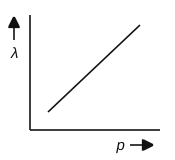
- B
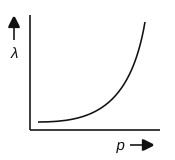
- C
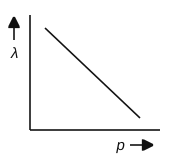
- D
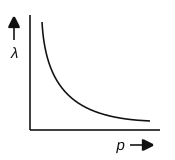
Show answer
Concept: de Broglie relation , so .
- = constant – this is a rectangular hyperbola.
- As p increases, falls steeply first and then flattens, never touching either axis.
- Graph (A) and (C) are straight lines (linear relation) and (B) is increasing – all wrong.
Short trick: = constant ⇒ always a rectangular hyperbola in the first quadrant.
Answer: (D) the falling hyperbola
अवधारणा: दे ब्रॉग्ली संबंध , अतः ।
- = नियतांक – यह एक आयताकार अतिपरवलय (rectangular hyperbola) है।
- p बढ़ने पर पहले तेज़ी से घटता है फिर धीरे-धीरे, और किसी भी अक्ष को नहीं छूता।
- ग्राफ (A) और (C) सरल रेखाएँ (रैखिक संबंध) हैं तथा (B) बढ़ता हुआ है – सभी गलत।
शॉर्ट ट्रिक: = नियतांक ⇒ प्रथम चतुर्थांश में सदैव आयताकार अतिपरवलय।
उत्तर: (D) घटता हुआ अतिपरवलय
NEET UGPhysicsDual nature – de Broglie wavelengthNEET UG 2022 · 17 Jul Shift 1
Q762.As the temperature increases, the electrical resistance:
ताप बढ़ने पर विद्युत प्रतिरोध:
- AIncreases for both conductors and semiconductorsचालकों और अर्धचालकों दोनों के लिए बढ़ता है
- BDecreases for both conductors and semiconductorsचालकों और अर्धचालकों दोनों के लिए घटता है
- CIncreases for conductors but decreases for semiconductorsचालकों के लिए बढ़ता है परन्तु अर्धचालकों के लिए घटता है
- DDecreases for conductors but increases for semiconductorsचालकों के लिए घटता है परन्तु अर्धचालकों के लिए बढ़ता है
Show answer
Concept: . In conductors n is fixed and falls with T; in semiconductors n rises exponentially with T.
- Conductor: more lattice vibrations → more collisions → decreases → R increases (positive temperature coefficient).
- Semiconductor: heat breaks covalent bonds → many more carriers (n) → R decreases (negative temperature coefficient).
- Hence options (A), (B), (D) are wrong.
Short trick: Metals: “hot = harder”; semiconductors: “hot = freer carriers”.
Answer: (C) Increases for conductors, decreases for semiconductors
अवधारणा: । चालकों में n नियत रहता है और ताप बढ़ने पर घटता है; अर्धचालकों में ताप के साथ n चरघातांकी रूप से बढ़ता है।
- चालक: जालक कंपन बढ़ते हैं → टक्करें बढ़ती हैं → घटता है → R बढ़ता है (धनात्मक ताप गुणांक)।
- अर्धचालक: ऊष्मा से सहसंयोजक बंध टूटते हैं → आवेश वाहक (n) बहुत बढ़ जाते हैं → R घटता है (ऋणात्मक ताप गुणांक)।
- अतः विकल्प (A), (B), (D) गलत हैं।
शॉर्ट ट्रिक: धातु: “गर्म = कठिन मार्ग”; अर्धचालक: “गर्म = अधिक मुक्त वाहक”।
उत्तर: (C) चालकों के लिए बढ़ता है, अर्धचालकों के लिए घटता है
NEET UGPhysicsCurrent electricity – temperature dependence of resistanceNEET UG 2022 · 17 Jul Shift 1
Q763.Let T1 and T2 be the energy of an electron in the first and second excited states of hydrogen atom, respectively. According to the Bohr’s model of an atom; the ratio T1 : T2 is:
माना T1 तथा T2 क्रमशः हाइड्रोजन परमाणु की प्रथम तथा द्वितीय उत्तेजित अवस्थाओं में इलेक्ट्रॉन की ऊर्जा हैं। बोर के परमाणु मॉडल के अनुसार अनुपात T1 : T2 है:
- A1 : 4
- B4 : 1
- C4 : 9
- D9 : 4
Show answer
Concept: eV. First excited state is n = 2, second excited state is n = 3.
- eV eV
- eV eV
Short trick: Excited state number + 1 = n. Ratio of energies = inverse ratio of = 3² : 2².
Answer: (D) 9 : 4
अवधारणा: eV। प्रथम उत्तेजित अवस्था n = 2 तथा द्वितीय उत्तेजित अवस्था n = 3 है।
- eV eV
- eV eV
शॉर्ट ट्रिक: उत्तेजित अवस्था क्रमांक + 1 = n। ऊर्जाओं का अनुपात = का व्युत्क्रम अनुपात = 3² : 2²।
उत्तर: (D) 9 : 4
NEET UGPhysicsAtoms – Bohr model energy levelsNEET UG 2022 · 17 Jul Shift 1
Q764.Two objects of mass 10 kg and 20 kg respectively are connected to the two ends of a rigid rod of length 10 m with negligible mass. The distance of the center of mass of the system from the 10 kg mass is:
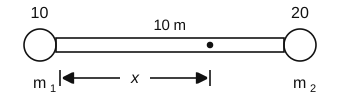
10 kg तथा 20 kg द्रव्यमान की दो वस्तुएँ नगण्य द्रव्यमान की 10 m लंबी एक दृढ़ छड़ के दोनों सिरों से जुड़ी हैं। 10 kg द्रव्यमान से निकाय के द्रव्यमान केंद्र की दूरी है:
- A m
- B m
- C10 m
- D5 m
Show answer
Concept: Taking the 10 kg mass at the origin, .
- m ≈ 6.67 m from the 10 kg mass (closer to the heavier mass, as expected).
Short trick: Distance from = .
Answer: (B) m
अवधारणा: 10 kg द्रव्यमान को मूल बिंदु पर लेने पर, ।
- m ≈ 6.67 m, 10 kg द्रव्यमान से (भारी द्रव्यमान के अधिक निकट, जैसा अपेक्षित है)।
शॉर्ट ट्रिक: से दूरी = ।
उत्तर: (B) m
NEET UGPhysicsSystem of particles – centre of massNEET UG 2022 · 17 Jul Shift 1
Q765.The ratio of the distance travelled by a freely falling body in the 1st, 2nd, 3rd and 4th second
स्वतंत्र रूप से गिरती हुई किसी वस्तु द्वारा 1ले, 2रे, 3रे तथा 4थे सेकंड में तय की गई दूरियों का अनुपात
- A1 : 2 : 3 : 4
- B1 : 4 : 9 : 16
- C1 : 3 : 5 : 7
- D1 : 1 : 1 : 1
Show answer
Concept: Distance in the nth second (u = 0): .
- Option (B) 1 : 4 : 9 : 16 is the ratio of total distances in 1, 2, 3, 4 s – a common trap.
Short trick: Galileo’s law of odd numbers – from rest, successive equal time intervals give 1 : 3 : 5 : 7 …
Answer: (C) 1 : 3 : 5 : 7
अवधारणा: nवें सेकंड में तय दूरी (u = 0): ।
- विकल्प (B) 1 : 4 : 9 : 16, 1, 2, 3, 4 s में तय कुल दूरियों का अनुपात है – एक सामान्य भ्रम।
शॉर्ट ट्रिक: गैलीलियो का विषम संख्या नियम – विरामावस्था से, क्रमागत समान समय अंतरालों में दूरियाँ 1 : 3 : 5 : 7 …
उत्तर: (C) 1 : 3 : 5 : 7
NEET UGPhysicsKinematics – free fall (Galileo’s law of odd numbers)NEET UG 2022 · 17 Jul Shift 1
Q766.The ratio of the radius of gyration of a thin uniform disc about an axis passing through its centre and normal to its plane to the radius of gyration of the disc about its diameter is
किसी पतली एकसमान चकती की, उसके केंद्र से गुजरने वाली तथा उसके तल के अभिलंबवत अक्ष के परितः घूर्णन त्रिज्या (radius of gyration) का, उसके व्यास के परितः घूर्णन त्रिज्या से अनुपात है
- A2 : 1
- B : 1
- C4 : 1
- D1 :
Show answer
Concept: . For a disc and, by the perpendicular-axis theorem, .
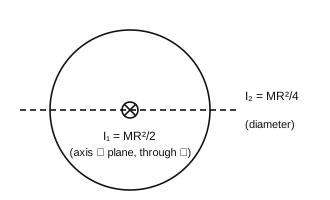
Short trick: K ∝ √I, and ⇒ .
Answer: (B) : 1
अवधारणा: । चकती के लिए तथा लंबवत अक्ष प्रमेय से ।
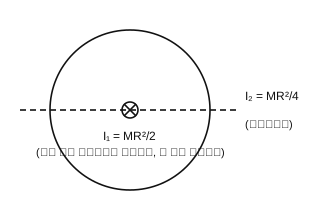
शॉर्ट ट्रिक: K ∝ √I, तथा ⇒ ।
उत्तर: (B) : 1
NEET UGPhysicsRotational motion – radius of gyrationNEET UG 2022 · 17 Jul Shift 1
Q767.The angular speed of a fly wheel moving with uniform angular acceleration changes from 1200 rpm to 3120 rpm in 16 seconds. The angular acceleration in rad/s2 is:
एकसमान कोणीय त्वरण से गतिमान एक गतिपालक चक्र (fly wheel) की कोणीय चाल 16 सेकंड में 1200 rpm से 3120 rpm हो जाती है। कोणीय त्वरण rad/s2 में है:
- A
- B
- C
- D
Show answer
Concept: with in rad/s: 1 rpm = rad/s.
- rpm rad/s
- rad/s²
Short trick: 1920/60 = 32 rev/s gained in 16 s ⇒ 2 rev/s² = 2 × 2π = 4π rad/s².
Answer: (B)
अवधारणा: , जहाँ rad/s में: 1 rpm = rad/s।
- rpm rad/s
- rad/s²
शॉर्ट ट्रिक: 1920/60 = 32 rev/s, 16 s में ⇒ 2 rev/s² = 2 × 2π = 4π rad/s²।
उत्तर: (B)
NEET UGPhysicsRotational kinematics – angular accelerationNEET UG 2022 · 17 Jul Shift 1
Q768.An ideal gas undergoes four different processes from the same initial state as shown in the figure below. Those processes are adiabatic, isothermal, isobaric and isochoric. The curve which represents the adiabatic process among 1, 2, 3 and 4 is:
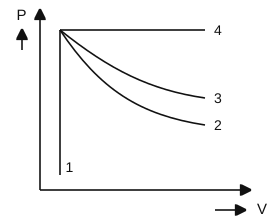
एक आदर्श गैस समान प्रारंभिक अवस्था से चार भिन्न प्रक्रमों से गुजरती है, जैसा नीचे चित्र में दर्शाया गया है। ये प्रक्रम रुद्धोष्म, समतापी, समदाबी तथा समआयतनिक हैं। 1, 2, 3 तथा 4 में से रुद्धोष्म प्रक्रम को निरूपित करने वाला वक्र है:
- A1
- B2
- C3
- D4
Show answer
Concept: Slopes on a P-V diagram: isobaric = 0, isochoric = ∞ (vertical), isothermal , adiabatic (steeper since ).
- Curve 4 is horizontal → isobaric.
- Curve 1 is vertical → isochoric.
- Of the two falling curves, the steeper one (curve 2) is adiabatic; the gentler one (curve 3) is isothermal.
Short trick: Adiabatic is always γ times steeper than isothermal from the same point.
Answer: (B) 2
अवधारणा: P-V आरेख पर ढाल: समदाबी = 0, समआयतनिक = ∞ (ऊर्ध्वाधर), समतापी , रुद्धोष्म (अधिक ढालू क्योंकि )।
- वक्र 4 क्षैतिज है → समदाबी।
- वक्र 1 ऊर्ध्वाधर है → समआयतनिक।
- दोनों गिरते वक्रों में से अधिक ढालू (वक्र 2) रुद्धोष्म है; कम ढालू (वक्र 3) समतापी है।
शॉर्ट ट्रिक: एक ही बिंदु से रुद्धोष्म वक्र सदैव समतापी से γ गुना अधिक ढालू होता है।
उत्तर: (B) 2
NEET UGPhysicsThermodynamics – P-V curves of processesNEET UG 2022 · 17 Jul Shift 1
Q769.Two hollow conducting spheres of radii R1 and R2 (R1 >> R2) have equal charges. The potential would be:
त्रिज्याओं R1 तथा R2 (R1 >> R2) के दो खोखले चालक गोलों पर समान आवेश हैं। विभव होगा:
- AMore on bigger sphereबड़े गोले पर अधिक
- BMore on smaller sphereछोटे गोले पर अधिक
- CEqual on both the sphereदोनों गोलों पर समान
- DDependent on the material properly of the sphereगोले के पदार्थ के गुण पर निर्भर
Show answer
Concept: Potential of a charged conducting sphere: – independent of material.
- Same Q ⇒ .
- : the smaller sphere is at higher potential.
- Option (D) is wrong: for a conductor V depends only on Q and R.
Short trick: Same charge on a smaller sphere = more “crowded” = higher potential (that is why sharp points leak charge).
Answer: (B) More on smaller sphere
अवधारणा: आवेशित चालक गोले का विभव: – पदार्थ पर निर्भर नहीं।
- समान Q ⇒ ।
- : छोटा गोला उच्च विभव पर है।
- विकल्प (D) गलत: चालक के लिए V केवल Q तथा R पर निर्भर है।
शॉर्ट ट्रिक: छोटे गोले पर समान आवेश = अधिक “भीड़” = अधिक विभव (इसी कारण नुकीले सिरों से आवेश का क्षरण होता है)।
उत्तर: (B) छोटे गोले पर अधिक
NEET UGPhysicsElectrostatics – potential of charged spheresNEET UG 2022 · 17 Jul Shift 1
Q770.When light propagates through a material medium of relative permittivity , and relative permeability , the velocity of light, v is given by (c - velocity of light in vacuum)
जब प्रकाश आपेक्षिक विद्युतशीलता तथा आपेक्षिक चुम्बकशीलता वाले किसी द्रव्य माध्यम में संचरित होता है, तो प्रकाश का वेग v होगा (c - निर्वात में प्रकाश का वेग)
- A
- B
- C
- D
Show answer
Concept: Speed of an EM wave: , with and .
- Since , .
- Options (B), (C) are dimensionless – cannot be a speed; (A) holds only in vacuum.
Short trick: Refractive index and .
Answer: (D)
अवधारणा: विद्युतचुम्बकीय तरंग की चाल: , जहाँ तथा ।
- चूँकि , अतः ।
- विकल्प (B), (C) विमाहीन हैं – चाल नहीं हो सकते; (A) केवल निर्वात में सत्य है।
शॉर्ट ट्रिक: अपवर्तनांक तथा ।
उत्तर: (D)
NEET UGPhysicsEM waves – speed of light in a mediumNEET UG 2022 · 17 Jul Shift 1
Q771.A long solenoid of radius 1 mm has 100 turns per mm. If 1 A current flows in the solenoid, the magnetic field strength at the centre of the solenoid is :
1 mm त्रिज्या की एक लंबी परिनालिका में प्रति mm 100 फेरे हैं। यदि परिनालिका में 1 A धारा प्रवाहित हो, तो परिनालिका के केंद्र पर चुम्बकीय क्षेत्र की तीव्रता है:
- A6.28 × 10-2 T
- B12.56 × 10-2 T
- C12.26 × 10-4 T
- D6.28 × 10-4 T
Show answer
Concept: Inside a long solenoid (n = turns per metre); the radius does not matter.
- turns/m
- T
- T
Short trick: Radius 1 mm is a distractor – B inside an ideal long solenoid is independent of radius.
Answer: (B) 12.56 × 10⁻² T
अवधारणा: लंबी परिनालिका के अंदर (n = प्रति मीटर फेरे); त्रिज्या का कोई प्रभाव नहीं।
- फेरे/m
- T
- T
शॉर्ट ट्रिक: 1 mm त्रिज्या भ्रमित करने वाला आँकड़ा है – आदर्श लंबी परिनालिका के अंदर B त्रिज्या पर निर्भर नहीं।
उत्तर: (B) 12.56 × 10⁻² T
NEET UGPhysicsMagnetism – field of a solenoidNEET UG 2022 · 17 Jul Shift 1
Q772.The peak voltage of the ac source is equal to :
ac स्रोत की शिखर वोल्टता बराबर है:
- Athe value of voltage supplied to the circuitपरिपथ को दी गई वोल्टता के मान के
- Bthe rms value of the ac sourceac स्रोत के rms मान के
- C times the rms value of the ac sourceac स्रोत के rms मान के गुने के
- D times the rms value of the ac sourceac स्रोत के rms मान के गुने के
Show answer
Concept: For a sinusoidal voltage .
- Example: 220 V mains (rms) has a peak of about 311 V.
- Option (D) inverts the relation; (A), (B) refer to the rms value, not the peak.
Short trick: Peak is always the bigger one: .
Answer: (C) times the rms value
अवधारणा: ज्यावक्रीय वोल्टता के लिए ।
- उदाहरण: 220 V (rms) घरेलू आपूर्ति का शिखर मान लगभग 311 V है।
- विकल्प (D) संबंध को उलट देता है; (A), (B) rms मान को दर्शाते हैं, शिखर मान को नहीं।
शॉर्ट ट्रिक: शिखर मान सदैव बड़ा: ।
उत्तर: (C) rms मान का गुना
NEET UGPhysicsAlternating current – peak and rms valuesNEET UG 2022 · 17 Jul Shift 1
Q773.An electric lift with a maximum load of 2000 kg (lift + passengers) is moving up with a constant speed of 1.5 ms-1. The frictional force opposing the motion is 3000 N. The minimum power delivered by the motor to the lift in watts is: (g = 10 ms-2)
अधिकतम 2000 kg भार (लिफ्ट + यात्री) वाली एक विद्युत लिफ्ट 1.5 ms-1 की नियत चाल से ऊपर जा रही है। गति का विरोध करने वाला घर्षण बल 3000 N है। मोटर द्वारा लिफ्ट को दी गई न्यूनतम शक्ति वाट में है: (g = 10 ms-2)
- A23000
- B20000
- C34500
- D23500
Show answer
Concept: At constant velocity the net force is zero, so motor force = weight + friction; .
- Weight = 2000 × 10 = 20000 N
- N
- W
Short trick: Option (A) 23000 is the force, not the power – multiply by v.
Answer: (C) 34500 W
अवधारणा: नियत वेग पर कुल बल शून्य है, अतः मोटर बल = भार + घर्षण; ।
- भार = 2000 × 10 = 20000 N
- N
- W
शॉर्ट ट्रिक: विकल्प (A) 23000 बल है, शक्ति नहीं – v से गुणा कीजिए।
उत्तर: (C) 34500 W
NEET UGPhysicsWork, energy and power – power of a lift motorNEET UG 2022 · 17 Jul Shift 1
Q774.In a Young's double slit experiment, a student observes 8 fringes in a certain segment of screen when a monochromatic light of 600 nm wavelength is used. If the wavelength of light is changed to 400 nm, then the number of fringes he would observe in the same region of the screen is
यंग के द्वि-झिरी प्रयोग में 600 nm तरंगदैर्घ्य का एकवर्णी प्रकाश प्रयुक्त करने पर एक छात्र पर्दे के एक निश्चित भाग में 8 फ्रिंजें देखता है। यदि प्रकाश की तरंगदैर्घ्य 400 nm कर दी जाए, तो पर्दे के उसी भाग में वह कितनी फ्रिंजें देखेगा?
- A6
- B8
- C9
- D12
Show answer
Concept: Fringe width . For a fixed region, = constant ⇒ = constant.
Short trick: Smaller λ ⇒ narrower fringes ⇒ more fringes: 8 × 600/400 = 12.
Answer: (D) 12
अवधारणा: फ्रिंज चौड़ाई । निश्चित भाग के लिए = नियतांक ⇒ = नियतांक।
शॉर्ट ट्रिक: कम λ ⇒ संकरी फ्रिंजें ⇒ अधिक फ्रिंजें: 8 × 600/400 = 12।
उत्तर: (D) 12
NEET UGPhysicsWave optics – YDSE fringe countNEET UG 2022 · 17 Jul Shift 1
Q775.A copper wire of length 10 m and radius m has electrical resistance of 10 Ω. The current density in the wire for an electric field strength of 10 (V/m) is:
10 m लंबाई तथा m त्रिज्या के एक ताँबे के तार का विद्युत प्रतिरोध 10 Ω है। 10 (V/m) विद्युत क्षेत्र तीव्रता के लिए तार में धारा घनत्व है:
- A104 A/m2
- B106 A/m2
- C10-5 A/m2
- D105 A/m2
Show answer
Concept: gives ; then Ohm’s law in vector form .
- m²
- Ω m
- A/m²
Short trick: Shortcut: .
Answer: (D) 105 A/m2
अवधारणा: से ज्ञात करें; फिर ओम के नियम का सदिश रूप ।
- m²
- Ω m
- A/m²
शॉर्ट ट्रिक: शॉर्टकट: ।
उत्तर: (D) 105 A/m2
NEET UGPhysicsCurrent electricity – resistivity and current densityNEET UG 2022 · 17 Jul Shift 1
Q776.The dimensions [MLT-2A-2] belong to the:
विमाएँ [MLT-2A-2] किसकी हैं?
- AMagnetic fluxचुम्बकीय फ्लक्स
- BSelf inductanceस्वप्रेरकत्व
- CMagnetic permeabilityचुम्बकीय पारगम्यता (permeability)
- DElectric permittivityविद्युत विद्युतशीलता (permittivity)
Show answer
Concept: From : .
- Magnetic flux: – wrong.
- Self inductance: – wrong (extra L).
- Permittivity : – wrong.
- Permeability : – matches.
Short trick: = force per (current)²; also cross-checks.
Answer: (C) Magnetic permeability
अवधारणा: से: ।
- चुम्बकीय फ्लक्स: – गलत।
- स्वप्रेरकत्व: – गलत (एक L अतिरिक्त)।
- विद्युतशीलता : – गलत।
- पारगम्यता : – मेल खाता है।
शॉर्ट ट्रिक: = बल प्रति (धारा)²; साथ ही से जाँच करें।
उत्तर: (C) चुम्बकीय पारगम्यता
NEET UGPhysicsUnits and dimensions – magnetic permeabilityNEET UG 2022 · 17 Jul Shift 1
Q777.If the initial tension on a stretched string is doubled, then the ratio of the initial and final speeds of a transverse wave along the string is:
यदि किसी तनी हुई डोरी का प्रारंभिक तनाव दोगुना कर दिया जाए, तो डोरी के अनुदिश अनुप्रस्थ तरंग की प्रारंभिक तथा अंतिम चालों का अनुपात है:
- A1 : 1
- B : 1
- C1 :
- D1 : 2
Show answer
Concept: ⇒ for the same string.
- ⇒ ratio 1 :
Short trick: Tension doubled ⇒ speed × √2; initial : final = 1 : √2.
Answer: (C) 1 :
अवधारणा: ⇒ उसी डोरी के लिए ।
- ⇒ अनुपात 1 :
शॉर्ट ट्रिक: तनाव दोगुना ⇒ चाल × √2; प्रारंभिक : अंतिम = 1 : √2।
उत्तर: (C) 1 :
NEET UGPhysicsWaves – speed of transverse wave on a stringNEET UG 2022 · 17 Jul Shift 1
Q778.In half wave rectification, if the input frequency is 60 Hz, then the output frequency would be:
अर्ध-तरंग दिष्टकरण में यदि निवेशी आवृत्ति 60 Hz हो, तो निर्गत आवृत्ति होगी:
- AZeroशून्य
- B30 Hz
- C60 Hz
- D120 Hz
Show answer
Concept: A half-wave rectifier passes only one half of every input cycle, so it gives one output pulse per input cycle.
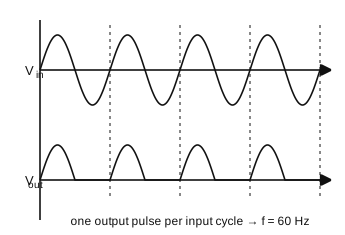
- Input: 60 cycles per second.
- Output: one positive pulse for each cycle ⇒ 60 pulses per second.
- Output (ripple) frequency = 60 Hz. A full-wave rectifier would give 2 × 60 = 120 Hz (option D trap).
Short trick: Half-wave: fout = fin; full-wave: fout = 2fin.
Answer: (C) 60 Hz
अवधारणा: अर्ध-तरंग दिष्टकारी प्रत्येक निवेशी चक्र का केवल एक अर्धभाग पारित करता है, अतः प्रत्येक निवेशी चक्र पर एक निर्गत स्पंद देता है।
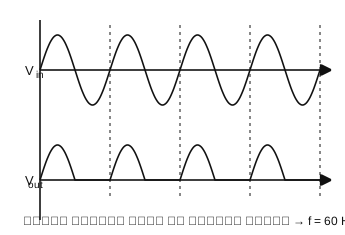
- निवेश: 60 चक्र प्रति सेकंड।
- निर्गत: प्रत्येक चक्र के लिए एक धनात्मक स्पंद ⇒ 60 स्पंद प्रति सेकंड।
- निर्गत (ऊर्मिका) आवृत्ति = 60 Hz। पूर्ण-तरंग दिष्टकारी 2 × 60 = 120 Hz देगा (विकल्प D का भ्रम)।
शॉर्ट ट्रिक: अर्ध-तरंग: fout = fin; पूर्ण-तरंग: fout = 2fin।
उत्तर: (C) 60 Hz
NEET UGPhysicsSemiconductors – half-wave rectifierNEET UG 2022 · 17 Jul Shift 1
Q779.The displacement time graphs of two moving particles make angles of 30° and 45° with the x-axis as shown in the figure. The ratio of their respective velocity is
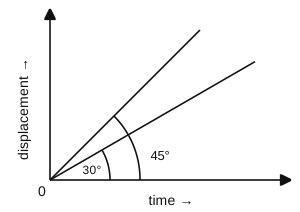
दो गतिमान कणों के विस्थापन-समय ग्राफ x-अक्ष से 30° तथा 45° के कोण बनाते हैं, जैसा चित्र में दर्शाया गया है। उनके संगत वेगों का अनुपात है
- A : 1
- B1 : 1
- C1 : 2
- D1 :
Show answer
Concept: Velocity = slope of the displacement-time graph = .
- ,
Short trick: Steeper line = faster; 30° line is slower, so the ratio must be less than 1 – only (C) or (D); tan ratio gives (D).
Answer: (D) 1 :
अवधारणा: वेग = विस्थापन-समय ग्राफ की ढाल = ।
- ,
शॉर्ट ट्रिक: अधिक ढालू रेखा = अधिक तेज़; 30° वाली रेखा धीमी है, अतः अनुपात 1 से कम – केवल (C) या (D); tan का अनुपात (D) देता है।
उत्तर: (D) 1 :
NEET UGPhysicsKinematics – slope of displacement-time graphNEET UG 2022 · 17 Jul Shift 1
Q780.A square loop of side 1 m and resistance 1 Ω is placed in a magnetic field of 0.5 T. If the plane of loop is perpendicular to the direction of magnetic field, the magnetic flux through the loop is
1 m भुजा तथा 1 Ω प्रतिरोध का एक वर्गाकार लूप 0.5 T के चुम्बकीय क्षेत्र में रखा है। यदि लूप का तल चुम्बकीय क्षेत्र की दिशा के लंबवत हो, तो लूप से गुजरने वाला चुम्बकीय फ्लक्स है
- A2 weber2 वेबर
- B0.5 weber0.5 वेबर
- C1 weber1 वेबर
- DZero weberशून्य वेबर
Show answer
Concept: , θ = angle between and the area vector (normal to the plane).
- Plane ⊥ field ⇒ normal ∥ field ⇒ θ = 0°.
- Wb
- Resistance 1 Ω is irrelevant to flux.
Short trick: “Plane perpendicular to B” = maximum flux BA; “plane parallel to B” = zero flux.
Answer: (B) 0.5 weber
अवधारणा: , θ = तथा क्षेत्रफल सदिश (तल के अभिलंब) के बीच कोण।
- तल ⊥ क्षेत्र ⇒ अभिलंब ∥ क्षेत्र ⇒ θ = 0°।
- Wb
- 1 Ω प्रतिरोध फ्लक्स के लिए अप्रासंगिक है।
शॉर्ट ट्रिक: “तल B के लंबवत” = अधिकतम फ्लक्स BA; “तल B के समांतर” = शून्य फ्लक्स।
उत्तर: (B) 0.5 वेबर
NEET UGPhysicsEMI – magnetic fluxNEET UG 2022 · 17 Jul Shift 1

