Q801.A series LCR circuit with inductance 10 H, capacitance 10 μF, resistance 50 Ω is connected to an ac source of voltage, V = 200 sin(100 t) volt. If the resonant frequency of the LCR circuit is and the frequency of the ac source is , then:
10 H प्रेरकत्व, 10 μF धारिता तथा 50 Ω प्रतिरोध वाला एक श्रेणी LCR परिपथ वोल्टता V = 200 sin(100 t) वोल्ट वाले ac स्रोत से जुड़ा है। यदि LCR परिपथ की अनुनादी आवृत्ति तथा ac स्रोत की आवृत्ति है, तो:
- A Hz
- B Hz
- C Hz, Hz
- D Hz; Hz
Show answer
Concept: Source: ⇒ . Resonance: .
- rad/s ⇒ Hz
- s² ⇒ rad/s
- Hz = – the circuit is driven at resonance.
Short trick: Compare ω directly: = source ω ⇒ ; only (A) or (B), and 100/2π = 50/π.
Answer: (B) Hz
अवधारणा: स्रोत: ⇒ । अनुनाद: ।
- rad/s ⇒ Hz
- s² ⇒ rad/s
- Hz = – परिपथ अनुनाद पर चालित है।
शॉर्ट ट्रिक: सीधे ω की तुलना करें: = स्रोत का ω ⇒ ; केवल (A) या (B), तथा 100/2π = 50/π।
उत्तर: (B) Hz
NEET UGPhysicsAlternating current – LCR resonanceNEET UG 2022 · 17 Jul Shift 1
Q802.Match List - I with List - II
| List-I | List-II |
|---|
| (a) Gravitational constant (G) | (i) [L2T-2] |
| (b) Gravitational potential energy | (ii) [M-1L3T-2] |
| (c) Gravitational potential | (iii) [LT-2] |
| (d) Gravitational intensity | (iv) [ML2T-2] |
Choose the correct answer from the options given below:
सूची - I का सूची - II से मिलान कीजिए
| सूची-I | सूची-II |
|---|
| (a) गुरुत्वाकर्षण नियतांक (G) | (i) [L2T-2] |
| (b) गुरुत्वीय स्थितिज ऊर्जा | (ii) [M-1L3T-2] |
| (c) गुरुत्वीय विभव | (iii) [LT-2] |
| (d) गुरुत्वीय तीव्रता | (iv) [ML2T-2] |
नीचे दिए गए विकल्पों में से सही उत्तर चुनिए:
- A(a) - (ii), (b) - (i), (c) - (iv), (d) - (iii)
- B(a) - (ii), (b) - (iv), (c) - (i), (d) - (iii)
- C(a) - (ii), (b) - (iv), (c) - (iii), (d) - (i)
- D(a) - (iv), (b) - (ii), (c) - (i), (d) - (iii)
Show answer
Concept: Write each quantity from its defining formula.
- G = ⇒ → (ii)
- Potential energy = energy ⇒ → (iv)
- Potential = energy/mass ⇒ → (i)
- Intensity = force/mass = acceleration ⇒ → (iii)
Short trick: Potential = (velocity)², intensity = acceleration (g) – two quick anchors.
Answer: (B) (a) - (ii), (b) - (iv), (c) - (i), (d) - (iii)
अवधारणा: प्रत्येक राशि को उसके परिभाषा सूत्र से लिखें।
- G = ⇒ → (ii)
- स्थितिज ऊर्जा = ऊर्जा ⇒ → (iv)
- विभव = ऊर्जा/द्रव्यमान ⇒ → (i)
- तीव्रता = बल/द्रव्यमान = त्वरण ⇒ → (iii)
शॉर्ट ट्रिक: विभव = (वेग)², तीव्रता = त्वरण (g) – दो त्वरित संकेत।
उत्तर: (B) (a) - (ii), (b) - (iv), (c) - (i), (d) - (iii)
NEET UGPhysicsUnits and dimensions – gravitational quantitiesNEET UG 2022 · 17 Jul Shift 1
Q803.Two pendulums of length 121 cm and 100 cm start vibrating in phase. At some instant, the two are at their mean position in the same phase. The minimum number of vibrations of the shorter pendulum after which the two are again in phase at the mean position is :
121 cm तथा 100 cm लंबाई के दो लोलक समान कला में कंपन प्रारंभ करते हैं। किसी क्षण दोनों समान कला में अपनी माध्य स्थिति पर हैं। छोटे लोलक के कंपनों की न्यूनतम संख्या, जिसके बाद दोनों पुनः माध्य स्थिति पर समान कला में होंगे, है:
- A11
- B9
- C10
- D8
Show answer
Concept: ⇒ . They are in phase again when both have completed whole numbers of oscillations in the same time.
- Let , . Need with smallest integers.
- (long), (short): time = 110k.
- Shorter pendulum makes 11 vibrations (the faster one makes one extra).
Short trick: The faster (shorter) pendulum gains exactly one oscillation: nshort = .
Answer: (A) 11
अवधारणा: ⇒ । दोनों पुनः कला में तब होंगे जब समान समय में दोनों पूर्ण संख्या में दोलन कर लें।
- माना , । न्यूनतम पूर्णांकों के लिए ।
- (लंबा), (छोटा): समय = 110k।
- छोटा लोलक 11 कंपन करता है (तेज़ लोलक एक अतिरिक्त कंपन करता है)।
शॉर्ट ट्रिक: तेज़ (छोटा) लोलक ठीक एक दोलन आगे निकलता है: nshort = ।
उत्तर: (A) 11
NEET UGPhysicsOscillations – simple pendulums in phaseNEET UG 2022 · 17 Jul Shift 1
Q804.A big circular coil of 1000 turns and average radius 10 m is rotating about its horizontal diameter at 2 rad s-1. If the vertical component of earth’s magnetic field at that place is 2 × 10⁻⁵ T and electrical resistance of the coil is 12.56 Ω, then the maximum induced current in the coil will be:
1000 फेरों तथा 10 m औसत त्रिज्या की एक बड़ी वृत्ताकार कुंडली अपने क्षैतिज व्यास के परितः 2 rad s-1 से घूर्णन कर रही है। यदि उस स्थान पर पृथ्वी के चुम्बकीय क्षेत्र का ऊर्ध्वाधर घटक 2 × 10⁻⁵ T है तथा कुंडली का विद्युत प्रतिरोध 12.56 Ω है, तो कुंडली में अधिकतम प्रेरित धारा होगी:
- A0.25 A
- B1.5 A
- C1 A
- D2 A
Show answer
Concept: Rotating about a horizontal diameter, the coil cuts the vertical field: , so .
- m²
- V
- A
Short trick: NBAω = 10³ × 2×10⁻⁵ × 100π × 2 = 4π ≈ 12.56; R = 12.56 = 4π ⇒ I = 1 A.
Answer: (C) 1 A
अवधारणा: क्षैतिज व्यास के परितः घूमने पर कुंडली ऊर्ध्वाधर क्षेत्र को काटती है: , अतः ।
- m²
- V
- A
शॉर्ट ट्रिक: NBAω = 10³ × 2×10⁻⁵ × 100π × 2 = 4π ≈ 12.56; R = 12.56 = 4π ⇒ I = 1 A।
उत्तर: (C) 1 A
NEET UGPhysicsEMI – AC generator (rotating coil)NEET UG 2022 · 17 Jul Shift 1
Q805.A capacitor of capacitance C = 900 pF is charged fully by 100 V battery B as shown in figure (a). Then B is disconnected from the battery and connected to another uncharged capacitor of capacitance C = 900 pF as shown in figure (b). The electrostatic energy stored by the system (b) is:
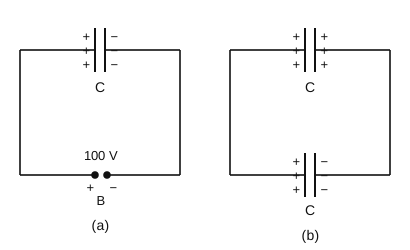
धारिता C = 900 pF वाले एक संधारित्र को 100 V बैटरी B द्वारा पूर्णतः आवेशित किया जाता है, जैसा चित्र (a) में दर्शाया गया है। फिर इसे बैटरी से हटाकर धारिता C = 900 pF वाले एक अन्य अनावेशित संधारित्र से जोड़ा जाता है, जैसा चित्र (b) में दर्शाया गया है। निकाय (b) द्वारा संचित स्थिरवैद्युत ऊर्जा है:
- A4.5 × 10-6 J
- B3.25 × 10-6 J
- C2.25 × 10-6 J
- D1.5 × 10-6 J
Show answer
Concept: After disconnecting the battery, charge is conserved; two equal capacitors in parallel share it, and .
- C
- Initial energy J
- J
Short trick: Equal capacitors sharing charge ⇒ energy halves: 4.5 → 2.25 μJ (the other half is lost as heat/radiation).
Answer: (C) 2.25 × 10⁻⁶ J
अवधारणा: बैटरी हटाने के बाद आवेश संरक्षित रहता है; दो समान संधारित्र समांतर में इसे बाँटते हैं, तथा ।
- C
- प्रारंभिक ऊर्जा J
- J
शॉर्ट ट्रिक: समान संधारित्रों में आवेश बँटने पर ऊर्जा आधी: 4.5 → 2.25 μJ (शेष आधी ऊष्मा/विकिरण में व्यय)।
उत्तर: (C) 2.25 × 10⁻⁶ J
NEET UGPhysicsCapacitors – charge sharing and energyNEET UG 2022 · 17 Jul Shift 1
Q806.A nucleus of mass number 189 splits into two nuclei having mass number 125 and 64. The ratio of radius of two daughter nuclei respectively is:
द्रव्यमान संख्या 189 का एक नाभिक, द्रव्यमान संख्या 125 तथा 64 वाले दो नाभिकों में विभाजित होता है। दोनों संतति नाभिकों की त्रिज्याओं का क्रमशः अनुपात है:
- A1 : 1
- B4 : 5
- C5 : 4
- D25 : 16
Show answer
Concept: Nuclear radius .
Short trick: 125 and 64 are perfect cubes (5³, 4³) – the answer is just 5 : 4.
Answer: (C) 5 : 4
अवधारणा: नाभिकीय त्रिज्या ।
शॉर्ट ट्रिक: 125 तथा 64 पूर्ण घन हैं (5³, 4³) – उत्तर सीधे 5 : 4।
उत्तर: (C) 5 : 4
NEET UGPhysicsNuclei – nuclear radiusNEET UG 2022 · 17 Jul Shift 1
Q807.A Wheatstone bridge is used to determine the value of unknown resistance X by adjusting the variable resistance Y as shown in the figure. For the most precise measurement of X, the resistances P and Q:
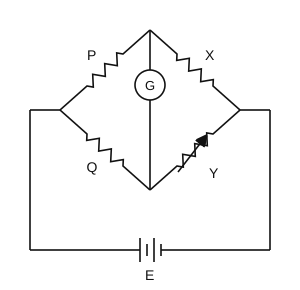
चित्र में दर्शाए अनुसार परिवर्ती प्रतिरोध Y को समायोजित करके अज्ञात प्रतिरोध X का मान ज्ञात करने के लिए एक व्हीटस्टोन सेतु प्रयुक्त किया जाता है। X के सबसे यथार्थ मापन के लिए प्रतिरोध P तथा Q:
- AShould be approximately equal to 2Xलगभग 2X के बराबर होने चाहिए
- BShould be approximately equal and are smallलगभग बराबर तथा छोटे होने चाहिए
- CShould be very large and unequalबहुत बड़े तथा असमान होने चाहिए
- DDo not play any significant roleकोई महत्वपूर्ण भूमिका नहीं निभाते
Show answer
Concept: A Wheatstone bridge is most sensitive when all four arms are of the same order and small, so that a small imbalance sends a detectable current through the galvanometer.
- Balance: .
- P ≈ Q (ratio ≈ 1) ⇒ Y ≈ X, all arms comparable ⇒ maximum sensitivity.
- Small P, Q ⇒ larger galvanometer current for a given imbalance ⇒ null point is sharper.
- Very large / unequal P, Q (C) reduce sensitivity; (D) is wrong since P/Q fixes X.
Short trick: Sensitivity is best when the bridge is “balanced by equals”: P ≈ Q ≈ X ≈ Y, and not too large.
Answer: (B) Approximately equal and small
अवधारणा: व्हीटस्टोन सेतु तब सबसे अधिक सुग्राही होता है जब चारों भुजाएँ एक ही कोटि की तथा छोटी हों, ताकि थोड़े से असंतुलन पर भी धारामापी में पहचानने योग्य धारा प्रवाहित हो।
- संतुलन: ।
- P ≈ Q (अनुपात ≈ 1) ⇒ Y ≈ X, सभी भुजाएँ तुलनीय ⇒ अधिकतम सुग्राहिता।
- छोटे P, Q ⇒ दिए गए असंतुलन पर धारामापी में अधिक धारा ⇒ शून्य विक्षेप बिंदु अधिक स्पष्ट।
- बहुत बड़े / असमान P, Q (C) सुग्राहिता घटाते हैं; (D) गलत है क्योंकि P/Q से ही X निर्धारित होता है।
शॉर्ट ट्रिक: सुग्राहिता सर्वोत्तम तब, जब सेतु “समान भुजाओं” से संतुलित हो: P ≈ Q ≈ X ≈ Y, तथा बहुत बड़े न हों।
उत्तर: (B) लगभग बराबर तथा छोटे
NEET UGPhysicsCurrent electricity – Wheatstone bridge sensitivityNEET UG 2022 · 17 Jul Shift 1
Q808.The volume occupied by the molecules contained in 4.5 kg water at STP, if the intermolecular forces vanish away is:
यदि अंतराअणुक बल समाप्त हो जाएँ, तो STP पर 4.5 kg जल में उपस्थित अणुओं द्वारा घेरा गया आयतन है:
- A5.6 × 106 m3
- B5.6 × 103 m3
- C5.6 × 10-3 m3
- D5.6 m3
Show answer
Concept: With no intermolecular forces the water behaves as an ideal gas: 1 mol occupies 22.4 L at STP.
- n = mol
- V = 250 × 22.4 L = 5600 L
- = 5.6 m³ (1 m³ = 1000 L)
Short trick: Moles × 22.4 L, then ÷ 1000 for m³ – no need for PV = nRT.
Answer: (D) 5.6 m3
अवधारणा: अंतराअणुक बलों के अभाव में जल आदर्श गैस की तरह व्यवहार करेगा: STP पर 1 mol का आयतन 22.4 L।
- n = mol
- V = 250 × 22.4 L = 5600 L
- = 5.6 m³ (1 m³ = 1000 L)
शॉर्ट ट्रिक: मोल × 22.4 L, फिर m³ के लिए ÷ 1000 – PV = nRT की आवश्यकता नहीं।
उत्तर: (D) 5.6 m3
NEET UGPhysicsKinetic theory – molar volume at STPNEET UG 2022 · 17 Jul Shift 1
Q809.A ball is projected with a velocity, 10 ms-1, at an angle of 60° with the vertical direction. Its speed at the highest point of its trajectory will be:
एक गेंद 10 ms-1 वेग से ऊर्ध्वाधर दिशा से 60° के कोण पर प्रक्षेपित की जाती है। इसके प्रक्षेप-पथ के उच्चतम बिंदु पर इसकी चाल होगी:
- AZeroशून्य
- B ms-1
- C5 ms-1
- D10 ms-1
Show answer
Concept: At the highest point only the horizontal component of velocity remains, and it stays constant throughout the flight.
- Angle with the vertical = 60° ⇒ angle with the horizontal = 30°.
- Horizontal component = (measured from vertical) =
- m/s ≈ 8.66 m/s
Short trick: Read the angle carefully: “with the vertical” ⇒ horizontal part uses sin, not cos. 5 m/s is the trap.
Answer: (B) ms-1
अवधारणा: उच्चतम बिंदु पर केवल वेग का क्षैतिज घटक बचता है, जो पूरी उड़ान में नियत रहता है।
- ऊर्ध्वाधर से कोण = 60° ⇒ क्षैतिज से कोण = 30°।
- क्षैतिज घटक = (ऊर्ध्वाधर से मापा गया) =
- m/s ≈ 8.66 m/s
शॉर्ट ट्रिक: कोण ध्यान से पढ़ें: “ऊर्ध्वाधर से” ⇒ क्षैतिज घटक में sin, cos नहीं। 5 m/s भ्रामक उत्तर है।
उत्तर: (B) ms-1
NEET UGPhysicsKinematics – projectile at highest pointNEET UG 2022 · 17 Jul Shift 1
Q810.Two transparent media A and B are separated by a plane boundary. The speed of light in those media are 1.5 × 10⁸ m/s and 2.0 × 10⁸ m/s, respectively. The critical angle for a ray of light for these two media is:
दो पारदर्शी माध्यम A तथा B एक समतल सीमा द्वारा पृथक हैं। इन माध्यमों में प्रकाश की चालें क्रमशः 1.5 × 10⁸ m/s तथा 2.0 × 10⁸ m/s हैं। इन दोनों माध्यमों के लिए प्रकाश किरण का क्रांतिक कोण है:
- Asin-1(0.5000)
- Bsin-1(0.750)
- Ctan-1(0.500)
- Dtan-1(0.750)
Show answer
Concept: For light going from denser to rarer medium, .
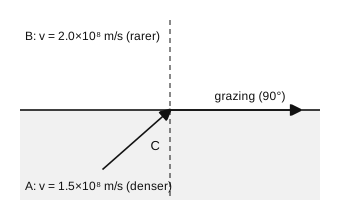
- Light is slower in A ⇒ A is denser.
- ,
- ⇒
Short trick: Directly: sin C = (smaller speed)/(larger speed) = 1.5/2.0. Critical angle is always a sin⁻¹, so (C), (D) are out at once.
Answer: (B) sin-1(0.750)
अवधारणा: सघन से विरल माध्यम में जाते प्रकाश के लिए ।
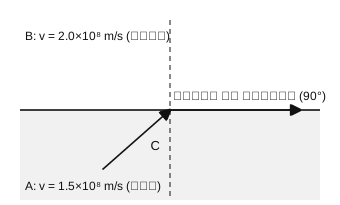
- A में प्रकाश धीमा है ⇒ A सघन माध्यम है।
- ,
- ⇒
शॉर्ट ट्रिक: सीधे: sin C = (कम चाल)/(अधिक चाल) = 1.5/2.0। क्रांतिक कोण सदैव sin⁻¹ होता है, अतः (C), (D) तुरंत बाहर।
उत्तर: (B) sin-1(0.750)
NEET UGPhysicsRay optics – critical angleNEET UG 2022 · 17 Jul Shift 1
Q811.Gadolinium has a low value of third ionisation enthalpy because of
गैडोलिनियम (Gd) की तृतीय आयनन एन्थैल्पी का मान कम होता है, इसका कारण है
- Asmall sizeछोटा आकार
- Bhigh exchange enthalpyउच्च विनिमय एन्थैल्पी (exchange enthalpy)
- Chigh electronegativityउच्च विद्युत-ऋणात्मकता
- Dhigh basic characterउच्च क्षारकीय गुण
Show answer
Concept: A half-filled f7 shell is extra stable because of high exchange energy; reaching it makes ionisation easy.
- Gd: [Xe]4f75d16s2. Gd2+: [Xe]4f75d1.
- The third electron removed is the lone 5d electron, leaving Gd3+ = [Xe]4f7 – a half-filled, highly stable configuration with maximum exchange energy.
- Hence IE3 is low. Size, electronegativity and basic character do not decide this particular ionisation step.
Short trick: Low IE whenever the product ion gets 4f0, 4f7 or 4f14 (La, Gd, Lu) – 'half/full shell = exchange energy'.
Answer: (B) high exchange enthalpy
अवधारणा: अर्ध-पूरित f7 कोश उच्च विनिमय ऊर्जा के कारण अतिरिक्त स्थायी होता है; उस तक पहुँचना आयनन को आसान बनाता है।
- Gd: [Xe]4f75d16s2। Gd2+: [Xe]4f75d1।
- तीसरा निकलने वाला इलेक्ट्रॉन अकेला 5d इलेक्ट्रॉन है, जिससे Gd3+ = [Xe]4f7 बनता है – अर्ध-पूरित, अधिकतम विनिमय ऊर्जा वाला अत्यंत स्थायी विन्यास।
- अतः IE3 कम है। आकार, विद्युत-ऋणात्मकता और क्षारकीय गुण इस आयनन चरण को निर्धारित नहीं करते।
शॉर्ट ट्रिक: जब भी बनने वाले आयन में 4f0, 4f7 या 4f14 (La, Gd, Lu) मिले, IE कम – 'आधा/पूरा कोश = विनिमय ऊर्जा'।
उत्तर: (B) उच्च विनिमय एन्थैल्पी
NEET UGChemistryd- and f-block – lanthanoids (ionisation enthalpy)NEET UG 2022 · 17 Jul Shift 1
Q812.Which one is not correct mathematical equation for Dalton's Law of partial pressure? Here p = total pressure of gaseous mixture
डाल्टन के आंशिक दाब नियम के लिए निम्नलिखित में से कौन-सा गणितीय समीकरण सही नहीं है? यहाँ p = गैसीय मिश्रण का कुल दाब
- A
- B
- C, where = partial pressure of ith gas; = mole fraction of ith gas in gaseous mixture, जहाँ = iवीं गैस का आंशिक दाब; = गैसीय मिश्रण में iवीं गैस का मोल-अंश
- D, where = mole fraction of ith gas in gaseous mixture = pressure of ith gas in pure state, जहाँ = गैसीय मिश्रण में iवीं गैस का मोल-अंश, = शुद्ध अवस्था में iवीं गैस का दाब
Show answer
Concept: Dalton: total pressure of non-reacting gases = sum of partial pressures; each partial pressure = (mole fraction × total pressure).
- (A) – the law itself. Correct.
- (B) Each (ideal gas), so the sum is correct.
- (C) – correct form of Dalton's law.
- (D) is Raoult's law (vapour pressure of a component over a liquid solution), not Dalton's law. Incorrect.
Short trick: (pure-state pressure) = Raoult; (total) = Dalton.
Answer: (D)
अवधारणा: डाल्टन: अभिक्रिया न करने वाली गैसों का कुल दाब = आंशिक दाबों का योग; प्रत्येक आंशिक दाब = (मोल-अंश × कुल दाब)।
- (A) – स्वयं नियम। सही।
- (B) प्रत्येक (आदर्श गैस), अतः योग सही है।
- (C) – डाल्टन नियम का सही रूप।
- (D) राउल्ट का नियम है (द्रव विलयन के ऊपर घटक का वाष्प दाब), डाल्टन का नियम नहीं। गलत।
शॉर्ट ट्रिक: (शुद्ध अवस्था का दाब) = राउल्ट; (कुल दाब) = डाल्टन।
उत्तर: (D)
NEET UGChemistryStates of matter – Dalton's law of partial pressuresNEET UG 2022 · 17 Jul Shift 1
Q813.Assertion (A): In a particular point defect, an ionic solid is electrically neutral, even if few of its cations are missing from its unit cells.
Reason (R): In an ionic solid, Frenkel defect arises due to dislocation of cation from its lattice site to interstitial site, maintaining overall electrical neutrality.
Choose the most appropriate answer from the options given below:
अभिकथन (A): एक विशेष बिंदु दोष में, आयनिक ठोस विद्युत रूप से उदासीन रहता है, भले ही उसके एकक कोष्ठिकाओं से कुछ धनायन अनुपस्थित हों।
कारण (R): आयनिक ठोस में फ्रेंकेल दोष, धनायन के अपने जालक स्थल से अंतराकाशी स्थल पर विस्थापन के कारण उत्पन्न होता है, जिससे समग्र विद्युत उदासीनता बनी रहती है।
नीचे दिए गए विकल्पों में से सबसे उपयुक्त उत्तर चुनिए:
- ABoth (A) and (R) are correct and (R) is the correct explanation of (A)(A) और (R) दोनों सही हैं तथा (R), (A) की सही व्याख्या है
- BBoth (A) and (R) are correct but (R) is not the correct explanation of (A)(A) और (R) दोनों सही हैं परंतु (R), (A) की सही व्याख्या नहीं है
- C(A) is correct but (R) is not correct(A) सही है परंतु (R) सही नहीं है
- D(A) is not correct but (R) is correct(A) सही नहीं है परंतु (R) सही है
Show answer
Concept: Schottky defect: equal numbers of cations and anions are missing → neutral. Frenkel defect: a cation shifts to an interstitial site → neutral, but no ion is 'missing' from the crystal.
- (A): cations can be missing and the solid stays neutral – true for Schottky defect (matching anions also missing). A is correct.
- (R): description of Frenkel defect is correct.
- But in Frenkel defect no cation leaves the crystal – it is only displaced. So (R) does not explain (A); (A) is explained by Schottky defect.
Short trick: 'Missing ions' = Schottky (density ↓); 'displaced ion' = Frenkel (density same).
Answer: (B)
अवधारणा: शॉट्की दोष: समान संख्या में धनायन और ऋणायन अनुपस्थित → उदासीन। फ्रेंकेल दोष: धनायन अंतराकाशी स्थल पर चला जाता है → उदासीन, परंतु क्रिस्टल से कोई आयन 'अनुपस्थित' नहीं होता।
- (A): धनायन अनुपस्थित हो सकते हैं और ठोस उदासीन रहता है – शॉट्की दोष के लिए सत्य (साथ में उतने ही ऋणायन भी अनुपस्थित)। A सही है।
- (R): फ्रेंकेल दोष का वर्णन सही है।
- परंतु फ्रेंकेल दोष में कोई धनायन क्रिस्टल नहीं छोड़ता – केवल विस्थापित होता है। अतः (R), (A) की व्याख्या नहीं करता; (A) की व्याख्या शॉट्की दोष से होती है।
शॉर्ट ट्रिक: 'अनुपस्थित आयन' = शॉट्की (घनत्व ↓); 'विस्थापित आयन' = फ्रेंकेल (घनत्व समान)।
उत्तर: (B)
NEET UGChemistrySolid state – point defectsNEET UG 2022 · 17 Jul Shift 1
Q814.The pH of the solution containing 50 mL each of 0.10 M sodium acetate and 0.01 M acetic acid is
[Given pKa of CH3COOH = 4.57]
50 mL 0.10 M सोडियम ऐसीटेट तथा 50 mL 0.01 M ऐसीटिक अम्ल युक्त विलयन का pH है
[दिया है: CH3COOH का pKa = 4.57]
- A5.57
- B3.57
- C4.57
- D2.57
Show answer
Concept: Acidic buffer – Henderson equation: .
- Equal volumes mixed → both concentrations halve, ratio unchanged: [salt]/[acid] = 0.05/0.005 = 10.
- pH = 4.57 + log 10 = 4.57 + 1 = 5.57.
Short trick: Salt 10 times acid → pH = pKa + 1.
Answer: (A) 5.57
अवधारणा: अम्लीय बफर – हेंडरसन समीकरण: ।
- समान आयतन मिलाने पर दोनों सांद्रताएँ आधी हो जाती हैं, अनुपात वही रहता है: [लवण]/[अम्ल] = 0.05/0.005 = 10।
- pH = 4.57 + log 10 = 4.57 + 1 = 5.57।
शॉर्ट ट्रिक: लवण, अम्ल का 10 गुना → pH = pKa + 1।
उत्तर: (A) 5.57
NEET UGChemistryIonic equilibrium – buffer pHNEET UG 2022 · 17 Jul Shift 1
Q815.Identify the incorrect statement from the following
निम्नलिखित में से गलत कथन को पहचानिए
- AAlkali metals react with water to form their hydroxidesक्षार धातुएँ जल से अभिक्रिया करके अपने हाइड्रॉक्साइड बनाती हैं
- BThe oxidation number of K in KO2 is + 4.KO2 में K की ऑक्सीकरण संख्या + 4 है।
- CIonisation enthalpy of alkali metals decreases from top to bottom in the group.क्षार धातुओं की आयनन एन्थैल्पी वर्ग में ऊपर से नीचे की ओर घटती है।
- DLithium is the strongest reducing agent among the alkali metals.क्षार धातुओं में लीथियम सबसे प्रबल अपचायक है।
Show answer
Concept: KO2 is potassium superoxide: K+ and O2−.
- (A) 2M + 2H2O → 2MOH + H2 – correct.
- (B) In KO2, K is +1 (alkali metal is always +1); the superoxide ion O2− carries −1. So '+4' is incorrect.
- (C) Size increases down the group → IE decreases – correct.
- (D) Li has the most negative E° (−3.04 V) due to very high hydration enthalpy → strongest reducing agent in water – correct.
Short trick: Group-1 metal in any compound = +1. Any other value is wrong at sight.
Answer: (B)
अवधारणा: KO2 पोटैशियम सुपरऑक्साइड है: K+ तथा O2−।
- (A) 2M + 2H2O → 2MOH + H2 – सही।
- (B) KO2 में K की ऑक्सीकरण संख्या +1 है (क्षार धातु सदैव +1); सुपरऑक्साइड आयन O2− पर −1 है। अतः '+4' गलत है।
- (C) वर्ग में नीचे जाने पर आकार बढ़ता है → IE घटती है – सही।
- (D) अत्यधिक जलयोजन एन्थैल्पी के कारण Li का E° सबसे अधिक ऋणात्मक (−3.04 V) है → जल में सबसे प्रबल अपचायक – सही।
शॉर्ट ट्रिक: किसी भी यौगिक में वर्ग-1 धातु = +1। कोई अन्य मान देखते ही गलत।
उत्तर: (B)
NEET UGChemistrys-Block elements – alkali metalsNEET UG 2022 · 17 Jul Shift 1
Q816.Statement I: The acidic strength of monosubstituted nitrophenol is higher than phenol because of electron withdrawing nitro group.
Statement II: o-nitrophenol, m-nitrophenol and p-nitrophenol will have same acidic strength as they have one nitro group attached to the phenolic ring.
Choose the most appropriate answer from the options given below:
कथन I: इलेक्ट्रॉन-आकर्षी नाइट्रो समूह के कारण एकल-प्रतिस्थापित नाइट्रोफ़ीनॉल की अम्लीय प्रबलता फ़ीनॉल से अधिक होती है।
कथन II: o-नाइट्रोफ़ीनॉल, m-नाइट्रोफ़ीनॉल तथा p-नाइट्रोफ़ीनॉल की अम्लीय प्रबलता समान होगी क्योंकि इनमें फ़ीनॉलिक वलय से एक ही नाइट्रो समूह जुड़ा है।
नीचे दिए गए विकल्पों में से सबसे उपयुक्त उत्तर चुनिए:
- ABoth Statement I and Statement II are correct.कथन I और कथन II दोनों सही हैं।
- BBoth Statement I and Statement II are incorrect.कथन I और कथन II दोनों गलत हैं।
- CStatement I is correct but Statement II is incorrect.कथन I सही है परंतु कथन II गलत है।
- DStatement I is incorrect but Statement II is correct.कथन I गलत है परंतु कथन II सही है।
Show answer
Concept: –NO2 stabilises phenoxide ion by −I (all positions) and −R (only o and p) effects.
- Statement I: every nitrophenol is more acidic than phenol (pKa 10.0) – correct.
- Statement II: position matters. pKa: p-nitrophenol 7.1, o-nitrophenol 7.2, m-nitrophenol 8.3 – they are not equal. Incorrect.
- m-isomer has no −R stabilisation, so it is the weakest of the three.
Short trick: Acidity order to remember: p > o > m > phenol (o is a little lower than p due to intramolecular H-bond).
Answer: (C)
अवधारणा: –NO2 समूह −I प्रभाव (सभी स्थितियों पर) तथा −R प्रभाव (केवल o और p पर) द्वारा फ़ीनॉक्साइड आयन को स्थायी करता है।
- कथन I: प्रत्येक नाइट्रोफ़ीनॉल, फ़ीनॉल (pKa 10.0) से अधिक अम्लीय है – सही।
- कथन II: स्थिति का प्रभाव पड़ता है। pKa: p-नाइट्रोफ़ीनॉल 7.1, o-नाइट्रोफ़ीनॉल 7.2, m-नाइट्रोफ़ीनॉल 8.3 – समान नहीं हैं। गलत।
- m-समावयव में −R द्वारा स्थायित्व नहीं मिलता, इसलिए यह तीनों में सबसे दुर्बल है।
शॉर्ट ट्रिक: याद रखें अम्लता क्रम: p > o > m > फ़ीनॉल (अंतःअणुक H-आबंध के कारण o, p से थोड़ा कम)।
उत्तर: (C)
NEET UGChemistryAlcohols, phenols – acidity of nitrophenolsNEET UG 2022 · 17 Jul Shift 1
Q817.What mass of 95% pure CaCO3 will be required to neutralise 50 mL of 0.5 M HCl solution according to the following reaction?
CaCO3(s) + 2HCl(aq) → CaCl2(aq) + CO2(g) + 2H2O(l)
[Calculate upto second place of decimal point]
निम्नलिखित अभिक्रिया के अनुसार 0.5 M HCl विलयन के 50 mL को उदासीन करने के लिए 95% शुद्ध CaCO3 का कितना द्रव्यमान आवश्यक होगा?
CaCO3(s) + 2HCl(aq) → CaCl2(aq) + CO2(g) + 2H2O(l)
[दशमलव के दूसरे स्थान तक गणना कीजिए]
- A1.25g
- B1.32g
- C3.65g
- D9.50g
Show answer
Concept: Moles of HCl = M × V(L); 1 mol CaCO3 neutralises 2 mol HCl; impure mass = pure mass × 100/purity.
- n(HCl) = 0.5 × 0.050 = 0.025 mol.
- n(CaCO3) = 0.025/2 = 0.0125 mol → mass of pure CaCO3 = 0.0125 × 100 = 1.25 g.
- Mass of 95% pure sample = 1.25 × 100/95 = 1.316 ≈ 1.32 g.
Short trick: 1.25 g is the trap (pure mass); impure sample must weigh a little more than 1.25 g → only 1.32 fits.
Answer: (B) 1.32 g
अवधारणा: HCl के मोल = M × V(L); 1 मोल CaCO3, 2 मोल HCl को उदासीन करता है; अशुद्ध द्रव्यमान = शुद्ध द्रव्यमान × 100/शुद्धता।
- n(HCl) = 0.5 × 0.050 = 0.025 मोल।
- n(CaCO3) = 0.025/2 = 0.0125 मोल → शुद्ध CaCO3 का द्रव्यमान = 0.0125 × 100 = 1.25 g।
- 95% शुद्ध नमूने का द्रव्यमान = 1.25 × 100/95 = 1.316 ≈ 1.32 g।
शॉर्ट ट्रिक: 1.25 g जाल (trap) है (शुद्ध द्रव्यमान); अशुद्ध नमूना 1.25 g से थोड़ा अधिक होगा → केवल 1.32 उपयुक्त।
उत्तर: (B) 1.32 g
NEET UGChemistrySome basic concepts – stoichiometry and purityNEET UG 2022 · 17 Jul Shift 1
Q818.The IUPAC name of an element with atomic number 119 is
परमाणु क्रमांक 119 वाले तत्व का IUPAC नाम है
- Aununennium
- Bunnilennium
- Cunununnium
- Dununoctium
Show answer
Concept: Digit roots: 0 nil, 1 un, 2 bi, 3 tri, 4 quad, 5 pent, 6 hex, 7 sept, 8 oct, 9 enn + 'ium'.
- 119 → 1 (un) + 1 (un) + 9 (enn) + ium = ununennium (symbol Uue).
- unnilennium = 109, unununnium = 111, ununoctium = 118.
Short trick: Read the digits left to right: un-un-enn.
Answer: (A) ununennium
अवधारणा: अंकों के मूल: 0 nil, 1 un, 2 bi, 3 tri, 4 quad, 5 pent, 6 hex, 7 sept, 8 oct, 9 enn + 'ium'।
- 119 → 1 (un) + 1 (un) + 9 (enn) + ium = ununennium (प्रतीक Uue)।
- unnilennium = 109, unununnium = 111, ununoctium = 118।
शॉर्ट ट्रिक: अंकों को बाएँ से दाएँ पढ़िए: un-un-enn।
उत्तर: (A) ununennium
NEET UGChemistryClassification of elements – IUPAC nomenclature (Z > 100)NEET UG 2022 · 17 Jul Shift 1
Q819.Choose the correct statement:
सही कथन चुनिए:
- ADiamond and graphite have two dimensional network.हीरा और ग्रेफ़ाइट दोनों में द्वि-आयामी जालक होता है।
- BDiamond is covalent and graphite is ionic.हीरा सहसंयोजक है तथा ग्रेफ़ाइट आयनिक है।
- CDiamond is sp3 hybridised and graphite is sp2 hybridized.हीरा sp3 संकरित है तथा ग्रेफ़ाइट sp2 संकरित है।
- DBoth diamond and graphite are used as dry lubricants.हीरा और ग्रेफ़ाइट दोनों शुष्क स्नेहक के रूप में प्रयुक्त होते हैं।
Show answer
Concept: Diamond: each C sp3, tetrahedral 3-D network. Graphite: each C sp2, hexagonal layers.
- (A) Diamond is a 3-D network; only graphite is layered (2-D). Wrong.
- (B) Both are covalent network solids. Wrong.
- (C) Correct.
- (D) Only graphite (slippery layers) is a dry lubricant; diamond is the hardest substance (abrasive). Wrong.
Short trick: Diamond = 4 bonds = sp3 = 3-D hard; graphite = 3 bonds + free electron = sp2 = layers, conducts, lubricates.
Answer: (C)
अवधारणा: हीरा: प्रत्येक C sp3, चतुष्फलकीय त्रि-आयामी जालक। ग्रेफ़ाइट: प्रत्येक C sp2, षट्कोणीय परतें।
- (A) हीरा त्रि-आयामी जालक है; केवल ग्रेफ़ाइट परतदार (द्वि-आयामी) है। गलत।
- (B) दोनों सहसंयोजक जालक ठोस हैं। गलत।
- (C) सही।
- (D) केवल ग्रेफ़ाइट (फिसलने वाली परतें) शुष्क स्नेहक है; हीरा सबसे कठोर पदार्थ है (अपघर्षक)। गलत।
शॉर्ट ट्रिक: हीरा = 4 आबंध = sp3 = 3-D कठोर; ग्रेफ़ाइट = 3 आबंध + मुक्त इलेक्ट्रॉन = sp2 = परतें, चालक, स्नेहक।
उत्तर: (C)
NEET UGChemistryp-Block (group 14) – allotropes of carbonNEET UG 2022 · 17 Jul Shift 1
Q820.Statement I: In the coagulation of a negative sol, the flocculating power of the three given ions is in the order -
Al3+ > Ba2+ > Na+
Statement II: In the coagulation of a positive sol, the flocculating power of the three given salts is in the order -
NaCl > Na2SO4 > Na3PO4
Choose the most appropriate answer from the options given below:
कथन I: ऋणात्मक सॉल के स्कंदन में, दिए गए तीन आयनों की ऊर्णन क्षमता (flocculating power) का क्रम है -
Al3+ > Ba2+ > Na+
कथन II: धनात्मक सॉल के स्कंदन में, दिए गए तीन लवणों की ऊर्णन क्षमता का क्रम है -
NaCl > Na2SO4 > Na3PO4
नीचे दिए गए विकल्पों में से सबसे उपयुक्त उत्तर चुनिए:
- ABoth Statement I and Statement II are correct.कथन I और कथन II दोनों सही हैं।
- BBoth Statement I and Statement II are incorrect.कथन I और कथन II दोनों गलत हैं।
- CStatement I is correct but Statement II is incorrect.कथन I सही है परंतु कथन II गलत है।
- DStatement I is incorrect but Statement II is correct.कथन I गलत है परंतु कथन II सही है।
Show answer
Concept: Hardy–Schulze rule: the ion carrying charge opposite to the sol coagulates it, and its power rises with its charge (valency).
- Negative sol → cations act: Al3+ > Ba2+ > Na+. Statement I correct.
- Positive sol → anions act: PO43− > SO42− > Cl−, so Na3PO4 > Na2SO4 > NaCl. Statement II gives the reverse – incorrect.
Short trick: Opposite charge, higher valency = stronger coagulant (3 > 2 > 1).
Answer: (C)
अवधारणा: हार्डी–शुल्ज़ नियम: सॉल के विपरीत आवेश वाला आयन उसका स्कंदन करता है, और उसकी क्षमता उसके आवेश (संयोजकता) के साथ बढ़ती है।
- ऋणात्मक सॉल → धनायन कार्य करते हैं: Al3+ > Ba2+ > Na+। कथन I सही।
- धनात्मक सॉल → ऋणायन कार्य करते हैं: PO43− > SO42− > Cl−, अतः Na3PO4 > Na2SO4 > NaCl। कथन II उल्टा क्रम देता है – गलत।
शॉर्ट ट्रिक: विपरीत आवेश, अधिक संयोजकता = प्रबल स्कंदक (3 > 2 > 1)।
उत्तर: (C)
NEET UGChemistrySurface chemistry – coagulation (Hardy–Schulze rule)NEET UG 2022 · 17 Jul Shift 1

